
Introduction and sources
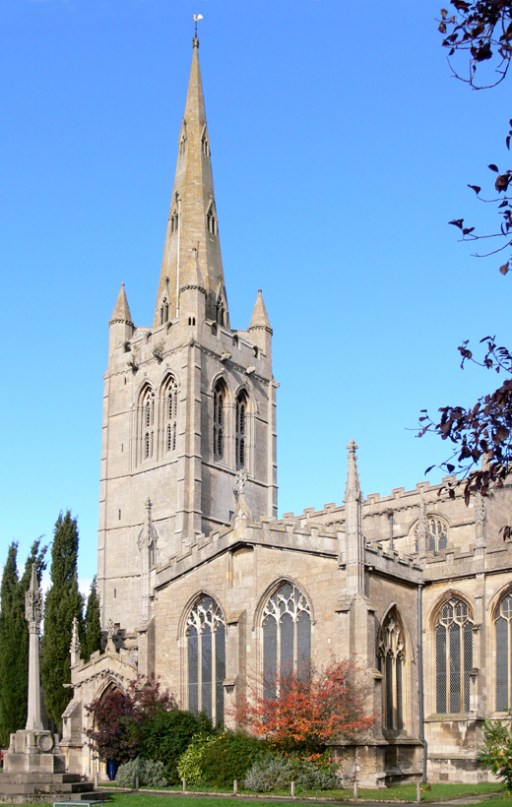
One of the most interesting features of the parish church of All Saints in Oakham is the set of elaborately decorated capitals at the top of the pillars supporting the arches in the nave. The subject matter includes biblical stories, images of grotesque beasts, angels, devils and a green man. This blog posts will consider these capitals in some detail, trying to understand what is represented on each one, and speculating as to whether or not there are relationships between some or all of the individual designs.
There have been a number of descriptions of the capitals in the past – the Victoria County History for Rutland (1), Pevsner’s Buildings of England (2) and Aston’s Guide and history of the Church (3). These will be referred to as VCH, Pevsner and Guide in what follows. In addition, Lionel Wall has a web page on his “Great English Churches website (4), with many photographs of the capitals. These are significantly better than the photographs I have managed to take, and he has kindly given me permission to use them in this post. Thus nearly all the photographs in what follows are from this source, although they have all been rendered in greyscale for comparative purposes. However, I will use a few of my own photographs, which will be clearly distinguished in what follows, even if only by their poor quality.
I have adopted an identification system for the Capital carvings, and this is shown in figure 1 below, the underlying plan being taken from (1). T indicates the carvings on the Tower capitals, C those on the chancel, CA those on the chancel arch and P1, P2 and P3 those on the pillars. N indicates those on the north side of the church, and S those on the south side.

Figure 1. Key to the Capitals – plan taken from (1)
On P1N, P2N, P1S, P2S and P3S the carvings encircle the capitals, whilst on P3N the carving is only on the Nave side. TN, TS, CN, CS, CAN and CAS are, due to the local geometry, carved on one side only. CAN and CAS have been partially damaged by the installation, and possibly the later removal, of the Victorian rood screen.
I will begin by looking at the Capitals in turn, and then move on to speculating as to the nature of a possible overall arrangement with links between the individual designs.
Descriptions of the Capitals
Tower North (TN)
VCH – expulsion from Eden; Pevsner – expulsion from Eden; Guide – the expulsion of Adam and Eve from Eden
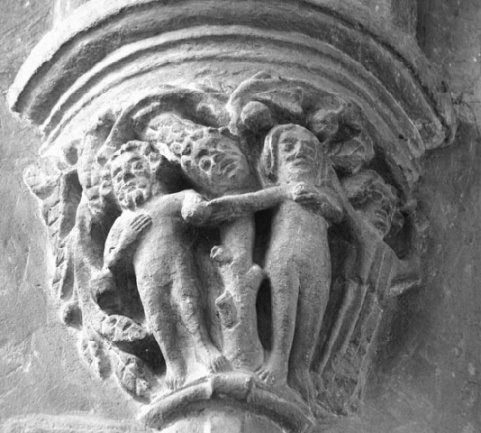

Figure 2. The Tower North Capital
The three earlier descriptions are clearly correct, but more can be said. The carving on the left of figure 2 shows Adam and Eve either side of either the Tree of Life or the Tree of the Knowledge of Good and Evil – there is debate amongst scholars as to whether or not these names refer to the same tree. The serpent can be seen between them (Genesis 3.1-6). Eve’s arm is extended to Adam, perhaps offering him the apple from the tree. The figure on the right shows the pair being expelled from the garden, with the angel with flaming sword depicted blocking the way back (Genesis 3.23-24).
Pillar 1 North (P1N)
VCH – grotesque heads and hands; Pevsner – grotesque figures; Guide – grotesque heads and legs
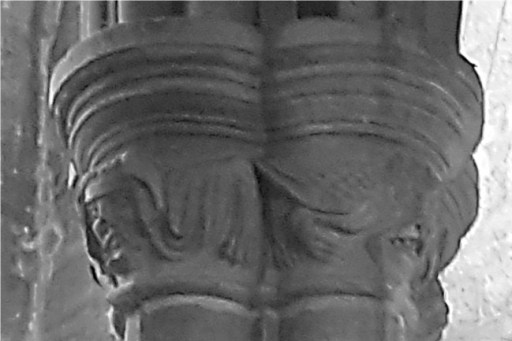
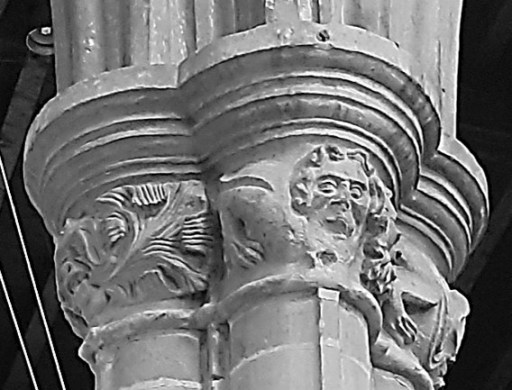
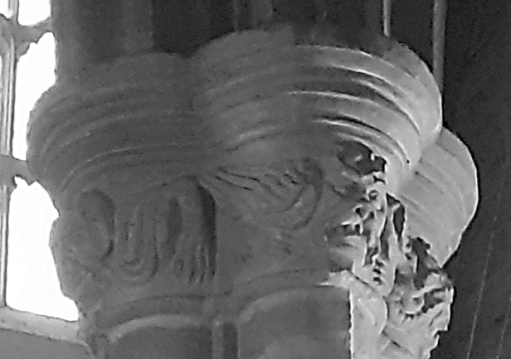

Figure 3 Pillar 1 North Capital (photographs by author)
The four figures are indeed grotesque, with faces showing a range of expressions from aggression to horror. If they represent anything at all other than the stonemason’s fancy, they could represent the state of fallen humanity, or be representations of demons. This capital was very difficult to photograph because of the lighting conditions, and the pictures are not all that I would wish for.
Pillar 2 North (P2N)
VCH – grotesque heads and limbs with a dragon biting itself; Pevsner – dragon; Guide – grotesque heads and a dragon.

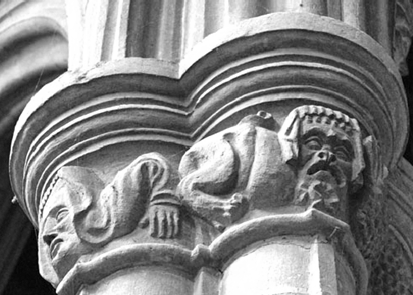
Figure 4. Pillar 2 North Capital
There are more grotesque heads on one side of the capital, a male and a female in my view, with a coiled dragon on the other. The dragon only occurs in scripture at several places in the book of Revelation, where it is unambiguously a representation of Satan. So perhaps we have here a picture of the oppression of humanity by the devil. The two faces have animal like bodies however, so perhaps these too are meant to represent demons or evil spirits.
Pillar 3 North (P3N)
VCH – foliage; Pevsner – leaves; Guide – the Green Man.
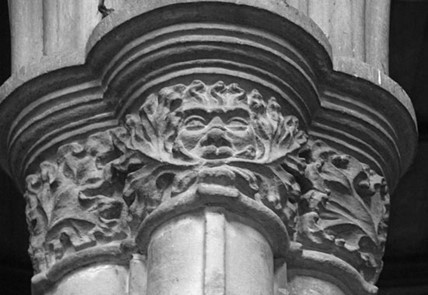
Figure 5. Pillar 3 North Capital
Oddly both VCH and Pevsner miss the main feature of this Capital – a rather fine Green Man with foliage sprouting from its mouth. This design is on one side of the capital only. The notion that the Green Man represents a survival from pagan worship has been thoroughly debunked in recent years (5), and historians have demonstrated an origin in India that came, via the Arab world to be used with a decorative function in European churches. In terms of Christian iconography, some think that Green Men with foliage springing from their mouths, such as the one here, reflected the Golden Legend of Jacobus de Voragine, from the 13th century, which describes how Seth, the third son of Adam, planted seeds from the Tree of Life in his dead father’s mouth as he lies in his grave. The tree that grew from them became the tree of the true cross of the crucifixion. The figure could thus represent the death mask of Adam, with a foreshadowing of the cross and resurrection.
Chancel North (CN)
VCH – a beast-like figure playing upon a musical instrument, the figure ending in foliage; Pevsner – not described; Guide – a beast with a human head plays an instrument.
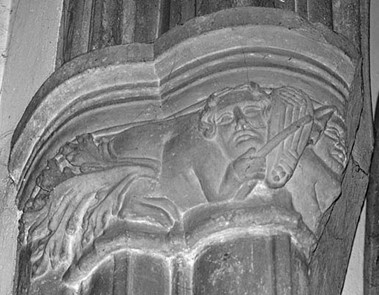
Figure 6. The Chancel North Capital
The decoration on the pillar next to the chancel show a winged beast with a human head playing an instrument that looks like a lyre, using a bow. The only meaning I can give to this is that it is a Siren of the legends of antiquity, that lured sailors to their death by the beauty of their song – the medieval period was much influenced by such classical legends. As such it may represent the alluring temptations of sin.
Chancel arch north (CAN)
VCH – not described; Pevsner – not described; Guide – not described.
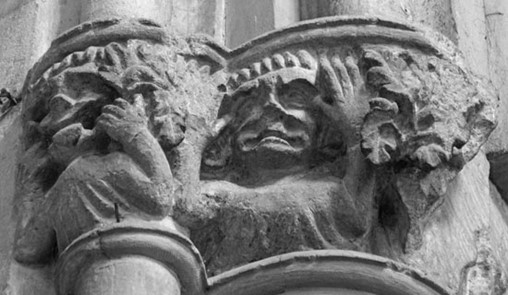
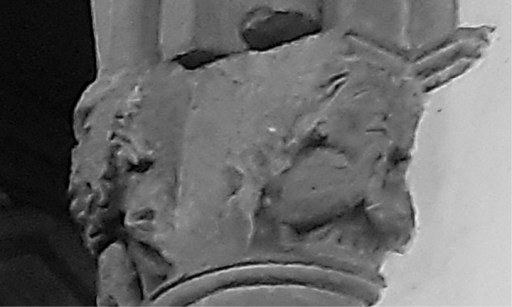
Figure 7. The Chancel Arch North Capital (right hand photograph by author)
This carving was damaged by the installation of the Victorian rood screen, long since removed. Thank you, Gilbert Scott. The front figure shows two figures making faces, and there was presumably a third to the right. Around the back however, on the other side of the rood screen damage, there is a much more serious, although rather worn, person in prayer. What this all represents is beyond me – I am inclined to think it is simply the sense of humour of the mason.
Tower South (TS)
VCH – rich foliage and a pelican in piety; Pevsner – birds; Guide – the pelican in her piety – symbol of the sacrament.

Figure 8. The Tower South Capital
The identification of the Pelican with Holy Communion is well set out in the following quote from the Catholic Education Resource Centre (6).
The symbolism of the mother pelican feeding her little baby pelicans is rooted in an ancient legend which preceded Christianity. The legend was that in time of famine, the mother pelican wounded herself, striking her breast with the beak to feed her young with her blood to prevent starvation. Another version of the legend was that the mother fed her dying young with her blood to revive them from death, but in turn lost her own life. Given this tradition, one can easily see why the early Christians adapted it to symbolize our Lord, Jesus Christ. The pelican symbolizes Jesus our Redeemer who gave His life for our redemption and the atonement He made through His passion and death. We were dead to sin and have found new life through the Blood of Christ. Moreover, Jesus continues to feed us with His body and blood in the holy Eucharist.
On the Capital we have the pelican and her chicks on a nest in a tree – perhaps again representing the Tree of Life.
Pillar 1 South (P1S)
VCH – fox stealing goose followed by goslings and man with a besom, and on the other side an ape with his clog; Pevsner – a fox, an ape with a chain ending in a clog; Guide – the legend of Reynard the Fox.
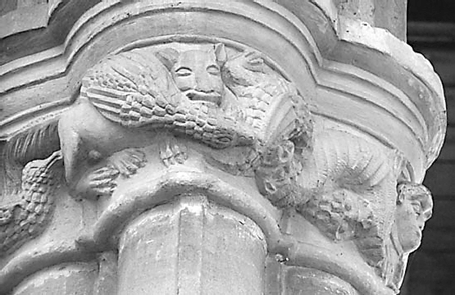
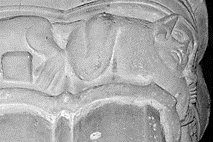
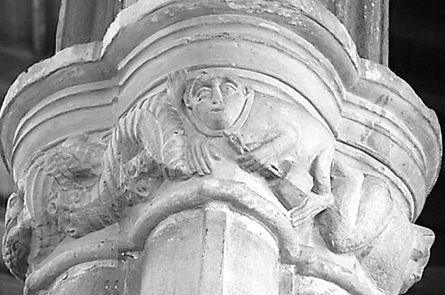

Figure 9. Pillar 1 South Capital
This is perhaps the most complex of the carvings and certainly the most difficult to interpret. VCH and Pevsner’s descriptions are brief and partial, whilst that of the Guide makes quite a firm statement as to its content. The Guide goes on to give the following further explanation.
The carving of Reynard the Fox is similar to that at Tilton on the Hill, 8 miles west in Leicestershire. At Oakham Reynard is seen on the north side of the capital, with a goose in his jaws, followed by goslings. A man points his distaff at the fox. A fettered monkey is also depicted, and two snake-like creatures intertwine, each biting the others tail. The fox may represent the Abbot of Westminster making off with the great tithe, leaving only the small tithe for the local priest (the fettered monkey). Alternatively, it could be and illustration of Chaucer’s Nun’s Priest tale.
I find some of this very debatable indeed. Firstly, my reading of the medieval stories of Reynard the Fox suggests he is primarily a trickster, and I can find no reference to him stealing a goose. The Nuns Priest’s tale is perhaps a better fit. A summary from the Harvard Geoffery Chaucer web site (7) reads as follows.
In a chicken yard owned by a poor widow, the rooster Chaunticleer lives in royal splendor with his seven wives, of whom his favorite is the fair Pertelote. He dreams that he is attacked by a strange beast (a fox, which he does not recognize because he has never seen one). Pertelote advises he forget the dream; dreams, she says, come from indigestion. Chaunticleer insists on the power of dreams to predict the future. But he takes her advice. Later that day a fox appears and by trickery seizes Chaunticleer and carries him off, pursued by all of the old widow’s household. Chaunticleer tells the fox to taunt his pursuers; the fox opens his mouth to do so, and Chaunticleer is free to fly into a tree. Chaunticleer, the fox, and the narrator all draw morals from the adventure.
The specific moral of interest is a warning against vanity – as demonstrated by both Chaunticleer and the fox.
As the fox seems to have dropped the “goose” from his mouth, and he is pursued by seven “goslings”, this would seem to fit with at least part of the Capital depiction, although how well a stonemason might be expected to know what was essentially a courtly tale is debatable. It could however be based on a folk tale that was used by Chaucer for his composition.
But, there are other characters in the carving that certainly don’t figure in the Nuns Priest’s tale: the recumbent man holding a distaff (but why should be holding a distaff, usually the symbol of a women, is another issue); the creature with the chain around its neck which is almost certainly an ape or a monkey – the “weight” that seems to hang from it is a clog – a wooden block that was used to attach to a chain (although the animal appears unfettered); and the serpentine figure between the fox and the ape.
I presume the notion that this is representative of the disagreements between the clergy of Westminster Abbey and the local clergy has a source somewhere, but I have never come across it, and why the former should be represented by a fox and the latter by an ape / monkey is a bit of a mystery.
So what are we to make of this? Perhaps the answer lies in Christian symbolism. Foxes are occasionally mentioned in scripture, almost always negatively. Jesus refers to King Herod as “that fox” (Luke 13.32). In the Song of Solomon we read
Catch for us the foxes, the little foxes that ruin the vineyards (Song of Solomon 2.15)
Perhaps we have here the likely meaning – the fox is a symbol of and of the sins of church members that are the ruination of faith – in particular, if the Nuns Priest’s tale is referred to, the sin of vanity. In Christian iconography, monkeys or apes represent base instincts such as lust, greed and malice, particularly when unchained (8). The snakes might also be representations of the devil. So taken together we might have an allegorical representation of the sins that defile individuals and the church. But the level of speculation here is becoming excessive.
Pillar 2 South (P2S)
VCH – four angels; Pevsner – four angels; Guide – four angels facing the points of the compass.
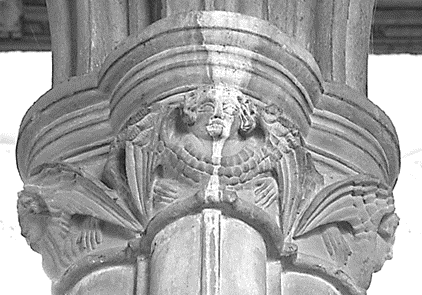
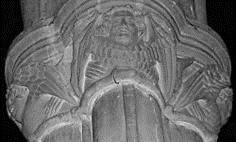
Figure 10. Pillar 2 South Capital
The four angels are indeed facing in the four cardinal directions. They are all quite similar in form. Symbolically they may simply be an indication of the protection of God’s people, or they might refer more explicitly to the four angels of Revelation 7.1.
After this I saw four angels standing at the four corners of the earth, holding back the four winds of the earth, that no wind might blow on earth or sea or against any tree.
The winds here indicate the coming judgement of God on the world, held back until the right time by the heavenly powers.
Pillar 3 South (P3S)
VCH – symbols of the four Evangelists; Pevsner – signs of the Evangelists; Guide – the four Evangelists
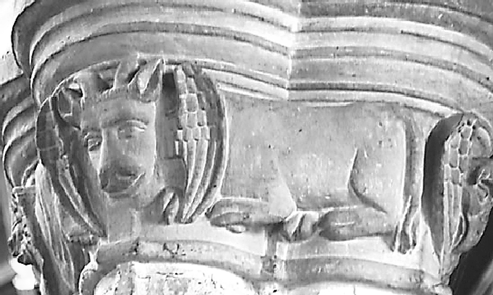
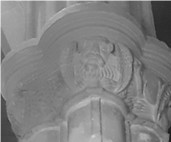
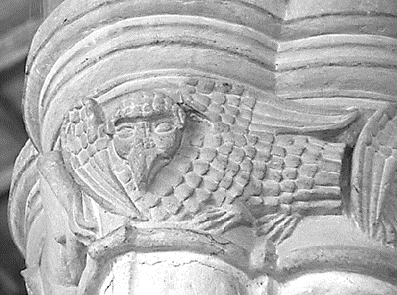
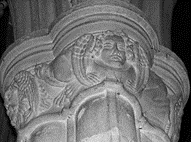
Figure 11. Pillar 3 South Capital (bottom two photographs by the author)
These figures do indeed represent the four gospel writers – Saint Luke (Ox – top left picture), Saint John (Eagle – top right picture) and St Mark (Lion – bottom left picture) and Saint Matthew (Angel – bottom right picture). These in turn reflect the natures of the four living creatures of Ezekiel’s vision from the Old Testament, the seraphim bearing the throne chariot of God each with the same four faces. Ezekiel 1.10 describes them as follows.
Their faces looked like this: Each of the four had the face of a human being, and on the right side each had the face of a lion, and on the left the face of an ox; each also had the face of an eagle.
This chapter, and its associated symbolism, was very influential in early Christian and Jewish apocalyptic literature (9). These symbols then probably represent the Word of God, and the presence of God.
Chancel South (CS)
VCH – the Expulsion from Eden, the Annunciation, the Coronation of the Virgin; Pevsner – Adam and Eve, the Annunciation and the Coronation of the Virgin; Guide – Coronation of the Virgin – the Annunciation.
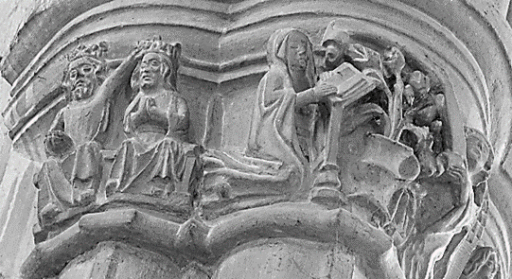
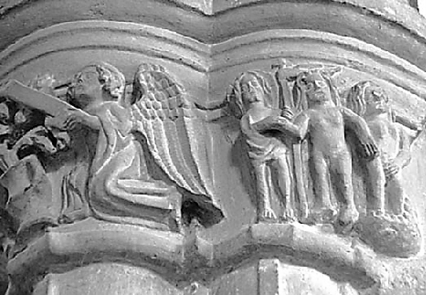
Figure 12. Chancel South Capital
This is perhaps the most intricately carved of all the capitals in All Saints. There are three scenes. The first shows a king crowning a queen, taken as being the Crowning of the Virgin Mary in heaven by either God the Father or her son Jesus, also crowned – a thoroughly non-biblical story. The very anthropomorphic nature of the scene suggests to me that this is based on a model of the coronation of a medieval queen. The second scene is a representation of the Annunciation – the appearance of the angel Gabriel to Mary to announce the coming birth of Christ. Between Mary and Gabriel, we can see the Lily – the symbol of Mary. Finally on the right we seem to have another Adam and Eve scene, accompanied by an angel with a scythe – perhaps representing the final harvest of souls, where the first couple are given a vision of the redemption of the world by the son of Mary.
Chancel arch south (CAS)
VCH – not described; Pevsner – not described; Guide – damaged by the Victorian rood screen
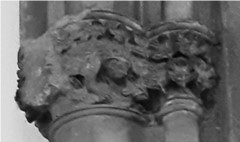
Figure 13. Chancel Arch South Capital (photograph by author)
As with the north chancel arch carving, this was damaged to install the Victorian rood screen. Its contents are not clear, but seem to be largely foliage. However it is perhaps possible that some of the foliage is actually small heads, and digits, but there is too much damage to be certain. Again, hearty thanks are due to Mr Scott for his contribution.
A bigger picture
So, having discussed all the Capital designs individually, is it possible that they fit into an overall scheme in some way? In what follows I will try to make the case that there is an overarching theme that connects all the designs, although in doing so, I am conscious I might simply be reading too much into the available evidence – and that the collection simply represents the imagination and arbitrary decisions of the masons.
Figure 14 below is an annotated version of Figure 1 that will help to understand the musings that follow with relationships between the different capitals indicated by arrows. Firstly, there are clear similarities of them between TN and CS – the story of Adam and Eve, both at the creation and at the end of time. These are on a diagonal across the church. Moving clockwise PIN and P3S are clearly similar although opposites of each other. – grotesque animals and faces in the former, with a devilish aspect, with similar, but sanctified beasts in the latter representing the evangelists. P2N and P2S are also opposites – the devil in the former and the angels in the latter. Carrying on clockwise, we come to P3N (the Green Man) and P1S (the fox and his entourage). It is hard to see much in common or in opposition here, other than their ambiguity of meaning. Perhaps in the former we see good coming from evil, whilst the latter shows that evil is always aiming for a comeback. Then we come to CN and TS – both featuring birds or winged beast – the first luring humanity to sin, and the second showing the cure for sin – the eucharist. That leaves us with the chancel arch decorations – I can see no linkage here, and, if there is an overall plan to the other carvings, I do not think these are part of it.

Figure 14. Relationships between Capitals
Overall then, these carvings seem to show a set of images in opposition to each other across the nave of the church – symbols of evil and darkness on the north and symbols of redemption and light on the south – which is quite consistent with many aspects of church and churchyard architecture.
One final puzzle however – nowhere I the carvings is there an unambiguous representation of Christ, unless that be in the scene of the Coronation of the Virgin. This seems to me odd, but perhaps the reader better versed in medieval symbolism might be able to enlighten me.
References
- A History of the County of Rutland: Volume 2. Originally published by Victoria County History, London, 1935. British History Online https://www.british-history.ac.uk/vch/rutland/vol2/pp5-27 Accessed February 2024
- Pevsner N (1960) “The buildings of England. Leicestershire and Rutland”, Penguin Books
- Aston N (2003) “All Saints, Oakham, Rutland. A guide and history” Friends of All Saints. Multum in Parvo Press, Oakham
- Great English Churches, the website of Lionel Wall. Oakham. Accessed February 2024
- Wikipedia https://en.wikipedia.org/wiki/Green_Man Accessed February 2024
- Catholic Education Resource Centre. https://www.catholiceducation.org/en/culture/catholic-contributions/the-symbolism-of-the-pelican.html Accessed February 2024
- Harvard Geoffery Chaucer web site. https://chaucer.fas.harvard.edu/pages/nuns-priests-tale Accessed February 2024.
- Daniel Esparza (2019) The curious place of apes in Christian art https://aleteia.org/2019/10/15/the-curious-place-of-apes-in-christian-art/ Accessed February 2024
- Rowland C (2002) “The Open Heaven: A Study of Apocalyptic in Judaism and Early Christianity” Wipf and Stock
 Engineering, history and ecclesiology
3 thoughts on “The good, the bad and the grotesque – the decorated capitals of All Saints church in Oakham”