
Introduction
In August 1860 the Rev. Thomas James., M.A.- honorary canon of Peterborough, vicar of Theddingworth, and one the secretaries of Architectural Court of the Archdeaconry of Northampton delivered a lecture to Oakham Literary Institute at the Old Castle Hall of Oakham, on ” Gothic Architecture,” particularly with regard to the history and arrangements of the Church and Castle Hall in Oakham (1). The transcript of his talk can be found here. The speaker was described as “an accomplished ecclesiologist and erudite and painstaking antiquary” and was clearly a major proponent of gothic church architecture in the area.
In his talk he mentions two speculations that I wish to consider briefly in this post. Firstly he stated that there was “a cupboard in the eastern wall, behind the altar, which might have been used as a receptacle for relics, or for receiving the stoup of holy water which stood at the chancel door.” Secondly, with regard to the clergy vestry he said, obviously referring to some past time “…the vestry was two storied, in all probability it was formerly used as the dwelling of an anchorite, that being a prevailing custom at one time. There was a similar instance of a two storied room attached to the church at Barnack, near Stamford“. We consider each of these two statements below.
The altar cupboard
The east end of the church was extensively modified by Gilbert Scott in 1858, but probably only from the bottom of the east window upwards, and it would seem, from the description by James, that the altar cupboard, whatever it was, was still in place in 1860. The area was further extensively modified in 1898 when the current Reredos was installed , and the walling and flooring renewed. However there is still a slot behind the altar which almost certainly was created to mark the position of the cupboard (figure 1). So what was it – a reliquary, a place for storage of holy water, or perhaps an aumbry, where the consecrated bread and wind would be kept? There are as far as I know, no historical mention of any relics in All Saints, but a church of its size and significance may well have been graced with them. There is of course evidence of relics at the priory cell at Brooke to the south of Oakham and the Reliquary can be seen in Rutland County Museum. If it were an aumbry for consecrated bread and wine or a storage place for holy water, then it would need to be opened fairly regularly, and its location behind the altar, which would have been standing against the east wall would have made it relatively inaccessible. So it is possible that it was a reliquary, which would not have been opened regularly, but this must remain as speculation.
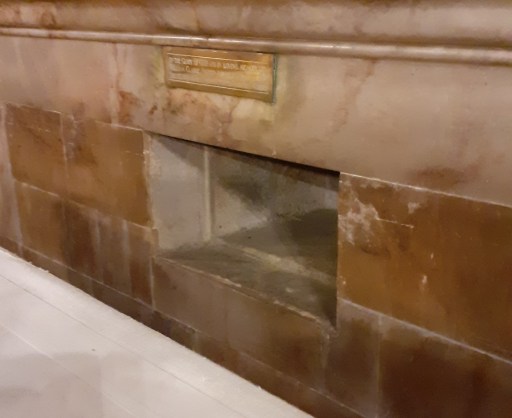
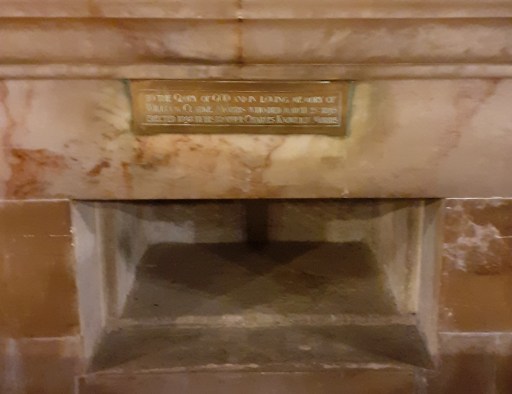
Figure 1. The slot in the wall at the east end marking the position of the “cupboard”
The Vestry
The vestry is thought to have been built around 1480 at the same time as the adjoining Lady Chapel, although this is not certain. It is certainly tall, and could have accommodated a second floor, although there is no current structural evidence for that. One potential feature could be consistent with the idea that and Anchorite hermit (or an Anchoress) resided there, is that there is a blocked up “window” structure in the wall between the vestry and the Lady chapel, which could possibly have been used by the resident hermit to observe the celebration of the mass at the altar below (figure 2). As it stands, the lower edge of this recess is rather too low for it too have been at the level of the floor above, so this might have involved a step down, or perhaps was first built to match the height of an earlier structure on the site of the current vestry. So this perhaps goes some way to bolstering the claim made by Wood, but again there is no certainty.
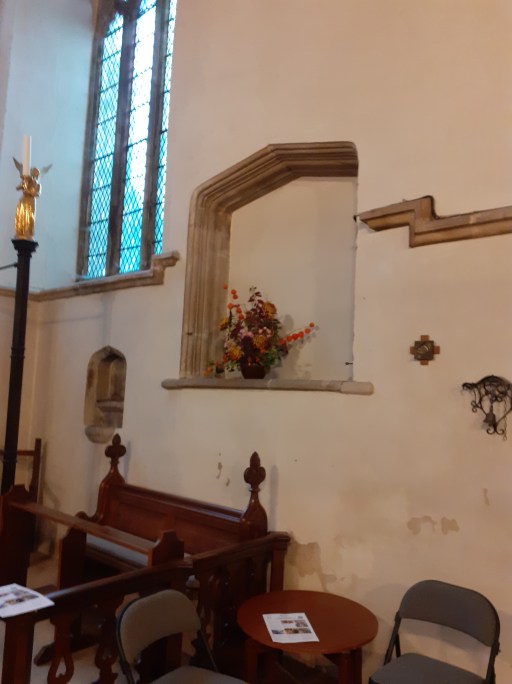
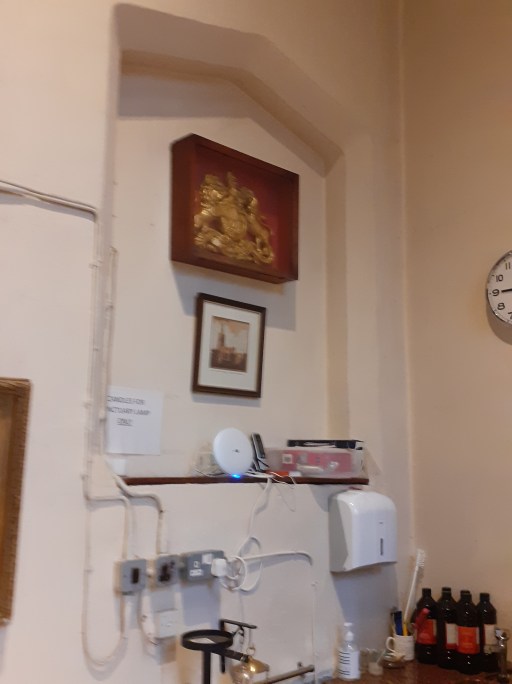
Figure 2. The blocked up window structure. a – from the Lady chapel; b – from the vestry. The bottom edge is at the same level in each case.
So to conclude. Whist the presence of relics and hermits in All Saints is a possibility, this is far from certain. As with many Victorian ecclesiologists and antiquarians, the Revd. James may well have let his speculations outrun the evidence.
Additional Note (29/11/24)
After reading the above blog, the Vicar of Oakham, Revd. Stephen Griffiths, sent me the photograph shown in Figure 3 below. This shows two blocked up windows on the east side of the Vestry. From the inside, the lower window corresponds with a recessed cupboard in the wall, which has the appearance of a door, and from the photograph, there seems to be a break in the stone work beneath the window that might indeed suggest it was originally a door. The upper window is similar in form to the stair windows in the tower. Taken together they perhaps suggest a separate entrance with access to an upper level in the vestry. How this relates to the issues addressed in the above blog is not, however, at all clear. All a bit of a mystery.

Figure 3. The east side of the vestry (photograph by Revd. Stephen Griffiths)
 Engineering, history and ecclesiology