
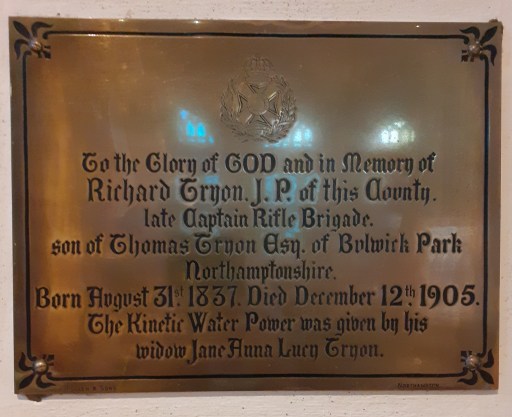
Recently, whilst waiting for a service to begin at All Saints church in Oakham, I stood in the Lady Chapel idly reading the memorials attached to the wall (as one does). I came across the one above. The inscription reads
To the Glory of GOD and in Memory of
Richard Tryon J.P. of this County.
late Captain Rifle Brigade.
son of Thomas Tryon Esq, of Bulwick Park
Northamptonshire,
Born August 31st 1837, Died December 12th 1905.
The Kinetic Water Power was given by his
widow Jane Anna Lucy Tryon.
Ricard Tryon was one of the great and the good of Rutland society in the late 19th century, and even has his own Wikipedia page. There we read the following.
Richard Tryon DL JP (31 August 1837 — 12 December 1905) was an English first-class cricketer and British Army officer. The son of Thomas Tryon and Anne Trollope, he was born in August 1837 at Bulwick Park in the Northamptonshire village of Bulwick. He was commissioned into the British Army as an ensign in the Rifle Brigade in November 1854. Shortly after he was promoted to lieutenant in February 1855. Tryon purchased the rank of captain in July 1858, later retiring from active service nearly a decade later in May 1867. Tryon made a single appearance in first-class cricket for the Marylebone Cricket Club (MCC), captained by W. G. Grace, against Kent at Lord’s in 1871.Batting once in the match, he was dismissed by Bob Lipscomb for 7 runs in the MCC first innings. A resident of The Lodge, Oakham in the County of Rutland, Tryon was nominated to be Sheriff of Rutland in November 1880. He was unsuccessful, with Francis Pierremont Cecil being made Sheriff; however, Cecil went on active naval service and was replaced by Tryon in April 1881. He was made a deputy lieutenant of Rutland in December 1901. He additionally served as a justice of the peace for Rutland. Tryon died at Marylebone in December 1905, following a short illness. He married Jane Anna Lucy Johnson, daughter of General William Augustus Johnson, in 1867. Two sons, Henry and Richard, were killed in the First World War. A brother was the Royal Navy Vice-Admiral Sir George Tryon.
So he was an interesting character in his own right. However it was the words The Kinetic Water Power was given by his widow Jane Anna Lucy Tryon that caught my eye. What on earth was this about? Kinetic Water Power are words I would associate more with my first year fluid mechanics lectures to engineering undergraduates than to tthe interior of churches. However, when I did a quick search of the British Newspaper Archive things became a little clearer.
Grantham Journal 23/11/1907 … o. The Parish Church Organ. Through the munificence ot Mrs. Rd. Tryon, the Lodge, Oakham, and the Earl Lonsdale, Kinetic water-power apparatus and pneumatic pedal-action have been added to the organ of All Saints* Church, in addition to which the instrument …
Stamford Mercury 22/11/1907 … just undergone complete renovation, the work being carried out by Messrs. Brindley and Foster, of Sheffield. hydraulic kinetic water-power has also been added. Near the instrument brass plate hears the following inscription : To the glory of God, and in memory …
It seems the words Kinetic Water Power refer to the method for powering the church organ, which at that period was housed at the East end of the Lady Chapel, close to the location of the memorial to Richard Tryon. But what was the memorial referring to? Basically, water power was used to operate the bellows of organs when a mains water supply become available, and date back to the 1870s. This was used to fill two pistons sequentially that drove the rod that pumped the bellows. One such hydraulic engine has recently been restored at Moccas church in Herefordshire – see the photo below, the Facebook page and the church website here. More information on hydraulic engines can also be found here.
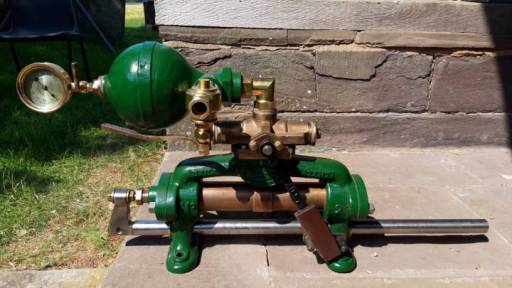
But there is still something of a puzzle. The Stamford Mercury extract above indicates that the apparatus was installed by Brindley and Foster of Sheffield, who installed the original organ in 1872. However the word Kinetic suggest some sort of association with the Kinetic Organ Blower Company, an offshoot of Cousans of Lincoln (1), However by 1907, this company was busy building Kinetic Blowers – fan blowers operated by electricity. It may be that the Kinetic company also produced hydraulic apparatus, or it may be that there was a somewhat loose usage of the word kinetic on the memorial, particularly as it refers to water power rather than air blowers. But interestingly it would seem that hydraulic engines were old and somewhat out of date technology by 1907.
- Elvin L. (1995) Pipes and Actions. Some Organ Builders in the Midlands and beyond, Published by Laurence Elvin, Lincoln.
 Engineering, history and ecclesiology
Being cynical, when I come across a name of a worthy of a town that is glorified by a memorial, I wonder what is omitted from Wikipedia. Richard Tryon once lectured to schoolchildren on the advantages of the habits of thrift. He seems also to have been a member of “the not in my back yard Brigade.” He took time out of his otter-hunting to write to the Grantham Journal of May 1877 concerning the plans for Oakham Drainage…
“The plans showed a large tank, drying shed, and four acres of filtering bed, being only 400 yards from my house. I am sure the authorities do not want to drive the principal inhabitants from the town. I wish to make it understood I will spare no expense should the proposed plan in any way affect me, to make the town remove the nuisance, which will cost perhaps more than the damage…”
LikeLike
As an academic, I lectured an undergraduate course on hydraulic engineering that included both hydraulic pumps (clearly approved of by Tryon, or at least his widow) and water treatment works (which were clearly not). It would seem that Hydraulic Engineering is both good and evil. Who would have thought it!
LikeLike