
Pulpit and window
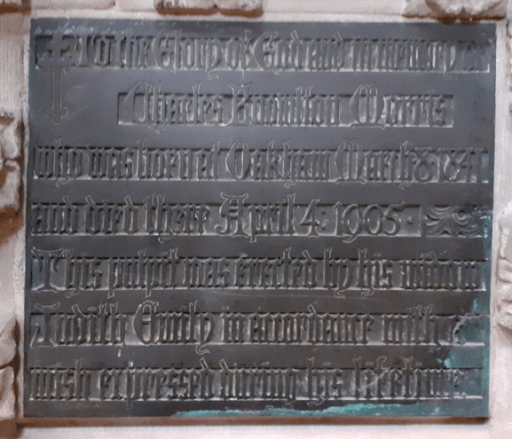
Memorials in churches can be in some really odd places. I recently noticed a brass plaque almost at ground level on the base of the pulpit at All Saints in Oakham. Even sitting on the floor in close proximity I was unable to make out much of it, but by taking some photographs and enhancing the contrast, I was able to get the image on the right. This reads
To the Glory of god and in remembrance of Charles Knowlton Morris, who was born at Oakham March 18 1841 and died there April 4 1905. This pulpit was erected by his widow Judith Emily in accordance with his wish expressed during his lifetime.
The name rang a bell in my mind – there is a very similar dedication on the stained glass window in the south transept.
To the glory of God and in remembrance of Charles Knowlton Morris who was born at Oakham 8th March 1841 and died there 4th April 1905. This memorial is erected by his widow Judith Emily.

Charles Knowlton Morris
So who was this Charles Knowlton Morris? He turned out to be quite easy to trace through the historical record. He was born in 1841, the son of Clarke and Francis Morris (nee Hare) of Catmose Street in Oakham, one of at least six children. Clarke Morris was a brewer in Northgate in Oakham. Two of his sons – William Clarke Morris and Charles Knowlton Morris took over the business after Clarke’s death in 1857. The brewery moved to Cross St / New St in 1866 and in censuses and trade directories, the business is usually described as Morris’ Rutland Brewery, and they were also listed as coal, salt and seed merchants at the railway station wharf. William Clark died in 1895 and it appears that the business passed directly to his brother. The Reredos and Marble flooring in the chancel at All Saints were donated by Charles in memory of his brother in 1898.


Charles married late in life, in 1898 aged 57 to Judith Emily Tiptaft, the daughter of a Northamptonshire farmer, who was seventeen years his junior. There were no children. Charles died on 4/4/1905, leaving a very considerable business and effects worth £19448. The business was sold off by auction fairly soon after his death. It is described in the Grantham Journal of 25/11/1905 as consisting of the brewery in New Street, and nineteen public houses in Oakham and the surrounding area. Those in Oakham included the Railway Hotel on Station Road, the Roebuck Inn on Church Street, the Bell Inn on Catmose Street, the Royal Duke Inn on West Road, Oakham, the Angel Inn on Northgate Street, and two off licenses, the Rutland Arms in New St and the Britannia Inn on Northgate Street. The estate was bought for £28,250 by Warwicks & Richardsons Ltd, Newark. Brewing ceased in 1907, but Warwicks continued to use the name Morris Rutland Brewery on Guiness bottled in Newark until 1962.

The dedication service
On 6/9/1896 at a service at All Saints church in Oakham, a new pulpit and stained glass window were dedicated to the memory of Charles. These are described at length in the Grantham Journal of 8/9/1906 as follows.

The window composed of three long lights, surmounted by beautiful tracery, and is now the best of the many fine windows in this Church. The stained-glass design is governed by the architectural features, which are typical 14th century work, demanding small subjects and canopies. The subjects are nine in number, massed in rich deep colours, all contributing to the design of three bands running laterally through the tall lights in the window, and are set off by the intercepting canopies, which are soft, and display a silvery effect. Incidents in the life of our Lord with which all are familiar are represented, and portray, respectively, ” Endurance,” “Love,” ” Fortitude,” “Humility*,” “Principle,” “Charity,” ” Innocence,” Sympathy,” and “Justice.” These help to illustrate, in their appropriateness, the beautiful life of Charles Knowlton Morris, whose memory they will perpetuated.…..……. Flowers and birds are delicately introduced as emblems, and the Past Masters’ jewel .and badge of the Vale of Catmos Lodge (No. 1265) of Freemasons are shown a small shield at the foot of the centre light.
The apex of the window contains the dove, and rays emanate from it into the surrounding side lights, and disappear behind the finials of the canopy, which runs out from main design below. The window was designed and executed by Mr. Dudley Forsyth, 335, Finchley-road, Hampstead, London
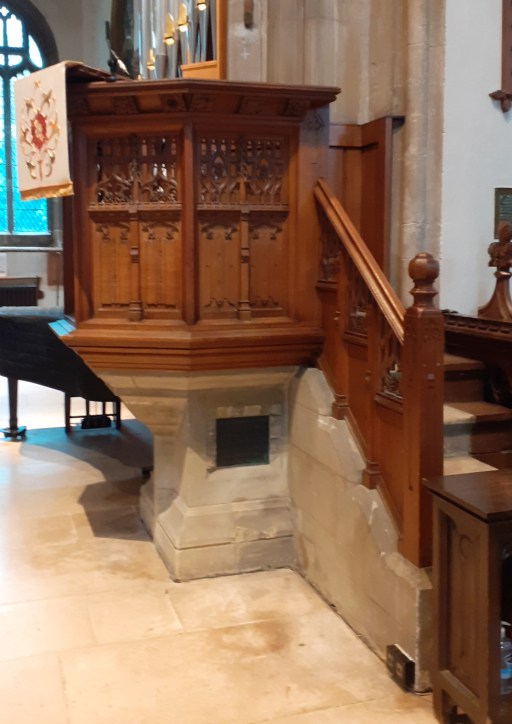
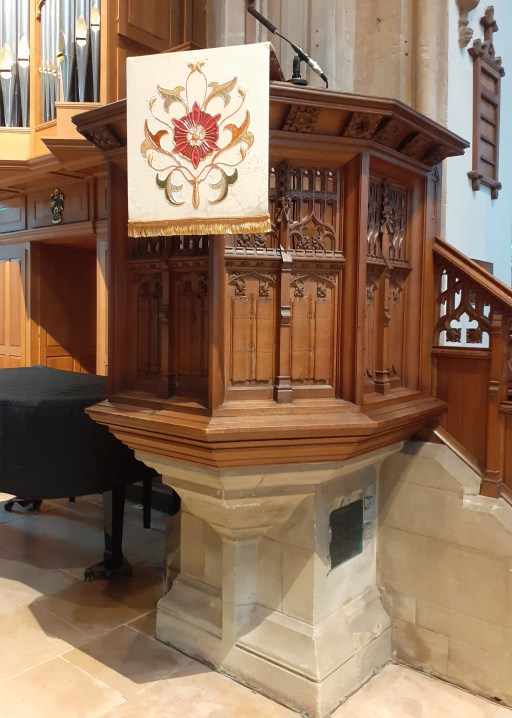
The new pulpit, as detailed on the inscription panel at fulfils wish expressed by the late Mr. Morris during his lifetime. It is in the Gothic style, and has been carefully designed so as to harmonise with its surroundings. The steps and the stone base by which the pulpit is supported are green Chilmark stone. A large moulded corbel, springing from the base, carries the pulpit, which is, in shape, five sides octagon. The material used is Austrian oak, slightly tongued, in order that it may resemble the existing oak fittings in the Church. Each side of the octagon is divided into two panels, the lower part of each carved, the upper part pierced; and care has been taken vary the design of the carving, as avoid monotony and give interest work. The cornice which crowns the pulpit is variously carved to represent the of the Passion of our Lord. The balustrade to the steps is similarly treated panels, and the whole, including the brass memorial tablet, reading-desk, and black fittings, has been designed Messrs. Forsyth and Maale, architects, of London, and carried out for the pulpit by J. P. White, of Bedford, and for metal work by Messrs. J. Elsley, of London.
Later years
Judith Morris must have spent a considerable part of her inheritance on these monuments to her husband. She was later to marry Dr Henry Drew in London in 1922. She died in 1945 at the age of 87. Pictures are available of her here and here, although an Ancestry subscription will be required to access these.
After her death in 1945 we read in the Leicester Evening Mail of 16/3/1945
Under the will of the late Mr. Charles Knowlton Morris, a former Oakham brewer, the vicar and churchwardens of Oakham receive a legacy, following the death of his widow, Mrs, Judith Emily Drew. of Leadenham House, Braunston Road. Oakham, to provide pensions for members of the Church of England. The sum is £3O annually. to provide three £l0 pensions for three poor persons of good character of the age of 85 and upwards residing in the town, and being members of the Church. It will be called the “Morris Gift.”
So it can be seen that much of what can now be seen at the “business” end of the church – around the altar where the Eucharist is celebrated, and the pulpit where sermons are preached was donated by the Morris family. Now the late 19th century was a time when the Teetotaller movement was very strong in reaction to the obvious ill effects of excess alcohol consumption, mainly on the poor. But clearly the Church of England in Oakham had no scruples about accepted considerable donations from a brewer. But, even in this more moderate age (at least in terms of alcohol consumption) the fact that Sunday services take place on structures funded by the receipts of nineteen public houses in Rutland might manage to raise a few eyebrows.
 Engineering, history and ecclesiology
.jpg)