
Related blog posts
The diaries of William Baker 1907 to 1919 – Part 2. The family entries
The diaries of William Baker 1907 to 1919 – Part 3. Local people and events
The diaries of William Baker 1907 to 1919 – Part 4. National people and events
The diaries of William Baker 1907 to 1919 – Part 5. Woodside Iron works
Background
Somewhere around 1980, my mother gave me two small notebooks that contained William Baker’s (her grandfather) “diaries” for the period from 1907 to 1919. At that time Willian (1866-1936) worked at the Woodside Iron Works as a Stationary Engine Driver, and lived in Chapel Street in Pensnett. The diaries were far from easy to read, and although my wife and myself transcribed a small portion of them not long after they came to us, we never completed the task. The diaries were put away in a drawer in a large chest that moved from house to house over the coming years without being emptied, and we largely forgot about them. Recently however I have come across them, and, with the leisure that retirement apparently offers (although I remain unconvinced about that), I decided that I would try to transcribe them in full and see what they contained. And they did indeed contain material of interest, even if the grammatical style and spelling is somewhat wobbly throughout. This is thus the first in a series of blogs that describe these diaries and their contents and hopefully illustrates something of the life and times of a Black Country Ironworker in the first two decades of the 20th century. This post gives a brief description of the diaries and their context, and then sets out the different categories of material that they contain – family matters, matters of local and national interest, and details of life at the Woodside Iron Works.
The diaries
The diaries, if that is not too grand a name for them, are two small notebooks (3” x 6”), clearly produced by the Great Western Railway, with GWR embossed on the front cover – see figure 1. They are now in a poor state of repair. They each contain around 80 or 90 sheets of thin paper, written on both sides. In addition a few loose leaves were bundled with them, and the isolated cover of a (missing) third volume. The entries date from June 1907 to June 1911 for the first notebook and July 1911 to September 1919 for the second. In each volume the entries begin both at the front of the back and work towards the middle. Although there is a tendency for each of the resulting four series of entries to differentiate in terms of subject matter (see below) this is far from always the case the case, and there is much jumbling up of dates, as entries are added retrospectively. The earlier entries tend to be in pencil and are much faded and difficult to read, but are more frequently in ink for the later entries – see Figure 2. William’s hand is reasonably neat, but not always easy to understand, and his grammar is odd and spelling very inconsistent. Punctuation doesn’t exist.

Figure 1. The diaries

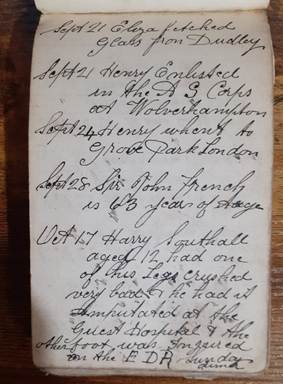
Figure 2. Sample pages – from 1910 (pencil) and 1915 (ink)
The author
William Baker (1866 – 1936) was the son of John Baker (1833 – ) and Hannah Jones (1835 – ). His family are recorded as living on Church St. in Pensnett in the Black Country. He married Dinah Chambers from Smethwick in 1892, who he met whist she was working at a Draper’s shop in Dudley. The records show that they lived in Queen St. in Pensnett (1893), Vine St. in Harts Hill (1901) and then at 37, Chapel St in Pensnett in 1911 and 1921. In 1891 the young William is described as a labourer, and in 1901 and 1911 as a blast furnace engine driver. The 1921 census expands this description somewhat to identify him as a hoist engine driver at the blast furnaces at Cochrane and Co. Ironworks at Woodside. William and Dinah had four children who will feature in later blog posts – John Simeon (my grandfather) born in 1893, William Henry born in 1896, Joseph Richard born in 1898 and Eliza Jane born in 1901.
The contents
To put the material into a workable form, all the entries were transcribed into an EXCEL spreadsheet, where they could be ordered by date and classified by type. This was, inevitably, quite a tedious process, but in the long term very useful. In total the diaries contain just over 1200 entries (although there is considerable interpretation involved in the definition of what makes for an entry). These can be conveniently divided into four categories.
- Family. Entries concerning family members – 105 entries.
- Local. Descriptions of local people and events in the Pensnett / Woodside / Dudley area – 306 entries. The majority of these are recordings of deaths and burials, but contain some material relating to enlistments in the army and major occurrences in the area (often accidents of one sort or another).
- National. Descriptions of national and international events or famous people that had come to William’s notice – 62 entries. There are many reports of executions and major disasters included – but surprisingly little about the events of World War 1.
- Woodside Iron Works. Detail of the operation and personnel at William’s place of work – 734 entries.
These four categories of diary entry will be discussed in turn in the four posts that follow.
At this point it is perhaps worth noting that there are duplicate entries (written at different ends of the same notebook) and there is little consistency in the recording of sequences of events that are related to each other. Thus it is sometimes difficult to pin down series of events and their consequences and in the blogs that follow there is much conjecture. Also the commonplace things relating to day to day living and relationships are not recorded – they would simply have been part of the recurring background of William’s life.
Finally it should be noted that in the quotes of diary entries that are given in the following blog posts, spelling and presentation has been “cleaned” up to avoid the reader being distracted. The sense of the entry, and the order of words has not been altered however.
 Engineering, history and ecclesiology
4 thoughts on “The diaries of William Baker 1907 to 1919 – Part 1. Introduction”