
Related blog posts
The diaries of William Baker 1907 to 1919 – Part 1. Introduction
The diaries of William Baker 1907 to 1919 – Part 3. Local people and events
The diaries of William Baker 1907 to 1919 – Part 4. National people and events
The diaries of William Baker 1907 to 1919 – Part 5. Woodside Iron works
The Family Tree
A very simplified family tree is shown in Figure 1, containing the names of most of those mentioned in the diaries, together with some who are not mentioned, but are important in the family story. We will consider specifically the diary entries relating to William’s wife Dinah and his four children John Simeon, William Henry, Joseph Richard and Eliza Jane. We then consider entries relating to other in Figure 1.
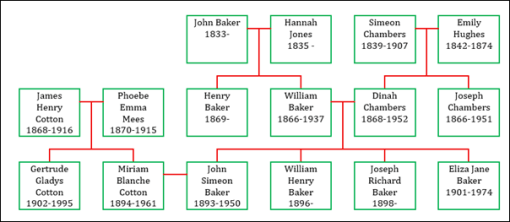
Figure 1. A simplified family tree.
Dinah Baker (nee Chambers)
The first mention of Dinah is an entry for March 8th 1909, where we are told
Dinah was operated on and a polp was taken out of her back passage
Polp is presumably a polyp. This raises all sorts of questions about who did the operation, what the procedure was etc.. Later that same year on September 2nd, we are told
Dinah went to Dudley station and had consent to get on with the job
Again the lack of detail is regrettable. Did she work at Dudley station, or was she employed by a railway company in another way? The other entries are mainly of visits that Dinah paid, often with Eliza to various places in the locality, including to see her brother Joseph in Smethwick.
On January 30th 1916, William wrote
We had photo taken at W Clarke 2 ….. St. Brierley Hill
And two weeks later on February 13th
Mr W Clarke brought ….. photo and post cards
Rather wonderfully that photo has survived and is shown in Figure 2.
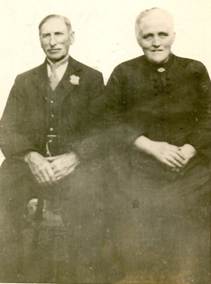
Figure 2. William and Dinah Baker, 1916
At this point we also include in Figure 3 another photo of Dinah, taken perhaps 35 years later, after Williams death. She cuts a somewhat formidable figure!
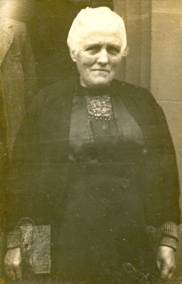
Figure 3. Dinah Baker c 1940
John Simeon Baker
The diary entries for John Simeon, William’s oldest son, are extensive, and give hints of more complex events that are not explained. We read first that on June 17th 1907, when he was 14, he began work at Parson’s Leys Foundry. Just two days later he finished working there – why that position only lasted two days isn’t explained. On the 14th of July 1908 he started to work at CIC……… Ltd Bridge End (an almost illegible entry), which probably refers to Bridge End mine in Bromley. The next entry concerning him is from March 24th 1909.
John received last pay of compensation
And a week later
John started to work after his accident at No 16 Colliery
So it would seem that at some point between July 1907 and March 1909 he was injured in some way – presumably quite seriously if compensation were paid. He remained at the Colliery until June 1910 when he began work at J. Glaze’s Tin Works, and he was clearly still employed there at the 1911 census when he is referred to as a Tin Works labourer. In the next two years he was employed at WW Round Oak, Roberts and Coopers, Brockmoor and at another illegible location. Then on the 7th July 1913 we read of him as being sent to the convalescent home at Clent (see Figure 4). One wonders if these multiple changes of job, and his period at Clent, were in some way a result of whatever accident he suffered in 1909. After coming out of the home, this succession of jobs continued – Roberts and Coopers at Brockmoor again, J Glazes, Cartwrights at Harts Hill, somewhere in Brettell Lane and on the 6th December 1915, the Earl of Dudley’s Steel Works (Round Oak). And there the entries end. There is no indication that he attempted to enlist in the army as did his brothers (see below). On the 13th April 1916 he married Miriam Blanche Cotton in a civil ceremony in Stourbridge. Mirian was 5 months pregnant at the time, so clearly whatever accident John experience, had no effect on his fertility. But there is no mention at all of his marriage, or of Miriam, in the diaries. Does this hint at some sort of family estrangement perhaps?
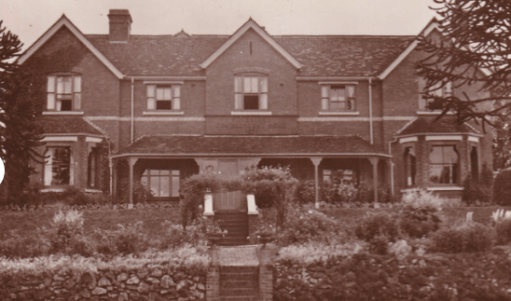
Figure 4. Clent Convalescent Home (from an old postcard)
Miriam Blanche was the daughter of James Cotton, a miner from Kingswinford. It can be seen from Figure 1 that her mother Phoebe had died in 1915 and prior to her marriage she worked as a tailoress. After the marriage, John left his Chapel St. home and he and Mirian began their married life with their eldest child at 32, Commonside in Pensnett. In the 1921 census John is described as a Blacksmith at the Earl of Dudley’s Ironworks Round Oak, where he had started in 1915, so perhaps he found stable employment at last. In the 1939 register he is described as a constructional fitter. Figure 5 shows a photograph of John and Miriam outside the Commonside house, sometime in the late 1930s, before they moved to a house in Tiled House Lane.
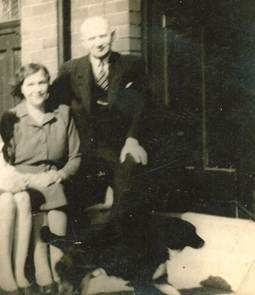
Figure 5 John Simeon and Miriam Blanche in the late 1930s
William Henry, Joseph Richard and Eliza Jane Baker
In contract to the entries concerning John Simeon, the entries relating to his siblings are much more straightforward. William Henry began work around 1910 and in the 1911 census he is described as 1911 Apprentice engine fitter. This may have been at Parson’s works in the Hollies where he remained till 1915. He enlisted in the army on the 21st September 1915 and served in France. The entries thereafter simply give times and dates for his periods of leave when he returned to Pensnett. The 1921 census records him working as an Engineers Fitter at Gibbons and Co. There is no record that he married, and he does not appear on the 1939 register, so presumably died before then.
It is not clear when Joseph Richard started to work, but in 1913 he is recorded as having his foot bruised. He seems to have begun work at Cochranes and Co in Woodside in February 1914 (the same place as his father). In August 1914, at the age of 16, he enlisted and was sent to a Foot Camp at Looe in Cornwall. For some reason he was discharged on January 1st 1915 (perhaps again as a result of an earlier injury) and on January 12th he began to work at “Mr Shaw’s Foundry”. He clearly enlisted again in 1917/18 and we read of further visits home on leave. On the first of May 1919, presumably after his discharge we read,
Jo was taken ill coming home from work and Doctor Plant was sent for. He came to see him
Dr Plant was one of the dynasty of Pensnett doctors from that family, who lived at the Plantation, formerly Shut End House, on he High Street in Pensnett. A few days after this incident Joseph was sent to the convalescent home at Clent where he stayed for two weeks. In the next two years, he found employment at Woodside Iron Works (again), Beans at Tipton and in the local police force. The last that records tell of him is that at the 1921 census he was a patient at a hospital in Birmingham. Again there seems to be an ongoing history of illness of some form.
Eliza Jane clearly took up the position of domestic worker at home, as was so common for girls in that era. She is recorded in September 1915 as collecting her glasses from Dudley so she clearly had issues with her eyesight – issues which certainly have appeared elsewhere in the family line, not least with me. From January to June 1916 she worked at Dixons’ Green in Dudley, before moving to Miss Rushworth in Dudley High Street, on a wage of 2s 6d per week. Miss Rushworth’ business, whatever it was, folded in 1918 and Eliza went to work at Mason’s Accounts in Wolverhampton St. in Dudley as a clerk. By 1921 she was again engaged in domestic duties. In the 1939 register she was living with Dinah, then recently widowed, and is described as a “Female Examiner. Inspector of Naval Ordinance”. She was to marry in 1941 at the age of 40 and lived until 1974. I remember her as rather a severe unsmiling lady – with very thick spectacles!
Other family members
A number of other relatives are mentioned in the diaries. William’s brother Henry, a Railway Guard for the GWR living at first in Birmingham and then in Stourbridge, was a regular visitor, often with his wife Annie Mary. It may well be that some of the entries that relate deaths in the area refer to one of William’s five sisters under their married names. One such was certainly Merriah Jones who dies on February 3rd 1916. There were also references to various members of the Chambers family in Smethwick with whom Dinah clearly kept in touch, but it is difficult to determine the precise family relationships here. Perhaps of most interest, one James Chambers is recorded as having emigrated to Canada in 1910.
The entry that most surprised (and indeed shocked) me however was to James Cotton, Miriam’s father, and my great grandfather. For June 22nd 1916 we read
James Cotton was killed at the Sampson Colliery Netherton
A little more detail can be found in the Dudley Chronicle of June 24th.
DUDLEY COLLIERY ACCIDENT – BURIED BY FALL OF COAL. Two miners were buried by a fall of coal at the Dudley Sampson pit, owned by Stourbridge Brick Co., on Thursday, and one—James Cotton, of Commonside, Pensnett—was dead when released. The other, a man named Thomas Treater, had a remarkable escape. He was practically uninjured when liberated, and was able to walk home. The fall was caused by timber supports giving way.
James’ name was given as “Cloteon” in the transcript on the British Newspaper Archive – a result of the fallibility of the OCR system that the Archive uses. This explains why I had hadn’t picked out this accident in earlier searches. In terms of the family it means that Miriam Blanche and her siblings would have lost both parents in a very short time. We find one of them, her younger sister Gertrude Gladys Cotton, living with John and Miriam in the 1921 census.
 Engineering, history and ecclesiology
4 thoughts on “The diaries of William Baker 1907 to 1919 – Part 2. The family entries”