
Introduction
Recently, whilst researching some aspects of the history of All Saints Church in Oakham, I found some really useful articles in the Rutland Magazine and County Historical Record from the early years of the 20th century. It seems that this magazine had only a limited life span, but the volumes that were published contain some interesting and in depth articles on aspects of Rutland history. As I was browsing the contents, I found, in the very first edition, an article by A J Waterfield of Stamford, in which he reviews a 1902 reprint of a 1763 book that sets out an alternative history of England, and in particular describes the reign of King George VI of Britain between 1900 and 1925. In reviewing the book, Mr Waterfield was delighted to find that it contains a description of King George’s new capital – the City of Stanley just south of Uppingham in Rutland! I shared his delight and enjoyment, so I thought I would share his article here. This is set out in the next section. This is followed by some further notes on the eventful reign of King George VI as foreseen from 1763, more on the city of Stanley, and a short discussion on the authorship of the original book.
The City of Stanley, Rutland by Mr A J Waterfield
Rutland Magazine and County Historical Record, 1, 34-36
Having got over the first flush of tempestuous joy, which followed the arrival of the prospectus of the Rutland Magazine, I am now able to read through the same in a spirit of almost judicial calm, in a manner dispassionate, and again with ‘ Pleasure at the helm.’ In the list of articles shown as intended for publication, I observe, that one of the many good things promised is styled, ” The Lost Villages of Rutland.” Now the purpose of my present endeavour is to set down a few rambling remarks respecting a City of Rutland which was never founded. It is just a hundred and forty years since there was issued anonymously—printed in London—a little book of about a hundred leaves, bearing title, “The Reign of George VI.” As the name barely affords a glimmer as to the drift of the work,
taken up at a what’s-to-come period, and begun at an era that will not begin these hundred years,
I may be allowed to use the words of the Editor of a reprint, sent out three years ago. Mr. Oman, the well-known author, and Fellow of All Souls’ College, Oxford, says :
The author was intending to influence the men of his own day, by pointing out, in the actions of his puppets what ought to be done and what avoided in the Year of Grace 1763.
The author himself, begins with a reference to Swift’s History of Captain Lemuel Gulliver [written 1726], and goes on to say,
The modesty which is ever the companion of true merit, would by no means admit your author to think of a parallel between this history and the travels of Captain Gulliver.
Briefly then, the volume, under present notice, is a forecast—the years of the ‘ action ‘ being 1900-1925,—and at this stage, that part of the subject concerning the nature and tendency of “The Reign of George VI” may be dismissed. The part played by the gallant little county which the Saxons called Roteland, will presently be discerned. Our author writes:
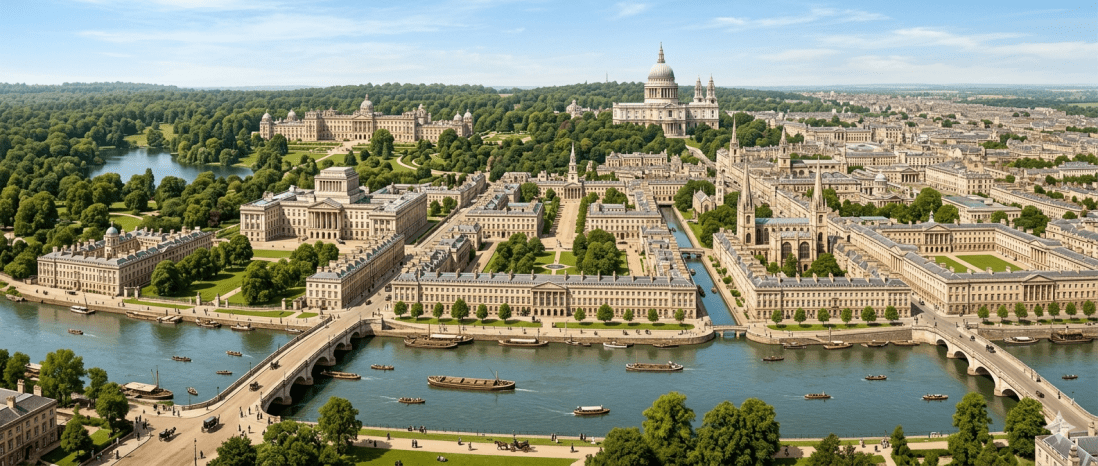
London, though the wonder of the world, never pleased the King. The meanness of his Majesty’s palace disgusted him; he had a taste for architecture, and determined to exert it in raising an edifice, that should at once do honour to his kingdom, and add splendour to his court.
In Rutlandshire, near Uppingham, was a small hunting box of the late King’s, which George admired ; not for the building, but its beautiful situation. Few parts of his dominions could afford a more desirable spot for such a purpose. The old seat stood on an elevated situation which commanded an extensive prospect over the adjacent country. It was almost surrounded with extensive woods ; which having been artfully planted, added the greatest beauty to the prospect, without intercepting the view. On one side there was an easy descent of about three miles, which led into an extensive plain, through which a river took its meandering course. Many villages seemed to rise here and there from out the woods, which gave a great variety to the scene, and the fertile plain was one continued prospect of villages, groves, meadows, and rivulets, and all was in the neighbourhood of a noble and capacious forest.
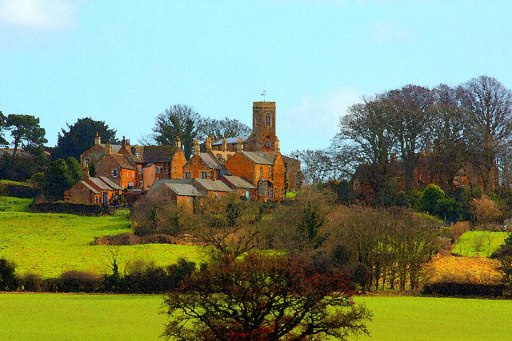
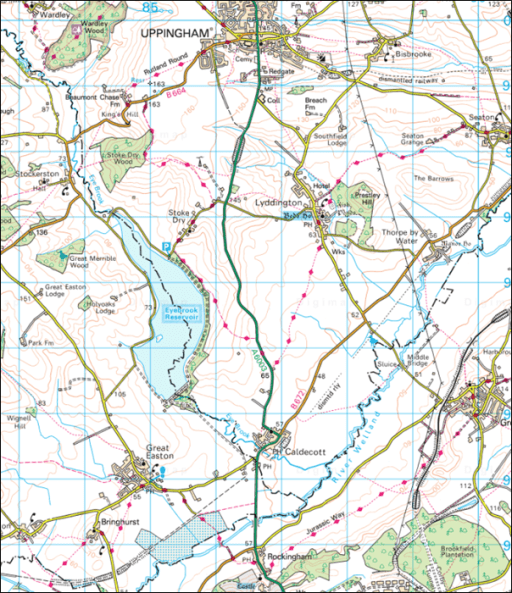
The landscape here described is that seen from Stoke Dry, the river the peaceful Welland, and the neighbouring forest, that of Rockingham. I remember reading, some years since, an ecstatic description of this quite charming spot, by an American visitor (perhaps Elihu Burritt, but I am not sure), whose opinion was that this viewpoint was one of the most delightful in the United Kingdom. Hereabout then, it is written, was begun, (one of several plans having been chosen), the building of a palace for his Majesty, to the exceeding wonder, no doubt, of the whole countryside. Toward the cost, a generous Parliament voted a first grant of a million sterling.
Nothing was spared to make this palace the wonder of the world,
and without touching details this bare statement is, in itself, quite sufficient to engage our interest, if not wonderment. Then followed, through the accident of an afterthought, the raising of some public edifices, Saint Stephen’s church and the Academy of Architecture being the first two ; of the latter, Gilbert, the King’s architect, was the first President. Later,
most of the nobility and many of the rich commoners, in imitation of their sovereign, erected magnificent palaces at Stanley,
by which name the fast uprising city became known.
What gave a prodigious increase to this noble city was the erection of the Senate House : that noble building . . . . the admiration of all Europe.
To hark back a little, I should before have mentioned that, by Act of Parliament, the Welland was made navigable
to the very plain at the bottom of the hill
on which the city was growing, for the purpose of the conveyance of the material required. Portland stone only was used, and
” the houses were all built to form one general front on each side of every street,”
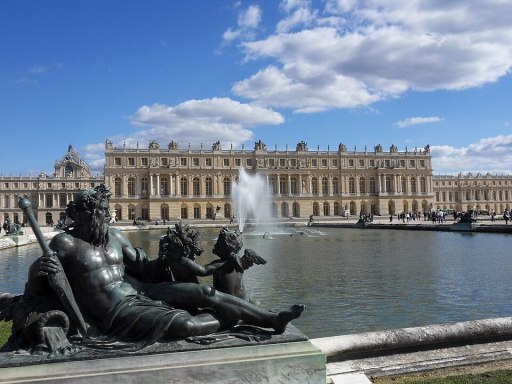
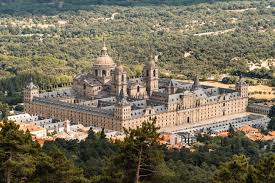
a regularity which might very easily have proved wearisome. An Academy of Painting was formed, on a grand scale, and about the same time the King’s palace was finished, eight years after its commencement. We read that the shell of the building alone cost eight millions sterling, and that the Spanish Escurial and Versailles were each
infinitely exceeded by Stanley
More than a dozen pages of the book are given up to the description of the city of Stanley to name the wonders and outstanding features of which would be, as it were, to compile a catalogue. By the year 1921, it is written, Stanley possessed a Cathedral which
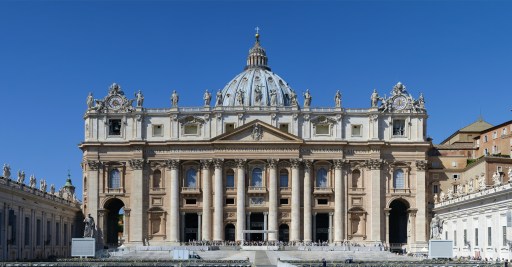
in architecture, grandeur and extent far exceeded Saint Peters’ at Rome,
while the gardens of the King’s palace were become an eighth wonder in the land. The city had grown to be four miles square ; it had its University,
and was evidently become the metropolis of the three, or rather, four kingdoms.
And here we must take our leave of the amazing City of Stanley, Rutland, having in no appreciable degree exhausted the written account of its glories.
As a pendant to the foregoing, I proceed to add that, in regard to the authorship of “George VI” Mr. Oman, in his Editorial preface, invited information. I sought the aid of Mr. Joseph Phillips, F.S.A., that Admirable Crichton in everything relating to the history and records of Stamford and the district around. One learned that the author was the Rev. William Hanbury, an eighteenth century Rector of Church Langton, Leicestershire, an account of whose by no means Lilliputian achievements, not less than his gigantic (Brobdingnagian is quite too unwieldy) schemes form a really remarkable chapter, in what may be termed local history. Then some pleasant correspondence with Mr. Oman, to whom was given (as a matter of course), the name of my informant, the sterling gentleman whose recent death we all deplore.
King George VI
“The reign of George VI” was written in 1763, three years into the reign of the real George III. In the alternate history he is followed by George IV, George V. George VI then came to the throne in 1900. This suggests long reigns for the first three of these Georges, implying either that at least one of them fathered a child in his old age, or they were not necessarily all fathers and sons. By 1900, when George VI came to the throne, Britain was faced with an aggressive, expansionist Russian Empire that had taken over much of northern Europe. In the first year of his reign, the Russians invaded Britain, engaging in major land and sea battles. The nature of warfare was very much that of the 18th century – based on infantry and cavalry, with the leaders of the army being Earls and Dukes. Parliament refused at first to sanction money for the nation’s defence, partly because the Czar
had conveyed immense sums into England, and had most politically distributed them to the most advantageous purposes
but under pressure from the mob, parliament
they now offered to address his Majesty to take the state under his protection,
which in effect meant royal control over the exchequer, with which he properly equipped the army. The Russians were defeated at Wetherby under the field leadership of the king. The description given of the battle would not out of place in War and Peace. But this was not the end, and ongoing skirmishes with France tipped over into full scale warfare, with the army and the navy of the French king being supplemented by the remains of the Russian forces. George then led a small army into Flanders and northern France and forced the French into submission and a peace treaty was signed. The ensuring peace, in 1903, enabled George to turn to more peaceful interests in building up his country, and in particular in the building of his city of Stanley. The peace lasted until 1917, when the Russians attacked the German Empire, assisted, naturally enough, by the French. George took his army to assist Germany, and helped fight of the Russians, and defeat the French armies. In 1919 he entered Paris in triumph. Europe by this time was in a state of political and economic confusion, and George fought minor skirmishes and military actions throughout the next year, to subdue the Spanish in particular. The American colonists, still loyal to the crown, played their part in the defeat and overrunning of Mexico. It culminated with a victorious George being crowned King of France in 1920.
Entertaining as all of this alternative history is, it is of course, simply a reflection of the period in which it was written and of the concerns of that time. The armies were those of the 18th century, the countries and empires that threatened George were similarly those of that period. Monarchs and aristocracies still ruled and the French and American revolutions hadn’t happened. The huge changes brought about by the Industrial Revolution simply weren’t foreseen. The editor of the revised edition, Charles Oman has much more to say in his preface about the nature of the book’s predictions and how they relate to the politics of the original author’s own day.
The City of Stanley
As noted by Mr. Waterfield, he only gives the briefest of accounts of the City of Stanley, and the book contains much more information than that which he included. Rather than trying to summarise it, I have extracted the Stanley material and this can be accessed through the button below.

But here I would make one or two further points. Firstly, I presume the name of the city comes from the Stanleys who were of course the Earls of Derby and very prominent in politics and intrigue for many centuries before the book was written, But as far as I can see, the choice of name is not made explicit anywhere. I fear that I struggle to take the name seriously, Stanley being forever associated in my mind with Stanley Unwin, Stanly Baxter and Stan(ley) Laurel. But that is my problem.
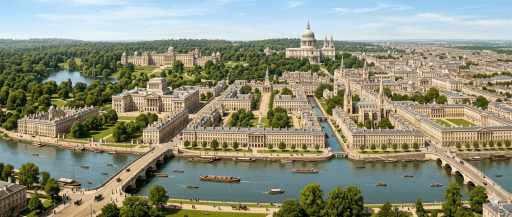
Secondly it is clear that, as with the political situation that is supposed, in architectural and planning terms, the author is reflecting his own time, and the city he envisages is essentially Georgian. I find it has a slightly nightmarish quality to it – grand, but rather soulless buildings, with no indication of commercial or domestic life. Indeed one wonders where all those who will provide for the aristocratic occupants of Stanley will live and where its food will come from – cities do not exists in a vacuum. At the very least the surrounding areas of Rutland would have been wholly changed in nature.
Similarly there is nothing about transport. One might have expected something about a grand road connecting Stanley with London – the author must have surely been aware of John Ogilby’s Britannia from 1675, which showed strip maps starting in London (see the map for our area to the left). Two years before the book was written, in 1761, the Bridgewater canal had been opened in the northwest and was seen as a major technological achievement. That is perhaps reflected in the mention of the canalisation of the Welland. Elsewhere in the book, where King George’s munificence to the general population is described, it is stated that canals connected every city in the realm – more or less the only transportation development that is described.
Who was the author?
Charles Oman, the editor of the reprint of 1902, was of the view that the author of “The reign of George VI” was clearly local to Rutland, because of his knowledge of the topography on which Stanley was built, and it is hard ot disagree with that. There are a couple of other indications pointing in that direction. Firstly, the canalisation of the Welland had been achieved in some fashion 100 years before in 1670 by the building of the Stamford Canal from Market Deeping to Stamford bypassing a stretch of the Welland that was used by mills and was not navigable. This predated the building of the first modern canal (the Bridgwater mentioned above) by 100 years and contributed greatly to the commercial success of Stamford. It is plausible to suppose that the author was aware of this attempt to make the Welland navigable in the development of his ideas.
The second point also relates to Stamford. Stanley is said to have 25 parish churches. In this of course, it resembles London, but Stamford also had a multiplicity of small parishes and their churches within the town. Again, this was an idea on which the author might have drawn.
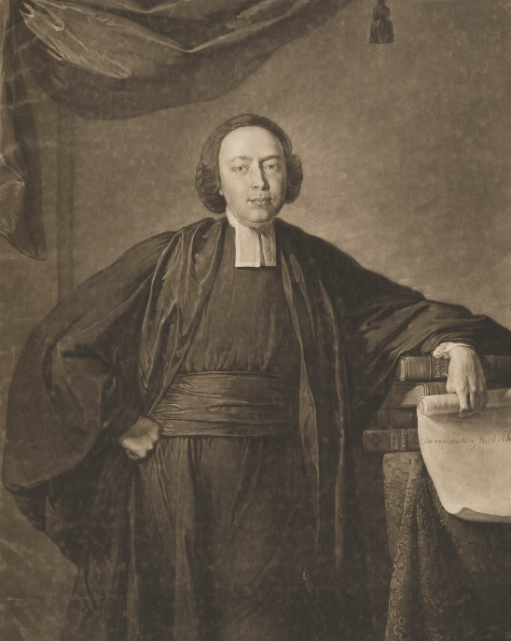
As can be seen from Mr Waterfield’s article, he identified the author as the Rev. William Hanbury, Rector of Church Langton in Leicestershire (1725-1778), and he was certainly an interesting character – a clergyman, garden and plantation creator, music festival organiser and philanthropist. But there seems to be little indication that he authored books and pamphlets such as the Reign of King George VI. Neither was he particularly local to Rutland.
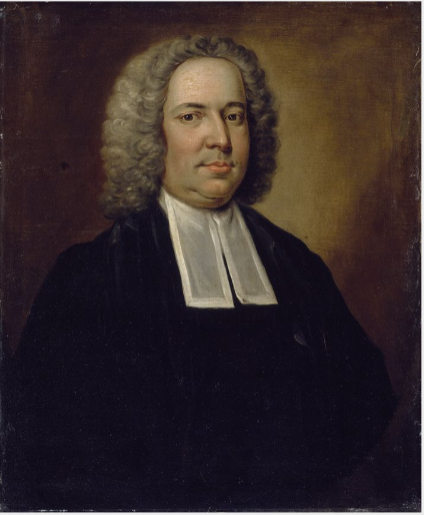
On the edition of the book on Google Books, there is a note “Maddon?” which seems to refer to the Irish author Rev. Samuel Maddon (1686-1765). One of Maddon’s early works, from 1733, was what has been described as the first science fiction book “Memoirs of the 20th century” which included the first recorded depiction of time travel and consisted of diplomatic letters from between 1997 and 1999 in the reign of King George VI. The political situation depicted is however very much of his own time, with international relations mirroring those of 1733. The parallels are obvious, but there is no indication that Maddon was familiar with Rutland, and it may be that his book simply served as the inspiration for “The Reign of King George VI”.
To my mind, neither Hanbury or Maddon has a convincing case for being the author of the work considered here. I would look for somebody who lived in the Rutland / Stamford area, but as to who that might be I have no idea at all.
 Engineering, history and ecclesiology