Woodside Iron Works c 1860

The Engraving

Woodside Iron Works, was founded in 1840 by Alexander Brodie Cochrane and his son Charles Cochrane. It became very well known and respected and produced components for many significant structures, including girders for the Runcorn Bridge over the River Mersey and the Farringdon Street Viaduct in London; ironwork for the Rochester Road Bridge, the Swing Bridge over the River Medway and the Clifton Suspension Bridge; and a wrought iron bridge for New Street Railway Station in Birmingham

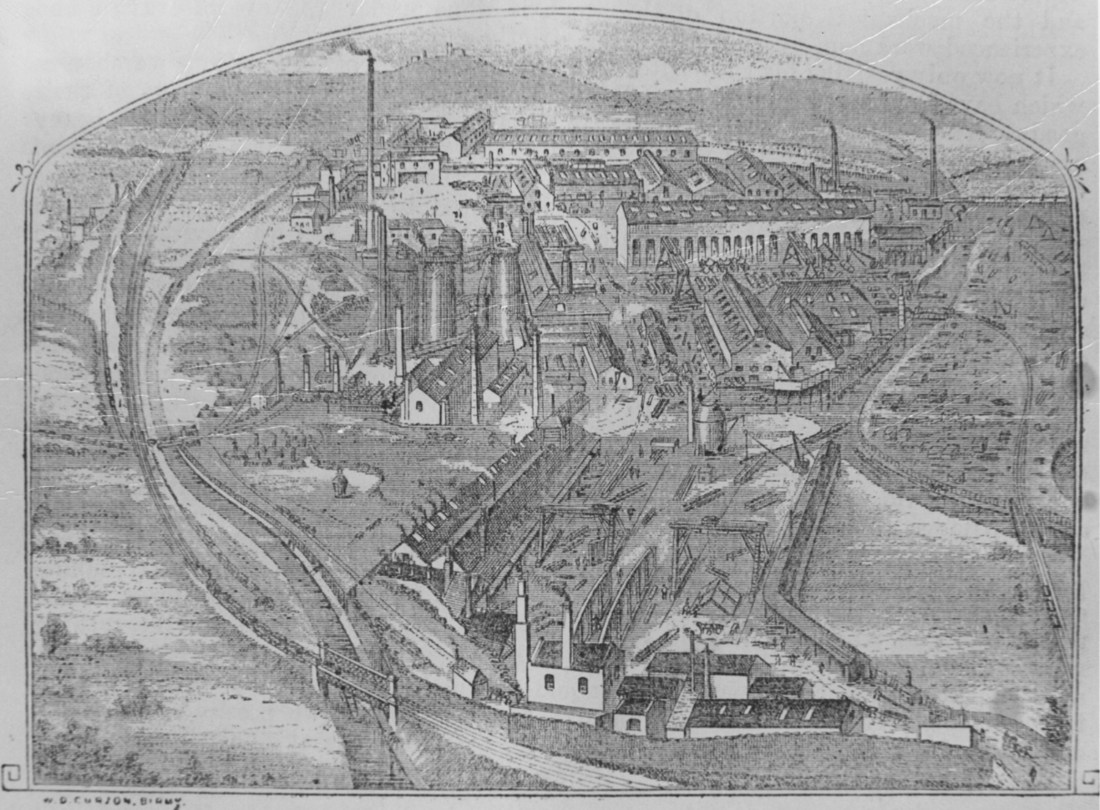
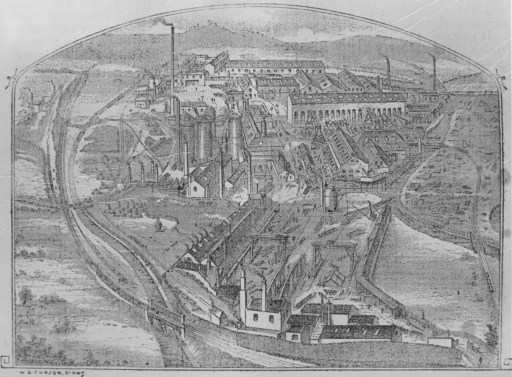
Now I recently paid for a license from Dudley Archives for the use of the engraving of the works shown in Figure 1 below, for use in a blog post and in a forthcoming article in the Blackcountryman based on that blog post. It is catalogued as Woodside Iron Works c 1860. In the blog post and article, I used it to illustrate accounts of the works found in my great grandfather’s diaries and did not discuss it to any extent. It really does however deserve somewhat greater consideration, and so in this post, I will consider it in somewhat greater detail.

Figure 1. Woodside Iron Works c1860

Major Features

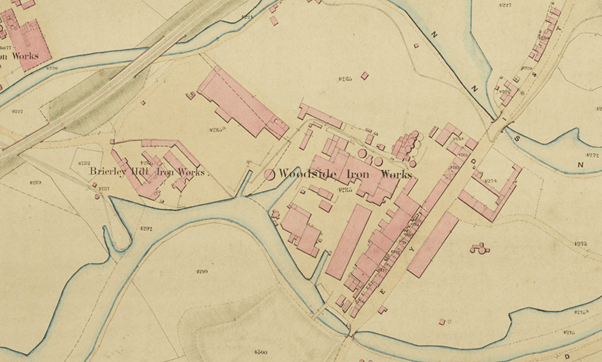
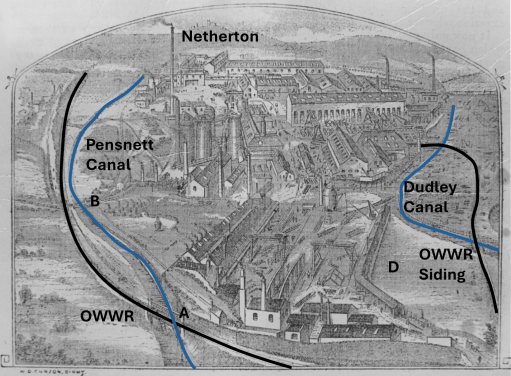
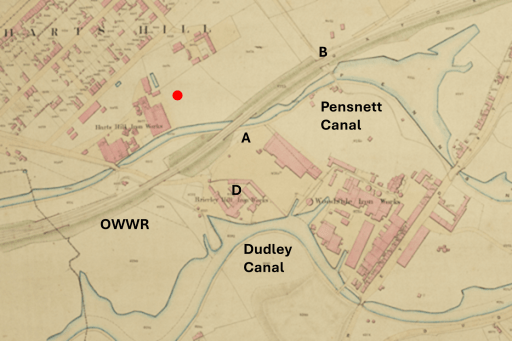
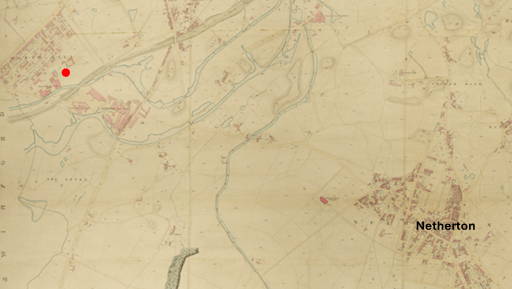
So what does the engraving actually show? Figure 2 shows a comparison between the engraving and a map of Dudley from 1857. Note that north on the map is around 20 degrees clockwise from the map vertical axis. On both the engraving and the map, the main line of the Oxford, Worcester and Wolverhampton Railway can be seen , with the engraving also showing a siding into the works. The Dudley Canal can be seen on both engraving and map (heading for Dudley Tunnel in the distance) with Lord Ward’s Pensnett Canal also visible, heading to a junction with the Dudley Canal just south of Dudley Tunnel. Two railway bridges, over the Pensnett Canal and a road are shown at A and B on both. In the distance can be seen the Netherton ridge and Netherton church. The likely vantage point from which the initial sketch for engraving was made is shown by the red circle on the map.

Figure 2. Comparison between the engraving anda map of 1857

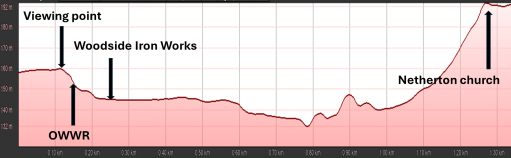
Figure 3a shows a smaller scale version of the map of figure 2 so that the relationship can be seen between the Iron Works (and the vantage point from which it was sketched) and Netherton in the far distance on the engraving. Figure 3b shows an elevation profile along a line through the vantage point and Netherton church. It can be seen that there is an initials steep drop from the vantage point across the railway to the Iron Works, and the ground then remains fairly level until the steep slope up to the Netherton ridge is reached. Thus the view of the iron works shown on the engraving, with a perspective indicating that it was painted from an elevated position, is a real one.

(a)

(b)
Figure 3. The Iron Works in the wider landscape.

The date of the engraving

The Archive catalogue gives the date of the engraving as c1860, but can a more precise date be determined? The Iron Works themselves had opened in the 1840s, but the main line of the Oxford, Worcester and Wolverhampton Railway wasn’t opened intill November 1852, so that gives the earliest possible date for the engraving. The Brierley Hill Iron Works (D on the map of figure 2) was also operational from the 1840s, but oddly does not appear on the engraving. Or rather only the angular building that marks the northern edge of the works is shown. I am inclined to think that this was because whoever commissioned the engraving didn’t wish to show the works of a competitor and I suspect request that it be removed. Indeed the area D on the engraving is suspiciously level and without any features, which suggest that this might have been the results of a major edit.

Now, from Grace’s Guide we have a description of a report of an “Open Day” at the Iron Works where the proprietors  Alexander Brodie Cochrane, and his son Charles Cochrane invited the local gentry and other local iron masters to look around the works (Worcestershire Chronicle, 2 April 1856) and indeed the guest list was very impressive. Was the engraving produced for this event, and perhaps given to those who attended? It would seem very appropriate for this to have been the case. It would also explain why the owners were keen for Brierley Hill Iron Works not to be shown.

The detail

Figure 4. The details of the Iron Works

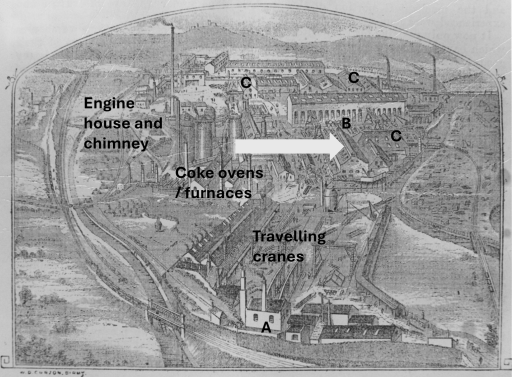
Later Ordnance Survey Maps of the Iron Works (from the 1880s) enable some functions to be identified – the travelling cranes in the foreground of the engravings, the coke ovens and furnaces, and the engine house and chimney. The report of the 1856 event found in the Worcester Chronicle that has already been mentioned contains some information that helps to understand what the engraving shows. The relevant paragraphs are as follows.

The Oxford, Worcester, and Wolverhampton railway running for a considerable distance along the side these works, drops down into their midst the green sand for the moulds, the Staffordshire ironstone, the unctuous red haematite from Cumberland, the limestone for the flux, and the Derbyshire cokes. The coal is raised from pits upon the premises, and in very few hours the raw material thus handed on the one side may be smelted, converted into pigs, cast into pipes, proved by the hydraulic press, smoothed, cut, and drilled, by machines of singular ingenuity and power, and shipped at the other side of the works upon the canal, to be borne from canal to river, from river to sea, and so to the Antipodes, to minister to the wants of rich and populous Australian cities, which in the memory of the present generation, had no name, or to complete the civilisation of communities planted few years since in spots where forests grew, and New Zealand cannibals roamed. What an illustration of human progress!

Several of Messrs. Cochrane’s relations and friends were distinguished by a white ribbon in their buttonhole, and escorted the various visitors through the works, showing them every process of iron manufacture and founding. The grinding of the sand for moulds, the curious processes of making, baking, and smoothing those moulds, the powerful steam engine for supplying cold blast to the two melting furnaces, the hydraulic lift raising the ” burden ” or supply of food to these huge retorts, whose fires never cease to devour day or night; the other engines for working the beautiful machinery of the fitting-room, where iron is planed, and drilled, and cut, with the same nicety, and almost the same facility, as if it had been deal, were all inspected in turn. 

From this information we can conclude that raw materials, other than coal, were brought into the works from the line of the OWWR that ran along its boundary, presumably around point A on figure 4. Coal was mined somewhere on the site itself – perhaps we can see the pit head mechanisms at B in the figure? (By the late 19th century these mines had clearly become exhausted and further mines opened to the west of the Dudley to Stourbridge Road, with the coal brought into the works by a cable operated incline). Iron was then produced in the two furnaces, and then used in a variety of manufacturing processes in the various buildings marked C, before being loaded onto barges on the canal (and also presumably onto railway trucks on the OWRR siding). The process of manufacture thus moved from left to right across the engraving (north to south in reality) as shown by the arrow. In the above report we read that the products of the works were

borne from canal to river, from river to sea

which suggests that they were moved west along the Dudley and Stourbridge Canals, to the Staffs and Worcs. canal at Stourton and thus to the Severn at Stourport, and onward to Bristol and the sea. Such a movement would have avoided the notoriously congested Dudley tunnel. It also gives a degree of confirmation of the date as being around 1856, as in 1858 the Netherton tunnel opened, which would have made travel to the east to Birmngham and London much easier and would have presented an attractive route for the products of the Iron Works.

Pensnett history blogs and presentations – a compilation

Some summer reading and viewing for those interested in the history of Pensnett (which includes the area that used to be known as Shut End).

Blog posts

The railways of Shut End and Corbyn’s Hall A detailed look at the industrial railways within and around the iron works at Corbyn’ Hall and Shut End. (March 2nd 2020)

The Shut End Primitive Methodist Chapel. These three posts are based on the Baptismal Register of the Shut End Primitive Methodist Chapel in Tansey Green, and look at the life of the chapel in the mid to late 19th century. Part 1 Introduction and Chapel Building Part 2 The Baptismal Register Part 3 Ministers and Families (March 21st 2020)

Coal mining in the Shut End and Corbyn’s Hall area This post looks the coal mines in the Shut End and Corbyn’s Hall area, using the extensive database on the Coal Authority website. (April 18th 2020)

Cricket and Football in Pensnett in the Nineteenth Century. a brief description of the sporting scene in Pensnett from around 1860 to 1900. (November 21st 2020). I have also posted an amplification of part of this post (the single wicket cricket match on the Black Country Society web site at Cricket, but not as we know it (September 29th 2022)

The Pensnett Saxhorn Band. A post describing the life and times of the Pensnett Saxhorn Band in the mid-nineteenth century, giving a snapshot of some aspects of Black Country cultural life at the time. (March 30th 2021)

The fields that survived. An investigation of a small unit of land consisting of three late 17th century Black Country fields that escaped the ravages of mining, colliery waste and urban development to remain more or less intact to the present day. (July 23rd 2023)

The early history of the Crooked House. A post looking at the history of the Crooked House, or Glynne Arms, up to the 1870s, mainly based on early maps of the area (September 23rd 2023)

For more blog posts about Pensnett and the wider Black Country see https://profchrisbaker.com/historical-studies/black-country-history/

Presentations

A tale of two maps – the 1822 and 1840 Fowler Maps of Kingswinford. A version of a talk given at a conference entitled “A landscape of the end of the world: the industrial revolution and the Black Country c. 1706-1914” at the Black Country Museum in July 2023

A policeman’s life – Samuel Hicklin (1858-1924). A policeman’s life – Samuel Hicklin (1858-1924). This presentation that describe the remarkable life of Sam Hicklin, the son of a farm labourer who was to progress to the highest ranks of the Staffordshire Constabulary (via Pensnett).

An Ecclesiastical Affair The video tells a true story from 1870, with many contemporary resonances, about the Victorian Black Country parish of Pensnett where the errant clergyman had a flirtation with a pupil teacher at the local school, that led to scandal in the village, a clergy discipline trial, a series of anonymous broadsheets circulating in the village making all sorts of accusations about church members (some comical, some rather nasty), and a nationally reported libel trial. Wayward clergy, scandal and libel – all the hallmarks of a good story!

A Black Country poet – Jim William Jones

On November 9th 2024 as part of the Black Country History Day to be held the Black Country Living Museum in Dudley, I will be presenting (with help from Emma Purshouse) some of the poetry of the Black Country poet Jim William Jones, to illustrate the industrial, social and built environment of the region in the second half of the 20th century. Jones was a sharp eyed observer of his beloved Black Country and his poems give a deep insight into the area and its people over that period. This is a rather different way of “doing” history, but hopefully one that will both entertain and inform. I write below to give some brief details of his life and work, since this information is not generally available elsewhere.

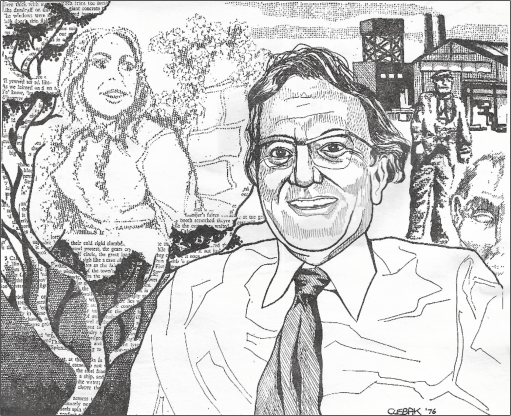
J W Jones by CLEBAK, From Black Country Society Calendar collection 1976

Jim William Jones was born in Coseley on February 15th, 1923, and spent his childhood and school years there. After leaving school he began work with the engineering firm Joseph Sankey and Sons as a junior clerk. He was conscripted into the army at the age of 18 in 1941, taking part in the Normandy landing in 1944 and also serving in India and Ceylon, reaching the rank of Warrant Officer. After the war he returned to Sankey’s and was trained in works management, before leaving industry to join local government in 1955 where he worked in education administration, marrying Jesse Ralphs at Wednesbury in that year. He was a qualified teacher of speech and drama and a member of amateur dramatic societies, hosting a radio programme on Beacon Radio and working with the Black Country folk music group Giggetty. He had a strong Christian faith and was a gifted speaker and Methodist local preacher. He became a very well-known Black Country poet, both for his dialect poetry (Black Country ballads) and for his poetry in more conventional English. Some of these can be found in three small publications by the Black Country Society – “From under the smoke” from 1972, “Factory and Fireside” from 1974, and “Jim and Kate” from 1986, all sadly long out of print. He contributed numerous poems to the first 25 years of the Society magazine, the Blackcountryman from 1967 to 1992. He died in 1993.

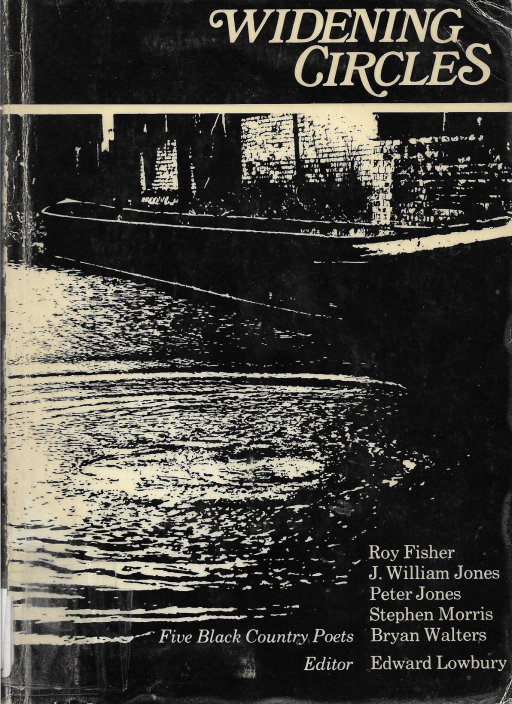
Some of Jim Jones poems were included in a 1976 anthology “Widening circles” edited by Edward Lowbury. Following Jones’ death, Lowbury wrote an appreciation for the Blackcountryman (26.4, 1993). He acknowledged the humour and the pathos in the dialect ballads, which at the time of publication of “Widening Circles” he felt to be more successful than the poems in standard English. By 1992 however he had somewhat modified his views and concluded that his standard English poems were perhaps “nearer to the heart of poetry than the more immediately entertaining dialect ballads”.

In a much later Blackcountryman article (45.3, 2012) Trevor Brookes again writes in appreciation of Jim Jones, and in particular his dialect poetry, emphasising that as well as humour, they contained much that showed a profound understanding of people and their lives. He regretted that these were not easily available, being scattered across many newspapers and other publications, and not accessible to modern readers.

Personally, I first became aware of Jim Jones work in the early 1970s, when my mother gave me a copy of “From under the smoke” as a Birthday present. This little volume became a prized possession and has travelled around the country with me over the last 50 years, regularly read and re-read.

To enable others to either reacquaint themselves with his work, or to enjoy it for the first time, some of Jones’ poems have ben published in a short series of Black Country Society blog posts from 2022 that can be found at the links below.

The Blackcountryman poems of Jim William Jones Part 1

The Blackcountryman poems of Jim William Jones Part 2

The Blackcountryman poems of Jim William Jones Part 3

In addition, the Black Country Society has scanned “From under the smoke” and “Factory and Fireside” and these are available for members on the Society web site (password required). I have also produced a compilation of 33 of his poems that span the period from 1968 to 1992 – from “From under the Smoke”, “Factory and Fireside” and the Blackcountryman. This is again available to Society members on the web site. These three volumes will be available for purchase as pdfs from the Society online shop at some point in the near future.

Most, but not quite all, of the poems in the compilation are in standard English. Another volume could easily be produced containing a selection of his dialect poetry, but as Trevor Brookes noted, these are more scattered, and the collection of them would be a major task. Nonetheless it is perhaps something I will attempt in the future.