

Related blog posts
The diaries of William Baker 1907 to 1919 – Part 1. Introduction
The diaries of William Baker 1907 to 1919 – Part 2. The family entries
The diaries of William Baker 1907 to 1919 – Part 3. Local people and events
The diaries of William Baker 1907 to 1919 – Part 4. National people and events
Introduction
William Baker worked at Woodside Iron Works, which was founded in 1840 by Alexander Brodie Cochrane and his son. It became very well known and respected and produced components for many significant structures, including girders for the Runcorn Bridge over the River Mersey and the Farringdon Street Viaduct in London; ironwork for the Rochester Road Bridge, the Swing Bridge over the River Medway and the Clifton Suspension Bridge; and a wrought iron bridge for New Street Railway Station in Birmingham. In the early years of the 20th century it was owned and operated by Alexander’s grandson, Walter Cochrane.
The works were situated between the Dudley and Pensnett Canals , with the Earl of Dudley’s Round Oak Steelworks being on the other side of the Dudley Canal (Figure 1). Woodside was connected to the Great Western Railway which ran to its west (given by its earlier name of the Oxford, Worcester and Wolverhampton Railway on the map). It was supplied with coal from mines on the other side of the railway, through a series of inclines and tramways. A view of the works, roughly from the point marked by a red circle in Figure 1, is given by an engraving in Dudley Archives (Figure 2).
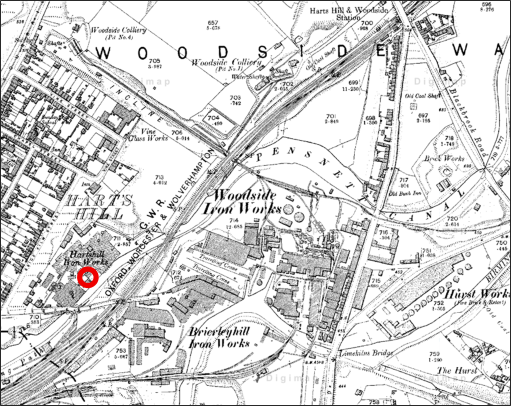
Figure 1. Location of Woodside works from the 1910 OS Map
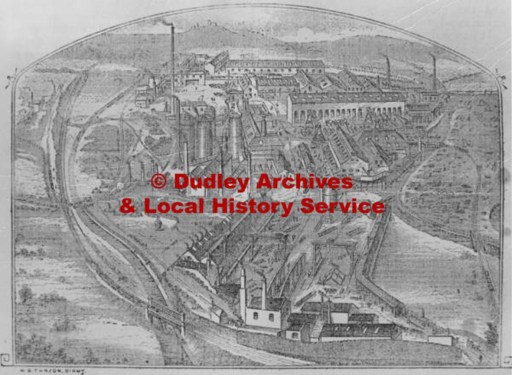
Figure 2. Engraving of Woodside Iron Works from Dudley Archives
Furnace operation
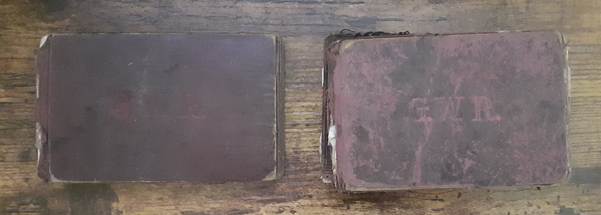
There are 148 entries in the diary that describe the operation of the Blast Furnace. These are mainly in the earlier period covered by the diaries and become very sporadic after 1913. On the cover of Book 2 we find a list of when the two furnaces (numbers 2 and 3) were “blown” i.e. when they started to produce cast iron.
Dates of Furnaces Blown. No 2 Dec 14 1904; No 3 Aug 15 1906; No 2 Dec 3 1909; No 3 Sept 19 1911; No 2 May 19 1916
There were periods when both were in operation, but also periods when one of the furnaces was being rebuilt or relined. Furnaces would be in operation for several years before being rebuilt. The starting process for the furnaces was lengthy and extended over several days. As an example consider the start up of Number 3 Furnace in August 1906.
9/8/1906 Started to fill No 3 Furnace.
12/8/1906 Finished filling No 3 Furnace.
12/8/1906 No 3 Furnace fired off 6.18pm.
15/8/1906 Blast put to No 3 Furnace at 9.40am……
17/8/1906 First cast of iron from No 3 Furnace.
17/8/1906 ?? blow out No 3 Furnace at 8.50pm. 2½ lbs.
I am not familiar with the terms used here, and readers might be able to say more, but presumably the “filling” was with coke and ironstone (with the use of the hoist engine), the “firing” was the lighting of the fire, and the “blast was the turning on of the Blast Engine to provide a through flow of air. The 2½ lbs mentioned in the last entry is the pressure of the blast air flow – which should properly be in lbs / square inch. Sometimes at start up the increase in this pressure over several days is recorded.
Furnace “stands” when presumably the blast is turned off, are frequently recorded. In addition we have entries of the following type t roughly annual intervals.
3/10/1907 Mine load On No 3 Furnace…….
30/10/1907 Mine load taken off about 4.00am
I am not at all sure what such entries describe – again reader input would be useful. Other work in the vicinity was obviously of interest to William Baker, and he may well have been involved in some way – there seems to be some flexibility in the use of manpower across different tasks. For example
19/3/1909 The three new Sankey and Sons boilers put to work. The new reducing valve put to work ……
1/8/1910 Preparing to start new colliery
Repairs
There are 244 entries in the diaries that relate to what might be described as ongoing maintenance or repairs. These cover the entire period of the diaries, but there are more in the period up to about 1914 than afterwards. At roughly three month intervals we have series of entries of the similar to this example from late 1910.
11/11/1910 Steam valve packed with 5 rolls of 3/8” white packing.
14/11/1910 Steam Valve packed 2 rolls 3/8” by 1″ Lapped elastic.
23/11/1910 New rope put on right hand cage . Stand from 9 till 12. 3 hours stand.
30/11/1910 New rope put on left hand cage. Screw loosened out on right hand band. Stand from 9.20am till 11.40am 2 hours 20 mins
1/12/1910 Left hand band taken up 1½”
4/12/1910 New lamp put on over engines No 32
9/12/1910 Right hand band taken up 1″.
13/12/1910Small steam box packed to back
14/12/1910 Large steam boxes packed to back
16/12/1910 Right hand band taken up 1¼”
21/12/1910 New joints put in lubricator
Again, reader input would be useful. What were these steam boxes and steam valves and what did packing them entail? Presumably they were some part of the hoist engine. The bands seem to have been part of the hoist mechanism and expanded with use and needed to be taken up by an inch or so at regular intervals. Similarly new ropes were required for the “cages” – were these to transport workers to the tops of the furnaces?
Less frequently we have a number of other tasks – the whitewashing of the Engine House (at intervals between 6 months and 2 year); repairs to the “Nelson” locomotive used to move material around the site; and occasionally (recorded only two times) the drainage of a stretch of canal to repair the loading wharfs. Some examples are shown below.
28/5/1908 Engine house whitewashed
17/5/1909 The Nelson loco put in for repairs
31/5/1909 The Nelson loco came out of repairs at 9.00
5/8/1911Started to empty the water out of canal at 4.00am. Started pumps to feed ….. at 5.30am
11/8/1911 Canal started to be refilled
12/8/1911 Pumps stopped at 4.0am
The Nelson locomotive might be a mis-wrting of Neilsen – Neilson and Co. were a Glasgow based locomotive manufacturer in the 19th and early 20th centuries,
People
The diaries mention a large number of individuals in the context of Woodside Iron Works, but most only once or twice. There are 192 such entries in total from across the period covered by the diaries. In this section we mention a few who occurred in many entries. First of all there is J. Lewis, the foreman over the Blast Furnace Men. There is also mention of his son, another J. Lewis, although the entries usually refer to the former.
15/10/1907 J Lewis foreman (in place of) Mr Hughes.
15/12/1907 J Lewis Jun started to work at No 1 Furnace with H Pearson.
1/1/1909 Mr Lewis has … that his house cost £260
8/2/1909 Mr J. Lewes bought a house in Scotts Green. The amount asked was……
1/3/1909 Mr J. Lewis removed to Scotts Green to live in his own house
20/8/1909 J. Lewis went on his holiday
28/6/1913 Mr J. Lewis went on his holiday
2/7/1913 Mr J. Lewis came back from his holiday
6/4/1914 J. Lewis left Woodside for Pitt and Co, Shut End Colliery
8/8/1914 Mr J. Lewis went on his holiday
24/8/1914 Mr J. Lewis came back from his holiday
24/9/1914 J. Lewis was buried at the New Cemetery Dudley Thursday
28/9/1914 ? Stockton and W. Baker paid a visit to the Guest Hospital to see Mr J. Lewis. They allowed us 2 mins only. The late John Lewis compensation award £75 to the widow, £100 to the sons
26/4/1915 Mr Lewis came to work after his accident 31 weeks
Clearly the early mentions are quite mundane, with a particular interest in living arrangements and holidays, but in September 1914 there was clearly some (unrecorded) major incident that resulted in the death of John Lewis senior, and a significant compensation payment, and serious injury to the son.
Mr D Colley was a colleague of William Baker’s that clearly suffered significant periods of ill health.
21/2/1907 Mr D Colley was admitted into the Corbett Hospital
25/3/1907 Mr D Colley admitted into the convalescent home at Clent
3/7/1907 Mr D Colley admitted into the Corbet Hospital
4/8/1907 Mr D Colley came out of Corbetts Hospital Sunday after having all his teeth drawn
2/9/1907 Mr D Colley has gone to convalescent home at Clent
16/9/1907 Mr D Colley comes back home from Clent
24/9/1907 Mr D Colley started to work after his second illness
29/3/1908 Mr D Colley was taken ill down the pit and was taken to Corbett Hospital and an operation was performed.
14/5/1908 Mr D Colley admitted into the Convalescent home at Rhyl
17/08/1908 D Colley started to work at his old job.
Mr W Shuker seems to have been a long term colleague of William’s and again the entries express much interest in his holidays. At this point it is perhaps worth saying that William makes no mention of his own holidays at all.
24/3/1907 William Shuker was married at St Luke’s Dudley
14/8/1909 Mr Shuker went on his holiday
23/12/1909 W. Shuker finished on Thursday morning
16/1/1910 W. Shuker started to drive the loco Sunday nights on a night turn
7/8/1910 Mr Shuker went on his holiday for 8 days
12/8/1912 Mr Shuker went on his holiday
17/8/1912 Mr Shuker came back from holiday Saturday night
20/9/1913 Mr Shuker went on his holiday
27/9/1913 Mr Shuker came back from his holiday
26/12/1913 W. Shuker suspended
5/1/1914 W. Shuker started to work after being suspended
24/8/1914 Mr Shuker went on his holiday
2/9/1914 Mr Shuker came back from his holiday
30/1/1915 Mr Shuker sent J Young home and said he was drunk on Saturday night
9/2/1915 …. and Mr Shuker were burned about the face and were taken to the Guest Hospital. Shuker was allowed out
13/3/1915 Saturday night. Had a few words with W Shuker for not telling the bone man where I was going away from about 9.20am. . Realised 9.50am. He accused me that we were paid better than anyone else on the ground . I told him either him or someone else was tampering with the books in the offices if he knew what we were having
11/3/1919 W. Shuker left Woodside. J. Bagger took his place
It may be that the entries refer to more than one person as there seems to be more than one marriage recorded. Clearly Shuker came to hold some position of authority, in that he could send someone home for being drunk. In February 1915 he suffered from an accident that burned his face and the month after he and William seemed to have some sort of altercation.
S. Powell was another colleague of William’s that we will meet again in the next section. His working career seems to have been relatively uneventful.
19/8/1907 S. Powell started to work on the Hoist Engine in J. Lewis place
28/8/1908 S. Powell went on his holidays to Blackpool 4 days
5/1/1909 S. Powell had his strong book
11/1/1909 S. Powell was taken ill and went on the sick fund till Jan 19
6/2/1913 S. Powell moved to 40 St Andrews St Netherton
11/3/1914 S. Powell left the shop
The war impinged little on the activities at the Iron Works, but inevitably a number left to enlist in the army. From an entry of late 1914
Embarked for the war from Woodside Furnaces and Colliery. J Mills enlisted August; H Sumner enlisted August; Round enlisted Nov 7; Mr Hughes enlisted Nov 9; S Edwards enlisted December 28; G Shaw enlisted December 28; J Dean enlisted December 28; W Marten enlisted September 1st
Employment
There were approximately 120 entries associated with employment practices and concerns. Whilst these are mostly concentrated in the period after 1913, from 1909 the issue of meal time working was clearly of concern.
23/6/1909 Meal time work increased to 4 rounds per meal hour
3/7/1909 Machine men received 9d extra for mealtime work. Make 440 tons
24/7/1909 Received payment of 1s per meal time work
19/4/1913 Payment stopped for meal times
Many entries concern wage advances (increases) and reductions. For his own wages, he recorded these in some detail and these are included in the table below from 1912 to 1915. Wages were changed at regular intervals of around 2 to 3 months. The table shows the annual change in each year and compares this with the national inflation rate. It can be seen that broadly wages fell below inflation from 1912 to 1914, but far exceeded inflation in 1915. Overall in the period wages increase by 36.7% against a national inflation rate of 14.7%.
| Change in pay | Inflation | ||||||
| 17/02/12 | 15/06/12 | 10/08/12 | 1912 | 1912 | |||
| -2.50% | +2.50% | +2.50% | +2.4% | +3.13% | |||
| 04/07/13 | 14/06/13 | 18/10/13 | 20/12/13 | 1913 | 1913 | ||
| +2.50% | +2.50% | -2.50% | -5% | -2.7% | -1.01% | ||
| 14/02/14 | 18/04/14 | 13/06/14 | 15/08/14 | 12/12/14 | 1914 | 1914 | |
| -2.50% | -2.50% | -2.50% | -2.50% | +5% | -5.1% | 0% | |
| 20/02/15 | 01/04/15 | 19/06/15 | 14/08/15 | 16/10/15 | 11/12/15 | 1915 | 1915 |
| +2.50% | +0% | +2.50% | 7.50% | +10% | +10% | +36.7% | +12.14% |
| Overall | +29.2% | +14.7% |
Some indication of the absolute values of these wages can be judged from the entries below from April 1913 and July 1917. The latter shows how these wages were agreed – through discussion between J. Lewis the foreman and Mr. Cochrane, the Iron Works owner. The wages shown are for one 8 to 10 hour shift in a 6 shift working week.
7/4/1913 2 ……. Blast Furnace Men 6-2, Stokers 4-2, Labourers 3-5
1/7/1916 Blast Engine Men and stokers 7-3, Loco Engine men and stokers 7-3. Hoist Engine stokers 6-330/5/1913 Friday. Hoist Engine. Mr J. Lewis had an interview with Mr Cochrane and he agreed to give us 10% advance on our present wages and to go up and down with the …. but not to go below the mark of 4d per day
As the years passed, the entries concerning employment practice become more regular. Discussion between workers and the owner are frequently recorded.
12/6/1913 Deputation … Mr Cochrane those drivers and labourers and he agreed to give 10%
14/1/1914 Mr Walter Cochrane called a meeting with the Furnacemen about the advances and extra service
29/5/1914 A deputation of Furness Men was sent for by Mr Cochrane and he agreed to give 1% extra for Sundays
11/10/1915 A delegation out of the works waited on Mr Cochrane for advances in wages. He agreed to put the war bonus on the wages 6d per day permanent
13/12/1915 Mr Powel spoke to Mr Bach about the 10% advance. He said he would pay the … workers which he did
6/6/1916 W Baker had interview with Mr Bach about the 10% due to us
Union activity also seems to have increased from 1914 onwards, with the Blast Furnace Workers joining the Midland Blast Furnace Association, and strikes being recorded.
14/3/1914 The Blast Furnace men and engine men joined the Midland BF Association first payment
4/11/1915 Moulders came out on strike for 4 advances on wages instead of War bonus
29/4/ 1915 The moulders started to work again from strike . The firm sent for them
William himself seems to have become involved in union activities, although this is nowhere made explicit. He had responsibility for distributing collections and for setting up a fund to support disabled ex-soldiers.
2/12/1915 Paid to J Hill the sum of £1-0-2 collected for Mrs Hill’s memorial fund . W Baker
1/3/1916 Started to pay 1 penny to … fund to help the soldiers who come home disabled
1/4/1916 It was agreed by W. Foster and seconded by B. Hutchinson that Mister Shuker be appointed on the committee of the penny a week fund and E. Clowes suspended
From April 1916 we have entries of the following rom at roughly three month intervals
21/4/1916 Received payment as President 7-3
I read these as indicating that William had become President of a local union branch and was paid roughly the equivalent of one working shift every three months from the union funds. I could however have completely mis-interpreted these entries.
The 1921 census identifies William as a hoist engine driver at the Woodside Iron Works. However in that year the factory closed after a strike and was bought by John Cashmore’s Limited and used to manufacture a number of products including street lamps. What part William played in the strike and what happened to him and his family afterwards is not known. Did he play some sort of role, for good or bad, in the demise of his place of employment?





 Engineering, history and ecclesiology