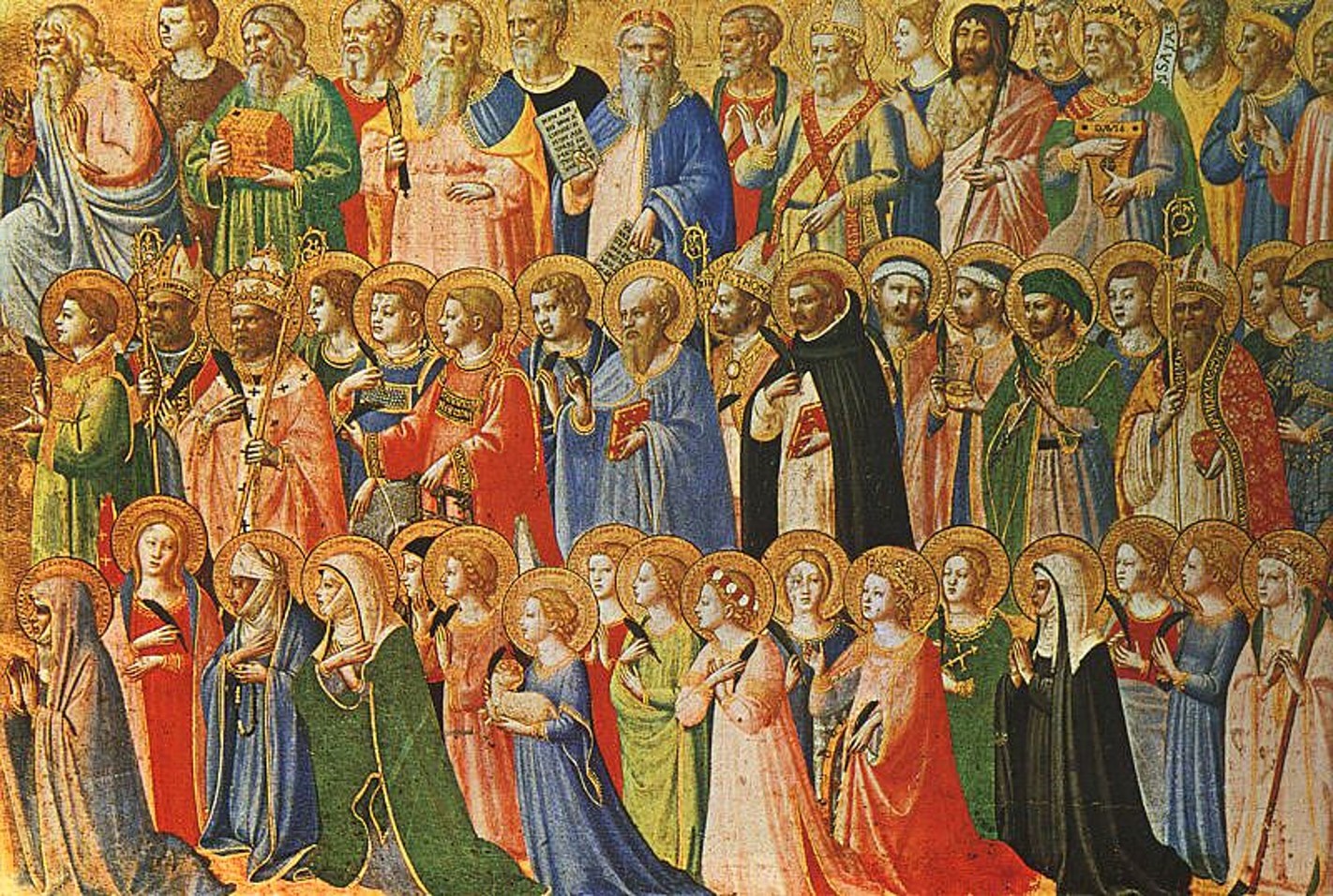

Last time I gave a talk of this nature, at the Queen Edith Festival last March, I began by admitting I was something of an imposter and that my real expertise lay elsewhere – mainly in rather obscure branches of engineering, but in historical terms, in 19th century Black Country history – neither of which are terribly relevant to what I am about to say tonight. So once again, ladies and gentlemen, I fear you have an imposter in your midst.
Be that as it may, as you will be quite aware, we are at the beginning a quite intensive run of festivals of different sorts – in ecclesiastical terms, the feasts of All Saints and All Souls, nominally on the 1st and 2nd of November, tomorrow and Saturday, but which we will be celebrating on Sunday and Monday. Then we have the more secular celebrations of Halloween tonight, Bonfire night on Tuesday November 5th, but which will mainly be celebrated in different places over the coming weekend and Remembrance Day on Monday November 11th, but again with the main ceremonies held next Sunday. In this talk – I hesitate to call it a lecture since that suggests expertise – I want to trace how all these festivals came about, and how they interact with each other, at least as far as Britain and (to an extent) Ireland are concerned. In doing the research for this talk, I have been led down some fascinating alleyways of knowledge and have really rather enjoyed myself. Hopefully what I have to say may be of interest, and perhaps also to a limited extent, enjoyable.
As a working title for the season I am thinking about, I will refer to it as the All Saints season that extends from the end of October through to the middle of November. The title of the talk is of course taken from the book of Ecclesiastes that, for those of a certain age, they will know this passage from the version by the soft rock band the Byrds in the 1960s.
To everything there is a season, and a time to every purpose under the heaven: A time to be born, and a time to die; a time to plant, and a time to pluck up that which is planted……. A time to weep, and a time to laugh; a time to mourn, and a time to dance…….
I chose the title, because the season is indeed one of contrasts, of joy and sadness, of light and darkness.
Before going any further though, it is worth pointing out that this isn’t the first time there has been a special series of events here in the All Saints season. On November 10th 1858, the church was re-opened after its restoration (it should have been on All Saints Day, but the work dragged on somewhat). The events in that case consisted of a series of sermons spread over three or four days. The church was filled on at least some of these occasions – I doubt sermons would be that attractive today! There were also similarities in financial terms. – there was a deficit of £300 on the total project cost of £4000 and the collections were devoted to that. Not unlike the current lighting appeal!
But onto the talk. In thinking about the material, it is clear that in the development of this season there are a number of what one might call strands, as in a rope, that twist around each other. So, it seems to me that a way of presenting the material is to think of each strand separately and then think about how they interact with each other. Up to the time of the Reformation in the 1500s, it seems to me that there are two major strands, and I will call them the seasonal strand and the sacral strand. Each of these strands are composed of different threads, although that is perhaps pushing the metaphor a bit far. After discussing the nature of these strands, I will then go on to argue that the Reformation caused major disruption. But after the Reformation, by the late 1500s, these strands have reformed, although composed of perhaps rather different threads, and a third one added, that I will refer to as the secular strand. This gives a pleasing three-way alliteration such as is beloved of preachers, of which of course I am one. And, whilst I will basically try to keep this as a historical talk, it will inevitably have a Christian perspective, with very much of an Anglican bias.
So, we begin by thinking about the pre-Reformation era, and firstly with the seasonal strand. For all agricultural and pastoral societies, the development of a calendar of some sort is a necessity to know when crops should be planted and harvested, when animal migrations will occur and so on. Now, there are two basic types of calendars that are found to this day – the solar and the lunar. Both have had an effect on how this season of All Saints has developed. Of most importance to this particular season is the solar calendar – it comes at a fixed time of year as Autumn closes and the rigours of winter begin. The influence of the lunar calendar is less obvious but comes from the fact that the central religious events that are commemorated in the Christian tradition – the death and resurrection of Jesus – are defined by the Jewish lunar calendar, and these feasts move year on year through the solar calendar. We will see that this has influenced, at times, the dates of All Saints Day in particular. Getting the relationship between the lunar calendar and the solar calendar correct was of huge importance to early Christians – obviously so that the date of Easter would be correct. This led to a form of calendric mysticism – seeing in the overlapping lunar and solar cycles something about the nature of time and the nature of God.
Now in the British Isles there have been two basic solar calendars. The first is built around the quarter days, the spring equinox; the summer solstice; the autumn equinox, and the winter solstice. From an early period, perhaps from the early Anglo-Saxon era. these quarter days have been sacralised and aligned, roughly, with Christian feasts as Lady Day (the feast of the Annunciation); the birth of John the Baptist and the feast days of St Peter and St Paul in the middle of summer, the feast of St Michael and All Angels or Michaelmas, and, of course, Christmas Day. They correspond with the approximate middle of our four seasons of spring, summer, autumn and winter. In the Gaelic and Brittonic speaking areas of the British Isles – Ireland, Scotland and Wales the seasons were marked by festivals that (approximately) aligned with the mid-quarter days – Imbolc the start of February, Bealtaine at the start of May, Lughnasadh at the start of August and Samhain at the start of November. These correspond to the beginnings and endings of the four seasons. Again, they became, to a degree, sacralised after the conversion to Christianity in late antiquity- Imbolc became Candlemas; Lughnasadh became Lammas (loaf mass) Samhain becomes
All Hallows or All Saints. It is the latter of course that is of interest to us at the moment. Sacralisation never really worked for Bealtaine, and all it managed was to become the feast of St Philip and St James, two apostles about whom little or nothing is known. Historically, the records, such as they are, suggest that before the Reformation, Samhain was a time when there was widespread celebrations and feasts in Ireland, Wales and Scotland, as families and tribes gathered together – a community time. The Venerable Bede, in the seventh century refers to the month of November as Blod-monath in pagan Anglo-Saxon times – Blood month, where animals are slaughtered before the winter, and their meat salted, and this may well have also been an aspect of Samhain for the 1000 years that followed the conversion. The number of folk tales of witches, fairies, goblins and so on that have Samhain as a setting, suggest that it was regarded as an “uncanny” time, when the spirits were abroad. There is however no evidence at of religious rites, sacrifices to gods and so on. This is hardly surprising in my view – all of the British Isles was thoroughly Christianised by the six and seventh centuries, and although we read tales of the early evangelists contending with demons these tend to run out near the beginning of the Anglo-Saxon period in the century after the conversion. One of the last such group of tales seems to belong to the life of St Guthlac of Crowland not far from here, in the fens around Peterborough in the early 700s, where he battled against demons and demi-gods. Recently on an early morning train trip seeing the mists drifting over the fens around Whittlesea, it still seemed like an ideal place for demons to inhabit! But after Guthlac’s time, there is no record of worship of anything other than the Christian God and the formal warnings by Bishops against pagan practices cease about the same time too. There is however evidence, albeit from a rather late period, that the festival was also marked by the lighting of fires – perhaps as a protection against the surrounding spirit world, or perhaps for the purposes of divination as is known to be the case at Bealtaine for example.
In England and much of Europe, however, the situation was somewhat different and the community and feasting aspects of the season were centred on Martinmas on November 11th, which was seen as the end of the harvest and the start of winter. St Martin was a 4th century Roman soldier who couldn’t reconcile his Christianity with a military life and became a hermit and then a bishop at Tours in France. He was much loved by his congregation and was very active in the destruction of pagan temples and sacred groves.
Moving on now to the second strand – the Sacral. From the depths of time, it is possible to discern in the archaeological and written records, a deep human concern with ancestors, with careful preparation of bodies for burial, storage of ancestor’s bones and so on through cultures as diverse as the ancient Egyptians and the neolithic, bronze and iron age inhabitants of these islands. At the start of the Christian era in the Mediterranean, it was commonplace for families to meet at the tombs of ancestors to eat, and in some sense share with the dead, a celebratory meal. There is some evidence that at the feast of Samhain in particular in Ireland and to a lesser extent in Scotland and Wales, the spirits of the ancestors were perceived to be abroad and needed to be appeased by offerings of food and drink.
One striking exception to these practices concerned with the ancestors seems to be in the Jewish tradition, where there was no clear concept of the afterlife, and certainly noindication that the ancestors were in any way concerned with the living. Indeed, any attempts to contact ancestors or to appease them was strictly forbidden under the Torah. At the start of the common era there were two schools of thought within Judaism. The first envisaged a rather nebulous and shadowy afterlife for the dead in Sheol. Again, from the book of Ecclesiastes
For the living know that they will die, but the dead know nothing; they have no further reward, and even their name is forgotten
Ecclesiastes was a cheery soul. The other school held to a developing concept of a heavenly resurrection from the dead. These were the Sadducees and Pharisees of the biblical accounts.
The events of the Jewish month of Nisan in the year 33 were to change all that – the passion and resurrection of Jesus. Whatever one makes of these events, one thing about them is certain – that the relationship between the dead and the living was radically changed for the followers of Christ. The hope of an eternal existence and some sort of physical resurrection was, and is, the core of the Christian story, with the belief that life continues beyond the grave. This radical change in belief was to have several implications both for Jewish and non-Jewish Christians that were worked out over the centuries. The first was the concept that for the heroes of the faith – the martyrs, those who lived particularly holy lives – their death meant a direct entry to the presence of God. From this there arose, quite early in the Christian era, the concept of the saints in heaven being in close relationship with those on earth. From the letter to the Hebrews, written in the second half of the first century
Therefore, since we are surrounded by such a great cloud of witnesses, let us throw off everything that hinders and the sin that so easily entangles.
The boundary between the church triumphant in heaven and the church militant on earth was perceived as very thin and porous. And the saints took the place of ancestors in the lives and rituals of many. In the early centuries meals were eaten around the tomb of these “saints”, as they had been around the tombs of ancestors, which in turn lead to the development of churches around these tombs, where the Christian meal of the Eucharist was celebrated, often within cemeteries. The Basilica of St Peter in Rome is the most magnificent outworking of this. In essence the saints became part of the Christian family in a specific location. And it is clear from the records that many Christians felt a very close and real relationship with their local saint, or with the saint they were named after. This is not something that, with our twentieth century materialistic mind set, we can easily understand, but it was of huge importance to those in the Middle Ages. From this the medieval cult of the saints developed, with churches of increasing magnificence being built around the tombs of saints, or parts of saints – their relics – with pilgrimages to particularly holy sites. And saints were appropriated by different groups in society as their patrons. For example, consider the saints commemorated on May Day, Bealtaine, the two little know apostles – Philip became the patron saint of bakers and cooks and James the patron saint of hatters. Generally, the major celebration of any particular saint or martyr was on the anniversary of their death and if this was not known, then some arbitrary day related to Easter or Pentecost was often chosen. But there were of course many minor saints, martyrs and holy men and women who were not celebrated universally and whose death date was generally not known, and it was this that led to the idea of celebrating this crowd of witnesses on a particular day.
From the fourth century onwards, this celebration of All Hallows seems to have been held on days at fixed times around Easter and Pentecost and this remains the case for some of the eastern churches – on the lunar calendar of course. However, in Northern Europe churches began to celebrate this feast on November 1st (on the solar calendar) and this practice was extended to the whole catholic church by Pope Gregory IV in the ninth century. It is not clear why this date was chosen, but clearly one particular reason might have been that this coincided with the date of Samhain, and similar feasts elsewhere in Europe where the ancestral spirits were felt to be active. But this is really speculation. The feast clearly proved popular however and the church dedication to All Saints or All Hallows is the third most popular in England.
There were of course many other Christians than the saints and martyrs that were so honoured and exalted. And the line of thought developed over the centuries that these did not go straight into the presence of God, but rather to “purgatory” a place of purging and preparation the nature of which could be quite benign, a sort of final washing away of the sins of this world, or could be more severe – with the obligatory taste of hellfire and the length of stay (one might say sentence) was dependent upon the nature of one’s life on earth. This period could be shortened by the prayers of the faithful still living, or, much more effectively, by the prayers of the saints who are already in the presence of God. And this led to the practice of invoking the saints to pray for dead loved ones evolved. This was a very radical change in concept from the pre-Christian era in all parts of Europe, and it took a strong hold within the British churches. By the time of the Reformation, the concepts of praying for those who have died, both directly and through ones favoured saint or saints had become the norm. The institution of a day for a general payer for the departed, on November 2, is due to Odilo, abbot of Cluny who died 1048, chosen to follow All Saints’ Day. Having celebrated the feast of all the members of the church who are believed to be in heaven, the church on earth turns, on the next day, to commemorate those souls believed to be still in purgatory. Again, the choice of this date was consistent with the date of Samhain and other similar festivals.
The idea of purgatory and the need for prayers for the dead had many consequences. One of these was the trend toward establishing chantries – to pay priest to say masses and to pray for the souls of specific departed and for their release from purgatory. And in many medieval churches there would have been altars dedicated to such purposes. Here at All Saints, it is likely that the guild altars dedicated to the Holy Trinity, All Saints and St Mary (the modern Trinity chapel, chancel and Lady chapel) would also have been used for this purpose, together with the other guild chapels located where the old grammar school now stands, dedicated to St Michael and St Mary again. The existence of communion shelves or piscinas in the north and south transepts suggests there was an altar on their east walls, that again were likely to be used as chantries.
It is possible too that here at All Saints there were relics – 19th century reports describe a cupboard in the east wall for that purpose – and it is still marked by a shelf in the late 19th century stone work. Whist that may have been the case, I am far from convinced. But of course there is a more proven place of relics locally, at Brooke, and the Brooke Reliquary can be seen in the County Museum.
Another consequence of the concept of purgatory that is perhaps less attractive was the selling of indulgences – by suitably donating to the church, a reduction of the time your loved ones spent in purgatory could be reduced. Apparently. Apparently. Johan Tetzel is said to have coined the phrase
As soon as the coin in the coffer rings, the soul from purgatory doth spring.
So just prior to the Reformation in the 1500s, ordinary Christians would have experienced the liturgical expressions of All Saints Day – the ceremonial of the high mass and processions to shrines, and the call to prayer for the dead on All Souls Day. The primary liturgical celebration of the latter was the ringing of bells – for the encouragement of the dead, to show that they have not been forgotten. In parts of the British Isles these celebrations would have been accompanied by family and community celebrations, perhaps with the lighting of fires, and generally there was an enhanced awareness of the reality of the spirit world all around them.
The two strands of the seasonal and the sacral had become thoroughly entwined. But the Reformation was to change all that. This is not the place to give the history of the Reformation, or to chart its different courses across the countries of Europe. It is usually said to have begun in 1517 when Martin Luther famously nailed his 95 theses to the door of the church in Wittenberg, with one of his major targets being the sale of indulgences. Uniquely in England it led to the considerable enrichment of the monarchy, in this case Henry VIII, through the dissolution and sale of the monasteries, overseen by Thomas Cromwell, and to a reformed protestant national church, with a quite conservative liturgical provision, as well as a wide range of fissiparous non-conformist churches.
Now let’s move on to see how the season developed after the Reformation. As I said both the seasonal and the sacral strands were to re-form, perhaps with rather different threads, and we will see a third was added – the secular. Again, we consider each in turn.
Firstly, the Martinmas feasting tradition in England died out and was not revived, and the community and family celebrations moved to the feasts of All Saints and All Souls at start of the month, effectively merging with the Samhain celebrations in the rest of the islands. Indeed, Martinmas was known as the old Halloween, particularly after the loss of 11 days in the calendar change of 1752. In the regions where Catholicism remained strong, particularly in Ireland the Highlands, the seasonal strand at Samhain continued much as before. As the sources become more widespread, we can see that, in all parts of these islands, there were collections for provisions for the feasts associated with this strand, often with “collecting” songs – for example the soul cake tradition
A soul! A soul! A soul-cake!
Please good Missis, a soul-cake!
An apple, a pear, a plum or a cherry,
Or any good thing to make us all merry.
One for Peter, two for Paul
Three for Him who made us all.
Similar collecting songs were widespread across the country, including the more protestant areas. The collections were often accompanied by lanterns made from candles within hollowed out mangle wurzels or turnips. It remained an “uncanny” time and there are records of bonfires for either protection or divination continuing across England, Wales, Scotland and Ireland – the evidence usually coming from reports of clergy attempting to suppress them.
Even where they were successful in this, the tradition changed, either to small hand-held fires – such as those in Lancashire consisting of a bunch of straw at the end of a fork, or small bonfires known as tindles around Derby, which seems to have an association with praying for the dead in purgatory. In addition, a tradition of disguising begins to appear in the record (seemingly at first to protect those disguised from witches and fairies), and this, inevitably, evolved into pranks and games. This began in Ireland, but quickly spread with the emigration of the Irish to England and Scotland, particularly in the 18th and 19th centuries. It also passed to the United States and from there back to England through immigrants and visitors and we all know where that was to lead to.
But again, it needs to be stressed that there is no evidence at all that pagan deities were worshipped at the time. That such worship continued underground throughout the Christian era is largely an invention of the Victorian folklorists and in particular Sir James Frazer of Trinity College Cambridge and Margaret Murray of University College and President of the Folklore Society. This concept has been thoroughly debunked in recent years by historians who, quite reasonably, went back to the source material and found nothing there. But nonetheless this concept has entered the popular imagination, and many would still believe that pagan worship continued underground beneath a thin veneer of Christianity, despite the complete lack of any evidence for this.
That being said, is perhaps worth digressing to consider the concept of fairies, spirits and witches a little at this point. Was there any reality behind the fears and worries apparent in many of the stories of the seasonal thread that derived from Samhain? As someone who believes in a creator God, I don’t find it difficult to believe that other, what one might call, spiritual, entities exist, in our world. But if they did, or indeed, do exist, recent scholarship has shown that they are very much dressed in the clothes of beings that ultimately find their origin in classical Greek and Roman myths and folk tales, mediated through the medieval church. They have been moulded, if not created, by men and women. As such, if they are human creations even in a secondary sense, they will, like humans, be a complex mix of the good and the bad. With regard to the witches so feared at Samhain, these probably derived from the ancient “wise woman” or “cunning folk” traditions, or from simple fear of older ladies who refused to be bound by social conventions. There are maybe a few such in Oakham still.
Moving on now to the Sacral strand. This strand was inevitably most affected by the Reformation. As in other countries, the unscriptural doctrines of purgatory, the selling of indulgences and praying to the saints for the departed were obvious targets for the reformers. Article 22 of the 39 articles reads
The Romish Doctrine concerning Purgatory, Pardons, Worshipping, and Adoration, as well of Images as of Reliques, and also invocation of Saints, is a fond thing vainly invented, and grounded upon no warranty of Scripture, but rather repugnant to the Word of God.
In the prayer book of 1549 and all those that followed, All Saints Day was retained as a festival, but as a simple commemoration of the lives of past saints, rather than an affirmation of the unity of church triumphant and militant. Saints were at best seen as examples and role models. For example, the hymn “How bright these glorious spirits shine!”, by the 17th century hymn writer Isaac Watts, contains these verses.
Lo! these are they from sufferings great
who came to realms of light,
and in the blood of Christ have washed
those robes that shine so bright.
Now with triumphal palms they stand
before the throne on high,
and serve the God they love amidst
the glories of the sky.
Here the Saints are pictured, and their heavenly state described, but there is no indication that there is any possibility of human interaction as in the old pre-Reformation days. All Souls Day was not mentioned in the Prayer Book at all, and the concept of praying to the saints and for the departed was, as far as it was possible, abolished – although the personal prayers of individuals couldn’t of course be so proscribed – for example the small fires mentioned above were regarded by some as surrogates for prayer for their loved ones. Also of course the graves of the dead were still visible, and still received the attention of their families. And there could be no prohibition on whatever private prayers might have been offered there.
Ringing bells for the dead was intermittently banned and restored during the reigns of Edward VI, Mary and Elizabeth after the reformation, but continued sporadically for many years in a number of places, despite clergy opposition. Nonetheless until the Tractarian Revival of the nineteenth century revived the practice, praying for the departed was absent from the church’s liturgy. Even now, for many parts of the Church of England and the non-conformist churches, such prayer is definitely not encouraged, in public at least, and there is often a hesitancy about the practice. The invocation of the prayers of the saints for the departed has really departed from mainstream Anglican and non-conformist traditions.
I mentioned earlier that after the Reformation a third strand appeared – which I called the secular. The secular strand first arose in the reign of Queen Elizabeth I, where it became the practice to ring church bells, usually in the evening, to celebrate her accession date conveniently timed for the season on November 17th. This began after the catholic rebellion of 1569 as a mark of loyalty. Whilst theoretically not connected at all with the earlier practice of ringing for the dead, many would no doubt have made the connection. This practice continued after her death, particularly in London, as a form of protest – the bells were rung for her on November 17th and very ostensibly not rung for the birthdays of Charles I and his (catholic) wife Henrietta Maria on November 19th and 16th respectively. Who would have thought that bell ringers would be radical protesters? The same situation arose after the Restoration with the bells ringing on November 17th in contrast with the non-celebration of Charles II’s catholic wife Catherine of Broganza on November 15th. Maybe the older bells in Oakham’s ring of eight, which, at least before their recast in 1910, date from this period, were used for this seditious purpose. It would be nice to think so.
The next thread in the secular strand is of course the events of November 5th, 1605 – Gunpowder, Treason and Plot and so on. It was clearly very thoughtfully timed for the All Saints season, and the celebratory bonfires (and papal effigies) that resulted were almost immediately popular and have remained so to this day. Again, they are not in a direct way a continuation of the bonfires of protection and divination in the pre-Reformation seasonal strand, but they certainly match the mood of celebration and provision of light that were characteristic of the old ways. Fireworks were used almost from the start, at least for the larger events, the techniques of making them having come from China a couple of hundred years before. This is perhaps the most international aspect of the season. Sporadic attempts were made to ban them – most notably by the catholic James II in the early 1680s, but these were mostly futile. Again, most suitably for the season, William of Orange, scourge of the Catholics, landed in England on November 5th, 1688. James II fled to France, and the Glorious Revolution began.
This essentially secular festival did, however, become entwined with the sacral strand, with a liturgy being produced by the Church of England and used through to the mid nineteenth century. This had specific responses, readings and prayers that were to be used on November 5th, which included this gem
ALMIGHTY God…we yield thee our unfeigned thanks and praise for the wonderful and mighty deliverance of our late gracious Sovereign King James, the Queen, the Prince, and all the Royal Branches, with the Nobility, Clergy, and Commons of England, then assembled in Parliament, by Popish treachery appointed as sheep to the slaughter, in a most barbarous, and savage manner, beyond the examples of former ages. From this unnatural conspiracy……thy providence, delivered us: therefore, unto thy Name be ascribed all honour and glory … through Jesus Christ our Lord. Amen.
We don’t have collects like that anymore. And that one wouldn’t have done a great deal for ecumenical relations. The liturgy for the day was withdrawn in 1849.
And of course, in this secular strand, we have Remembrance Day on November 11th, commemorating in the first instance the end of the Great War in 1918. When this annual remembrance was first suggested, there was a move to create a Bank Holiday as a day of celebration. This was resisted by the then government on the grounds that there should be a solemn act of remembrance rather than the celebrations that would result from a Bank Holiday. Indeed, in the first instance, the only act of remembrance that was specified was the silence on November 11th on whatever day of the week it was, although specific liturgies were to develop. This decision seems to me to have been wise, and to a large extent responsible for the fact that Remembrance Sunday has retained its importance and is usually the final act of the All Saints season.
But over the last fifty or so years another aspect has been added to the season, that fits in with both the seasonal and the sacral strands – the rise of what has been called Modern Paganism for which the feast of Samhain is a significant time. Modern Paganism exists in many different forms, but one of its underlying concepts seems to be a desire to recover the “uncanniness” of the season, for which I have every sympathy. But with this quite often comes a pantheistic approach to creation – that God and creation are one and the same, which is certainly not consistent with the Christian idea of a transcendent God that is both within and separate from the created world. Some forms of paganism also see this as an occasion for worship of their Gods, primarily the duality of the Mother Goddess and the Horned God, which it has to be said doesn’t seem to have much historical justification, as it is clear that this hasn’t been an aspect of the festival for most of the last 1500 years. Indeed, the origin of some of the pagan deities worshipped today lies in literary movements of the nineteenth century – the literary recreation of Natura, nature personified, and the minor Greek god Pan. Nonetheless, this brings a completely new aspect to the season, one that has considerable spiritual power for its adherents.
And all of this of course brings us to the present, where we see our three strands to the season thoroughly entwined, with each of the current elements of the season reflecting to a greater or lesser degree all three of them.
Whilst the precise dates of the various festivals have slipped somewhat, often to the nearest available weekend date, we now go through them in their calendar order.
Modern Halloween, on October 31st is, in the main, a secular celebration, although it clearly has a seasonal aspect. Sometimes it seems, with its demand for sweets and other goodies, almost to be a license for robbery with menaces! It is common, particularly amongst church goers, to bemoan the commercialization and trivialisation of the day, although a church that in the past sold indulgences to fill its coffers is perhaps in no position to moan. I do object however to the use of pumpkins, American interlopers, as lanterns rather than turnips or mangle-wurzles. I think I might start a campaign for the reintroduction of turnip lanterns.
The importance of Halloween to Modern Paganism has taken on a sacral aspect for its adherents. Whilst one should be respectful of those involved, and perhaps welcome the emphasis on the uncanniness of the season, the church needs nonetheless to be very wary of worship focused on anything other than Jesus, the way, the truth and the life – be it the worship of material possessions or spiritual beings.
Also on October 31st, the church now, with a deep implicit irony, celebrates the life of Martin Luther, from whom the Reformation sprang. He would probably be horrified to be remembered on the eve of the commemoration he sought to abolish – the anniversary of the day he posted his 95 theses on the door of the church in Wittenberg. In many European countries the day is celebrated as Reformation Day or held on the Sunday before as Reformation Sunday – an echo of which can be found in the Anglican Bible Sunday with which it coincides.
With regard to All Saints itself on November 1st, a body of powerful, new liturgical material has become available in recent years and I sense that once again the concept of the proximity of the heavenly and the earthly, the church triumphant and the church militant, is being more consistently reflected in the liturgy, and it is now more than a mere commemoration of the saints of old. There is, I believe, a deep human need for ceremony and ritual – a need I believe the more formal Anglican worship on occasions such as All Saints Day can go some way to meeting.
Recently too there have been wider liturgical innovations. All Saints Day has become the first day of a liturgical season that extends to Advent in which the lectionary explores the former traditional Advent themes of death, judgement, heaven and hell – perhaps after the realization that to try to make Advent about anything other than the preparation for Christmas is a losing battle!
There is one more thing I would like to say about All Saints itself. Specifically, I think there is a potential for it to become part of a much fuller seasonal liturgy. The church since the Reformation has to a great extent ceded the seasonal calendar to others – to commercial interests, to new age mystics, and to modern paganism. I would suggest that there is an opportunity to recapture that ground and provide a coherent and dramatic seasonal liturgy built around the eight solar calendar points, that both celebrates the changing seasons, and the world God has given us, but also tells the Christian story. Or in more theological terms, to redeem the calendar and consecrate the seasons. We do it already to some degree of course, specifically with Christmas, Easter and Harvest, but I think an overall coherent liturgical structure would give a framework and a focus for the growing “outdoor church” movement and for concerns over climate change and environmental degradation, moving beyond the current “creation” season which has been tacked on the liturgy in September time. The festival of All Saints would be crucial in any such liturgical framework – in some ways the culmination of the seasons, the drawing together of the events of the previous year, the turning of the seasons and the apex of the Christian story. Something to consider perhaps.
All Souls Day too on November 2nd was reinstated into the Prayer Book in 1928 and found its proper place in the liturgy of the church. It continues to provide for many, both within and without the church, focus for their prayers and their thoughts for their loved ones, with the candles that are so often used being in a direct line of descent from the small fires that were ignited after the Reformation. This has come at a time when there have been major shifts in the nature of funerary practices. Firstly, the most common form for a funeral is now cremation, and with the scattering of ashes at the deceased’s favourite locations, often there is no “place” for mourners to return to. Lighting a candle in church for the departed can fill a gap here, be it on all Souls Day or at other times. And secondly funerals and funerary monuments have moved away from proclaiming the hope of the Christian of resurrection, towards the celebration of the departed’s place within the family and a somewhat incoherent belief that those departed and their family will meet again.
This was very clear from a study I recently carried out on the memorial inscriptions in the large nine-acre churchyard of the church where we worshipped in Lichfield, where there was a significant shift in the nature of the inscriptions. Up to around 1940 these were very much centred on the Christian hope of resurrection, but since then they have come to reflect the deceased role as mother, father, grandparent and in some cases uncle, auntie, great-grandparent, or of their role within society, with a vague hope that all will meet again. The deceased is spoken of in such glowing terms that sometimes one wonders sometimes looking at the grave inscriptions what has happened to the curmudgeonly and miserable old grandfathers and grandmothers – they do not ever seem to have existed. But perhaps this lost hope of eternity is something that the All Souls service can help to rebuild as well as continuing to meet the emotional needs of the bereaved and to help them to remember those they have lost
On November 5th Bonfire night continues to meet the universal need for a good knees-up as winter closes in and with its fun and fireworks surely reflects the old bonfires of the pre-Reformation period – doe example effigies of prime ministers and other politicians are regularly burnt in the major celebration at Lewes. No doubt the current prime minister will feature at some stage.
Recently a new liturgical feast has been added to the season – one week after All Saints Day – the Saints and Martyrs of England on November 8th. Some of these martyrs come from the relatively recent past – a reminder perhaps that, to quote T S Elliot “There will always be martyrs and saints”.
Remembrance Day, marked on November 11th or on Remembrance Sunday continues, and its observance is widespread. In the poppy we have a powerful symbol that has been loaded with all kinds of significance. For those in any sort of public position the wearing of poppies for perhaps up to two weeks before seems almost obligatory. If they don’t, it seems to me they face the modern-day equivalent of blasphemy charges by sections of the press. Whilst it is essentially a secular festival, it is celebrated in many places, included here, with sacral or quasi-sacral rites, as indeed will happen here on Remembrance Sunday.
A further recent change has been the growth of Festivals of Remembrance, concerts with an Act of Remembrance, such as those at the Royal Albert Hall on Saturday, which have a significant entertainment aspect. So, we again see perhaps the festival moving away from the church and the coming together of the secular and seasonal strands, in a way that is completely consistent with the history of the season.
But perhaps on Remembrance Day it is also no bad thing to remember that it is also the feast day of St Martin of Tours who walked away from his career as a soldier to follow the way of Jesus, the Prince of Peace.
But our country is changing, with an influx of new immigrant communities from around the world. And I suspect these will all have an effect on the season. The catholic European and Latin American communities may bring new life to the traditional sacral celebrations, whilst the Black churches of the African communities may bring an increased awareness of the uncanny. But what will be particularly interesting is how these communities and also the large South Asian communities will begin to relate to the remembrance aspects of the season – remembering the departed on All Souls and those killed in conflicts on Remembrance Day. I don’t know enough of these communities to be able to even speculate on these questions, but these aspects of the season are of general and universal relevance and could be a major aid in the urgent need we have in this country to develop greater community coherence.
So, a season then of light and dark, a time to mourn and a time to laugh. A season of different strands and threads from a range of sources, but now all thoroughly mixed up together. I end with some very well-known words by William Walsham How, that speak of what to me is the most important aspect of the season, the long held Christian conviction that what we see is not all that there is, that the barrier between the church triumphant and the church militant is very thin, that we are indeed surrounded by a great cloud of witnesses.
But lo there breaks a still more glorious day:
the saints triumphant rise in bright array;
the King of glory passes on His way.
Alleluia, Alleluia!
From earth’s wide bounds, from ocean’s farthest coast,
through gates of pearl streams in the countless host,
singing to Father, Son, and Holy Ghost.
Alleluia, Alleluia!

