
All Saints Church in Oakham is a long term supporter of the Church Mission Society (CMS). It has recently been allocated two new mission partners, both working in Myanmar (formerly Burma). CMS have requested that the church does not publicise these links, as the partners work in a dangerous and sensitive situation. Nonetheless we pray for them and support them as best we can.
Very recently, after a service of Morning Prayer in which the mission partners were remembered, I happened to look at a plaque on the wall of the chancel just behind the pulpit, over one of the clergy stalls. The plaque’s location, and the plaque itself are shown in the photographs below.
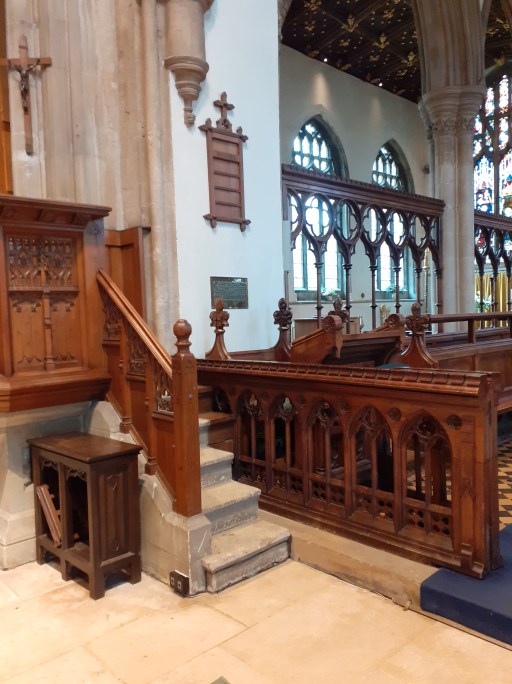

The typography of the plaque makes it quite difficult to read, which is presumably the reason I have never done so in the past, despite the fact that I have sat in front of it on numerous occassions. But on reading it, I noted that the church in 1906 already had a link with Burma. The plaque reads as follows.
To the glory of God and in memory of Henry Arthur Jerwood, scholar and prefect of Oakham School; a faithful and beloved curate of this parish and a zealous missionary. The lamps in the chancel and sanctuary are erected by his schoolfellows, friends and parishioners. He died serving in obedience to his Master’s call at Mandalay on March 26th 1906.
Mandalay is the second largest city in Myanmar, 600km north of the capital Yangon (formerly Rangoon) and is the centre of a largely Buddhist area. Our current mission partners are thus not the first links that the church has had in that area.
Henry Arthur Jerwood
Can we say any more about Henry Jerwood? His basic biographical details can easily be traced on Ancestry. He was born in 1878, the eldest child of Rev. Thomas Frederick Jerwood (1846-1926), Rector of Little Bowden and Dorothea Elizabeth Longsdon (1853-1942) who were married in Yorkshire in 1877. The couple had a number of other children, amongst them Helen Dorothea Jerwood (1880-1965), who will be mentioned below, Rev. Frederick Harold Jerwood (1885-1971) who was to become Chaplain at Oakham School, amd Major Hugh John Jerwood MC (1890-1918) who was killed in action. The latter had a son, born in 1918 after his death – John Michael Jerwood (1918-1991), a businessman and philanthropist, who was to become a significant benefactor of Oakham School, and a number of the school facilities bear his name.


Henry Arthur attended Oakham School, as his father had done before him, and his brothers were later to follow him there. He matriculated at Sidney Sussex College, Cambridge in 1897, taking his BA in 1902 and his MA in 1905. He took some time out just before he graduated to fight in the South African (i.e. Boer) War from 1900 to 1902 with the Suffolk Regiment.
Clergyman and Missionary
After graduation, Henry Jerwood attended the Clergy Training School in Cambridge (the early name of Wescott House) and was ordained deacon in 1902 and took up the curacy at All Saints church in Oakham, a town with which he would have been very familar from his schooldays. The chronology of his training and ordination as deacon and priest is not wholly clear from the sources. In 1905 he applied to become a missionary to Burma. We can trace his short career there through the pages of the Quarterly Paper of the Rangoon Diocesan Association (RQP), a nationwide organisation that supported the work of missionaries in Burma, and was affiliated to the Society for the Promulgation of the Gospel (SPG). These are all available as pdfs in the SOAS missionary archive. As an aside, those who, like myself, dabble in historical matters, are hugely indebted to the patience and the perseverance of the archivisits who made such material available. In RQP 34, June 1905 we read the following under the heading Reinforcements, which says something of the military mindset of the organisation.
…….The Rev. Henry Arthur Jerwood, B.A., of Sidney Sussex ‘College, Cambridge, and the Clergy Training School, was ordained in 1902, to the Curacy at All Saints, Oakham, in the Diocese of Peterborough……
The Rev. A. Jerwood, at present an assistant Curate at Oakham, will join Mr. Fyffe at Mandalay~ a man stout and , vigorous in body and stout of heart, who went to South Africa when the war broke out, and did his part there man fully, and will carry to his work in Burma the same vigour he gave to South Africa and Oakham.
In the next edition (RQP 35, September 1905) we read that, as a consequence of Jerwood’s departure, Rev H J C Knight, the Commissary of the Rangoon Diocesan Association (who recruited for the Association and was living in Jesus Lane in Cambridge), preached at All Saints on Sunday July 30th. The collection of £3 4s was given to the R.D.A.
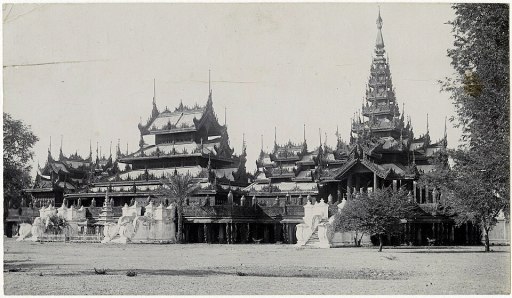
Then in RQP 36 from December 1905 Jerwood’s arrival in Burma is noted, under the heading News from the Front, again another military metaphor.
The newcomers have arrived, and are settling down to work, the Rev. H. A. Jerwood and Mr. Hart with Mr. Fyffe at Mandalay, the Rev. R. J. Stone at Bishop’s Court as Chaplain, the Rev. R. G. Fairhurst at S. Luke’s, Toungoo, and the Rev. W. H. C. Pope at Rangoon .
We also have the following description of the work in Mandalay,
The Buddhist Field – The Winchester Brotherhood has been founded at Mandalay, on the general lines of the Indian Community Missions, for systematic study of Buddhism and work in the field. The Head, Rev. R. S. Fyffe, has at present only one Brother (Rev. H. A. Jerwood). These two men are the only English Clergy for Missionary work in the chief town of Upper Burma, a city of 180,000 souls. They need at once two men of (if possible) a studious type, of patience, hope, and brotherliness. There is work to do while learning Burmese. The Brothers have passage and outfit paid, maintenance, lodging together, and £40 a year.
The mention of Jerwood in RQP 37 for March 1906 is very brief and simply says that he had taken over the role of Principal at the School run by the Winchester Brotherhood from Mr. Hart, who arrived in Burma at the same time as he did. Jerwood died on March 28th 1906. We read his obituary in RGA 38 June 2006, written by the Commissary Rev H. J. C. Knight.

Though most of our readers will have read the Bishop’s notice of Mr. Jerwood in the Mission Field for June, our R. Q. P. ought to have some notice of him. He was born on February 25th, 1878, the eldest son of the Rev. Thomas Frederick Jerwood, Rector of Little Bowden. He must have owed much to his home. On hearing from Bishop Montgomery that he had fallen asleep, his father was able to write “we hope to send another son.” and assuredly in homes that can speak thus:
“The father’s passion arms the son, And the great work goes on, goes on.”
All his school days were spent at Oakham School; thence he entered Sidney Sussex College, Cambridge. While yet an undergraduate he served in the S. A. war. On his return he graduated, entered the Clergy Training School, and was ordained to Oakham in 1902. Last autumn he went to Burma, calling at Delhi {where his sister was working under S. P. G. in the Cambridge Mission), and other Brotherhoods, and joined Mr. Fyffe at Mandalay in December. On the 28th March last he passed from us. The cause of his death was a rare type of paralysis – nothing climatic. The Bishop and the Rev. R. J. Stone, who was with him at the C. T. S., were in Mandalay at the time.
His body rests near the graves of the Colbecks.
We had looked for great things from his ministry in Burma. His qualities of simple manliness, unaffected and robust piety, a very-single-hearted devotion, unselfishness, courage and affection, drew men to him. These, and his unfailing cheerfulness, promised much for our Winchester Brotherhood. He went out “for life,” and so his home gave him. His letters from Mandalay were always touched with humour, and were full of hope and determination. It is easy to pray “Thy will be done,” while we have no disappointments or reversing of our purposes; but it is hard really to bow to the surrender of such a man. When Bishop Maples was drowned on Lake Nyassa. on the very day of his arrival as Bishop of Likoma, Augustine Ambati wrote, “God liked to take him, to make white (i.e., consecrate) so the waters of the lake.” Even so may Mr. Jerwood’s death in Mandalay be one more consecration of the city. To his friends – there and here – it will be one more tie binding us to the missionary spirit, and the forward march of the Church. It is good to know that Mr. Garrad, whom God has moved to carry on his torch, will be, we believe, in every way a brother to Mr. Fyffe. Those who loved H. A. J. will pray “The Lord bless his going out and coming in. ”
H. J. C. K.
The sister in Dehli that is referred to is Helen Dorothea. At the time she worked for the Cambridge Mission of SPG, but was later to work for the East India Company in Dehli. She remained in India all her life, dying in 1965.
Some final thoughts
Interesting as it is to find that All Saints had a link with Myanmar one hundred and twenty years before our current one, and to read Arthur Jerwood’s interesting and ultimately tragic story the aspect that has struck me most in the preparation of this post, is how very different our current Christian culture is to that of 1906. As noted above, military metaphors are often used in the RQP, and indeed the whole publication shows an extremely ordered and extensive organisation that itself has a military flavour. The form of Christianity that one finds in its pages is a very muscular and forceful one and whilst one can admire the earnestness and zeal of those determined to bring the gospel to those who had never heard it, the tone of the publication reflects the colonial era of its time, and the implicit superiority of European (and particularly British) civilisation and culture to that of the “natives”. Howerver, whilst I find this aspect more than a little repellent, I do wonder if we have lost something over the last century, in terms of our zeal and enthusiasm for the mission of the church, both at home and overseas. The words of Revelation 3.15-16 come uncomfortably to mind.
 Engineering, history and ecclesiology

2 thoughts on “From Oakham to Mandalay”