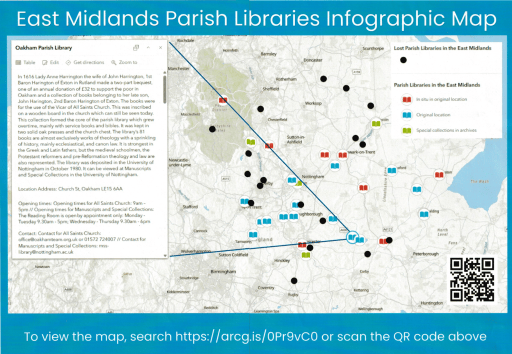
In early 2026, the University of Nottingham Library (Manuscripts and Special Collections) was instrumental in forming the East Midlands Parish Library Network, linking together those institutions who are custodians of a Parish Library, or whose Library is held elsewhere. All Saints Oakham is part of that network, with a Parish Library dating from 1616 that is held at Nottingham University. As a first step in establishing the network, an interactive map of the East Midland libraries has been produced. A screen shot is shown below, that links to the interactive online version.
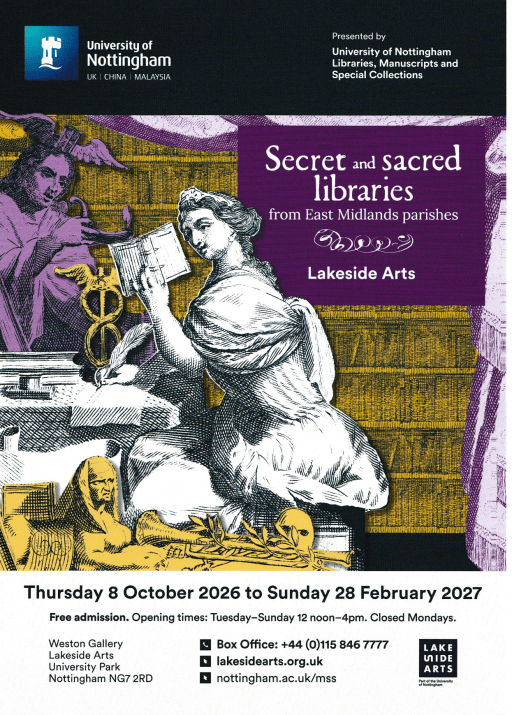
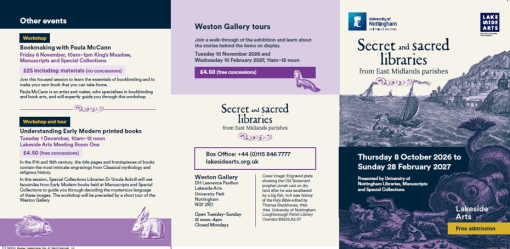
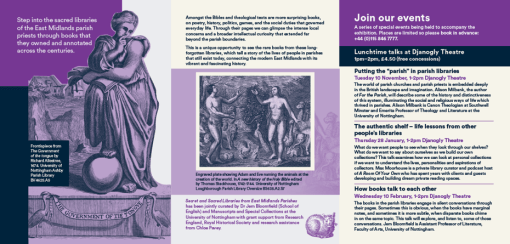
To further mark the opening of the network, an exhibition at the Lakeside Arts Centre was arranged from October 2026 to February 2027, with some associated talks and lectures. The publicity material is given below.
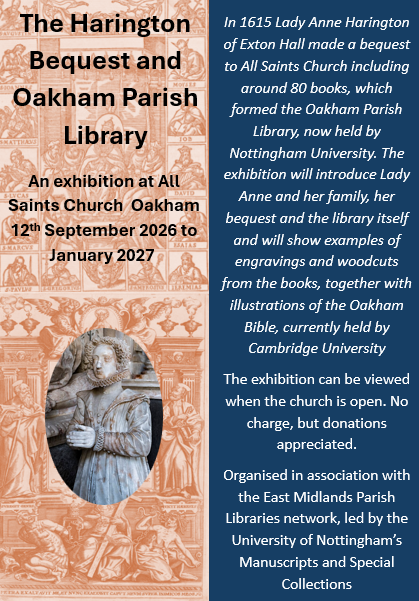
Harington Bequest and Oakham Parish Library Exhibition publicity and handout
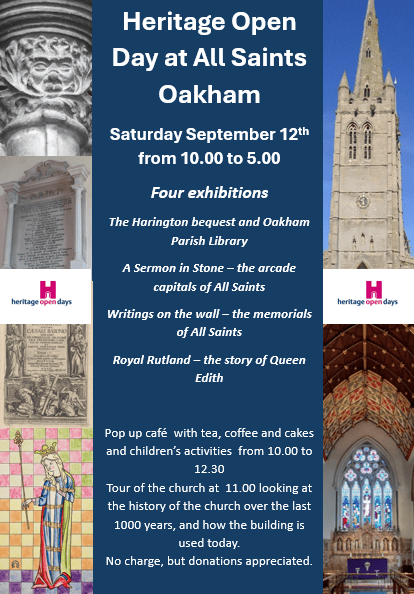
An exhibition to showcase the Oakham Parish Library was held in All Saints church from September to December 2026. It opened on September 12th, which was also a Heritage Open Day. The publicity material for the exhibition and the Open Day is given below.
The exhibition posters and other material
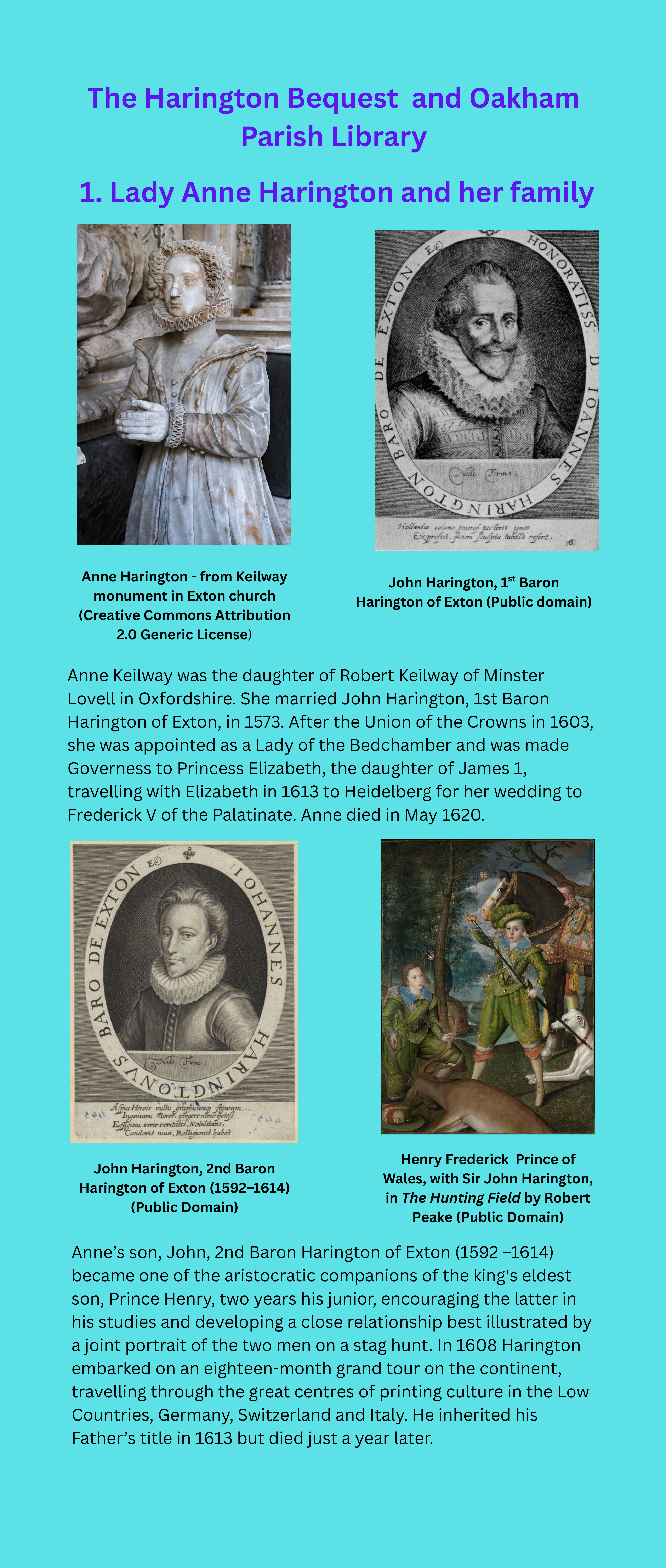
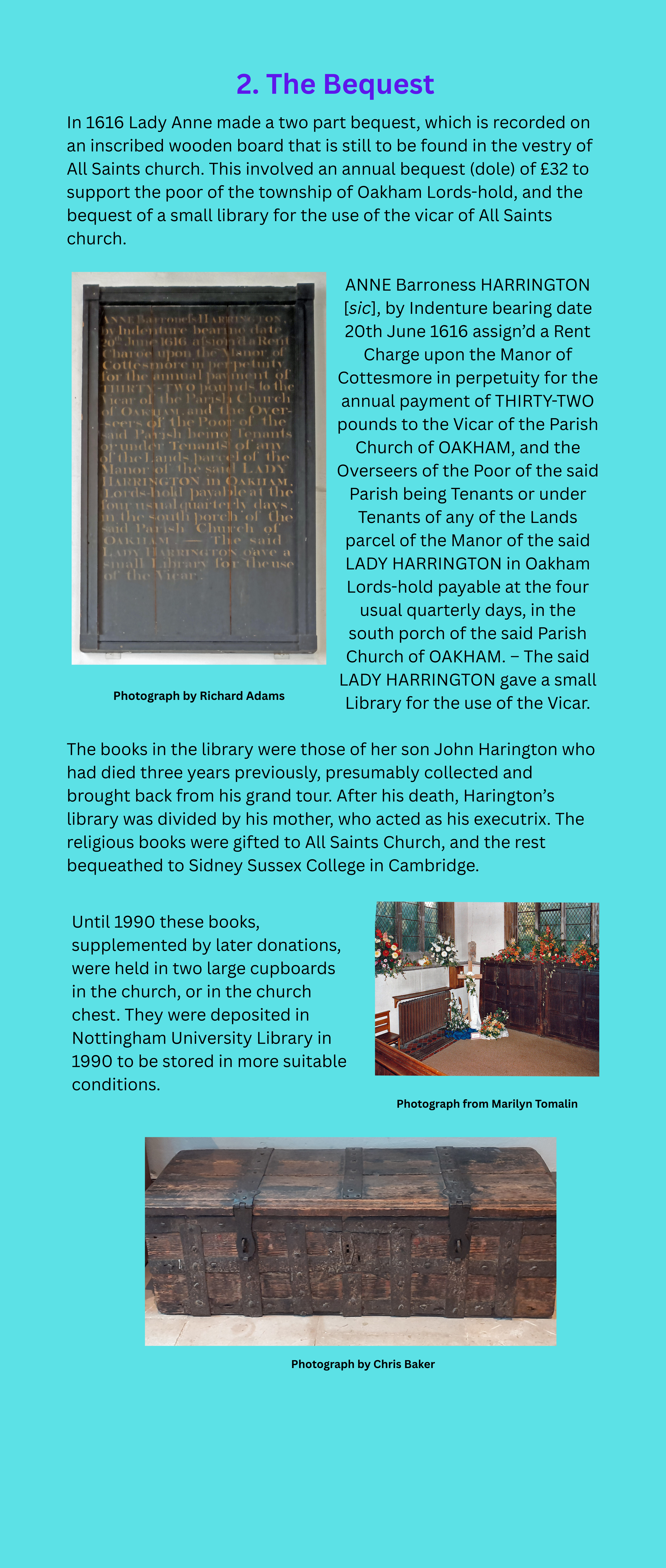
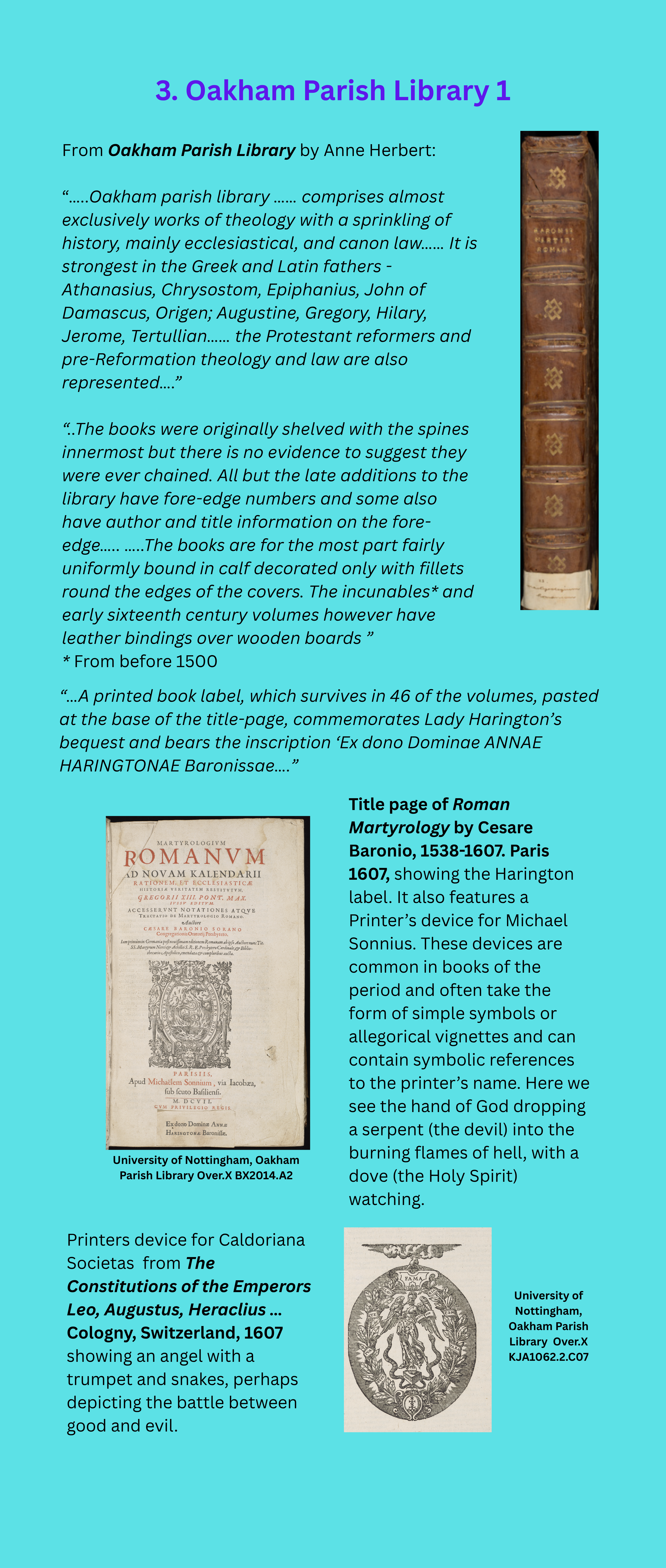
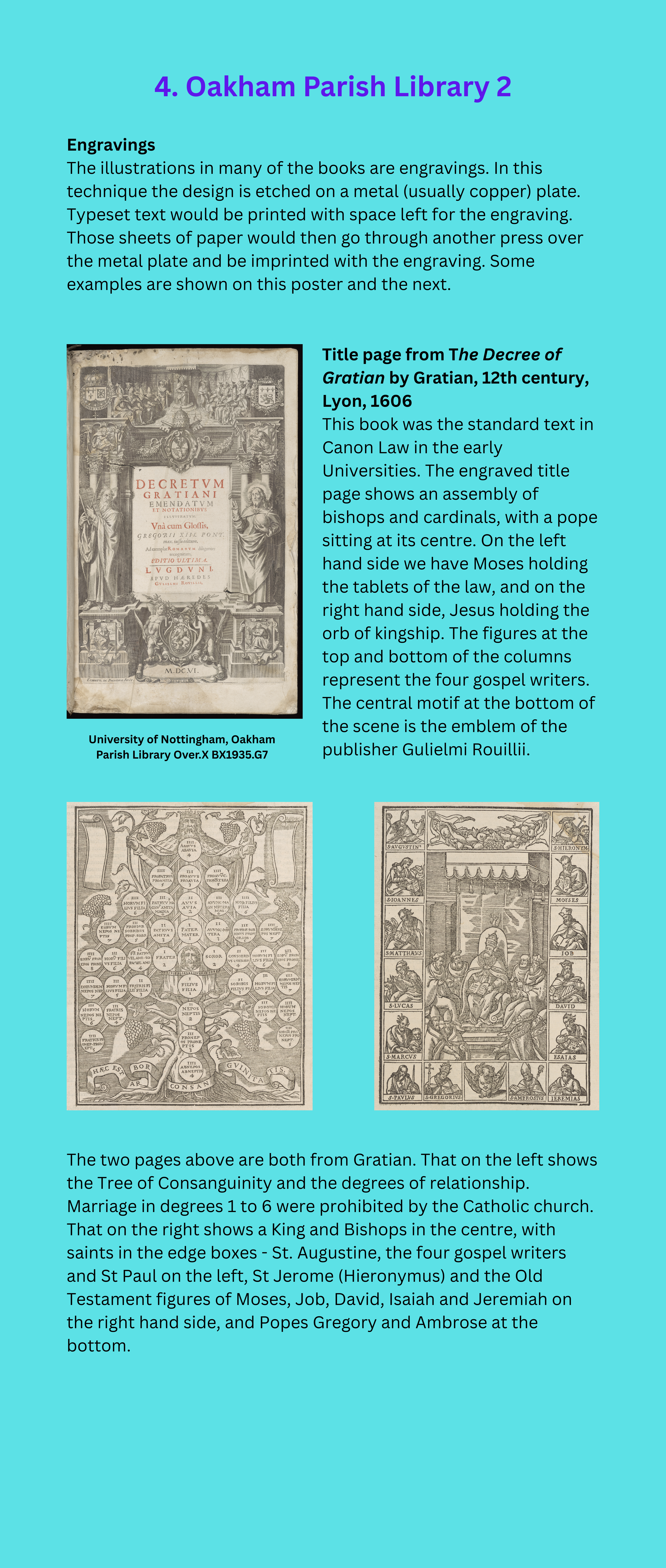
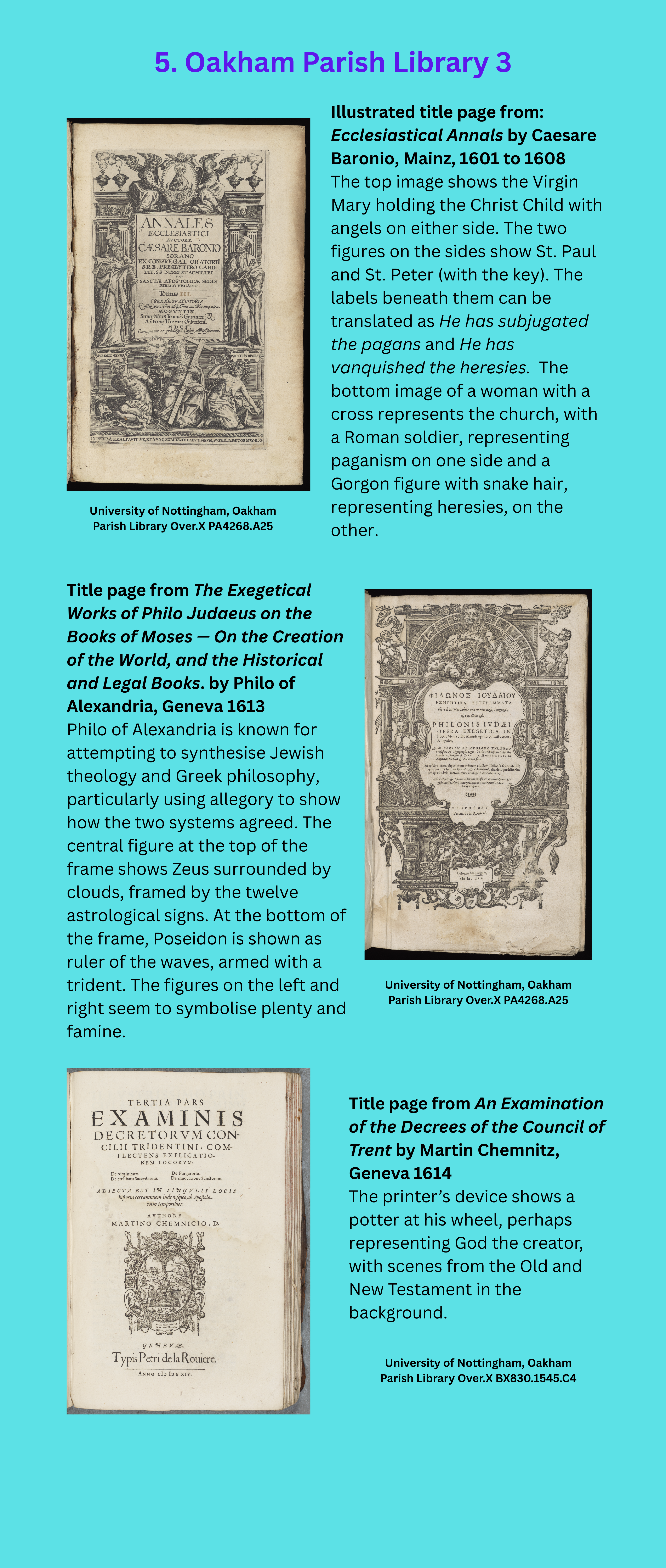
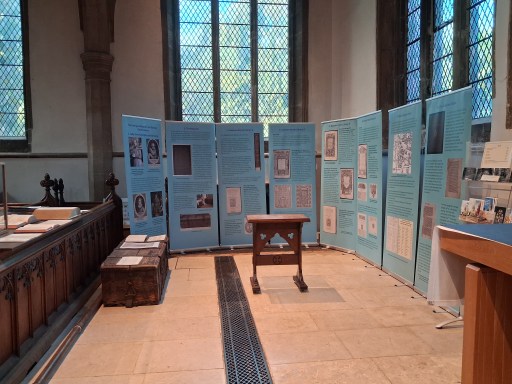
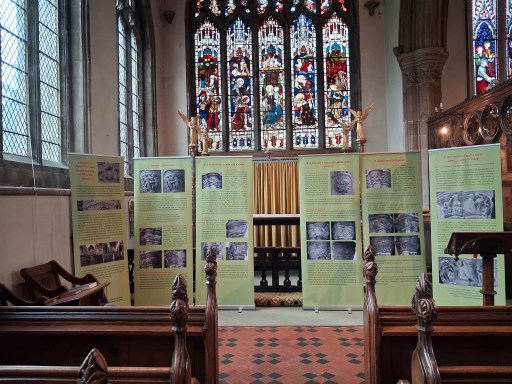
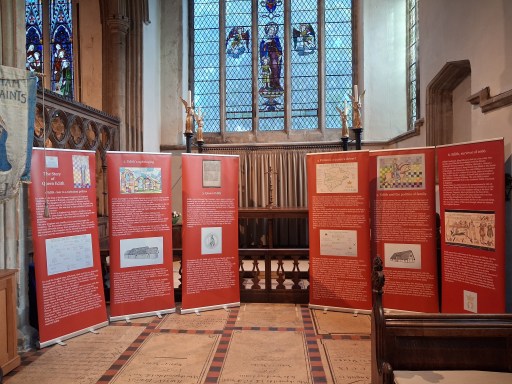
The exhibition itself consisted of eight pull up posters and a number of old bibles and prayer books held by the church that described the Harington bequest, the Oakham Parish Library and the Harington dole. In addition there is a board that features the Oakham Bible – a 13th century bible owned by the church but now in the Cambridge University Library. The record book for the Harington dole was also on show. The pull up posters are shown below. they can be expanded and downloaded if required by clicking on the images.
Photographs
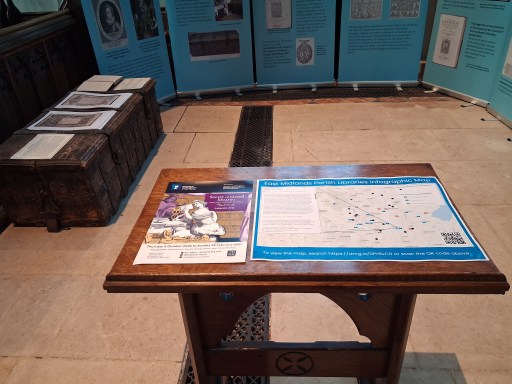
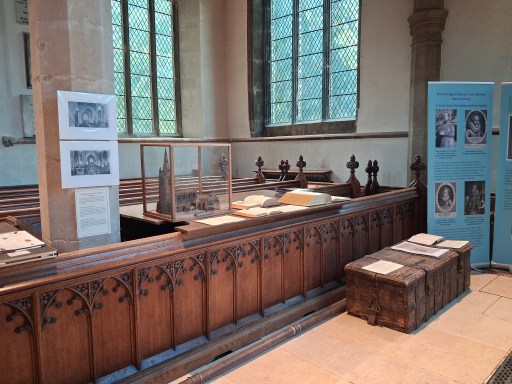
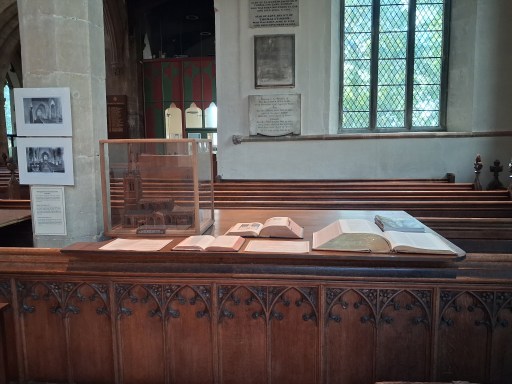
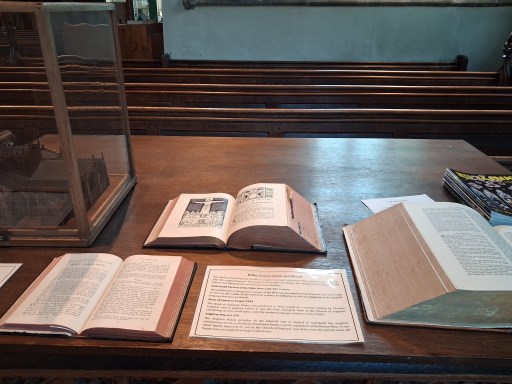
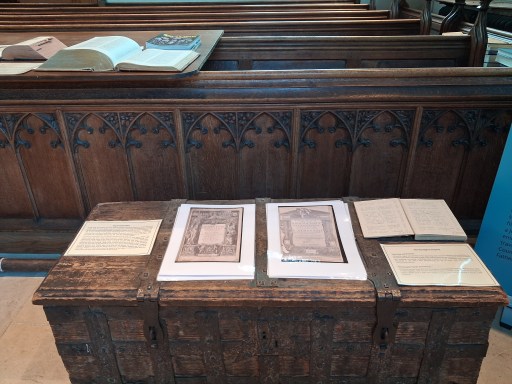
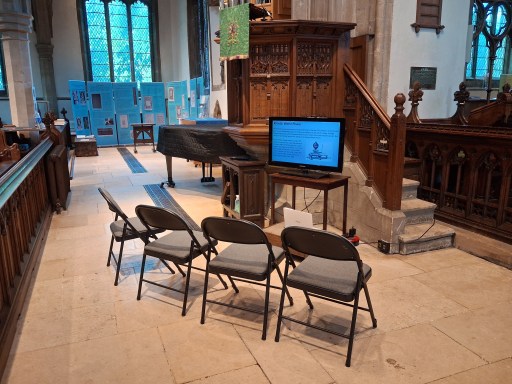
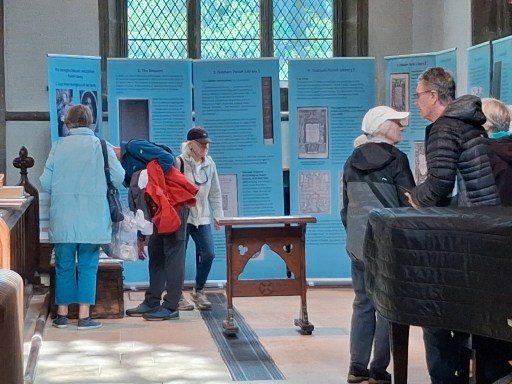
The photographs below show the exhibition itself – the poster boards, a table displaying the Parish Network Map, the Parish chest, where the library was once stored, and a number of old, but relatively modern, prayer books and bibles that were on display on display
The exhibition poster boardsOther exhibitsThe Parish Chest and booksBooks on displayBooks on displayThe Parish Chest, laminated front pieces and the Harington Dole record book
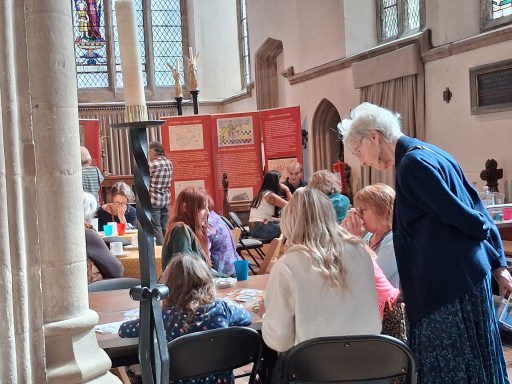
The Sermon in Stone Exhibition in the Trinty chapelThe Queen Edith Exhibition in the Lady ChapelThe Writings on the Wall presentationHeritage Open Day 11/9/26Heritage Open Day 11/9/26Pop Up Cafe 11/9/26
In this blog post I look at three 14th and 15th century wills – two of them are wills from Vicars of Oakham and one from the founder of a major charitable institution in the town. The texts of these wills are taken from
These wills have been used in previous historical investigations of the area, to address specific issues and interests, but do not seem to have been considered elsewhere in their totality. In this short post, we consider these wills, what they can tell us about the individuals involved, and about 14th and 15th century Oakham. The texts of the wills are in the main taken directly from Gibbons although I have modified the punctuation, expanded abbreviations and added full currency descriptions to make the extracts easier to read.
William de Pensax, Vicar 1338 to 1378
WILLIAM PENSAX, vicar of Okham. Monday before Feast of St. James Apostle 1378 To be buried in the Chancel of Okham. Bequest to St Mary’s Chapel in Okham Churchyard ; and to John Belgrave, parish chaplain there. Ellen, daughter of Richard de Pilton. Alice de Langton Katherine daughter of John de Multon. Margaret de Langton. Executors —William fflore and John de Pensax Proved at Lydington, 4 May 1385.
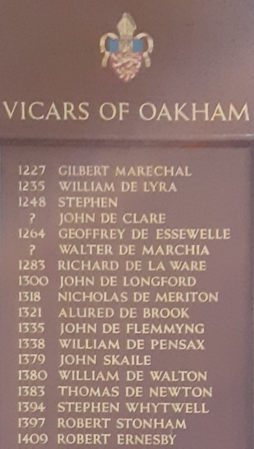
Extract from the Vicar’s board at All Saints Oakham
Little seems to be known about William de Pensax other than his will. John de Pensax, the executor of his will and almost certainly a close relative, has made more impression on the historical record. He was one of Rutland’s parliamentary representative in 1404, 1406, 1413 and 1421 and Sherrif from1400-8 and 1419-1420. and seems to have had Lancastrian sympathies. One can probably assume that William was of the same political persuasion.
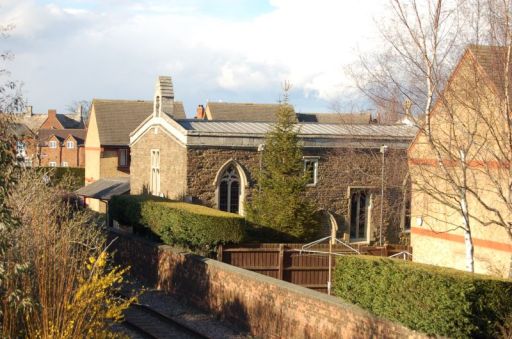
The will itself is the briefest of the three presented here and gives a short list of beneficiaries. It would seem that it was written close to William’s death on July 19th 1378 – the Feast of St James is on July 25th. There was and interval of 6 years until it was proved, possibly indicating that it was in some fashion controversial. Of interest is his request for burial under the chancel of the church, but if there was ever any memorial, it was lost either in the chancel rebuilding of the fifteenth century or during the Reformation, He also made a bequest to the Guild Chapel of St. Mary and the chaplain there. This was situated in the churchyard, roughly at the site of the current Old School building. More mention will be made of this and other guilds below. No details of the scale of the bequests is given, so presumably these were recorded in some other way or Gibbons chose not to record them.
As an aside, Pensax, presumably William’s ancestral home, is a small village to the south west of Kidderminster. On the Parish Council web site we read the following.
The name Pensax is a combination of the Celtic words “pen” (hilltop) and “sais” (Englishman, Saxon). Unlike many English place names with Celtic elements, the modifier follows the basic noun, as is customary in Celtic languages. This indicates that Brittonic speakers coined the name, rather than Old English speakers borrowing a Brittonic element
William Dalby, founder of the Hospital of St. John and St. Anne, 1398
WILLIAM DALBY, of Okham. Dated there, 8 October 1404 To be buried in All Saints’ Church, Okham. Thomas Man, vicar of Exston. To Thomas Smyth formerly dwelling in Exston, a noble. John Sapcote 20 pounds William Lytell 10 pounds William Luffeld 20 pounds William Lesyngham 10 marks Anne Wyttilbury 100 shillings. My servants Thomas, Bernard Osbern, and Margaret Osbern. John Eltham my apprentice. Isabell Aldewyn. William, William and Hugh, sons of Richard Sapcote. My wife’s sister Johan. Roger fflore, and his children, William, John, Robert, Agnes, Elizabeth, and Johan. John clerk of Wyssenden. My daughter Johan 20 pounds. John and Elizabeth children of William Grene. My brother John and his children. To Simon master of the Hospital 10 pounds; to Thomas Heremyte and Johan Godewyn of the Hospital 3 pounds each, and to10 other poor persons of the Hospital 10 pounds. Guilds of S. Trinity of Tylton, Corpus Christi of Leycester, the Great Guild of Coventry, and S. Trinity, S. Mary, and S. Michael of Okham. Abbeys of Osolueston and de Lauda. Agnes my wife 50 pounds. Executors :—Roger fflore, John clerk of Wyssenden, and John Skynner chaplain. Proved at Lincoln, 14 June 1405.
William Dalby, a wealthy wool merchant of the staple of Calais, is best know for founding The hospital of St. John Evangelist and St. Anne in 1398, to support twelve poor men, under the charge of two chaplains. The advowson of the hospital was to be in the hands of the prior and convent of St. Anne’s, Coventry. William Dalby granted an estate worth £40 a year for the foundation, and a little later paid 577 marks to the prior and convent of St. Anne’s to increase the endowment.
The will itself again seems to have been written just before William’s death and was proved soon afterwards. Unlike that of William de Pensax it gives details of some, but not all, of the bequests, These are for varying amounts up to £50. Depending on how one does the calculation this represents somewhere between £40,000 and several million pounds in today’s terms. There were generous gifts to the Hospital Master and to its inmates. Amongst the beneficiaries are the abbeys at Laund and the nearby Owston Abbey, just over the Rutland border in Leicestershire. Guilds again get a mention with bequests to the guild of the Holy Trinity at Tilton (oddly named as St Trinity), the guild of Corpus Christie in Leicester, the great guild at Coventry and the guilds of the Holy Trinty, St Mary and St Michael in Oakham. At Oakham the guild of the Trinity was probably based in the current Trinity chapel at All Saints, and the guilds of St Mary and St Michael at chapels in the churchyard. That of St Mary may have also been associated later with the Lady Chapel at All Saints, although that does not seem to have been in existence till around 1480.
Robert Stoneham Vicar 1397 to 1409
ROBERT STONHAM, vicar of Okham. Not dated, Ego, Xpianus in fide firmus &c. Corpus meum sepeliendum et post diem judicii cum anipia glorificandum &c. (I, a Christian firm in the faith, etc. [I desire] my body to be buried and, after the Day of Judgment, to be glorified together with the soul, etc) 18 poor people of Okham and 6 of Lydington to be clothed, tam ad corpus quam ad lectum (as much to the body as to the bed.) To Okham church various plate, librum rubeum decretorum, librum decretalium, librum bonum ligatum pupiUe oculi cum constitutionibus in eodem contentis. (The red book of decrees, the book of decretals, and a well-bound book—the apple of my eye— containing the constitutions within it.) Chapels of Langham, Egilton, Caldecote, and Brook, 6 shillings each for 3 chalices. Lidyngton church, 100 shillings for a silver cross. Merton Hall, Oxford, 20 pounds for a silver cross and candelabra ; also my books not otherwise bequeathed, to be kept in the College Library. To the Church and Bishop of ‘Carlisle the Bible which I had of gift of Thomas late Bishop of Carlisle. To Master Henry Abyngdon, my portiforium (breviary) To Deacon William Baxter my manuale &c. (handbook?) Deacon Thomas Gauter. John Bower. Richard Brook my clerk. Bequests to William Carter, principalis meus famulus (my chief servant), and other servants; also, illis meis servientibus qui non recedent sed pro tempore quo ero extra Angliam fidelicer manebunt ad reventum meum. (to those servants of mine who will not leave, but will remain faithfully until my return for the time I am away from England.) My sister, a nun ; and my sister Isabella. To my Lord of Lincoln zonam meam viridem deauratam. (my green, gold-trimmed belt.) Item domine Comitesse de Cancia de Brunne gobeletum deauratum. (Item, for the Countess of Kent, of Bourne, a gilded goblet.) Deacon Robert Croxton of Lincoln. All my tenements in the city of London to my brother Edmund and my sister Isabella, they procuring masses (either alone or by turns with the heirs of John Basse) for the souls of my mother, of Lucia atte Stone, and of John Basse. My sister Alice. To Master Henry Abyngdon my quat’num novum preciosum qui incipit ‘In nomine patris et filii et spiritus et alium quat’num preciosum et secretum Gebar s^ patris in nibio papiro ubi fit mentio de omnibus libris meis quam aliorum (quia habeo multos Ubros qui non sunt mei et volo quod quUibet habeat quod suum est). (A new, valuable quire beginning “In the name of the Father and of the Son and of the Spirit,” and another valuable and private quire of Father Gebar on fine paper, in which mention is made of all my books as well as those of others (for I have many books that do not belong to me, and I wish for everyone to have what is their own). To Richard Curteys, Tabulam de Eborer cipresso cum stilo argenteo. (A writing tablet of ivory and cypress wood with a silver stylus.) Item Master Henrious habebit meum Annys de Crysty Gray (Master Henry shall have my Agnes de Crysty Gray.). Item Baxter meum Mens suppellic’. (My Baxter’s furniture). Item ecclesia de Okham totum meum velym pro antiphonarijs et libris. (To the church of Okham, my entire stock of wool for antiphonaries and books.) Item Corrector de Aischeruge habebit certum librum in quat’nis xuj quos mihi dedit qui incipit ‘ ffrat’ p’ dil’ce.’ (The corrector of Aischeruge shall have the specific book in sixteen quires which he gave to me, beginning “Frater praedilecte.”) Executors :—My brother Edmund, and William Baxter chaplain. Supervisors :—The Bishop of Lincoln, and Roger flflore. Proved at Sleford, 15 Jan. 1409.
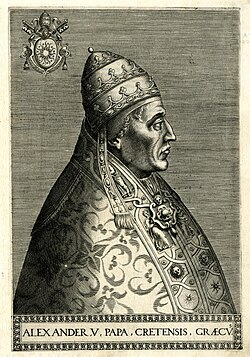
Robert Stoneham was probably born in the 1350s or 1360s. He was a fellow of Merton College Oxford from 1384 to 1397, when he was appointed Vicar of Oakham. At some stage he was appointed a Canon of Lincoln Cathedral. He clearly rose through the church hierarchy and by 1409 was a member of the Papal Court at Pisa. He was taken ill in that year and remained in Pisa, where he died, when Pope Alexander V (an antipope, elected in 1409 at the Council of Pisa) transferred his court from Pisa to Pistoia.
Stoneham’s will is the longest of the three presented here, and is partly in Latin. The Latin phrases have been translated (using Google Translate – such is my ability in the language) and the translations are shown in italics. The will lists a large number of bequests, and in particular specifies the destination of what seems to have been a very considerable library. His servants and family seem to have been well provided for. His bequest of a silver cross and books to Merton College is noted in the College archives. Despite the fact that his career took him away from Oakham, for what were probably considerable periods, he clearly retained an interest there, and made a bequest to clothe 18 poor people from the town (and 6 in Lyddington). He also donated books to the church, including what seems to have been his favourite.
The red book of decrees, the book of decretals, and a well-bound book—the apple of my eye— containing the constitutions within it.
He also donated a stock of wool to the church, seemingly for the purpose of buying books.
To the church of Okham, my entire stock of wool for antiphonaries and books.
A bibliophile indeed. In the light of the current (September 2026) exhibition of the Oakham Parish Library in All Saints church, from 1616, it is of interest to see that books, and material with which to purchae books, were being donated to All Saints two centuries before that.
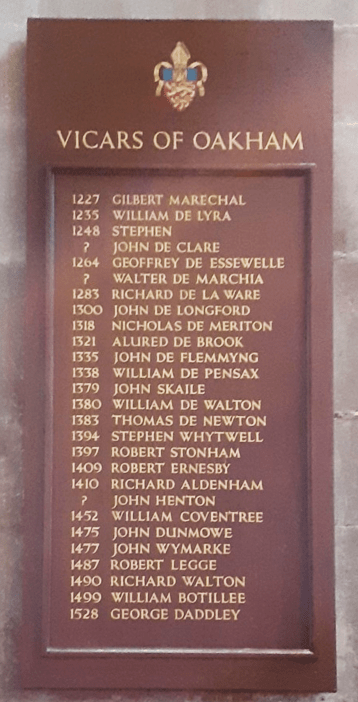
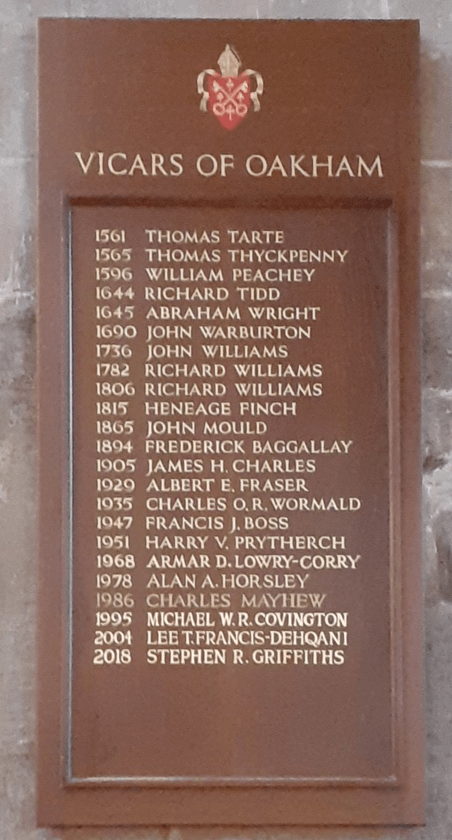
Two large inscribed boards at the west end of All Saints church list the vicars of the church from 1227 to the present day (figure 1). This list matches those found in church guides written over the last 100 years and date back to the primary research found in a 1903 article in the Rutland County Magazine and Historical Record of 1905. Whist this list is quite comprehensive, a more detailed resource is now available – the The Clergy of the Church of England Database 1540-1835 (CCEd) which contains information from a wider variety of sources than were available in 1905. In this post we look at the information that can be obtained from this database about the life and times of Vicars of Oakham for the period 1540-1835 – roughly corresponding to the top half of the second board in figure 1.
Figure 1. The Vicar boards at All Saints Church
The database listing
A listing of the Vicars of Oakham from the database is given in Table 1 below. The table gives the names and the year and type of the event recorded. The hyperlinks on the names link to the information held in the database of the career that particular person, both at Oakham and elsewhere, and the hyperlinks in the “View” column link to details of the particular event recorded. The types of event are as follows.
Appt (Admission) – Definition not clear
Appt (Collation) – Candidate appointed by the Bishop as Patron, combining presentation and institution
Appt (Institution) – Appointment of the candidate to the living by the Bishop
Appt (Licensing) – Appointed with a Bishop’s license
Appt (Presentation) – Patron presents the candidate to the Bishop
Disp (Dispensation) – Some variation of normal practice
LibC – Liber Cleri – Name found in Visitation records
Not only does the database list the Vicars of Oakham, but also those who were curates or licensed preachers, and these are shown in Table 2. The intermittent nature of this listing suggests that this list is far from complete. Indeed the database also lists curates in the associated parishes of Egleton, Barleythorpe, Langham and other chapels, who were probably under the oversight of the vicar of Oakham.
In what follows we delve deeper into the database to learn more about the clergy named in the above tables.
Reformation, counter Reformation and the Elizabethan settlement (1540 -1596)
Henry VIII died in 1547, and was succeeded by his son Edward VI (1547-1553). In his reign the Protestant Reformation took hold, with the publication of the 1549 Prayer book in English. The situation rapidly changed when his sister Mary (1553 to 1558) came to the throne, with the Catholic Counter Reformation. This period was a time of turmoil for the church, with loyalties tested amid persecution and martyrdom. The situation stabilised when Elizabeth I came to the throne, with a return to Protestantism, but acceptance, if not approval of catholic worship as long as it was carried out discretely.
George Daddley, who appears on the board for 1528, does not appear in the database, presumably because all the information about him precedes 1540, the start date for the database. The first vicar recorded in the database after that date is William (Willimus) Archebolde who resigned in 1561. He was Vicar of Blakeskey from 1551 and presumably resigned at some time after that to take up the position at Oakham. He was also Vicar of Bugbrooke from 1560 to1561 and Vicar of Kislingbury 1559-1568. How he fared in the reigns of Edward and Mary is unknown – but he at least survived to the reign of Elizabeth. He was succeeded at Oakham by Thomas Tarte in 1561. Tarte presumably resigned after two or three years and was succeeded by John (Johannes) Bartlett (again not on the board) who himself resigned in 1565. This rapid turnover of clergy then came to an end with the appointment of Thomas Thyckpennye, who had been a curate at North Luffenham from 1562, who remained in post until 1596.
The Stuarts, the Civil War and the Restoration (1596-1691)
Over the course of the seventeenth century, the stability achieved under Elizabeth was to be lost under the Stuart Monarchs and during the Civil War and the Commonwealth. Again, this would result in far reaching disruption to he life of the church, with conflict between the episcopal Church of England and the Presbyterian parliament. However for the first 40 years of the century there was a sense of stability, with only one, long serving vicar, William Peachie. His career is well documented in the database.
Father Thomas and born in Essex,
Matriculated as a Pensioner at St John’s, Cambridge , Michaelmas 1582
B.A. 1586-7; M.A. 1590; B.D. 1597. Fellow, 1590
Ordained Deacon and Priest on the same day in 1591
Vicar of Exton, Rutland, 1592-6.
Vicar of Oakham, 1596-1643
Father Thomas buried at Oakham in 1602
Rector of Burrough-on-the-Hill, Leics., 1628-43.
Died Oct. 6, 1643, aged 78. M.I. at Oakham.
Father of Josias (1617), John (1620) and Samuel (1614).
Early in his incumbency, a report of a Visitation suggest the church was in poor repair.
The seats on the south aisle are all broken in the bottom and neither paved nor boarded. Pavement in the east and north aisles broken. The chancel and the chapel on the north side neither plastered nor whited…Two bell wheels broken but being mended. The communion table unfit. The linen cloths very old. The north door in decay
Subtus jacet Venerab. Vir Guil. Peachie S.T.B. quondam Coll. D. Joh. Cant. Soc. nuper bujus EcclesiaVic. Morum innocentia satis laudatus, in arte concionandi Versatiss. Quator Trium, Insignum Theologor, Pater Soror Qui OJob. 6. Non tam morbo confectus, quam vivendi tedio lassatus, placide expiravit. Dom. 1643. Etat. 78. Residentia, 47. Noli vexare Quiescit.
The gravestone no longer exists. The English Translation is as follows.
Beneath lies the Venerable. Rev William Peachie S.T.B. formerly of the College of St John, Cambridge. Recently the Vicar of the Church. His innocence of morals is highly praised, he is skilled in the art of preaching. Four Three, Insignia Theologian, Father Sister Job 6 Not so much worn out by illness, as worn out by the tedium of life, he expired peacefully. Died 1643 Age 78 Residence 47 Don’t bother him. He’s resting.
Peachie thus survived through the reigns of James I and Charles I, but by the time of his death, the Civil War was underway and the relative peace of the first half of the century shattered. In this context one can perhaps appreciate the world weariness expressed in the inscription. It may also be that Peachie would have been required to sign the Solemn League and Covenant – a Presbyterian document of 1643 to which all those appointed to livings were required to subscribe. There are other indications in the record that his tenure was not wholly without incident. The records indicate that in 1609 John (Johannes) Green was presented to be Vicar of Oakham by the Patron, King James. No further details are known, and this may simply be a mistake in the original record or the transcription to the database. But it might indicate some sort of conflict over the living. Then in 1612, Nathaniel Gooch was licensed as a Preacher in the parish, having been ordained deacon and priest in 1607. What this role was in relation to Peachie is unknown, and Gooch is next found in the record as being appointed Vicar of Twyford in Leicestershire in 1630. Neither Green or Gooch are on the Vicar’s board. Further to these appointments, in 1639 James Chamberlin was appointed curate of the Parish and Preacher throughout the Diocese of Peterborough. He had been a curate and preacher at Kirkby Mallory, Earl Shilton Chapel from 1633. Again what his role was in relation to Peachie’s is not clear. The record shows him again at Kirkby Mallory, Earl Shilton chapel in 1662 after the Restoration. Again, as a curate he does not appear on the Vicar’s board.
We have little information on the next vicar other than his name – Richard Tydd, who was appointed in 1644, by when the conflict between Bishops and Presbyterians for control of the church was underway. His incumbency only lasted a year and it might be that he too was required to sign the covenant, but refused to do so. The next incumbent was one of the most consequential of the period under study – Abraham Wright. Details of his career can be found on a Wkipedea page, an obviously AI written Grokipedea page, the Oxford Dictionary of National Biography and Rutland Record 8, 1988. The latter is most succinct and is reproduced below.
WRIGHT, Rev. Abraham (1611-90) Oakham’s notable Vicar, Abraham Wright, was born in 1611. He became a Fellow at St John’s College, Oxford, in 1632 and, in 1636, when Archbishop Laud, a former President, came with King Charles 11 and the Queen to open the new Library, it was Abraham Wright who read his own poem of welcome, later contained in “Parnassus Biceps”. During the same visit, he acted before the Royal Visitors in “Love’s Hospital”. Earlier, he had written a comic interlude, which he called “The Reformation”. Later, he published his own Sermons, including one which he preached at his own Ordination, and another given before the King. Other writings include an essay in praise of Strafford. In 1645, Wright was offered the living of Oakham by William Juxon, his President when he went up to Oxford, and by now Bishop of London but, because he could not accept the interregnum requirement to take the covenant, he was not instituted until 1660. Instead, he was active in Peckham and St Olave’s, Hart Street. When 1660 came, he was offered the Chaplaincy to the Queen of Bohemia, the new King’s sister. However, he refused this and other offers of high preferment and chose to come and remain in Oakham until his death in 1690. He married twice. His first wife bore him James, the writer of The History and Antiquities of the County of Rutland, towards which Abraham Wright provided the cost of two plates, including one of the windows of a former hall of the Hospital of St John and St Anne. As a disciple of Juxon, and as seen in some of his writings, Abraham Wright was a Laudian and, as such, insisted on ceremonial, belief in the Sacraments and the dignity of the Priesthood.
Again there seems to have been problems with the church fabric in the latter part of Wright’s incumbency, perhaps partly due to neglect during the Civil War. From the Victoria County History 1935.
In 1681 an order was made on Mr. Abraham Wright, vicar, and Mr. Burton, tenant of the Dean and Chapter of Westminster, to pave the chancel and repair the ceiling, seats and windows; and on the churchwardens to remove the rubbish out of the churchyard, repave the church alleys throughout, repair the seats and the roof and glaze the windows, rebind the Bible, provide a new Common Prayer Book, plaster and whitewash the vestry, provide a covering to one of the pewter flagons, a carpet for the Communion table of fine green or purple broad cloth, to repair the beam in the middle aisle over the minister’s pew and to take away the seats in the middle aisle.
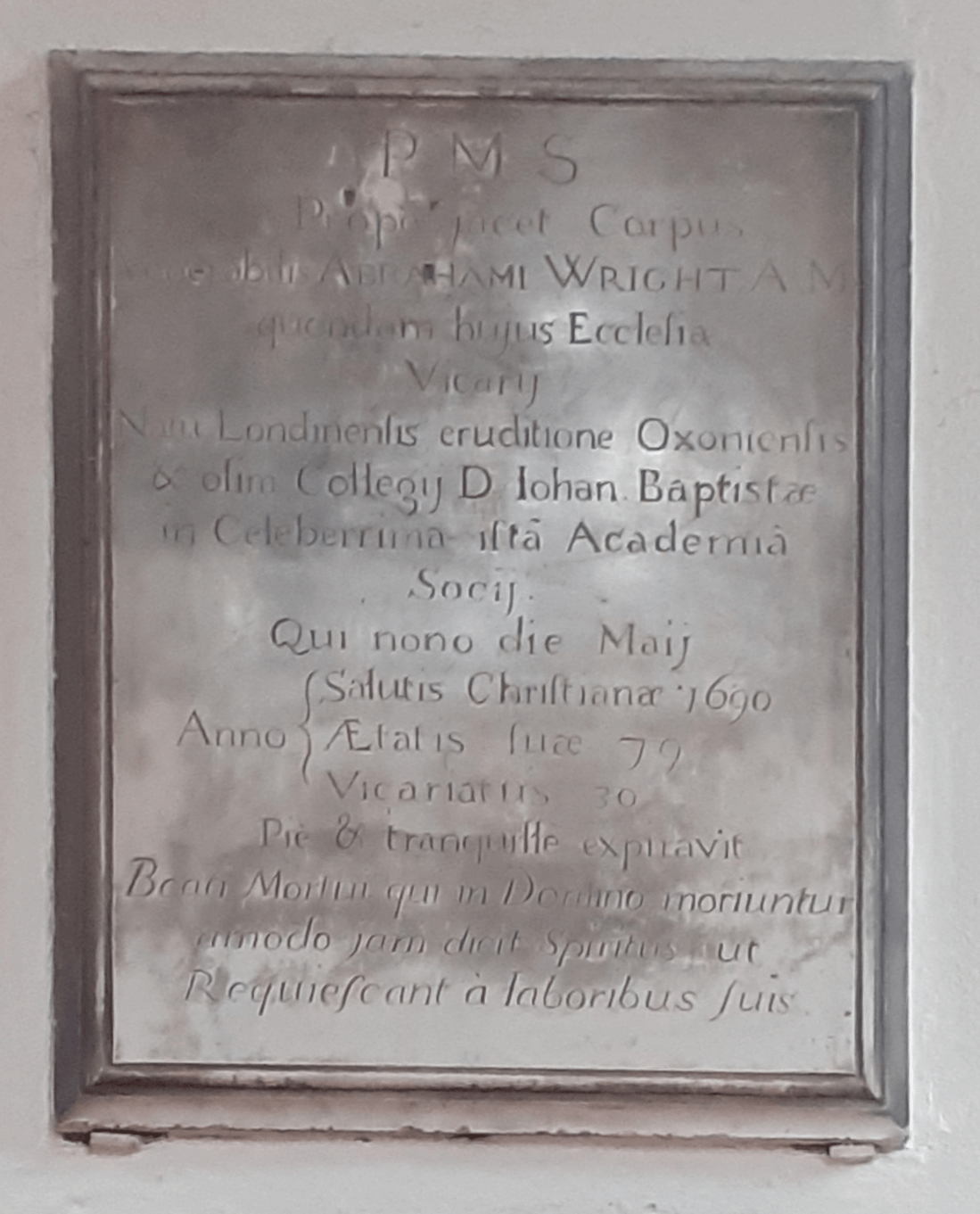
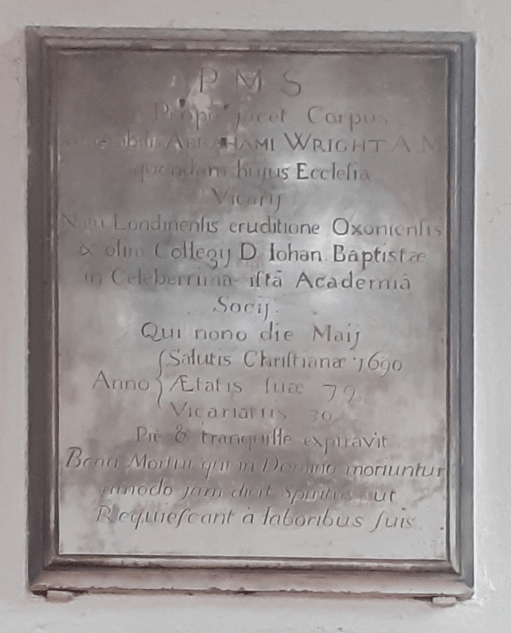
Figure 2. The Abraham Wright Memorial
The memorial to Wright still exists on the west wall of the north transept (Figure 2). It is the only monument in the church written in Latin.
P. M. S. Prope jacet corpus venerabilis Abraham Wright M.A. quondam hujus Ecclesia Vicarij nata Londinensis, eruditione Oxoniensis, olim Collegij d. Johan Baptista in celebeuima ista Academia Socij. qui nons die Maij Salutis Christianæ 1690 ætatis sua 79, Vicariatus 30, pie et tranquille expiravit Beati mortui qui in domino moriuntur, amodo jam dicit spiritus ut requiescant a laboribus suis.
The English Translation is as follows.
P. M. S. Near lies the body of the venerable Abraham Wright M.A., formerly Vicar of this Church born in London, educated in Oxford formerly of the College of John the Baptist in that celebrated Academic Society who died on the 1st of May, 1690 aged 79 Vicar for 30 years, in piety and tranquillity. Blessed are the dead who die in the Lord from now on the Spirit says that they may rest from their labours.
The other “vicar” that deserves further mention is the one who replaced Wright during the Civil War and Commonwealth – Benjamin King (1545-1660). His name, unsurprisingly, does not feature on the Vicar’s Board. After the Restoration he was ejected from the living at Oakham, one of six in Rutland to suffer that fate. But he seems to have remained in the area. From the Victoria County History.
In 1672 a licence was granted to Benjamin King, who had been intruding minister at Oakham during the time of the Commonwealth, for Presbyterians to meet at the house of Matthias Barry at Oakham. King had two daughters, one of whom married Vincent Alsop, usher of Oakham School and later an eminent minister in Westminster; the other married Robert Ekins, the first minister in the Northgate Barn.
The eighteenth and nineteenth centuries (1691-1835)
The eighteenth century again saw two long incumbencies – John Warburton from 1691 to 1736, and John Williams from 1736 to 1782. Curates become more common (or they are recorded more diligently) with six in total recorded during these incumbencies.
After the death of John Williams, his place was taken by his son Richard. He had been ordained deacon in 1771 and priest in 1772, a was curate of Stapleford in Leicestershire and vicar of Skillington in Lincolnshire from 1772. He was vicar of Oakham from 1782 to 1806 – a relatively short incumbency of only 24 years! He in his turn was succeeded by his son, another Richard, whose was ordained deacon and priest in 1801 and 1802. He was a curate in his father’s parish from 1801 until he succeeded him in 1806. In addition he was Usher at Oakham School from 1802-10. curate of Langham from 1801,vicar. of Enderby with Whetstone in Leicestershire from1803-15 and domestic chaplain to George Finch,9th Earl of Winchilsea and Nottingham of Burley House from 1806 to 1815 (the patron of the church, and thus the one who presented him to the living). Only two curates are recorded during the incumbencies of the two Richards.
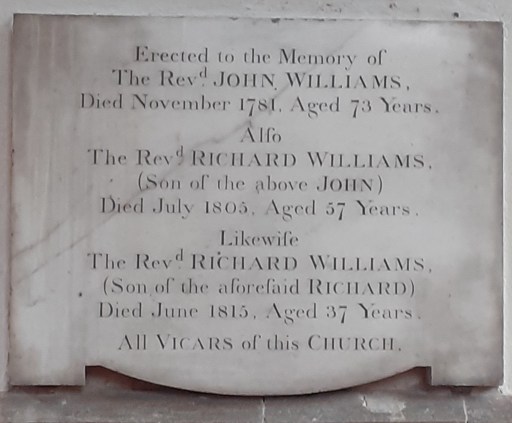
A monument to all three Williams is still in place in the north transept of the church and is shown in Figure 3.
Figure 3. The Williams memorial
The final vicar in the period of the Clergy of the Church of England dataset is Heneage Finch, grandson of Heneage Finch, 3rd Earl of Aylesford (History of the Finch Family, Brayan I’Anson, 1933) and a distant relative of George Finch,9th Earl of Winchilsea and Nottingham mentioned above, the patron of the living. He was ordained deacon and priest in 1812, and was curate of Harpsden before moving to Oakham in1815. He was also Rector of Great Weldon from 1812 to 1819 and Domestic chaplain to William Legge, 4th earl of Dartmouth and Viscount Lewisham from 1815. He was another long serving vicar and died in post in 1865. It was during his incumbency that the church was restored by Gilbert Scott in 1858. Before that, as can be judged by Scott’s report, the church was again in a very poor state of repair. Indeed a lecture of 1860 that describes the pre-Restoration state of the church mentions
….that old ladies sat in church with their umbrellas up, and the pulpit to the last was in mourning for George III…
Woodside Iron Works, was founded in 1840 by Alexander Brodie Cochrane and his son Charles Cochrane. It became very well known and respected and produced components for many significant structures, including girders for the Runcorn Bridge over the River Mersey and the Farringdon Street Viaduct in London; ironwork for the Rochester Road Bridge, the Swing Bridge over the River Medway and the Clifton Suspension Bridge; and a wrought iron bridge for New Street Railway Station in Birmingham
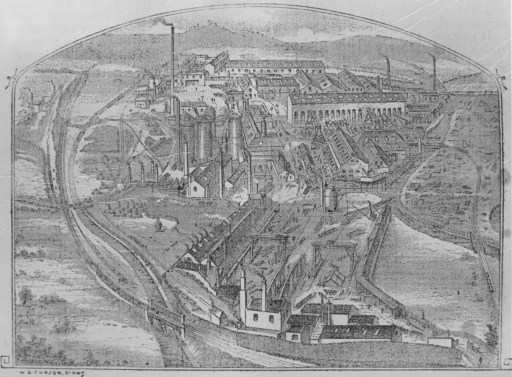
Now I recently paid for a license from Dudley Archives for the use of the engraving of the works shown in Figure 1 below, for use in a blog post and in a forthcoming article in the Blackcountryman based on that blog post. It is catalogued as Woodside Iron Works c 1860. In the blog post and article, I used it to illustrate accounts of the works found in my great grandfather’s diaries and did not discuss it to any extent. It really does however deserve somewhat greater consideration, and so in this post, I will consider it in somewhat greater detail.
Figure 1. Woodside Iron Works c1860
Major Features
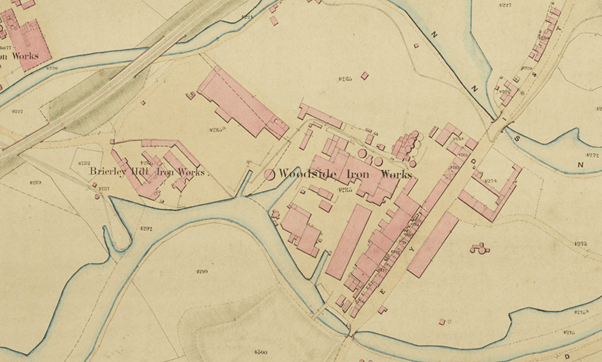
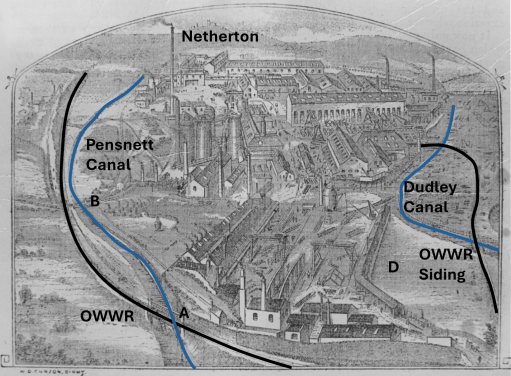
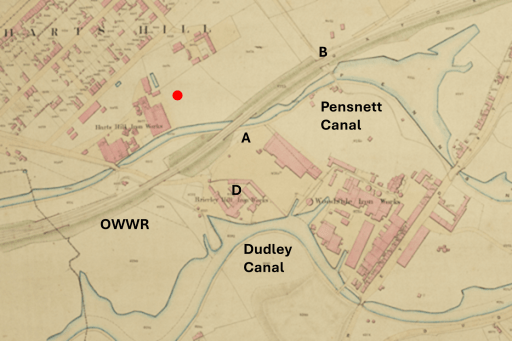
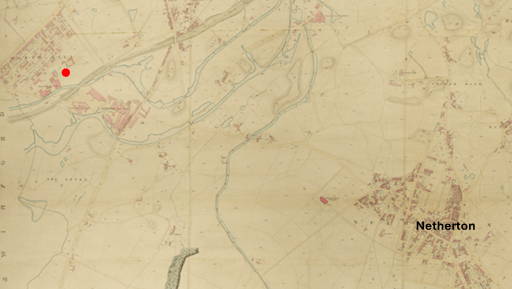
So what does the engraving actually show? Figure 2 shows a comparison between the engraving and a map of Dudley from 1857. Note that north on the map is around 20 degrees clockwise from the map vertical axis. On both the engraving and the map, the main line of the Oxford, Worcester and Wolverhampton Railway can be seen , with the engraving also showing a siding into the works. The Dudley Canal can be seen on both engraving and map (heading for Dudley Tunnel in the distance) with Lord Ward’s Pensnett Canal also visible, heading to a junction with the Dudley Canal just south of Dudley Tunnel. Two railway bridges, over the Pensnett Canal and a road are shown at A and B on both. In the distance can be seen the Netherton ridge and Netherton church. The likely vantage point from which the initial sketch for engraving was made is shown by the red circle on the map.
Figure 2. Comparison between the engraving anda map of 1857
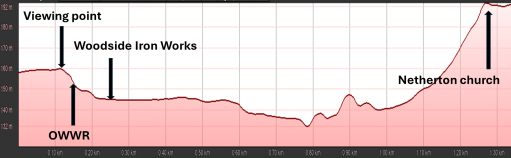
Figure 3a shows a smaller scale version of the map of figure 2 so that the relationship can be seen between the Iron Works (and the vantage point from which it was sketched) and Netherton in the far distance on the engraving. Figure 3b shows an elevation profile along a line through the vantage point and Netherton church. It can be seen that there is an initials steep drop from the vantage point across the railway to the Iron Works, and the ground then remains fairly level until the steep slope up to the Netherton ridge is reached. Thus the view of the iron works shown on the engraving, with a perspective indicating that it was painted from an elevated position, is a real one.
(a)
(b) Figure 3. The Iron Works in the wider landscape.
The date of the engraving
The Archive catalogue gives the date of the engraving as c1860, but can a more precise date be determined? The Iron Works themselves had opened in the 1840s, but the main line of the Oxford, Worcester and Wolverhampton Railway wasn’t opened intill November 1852, so that gives the earliest possible date for the engraving. The Brierley Hill Iron Works (D on the map of figure 2) was also operational from the 1840s, but oddly does not appear on the engraving. Or rather only the angular building that marks the northern edge of the works is shown. I am inclined to think that this was because whoever commissioned the engraving didn’t wish to show the works of a competitor and I suspect request that it be removed. Indeed the area D on the engraving is suspiciously level and without any features, which suggest that this might have been the results of a major edit.
Now, from Grace’s Guide we have a description of a report of an “Open Day” at the Iron Works where the proprietors Alexander Brodie Cochrane, and his son Charles Cochrane invited the local gentry and other local iron masters to look around the works (Worcestershire Chronicle, 2 April 1856) and indeed the guest list was very impressive. Was the engraving produced for this event, and perhaps given to those who attended? It would seem very appropriate for this to have been the case. It would also explain why the owners were keen for Brierley Hill Iron Works not to be shown.
The detail
Figure 4. The details of the Iron Works
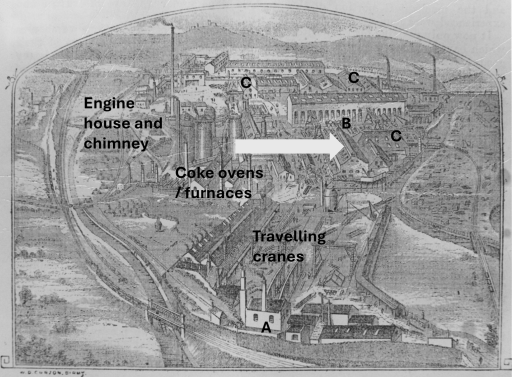
Later Ordnance Survey Maps of the Iron Works (from the 1880s) enable some functions to be identified – the travelling cranes in the foreground of the engravings, the coke ovens and furnaces, and the engine house and chimney. The report of the 1856 event found in the Worcester Chronicle that has already been mentioned contains some information that helps to understand what the engraving shows. The relevant paragraphs are as follows.
The Oxford, Worcester, and Wolverhampton railway running for a considerable distance along the side these works, drops down into their midst the green sand for the moulds, the Staffordshire ironstone, the unctuous red haematite from Cumberland, the limestone for the flux, and the Derbyshire cokes. The coal is raised from pits upon the premises, and in very few hours the raw material thus handed on the one side may be smelted, converted into pigs, cast into pipes, proved by the hydraulic press, smoothed, cut, and drilled, by machines of singular ingenuity and power, and shipped at the other side of the works upon the canal, to be borne from canal to river, from river to sea, and so to the Antipodes, to minister to the wants of rich and populous Australian cities, which in the memory of the present generation, had no name, or to complete the civilisation of communities planted few years since in spots where forests grew, and New Zealand cannibals roamed. What an illustration of human progress!
Several of Messrs. Cochrane’s relations and friends were distinguished by a white ribbon in their buttonhole, and escorted the various visitors through the works, showing them every process of iron manufacture and founding. The grinding of the sand for moulds, the curious processes of making, baking, and smoothing those moulds, the powerful steam engine for supplying cold blast to the two melting furnaces, the hydraulic lift raising the ” burden ” or supply of food to these huge retorts, whose fires never cease to devour day or night; the other engines for working the beautiful machinery of the fitting-room, where iron is planed, and drilled, and cut, with the same nicety, and almost the same facility, as if it had been deal, were all inspected in turn.
From this information we can conclude that raw materials, other than coal, were brought into the works from the line of the OWWR that ran along its boundary, presumably around point A on figure 4. Coal was mined somewhere on the site itself – perhaps we can see the pit head mechanisms at B in the figure? (By the late 19th century these mines had clearly become exhausted and further mines opened to the west of the Dudley to Stourbridge Road, with the coal brought into the works by a cable operated incline). Iron was then produced in the two furnaces, and then used in a variety of manufacturing processes in the various buildings marked C, before being loaded onto barges on the canal (and also presumably onto railway trucks on the OWRR siding). The process of manufacture thus moved from left to right across the engraving (north to south in reality) as shown by the arrow. In the above report we read that the products of the works were
borne from canal to river, from river to sea
which suggests that they were moved west along the Dudley and Stourbridge Canals, to the Staffs and Worcs. canal at Stourton and thus to the Severn at Stourport, and onward to Bristol and the sea. Such a movement would have avoided the notoriously congested Dudley tunnel. It also gives a degree of confirmation of the date as being around 1856, as in 1858 the Netherton tunnel opened, which would have made travel to the east to Birmngham and London much easier and would have presented an attractive route for the products of the Iron Works.
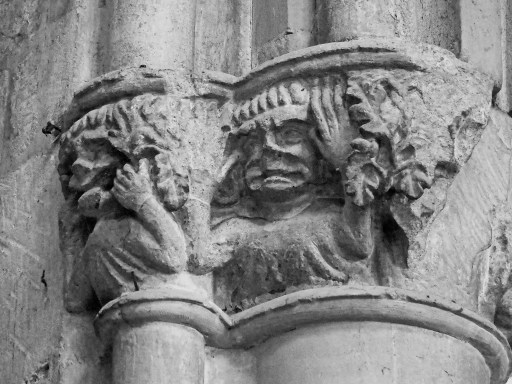
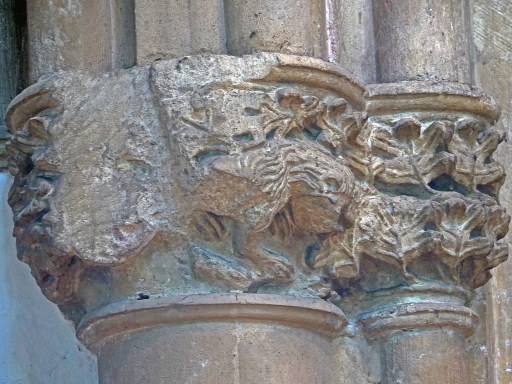
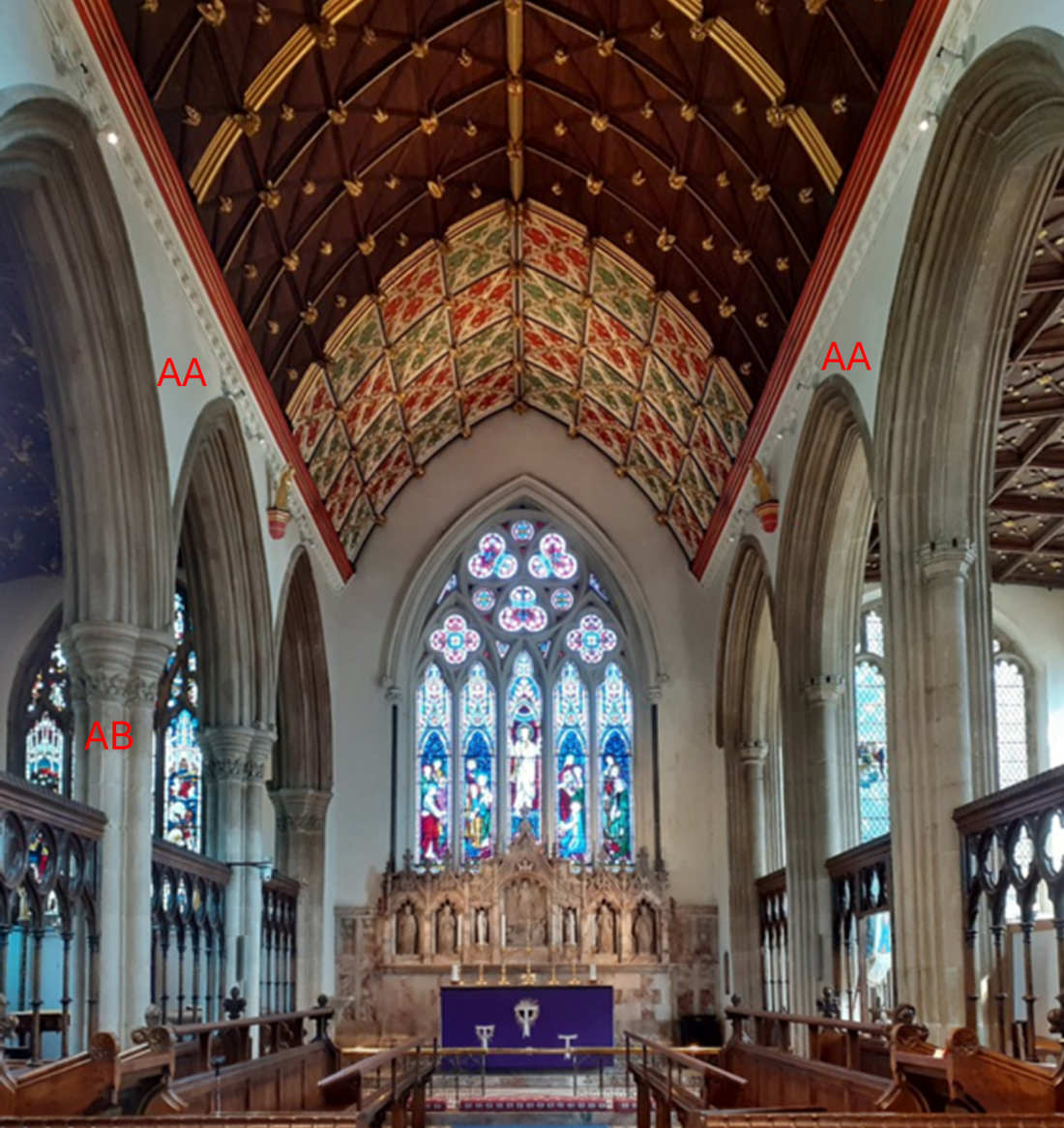
In a recent post I have described the exhibition “A sermon in stone” at All Saints Oakham which features photographs of the 13th century nave arcade capitals. That exhibition builds on work set out in an earlier blog post. The carvings feature biblical, classical and folklore themes and between them appear to tell the salvation story from the fall of Adam and Eve to the resurrection of Jesus and beyond. In this post I include a photograph and brief discussion of a carving that didn’t feature in the exhibition, as it was felt to be too badly damaged.
Figure 1. Making faces and praying
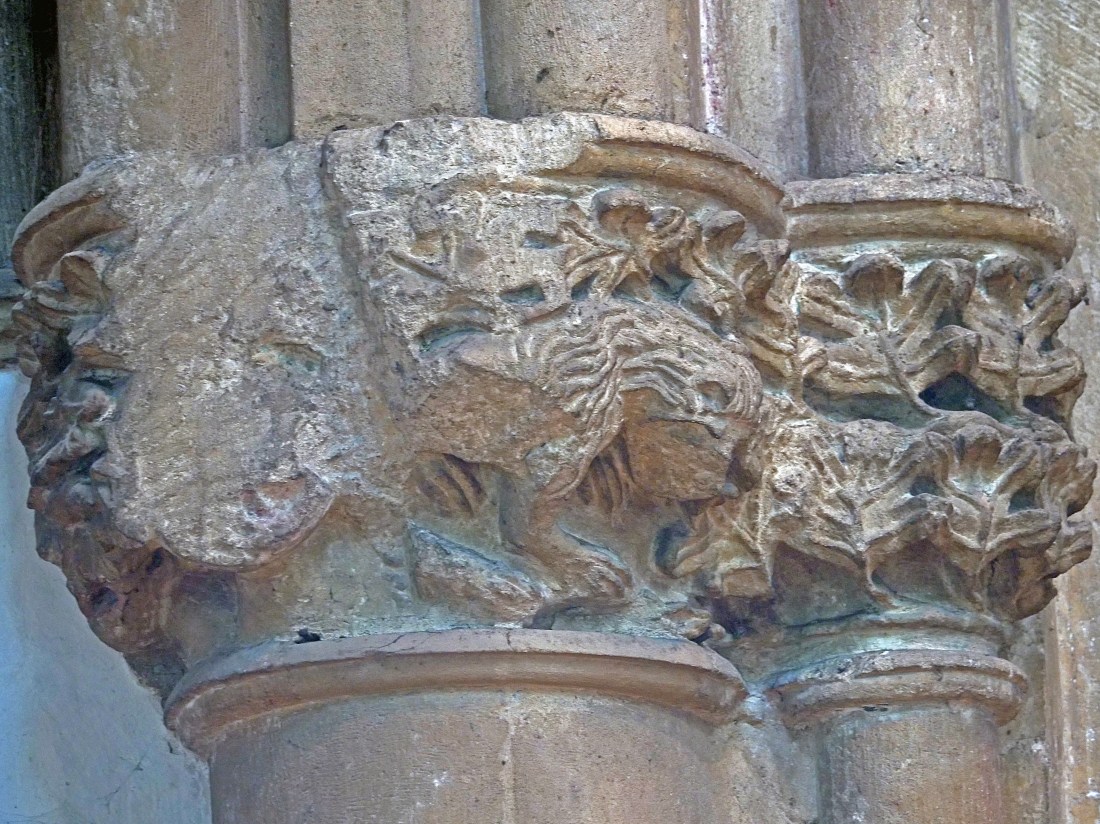
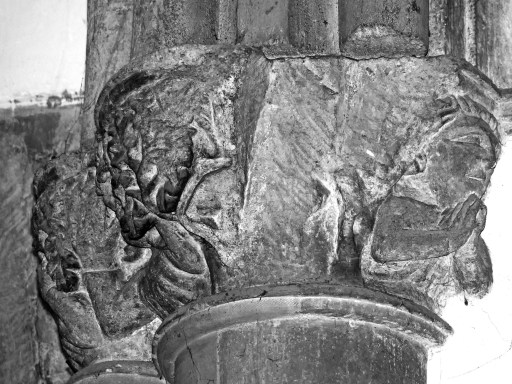
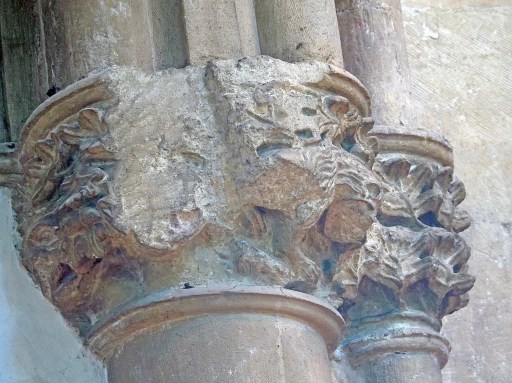
Most of the carvings are around the capitals on the pillars in the nave arcade, but two are actually on the chancel arch at the same height as on the arcade. Both have been damaged at some point it the past by the installation of a rood screen. One of these features in the “Sermon in Stone” exhibition – that on the north side of the chancel arch of jesters making faces above the pulpit with a more serious praying figure looking into the chancel (figure 1). The other, on the south side, was thought at the time to be too damaged to include. However when a high resolution photograph was taken (by Richard Adams who took all the photos for the exhibition) it was found that there was considerable detail remaining – see figure 2, which shows a lion like figure, in an oak leaf surround.
The question then arises as to whether or not this carving has any meaning in the overall salvation theme of the carvings. It is clear from the overall arrangement that those carvings on the north side represent the dark side of salvation history – the fall, the devil, temptations to sin – and those on the south side the light side of redemption and restoration – the eucharist, angels and evangelists, the annunciation and crowning of the Virgin. The jester on the north side fits into this theme quite well, as displaying a range of unredeemed human qualities, and on this basis one would expect the figure on the south side to represent something more positive. Now in scripture, the symbolism of a lion is nearly always negative, as a creature that attacks and destroys, except in one place in the book of Revelation where Jesus is described as a lion of the tribe of Judah (Revelation 5.5).
Then one of the elders said to me, ‘Do not weep. See, the Lion of the tribe of Judah, the Root of David, has conquered, so that he can open the scroll and its seven seals
So perhaps in this carving we perhaps see a representation of Jesus, identified as the Lion of Judah, sat on the throne of God in heaven. This would be appropriate in its position as next to the capital that shows the crowning of the Virgin and the Harrowing of Hell, which are also eschatological themes. But, as ever with these carvings, this identification must be quite speculative.
Of the internal fittings I have but little to say. They exceed in meanness even what is usual in country churches. And there must be but one opinion about them – they must entirely cleared away, and the whole refitted in proper manner with good oak seats
A few years earlier, Baron Stephen Glynne in his church notes had written in a similar, if somewhat milder, vein.
Altogether the interior is not so well kept as it deserves to be. The pews and galleries are shabby and the whole dirty and untidy.
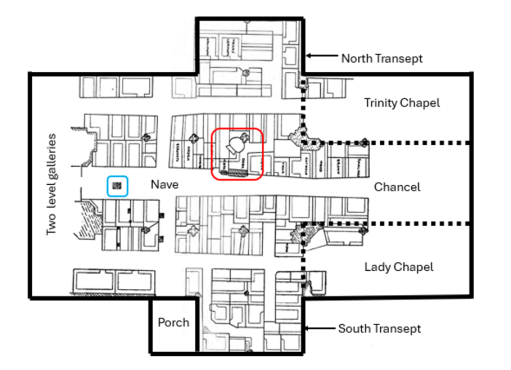
In this short note we present some information contained in the history of the church in the Rutland County Magazine published in 1903 concerning the internal arrangement of the church before the 1858 restoration. In particular Figure 1 shows the arrangements of the pews as sketched by Rev. C. A. Stevens, superimposed on the ground plan of the church – the interior fittimgs so disparaged by Scott.
Figure 1. Box pew arrangements in All Saints church – from the Rutland County Magazine of 1903
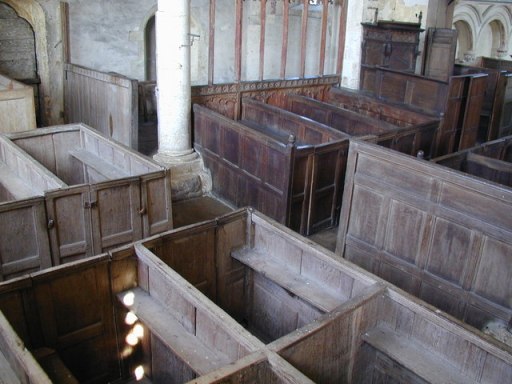
For those who know the orderly front facing bench pews in All Saints today, the arrangement shown in the figure will appear very odd. Box pews (for which a rent would have been charged) fill the nave, extending into the Trinity chapel, the Chancel and the Lady Chapel and would have been occupied by the wealthier members of Oakham Society. The sides would have been 3 or 4 feet high and they would have afforded a degree of privacy. As an example of how they might have appeared, see the pictire of eighteenth century box pews from Inglesham church in Figure 2.
The lack of geometric regularity and uniformity in Figure 1 is clear, indicating that this arrangement developed over the years, as new pews were added and old ones removed or adapted. The hoi polloi would have been housed in the free sittings in the double deck gallery at the west end of the church.
The focus of the church was also very different from today. The red square gives the location of the pulpit, the clergy desk and the church clerk’s desk – which are in the centre of the nave, adjacent to the pillar with the Green Man capital. The pulpit is surrounded on all sides by pews, some of which, but by no means all, would have enabled worshippers to face the preacher and vice versa. Unfortunately no indication of how the chancel is laid out is given, but presumably the altar was at the east end as now.
The function of the pews and the names of those families that rented the pews are shown on the figure, but the writing is too small to easily read at the scale shown here. From west to east in the nave we have
In the north transept we have, again from west to east
Wellington; Vicar’s servants
These are presumably names of parishioner families. A final point of interest is the location of what is almost certainly the font, within the blue square. This stands in the middle of the central aisle at the west of church, which is in many ways much more liturgically sensible than its current position, tucked away amongst pews on the north side of the central aisle.
Recently, whilst researching some aspects of the history of All Saints Church in Oakham, I found some really useful articles in the Rutland Magazine and County Historical Record from the early years of the 20th century. It seems that this magazine had only a limited life span, but the volumes that were published contain some interesting and in depth articles on aspects of Rutland history. As I was browsing the contents, I found, in the very first edition, an article by A J Waterfield of Stamford, in which he reviews a 1902 reprint of a 1763 book that sets out an alternative history of England, and in particular describes the reign of King George VI of Britain between 1900 and 1925. In reviewing the book, Mr Waterfield was delighted to find that it contains a description of King George’s new capital – the City of Stanley just south of Uppingham in Rutland! I shared his delight and enjoyment, so I thought I would share his article here. This is set out in the next section. This is followed by some further notes on the eventful reign of King George VI as foreseen from 1763, more on the city of Stanley, and a short discussion on the authorship of the original book.
The City of Stanley, Rutland by Mr A J Waterfield
Rutland Magazine and County Historical Record, 1, 34-36
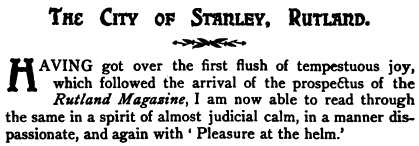
Having got over the first flush of tempestuous joy, which followed the arrival of the prospectus of the Rutland Magazine, I am now able to read through the same in a spirit of almost judicial calm, in a manner dispassionate, and again with ‘ Pleasure at the helm.’ In the list of articles shown as intended for publication, I observe, that one of the many good things promised is styled, ” The Lost Villages of Rutland.” Now the purpose of my present endeavour is to set down a few rambling remarks respecting a City of Rutland which was never founded. It is just a hundred and forty years since there was issued anonymously—printed in London—a little book of about a hundred leaves, bearing title, “The Reign of George VI.” As the name barely affords a glimmer as to the drift of the work,
taken up at a what’s-to-come period, and begun at an era that will not begin these hundred years,
I may be allowed to use the words of the Editor of a reprint, sent out three years ago. Mr. Oman, the well-known author, and Fellow of All Souls’ College, Oxford, says :
The author was intending to influence the men of his own day, by pointing out, in the actions of his puppets what ought to be done and what avoided in the Year of Grace 1763.
The author himself, begins with a reference to Swift’s History of Captain Lemuel Gulliver [written 1726], and goes on to say,
The modesty which is ever the companion of true merit, would by no means admit your author to think of a parallel between this history and the travels of Captain Gulliver.
Briefly then, the volume, under present notice, is a forecast—the years of the ‘ action ‘ being 1900-1925,—and at this stage, that part of the subject concerning the nature and tendency of “The Reign of George VI” may be dismissed. The part played by the gallant little county which the Saxons called Roteland, will presently be discerned. Our author writes:
London, though the wonder of the world, never pleased the King. The meanness of his Majesty’s palace disgusted him; he had a taste for architecture, and determined to exert it in raising an edifice, that should at once do honour to his kingdom, and add splendour to his court.
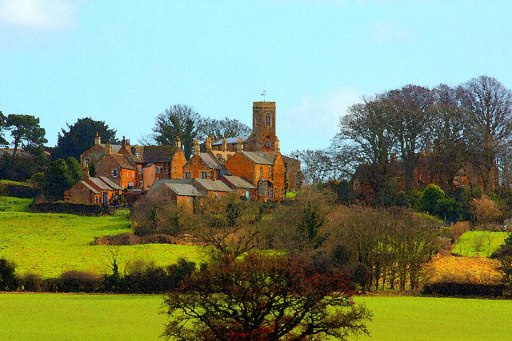
In Rutlandshire, near Uppingham, was a small hunting box of the late King’s, which George admired ; not for the building, but its beautiful situation. Few parts of his dominions could afford a more desirable spot for such a purpose. The old seat stood on an elevated situation which commanded an extensive prospect over the adjacent country. It was almost surrounded with extensive woods ; which having been artfully planted, added the greatest beauty to the prospect, without intercepting the view. On one side there was an easy descent of about three miles, which led into an extensive plain, through which a river took its meandering course. Many villages seemed to rise here and there from out the woods, which gave a great variety to the scene, and the fertile plain was one continued prospect of villages, groves, meadows, and rivulets, and all was in the neighbourhood of a noble and capacious forest.
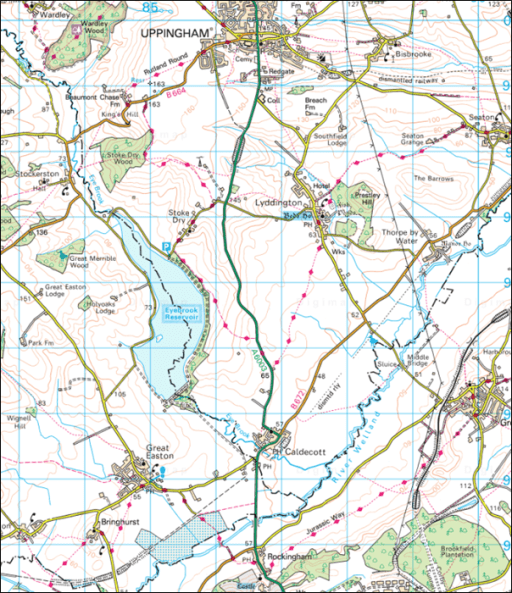
Stoke Dry, 2009 – WikipediaThe lcation of Stanley – Digimap
The landscape here described is that seen from Stoke Dry, the river the peaceful Welland, and the neighbouring forest, that of Rockingham. I remember reading, some years since, an ecstatic description of this quite charming spot, by an American visitor (perhaps Elihu Burritt, but I am not sure), whose opinion was that this viewpoint was one of the most delightful in the United Kingdom. Hereabout then, it is written, was begun, (one of several plans having been chosen), the building of a palace for his Majesty, to the exceeding wonder, no doubt, of the whole countryside. Toward the cost, a generous Parliament voted a first grant of a million sterling.
Nothing was spared to make this palace the wonder of the world,
and without touching details this bare statement is, in itself, quite sufficient to engage our interest, if not wonderment. Then followed, through the accident of an afterthought, the raising of some public edifices, Saint Stephen’s church and the Academy of Architecture being the first two ; of the latter, Gilbert, the King’s architect, was the first President. Later,
most of the nobility and many of the rich commoners, in imitation of their sovereign, erected magnificent palaces at Stanley,
by which name the fast uprising city became known.
What gave a prodigious increase to this noble city was the erection of the Senate House : that noble building . . . . the admiration of all Europe.
To hark back a little, I should before have mentioned that, by Act of Parliament, the Welland was made navigable
to the very plain at the bottom of the hill
on which the city was growing, for the purpose of the conveyance of the material required. Portland stone only was used, and
” the houses were all built to form one general front on each side of every street,”
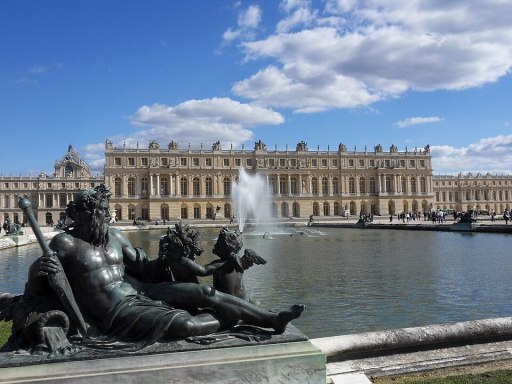
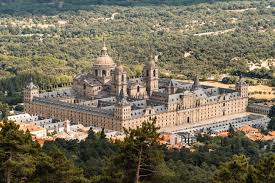
a regularity which might very easily have proved wearisome. An Academy of Painting was formed, on a grand scale, and about the same time the King’s palace was finished, eight years after its commencement. We read that the shell of the building alone cost eight millions sterling, and that the Spanish Escurial and Versailles were each
infinitely exceeded by Stanley
More than a dozen pages of the book are given up to the description of the city of Stanley to name the wonders and outstanding features of which would be, as it were, to compile a catalogue. By the year 1921, it is written, Stanley possessed a Cathedral which
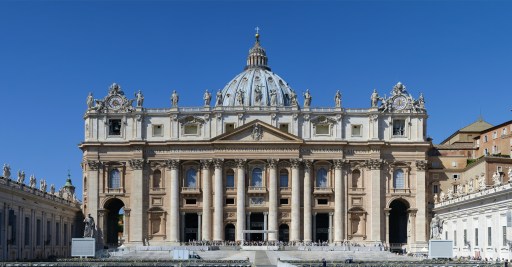
in architecture, grandeur and extent far exceeded Saint Peters’ at Rome,
while the gardens of the King’s palace were become an eighth wonder in the land. The city had grown to be four miles square ; it had its University,
and was evidently become the metropolis of the three, or rather, four kingdoms.
And here we must take our leave of the amazing City of Stanley, Rutland, having in no appreciable degree exhausted the written account of its glories.
As a pendant to the foregoing, I proceed to add that, in regard to the authorship of “George VI” Mr. Oman, in his Editorial preface, invited information. I sought the aid of Mr. Joseph Phillips, F.S.A., that Admirable Crichton in everything relating to the history and records of Stamford and the district around. One learned that the author was the Rev. William Hanbury, an eighteenth century Rector of Church Langton, Leicestershire, an account of whose by no means Lilliputian achievements, not less than his gigantic (Brobdingnagian is quite too unwieldy) schemes form a really remarkable chapter, in what may be termed local history. Then some pleasant correspondence with Mr. Oman, to whom was given (as a matter of course), the name of my informant, the sterling gentleman whose recent death we all deplore.
“The reign of George VI” was written in 1763, three years into the reign of the real George III. In the alternate history he is followed by George IV, George V. George VI then came to the throne in 1900. This suggests long reigns for the first three of these Georges, implying either that at least one of them fathered a child in his old age, or they were not necessarily all fathers and sons. By 1900, when George VI came to the throne, Britain was faced with an aggressive, expansionist Russian Empire that had taken over much of northern Europe. In the first year of his reign, the Russians invaded Britain, engaging in major land and sea battles. The nature of warfare was very much that of the 18th century – based on infantry and cavalry, with the leaders of the army being Earls and Dukes. Parliament refused at first to sanction money for the nation’s defence, partly because the Czar
had conveyed immense sums into England, and had most politically distributed them to the most advantageous purposes
but under pressure from the mob, parliament
they now offered to address his Majesty to take the state under his protection,
which in effect meant royal control over the exchequer, with which he properly equipped the army. The Russians were defeated at Wetherby under the field leadership of the king. The description given of the battle would not out of place in War and Peace. But this was not the end, and ongoing skirmishes with France tipped over into full scale warfare, with the army and the navy of the French king being supplemented by the remains of the Russian forces. George then led a small army into Flanders and northern France and forced the French into submission and a peace treaty was signed. The ensuring peace, in 1903, enabled George to turn to more peaceful interests in building up his country, and in particular in the building of his city of Stanley. The peace lasted until 1917, when the Russians attacked the German Empire, assisted, naturally enough, by the French. George took his army to assist Germany, and helped fight of the Russians, and defeat the French armies. In 1919 he entered Paris in triumph. Europe by this time was in a state of political and economic confusion, and George fought minor skirmishes and military actions throughout the next year, to subdue the Spanish in particular. The American colonists, still loyal to the crown, played their part in the defeat and overrunning of Mexico. It culminated with a victorious George being crowned King of France in 1920.
Entertaining as all of this alternative history is, it is of course, simply a reflection of the period in which it was written and of the concerns of that time. The armies were those of the 18th century, the countries and empires that threatened George were similarly those of that period. Monarchs and aristocracies still ruled and the French and American revolutions hadn’t happened. The huge changes brought about by the Industrial Revolution simply weren’t foreseen. The editor of the revised edition, Charles Oman has much more to say in his preface about the nature of the book’s predictions and how they relate to the politics of the original author’s own day.
The City of Stanley
As noted by Mr. Waterfield, he only gives the briefest of accounts of the City of Stanley, and the book contains much more information than that which he included. Rather than trying to summarise it, I have extracted the Stanley material and this can be accessed through the button below.
But here I would make one or two further points. Firstly, I presume the name of the city comes from the Stanleys who were of course the Earls of Derby and very prominent in politics and intrigue for many centuries before the book was written, But as far as I can see, the choice of name is not made explicit anywhere. I fear that I struggle to take the name seriously, Stanley being forever associated in my mind with Stanley Unwin, Stanly Baxter and Stan(ley) Laurel. But that is my problem.
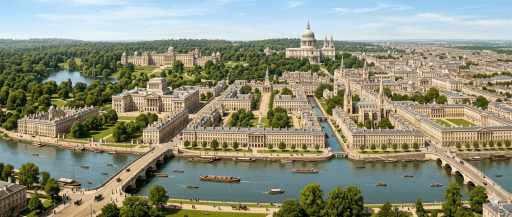
Secondly it is clear that, as with the political situation that is supposed, in architectural and planning terms, the author is reflecting his own time, and the city he envisages is essentially Georgian. I find it has a slightly nightmarish quality to it – grand, but rather soulless buildings, with no indication of commercial or domestic life. Indeed one wonders where all those who will provide for the aristocratic occupants of Stanley will live and where its food will come from – cities do not exists in a vacuum. At the very least the surrounding areas of Rutland would have been wholly changed in nature.
Similarly there is nothing about transport. One might have expected something about a grand road connecting Stanley with London – the author must have surely been aware of John Ogilby’s Britannia from 1675, which showed strip maps starting in London (see the map for our area to the left). Two years before the book was written, in 1761, the Bridgewater canal had been opened in the northwest and was seen as a major technological achievement. That is perhaps reflected in the mention of the canalisation of the Welland. Elsewhere in the book, where King George’s munificence to the general population is described, it is stated that canals connected every city in the realm – more or less the only transportation development that is described.
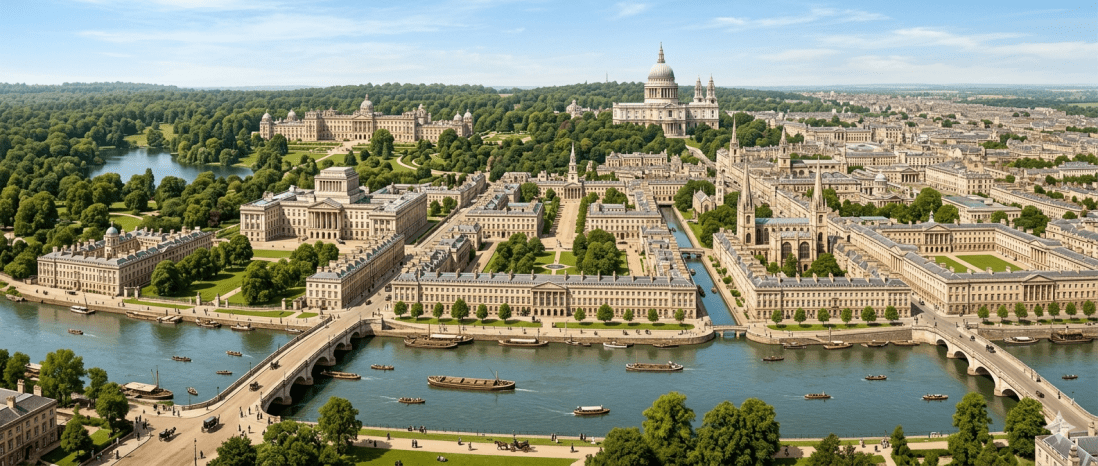
The City of Stanley – from Gemeni 2 AI
Who was the author?
Charles Oman, the editor of the reprint of 1902, was of the view that the author of “The reign of George VI” was clearly local to Rutland, because of his knowledge of the topography on which Stanley was built, and it is hard ot disagree with that. There are a couple of other indications pointing in that direction. Firstly, the canalisation of the Welland had been achieved in some fashion 100 years before in 1670 by the building of the Stamford Canal from Market Deeping to Stamford bypassing a stretch of the Welland that was used by mills and was not navigable. This predated the building of the first modern canal (the Bridgwater mentioned above) by 100 years and contributed greatly to the commercial success of Stamford. It is plausible to suppose that the author was aware of this attempt to make the Welland navigable in the development of his ideas.
The second point also relates to Stamford. Stanley is said to have 25 parish churches. In this of course, it resembles London, but Stamford also had a multiplicity of small parishes and their churches within the town. Again, this was an idea on which the author might have drawn.
As can be seen from Mr Waterfield’s article, he identified the author as the Rev. William Hanbury, Rector of Church Langton in Leicestershire (1725-1778), and he was certainly an interesting character – a clergyman, garden and plantation creator, music festival organiser and philanthropist. But there seems to be little indication that he authored books and pamphlets such as the Reign of King George VI. Neither was he particularly local to Rutland.
On the edition of the book on Google Books, there is a note “Maddon?” which seems to refer to the Irish author Rev. Samuel Maddon (1686-1765). One of Maddon’s early works, from 1733, was what has been described as the first science fiction book “Memoirs of the 20th century” which included the first recorded depiction of time travel and consisted of diplomatic letters from between 1997 and 1999 in the reign of King George VI. The political situation depicted is however very much of his own time, with international relations mirroring those of 1733. The parallels are obvious, but there is no indication that Maddon was familiar with Rutland, and it may be that his book simply served as the inspiration for “The Reign of King George VI”.
To my mind, neither Hanbury or Maddon has a convincing case for being the author of the work considered here. I would look for somebody who lived in the Rutland / Stamford area, but as to who that might be I have no idea at all.
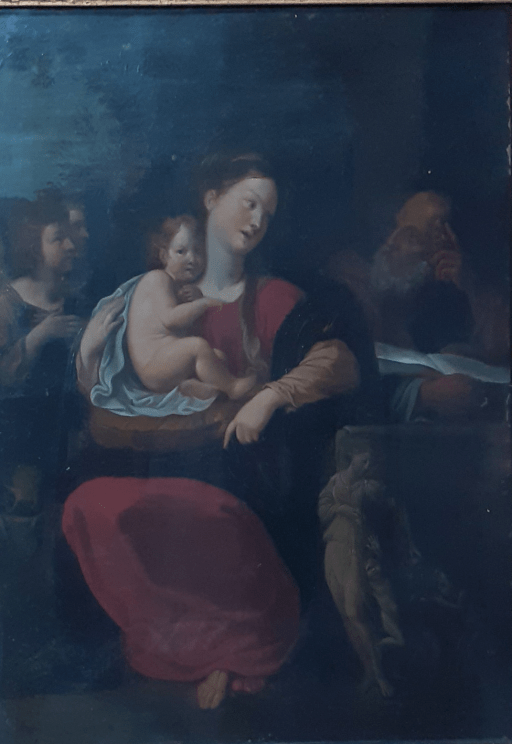
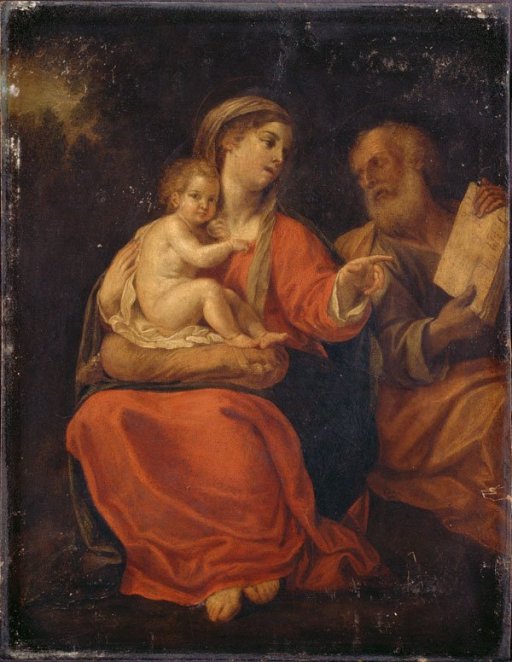
The painting of the Holy Family shown below has hung in the Vicar’s Vestry at All Saints church in Oakham for many years, and has, until recently, never been properly identified. Recent expert advice suggests it is a late 18th / early 19th century copy of a composition by Francesco Albani of between 1608 and 1610. It is believed that it was produced by a workshop in Italy, or perhaps the Netherlands, to satisfy the demands of those on the “Grand Tour” for devotional works. Whilst thus not of any great value, it thus does have an interesting back story.
After a composition by Francesco Albani, paint on metal, late 17th / early 18th century
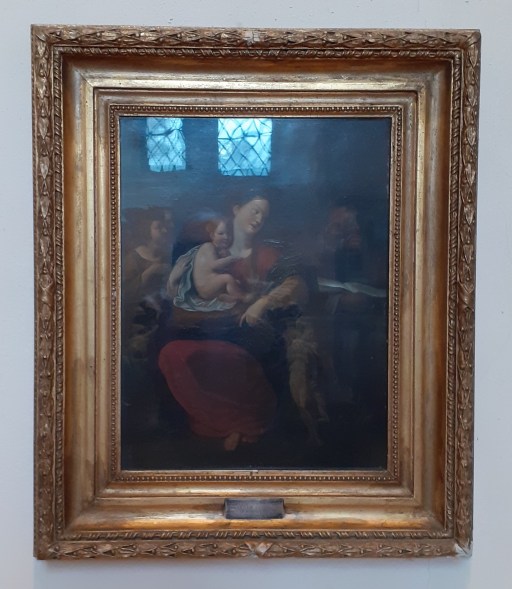
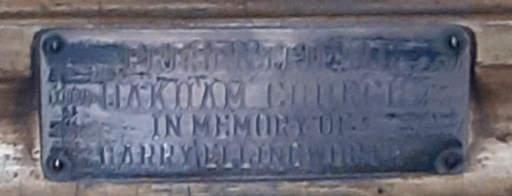
It’s detailed provenance is not known, but a difficult to read caption on the painting frame (below) has the inscription
“Presented to Oakham Church in memory of Harry Ellingworth”.
The Ellingworth family were prosperous shopkeepers in Oakham in the late 19th and early 20th century, and a number of them were named Harry. The most significant of these seems to have been a Harry Ellingworth who was a Town Crier in Oakham in 1881.
Painting in frame (with window reflections)
Dedication label
Interestingly a number of similar copies of the painting can be traced – either painted in Albani’s workshop or elsewhere (see below). The details vary, but the basic composition is the same. The market for such paintings was clearly buoyant.
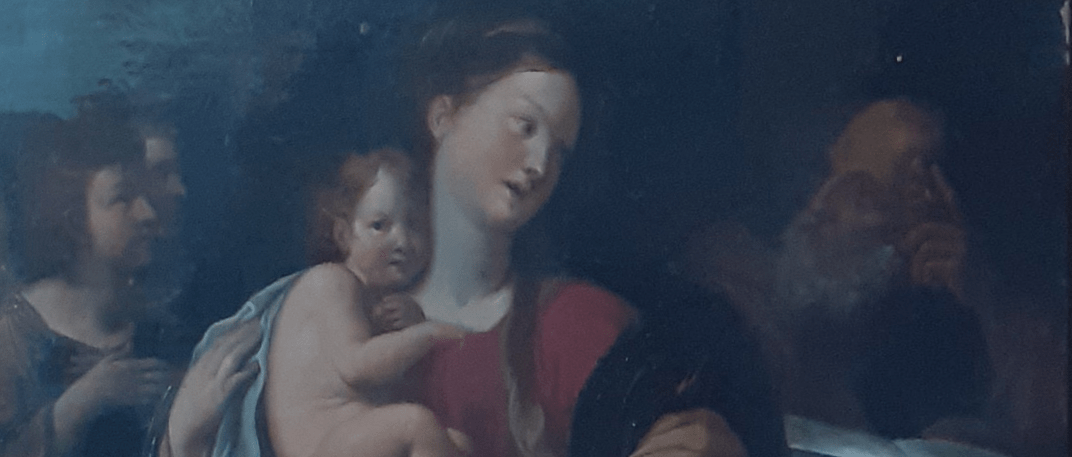
The painting shows a somewhat weary and pensive looking Madonna in a red dress with a dark blue shawl, The Christ child sits on a golden cushion on her lap, partly surrounded by a blue sheet. Joseph looks on from the right, with an open book in front of him, that seems to be placed on a stone chest or altar or perhaps a tomb. It may be that the directions in which the Madonna and her husband are pointing is of some iconographic significance – Joseph, in his contemplation of scripture pointing upwards to God, and Mary, with the Christ child on her lap, pointing down to earth, the direction, if that is an appropriate word, of the incarnation. Two angelic figures look on from the left. There is a figure carved on the stone chest, that, from the original, appears to be some sort of Bachannalia, with wine being poured out for small dancing child like figures. Again there may be some iconographic significance here with a representation of Christ’s blood being poured out at the Eucharist. The mixture of biblical and classical themese seems to have been common at the period of the original composition.
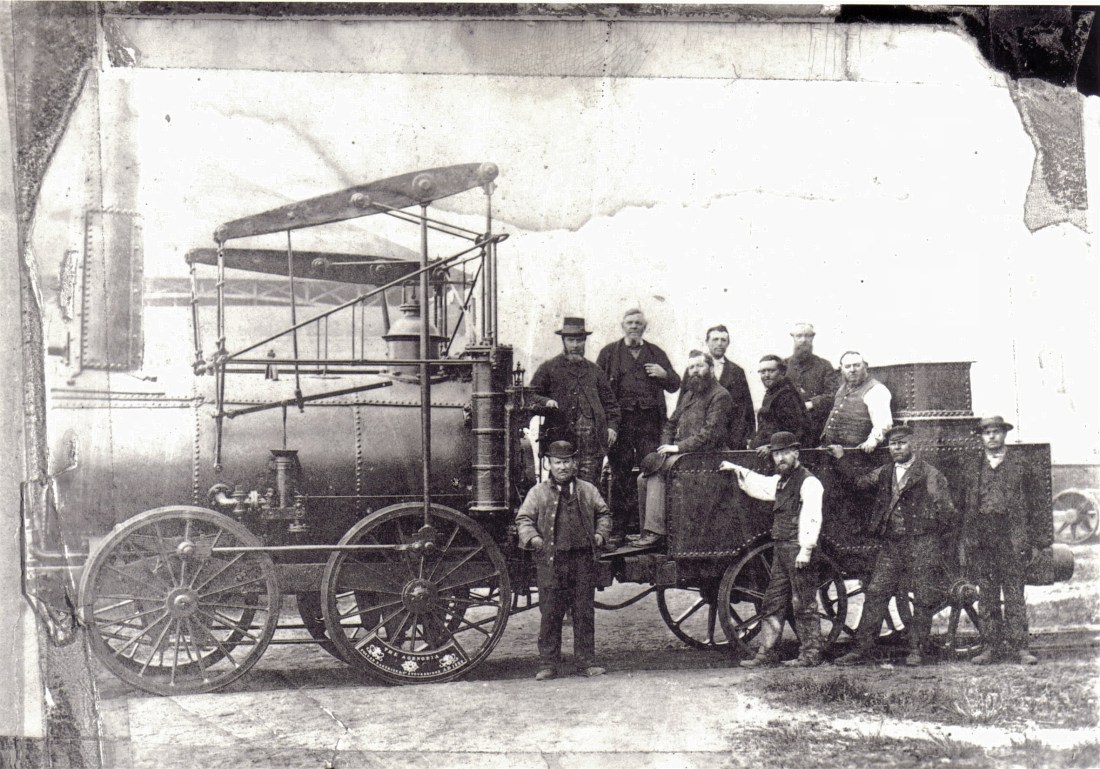
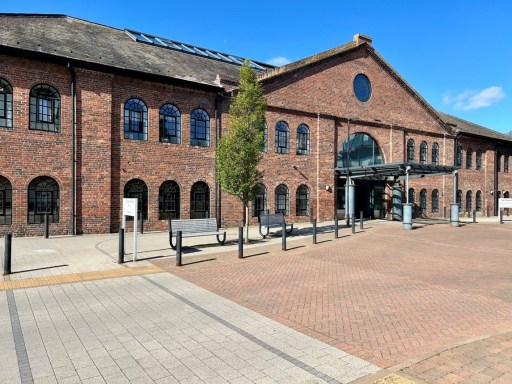
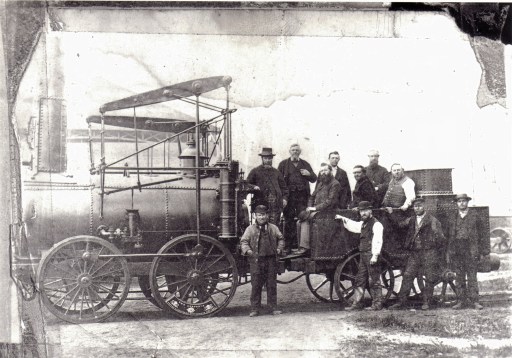
One of my recent tasks as a member of the committee of the Black Country Society has been to help organise an exhibition of photographs and other material at Dudley Archives entitled “From Agenoria to Beeching – the first and last days of steam in Dudley”, which ran from October 2025 to January 2026. This brought together material on the first Railway in the area (the Shutt End or Kingswinford Railway) and its locomotive, the Agenoria, with photos from the 1950s and 1960s that illustrate the last days of steam in the area. As the exhibition drew to a close, I prepared a web version which included the majority of the material in the exhibition and gave it some sort of long term presence. When this online exhibition went live, it resulted in some very interesting email exchanges and conversations with a number of those who looked at it. One of these was with Mr. David Marlow from Northumbria who provided two items that are now actually included in the online exhibition. The first is a photograph of a plaque on the wall on the old (and then derelict) John Bradley and Company factory in Stourbridge (now renovated as the Lion Health Centre), which commemorated the locomotives Agenoria and its sister locomotive, the Stourbridge Lion, that were built there. The second was a copy of a posed picture of the Agenoria with a number of workmen / managers. The original was donated to the National Railway Museum in the 1990s. From Mr. Marlow’s perspective, this photograph was particularly interesting as the “driver” of the locomotive was his great great grandfather Edward Stockton. Both these items raise some interesting chronological questions about the timelines of the Agenoria and the Stourbridge Lion, and these issues are probed in what follows.
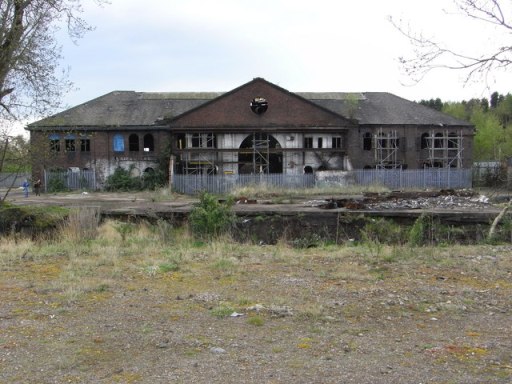
Figure 1. The derelict John Bradley factory in the early 2000s and the renovated building, now the Lion Health Centre
The Agenoria and the Stourbridge Lion were built at the John Bradley factory in Stourbridge in the 1820s (figure 1). The first was to run on the Shutt End Railway in Kingswinford for over 30 years, and is now preserved in the National Railway Museum in York. The second became the first locomotive to run under steam in the USA, although it was not much used because the tracks provided were not sufficiently robust. The careers of both locomotives are well outlined in “Two Stourbridge Locomotives” by Bill Pardoe and Michael Hale, Black Country Society Studies in Industrial Archaeology No. 3, published by the Black Country Society.
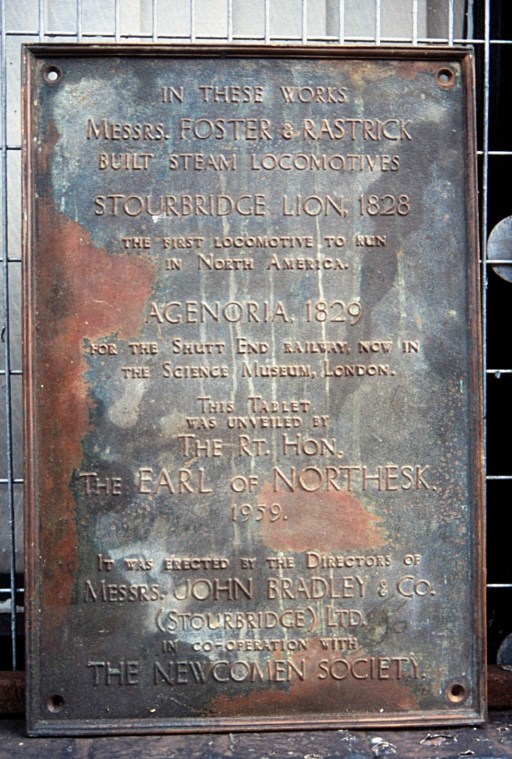
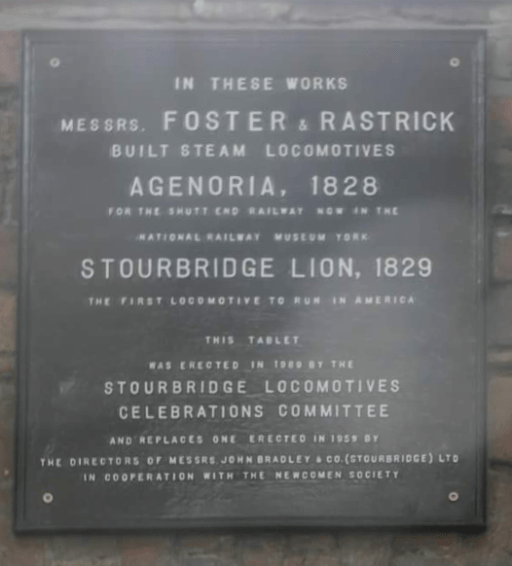
On a Black Country Society Industrial Archaeology Group visit to the derelict John Bradley foundry in 2005, Keith Hodgkins took a photo of a plaque that had been placed there by the Newcomen Society in 1959, commemorating the Stourbridge Lion and the Agenoria (Figure 2a). In our recent correspondence Mr. Marlow sent a photo of another plaque from the same building, apparently placed there to replace the Newcomen Society plaque by the Stourbridge Locomotives Celebrations Committee in 1988 (Figure 2b). The current whereabouts of these plaques is not known. But my interest was aroused by the dates on the plaques – Stourbridge Lion 1828 and Agenoria 1829 on the first, and Agenoria 1828 and Stourbridge Lion 1829 on the latter. There is clearly some chronological confusion here – which of the two engines should have the chronological priority?
a
b
Figure 2. Plaques celebrating the Agenoria and the Stourbridge Lion
From the historical record, we can trace the timeline of the construction and operation of the locomotives to some extent. The Shutt End Railway was first proposed in the early 1820s to connect the mines and the developing Iron Works in the area to the Staffordshire and Worcestershire Canal to the west, to enable coal and iron products to be shipped to market. Eventually in January1827 an agreement to build the line was signed between the Dudley Estate and James Foster of the Shutt End Iron Works, which was itself owned by John Bradley and Company, coal and iron masters of Stourbridge. Construction took place soon after the signing of the agreement and the line was opened with great celebrations on June 2nd 1829. The Agenoria locomotive was built by Foster Rastrick and Co at Stourbridge (at the works of Figure 1). The Foster was the same James Foster who owned the Shutt End works, and John Rastrick was a noted locomotive engineer and builder.
In 1828 Horatio Allen, went on a railroad research tour of England on behalf of the Delaware and Hudson Railway in the USA. By July 1828 he had ordered four locomotives – three from Foster, Rastrick and Company and one from Robert Stephenson and Company. Stourbridge Lion was one of these three locomotives built by Rastrick, but Stephenson’s shop completed their locomotive, the Pride of Newcastle, before any of Rastrick’s locomotives, and it arrived in America nearly two months before the Stourbridge Lion, which was transported from Liverpool aboard the ship John Jay, arriving at New York in mid-May 1829. The two other Foster, Rastrick & Co locomotives that had been ordered by Allen, Delaware and Hudson, arrived in New York in August and September 1829. The Lion however was the first to be used, running on the Delaware and Hudson Railway on August 8th 1829. Although the locomotive performed well, the track laid for it was unable to adequately take its weight and it never found operational use.
So which of the Agenoria and Stourbridge Lion should have priority. Certainly the Agenoria ran along tracks at Shut End in June 1829 a few months before the Lion did the same in the USA. But the Lion is the first recorded in the historical record on its shipment to the US in May that year. But, in my mind it is likely that the Agenoria was under construction and seen by Allen before he placed his order in July 1828. Certainly the Agenoria must have been complete by early 1829, as it is almost certain that there would have been extensive trials on the Shutt End line before the public opening in June that year. So I would suggest that Agenoria was probably completed first, sometime in late 1828, and the Lion a few months after that. Thus of the two plaques, the second, from 1988, is probably correct, although it would be fairer to say that both were probably constructed if not completed in 1828, and first ran in operation in 1829. But Agenoria should have the historical priority in both construction and operation.
Retirement and Restoration
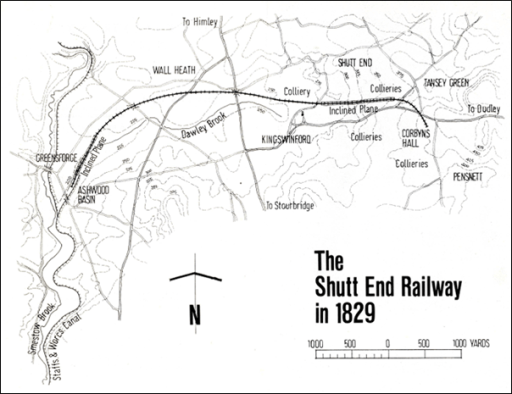
The Agenoria ran along the Kingswinford Railway from the top of the incline at Ashwood Basin in the west to the bottom of two inclines close to Kingswinford church in the east. See the map from “Two Stourbridge Locomotives” shown in Figure 3.
Figure 3.The Shutt End Railway – from “Two Stourbridge Locomotives” by Bill Pardoe and Michael Hale, Black Country Society Studies in Industrial Archaeology No. 3
One incline (shown in Figure 3) took the railway itself to the mines around Corbyn’s Hall in Pensnett, and one (not shown on the Figure) provided access to and from the works of John Bradley and Co. Both inclines can be assumed to have been cable hauled. The Engine Shed and presumably other maintenance facilities was close to the foot of the two inclines. The Kingswinford Railway was only connected to the wider Earl of Dudley’s Railway network (the Pensnett Railway) in 1865, through a junction several hundred yards to the west of the bottom of the inclines. Correspondence in 1864 between the mineral agent of the Dudley Estate (Frederick Smith) and William Orme Foster who had taken over control of John Bradley and Co Iron Works from his uncle James Foster, implies that Agenoria was owned by John Bradley and Co, rather than by the Dudley Estate, as was the Locomotive Shed and the maintenance facilities. The correspondence was about the state of the Kingswinford Railway infrastructure and led to improvements being made and a new locomotive being purchased by Foster in 1865 – a Manning Wardle 0-4-0 saddle tank. It is generally assumed that it was around that time that the Agenoria was taken out of service.
The next mention of Agenoria in the historical record is in 1880, when Edward Marten (Chief Engineer at the Midland Steam boiler Inspection and Insurance Co in the 1860s, and later the engineer in connection with the South Staffordshire Mines Drainage and Improvement Act of 1873) sought to gain support for restoring and preserving the locomotive whose components by that time seem to have been scattered around Shut End Iron Works. This led to a restored Agenoria being exhibited at Wolverhampton Fine Arts & Industrial Exhibition in 1884, before being formally donated to the Science Museum in 1885 by William Orme Foster. The implication here is that, after the Agenoria had been taken out of service, it was taken into the Iron Works, either by being hauled up the incline or (possibly more likely) taken around a less steep but more circuitous connection into the works that was in place by 1880 and possibly a couple of decades earlier.
Figure 4. The Agenoria and workers (from Mr. D. Marlow)
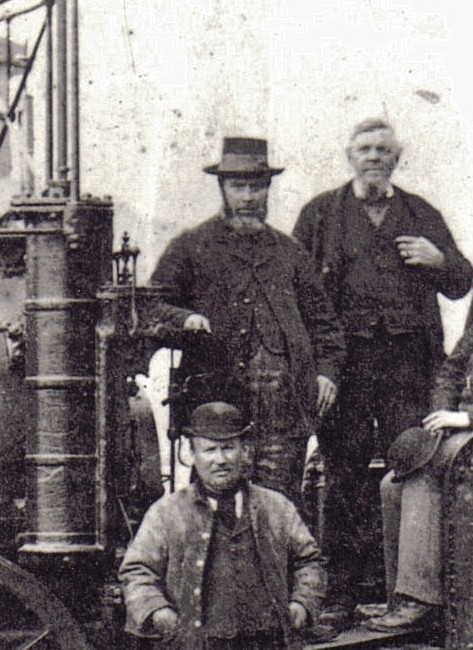
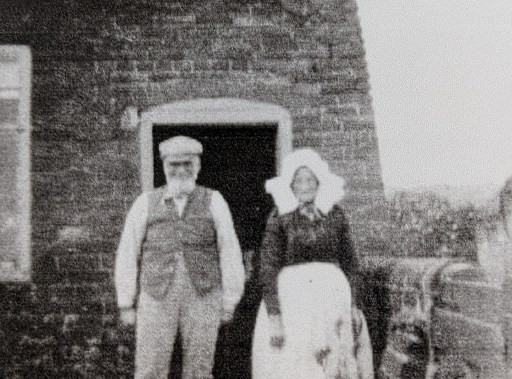
Now consider the photograph that was sent to me by Mr Marlow, shown in Figure 4 above. Mr. Marlow believes the figure closest to the boiler on the photograph, in the driver’s position, is his great great grandfather, Edward Stockton, and family tradition has it that he was one of the drivers of the locomotive. Figure 5a shows an expanded version of Figure 4 where the driver is shown in better definition, whilst figure 5b shows an (admittedly poor) photograph that is certainly of Edward Stockton and his wife Ellen from the 18890s or later, also supplied by Mr. Marlow. These both, in my view, seem to show the same person, and I am reasonably confident that the driver of the footplate is indeed Edward Stockton.
a
b
Figure 5 Edward Stockton – (a) from Figure 4 and (b) showing Edward and his wife Ellen
Edward Stockton was born at Moreton Cobbett in Shropshire in 1824, Some time before the 1851 census he had moved to the Pensnett area as he married an Eliza Farringdon at Dudley Parish Church in November 1847. She died within a very short time and Edward then married her sister Ellen two years later, this time at Kingswinford Parish Church. In the 1851 census he is identified as a Furnace Man, in 1861 as a Labourer, in 1871 as a Labourer in Iron Works and in 1881 as a Farm Labourer, always living in the vicinity of the Shutt End Iron Works. Nowhere is he identified as an Engine Driver as might be expected. Of course this might simply be due to the idiosyncrasies of how he completed the census returns, but it seems to me more likely that Stockton became an Engine Driver sometime after the 1871 census. This suggests that the Agenoria, after being withdrawn from the Kingswinford Railway, had a brief afterlife as a locomotive in the Shutt End works, where an extensive railway system was developing in the 1870. Supposing the photo to have been taken between 1871 and 1875, this would put Edward in his late 40’s / early 50’s at the time, which seems consistent with the photograph. The occasion of the photo might be to mark the start of Agenoria’s Iron Work’s career (which would imply that it was not moved into the works till the 1870s, or perhaps we have here a picture of the reconstructed engine in 1880 or early 1881 before the census of that year. However at this time Edward was a farm labourer and presumably working elsewhere. The first occasion seems to me to be more likely.
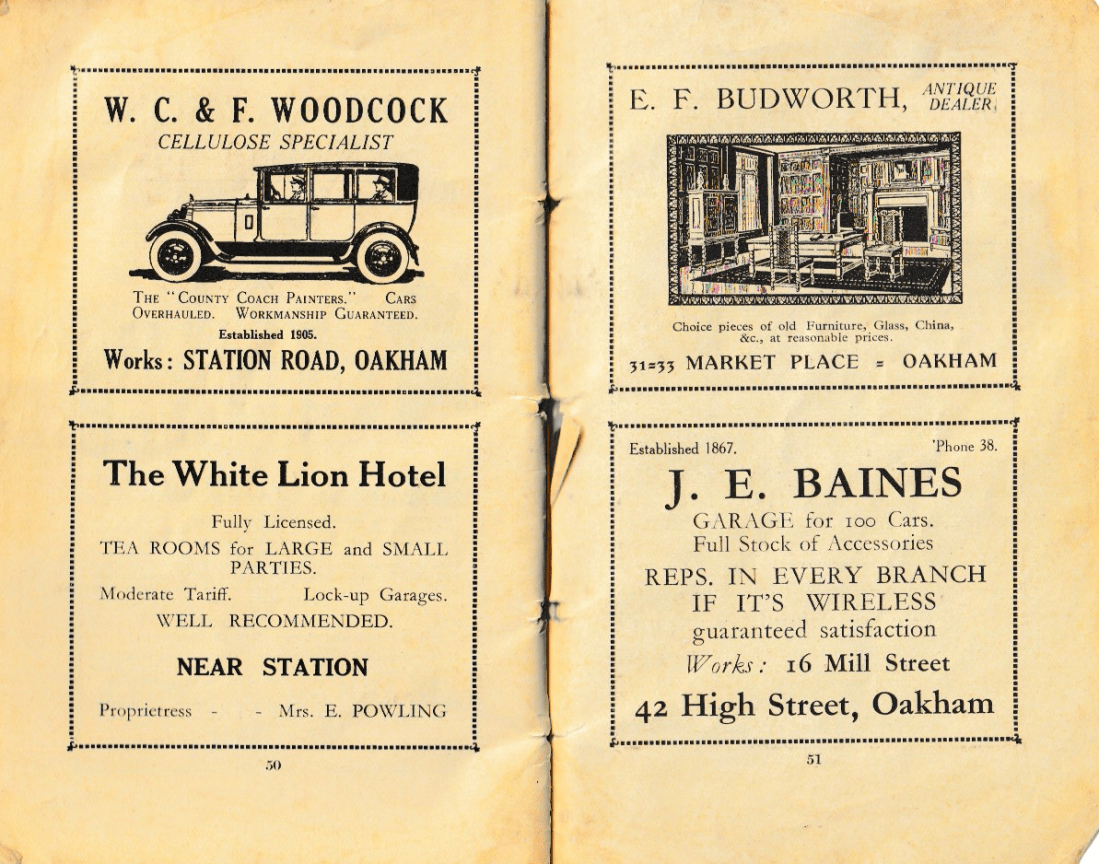
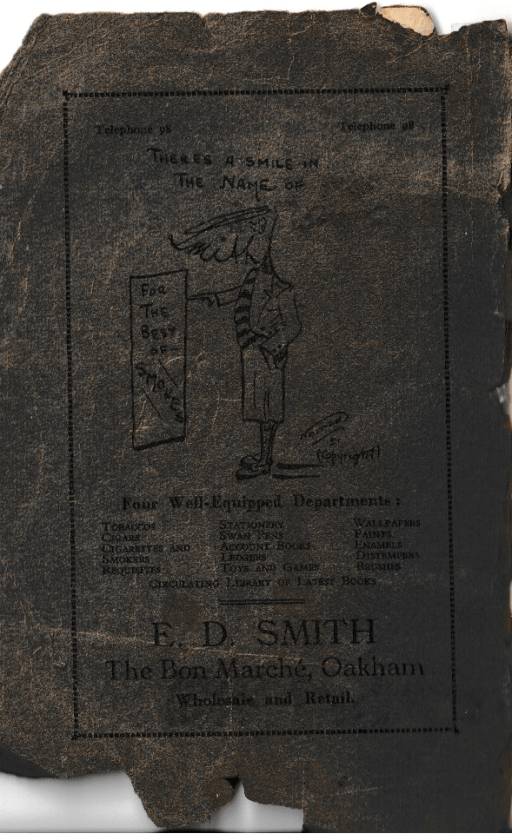
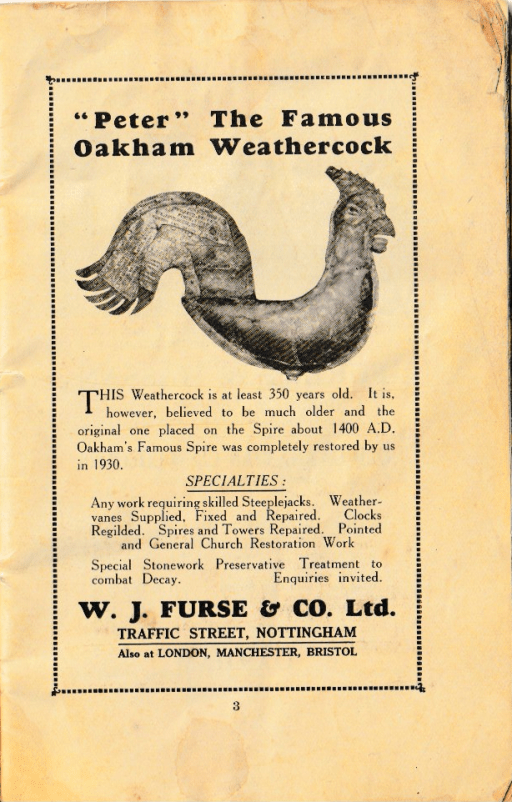
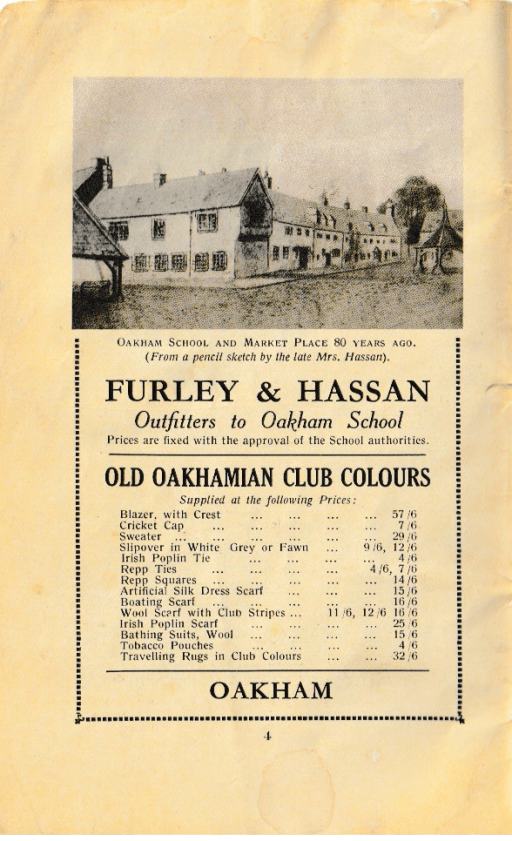
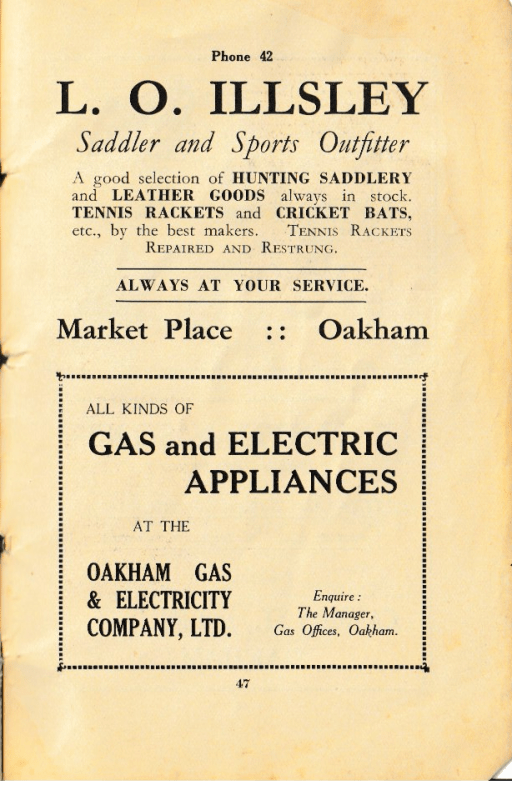
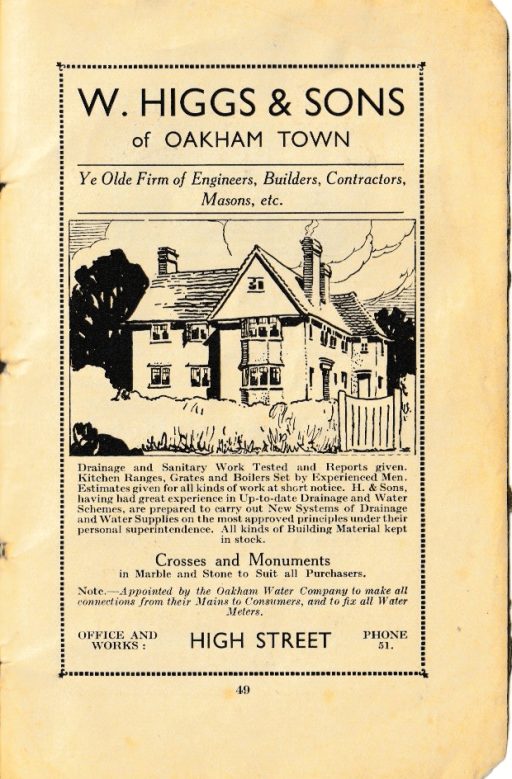
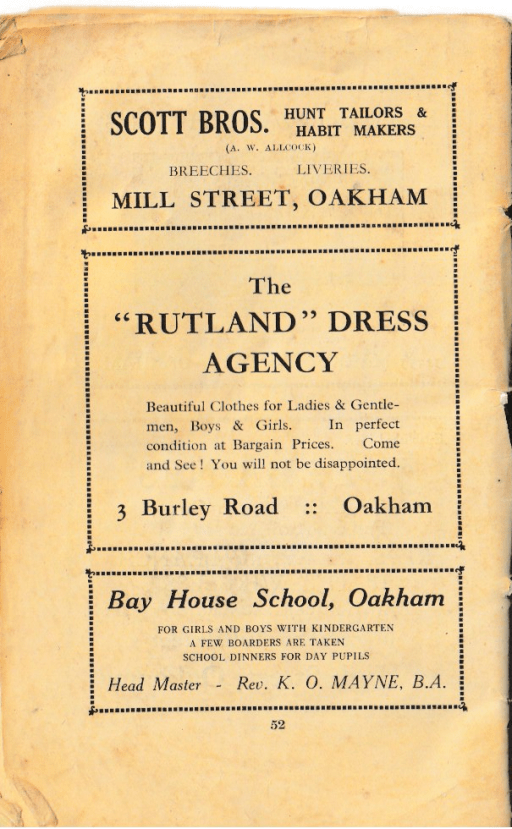
Recently I have come across a number of old Church Guides and Histories for All Saints Church in Oakham- from 1932, 1972 and 1980. PDFS of these can be found on the History and Heritage page of the church website. There comes a time of course when old guides and histories become historical documents in their own right, revealing how the church was thought of and communicated at the time of writing, and in their description of their contemporary activities, give an indication of the nature of the church’s worship and other activities. This is particularly true of the 1932 guide – The Story of Oakham Church, School and Castle by the then vicar, A. Edward Fraser. In what follows I post just a few pages from this this guide – the adverts it contained for local businesses that paid for its publication. These are given below, and I suspect that Oakham readers will find them of considerable interest.












.JPG)


