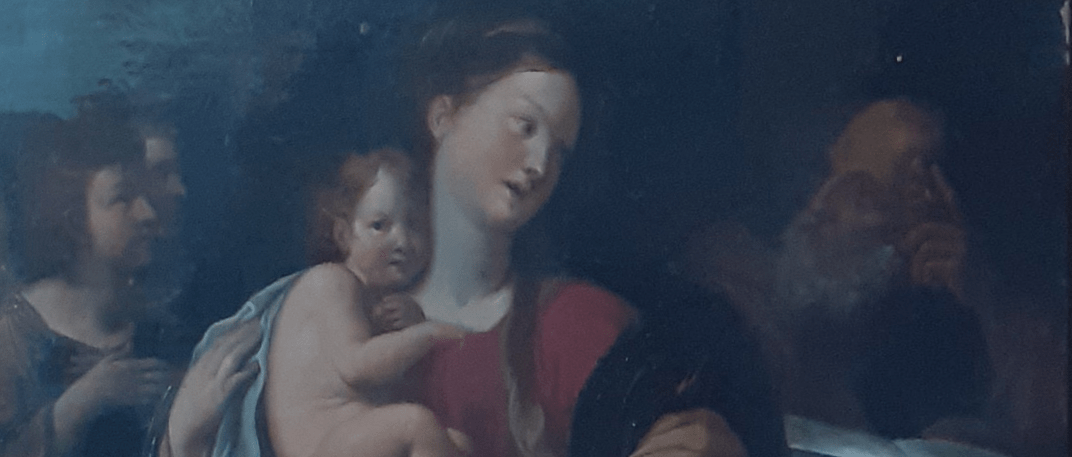
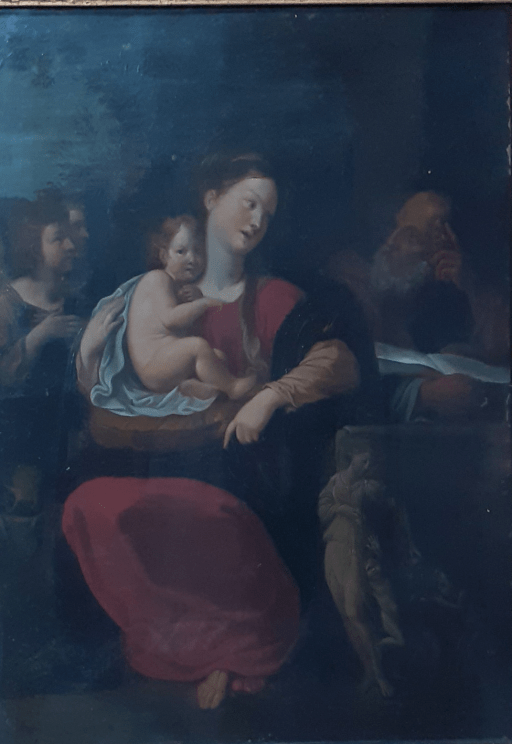
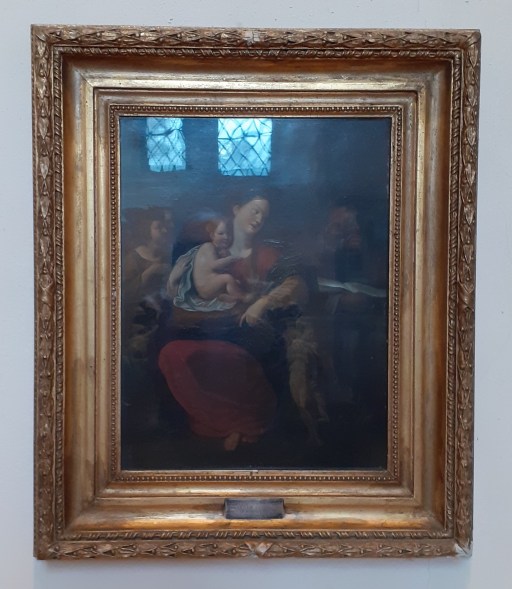
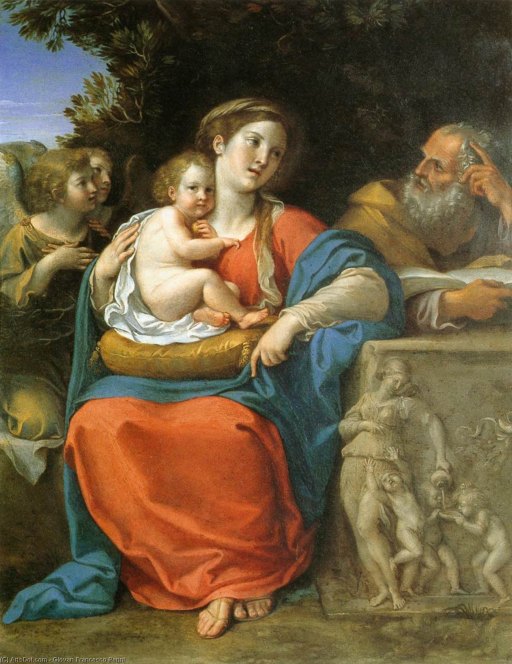
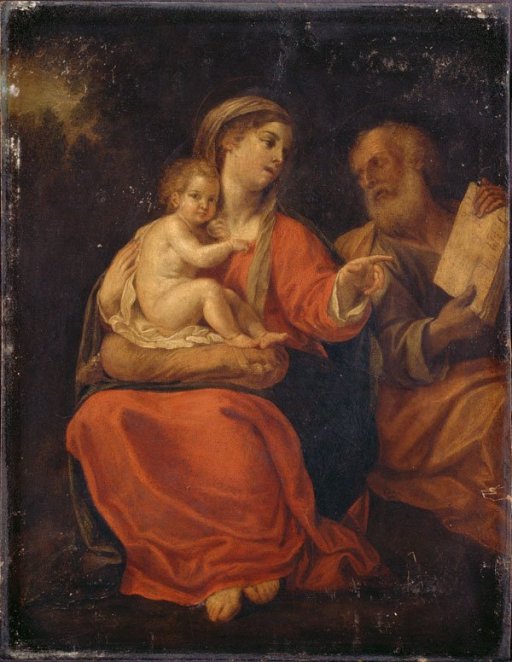
The painting of the Holy Family shown below has hung in the Vicar’s Vestry at All Saints church in Oakham for many years, and has, until recently, never been properly identified. Recent expert advice suggests it is a late 18th / early 19th century copy of a composition by Francesco Albani of between 1608 and 1610. It is believed that it was produced by a workshop in Italy, or perhaps the Netherlands, to satisfy the demands of those on the “Grand Tour” for devotional works. Whilst thus not of any great value, it thus does have an interesting back story.
After a composition by Francesco Albani, paint on metal, late 17th / early 18th century
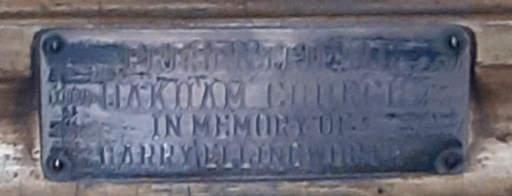
It’s detailed provenance is not known, but a difficult to read caption on the painting frame (below) has the inscription
“Presented to Oakham Church in memory of Harry Ellingworth”.
The Ellingworth family were prosperous shopkeepers in Oakham in the late 19th and early 20th century, and a number of them were named Harry. The most significant of these seems to have been a Harry Ellingworth who was a Town Crier in Oakham in 1881.
Painting in frame (with window reflections)
Dedication label
Interestingly a number of similar copies of the painting can be traced – either painted in Albani’s workshop or elsewhere (see below). The details vary, but the basic composition is the same. The market for such paintings was clearly buoyant.
Print of the original by Francesco Albani housed in the Museum of Fine Arts in Boston. 1608-1610
Dulwich Art Gallery Holy Family by Studio of Francesco Albani 1610-60
The painting shows a somewhat weary and pensive looking Madonna in a red dress with a dark blue shawl, The Christ child sits on a golden cushion on her lap, partly surrounded by a blue sheet. Joseph looks on from the right, with an open book in front of him, that seems to be placed on a stone chest or altar or perhaps a tomb. It may be that the directions in which the Madonna and her husband are pointing is of some iconographic significance – Joseph, in his contemplation of scripture pointing upwards to God, and Mary, with the Christ child on her lap, pointing down to earth, the direction, if that is an appropriate word, of the incarnation. Two angelic figures look on from the left. There is a figure carved on the stone chest, that, from the original, appears to be some sort of Bachannalia, with wine being poured out for small dancing child like figures. Again there may be some iconographic significance here with a representation of Christ’s blood being poured out at the Eucharist. The mixture of biblical and classical themese seems to have been common at the period of the original composition.
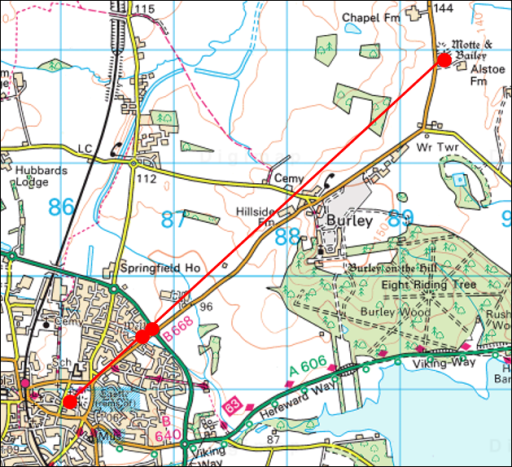
In a post “A possible Anglo-Saxon church group at Oakham in Rutland” from May 2024, I noted that All Saints Church in Oakham, and Our Lady’s Well to the north east were on what could be a mid-summer sunrise / mid-winter sunset solar alignment. I went no further than simply noting this, and didn’t speculate further about what it might imply. One always needs to be cautious about such alignments – they can be simple coincidences, and, if they are being looked for, can be found in the most unlikely places. For example from Borrowcop Hill in Lichfield, possibly an ancient burial mound, there was until recently a perfect alignment with the medieval spires of Lichfield Cathedral and the cooling towers of Rugeley power station, the latter sadly now demolished, which can hardly be of ancient origin. That being said, a reader of the May 2024 post sent me some further information that suggests that a cluster of Stone Age / Bronze Age / Iron Age remains have been found to the north east of Our Lady’s well that could also be on the same alignment. Looking at this further, I realised that several kilometres to the north east of that, and again on much the same alignment, we have Alstoe Mount, another historic monument. These are all shown on the Ordnance Survey map extract of Figure 1 below. The nature of this possible alignment, along the axis of the mid-summer sunrise and mid-winter sunset is discussed further in this post.
Figure 1. The possible alignment. The sites are shown as red circles – from the south west to the north east these are All Saints church in Oakham, Our Lady’s Well, the historic monuments and Alstoe Mount.
The sites
All Saints church, Oakham
All Saints Church is Oakham (Figure 2) is a twelfth century church with thirteenth to fifteenth century additions. Internally it is pure Victorian, having been restored by Gilbert Scott. However it almost certainly stands on the site of an Anglo-Saxon church, and a church in Oakham is mentioned in the Domesday book. A compendium of historical information is given on the church website.
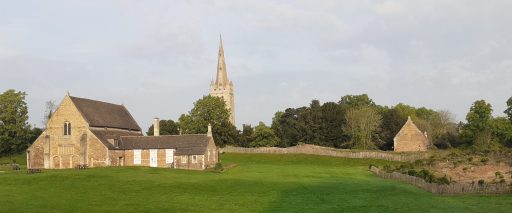
Figure 2. All Saints Oakham and Oakham Castle (photograph by the author)
Our Lady’s Well
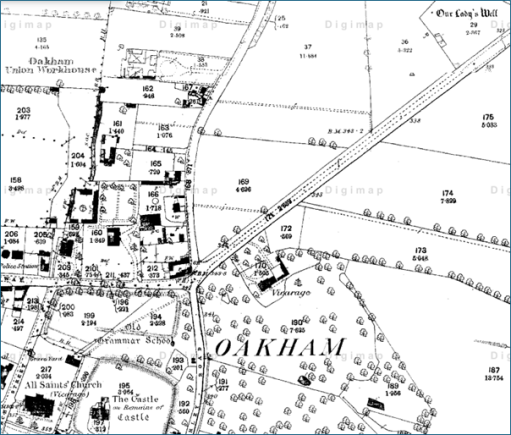
Our Lady’s Well is a historically well-attested pilgrim site to the north east of All Saints church – see Figure 3. To quote from Leicestershire and Rutland’s Holy Wells by Bob Trubshaw from 2004;
Our Lady’s Well was once famed for curing sore eyes – providing that a pin was thrown in first. In 1291 indulgences could be obtained by visiting Oakham Church during its patronal festival and, for a price, joining a pilgrimage to Our Lady’s Well. In 1881 it was visited by the future Queen Alexandra. The well is to the north-east of the town, in a somewhat overgrown area between the Cottesmore road and a modern housing estate (NGR SK:866095).
It’s current condition is no better, and it is now impossible to access the well, in an overgrown plot of wasteland, which seems a shame.
Figure 3. Location of Our Lady’s Well from the 1880 Ordnance survey Map (All Saints church is at the bottom left, and the well at the top right.)
The Stone Age / Bronze Age / Iron Age monuments
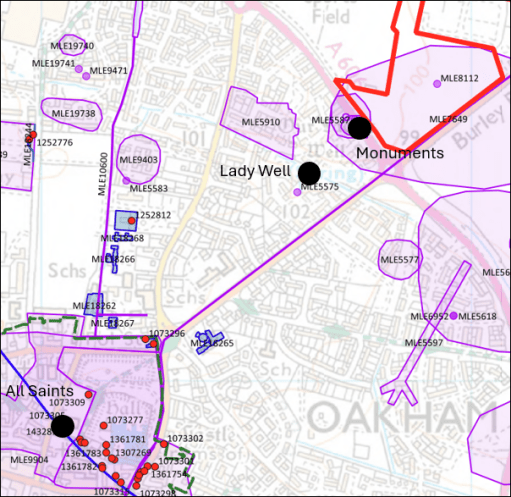
The material I was sent concerning the Stone Age / Bronze Age / Iron Age monuments came from “Land off Burley Road Oakham, Vision and Delivery Document” produced by Pigeon Investment Management with regard to a proposed hosing development. Figure 4 is taken from that document and shows the location of Our Lady’s Well and the relevant monuments.
The monuments are listed as follows, where the numbers are those on the Historic England National Heritage list.
MLE5587 – Possible Mesolithic site west of Burley Road MLE5592 – Late Iron Age/Roman site west of Burley Road MLE5593 – Bronze Age burial, west of Burley Road MLE5594 – Neolithic pit circle site west of Burley Road
Alstoe Mount
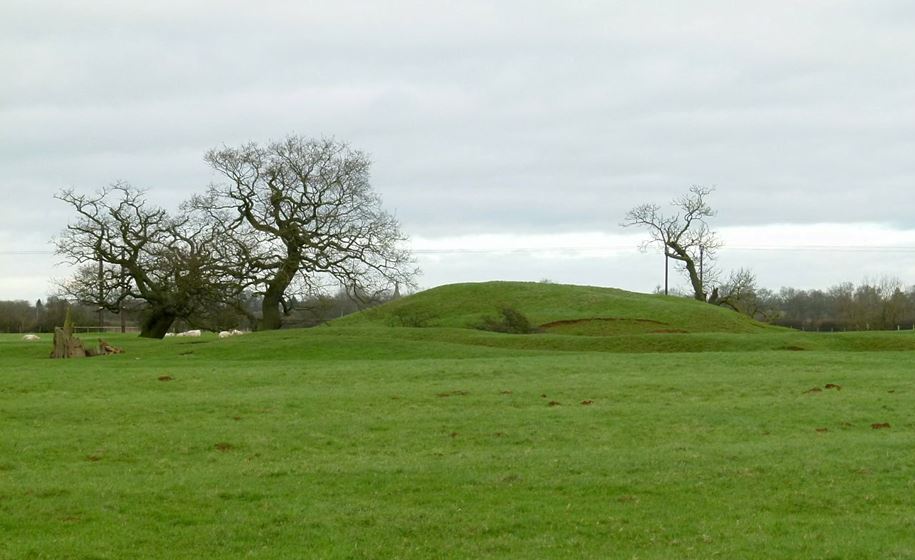
The substantial mound of Alstoe Mount (Figure 5) is described on the Ordnance Survey map as a Motte and Bailey. That is almost certainly not true. It was probably the Moot location for Alstoe Hundred. Details of the mound and the surrounding deserted village are given in the Historic England list entry.
Figure 5. Alstoe Mount (photograph from Historic England by Alan Murray-Rust, 2016)
The possible solar alignment
A current mid-summer sunrise / midwinter sunset direction from Oakham is 47.5 degrees east of north (from SunCalc). However obtaining a precise value to compare with the possible alignment shown in Figure 1 is difficult for two reasons. Firstly the actual direction of sunrise and sunset has varied over the millennia – and as things stand, we have no date for which a calculation can be made. This change is however small – of the order of 0.2 to 0.5 degrees. Also the apparent direction from any point depends upon the precise topography of the horizon over which the sunrise / sunset is observed – and as we know nothing about the observation point or the direction of observation, this is again not possible to specify. This again results in an uncertainty of around 0.5 degrees. So all we can probably say is that we are looking for an alignment of 47.5 +/-1.0 degrees east of north.
The actual directions between All Saints Oakham and the other sites is as follows.
Oakham to Our Lady’s Well – 46.3 degrees Oakham to Stone Age / Bronze Age / Iron Age monuments – 47.1 degrees Oakham to Alstoe Mount – 47.8 degrees
Again there is uncertainty here – particularly in the specification of the precise site at Our Lady’s Well of any structure that might have been visible from All Saints, and similarly the precise position of any relevant structure in the monument field. The location point for All Saints (taken as the centre of the building) could be around 10m to the east or west. This can have an effect of the bearings of Our Lady’s Well and the monuments by around 0.25 degrees. Considering these uncertainties the above bearings and a sunrise / sunset direction of 47.5 degrees seem broadly consistent, and thus there does seem to be some evidence for all four sites lying along a solar alignment of some significance.
But there is another issue – that of elevation. A cross section along the proposed alignment is shown in Figure 6. From this it is clear that Alstoe Mount would not be visible from Our Lady’s Well or from the Monument field, and would only just be visible from All Saints if any observation platforms that existed there and at Alstoe were raised off the ground by a metre or so. Beacons however would have been visible.
Figure 6. Section through the proposed alignment (from Google Earth Pro.).
Discussion
So what does the above analysis lead to. Firstly I think there is plausible (but far from conclusive) evidence for a mid-summer sunrise / mid-winter sunset alignment, at least between the Monument field / Our Lady’s Well and All Saints, and possibly between Alstoe Mount and All Saints. but the available evidence gives us no chronological information as to when the alignment might have been of significance. Our Lady’s Well is first mentioned in the late Middle Ages and All Saints and Alstoe Mount can only be said to become of important in the pre-conquest period. There is no evidence at all, except in the monument field, for the other sites being important in the Stone Age / Bronze Age / Iron Age. So in my view it is probably better to stop at this point – acknowledging that there may be a solar alignment, but not taking speculation any further. The boring, cautious approach I guess, but I don’t think there is much more to be said.
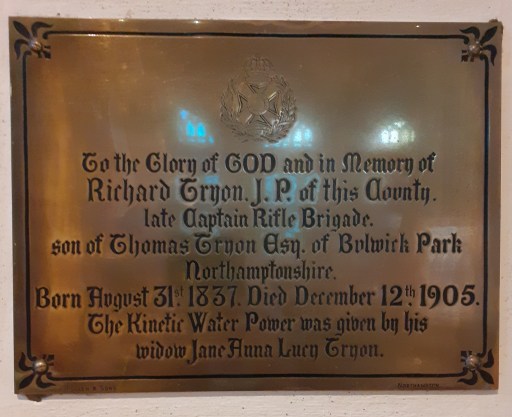
Recently, whilst waiting for a service to begin at All Saints church in Oakham, I stood in the Lady Chapel idly reading the memorials attached to the wall (as one does). I came across the one above. The inscription reads
To the Glory of GOD and in Memory of Richard Tryon J.P. of this County. late Captain Rifle Brigade. son of Thomas Tryon Esq, of Bulwick Park Northamptonshire, Born August 31st 1837, Died December 12th 1905. The Kinetic Water Power was given by his widow Jane Anna Lucy Tryon.
Ricard Tryon was one of the great and the good of Rutland society in the late 19th century, and even has his own Wikipedia page. There we read the following.
Richard Tryon DL JP (31 August 1837 — 12 December 1905) was an English first-class cricketer and British Army officer. The son of Thomas Tryon and Anne Trollope, he was born in August 1837 at Bulwick Park in the Northamptonshire village of Bulwick. He was commissioned into the British Army as an ensign in the Rifle Brigade in November 1854. Shortly after he was promoted to lieutenant in February 1855. Tryon purchased the rank of captain in July 1858, later retiring from active service nearly a decade later in May 1867. Tryon made a single appearance in first-class cricket for the Marylebone Cricket Club (MCC), captained by W. G. Grace, against Kent at Lord’s in 1871.Batting once in the match, he was dismissed by Bob Lipscomb for 7 runs in the MCC first innings. A resident of The Lodge, Oakham in the County of Rutland, Tryon was nominated to be Sheriff of Rutland in November 1880. He was unsuccessful, with Francis Pierremont Cecil being made Sheriff; however, Cecil went on active naval service and was replaced by Tryon in April 1881. He was made a deputy lieutenant of Rutland in December 1901. He additionally served as a justice of the peace for Rutland. Tryon died at Marylebone in December 1905, following a short illness. He married Jane Anna Lucy Johnson, daughter of General William Augustus Johnson, in 1867. Two sons, Henry and Richard, were killed in the First World War. A brother was the Royal Navy Vice-Admiral Sir George Tryon.
So he was an interesting character in his own right. However it was the words The Kinetic Water Power was given by his widow Jane Anna Lucy Tryon that caught my eye. What on earth was this about? Kinetic Water Power are words I would associate more with my first year fluid mechanics lectures to engineering undergraduates than to tthe interior of churches. However, when I did a quick search of the British Newspaper Archive things became a little clearer.
Grantham Journal 23/11/1907… o. The Parish Church Organ. Through the munificence ot Mrs. Rd. Tryon, the Lodge, Oakham, and the Earl Lonsdale, Kinetic water-power apparatus and pneumatic pedal-action have been added to the organ of All Saints* Church, in addition to which the instrument …
Stamford Mercury 22/11/1907… just undergone complete renovation, the work being carried out by Messrs. Brindley and Foster, of Sheffield. hydraulic kinetic water-power has also been added. Near the instrument brass plate hears the following inscription : To the glory of God, and in memory …
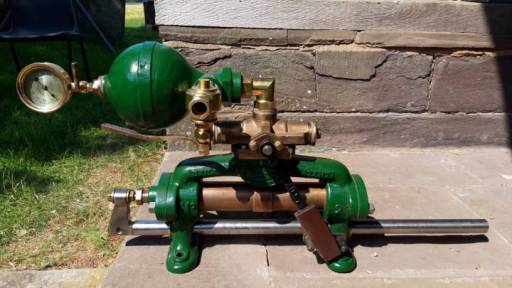
It seems the words Kinetic Water Power refer to the method for powering the church organ, which at that period was housed at the East end of the Lady Chapel, close to the location of the memorial to Richard Tryon. But what was the memorial referring to? Basically, water power was used to operate the bellows of organs when a mains water supply become available, and date back to the 1870s. This was used to fill two pistons sequentially that drove the rod that pumped the bellows. One such hydraulic engine has recently been restored at Moccas church in Herefordshire – see the photo below, the Facebook page and the church website here. More information on hydraulic engines can also be found here.
But there is still something of a puzzle. The Stamford Mercury extract above indicates that the apparatus was installed by Brindley and Foster of Sheffield, who installed the original organ in 1872. However the word Kinetic suggest some sort of association with the Kinetic Organ Blower Company, an offshoot of Cousans of Lincoln (1), However by 1907, this company was busy building Kinetic Blowers – fan blowers operated by electricity. It may be that the Kinetic company also produced hydraulic apparatus, or it may be that there was a somewhat loose usage of the word kinetic on the memorial, particularly as it refers to water power rather than air blowers. But interestingly it would seem that hydraulic engines were old and somewhat out of date technology by 1907.
Elvin L. (1995) Pipes and Actions. Some Organ Builders in the Midlands and beyond, Published by Laurence Elvin, Lincoln.
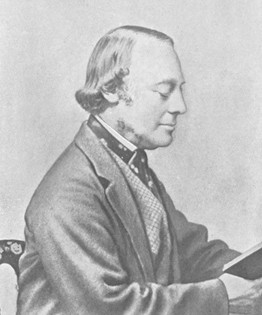
The Glynne Baronetcy dates back to 1661, with its main estate at Hawarden in Flintshire. The 8th Baronet, Sir Stephen Glynne (1780 to 1815) married Mary Griffin, daughter of Lord Braybrooke. After his early death, he was succeeded by his son Sir Stephen Richard Glynne, the 9th Baronet (1807-1874). I first came across him as the owner of the Oak Farm Iron Works in the Black Country, which was the subject of a spectacular financial crash. Glyne was saved from financial ruin by the efforts of his brother-in-law, the future Prime Minister William Gladstone, at very considerable expense to the latter.
More widely, Stephen Glynne is best known as a church antiquarian. Over the course of his adult lifetime he visited over 5000 churches in England and Wales, making notes, and in some cases sketches of their architecture, plans and furnishings. These notes can be found in 106 volumes now housed in the Gladstone Library at Hawarden. A small minority of these have been transcribed and published, but unfortunately this does not include the volumes containing the Rutland churches. This blog post goes some way towards remedying this, by presenting a transcription of the entry for All Saints Oakham. It is intended as the first fruits of a project to do the same for all the churches in the Oakham Team Ministry that were visited by Glynne. However, this may simply result in the creation of paving slabs for the road to hell.
Stephen Glynne’s description of All Saints Oakham
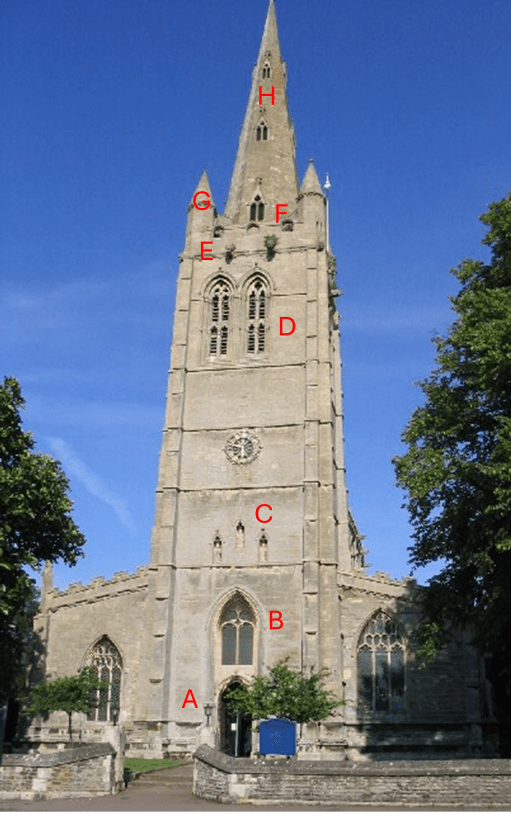
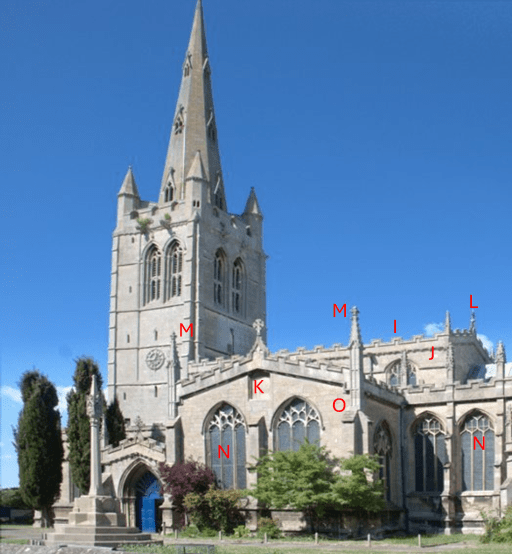
The text of Glynne’s entry for All Saints Oakham is given below, from Volume 33 of his Church Notes, one of three covering Leicestershire and Rutland. It is not dated, but other entries in the same volume indicate the year 1849, and it is likely this applies to the Oakham entry too. Certainly it was written before the restoration of 1858 – see earlier blogs here, here, here and here that deal with that. As written, it was all in one long paragraph, with somewhat dubious punctuation – almost a stream of consciousness approach. I have divided it up into sections with my own headings, and added consistent punctuation, which hopefully makes it a little easier to understand. The letters in brackets refer to the captions on the photographs, which illustrate the text. Numbers in brackets refer to the explanatory notes given at the end of the transcript.
The transcript
General This is a very large and fine church with large portions of Curvilinear work (1) and some of the later style. It consists of a large and lofty Nave with wide aisles, Clerestory, North and South Transepts, each with one aisle, and a chancel with side aisles.
The tower and the spire
The tower and spire The steeple is at the west end of the nave. Included within the aisles, it is a remarkably fine composition consisting of a tower with pinnacles at the angles, surmounted by a beautiful spire connecting to the pinnacles by flying buttresses, the work of the Curvilinear period. On the west side of the tower is the door (A) and over it a two light windows included within one pointed arch (B). In the next stage are three small trefoiled niches on the west side (C) (2). The belfry storey has, on each side, two long windows each of two lights divided by a transom and having deep architrave moulding and shafts (D). Just above the nave a rich band filled with heads and foliage (E) (3). The parapet of the tower is pierced at rectangular intervals with small ogee openings (F). At each angle is a small octagonal turret covered by a large pinnacle from there being flying buttresses to the spire (G) (4), which is well proportioned and has several lights of small canopied windows (H).
The body of the church The whole of the body of the Chancel is embattled (I), there being beneath the parapet at some positions a cornice of heads etc (J) (5). The apex of the gable of Chancel, Transepts and Clerestory is in each crowned with an ogee canopy (K) (6). That of the Clerestory has a fine ornamental cross (L). The Transept ends are enriched with large crocketed pinnacles (M). The northern one is plainer externally than the corresponding one and has much blank wall. The windows of the Nave, Clerestory and Transepts are all Rectilinear (N) (1) but the walls are earlier. Some of the buttresses on the south have crocketed triangular canopies (O).
Transept, Nave and Clerestory
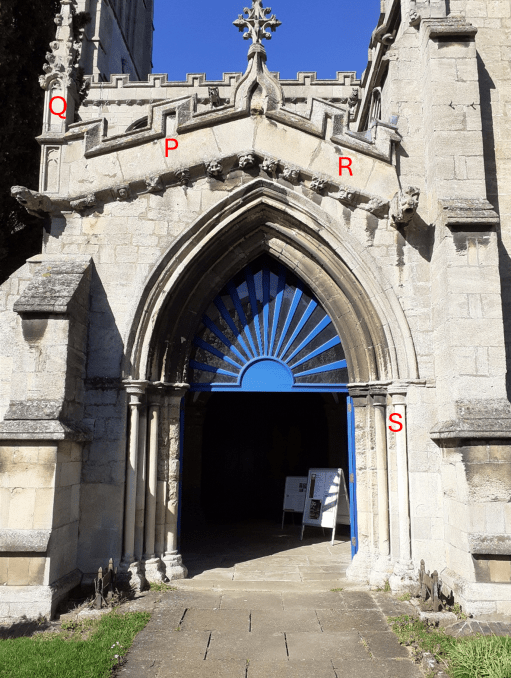
The South Porch The South Porch has an embattled gable (P) with pinnacles (Q) and cornices of heads (R) (7). The doorway is large and has deep mouldings and shafts of early English character having the nail head in the capital (S). Within the porch are niches on each side.
South Porch
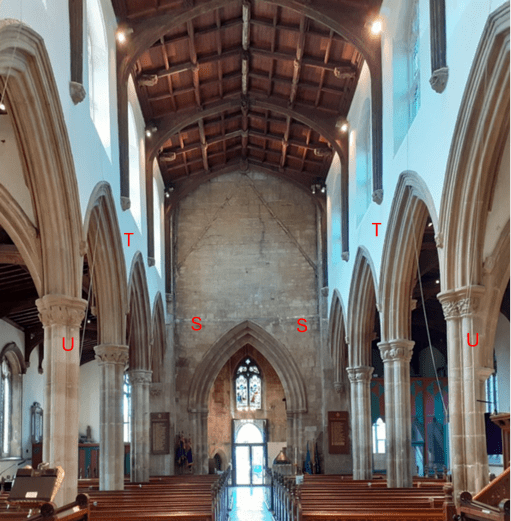
Nave and aisles The tower opens to the Nave and each aisle has a pointed arch springing from chamfered shafts (S), but much concealed by clumsy boarded partitions and lumber (8). Some of the windows are of three, others of four lights. The Nave and aisles are of considerable width and the divisions are formed by a double row of lofty pointed arches, four on each side (T). The pillars consists of four clustered shafts in lozenge form with the capitals sculptured with heads (U) (9).
The nave and ailses looking towards west end
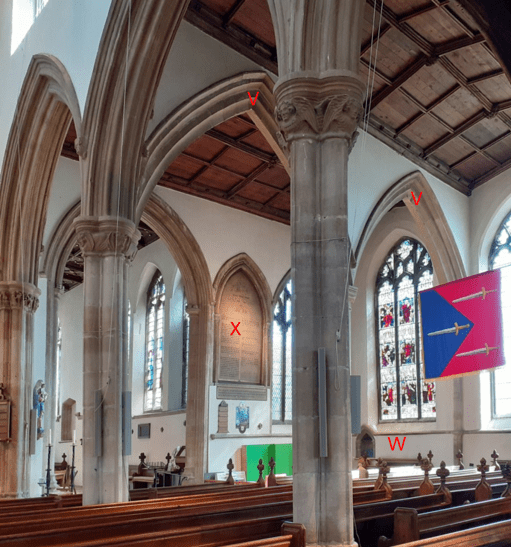
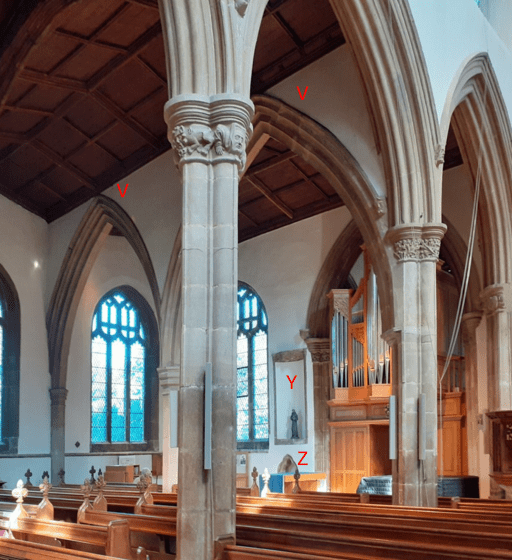
Transepts The Transepts are each divided into two aisles by two pointed arches with octagonal pillars (V). The ends of the transept have each two windows under one gable. In the South Transept is the niche with a contracted arch and shafts of early English character, with the piscina (W). On the east side of the same Transept, between the arch opening to the South Aisle and chancel is a window in an arch in the wall of early English work with toothed ornaments in the mouldings (X) (10). In the north transept is a Rectilinear corniced niche in the east wall (Y) and beneath it a trefoiled niche with drain of Curvilinear work (Z).
The South (left) and North (right) transepts
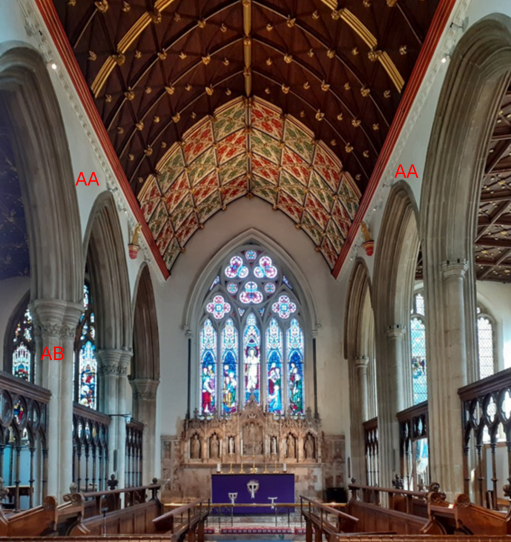
Chancel and chapels The Chancel with its Aisles has a great portion of Rectilinear work (11). The three east windows are large fine ones of four or five lights but only one retains its tracery. The side windows are of three lights. There are three pointed arches on each side of the Chancel (AA). Those in the south are rectilinear, the piers having fine mouldings carried down the ?? with shafts attached. On the sides on the north the piers resemble those of the nave but have the Tudor flower in the capitals (AB). The north aisle (12) has had a good panelled wood ceiling but now somewhat mutilated. On the north side (13) of the chancel is a rectilinear vestry which has no battlement but the gable is finished by a rich canopied niche and cross. The windows east of the chancel and south arch are under one gable and between their heads is a quatrefoiled circle. There is a niche and stoop near the South door of the chancel externally.
The chancel
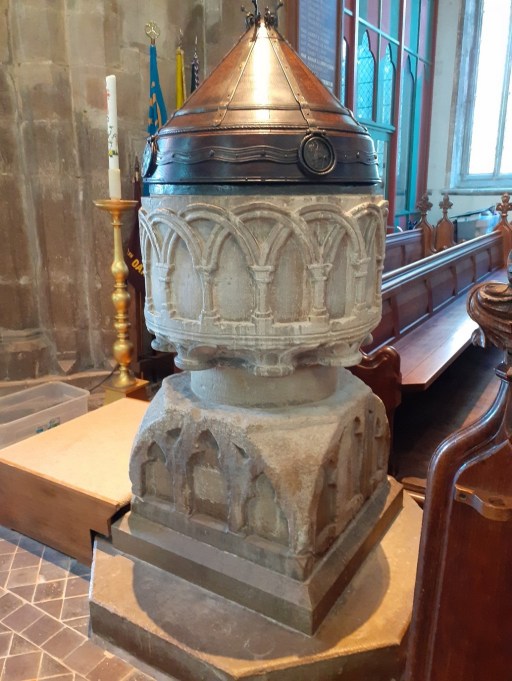
The font The font is Norman of circular form with intersecting arches and shafts (14). The base is square but with corners chamfered off, and moulded with small trefoil arches. There are traces of some fine ??.
Closing remarks Altogether the interior is not so well kept as it deserves to be. The pews and galleries are shabby and the whole dirty and untidy but the exterior is in good preservation and the stone of excellent quality (15).
Notes
1. The architectural periods referred to in the transcript are Early English (1190 to 1250); Curvilinear (or Decorated (1250 to 1350) and Rectilinear or Perpendicular (1330 to 1530). 2. No mention is made of the statues now in these niches, so it is most likely these were added during the 1858 restoration. 3. This band is above the belfry rather than the nave, so Glynne probably made a mistake here. It is possible however that the carvings were moved during the restoration, but the order of the text suggest that the first explanation is most likely. 4. These might be better described a low flying buttresses – it is difficult to observe them from ground level. 5. The heads cannot be seen on the large scale photograph. However there are some wonderful close up pictures of them on the Great English Churches website. 6. Shown here on the South Transept gable. 7. Again, detailed pictures can be found on the Great English Churches website. 8. This is very much inline with the description given by Gilbert Scott in his survey before the 1858 restoration. However his language was somewhat more robust. The aisles referred to are behind the west wall of the nave in the photo. 9. The capitals are perhaps the most significant heritage aspect of All Saints. I have discussed them at length here. 10. The wording is unclear here, but probably refers to the blind window which now houses the ten commandments. 11. The Chancel and side chapels were the most altered part of the church in the 1858 restoration, and much of what is described by Glynne no longer exists. 12. The current Holy Trinity Chapel. The southern aisle (the current Lady Chapel) is not mentioned. 13. This is a mistake – the vestry is on the south side. 14. The order of text here suggest the font was in the chancel area. However, it now stands close to the west door. Whether that has always been the case, or whether it was moved during the restoration to a more ecclesiastically acceptable position is not clear. I am inclined to think it was moved, as it would have been very awkwardly placed under the gallery if it were at the west end before the restoration. 15. Again, this finds and echo in the condition report of Gilbert Scott before the restoration.
All Saints Church in Oakham is a long term supporter of the Church Mission Society (CMS). It has recently been allocated two new mission partners, both working in Myanmar (formerly Burma). CMS have requested that the church does not publicise these links, as the partners work in a dangerous and sensitive situation. Nonetheless we pray for them and support them as best we can.
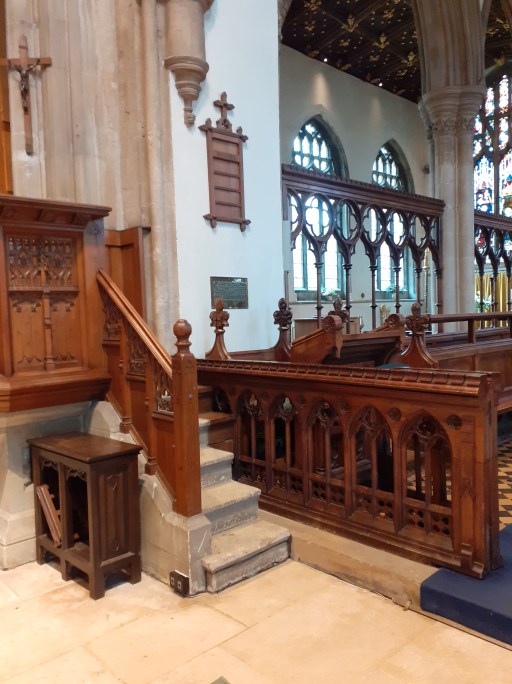
Very recently, after a service of Morning Prayer in which the mission partners were remembered, I happened to look at a plaque on the wall of the chancel just behind the pulpit, over one of the clergy stalls. The plaque’s location, and the plaque itself are shown in the photographs below.
The typography of the plaque makes it quite difficult to read, which is presumably the reason I have never done so in the past, despite the fact that I have sat in front of it on numerous occassions. But on reading it, I noted that the church in 1906 already had a link with Burma. The plaque reads as follows.
To the glory of God and in memory of Henry Arthur Jerwood, scholar and prefect of Oakham School; a faithful and beloved curate of this parish and a zealous missionary. The lamps in the chancel and sanctuary are erected by his schoolfellows, friends and parishioners. He died serving in obedience to his Master’s call at Mandalay on March 26th 1906.
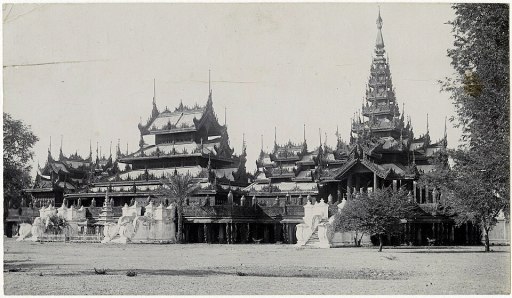
Mandalay is the second largest city in Myanmar, 600km north of the capital Yangon (formerly Rangoon) and is the centre of a largely Buddhist area. Our current mission partners are thus not the first links that the church has had in that area.
Henry Arthur Jerwood
Can we say any more about Henry Jerwood? His basic biographical details can easily be traced on Ancestry. He was born in 1878, the eldest child of Rev. Thomas Frederick Jerwood (1846-1926), Rector of Little Bowden and Dorothea Elizabeth Longsdon (1853-1942) who were married in Yorkshire in 1877. The couple had a number of other children, amongst them Helen Dorothea Jerwood (1880-1965), who will be mentioned below, Rev. Frederick Harold Jerwood (1885-1971) who was to become Chaplain at Oakham School, amd Major Hugh John Jerwood MC (1890-1918) who was killed in action. The latter had a son, born in 1918 after his death – John Michael Jerwood (1918-1991), a businessman and philanthropist, who was to become a significant benefactor of Oakham School, and a number of the school facilities bear his name.
St. Nicholas, Little Bowden, Northants
Oakham School
Henry Arthur attended Oakham School, as his father had done before him, and his brothers were later to follow him there. He matriculated at Sidney Sussex College, Cambridge in 1897, taking his BA in 1902 and his MA in 1905. He took some time out just before he graduated to fight in the South African (i.e. Boer) War from 1900 to 1902 with the Suffolk Regiment.
Clergyman and Missionary
After graduation, Henry Jerwood attended the Clergy Training School in Cambridge (the early name of Wescott House) and was ordained deacon in 1902 and took up the curacy at All Saints church in Oakham, a town with which he would have been very familar from his schooldays. The chronology of his training and ordination as deacon and priest is not wholly clear from the sources. In 1905 he applied to become a missionary to Burma. We can trace his short career there through the pages of the Quarterly Paper of the Rangoon Diocesan Association (RQP), a nationwide organisation that supported the work of missionaries in Burma, and was affiliated to the Society for the Promulgation of the Gospel (SPG). These are all available as pdfs in the SOAS missionary archive. As an aside, those who, like myself, dabble in historical matters, are hugely indebted to the patience and the perseverance of the archivisits who made such material available. In RQP 34, June 1905 we read the following under the heading Reinforcements, which says something of the military mindset of the organisation.
…….The Rev. Henry Arthur Jerwood, B.A., of Sidney Sussex ‘College, Cambridge, and the Clergy Training School, was ordained in 1902, to the Curacy at All Saints, Oakham, in the Diocese of Peterborough……
The Rev. A. Jerwood, at present an assistant Curate at Oakham, will join Mr. Fyffe at Mandalay~ a man stout and , vigorous in body and stout of heart, who went to South Africa when the war broke out, and did his part there man fully, and will carry to his work in Burma the same vigour he gave to South Africa and Oakham.
In the next edition (RQP 35, September 1905) we read that, as a consequence of Jerwood’s departure, Rev H J C Knight, the Commissary of the Rangoon Diocesan Association (who recruited for the Association and was living in Jesus Lane in Cambridge), preached at All Saints on Sunday July 30th. The collection of £3 4s was given to the R.D.A.
Then in RQP 36 from December 1905 Jerwood’s arrival in Burma is noted, under the heading News from the Front, again another military metaphor.
The newcomers have arrived, and are settling down to work, the Rev. H. A. Jerwood and Mr. Hart with Mr. Fyffe at Mandalay, the Rev. R. J. Stone at Bishop’s Court as Chaplain, the Rev. R. G. Fairhurst at S. Luke’s, Toungoo, and the Rev. W. H. C. Pope at Rangoon .
We also have the following description of the work in Mandalay,
The Buddhist Field – The Winchester Brotherhood has been founded at Mandalay, on the general lines of the Indian Community Missions, for systematic study of Buddhism and work in the field. The Head, Rev. R. S. Fyffe, has at present only one Brother (Rev. H. A. Jerwood). These two men are the only English Clergy for Missionary work in the chief town of Upper Burma, a city of 180,000 souls. They need at once two men of (if possible) a studious type, of patience, hope, and brotherliness. There is work to do while learning Burmese. The Brothers have passage and outfit paid, maintenance, lodging together, and £40 a year.
The mention of Jerwood in RQP 37 for March 1906 is very brief and simply says that he had taken over the role of Principal at the School run by the Winchester Brotherhood from Mr. Hart, who arrived in Burma at the same time as he did. Jerwood died on March 28th 1906. We read his obituary in RGA 38 June 2006, written by the Commissary Rev H. J. C. Knight.
Though most of our readers will have read the Bishop’s notice of Mr. Jerwood in the Mission Field for June, our R. Q. P. ought to have some notice of him. He was born on February 25th, 1878, the eldest son of the Rev. Thomas Frederick Jerwood, Rector of Little Bowden. He must have owed much to his home. On hearing from Bishop Montgomery that he had fallen asleep, his father was able to write “we hope to send another son.” and assuredly in homes that can speak thus:
“The father’s passion arms the son, And the great work goes on, goes on.”
All his school days were spent at Oakham School; thence he entered Sidney Sussex College, Cambridge. While yet an undergraduate he served in the S. A. war. On his return he graduated, entered the Clergy Training School, and was ordained to Oakham in 1902. Last autumn he went to Burma, calling at Delhi {where his sister was working under S. P. G. in the Cambridge Mission), and other Brotherhoods, and joined Mr. Fyffe at Mandalay in December. On the 28th March last he passed from us. The cause of his death was a rare type of paralysis – nothing climatic. The Bishop and the Rev. R. J. Stone, who was with him at the C. T. S., were in Mandalay at the time. His body rests near the graves of the Colbecks.
We had looked for great things from his ministry in Burma. His qualities of simple manliness, unaffected and robust piety, a very-single-hearted devotion, unselfishness, courage and affection, drew men to him. These, and his unfailing cheerfulness, promised much for our Winchester Brotherhood. He went out “for life,” and so his home gave him. His letters from Mandalay were always touched with humour, and were full of hope and determination. It is easy to pray “Thy will be done,” while we have no disappointments or reversing of our purposes; but it is hard really to bow to the surrender of such a man. When Bishop Maples was drowned on Lake Nyassa. on the very day of his arrival as Bishop of Likoma, Augustine Ambati wrote, “God liked to take him, to make white (i.e., consecrate) so the waters of the lake.” Even so may Mr. Jerwood’s death in Mandalay be one more consecration of the city. To his friends – there and here – it will be one more tie binding us to the missionary spirit, and the forward march of the Church. It is good to know that Mr. Garrad, whom God has moved to carry on his torch, will be, we believe, in every way a brother to Mr. Fyffe. Those who loved H. A. J. will pray “The Lord bless his going out and coming in. ”
H. J. C. K.
The sister in Dehli that is referred to is Helen Dorothea. At the time she worked for the Cambridge Mission of SPG, but was later to work for the East India Company in Dehli. She remained in India all her life, dying in 1965.
Some final thoughts
Interesting as it is to find that All Saints had a link with Myanmar one hundred and twenty years before our current one, and to read Arthur Jerwood’s interesting and ultimately tragic story the aspect that has struck me most in the preparation of this post, is how very different our current Christian culture is to that of 1906. As noted above, military metaphors are often used in the RQP, and indeed the whole publication shows an extremely ordered and extensive organisation that itself has a military flavour. The form of Christianity that one finds in its pages is a very muscular and forceful one and whilst one can admire the earnestness and zeal of those determined to bring the gospel to those who had never heard it, the tone of the publication reflects the colonial era of its time, and the implicit superiority of European (and particularly British) civilisation and culture to that of the “natives”. Howerver, whilst I find this aspect more than a little repellent, I do wonder if we have lost something over the last century, in terms of our zeal and enthusiasm for the mission of the church, both at home and overseas. The words of Revelation 3.15-16 come uncomfortably to mind.
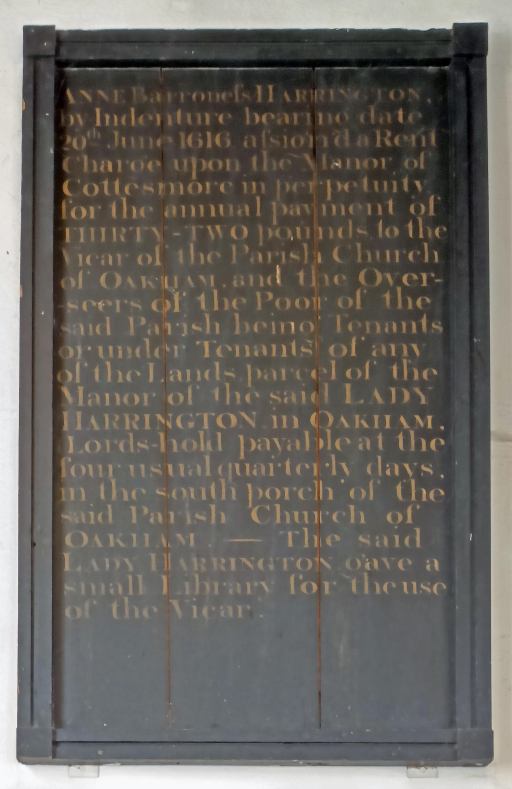
ANNE Barroness HARRINGTON, by Indenture bearing date 20th June 1616 assign’d a Rent Charge upon he Manor of Cottesmore in perpetuity for the annual payment of THIRTY-TWO pounds to the Vicar of the Parish Church of OAKHAM, and the Overseers of the Poor of the said Parish being Tenants or under Tenants of any of the Lands parcel of the Manor of the said LADT HARRINGTON in Oakham Lords-hold payable at the four usual quarterly days, in the south porch of the said Parish Church of OAKHAM. – The said LADY HARRINGTON gave a small Library for the use of the Vicar.
The inscribed board in the vestry of All Saints church in Oakham (photograph by Richard Adams)
Anne, Lady Harrington
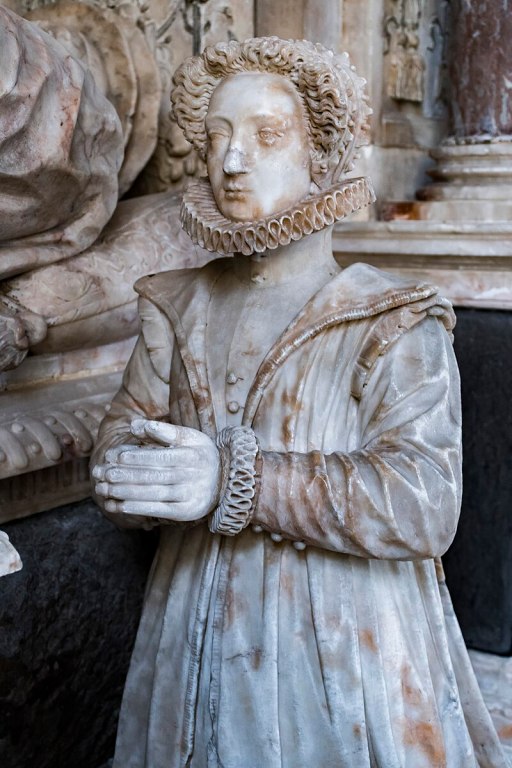
Anne Keilway was a daughter of Robert Keilway of Minster Lovell in Oxfordshire. She married John Harington, 1st Baron Harington of Exton, in 1573. After the Union of the Crowns in 1603, she was appointed as a Lady of the Bedchamber and was made Governess to Princess Elizabeth, the daughter of James 1, travelling with Elizabeth in 1613 to Heidelberg for her wedding to Frederick V of the Palatinate. Anne died in May 1620. The younger Anne is depicted on a memorial to her Father in Exton parish church (right).
The Harrington bequest
In 1616 Lady Anne Harringtom made a two part bequest, which is recorded on a an inscribed wooden board in the vestry of All Saints Parish church in Oakham shown above. This involved an annual bequest of £32 to support the poor of the township of Oakham Lordshold, and the bequest of a small library for the use of the vicar of All Saints church. This post describes the second part of the bequest – what was to become known as the Oakham Parish library. The support for the poor of Oakham is addressed in a related post.
The Oakham Parish Library
In 1616 Anne bequeathed a collection of books to All Saints Oakham, and these formed the core of the parish library. a number of volumes were added to the library over the years, mainly service books and bibles, This collection, numbering 115 volumes was transferred in October 1980 on indefinite loan into the custody of the Department of Special Collections of Nottingham University Library. The Oakham Parish Library is well described in the paper “Oakham Parish Library” by Anne Herbert. This paper is however not easily available (unless one has a University Library access or is prepared to pay £35 for a copy), so I quote below the most relevant passages.
……Until their removal to Nottingham the books were housed in two oak presses 176 cm. in height, 183 cm. in width and 39 cm. in depth, with three shelves apiece and a central vertical divide of a later date. The craftsman ship is rather crude and lacking in decoration with the exception of a single strip of carving along the top of each press……
…..Oakham parish library …… comprises almost exclusively works of theology with a sprinkling of history, mainly ecclesiastical, and canon law…… It is strongest in the Greek and Latin fathers-Athanasius, Chrysostom, Epiphanius, John of Damascus, Origen; Augustine, Gregory, Hilary, Jerome, Tertullian……. But the medieval schoolmen, the Protestant reformers and pre-Reformation theology and law are also represented….
…..The books were originally shelved with the spines innermost but there is no evidence to suggest they were ever chained. All but the late additions to the library have fore-edge numbers and some also have author and title information on the fore-edge…..
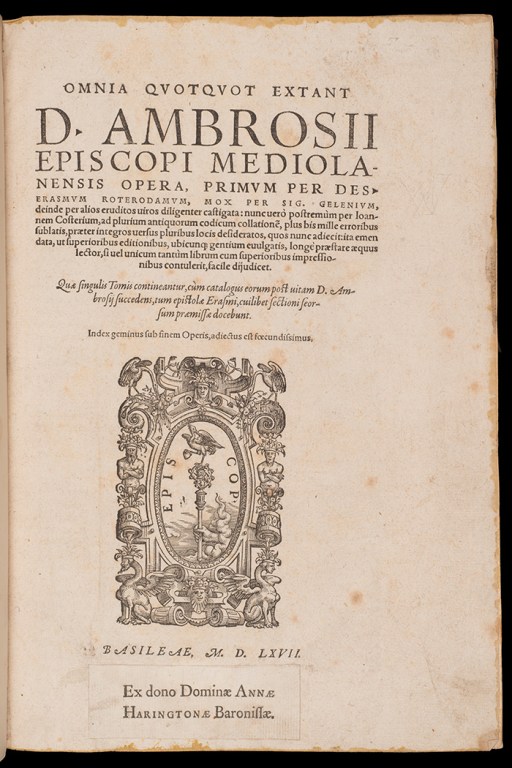
…..A printed book label, which survives in 46 of the volumes, pasted at the base of the title-page, commemorates Lady Harington’s bequest and bears the inscription ‘Ex dono Dominae ANNAE HARINGTONAE Baronissae….
…..The books are for the most part fairly uniformly bound in calf decorated only with fillets round the edges of the covers. The incunables and early sixteenth century volumes, however, have blind-stamped leather bindings over wooden boards…..
….Oakham parish library seems to have been rather neglected durng the subsequent centuries. There is very little documentation relating to its establishment or history-no extant loan records and little evidence that it was ever used by the incumbents of Oakham for whose benefit the books were originally given…..
In an appendix to her paper, Herbert lists 67 books that belong to or were contemporary with the Harrington bequest, the remaining items being later additions to the library. The library is also discussed by Aaron T Pratt “A Baroness and her books” which contains a photograph of the printed book label shown to the left, and also some examples from elsewhere that show how the books might have looked on their shelves.
The library at the University of Nottingham
81 items from the Oakham Parish Library are listed in the Nottingham University Catalogue. As Herbert states that 115 volumes were transferred in 1980, it is likely that some catalogue entries relate to multiple documents – most likely those referring to bibles or prayer books.
ANNE Barroness HARRINGTON, by Indenture bearing date 20th June 1616 assign’d a Rent Charge upon he Manor of Cottesmore in perpetuity for the annual payment of THIRTY-TWO pounds to the Vicar of the Parish Church of OAKHAM, and the Overseers of the Poor of the said Parish being Tenants or under Tenants of any of the Lands parcel of the Manor of the said LADT HARRINGTON in Oakham Lords-hold payable at the four usual quarterly days, in the south porch of the said Parish Church of OAKHAM. – The said LADY HARRINGTON gave a small Library for the use of the Vicar.
The inscribed board in the vestry of All Saints church in Oakham (photograph by Richard Adams)
Anne, Lady Harrington
Anne Keilway was a daughter of Robert Keilway of Minster Lovell in Oxfordshire. She married John Harington, 1st Baron Harington of Exton, in 1573. After the Union of the Crowns in 1603, she was appointed as a Lady of the Bedchamber and was made Governess to Princess Elizabeth, the daughter of James 1, travelling with Elizabeth in 1613 to Heidelberg for her wedding to Frederick V of the Palatinate. Anne died in May 1620. The younger Anne is depicted on a memorial to her Father in Exton parish church (right).
The Harrington bequest
In 1616 Lady Anne made a two part bequest, which is recorded on an inscribed wooden board in the vestry of All Saints Parish church in Oakham shown above. This involved an annual bequest of £32 to support the poor of the township of Oakham Lordshold, and the bequest of a small library for the use of the vicar of All Saints church. This post describes the first part of the bequest. The library bequest is addressed in a related post.
The Harrington Charity
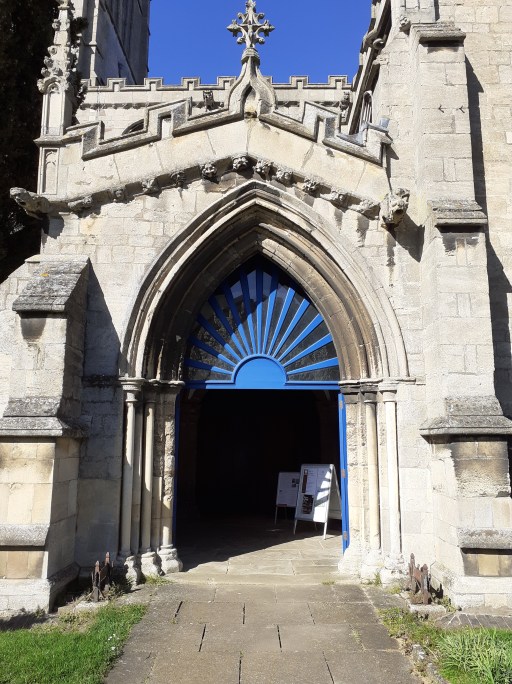
As set out on the board in the vestry of All Saints church shown above, the original bequest was for £32 per annum to the vicar of All Saints and to the Overseers of the Poor, to be distributed to the poor in the township of Oakham Lords-hold. The distinction between Oakham Lords-hold and Oakham Deans-hold is an ancient one and in well described by T H McK Clough in “Oakham Lordshold in 1787”. The distribution was to be made on the quarter days from the south porch of the church. In 1915 the administration of the bequest was formalised by the Charity Commission. The Trustees of the Charity were to be the Vicar of All Saints, and four others appointed by the (then) Urban District Council. Procedures for meetings of the Trustees and for their appointment are also set out. The income is specified as £32 per year from the Earl of Gainsborough, which shall be spent as follows
As set out on the board in the vestry of All Saints church shown above, the original bequest was for £32 per annum to the vicar of All Saints and to the Overseers of the Poor, to be distributed to the poor in the township of Oakham Lords-hold. The distinction between Oakham Lords-hold and Oakham Deans-hold is an ancient one and in well described by T H McK Clough in “Oakham Lordshold in 1787”. The distribution was to be made on the quarter days from the south porch of the church. In 1915 the administration of the bequest was formalised by the Charity Commission. The Trustees of the Charity were to be the Vicar of All Saints, and four others appointed by the (then) Urban District Council. Procedures for meetings of the Trustees and for their appointment are also set out. The income is specified as £32 per year from the Earl of Gainsborough, which shall be spent as follows.
I. Grants or contributions for or towards the the provision of Nurses, and of medical and surgical assistance for the Sick and Infirm, including medical and surgical appliances, medicines, and comforts or necessaries : II The supply of (a) Clothes. Linen. Bedding, Fuel, or Food or other articles in kind (b) Temporary assistance in money by way of loan or otherwise. III Weekly allowances. being in no case, except with the approval of the Charity Commissioners, less in value than 1s 6d a week or more than 3s a week, during the pleasure of the Trustees, to or for the benefit or persons qualified, as aforesaid, and not in receipt of Poor-law relief other than medical relief, who have attained the age of 60 years, and become wholly or part unable to maintain themselves by their own exertions, in augmentation of any means of support possessed by the beneficiaries – which shall be proved to the satisfaction of the Trustees to be reasonably assured. and to be sufficient, when so augmented, to enable the beneficiaries to live in reasonable comfort.
The Minute Book 1925 to 2000
A minute book for the Harrington charity has recently come to light, during a clear out of old financial documents. this runs from 1925 to 2000, and contains some interesting information on the development, and the running down of the charity over that period. In this section we will look at the general trends over that period. In the following section we will look in more detail at the entries for 1925.
The annual entries in the minute book are largely routine, reporting the appointment of trustees, and giving a list of those to whom payments were made. Each year from 1925 to 2001 the total payments were close to the income of £32. There were a few other points of interest however. In 1933, it was decided to make payments directly to individuals rather than requiring them to congregate in the Church School – which had replaced the south Porch of the church as the distribution centre at some point. In 1935 grocery vouchers worth 2s 6d and redeemable at G. W. Peesgood, were also distributed alongside the cash dole. In 1954 enquiries were made as to whether it was possible to support those outside the Lordshold area, which seem to have been inconclusive. No meetings were held in 1998, 1999 and 2000 and the final meeting in 2001 discussed the possibility of amalgamation with the Morren charity. It also resolved to request the last three years payment from the Exton Estate (still of £32 / year). How these two issues were, or were not resolved is not recorded. Note however that the distribution in this form is not a good match with that specified in the 1915 document – and indeed there are no indications that regaulr weekly payments were made over the period.
The minute book also enables us to look in more detail at some aspects of the dole. The figure to the right shows the number of recipients of the dole over the years. It can be seen that this falls from just under 90 in 1925 to around 60 by 1930, and remains at that number until 1960, when a gradual decline sets in. Up until 1930, different amounts were given to different people – either 2s 6d, 5s, 7s 6d or 10s. From 1933 a standard amount was paid. this was 10s to each recipient to 1960, and then increasing gradually as the number of recipients fell from then on. In the mid 1990s £8 was paid to each four recipients.
The number of recipients of the Harrington dole from 1925 to 1997
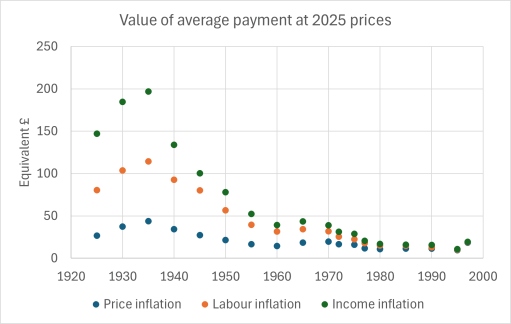
Value of the average dole between 1925 and 1997 in today’s prices, using three different inflation measures.
But how much were such payments worth in todays prices? There are various ways of calculating this as set out by the Measuring Worth website. The right hand figure shows the value of the average dole payment from 1925 onwards at today’s prices, as calculated using price inflation, labour cost inflation and income inflation. The last two are probably the most relevant to this study. These show that the average dole payment in the 1920s and 1930 was worth somewhere between £100 and £200 in today’s terms – not a massive amount, but perhaps something like the Winter Fuel allowance.
Using the same method, the value of £32 in 1603 when the charity was set up was £127,000 based on labour cost inflation and £228,000 based on income inflation. On the assumption that there were around 100 recipients of the dole, this gives the worth of an average payment of between £1000 and £2000 in today’s terms, which would be quite substantial.
The 1925 Dole
We now look at the information for the 1925 payments in more detail. This year is on the limit of the 100 year period usually applied to the release of individual names, and the entries in the minute book may be of interest to Family Historians.
The 1925 pages have been scanned and transcribed, and both the scan and the transcriptions are shown below in pdf viewers. The original writing is not easy to read, so I can’t be certain about the accuracy of the transcripts – but I have done my best! In general terms, the large majority of the recipients were women, usually identified as Widows.
Brooke Rd Cold Overton Rd Cross St Crown St Gaol St Gas St John St Johns court Jubilee Buildings Mill St Mount Pleasant New St Northgate St Park Lane Pullins Yard Simper St South St Westgate
1 7 3 5 4 7 10 7 3 3 2 2 5 1 1 10 5 10
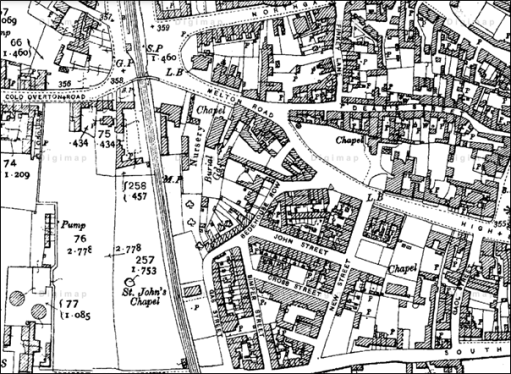
A breakdown of the streets where those who recieved the 1925 lived is given to the left. Most of these are shown on the map from 1910above. Some of these streets no longer exist, specifically those streets in the area between New St., Melton Rd. and the railway line – Cross St., Gas St., and Simper St., with John St. being much curtailed. Others cannot be precisely located – Pullins Yard and Johns Court, although they are likley to be in the same area. Bedehouse Row on the map is referred to as Westgate in the minute book. In total 58 of the dole recipients (around two thirds of the total) lived in the area bounded by South St, Gaol St., High St., Melton Rd. and the railway.
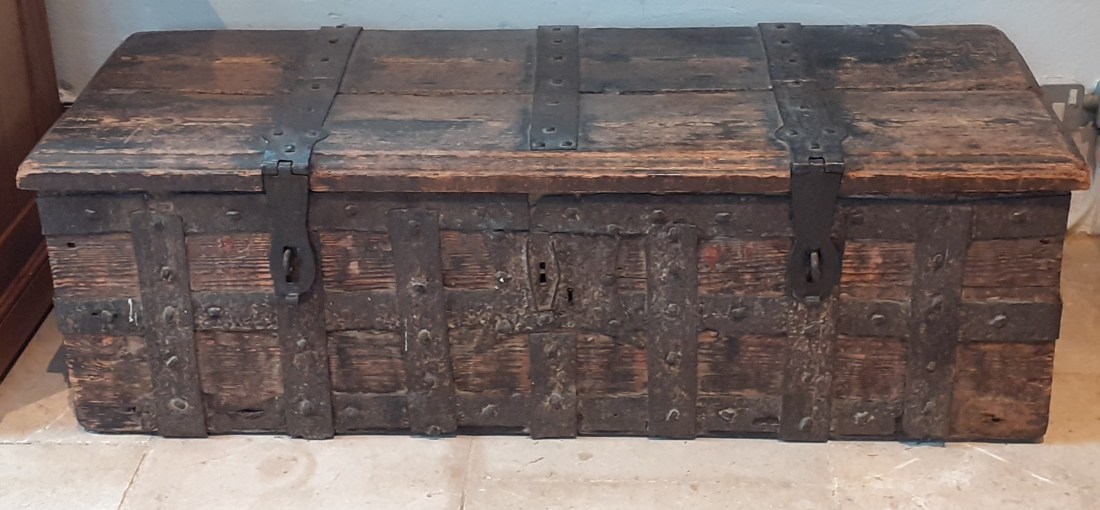
In the north transept at All Saints church in Oakham, there is a large wooden chest, shown in the photograph above. This is the Oakham Parish chest, which is encompassed by iron bands, with three locks. It is well described by a framed description close by, written by an unknown author, and dated 2007.
The earliest Parish Chests are of Norman or even Saxon date. In the early 16th century the Vicar General, Thomas Cromwell issued a mandate to the effect that every parson, vicar or curate had to enter in a book every christening, marriage and burial in his parish, with the names of the parties. In addition to these records documents relating to the day to day running of the parish would have been stored in the Chest, including the Churchwarden’s accounts, Removal and Settlement Certificates Poor Rate and Poor Law records.
The parish was to provide a `sure coffer’ with two locks, the incumbent having the custody of one key and the Churchwarden having the other. _ The safety of the documents was assured by there being two locks and therefore the opening of the Chest had to be approved by the incumbent and the Churchwarden together. The chests were usually made of oak, early ones having been `dug out’ of a substantial log. Later chests became more refined being made of boards secured with iron nails. Some were decorated with iron banding. These were common from the early part of the fourteenth century. Some had slots pierced in their lids possibly to receive monetary offerings.
An injunction in the thirteenth century was that in every church a chest should be provided fastened with THREE keys, to be kept by the Bishop, the Priest and a religious layman. It will be noted that the Parish Chest here at All Saints, Oakham has three such fastenings. Whilst an exact date cannot be made as to its origin it would appear that this Parish Chest may date from the early years of the Church.
By the mid-1500’s the parishioners in every parish of the land were instructed by law to provide a strong chest with a hole in the upper part thereof, and having three keys, for holding the alms for the poor. Another chest may have been used to keep safe the church’s plate and this or the first chest would also double up as a place where the parish registers and other parish documents could be kept safe. In some places only one chest would have sufficed for both purposes, while in other parishes two or more may have been used.
So there is a possibility that the three locks might indicate a 16th century rather than a thirteenth century date.
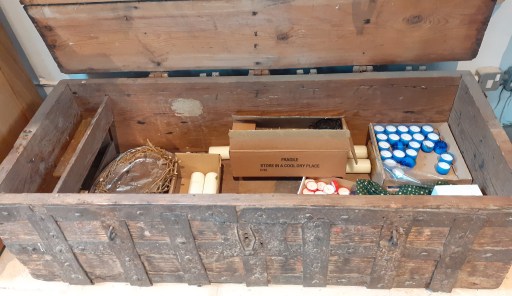
Of course, confronted by an old oak chest, the immediate question that comes to mind, is what mysteries does it still contain. The Oakham chest opens without much effort, although the lid is a bit weighty, so that question can easily be answered. And the mystery turns out to be quite mundane as can be seen from the photograph below – a crown of thorns, presumably for the Holy Week liturgy and an assortment of large and votive candles. Pretty much the sort of stuff that would be found in a cupboard in any parish church! The mysteries are long gone (and probably deposited in Leicester Archives).
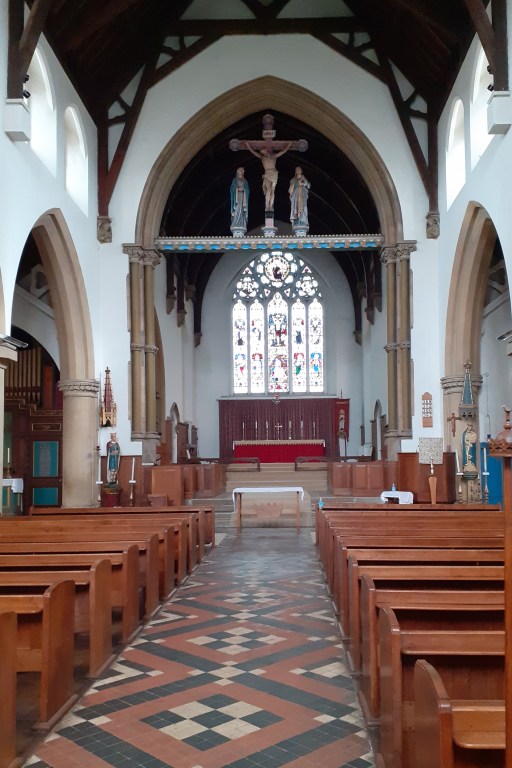
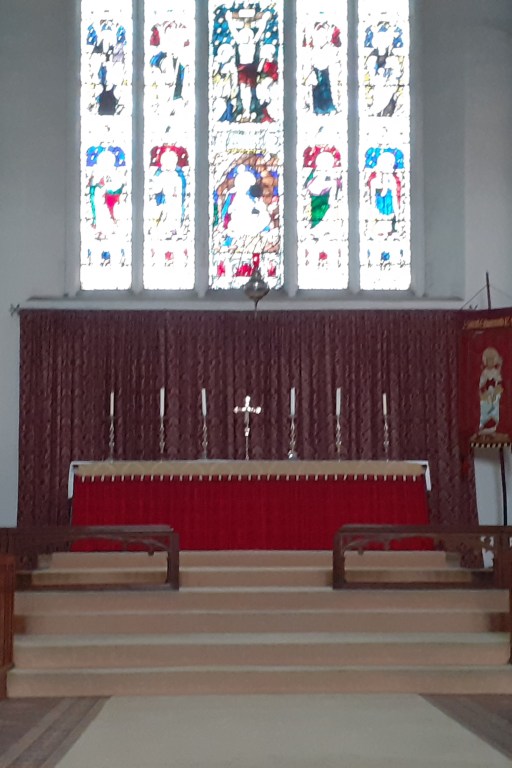
Appropriately, on the eve of St Edmunds Day in November 2024, we paid a visit to St Edmund’s church in Hunstanton in Norfolk (“we” being myself, my wife and our dog).This mid-Victorian church is VERY Anglo-Catholic as can be gathered from the photographs of Figure 1 which show the crucifix in the chancel arch, the baptistry at the west end (with the chapel of Our Lady at Walshingham on the right), and the raised altar in the chancel. I doubt I could ever have managed to get up and down those altar steps safely in a cassock or alb, and certainly now, if I were ever to preside there (which is unlikely in the extreme), I would certainly need a stair rail, and possibly, given the current state of my right knee, a stair lift*. That being said, it is an impressive church interior.
Nave and chancel (east end)Baptistry (west end)Altar
Figure 1. The interior of St. Edmund’s
Now whilst there are some fairly conventional depictions of biblical events and saints in the windows in the church, those that I found of most interest are the series of windows that depict the life and death (and afterlife) of King Edmund. In reality, very little is known about him other than the entry in the Anglo Saxon Chronicle of 870.
In this year the raiding army rode across Mercia into East Anglia and took up winter quarters at Thetford. That winter King Edmund fought against them, and the Danes had the victory and killed the king and conquered all the land.
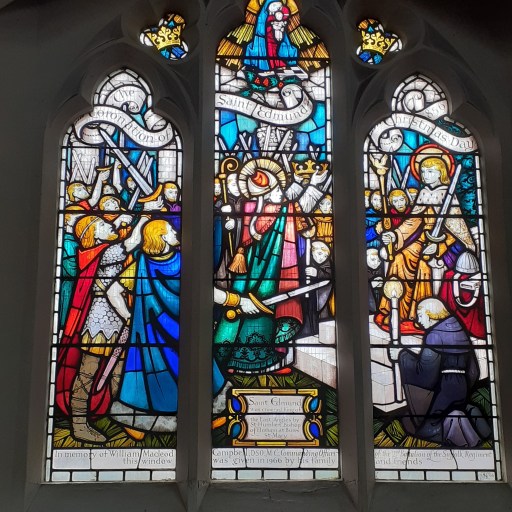
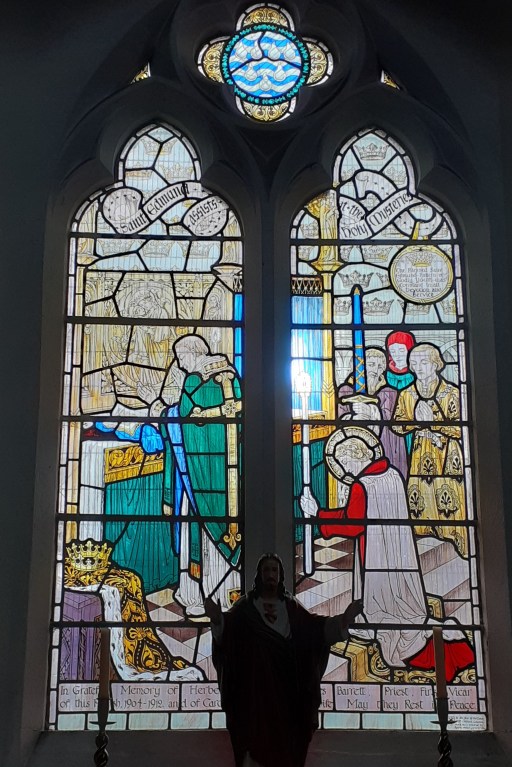
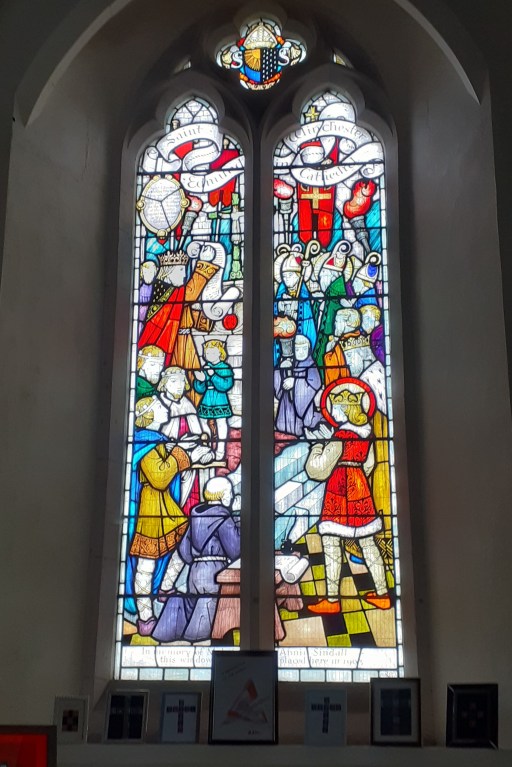
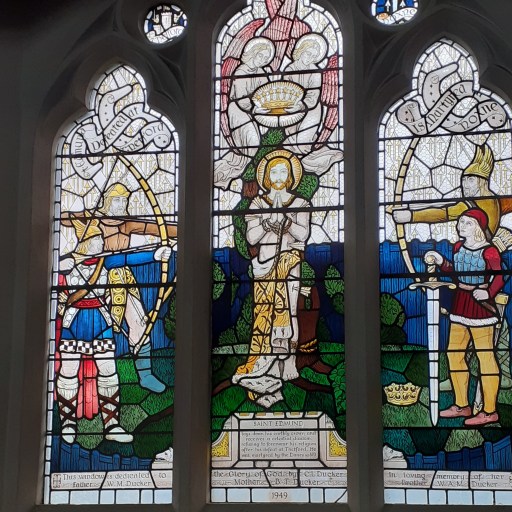
However, a much more fulsome legend of his life soon appeared. and the events of this legend are related in the windows that are shown below in Figure 2. The perspective of some of these is a little odd, largely because I was trying to avoid the above-mentioned dog and his lead whilst taking the photographs. The windows show Edmund’s landing from Saxony at Hunstanton; his coronation; Edmund reading from the psalms, showing hospitality and assisting at mass (illustrating his devotion and humility); Edmund in Winchester (not sure why); his martyrdom at the hands of the Viking Great Army (but not his later beheading); his welcome into heaven and being brought before God by the East Anglian saints Humbert, Felix, and Lady Julian of Norwich; and his shrine at Bury St Edmunds. There is a lot of detail in the windows that reward close scrutiny,
Sailing from SaxonyCoronationReading from psalmsShowing hospitalityAssisting at massAt WinchesterMrrtyrdomKneeling before GodThe shrine
Figure 2. The St. Edmund windows
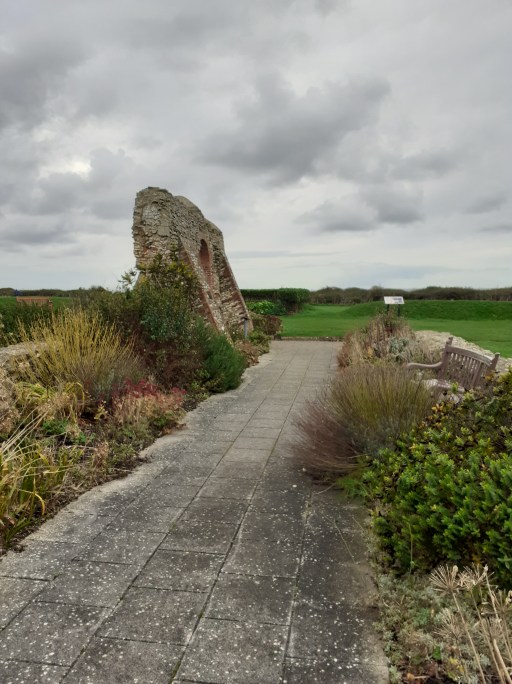
To the north of the village there is another site of relevance to St. Edmunds – the ruins of the old medieval chapel dedicated to the saint, allegedly built to mark the point of his arrival into England – see Figure 3 below. The last photograph shows a wolf carving – commemorating the legend, probably arising from the supposed fact that Edmund was a member of the Wulfinglas dynasty, that the followers of St Edmund, after his death and beheading, found his head protected from further harm by a wolf.
South wall and doorView through south door looking northLooking along nave to east endPosition of altarLooking along nave to west endThe wolf carving
Figure 3. Ruins of St. Edmund’s chapel
* Any such ecclesiastical stair lift should of course have changeable cushions in the correct liturgical colours.
In August 1860 the Rev. Thomas James., M.A.- honorary canon of Peterborough, vicar of Theddingworth, and one the secretaries of Architectural Court of the Archdeaconry of Northampton delivered a lecture to Oakham Literary Institute at the Old Castle Hall of Oakham, on ” Gothic Architecture,” particularly with regard to the history and arrangements of the Church and Castle Hall in Oakham (1). The transcript of his talk can be found here. The speaker was described as “an accomplished ecclesiologist and erudite and painstaking antiquary” and was clearly a major proponent of gothic church architecture in the area.
In his talk he mentions two speculations that I wish to consider briefly in this post. Firstly he stated that there was “a cupboard in the eastern wall, behind the altar, which might have been used as a receptacle for relics, or for receiving the stoup of holy water which stood at the chancel door.” Secondly, with regard to the clergy vestry he said, obviously referring to some past time “…the vestry was two storied, in all probability it was formerly used as the dwelling of an anchorite, that being a prevailing custom at one time. There was a similar instance of a two storied room attached to the church at Barnack, near Stamford“. We consider each of these two statements below.
The altar cupboard
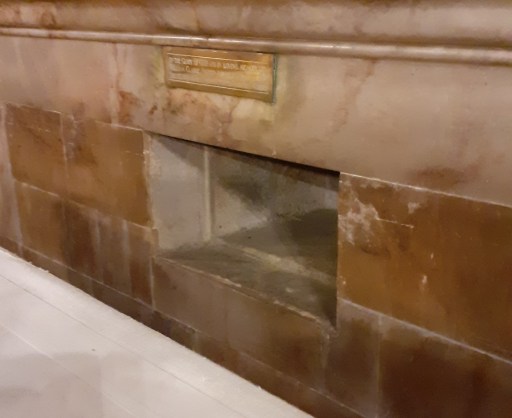
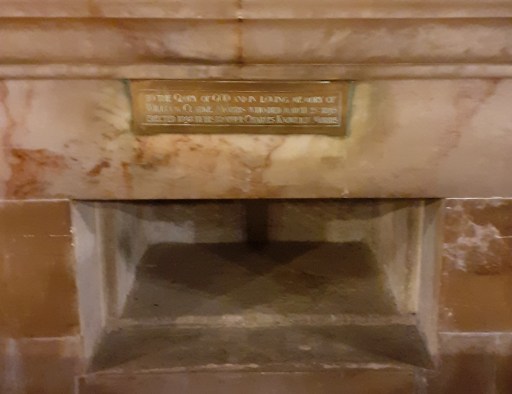
The east end of the church was extensively modified by Gilbert Scott in 1858, but probably only from the bottom of the east window upwards, and it would seem, from the description by James, that the altar cupboard, whatever it was, was still in place in 1860. The area was further extensively modified in 1898 when the current Reredos was installed , and the walling and flooring renewed. However there is still a slot behind the altar which almost certainly was created to mark the position of the cupboard (figure 1). So what was it – a reliquary, a place for storage of holy water, or perhaps an aumbry, where the consecrated bread and wind would be kept? There are as far as I know, no historical mention of any relics in All Saints, but a church of its size and significance may well have been graced with them. There is of course evidence of relics at the priory cell at Brooke to the south of Oakham and the Reliquary can be seen in Rutland County Museum. If it were an aumbry for consecrated bread and wine or a storage place for holy water, then it would need to be opened fairly regularly, and its location behind the altar, which would have been standing against the east wall would have made it relatively inaccessible. So it is possible that it was a reliquary, which would not have been opened regularly, but this must remain as speculation.
Figure 1. The slot in the wall at the east end marking the position of the “cupboard”
The Vestry
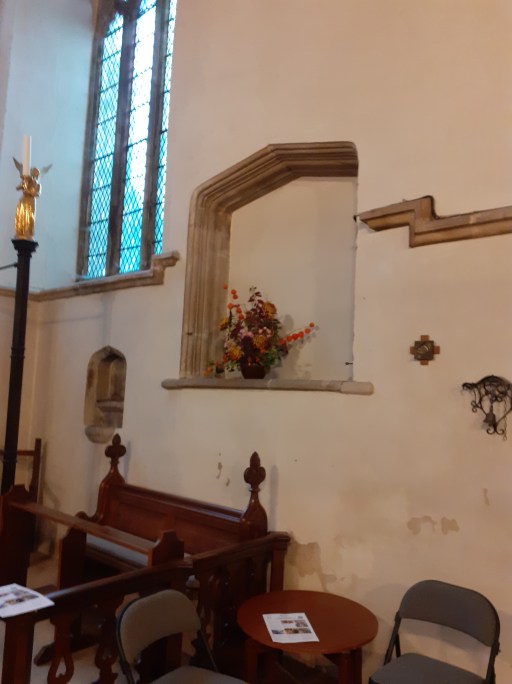
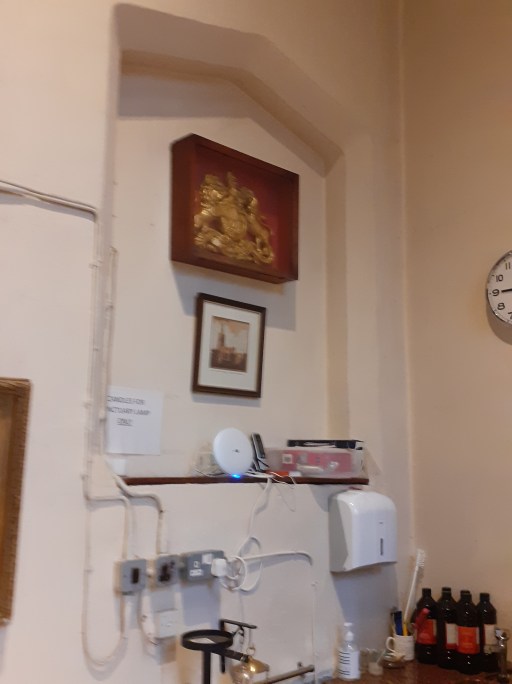
The vestry is thought to have been built around 1480 at the same time as the adjoining Lady Chapel, although this is not certain. It is certainly tall, and could have accommodated a second floor, although there is no current structural evidence for that. One potential feature could be consistent with the idea that and Anchorite hermit (or an Anchoress) resided there, is that there is a blocked up “window” structure in the wall between the vestry and the Lady chapel, which could possibly have been used by the resident hermit to observe the celebration of the mass at the altar below (figure 2). As it stands, the lower edge of this recess is rather too low for it too have been at the level of the floor above, so this might have involved a step down, or perhaps was first built to match the height of an earlier structure on the site of the current vestry. So this perhaps goes some way to bolstering the claim made by Wood, but again there is no certainty.
a
b
Figure 2. The blocked up window structure. a – from the Lady chapel; b – from the vestry. The bottom edge is at the same level in each case.
So to conclude. Whist the presence of relics and hermits in All Saints is a possibility, this is far from certain. As with many Victorian ecclesiologists and antiquarians, the Revd. James may well have let his speculations outrun the evidence.
Additional Note (29/11/24)
After reading the above blog, the Vicar of Oakham, Revd. Stephen Griffiths, sent me the photograph shown in Figure 3 below. This shows two blocked up windows on the east side of the Vestry. From the inside, the lower window corresponds with a recessed cupboard in the wall, which has the appearance of a door, and from the photograph, there seems to be a break in the stone work beneath the window that might indeed suggest it was originally a door. The upper window is similar in form to the stair windows in the tower. Taken together they perhaps suggest a separate entrance with access to an upper level in the vestry. How this relates to the issues addressed in the above blog is not, however, at all clear. All a bit of a mystery.
Figure 3. The east side of the vestry (photograph by Revd. Stephen Griffiths)





















 Engineering, history and ecclesiology

