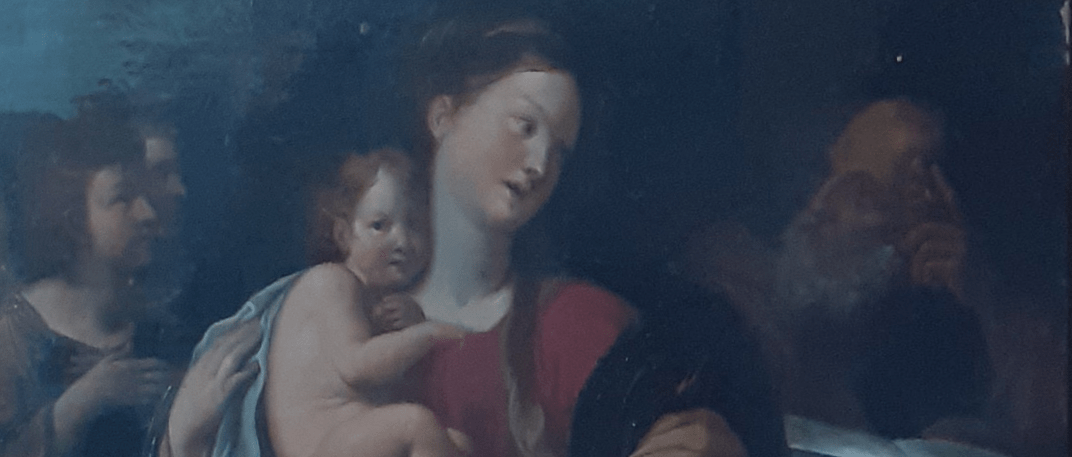
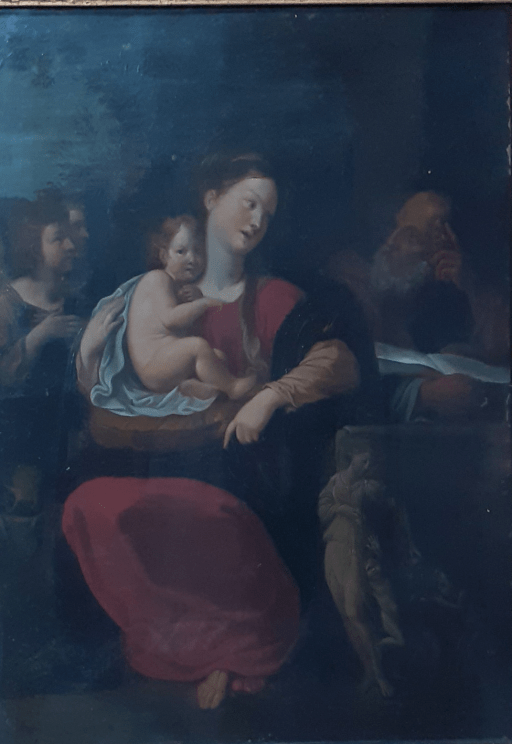
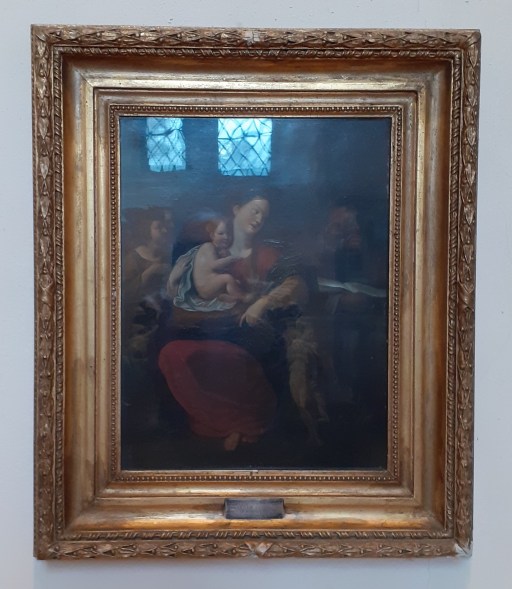
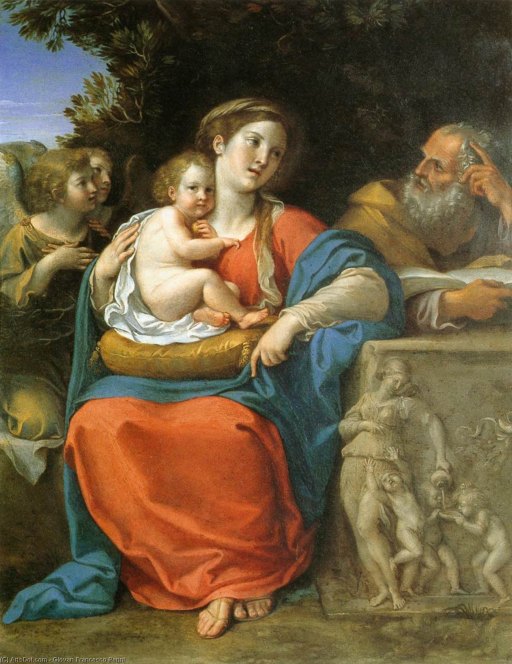
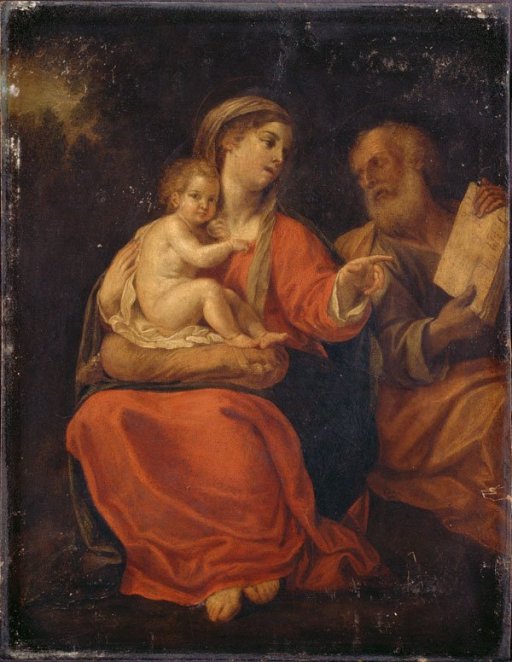
The painting of the Holy Family shown below has hung in the Vicar’s Vestry at All Saints church in Oakham for many years, and has, until recently, never been properly identified. Recent expert advice suggests it is a late 18th / early 19th century copy of a composition by Francesco Albani of between 1608 and 1610. It is believed that it was produced by a workshop in Italy, or perhaps the Netherlands, to satisfy the demands of those on the “Grand Tour” for devotional works. Whilst thus not of any great value, it thus does have an interesting back story.
After a composition by Francesco Albani, paint on metal, late 17th / early 18th century
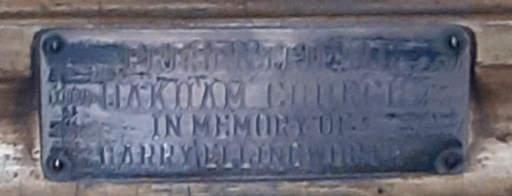
It’s detailed provenance is not known, but a difficult to read caption on the painting frame (below) has the inscription
“Presented to Oakham Church in memory of Harry Ellingworth”.
The Ellingworth family were prosperous shopkeepers in Oakham in the late 19th and early 20th century, and a number of them were named Harry. The most significant of these seems to have been a Harry Ellingworth who was a Town Crier in Oakham in 1881.
Painting in frame (with window reflections)
Dedication label
Interestingly a number of similar copies of the painting can be traced – either painted in Albani’s workshop or elsewhere (see below). The details vary, but the basic composition is the same. The market for such paintings was clearly buoyant.
Print of the original by Francesco Albani housed in the Museum of Fine Arts in Boston. 1608-1610
Dulwich Art Gallery Holy Family by Studio of Francesco Albani 1610-60
The painting shows a somewhat weary and pensive looking Madonna in a red dress with a dark blue shawl, The Christ child sits on a golden cushion on her lap, partly surrounded by a blue sheet. Joseph looks on from the right, with an open book in front of him, that seems to be placed on a stone chest or altar or perhaps a tomb. It may be that the directions in which the Madonna and her husband are pointing is of some iconographic significance – Joseph, in his contemplation of scripture pointing upwards to God, and Mary, with the Christ child on her lap, pointing down to earth, the direction, if that is an appropriate word, of the incarnation. Two angelic figures look on from the left. There is a figure carved on the stone chest, that, from the original, appears to be some sort of Bachannalia, with wine being poured out for small dancing child like figures. Again there may be some iconographic significance here with a representation of Christ’s blood being poured out at the Eucharist. The mixture of biblical and classical themese seems to have been common at the period of the original composition.
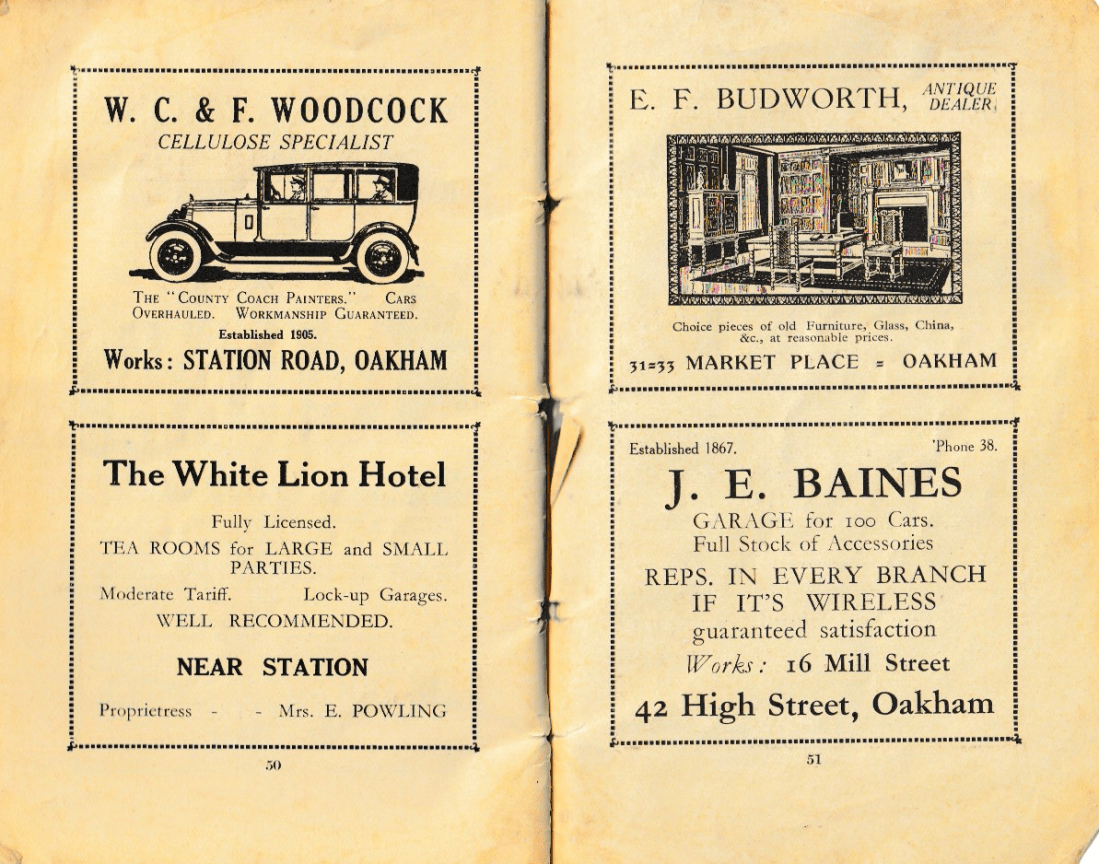
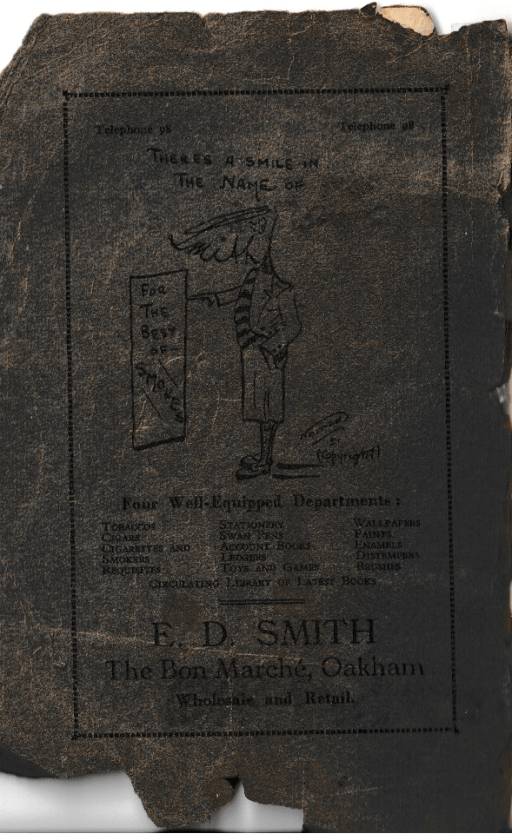
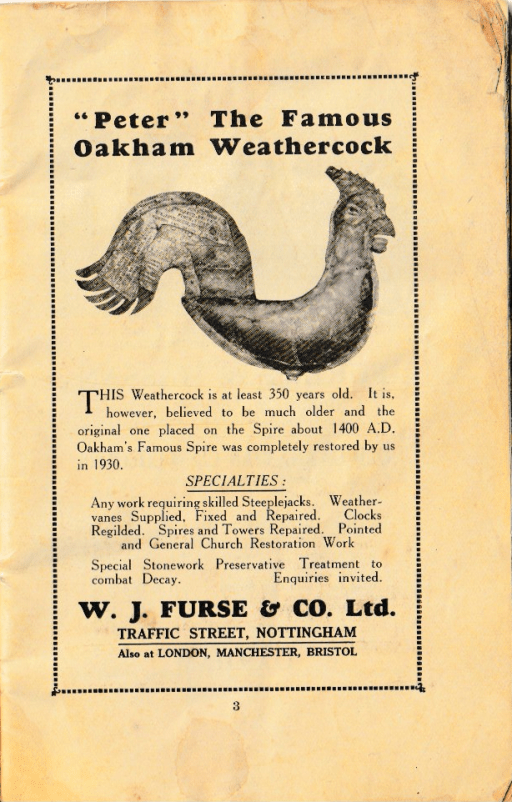
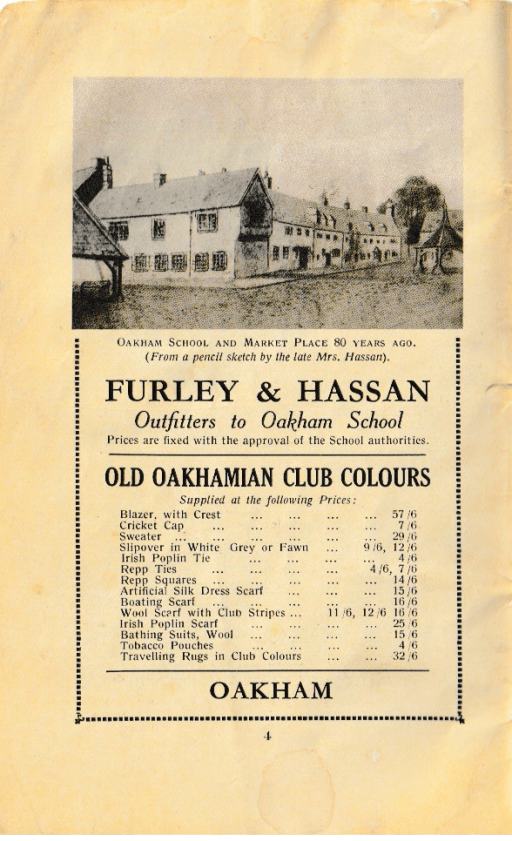
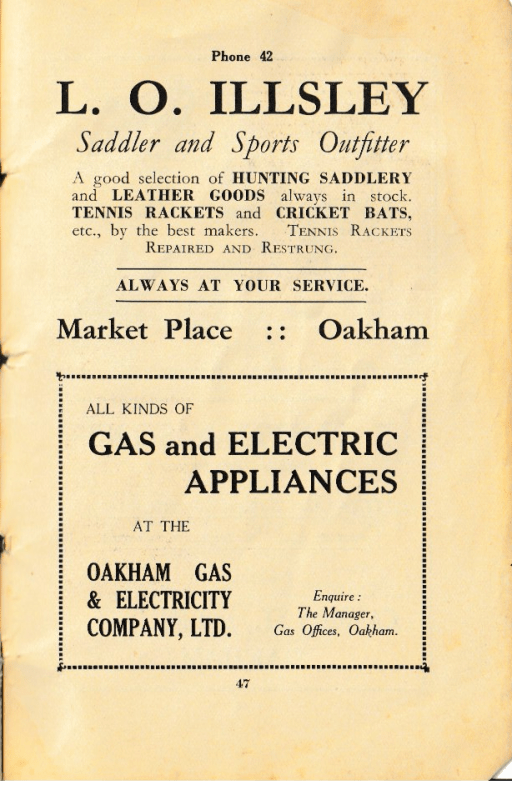
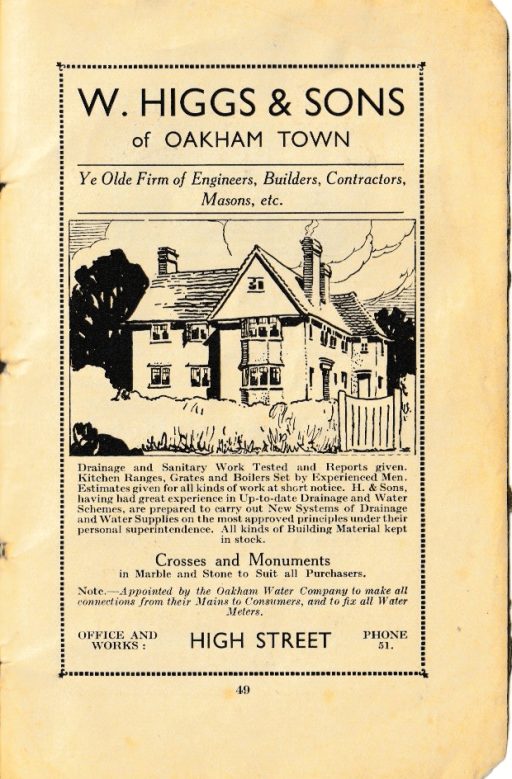
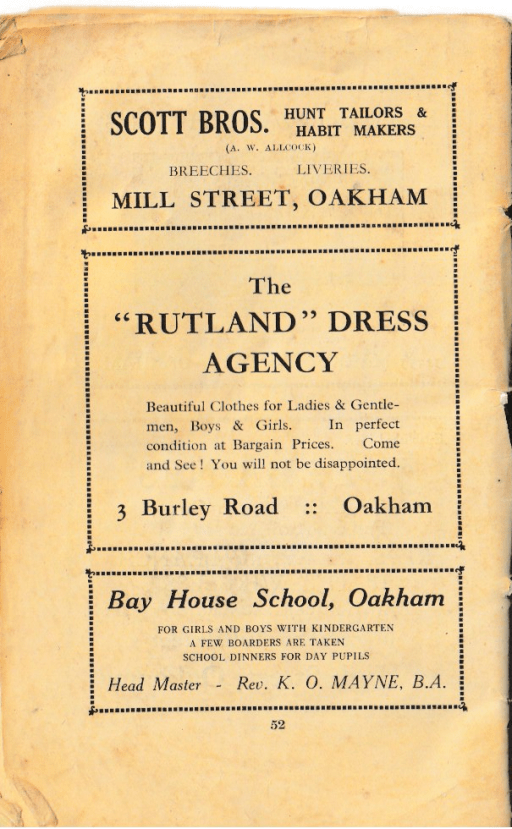
Recently I have come across a number of old Church Guides and Histories for All Saints Church in Oakham- from 1932, 1972 and 1980. PDFS of these can be found on the History and Heritage page of the church website. There comes a time of course when old guides and histories become historical documents in their own right, revealing how the church was thought of and communicated at the time of writing, and in their description of their contemporary activities, give an indication of the nature of the church’s worship and other activities. This is particularly true of the 1932 guide – The Story of Oakham Church, School and Castle by the then vicar, A. Edward Fraser. In what follows I post just a few pages from this this guide – the adverts it contained for local businesses that paid for its publication. These are given below, and I suspect that Oakham readers will find them of considerable interest.
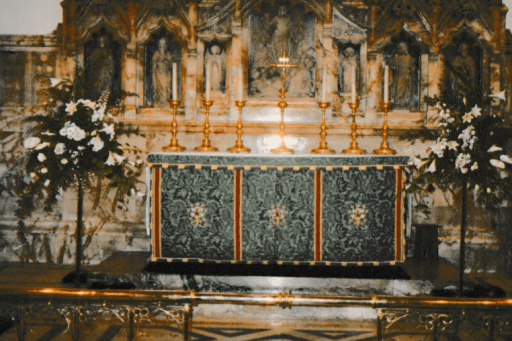
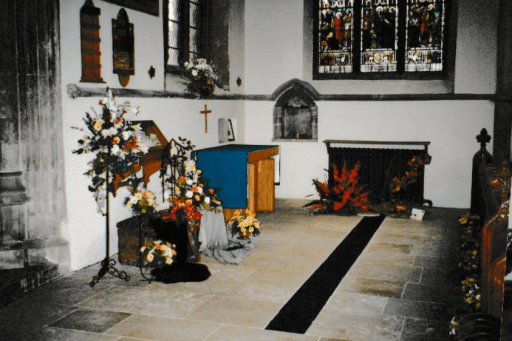
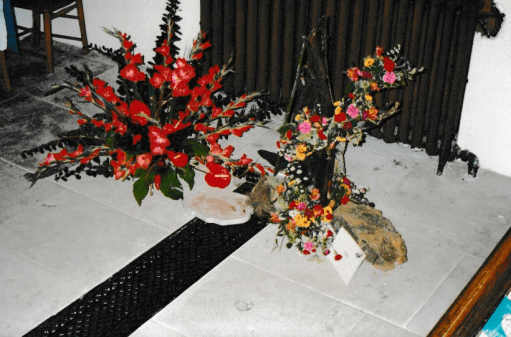
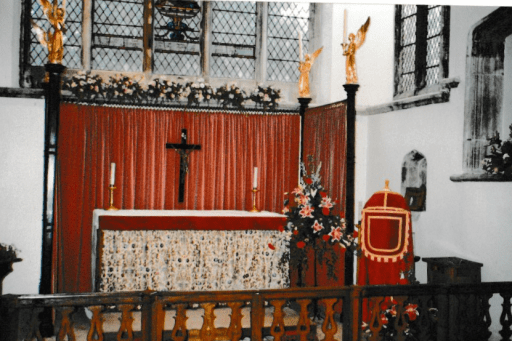
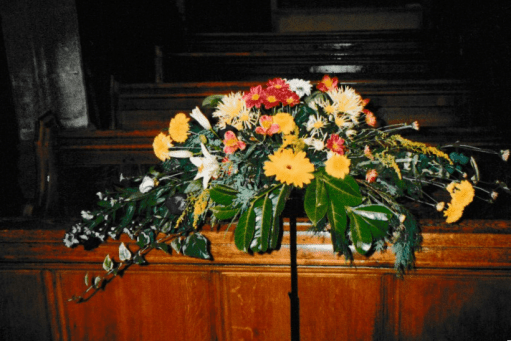
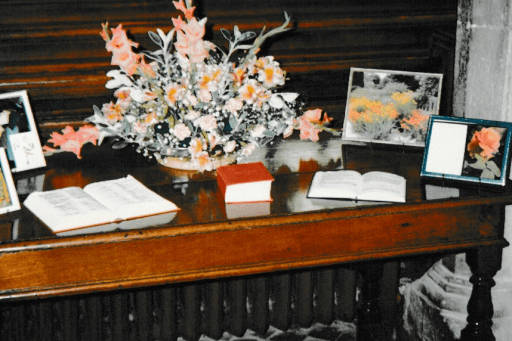
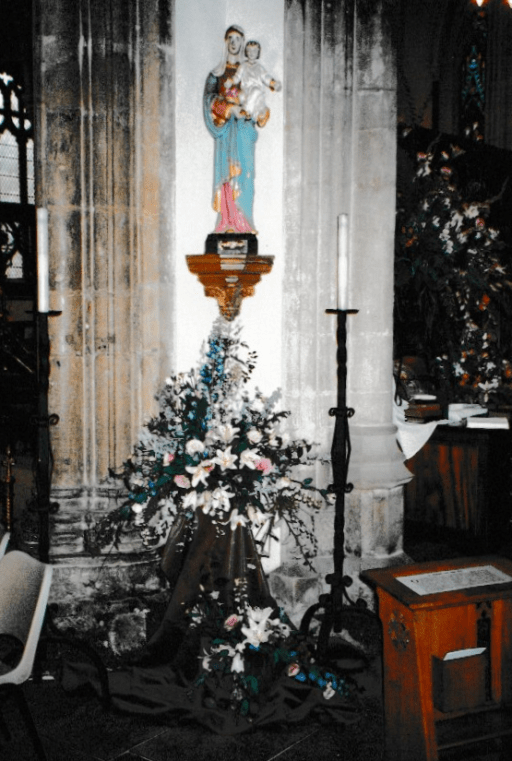
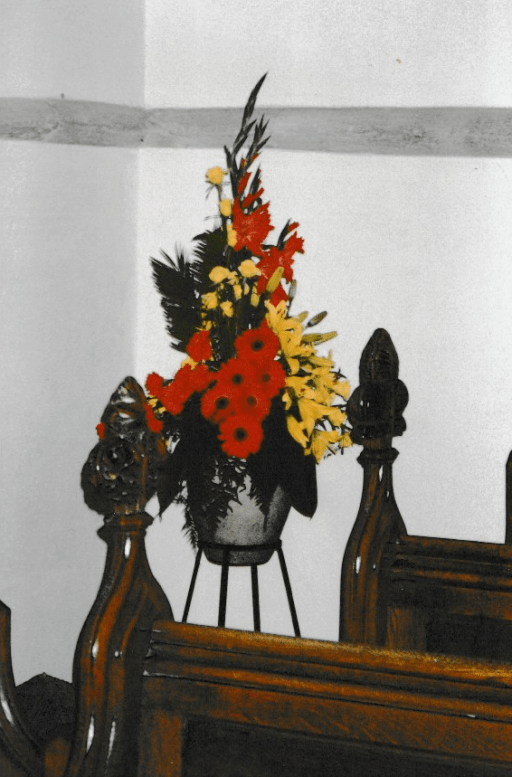
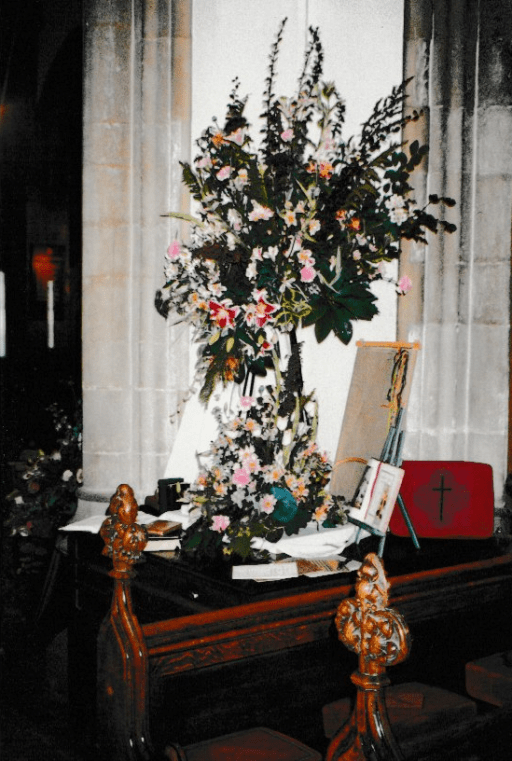
In 1996, All Saints church in Oakham, organised a flower festival. Some photographs from this event were deposited in the church safe for safe keeping, and I have recently come across these whilst searching the safe for other items. It seems to me that these photos are well worth sharing – both for the flower displays but also for the glimpse they give of the church from 30 years ago. Pleas click on the photos below for larger versions of the pictures. The colours aren’t marvellous – they can only be as good as the prints – but they will be of interest to some.
Holy Trinity ChapelHoly Trinity ChapelNorth TranseptHigh altarSouth TranseptSouth TranseptSouth TranseptLady ChapelLady ChapelArea near north doorCentral CrossingCEntral CrossingNorth TranseptNear pulpitEntrance to Lady ChapelWest End
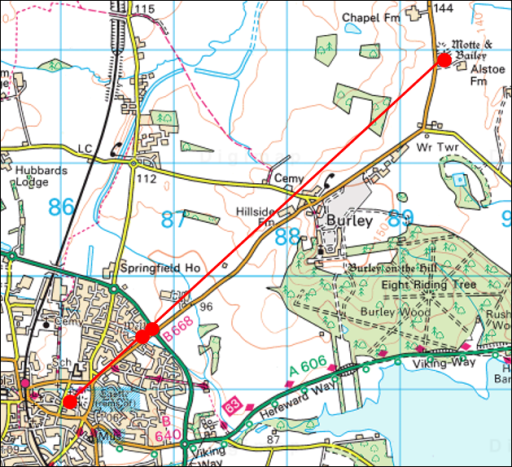
In a post “A possible Anglo-Saxon church group at Oakham in Rutland” from May 2024, I noted that All Saints Church in Oakham, and Our Lady’s Well to the north east were on what could be a mid-summer sunrise / mid-winter sunset solar alignment. I went no further than simply noting this, and didn’t speculate further about what it might imply. One always needs to be cautious about such alignments – they can be simple coincidences, and, if they are being looked for, can be found in the most unlikely places. For example from Borrowcop Hill in Lichfield, possibly an ancient burial mound, there was until recently a perfect alignment with the medieval spires of Lichfield Cathedral and the cooling towers of Rugeley power station, the latter sadly now demolished, which can hardly be of ancient origin. That being said, a reader of the May 2024 post sent me some further information that suggests that a cluster of Stone Age / Bronze Age / Iron Age remains have been found to the north east of Our Lady’s well that could also be on the same alignment. Looking at this further, I realised that several kilometres to the north east of that, and again on much the same alignment, we have Alstoe Mount, another historic monument. These are all shown on the Ordnance Survey map extract of Figure 1 below. The nature of this possible alignment, along the axis of the mid-summer sunrise and mid-winter sunset is discussed further in this post.
Figure 1. The possible alignment. The sites are shown as red circles – from the south west to the north east these are All Saints church in Oakham, Our Lady’s Well, the historic monuments and Alstoe Mount.
The sites
All Saints church, Oakham
All Saints Church is Oakham (Figure 2) is a twelfth century church with thirteenth to fifteenth century additions. Internally it is pure Victorian, having been restored by Gilbert Scott. However it almost certainly stands on the site of an Anglo-Saxon church, and a church in Oakham is mentioned in the Domesday book. A compendium of historical information is given on the church website.
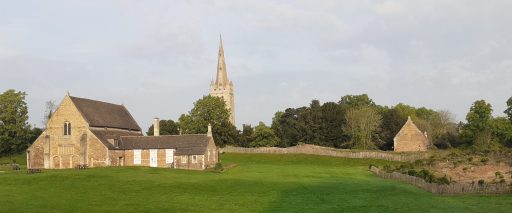
Figure 2. All Saints Oakham and Oakham Castle (photograph by the author)
Our Lady’s Well
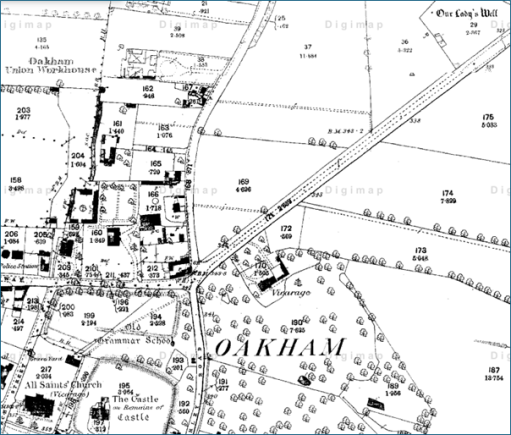
Our Lady’s Well is a historically well-attested pilgrim site to the north east of All Saints church – see Figure 3. To quote from Leicestershire and Rutland’s Holy Wells by Bob Trubshaw from 2004;
Our Lady’s Well was once famed for curing sore eyes – providing that a pin was thrown in first. In 1291 indulgences could be obtained by visiting Oakham Church during its patronal festival and, for a price, joining a pilgrimage to Our Lady’s Well. In 1881 it was visited by the future Queen Alexandra. The well is to the north-east of the town, in a somewhat overgrown area between the Cottesmore road and a modern housing estate (NGR SK:866095).
It’s current condition is no better, and it is now impossible to access the well, in an overgrown plot of wasteland, which seems a shame.
Figure 3. Location of Our Lady’s Well from the 1880 Ordnance survey Map (All Saints church is at the bottom left, and the well at the top right.)
The Stone Age / Bronze Age / Iron Age monuments
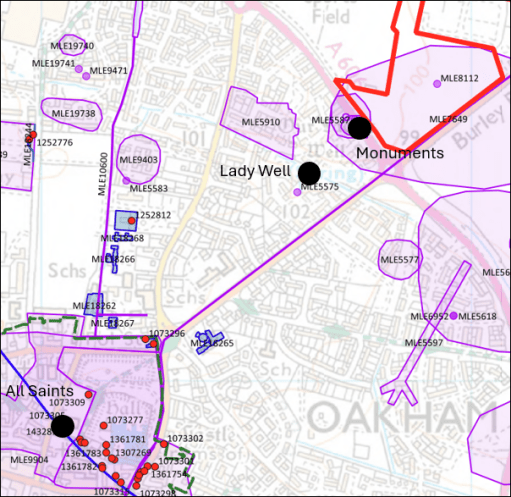
The material I was sent concerning the Stone Age / Bronze Age / Iron Age monuments came from “Land off Burley Road Oakham, Vision and Delivery Document” produced by Pigeon Investment Management with regard to a proposed hosing development. Figure 4 is taken from that document and shows the location of Our Lady’s Well and the relevant monuments.
The monuments are listed as follows, where the numbers are those on the Historic England National Heritage list.
MLE5587 – Possible Mesolithic site west of Burley Road MLE5592 – Late Iron Age/Roman site west of Burley Road MLE5593 – Bronze Age burial, west of Burley Road MLE5594 – Neolithic pit circle site west of Burley Road
Alstoe Mount
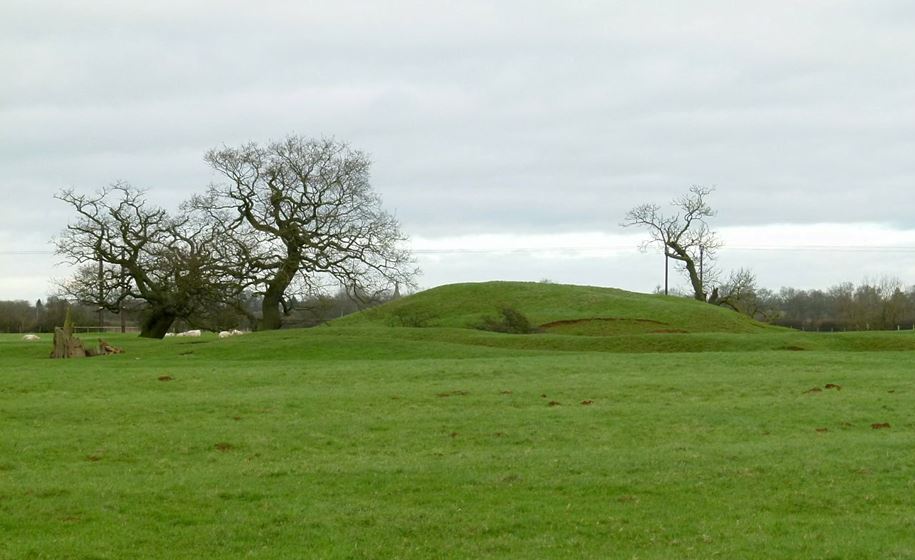
The substantial mound of Alstoe Mount (Figure 5) is described on the Ordnance Survey map as a Motte and Bailey. That is almost certainly not true. It was probably the Moot location for Alstoe Hundred. Details of the mound and the surrounding deserted village are given in the Historic England list entry.
Figure 5. Alstoe Mount (photograph from Historic England by Alan Murray-Rust, 2016)
The possible solar alignment
A current mid-summer sunrise / midwinter sunset direction from Oakham is 47.5 degrees east of north (from SunCalc). However obtaining a precise value to compare with the possible alignment shown in Figure 1 is difficult for two reasons. Firstly the actual direction of sunrise and sunset has varied over the millennia – and as things stand, we have no date for which a calculation can be made. This change is however small – of the order of 0.2 to 0.5 degrees. Also the apparent direction from any point depends upon the precise topography of the horizon over which the sunrise / sunset is observed – and as we know nothing about the observation point or the direction of observation, this is again not possible to specify. This again results in an uncertainty of around 0.5 degrees. So all we can probably say is that we are looking for an alignment of 47.5 +/-1.0 degrees east of north.
The actual directions between All Saints Oakham and the other sites is as follows.
Oakham to Our Lady’s Well – 46.3 degrees Oakham to Stone Age / Bronze Age / Iron Age monuments – 47.1 degrees Oakham to Alstoe Mount – 47.8 degrees
Again there is uncertainty here – particularly in the specification of the precise site at Our Lady’s Well of any structure that might have been visible from All Saints, and similarly the precise position of any relevant structure in the monument field. The location point for All Saints (taken as the centre of the building) could be around 10m to the east or west. This can have an effect of the bearings of Our Lady’s Well and the monuments by around 0.25 degrees. Considering these uncertainties the above bearings and a sunrise / sunset direction of 47.5 degrees seem broadly consistent, and thus there does seem to be some evidence for all four sites lying along a solar alignment of some significance.
But there is another issue – that of elevation. A cross section along the proposed alignment is shown in Figure 6. From this it is clear that Alstoe Mount would not be visible from Our Lady’s Well or from the Monument field, and would only just be visible from All Saints if any observation platforms that existed there and at Alstoe were raised off the ground by a metre or so. Beacons however would have been visible.
Figure 6. Section through the proposed alignment (from Google Earth Pro.).
Discussion
So what does the above analysis lead to. Firstly I think there is plausible (but far from conclusive) evidence for a mid-summer sunrise / mid-winter sunset alignment, at least between the Monument field / Our Lady’s Well and All Saints, and possibly between Alstoe Mount and All Saints. but the available evidence gives us no chronological information as to when the alignment might have been of significance. Our Lady’s Well is first mentioned in the late Middle Ages and All Saints and Alstoe Mount can only be said to become of important in the pre-conquest period. There is no evidence at all, except in the monument field, for the other sites being important in the Stone Age / Bronze Age / Iron Age. So in my view it is probably better to stop at this point – acknowledging that there may be a solar alignment, but not taking speculation any further. The boring, cautious approach I guess, but I don’t think there is much more to be said.
Some summer reading and viewing – a compilation of some of my recent blog posts and a presentation on the history and heritage of All Saints church in Oakham.
Blog posts
The memorials of All Saints Oakham. Photographs and brief descriptions of the wall mounted memorials at All Saints church in Oakham (May 19th 2025)
From Oakham to Mandalay. The story of a young curate from Oakham and his brief service as a missionary in Burma before his early death (April 29th 2025)
Kinetic Water Power – some odd words on a memorial in All Saints Oakham led to some interesting findings about how church organs were powered at the start of the 20th century (25th April 2025)
The 1858 Restoration of All Saints church in Oakham. Part 1, Part 2,Part 3 Three linked posts giving the transcripts of press reports of the restoration and re-opening of All Saints church in 1858, including the condition report by Gilbert Scott (October 9th 2024)
A time to mourn and a time to dance. A time to mourn and a time to dance – the All Saints season through the ages. The video of a talk given at All Saints Oakham on October 31st 2024
For some summer reading – a compilation of some of my recent blog posts on ancient and more modern Oakham and Rutland history.
The street topography of early Oakham. A post that considers how the street of Oakham and the surrounding areas might have been configured in the Anglo-Saxon and Norman periods (December 8th 2024)
Oakham roofs. A photo blog simply showing the upper floors and roofs of the buildings on the north side of the High Street in Oakham. For no other reason than I like roofs. The history is implicit rather than explicit (July 23rd 2024)
Rutland – an enigmatic history – a further speculative consideration of three oddities about the early history of Rutland (2nd February 2024)
Rutland and the Hwicce Some further thoughts on the County of Rutland and its association with the Hwiccan tribe of Worcestershire and Gloucestershire (30th December 2023)
The Origin of Rutland – some speculations on the early history of the area where I now live (2nd December 2023)
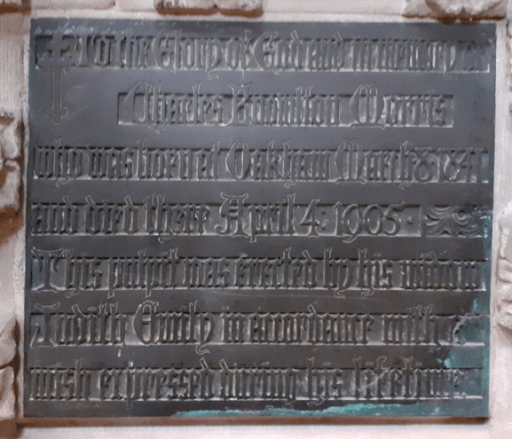
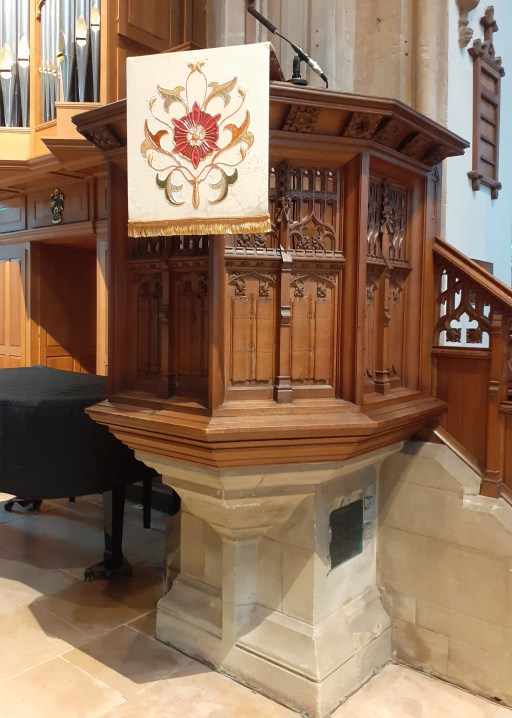
Memorials in churches can be in some really odd places. I recently noticed a brass plaque almost at ground level on the base of the pulpit at All Saints in Oakham. Even sitting on the floor in close proximity I was unable to make out much of it, but by taking some photographs and enhancing the contrast, I was able to get the image on the right. This reads
To the Glory of god and in remembrance of Charles Knowlton Morris, who was born at Oakham March 18 1841 and died there April 4 1905. This pulpit was erected by his widow Judith Emily in accordance with his wish expressed during his lifetime.
Pulpit memorial tablet
The name rang a bell in my mind – there is a very similar dedication on the stained glass window in the south transept.
To the glory of God and in remembrance of Charles Knowlton Morris who was born at Oakham 8th March 1841 and died there 4th April 1905. This memorial is erected by his widow Judith Emily.
Window memorial dedication
Charles Knowlton Morris
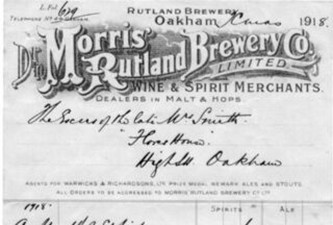
So who was this Charles Knowlton Morris? He turned out to be quite easy to trace through the historical record. He was born in 1841, the son of Clarke and Francis Morris (nee Hare) of Catmose Street in Oakham, one of at least six children. Clarke Morris was a brewer in Northgate in Oakham. Two of his sons – William Clarke Morris and Charles Knowlton Morris took over the business after Clarke’s death in 1857. The brewery moved to Cross St / New St in 1866 and in censuses and trade directories, the business is usually described as Morris’ Rutland Brewery, and they were also listed as coal, salt and seed merchants at the railway station wharf. William Clark died in 1895 and it appears that the business passed directly to his brother. The Reredos and Marble flooring in the chancel at All Saints were donated by Charles in memory of his brother in 1898.
All Saints Reredos
Reredos dedication plate
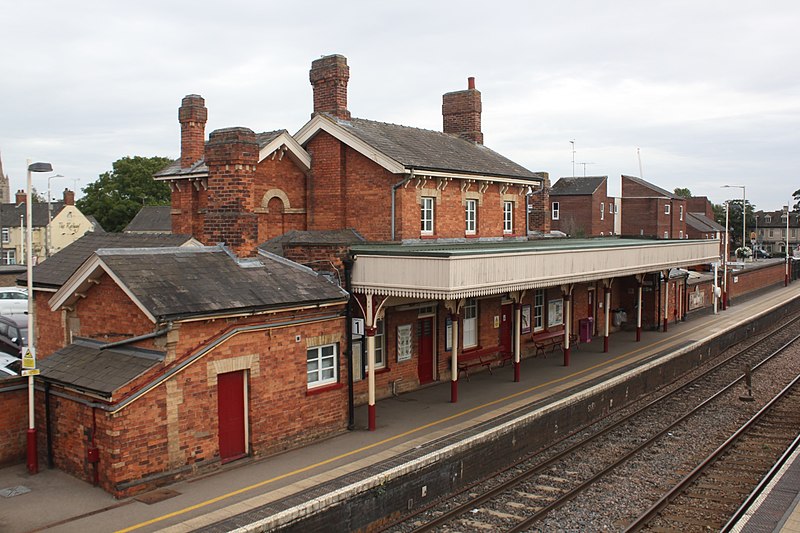
Charles married late in life, in 1898 aged 57 to Judith Emily Tiptaft, the daughter of a Northamptonshire farmer, who was seventeen years his junior. There were no children. Charles died on 4/4/1905, leaving a very considerable business and effects worth £19448. The business was sold off by auction fairly soon after his death. It is described in the Grantham Journal of 25/11/1905 as consisting of the brewery in New Street, and nineteen public houses in Oakham and the surrounding area. Those in Oakham included the Railway Hotel on Station Road, the Roebuck Inn on Church Street, the Bell Inn on Catmose Street, the Royal Duke Inn on West Road, Oakham, the Angel Inn on Northgate Street, and two off licenses, the Rutland Arms in New St and the Britannia Inn on Northgate Street. The estate was bought for £28,250 by Warwicks & Richardsons Ltd, Newark. Brewing ceased in 1907, but Warwicks continued to use the name Morris Rutland Brewery on Guiness bottled in Newark until 1962.
Comapny banner
The Brewery in New St in 1980
The dedication service
On 6/9/1896 at a service at All Saints church in Oakham, a new pulpit and stained glass window were dedicated to the memory of Charles. These are described at length in the Grantham Journal of 8/9/1906 as follows.
The window composed of three long lights, surmounted by beautiful tracery, and is now the best of the many fine windows in this Church. The stained-glass design is governed by the architectural features, which are typical 14th century work, demanding small subjects and canopies. The subjects are nine in number, massed in rich deep colours, all contributing to the design of three bands running laterally through the tall lights in the window, and are set off by the intercepting canopies, which are soft, and display a silvery effect. Incidents in the life of our Lord with which all are familiar are represented, and portray, respectively, ” Endurance,” “Love,” ” Fortitude,” “Humility*,” “Principle,” “Charity,” ” Innocence,” Sympathy,” and “Justice.” These help to illustrate, in their appropriateness, the beautiful life of Charles Knowlton Morris, whose memory they will perpetuated.…..……. Flowers and birds are delicately introduced as emblems, and the Past Masters’ jewel .and badge of the Vale of Catmos Lodge (No. 1265) of Freemasons are shown a small shield at the foot of the centre light.
The apex of the window contains the dove, and rays emanate from it into the surrounding side lights, and disappear behind the finials of the canopy, which runs out from main design below. The window was designed and executed by Mr. Dudley Forsyth, 335, Finchley-road, Hampstead, London
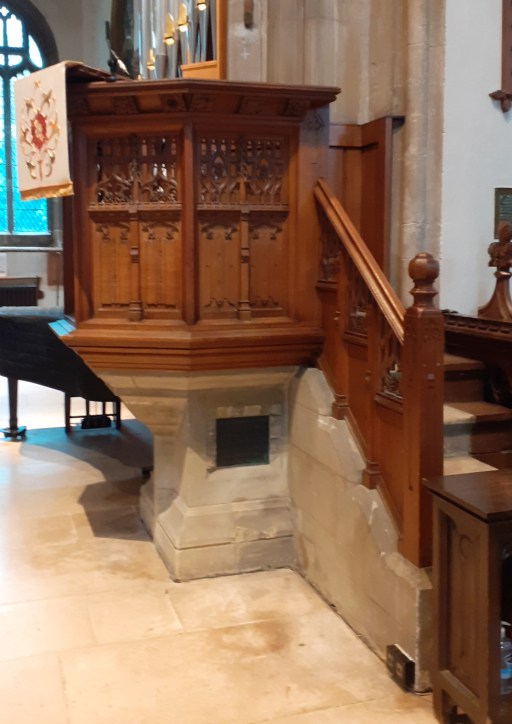
The new pulpit, as detailed on the inscription panel at fulfils wish expressed by the late Mr. Morris during his lifetime. It is in the Gothic style, and has been carefully designed so as to harmonise with its surroundings. The steps and the stone base by which the pulpit is supported are green Chilmark stone. A large moulded corbel, springing from the base, carries the pulpit, which is, in shape, five sides octagon. The material used is Austrian oak, slightly tongued, in order that it may resemble the existing oak fittings in the Church. Each side of the octagon is divided into two panels, the lower part of each carved, the upper part pierced; and care has been taken vary the design of the carving, as avoid monotony and give interest work. The cornice which crowns the pulpit is variously carved to represent the of the Passion of our Lord. The balustrade to the steps is similarly treated panels, and the whole, including the brass memorial tablet, reading-desk, and black fittings, has been designed Messrs. Forsyth and Maale, architects, of London, and carried out for the pulpit by J. P. White, of Bedford, and for metal work by Messrs. J. Elsley, of London.
Later years
Judith Morris must have spent a considerable part of her inheritance on these monuments to her husband. She was later to marry Dr Henry Drew in London in 1922. She died in 1945 at the age of 87. Pictures are available of her here and here, although an Ancestry subscription will be required to access these.
After her death in 1945 we read in the Leicester Evening Mail of 16/3/1945
Under the will of the late Mr. Charles Knowlton Morris, a former Oakham brewer, the vicar and churchwardens of Oakham receive a legacy, following the death of his widow, Mrs, Judith Emily Drew. of Leadenham House, Braunston Road. Oakham, to provide pensions for members of the Church of England. The sum is £3O annually. to provide three £l0 pensions for three poor persons of good character of the age of 85 and upwards residing in the town, and being members of the Church. It will be called the “Morris Gift.”
So it can be seen that much of what can now be seen at the “business” end of the church – around the altar where the Eucharist is celebrated, and the pulpit where sermons are preached was donated by the Morris family. Now the late 19th century was a time when the Teetotaller movement was very strong in reaction to the obvious ill effects of excess alcohol consumption, mainly on the poor. But clearly the Church of England in Oakham had no scruples about accepted considerable donations from a brewer. But, even in this more moderate age (at least in terms of alcohol consumption) the fact that Sunday services take place on structures funded by the receipts of nineteen public houses in Rutland might manage to raise a few eyebrows.
All Saints church in Oakham is not particularly well endowed with memorials to individuals and events, and there are no spectacular carvings. However some of those that do exist enable interesting stories to be told. In this post I present a number of these, with links to more information, and highlight those memorials that require further investigation. The post is very much a work in progress, and I will edit it as more information becomes available.
Note – to read some of the inscriptions below readers may well need to magnify them. Even then, some will take a little patience to read, particularly the brasses where it is difficult to take photographs without reflections obscuring the text.
Vestry
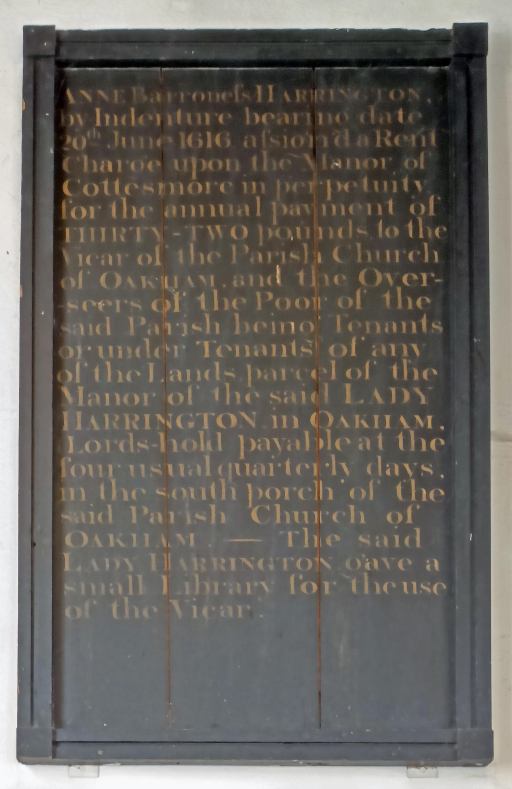
I have discussed the wooden memorial of the Lady Harrington bequest – money for the relief of the poor and a donation of a Parish Library – in two blog posts here and here. The memorial is in the vestry on the south side of the church and is not usually publicly accessible.
Chancel
A transcript of this plaque in the Chancel is given in the post From Oakham to Mandalay and a little more information is given on the career of Henry Jerwood.
Lady Chapel
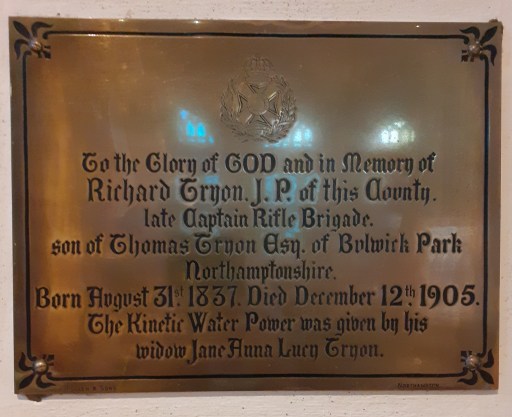
A transcript of this plaque in the Lady Chapel is given in the post Kinetic Water Power, and information is given there about Richard Tryon and (at some length) the Kinematic Water Power apparatus.
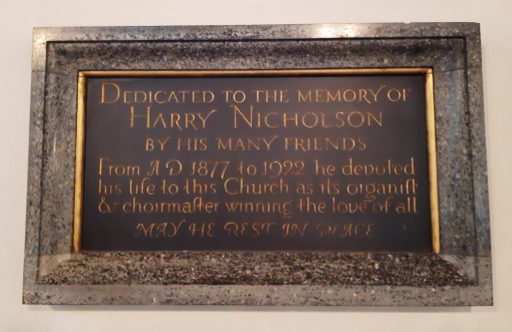
The life and times of long term organist of All Saints church and the founder of the Oakham Choral Society are well described in a blog from the Rutland County Museum.
Pulpit
The pulpit has a dedicatory plaque, very low down near the foot of the steps. It reads as follows To the Glory of god and in remembrance of Charles Knowlton Morris, who was born in Oakham March 18 1841 and died there April 4 1905. This pulpit was erected by his widow Judith Emily in accordance with his wish expressed during his lifetime. Charles Morris was a brewer and a coal merchant. A window in the church has a similar dedication from his wife and is described in the following way Depicting Endurance, Humility, Innocence, Love, Principle, Sympathy, Fortitude, Charity and Justice, as mostly portrayed by scenes from Jesus’ life. The badge of the Vale of Catmose lodge of the Independent Order of Oddfellows is at the bottom.
South Transept
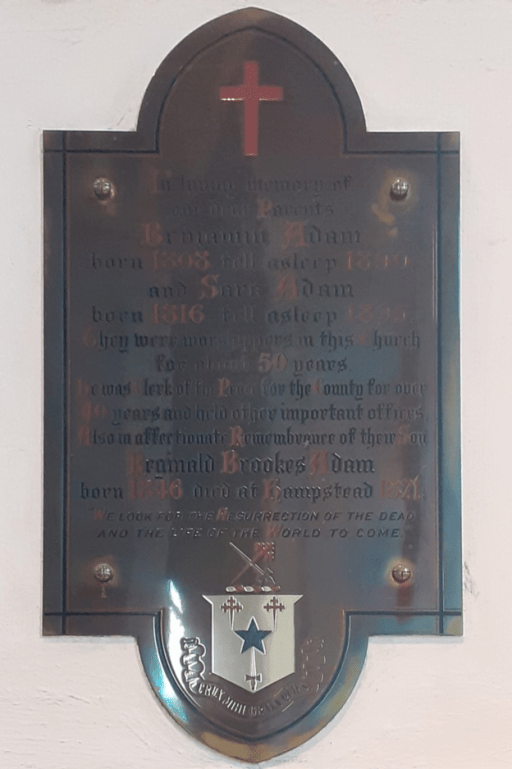
This difficult to read memorial is to Benjamin Adam (1808-1890?), his wife Sara (1816-1895?) and their son Reginald Brookes Adam (1846-1871?). We are told that Benjamin and Sara were worshippers at All Saints for over 50 years, and that Benjamin was Clerk of the Peace for the County (a legal officer) for over 40, and that he also held other important positions.
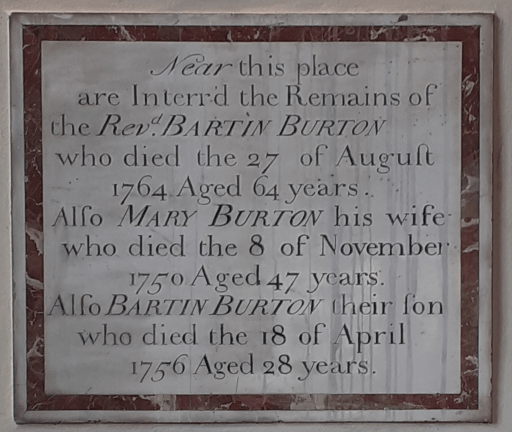
The Church of England Clergy database reveals that Bartin Burton was born in Oakham and served as Curate in the parish of Rockingham, Rector at Oxendon (both in Peterborough diocese) from 1728 to 1729 and Vicar of Ravenstone in Buckinghamshire (Lincoln diocese) from 1747 to 1764.
North Transept
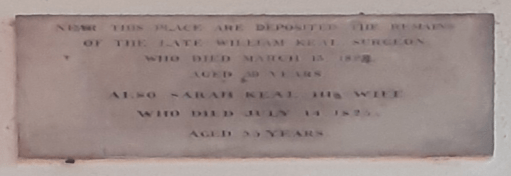
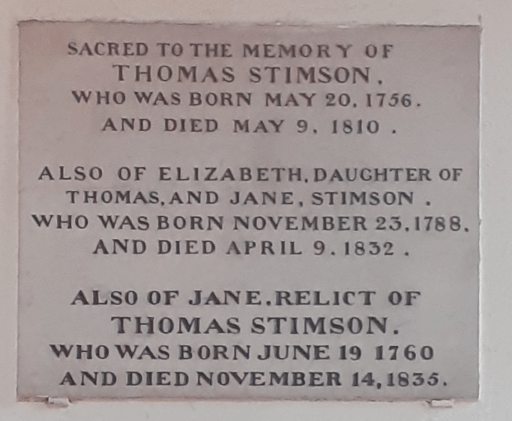
These four memorials in the north transept are placed one above the other in the order shown to the left. The top one commemorates William Keal, a surgeon (d1824?) and his wife Sara (d1825). The one below it commemorates the lives of Thomas Stimson (1756-1810), his wife (relict) Jane (1760-1835) and their daughter Elizabeth (1788-1832).
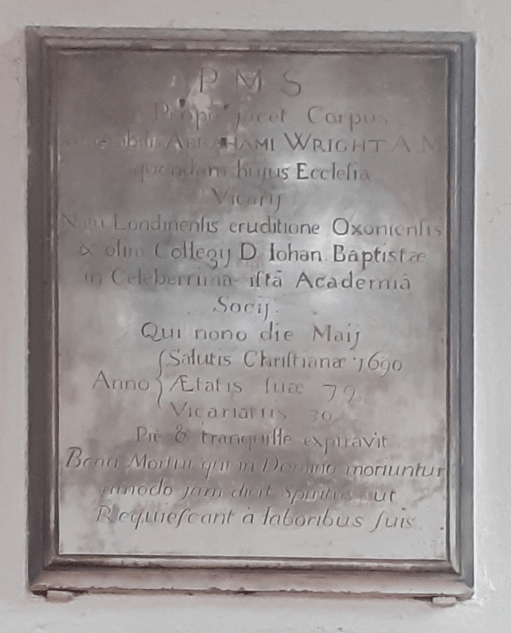
The third is in Latin and commemorates John Abraham Wright (d1690) aged 79, vicar for 30 years, during and after the Commonwealth period. In the first instance he served only one year (1644-5) before he was and replaced by the parliamentary favourite Benjamin King. He took up his post again after the Restoration in 1660.
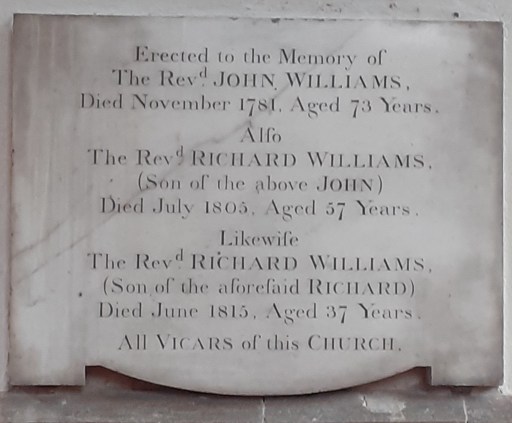
The lower memorial is to three generations of Vicars of the parish – John Williams (d1781), Richard Williams (d1805) and Richard Williams (d1815). More details of their appointments at Oakham and elsewhere can be found in the Church of England Clergy Database.
South Aisle
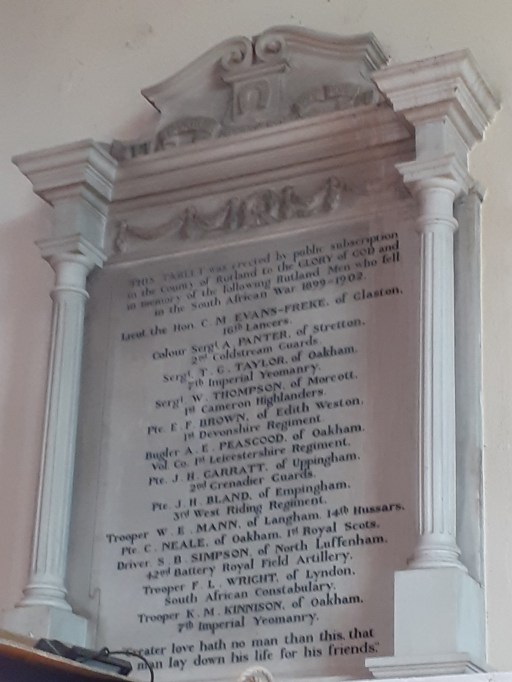
This Boer War monument is now above the choir vestry in the South aisle and not easily accessible – or indeed to photograph. The expertise of a military historian is probably required to unpack and present the stories of those listed here.
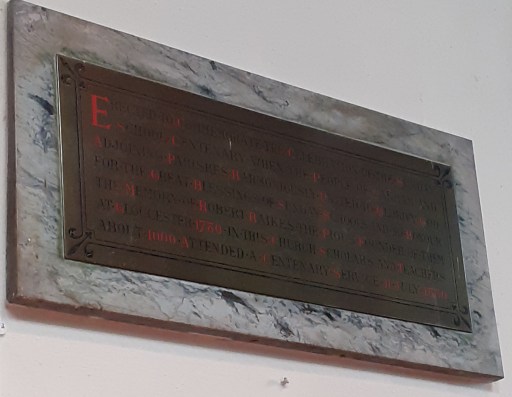
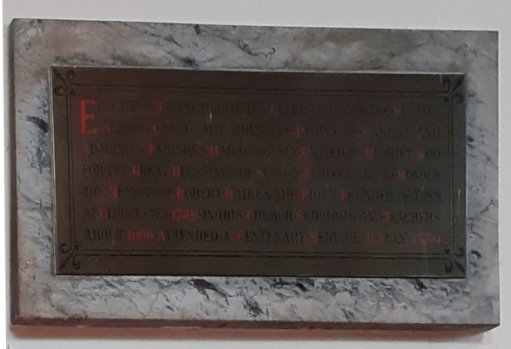
The monument above was both difficult to photograph (to avoid reflections) and difficult to read. It is shown in two forms – as originally taken, and with an attempt made to remove the effect of perspective. It commemorates the 100th anniversary celebration of the Sunday School movement, which around 1000 people attended, and commemorates its founder, Robert Raikes of Gloucester.
North aisle
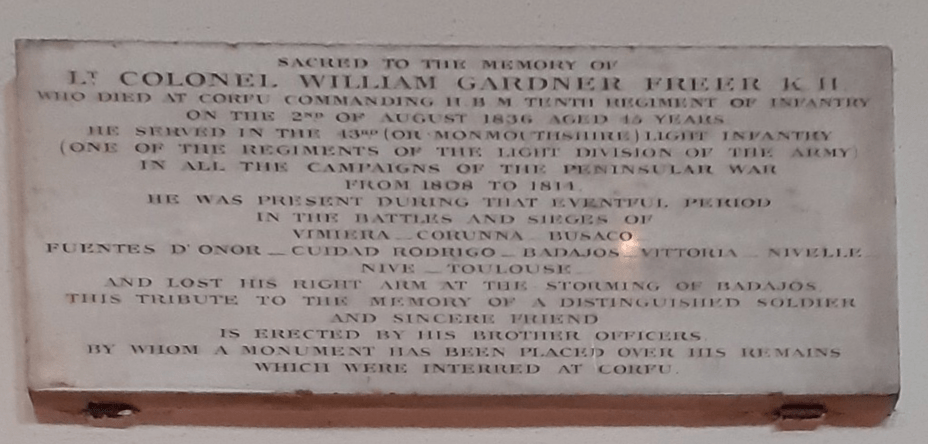
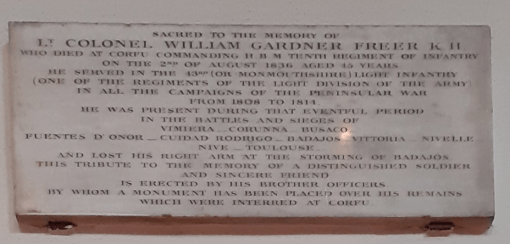
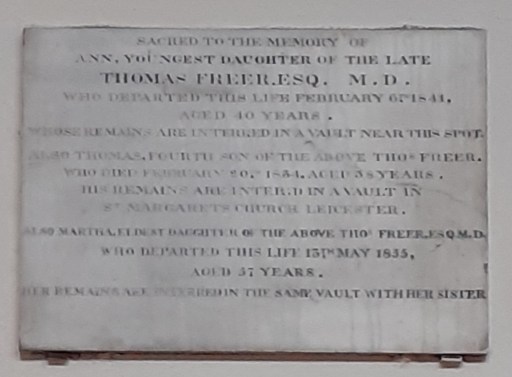
These three monuments are placed above each other in the north aisle in the order shown. The top one is too small to read easily from ground level. They all refer to the Freer family from the early 19th century. The bottom memorial is to Thomas Freer, a doctor, who died in 1835, his wife Martha who died in 1827, and his third son, Edward Gardner who fell in action in the Pyrennees in 1813 aged 20. The second memorial commemorates Thomas and Matha’s youngest daughter Ann (d 1844), their fourth son Thomas (d 1834) and buried in Leicester, and their eldest daughter Martha (d 1835). Finally the upper memorial describes in very small text, Lt. Colonel William Garner Freer who died in Corfu in 1836, whilst commanding the 10th Infantry Regiment. His long military career is outlined, including the loss of his right arm at the storming of Badajos. He is buried in Corfu.
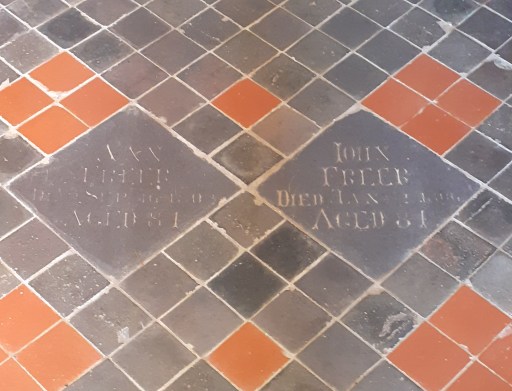
The Freer’s are also commemorated in two tiles in the nave aisle – much faded as they are on the main thoroughfare through church. They are dedicated to Ann and John who, as far as I can make out, died in the early 1800s.
West End
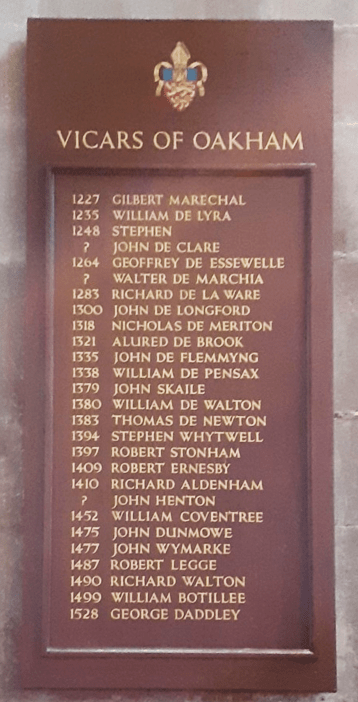
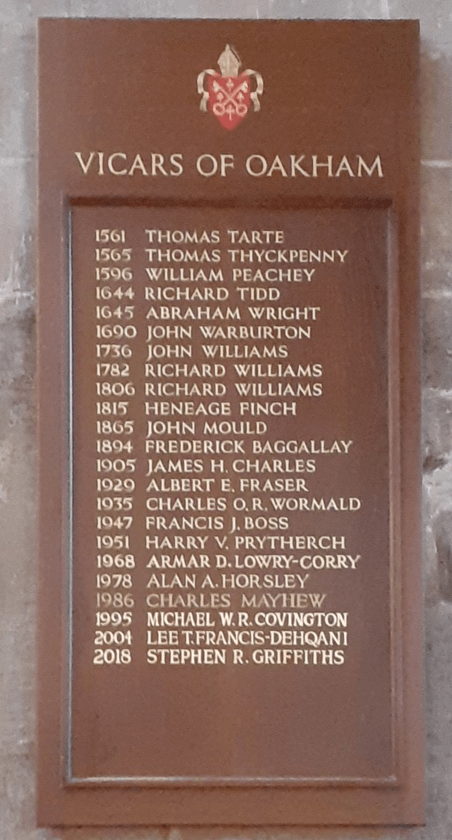
More details of the Vicars of Oakham can be found in the church guide. The Church of England Clergy Database also includes records for both vicars and curates of the parish, and of the surrounding chapels from the mid-sixteenth to the early nineteenth centuries.
Recently, whilst waiting for a service to begin at All Saints church in Oakham, I stood in the Lady Chapel idly reading the memorials attached to the wall (as one does). I came across the one above. The inscription reads
To the Glory of GOD and in Memory of Richard Tryon J.P. of this County. late Captain Rifle Brigade. son of Thomas Tryon Esq, of Bulwick Park Northamptonshire, Born August 31st 1837, Died December 12th 1905. The Kinetic Water Power was given by his widow Jane Anna Lucy Tryon.
Ricard Tryon was one of the great and the good of Rutland society in the late 19th century, and even has his own Wikipedia page. There we read the following.
Richard Tryon DL JP (31 August 1837 — 12 December 1905) was an English first-class cricketer and British Army officer. The son of Thomas Tryon and Anne Trollope, he was born in August 1837 at Bulwick Park in the Northamptonshire village of Bulwick. He was commissioned into the British Army as an ensign in the Rifle Brigade in November 1854. Shortly after he was promoted to lieutenant in February 1855. Tryon purchased the rank of captain in July 1858, later retiring from active service nearly a decade later in May 1867. Tryon made a single appearance in first-class cricket for the Marylebone Cricket Club (MCC), captained by W. G. Grace, against Kent at Lord’s in 1871.Batting once in the match, he was dismissed by Bob Lipscomb for 7 runs in the MCC first innings. A resident of The Lodge, Oakham in the County of Rutland, Tryon was nominated to be Sheriff of Rutland in November 1880. He was unsuccessful, with Francis Pierremont Cecil being made Sheriff; however, Cecil went on active naval service and was replaced by Tryon in April 1881. He was made a deputy lieutenant of Rutland in December 1901. He additionally served as a justice of the peace for Rutland. Tryon died at Marylebone in December 1905, following a short illness. He married Jane Anna Lucy Johnson, daughter of General William Augustus Johnson, in 1867. Two sons, Henry and Richard, were killed in the First World War. A brother was the Royal Navy Vice-Admiral Sir George Tryon.
So he was an interesting character in his own right. However it was the words The Kinetic Water Power was given by his widow Jane Anna Lucy Tryon that caught my eye. What on earth was this about? Kinetic Water Power are words I would associate more with my first year fluid mechanics lectures to engineering undergraduates than to tthe interior of churches. However, when I did a quick search of the British Newspaper Archive things became a little clearer.
Grantham Journal 23/11/1907… o. The Parish Church Organ. Through the munificence ot Mrs. Rd. Tryon, the Lodge, Oakham, and the Earl Lonsdale, Kinetic water-power apparatus and pneumatic pedal-action have been added to the organ of All Saints* Church, in addition to which the instrument …
Stamford Mercury 22/11/1907… just undergone complete renovation, the work being carried out by Messrs. Brindley and Foster, of Sheffield. hydraulic kinetic water-power has also been added. Near the instrument brass plate hears the following inscription : To the glory of God, and in memory …
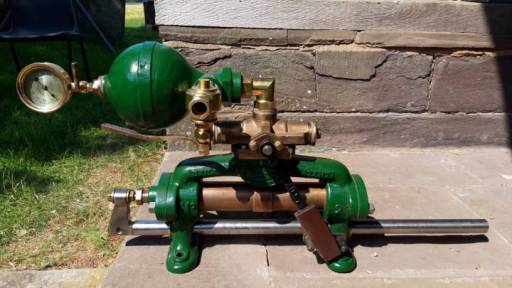
It seems the words Kinetic Water Power refer to the method for powering the church organ, which at that period was housed at the East end of the Lady Chapel, close to the location of the memorial to Richard Tryon. But what was the memorial referring to? Basically, water power was used to operate the bellows of organs when a mains water supply become available, and date back to the 1870s. This was used to fill two pistons sequentially that drove the rod that pumped the bellows. One such hydraulic engine has recently been restored at Moccas church in Herefordshire – see the photo below, the Facebook page and the church website here. More information on hydraulic engines can also be found here.
But there is still something of a puzzle. The Stamford Mercury extract above indicates that the apparatus was installed by Brindley and Foster of Sheffield, who installed the original organ in 1872. However the word Kinetic suggest some sort of association with the Kinetic Organ Blower Company, an offshoot of Cousans of Lincoln (1), However by 1907, this company was busy building Kinetic Blowers – fan blowers operated by electricity. It may be that the Kinetic company also produced hydraulic apparatus, or it may be that there was a somewhat loose usage of the word kinetic on the memorial, particularly as it refers to water power rather than air blowers. But interestingly it would seem that hydraulic engines were old and somewhat out of date technology by 1907.
Elvin L. (1995) Pipes and Actions. Some Organ Builders in the Midlands and beyond, Published by Laurence Elvin, Lincoln.
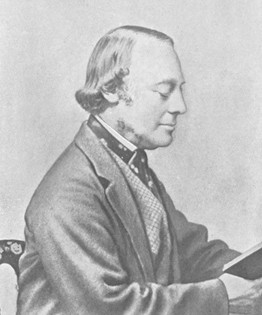
The Glynne Baronetcy dates back to 1661, with its main estate at Hawarden in Flintshire. The 8th Baronet, Sir Stephen Glynne (1780 to 1815) married Mary Griffin, daughter of Lord Braybrooke. After his early death, he was succeeded by his son Sir Stephen Richard Glynne, the 9th Baronet (1807-1874). I first came across him as the owner of the Oak Farm Iron Works in the Black Country, which was the subject of a spectacular financial crash. Glyne was saved from financial ruin by the efforts of his brother-in-law, the future Prime Minister William Gladstone, at very considerable expense to the latter.
More widely, Stephen Glynne is best known as a church antiquarian. Over the course of his adult lifetime he visited over 5000 churches in England and Wales, making notes, and in some cases sketches of their architecture, plans and furnishings. These notes can be found in 106 volumes now housed in the Gladstone Library at Hawarden. A small minority of these have been transcribed and published, but unfortunately this does not include the volumes containing the Rutland churches. This blog post goes some way towards remedying this, by presenting a transcription of the entry for All Saints Oakham. It is intended as the first fruits of a project to do the same for all the churches in the Oakham Team Ministry that were visited by Glynne. However, this may simply result in the creation of paving slabs for the road to hell.
Stephen Glynne’s description of All Saints Oakham
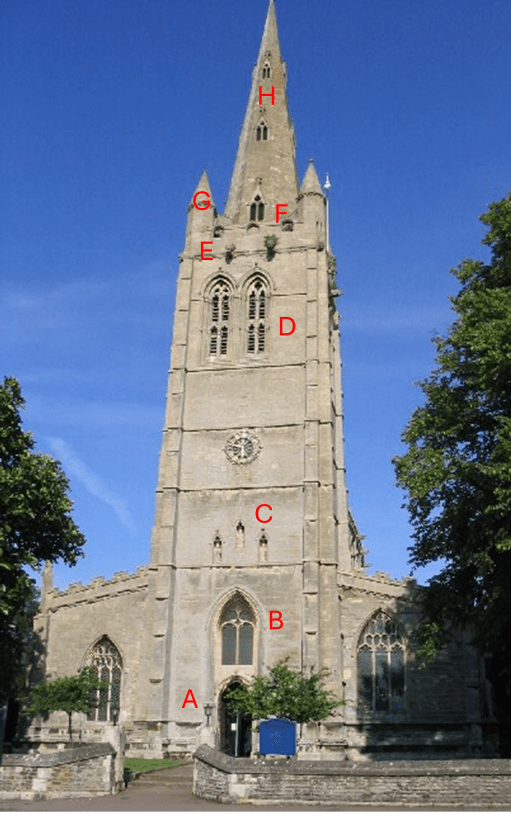
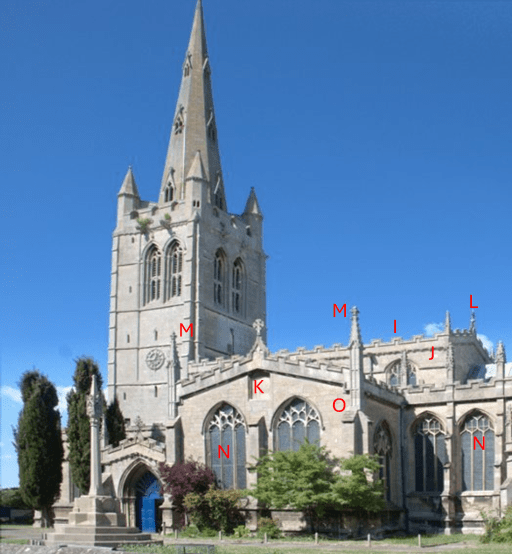
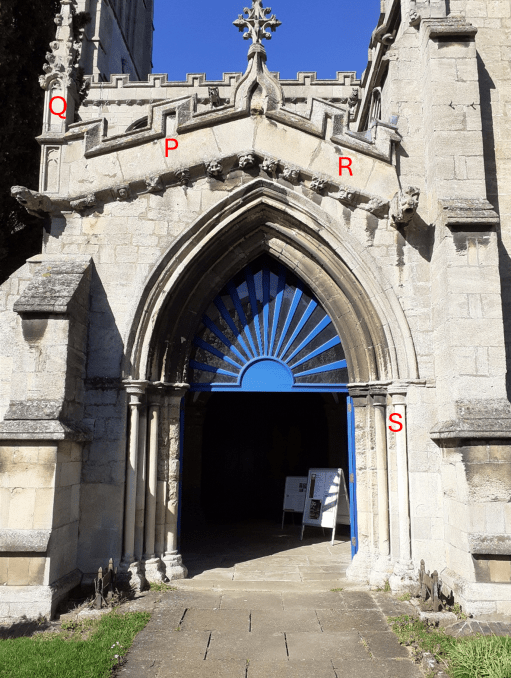
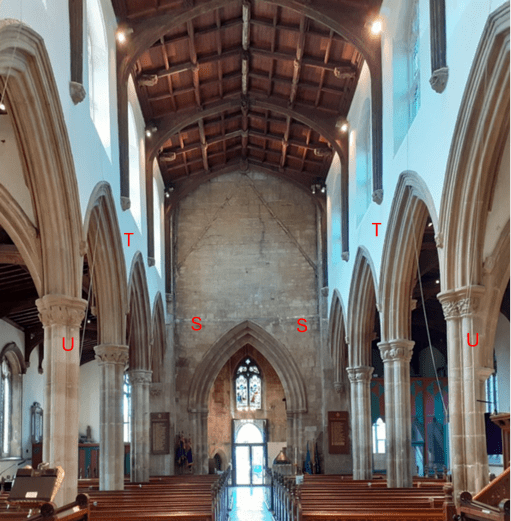
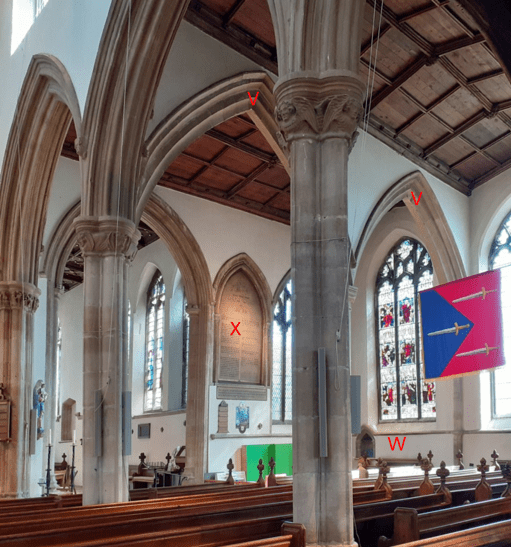
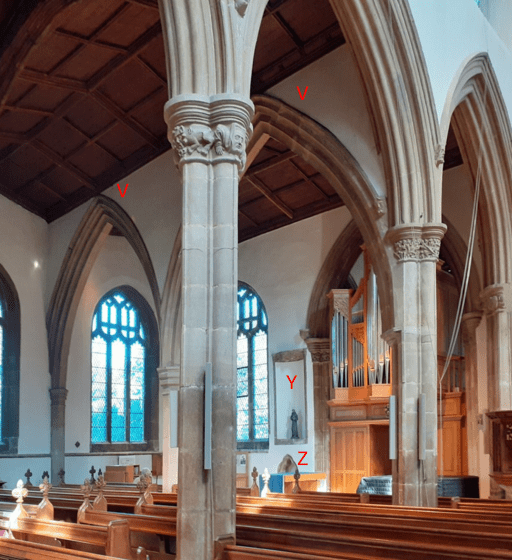
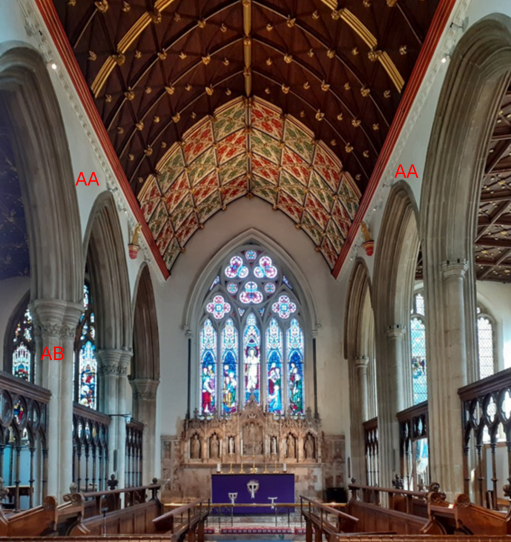
The text of Glynne’s entry for All Saints Oakham is given below, from Volume 33 of his Church Notes, one of three covering Leicestershire and Rutland. It is not dated, but other entries in the same volume indicate the year 1849, and it is likely this applies to the Oakham entry too. Certainly it was written before the restoration of 1858 – see earlier blogs here, here, here and here that deal with that. As written, it was all in one long paragraph, with somewhat dubious punctuation – almost a stream of consciousness approach. I have divided it up into sections with my own headings, and added consistent punctuation, which hopefully makes it a little easier to understand. The letters in brackets refer to the captions on the photographs, which illustrate the text. Numbers in brackets refer to the explanatory notes given at the end of the transcript.
The transcript
General This is a very large and fine church with large portions of Curvilinear work (1) and some of the later style. It consists of a large and lofty Nave with wide aisles, Clerestory, North and South Transepts, each with one aisle, and a chancel with side aisles.
The tower and the spire
The tower and spire The steeple is at the west end of the nave. Included within the aisles, it is a remarkably fine composition consisting of a tower with pinnacles at the angles, surmounted by a beautiful spire connecting to the pinnacles by flying buttresses, the work of the Curvilinear period. On the west side of the tower is the door (A) and over it a two light windows included within one pointed arch (B). In the next stage are three small trefoiled niches on the west side (C) (2). The belfry storey has, on each side, two long windows each of two lights divided by a transom and having deep architrave moulding and shafts (D). Just above the nave a rich band filled with heads and foliage (E) (3). The parapet of the tower is pierced at rectangular intervals with small ogee openings (F). At each angle is a small octagonal turret covered by a large pinnacle from there being flying buttresses to the spire (G) (4), which is well proportioned and has several lights of small canopied windows (H).
The body of the church The whole of the body of the Chancel is embattled (I), there being beneath the parapet at some positions a cornice of heads etc (J) (5). The apex of the gable of Chancel, Transepts and Clerestory is in each crowned with an ogee canopy (K) (6). That of the Clerestory has a fine ornamental cross (L). The Transept ends are enriched with large crocketed pinnacles (M). The northern one is plainer externally than the corresponding one and has much blank wall. The windows of the Nave, Clerestory and Transepts are all Rectilinear (N) (1) but the walls are earlier. Some of the buttresses on the south have crocketed triangular canopies (O).
Transept, Nave and Clerestory
The South Porch The South Porch has an embattled gable (P) with pinnacles (Q) and cornices of heads (R) (7). The doorway is large and has deep mouldings and shafts of early English character having the nail head in the capital (S). Within the porch are niches on each side.
South Porch
Nave and aisles The tower opens to the Nave and each aisle has a pointed arch springing from chamfered shafts (S), but much concealed by clumsy boarded partitions and lumber (8). Some of the windows are of three, others of four lights. The Nave and aisles are of considerable width and the divisions are formed by a double row of lofty pointed arches, four on each side (T). The pillars consists of four clustered shafts in lozenge form with the capitals sculptured with heads (U) (9).
The nave and ailses looking towards west end
Transepts The Transepts are each divided into two aisles by two pointed arches with octagonal pillars (V). The ends of the transept have each two windows under one gable. In the South Transept is the niche with a contracted arch and shafts of early English character, with the piscina (W). On the east side of the same Transept, between the arch opening to the South Aisle and chancel is a window in an arch in the wall of early English work with toothed ornaments in the mouldings (X) (10). In the north transept is a Rectilinear corniced niche in the east wall (Y) and beneath it a trefoiled niche with drain of Curvilinear work (Z).
The South (left) and North (right) transepts
Chancel and chapels The Chancel with its Aisles has a great portion of Rectilinear work (11). The three east windows are large fine ones of four or five lights but only one retains its tracery. The side windows are of three lights. There are three pointed arches on each side of the Chancel (AA). Those in the south are rectilinear, the piers having fine mouldings carried down the ?? with shafts attached. On the sides on the north the piers resemble those of the nave but have the Tudor flower in the capitals (AB). The north aisle (12) has had a good panelled wood ceiling but now somewhat mutilated. On the north side (13) of the chancel is a rectilinear vestry which has no battlement but the gable is finished by a rich canopied niche and cross. The windows east of the chancel and south arch are under one gable and between their heads is a quatrefoiled circle. There is a niche and stoop near the South door of the chancel externally.
The chancel
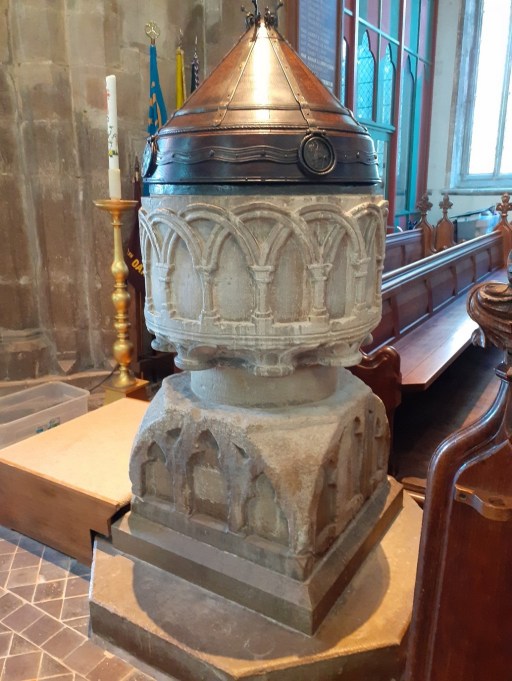
The font The font is Norman of circular form with intersecting arches and shafts (14). The base is square but with corners chamfered off, and moulded with small trefoil arches. There are traces of some fine ??.
Closing remarks Altogether the interior is not so well kept as it deserves to be. The pews and galleries are shabby and the whole dirty and untidy but the exterior is in good preservation and the stone of excellent quality (15).
Notes
1. The architectural periods referred to in the transcript are Early English (1190 to 1250); Curvilinear (or Decorated (1250 to 1350) and Rectilinear or Perpendicular (1330 to 1530). 2. No mention is made of the statues now in these niches, so it is most likely these were added during the 1858 restoration. 3. This band is above the belfry rather than the nave, so Glynne probably made a mistake here. It is possible however that the carvings were moved during the restoration, but the order of the text suggest that the first explanation is most likely. 4. These might be better described a low flying buttresses – it is difficult to observe them from ground level. 5. The heads cannot be seen on the large scale photograph. However there are some wonderful close up pictures of them on the Great English Churches website. 6. Shown here on the South Transept gable. 7. Again, detailed pictures can be found on the Great English Churches website. 8. This is very much inline with the description given by Gilbert Scott in his survey before the 1858 restoration. However his language was somewhat more robust. The aisles referred to are behind the west wall of the nave in the photo. 9. The capitals are perhaps the most significant heritage aspect of All Saints. I have discussed them at length here. 10. The wording is unclear here, but probably refers to the blind window which now houses the ten commandments. 11. The Chancel and side chapels were the most altered part of the church in the 1858 restoration, and much of what is described by Glynne no longer exists. 12. The current Holy Trinity Chapel. The southern aisle (the current Lady Chapel) is not mentioned. 13. This is a mistake – the vestry is on the south side. 14. The order of text here suggest the font was in the chancel area. However, it now stands close to the west door. Whether that has always been the case, or whether it was moved during the restoration to a more ecclesiastically acceptable position is not clear. I am inclined to think it was moved, as it would have been very awkwardly placed under the gallery if it were at the west end before the restoration. 15. Again, this finds and echo in the condition report of Gilbert Scott before the restoration.
























 Engineering, history and ecclesiology
.jpg)
