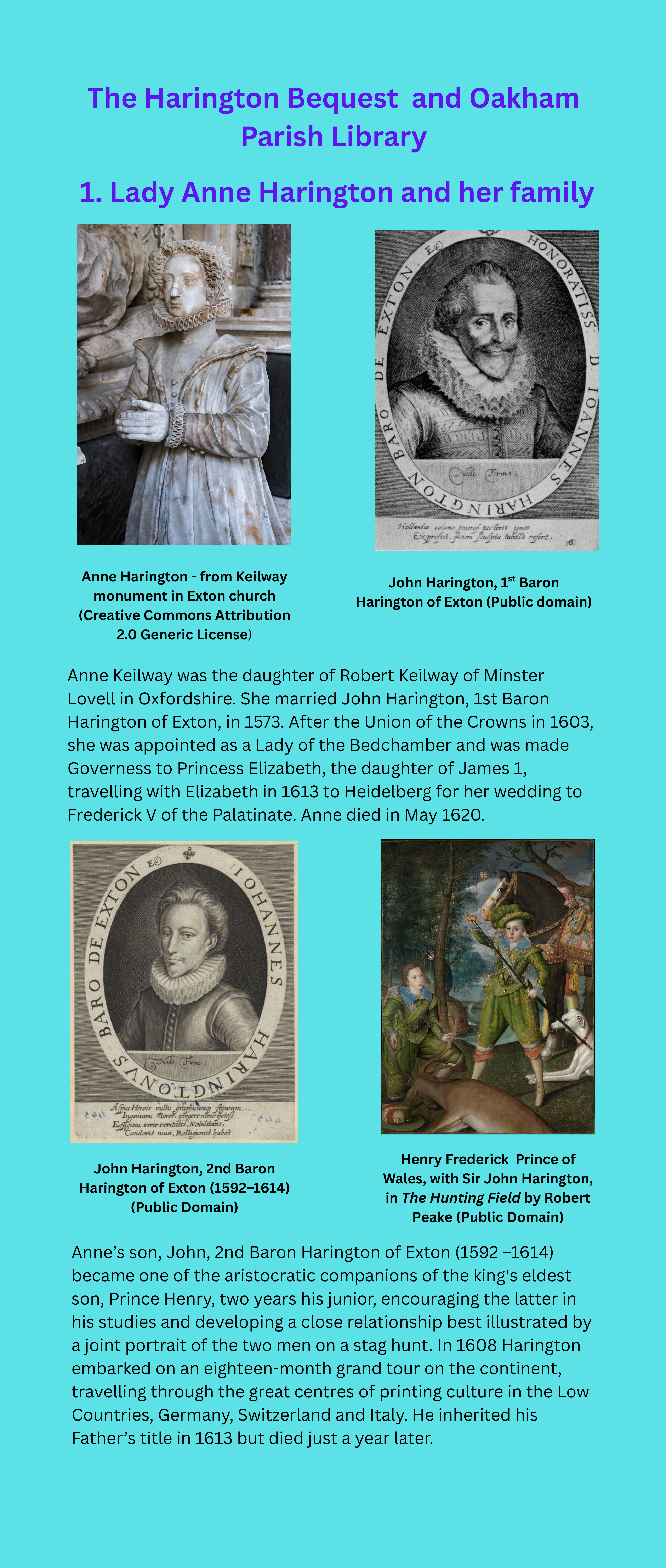
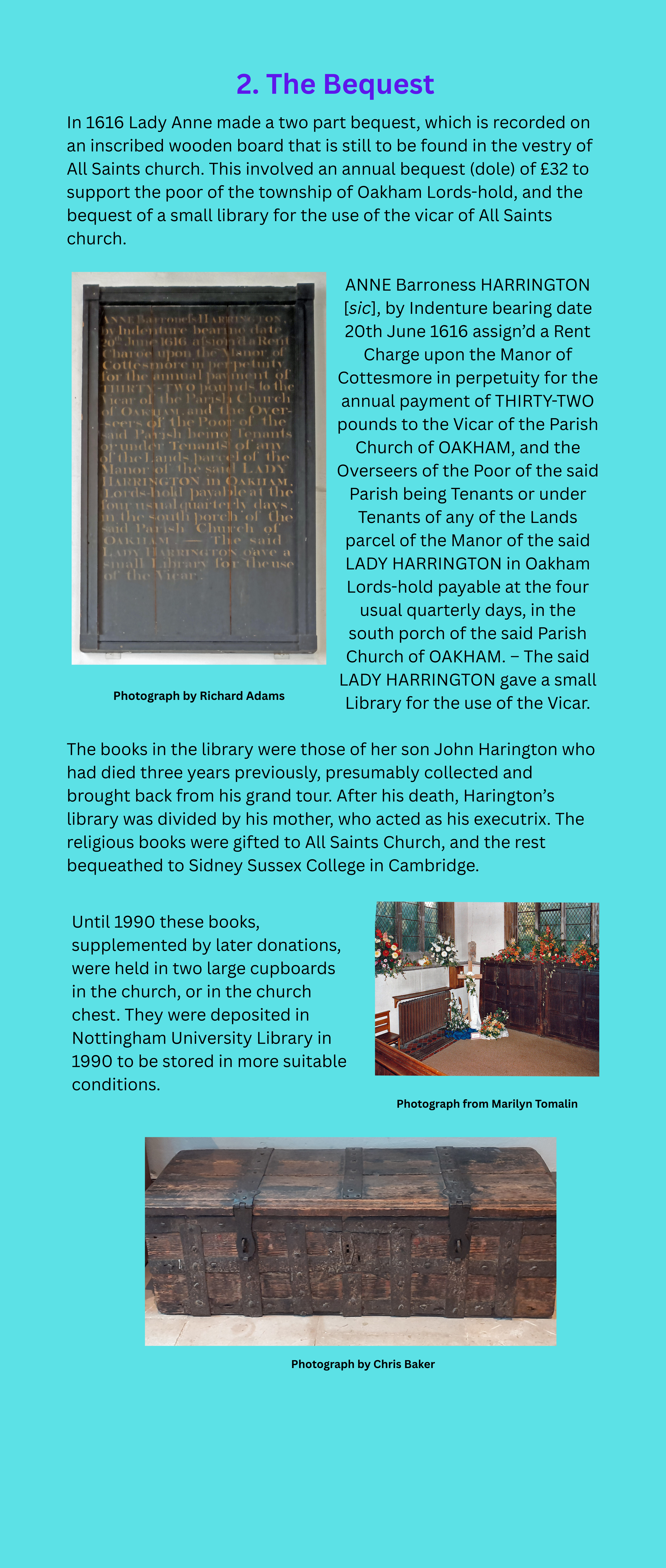
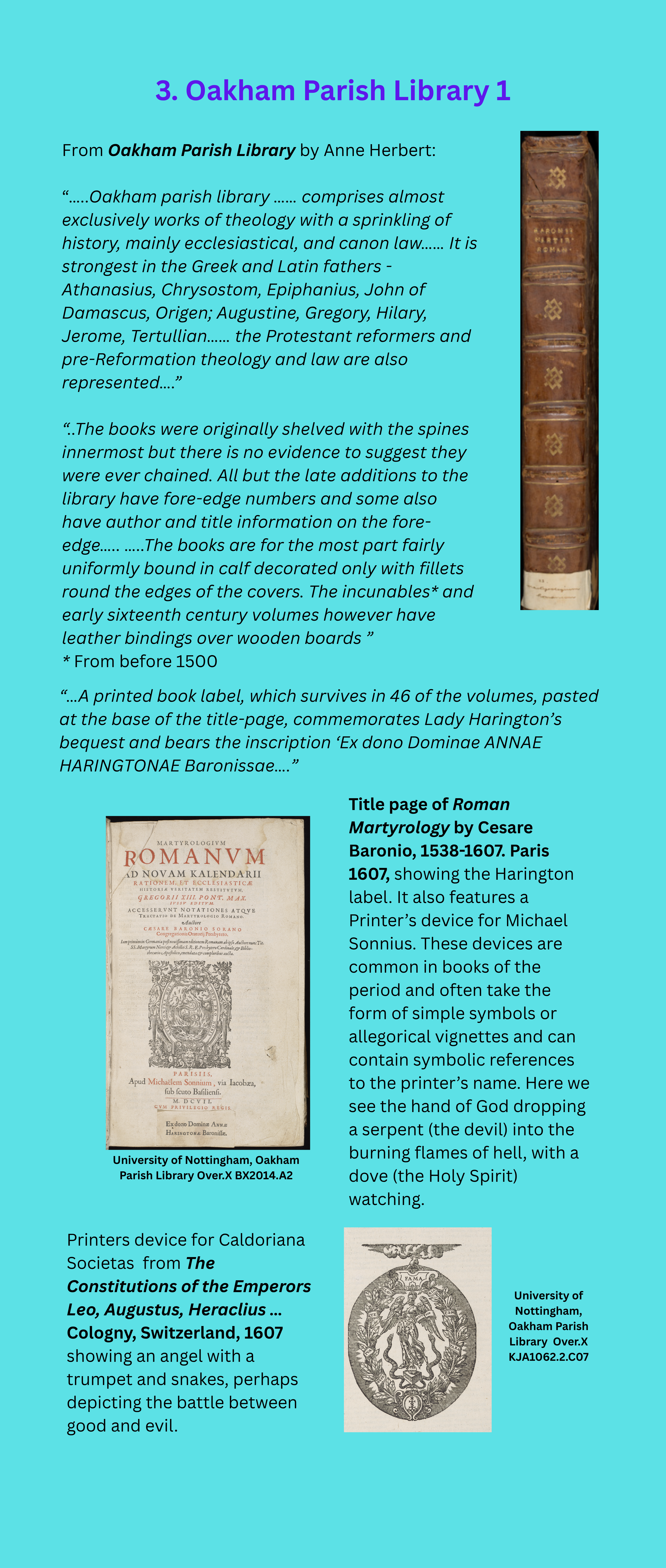
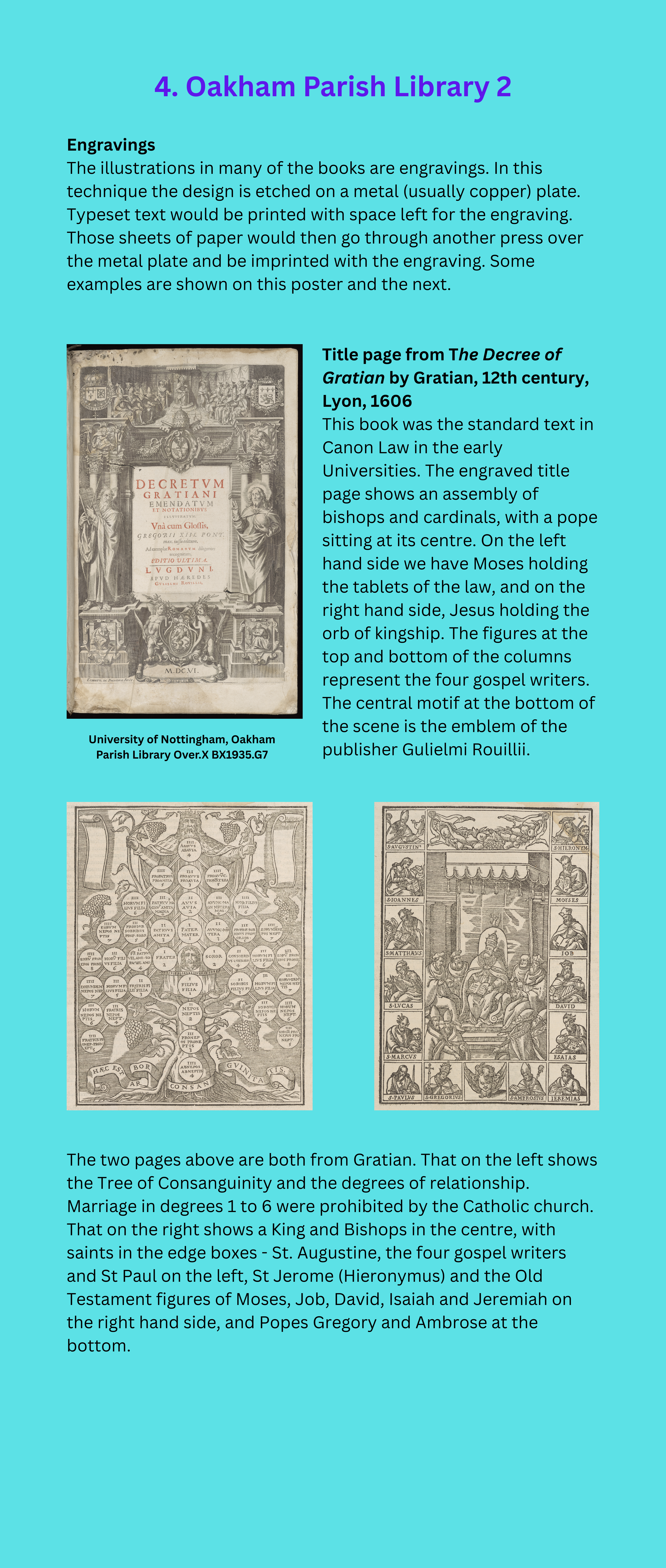
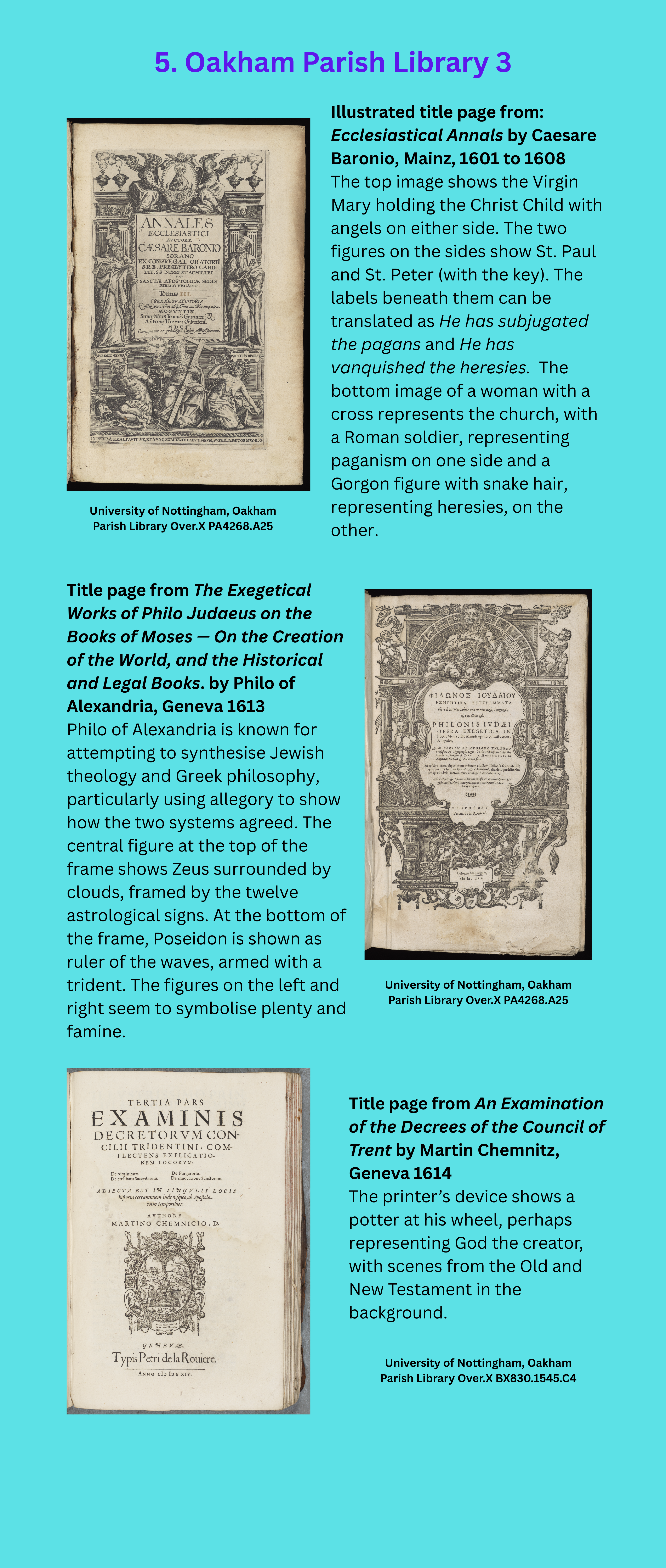
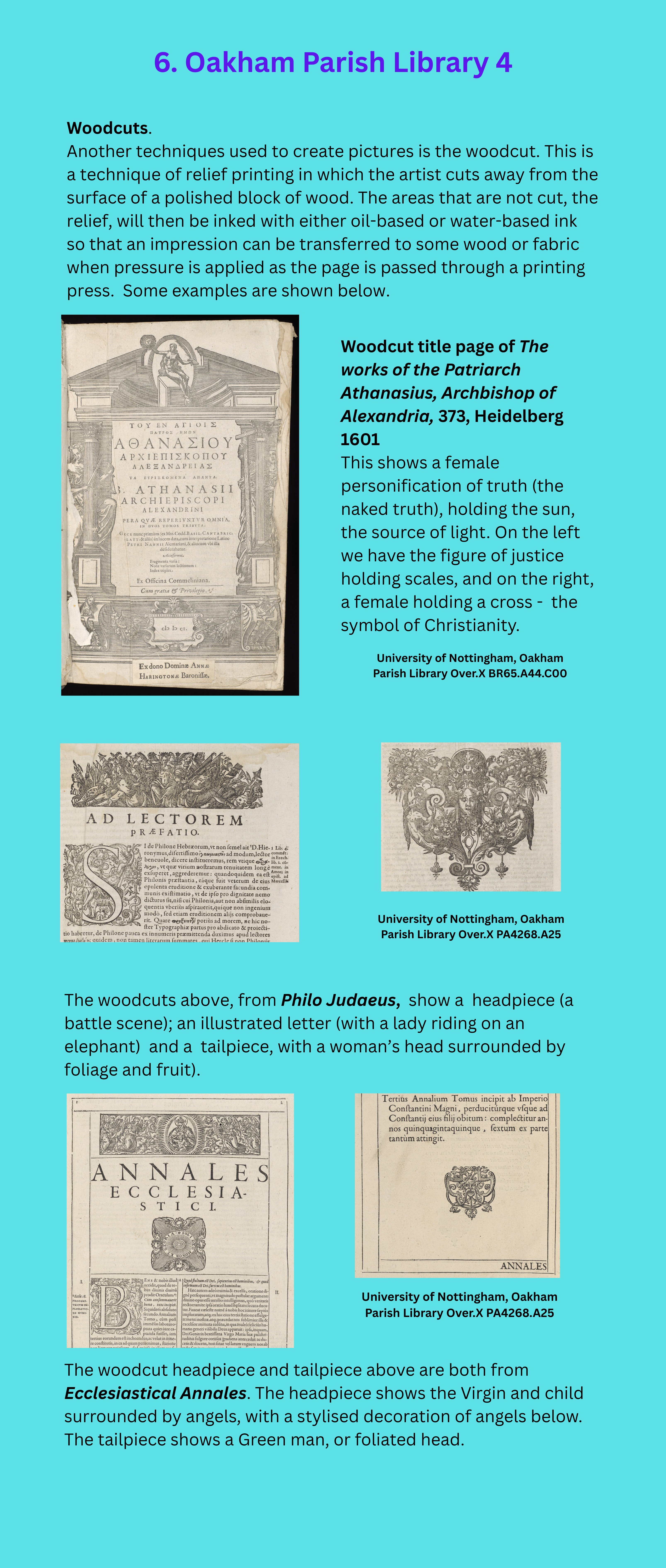
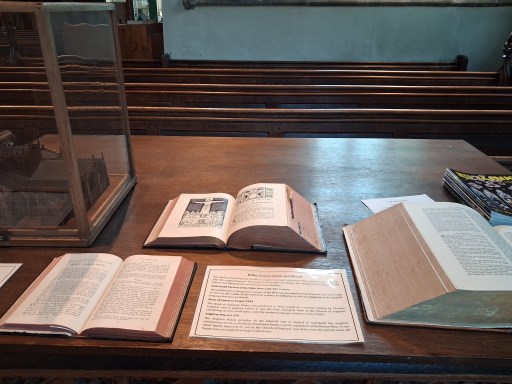
The parish library of Oakham’s All Saints Church began its life earlier than most parish libraries represented here, by over 100 years. In 1616 Lady Anne Harington, widow of John, 1st Baron Harington of Exton in Rutland gave a collection of books to the parish “for the use of the Vicar of that Church, and accommodation of the Neighbouring Clergy”, which I guess includes me. It remained in the church until 1980 when it was deposited at the University of Nottingham’s Manuscripts and Special Collections (2 years before I was appointed as a lecturer in Civil Engineering).
There are 67 titles documented at the time of the deposit whose dates of publication predate 1616, that are thus likely to be part of the Harington bequest. 23 titles of these 67 titles, are definitely part of the bequest because Lady Anne had a label printed with her name as donor and pasted onto the title pages.
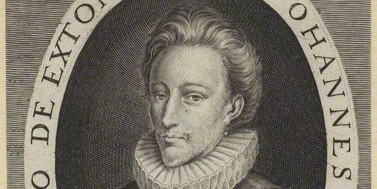
The set of books was put together by Lady Harington’s son John, born in 1592 and a student of Sidney Sussex College in Cambridge. In 1608 he undertook his “Grand Tour” of the Low Countries, Italy and France, and bought books which were distinctly Catholic in their outlook, like the ones on show in the Oakham Parish Library display case, including books of church canons and papal decrees. There are also 16th and 17th century reprints of the work of the church fathers from the early years of the Christian era. This was an odd choice, both for a 16 old young man and for those post reformation times, and one can only speculate on why these were chosen – perhaps some youthful act of rebellion? The books remained by and large unread because John Harington died at the age of 22, of smallpox. His mother was the executrix of his will and she gave his books to Oakham’s All Saints Church and to Sidney Sussex College. The library remained in the church, supplemented by others over the years, mainly bibles and prayer books. I find it remarkable that it survived the commonwealth period when Oakham was a centre of Presbyterianism – and indeed the vicar at that time was displaced by a Presbyterian preacher who thus took ownership of them. In the 1980s, a church guide booklet described them as looking “decidedly unread”. Perhaps, in terms of their survival, being unread was a good thing!
At Nottingham, the books have been catalogued to a high descriptive level and are findable in the online catalogue by researchers everywhere. Locally, they are used for teaching students. The staff at Manuscripts and Special Collections have designed a workshop using the images printed on frontispieces and title pages from the Oakham library and from others. In the last three years over 200 students have completed this workshop as part of their modules in the Schools of History, Liberal Arts and Theology. The books have thus probably received more attention over the last decade or so than they did in their 350 years in All Saints church!
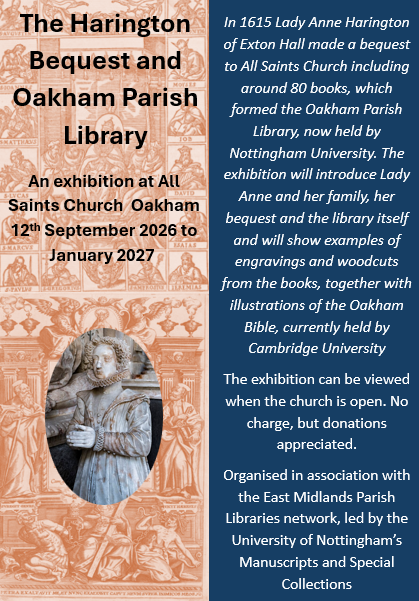
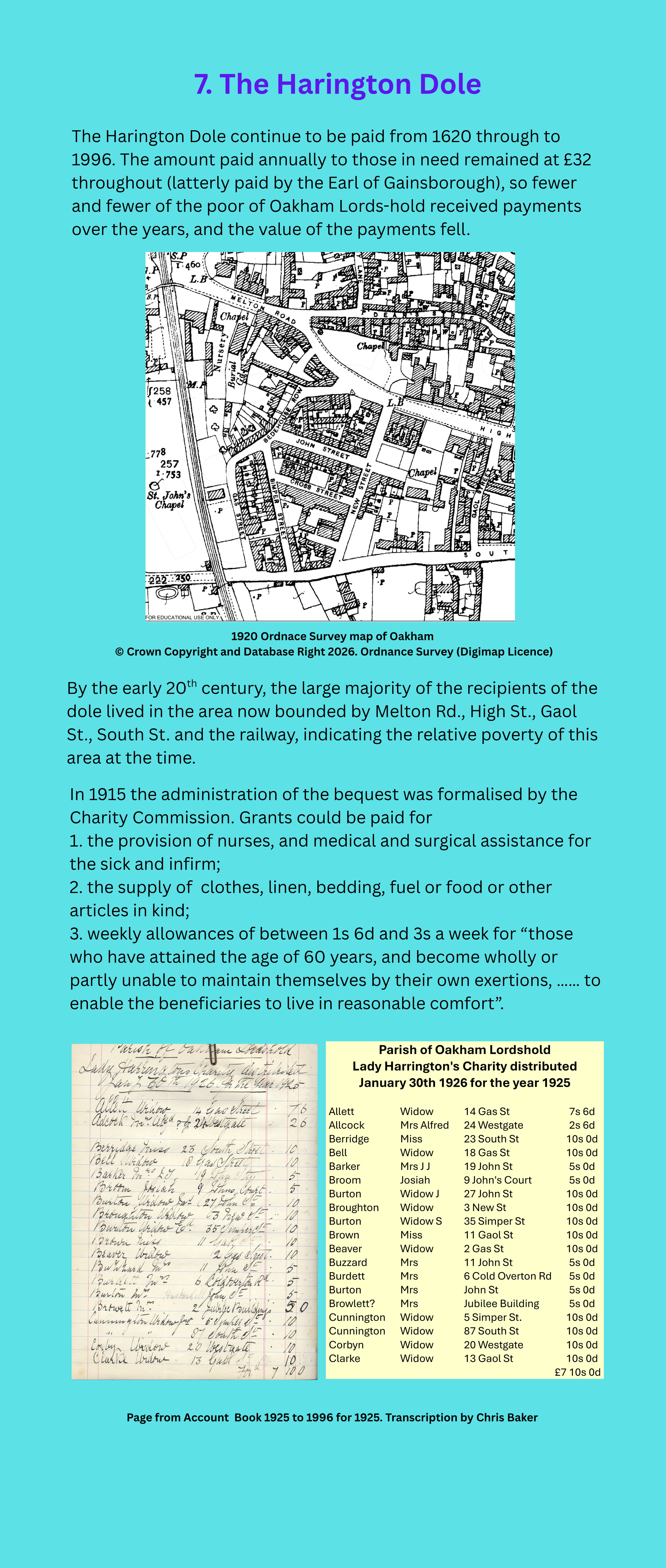
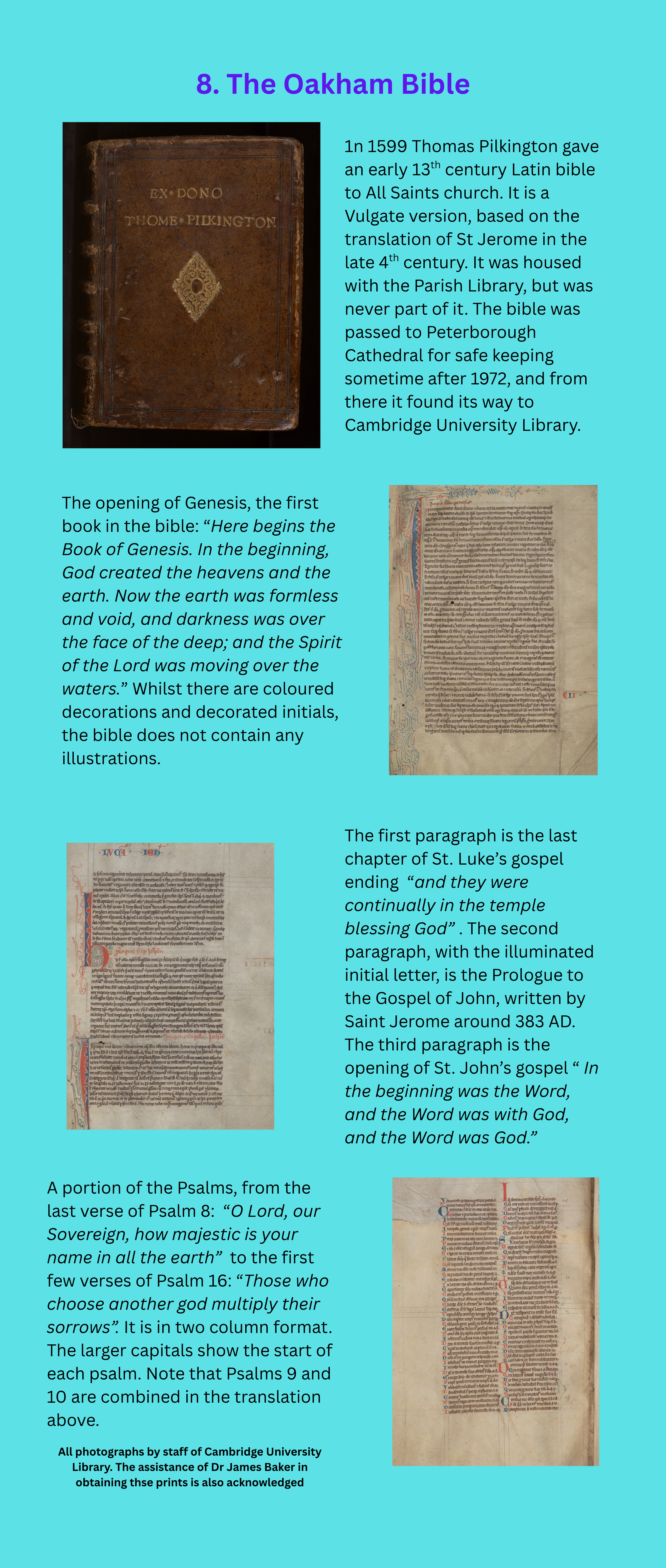
In association with the Parish Library Network, there is currently a small exhibition in All Saints Oakham, featuring the Parish Library, the Harington Dole (a gift of £32 pounds per year made at the same time to support the poor of the town) and the Oakham bible, a thirteenth century bible, owned by the church, but now in the keeping of the UL at Cambridge. There are some fliers for this about – do come over and have a look if you have time.
The Oakham Parish Library books were all printed in the foreign centres of the print revolution in Italy, France and the Low Countries. They are mainly in Latin, with a few in Greek, which of course most educated Europeans would have been able to read. The books thus transcended national and linguistic boundaries. The texts that they included were written over a period of over 1000 years or more in very different cultural contexts. Parish libraries in general, and perhaps the Oakham Parish Library in particular, can be thought of as vehicles for the mind. Whilst being rooted in a time and place they have the ability to take their readers to times and places far beyond their own experience. And so I very much hope that this exhibition will inspire the research community as well as the local communities of the East Midlands, and give us all this wider appreciation of the worlds from which they came.
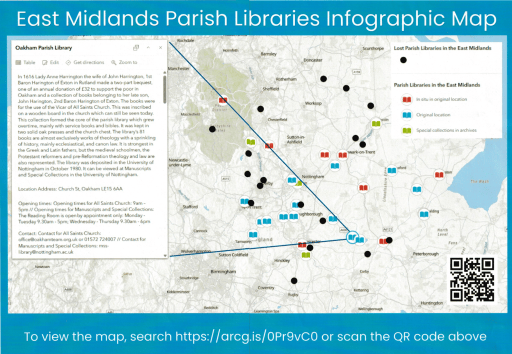
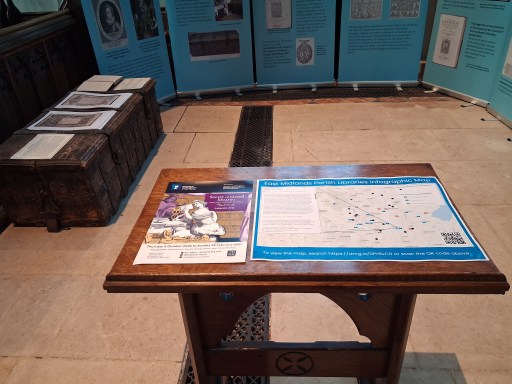
In early 2026, the University of Nottingham Library (Manuscripts and Special Collections) was instrumental in forming the East Midlands Parish Library Network, linking together those institutions who are custodians of a Parish Library, or whose Library is held elsewhere. All Saints Oakham is part of that network, with a Parish Library dating from 1616 that is held at Nottingham University. As a first step in establishing the network, an interactive map of the East Midland libraries has been produced. A screen shot is shown below, that links to the interactive online version.
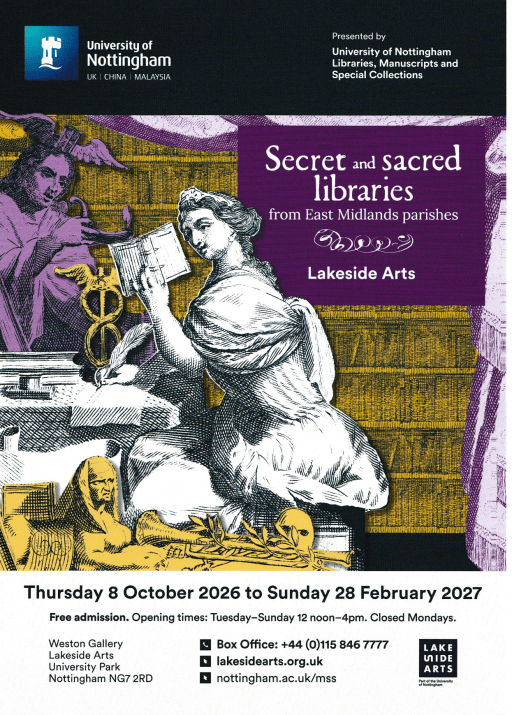
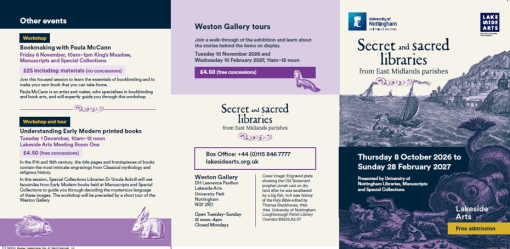
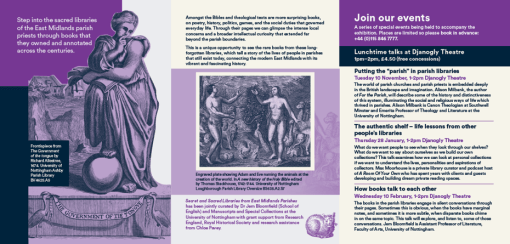
To further mark the opening of the network, an exhibition at the Lakeside Arts Centre was arranged from October 2026 to February 2027, with some associated talks and lectures. The publicity material is given below.
Harington Bequest and Oakham Parish Library Exhibition publicity and handout
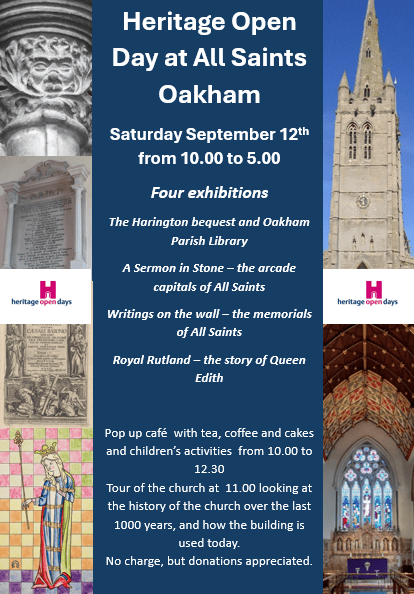
An exhibition to showcase the Oakham Parish Library was held in All Saints church from September to December 2026. It opened on September 12th, which was also a Heritage Open Day. The publicity material for the exhibition and the Open Day is given below.
The exhibition posters and other material
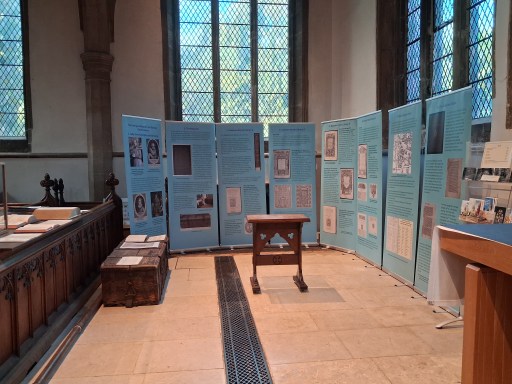
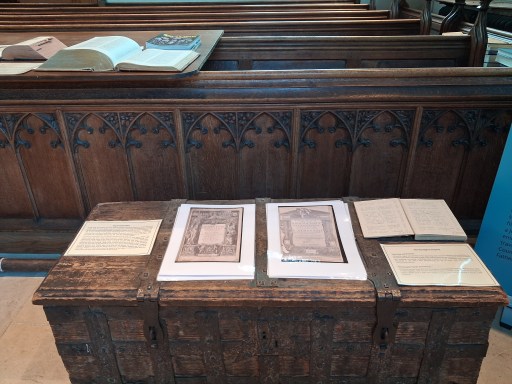
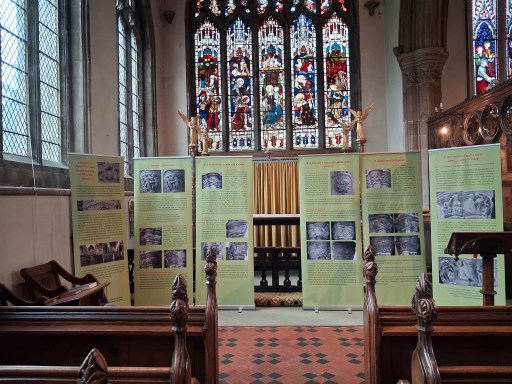
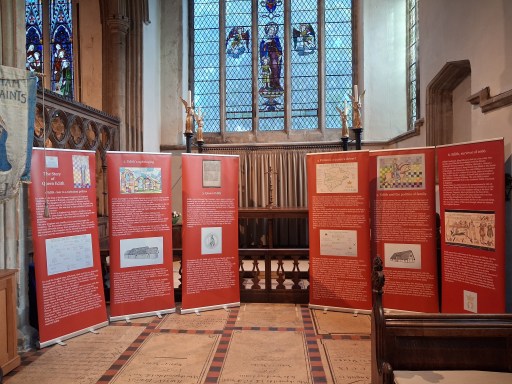
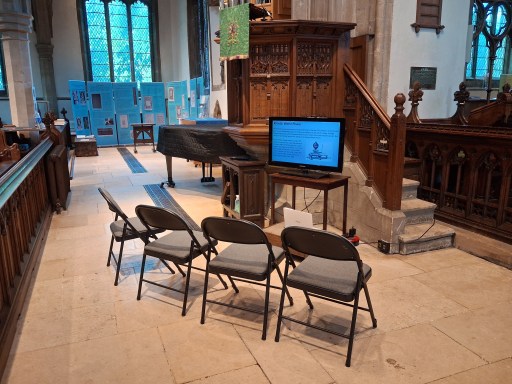
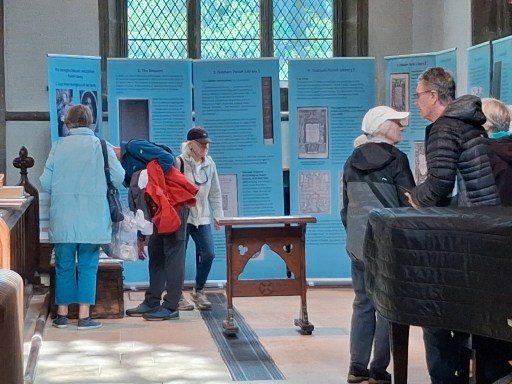
The exhibition itself consisted of eight pull up posters and a number of old bibles and prayer books held by the church that described the Harington bequest, the Oakham Parish Library and the Harington dole. In addition there is a board that features the Oakham Bible – a 13th century bible owned by the church but now in the Cambridge University Library. The record book for the Harington dole was also on show. The pull up posters are shown below. they can be expanded and downloaded if required by clicking on the images.
Photographs
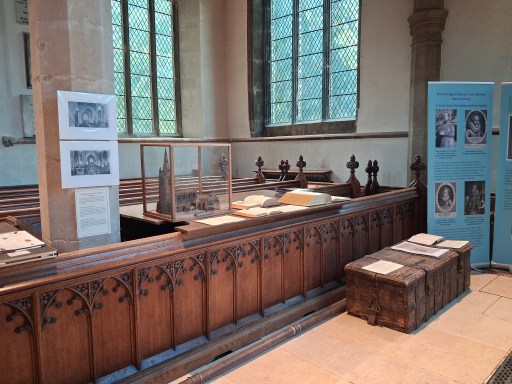
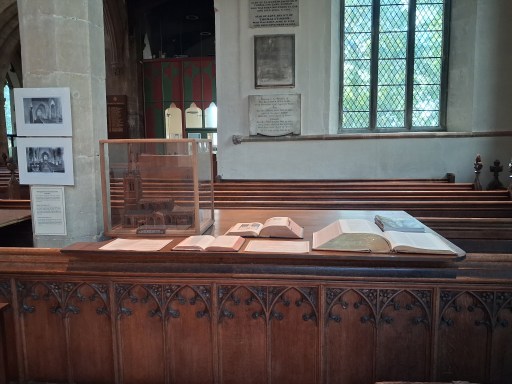
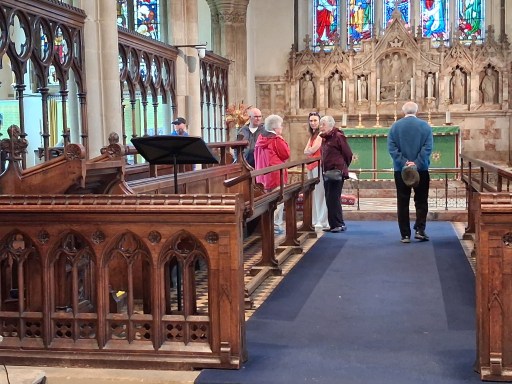
The photographs below show the exhibition itself – the poster boards, a table displaying the Parish Network Map, the Parish chest, where the library was once stored, and a number of old, but relatively modern, prayer books and bibles that were on display on display
The exhibition poster boardsOther exhibitsThe Parish Chest and booksBooks on displayBooks on displayThe Parish Chest, laminated front pieces and the Harington Dole record book
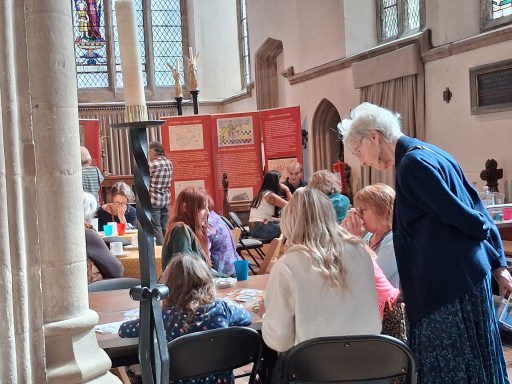
The Sermon in Stone Exhibition in the Trinty chapelThe Queen Edith Exhibition in the Lady ChapelThe Writings on the Wall presentationHeritage Open Day 11/9/26Heritage Open Day 11/9/26Pop Up Cafe 11/9/26
In this blog post I look at three 14th and 15th century wills – two of them are wills from Vicars of Oakham and one from the founder of a major charitable institution in the town. The texts of these wills are taken from
These wills have been used in previous historical investigations of the area, to address specific issues and interests, but do not seem to have been considered elsewhere in their totality. In this short post, we consider these wills, what they can tell us about the individuals involved, and about 14th and 15th century Oakham. The texts of the wills are in the main taken directly from Gibbons although I have modified the punctuation, expanded abbreviations and added full currency descriptions to make the extracts easier to read.
William de Pensax, Vicar 1338 to 1378
WILLIAM PENSAX, vicar of Okham. Monday before Feast of St. James Apostle 1378 To be buried in the Chancel of Okham. Bequest to St Mary’s Chapel in Okham Churchyard ; and to John Belgrave, parish chaplain there. Ellen, daughter of Richard de Pilton. Alice de Langton Katherine daughter of John de Multon. Margaret de Langton. Executors —William fflore and John de Pensax Proved at Lydington, 4 May 1385.
Extract from the Vicar’s board at All Saints Oakham
Little seems to be known about William de Pensax other than his will. John de Pensax, the executor of his will and almost certainly a close relative, has made more impression on the historical record. He was one of Rutland’s parliamentary representative in 1404, 1406, 1413 and 1421 and Sherrif from1400-8 and 1419-1420. and seems to have had Lancastrian sympathies. One can probably assume that William was of the same political persuasion.
The will itself is the briefest of the three presented here and gives a short list of beneficiaries. It would seem that it was written close to William’s death on July 19th 1378 – the Feast of St James is on July 25th. There was and interval of 6 years until it was proved, possibly indicating that it was in some fashion controversial. Of interest is his request for burial under the chancel of the church, but if there was ever any memorial, it was lost either in the chancel rebuilding of the fifteenth century or during the Reformation, He also made a bequest to the Guild Chapel of St. Mary and the chaplain there. This was situated in the churchyard, roughly at the site of the current Old School building. More mention will be made of this and other guilds below. No details of the scale of the bequests is given, so presumably these were recorded in some other way or Gibbons chose not to record them.
As an aside, Pensax, presumably William’s ancestral home, is a small village to the south west of Kidderminster. On the Parish Council web site we read the following.
The name Pensax is a combination of the Celtic words “pen” (hilltop) and “sais” (Englishman, Saxon). Unlike many English place names with Celtic elements, the modifier follows the basic noun, as is customary in Celtic languages. This indicates that Brittonic speakers coined the name, rather than Old English speakers borrowing a Brittonic element
William Dalby, founder of the Hospital of St. John and St. Anne, 1398
WILLIAM DALBY, of Okham. Dated there, 8 October 1404 To be buried in All Saints’ Church, Okham. Thomas Man, vicar of Exston. To Thomas Smyth formerly dwelling in Exston, a noble. John Sapcote 20 pounds William Lytell 10 pounds William Luffeld 20 pounds William Lesyngham 10 marks Anne Wyttilbury 100 shillings. My servants Thomas, Bernard Osbern, and Margaret Osbern. John Eltham my apprentice. Isabell Aldewyn. William, William and Hugh, sons of Richard Sapcote. My wife’s sister Johan. Roger fflore, and his children, William, John, Robert, Agnes, Elizabeth, and Johan. John clerk of Wyssenden. My daughter Johan 20 pounds. John and Elizabeth children of William Grene. My brother John and his children. To Simon master of the Hospital 10 pounds; to Thomas Heremyte and Johan Godewyn of the Hospital 3 pounds each, and to10 other poor persons of the Hospital 10 pounds. Guilds of S. Trinity of Tylton, Corpus Christi of Leycester, the Great Guild of Coventry, and S. Trinity, S. Mary, and S. Michael of Okham. Abbeys of Osolueston and de Lauda. Agnes my wife 50 pounds. Executors :—Roger fflore, John clerk of Wyssenden, and John Skynner chaplain. Proved at Lincoln, 14 June 1405.
William Dalby, a wealthy wool merchant of the staple of Calais, is best know for founding The hospital of St. John Evangelist and St. Anne in 1398, to support twelve poor men, under the charge of two chaplains. The advowson of the hospital was to be in the hands of the prior and convent of St. Anne’s, Coventry. William Dalby granted an estate worth £40 a year for the foundation, and a little later paid 577 marks to the prior and convent of St. Anne’s to increase the endowment.
The will itself again seems to have been written just before William’s death and was proved soon afterwards. Unlike that of William de Pensax it gives details of some, but not all, of the bequests, These are for varying amounts up to £50. Depending on how one does the calculation this represents somewhere between £40,000 and several million pounds in today’s terms. There were generous gifts to the Hospital Master and to its inmates. Amongst the beneficiaries are the abbeys at Laund and the nearby Owston Abbey, just over the Rutland border in Leicestershire. Guilds again get a mention with bequests to the guild of the Holy Trinity at Tilton (oddly named as St Trinity), the guild of Corpus Christie in Leicester, the great guild at Coventry and the guilds of the Holy Trinty, St Mary and St Michael in Oakham. At Oakham the guild of the Trinity was probably based in the current Trinity chapel at All Saints, and the guilds of St Mary and St Michael at chapels in the churchyard. That of St Mary may have also been associated later with the Lady Chapel at All Saints, although that does not seem to have been in existence till around 1480.
Robert Stoneham Vicar 1397 to 1409
ROBERT STONHAM, vicar of Okham. Not dated, Ego, Xpianus in fide firmus &c. Corpus meum sepeliendum et post diem judicii cum anipia glorificandum &c. (I, a Christian firm in the faith, etc. [I desire] my body to be buried and, after the Day of Judgment, to be glorified together with the soul, etc) 18 poor people of Okham and 6 of Lydington to be clothed, tam ad corpus quam ad lectum (as much to the body as to the bed.) To Okham church various plate, librum rubeum decretorum, librum decretalium, librum bonum ligatum pupiUe oculi cum constitutionibus in eodem contentis. (The red book of decrees, the book of decretals, and a well-bound book—the apple of my eye— containing the constitutions within it.) Chapels of Langham, Egilton, Caldecote, and Brook, 6 shillings each for 3 chalices. Lidyngton church, 100 shillings for a silver cross. Merton Hall, Oxford, 20 pounds for a silver cross and candelabra ; also my books not otherwise bequeathed, to be kept in the College Library. To the Church and Bishop of ‘Carlisle the Bible which I had of gift of Thomas late Bishop of Carlisle. To Master Henry Abyngdon, my portiforium (breviary) To Deacon William Baxter my manuale &c. (handbook?) Deacon Thomas Gauter. John Bower. Richard Brook my clerk. Bequests to William Carter, principalis meus famulus (my chief servant), and other servants; also, illis meis servientibus qui non recedent sed pro tempore quo ero extra Angliam fidelicer manebunt ad reventum meum. (to those servants of mine who will not leave, but will remain faithfully until my return for the time I am away from England.) My sister, a nun ; and my sister Isabella. To my Lord of Lincoln zonam meam viridem deauratam. (my green, gold-trimmed belt.) Item domine Comitesse de Cancia de Brunne gobeletum deauratum. (Item, for the Countess of Kent, of Bourne, a gilded goblet.) Deacon Robert Croxton of Lincoln. All my tenements in the city of London to my brother Edmund and my sister Isabella, they procuring masses (either alone or by turns with the heirs of John Basse) for the souls of my mother, of Lucia atte Stone, and of John Basse. My sister Alice. To Master Henry Abyngdon my quat’num novum preciosum qui incipit ‘In nomine patris et filii et spiritus et alium quat’num preciosum et secretum Gebar s^ patris in nibio papiro ubi fit mentio de omnibus libris meis quam aliorum (quia habeo multos Ubros qui non sunt mei et volo quod quUibet habeat quod suum est). (A new, valuable quire beginning “In the name of the Father and of the Son and of the Spirit,” and another valuable and private quire of Father Gebar on fine paper, in which mention is made of all my books as well as those of others (for I have many books that do not belong to me, and I wish for everyone to have what is their own). To Richard Curteys, Tabulam de Eborer cipresso cum stilo argenteo. (A writing tablet of ivory and cypress wood with a silver stylus.) Item Master Henrious habebit meum Annys de Crysty Gray (Master Henry shall have my Agnes de Crysty Gray.). Item Baxter meum Mens suppellic’. (My Baxter’s furniture). Item ecclesia de Okham totum meum velym pro antiphonarijs et libris. (To the church of Okham, my entire stock of wool for antiphonaries and books.) Item Corrector de Aischeruge habebit certum librum in quat’nis xuj quos mihi dedit qui incipit ‘ ffrat’ p’ dil’ce.’ (The corrector of Aischeruge shall have the specific book in sixteen quires which he gave to me, beginning “Frater praedilecte.”) Executors :—My brother Edmund, and William Baxter chaplain. Supervisors :—The Bishop of Lincoln, and Roger flflore. Proved at Sleford, 15 Jan. 1409.
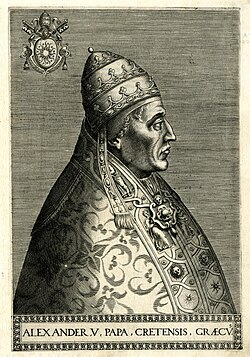
Robert Stoneham was probably born in the 1350s or 1360s. He was a fellow of Merton College Oxford from 1384 to 1397, when he was appointed Vicar of Oakham. At some stage he was appointed a Canon of Lincoln Cathedral. He clearly rose through the church hierarchy and by 1409 was a member of the Papal Court at Pisa. He was taken ill in that year and remained in Pisa, where he died, when Pope Alexander V (an antipope, elected in 1409 at the Council of Pisa) transferred his court from Pisa to Pistoia.
Stoneham’s will is the longest of the three presented here, and is partly in Latin. The Latin phrases have been translated (using Google Translate – such is my ability in the language) and the translations are shown in italics. The will lists a large number of bequests, and in particular specifies the destination of what seems to have been a very considerable library. His servants and family seem to have been well provided for. His bequest of a silver cross and books to Merton College is noted in the College archives. Despite the fact that his career took him away from Oakham, for what were probably considerable periods, he clearly retained an interest there, and made a bequest to clothe 18 poor people from the town (and 6 in Lyddington). He also donated books to the church, including what seems to have been his favourite.
The red book of decrees, the book of decretals, and a well-bound book—the apple of my eye— containing the constitutions within it.
He also donated a stock of wool to the church, seemingly for the purpose of buying books.
To the church of Okham, my entire stock of wool for antiphonaries and books.
A bibliophile indeed. In the light of the current (September 2026) exhibition of the Oakham Parish Library in All Saints church, from 1616, it is of interest to see that books, and material with which to purchae books, were being donated to All Saints two centuries before that.
The traditional Catholic / Anglo-Catholic liturgy for Holy Week and Easter is both powerful and deeply moving. It is built around four services – the liturgy of Palm Sunday, the washing of the feet and institution of holy Communion on Maundy Thursday, the liturgy of the Crucifixion on good Friday and the Service of Light and Holy Communion on Easter Day. It has a well established form that has been shaped by 2000 years of history and, some might say, should not be changed or modified to any degree.
Whilst I personally always find the sequence of service uplifting and thought provoking, I have to admit that there are aspects that I find distracting and unsatisfactory. The entire passion gospel is read twice – on Palm Sunday and Good Friday, and this seems to me to have two downsides. Firstly the unfolding series of events in Holy Week is somewhat obscured using this approach, and secondly this limits the time for serious preaching on the passion narrative at these two services. The on Easter Day, the traditional order places the reading of the resurrection gospel a long way into the service, which has always struck me as off, as to my mind, this belongs right at the start.
Now in 2026, I was, for the first time in my ministerial career, able to craft the Holy Week services to reflect my own views. This is a task normally undertaken by any incumbent, but as we don’t currently have one I was able to take advantage. This post contains the liturgical material that was put together for that week, that I offer here perhaps as a model that others might use. It is not terribly radical – the main innovation being that it is based around the reading of the Passion narrative from the gospel for the year (Matthew in this case) throughout Holy Week, and its use of both online and face-to-face services to enable as many as possible to take some part in the celebration.
The setting
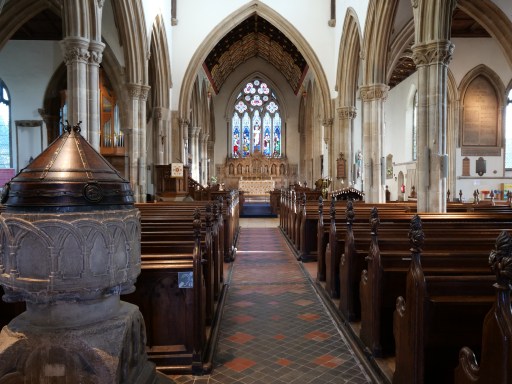
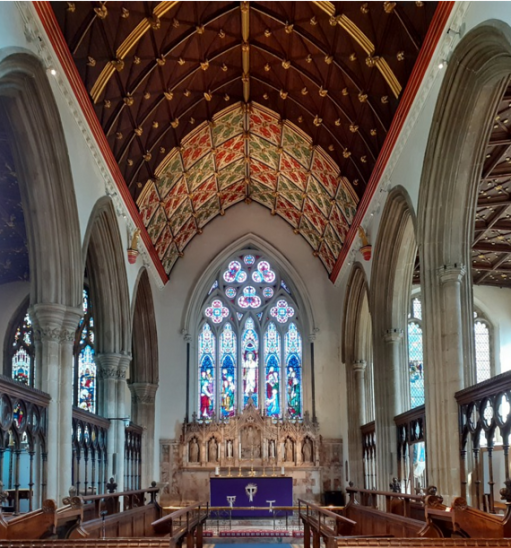
There were two settings for the Holy Week liturgy presented here – one physical and one virtual. The physical one is of course All Saints itself. this is a large, high church, with nave, nave aisles, transepts, chancel and chancel chapels, The nave and transepts are, in the main, filled with pews, which limits the amount of liturgical movement, but the aisles offer room for processions, and some pews have been removed at the front of the nave, which allows for a nave altar to be used on most Sundays. The chancel, normally used for the choir, offers a different and more intimate worship space for small congregations. The Eucharist is celebrated at the high altar at the east end on festivals. Even when a nave altar is used, communion is usually received at the communion rails at the high altar. The chapel to the north side of the chancel (dedicated to the Holy Trinity) is used for small worship services and, as we will see below, is used as the Chapel of the Watch in Holy Week.
The virtual context is the streaming of services via Facebook, which has been used since the Covid lockdown. The audience for streamed Sunday services can be significant, but there is also a regular audience for streamed morning prayer services on three days a week.
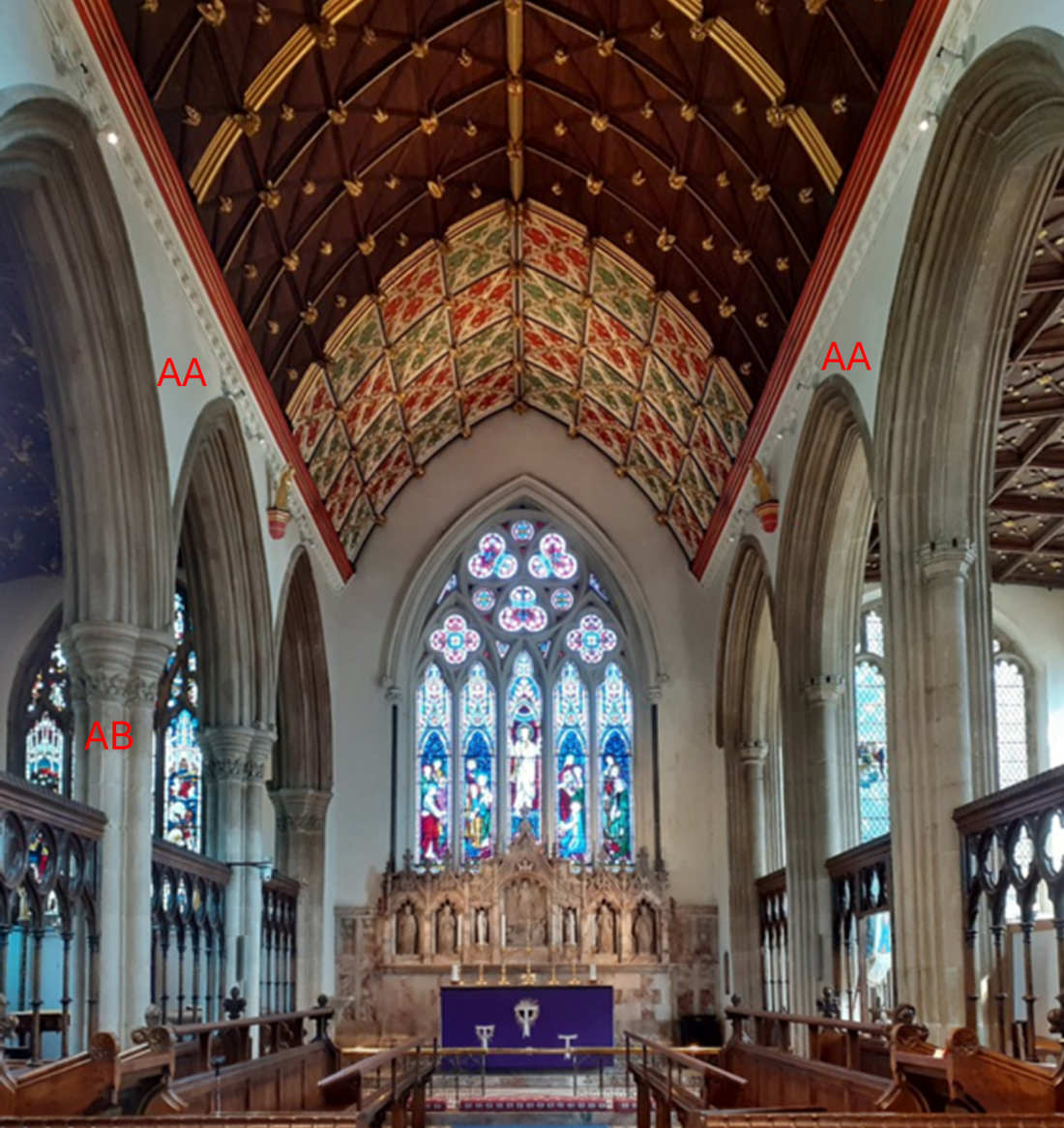
Nave viewed from west endChancel viewed from steps to nave
Principles
My objectives in developing the Easter and Holy Week services for 2026 were as follows.
To broadly follow the traditional form, but to improve its consistency in the context of the congregations and facilities at All Saints Oakham.
To read through the Passion account for the set gospel of the year (Matthew), allowing space for sermons to be preached on most aspect of the story.
To allow members of the congregation to follow the liturgy to as great an extent as they could individually manage, through the provision of a pattern for readings, and streaming and face to face services.
A booklet of readings was available for collection in church from Passion Sunday onwards and was also posted on line. The gospel readings basically followed the account in Matthew 21 and 26 to 28 from Palm Sunday onwards, although a precise chronological framework is not of course possible. Appropriate Old Testament readings were also provided.
Palm Sunday
The service began with the reading of the gospel and the palm procession from the south door to the west door. The story of Jesus in the temple was then read, a sermon preached and the eucharist followed in the normal way. The service featured full ceremonial – formal processions with incense and anthems.
From Monday to Wednesday, Morning Prayer was streamed on Facebook using the normal online form from Common Worship Daily Prayer. The Old Testament readings were taken from Lamentations in a traditional pattern. Compline was said in the chancel of church every evening, with a short address and suitable recorded music. At both Morning Prayer and Compline each day the same New Testament reading from Matthew was used was used.
Maundy Thursday
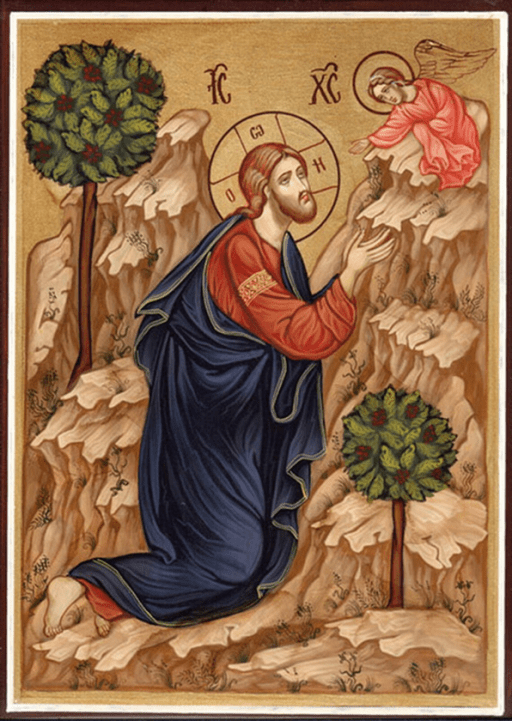
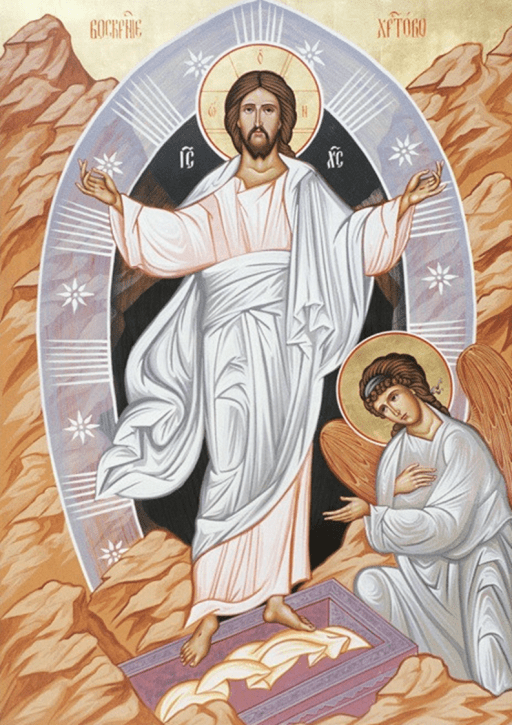
Morning Prayer was again streamed over Facebook, with a reading from Lamentations and a short reading from Matthew. The main Maundy Thursday service in the evening was held in the body of church. The first part of the service was focussed on the events of the Last Supper as recorded by John (the only non-Matthean reading of the week), leading into a sermon and the foot / hand washing. The service then moved on to the institution of Holy Communion and the celebration of the Eucharist itself. The icon shown below was brought to the altar with the bread and the wine. After the Eucharist, the altar was stripped and the consecrated bread and wine taken to the Holy Trinity chapel. The gospel account of Gethsemane was read before the congregation departed, with some moving to the Trinity chapel for a short Watch.
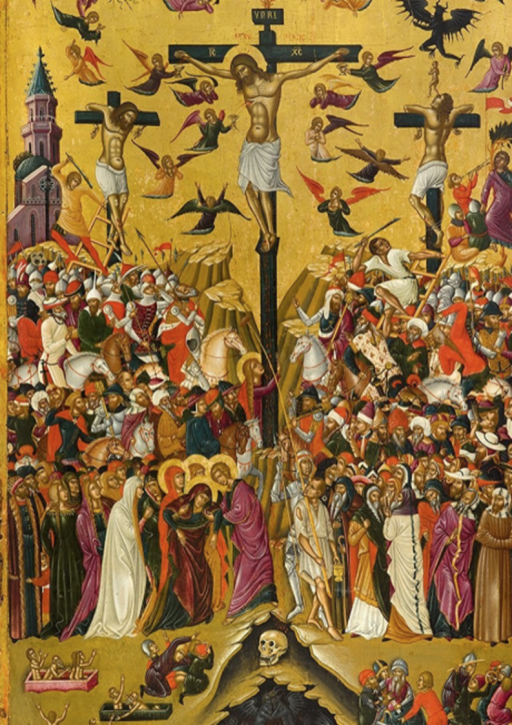
Morning Prayer was said in the Chapel of St John and St Anne, with the reading of the accounts of the trials of Jesus. A sermon was delivered. the formal Good Friday liturgy followed at noon. This began with the account of the crucifixion, followed by a sermon and the proclamation of the cross with the usual devotions. The icon below as placed in front of the cross. The formal Good Friday intercessions were then used, and then the account of the death of Jesus was read, with last year’s Easter candle being established. Communion was administered using the consecrated bread and wine from the evening before. In the evening, Compline was streamed on Facebook, and focussed on the burial of Jesus.
The readings for the Vigil were provided in a separate booklet and posted online, and their reading was streamed on Facebook on Holy Saturday evening, on the basis that some of the congregation would like to mark the vigil, but could not attend the Easter Dawn liturgy.
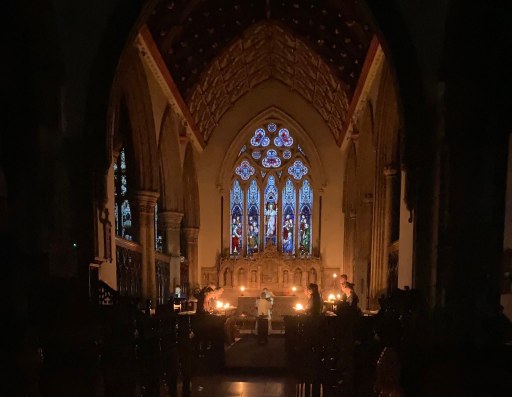
The dawn service (at 5.30am) began in near darkness at the back of church with the Vigil readings. The congregation then gathered around a brazier outside the south door where the Paschal candle was lit, from which all lit their own candles. The candle was then taken into church with the congregation following to the chancel, where all the altar lights were lit whilst the Exsultet was sung. The icon below was placed in front of the altar. The Easter gospel was then read, and the Easter greeting proclaimed and hymns were sung. The renewal of baptismal vows, with sprinkling of blessed water and the Eucharist then followed.
A straightforward traditional language Eucharist was celebrated at 8.00, supplemented on this occasion by hymns. The main Easter Eucharist was celebrated at 10.30 on Easter morning – a choral service with full ceremonial. The liturgy was straightforward beginning with the reading of the Easter Gospel from Matthew and included the renewal of baptismal vows as at the early service, and also, for those who wished, the anointing with oil at the communion rail for healing for themselves or those on their hearts. The icon above was again used as a focus for those receiving communion.
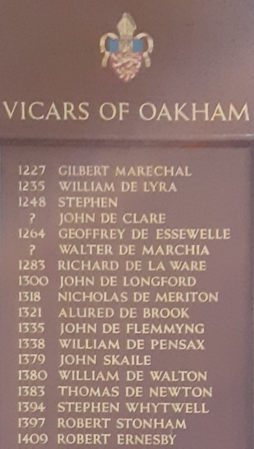
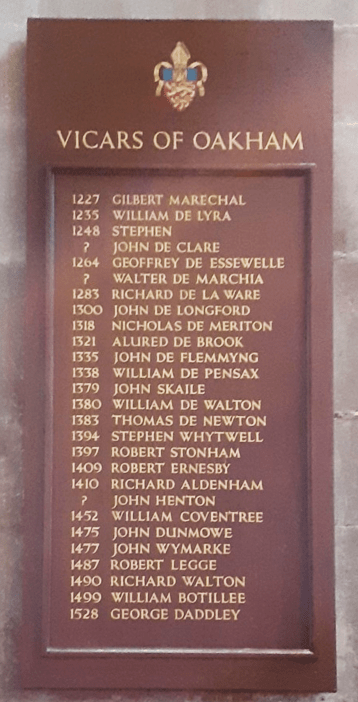
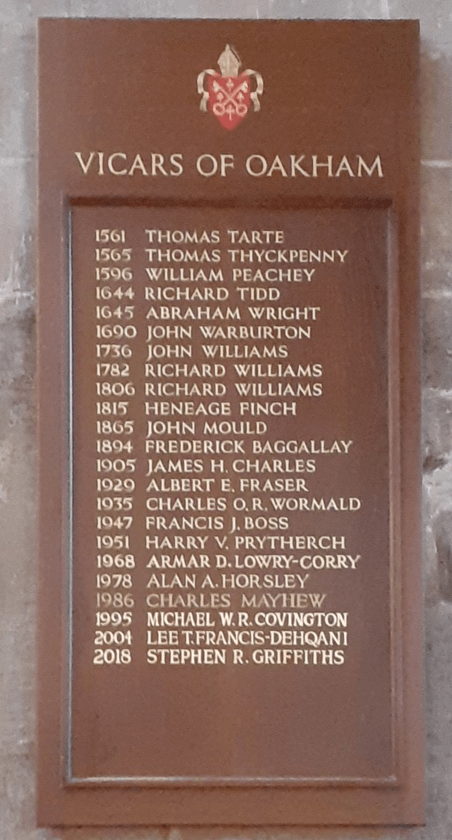
Two large inscribed boards at the west end of All Saints church list the vicars of the church from 1227 to the present day (figure 1). This list matches those found in church guides written over the last 100 years and date back to the primary research found in a 1903 article in the Rutland County Magazine and Historical Record of 1905. Whist this list is quite comprehensive, a more detailed resource is now available – the The Clergy of the Church of England Database 1540-1835 (CCEd) which contains information from a wider variety of sources than were available in 1905. In this post we look at the information that can be obtained from this database about the life and times of Vicars of Oakham for the period 1540-1835 – roughly corresponding to the top half of the second board in figure 1.
Figure 1. The Vicar boards at All Saints Church
The database listing
A listing of the Vicars of Oakham from the database is given in Table 1 below. The table gives the names and the year and type of the event recorded. The hyperlinks on the names link to the information held in the database of the career that particular person, both at Oakham and elsewhere, and the hyperlinks in the “View” column link to details of the particular event recorded. The types of event are as follows.
Appt (Admission) – Definition not clear
Appt (Collation) – Candidate appointed by the Bishop as Patron, combining presentation and institution
Appt (Institution) – Appointment of the candidate to the living by the Bishop
Appt (Licensing) – Appointed with a Bishop’s license
Appt (Presentation) – Patron presents the candidate to the Bishop
Disp (Dispensation) – Some variation of normal practice
LibC – Liber Cleri – Name found in Visitation records
Not only does the database list the Vicars of Oakham, but also those who were curates or licensed preachers, and these are shown in Table 2. The intermittent nature of this listing suggests that this list is far from complete. Indeed the database also lists curates in the associated parishes of Egleton, Barleythorpe, Langham and other chapels, who were probably under the oversight of the vicar of Oakham.
In what follows we delve deeper into the database to learn more about the clergy named in the above tables.
Reformation, counter Reformation and the Elizabethan settlement (1540 -1596)
Henry VIII died in 1547, and was succeeded by his son Edward VI (1547-1553). In his reign the Protestant Reformation took hold, with the publication of the 1549 Prayer book in English. The situation rapidly changed when his sister Mary (1553 to 1558) came to the throne, with the Catholic Counter Reformation. This period was a time of turmoil for the church, with loyalties tested amid persecution and martyrdom. The situation stabilised when Elizabeth I came to the throne, with a return to Protestantism, but acceptance, if not approval of catholic worship as long as it was carried out discretely.
George Daddley, who appears on the board for 1528, does not appear in the database, presumably because all the information about him precedes 1540, the start date for the database. The first vicar recorded in the database after that date is William (Willimus) Archebolde who resigned in 1561. He was Vicar of Blakeskey from 1551 and presumably resigned at some time after that to take up the position at Oakham. He was also Vicar of Bugbrooke from 1560 to1561 and Vicar of Kislingbury 1559-1568. How he fared in the reigns of Edward and Mary is unknown – but he at least survived to the reign of Elizabeth. He was succeeded at Oakham by Thomas Tarte in 1561. Tarte presumably resigned after two or three years and was succeeded by John (Johannes) Bartlett (again not on the board) who himself resigned in 1565. This rapid turnover of clergy then came to an end with the appointment of Thomas Thyckpennye, who had been a curate at North Luffenham from 1562, who remained in post until 1596.
The Stuarts, the Civil War and the Restoration (1596-1691)
Over the course of the seventeenth century, the stability achieved under Elizabeth was to be lost under the Stuart Monarchs and during the Civil War and the Commonwealth. Again, this would result in far reaching disruption to he life of the church, with conflict between the episcopal Church of England and the Presbyterian parliament. However for the first 40 years of the century there was a sense of stability, with only one, long serving vicar, William Peachie. His career is well documented in the database.
Father Thomas and born in Essex,
Matriculated as a Pensioner at St John’s, Cambridge , Michaelmas 1582
B.A. 1586-7; M.A. 1590; B.D. 1597. Fellow, 1590
Ordained Deacon and Priest on the same day in 1591
Vicar of Exton, Rutland, 1592-6.
Vicar of Oakham, 1596-1643
Father Thomas buried at Oakham in 1602
Rector of Burrough-on-the-Hill, Leics., 1628-43.
Died Oct. 6, 1643, aged 78. M.I. at Oakham.
Father of Josias (1617), John (1620) and Samuel (1614).
Early in his incumbency, a report of a Visitation suggest the church was in poor repair.
The seats on the south aisle are all broken in the bottom and neither paved nor boarded. Pavement in the east and north aisles broken. The chancel and the chapel on the north side neither plastered nor whited…Two bell wheels broken but being mended. The communion table unfit. The linen cloths very old. The north door in decay
Subtus jacet Venerab. Vir Guil. Peachie S.T.B. quondam Coll. D. Joh. Cant. Soc. nuper bujus EcclesiaVic. Morum innocentia satis laudatus, in arte concionandi Versatiss. Quator Trium, Insignum Theologor, Pater Soror Qui OJob. 6. Non tam morbo confectus, quam vivendi tedio lassatus, placide expiravit. Dom. 1643. Etat. 78. Residentia, 47. Noli vexare Quiescit.
The gravestone no longer exists. The English Translation is as follows.
Beneath lies the Venerable. Rev William Peachie S.T.B. formerly of the College of St John, Cambridge. Recently the Vicar of the Church. His innocence of morals is highly praised, he is skilled in the art of preaching. Four Three, Insignia Theologian, Father Sister Job 6 Not so much worn out by illness, as worn out by the tedium of life, he expired peacefully. Died 1643 Age 78 Residence 47 Don’t bother him. He’s resting.
Peachie thus survived through the reigns of James I and Charles I, but by the time of his death, the Civil War was underway and the relative peace of the first half of the century shattered. In this context one can perhaps appreciate the world weariness expressed in the inscription. It may also be that Peachie would have been required to sign the Solemn League and Covenant – a Presbyterian document of 1643 to which all those appointed to livings were required to subscribe. There are other indications in the record that his tenure was not wholly without incident. The records indicate that in 1609 John (Johannes) Green was presented to be Vicar of Oakham by the Patron, King James. No further details are known, and this may simply be a mistake in the original record or the transcription to the database. But it might indicate some sort of conflict over the living. Then in 1612, Nathaniel Gooch was licensed as a Preacher in the parish, having been ordained deacon and priest in 1607. What this role was in relation to Peachie is unknown, and Gooch is next found in the record as being appointed Vicar of Twyford in Leicestershire in 1630. Neither Green or Gooch are on the Vicar’s board. Further to these appointments, in 1639 James Chamberlin was appointed curate of the Parish and Preacher throughout the Diocese of Peterborough. He had been a curate and preacher at Kirkby Mallory, Earl Shilton Chapel from 1633. Again what his role was in relation to Peachie’s is not clear. The record shows him again at Kirkby Mallory, Earl Shilton chapel in 1662 after the Restoration. Again, as a curate he does not appear on the Vicar’s board.
We have little information on the next vicar other than his name – Richard Tydd, who was appointed in 1644, by when the conflict between Bishops and Presbyterians for control of the church was underway. His incumbency only lasted a year and it might be that he too was required to sign the covenant, but refused to do so. The next incumbent was one of the most consequential of the period under study – Abraham Wright. Details of his career can be found on a Wkipedea page, an obviously AI written Grokipedea page, the Oxford Dictionary of National Biography and Rutland Record 8, 1988. The latter is most succinct and is reproduced below.
WRIGHT, Rev. Abraham (1611-90) Oakham’s notable Vicar, Abraham Wright, was born in 1611. He became a Fellow at St John’s College, Oxford, in 1632 and, in 1636, when Archbishop Laud, a former President, came with King Charles 11 and the Queen to open the new Library, it was Abraham Wright who read his own poem of welcome, later contained in “Parnassus Biceps”. During the same visit, he acted before the Royal Visitors in “Love’s Hospital”. Earlier, he had written a comic interlude, which he called “The Reformation”. Later, he published his own Sermons, including one which he preached at his own Ordination, and another given before the King. Other writings include an essay in praise of Strafford. In 1645, Wright was offered the living of Oakham by William Juxon, his President when he went up to Oxford, and by now Bishop of London but, because he could not accept the interregnum requirement to take the covenant, he was not instituted until 1660. Instead, he was active in Peckham and St Olave’s, Hart Street. When 1660 came, he was offered the Chaplaincy to the Queen of Bohemia, the new King’s sister. However, he refused this and other offers of high preferment and chose to come and remain in Oakham until his death in 1690. He married twice. His first wife bore him James, the writer of The History and Antiquities of the County of Rutland, towards which Abraham Wright provided the cost of two plates, including one of the windows of a former hall of the Hospital of St John and St Anne. As a disciple of Juxon, and as seen in some of his writings, Abraham Wright was a Laudian and, as such, insisted on ceremonial, belief in the Sacraments and the dignity of the Priesthood.
Again there seems to have been problems with the church fabric in the latter part of Wright’s incumbency, perhaps partly due to neglect during the Civil War. From the Victoria County History 1935.
In 1681 an order was made on Mr. Abraham Wright, vicar, and Mr. Burton, tenant of the Dean and Chapter of Westminster, to pave the chancel and repair the ceiling, seats and windows; and on the churchwardens to remove the rubbish out of the churchyard, repave the church alleys throughout, repair the seats and the roof and glaze the windows, rebind the Bible, provide a new Common Prayer Book, plaster and whitewash the vestry, provide a covering to one of the pewter flagons, a carpet for the Communion table of fine green or purple broad cloth, to repair the beam in the middle aisle over the minister’s pew and to take away the seats in the middle aisle.
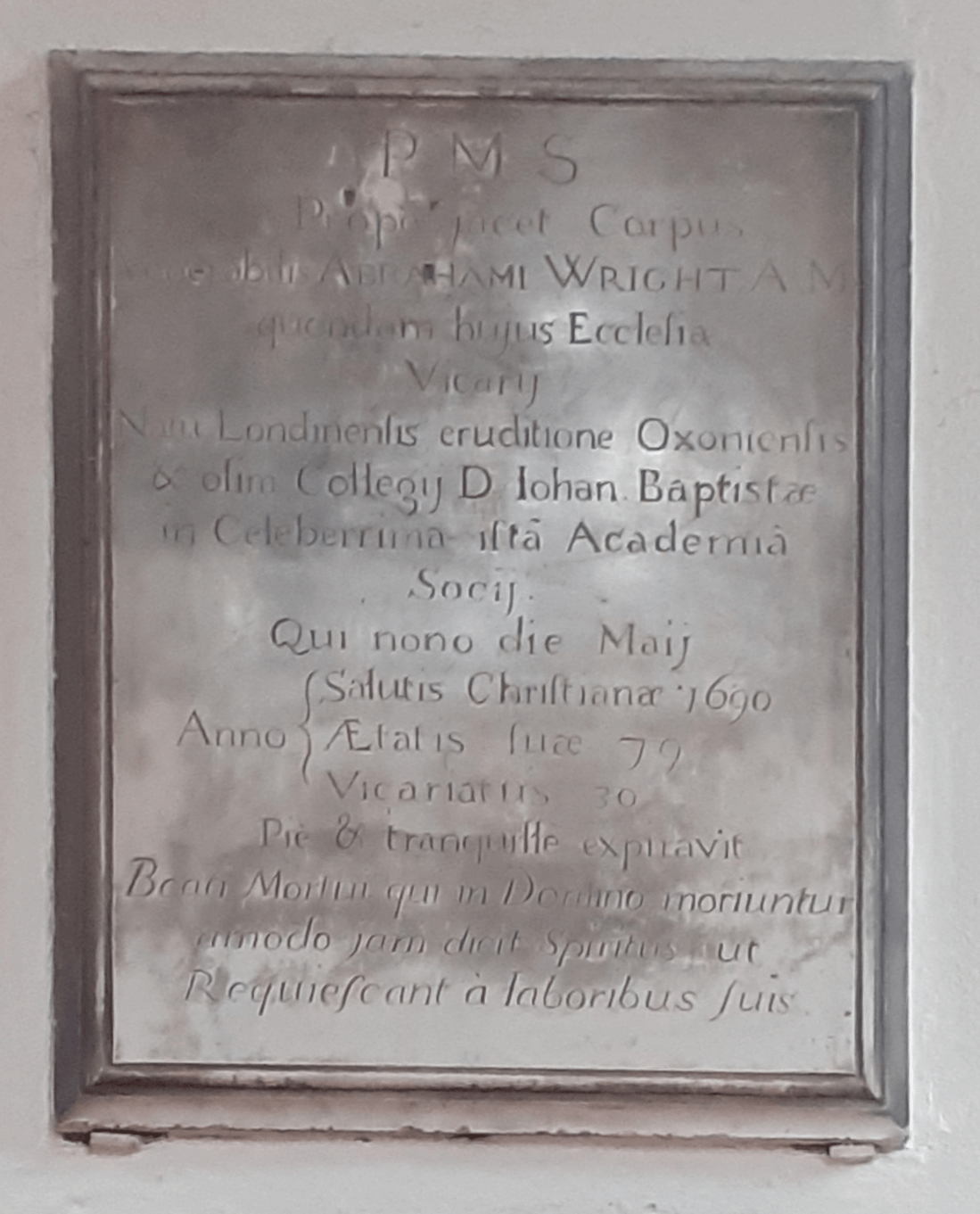
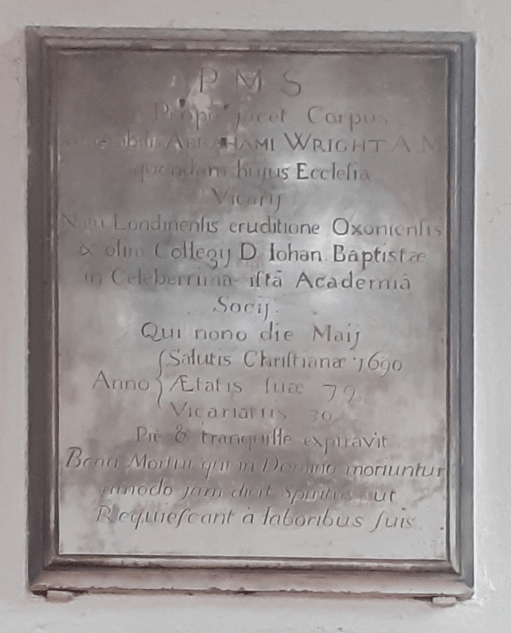
Figure 2. The Abraham Wright Memorial
The memorial to Wright still exists on the west wall of the north transept (Figure 2). It is the only monument in the church written in Latin.
P. M. S. Prope jacet corpus venerabilis Abraham Wright M.A. quondam hujus Ecclesia Vicarij nata Londinensis, eruditione Oxoniensis, olim Collegij d. Johan Baptista in celebeuima ista Academia Socij. qui nons die Maij Salutis Christianæ 1690 ætatis sua 79, Vicariatus 30, pie et tranquille expiravit Beati mortui qui in domino moriuntur, amodo jam dicit spiritus ut requiescant a laboribus suis.
The English Translation is as follows.
P. M. S. Near lies the body of the venerable Abraham Wright M.A., formerly Vicar of this Church born in London, educated in Oxford formerly of the College of John the Baptist in that celebrated Academic Society who died on the 1st of May, 1690 aged 79 Vicar for 30 years, in piety and tranquillity. Blessed are the dead who die in the Lord from now on the Spirit says that they may rest from their labours.
The other “vicar” that deserves further mention is the one who replaced Wright during the Civil War and Commonwealth – Benjamin King (1545-1660). His name, unsurprisingly, does not feature on the Vicar’s Board. After the Restoration he was ejected from the living at Oakham, one of six in Rutland to suffer that fate. But he seems to have remained in the area. From the Victoria County History.
In 1672 a licence was granted to Benjamin King, who had been intruding minister at Oakham during the time of the Commonwealth, for Presbyterians to meet at the house of Matthias Barry at Oakham. King had two daughters, one of whom married Vincent Alsop, usher of Oakham School and later an eminent minister in Westminster; the other married Robert Ekins, the first minister in the Northgate Barn.
The eighteenth and nineteenth centuries (1691-1835)
The eighteenth century again saw two long incumbencies – John Warburton from 1691 to 1736, and John Williams from 1736 to 1782. Curates become more common (or they are recorded more diligently) with six in total recorded during these incumbencies.
After the death of John Williams, his place was taken by his son Richard. He had been ordained deacon in 1771 and priest in 1772, a was curate of Stapleford in Leicestershire and vicar of Skillington in Lincolnshire from 1772. He was vicar of Oakham from 1782 to 1806 – a relatively short incumbency of only 24 years! He in his turn was succeeded by his son, another Richard, whose was ordained deacon and priest in 1801 and 1802. He was a curate in his father’s parish from 1801 until he succeeded him in 1806. In addition he was Usher at Oakham School from 1802-10. curate of Langham from 1801,vicar. of Enderby with Whetstone in Leicestershire from1803-15 and domestic chaplain to George Finch,9th Earl of Winchilsea and Nottingham of Burley House from 1806 to 1815 (the patron of the church, and thus the one who presented him to the living). Only two curates are recorded during the incumbencies of the two Richards.
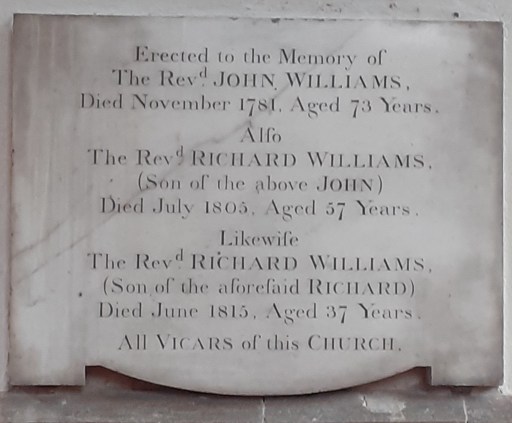
A monument to all three Williams is still in place in the north transept of the church and is shown in Figure 3.
Figure 3. The Williams memorial
The final vicar in the period of the Clergy of the Church of England dataset is Heneage Finch, grandson of Heneage Finch, 3rd Earl of Aylesford (History of the Finch Family, Brayan I’Anson, 1933) and a distant relative of George Finch,9th Earl of Winchilsea and Nottingham mentioned above, the patron of the living. He was ordained deacon and priest in 1812, and was curate of Harpsden before moving to Oakham in1815. He was also Rector of Great Weldon from 1812 to 1819 and Domestic chaplain to William Legge, 4th earl of Dartmouth and Viscount Lewisham from 1815. He was another long serving vicar and died in post in 1865. It was during his incumbency that the church was restored by Gilbert Scott in 1858. Before that, as can be judged by Scott’s report, the church was again in a very poor state of repair. Indeed a lecture of 1860 that describes the pre-Restoration state of the church mentions
….that old ladies sat in church with their umbrellas up, and the pulpit to the last was in mourning for George III…
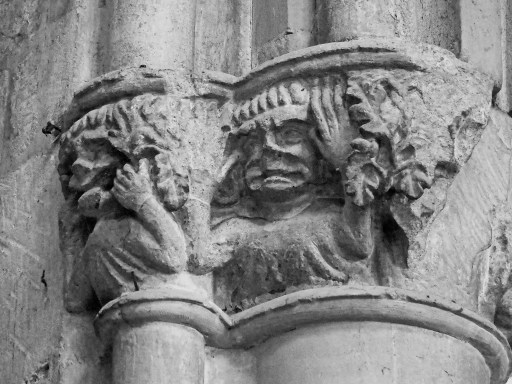
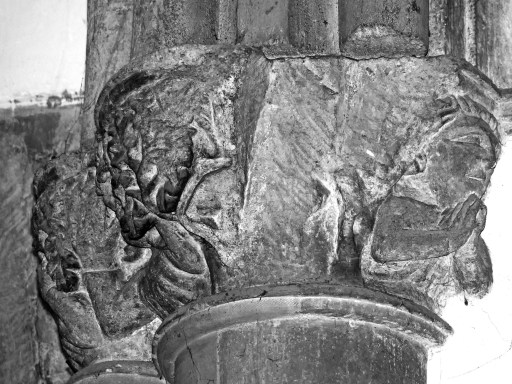
In a recent post I have described the exhibition “A sermon in stone” at All Saints Oakham which features photographs of the 13th century nave arcade capitals. That exhibition builds on work set out in an earlier blog post. The carvings feature biblical, classical and folklore themes and between them appear to tell the salvation story from the fall of Adam and Eve to the resurrection of Jesus and beyond. In this post I include a photograph and brief discussion of a carving that didn’t feature in the exhibition, as it was felt to be too badly damaged.
Figure 1. Making faces and praying
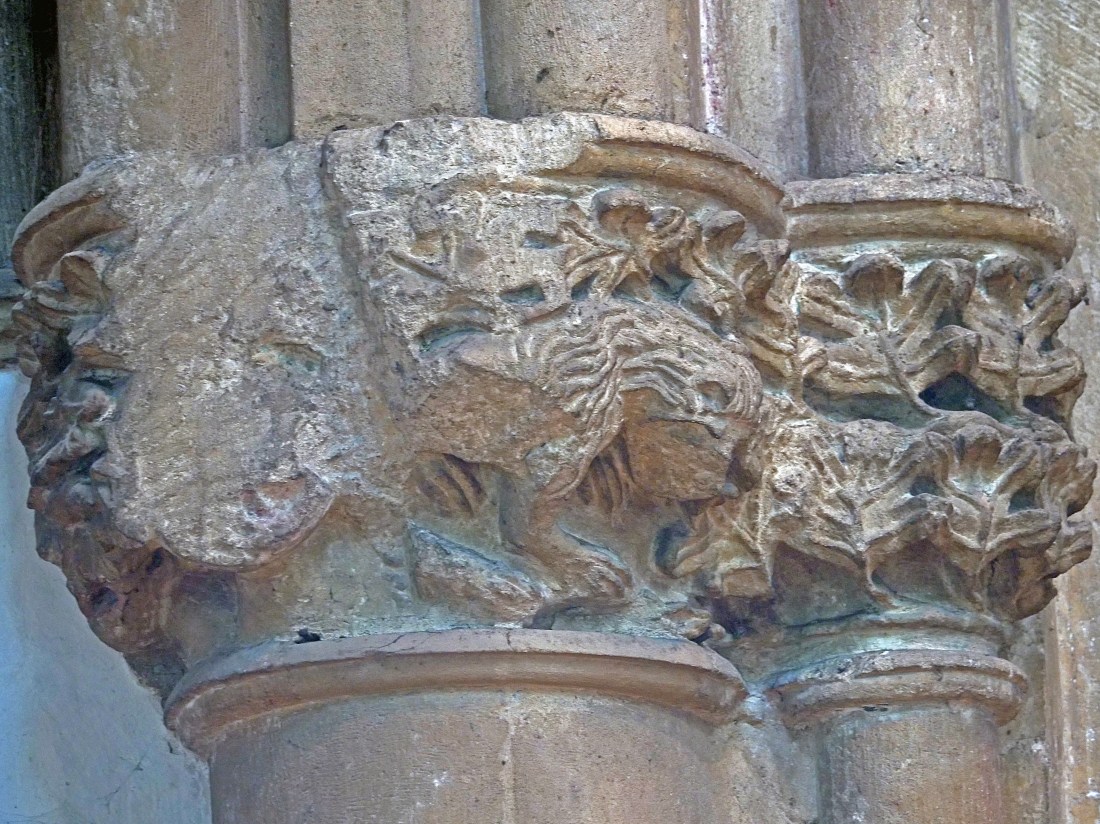
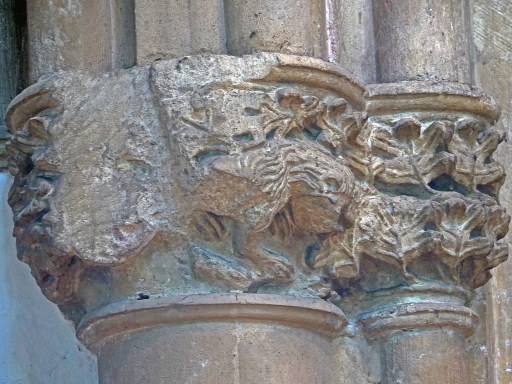
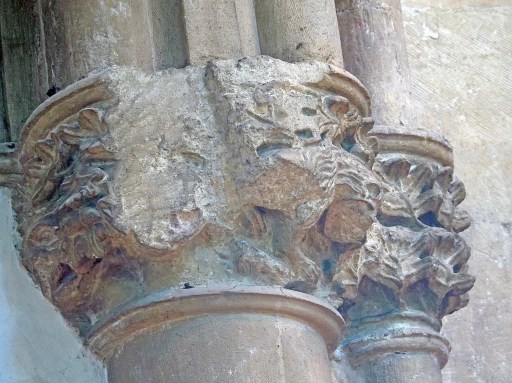
Most of the carvings are around the capitals on the pillars in the nave arcade, but two are actually on the chancel arch at the same height as on the arcade. Both have been damaged at some point it the past by the installation of a rood screen. One of these features in the “Sermon in Stone” exhibition – that on the north side of the chancel arch of jesters making faces above the pulpit with a more serious praying figure looking into the chancel (figure 1). The other, on the south side, was thought at the time to be too damaged to include. However when a high resolution photograph was taken (by Richard Adams who took all the photos for the exhibition) it was found that there was considerable detail remaining – see figure 2, which shows a lion like figure, in an oak leaf surround.
The question then arises as to whether or not this carving has any meaning in the overall salvation theme of the carvings. It is clear from the overall arrangement that those carvings on the north side represent the dark side of salvation history – the fall, the devil, temptations to sin – and those on the south side the light side of redemption and restoration – the eucharist, angels and evangelists, the annunciation and crowning of the Virgin. The jester on the north side fits into this theme quite well, as displaying a range of unredeemed human qualities, and on this basis one would expect the figure on the south side to represent something more positive. Now in scripture, the symbolism of a lion is nearly always negative, as a creature that attacks and destroys, except in one place in the book of Revelation where Jesus is described as a lion of the tribe of Judah (Revelation 5.5).
Then one of the elders said to me, ‘Do not weep. See, the Lion of the tribe of Judah, the Root of David, has conquered, so that he can open the scroll and its seven seals
So perhaps in this carving we perhaps see a representation of Jesus, identified as the Lion of Judah, sat on the throne of God in heaven. This would be appropriate in its position as next to the capital that shows the crowning of the Virgin and the Harrowing of Hell, which are also eschatological themes. But, as ever with these carvings, this identification must be quite speculative.
Of the internal fittings I have but little to say. They exceed in meanness even what is usual in country churches. And there must be but one opinion about them – they must entirely cleared away, and the whole refitted in proper manner with good oak seats
A few years earlier, Baron Stephen Glynne in his church notes had written in a similar, if somewhat milder, vein.
Altogether the interior is not so well kept as it deserves to be. The pews and galleries are shabby and the whole dirty and untidy.
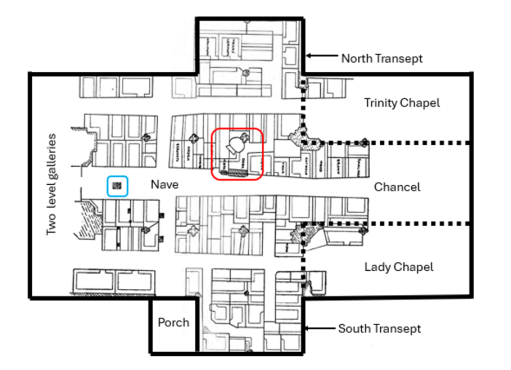
In this short note we present some information contained in the history of the church in the Rutland County Magazine published in 1903 concerning the internal arrangement of the church before the 1858 restoration. In particular Figure 1 shows the arrangements of the pews as sketched by Rev. C. A. Stevens, superimposed on the ground plan of the church – the interior fittimgs so disparaged by Scott.
Figure 1. Box pew arrangements in All Saints church – from the Rutland County Magazine of 1903
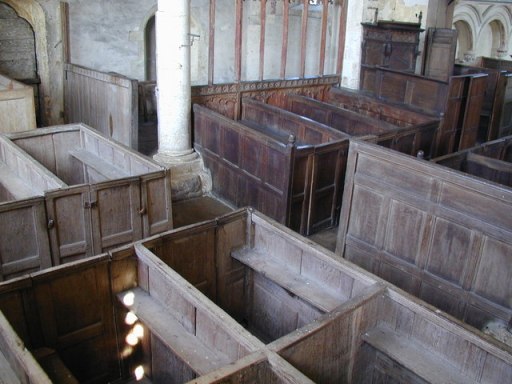
For those who know the orderly front facing bench pews in All Saints today, the arrangement shown in the figure will appear very odd. Box pews (for which a rent would have been charged) fill the nave, extending into the Trinity chapel, the Chancel and the Lady Chapel and would have been occupied by the wealthier members of Oakham Society. The sides would have been 3 or 4 feet high and they would have afforded a degree of privacy. As an example of how they might have appeared, see the pictire of eighteenth century box pews from Inglesham church in Figure 2.
The lack of geometric regularity and uniformity in Figure 1 is clear, indicating that this arrangement developed over the years, as new pews were added and old ones removed or adapted. The hoi polloi would have been housed in the free sittings in the double deck gallery at the west end of the church.
The focus of the church was also very different from today. The red square gives the location of the pulpit, the clergy desk and the church clerk’s desk – which are in the centre of the nave, adjacent to the pillar with the Green Man capital. The pulpit is surrounded on all sides by pews, some of which, but by no means all, would have enabled worshippers to face the preacher and vice versa. Unfortunately no indication of how the chancel is laid out is given, but presumably the altar was at the east end as now.
The function of the pews and the names of those families that rented the pews are shown on the figure, but the writing is too small to easily read at the scale shown here. From west to east in the nave we have
In the north transept we have, again from west to east
Wellington; Vicar’s servants
These are presumably names of parishioner families. A final point of interest is the location of what is almost certainly the font, within the blue square. This stands in the middle of the central aisle at the west of church, which is in many ways much more liturgically sensible than its current position, tucked away amongst pews on the north side of the central aisle.
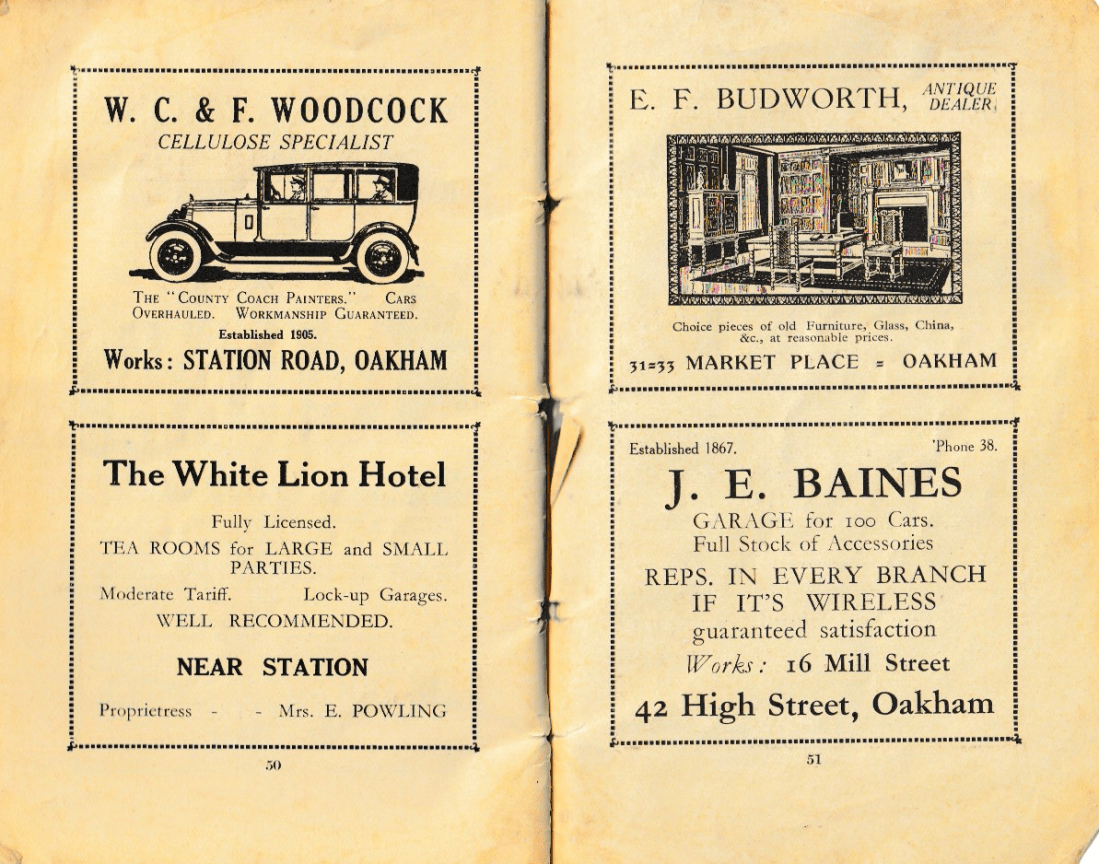
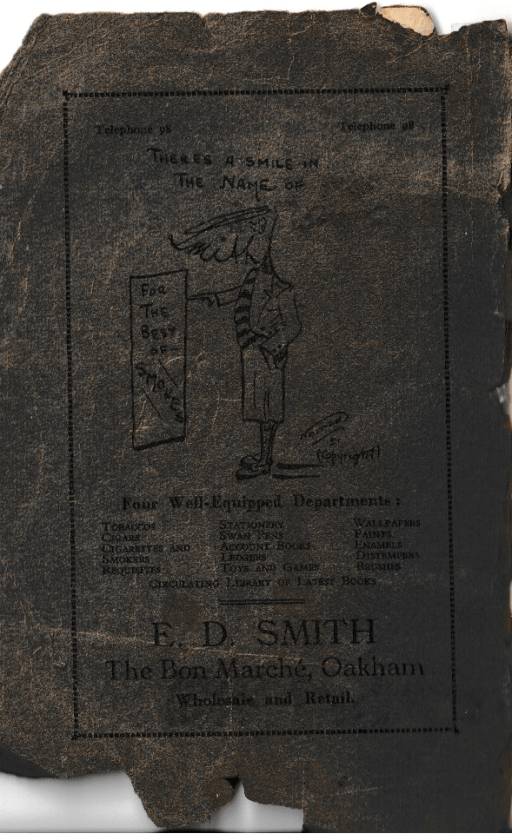
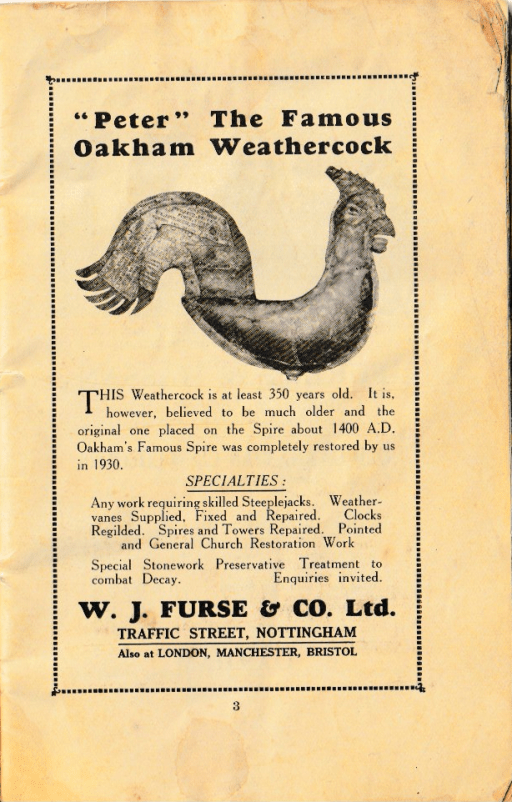
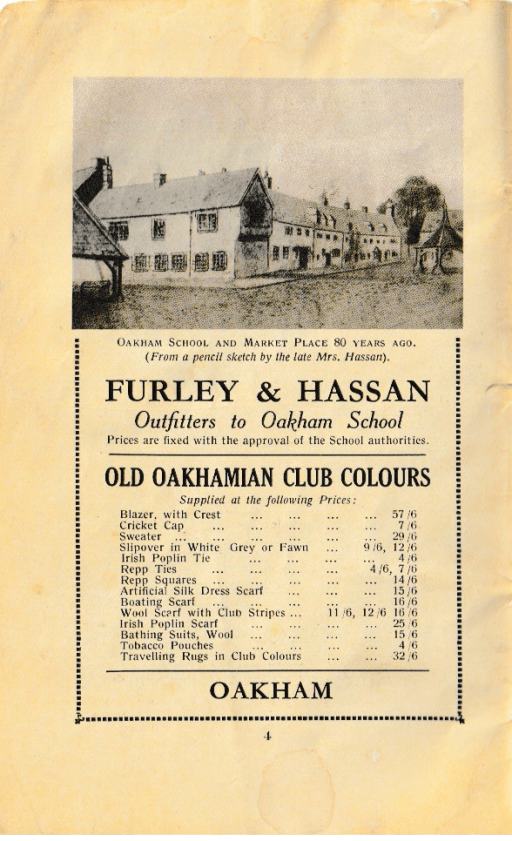
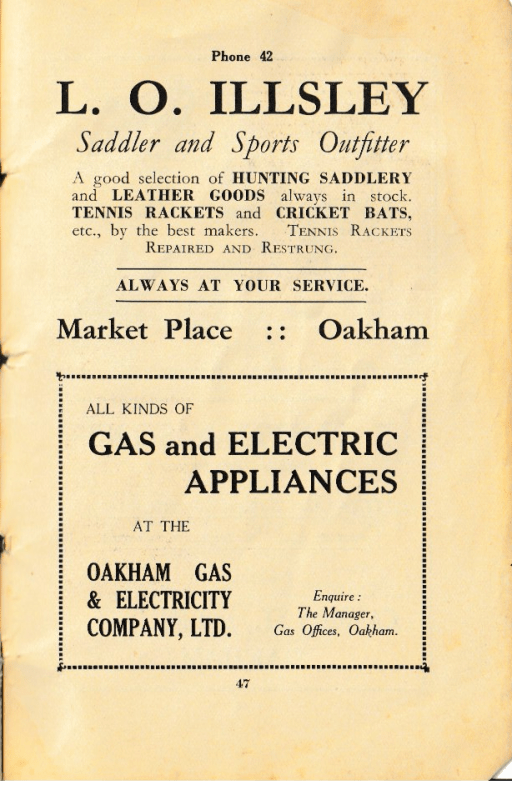
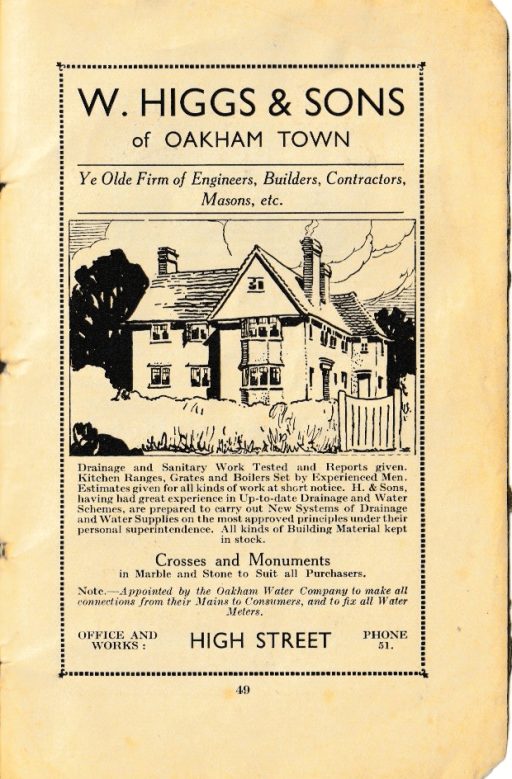
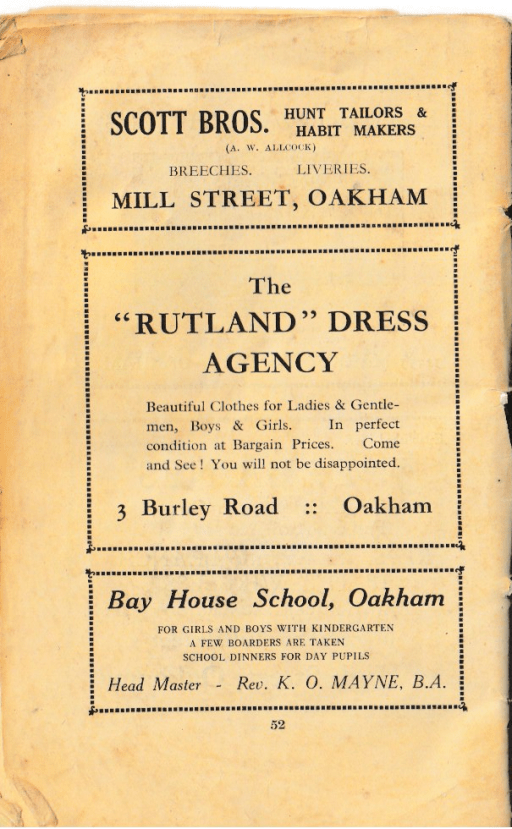
Recently I have come across a number of old Church Guides and Histories for All Saints Church in Oakham- from 1932, 1972 and 1980. PDFS of these can be found on the History and Heritage page of the church website. There comes a time of course when old guides and histories become historical documents in their own right, revealing how the church was thought of and communicated at the time of writing, and in their description of their contemporary activities, give an indication of the nature of the church’s worship and other activities. This is particularly true of the 1932 guide – The Story of Oakham Church, School and Castle by the then vicar, A. Edward Fraser. In what follows I post just a few pages from this this guide – the adverts it contained for local businesses that paid for its publication. These are given below, and I suspect that Oakham readers will find them of considerable interest.
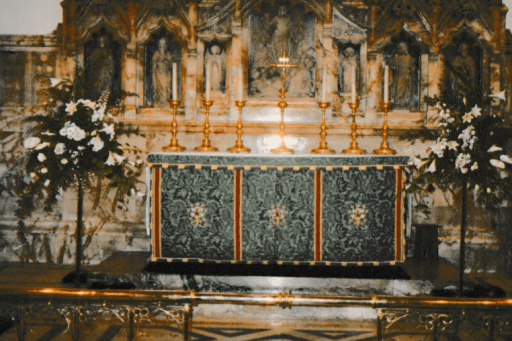
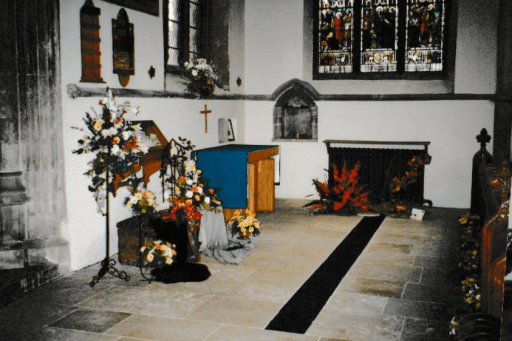
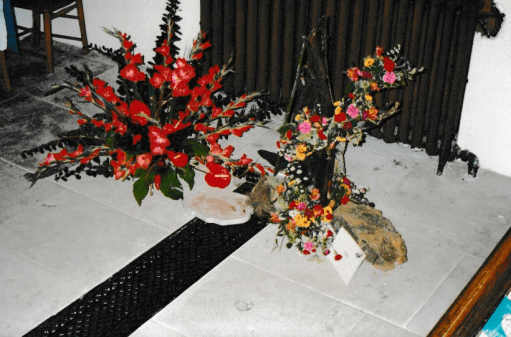
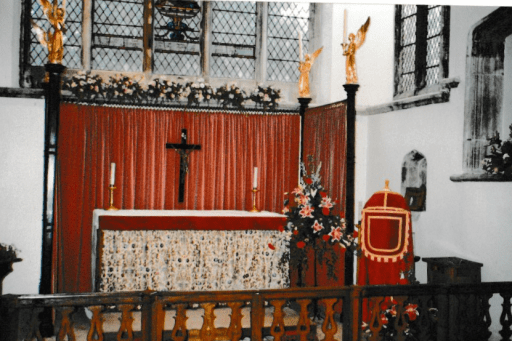
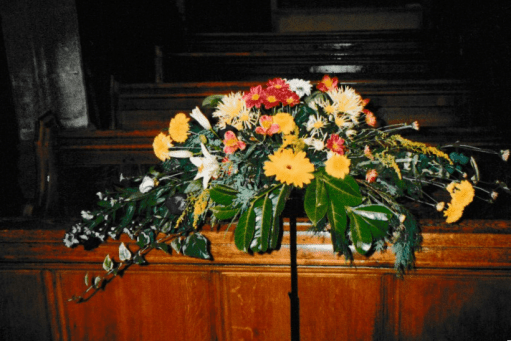
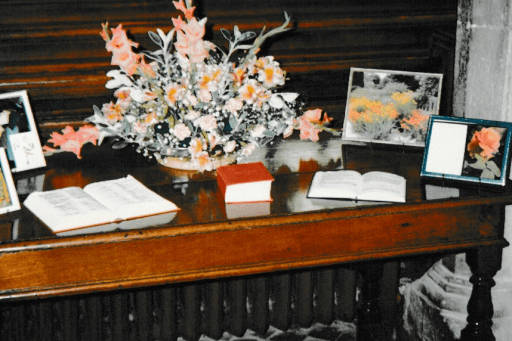
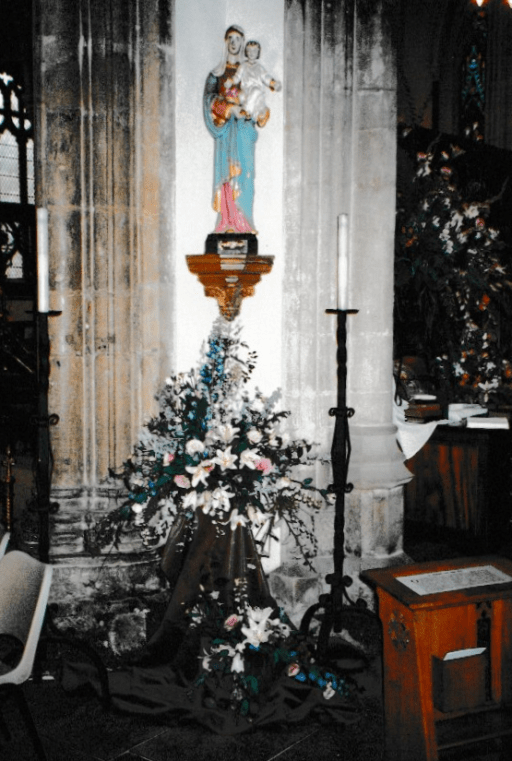
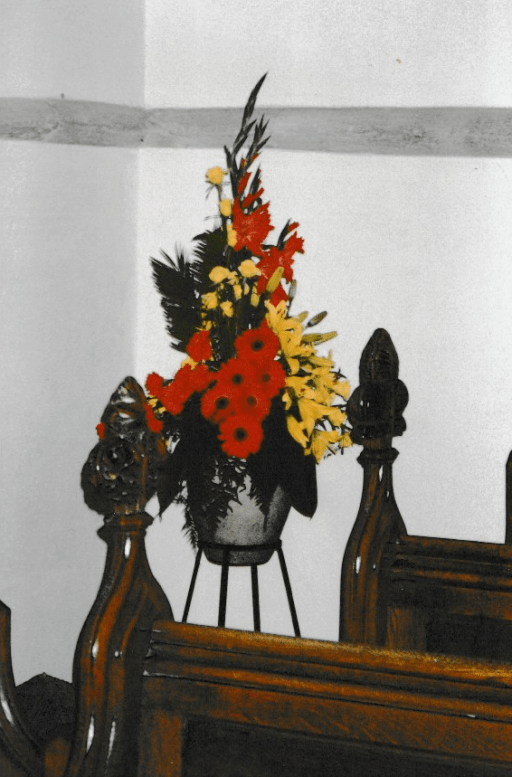
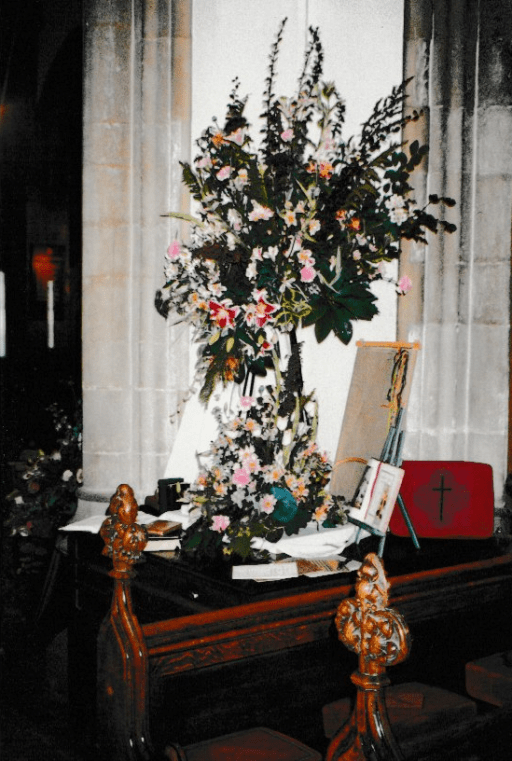
In 1996, All Saints church in Oakham, organised a flower festival. Some photographs from this event were deposited in the church safe for safe keeping, and I have recently come across these whilst searching the safe for other items. It seems to me that these photos are well worth sharing – both for the flower displays but also for the glimpse they give of the church from 30 years ago. Pleas click on the photos below for larger versions of the pictures. The colours aren’t marvellous – they can only be as good as the prints – but they will be of interest to some.
Holy Trinity ChapelHoly Trinity ChapelNorth TranseptHigh altarSouth TranseptSouth TranseptSouth TranseptLady ChapelLady ChapelArea near north doorCentral CrossingCEntral CrossingNorth TranseptNear pulpitEntrance to Lady ChapelWest End
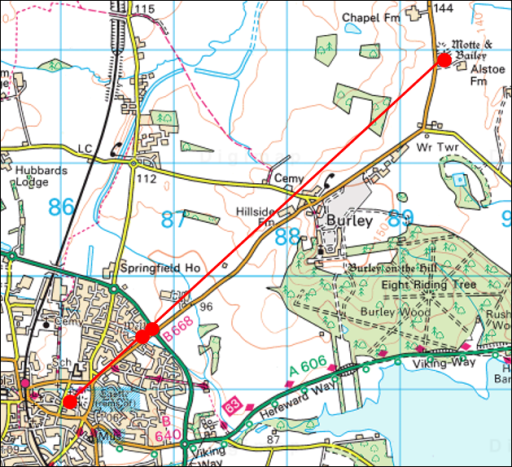
In a post “A possible Anglo-Saxon church group at Oakham in Rutland” from May 2024, I noted that All Saints Church in Oakham, and Our Lady’s Well to the north east were on what could be a mid-summer sunrise / mid-winter sunset solar alignment. I went no further than simply noting this, and didn’t speculate further about what it might imply. One always needs to be cautious about such alignments – they can be simple coincidences, and, if they are being looked for, can be found in the most unlikely places. For example from Borrowcop Hill in Lichfield, possibly an ancient burial mound, there was until recently a perfect alignment with the medieval spires of Lichfield Cathedral and the cooling towers of Rugeley power station, the latter sadly now demolished, which can hardly be of ancient origin. That being said, a reader of the May 2024 post sent me some further information that suggests that a cluster of Stone Age / Bronze Age / Iron Age remains have been found to the north east of Our Lady’s well that could also be on the same alignment. Looking at this further, I realised that several kilometres to the north east of that, and again on much the same alignment, we have Alstoe Mount, another historic monument. These are all shown on the Ordnance Survey map extract of Figure 1 below. The nature of this possible alignment, along the axis of the mid-summer sunrise and mid-winter sunset is discussed further in this post.
Figure 1. The possible alignment. The sites are shown as red circles – from the south west to the north east these are All Saints church in Oakham, Our Lady’s Well, the historic monuments and Alstoe Mount.
The sites
All Saints church, Oakham
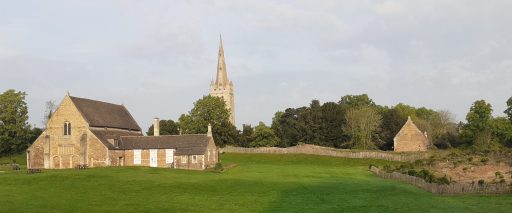
All Saints Church is Oakham (Figure 2) is a twelfth century church with thirteenth to fifteenth century additions. Internally it is pure Victorian, having been restored by Gilbert Scott. However it almost certainly stands on the site of an Anglo-Saxon church, and a church in Oakham is mentioned in the Domesday book. A compendium of historical information is given on the church website.
Figure 2. All Saints Oakham and Oakham Castle (photograph by the author)
Our Lady’s Well
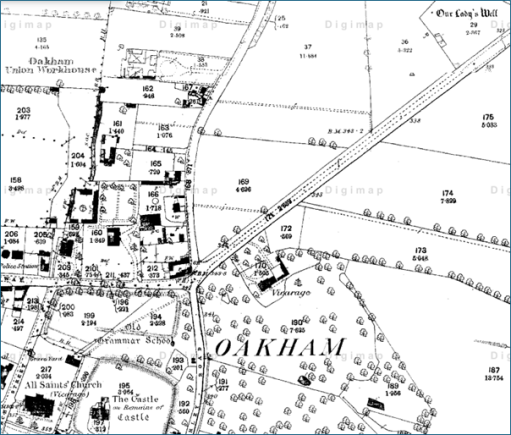
Our Lady’s Well is a historically well-attested pilgrim site to the north east of All Saints church – see Figure 3. To quote from Leicestershire and Rutland’s Holy Wells by Bob Trubshaw from 2004;
Our Lady’s Well was once famed for curing sore eyes – providing that a pin was thrown in first. In 1291 indulgences could be obtained by visiting Oakham Church during its patronal festival and, for a price, joining a pilgrimage to Our Lady’s Well. In 1881 it was visited by the future Queen Alexandra. The well is to the north-east of the town, in a somewhat overgrown area between the Cottesmore road and a modern housing estate (NGR SK:866095).
It’s current condition is no better, and it is now impossible to access the well, in an overgrown plot of wasteland, which seems a shame.
Figure 3. Location of Our Lady’s Well from the 1880 Ordnance survey Map (All Saints church is at the bottom left, and the well at the top right.)
The Stone Age / Bronze Age / Iron Age monuments
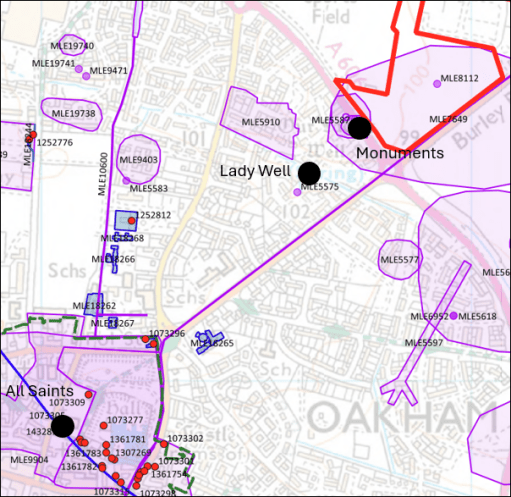
The material I was sent concerning the Stone Age / Bronze Age / Iron Age monuments came from “Land off Burley Road Oakham, Vision and Delivery Document” produced by Pigeon Investment Management with regard to a proposed hosing development. Figure 4 is taken from that document and shows the location of Our Lady’s Well and the relevant monuments.
The monuments are listed as follows, where the numbers are those on the Historic England National Heritage list.
MLE5587 – Possible Mesolithic site west of Burley Road MLE5592 – Late Iron Age/Roman site west of Burley Road MLE5593 – Bronze Age burial, west of Burley Road MLE5594 – Neolithic pit circle site west of Burley Road
Alstoe Mount
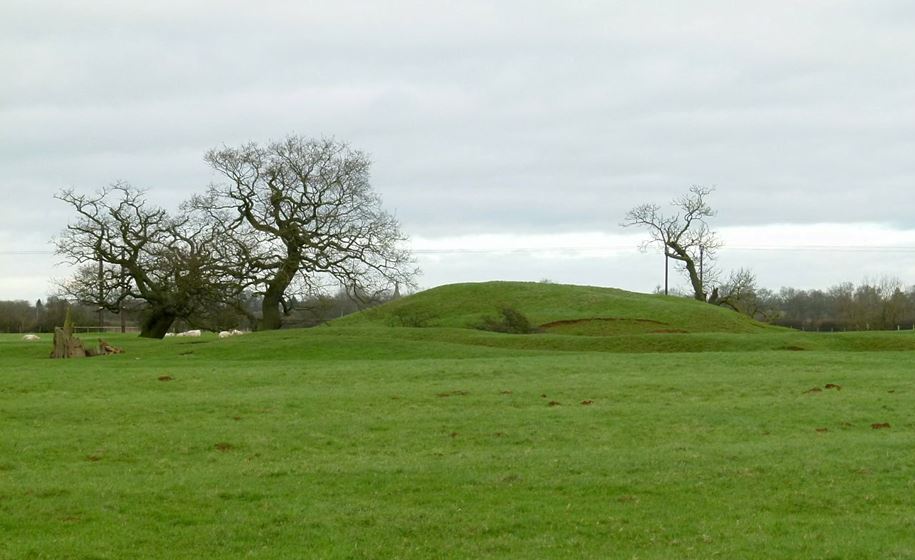
The substantial mound of Alstoe Mount (Figure 5) is described on the Ordnance Survey map as a Motte and Bailey. That is almost certainly not true. It was probably the Moot location for Alstoe Hundred. Details of the mound and the surrounding deserted village are given in the Historic England list entry.
Figure 5. Alstoe Mount (photograph from Historic England by Alan Murray-Rust, 2016)
The possible solar alignment
A current mid-summer sunrise / midwinter sunset direction from Oakham is 47.5 degrees east of north (from SunCalc). However obtaining a precise value to compare with the possible alignment shown in Figure 1 is difficult for two reasons. Firstly the actual direction of sunrise and sunset has varied over the millennia – and as things stand, we have no date for which a calculation can be made. This change is however small – of the order of 0.2 to 0.5 degrees. Also the apparent direction from any point depends upon the precise topography of the horizon over which the sunrise / sunset is observed – and as we know nothing about the observation point or the direction of observation, this is again not possible to specify. This again results in an uncertainty of around 0.5 degrees. So all we can probably say is that we are looking for an alignment of 47.5 +/-1.0 degrees east of north.
The actual directions between All Saints Oakham and the other sites is as follows.
Oakham to Our Lady’s Well – 46.3 degrees Oakham to Stone Age / Bronze Age / Iron Age monuments – 47.1 degrees Oakham to Alstoe Mount – 47.8 degrees
Again there is uncertainty here – particularly in the specification of the precise site at Our Lady’s Well of any structure that might have been visible from All Saints, and similarly the precise position of any relevant structure in the monument field. The location point for All Saints (taken as the centre of the building) could be around 10m to the east or west. This can have an effect of the bearings of Our Lady’s Well and the monuments by around 0.25 degrees. Considering these uncertainties the above bearings and a sunrise / sunset direction of 47.5 degrees seem broadly consistent, and thus there does seem to be some evidence for all four sites lying along a solar alignment of some significance.
But there is another issue – that of elevation. A cross section along the proposed alignment is shown in Figure 6. From this it is clear that Alstoe Mount would not be visible from Our Lady’s Well or from the Monument field, and would only just be visible from All Saints if any observation platforms that existed there and at Alstoe were raised off the ground by a metre or so. Beacons however would have been visible.
Figure 6. Section through the proposed alignment (from Google Earth Pro.).
Discussion
So what does the above analysis lead to. Firstly I think there is plausible (but far from conclusive) evidence for a mid-summer sunrise / mid-winter sunset alignment, at least between the Monument field / Our Lady’s Well and All Saints, and possibly between Alstoe Mount and All Saints. but the available evidence gives us no chronological information as to when the alignment might have been of significance. Our Lady’s Well is first mentioned in the late Middle Ages and All Saints and Alstoe Mount can only be said to become of important in the pre-conquest period. There is no evidence at all, except in the monument field, for the other sites being important in the Stone Age / Bronze Age / Iron Age. So in my view it is probably better to stop at this point – acknowledging that there may be a solar alignment, but not taking speculation any further. The boring, cautious approach I guess, but I don’t think there is much more to be said.




















.JPG)
