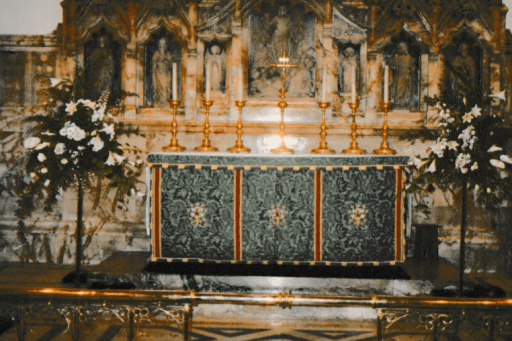
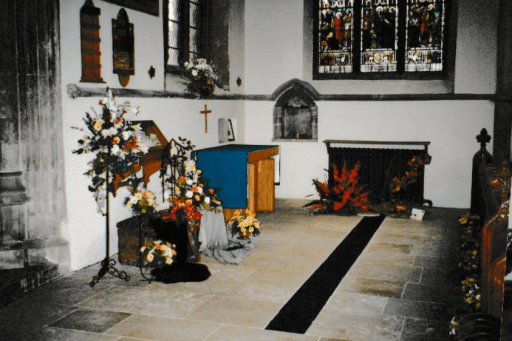
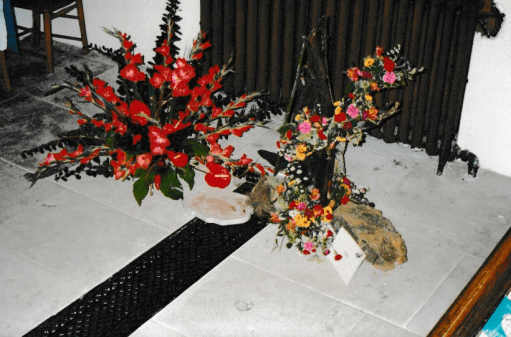
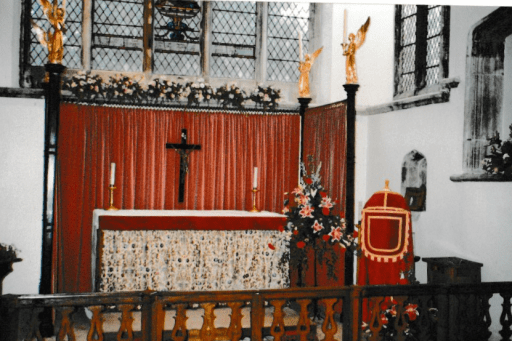
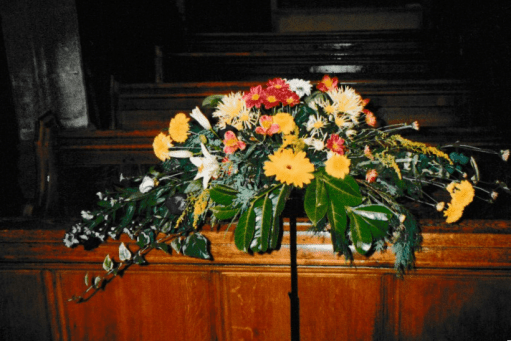
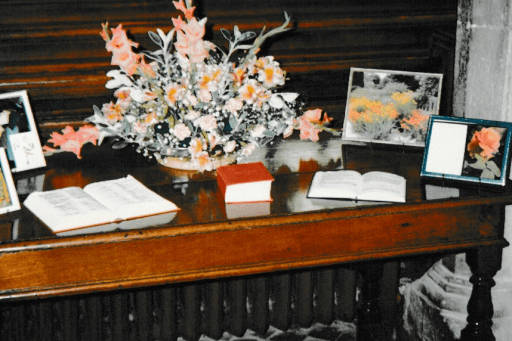
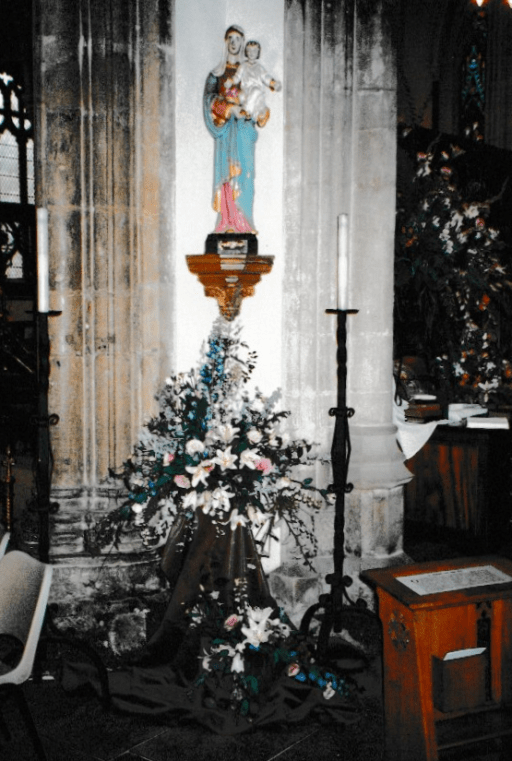
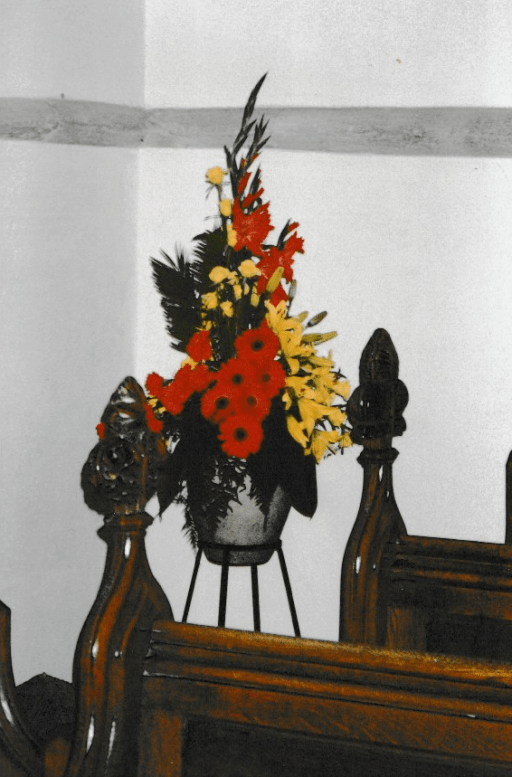
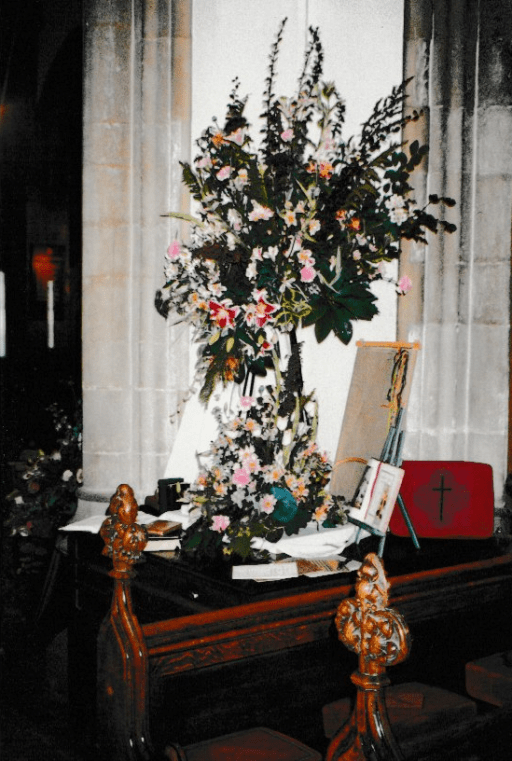
In 1996, All Saints church in Oakham, organised a flower festival. Some photographs from this event were deposited in the church safe for safe keeping, and I have recently come across these whilst searching the safe for other items. It seems to me that these photos are well worth sharing – both for the flower displays but also for the glimpse they give of the church from 30 years ago. Pleas click on the photos below for larger versions of the pictures. The colours aren’t marvellous – they can only be as good as the prints – but they will be of interest to some.
Holy Trinity ChapelHoly Trinity ChapelNorth TranseptHigh altarSouth TranseptSouth TranseptSouth TranseptLady ChapelLady ChapelArea near north doorCentral CrossingCEntral CrossingNorth TranseptNear pulpitEntrance to Lady ChapelWest End
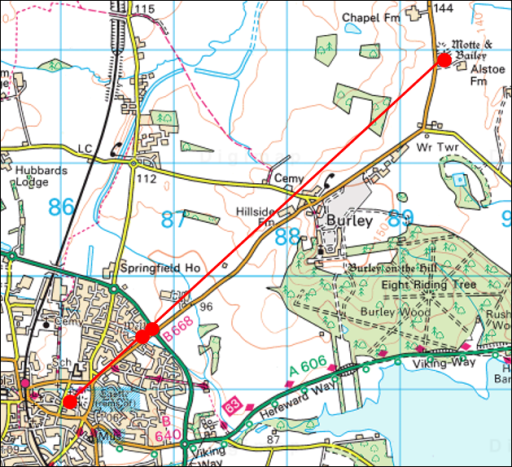
In a post “A possible Anglo-Saxon church group at Oakham in Rutland” from May 2024, I noted that All Saints Church in Oakham, and Our Lady’s Well to the north east were on what could be a mid-summer sunrise / mid-winter sunset solar alignment. I went no further than simply noting this, and didn’t speculate further about what it might imply. One always needs to be cautious about such alignments – they can be simple coincidences, and, if they are being looked for, can be found in the most unlikely places. For example from Borrowcop Hill in Lichfield, possibly an ancient burial mound, there was until recently a perfect alignment with the medieval spires of Lichfield Cathedral and the cooling towers of Rugeley power station, the latter sadly now demolished, which can hardly be of ancient origin. That being said, a reader of the May 2024 post sent me some further information that suggests that a cluster of Stone Age / Bronze Age / Iron Age remains have been found to the north east of Our Lady’s well that could also be on the same alignment. Looking at this further, I realised that several kilometres to the north east of that, and again on much the same alignment, we have Alstoe Mount, another historic monument. These are all shown on the Ordnance Survey map extract of Figure 1 below. The nature of this possible alignment, along the axis of the mid-summer sunrise and mid-winter sunset is discussed further in this post.
Figure 1. The possible alignment. The sites are shown as red circles – from the south west to the north east these are All Saints church in Oakham, Our Lady’s Well, the historic monuments and Alstoe Mount.
The sites
All Saints church, Oakham
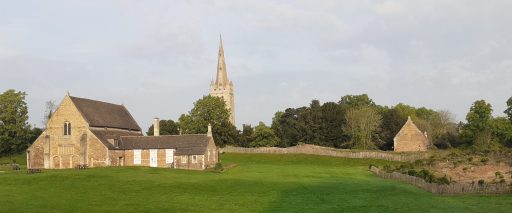
All Saints Church is Oakham (Figure 2) is a twelfth century church with thirteenth to fifteenth century additions. Internally it is pure Victorian, having been restored by Gilbert Scott. However it almost certainly stands on the site of an Anglo-Saxon church, and a church in Oakham is mentioned in the Domesday book. A compendium of historical information is given on the church website.
Figure 2. All Saints Oakham and Oakham Castle (photograph by the author)
Our Lady’s Well
Our Lady’s Well is a historically well-attested pilgrim site to the north east of All Saints church – see Figure 3. To quote from Leicestershire and Rutland’s Holy Wells by Bob Trubshaw from 2004;
Our Lady’s Well was once famed for curing sore eyes – providing that a pin was thrown in first. In 1291 indulgences could be obtained by visiting Oakham Church during its patronal festival and, for a price, joining a pilgrimage to Our Lady’s Well. In 1881 it was visited by the future Queen Alexandra. The well is to the north-east of the town, in a somewhat overgrown area between the Cottesmore road and a modern housing estate (NGR SK:866095).
It’s current condition is no better, and it is now impossible to access the well, in an overgrown plot of wasteland, which seems a shame.
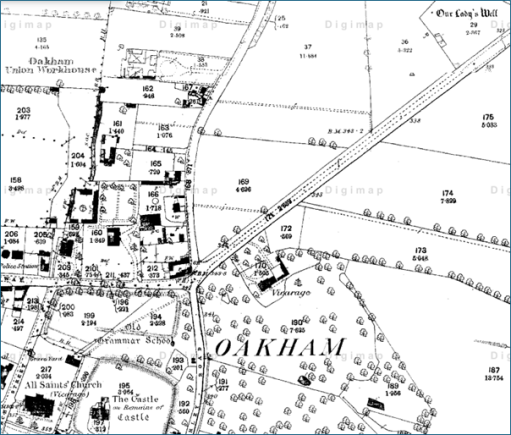
Figure 3. Location of Our Lady’s Well from the 1880 Ordnance survey Map (All Saints church is at the bottom left, and the well at the top right.)
The Stone Age / Bronze Age / Iron Age monuments
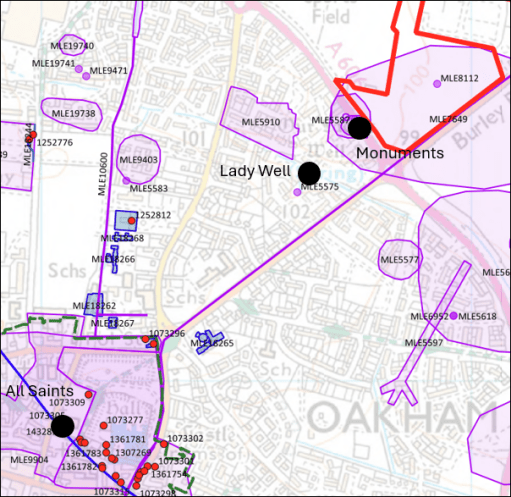
The material I was sent concerning the Stone Age / Bronze Age / Iron Age monuments came from “Land off Burley Road Oakham, Vision and Delivery Document” produced by Pigeon Investment Management with regard to a proposed hosing development. Figure 4 is taken from that document and shows the location of Our Lady’s Well and the relevant monuments.
The monuments are listed as follows, where the numbers are those on the Historic England National Heritage list.
MLE5587 – Possible Mesolithic site west of Burley Road MLE5592 – Late Iron Age/Roman site west of Burley Road MLE5593 – Bronze Age burial, west of Burley Road MLE5594 – Neolithic pit circle site west of Burley Road
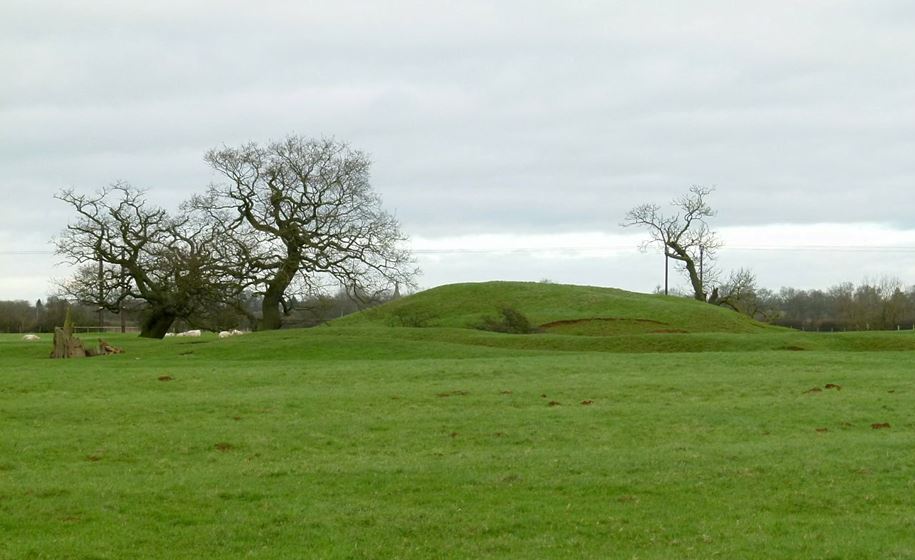
Alstoe Mount
The substantial mound of Alstoe Mount (Figure 5) is described on the Ordnance Survey map as a Motte and Bailey. That is almost certainly not true. It was probably the Moot location for Alstoe Hundred. Details of the mound and the surrounding deserted village are given in the Historic England list entry.
Figure 5. Alstoe Mount (photograph from Historic England by Alan Murray-Rust, 2016)
The possible solar alignment
A current mid-summer sunrise / midwinter sunset direction from Oakham is 47.5 degrees east of north (from SunCalc). However obtaining a precise value to compare with the possible alignment shown in Figure 1 is difficult for two reasons. Firstly the actual direction of sunrise and sunset has varied over the millennia – and as things stand, we have no date for which a calculation can be made. This change is however small – of the order of 0.2 to 0.5 degrees. Also the apparent direction from any point depends upon the precise topography of the horizon over which the sunrise / sunset is observed – and as we know nothing about the observation point or the direction of observation, this is again not possible to specify. This again results in an uncertainty of around 0.5 degrees. So all we can probably say is that we are looking for an alignment of 47.5 +/-1.0 degrees east of north.
The actual directions between All Saints Oakham and the other sites is as follows.
Oakham to Our Lady’s Well – 46.3 degrees Oakham to Stone Age / Bronze Age / Iron Age monuments – 47.1 degrees Oakham to Alstoe Mount – 47.8 degrees
Again there is uncertainty here – particularly in the specification of the precise site at Our Lady’s Well of any structure that might have been visible from All Saints, and similarly the precise position of any relevant structure in the monument field. The location point for All Saints (taken as the centre of the building) could be around 10m to the east or west. This can have an effect of the bearings of Our Lady’s Well and the monuments by around 0.25 degrees. Considering these uncertainties the above bearings and a sunrise / sunset direction of 47.5 degrees seem broadly consistent, and thus there does seem to be some evidence for all four sites lying along a solar alignment of some significance.
But there is another issue – that of elevation. A cross section along the proposed alignment is shown in Figure 6. From this it is clear that Alstoe Mount would not be visible from Our Lady’s Well or from the Monument field, and would only just be visible from All Saints if any observation platforms that existed there and at Alstoe were raised off the ground by a metre or so. Beacons however would have been visible.
Figure 6. Section through the proposed alignment (from Google Earth Pro.).
Discussion
So what does the above analysis lead to. Firstly I think there is plausible (but far from conclusive) evidence for a mid-summer sunrise / mid-winter sunset alignment, at least between the Monument field / Our Lady’s Well and All Saints, and possibly between Alstoe Mount and All Saints. but the available evidence gives us no chronological information as to when the alignment might have been of significance. Our Lady’s Well is first mentioned in the late Middle Ages and All Saints and Alstoe Mount can only be said to become of important in the pre-conquest period. There is no evidence at all, except in the monument field, for the other sites being important in the Stone Age / Bronze Age / Iron Age. So in my view it is probably better to stop at this point – acknowledging that there may be a solar alignment, but not taking speculation any further. The boring, cautious approach I guess, but I don’t think there is much more to be said.
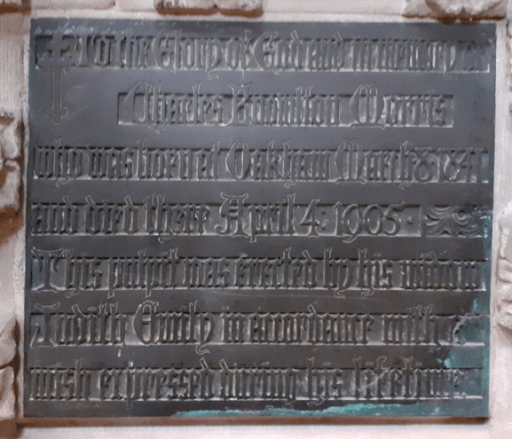
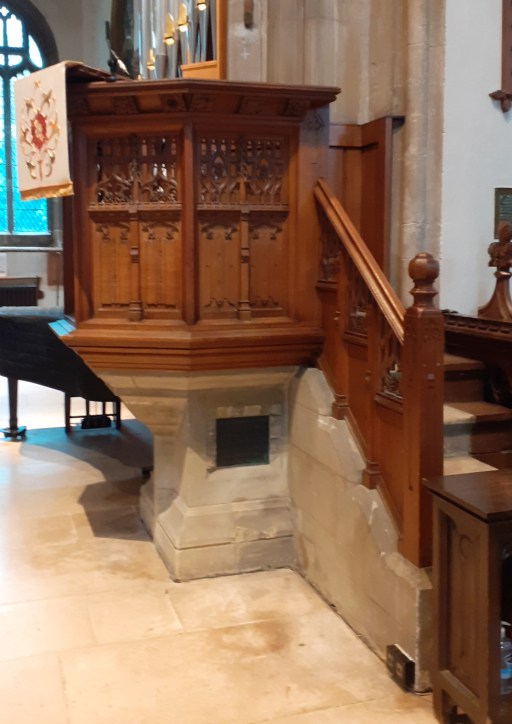
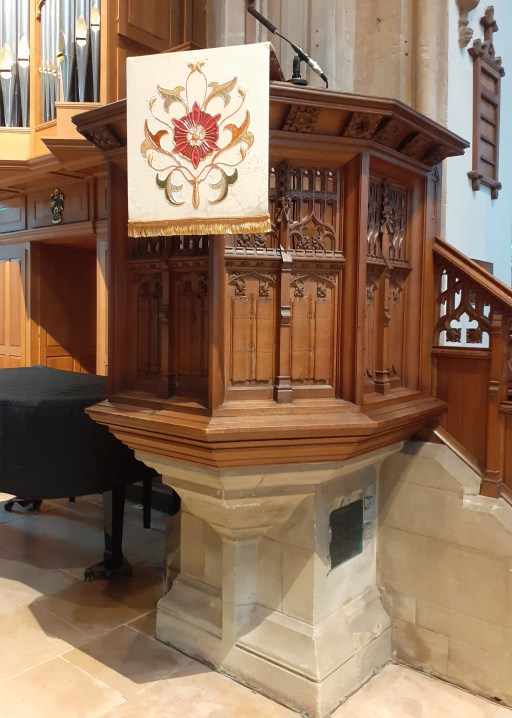
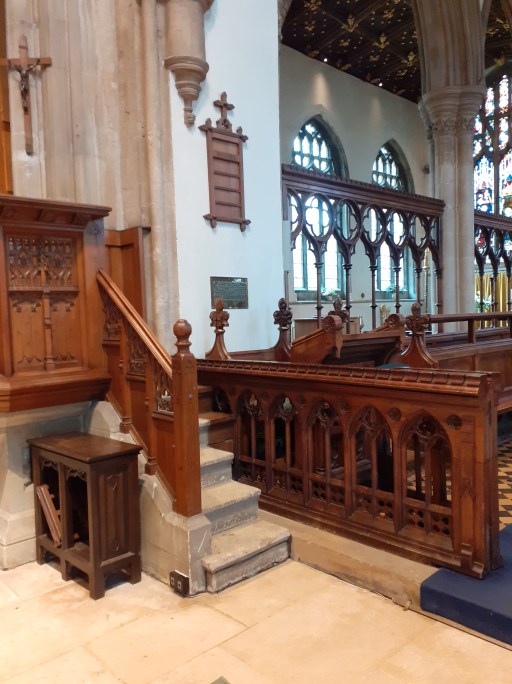
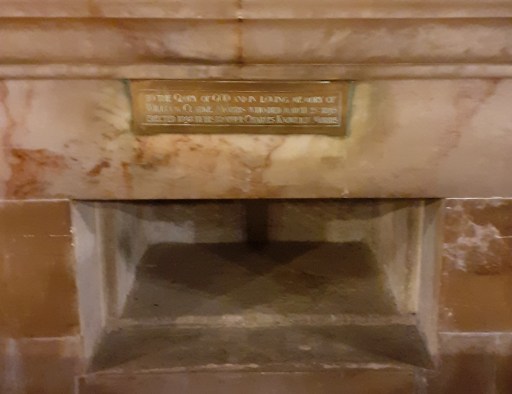
Memorials in churches can be in some really odd places. I recently noticed a brass plaque almost at ground level on the base of the pulpit at All Saints in Oakham. Even sitting on the floor in close proximity I was unable to make out much of it, but by taking some photographs and enhancing the contrast, I was able to get the image on the right. This reads
To the Glory of god and in remembrance of Charles Knowlton Morris, who was born at Oakham March 18 1841 and died there April 4 1905. This pulpit was erected by his widow Judith Emily in accordance with his wish expressed during his lifetime.
Pulpit memorial tablet
The name rang a bell in my mind – there is a very similar dedication on the stained glass window in the south transept.
To the glory of God and in remembrance of Charles Knowlton Morris who was born at Oakham 8th March 1841 and died there 4th April 1905. This memorial is erected by his widow Judith Emily.
Window memorial dedication
Charles Knowlton Morris
So who was this Charles Knowlton Morris? He turned out to be quite easy to trace through the historical record. He was born in 1841, the son of Clarke and Francis Morris (nee Hare) of Catmose Street in Oakham, one of at least six children. Clarke Morris was a brewer in Northgate in Oakham. Two of his sons – William Clarke Morris and Charles Knowlton Morris took over the business after Clarke’s death in 1857. The brewery moved to Cross St / New St in 1866 and in censuses and trade directories, the business is usually described as Morris’ Rutland Brewery, and they were also listed as coal, salt and seed merchants at the railway station wharf. William Clark died in 1895 and it appears that the business passed directly to his brother. The Reredos and Marble flooring in the chancel at All Saints were donated by Charles in memory of his brother in 1898.
All Saints Reredos
Reredos dedication plate
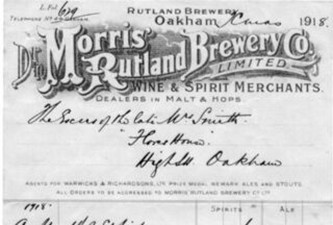
Charles married late in life, in 1898 aged 57 to Judith Emily Tiptaft, the daughter of a Northamptonshire farmer, who was seventeen years his junior. There were no children. Charles died on 4/4/1905, leaving a very considerable business and effects worth £19448. The business was sold off by auction fairly soon after his death. It is described in the Grantham Journal of 25/11/1905 as consisting of the brewery in New Street, and nineteen public houses in Oakham and the surrounding area. Those in Oakham included the Railway Hotel on Station Road, the Roebuck Inn on Church Street, the Bell Inn on Catmose Street, the Royal Duke Inn on West Road, Oakham, the Angel Inn on Northgate Street, and two off licenses, the Rutland Arms in New St and the Britannia Inn on Northgate Street. The estate was bought for £28,250 by Warwicks & Richardsons Ltd, Newark. Brewing ceased in 1907, but Warwicks continued to use the name Morris Rutland Brewery on Guiness bottled in Newark until 1962.
On 6/9/1896 at a service at All Saints church in Oakham, a new pulpit and stained glass window were dedicated to the memory of Charles. These are described at length in the Grantham Journal of 8/9/1906 as follows.
The window composed of three long lights, surmounted by beautiful tracery, and is now the best of the many fine windows in this Church. The stained-glass design is governed by the architectural features, which are typical 14th century work, demanding small subjects and canopies. The subjects are nine in number, massed in rich deep colours, all contributing to the design of three bands running laterally through the tall lights in the window, and are set off by the intercepting canopies, which are soft, and display a silvery effect. Incidents in the life of our Lord with which all are familiar are represented, and portray, respectively, ” Endurance,” “Love,” ” Fortitude,” “Humility*,” “Principle,” “Charity,” ” Innocence,” Sympathy,” and “Justice.” These help to illustrate, in their appropriateness, the beautiful life of Charles Knowlton Morris, whose memory they will perpetuated.…..……. Flowers and birds are delicately introduced as emblems, and the Past Masters’ jewel .and badge of the Vale of Catmos Lodge (No. 1265) of Freemasons are shown a small shield at the foot of the centre light.
The apex of the window contains the dove, and rays emanate from it into the surrounding side lights, and disappear behind the finials of the canopy, which runs out from main design below. The window was designed and executed by Mr. Dudley Forsyth, 335, Finchley-road, Hampstead, London
The new pulpit, as detailed on the inscription panel at fulfils wish expressed by the late Mr. Morris during his lifetime. It is in the Gothic style, and has been carefully designed so as to harmonise with its surroundings. The steps and the stone base by which the pulpit is supported are green Chilmark stone. A large moulded corbel, springing from the base, carries the pulpit, which is, in shape, five sides octagon. The material used is Austrian oak, slightly tongued, in order that it may resemble the existing oak fittings in the Church. Each side of the octagon is divided into two panels, the lower part of each carved, the upper part pierced; and care has been taken vary the design of the carving, as avoid monotony and give interest work. The cornice which crowns the pulpit is variously carved to represent the of the Passion of our Lord. The balustrade to the steps is similarly treated panels, and the whole, including the brass memorial tablet, reading-desk, and black fittings, has been designed Messrs. Forsyth and Maale, architects, of London, and carried out for the pulpit by J. P. White, of Bedford, and for metal work by Messrs. J. Elsley, of London.
Later years
Judith Morris must have spent a considerable part of her inheritance on these monuments to her husband. She was later to marry Dr Henry Drew in London in 1922. She died in 1945 at the age of 87. Pictures are available of her here and here, although an Ancestry subscription will be required to access these.
After her death in 1945 we read in the Leicester Evening Mail of 16/3/1945
Under the will of the late Mr. Charles Knowlton Morris, a former Oakham brewer, the vicar and churchwardens of Oakham receive a legacy, following the death of his widow, Mrs, Judith Emily Drew. of Leadenham House, Braunston Road. Oakham, to provide pensions for members of the Church of England. The sum is £3O annually. to provide three £l0 pensions for three poor persons of good character of the age of 85 and upwards residing in the town, and being members of the Church. It will be called the “Morris Gift.”
So it can be seen that much of what can now be seen at the “business” end of the church – around the altar where the Eucharist is celebrated, and the pulpit where sermons are preached was donated by the Morris family. Now the late 19th century was a time when the Teetotaller movement was very strong in reaction to the obvious ill effects of excess alcohol consumption, mainly on the poor. But clearly the Church of England in Oakham had no scruples about accepted considerable donations from a brewer. But, even in this more moderate age (at least in terms of alcohol consumption) the fact that Sunday services take place on structures funded by the receipts of nineteen public houses in Rutland might manage to raise a few eyebrows.
All Saints church in Oakham is not particularly well endowed with memorials to individuals and events, and there are no spectacular carvings. However some of those that do exist enable interesting stories to be told. In this post I present a number of these, with links to more information, and highlight those memorials that require further investigation. The post is very much a work in progress, and I will edit it as more information becomes available.
Note – to read some of the inscriptions below readers may well need to magnify them. Even then, some will take a little patience to read, particularly the brasses where it is difficult to take photographs without reflections obscuring the text.
Vestry
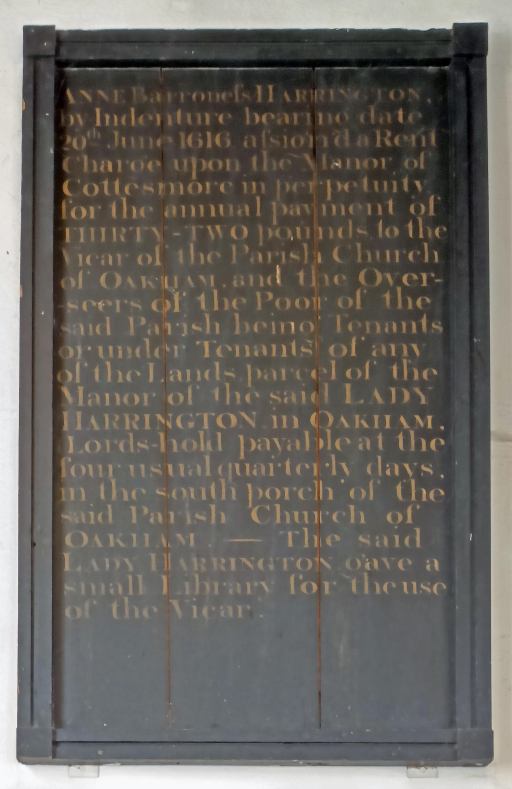
I have discussed the wooden memorial of the Lady Harrington bequest – money for the relief of the poor and a donation of a Parish Library – in two blog posts here and here. The memorial is in the vestry on the south side of the church and is not usually publicly accessible.
Chancel
A transcript of this plaque in the Chancel is given in the post From Oakham to Mandalay and a little more information is given on the career of Henry Jerwood.
Lady Chapel
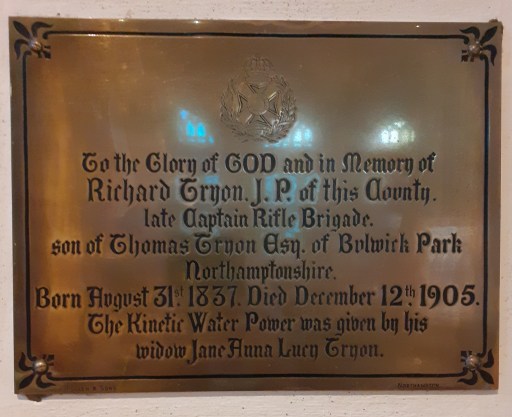
A transcript of this plaque in the Lady Chapel is given in the post Kinetic Water Power, and information is given there about Richard Tryon and (at some length) the Kinematic Water Power apparatus.
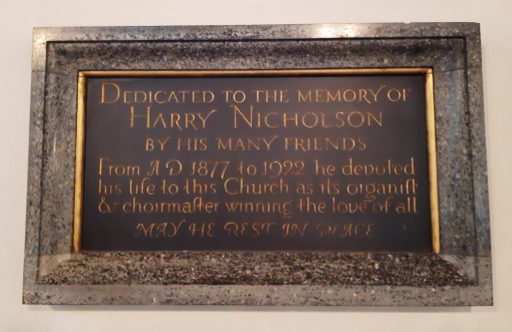
The life and times of long term organist of All Saints church and the founder of the Oakham Choral Society are well described in a blog from the Rutland County Museum.
Pulpit
The pulpit has a dedicatory plaque, very low down near the foot of the steps. It reads as follows To the Glory of god and in remembrance of Charles Knowlton Morris, who was born in Oakham March 18 1841 and died there April 4 1905. This pulpit was erected by his widow Judith Emily in accordance with his wish expressed during his lifetime. Charles Morris was a brewer and a coal merchant. A window in the church has a similar dedication from his wife and is described in the following way Depicting Endurance, Humility, Innocence, Love, Principle, Sympathy, Fortitude, Charity and Justice, as mostly portrayed by scenes from Jesus’ life. The badge of the Vale of Catmose lodge of the Independent Order of Oddfellows is at the bottom.
South Transept
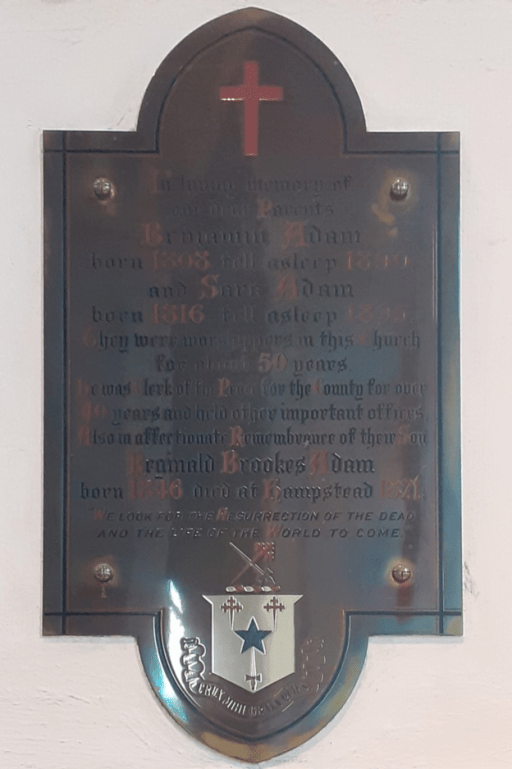
This difficult to read memorial is to Benjamin Adam (1808-1890?), his wife Sara (1816-1895?) and their son Reginald Brookes Adam (1846-1871?). We are told that Benjamin and Sara were worshippers at All Saints for over 50 years, and that Benjamin was Clerk of the Peace for the County (a legal officer) for over 40, and that he also held other important positions.
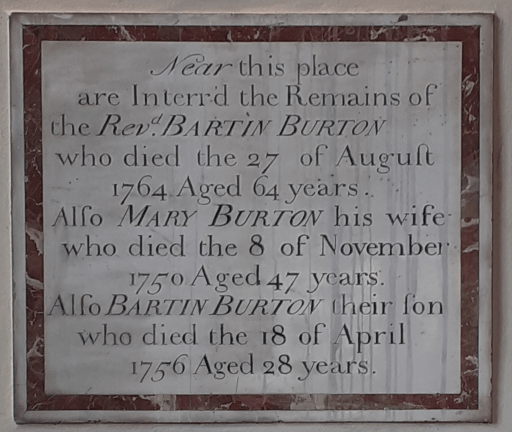
The Church of England Clergy database reveals that Bartin Burton was born in Oakham and served as Curate in the parish of Rockingham, Rector at Oxendon (both in Peterborough diocese) from 1728 to 1729 and Vicar of Ravenstone in Buckinghamshire (Lincoln diocese) from 1747 to 1764.
North Transept
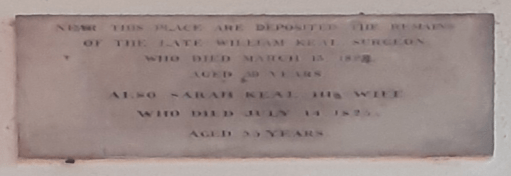
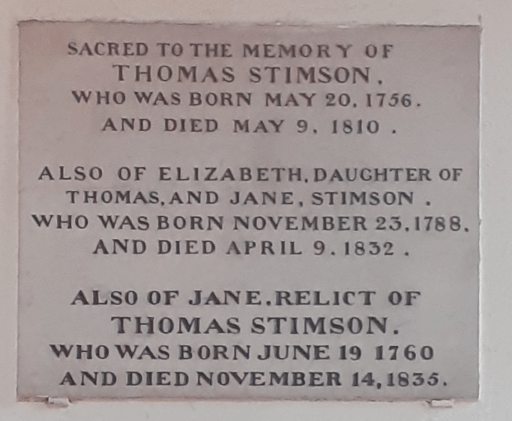
These four memorials in the north transept are placed one above the other in the order shown to the left. The top one commemorates William Keal, a surgeon (d1824?) and his wife Sara (d1825). The one below it commemorates the lives of Thomas Stimson (1756-1810), his wife (relict) Jane (1760-1835) and their daughter Elizabeth (1788-1832).
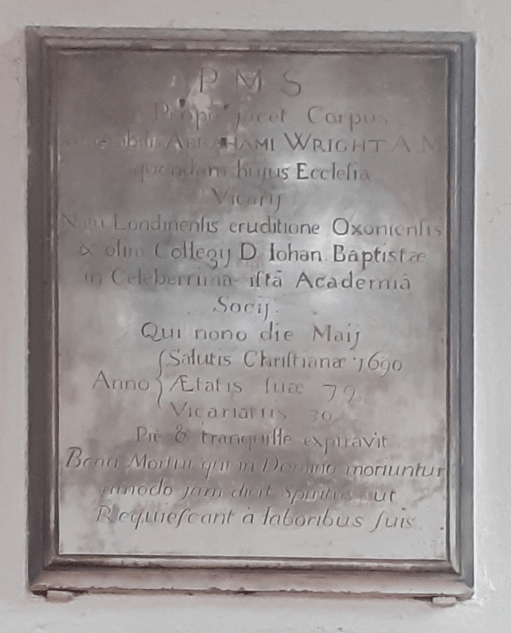
The third is in Latin and commemorates John Abraham Wright (d1690) aged 79, vicar for 30 years, during and after the Commonwealth period. In the first instance he served only one year (1644-5) before he was and replaced by the parliamentary favourite Benjamin King. He took up his post again after the Restoration in 1660.
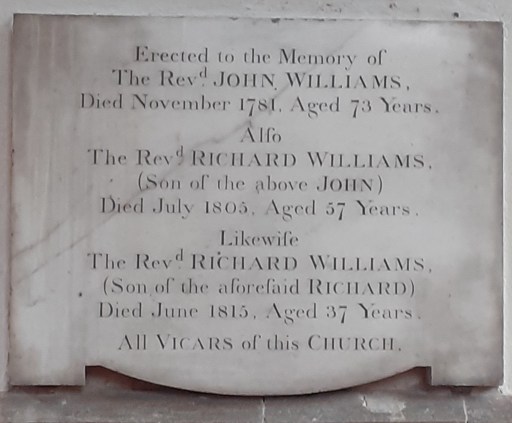
The lower memorial is to three generations of Vicars of the parish – John Williams (d1781), Richard Williams (d1805) and Richard Williams (d1815). More details of their appointments at Oakham and elsewhere can be found in the Church of England Clergy Database.
South Aisle
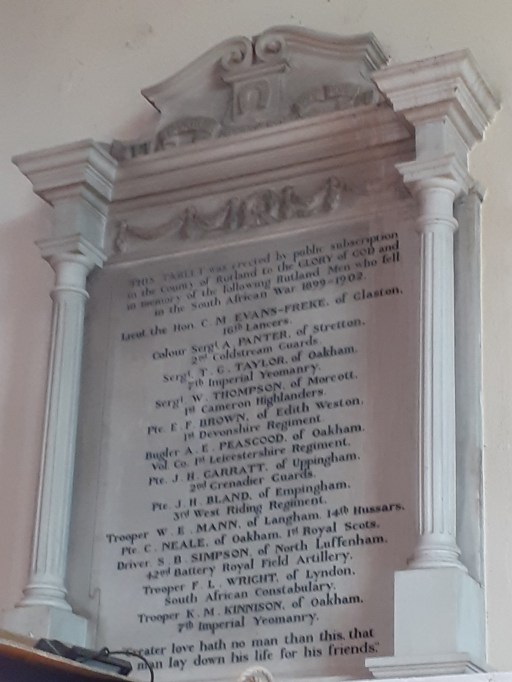
This Boer War monument is now above the choir vestry in the South aisle and not easily accessible – or indeed to photograph. A full description of the dedication service is given in Rutland County Magazine and Historical Record Volume 2, which includes brief biographises of some of those named.
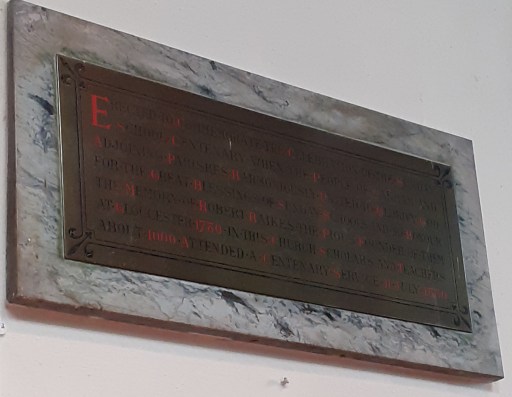
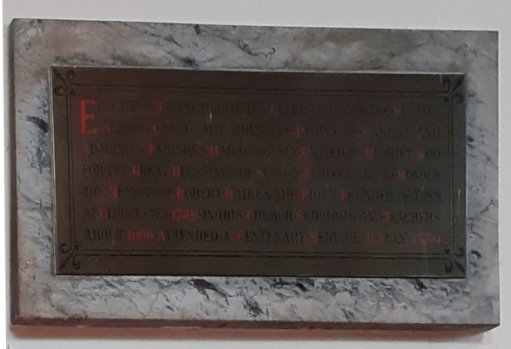
The monument above was both difficult to photograph (to avoid reflections) and difficult to read. It is shown in two forms – as originally taken, and with an attempt made to remove the effect of perspective. It commemorates the 100th anniversary celebration of the Sunday School movement, which around 1000 people attended, and commemorates its founder, Robert Raikes of Gloucester.
North aisle
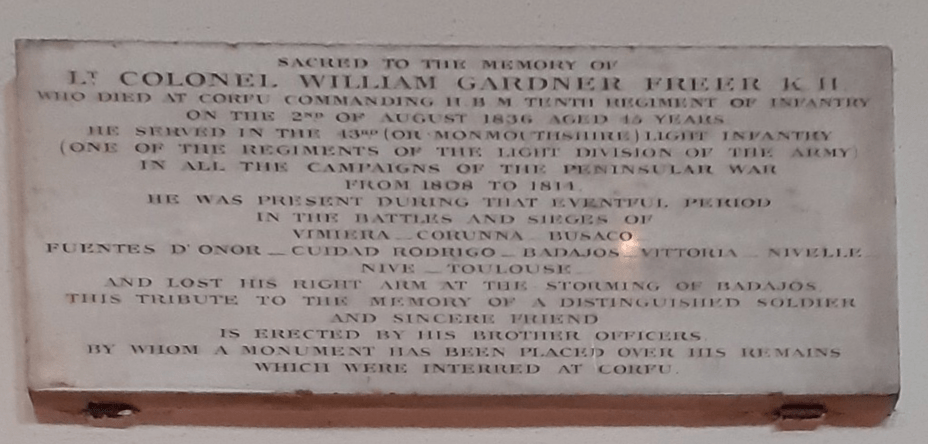
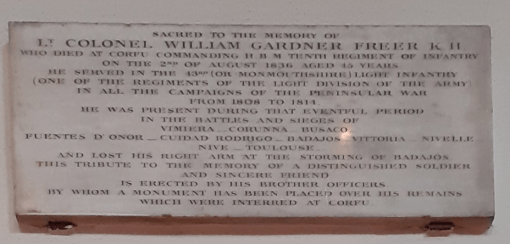
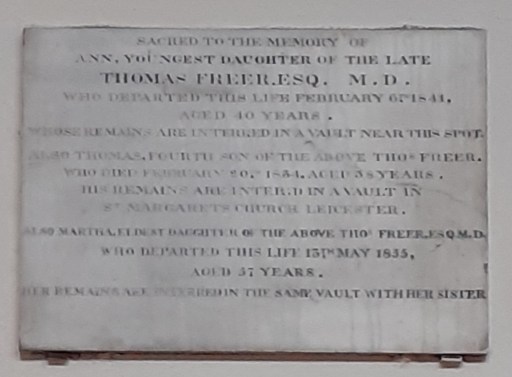
These three monuments are placed above each other in the north aisle in the order shown. The top one is too small to read easily from ground level. They all refer to the Freer family from the early 19th century. The bottom memorial is to Thomas Freer, a doctor, who died in 1835, his wife Martha who died in 1827, and his third son, Edward Gardner who fell in action in the Pyrennees in 1813 aged 20. The second memorial commemorates Thomas and Matha’s youngest daughter Ann (d 1844), their fourth son Thomas (d 1834) and buried in Leicester, and their eldest daughter Martha (d 1835). Finally the upper memorial describes in very small text, Lt. Colonel William Garner Freer who died in Corfu in 1836, whilst commanding the 10th Infantry Regiment. His long military career is outlined, including the loss of his right arm at the storming of Badajos. He is buried in Corfu.
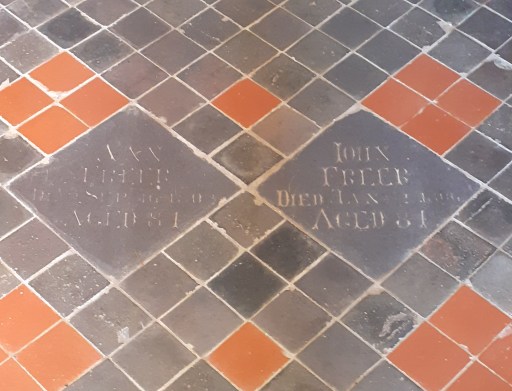
The Freer’s are also commemorated in two tiles in the nave aisle – much faded as they are on the main thoroughfare through church. They are dedicated to Ann and John who, as far as I can make out, died in the early 1800s.
West End
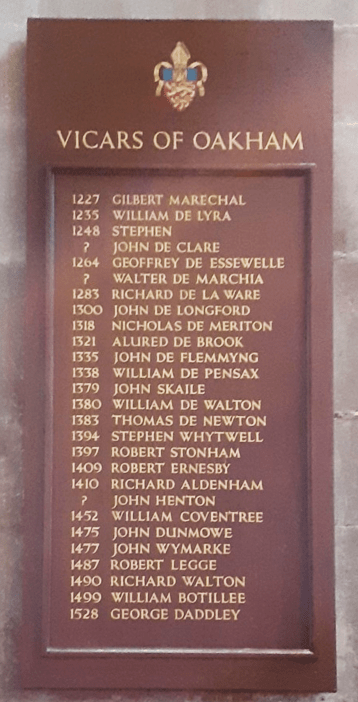
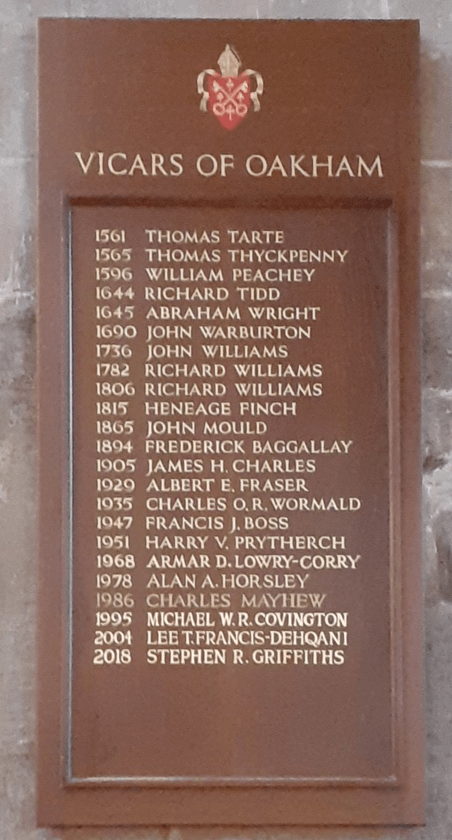
More details of the Vicars of Oakham can be found in the church guide. The Church of England Clergy Database also includes records for both vicars and curates of the parish, and of the surrounding chapels from the mid-sixteenth to the early nineteenth centuries.
All Saints Church in Oakham is a long term supporter of the Church Mission Society (CMS). It has recently been allocated two new mission partners, both working in Myanmar (formerly Burma). CMS have requested that the church does not publicise these links, as the partners work in a dangerous and sensitive situation. Nonetheless we pray for them and support them as best we can.
Very recently, after a service of Morning Prayer in which the mission partners were remembered, I happened to look at a plaque on the wall of the chancel just behind the pulpit, over one of the clergy stalls. The plaque’s location, and the plaque itself are shown in the photographs below.
The typography of the plaque makes it quite difficult to read, which is presumably the reason I have never done so in the past, despite the fact that I have sat in front of it on numerous occassions. But on reading it, I noted that the church in 1906 already had a link with Burma. The plaque reads as follows.
To the glory of God and in memory of Henry Arthur Jerwood, scholar and prefect of Oakham School; a faithful and beloved curate of this parish and a zealous missionary. The lamps in the chancel and sanctuary are erected by his schoolfellows, friends and parishioners. He died serving in obedience to his Master’s call at Mandalay on March 26th 1906.
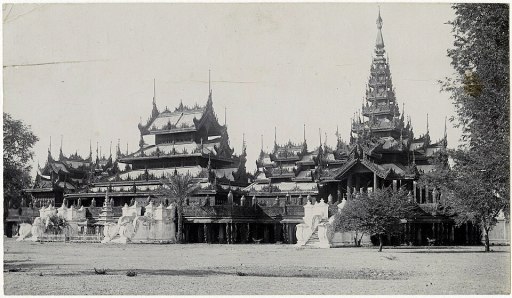
Mandalay is the second largest city in Myanmar, 600km north of the capital Yangon (formerly Rangoon) and is the centre of a largely Buddhist area. Our current mission partners are thus not the first links that the church has had in that area.
Henry Arthur Jerwood
Can we say any more about Henry Jerwood? His basic biographical details can easily be traced on Ancestry. He was born in 1878, the eldest child of Rev. Thomas Frederick Jerwood (1846-1926), Rector of Little Bowden and Dorothea Elizabeth Longsdon (1853-1942) who were married in Yorkshire in 1877. The couple had a number of other children, amongst them Helen Dorothea Jerwood (1880-1965), who will be mentioned below, Rev. Frederick Harold Jerwood (1885-1971) who was to become Chaplain at Oakham School, amd Major Hugh John Jerwood MC (1890-1918) who was killed in action. The latter had a son, born in 1918 after his death – John Michael Jerwood (1918-1991), a businessman and philanthropist, who was to become a significant benefactor of Oakham School, and a number of the school facilities bear his name.
St. Nicholas, Little Bowden, Northants (Richard Dear). Wikipedia
Henry Arthur attended Oakham School, as his father had done before him, and his brothers were later to follow him there. He matriculated at Sidney Sussex College, Cambridge in 1897, taking his BA in 1902 and his MA in 1905. He took some time out just before he graduated to fight in the South African (i.e. Boer) War from 1900 to 1902 with the Suffolk Regiment.
Clergyman and Missionary
After graduation, Henry Jerwood attended the Clergy Training School in Cambridge (the early name of Wescott House) and was ordained deacon in 1902 and took up the curacy at All Saints church in Oakham, a town with which he would have been very familar from his schooldays. The chronology of his training and ordination as deacon and priest is not wholly clear from the sources. In 1905 he applied to become a missionary to Burma. We can trace his short career there through the pages of the Quarterly Paper of the Rangoon Diocesan Association (RQP), a nationwide organisation that supported the work of missionaries in Burma, and was affiliated to the Society for the Promulgation of the Gospel (SPG). These are all available as pdfs in the SOAS missionary archive. As an aside, those who, like myself, dabble in historical matters, are hugely indebted to the patience and the perseverance of the archivisits who made such material available. In RQP 34, June 1905 we read the following under the heading Reinforcements, which says something of the military mindset of the organisation.
…….The Rev. Henry Arthur Jerwood, B.A., of Sidney Sussex ‘College, Cambridge, and the Clergy Training School, was ordained in 1902, to the Curacy at All Saints, Oakham, in the Diocese of Peterborough……
The Rev. A. Jerwood, at present an assistant Curate at Oakham, will join Mr. Fyffe at Mandalay~ a man stout and , vigorous in body and stout of heart, who went to South Africa when the war broke out, and did his part there man fully, and will carry to his work in Burma the same vigour he gave to South Africa and Oakham.
In the next edition (RQP 35, September 1905) we read that, as a consequence of Jerwood’s departure, Rev H J C Knight, the Commissary of the Rangoon Diocesan Association (who recruited for the Association and was living in Jesus Lane in Cambridge), preached at All Saints on Sunday July 30th. The collection of £3 4s was given to the R.D.A.
Then in RQP 36 from December 1905 Jerwood’s arrival in Burma is noted, under the heading News from the Front, again another military metaphor.
The newcomers have arrived, and are settling down to work, the Rev. H. A. Jerwood and Mr. Hart with Mr. Fyffe at Mandalay, the Rev. R. J. Stone at Bishop’s Court as Chaplain, the Rev. R. G. Fairhurst at S. Luke’s, Toungoo, and the Rev. W. H. C. Pope at Rangoon .
We also have the following description of the work in Mandalay,
The Buddhist Field – The Winchester Brotherhood has been founded at Mandalay, on the general lines of the Indian Community Missions, for systematic study of Buddhism and work in the field. The Head, Rev. R. S. Fyffe, has at present only one Brother (Rev. H. A. Jerwood). These two men are the only English Clergy for Missionary work in the chief town of Upper Burma, a city of 180,000 souls. They need at once two men of (if possible) a studious type, of patience, hope, and brotherliness. There is work to do while learning Burmese. The Brothers have passage and outfit paid, maintenance, lodging together, and £40 a year.
The mention of Jerwood in RQP 37 for March 1906 is very brief and simply says that he had taken over the role of Principal at the School run by the Winchester Brotherhood from Mr. Hart, who arrived in Burma at the same time as he did. Jerwood died on March 28th 1906. We read his obituary in RGA 38 June 2006, written by the Commissary Rev H. J. C. Knight.
Though most of our readers will have read the Bishop’s notice of Mr. Jerwood in the Mission Field for June, our R. Q. P. ought to have some notice of him. He was born on February 25th, 1878, the eldest son of the Rev. Thomas Frederick Jerwood, Rector of Little Bowden. He must have owed much to his home. On hearing from Bishop Montgomery that he had fallen asleep, his father was able to write “we hope to send another son.” and assuredly in homes that can speak thus:
“The father’s passion arms the son, And the great work goes on, goes on.”
All his school days were spent at Oakham School; thence he entered Sidney Sussex College, Cambridge. While yet an undergraduate he served in the S. A. war. On his return he graduated, entered the Clergy Training School, and was ordained to Oakham in 1902. Last autumn he went to Burma, calling at Delhi {where his sister was working under S. P. G. in the Cambridge Mission), and other Brotherhoods, and joined Mr. Fyffe at Mandalay in December. On the 28th March last he passed from us. The cause of his death was a rare type of paralysis – nothing climatic. The Bishop and the Rev. R. J. Stone, who was with him at the C. T. S., were in Mandalay at the time. His body rests near the graves of the Colbecks.
We had looked for great things from his ministry in Burma. His qualities of simple manliness, unaffected and robust piety, a very-single-hearted devotion, unselfishness, courage and affection, drew men to him. These, and his unfailing cheerfulness, promised much for our Winchester Brotherhood. He went out “for life,” and so his home gave him. His letters from Mandalay were always touched with humour, and were full of hope and determination. It is easy to pray “Thy will be done,” while we have no disappointments or reversing of our purposes; but it is hard really to bow to the surrender of such a man. When Bishop Maples was drowned on Lake Nyassa. on the very day of his arrival as Bishop of Likoma, Augustine Ambati wrote, “God liked to take him, to make white (i.e., consecrate) so the waters of the lake.” Even so may Mr. Jerwood’s death in Mandalay be one more consecration of the city. To his friends – there and here – it will be one more tie binding us to the missionary spirit, and the forward march of the Church. It is good to know that Mr. Garrad, whom God has moved to carry on his torch, will be, we believe, in every way a brother to Mr. Fyffe. Those who loved H. A. J. will pray “The Lord bless his going out and coming in. ”
H. J. C. K.
The sister in Dehli that is referred to is Helen Dorothea. At the time she worked for the Cambridge Mission of SPG, but was later to work for the East India Company in Dehli. She remained in India all her life, dying in 1965.
Some final thoughts
Interesting as it is to find that All Saints had a link with Myanmar one hundred and twenty years before our current one, and to read Arthur Jerwood’s interesting and ultimately tragic story the aspect that has struck me most in the preparation of this post, is how very different our current Christian culture is to that of 1906. As noted above, military metaphors are often used in the RQP, and indeed the whole publication shows an extremely ordered and extensive organisation that itself has a military flavour. The form of Christianity that one finds in its pages is a very muscular and forceful one and whilst one can admire the earnestness and zeal of those determined to bring the gospel to those who had never heard it, the tone of the publication reflects the colonial era of its time, and the implicit superiority of European (and particularly British) civilisation and culture to that of the “natives”. Howerver, whilst I find this aspect more than a little repellent, I do wonder if we have lost something over the last century, in terms of our zeal and enthusiasm for the mission of the church, both at home and overseas. The words of Revelation 3.15-16 come uncomfortably to mind.
In August 1860 the Rev. Thomas James., M.A.- honorary canon of Peterborough, vicar of Theddingworth, and one the secretaries of Architectural Court of the Archdeaconry of Northampton delivered a lecture to Oakham Literary Institute at the Old Castle Hall of Oakham, on ” Gothic Architecture,” particularly with regard to the history and arrangements of the Church and Castle Hall in Oakham (1). The transcript of his talk can be found here. The speaker was described as “an accomplished ecclesiologist and erudite and painstaking antiquary” and was clearly a major proponent of gothic church architecture in the area.
In his talk he mentions two speculations that I wish to consider briefly in this post. Firstly he stated that there was “a cupboard in the eastern wall, behind the altar, which might have been used as a receptacle for relics, or for receiving the stoup of holy water which stood at the chancel door.” Secondly, with regard to the clergy vestry he said, obviously referring to some past time “…the vestry was two storied, in all probability it was formerly used as the dwelling of an anchorite, that being a prevailing custom at one time. There was a similar instance of a two storied room attached to the church at Barnack, near Stamford“. We consider each of these two statements below.
The altar cupboard
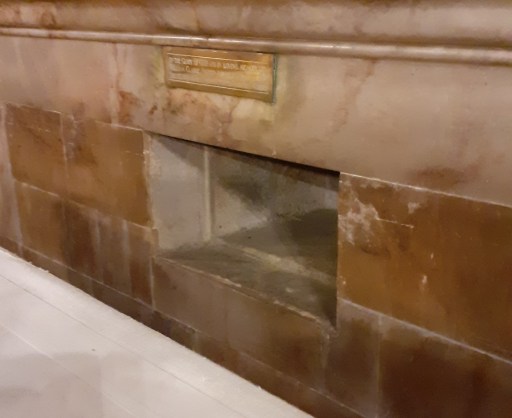
The east end of the church was extensively modified by Gilbert Scott in 1858, but probably only from the bottom of the east window upwards, and it would seem, from the description by James, that the altar cupboard, whatever it was, was still in place in 1860. The area was further extensively modified in 1898 when the current Reredos was installed , and the walling and flooring renewed. However there is still a slot behind the altar which almost certainly was created to mark the position of the cupboard (figure 1). So what was it – a reliquary, a place for storage of holy water, or perhaps an aumbry, where the consecrated bread and wind would be kept? There are as far as I know, no historical mention of any relics in All Saints, but a church of its size and significance may well have been graced with them. There is of course evidence of relics at the priory cell at Brooke to the south of Oakham and the Reliquary can be seen in Rutland County Museum. If it were an aumbry for consecrated bread and wine or a storage place for holy water, then it would need to be opened fairly regularly, and its location behind the altar, which would have been standing against the east wall would have made it relatively inaccessible. So it is possible that it was a reliquary, which would not have been opened regularly, but this must remain as speculation.
Figure 1. The slot in the wall at the east end marking the position of the “cupboard”
The Vestry
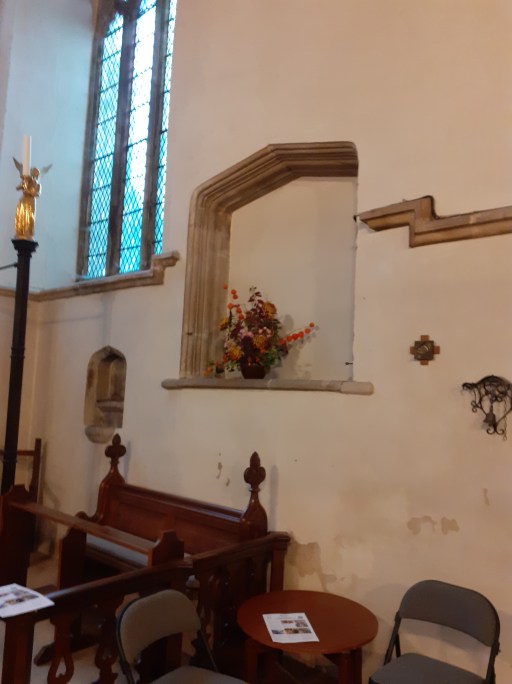
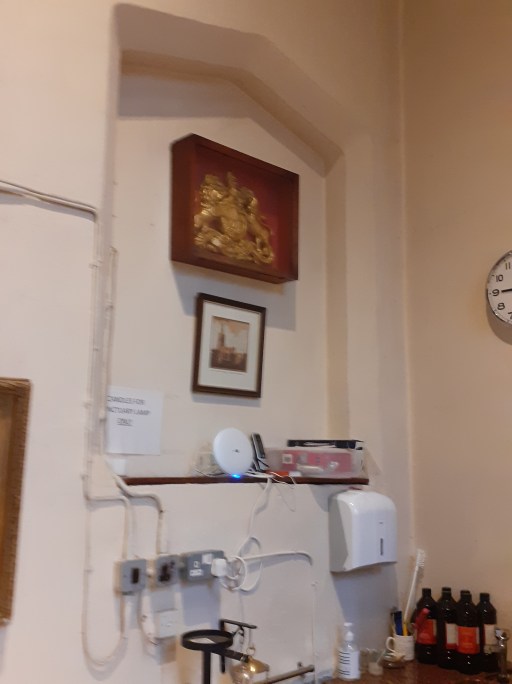
The vestry is thought to have been built around 1480 at the same time as the adjoining Lady Chapel, although this is not certain. It is certainly tall, and could have accommodated a second floor, although there is no current structural evidence for that. One potential feature could be consistent with the idea that and Anchorite hermit (or an Anchoress) resided there, is that there is a blocked up “window” structure in the wall between the vestry and the Lady chapel, which could possibly have been used by the resident hermit to observe the celebration of the mass at the altar below (figure 2). As it stands, the lower edge of this recess is rather too low for it too have been at the level of the floor above, so this might have involved a step down, or perhaps was first built to match the height of an earlier structure on the site of the current vestry. So this perhaps goes some way to bolstering the claim made by Wood, but again there is no certainty.
a
b
Figure 2. The blocked up window structure. a – from the Lady chapel; b – from the vestry. The bottom edge is at the same level in each case.
So to conclude. Whist the presence of relics and hermits in All Saints is a possibility, this is far from certain. As with many Victorian ecclesiologists and antiquarians, the Revd. James may well have let his speculations outrun the evidence.
Additional Note (29/11/24)
After reading the above blog, the Vicar of Oakham, Revd. Stephen Griffiths, sent me the photograph shown in Figure 3 below. This shows two blocked up windows on the east side of the Vestry. From the inside, the lower window corresponds with a recessed cupboard in the wall, which has the appearance of a door, and from the photograph, there seems to be a break in the stone work beneath the window that might indeed suggest it was originally a door. The upper window is similar in form to the stair windows in the tower. Taken together they perhaps suggest a separate entrance with access to an upper level in the vestry. How this relates to the issues addressed in the above blog is not, however, at all clear. All a bit of a mystery.
Figure 3. The east side of the vestry (photograph by Revd. Stephen Griffiths)
Three recent blog posts here, here and here, contain transcripts of newspaper reports that describe the restoration of All Saints Church in Oakham in 1858, under the direction of Gilbert Scott. It is clear from these reports that at the time the church was in a very bad state of repair and most of the restoration was concerned with repairing defects, particularly to the roofs, renovating historical features and replacing much of the internal furnishings. However there was one major area of the church where significant work was carried out that went far beyond simple repairs – to the chancel and to the east end in general. In his condition assessment Scott (1) wrote
The chancel has a roof of modern date concealed by a flat plaster ceiling which cuts across the chancel arch. The same roof extends over the north chancel aisle, thus deforming the east end, by placing two divisions under one gable. The north aisle has most beautiful oak panelled ceiling, which happily conceals its roof from within. The south aisle of the chancel has modern roof, of the very meanest description, so that in the interior of the chancel and its aisles we have first a plain flat plaster ceiling to the chancel itself; then to the north aisle a beautiful oak ceiling, showing the manner in which the ancient builders treated their work; and on the south aisle the roof of modern hedge-carpenter, such as would disgrace a cart-shed.
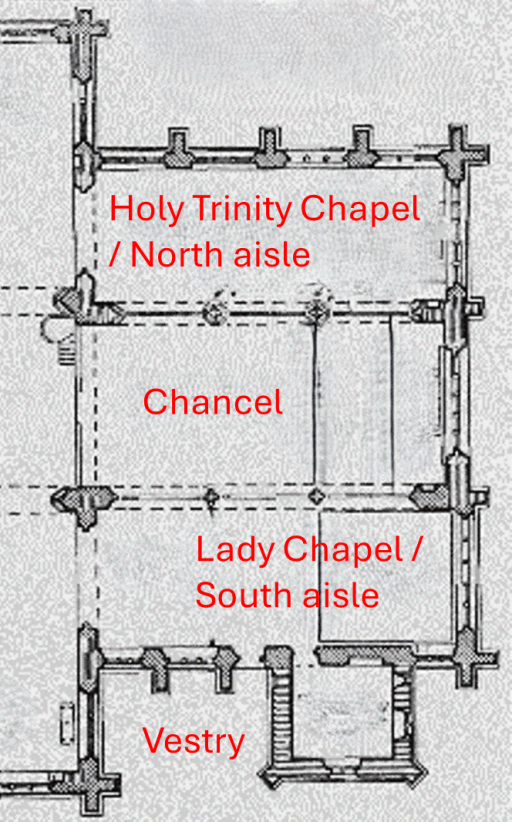
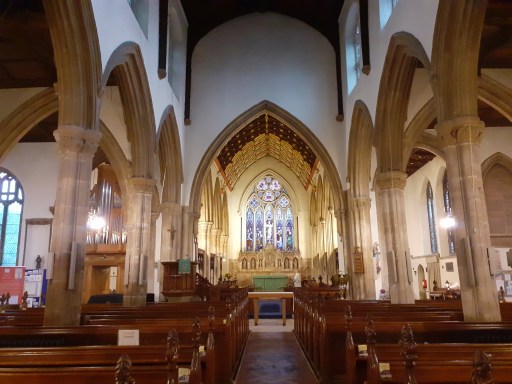
It is not altogether clear what is being described here, particularly in the first sentence, and this is the aspect of the work that will be considered in this post. First of all, let us consider the current (2024) state of that area of the church. A plan is given in figure 1 and shows the chancel, with the 13th century Holy Trinity chapel to the north and the Lady Chapel (built around 1480) to the south (the chapels are the north and south aisles referred to in the above quotation) (2). Figure 2a,b,c,d shows views of chancel and the chapels from the west end of the church. The chancel arch, referred to by Scott can be seen in figure 2d. It can be seen that the chancel itself is higher than the chapels to either side and certainly higher than the chancel arch, so the ceiling that Scott took exception to has been removed.
Figure 1. Plan of the east end of the church
a
b
c
d
Figure 2. a – North aisle / Holy Trinity chapel; b -Chancel; c – South aisle / Lady chapel; d – view from nave showing chancel arch.
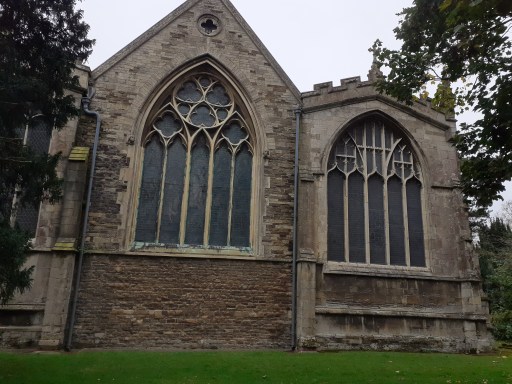
Photographs of the east end of the church from the outside are shown in figure 3. There is no natural viewing point to take an overall photograph and the view is obstructed by trees in the churchyard, but, despite the odd perspective, both chapels and the chancel can be seen. The change in stonework around and above the chancel window shows the rebuilding of the 1850s.
a. Lady chapel and chancel
Chancel and Holy Trinity chapel
Figure 3. The east end of the church
Happily we can gain an understanding of what this end of the church looked like before the restoration from an 1851 model kept in the church (3). This is in a glass display case, currently in the north transept, and was not altogether easy to photograph, largely because this entailed standing on a pew, turning through ninety degrees and trying to photograph something in a glass case next to a window, with multiple reflections. Nonetheless, a rather poor quality photograph is shown in figure 4. The caption on the display case reads
In loving memory of Mary Grinter who passed to her rest on 10th February 1950. Age 87 years. This model was made by her father John Pitt Coulam (1833-1898)
Figure 4. The 1851 model
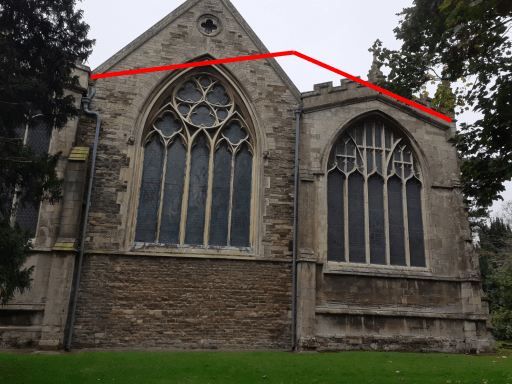
Figure 5. Photograph of the east end of the church showing the roof line of the 1851 model.
The east end in this photograph can be seen to be very different from the photographs of figure 3. Figure 5 shows the 1851 roof line from figure 4 superimposed on the photograph of figure 3b. And from this one can understand what Scott meant. The chancel seems to have been reduced from its original height (which the height of the chance arch suggest was similar to today), and a pitched roof added over both the north aisle / Holy Trinity, chapel and the chancel itself. Thus, the two chapels indeed share a gable, and the roof / ceiling of the chancel would cut across the chancel arch in a very un-elegant fashion. The window at the east end would also seem to have been deliberately lowered to fit into the new arrangement. Figure 6 shows, in an edited version of figure 2b, how Scott would have seen the interior of the church, with the top of the chancel arch blocked, a lower flat ceiling in place, and a smaller east window
Figure 6. The chancel as would have been seen by Scott, with chancel arch blocked, lowered flat ceilingand smaller east window
Scott’s work changed all this, restoring the chancel to its original height and adding sound roofs and spectacular internal ceilings. A new east window was inserted, which, the 2003 church guide (3) tells us, was criticised at the time for being of “decorated” rather than “perpendicular” form. Funny what folk get upset about.
So why on earth did this happen – why was the original rather elegant design of the chancel and chapel changed in this way, presumably sometime in the 15th to 17th centuries. I can think of two possible reasons. The first is wholly utilitarian – the chancel, and in particular the roof, may have been in a very poor state of repair, and required extensive renovation and repair. The arrangement criticised by Scott could have been a cheap way of making that end of the church reasonably sound, if rather ugly. The second reason has a more theological basis. After the Reformation, the Elizabethan settlement enforced conformity of practice – in particular taking down the altars at the eats ends of chancels and replacing them, for the purpose of celebrating holy communion, with a table placed lengthways in the chancel, around which communicants would have gathered, with the celebrant on the north (long) side of the table. The combined chancel and north chapel would thus have provided a typical Elizabethan “communion room”. A surviving example of such an arrangement can be seen locally at Brooke. (figure 7) where the spacious chancel is separated from a north chapel by a simple screen. This arrangement was only temporary and after the restoration of the monarchy in 1660, with the Laudians in the ascendency, the altars at the east ends of chancels were reinstated with little opposition. Some clergy however continued to celebrate from the north end even with the altar in the new positions, and indeed, this is still the case in a few places.
Whatever the reason, I have to admit (albeit grudgingly) that Scott was correct in this case in his desire to restore the chancel to its gothic glory from what seems to have been a somewhat botched Elizabethan / Stuart arrangement.
One further point arises. In the north aisle / Holy Trinity chapel there is a large chest tomb, with no dedication, placed lengthways next to the chancel (figure 8). It is said in (2) to be early 16th century – perhaps around the time of the Reformation. The images of sheep bells or wool weights on the side have led to the suggestion that it might be the tomb of a wool merchant. In the chancel arrangement before Scott’s restoration this would have been very prominent – indeed in the centre of the gable, possibly between two altar positions. One can speculate that the tomb was either placed in this position deliberately or indeed whoever was responsible might also have rebuilt the chancel / chapel to give the tomb such a prominence.
‘Parishes: Oakham’, in A History of the County of Rutland: Volume 2, ed. William Page (London, 1935), British History Online [accessed 21 October 2024].
Aston N (2003) All Saints Oakham, Rutland. A guide and history.
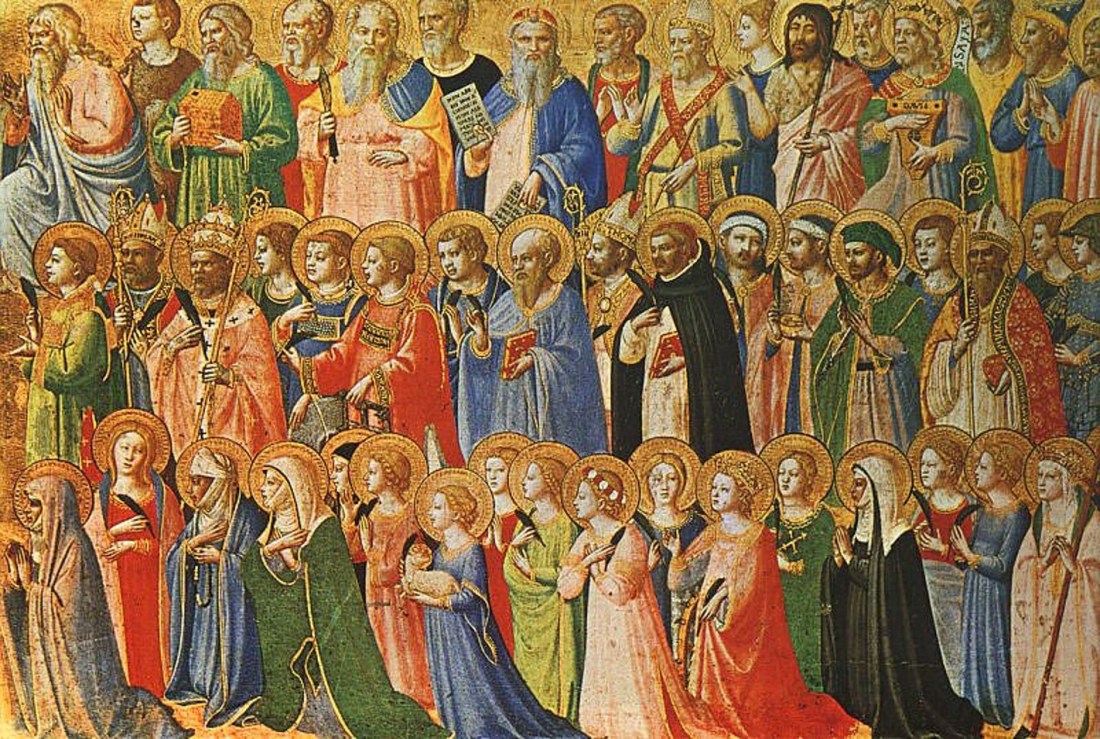
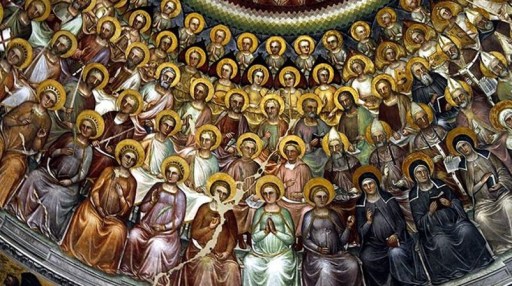
“Communion of the Saints” in a Baptistry in Padua (José Luiz)
On October 31st 2024, I gave a lecture at All Saints church entitled “A time to mourn, and a time to dance – the All Saints season through the ages“, which explored how the season between Halloween had developed over the centuries and millennia. This was part of a wider celebration of the festival of All Saints that included a musical concert; church tours; a tower climb, a pop up cafe and a number of services of worship.
In the church notices for the Sunday beforehand I wrote the following introduction to the talk.
The start of November marks the beginning of winter in seasonal terms, and is the time of a number of festivals and celebrations – Halloween, All Saints Day, All Souls Day, Bonfire Night and Remembrance Day. In this talk I will explore how all these evolved through the ages from pre-Christian times, through the medieval period to the Reformation and from then to the 21st century. A few other festivals which haven’t made it to modern times will also be mentioned. There will be a large cast of popes and bishops, kings and queens, saints and sinners with a few fairies and witches thrown in. I will of course be using PowerPoint, the academics comfort blanket, with some audio tracks, so if nothing else the almost inevitable failure of technology may be entertaining. But I found putting the talk together really quite interesting, and I l learnt a few things that were new to me on the way, so hopefully others will find it interesting too – and possibly even enjoyable!
This web page contains links to a transcript of the talk, and a re-recording of the talk made after the event. The latter contains the PowerPoint slides I used; the former is just the text. The presentation does not include the audio clips I used in the talk – YouTube would not have allowed me to upload these for copyright reasons.
For those interested in reading further about the development of seasonal celebrations in England I would recommend the following book by Prof Ronald Hutton – from which I took much of the information for the talk.
This is a picture blog, that simply gives pictures of a walk around Oakham. This is not a walk that takes in the traditional historical highlights, although some of those are included, but is rather one in which I show the things that have caught my eye, mainly on my wonderings about the town with the dog. So it is a little idiosyncratic, but I hope will be of interest to some. Except where otherwise indicated, the pictures were all taken by me, and I am happy for them to be used by others, properly credited of course.
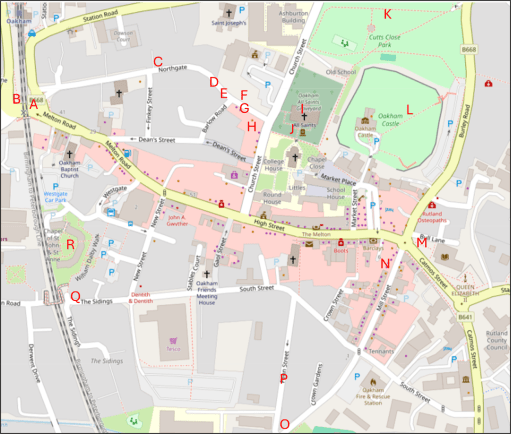
The map
The map below shows the approximate locations from which the photographs (A to R) were taken, superimposed on an up to date map from Open Street Map.
The pictures
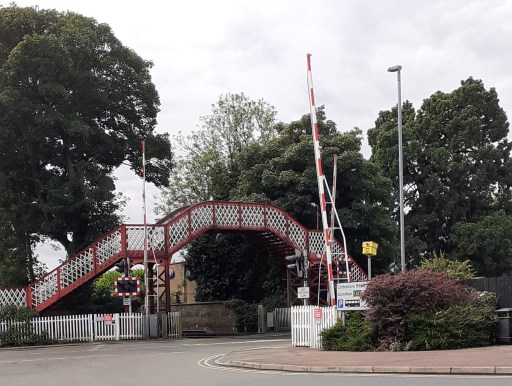
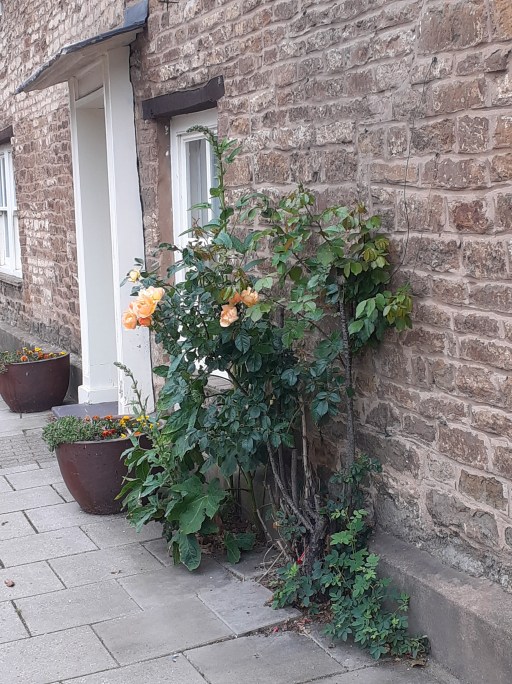
A. The railway crossingB. The signal boxC. Roses on NorthgateD. Roses on NorthgateE. Roses on NorthgateF. House on Northgate
The first picture is of the listed Midland Railway bridge and level crossing (Picture A) a source of endless frustration to drivers, and, as the location of the meeting of five roads, a horribly hazardous place for pedestrians. There must be a better way of doing traffic management here. Picture B is the Midland Railway Signal Box, which was the inspiration for the Hornby Railway model. Turning along Northgate, there are three pictures of rose bushes (Pictures C to E), some cultivated, some not. but in early summer their cumulative effect is striking. Picture F is of a house a little further along Northgate, with a wonderful display of creepers and climbing foliage.
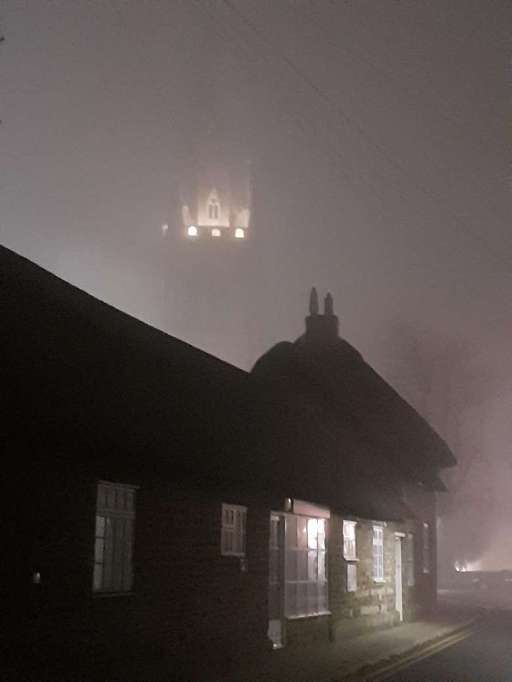
G. All Saints Church through the mistH. All Saints Church from the Wheatsheaf gardenI. Green Man carving in All Saints ChurchJ. Possible Anglo-Saxon cross at All Saints ChurchK. Castle Great Hall, Old School and Church from Cutts CloseL. Castle Great Hall, Church and Old School from Castle grounds
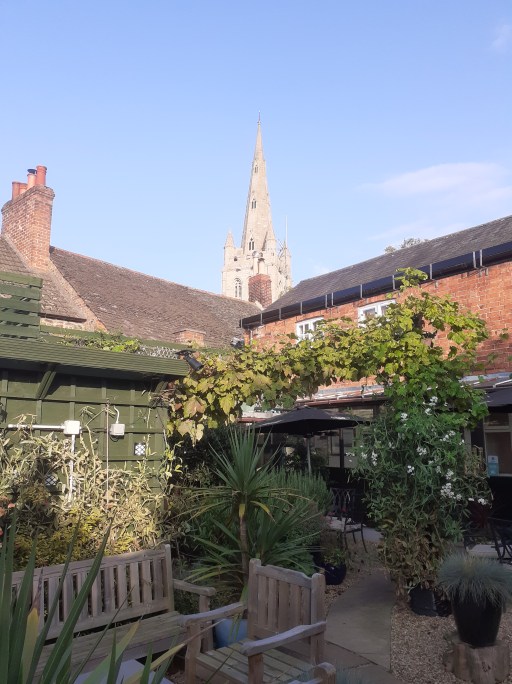
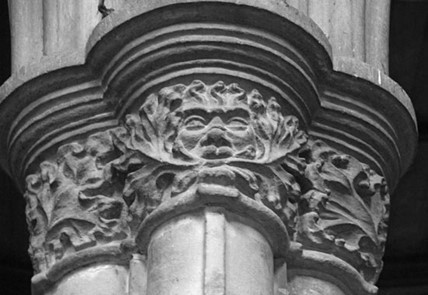
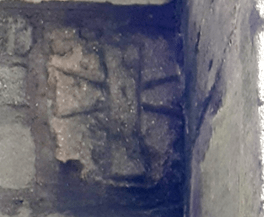
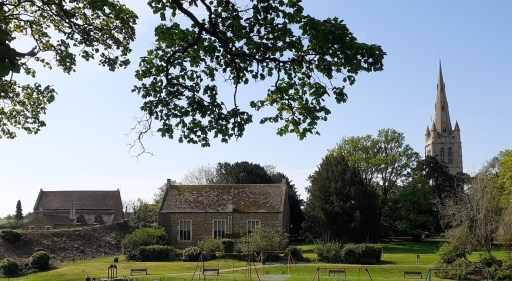
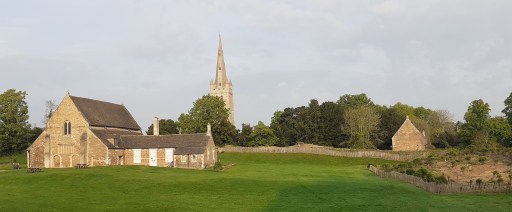
The next six photos all figure All Saints Church in one way or another. Picture G is a photo taken from Northgate on a misty evening where all that can be seen of the tower is a small floodlight area. The thatched cottages on Northgate can be seen in the foreground. Picture H shows the spire of the church from the garden of the Wheatsheaf pub opposite on a pleasant summer afternoon. Picture I (from here) shows the Green Man stone capital within the church – one of a series of wonderful capital carvings I have blogged about elsewhere. Picture J shows a possible Anglo-Saxon Saxon cross built into the south porch of the church. The identification is very speculative, but the cross is very similar to other, demonstratively, Anglo-Saxon examples. Pictures K and L shows t wo views of the Castle Great Hall, Old School and Church, from Cutts Close and the Castle grounds. I have argued elsewhere that these might be an indication of an early church group in the area. Click on the pictures to see the full extent of the photographs.
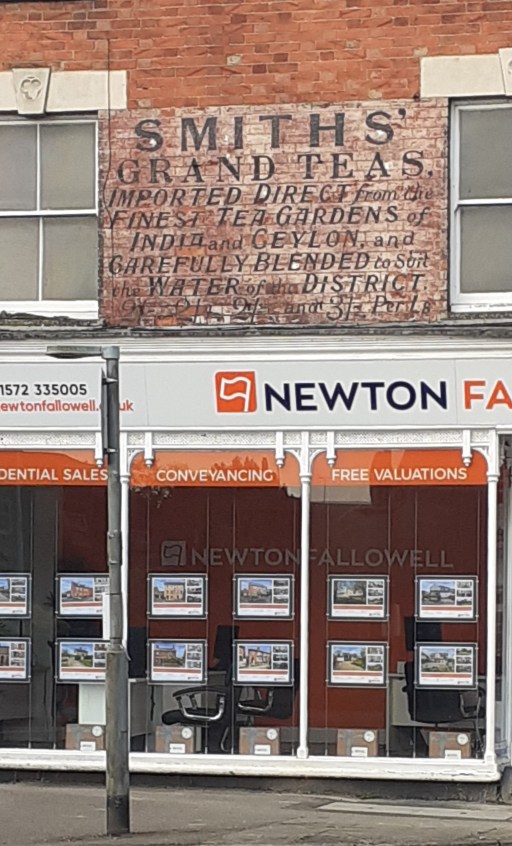
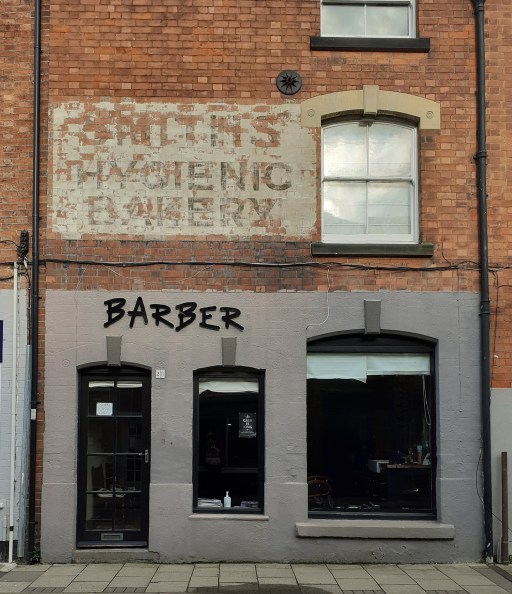
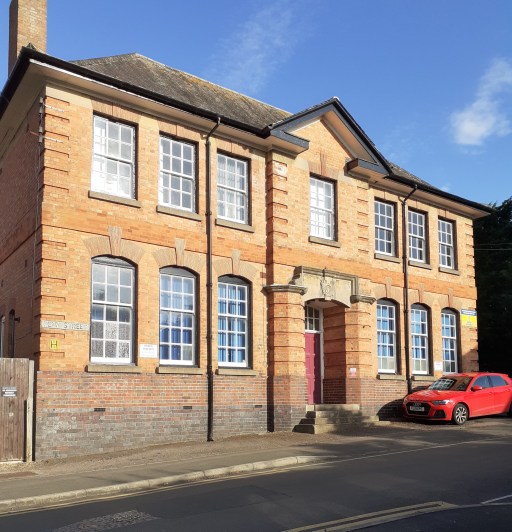
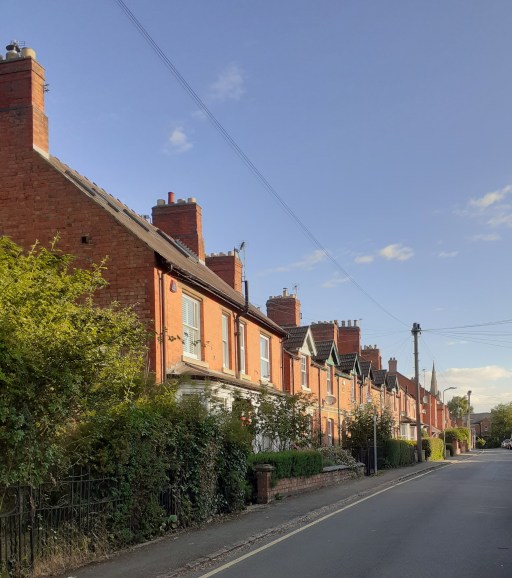
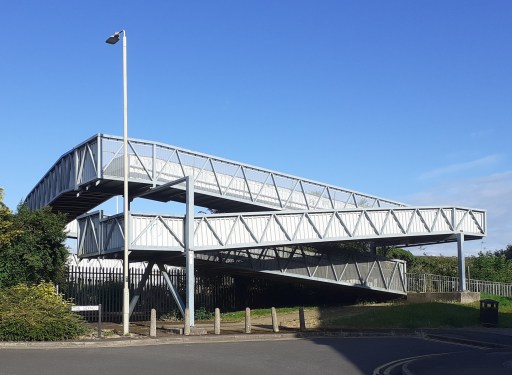
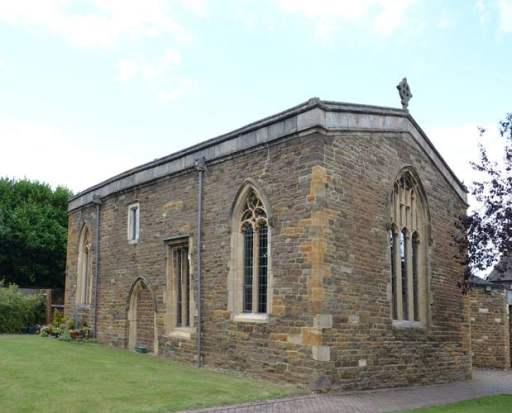
M. Ghost sign on Catmose St.N. Ghost sigh on Mill St. O. The Old Drill Hall on Penn St. P. Houses on Penn St. Q. Pedestrian bridge over the railway at the end of South St. R. The chapel of St. John and St. Anne
Pictures M and N show two nice examples of ghost signs from Catmose Street and Mill Street – faded, painted signs indicating a former usages. Picture O shows the Old Drill Hall on Penn Street which is impressive despite looking as if it could do with a bit of TLC. Picture P, also on Penn Street shows row of houses with a pleasing skyline. South Street Railway Bridge (Picture Q) is hardly beautiful, but very functional ,offering a way over the railway for pedestrians old and young, cyclists, mobility scooters, prams, shopping trolleys etc. For obvious reasons it is know in my household as the “slow bridge”. Finally Picture R (from here) shows the chapel of St John and St Anne – a medieval foundation serving the sheltered housing around it. It is the only place I know where the minister presiding at communion can watch, through the west window, the tops of passenger and freight trains passing within a few yards of the outer wall.#



































.jpg)


