

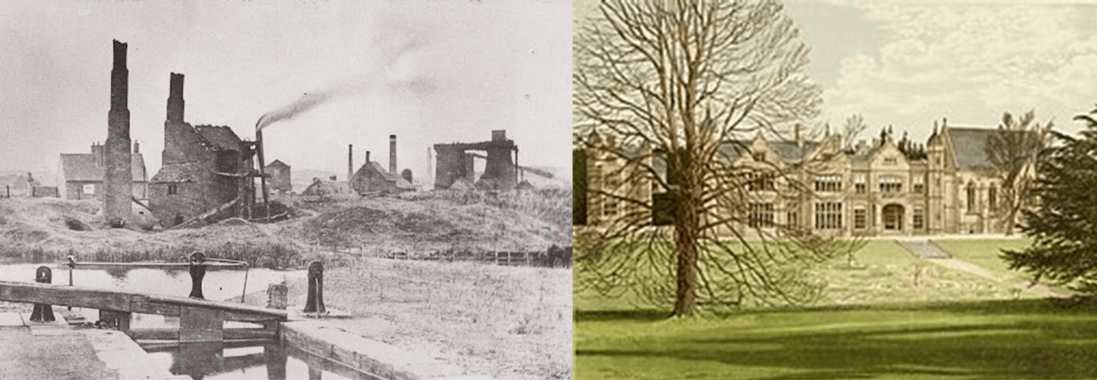
Readers of my blogs will know that I have written extensively about the history of the Black Country, and in particular the area around Dudley where I was born and brought up. More recently I have been delving into the history of my current home in Oakham in Rutland. In recent months I have been thinking particularly about the Oakham Parish Library, that was donated to All Saints church in Oakham through the bequest of Lady Anne Harington of Exton in 1616. This bequest was of half of her son John’s books, acquired on European trips in 1604 and 1608, following his death in 1614, together with a sum of £32 for the poor of Oakham Lordshold. One might think that my Black Country work, largely looking at the nitty gritty detail of mining and industrial development in the 18th and 19th centuries would have little connection with the altogether grander Elizabethan court history of the Haringtons in leafy Exton. To paraphrase Tertullian “What has Dudley to do with Exton?”. But there is in fact a connection – through the marriage of Edward Sutton, 5th Baron Dudley to Theodosia Harington of Exton, and it comes with quite a story.
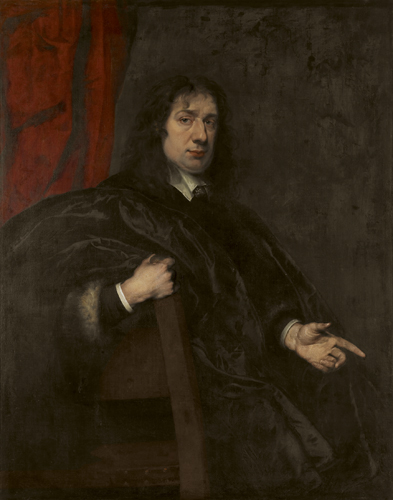
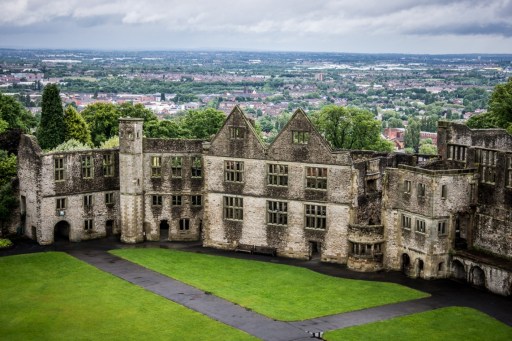
Edward Sutton succeeded to the title of Baron of Dudley in 1586, aged 19. The estate was centred on the ancient seat of Dudley Castle and owned several surrounding, resource rich, manors. The estate was in considerable financial trouble when he inherited it, and his profligacy made things worse. He developed the mining and iron making activities of the area in an attempt to improve his finances, but the debts remained and the situation became even worse. In addition he seems to have been in constant strife with his neighbours, particularly Gilbert Lyttelton of nearby Prestwood Hall, against whom he actually took up arms, and was brought before the Star Chamber on a number of occasions.
In 1581 Edward, at the age of 14, was married to Theodosia Harington, a daughter of James Harington of Exton Hall in Rutland, who was some years his senior. She was thus the sister in law of Anne Harington, the wife of her brother John 1st Baron Harington of Exton, who made the bequest to Oakham Parish Church, and the aunt of Anne’s son John, the second Baron Harington, whose books were donated.
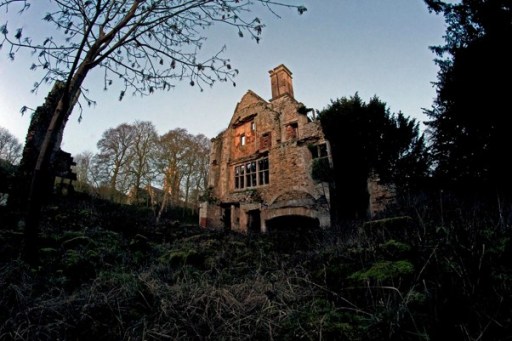
She and Edward had five children – the heir Ferdinando Sutton (b 1588) and four daughters Mary (b 1586), Anne (b 1589), Margaret (b 1697) and Theodosia (b 1599).
There was a major scandal however in the mid-1590s when Edward effectively abandoned Theodosia in favour of Elizabeth Tomlinson, “a lewd and infamous woman, a base collier’s daughter” by whom he was to have at least 11 children. This resulted in Privy Council proceedings where Edward was ordered to pay £100 per annum to Theodosia plus £20 for each legitimate child. Naturally he defaulted on this, no doubt due to his perilous financial situation, but also because he was supporting his children by Elizabeth. These children became a localised Black Country gentry, some of whom pursued industrial interests in the area, and in due course became the reason why many in the Black Country could claim aristocratic, and if they go back far enough, royal ancestry. Prominent amongst these was Dud Dudley, the metallurgist and doctor who attempted to smelt iron using coke instead of charcoal. Edward Sutton died in 1643 and was buried in the Parish church of St Edmund in Dudley.
Despite her abandonment Theodosia seems not to have fared too badly, and was active in court circles and well supported by her friends. She can be found in the dedication of a number of books of the period. Her son Ferdinando died before his father and Ferdinando’s daughter Frances inherited the Dudley title in her own right. Theodosia’s daughters also married well – Mary to Alexander Home, 1st Earl of Home, Anne to Hans Meinhard von Schönberg, and Margaret to Sir Miles Hobart. Theodosia died in 1649 and was buried in St Margaret’s Westminster.
Theodosia’ granddaughter Frances mentioned above married Humble Ward, son of a London Goldsmith, in 1628, who paid off the Dudley debts. He was ennobled in his own right as Baron Ward in 1644. Their children took the titles of Barons Dudley and Ward, until 1740 when the differing laws of succession of the two titles resulted in the Baronies being split. That of Dudley eventually went into abeyance because of a disputed succession in 1757, a situation that was not resolved till 1916. The Ward line, which inherited the Dudley Estate, prospered and John Ward was made Earl of Dudley in 1827.
From my perspective I find it interesting that Theodosia is no more than a footnote in Black Country History, simply the mother of the heir to the estate, and her background seems hardly to have merited discussion. Similarly Edward Sutton does not seem to get much of a mention in Rutland historical discussions. The short lives of Theodosia’s son Ferdinando and nephew John were lived in very different environments – the first mainly in the confines of Dudley Castle where his daughter Frances was born, already being surrounded by mines and limestone workings, whilst the second was able to consort with royalty, particularly the Prince of Wales and to travel around Europe before attending the then new Sidney Sussex College in Cambridge and living on the deeply rural Exton estate. Both lived in perilous financial circumstances however – Ferdinando due to the profligacy of his forebears, and John because of the amount that his father spent on entertaining royalty and living the sort of life expected of Elizabethan and Stuart courtiers.
So what has Dudley to do with Exton? Quite a lot really.


