
The parish library of Oakham’s All Saints Church began its life earlier than most parish libraries represented here, by over 100 years. In 1616 Lady Anne Harington, widow of John, 1st Baron Harington of Exton in Rutland gave a collection of books to the parish “for the use of the Vicar of that Church, and accommodation of the Neighbouring Clergy”, which I guess includes me. It remained in the church until 1980 when it was deposited at the University of Nottingham’s Manuscripts and Special Collections (2 years before I was appointed as a lecturer in Civil Engineering).
There are 67 titles documented at the time of the deposit whose dates of publication predate 1616, that are thus likely to be part of the Harington bequest. 23 titles of these 67 titles, are definitely part of the bequest because Lady Anne had a label printed with her name as donor and pasted onto the title pages.
The set of books was put together by Lady Harington’s son John, born in 1592 and a student of Sidney Sussex College in Cambridge. In 1608 he undertook his “Grand Tour” of the Low Countries, Italy and France, and bought books which were distinctly Catholic in their outlook, like the ones on show in the Oakham Parish Library display case, including books of church canons and papal decrees. There are also 16th and 17th century reprints of the work of the church fathers from the early years of the Christian era. This was an odd choice, both for a 16 old young man and for those post reformation times, and one can only speculate on why these were chosen – perhaps some youthful act of rebellion? The books remained by and large unread because John Harington died at the age of 22, of smallpox. His mother was the executrix of his will and she gave his books to Oakham’s All Saints Church and to Sidney Sussex College. The library remained in the church, supplemented by others over the years, mainly bibles and prayer books. I find it remarkable that it survived the commonwealth period when Oakham was a centre of Presbyterianism – and indeed the vicar at that time was displaced by a Presbyterian preacher who thus took ownership of them. In the 1980s, a church guide booklet described them as looking “decidedly unread”. Perhaps, in terms of their survival, being unread was a good thing!
At Nottingham, the books have been catalogued to a high descriptive level and are findable in the online catalogue by researchers everywhere. Locally, they are used for teaching students. The staff at Manuscripts and Special Collections have designed a workshop using the images printed on frontispieces and title pages from the Oakham library and from others. In the last three years over 200 students have completed this workshop as part of their modules in the Schools of History, Liberal Arts and Theology. The books have thus probably received more attention over the last decade or so than they did in their 350 years in All Saints church!
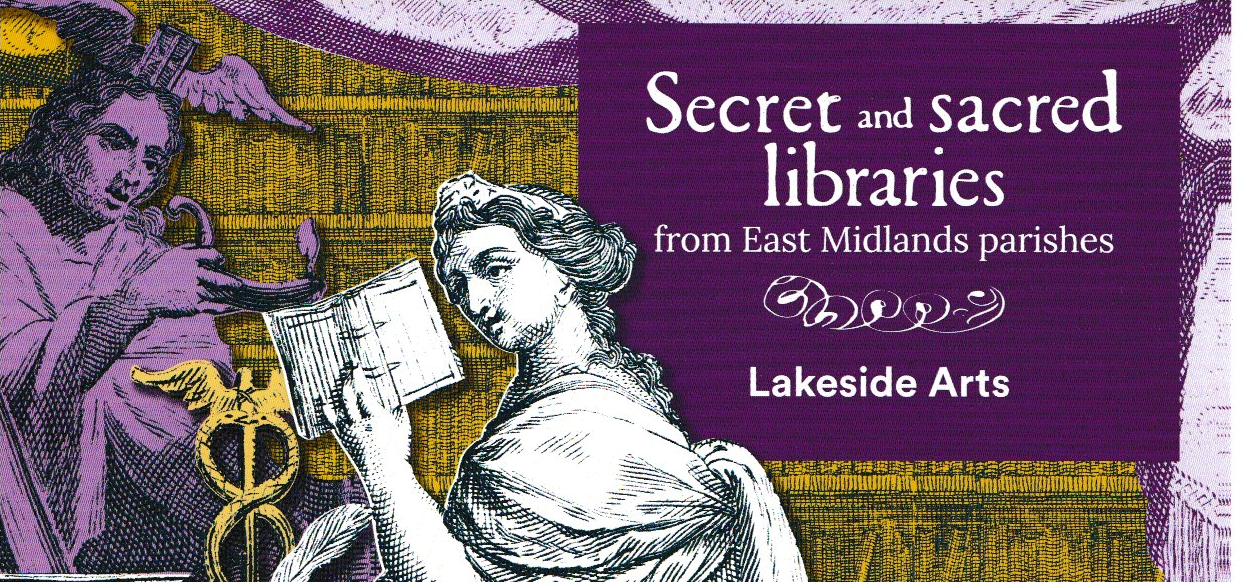
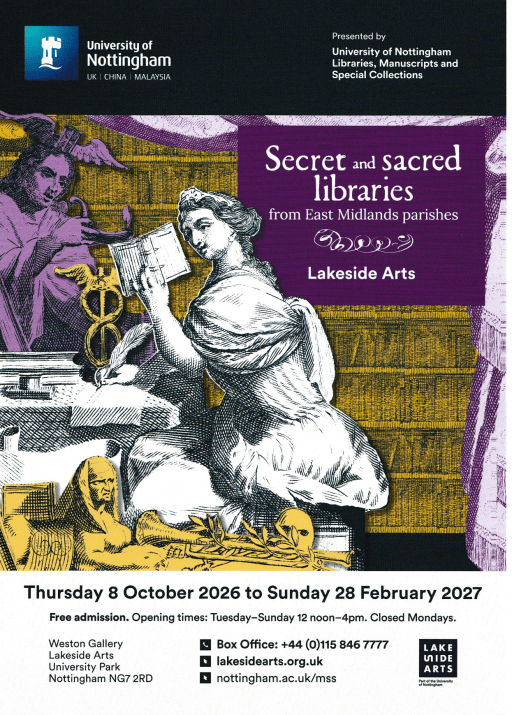
In association with the Parish Library Network, there is currently a small exhibition in All Saints Oakham, featuring the Parish Library, the Harington Dole (a gift of £32 pounds per year made at the same time to support the poor of the town) and the Oakham bible, a thirteenth century bible, owned by the church, but now in the keeping of the UL at Cambridge. There are some fliers for this about – do come over and have a look if you have time.
The Oakham Parish Library books were all printed in the foreign centres of the print revolution in Italy, France and the Low Countries. They are mainly in Latin, with a few in Greek, which of course most educated Europeans would have been able to read. The books thus transcended national and linguistic boundaries. The texts that they included were written over a period of over 1000 years or more in very different cultural contexts. Parish libraries in general, and perhaps the Oakham Parish Library in particular, can be thought of as vehicles for the mind. Whilst being rooted in a time and place they have the ability to take their readers to times and places far beyond their own experience. And so I very much hope that this exhibition will inspire the research community as well as the local communities of the East Midlands, and give us all this wider appreciation of the worlds from which they came.

