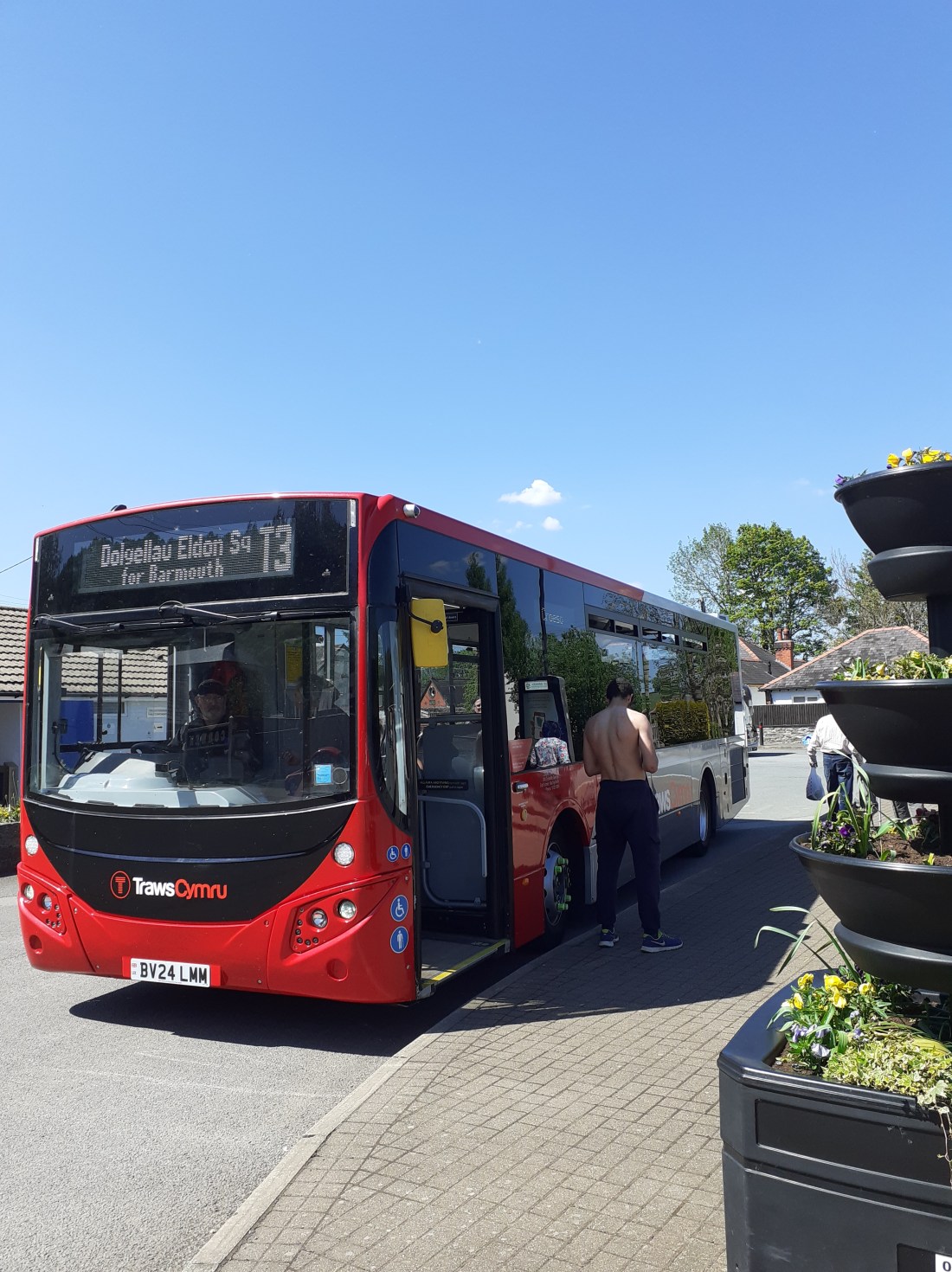
Traws Cymru – a trip around North Wales

Introduction

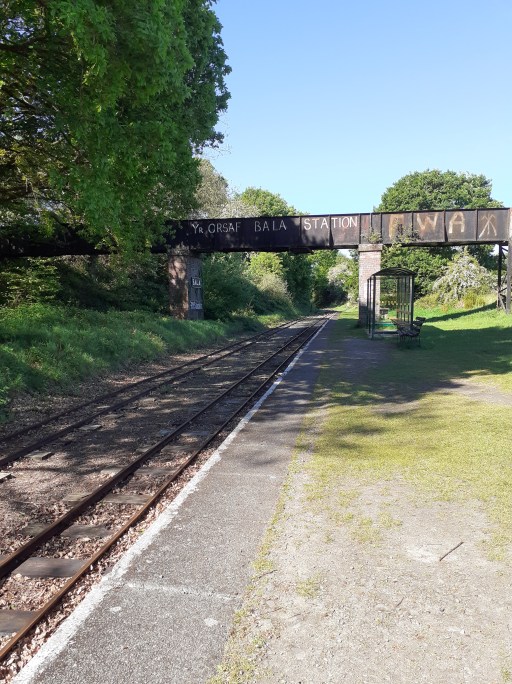
In mid-May 2025, I made a journey that I have had in mind for a number of years – a circular trip around North Wales mainly by inter-urban bus. I had a number of reasons for wanting to make this trip. Firstly it involves travel through some of the loveliest countryside anywhere in Britain. Secondly, it allowed me to indulge my obsession with looking at heritage railway stations, three of which are shown below – I will leave it to the reader to identify them. And thirdly, and for the purpose of this post most importantly, it allowed me to travel on the Traws Cymru bus network. I have watched this network develop from afar over the years, and have often thought I would like to look at it more closely.
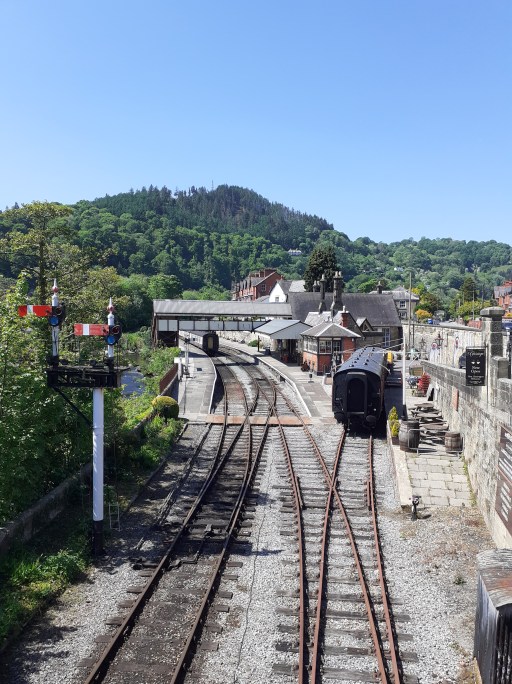
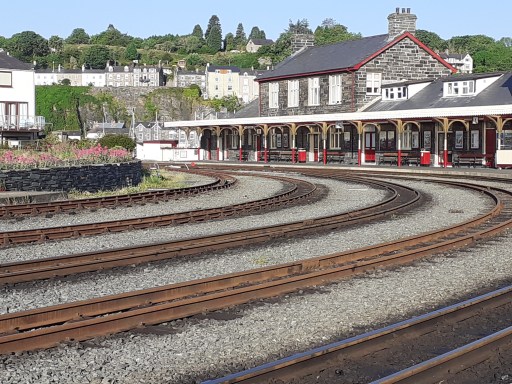
In what follows I firstly describe the route that I took and comment on some general aspects. I then consider the vehicles that I travelled on, and then the infrastructure – bus stops and interchanges. Finally I make a number of comments on the good and bad points of the trip.

The route

The first step of my journey was to travel from my home in Oakham in Rutland to Ruabon on the Welsh border by train. This involved changes ta Birmingham New St and Shrewsbury. There were no problems either on the way there or the way out, with all journeys running close to time. At the start of the journey there was the perennial feeling of relief when it became clear my Cross Country train was really running and had not been cancelled, that turned into a feeling of surprise when it actually arrived at Oakham on time. But, as I say, the journey worked well and I arrived at Ruabon around noon as planned.

Traws Cymru network (from the Traws Cymru web site)

The Traws Cymru inter-urban bus network in North Wales is shown in the figure above. My first bus was not however part of the Trwas Cymru network, but rather the Arriva 5 from Wrexham to Llangollen that I boarded at Ruabon. I took this rather than wait an hour and a half for the first Traws Cymru T3 bus, and it gave me time for a brief look around Llangollen and a look at the railway station. On boarding this bus I asked for a concessionary 1bws ticket (£4.70 for all day travel on buses in North Wales for English bus pass holders – excellent value). The driver looked a bit mystified but eventually gave me the correct ticket. The bus was quite full – over 50% loaded – but fairly comfortable and made up some of the time after a 10 minute late departure from Ruabon. From then on my journeys were all (bar one) on the Traws Cymru network as follows (approximate loading given in brackets).

  • Llandudno 13.39 to Corwen 14.04 – T3 (60%)
  • Corwen 14.15 to Betws-y-Coed 15.03 – T10 (5%)
  • Betws-y-Coed 15.05 to Caernarfon 16.23 – S1 (30 to 50%)
  • Caernarfon 17.05 to Porthmadog 18.05 – T2 (100%+)

And the following day.

  • Porthmadog 8.05 to Dolgellau 9.02 – T2 (30%)
  • Dolgellau 9.03 to Bala 9.33 – T3 (5%)
  • Bala 11.33 to Ruabon 12.39 – T3 (25%)

All the journeys kept time very well, and none was more than 3 or 4 minutes late at the point where I disembarked. Throughout the trip, the drivers were helpful and friendly, which makes a hige difference to the passenger experience. The journey not on the Traws Cymru network was the Sherpa S1. I chose to change onto this, rather than continue on the T10 to Bangor and catch the T2 to Caernarfon and Porthmadog there, simply because the ride up to Pen-y-Pass at the foot of Snowdon must be one of the most spectacular and exhilarating in the country.

The vehicles

I am by no means a bus expert, but from what I could gather from various websites, I travelled on the following vehicles.

  • 5 – ADL Enviro400 City, operated by Arriva
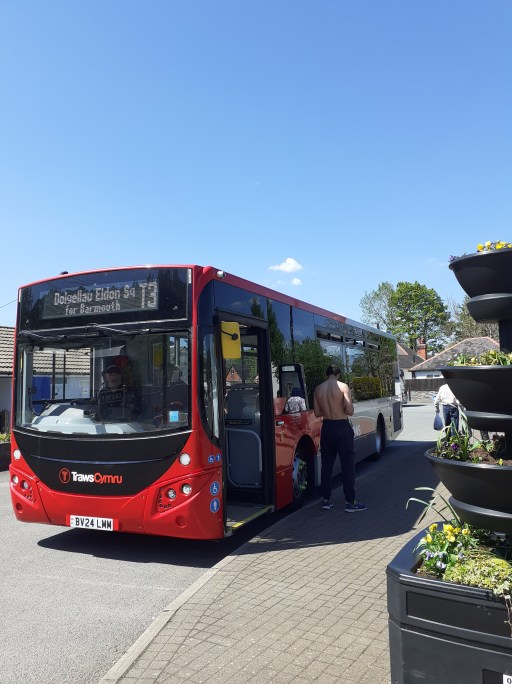
  • Traws Cymru T2 and T3 – Volvo B8RLE MCV Evora operated by Lloyds Coaches.
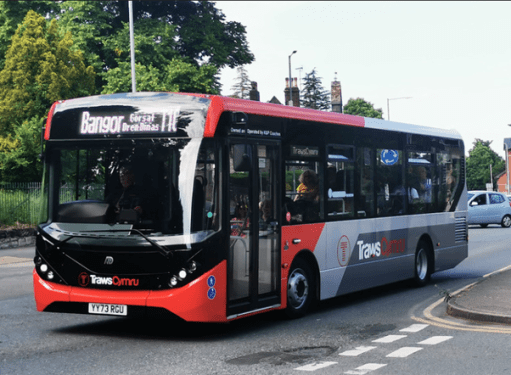
  • Traws Cymru T10 – ADL Enviro200 MMC operated by K and P coaches.
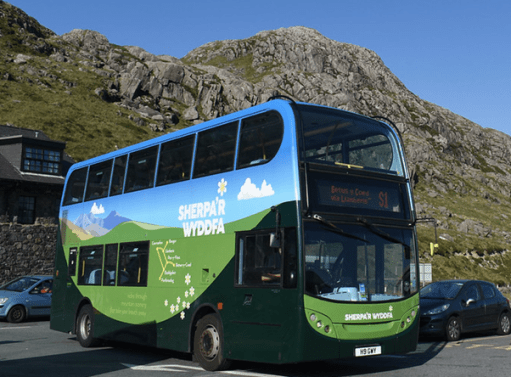
  • Sherpa S1 – ADL Enviro400 operated by Gwynfor coaches.

Photographs of all but the first of these are shown below
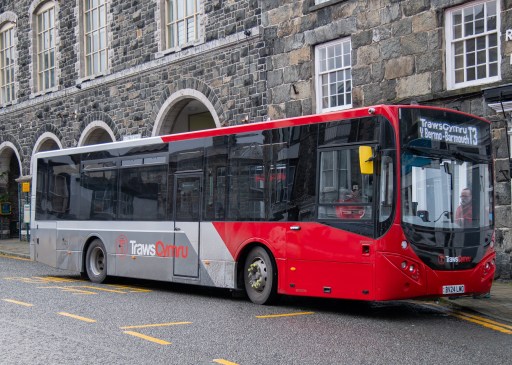
From my point of view as a passenger, the Traws Cymru and Sherpa vehicles were all basically buses – comfortable enough, with nice seats, but not of express coach standards. All vehicles had working USB charging points (something that many rail franchises don’t seem to be able to provide), and two of the Traws Cymru vehicles had WiFi, although this tended to drop out in the more rural areas. Most had screens that could potentially be passenger information screens, although they were not in use. As someone who isn’t terribly well acquainted with the area, the use of such screens to tell me which stop was coming next would have been really useful, and would have meant that I did not have to rely upon Google maps. In general though, I found the buses a pleasant and efficient way to travel, although I doubt I would have found them terribly comfortable for journeys of much more than an hour.

Bus stops and interchanges

Bus stops and interchanges are an integral part of any public transport journey, but in my experience receive far less attention and allocation of resources than they should. These feelings were reinforced on the journey described in this post
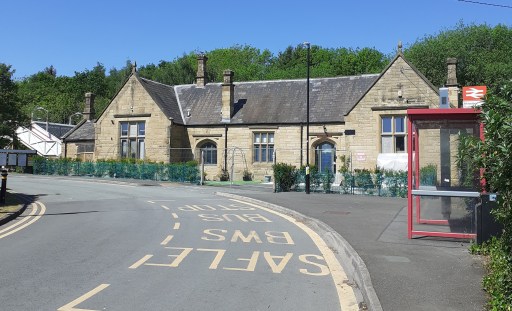
Ruabon station bus stop

At Ruabon the Traws Cymru stop was just outside the station building. It contained basic information about timetables, but no real time information. The shelter was functional but nothing more. I actually only used this stop on my return journey – the Arriva 5 left from a stop at the end of the Station Drive. Here the same information (about northbound buses to Wrexham only) was being displayed in the shelters on either side of the road, which was confusing to say the least. If one didn’t have a basic grasp of the geography of the area, it would be easy to have got on the wrong bus.

At Llangollen I got off and on the bus at the Bridge Hotel stop. This can be seen to be a roadside stop of the most basic sort. Fortunately it wasn’t raining. There was a timetable displayed, but no real time running information.
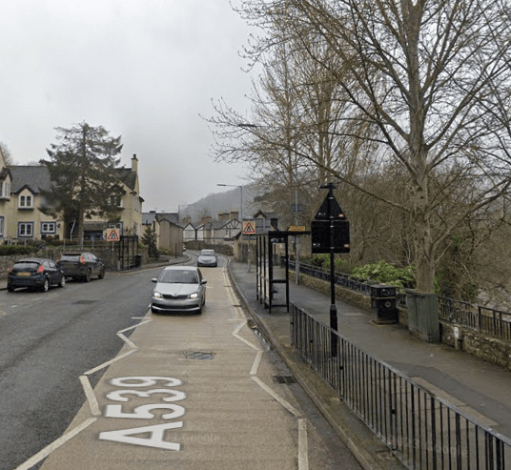
Llangollen Bridge Hotel stop (from Google Street View)

Corwen was very different. Here there are proper interchange facilities with good, real time information, a solid shelter and space to wonder in the bus stop area. I think I could make out a toilet block too, but didn’t investigate it. This is a nice facility. It would probably benefit from not being branded as “Corwen Car Park” – although it is indeed in the centre of a car park. It is much better than such a name would suggest. My only worry would be that the shelter would not be large enough for all those changing vehicles on a wet day. But this is how it should be done.
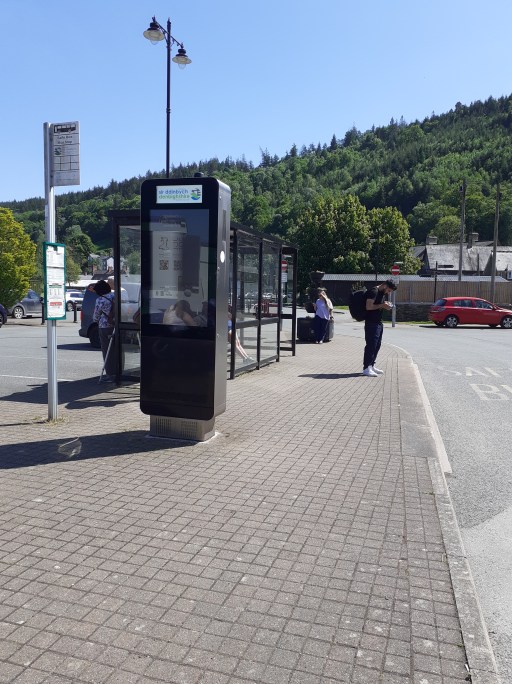
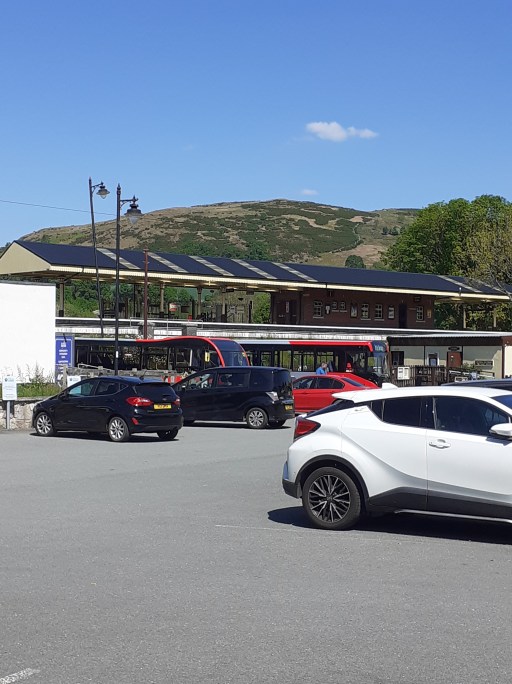
Corwen bus stop, waiting area and information panel
Corwen station on the Llangollen railway
T3 to Barmouth
Betws-y-Coed shelter
Betws-y-Coed interchange (from Google Street View)

Betws-y-Coed is a strange place. It seems to be drowning in an ever expanding sea of car parks that have obliterated whatever it was that attracted folk there in the first place. The interchange is close to the station, and whilst there is shelter and some timetable information, I found the interchange, with four buses parking in an area that simply wasn’t large enough, very confusing and unsettling. Indeed I boarded the wrong bus at my first attempt. I think that there is scope for producing something like Corwen here, but it will cost I guess. Sadly the adjacent railway line, with its not-quite three hour interval service simply isn’t part of the interchange game here, which is based on a regular two hourly frequency.

Caernarfon bus station is simply a row of three of four bus stop and bays along a narrow street. However there is good passenger information and the provision of shelters is adequate. No problems here from my perspective.

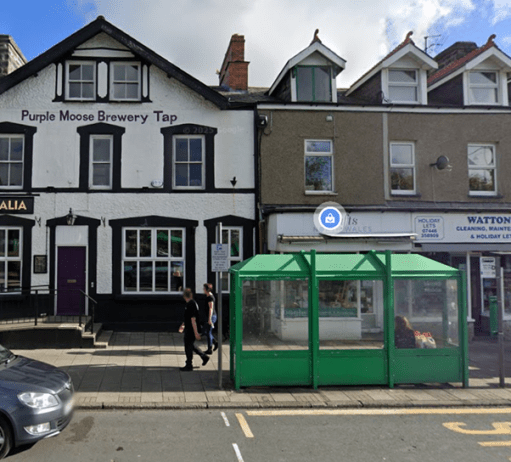
Caernarfon bus station
Porthmadog Australia (from Google Street View)

I began my second day at the bus stop outside the Australia in Porthmadog. It is simply a roadside stop. Passenger information and creature comforts are minimal. Porthmadog deserves better.

With my trip almost over, it reached its low point – Eldon Square in Dolgellau. This was perhaps the most chaotic bus interchange I have ever experienced with four buses double parked in wholly inadequate, highly trafficked space. There may have been public information systems, but such was the chaos I couldn’t find anything. The place is simply not fit for purpose. It is clear from a web search that its inadequacy is well appreciated and there have been long term discussions about how to overcome the issues. Maybe something will be sorted out in future, but of all my memories of the trip, Eldon Square is the one that remains with me. I will do my utmost to avoid ever having to use it again.

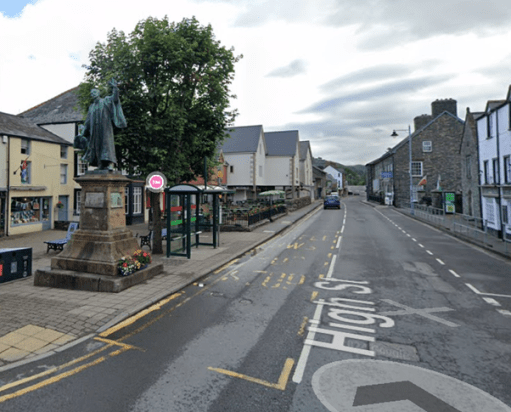
Bala (from Google Street View)

My final change of buses was at Bala – simply alighting at the stop in the centre and getting on the next bus in two hours time. again, it was a simple roadside bus stop. with only a paper timetable provided, amongst a sea of notices pasted to the stop itself. Very oddly, one of these was advertising a vacancy for a clergyman in East Sussex!

Some closing thoughts

On balance I was quite impressed by the Traws Cymru network. The regularity and timekeeping were impressive (although I suspect the latter might suffer when the traffic is busier in the high season) and the tickets were excellent value. The buses were comfortable, at least for journeys up to an hour or a little longer. It would be good if more use could be made of the on board information screens, particularly for passengers who don’t know the area well. The bus stops and interchanges were not so impressive however, with only just tolerable information provision (and hardly any in real time) and shelter provision in most places. I suspect if the weather had been wet, I would have been less impressed by the experience. The contrast between my experience at the well thought out interchange at Corwen and the chaos of Eldon Square in Dolgellau was quite stark. Something really does need to be done about the latter.

A recent news item indicates that an express North / South Wales coach service is under consideration, over the route of the current T2 to Aberystwyth and the T1 from there to Carmarthen, which would only have a relatively small number of stops in the larger towns. From my perspective this is to be welcomed, but I would urge anyone involved in implementing such a scheme not to forget the passenger infrastructure where the coach calls. If a premium service is to be provided by high quality coaches, then this must be matched by higher quality passenger facilities at its calling points, with good quality shelter and information systems – and ideally toilets and access to refreshments. Good interchange with the rail network should also be provided, with something better than a bus stop in the station carpark, Without such provision I fear any such experiment will fail.

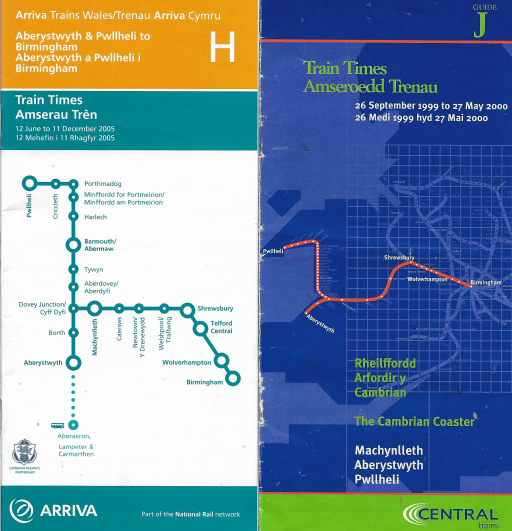
Rail through Porthmadog from the 1960s to the present day

Prologue

Readers of two earlier blogs will know that I have been a collector (or perhaps better described as a hoarder)  of train and bus timetables for many decades. In the two posts, I used this collection to look at public transport developments in Oakham and the development of the cross city rail line in Birmingham, both over the last 50 or 60 years.  In this post, I do something similar, and look at how the rail journeys through the Gwynedd town of Porthmadog have changed from the 1960s to the present day. Specifically I look at how services on the Cambrian Coast railway have changed over that period. I visited the area many times from the 1980s onwards, and particular from the mid 1990s through to the mid 2000s for family holidays. These holidays were often focussed on travelling on the Ffestiniog Railway and were thoroughly enjoyed by all. I do not however consider the services on the FR in this blog, except in passing.

In what follows, I basically consider the southbound services through Porthmadog in terms of frequency, connectivity, journey times and reliability, with my considerations based on timetables I have in my collection or are easily accessible over the web. The services heading east to Pwllheli exhibit much the same trends. But first we need to set out the basic facts about the Cambrian Coat line itself.

Cambrian Coast line

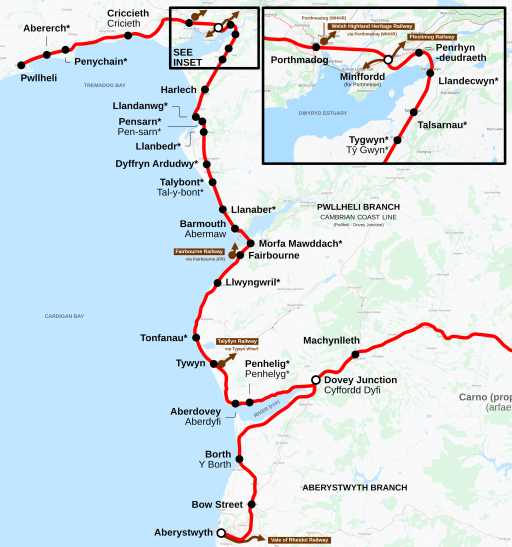
The Cambrian Coast line is shown on the map if Figure 1 (from Wikipedia). It extends from Pwllheli in the north to Dovey Junction in the south, where it meets with the Aberystwyth to Shrewsbury line. In between it passes through a number of small towns (Criccieth, Porthmadog, Harlech, Barmouth and Tywyn) and a larger number of villages. It is a single track route with a number of passing places – at Porthmadog, Harlech, Barmouth and Tywyn.  

Figure 1. The Cambrian Coast Line

In the pre-Beeching area, there were two other connections with the national rail network – at Afon Wen between Pwllheli and Criccieth where the line was met by the  Caernarfon and Bangor line; and at Morfa Mawddach, south of Barmouth, where there was a junction with the line to Dolgellau, Llangollen and Wrexham. At Porthmadog the line was crossed by the narrow gauge Ffestiniog and Welsh Highland Railways.

From the 1960s onwards the main service on the line has been between Pwllheli and Machynlleth, the latter being the first main station on the Aberystwyth to Shrewsbury line after Dovey Junction. Some of these services continued to Shrewsbury and beyond, often having attached to a service from Aberystwyth. These services have been provided by a number of operators – British Rail up to privatisation in 1996, then Regional Railways Central, which morphed into Central Trains from 1996 to 2001, then within the Wales and Border franchise operated by Arriva Trains Wales up to 2018.   The franchise was then awarded to Keolis Amey Wales  by Transport. Following the financial collapse of the franchise in 2021, services have been provided directly by Transport for Wales, through Transport for Wales Rail.

The traffic on the line is mostly passenger – some local traffic for work / school / leisure purposes, but mainly tourists and holidaymaker traffic that, inevitably, is much higher in the summer than in the winter. The major destinations are Barmouth, Porthmadog and Pwllheli, and up to the 1980s, there was a sizeable flow to Butlins near Pwllheli.

Post-Beeching the traction on the line was mainly coaches hauled by diesel locomotives – class 25s and then class 31s. But by the 1980s, the dominant forms of traction were DMUs of various types. Services are now provided by two coach Class 158s.

More details of the line can be found at its Wikipedia page, although this is somewhat unbalanced in subject matter and not terribly consistent in format and style.

Frequency Analysis

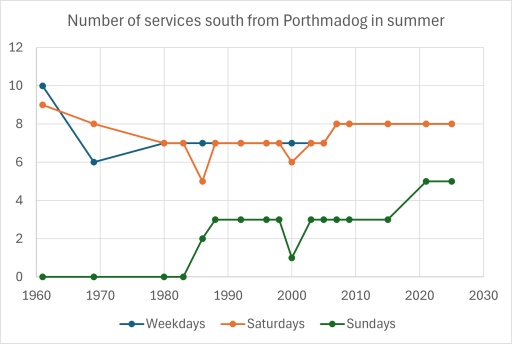
Figure 2 shows the number of trains on the line from 1960 to the present day, for weekdays, Saturdays and Sundays. These are southbound trains through Porthmadog during the summer period (there often being a slight reduction in the winter). In the early 1960s (pre-Beeching) there were nine or ten services on the line.  including through trains to Wrexham (and beyond) from the junction at Morfa Mawddach. Many of the services terminated at Barmouth. There  were also trains from Pwllehil to Bangor via Afon Wen that did not pass through Porthmadog.  After the Beeching cuts however, the service number settled down somewhat to seven or eight per day on weekdays and Saturdays. Sunday services were introduced in the 1980s and the number of these have steadily increased to around five per day.

Figure 2. Southbound services

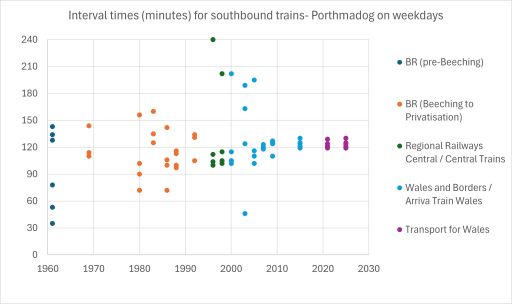
Figure 3 shows the interval between services on weekdays only – the graphs for Saturdays and Sundays tell the same story. Broadly, up to 2007, the services were irregular, with intervals between services from one hour to three hours are more. Around that time, a regular interval timetable was imposed, with trains at broadly two hourly intervals. This will be reflected in much of the discussion that follows.

Figure 3. Intervals between southbound services

Connectivity Analysis

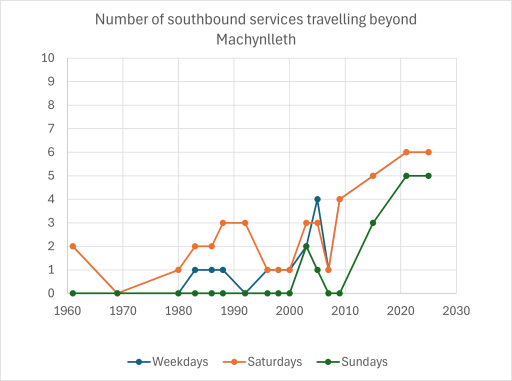
Figure 4 shows the number of through trains that ran south from Porthmadog and went beyond Machynlleth, again for weekdays, Saturdays and Sundays. From the 1960s to the 1980s these were very occasional, with most through trains running on Saturday for the holiday market. These included the Cambrian Coast Express to Euston. From the 1990s onwards the number of through services increased, mainly through the Cambrian Coast DMU coupling to the service from Aberystwyth and running to Birmingham New Street. In the late 1990s and early 2000s the turnaround time at New Street was very tight, which led to unreliability and late running, the effect of which was magnified by the single track nature of the line westwards from Shrewsbury, with delays caused by the need to wait for passing trains. This was to some extent alleviated from 2008 when most services ran through to Birmingham International. Most services on the line are now through services, although, oddly, the current timetable doesn’t acknowledge this and suggests a change at Machynlleth is necessary. There seems no obvious reason for such reticence, unless the operators are simply keeping their options open to terminate the Cambrian Coast services at Machynlleth.

Figure 4. Southbound services beyond Machynlleth

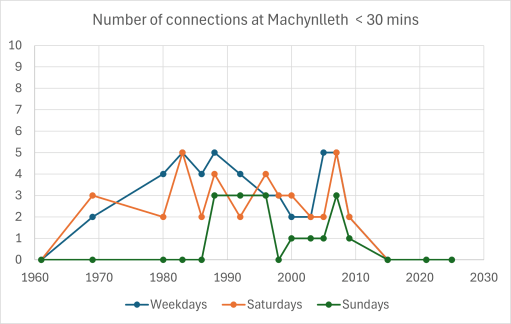
Figure 5 shows the number of connecting services from the Cambrian Coast line onto the Aberystwyth – Shrewsbury – Birmingham services, with a connection time of less than 30 mins. These peak in the 1980s and 1990s and then fall off as through trains become the norm.

Figure 5. Connections at Machynlleth

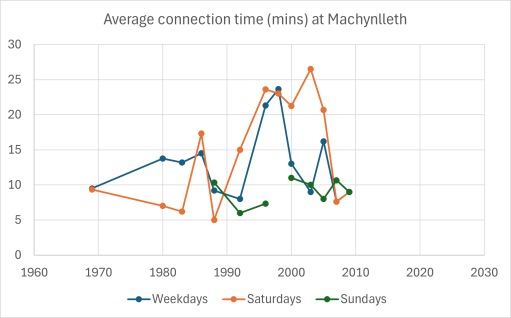
Figure 6 show the average connection times at either Machynlleth or Dovey Junction. In the 1990s and early 2000s the average connection time was over 20 minutes, with some connections (if they can be called that) having times of 40 minutes or more. Machynlleth is a very pleasant station on a dry summers day, and it is a pleasure to wait there. However, it is in mid-Wales and such days are few and far between. In general waiting there for 30 or 40 minutes for a connecting train was usually rather unpleasant. Some services required a change at Dovey Junction, a station with road access, minimal facilities and in the middle of a bog. Again on a dry summer’s day it has a certain bleak charm. But one suspects scheduling connections there was simply an act of sadism by the franchise timetabling teams.

Figure 6. Connections times at Machynlleth

Journey Time Analysis

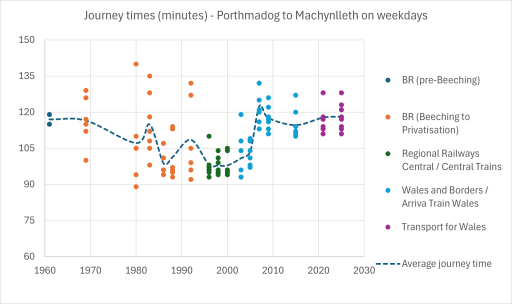
Figure 7 shows the journey times between Porthmadog and Machynlleth on weekdays – again the Saturday and Sunday times are similar. From the 1960s to the mid 1990s these decrease from around two hours on average to around one hour forty minutes on average, with a wide spread. In 2007, coinciding with the introduction of a regular interval service, there is a sharp increase in average journey times to around one hour and 55 minutes – roughly the same as in the 1960s.

Figure 7. Journey times

Reliability Analysis

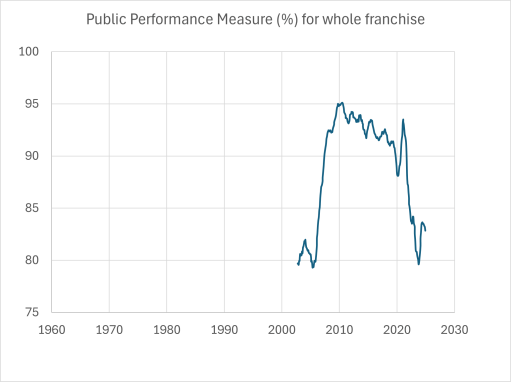
The rail industry measure reliability through the use of a Public Performance Measure (PPM). Essentially it produced a figure between 0 and 100% that is a measure of lateness / cancellation etc. All franchises are given targets for the measure that they have to meet. A value of 90 to 95% is regarded as adequate or good whilst one of 80% is regarded as poor. The historical figures for the whole of the Wales and Borders franchise are given in Figure 8. (The figures for individual routes are not easily available – at least I can’t find them on the web.) The graph shows a significant increase in PPM between 2006 and 2007, which coincides with the frequency and journey time savings on the Cambrian Coast. Now the Wikipedia page indicates that the Cambrian line was by far the worst performing line in the franchise, so it is not unreasonable to conclude that the changes made there in 2007 had a significant effect on the overall franchise PPM.

Figure 8. Public Performance Measure

Discussion

The major point to arise from the analysis presented above, is that in 2007 there was a positive decision to adopt a regular interval timetable, which enabled an increase in through journeys beyond Machynlleth through coupling with the Aberystwyth trains and resulted in a significant increase in reliability. However, this also resulted in a significant increase in journey times. The question arises as to whether a regular timetable and better connections and reliability was worth the extended journey times. I am inclined to think it was, but others may well disagree.

But could journey times be improved? I think perhaps they could be. simply having a longer layover at Pwllheli, with trains arriving there earlier and leaving later, should keep similar times for all the trains in the passing places. However I say this without having done any sort of timing analysis, which would require detailed route information and train performance characteristics. But perhaps a few minutes could be taken off the journey without loss of reliability.

Similarly, could journey frequency be improved to an hourly service? Leaving aside the issues of whether passenger numbers warrant this, or of stock availability, the answer is probably yes, if the two currently unused passing places at Barmouth and Porthmadog are brought into use. However this would effectively mean that the line was running at capacity – which would almost certainly lead to loss of reliability. A better way to improve service frequency would be, in my view, a closer integration with the Traws Cymru T2 bus service from Aberystwyth to Bangor via Machynlleth and Porthmadog. Indeed that service already offers a 1 hour 28 minute journey time between Machynlleth and Porthmadog – considerably better than the rail journey time, although it does take a much shorter route through Dolgellau.