

Introduction
In this blog post I look at three 14th and 15th century wills – two of them are wills from Vicars of Oakham and one from the founder of a major charitable institution in the town. The texts of these wills are taken from
These wills have been used in previous historical investigations of the area, to address specific issues and interests, but do not seem to have been considered elsewhere in their totality. In this short post, we consider these wills, what they can tell us about the individuals involved, and about 14th and 15th century Oakham. The texts of the wills are in the main taken directly from Gibbons although I have modified the punctuation, expanded abbreviations and added full currency descriptions to make the extracts easier to read.
William de Pensax, Vicar 1338 to 1378
WILLIAM PENSAX, vicar of Okham.
Monday before Feast of St. James Apostle 1378
To be buried in the Chancel of Okham.
Bequest to St Mary’s Chapel in Okham Churchyard ; and to John Belgrave, parish chaplain there.
Ellen, daughter of Richard de Pilton.
Alice de Langton
Katherine daughter of John de Multon.
Margaret de Langton.
Executors —William fflore and John de Pensax
Proved at Lydington, 4 May 1385.
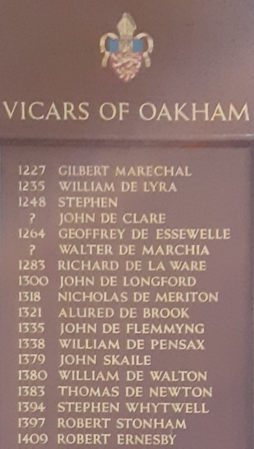
Extract from the Vicar’s board at All Saints Oakham
Little seems to be known about William de Pensax other than his will. John de Pensax, the executor of his will and almost certainly a close relative, has made more impression on the historical record. He was one of Rutland’s parliamentary representative in 1404, 1406, 1413 and 1421 and Sherrif from1400-8 and 1419-1420. and seems to have had Lancastrian sympathies. One can probably assume that William was of the same political persuasion.
The will itself is the briefest of the three presented here and gives a short list of beneficiaries. It would seem that it was written close to William’s death on July 19th 1378 – the Feast of St James is on July 25th. There was and interval of 6 years until it was proved, possibly indicating that it was in some fashion controversial. Of interest is his request for burial under the chancel of the church, but if there was ever any memorial, it was lost either in the chancel rebuilding of the fifteenth century or during the Reformation, He also made a bequest to the Guild Chapel of St. Mary and the chaplain there. This was situated in the churchyard, roughly at the site of the current Old School building. More mention will be made of this and other guilds below. No details of the scale of the bequests is given, so presumably these were recorded in some other way or Gibbons chose not to record them.
As an aside, Pensax, presumably William’s ancestral home, is a small village to the south west of Kidderminster. On the Parish Council web site we read the following.
The name Pensax is a combination of the Celtic words “pen” (hilltop) and “sais” (Englishman, Saxon). Unlike many English place names with Celtic elements, the modifier follows the basic noun, as is customary in Celtic languages. This indicates that Brittonic speakers coined the name, rather than Old English speakers borrowing a Brittonic element
William Dalby, founder of the Hospital of St. John and St. Anne, 1398
WILLIAM DALBY, of Okham.
Dated there, 8 October 1404
To be buried in All Saints’ Church, Okham.
Thomas Man, vicar of Exston.
To Thomas Smyth formerly dwelling in Exston, a noble.
John Sapcote 20 pounds
William Lytell 10 pounds
William Luffeld 20 pounds
William Lesyngham 10 marks
Anne Wyttilbury 100 shillings.
My servants Thomas, Bernard Osbern, and Margaret Osbern.
John Eltham my apprentice.
Isabell Aldewyn.
William, William and Hugh, sons of Richard Sapcote.
My wife’s sister Johan.
Roger fflore, and his children, William, John, Robert, Agnes, Elizabeth, and Johan.
John clerk of Wyssenden.
My daughter Johan 20 pounds.
John and Elizabeth children of William Grene.
My brother John and his children.
To Simon master of the Hospital 10 pounds; to Thomas Heremyte and Johan Godewyn of the Hospital 3 pounds each, and to10 other poor persons of the Hospital 10 pounds.
Guilds of S. Trinity of Tylton, Corpus Christi of Leycester, the Great Guild of Coventry, and S. Trinity, S. Mary, and S. Michael of Okham.
Abbeys of Osolueston and de Lauda.
Agnes my wife 50 pounds.
Executors :—Roger fflore, John clerk of Wyssenden, and John Skynner chaplain.
Proved at Lincoln, 14 June 1405.
William Dalby, a wealthy wool merchant of the staple of Calais, is best know for founding The hospital of St. John Evangelist and St. Anne in 1398, to support twelve poor men, under the charge of two chaplains. The advowson of the hospital was to be in the hands of the prior and convent of St. Anne’s, Coventry. William Dalby granted an estate worth £40 a year for the foundation, and a little later paid 577 marks to the prior and convent of St. Anne’s to increase the endowment.
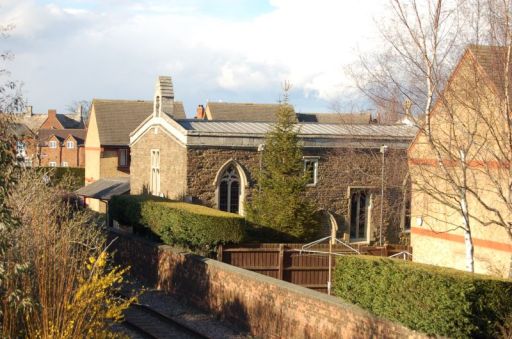
The will itself again seems to have been written just before William’s death and was proved soon afterwards. Unlike that of William de Pensax it gives details of some, but not all, of the bequests, These are for varying amounts up to £50. Depending on how one does the calculation this represents somewhere between £40,000 and several million pounds in today’s terms. There were generous gifts to the Hospital Master and to its inmates. Amongst the beneficiaries are the abbeys at Laund and the nearby Owston Abbey, just over the Rutland border in Leicestershire. Guilds again get a mention with bequests to the guild of the Holy Trinity at Tilton (oddly named as St Trinity), the guild of Corpus Christie in Leicester, the great guild at Coventry and the guilds of the Holy Trinty, St Mary and St Michael in Oakham. At Oakham the guild of the Trinity was probably based in the current Trinity chapel at All Saints, and the guilds of St Mary and St Michael at chapels in the churchyard. That of St Mary may have also been associated later with the Lady Chapel at All Saints, although that does not seem to have been in existence till around 1480.
Robert Stoneham Vicar 1397 to 1409
ROBERT STONHAM, vicar of Okham.
Not dated,
Ego, Xpianus in fide firmus &c. Corpus meum sepeliendum et post diem judicii cum anipia glorificandum &c. (I, a Christian firm in the faith, etc. [I desire] my body to be buried and, after the Day of Judgment, to be glorified together with the soul, etc)
18 poor people of Okham and 6 of Lydington to be clothed, tam ad corpus quam ad lectum (as much to the body as to the bed.)
To Okham church various plate, librum rubeum decretorum, librum decretalium, librum bonum ligatum pupiUe oculi cum constitutionibus in eodem contentis. (The red book of decrees, the book of decretals, and a well-bound book—the apple of my eye— containing the constitutions within it.)
Chapels of Langham, Egilton, Caldecote, and Brook, 6 shillings each for 3 chalices.
Lidyngton church, 100 shillings for a silver cross.
Merton Hall, Oxford, 20 pounds for a silver cross and candelabra ; also my books not otherwise bequeathed, to be kept in the College Library.
To the Church and Bishop of ‘Carlisle the Bible which I had of gift of Thomas late Bishop of Carlisle.
To Master Henry Abyngdon, my portiforium (breviary)
To Deacon William Baxter my manuale &c. (handbook?)
Deacon Thomas Gauter.
John Bower.
Richard Brook my clerk.
Bequests to William Carter, principalis meus famulus (my chief servant), and other servants; also, illis meis servientibus qui non recedent sed pro tempore quo ero extra Angliam fidelicer manebunt ad reventum meum. (to those servants of mine who will not leave, but will remain faithfully until my return for the time I am away from England.)
My sister, a nun ; and my sister Isabella.
To my Lord of Lincoln zonam meam viridem deauratam. (my green, gold-trimmed belt.)
Item domine Comitesse de Cancia de Brunne gobeletum deauratum. (Item, for the Countess of Kent, of Bourne, a gilded goblet.)
Deacon Robert Croxton of Lincoln.
All my tenements in the city of London to my brother Edmund and my sister Isabella, they procuring masses (either alone or by turns with the heirs of John Basse) for the souls of my mother, of Lucia atte Stone, and of John Basse.
My sister Alice.
To Master Henry Abyngdon my quat’num novum preciosum qui incipit ‘In nomine patris et filii et spiritus et alium quat’num preciosum et secretum Gebar s^ patris in nibio papiro ubi fit mentio de omnibus libris meis quam aliorum (quia habeo multos Ubros qui non sunt mei et volo quod quUibet habeat quod suum est). (A new, valuable quire beginning “In the name of the Father and of the Son and of the Spirit,” and another valuable and private quire of Father Gebar on fine paper, in which mention is made of all my books as well as those of others (for I have many books that do not belong to me, and I wish for everyone to have what is their own).
To Richard Curteys, Tabulam de Eborer cipresso cum stilo argenteo. (A writing tablet of ivory and cypress wood with a silver stylus.)
Item Master Henrious habebit meum Annys de Crysty Gray (Master Henry shall have my Agnes de Crysty Gray.). Item Baxter meum Mens suppellic’. (My Baxter’s furniture). Item ecclesia de Okham totum meum velym pro antiphonarijs et libris. (To the church of Okham, my entire stock of wool for antiphonaries and books.)
Item Corrector de Aischeruge habebit certum librum in quat’nis xuj quos mihi dedit qui incipit ‘ ffrat’ p’ dil’ce.’ (The corrector of Aischeruge shall have the specific book in sixteen quires which he gave to me, beginning “Frater praedilecte.”)
Executors :—My brother Edmund, and William Baxter chaplain.
Supervisors :—The Bishop of Lincoln, and Roger flflore.
Proved at Sleford, 15 Jan. 1409.
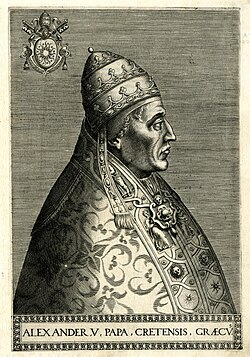
Alexander V
Robert Stoneham was probably born in the 1350s or 1360s. He was a fellow of Merton College Oxford from 1384 to 1397, when he was appointed Vicar of Oakham. At some stage he was appointed a Canon of Lincoln Cathedral. He clearly rose through the church hierarchy and by 1409 was a member of the Papal Court at Pisa. He was taken ill in that year and remained in Pisa, where he died, when Pope Alexander V (an antipope, elected in 1409 at the Council of Pisa) transferred his court from Pisa to Pistoia.
Stoneham’s will is the longest of the three presented here, and is partly in Latin. The Latin phrases have been translated (using Google Translate – such is my ability in the language) and the translations are shown in italics. The will lists a large number of bequests, and in particular specifies the destination of what seems to have been a very considerable library. His servants and family seem to have been well provided for. His bequest of a silver cross and books to Merton College is noted in the College archives. Despite the fact that his career took him away from Oakham, for what were probably considerable periods, he clearly retained an interest there, and made a bequest to clothe 18 poor people from the town (and 6 in Lyddington). He also donated books to the church, including what seems to have been his favourite.
The red book of decrees, the book of decretals, and a well-bound book—the apple of my eye— containing the constitutions within it.
He also donated a stock of wool to the church, seemingly for the purpose of buying books.
To the church of Okham, my entire stock of wool for antiphonaries and books.
A bibliophile indeed. In the light of the current (September 2026) exhibition of the Oakham Parish Library in All Saints church, from 1616, it is of interest to see that books, and material with which to purchae books, were being donated to All Saints two centuries before that.

