
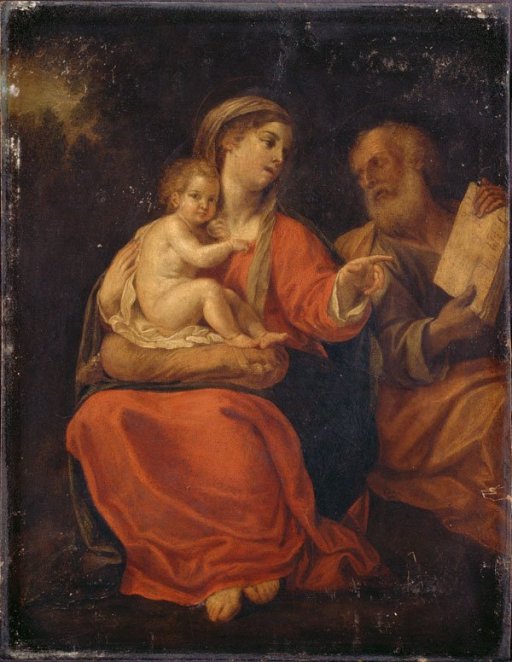
The painting of the Holy Family shown below has hung in the Vicar’s Vestry at All Saints church in Oakham for many years, and has, until recently, never been properly identified. Recent expert advice suggests it is a late 18th / early 19th century copy of a composition by Francesco Albani of between 1608 and 1610. It is believed that it was produced by a workshop in Italy, or perhaps the Netherlands, to satisfy the demands of those on the “Grand Tour” for devotional works. Whilst thus not of any great value, it thus does have an interesting back story.
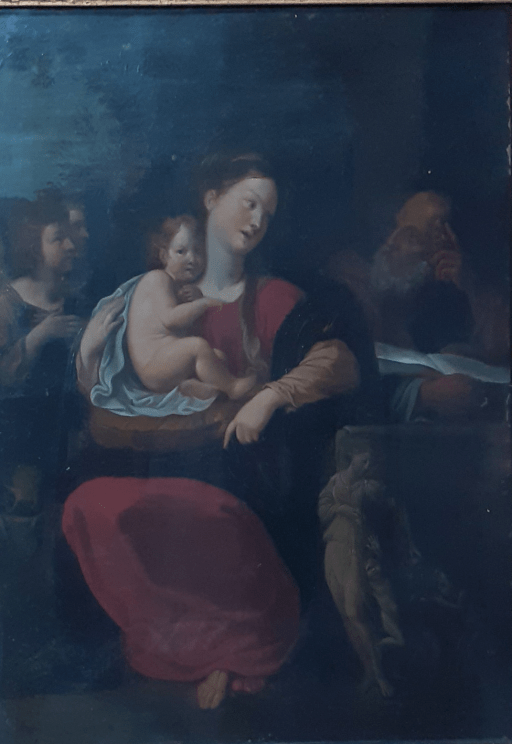
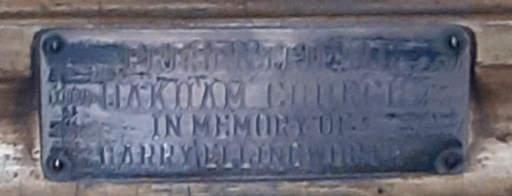
It’s detailed provenance is not known, but a difficult to read caption on the painting frame (below) has the inscription
“Presented to Oakham Church in memory of Harry Ellingworth”.
The Ellingworth family were prosperous shopkeepers in Oakham in the late 19th and early 20th century, and a number of them were named Harry. The most significant of these seems to have been a Harry Ellingworth who was a Town Crier in Oakham in 1881.
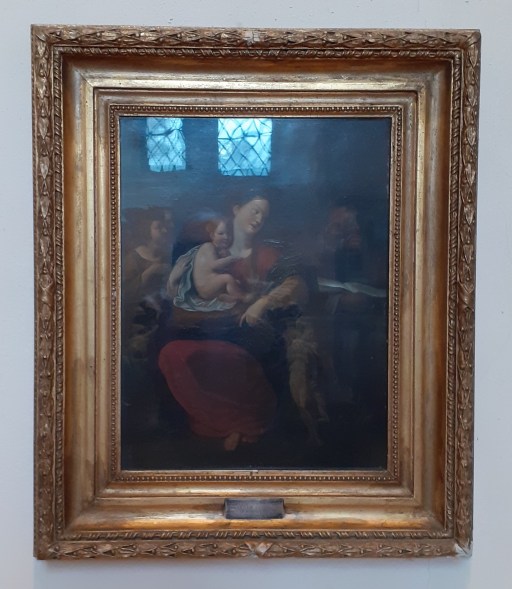
Interestingly a number of similar copies of the painting can be traced – either painted in Albani’s workshop or elsewhere (see below). The details vary, but the basic composition is the same. The market for such paintings was clearly buoyant.
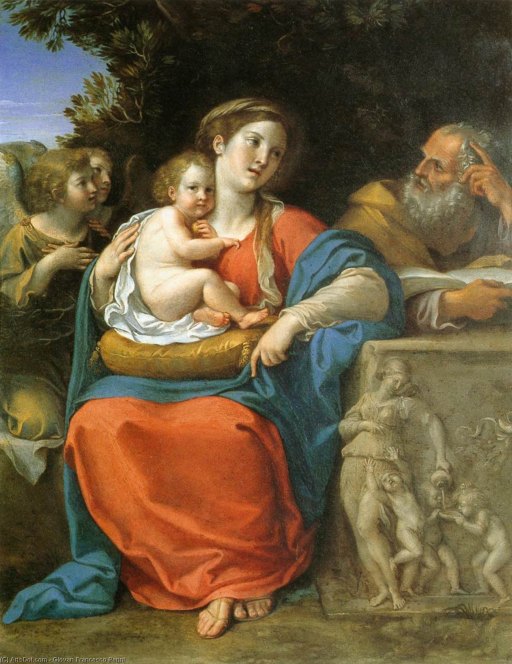
Holy Family by Studio of Francesco Albani
1610-60
The painting shows a somewhat weary and pensive looking Madonna in a red dress with a dark blue shawl, The Christ child sits on a golden cushion on her lap, partly surrounded by a blue sheet. Joseph looks on from the right, with an open book in front of him, that seems to be placed on a stone chest or altar or perhaps a tomb. It may be that the directions in which the Madonna and her husband are pointing is of some iconographic significance – Joseph, in his contemplation of scripture pointing upwards to God, and Mary, with the Christ child on her lap, pointing down to earth, the direction, if that is an appropriate word, of the incarnation. Two angelic figures look on from the left. There is a figure carved on the stone chest, that, from the original, appears to be some sort of Bachannalia, with wine being poured out for small dancing child like figures. Again there may be some iconographic significance here with a representation of Christ’s blood being poured out at the Eucharist. The mixture of biblical and classical themese seems to have been common at the period of the original composition.
 Engineering, history and ecclesiology