Journeys by rail and coach

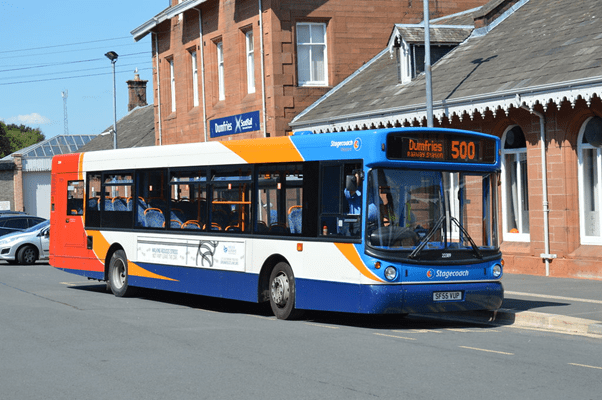
Stagecoach 500 at Dumfries Station

I recently travelled from my home in Lichfield to Gatehouse of Fleet in Galloway. The journey involved three trains (Lichfield to Crewe, Crewe to Carlisle, and Carlisle to Dumfries) and one bus journey (Stagecoach 500 from Dumfries to Gatehouse). The journey in both directions was, apart from some minor late running, pretty much without incident, and all the connections were made comfortably. The trains were comfortable and, as required for the moment, suitably socially distanced. The bus legs were similarly comfortable, with rather plush coaches and helpful drivers. That being said, the journey reinforced thoughts I often have when making journeys of this sort, that the weak links are the interchange between train and bus, and also the physical infrastructure of the bus pick up and set down points. I will consider each of these in turn with regard to my recent journey, but the same or similar points could be made for other journeys of this type.

The problem of train / bus interchange begins well before the journey itself, when journeys are being planned and fares considered. Finding the bus timetable is easy enough, even with current Covid related restrictions, but nonetheless required searching different web sites for the information, and making some sort of assessment of suitable connection times. No information at all was available on the fares, and I had to enquire of the bus driver on the outward leg as to whether returns were available or not. They were, at a very reasonable price, but it would have been good to know beforehand. On the journey itself, having alighted at the quite delightful Dumfries station, we found the rather flimsy bus shelters outside the station, effectively in the middle of a pedestrian thoroughfare. The weather, for both the outward and return journeys, was fine so this mattered little. No information at all was provided on how the bus was running, when it was due etc. But it came on time and all was well.

All the above could so easily be improved – by integrating train and bus timetables and fares; by extending a canopy from the station to serve as a bus waiting area and incorporating the bus area more completely into the station complex, so that toilets, the café etc. are more easily accessible to bus passengers; and developing the passenger information system so that details of both trains and buses were included.

At Gatehouse the facilities are rudimentary – simple bus shelters on the pavement with little by way of information, either on timetables or real time. The latter was not helped by recent Covid related service changes however. Once again this could so easily have been remedied – there is space available for a dedicated bus pick up / drop off point, ideally with more substantial passenger facilities that could act as a transport focus for the town; and the technology is available for real time bus running information to be made available.

Obviously the situation with regard to train / bus interchange and to local bus waiting facilities will be unique to any situation, but it does seem to me that there are two basic areas of improvement as follows.

  • Information – the integration of time, price and ticket information and purchase for at least a selection of important bus / coach routes with the train boking systems; and real time passenger information at interchanges and bus stops.
  • Infrastructure – at interchange points, the full physical integration of bus waiting facilities into the train station facilities; and the provision of more substantial local bus facilities that are ideally not part of a pedestrian throughfare.

But the question that then arises is who should be responsible for such facilities – it is clear that at the moment these fall into gaps between the train infrastructure and service operators; the bus operators; local authorities and community groups. Much has been said recently of the need for a “guiding mind” to oversee the rail network. I would suggest that this guiding mind, should it ever achieve consciousness, should have a wider role in the overall transport network, and particular in the field of modal interchange. The post-Covid recovery of the public transport network would benefit greatly from this.

The Church of England and Covid19

I have been much exercised in recent days over the latest Church of England guidelines for living with Covid19, and in particular the wearing of masks by congregation and ministers, even during services of Holy Communion. My basic irritation lies in the fact that this goes beyond government guidelines for a range of venues that are comparable to churches – restaurants, bars, museum etc.. On the positive side it has been the source of some amusement in our household when considering how the new mask wearing advice matches with the requirements to sanitize or wash hands before and after removing masks, and the prescriptive way of removing masks without touching them or the face. In the context of receiving Holy Communion this probably required 3 or 4 hands per person. As far as I am aware most Anglicans have two at the most. Personally I am disappointed that no reference is made to removing with dignity a face mask elastic from an ear already occupied by glasses and a hearing aid.

But there are other, deeper issues. The first of these concerns the appreciation of risk. In my current context, in Lichfield in Staffordshire, the number of Covid19 positive cases in the last week given by Middle Super Output Area (MSOA) in England  is less than 3, and as 2 by Coronavirus (Covid-19) in the UK. If we take a figure of 5 to allow for asymptomatic cases, and given a population of 100,000 for Lichfield district, this gives a probability of any one person having the virus of 5 x 10⁻⁵. Now let us suppose that the chance of meeting any one person in Lichfield on any one day during normal activities is (say) 1 in a 100 (which is probably a bit on the high side), this gives the probability of meeting someone with the virus of 5 x 10⁻⁷. Now suppose that one of those 5 infected folk attend a church service, if any one congregation member spends at least 15 minutes in the presence of each of the others, even without social distancing the risk of being infected is thus around 5 x 10⁻⁵. With 2m social distancing and recommended sanitization / washing hands etc. this figure falls by a factor of 100 to 5 x 10⁻⁷ again. To give this some context, around 100 people are killed or seriously injured in the UK on any one day. Given a population of 70 million, this gives a daily probability of being killed or seriously injured in a road accident of 1.4 x 10⁻⁶. Now whilst these approximations are very crude, it seems that, in the current context in Lichfield, including church services, the probability of catching Covid19 on any one day is probably no worse than the probability of being killed or seriously injured in a road accident.

Now I am not arguing for any relaxation of current procedures imposed by the government. These have necessarily to be rather broad brush and simple to understand. Also, whilst many areas of the country are in a similar position to Lichfield, there are places with much higher rates of infection, so the current procedures are in my view sensible and should be followed. But for the church to go beyond these procedures seems wholly unnecessary. To be consistent in terms of an appreciation of the risk, the church should be advising all its members to give up driving completely. I don’t see that happening any time soon.

Within the risk analysis community there is a basic assumption in the UK that we should aim at risks that are ALARP – as low as reasonably possible, where “reasonably” is understood to be such that the basic function of the procedure that is being analysed can be achieved. In some large organisations (and I am thinking here specifically of Network Rail with whom I have had numerous arguments) the approach by individuals within the organization to setting risk levels is better described as CMOA (Covering my own ___). I will let the reader complete the phrase. I fear I see the same approach in those involved in setting the Church of England guidelines, with no indication that the true nature of the risk in many parts of the country is appreciated. In the recent communications, the recommendations have gone beyond “reasonable” and threaten to undermine the purpose and integrity of the activity – in this case the giving and receiving of Holy Communion.

This brings me to some further considerations on the nature of the Communion service itself. Before making these arguments, it must be emphasized that I am no theologian, as I guess is only too apparent from what I have written already. So when I enter into discussions of eucharistic theology, it is very much as a non-expert.

As things stand, only the presiding minister takes both bread and wine, with the laity restricted to the bread. The rationale for this is that sharing a cup of wine might be a source of infection risk, which I can appreciate, although I do not find at all satisfactory that laity should be denied the cup. A way around this would be to put the wine into individual cups, as do many other churches. The Church of England has set its face against this, on the basis that sharing should be of “one bread and one cup”. This has been severely criticized by, for example, Andrew Goddard. The only comment I would make, based on some perceptive observations by my wife, is that, in Anglican circles we most certainly do not have “one bread” in a physical sense – with the people’s wafers coming from one production batch and the priest’s wafers from another (and any gluten free wafers from a third). I would contend that the oneness of the bread and cup comes from their consecration within a eucharistic community, rather than in any physical sense. Communion in both kinds could be offered, with no additional risk, by the simple use of individual cups, if such an approach were to be taken.

The same reasoning can be applied to what might be termed ”virtual communion”, the practice of allowing the consecration of bread and wine in people’s homes via a priest’s consecration over an internet platform. Again, the Church or England has set its face against this, based on a rather narrow concept of what is required for consecration – the physical proximity of a priest. There is a danger here of at least underestimating the role of an omnipresent God rather than the priest in the consecration. Whilst I would be reluctant to engage in such practices for a completely random audience, it seems for me that if a congregation who have formed the bonds of fellowship between them over the years, come together virtually around their tablets and laptops, then the consecration of the bread and wine would take place within the body of Christ, the gathered Eucharistic community. I can see no objection to this. But then, I am not a theologian. All I can say is that it would certainly eliminate the risk of Covid19 infection.