The World Test Championship

The cricket World Test Championship is perhaps one of the most impenetrable of all sports competitions, with playing regulations and points coring systems that are not all easily understood by any except those who devised it and those with advanced statistical training. Details can be found here for those interested. The result of this complexity is to make it poorly understood by media and public, and it does little to generate interest (and perhaps financial sponsorship) for the test match format. But it needn’t actually be so. In this short post I describe a simple format for a World Test Championship that would be easily understandable; would result in meaningful matches and series; and would produce an undisputed champion every year. There is a snowball in hells chance of anything this sensible being implemented by the ICC, but its formulation has proved to be intellectually satisfying at any rate.

The basic principle would be to divide test playing countries into divisions of three. Based on current rankings (January 2022) these would be

  • Division 1 – India, New Zealand, Australia
  • Division 2 – England, Pakistan, South Africa
  • Division 3 – Sri Lanka, West Indies, Bangladesh
  • Division 4 – Zimbabwe, Ireland, Afghanistan

Given the current political climate Afghanistan’s position in Division 4 might be untenable, and it might need to be replace by another side (perhaps Netherlands or Scotland).

The basic principle would be that the sides in each division each year would play each other in a three-match series – one home series and one away series. The position in the division would be determined by giving 2 points for a series win and one point for a draw, or, if these points are equal, on the number of matches won. The top side in each division would either be declared world champion for the year, or be promoted to the next division, whilst the bottom side would be relegated. It would be no more complicated than that.

Essentially this would give a baseline for the number of test matches per year of six per team, which ought to be achievable. It does not preclude other series (such as the Ashes) being played as required – and indeed the world championship games could be designated tests in, say, a five-match series.  Each team would play different teams in succeeding years, apart from the top two in Division 1 and the bottom two in Division 4.

 The main requirement would be a need for flexibility in arranging fixtures on an annual basis, rather than as part of the longer-term future tours programme. This may be easier if designated periods were kept free from other series. The real advantage of such a method would be that it would greatly increase the profile of the long form game, with each of the series that are played being meaningful in terms of promotion and relegation, and gives the possibility of the championship finding a significant sponsor.

A new rail connection for Blaenau Ffestiniog?

In a 2019 issue of the Ffestiniog Railway Society magazine, a brief article described the early days of a project to restore the Dinas branch at the Blaenau Ffestiniog end of the line, thus reconnecting the town centre with the area in the midst of the slate heaps to the south of the Conwy Valley line tunnel (see the above map from Wikipedia which shows the complex FR layout around Blaenau). A useful history of the branch is give here.  It was lifted in the 1950s but the trackbed remains visible and accessible to the west of the Conwy Valley line south of the Ffestiniog tunnel. The main driver for the project would have been to provide a connection between the town centre station and the Llechwedd quarry, to the east of the Conwy Valley line near the tunnel portal, which has become a major tourist attraction, both in terms of its mining heritage but also as a mountain cycling and zip line venue. Unfortunately, with the advent of the pandemic, this project seems to have dropped from view, which is hardly surprising. The idea was raised recently once again on the Ffestiniog & Welsh Highland Railways Insider Facebook page, and the large potential costs of re-opening the branch against the potential income was again emphasized as the main barrier to taking this idea further.

Whilst I quite understand why the project has not progressed, it still seems to me that the initial reason for the proposed re-opening still remains. The centre of Blaenau has been transformed in recent years, but it is still an area that requires much investment in its future. To have its major tourist attraction an inconvenient mile and a half out of town with no public transport links, does little to help with the development of the town itself – indeed visitors to Llechwedd have no real need to stop off in the town centre at all. And of course the lack of any public transport connection simply encourages what is being increasingly appreciated as the unsustainable use of the private car. Thus in this brief post I suggest a way in which this project could be taken forward in what might be an affordable fashion (although I present no sort of cost benefit analysis at all).

The basic idea is simple – instead of relaying the former Dinas branch, the existing track formation of the Conwy Valley line should be used instead. With the current level of service provision on the line, in normal times the section from Roman Bridge just north of the  tunnel is occupied for only 45 minutes every 3 hour period. With a little imagination in the development of a signaling system to ensure safety, I would suggest that the line between the town centre and Dinas could be used for a shuttle service to take visitors between the town centre and the quarry complex when that section of track is not occupied. This could be done in two, relatively cheap, ways – either through the use of (lung destroying) standard gauge heritage DMUs, between the Conwy Valley line platform and a new platform at Dinas (which could be positioned on the eastern, Llechwedd side of the track and would avoid the need for a foot crossing that would be inherent in the relaying of the FR Dinas branch) and an access road to the quarry. More interestingly, a narrow-gauge track could be laid within the standard gauge track, with switches to allow narrow gauge trains to access these rails from the FT station, and a short station branch at Dinas. This would of course allow existing FR stock to be used.

Both these alternatives should be much cheaper than the relaying of the branch and could provide an attractive link between town and quarry. Realistically however they are likely to meet with strong opposition from the very conservative Network Rail culture, with its massively inflated approvals procedure, and great determination would be required to take forward these or other similar ideas.

At some stage in the future, I will write another blog post on the development of public transport links within the World Heritage Slate Landscape region – there is much to be said about transforming the current private vehicle dominated system into something that could be accessed by public transport. But that is for another day / week / month / year.

The English domestic cricket schedule

Preamble

Following the recent Ashes debacle, there has been much talk of why the England cricket team’s performance has been so poor. One of the reasons (but by no means the only one) seems to be the lack of emphasis given to the red ball game in the domestic structure.

Ben Stokes bowled at the MCG

In addition the fact that red ball cricket has been increasingly pushed to the margins of the season to accommodate more and more white ball cricket, and in particular the abomination called the Hundred (and here I let my prejudices show clearly), and thus not allowing the development of batting skills in dry, hot conditions – which are the normal conditions in most other cricket playing countries. Thus in this blog post I set out a possible programme for the domestic season that, whilst allowing the financially lucrative white ball cricket proper exposure, also allows for red ball cricket to be played in the high summer months. I think it would be workable, but, inevitably, others will disagree.

Principles

In setting out the proposal, I adopt the following principles.

  • The domestic season should have a clear, identifiable structure that allows for each of the three formats to take the limelight at appropriate times.
  • All formats should be contested by the existing county teams, rather than by multi-county franchises based on the larger grounds, thus allowing for equitable treatment of all counties based on performance, and thus acknowledging the importance of history and tradition.
  • That there should be space in the high summer months for both red ball and white ball cricket.
New Road Worcester

What I propose is for the men’s game – I am afraid I simply don’t know enough about the structures, resources and finances of the women’s game to be able to make coherent proposals. That being said, it would seem to me that something mirroring the proposals below might be quit feasible, albeit with a reduced number of teams and matches.

Fifty over format

  • Three groups of six county teams, perhaps geographically based, playing each other twice (10 games) with quarter finals, semi-finals and final.
  • First round of five group matches to be played in last two weeks in March in southern hemisphere countries, and perhaps marketed as a cricketing holiday to county members and the public.
  • Second round of five group matches to be played in last two weeks of April in England (which will thus give an interesting variety of conditions overall).
  • Quarter finals on the Friday before May Bank Holiday. Semi-finals a week afterwards.
  • Final on Late May Bank Holiday Saturday.

Two innings format

  • First division of eight county teams, each playing each other twice (14 games) with bottom two relegated to second division.
  • Second division of ten county teams, split into two groups of five, which may or may not be geographically based. Each team to play the others in the group twice and those in the other group once (13 games). Top team in each group promoted, with play off for the divisional championship.
  • Games to be played from Sunday to Wednesday from first week in May to second week in August (15 weeks) with some exceptions to accommodate the twenty over format (see below). This would allow games to be played in high summer conditions.

Twenty over format

  • To be played in two stages. County teams in first stage to be divided into three geographical groups of six, each playing each other twice (10 games), with games on Friday evening or Saturday afternoons between the start of May and end of July. Games would thus not be spread through the week which might not please broadcasters. There might need to be some slight modification of the schedule for two innings games to accommodate two games on one or two weekends. Top two in each group and two best third place teams to Premier league, and others to National League.
  • The ECB to give contracts to twenty or more overseas players with different skills, who would be allocated to the Premiership counties at the start of August, based on the county’s requirements.
  • The Premier league would run in the last two weeks in August and the first week in September, with each team playing the others once (7 games). It would be desirable for their to be no international games during this period to allow England players to compete. A “hundred” format could be used if felt desirable (although I can think of no reason why it should be so). Finals day on the second Saturday in September would consist of a play off between second and third place teams, and a final between the winners of that tie and the first placed team.
  • The National league would consist of ten counties, play six franchise teams composing those displaced from premiership squads, second eleven, university and academy players etc. over the same period. These would be divided into two groups of eight, and each play each other once (7 games). The franchise teams would be based at holiday destinations, or conurbations normally without top level cricket as a means of widening audiences. The top teams in each group would contests the final, on the same occasion as the Premiership finals day.

Final thoughts

I would suggest that the advantages to such a system would be as follows.

  • The format would thus give a structured approach to the season, with the three formats contented sequentially, with manageable overlap between the formats.
  • There would be three high points in the season – the fifty over final on the late May Bank holiday; the climax to the two innings game in early / mid-August; and the short form finals day in mid-September.
  • The international / domestic structure for the fifty over competition would both be attractive in its own right for at least the more affluent spectators, would give players experience of a range of conditions, and would also take some scheduling pressure off the domestic season
  • The structure would allow two innings games to be played in high summer conditions. The proposed second division structure would enhance the integrity of the competition with teams only being judge against teams that have played the same number of games against the same opponents.
  • It would also maximise audiences for the short form game on summer evenings and during the last two or three weeks of the school holiday period.

As a final point, such a schedule would also allow space in late September for a regional championship between, say, teams drawn from northern south eastern and south western counties with three four day matches over a two week period. This would give the players some experience of cricket between county and international level. But this is not an integral part of the proposal.

Covid-19 – how risky are church services?

As I write, in late July 2021, Covid-19 infection rates are increasing rapidly, at the same time as restrictions are being eased, and people from all walks of life are becoming increasingly nervous about being infected. This nervousness is, quite understandably, shared by church congregations, and some are questioning whether it is actually safe to come to church in the current circumstances. Is it therefore actually possibly to be a bit more precise about what the actual risk of attending church might be? The answer is a qualified, yes, it is possible, very approximately, to calculate the risk of infection at church services, and, in this article, I will describe the risks of attending church for different scenarios, based on the current situation at St. Michael’s church in Lichfield, where I serve as a minister.

The method I will use is that developed by Prof Jose-Luis Jimenez at the University of Colorado – Boulder in the USA. This is a simple spreadsheet-based model of Covid transmission and infection using the latest scientific knowledge and which can be used in a variety of situations – residential homes, shops, public transport and places of worship for example. It is more fully described here. It is based on aerosol transmission of the virus, which is now regarded as the main way in which the virus is transmitted, particularly if simple hygiene methods are followed, such as regular cleaning of services and washing of hands, to reduce the risk of picking up the virus by touch. Prof Jimenez would be the first to admit that the method is very approximate and comes with lots of uncertainties, not least because the understanding of the way in which infected people emit the virus is at the moment poorly understood. Nonetheless it does give a rough indication of risk.

The situation I have looked at is effectively the current practice in St. Michael’s in Lichfield – a large, fairly poorly ventilated area, with a congregation of about 60 and a choir of 6. Social distancing is assumed, together with everyone wearing masks and only the choir singing, for a one-hour service, with the current community infection rate of about one in a hundred people being infected with Covid at any one time. 80% of the congregation are assumed to be double vaccinated. Plugging this lot into the spreadsheet gives a risk of any one member of the congregation being infected with the virus at a particular service of 1 in 26,700. To give some perspective, the risk of being involved in a road vehicle accident in Britain in the week following the service is 1 in 22,000. Thus, attending a service at St. Michael’s with the current practice is very safe indeed, even allowing for the very approximate nature of the calculations – we are all likely to be in much more hazardous situations at other times in the week.

As restrictions ease, churches across the country are considering easing their own restrictions, and Jimenez’s spreadsheet gives a way of how this might change the risk. Again, for St Michael’s, having 100 people in the congregation in church as opposed to 60 (and reducing social distancing) increases the risk to 1 in 17,500. Doing away with masks as well increases the risk further to 1 in 6,100. This is a big jump, as masks both restrict the spread of the virus from those who are infected, and also give some protection to those who aren’t. Taking the next step and letting the congregation sing hymns increases the risk to 1 in 2500. This is because singing, or speaking loudly, increases the breathing rate and allows more virus to be both exhaled and inhaled. As an interim step, should we keep social distancing and mask wearing but allow congregational singing with masks on, the risk of infection comes out as 1 in 10,200.

How these results should be interpreted is of course a matter for the individual. I personally would find a risk of 1 in 5000 acceptable but would begin to get a bit twitchy if the risk were as high as 1 in 1000.  Importantly though it should be remembered that the risks are more or less proportional to the number of infected in the general population. So as the community infection rate drops, as one hopes it will, the risk decreases. For example, if the community infection rate was 1 in 500, the risk of being infected at a church service with no social distancing, no masks and with singing, falls to 1 in 12,500, which I, for one, would regard as very acceptable and quite safe.

Covid-19 death rates – an international comparison

Preamble

One of the things that has become clear during the pandemic is the widespread public misunderstanding of statistics. Nowhere is this clearer than in the attempts to compare the UK performance in the pandemic with that of other countries. Many on social media attempted comparisons with countries of very different social structure (such as those in East Asia), or with very different levels of connectivity (such as New Zealand and Australia) – effectively trying to compare apples with oranges. Comparisons were also made using daily statistics for case numbers and deaths on specific days, completely ignoring day to day statistical variability, the place of the country in the pandemic cycle and indeed the variability in population size. Very often comparisons of this kind were made on Twitter etc. for overtly political reasons and to attack or support the government and were very selective both in their content and timing – government critics were at their most vociferous when infection rates were increasing and strangely quiet when they were decreasing, and the opposite was true for government supporters. All these comments served to do was to illustrate the ignorance and prejudice of the commentator.

In this post, I want to address the same question – how did the UK cope with the pandemic in comparison to similar countries – but to do so in a slightly more rigorous way. It will become clear I am no epidemiologist, but hopefully the argument will be based on a rather more firmly based methodology than in the past.to do so, I will use one statistical measure only – that of deaths due to Covid-19, which seems to me the statistic that is most likely to be recorded accurately. I will not use case numbers as the variations in testing regime between countries means that any such comparisons are unreliable from the beginning. Further, I will only make comparisons with a subset of countries in Western Europe, essentially extending as far east as Poland and Hungary, but not including countries in the Scandinavian or Balkan peninsulas, 18 such countries in all. These are all broadly similar in terms of culture and society. An argument can be made that the comparison should be restricted further to just that small number of countries with populations similar to the UK – France, Germany, Italy, Spain and Poland – and indeed we will use this subset to some degree in what follows. 

Nature of the analysis

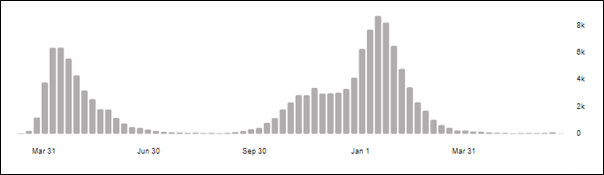
The weekly death rates from March 2020 to June 2021 for the UK are shown in figure 1 below from the WHO web site. The curves for all the other countries considered are broadly similar, but the precise shapes and timings of the curves depend crucially upon the lockdown measures that were imposed by different countries, upon the spread of the new variants through the countries (in particular the so-called Kent or alpha variant) and the effectiveness and rapidity of the vaccination programmes.

Figure 1 United Kingdom weekly death rates throughout waves 1 and 2

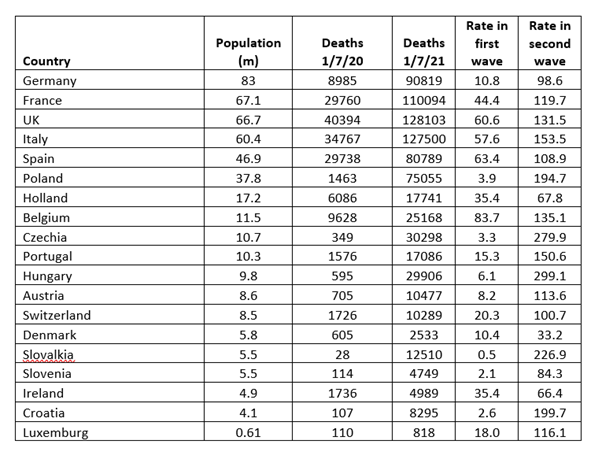
In the analysis we use WHO data for deaths and data from Wikipedia for country populations. The cumulative death figures at 30th June 2020 and 30th June 2021 are used and are shown in Table 1. The first wave of the pandemic was over by the first date, and the second wave well on the way to being over by the second, at least in terms of deaths. The death rates up to June 30th 2020 and between July 1st 2020 and June 30th 2021 have been calculated from the data and are expressed in what has become the conventional statistic of deaths per 100,000 population.

Table 1 Death rates per 100,000 for first and second waves

(At the time of writing – June 30th 2021- the delta variant continues to increase case rates in the UK, in effect a third wave, but deaths remain at a very low level. It is likely that this wave will spread across Europe in the next few months, but hopefully because of the vaccination efforts, serious illnesses and deaths in those countries too will remain at a low level.)

The first wave

The distinction between the first and second waves of the pandemic is important. For the first wave up to 30th June 2020, it can be seen from Table 1 that some countries were affected significantly whilst others hardly at all. The death rate per 100,000 in the UK of 60.6 was amongst the highest in the countries studied. The reasons for this variation are complex, and can be expected to include the degree of initial seeding of the countries from areas where Covid-19 was already endemic, the age profile of the population etc. The February half term skiing trips by many on the UK seem to have been a significant source of the spread, together with international travel from affected areas. There also seems to have been a pronounced west / east gradient, with the easternmost countries in the sample suffering very few deaths in this phase. Germany seems to have straddled this boundary. To unravel these effects would take a much more sophisticated analysis than I can carry out, and it must be left to those better able to do it, . This is not to say that what happened in this wave is unimportant, and the UK death rates were very high. Indeed, it is likely that the UK government will ultimately have to answer serious questions on their level of preparedness, PPE supplies, and in particular the decisions that were made to send untested elderly hospital patients back into care homes. The government estimate for the excess deaths in care homes up to mid-June 2020 was 19,394. If this figure is excluded from the totals the UK death rate in the first wave falls to 31.5 – close to the average of the death rates in the other countries.  That being said, the level of the analysis I am able to undertake does not enable me to draw any further conclusions concerning the relative performance of the different nations in the first wave of the pandemic.

The second wave

In the UK the rise in September and October 2020 was brought under control through a fairly severe lockdown from November 5th 2020 to 2nd December 2020 although by the end of the lockdown it had not fallen to pre-lockdown values. There was much criticism if the government at the lateness of the imposition of the lockdown. The rate began to rise again in early December, due to the emergence of the Kent or alpha variant, peaking in mid-January before being brought down by another lockdown which started on January 6th and was relaxed in stages from March 8th. Again, there was a widespread feeling that the government were late these restrictions and should not have allowed social mixing over Christmas. Vaccinations begin in late December 2020, and this also played a significant role in the lockdown. In the other countries under consideration, the peak in early 2021 due to the Kent variant usually began a month or two later, and the vaccination programmes were also a month or two behind those in the UK, so in general the curves were shifted along the time axis by a month or so. But by the end of June 2021 death rates were very low in all countries.

The international comparison shown in Table 1 indicates that in the second wave, the deaths per hundred thousand of all 18 countries varied widely between 33 in Denmark and 299 in Hungary. The population weighted average was 133. The average of the seven most populous countries was 129. The value for the UK was 132 – very close to the average for both the complete data set of all countries and for the restricted number of countries. Many of the death rates are similar with half the countries having rates between 75 and 150. The data offers little encouragement for those who would either praise or denigrate the performance of the UK – it was boringly average. No doubt it’s mistakes in not locking down quickly enough have been compensated by the rapid vaccination roll out, but the same sort of trade offs can be found in all countries. Perhaps the most important questions to ask are how Denmark, Ireland and Holland achieved the lowest death rates of less than half the average. There are almost certainly important lessons to be learnt from these countries.

A (half hearted) defence of Autonomous Vehicles and other transport innovations

Preamble

Over recent years it has almost become the norm amongst practicing railway engineers to pour scorn on any new transport proposal that emerges – for example Hyperloop, the autonomous metro system, being developed for Cambridgeshire, autonomous vehicles in general, vehicle platoons, bus rapid transit schemes and so on. Now whilst some new concepts deserve all the opprobrium that they receive and are often ideas looking for an application rather than the more sensible opposite, I want to argue in this post, that there is some merit in some of these concepts that deserves further consideration, particular as components of a rail based public transport network.

Before proceeding however, I need to be a little more explicit about those concepts that I do not believe are viable. These fall within two categories – very high- speed tube transport, and autonomous vehicles in mixed traffic situations. The former, exemplified by the monstrosity that is Hyperloop, faces very major technical difficulties. From my own aerodynamic perspective these include the difficulties of maintaining a controlled vacuum along very long tubes, and the highly complex unsteady forces that exists as flow speeds around some parts of the passenger capsule exceed the speed of sound i.e. locally supersonic flow with the Mach number >1.  With regard to the latter, I have seen no published information that these effects have been properly considered. Formidable as these technical issues are, they are of small concern in terms of the major practical issues of capacity (multiple tubes would be required to give the same capacity as high-speed trains); and safety (how these tubes would be evacuated in terms of an accident or fire). In these terms the concept is flawed.

Much of the hype concerning autonomous vehicles has been around the possibility of them providing door to door service with no human involvement in driving. I used to be of the view that this was a possible, if very long term, aim. I no longer think that that is the case, primarily for reasons of liability and safety. If there is an accident (as there will be) who is to blame – the passenger, the owner of the vehicle; the manufacturer; the software designer etc.? Who would wish to accept responsibility for injuries and fatalities? I believe that this consideration alone will cause the development of high levels of autonomy in private vehicles to stall – again when designers and engineers are faced with practical realities. I fear that autonomous vehicles are in the main “toys for the tech boys”. And they are boys – look at any AV website and count the relative number of males and females.

Having thus been dismissive of these two areas, let us proceed to think about those novel transport concepts that might have an application.

What are the viable concepts?

The two specific areas where I believe there might be possibilities of large-scale usage are in the field of tracked autonomy and platoons for public transport use.

Whilst I have doubts concerning the use autonomous vehicles on public highways, their use on restricted systems (let us call them tracks) seems to me less problematic. Such systems already exist in busways and bus metro concepts. Whilst many good railway folk would shout loudly that these would be better replaced by light railways or trams, these systems do have the distinct advantage in some areas of going where passengers wish to go rather than to some remote railway station – Cambridge is the classic example of this where the busway from St Ives allows buses to originate at a range of departure points in north Cambridgeshire, use the busway for the majority of the journey, and then end their journey in the city close to their place of work. Similar autonomous systems could equally be conceived, where the vehicle operate in a driverless mode whilst using the tracked system, with reduced staffing costs and redirection of staffing effort towards passenger care and revenue collection. If autonomous vehicles are restricted in this way, then the guidance system could be very much simpler than those currently proposed, with either short range infrastructure mounted wireless systems every few hundred yards or embedded in the tracked pavement.

The other novel area that has potential for significant use is the concept of platooning, particularly when combined with the idea of tracked autonomy. Autonomous tracked systems can in principle easily be configured to operate as platoons with the headway between vehicles along the platoon being controlled by the leading vehicle. Whist close platoon running will reduce aerodynamic drag and lead to reduced fuel use, the major advantage would be scalability, in that the capacity of such systems could be increased easily by adding extra vehicles in platoon, without a corresponding increase in staffing resource required.

Autonomous Platoon Transport (APT)

These thoughts lead me to propose a new hybrid concept, which I will refer to as Autonomous Platoon Transport  (APT), largely because I rather like the acronym and its associations. APT would have the following components.

  • Self-powered vehicles (almost certainly electric, but I would be open to hydrogen power if only to further irritate some of my rail readers) that have the ability to operate as ordinary vehicles on public roads, or as autonomous vehicles on reserved track. I would envisage a typical vehicle capacity to be around 30 to 40.
  • A simple paved road, single carriageway track (with passing places) with suitable guidance sensors either at trackside or embedded within the pavement – this would be much cheaper and easier to construct than a light railway or tramway.
  • These would operate as driven vehicles away from the reserved track, and as autonomous vehicles, either individually or in platoons, on the reserved track.
  • In principle vehicles could be either passenger or freight, although the latter might make significant demands upon pavement design. The operation of freight APTs would be of a different nature to those for passengers, and I won’t consider then further in this post.

I make no claims that such a concept would replace existing public transport systems, but I will argue in what follows that there are some circumstances where it could complement such systems.

Possible passenger applications

Conventional rail and tram systems have obvious advantages for long distance travel and for travel within major conurbations and meet the journey time and capacity requirements well. The specific areas where APT systems might have a role is where there is large variation of demand either geographically (with many small trip origins) or temporally (with large seasonal variations), or where there are major capital cost constraints that mitigate against the use of conventional rail.

First consider geographical constraints. The type situation here is that of Cambridge and its regions – and indeed the APT system bears a strong resemblance to the proposed Cambridge Autonomous Metro system, although with the use of driver-controlled vehicles at its outer limbs and autonomous platoon running in the central region. Here there is a large, dispersed commuter demand around the city that cannot be met economically by conventional systems but could potentially be met by the cheaper infrastructure required for APT operation. Cambridge is a special case in that the historic nature of the centre requires the hub of the system to be underground, but there are many other towns and cities of a similar size and with similar characteristics, where the central routes, where platoon operation would be in place, would be at surface level.

Typical temporally constrained routes would be rail routes with generally low local usage, but high usage in the summer months – such as coastal branch lines, where overcrowding, often to very unpleasant levels, can occur. The advantage of an APT system would be that it would be easily scalable in terms of capacity without the need for an increase in staffing resource. Whilst the base service might be operated by one APT vehicle, with a driver or passenger manager, this would be supplemented in peak times by other vehicles in platoon – perhaps diverted from those towns and cities with geographical constraints but where demand falls during the summer months and a reduced service is all that is required. This has implications concerning the nature of the infrastructure – either such lines need to be converted to operate in this mode, with paved instead of rail formations, or a new track needs to be constructed along the route, or a hybrid paved / track formation needs to be developed. I suspect the latter would prove to be a challenge, but could allow rail usage when appropriate, although new types of control and safety system would be required. This will bring accusations that I am a closet supporter of converting railways to roads. But no, I am not funded by the TPA (or anyone else come to that) – I am simply interested in providing the most appropriate services for customers that gets them to their destination in reasonable comfort and security. (Interestingly note the reversal in order of acronyms from APT to TPA – a device commonly used in Satanic circles I understand).

The third use of such a system might be in the re-use of old railway lines where rail re-instatement is simply not possible because of major track obstructions / loss of infrastructure. As an example, we might consider the Penrith – Keswick – Workington route in Cumbria. Here an APT system could be used along the existing trackway where this is still in place, with on road / driver sections where major infrastructure no longer exists – primarily in this case at the start and end of the route. Local demand would be small, but the much larger seasonal demand could be met by again scaling the number of vehicles and using platoon running for most of the route.

Finally, the concept could be applied to longer routes where there are both geographical and temporal constraints. A typical case here might be the Cambrian Coat line, where demand is highly seasonal. There are also geographical constraints in the dispersed nature of the communities it serves, and the lack of connectivity to surrounding areas. Thus for example one could envisage the base demand could be met by APT vehicles in short platoons, but joining and leaving the platoons at different places to more directly serve surrounding areas – for example at Harlech to serve the town and connect to Blaenau Ffestiniog, or at Porthmadoc, to again serve the town and to connect to Caernarfon. Such a scheme would rely on a hybrid track form, in order that through trains could operate to Birmingham and that the large summer demand could be met. Again there would be design and operational challenges.

Final thoughts

I suspect many will disagree with some or all of what I have written in this post – hopefully in a civil fashion. And of course all I have written is provisional and might not survive translation into a practical reality. All I would hope is that it encourages discussion of the use of novel transport systems, and how they might complement a modern transport network, rather than simply dismissing them.

The NIC report on “Rail needs assessment for the Midlands and the North” – common sense or betrayal?

Preamble

The National Infrastructure Commission report of December 2020 “Rail needs assessment for the Midlands and the North” has caused something of a stir in the rail industry. The NIC was tasked to look at how the proposals for HS2 and the Northern Powerhouse Rail could best be integrated. It considered two ranges of options  – one that prioritised regional links in the North and Midlands, and one that prioritised long distance links. All options integrated phase 1 and phase 2a of HS2 from London to Birmingham and Manchester, but only the long-distance option included the eastern arm of the original Y shaped network to the East Midlands and Leeds. On the basis of a wide range of indicators, including cost and deliverability, the report concluded that the prioritisation of regional links was to be preferred – cue loud denunciations, accusation of scrapping HS2 abandoning the Midlands and North and so on.   

My first reaction was astonishment that the proposals should have come as a surprise to rail industry commentators – it has been evident to me at least for a few months that some post Covid financial realism was necessary to rein in all the potential major railway projects on the table. Also the eminently sensible and rational Greengauge 21 has recently made very similar proposals, urging that the eastern arm of HS2 be built in a number of phases and repurposed to provide links between regional centres. However, my initial reaction was to share the view of those in the industry, that the conclusions were to be regretted, although perhaps with a greater sense of fatalism than most that this was going to happen anyway.

But then I read the report. I found it to be well laid out, with a convincing set of underlying assumptions and methodology. I have to say I have a great deal of sympathy with its conclusions, which should lose me a few followers on Twitter if nothing else. The basic points that came across to me were that the construction of all the rail schemes currently under discussion is unaffordable, and that the number of passengers travelling between regional centres is significantly greater than those travelling between these centres and London . Post-covid this discrepancy is likely to grow. In this brief post, I want to set out what I see as the benefits of the prioritisation of regional links over long-distance links.

The proposals

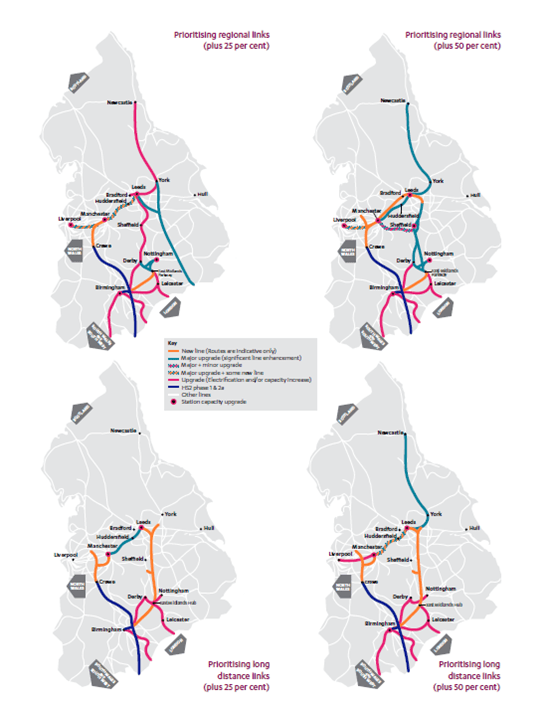
The proposals are summarised in figure 1 below from the NIC report. The report firstly sets out a baseline set of improvements that are already underway or committed to – the western leg of HS2, main line speed upgrades (ECML, MML, Manchester-Sheffield); Transpennine upgrade and Midlands Railhub upgrades. Two sets of proposals are provided for each prioritisation – one at the baseline cost plus 25% and one at the baseline cost + 50%. In the main I will consider the baseline + 50% options. The long-distance prioritisation is based on the Y shaped HS2 network, together with a partly new line between Leeds and Manchester, with upgrades to the ECML to serve the north east and Scotland and further upgrades of track in the Midlands and Lancashire. The regional prioritisation assume the western leg of HS2 to Birmingham and Manchester will be completed, but with the eastern leg replaced by high-speed lines from Birmingham to the East Midlands and from Leeds to Liverpool, with major upgrades to the lines from the new East Midlands line to Nottingham, Derby, Sheffield and Leeds; from Sheffield to Manchester; and from Leeds to the North East. Oddly for the regional prioritisation, the baseline + 25% case also sees a major ECML upgrade from Leeds to London, whereas this does not figure in the baseline + 50% option.

Figure 1

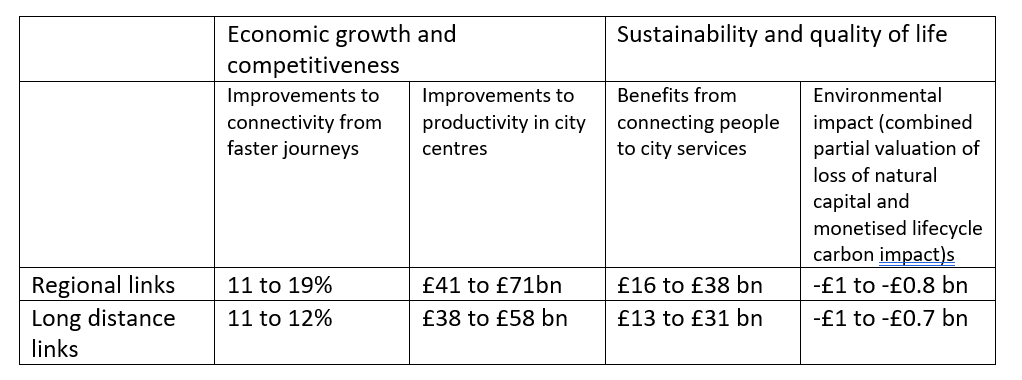
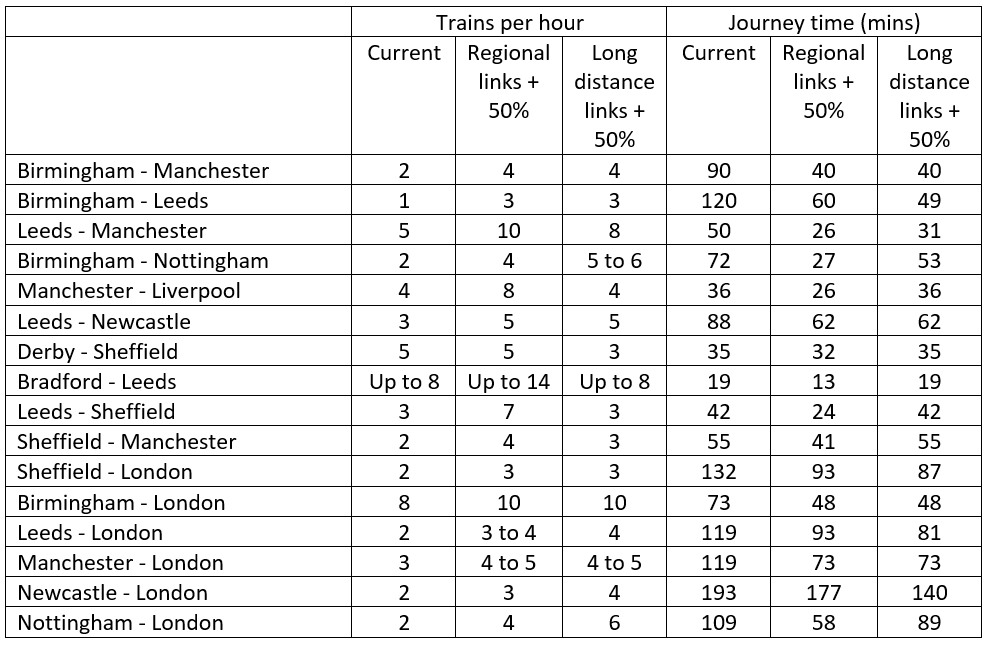
The overall benefits from the proposals are set out in table 1 below for the +50% options – taken directly from the NIC report. It can be seen that prioritising regional links delivers the greatest benefit. Journey time and service level details are given in table 2.

Table 1 – Analysis of baseline +50% scenarios
Table 2 – Journey times for baseline + 50% scenarios

The benefits of regional prioritisation

I will admit that my reasons for liking the regional proposals are very parochial and reflect the fact that I live in the Midlands between Birmingham, Derby and Nottingham. I suspect my views might be different should I live in Leeds. That being said, the major benefits from my perspective are as follows.

  • Links between Birmingham and the East Midlands (and Nottingham in particular) are much better than those offered by the current HS2 proposals, which would need to be routed through the proposed East Midlands Hub at Toton (27 minutes as opposed to 53 minutes).
  • Nottingham gains a direct link to the high-speed line facilitating faster overall journey times to London. (58 as opposed to 89 minutes).
  • The need for the East Midlands Hub at Toton is removed. The proposal for a hub there has always been in my view a mistake of potential historical significance. Such a station would suck the life out of the centres of Nottingham and Derby into a new urban centre at Toton which, because of its proximity to the M1 and A52, would also very likely be a major generator of road traffic in the area.
  • Services within and across the East Midlands, Yorkshire and Lancashire would be greatly enhanced – see table 2.

In addition, a link from the line from Derby to Birmingham to HS2 at Tamworth, would allow high-speed running most of the way from London to Derby. It is also of interest to note that the route of the proposed high-speed line to Nottingham appears to be further south than the current HS2 proposal and would allow a new station to be built close to East Midlands Airport. This would thus allow for a high-speed connection with Birmingham Airport, which would allow greater operational flexibility. for both airports.

The drawbacks of regional prioritisation

The main selling points of the current HS2 scheme are decreased journey times and the release of capacity on the classic network for other services, both passenger and freight. With regard to the former, table 2 shows that for the regional-links option journey times are mostly decreased from the long-distance links option between centres other than London. London to Sheffield, Leeds and Newcastle take 6. 12 and 37 minutes longer for the former than for the latter. The first two I would suggest are hardly significant. If the ECML upgrade is included in the regional-links option, the Newcastle / London time takes just 3 minutes longer than the long-distance option – as noted above this was, oddly, included in the +25% regional links option but not the +50% option.

The issue of capacity has also been addressed by the report. Whilst there can be seen to be significant benefits to the number of inter-regional services that it is possible to schedule, the report admits that the regional-links approach does little to release freight paths on the ECML and in the North and Midlands. This will not please the rail freight sector of course and must be seen as a weakness of the regional-links proposal.

One other point. The report only briefly mentions Scottish links. Those that are proposed in the HS2 plans for the WCML and the western arm of HS2 will not of course be affected. Those that are proposed for the eastern arm and the ECML will be affected to the same level as the Newcastle services – and the effects can be minimised by an ECML upgrade. This being said, I strongly suspect by the time these upgrades are delivered, we will have an independent Scotland and a united Ireland, with a transport focus on an east west corridor with high speed ferries from the continent to Edinburgh connecting with cross Scotland lines to high speed ferries to Ireland. Links to London and England in general will be of less concern, and may well involve customs and passport checks.

Final thoughts

As noted above, I find the report and its conclusions plausible and convincing. It is not ideal of course, particularly with regard to freight capacity, but it does seem to me to be realistic, and at least from my Midlands perspective, offers significant benefits. I strongly suspect however that that won’t be everyone’s view.

Engineers, roads and ethical standards

See the source image
Silvertown Tunnel Scheme

It is now established beyond all doubt that the unrestrained growth in road vehicle traffic is bringing many undesirable effects. Annually  around 1750 pedestrians are killed by cars in the UK, and 25000 seriously injured. The poor air quality that results from gaseous and particulate emissions from roads and vehicles results in significant adverse effects on the health of those who live in urban areas, children in particular. High levels of traffic can be both unattractive and dangerous for other road users such as pedestrians and cyclists and can discourage these active modes of transport. Again, this can lead to adverse health effects, seen particularly in the increase in childhood obesity.  Large areas of land are given over to sterile car parks that could be more profitably used for other activities. The effects on communities and urban environments is also significant and there is clear evidence that restricting car use can increase the vitality and livability of such areas and lead to real social and health benefits for the poorest in society. To these should be added the fact that the road sector is the major cause of greenhouse gas emissions in the developed world, and that road vehicles use precious energy resources in an unsustainable way. All these effects are well known and proven to high levels of reliability, and fully appreciated by most Transportation Engineers and Planners.

And yet…… Major road improvements are still carried out and new roads built, which inevitably results in further induced growth in traffic, magnifying the issues set out above. Induced traffic growth is of course often conveniently ignored in scheme appraisal. New housing developments are built, with major areas given up to parking and no provision for public or active transport. Low Traffic Neighbourhoods are now a political issue within the culture wars narrative and are more often removed than implemented.

My community, that of professional engineers, see these things and in the main recognize the folly of them. We regret them but we shrug our shoulders and carry on. In the end, we say, we have to provide what clients want, and we design and build road scheme after road scheme, housing estate after housing estate, knowing all the time that these will only result in more health problems, more congestion, more accidents and deaths and a degraded environment. The time has come when I would suggest we, as engineers, need to look very seriously at ourselves and our actions.

I am a Fellow of a number of professional institutions. Of these the two most relevant to the issues addressed here are the Institution of Civil Engineers, and the Chartered Institution of Highways and Transportation. The ICE Rules of Professional Conduct include the following clauses

3. All members shall have full regard for the public interest, particularly in relation to matters of health and safety, and in relation to the well-being of future generations.

4. All members shall show due regard for the environment and for the sustainable management of natural resources.

The CIHT Code of conduct contains something similar.

Members of the Institution must give due weight to all relevant law, facts and best practice guidance, and the wider public interest. They must:

  • minimise and justify any adverse effect on society or on the natural environment for their own and succeeding generations;
  • take due account of the limited availability of natural and human resources;
  • hold paramount the health, welfare and safety of others;

It seems to me that there is at least an arguable case that by knowingly being involved in road building developments which will lead to adverse effects for existing and future generations, and will consume limited natural resources in an uncontrolled way, professional engineers are in breach of their own institutional codes of conduct that bind them. Further this action could, in principle, lead to formal complaints made about the involvement of individuals. Indeed  the CIHT code of conduct lays a duty of complaint on its Members and Fellows to “report any violation of this Code by a member to CIHT”.

Without the involvement of engineers very many fewer environmentally, medically and socially damaging schemes would get off the ground and none would be designed and built. I would suggest that we are approaching a point where individuals and firms, and indeed the entire profession will need to make a choice – to comply with our own ethical codes and take them seriously or to ignore them. It is not a question that will be able to be avoided much longer.

A brief look at the incidence of Covid-19 in UK Universities

See the source image

Alarm has been expressed by many commentators at the prevalence of Covid-19 in UK Universities, and on the face of it, the figures do seem to be alarming. For example, the UniCovid UK website that attempts to track the spread of Covid in Universities indicates that, as at October 17th 2020, since the start of term there have been 1650 cases at the University of Manchester and 1522 at the University of Northumbria. This data comes from a variety of sources where it is reported in different ways and needs to be treated with caution, but nonetheless gives a broad indication of the current situation. However these raw figures do not give a real indication of the situation since they do not take into account the size of the institution or the length of time since the start of term, which differs from place to place. To look at this in a little more detail I have carried out the following simple analysis using the UniCovid UK data at October 17th 2020.  I have taken the number of reported cases since the start of term at each institution and divided them by the factor (total student population x days since the start of term / 14). This gives a rough approximation of the proportion of students who might currently be expected to have Covid-19, making the assumption that the illness lasts for 14 days. I am very aware of the other implicit assumptions involved in this calculation (the assumption of constant infection rate,  the neglect of the different demographic profiles of different universities, different rates of testing and so on), but at least it gives a crude normalization of the data. On this basis, the 30 Universities with the highest percentages of students currently with Covid-19 is shown in the table below.

Approximate % of students infected (October 17th 2020)

Now the UniCovid UK web site gives the prevalence of the virus amongst the student age population as between 0.24 and 0.52%. Most of the Universities in the above table lie above the upper bound value, but many not by a great amount (and here the assumptions in the analysis need to be kept in mind). Only twelve exceed a value of greater than 1% of the students having the virus. Whilst for some of these top twelve the situation is clearly very serious, with the proportion of those infected many times the expected levels, the numbers suggest that the issues are localized – and indeed mainly in areas where there are high rates of infection in the wider community.

Leisure travel by rail after the pandemic

Figure 1 Public transport use in the UK

It is becoming clear that the effect of the Covid-19 pandemic on public transport in the UK is very significant, and is resulting in a major reduction in rail and bus use that looks as if it will persist at least in the short and medium term and also possibly into the long term future. Figure 1, compiled from DfT statistics, shows the seven-day average use of rail and bus over the course of the pandemic, up to 29/9/2020. It can be seen that rail and tube use seems to be plateauing at around 40% of the pre-pandemic values, and bus use at around 60%. The same trend can be seen in other cities around Europe – see figure 2 from the Financial Times, which shows general public transport use. London does however seem to have a greater reduction than other capital cities.

Figure 2 Public transport use in major European cities

The trends shown on figures 1 and 2 do however mask considerable geographical and service type variations. There is evidence that the use of public transport in larger cities has fallen more sharply than in smaller conurbations, and also that travel patterns are changing. Network Rail Chairman Peter Hendy made the following comment at a recent online conference

“It is clear that people’s methodology of working has changed. Many jobs can’t be done from home, but there are lots of people who can work from home and have learned something they didn’t know before and are learning to live in a different way. Leisure travel has returned quicker than work travel. One of the scenarios that we might want to have in our heads is that we might be going back to a situation like the 1950s, when maximum traffic on the railway was on peak summer Saturdays and not in  what we now regard as normal peak hours.”

My personal experience would tend to confirm this – I, and others in my family, have recently travelled on quite heavily loaded services with passengers heading for leisure destinations in the north of England. This trend is also clear in the data from the excellent Centre for Cities website for Birmingham and Bournemouth, shown in figures 3 and 4 below. These show a variety of metrics that indicate how these places are recovering. It is clear that activity in Birmingham, a major commuter hub, remains well below pre-pandemic values, whilst activity in Bournemouth, at least in part a leisure resort, has in general increased.

Figure 3 Centre for Cities data for Birmingham

Figure 4 Centre for Cities data for Bournemouth

In this post I want to consider briefly how the rail network might take into account this leisure market. In pre-nationalisation days and the early days of BR, this market was catered for by excursion traffic from the major centres of population to a range of coastal resorts. In retrospect this involved a very inefficient use of rolling stock, with the carriages that were used for these excursions often having no other use other than at summer weekends. It also required extensive siding space at the resorts themselves, as the trains often waited there for a significant time before returning. After the demise of such traffic, the strategy (if one can use that word) seems to have been to provide an essentially local service on the routes to resorts, with connections to the main line, and to simply accept overcrowding oh high days and holidays. By its very nature such a strategy was self-limiting in terms of passenger numbers – the experience of trying to crowd onto a two-coach multiple unit with a family and luggage is not one that is willingly repeated if there is another way to travel.

So is there a way in which such traffic can be catered for in a more passenger friendly way? I would suggest there is, but it requires significant changes to the structure of the industry to make it effective. Firstly, it seems to me that there are a number of basic passenger requirements.

  • Passengers wish to go from their point of departure to their destination without changing trains – particularly those travelling with family and luggage.
  • There should be significant space for luggage, so that aisles and vestibules are not blocked.
  • There should be no overcrowding.

On a basic level these points suggest that excursion traffic and local traffic should be kept separate, with the former running directly from departure to destination. With regard to the first bullet point, considering the Birmingham / Bournmouth route as an example, trains should pick up at a small number of points in the West Midlands conurbation (say Wolverhampton, Sandwell and Dudley, Birmingham New Street and Coventry) and run non-stop to Poole and Bournemouth. The normal intermediate stops of Banbury, Oxford and Reading (amongst others), delightful as these places are, are simply of no interest to leisure travellers. The second point suggest that luggage facilities should be provided, perhaps in a separate coach with luggage tagged, loaded and unloaded by station staff. And the third point suggest that such trains should have compulsory reservations and those without reservations not allowed to board.

How could such an operation be achieved, making efficient use of rolling stock? I would suggest that there is already sufficient rolling stock available, particularly with the increasing use of relatively high speed, hybrid multiple units that are not restricted by the extent of electrification. However, a national approach needs to be taken, such that some rolling stock of this type is used for local, regional and  commuter services for much of the year, is transferred to excursion traffic during the summer when the local and regional demand is lowest. This requires a national approach to stock utilisation that cuts across TOC / Operating Unit boundaries, and also a similar integrated approach to timetabling and service provision. One could thus envisage for such services route 9 or 10 coach  hybrid multiple units, that would normally work on local and regional services, operating as excursion stock in the summer, both on weekdays and at weekends. Luggage facilities could be provided in one coach that has fold down seating, which is a perfectly viable concept. Passengers would deposit and collect their luggage at stations, which would require a suitable luggage tracking system and appropriate staffing. Reservations would need to be made before hand and systems put in place at stations for allowing only those with such reservations to access the platform as the train arrives.

The above is a suggestion for only one type of leisure traffic – the medium to long distance excursion market. There are many other types of leisure traffic that need to be catered for and a variety of methods need to be developed. The important point is that such traffic cuts across the neat geographic and organisational boundaries of the current system and require a national approach to stock utilisation, timetabling, station organisation etc. The current organisation of the network, with the multiple internal boundaries and barriers between regions and operating units, would simply not allow such services to be developed. Perhaps a nationwide “Leisure Travel” operating unit needs to be considered? Something for the still slumbering “Guiding mind” to think about?