High mortality events in Lichfield 1840 to 1940

Introduction

In a recent blog post, I investigated the registers and monumental inscriptions surveys of the churchyard of St Michael’s in Lichfield, to see if they contained traces of the effects of the 1918 flu pandemic. This was made possible by work carried out over the last decade where I collated both sets of records into a searchable spreadsheet. It turned out that there was significant excess mortality recorded at the time of the 1918 pandemic and that the age profile of this excess mortality matched that associated with the pandemic i.e. excess mortality in the age ranges from 20 to 50 (approximately).

The obvious follow up to such work was to further investigate the St Michael’s database to attempt to identify other periods of significant excess mortality in the Lichfield area, and this is addressed in this blog post. In the next section an outline of the methodology that was used is set out. This leads to the  identification of a number of periods of high mortality, that were then investigated further with regard to the excess mortality age profile. The results were then interpreted using limited historical data from other records.

Methodology

The methodology that was adopted is as follows.

  • The period from January 1840 to December 1940 was chosen for the analysis. For this period, earlier work has shown that the number of burials per year in St. Michael’s churchyard remained roughly constant, and was around 15% of the total number of deaths in the larger Lichfield Civil Registration area.
  • The number of burials each month was extracted from the data and tabulated by year and month.
  • For each month, the average of the monthly deaths for that month in the preceding five years and the five years that follow was obtained.
  • The ratio of the actual monthly data to the average monthly data was then obtained for each month (R). A value of less than 1.0 thus indicated that the monthly data was below the average for 10 years around that period, and a value above 1.0 indicated that the data was above that average.

As an example of this process, consider the period from 1860 to 1865. Firstly Figure 1a shows the number of burials by month over that period. It can be seen that, unsurprisingly, there is much month by month variability, but that there seem to be an unusual number of deaths in the first half of 1863. Figure 1b shows the 10 year averages, based on the same month 5 years before and 5 years after. The graphs for each year can be seen to be generally similar with a slight variation across the months. Figure 1c shows the ratio of the actual and mean values (R). Again the 1863 values stand out quite clearly.

a) Monthly burials from 1860 to 1865
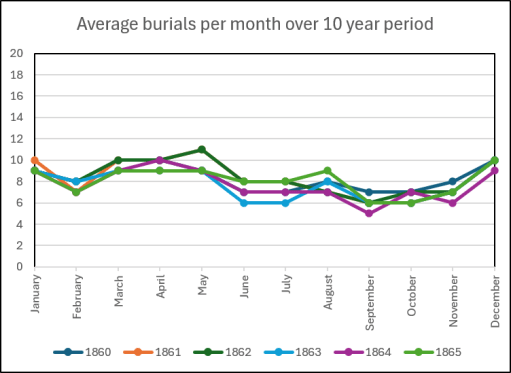
b) Average monthly burials five years before and five years after the month in question
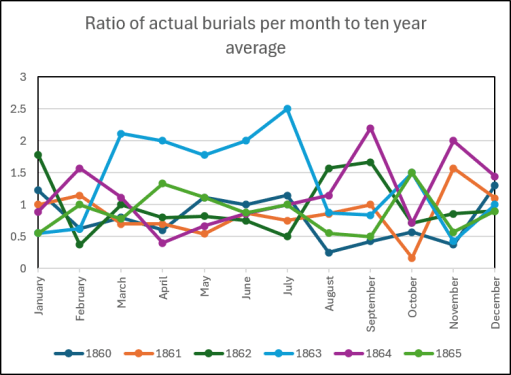
c) The ratio R of the data in figures a and b

Figure 1 Example of monthly data analysis

Identification of high mortality events

The criteria that were adopted for determining events for more detailed study were that firstly the ratio of actual burials to average burials (R) should exceed 1.7 for at least two consecutive months, and that secondly at least one month should have a value of R of greater than 2.0. Only those events with more than 30 deaths overall were chosen. This process resulted in seven events being identified and these are given below. The list shows the R value for each month; the total number of deaths in the period; the expected deaths in each period (the average values for 5 years before and 5 years after); and the excess deaths over the period (the difference between the last two values).

  • 1846 August (R=2.8); September (R=2.6); Actual deaths 33, Expected deaths 12; Excess deaths 21
  • 1863 March (R=2.1); April (R=2.0); May (R=1.8); June (R=2.0); July (R=2.5); Actual deaths 80, Expected deaths 39; Excess deaths 41
  • 1883 September (R=1.7);October (R=2.7); Actual deaths 31, Expected deaths 14; Excess deaths 17
  • 1895 February (R=1.7); March (R=2.3); Actual deaths 38, Expected deaths 22; Excess deaths 16
  • 1899 March (R=1.8); April (R=2.0); Actual deaths 41, Expected deaths 22; Excess deaths 19
  • 1918 October (R=4.6); November (R=2.8); Actual deaths 45, Expected deaths 13; Excess deaths 32
  • 1940 January (R=2.3); February (R=3.0); Actual deaths 42, Expected deaths 16; Excess deaths 26

As might be expected the 1863 data of figure 1 features in the list.

Analysis of events by age at death

The next step was to breakdown the number of deaths in each event by age, in intervals of ten years. As an example, the 1863 results are shown in Figure 2a. Similarly the deaths in the periods of 5 years before and 5 years after each event were broken down by age. These were then factored by the ratio of the number of deaths in the event and the overall number of deaths in the 10 year period, to calculate what might be called the expected number of deaths during the event. Figure 2b shows such values for the period 1858 to 1862 and 1864 to 1858. It can be seen that, in this case, the number of burials in the 0 to 9 age group greatly exceeds the expected value, a point that will be taken up in what follows. The differences between the values in the two graphs will be referred to as the excess deaths in what follows.
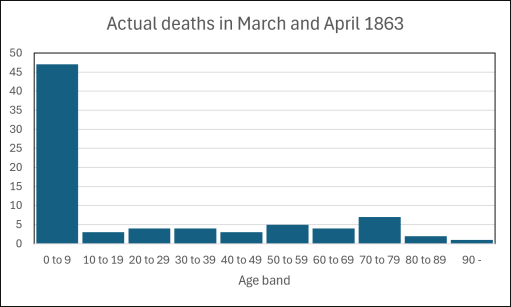
a) Age at death breakdown for 1863 event
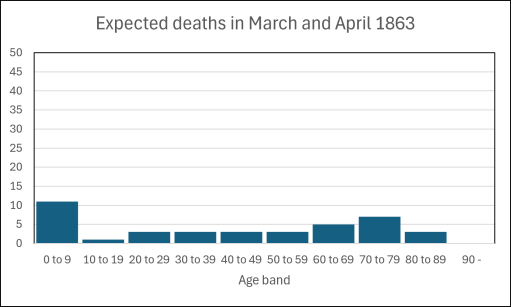
b) Expected age at death breakdown from 1858 to 1862 and 1864 to 1868

Figure 2. Breakdown of burials by age for 1863 event

The above procedure was then carried out for all seven identified events and the breakdown of excess deaths by age is shown in Figures 3a to 3g. The first three events (1846, 1863 and1883) are all of the same form, and show that the excess deaths are concentrated in the 0 to 9 age group, which was a period of high child mortality in any case. But the concentration or excess deaths in this age band are striking. The 1895 and 1899 events are different in form, with excess mortality in the older age groups, particularly for those over 60. The 1918 event by contrast shows excess mortality spread across the mid age range. The final 1940 event shows a large peak of excess mortality in the 60+ age range.
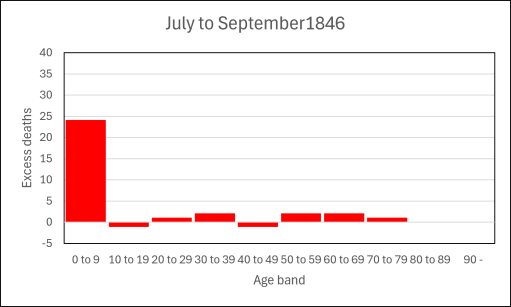
a) 1846 event
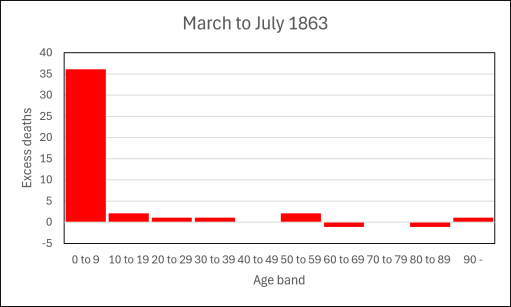
b) 1863 event
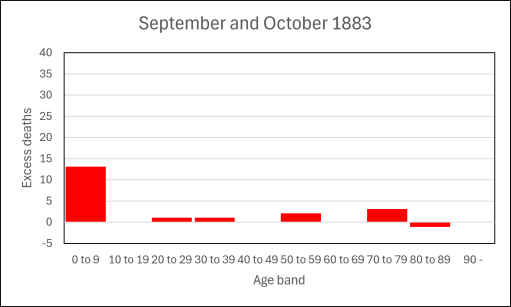
c) 1883 event
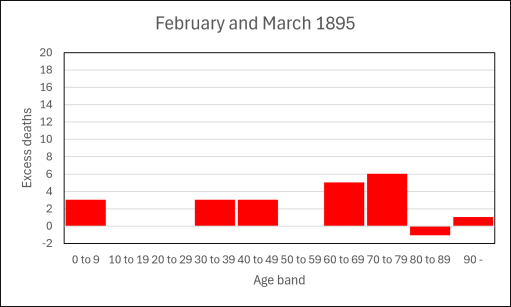
d) 1895 event
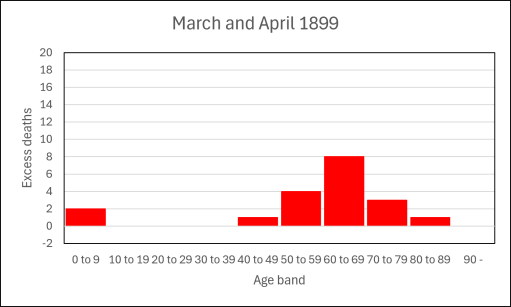
e) 1899 event
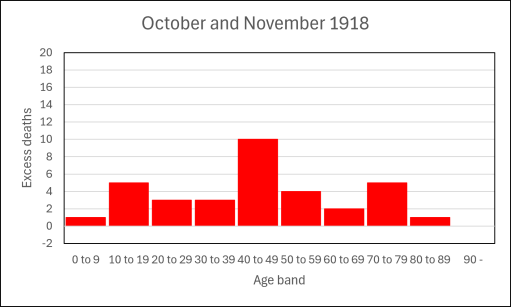
f) 1918 event

g) 1940 event

Figure 3.Excess deaths for each of the identified high mortality events

Interpretation

The question then arises as to whether any more can be said about the causes of the events from the historical record. For the last two events that proves to be the case. The 1918 event shows the effects of the Spanish Flu pandemic in Lichfield, and this was widely reported in the local press and that I considered in the earlier post. An analysis of the burial register for the 1940 event indicates that 18 of the 42 deaths in that period were elderly patients in the former Workhouse Infirmary, which would suggest that there was some sort of localised outbreak there. This was however, not reported in the press. The first five events listed above do not seem to have been recorded in any historical sources, and their cause must remain unknown. Conversely the major flu epidemic of 1889 / 1890 (the Russian Flu) has left no trace in the St. Michael’s burial records.

There is some indication of the effects of climate for the 1895 and 1940 events. February 1895 was the coldest February in the entire period from 1840 to 1940, with an average central England temperature of -1.8 degrees , and one of only two years below zero. The average over the period was 4.1 degrees. January1940 was also the coldest January in the entire period at -1.4 degrees against and average of 3.7 degrees. It was one of only three years below zero. Old people seem to have been particularly affected in these two events.

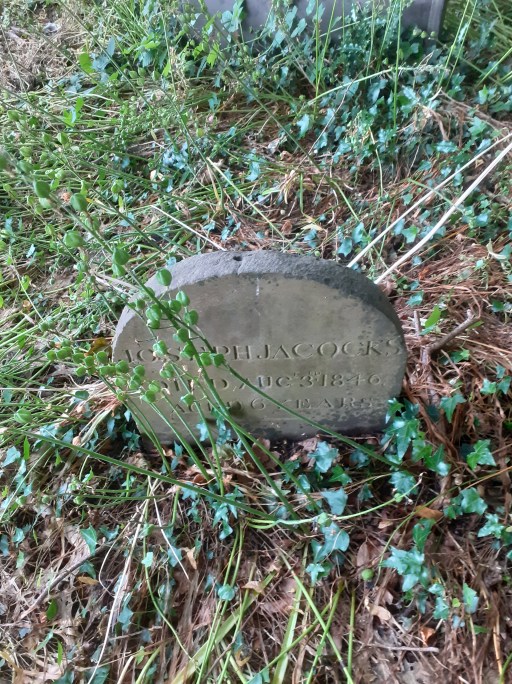
But the numbers and the age profiles of the events surely hide many stories; the concentrated grief of many parents losing their children in a short space of time in 1846, 1863c and 1883; the loss of elderly and much loved parents in 1895 and 1899; the incomprehension of the loss of the young and healthy in the Spanish flu of 1918; and the despair of the community in the dark days of 1940 that the place of safety and rest in the infirmary should become a place of death. The names of all those who died are recorded and for some the inscriptions on the memorial stones were recorded, even if the memorials can no longer be found. Perhaps one of the most poignant is that to the Hitchins children of Butchers Row who died during or close to the 1846 event.

Sacred to the memory of SARAH ANN HITCHINS who died July 25th 1846 aged 7 years. Also of HENRY WRIGHT HITCHINS who died August 5th 1846 aged 9 years. And of ADELAIDE HITCHINS who died November 15th 1846 aged 3 years.

There is perhaps one other individual who does come into sharper focus. Nearly all the burials in the 1846 and 1863 events were conducted by the Perpetual Curate (vicar) Thomas Gnossall Parr. More is told about him here. But the emotional trauma that he would have experienced as he buried the children of many of his parishioners must not be underestimated. He would no doubt have had a degree of professional detachment, but nonetheless he would have been faced with the raw grief and despair of many of his parishioners for whom he had the cure of souls. The strain of parish ministry in such circumstances is so often forgotten.
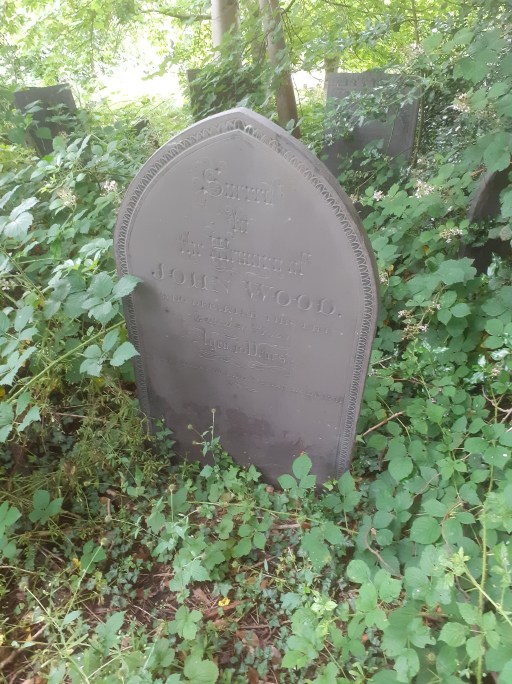
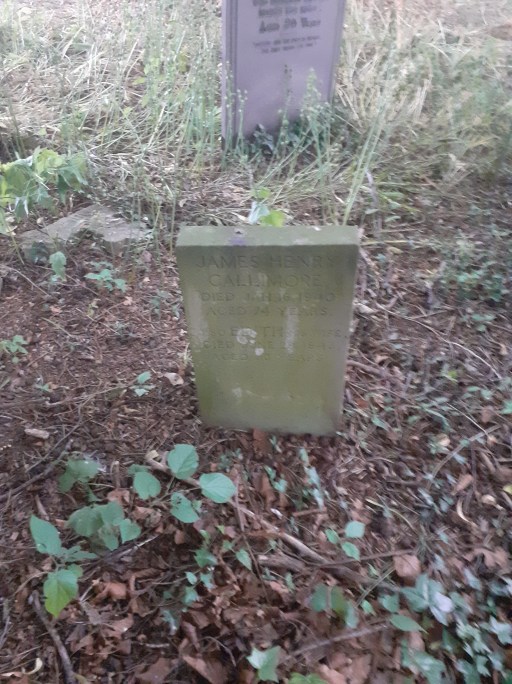
Traces of the 1918 Spanish flu pandemic in St. Michael’s churchyard, Lichfield

Background

Over the last decade or so, I have collated a great deal of information concerning the interments in the large churchyard of St. Michael’s church in Lichfield, bringing together burial register entries and monumental inscription surveys into one searchable spreadsheet. This has proved to be useful for family history researchers in particular. The data has also allowed me to carry out a fairly detailed analysis of how patterns of death and burial have changed over the two hundred year period since burial registers were introduced in 1812, The results of this work can be found elsewhere on this website in the paper “The changing face of death“.

Now of necessity this analysis, dealing with 200 years of data, has used fairly broad data averaging periods to examine long term trends, and most of the analysis used data averaged over 10 year periods. Thus the effects of any events that occur over a shorter time period will not be visible in the results. Now recently I have been reading a number of papers and reports about aspects of death, burial and cremation and have come across repeated references to the Spanish Flu epidemic of 1918 / 1919. This has led me to wonder if there is any trace of the deaths caused by this epidemic in the St. Michael’s churchyard data. As esch wave of this epidemic occurred over a period of a few months, an analysis over much shorter time scales than I previously used was required. This blog post presents the results of this analysis, and is supplemented by newspaper material from the period that illustrates how the pandemic was viewed in the wider Lichfield area.

Burial numbers 1918/1919

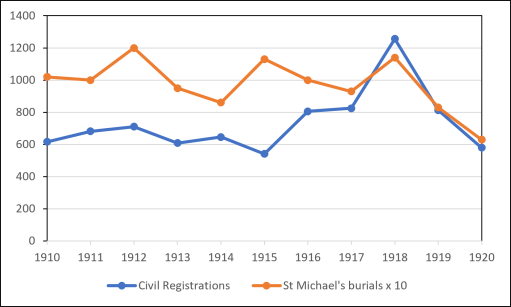
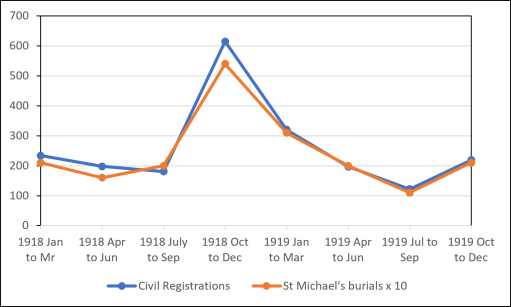
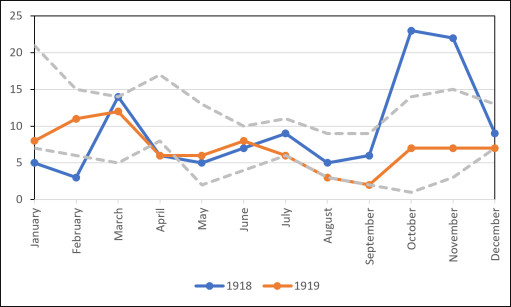
The analysis of burial numbers looked at two sets of data. The first was the information from the burial registers. This was analysed over annual, quarterly and monthly periods from 1910 to 1920. The second set of data was from the Civil Death Registration database for the Lichfield Registration area. This is much larger than the parishes of St. Michael and St. Mary that use the churchyard, and also much larger than the city of Lichfield itself. It extends to the surrounding towns and villages, including Brownhills, Burntwood and Rugeley. Data was analysed over annual and quarterly periods. The results of the analysis are shown in Figure 1 below. Figure 1a show the annual data for the two sets of records. The St. Michael’s data has been multiplied by a factor of 10 for clarity. In general the results imply that the number of burials recorded in the St. Michael’s records are around 10 to 15% of those for the entire registration district, which seems reasonable. The civil registrations show a significant peak in the data for 1918, but such a peak is not apparent in the St. Michael’s data. Figure 1b show quarterly burial numbers and registrations for 1918 and 1919. Here both datasets show a significant peak in the last quarter of 1918, which ties in with historical records that the epidemic was at its peak over this period. Figure 1c shows the monthly data for the St. Michael’s burials for 1918 and 1919 only. The dotted lines show the spread of the monthly data for the years 1910 to 1917.The 1918 data shows a low number of burials in January and February, below the 1910 to 1917 spread of data, and a major peak in October and November as the epidemic hit Lichfield. The low values in January and February of that year explain why the epidemic peak could not be seen in the annual averages, as they would tend to lower the averages despite the peak later in the year. The 1919 data lies within the spread of the 1910 to 1917 data. Tus to answer the question posed above, it is possible to see some traces of the epidemic in the St. Michael’s data, concentrated in the months of November and December 1918.

a) Annual averages 1910 to 1920
b) Quarterly averages 1918 and 1919
c) Monthly averages 1918 to 1919

Figure 1. Analysis of burials by year, quarter and month

Residence

In total in October and November 1918 there were 45 deaths recorded in the St. Michael’s burial register and it is possible to look at where these lived within the parish and their age at the time of death. Details of all 45 individuals are given in Table 1 below (a downloadable pdf). Of these 13 were residents of the Workhouse on Trent Valley Rd. The addresses do not reveal any particular cluster of cases, and deaths from across and beyond the parish were recorded.

Table 1. Details of the burials in October and November 1918

Age distributions

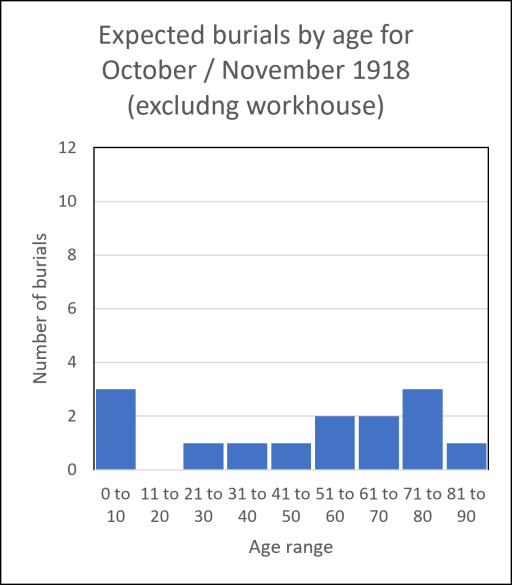
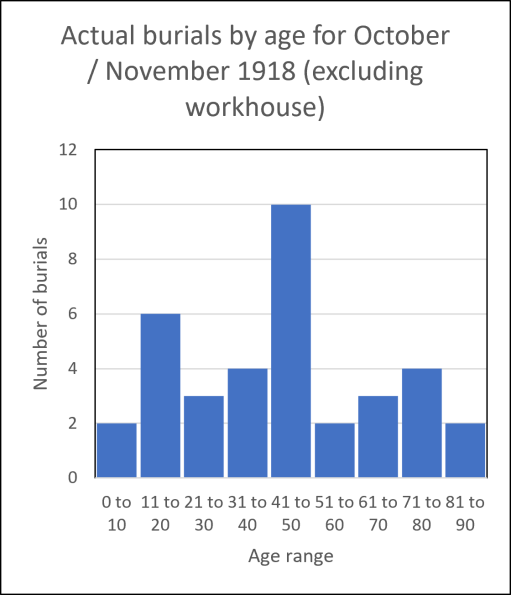
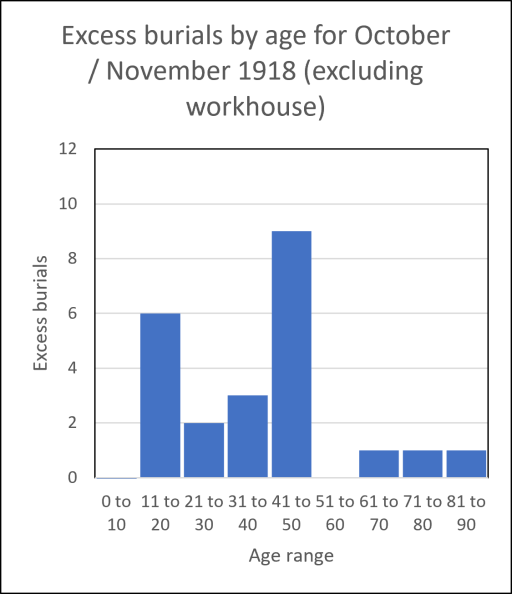
The data in table 1 also enables the age distribution of the deaths to be investigated. First however, the question arises as to what might be the expected age distribution of deaths. For the October / November period in the years 1910 to 1917 there were an average of 14 deaths. If one applies the average death age distribution for the decades 1910 to 1930 to the expected 14 deaths, the expected death age distribution for October / November 1918 is shown in figure 2a. It can be seen it shows a peak for ages between 0 and 10, followed by a rapid fall off, then a gradual rise withe age, peaking in the 71 to 80 age range. It thus shows high child mortality, but the majority of other deaths in the older age group. Note that these are average expected values and there were large variations around this distribution from year to year. Figure 2b shows the actual number of deaths by age in October / November 1918. The difference between Figures 2a and 2b is best appreciated from Figure 2c which shows this data from Figure 2b minus the expected death rates from Figure 2a i.e. what would now be called the excess deaths. It is clear that most of the excess deaths were in the 11 to 50 age range, which is very much in line with what has been reported by many other sources – that the Spanish flu virus was particularly dangerous for the young and healthy.

a) Expected deaths
b) Actual deaths
c) Excess deaths

Figure 2 Death rates by age group

From the press

Naturally the arrival of the epidemic in Lichfield caused much consternation and was reported at length in the press -particularly the Lichfield Mercury. In this section we present a few extracts from that publication between October and December 1918.

From 11/10/1918, we have this description of the effects of the virus and the symptoms.

An epidemic of influenza raging in Lichfield and all the schools. with the exception of the High School, have been closed. The epidemic is the most widespread that has occurred for very many years, and it has developed with great rapidity. There are quite a large number of instances where four or five members of a household are down with the disease and one case reported where eight persons in one house are under treatment Happily, the cases are for most part of mild type, though a proportion are of a more serious character. One noteworthy feature is that number of cases the influenza is accompanied by nose bleeding and vomiting, while in  others the sufferers are delirious. The outbreak has increased the strain on the local doctors, who. for a long time have been working at high pressure consequent on the absence on military service of members of the who formerly practiced in the district.

A week later (18/10/1918) there was no respite.

The influenza epidemic in Lichfield at present shows no signs of waning. Every day brings an addition the list of cases, and several deaths have occurred. The Grammar School and High School and all the elementary schools in the City are closed. Many people who so far have escaped are taking all the recognized precautions, and the local chemists have had large demands made upon them far quinine, essence of cinnamon, eucalyptus oil, and other preventatives.

On 25/10/1918 we read of the actions taken by the City Council with the (limited) provision of nursing support. Official advice on how to behave is also given.

The present influenza epidemic is the most virulent and widespread has been experienced in the district for very many years, certainly for the last quarter of a century. The Lichfield City Council, as the local health authority, has, through the Sanitary Committee, had the matter under consideration, and two special nurses have been called in to assist combating the disease. They are acting under the direction Mr. G. Homan. the City Medical Officer of Health, and the other local doctors, and although at the time of writing fresh cases continue to be notified, it hoped that before long the disease will have run its course.
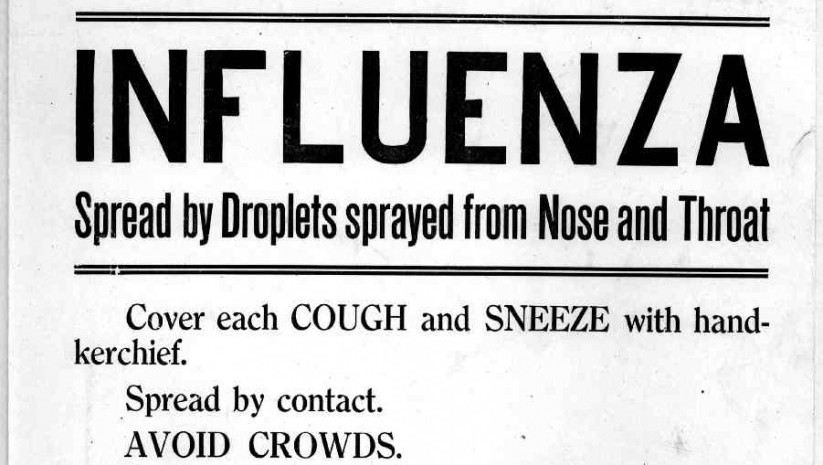
Of course the position in Lichfield is not by any means singular in regard to the extent of the epidemic; it has made its appearance in all parts of the country, and amongst all classes of the community. Those who have, so far escaped attack will wise to take all the available precautions. Sir Arthur Newsholme, Medical Officer of the Local Government Board, has issued a pamphlet asking for the cooperation of everyone in obtaining control over disease, and suggesting preventive measures. Infection is chiefly spread in the earlier stages, and every patient who has severe cold or fever should go bed and stay there for three or four days. If every person suffering from fever were to do this the spread of disease in factories and workshops, offices, shops, and schools would be greatly reduced. Among the precautions suggested are;— Avoid scattering infection in sneezing and coughing. Boil handkerchiefs. Spit in receptacles containing disinfectant. Indiscriminate spitting is especially dangerous during the prevalence of influenza. Keep windows open, especially in bedrooms. Thoroughly wash all utensils from influenza sick room. Overcrowding in dwellings, unventilated assembly rooms, and places of entertainment should avoided. Gargle the throat with solution of one in 5,000 permanganate of potassium in water containing a pinch of common salt. This should also be snuffed up through the nostrils and expelled through the mouth. Stay in bed until all fever is gone. Relapses follow chills or over exertion while convalescent. Alcoholism favours infection. Old persons and young children should not be allowed near an influenza patient. No vaccine is available for the treatment of influenza, and although in cases of primary pneumonia and bronchitis, treatment with a vaccine has sometimes been found useful, no such treatment can be recommended for the pulmonary complications of influenza.

By 1/11/18 the epidemic in the city was abating, although its seems to be still spreading in the outlying villages. The writer of the article below speculates on how such an epidemic might be better managed in the future,

LESSONS FROM THE LICHFIELD OUTBREAK -THE POLICY OF THE FUTURE
The influenza epidemic is still causing acute anxiety in Lichfield. Fresh cases continue to occur in the City, though they are not as numerous as they were fortnight or three weeks ago. Unfortunately the disease seems now to be spreading to the outlying districts and the schools are closed at Armitage, Gentleshaw, Fradley, Alrewas Shenstone. Wall, Chasetown, Kings Bromley, Whittington, Weeford, BrownhilIs and Norton Canes. It cannot, therefore, be said that there is any real abatement.
The impression has gaining ground that disease which has made its appearance with such virulence and over practically the whole world is not influenza. This impression arose the fact that the symptoms seemed in general to be a of quite different type from those experienced in previous epidemics. In the many people there was a suspicion that the outbreak was a form plague. The latter suspicion, is, according Sir Walter Director of the Medical Research Committee, and Lieutenant-Col. Harvey, the Royal Army Medical College, entirely without foundation. Research work has been proceeding for some time and no such organism as the plague bacilus has been found. Further it is pointed out by another expert that influenza manifests itself in various ways, and bacteriologists may find that what we call influenza is really a group of distinct diseases.
The widespread nature of the outbreak is responsible for the great public attention that the disease is attracting at the present time. The State is now directing its energies io ascertain what preventive measures may be taken, and a special conference of representatives of ail departments has been promised by Mr. Haves Fisher. But, Professor W. J. H. Simpson, of King’s College, London, points out. to wait until epidemic has acquired a full grip on the community before taking measures against it is not prevention. There should be some central health organization in the country which have readily its command all available information concerning all communicable diseases occurring in every part of the world and in every part of its own country. 

THE NURSING ARRANGEMENTS.
From the outbreak as it has manifested itself in Lichfield, a number of useful lessons may be drawn .It is of course, essential that the Medical Officer of Health should at once call into consultation with him the local doctors, and as part of the possible co-ordinate their service. Then, too, the local authority should take such steps they are able to secure adequate nursing. At Lichfield both these things have been done, though in regard to the nursing of cases the arrangements made have been totally inadequate. But for the latter fact it must be remembered that neither the Medical Officer of Health nor the City Council is in any degree to blame. Two nurses were specially engaged to in the nursing of cases and these, with the nurses from the Nursing Homo, have worked zealously and untiringly. But so heavy was the demand their services that they were not remain at one case for any length of time, and in cases of influenza and pneumonia not only careful but continual nursing is essential.
The simple truth that the supply of nurses not equal to the demand. The question arises, in the case of epidemic of the present magnitude, what can be done to remedy the paucity of trained nurses. An answer may be found if we turn our thoughts back to the beginning the war. The call went forth for nurses to assist in looking alter the wounded, and immediately there was noble and patriotic response on the part of a large number women, partly trained in nursing as members of the V.A.D. The call in the interests of the nation was answered then; and there is every reason to be believe that it would be similarly answered when an epidemic which threatened to have d effect on the mortality of the nation made its appearance. Some organizarion might established whose duty it would be to maintain a list of women who were prepared in an emergency offer their services. Such a scheme would, of course, call for some form of subsidy on the part of the local authority. It would be necessary to have available a number of women who could be called upon to sit up with patients during the night. The ordinary individual cannot afford to bear the whole of the expense a fully qualified nurse even if such were available. But if the City Council had a list of women, possessed of shrewd common sense and some knowledge of nursing, whom they could call upon in case of a serious epidemic and  to whose payment they would make a grant, it would be an incalculable service to the community.

Only a small number of obituaries of the deceased were published. The first (from 25/10/1918) describes the death of a soldier from influenza after having recovered from being wounded in action. Second Lieutenant Ward was not buried in the graveyard but was presumably buried around Le Havre. However the grief of his mother was firmly located in the city.

The death took place in. hospital on Saturday, from influenza and pneumonia, Second Lieutenant E. Ward. R.F.A., son of Mrs. Ward. 24, Trent Valley Road, Lichfield. Second Lieutenant Ward enlisted the R.F.A. in 1906. and at outbreak of the war was serving in India as a sergeant. His battery then served in Mesopotamia until last April, when they were moved to France. Last February deceased was granted commission as Second Lieutenant. and September 13th he was wounded. Recovering from his wounds was sent to Havre, and was passed as fit for duty. Subsequently he was admitted to hospital suffering from influenza and died as already stated. This is the second son Mrs Ward has lost and another son is still serving on Salonika.

And from 8/11/18

The funeral of the late Mrs. Agnes Pilsbury, wife of Councillor A. Pilsbury, 29, St. John Street, took place Saturday. The deceased, who was 43 years of age, died on the 28th ult. from pneumonia, following influenza, leaving a family of six little children, with whom, and the husband, sincerest sympathy is felt. The first part of the service was in St. Mary’s Church, the Rev. H. S. Cresswell officiating The interment place in St. Michael’s churchyard. The mourners were Councillor A. Pilsbury (husband), Misses Sylvia and Winifred Pilsbury (daughters). Mr. Jno. Topliss (brother), Miss Topliss (sister), Mr. and Mrs. Fred Topliss (brother and sister-in-law), Mr. and Mrs. W. Lester (Burton). Miss Leedbam, and Mrs Dix.

Finally on a lighter note, clearly some saw the pandemic as a commercial opportunity. From the 1/11/18 edition and weekly till the end of December we find this advert for an overcoat.

TO PREVENT INFLUENZA!
Order a good Overcoat, all wool. from £4 10s.
YOU KNOW THE TAILOR G. C. DEAN.
Lierapnon Serge, regd. (guaranteed all wool). 20 ozs.), Indigo, just arrived. Suit to Order, £6 6s.
Note Addresses:— 26, Queen Square, WOLVERHAMPTON. Corner Corporation St., BIRMINGHAM, (Opposite Stephenson Place). 94. BULL. RING. (Opposite Seed Shop). Tel. Mid 860.

On the 13/12/18 we see the difficulties caused by the war and the epidemic to the makers of Bovril.

Amongst the many difficulties that have hampered Food Manufacturers during the War none have been more troublesome. or have entailed more serious sequences, than the shortage of containers all kinds, and especially of glass bottles and jars. During the current  influenza epidemic, tor example, the special strengthening and stimulating powers of Bovril made large supplies of this well-known food, so urgently needed. the proprietors found themselves  totally unable to meet the public requirement through lack of bottles although they had ample supplies of raw materials in stock.