What has Dudley to do with Exton?

Readers of my blogs will know that I have written extensively about the history of the Black Country, and in particular the area around Dudley where I was born and brought up. More recently I have been delving into the history of my current home in Oakham in Rutland. In recent months I have been thinking particularly about the Oakham Parish Library, that was donated to All Saints church in Oakham through the bequest of Lady Anne Harington of Exton in 1616.  This bequest was of half of her son John’s books, acquired on European trips in 1604 and 1608, following his death in 1614, together with a sum of £32 for the poor of Oakham Lordshold. One might think that my Black Country work, largely looking at the nitty gritty detail of mining and industrial development in the 18th and 19th centuries  would have little connection with the altogether grander Elizabethan court history of the Haringtons in leafy Exton. To paraphrase Tertullian “What has Dudley to do with Exton?”. But there is in fact a connection – through the marriage of Edward Sutton, 5th Baron Dudley to Theodosia Harington of Exton, and it comes with quite a story.
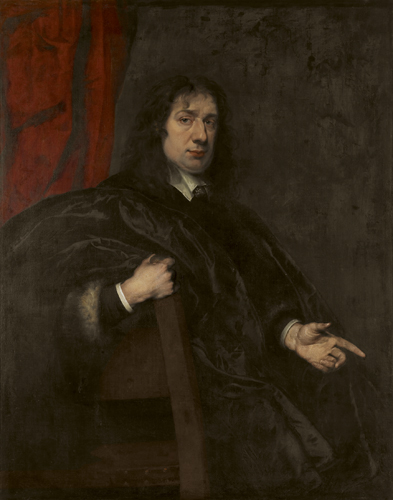
Edward Sutton from Wikipedia
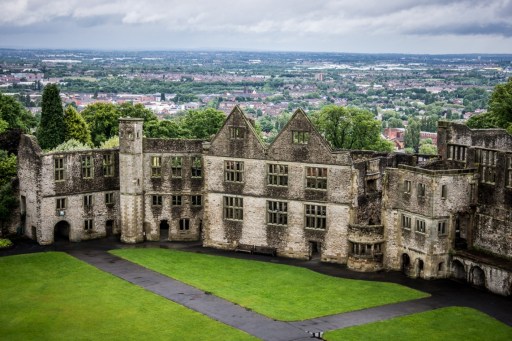
Dudley Castle from Wikipedia

Edward Sutton succeeded to the title of Baron of Dudley in 1586, aged 19. The  estate was centred on the ancient seat of Dudley Castle and owned several surrounding, resource rich, manors. The estate was in considerable financial trouble when he inherited it, and his profligacy made things worse. He developed the mining and iron making activities of the area in an attempt to improve his finances, but the debts remained and the situation became even worse. In addition he seems to have been in constant strife with his neighbours, particularly Gilbert Lyttelton of nearby Prestwood Hall, against whom he actually took up arms, and was brought before the Star Chamber on a number of occasions.

In 1581 Edward, at the age of 14, was married to Theodosia Harington, a daughter of James Harington of Exton Hall in Rutland, who was some years his senior. She was thus the sister in law of Anne Harington, the wife of her brother John 1st Baron Harington of Exton, who made the bequest to Oakham Parish Church, and the aunt of Anne’s son John, the second Baron Harington, whose books were donated.
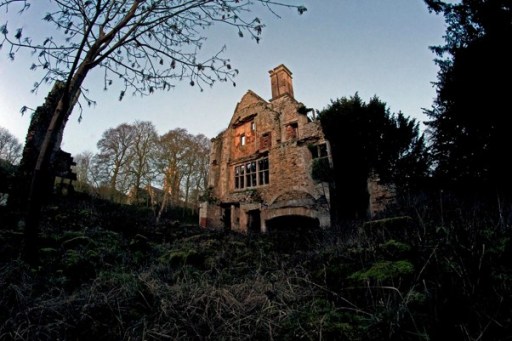
Exton Old Hall 1 by Infraredd, on Flickr

She and Edward had five children – the heir Ferdinando Sutton (b 1588) and four daughters Mary (b 1586), Anne (b 1589), Margaret (b 1697) and Theodosia (b 1599).

There was a major scandal however in the mid-1590s when Edward effectively abandoned Theodosia in favour of Elizabeth Tomlinson, “a lewd and infamous woman, a base collier’s daughter” by whom he was to have at least 11 children. This resulted in Privy Council proceedings where Edward was ordered to pay £100 per annum to Theodosia plus £20 for each legitimate child. Naturally he defaulted on this, no doubt due to his perilous financial situation, but also because he was supporting his children by Elizabeth. These children became a localised Black Country gentry, some of whom pursued industrial interests in the area, and in due course became the reason why many in the Black Country could claim aristocratic, and if they go back far enough, royal ancestry. Prominent amongst these was Dud Dudley, the metallurgist and doctor who attempted to smelt iron using coke instead of charcoal. Edward Sutton died in 1643 and was buried in the Parish church of St Edmund in Dudley.

Despite her abandonment Theodosia seems not to have fared too badly, and was active in court circles and well supported by her friends. She can be found in the dedication of a number of books of the period. Her son Ferdinando died before his father  and Ferdinando’s daughter Frances inherited the Dudley title in her own right. Theodosia’s daughters also married well – Mary to Alexander Home, 1st Earl of Home, Anne to Hans Meinhard von Schönberg, and Margaret to Sir Miles Hobart. Theodosia died in 1649 and was buried in St Margaret’s Westminster. 

Theodosia’ granddaughter Frances mentioned above married Humble Ward, son of a London Goldsmith, in 1628, who paid off the Dudley debts. He was ennobled in his own right as Baron Ward in 1644. Their children took the titles of Barons Dudley and Ward, until 1740 when the differing laws of succession of the two titles resulted in the Baronies being split. That of Dudley eventually went into abeyance because of a disputed succession in 1757, a situation that was not resolved till 1916. The Ward line, which inherited the Dudley Estate, prospered and John Ward was made Earl of Dudley in 1827.

From my perspective I find it interesting that Theodosia is no more than a footnote in Black Country History, simply the mother of the heir to the estate, and her background seems hardly to have merited discussion. Similarly Edward Sutton does not seem to get much of a mention in Rutland historical discussions. The short lives of Theodosia’s son Ferdinando and nephew John  were lived in very different environments – the first mainly in the confines of Dudley Castle where his daughter Frances was born, already being surrounded by mines and limestone workings, whilst the second was able to consort with royalty, particularly the Prince of Wales and to travel around Europe before attending the then new Sidney Sussex College in Cambridge and living on the deeply rural Exton estate. Both lived in perilous financial circumstances however – Ferdinando due to the profligacy of his forebears, and John because of the amount that his father spent on entertaining royalty and living the sort of life expected of Elizabethan and Stuart courtiers.

So what has Dudley to do with Exton? Quite a lot really.

From Agenoria to Beeching – The first and last days of steam in Dudley

The introductory poster

An exhibition of photographs and other material entitled From Agenoria to Beeching – The first and last days of steam in Dudley was organised by the Dudley Archives and Local History Service and the Black Country Society between October and December 2025, as a contribution to the national Railways 200 celebrations, which marked the 200th anniversary of Railways in Britain. The exhibition, held in the foyer of the Archives, was in two parts. The first part illustrated the first days of steam railways in the Dudley area between 1830 and 1860, mainly using material from the Dudley Archive collections. The second part of the exhibition illustrated the final days of steam in the area, from the late 1950s and early 1960s, through photographs from the Terry Hyde Collection held by the Black Country Society.

The Exhibition organisers were the Black Country Society (Chris Baker, Keith Hodgkins and Quintin Watt) and Dudley Archives and Local History Service (Hannah Clynes and Paul Ford). In this post I present those aspects of the exhibition which I contributed – primarily the material on the early days of steam in the Dudley area and the introductory slide loop and poster. Some photos from the opening of the exhibition are also included. More information and a fuller description of the exhibition can be found on the Black Country Society website.

Introductory slide loop

From Agenoria ……

Exhibition opening

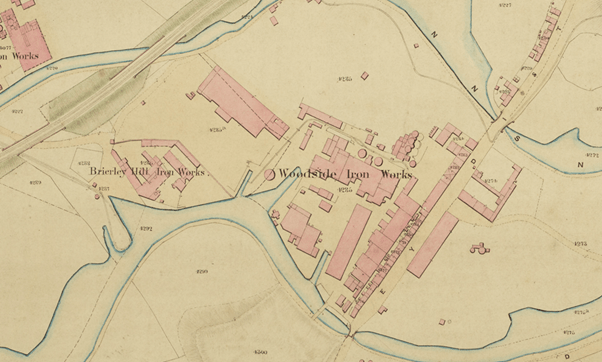
Woodside Iron Works c 1860

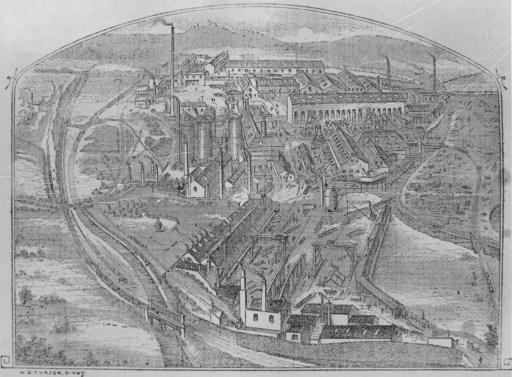
The Engraving

Woodside Iron Works, was founded in 1840 by Alexander Brodie Cochrane and his son Charles Cochrane. It became very well known and respected and produced components for many significant structures, including girders for the Runcorn Bridge over the River Mersey and the Farringdon Street Viaduct in London; ironwork for the Rochester Road Bridge, the Swing Bridge over the River Medway and the Clifton Suspension Bridge; and a wrought iron bridge for New Street Railway Station in Birmingham

Now I recently paid for a license from Dudley Archives for the use of the engraving of the works shown in Figure 1 below, for use in a blog post and in a forthcoming article in the Blackcountryman based on that blog post. It is catalogued as Woodside Iron Works c 1860. In the blog post and article, I used it to illustrate accounts of the works found in my great grandfather’s diaries and did not discuss it to any extent. It really does however deserve somewhat greater consideration, and so in this post, I will consider it in somewhat greater detail.

Figure 1. Woodside Iron Works c1860

Major Features

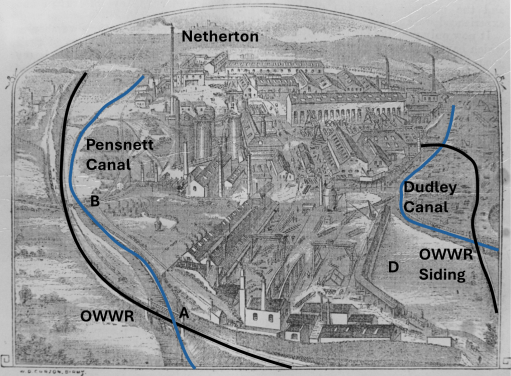
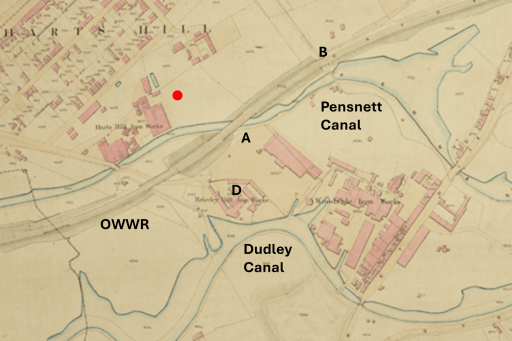
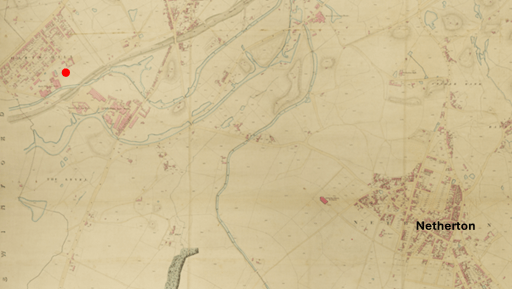
So what does the engraving actually show? Figure 2 shows a comparison between the engraving and a map of Dudley from 1857. Note that north on the map is around 20 degrees clockwise from the map vertical axis. On both the engraving and the map, the main line of the Oxford, Worcester and Wolverhampton Railway can be seen , with the engraving also showing a siding into the works. The Dudley Canal can be seen on both engraving and map (heading for Dudley Tunnel in the distance) with Lord Ward’s Pensnett Canal also visible, heading to a junction with the Dudley Canal just south of Dudley Tunnel. Two railway bridges, over the Pensnett Canal and a road are shown at A and B on both. In the distance can be seen the Netherton ridge and Netherton church. The likely vantage point from which the initial sketch for engraving was made is shown by the red circle on the map.

Figure 2. Comparison between the engraving anda map of 1857

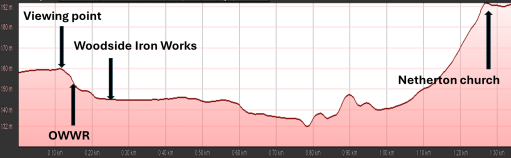
Figure 3a shows a smaller scale version of the map of figure 2 so that the relationship can be seen between the Iron Works (and the vantage point from which it was sketched) and Netherton in the far distance on the engraving. Figure 3b shows an elevation profile along a line through the vantage point and Netherton church. It can be seen that there is an initials steep drop from the vantage point across the railway to the Iron Works, and the ground then remains fairly level until the steep slope up to the Netherton ridge is reached. Thus the view of the iron works shown on the engraving, with a perspective indicating that it was painted from an elevated position, is a real one.

(a)

(b)
Figure 3. The Iron Works in the wider landscape.

The date of the engraving

The Archive catalogue gives the date of the engraving as c1860, but can a more precise date be determined? The Iron Works themselves had opened in the 1840s, but the main line of the Oxford, Worcester and Wolverhampton Railway wasn’t opened intill November 1852, so that gives the earliest possible date for the engraving. The Brierley Hill Iron Works (D on the map of figure 2) was also operational from the 1840s, but oddly does not appear on the engraving. Or rather only the angular building that marks the northern edge of the works is shown. I am inclined to think that this was because whoever commissioned the engraving didn’t wish to show the works of a competitor and I suspect request that it be removed. Indeed the area D on the engraving is suspiciously level and without any features, which suggest that this might have been the results of a major edit.

Now, from Grace’s Guide we have a description of a report of an “Open Day” at the Iron Works where the proprietors  Alexander Brodie Cochrane, and his son Charles Cochrane invited the local gentry and other local iron masters to look around the works (Worcestershire Chronicle, 2 April 1856) and indeed the guest list was very impressive. Was the engraving produced for this event, and perhaps given to those who attended? It would seem very appropriate for this to have been the case. It would also explain why the owners were keen for Brierley Hill Iron Works not to be shown.

The detail

Figure 4. The details of the Iron Works

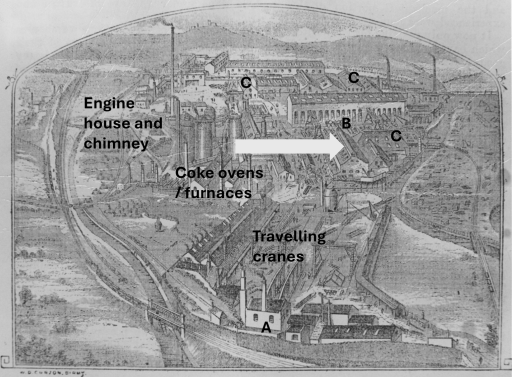
Later Ordnance Survey Maps of the Iron Works (from the 1880s) enable some functions to be identified – the travelling cranes in the foreground of the engravings, the coke ovens and furnaces, and the engine house and chimney. The report of the 1856 event found in the Worcester Chronicle that has already been mentioned contains some information that helps to understand what the engraving shows. The relevant paragraphs are as follows.

The Oxford, Worcester, and Wolverhampton railway running for a considerable distance along the side these works, drops down into their midst the green sand for the moulds, the Staffordshire ironstone, the unctuous red haematite from Cumberland, the limestone for the flux, and the Derbyshire cokes. The coal is raised from pits upon the premises, and in very few hours the raw material thus handed on the one side may be smelted, converted into pigs, cast into pipes, proved by the hydraulic press, smoothed, cut, and drilled, by machines of singular ingenuity and power, and shipped at the other side of the works upon the canal, to be borne from canal to river, from river to sea, and so to the Antipodes, to minister to the wants of rich and populous Australian cities, which in the memory of the present generation, had no name, or to complete the civilisation of communities planted few years since in spots where forests grew, and New Zealand cannibals roamed. What an illustration of human progress!

Several of Messrs. Cochrane’s relations and friends were distinguished by a white ribbon in their buttonhole, and escorted the various visitors through the works, showing them every process of iron manufacture and founding. The grinding of the sand for moulds, the curious processes of making, baking, and smoothing those moulds, the powerful steam engine for supplying cold blast to the two melting furnaces, the hydraulic lift raising the ” burden ” or supply of food to these huge retorts, whose fires never cease to devour day or night; the other engines for working the beautiful machinery of the fitting-room, where iron is planed, and drilled, and cut, with the same nicety, and almost the same facility, as if it had been deal, were all inspected in turn. 

From this information we can conclude that raw materials, other than coal, were brought into the works from the line of the OWWR that ran along its boundary, presumably around point A on figure 4. Coal was mined somewhere on the site itself – perhaps we can see the pit head mechanisms at B in the figure? (By the late 19th century these mines had clearly become exhausted and further mines opened to the west of the Dudley to Stourbridge Road, with the coal brought into the works by a cable operated incline). Iron was then produced in the two furnaces, and then used in a variety of manufacturing processes in the various buildings marked C, before being loaded onto barges on the canal (and also presumably onto railway trucks on the OWRR siding). The process of manufacture thus moved from left to right across the engraving (north to south in reality) as shown by the arrow. In the above report we read that the products of the works were

borne from canal to river, from river to sea

which suggests that they were moved west along the Dudley and Stourbridge Canals, to the Staffs and Worcs. canal at Stourton and thus to the Severn at Stourport, and onward to Bristol and the sea. Such a movement would have avoided the notoriously congested Dudley tunnel. It also gives a degree of confirmation of the date as being around 1856, as in 1858 the Netherton tunnel opened, which would have made travel to the east to Birmngham and London much easier and would have presented an attractive route for the products of the Iron Works.