

1. Introduction
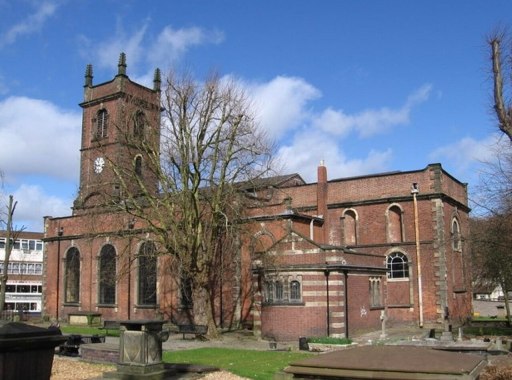
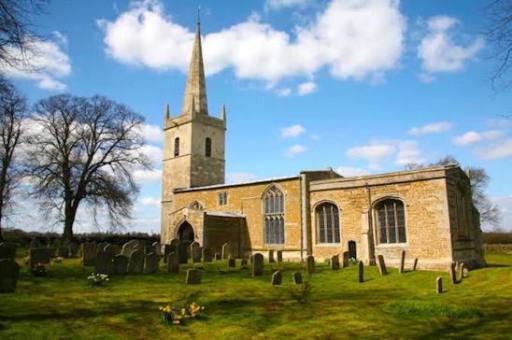
In a recent blog post entitled “What has Dudley to do with Exton” (shamelessly parodied from Tertullian) I explored the late 16th century marriage between Edward Sutton, 5th Baron Dudley, and Theodosia Harington of Exton Hall, a subject that brings together my historical interests in both the Black Country and in Rutland. In writing that post, I was reminded that the old parish church in Dudley is dedicated to St. Edmund, King and Martyr, as in one of the churches in the Oakham Team where I am now a minister, Egleton in Rutland. The church in Dudley is rather a dour brick built church dating from 1724, a centre of Anglo-Catholicism, on a busy road at the foot of Castle Hill (Note 1). It is however built on the site of an Anglo-Saxon / Norman church that was badly damaged in the Civil War siege of the Castle. It is known locally a Bottom Church, in relation to the church of St Thomas, on the top of the Dudley ridge, which is known as Top Church (see Note 2). The setting of St. Edmund’s Egleton is much more rural . The church dates from the 11th and 12th centuries and although architecturally it is a bit odd, it does have a Romanesque south door and an attractive Norman chancel arch.
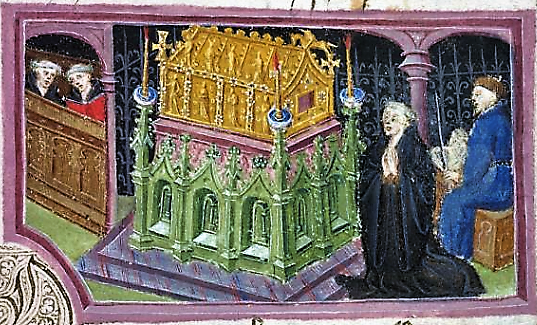
Now this dedication to St. Edmund, a saint whose shrine is at Bury St. Edmunds in East Anglia, is sufficiently unusual that my curiosity was aroused, and I wondered if there might be any connection between the two churches. I also remembered a conversation with a friend many years ago in which he argued that the dedications for some saints marked out pilgrim routes to that saints shrine, either as centres of devotion to the saint, or as a deliberate marketing ploy to take advantage of the passing pilgrim trade. This certainly seems to be the case for the Marian shrine at Walshingham.
Following on from these considerations, I then spent some time looking at the pattern of St. Edmund church dedications across the country, to see if any such pilgrim routes could be picked out that led to the saint’s shrine at Bury St. Edmunds. This blog posts gives the results of the investigation such as it was – very simple and in some ways superficial – and it does seem to suggest that such routes can be identified, even if in a preliminary way.
2. Methodology
My methodology was simple – to ask Gemini AI to identify all churches with dedications to St. Edmund, both still existing and “lost”; to give the grid reference for each church to enable the construction of maps; and to give a date for their foundation. I quickly found out that Gemini could indeed identify churches with that dedication, and a list was produced that contained all those in the more conventional list found here, plus a number of others. Gemini was also very good at giving me the grid references nicely tabulated. However, it proved to be absolutely hopeless at giving the foundation dates for the church – which is not surprising since for most of the earlier churches there is little accurate information and what there is can often only be inferred from architectural styles and rather late historical references. Thus, as I was primarily interested in churches that existed before 1400, the time when pilgrimages to the Shrine at Bury seems to have peaked, there was necessarily some rather laborious checking of dates, church by church. But after not too long, I was able to put together a list of 64 churches dedicated to St. Edmund, with a respectable level of confidence that they were founded before 1400. (That does not necessarily mean that the dedication to St. Edmund existed then of course, but in what follows I will assume that the dedication goes back to the foundation of the church.)
3. The geographical pattern of St. Edmund dedications
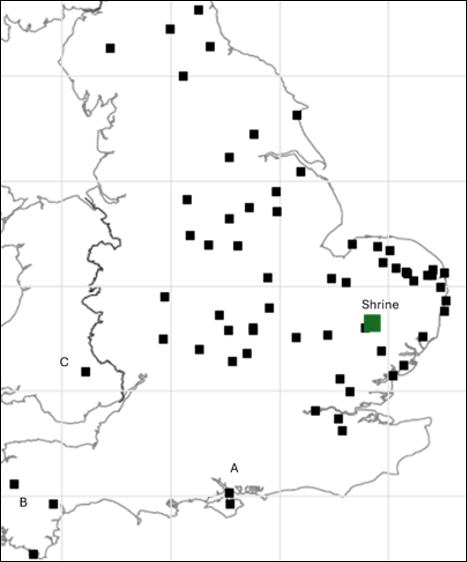
Figure 1 Churches dedicated to St. Edmund that were founded before 1400 (gridlines show 100km National Grid squares)
A map of the churches dedicated to St. Edmund, founded before 1400 is shown in Figure 1. A number of these are most likely pre-Domesday (including St. Edmunds in Dudley). The pattern is interesting. Across the Midlands and into Yorkshire, the locations do seem to follow lines that converge on the shrine and could plausibly represent pilgrimage routes. We consider these further in section 4. In Norfolk and Suffolk there is a marked arc of dedications around 50km from the shrine, with possible some routes coming from the south (section 5). In the north there is a scatter of dedications in north Yorkshire, Northumbria and Cumbria (section 6) and isolated dedications on the south coast (A), in the south west (B) and Wales (C) (section 7).
4. The Midlands and Yorkshire
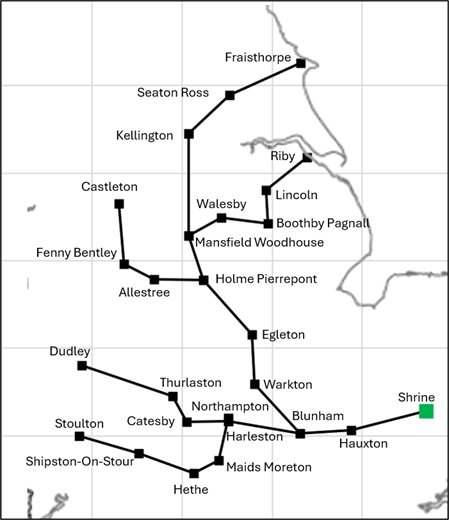
Figure 2 St. Edmund dedications in the Midlands and Yorkshire (gridlines show 50km National Grid squares)
An expanded view of the dedications across the Midlands and Yorkshire is shown in Figure 2. I have connected the sites with what I think are the lines of plausible routes, but I am very conscious that in adding these, it is forcing one particular interpretation upon the data (see Note 3). But if one accepts the plausibility of the lines, it suggest there are two basic routes that diverge at Blunham in Bedfordshire – one going to the West Midlands, branching again at Harleston / Northampton with termini in Stoulton, Worcestershire and Dudley itself; and one heading north, branching at Holme Pierrepont near Nottingham to Castleton in Derbyshire, and at Mansfield Wodehouse with one branch that eventually leads to Fraisthorpe on the Yorkshire coast and one through Lincoln to Riby on the Humber. Along these routes the dedications are generally (but not always) around 20 to 30kn apart, which would represent a day’s journey. In drawing the routes there are also uncertainties – the dedications at Northampton and Harleston are very close and how the routes branched at this point is very uncertain. Indeed the branch could plausibly occur at Blunham. But in the first instance, the idea that these lines represent pilgrim routes seems quite plausible.
5. East Anglia
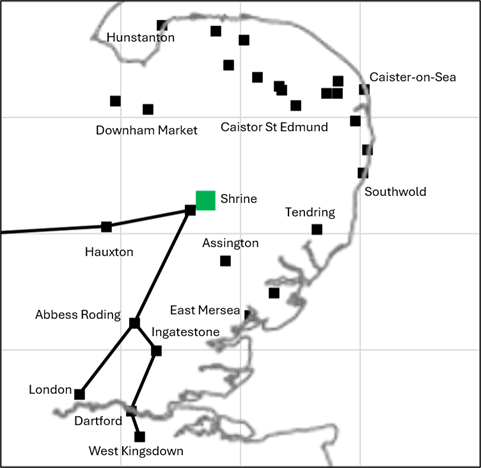
Figure 3. St. Edmund dedications in East Anglia (gridlines show 50km National Grid squares)
Figure 3 shows an expanded view of the dedications in East Anglia. As mentioned above there is a concentrated arc of dedications across Norfolk and into Suffolk but with no dedications close to the shrine itself. I can think of no particular reason for this, but it does seem to hint at some sort of purpose. Perhaps there was a circular pilgrimage route from Downham Market to East Mersea / Assington. The route to the Midlands and North through Hauxton (and on to Blunham) is shown, and there are two plausible routes to the south branching at Abbess Roding – one to St. Edmunds Lombard Street in London on the north bank of the Thames, and one crossing the Thames lower down at Dartford and heading into Kent. Was the former used by the (well documented) visits of kings to the shrine?
6. Northern England
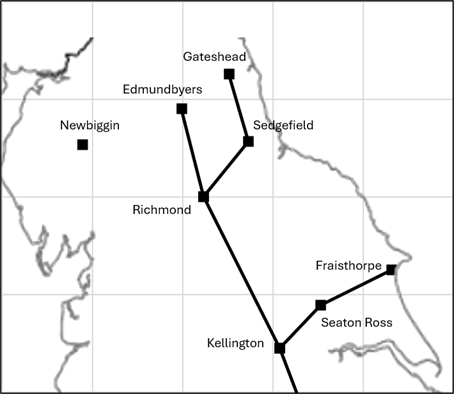
Figure 4 St. Edmund dedications in Northern England (gridlines show 50km National Grid squares)
Figure 4 shows the St. Edmund dedications in the north of England. The lines drawn connecting them are very speculative indeed, and assume a continuation north from Kellington of the Midlands / Yorkshire routes. It may well be that these locations are simply isolated occurrences of devotion to the Saint and not on any pilgrimage route at all. That there is a significant gap in dedications between Kellington and Richmond would tend to support this. Of particular interest is Edmundbyers – which is conjectured to be named after King Edmund Ironside, although the church is dedicated to St. Edmund of East Anglia.
7. Other scattered dedications
From figure 1 it can be seen that there are scattered dedications to St. Edmund in Portsmouth and the Isle of Wight, Exeter and Devon and one (Crickhowell) in south Wales. None of these can plausibly lie on pilgrim routes and probably represent localized devotions to the Saint.
8. Concluding remarks
So what may one conclude? Firstly the obvious deficiencies in the methodology need to be appreciated. Whilst I think the list of St. Edmund churches is reasonably comprehensive, there may well be others that I haven’t found. There is also no reason why other sites of spiritual significance should not be included on the routes – preaching crosses, holy wells etc, and these have not been considered at all in this post. Similarly I have selected the churches from before 1400 on the basis of published material that is often contradictory and ambiguous. Most importantly I have drawn proposed pilgrim routes on the basis of what I think is reasonable. I am all too aware that in doing so, I may be seeing what I want to see and reading too much into the data. The way forward to overcome some of these difficulties would be to look at each of the St. Edmund churches in detail, and interrogating what historical data there is to see if such pilgrim routes can be confirmed or otherwise. In addition, an investigation of the possible paths / roads between the churches would be useful. At some (undefined) stage in the future I might get round to this.
These points being made, I think there is a plausible case to be made for pilgrim routes converging on the Shrine from the North and the Midlands, and perhaps from London and Kent. However, I simply don’t understand the dedication pattern in East Anglia, that seems to suggest a purpose of some sort.
With regard to the two churches with which I began I would suggest that Dudley was probably an early centre of devotion to Edward, and forms the start of a pilgrim route. Egleton by contrast looks to me as if its dedication was opportunistic and an attempt to tap into the pilgrim market in some way. But this builds conjecture upon conjecture.
So what has Dudley to do with Egleton? Not all that much in this case, other than both possibly being on pilgrim routes to the Shrine of the Saint at Bury.
Notes
Note 1. St. Edmunds Dudley is a recent recipient of a grant of £587 from the Places of Worship Renewal Fund for a major series of repairs.
Note 2. S. Thomas’s church in Dudley (Top Church) was founded by Gervase Paganell, probably in the late1170s, and was initially dedicated to St Thomas of Canterbury. The Paganells were on the wrong side of the Civil War during the Anarchy and Dudley Castle was besieged by King Stephen in 1138. Gervase inherited the castle and its lands around 1150. He was involved in a failed rebellion against Henry II in 1173 and was ordered to demolish the defences from the castle. Local historians are of the view that the dedication of his new church in the late 1170s to Thomas of Canterbury, a few years after Thomas’ death in 1170 and canonisation in 1173 after which King Henry was forced to do homage at the shrine in Canterbury, was a coded response to the order to demolish the castle fortifications. There was further royal involvement in 1540 when Henry VIII ordered the dedication to be changed to St. Thomas the Apostle as at that stage the idea that Archbishops could oppose Kings was not terribly appreciated.
Note 3. Drawing speculative lines connecting places on maps is a somewhat dubious activity. When doing so, I am always reminded of the apparent perfect alignment in Lichfield of Borrowcop Hill, supposedly the site of an Anglo-Saxon fortification, the spires of Lichfield Cathedral and the shrine of St. Chad……..and the cooling towers of Rugeley Power Station.


