The Pensnett Saxhorn Band. A post describing the life and times of the Pensnett Saxhorn Band in the mid-nineteenth century, giving a snapshot of some aspects of Black Country cultural life at the time. (March 30th 2021)
The fields that survived. An investigation of a small unit of land consisting of three late 17th century Black Country fields that escaped the ravages of mining, colliery waste and urban development to remain more or less intact to the present day. (July 23rd 2023)
The early history of the Crooked House. A post looking at the history of the Crooked House, or Glynne Arms, up to the 1870s, mainly based on early maps of the area (September 23rd 2023)
A policeman’s life – Samuel Hicklin (1858-1924). A policeman’s life – Samuel Hicklin (1858-1924). This presentation that describe the remarkable life of Sam Hicklin, the son of a farm labourer who was to progress to the highest ranks of the Staffordshire Constabulary (via Pensnett).
An Ecclesiastical Affair The video tells a true story from 1870, with many contemporary resonances, about the Victorian Black Country parish of Pensnett where the errant clergyman had a flirtation with a pupil teacher at the local school, that led to scandal in the village, a clergy discipline trial, a series of anonymous broadsheets circulating in the village making all sorts of accusations about church members (some comical, some rather nasty), and a nationally reported libel trial. Wayward clergy, scandal and libel – all the hallmarks of a good story!
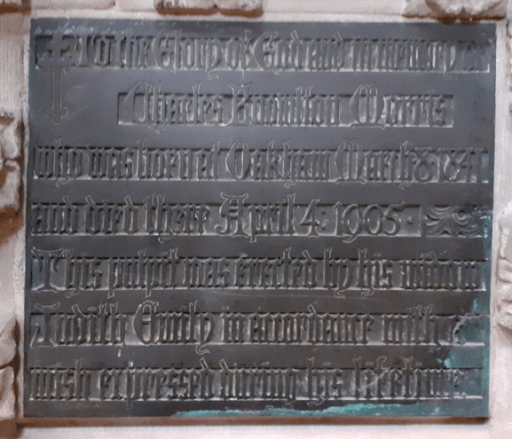
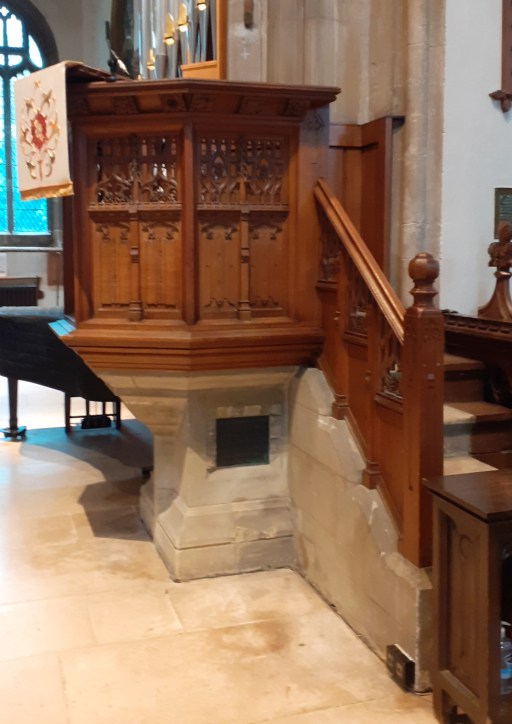
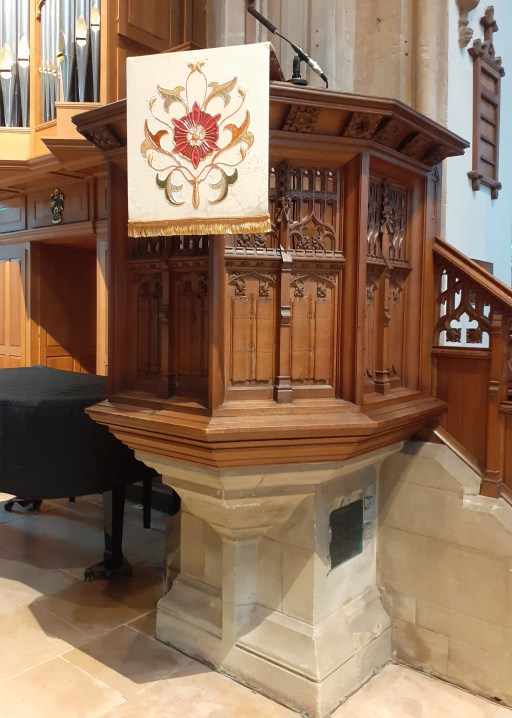
Memorials in churches can be in some really odd places. I recently noticed a brass plaque almost at ground level on the base of the pulpit at All Saints in Oakham. Even sitting on the floor in close proximity I was unable to make out much of it, but by taking some photographs and enhancing the contrast, I was able to get the image on the right. This reads
To the Glory of god and in remembrance of Charles Knowlton Morris, who was born at Oakham March 18 1841 and died there April 4 1905. This pulpit was erected by his widow Judith Emily in accordance with his wish expressed during his lifetime.
Pulpit memorial tablet
The name rang a bell in my mind – there is a very similar dedication on the stained glass window in the south transept.
To the glory of God and in remembrance of Charles Knowlton Morris who was born at Oakham 8th March 1841 and died there 4th April 1905. This memorial is erected by his widow Judith Emily.
Window memorial dedication
Charles Knowlton Morris
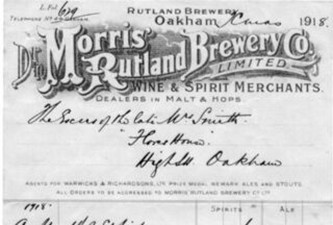
So who was this Charles Knowlton Morris? He turned out to be quite easy to trace through the historical record. He was born in 1841, the son of Clarke and Francis Morris (nee Hare) of Catmose Street in Oakham, one of at least six children. Clarke Morris was a brewer in Northgate in Oakham. Two of his sons – William Clarke Morris and Charles Knowlton Morris took over the business after Clarke’s death in 1857. The brewery moved to Cross St / New St in 1866 and in censuses and trade directories, the business is usually described as Morris’ Rutland Brewery, and they were also listed as coal, salt and seed merchants at the railway station wharf. William Clark died in 1895 and it appears that the business passed directly to his brother. The Reredos and Marble flooring in the chancel at All Saints were donated by Charles in memory of his brother in 1898.
All Saints Reredos
Reredos dedication plate
Charles married late in life, in 1898 aged 57 to Judith Emily Tiptaft, the daughter of a Northamptonshire farmer, who was seventeen years his junior. There were no children. Charles died on 4/4/1905, leaving a very considerable business and effects worth £19448. The business was sold off by auction fairly soon after his death. It is described in the Grantham Journal of 25/11/1905 as consisting of the brewery in New Street, and nineteen public houses in Oakham and the surrounding area. Those in Oakham included the Railway Hotel on Station Road, the Roebuck Inn on Church Street, the Bell Inn on Catmose Street, the Royal Duke Inn on West Road, Oakham, the Angel Inn on Northgate Street, and two off licenses, the Rutland Arms in New St and the Britannia Inn on Northgate Street. The estate was bought for £28,250 by Warwicks & Richardsons Ltd, Newark. Brewing ceased in 1907, but Warwicks continued to use the name Morris Rutland Brewery on Guiness bottled in Newark until 1962.
Comapny banner
The Brewery in New St in 1980
The dedication service
On 6/9/1896 at a service at All Saints church in Oakham, a new pulpit and stained glass window were dedicated to the memory of Charles. These are described at length in the Grantham Journal of 8/9/1906 as follows.
The window composed of three long lights, surmounted by beautiful tracery, and is now the best of the many fine windows in this Church. The stained-glass design is governed by the architectural features, which are typical 14th century work, demanding small subjects and canopies. The subjects are nine in number, massed in rich deep colours, all contributing to the design of three bands running laterally through the tall lights in the window, and are set off by the intercepting canopies, which are soft, and display a silvery effect. Incidents in the life of our Lord with which all are familiar are represented, and portray, respectively, ” Endurance,” “Love,” ” Fortitude,” “Humility*,” “Principle,” “Charity,” ” Innocence,” Sympathy,” and “Justice.” These help to illustrate, in their appropriateness, the beautiful life of Charles Knowlton Morris, whose memory they will perpetuated.…..……. Flowers and birds are delicately introduced as emblems, and the Past Masters’ jewel .and badge of the Vale of Catmos Lodge (No. 1265) of Freemasons are shown a small shield at the foot of the centre light.
The apex of the window contains the dove, and rays emanate from it into the surrounding side lights, and disappear behind the finials of the canopy, which runs out from main design below. The window was designed and executed by Mr. Dudley Forsyth, 335, Finchley-road, Hampstead, London
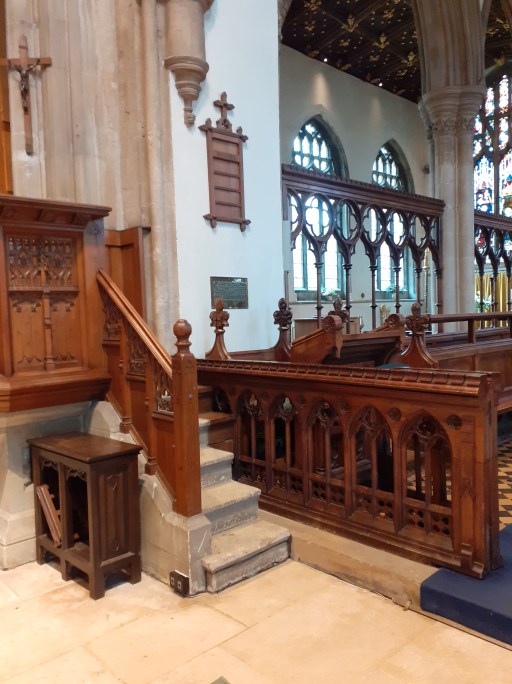
The new pulpit, as detailed on the inscription panel at fulfils wish expressed by the late Mr. Morris during his lifetime. It is in the Gothic style, and has been carefully designed so as to harmonise with its surroundings. The steps and the stone base by which the pulpit is supported are green Chilmark stone. A large moulded corbel, springing from the base, carries the pulpit, which is, in shape, five sides octagon. The material used is Austrian oak, slightly tongued, in order that it may resemble the existing oak fittings in the Church. Each side of the octagon is divided into two panels, the lower part of each carved, the upper part pierced; and care has been taken vary the design of the carving, as avoid monotony and give interest work. The cornice which crowns the pulpit is variously carved to represent the of the Passion of our Lord. The balustrade to the steps is similarly treated panels, and the whole, including the brass memorial tablet, reading-desk, and black fittings, has been designed Messrs. Forsyth and Maale, architects, of London, and carried out for the pulpit by J. P. White, of Bedford, and for metal work by Messrs. J. Elsley, of London.
Later years
Judith Morris must have spent a considerable part of her inheritance on these monuments to her husband. She was later to marry Dr Henry Drew in London in 1922. She died in 1945 at the age of 87. Pictures are available of her here and here, although an Ancestry subscription will be required to access these.
After her death in 1945 we read in the Leicester Evening Mail of 16/3/1945
Under the will of the late Mr. Charles Knowlton Morris, a former Oakham brewer, the vicar and churchwardens of Oakham receive a legacy, following the death of his widow, Mrs, Judith Emily Drew. of Leadenham House, Braunston Road. Oakham, to provide pensions for members of the Church of England. The sum is £3O annually. to provide three £l0 pensions for three poor persons of good character of the age of 85 and upwards residing in the town, and being members of the Church. It will be called the “Morris Gift.”
So it can be seen that much of what can now be seen at the “business” end of the church – around the altar where the Eucharist is celebrated, and the pulpit where sermons are preached was donated by the Morris family. Now the late 19th century was a time when the Teetotaller movement was very strong in reaction to the obvious ill effects of excess alcohol consumption, mainly on the poor. But clearly the Church of England in Oakham had no scruples about accepted considerable donations from a brewer. But, even in this more moderate age (at least in terms of alcohol consumption) the fact that Sunday services take place on structures funded by the receipts of nineteen public houses in Rutland might manage to raise a few eyebrows.
Material in the following paragraphs is repeated from an earlier post as an introduction to Stephen Glynne and his church notes.
The Glynne Baronetcy dates back to 1661, with its main estate at Hawarden in Flintshire. The 8th Baronet, Sir Stephen Glynne (1780 to 1815) married Mary Griffin, daughter of Lord Braybrooke. After his early death, he was succeeded by his son Sir Stephen Richard Glynne, the 9th Baronet (1807-1874). I first came across him as the owner of the Oak Farm Iron Works in the Black Country, which was the subject of a spectacular financial crash. Glyne was saved from financial ruin by the efforts of his brother-in-law, the future Prime Minister William Gladstone, at very considerable expense to the latter.
More widely, Stephen Glynne is best known as a church antiquarian. Over the course of his adult lifetime he visited over 5000 churches in England and Wales, making notes, and in some cases sketches of their architecture, plans and furnishings. These notes can be found in 106 volumes now housed in the Gladstone Library at Hawarden. Only a small minority of these have been transcribed and published. Here we give a transcript of his notes for St. Michael’s in Lichfield. The history of the church is set out in detail in my four part ebook. The restoration of the early 1840s, which is of relevance to what follows, is described in Part 3. At that time the Lichfield Society for the Encouragement of Ecclesiastical Architecture were instrumental in the rebuilding of the church (and the chancel in particular) in the prevailing gothic fashion.
Stephen Glynne’s description of St. Michael’s, Lichfield
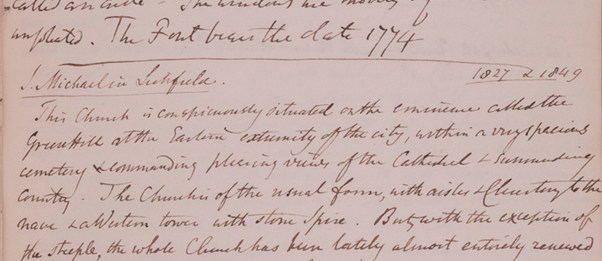
Stephen Glynne’s notes on St. Michael’s church in Lichfield are brief and mainly straightforward. They are oddly dated 1827 and 1849, but the description is clearly from a visit in 1849 after the extensive “restorations” of the early 1840s. There are a couple of entries on a blank facing page however that refer to the pre-restoration church and that might refer to an 1827 visit (given at the end of the transcript below).
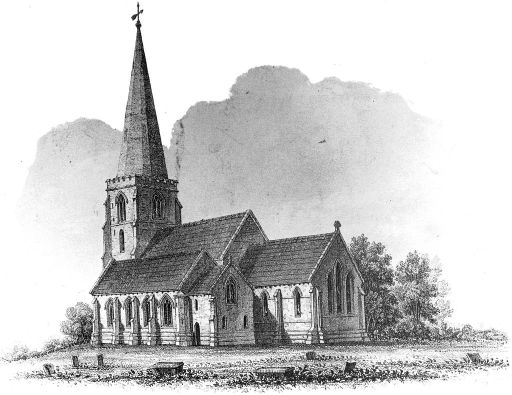
The church is conspicuously situated on the eminence called the Greenhill at the eastern extremity of the city within a very spacious cemetery commanding pleasing views of the Cathedral and surrounding county. The church is of the usual form with aisles and clerestory to the nave and a western tower with stone spire. But with the exception of the steeple, the whole church has been lately almost entirely renewed and in great measure rebuilt in tolerably good style. The steeple which is of red sandstone, appears to be a three ?? (1) of plain kind. The tower is embattled with corner buttresses, a string course under the belfry only. The belfry windows of two lights on the north and south is a long ??? slot -a questionable lancet on the west, but no west door. The spire is octagonal but not ribbed, having three horizontal bands and two tiers of spire lights, which are on the same sides. The north aisle, as rebuilt, has a low pitched roof and a battlement with three Perpendicular windows. The south aisle is wider and loftier with a high pitched roof and Perpendicular windows, varying in tracery. At the east end has been added a gabled chamber for receiving the Organ (2). The nave is of four bays, the arcades with pointed arches and octagon columns. The chancel has been wholly rebuilt in the Perpendicular style – its east window a triplet and on each side three single lancets. The chancel is groined, the ribs springing from shafts (3).The clerestory of the nave has a high pitched tiled roof and windows of two lights. The north porch is set in the western bay .
(4) The ancient chancel had a three ?? (1) east window, and the former chancel, as appears from a view in Shaw’s Staffordshire, had a quasi clerestory, an upper tier of windows. The whole of the former church was perpendicular.
Notes
1. This symbol can’t be read, but it is the same at both places where it occurs. 2. The description of the church matches what can be seen today, with one exception – the description of a gabled chamber for the organ. This clearly refers to a structure that was replaced by the current choir vestry in 1923 ad can be seen inthe foreground of the picture above. 3. The restored chancel was itself significantly altered in the late nineteenth century, with much of the work of the 1840 restorers removed or altered. 4. The text in this paragraph probably refers to an 1827 visit.
All Saints church in Oakham is not particularly well endowed with memorials to individuals and events, and there are no spectacular carvings. However some of those that do exist enable interesting stories to be told. In this post I present a number of these, with links to more information, and highlight those memorials that require further investigation. The post is very much a work in progress, and I will edit it as more information becomes available.
Note – to read some of the inscriptions below readers may well need to magnify them. Even then, some will take a little patience to read, particularly the brasses where it is difficult to take photographs without reflections obscuring the text.
Vestry
I have discussed the wooden memorial of the Lady Harrington bequest – money for the relief of the poor and a donation of a Parish Library – in two blog posts here and here. The memorial is in the vestry on the south side of the church and is not usually publicly accessible.
Chancel
A transcript of this plaque in the Chancel is given in the post From Oakham to Mandalay and a little more information is given on the career of Henry Jerwood.
Lady Chapel
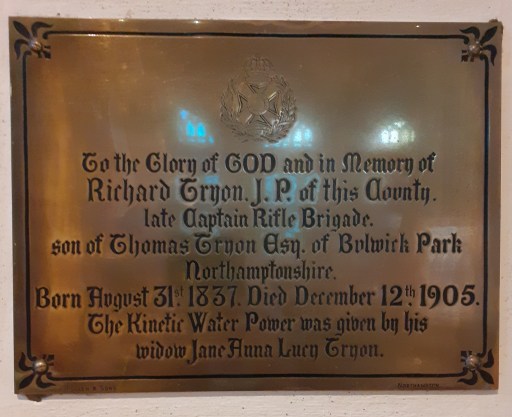
A transcript of this plaque in the Lady Chapel is given in the post Kinetic Water Power, and information is given there about Richard Tryon and (at some length) the Kinematic Water Power apparatus.
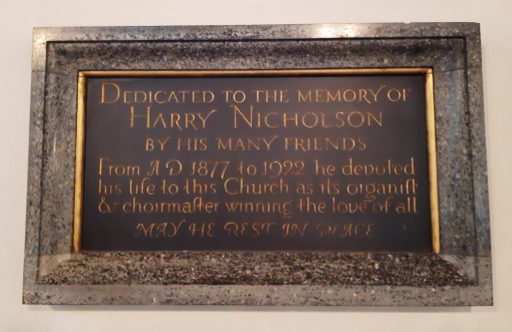
The life and times of long term organist of All Saints church and the founder of the Oakham Choral Society are well described in a blog from the Rutland County Museum.
Pulpit
The pulpit has a dedicatory plaque, very low down near the foot of the steps. It reads as follows To the Glory of god and in remembrance of Charles Knowlton Morris, who was born in Oakham March 18 1841 and died there April 4 1905. This pulpit was erected by his widow Judith Emily in accordance with his wish expressed during his lifetime. Charles Morris was a brewer and a coal merchant. A window in the church has a similar dedication from his wife and is described in the following way Depicting Endurance, Humility, Innocence, Love, Principle, Sympathy, Fortitude, Charity and Justice, as mostly portrayed by scenes from Jesus’ life. The badge of the Vale of Catmose lodge of the Independent Order of Oddfellows is at the bottom.
South Transept
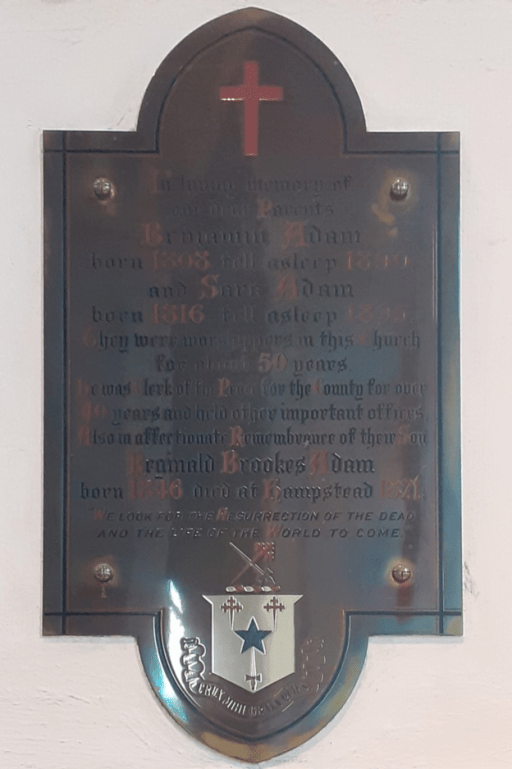
This difficult to read memorial is to Benjamin Adam (1808-1890?), his wife Sara (1816-1895?) and their son Reginald Brookes Adam (1846-1871?). We are told that Benjamin and Sara were worshippers at All Saints for over 50 years, and that Benjamin was Clerk of the Peace for the County (a legal officer) for over 40, and that he also held other important positions.
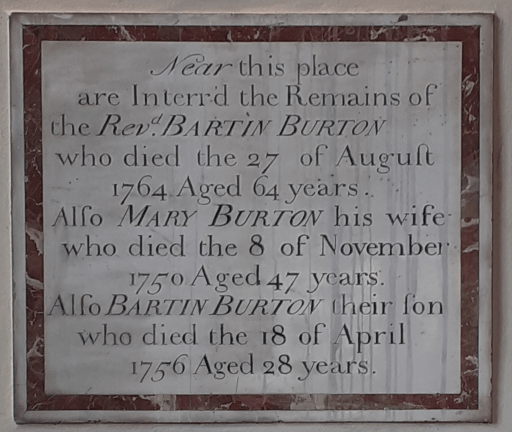
The Church of England Clergy database reveals that Bartin Burton was born in Oakham and served as Curate in the parish of Rockingham, Rector at Oxendon (both in Peterborough diocese) from 1728 to 1729 and Vicar of Ravenstone in Buckinghamshire (Lincoln diocese) from 1747 to 1764.
North Transept
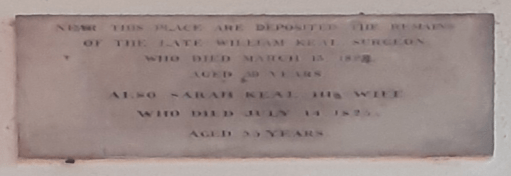
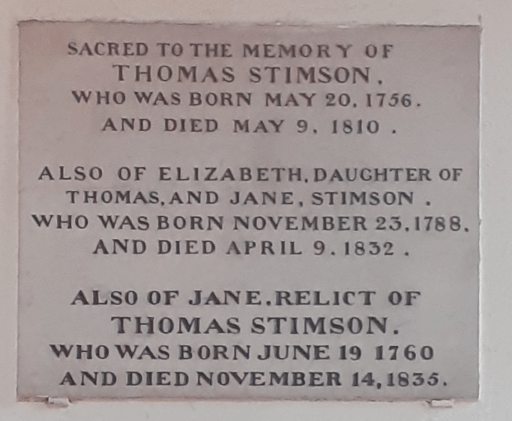
These four memorials in the north transept are placed one above the other in the order shown to the left. The top one commemorates William Keal, a surgeon (d1824?) and his wife Sara (d1825). The one below it commemorates the lives of Thomas Stimson (1756-1810), his wife (relict) Jane (1760-1835) and their daughter Elizabeth (1788-1832).
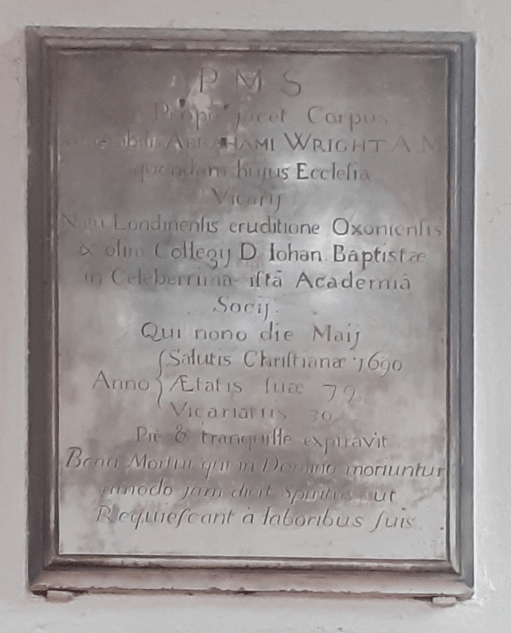
The third is in Latin and commemorates John Abraham Wright (d1690) aged 79, vicar for 30 years, during and after the Commonwealth period. In the first instance he served only one year (1644-5) before he was and replaced by the parliamentary favourite Benjamin King. He took up his post again after the Restoration in 1660.
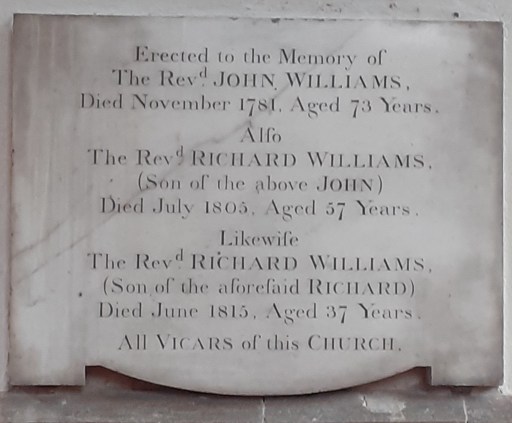
The lower memorial is to three generations of Vicars of the parish – John Williams (d1781), Richard Williams (d1805) and Richard Williams (d1815). More details of their appointments at Oakham and elsewhere can be found in the Church of England Clergy Database.
South Aisle
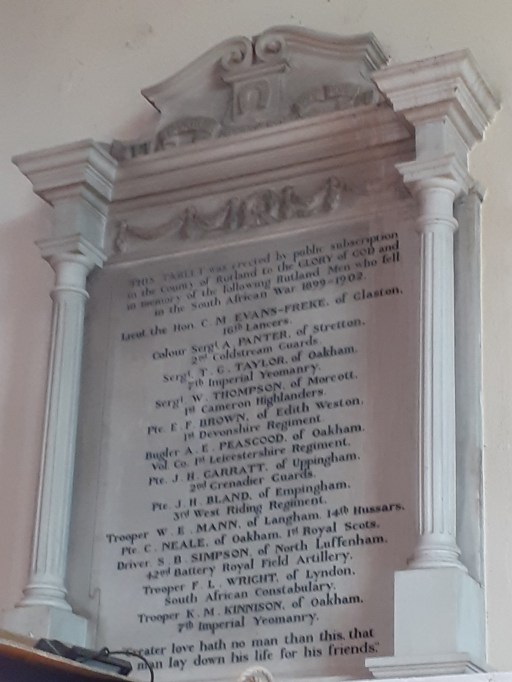
This Boer War monument is now above the choir vestry in the South aisle and not easily accessible – or indeed to photograph. The expertise of a military historian is probably required to unpack and present the stories of those listed here.
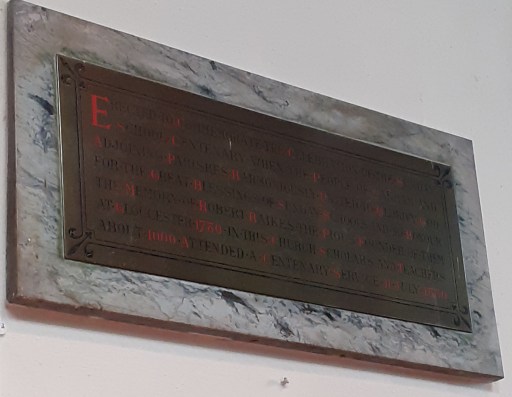
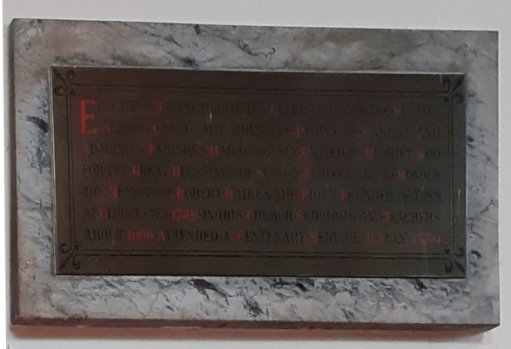
The monument above was both difficult to photograph (to avoid reflections) and difficult to read. It is shown in two forms – as originally taken, and with an attempt made to remove the effect of perspective. It commemorates the 100th anniversary celebration of the Sunday School movement, which around 1000 people attended, and commemorates its founder, Robert Raikes of Gloucester.
North aisle
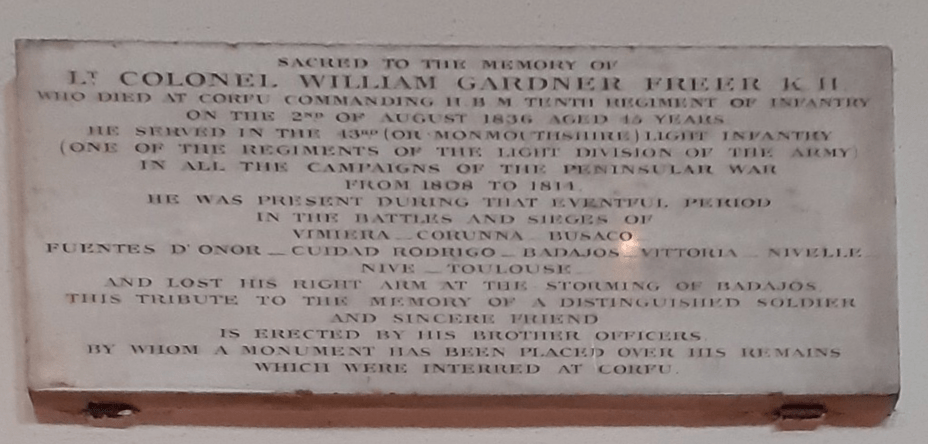
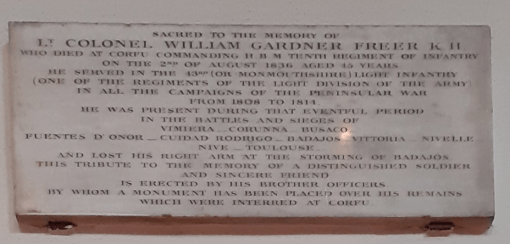
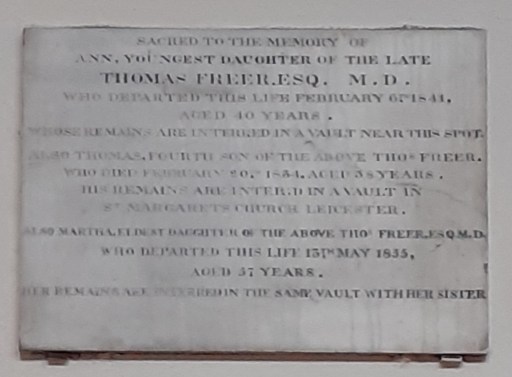
These three monuments are placed above each other in the north aisle in the order shown. The top one is too small to read easily from ground level. They all refer to the Freer family from the early 19th century. The bottom memorial is to Thomas Freer, a doctor, who died in 1835, his wife Martha who died in 1827, and his third son, Edward Gardner who fell in action in the Pyrennees in 1813 aged 20. The second memorial commemorates Thomas and Matha’s youngest daughter Ann (d 1844), their fourth son Thomas (d 1834) and buried in Leicester, and their eldest daughter Martha (d 1835). Finally the upper memorial describes in very small text, Lt. Colonel William Garner Freer who died in Corfu in 1836, whilst commanding the 10th Infantry Regiment. His long military career is outlined, including the loss of his right arm at the storming of Badajos. He is buried in Corfu.
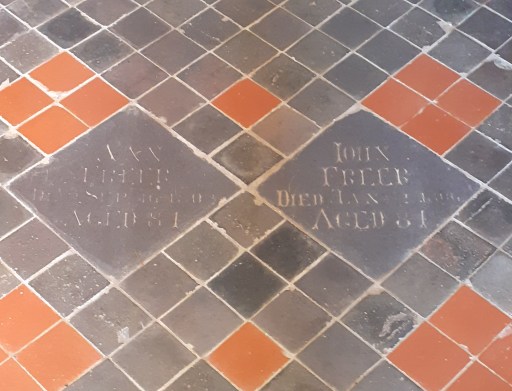
The Freer’s are also commemorated in two tiles in the nave aisle – much faded as they are on the main thoroughfare through church. They are dedicated to Ann and John who, as far as I can make out, died in the early 1800s.
West End
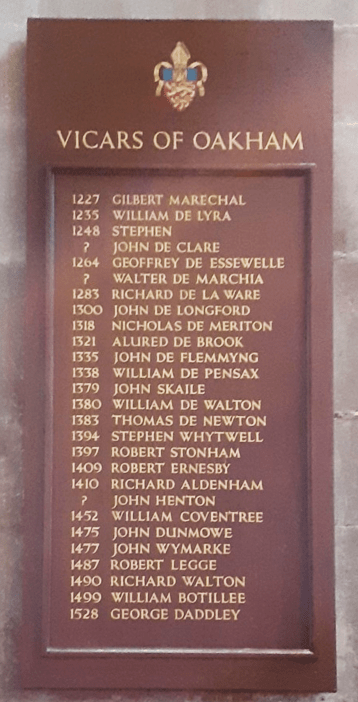
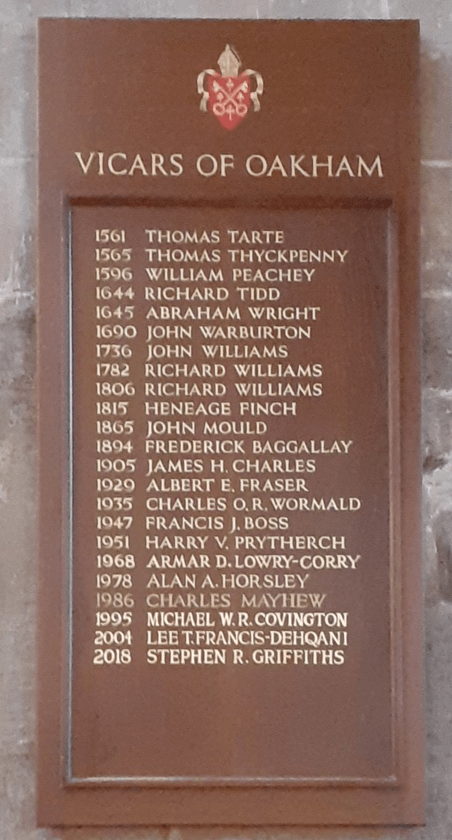
More details of the Vicars of Oakham can be found in the church guide. The Church of England Clergy Database also includes records for both vicars and curates of the parish, and of the surrounding chapels from the mid-sixteenth to the early nineteenth centuries.
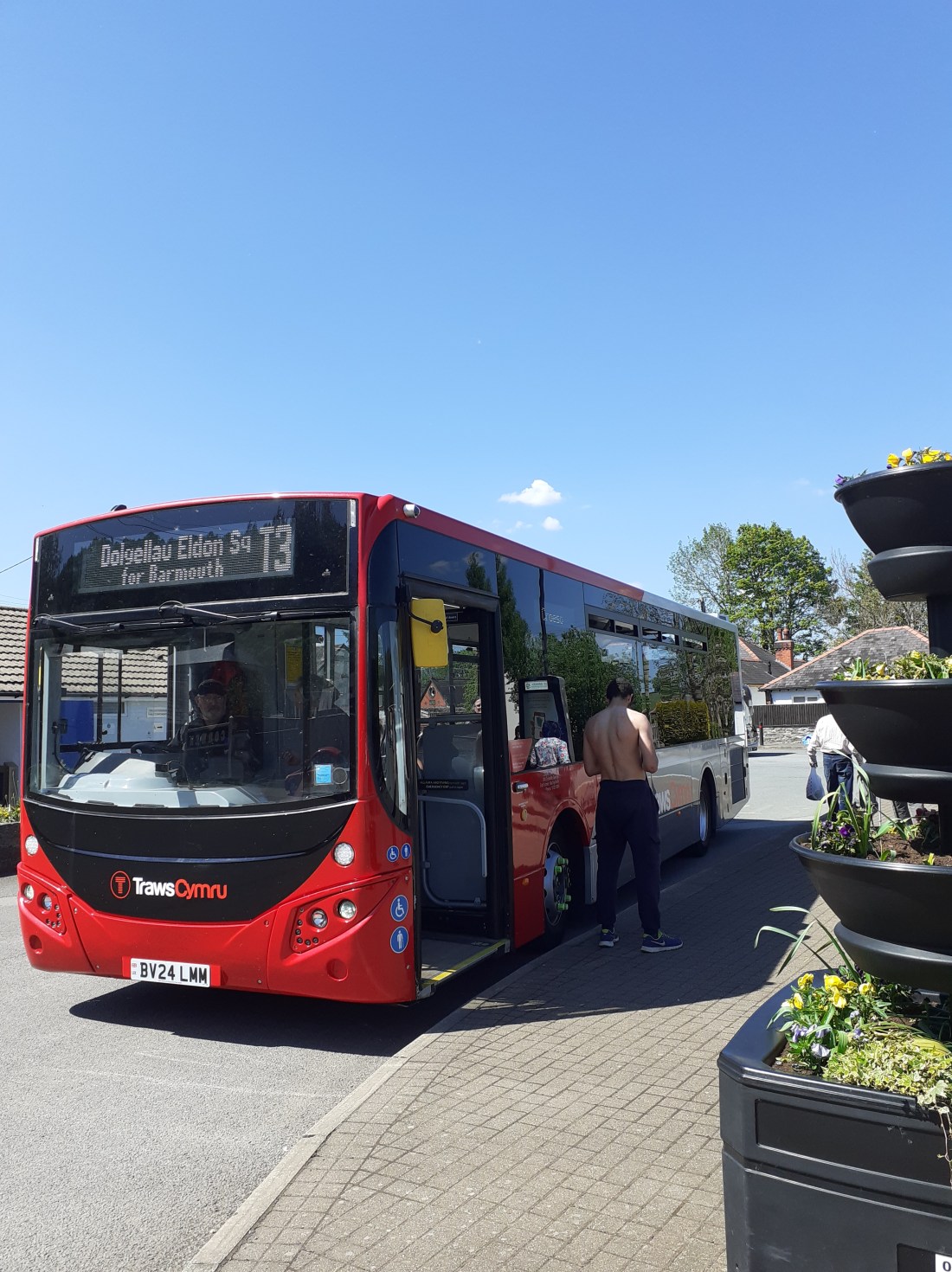
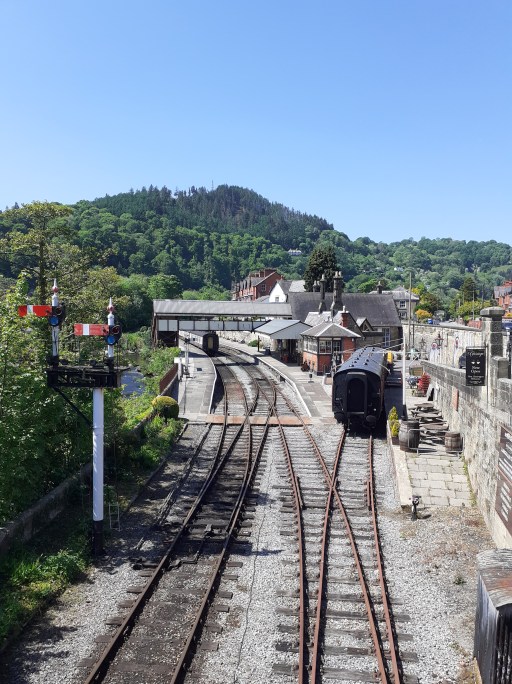
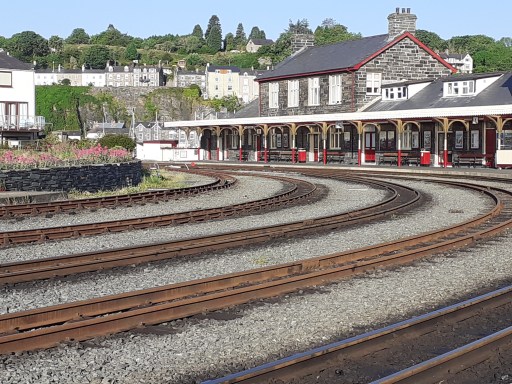
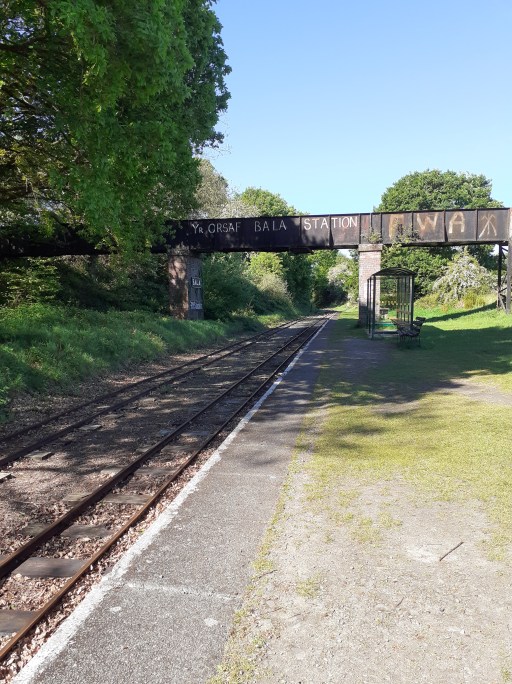
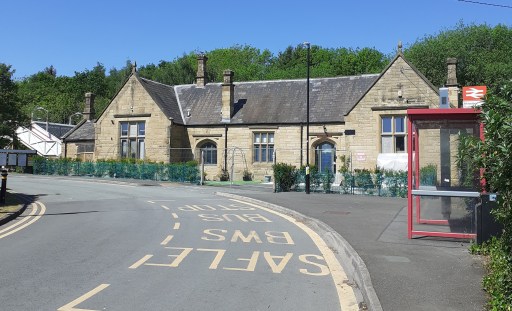
In mid-May 2025, I made a journey that I have had in mind for a number of years – a circular trip around North Wales mainly by inter-urban bus. I had a number of reasons for wanting to make this trip. Firstly it involves travel through some of the loveliest countryside anywhere in Britain. Secondly, it allowed me to indulge my obsession with looking at heritage railway stations, three of which are shown below – I will leave it to the reader to identify them. And thirdly, and for the purpose of this post most importantly, it allowed me to travel on the Traws Cymru bus network. I have watched this network develop from afar over the years, and have often thought I would like to look at it more closely.
In what follows I firstly describe the route that I took and comment on some general aspects. I then consider the vehicles that I travelled on, and then the infrastructure – bus stops and interchanges. Finally I make a number of comments on the good and bad points of the trip.
The route
The first step of my journey was to travel from my home in Oakham in Rutland to Ruabon on the Welsh border by train. This involved changes ta Birmingham New St and Shrewsbury. There were no problems either on the way there or the way out, with all journeys running close to time. At the start of the journey there was the perennial feeling of relief when it became clear my Cross Country train was really running and had not been cancelled, that turned into a feeling of surprise when it actually arrived at Oakham on time. But, as I say, the journey worked well and I arrived at Ruabon around noon as planned.
The Traws Cymru inter-urban bus network in North Wales is shown in the figure above. My first bus was not however part of the Trwas Cymru network, but rather the Arriva 5 from Wrexham to Llangollen that I boarded at Ruabon. I took this rather than wait an hour and a half for the first Traws Cymru T3 bus, and it gave me time for a brief look around Llangollen and a look at the railway station. On boarding this bus I asked for a concessionary 1bws ticket (£4.70 for all day travel on buses in North Wales for English bus pass holders – excellent value). The driver looked a bit mystified but eventually gave me the correct ticket. The bus was quite full – over 50% loaded – but fairly comfortable and made up some of the time after a 10 minute late departure from Ruabon. From then on my journeys were all (bar one) on the Traws Cymru network as follows (approximate loading given in brackets).
Llandudno 13.39 to Corwen 14.04 – T3 (60%)
Corwen 14.15 to Betws-y-Coed 15.03 – T10 (5%)
Betws-y-Coed 15.05 to Caernarfon 16.23 – S1 (30 to 50%)
Caernarfon 17.05 to Porthmadog 18.05 – T2 (100%+)
And the following day.
Porthmadog 8.05 to Dolgellau 9.02 – T2 (30%)
Dolgellau 9.03 to Bala 9.33 – T3 (5%)
Bala 11.33 to Ruabon 12.39 – T3 (25%)
All the journeys kept time very well, and none was more than 3 or 4 minutes late at the point where I disembarked. Throughout the trip, the drivers were helpful and friendly, which makes a hige difference to the passenger experience. The journey not on the Traws Cymru network was the Sherpa S1. I chose to change onto this, rather than continue on the T10 to Bangor and catch the T2 to Caernarfon and Porthmadog there, simply because the ride up to Pen-y-Pass at the foot of Snowdon must be one of the most spectacular and exhilarating in the country.
The vehicles
I am by no means a bus expert, but from what I could gather from various websites, I travelled on the following vehicles.
5 – ADL Enviro400 City, operated by Arriva
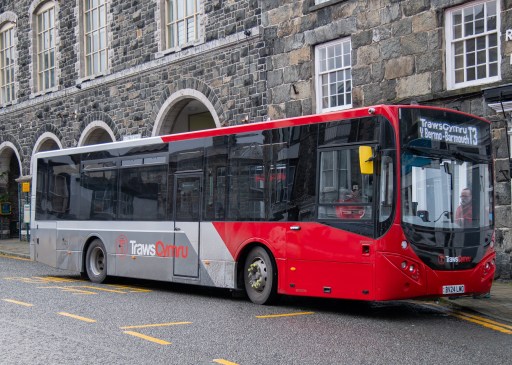
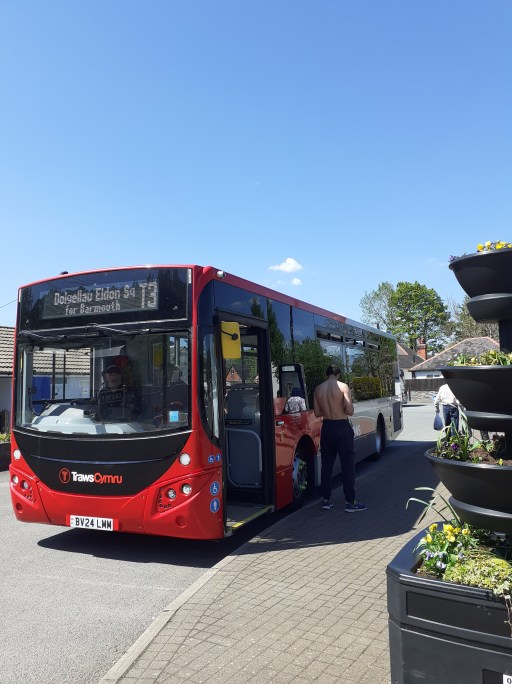
Traws Cymru T2 and T3 – Volvo B8RLE MCV Evora operated by Lloyds Coaches.
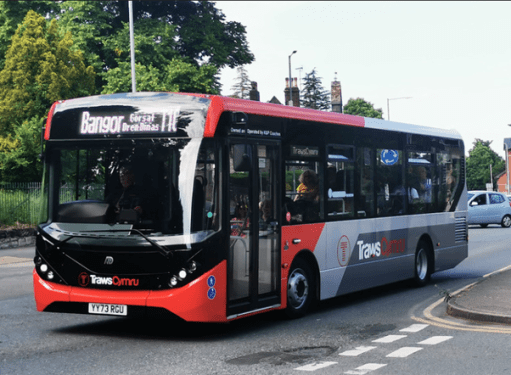
Traws Cymru T10 – ADL Enviro200 MMC operated by K and P coaches.
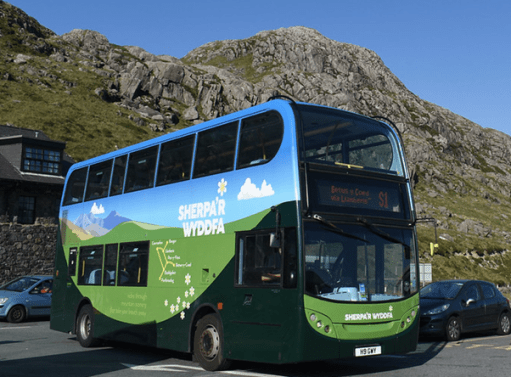
Sherpa S1 – ADL Enviro400 operated by Gwynfor coaches.
Photographs of all but the first of these are shown below
From my point of view as a passenger, the Traws Cymru and Sherpa vehicles were all basically buses – comfortable enough, with nice seats, but not of express coach standards. All vehicles had working USB charging points (something that many rail franchises don’t seem to be able to provide), and two of the Traws Cymru vehicles had WiFi, although this tended to drop out in the more rural areas. Most had screens that could potentially be passenger information screens, although they were not in use. As someone who isn’t terribly well acquainted with the area, the use of such screens to tell me which stop was coming next would have been really useful, and would have meant that I did not have to rely upon Google maps. In general though, I found the buses a pleasant and efficient way to travel, although I doubt I would have found them terribly comfortable for journeys of much more than an hour.
Bus stops and interchanges
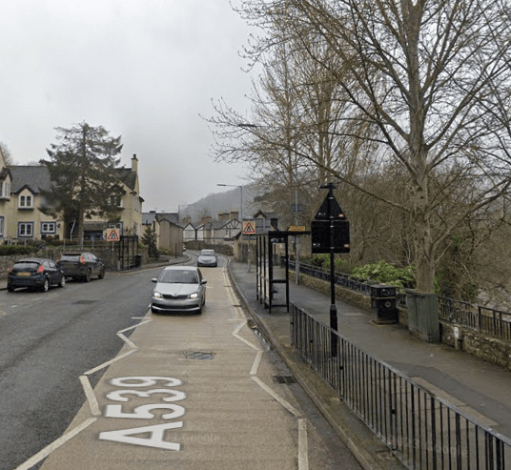
Bus stops and interchanges are an integral part of any public transport journey, but in my experience receive far less attention and allocation of resources than they should. These feelings were reinforced on the journey described in this post
Ruabon station bus stop
At Ruabon the Traws Cymru stop was just outside the station building. It contained basic information about timetables, but no real time information. The shelter was functional but nothing more. I actually only used this stop on my return journey – the Arriva 5 left from a stop at the end of the Station Drive. Here the same information (about northbound buses to Wrexham only) was being displayed in the shelters on either side of the road, which was confusing to say the least. If one didn’t have a basic grasp of the geography of the area, it would be easy to have got on the wrong bus.
At Llangollen I got off and on the bus at the Bridge Hotel stop. This can be seen to be a roadside stop of the most basic sort. Fortunately it wasn’t raining. There was a timetable displayed, but no real time running information.
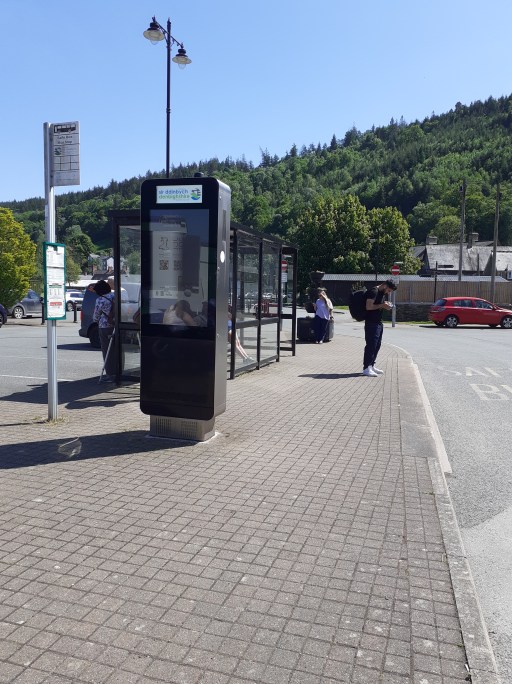
Corwen was very different. Here there are proper interchange facilities with good, real time information, a solid shelter and space to wonder in the bus stop area. I think I could make out a toilet block too, but didn’t investigate it. This is a nice facility. It would probably benefit from not being branded as “Corwen Car Park” – although it is indeed in the centre of a car park. It is much better than such a name would suggest. My only worry would be that the shelter would not be large enough for all those changing vehicles on a wet day. But this is how it should be done.
Corwen bus stop, waiting area and information panel
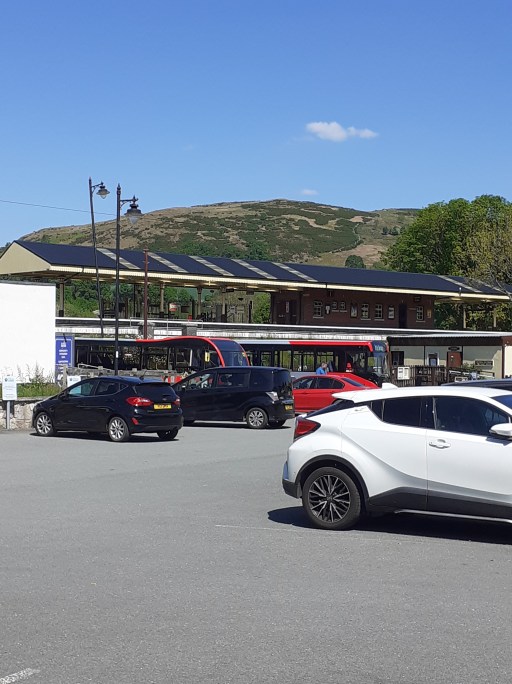
Betws-y-Coed is a strange place. It seems to be drowning in an ever expanding sea of car parks that have obliterated whatever it was that attracted folk there in the first place. The interchange is close to the station, and whilst there is shelter and some timetable information, I found the interchange, with four buses parking in an area that simply wasn’t large enough, very confusing and unsettling. Indeed I boarded the wrong bus at my first attempt. I think that there is scope for producing something like Corwen here, but it will cost I guess. Sadly the adjacent railway line, with its not-quite three hour interval service simply isn’t part of the interchange game here, which is based on a regular two hourly frequency.
Caernarfon bus station is simply a row of three of four bus stop and bays along a narrow street. However there is good passenger information and the provision of shelters is adequate. No problems here from my perspective.
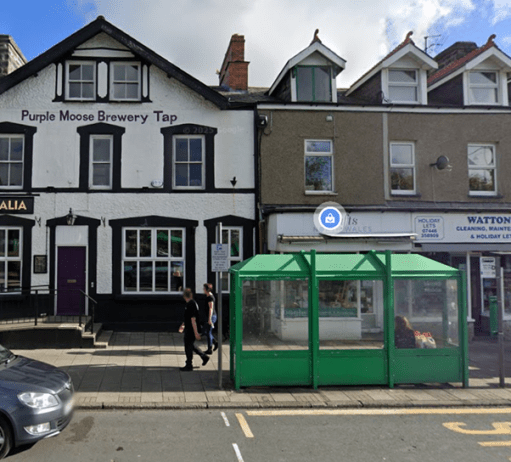
I began my second day at the bus stop outside the Australia in Porthmadog. It is simply a roadside stop. Passenger information and creature comforts are minimal. Porthmadog deserves better.
With my trip almost over, it reached its low point – Eldon Square in Dolgellau. This was perhaps the most chaotic bus interchange I have ever experienced with four buses double parked in wholly inadequate, highly trafficked space. There may have been public information systems, but such was the chaos I couldn’t find anything. The place is simply not fit for purpose. It is clear from a web search that its inadequacy is well appreciated and there have been long term discussions about how to overcome the issues. Maybe something will be sorted out in future, but of all my memories of the trip, Eldon Square is the one that remains with me. I will do my utmost to avoid ever having to use it again.
My final change of buses was at Bala – simply alighting at the stop in the centre and getting on the next bus in two hours time. again, it was a simple roadside bus stop. with only a paper timetable provided, amongst a sea of notices pasted to the stop itself. Very oddly, one of these was advertising a vacancy for a clergyman in East Sussex!
Some closing thoughts
On balance I was quite impressed by the Traws Cymru network. The regularity and timekeeping were impressive (although I suspect the latter might suffer when the traffic is busier in the high season) and the tickets were excellent value. The buses were comfortable, at least for journeys up to an hour or a little longer. It would be good if more use could be made of the on board information screens, particularly for passengers who don’t know the area well. The bus stops and interchanges were not so impressive however, with only just tolerable information provision (and hardly any in real time) and shelter provision in most places. I suspect if the weather had been wet, I would have been less impressed by the experience. The contrast between my experience at the well thought out interchange at Corwen and the chaos of Eldon Square in Dolgellau was quite stark. Something really does need to be done about the latter.
A recent news item indicates that an express North / South Wales coach service is under consideration, over the route of the current T2 to Aberystwyth and the T1 from there to Carmarthen, which would only have a relatively small number of stops in the larger towns. From my perspective this is to be welcomed, but I would urge anyone involved in implementing such a scheme not to forget the passenger infrastructure where the coach calls. If a premium service is to be provided by high quality coaches, then this must be matched by higher quality passenger facilities at its calling points, with good quality shelter and information systems – and ideally toilets and access to refreshments. Good interchange with the rail network should also be provided, with something better than a bus stop in the station carpark, Without such provision I fear any such experiment will fail.
Recently, whilst waiting for a service to begin at All Saints church in Oakham, I stood in the Lady Chapel idly reading the memorials attached to the wall (as one does). I came across the one above. The inscription reads
To the Glory of GOD and in Memory of Richard Tryon J.P. of this County. late Captain Rifle Brigade. son of Thomas Tryon Esq, of Bulwick Park Northamptonshire, Born August 31st 1837, Died December 12th 1905. The Kinetic Water Power was given by his widow Jane Anna Lucy Tryon.
Ricard Tryon was one of the great and the good of Rutland society in the late 19th century, and even has his own Wikipedia page. There we read the following.
Richard Tryon DL JP (31 August 1837 — 12 December 1905) was an English first-class cricketer and British Army officer. The son of Thomas Tryon and Anne Trollope, he was born in August 1837 at Bulwick Park in the Northamptonshire village of Bulwick. He was commissioned into the British Army as an ensign in the Rifle Brigade in November 1854. Shortly after he was promoted to lieutenant in February 1855. Tryon purchased the rank of captain in July 1858, later retiring from active service nearly a decade later in May 1867. Tryon made a single appearance in first-class cricket for the Marylebone Cricket Club (MCC), captained by W. G. Grace, against Kent at Lord’s in 1871.Batting once in the match, he was dismissed by Bob Lipscomb for 7 runs in the MCC first innings. A resident of The Lodge, Oakham in the County of Rutland, Tryon was nominated to be Sheriff of Rutland in November 1880. He was unsuccessful, with Francis Pierremont Cecil being made Sheriff; however, Cecil went on active naval service and was replaced by Tryon in April 1881. He was made a deputy lieutenant of Rutland in December 1901. He additionally served as a justice of the peace for Rutland. Tryon died at Marylebone in December 1905, following a short illness. He married Jane Anna Lucy Johnson, daughter of General William Augustus Johnson, in 1867. Two sons, Henry and Richard, were killed in the First World War. A brother was the Royal Navy Vice-Admiral Sir George Tryon.
So he was an interesting character in his own right. However it was the words The Kinetic Water Power was given by his widow Jane Anna Lucy Tryon that caught my eye. What on earth was this about? Kinetic Water Power are words I would associate more with my first year fluid mechanics lectures to engineering undergraduates than to tthe interior of churches. However, when I did a quick search of the British Newspaper Archive things became a little clearer.
Grantham Journal 23/11/1907… o. The Parish Church Organ. Through the munificence ot Mrs. Rd. Tryon, the Lodge, Oakham, and the Earl Lonsdale, Kinetic water-power apparatus and pneumatic pedal-action have been added to the organ of All Saints* Church, in addition to which the instrument …
Stamford Mercury 22/11/1907… just undergone complete renovation, the work being carried out by Messrs. Brindley and Foster, of Sheffield. hydraulic kinetic water-power has also been added. Near the instrument brass plate hears the following inscription : To the glory of God, and in memory …
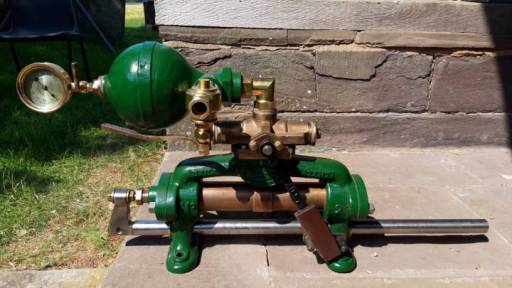
It seems the words Kinetic Water Power refer to the method for powering the church organ, which at that period was housed at the East end of the Lady Chapel, close to the location of the memorial to Richard Tryon. But what was the memorial referring to? Basically, water power was used to operate the bellows of organs when a mains water supply become available, and date back to the 1870s. This was used to fill two pistons sequentially that drove the rod that pumped the bellows. One such hydraulic engine has recently been restored at Moccas church in Herefordshire – see the photo below, the Facebook page and the church website here. More information on hydraulic engines can also be found here.
But there is still something of a puzzle. The Stamford Mercury extract above indicates that the apparatus was installed by Brindley and Foster of Sheffield, who installed the original organ in 1872. However the word Kinetic suggest some sort of association with the Kinetic Organ Blower Company, an offshoot of Cousans of Lincoln (1), However by 1907, this company was busy building Kinetic Blowers – fan blowers operated by electricity. It may be that the Kinetic company also produced hydraulic apparatus, or it may be that there was a somewhat loose usage of the word kinetic on the memorial, particularly as it refers to water power rather than air blowers. But interestingly it would seem that hydraulic engines were old and somewhat out of date technology by 1907.
Elvin L. (1995) Pipes and Actions. Some Organ Builders in the Midlands and beyond, Published by Laurence Elvin, Lincoln.
The Glynne Baronetcy dates back to 1661, with its main estate at Hawarden in Flintshire. The 8th Baronet, Sir Stephen Glynne (1780 to 1815) married Mary Griffin, daughter of Lord Braybrooke. After his early death, he was succeeded by his son Sir Stephen Richard Glynne, the 9th Baronet (1807-1874). I first came across him as the owner of the Oak Farm Iron Works in the Black Country, which was the subject of a spectacular financial crash. Glyne was saved from financial ruin by the efforts of his brother-in-law, the future Prime Minister William Gladstone, at very considerable expense to the latter.
More widely, Stephen Glynne is best known as a church antiquarian. Over the course of his adult lifetime he visited over 5000 churches in England and Wales, making notes, and in some cases sketches of their architecture, plans and furnishings. These notes can be found in 106 volumes now housed in the Gladstone Library at Hawarden. A small minority of these have been transcribed and published, but unfortunately this does not include the volumes containing the Rutland churches. This blog post goes some way towards remedying this, by presenting a transcription of the entry for All Saints Oakham. It is intended as the first fruits of a project to do the same for all the churches in the Oakham Team Ministry that were visited by Glynne. However, this may simply result in the creation of paving slabs for the road to hell.
Stephen Glynne’s description of All Saints Oakham
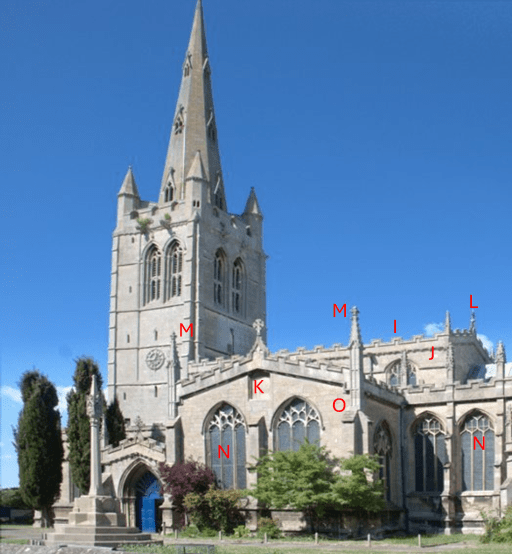
The text of Glynne’s entry for All Saints Oakham is given below, from Volume 33 of his Church Notes, one of three covering Leicestershire and Rutland. It is not dated, but other entries in the same volume indicate the year 1849, and it is likely this applies to the Oakham entry too. Certainly it was written before the restoration of 1858 – see earlier blogs here, here, here and here that deal with that. As written, it was all in one long paragraph, with somewhat dubious punctuation – almost a stream of consciousness approach. I have divided it up into sections with my own headings, and added consistent punctuation, which hopefully makes it a little easier to understand. The letters in brackets refer to the captions on the photographs, which illustrate the text. Numbers in brackets refer to the explanatory notes given at the end of the transcript.
The transcript
General This is a very large and fine church with large portions of Curvilinear work (1) and some of the later style. It consists of a large and lofty Nave with wide aisles, Clerestory, North and South Transepts, each with one aisle, and a chancel with side aisles.
The tower and the spire
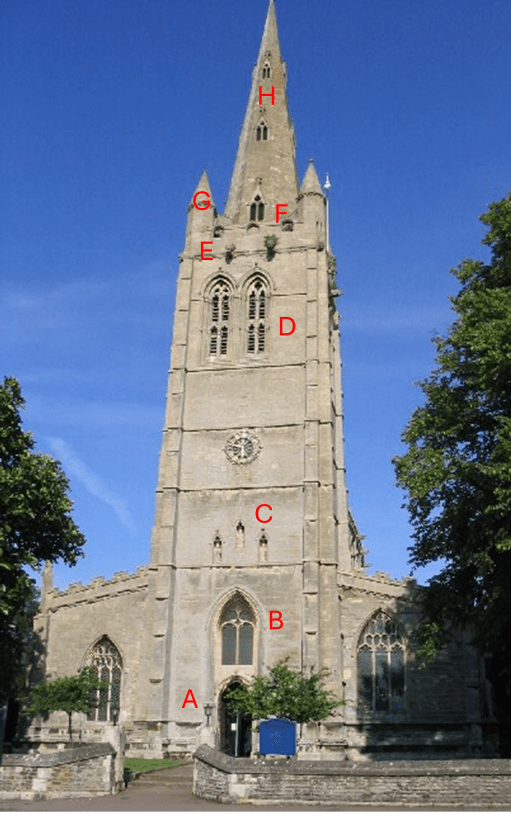
The tower and spire The steeple is at the west end of the nave. Included within the aisles, it is a remarkably fine composition consisting of a tower with pinnacles at the angles, surmounted by a beautiful spire connecting to the pinnacles by flying buttresses, the work of the Curvilinear period. On the west side of the tower is the door (A) and over it a two light windows included within one pointed arch (B). In the next stage are three small trefoiled niches on the west side (C) (2). The belfry storey has, on each side, two long windows each of two lights divided by a transom and having deep architrave moulding and shafts (D). Just above the nave a rich band filled with heads and foliage (E) (3). The parapet of the tower is pierced at rectangular intervals with small ogee openings (F). At each angle is a small octagonal turret covered by a large pinnacle from there being flying buttresses to the spire (G) (4), which is well proportioned and has several lights of small canopied windows (H).
The body of the church The whole of the body of the Chancel is embattled (I), there being beneath the parapet at some positions a cornice of heads etc (J) (5). The apex of the gable of Chancel, Transepts and Clerestory is in each crowned with an ogee canopy (K) (6). That of the Clerestory has a fine ornamental cross (L). The Transept ends are enriched with large crocketed pinnacles (M). The northern one is plainer externally than the corresponding one and has much blank wall. The windows of the Nave, Clerestory and Transepts are all Rectilinear (N) (1) but the walls are earlier. Some of the buttresses on the south have crocketed triangular canopies (O).
Transept, Nave and Clerestory
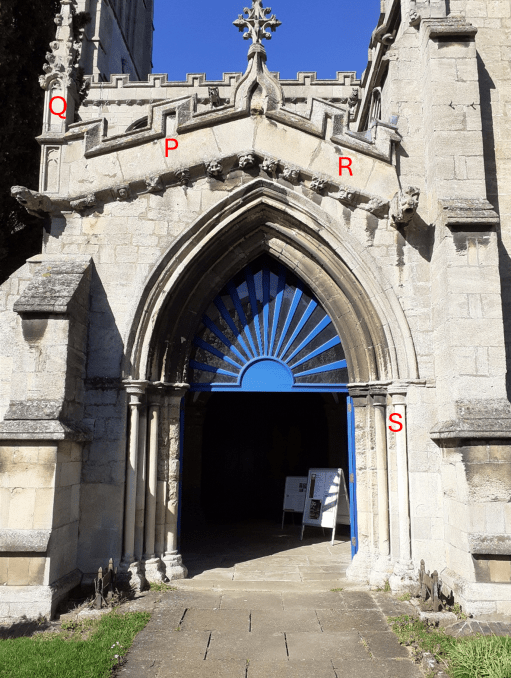
The South Porch The South Porch has an embattled gable (P) with pinnacles (Q) and cornices of heads (R) (7). The doorway is large and has deep mouldings and shafts of early English character having the nail head in the capital (S). Within the porch are niches on each side.
South Porch
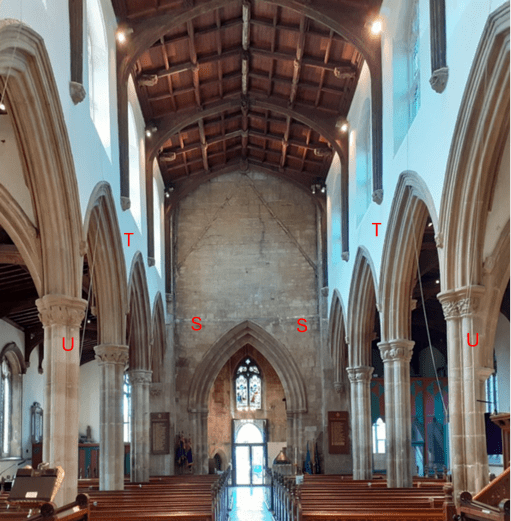
Nave and aisles The tower opens to the Nave and each aisle has a pointed arch springing from chamfered shafts (S), but much concealed by clumsy boarded partitions and lumber (8). Some of the windows are of three, others of four lights. The Nave and aisles are of considerable width and the divisions are formed by a double row of lofty pointed arches, four on each side (T). The pillars consists of four clustered shafts in lozenge form with the capitals sculptured with heads (U) (9).
The nave and ailses looking towards west end
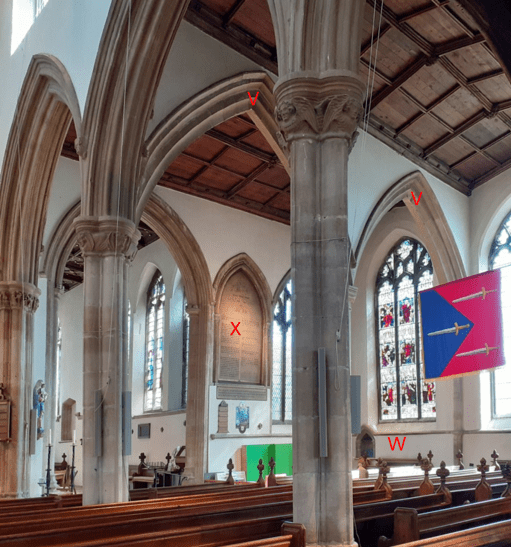
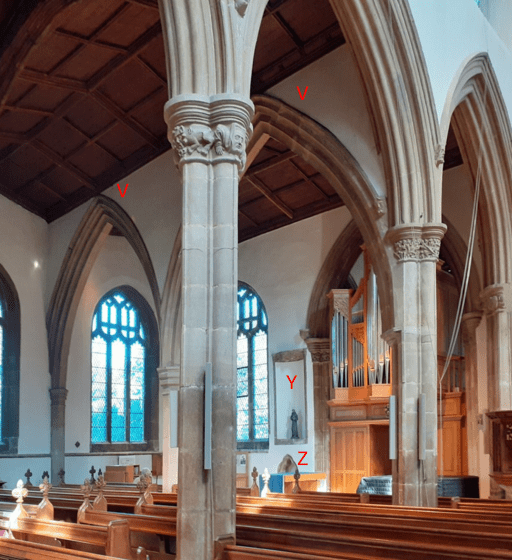
Transepts The Transepts are each divided into two aisles by two pointed arches with octagonal pillars (V). The ends of the transept have each two windows under one gable. In the South Transept is the niche with a contracted arch and shafts of early English character, with the piscina (W). On the east side of the same Transept, between the arch opening to the South Aisle and chancel is a window in an arch in the wall of early English work with toothed ornaments in the mouldings (X) (10). In the north transept is a Rectilinear corniced niche in the east wall (Y) and beneath it a trefoiled niche with drain of Curvilinear work (Z).
The South (left) and North (right) transepts
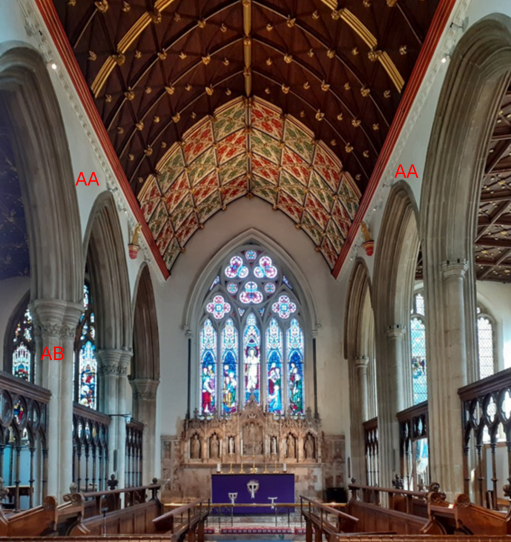
Chancel and chapels The Chancel with its Aisles has a great portion of Rectilinear work (11). The three east windows are large fine ones of four or five lights but only one retains its tracery. The side windows are of three lights. There are three pointed arches on each side of the Chancel (AA). Those in the south are rectilinear, the piers having fine mouldings carried down the ?? with shafts attached. On the sides on the north the piers resemble those of the nave but have the Tudor flower in the capitals (AB). The north aisle (12) has had a good panelled wood ceiling but now somewhat mutilated. On the north side (13) of the chancel is a rectilinear vestry which has no battlement but the gable is finished by a rich canopied niche and cross. The windows east of the chancel and south arch are under one gable and between their heads is a quatrefoiled circle. There is a niche and stoop near the South door of the chancel externally.
The chancel
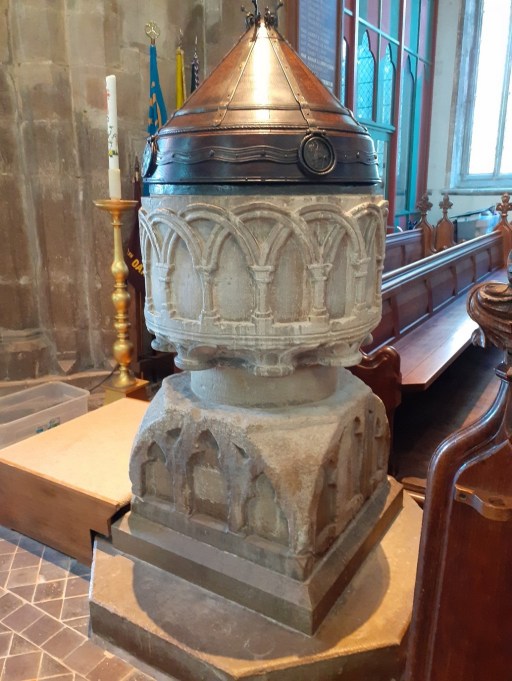
The font The font is Norman of circular form with intersecting arches and shafts (14). The base is square but with corners chamfered off, and moulded with small trefoil arches. There are traces of some fine ??.
Closing remarks Altogether the interior is not so well kept as it deserves to be. The pews and galleries are shabby and the whole dirty and untidy but the exterior is in good preservation and the stone of excellent quality (15).
Notes
1. The architectural periods referred to in the transcript are Early English (1190 to 1250); Curvilinear (or Decorated (1250 to 1350) and Rectilinear or Perpendicular (1330 to 1530). 2. No mention is made of the statues now in these niches, so it is most likely these were added during the 1858 restoration. 3. This band is above the belfry rather than the nave, so Glynne probably made a mistake here. It is possible however that the carvings were moved during the restoration, but the order of the text suggest that the first explanation is most likely. 4. These might be better described a low flying buttresses – it is difficult to observe them from ground level. 5. The heads cannot be seen on the large scale photograph. However there are some wonderful close up pictures of them on the Great English Churches website. 6. Shown here on the South Transept gable. 7. Again, detailed pictures can be found on the Great English Churches website. 8. This is very much inline with the description given by Gilbert Scott in his survey before the 1858 restoration. However his language was somewhat more robust. The aisles referred to are behind the west wall of the nave in the photo. 9. The capitals are perhaps the most significant heritage aspect of All Saints. I have discussed them at length here. 10. The wording is unclear here, but probably refers to the blind window which now houses the ten commandments. 11. The Chancel and side chapels were the most altered part of the church in the 1858 restoration, and much of what is described by Glynne no longer exists. 12. The current Holy Trinity Chapel. The southern aisle (the current Lady Chapel) is not mentioned. 13. This is a mistake – the vestry is on the south side. 14. The order of text here suggest the font was in the chancel area. However, it now stands close to the west door. Whether that has always been the case, or whether it was moved during the restoration to a more ecclesiastically acceptable position is not clear. I am inclined to think it was moved, as it would have been very awkwardly placed under the gallery if it were at the west end before the restoration. 15. Again, this finds and echo in the condition report of Gilbert Scott before the restoration.
All Saints Church in Oakham is a long term supporter of the Church Mission Society (CMS). It has recently been allocated two new mission partners, both working in Myanmar (formerly Burma). CMS have requested that the church does not publicise these links, as the partners work in a dangerous and sensitive situation. Nonetheless we pray for them and support them as best we can.
Very recently, after a service of Morning Prayer in which the mission partners were remembered, I happened to look at a plaque on the wall of the chancel just behind the pulpit, over one of the clergy stalls. The plaque’s location, and the plaque itself are shown in the photographs below.
The typography of the plaque makes it quite difficult to read, which is presumably the reason I have never done so in the past, despite the fact that I have sat in front of it on numerous occassions. But on reading it, I noted that the church in 1906 already had a link with Burma. The plaque reads as follows.
To the glory of God and in memory of Henry Arthur Jerwood, scholar and prefect of Oakham School; a faithful and beloved curate of this parish and a zealous missionary. The lamps in the chancel and sanctuary are erected by his schoolfellows, friends and parishioners. He died serving in obedience to his Master’s call at Mandalay on March 26th 1906.
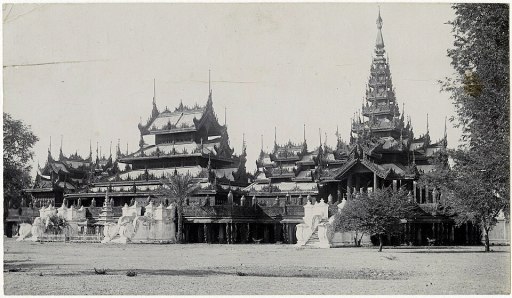
Mandalay is the second largest city in Myanmar, 600km north of the capital Yangon (formerly Rangoon) and is the centre of a largely Buddhist area. Our current mission partners are thus not the first links that the church has had in that area.
Henry Arthur Jerwood
Can we say any more about Henry Jerwood? His basic biographical details can easily be traced on Ancestry. He was born in 1878, the eldest child of Rev. Thomas Frederick Jerwood (1846-1926), Rector of Little Bowden and Dorothea Elizabeth Longsdon (1853-1942) who were married in Yorkshire in 1877. The couple had a number of other children, amongst them Helen Dorothea Jerwood (1880-1965), who will be mentioned below, Rev. Frederick Harold Jerwood (1885-1971) who was to become Chaplain at Oakham School, amd Major Hugh John Jerwood MC (1890-1918) who was killed in action. The latter had a son, born in 1918 after his death – John Michael Jerwood (1918-1991), a businessman and philanthropist, who was to become a significant benefactor of Oakham School, and a number of the school facilities bear his name.
St. Nicholas, Little Bowden, Northants
Oakham School
Henry Arthur attended Oakham School, as his father had done before him, and his brothers were later to follow him there. He matriculated at Sidney Sussex College, Cambridge in 1897, taking his BA in 1902 and his MA in 1905. He took some time out just before he graduated to fight in the South African (i.e. Boer) War from 1900 to 1902 with the Suffolk Regiment.
Clergyman and Missionary
After graduation, Henry Jerwood attended the Clergy Training School in Cambridge (the early name of Wescott House) and was ordained deacon in 1902 and took up the curacy at All Saints church in Oakham, a town with which he would have been very familar from his schooldays. The chronology of his training and ordination as deacon and priest is not wholly clear from the sources. In 1905 he applied to become a missionary to Burma. We can trace his short career there through the pages of the Quarterly Paper of the Rangoon Diocesan Association (RQP), a nationwide organisation that supported the work of missionaries in Burma, and was affiliated to the Society for the Promulgation of the Gospel (SPG). These are all available as pdfs in the SOAS missionary archive. As an aside, those who, like myself, dabble in historical matters, are hugely indebted to the patience and the perseverance of the archivisits who made such material available. In RQP 34, June 1905 we read the following under the heading Reinforcements, which says something of the military mindset of the organisation.
…….The Rev. Henry Arthur Jerwood, B.A., of Sidney Sussex ‘College, Cambridge, and the Clergy Training School, was ordained in 1902, to the Curacy at All Saints, Oakham, in the Diocese of Peterborough……
The Rev. A. Jerwood, at present an assistant Curate at Oakham, will join Mr. Fyffe at Mandalay~ a man stout and , vigorous in body and stout of heart, who went to South Africa when the war broke out, and did his part there man fully, and will carry to his work in Burma the same vigour he gave to South Africa and Oakham.
In the next edition (RQP 35, September 1905) we read that, as a consequence of Jerwood’s departure, Rev H J C Knight, the Commissary of the Rangoon Diocesan Association (who recruited for the Association and was living in Jesus Lane in Cambridge), preached at All Saints on Sunday July 30th. The collection of £3 4s was given to the R.D.A.
Then in RQP 36 from December 1905 Jerwood’s arrival in Burma is noted, under the heading News from the Front, again another military metaphor.
The newcomers have arrived, and are settling down to work, the Rev. H. A. Jerwood and Mr. Hart with Mr. Fyffe at Mandalay, the Rev. R. J. Stone at Bishop’s Court as Chaplain, the Rev. R. G. Fairhurst at S. Luke’s, Toungoo, and the Rev. W. H. C. Pope at Rangoon .
We also have the following description of the work in Mandalay,
The Buddhist Field – The Winchester Brotherhood has been founded at Mandalay, on the general lines of the Indian Community Missions, for systematic study of Buddhism and work in the field. The Head, Rev. R. S. Fyffe, has at present only one Brother (Rev. H. A. Jerwood). These two men are the only English Clergy for Missionary work in the chief town of Upper Burma, a city of 180,000 souls. They need at once two men of (if possible) a studious type, of patience, hope, and brotherliness. There is work to do while learning Burmese. The Brothers have passage and outfit paid, maintenance, lodging together, and £40 a year.
The mention of Jerwood in RQP 37 for March 1906 is very brief and simply says that he had taken over the role of Principal at the School run by the Winchester Brotherhood from Mr. Hart, who arrived in Burma at the same time as he did. Jerwood died on March 28th 1906. We read his obituary in RGA 38 June 2006, written by the Commissary Rev H. J. C. Knight.
Though most of our readers will have read the Bishop’s notice of Mr. Jerwood in the Mission Field for June, our R. Q. P. ought to have some notice of him. He was born on February 25th, 1878, the eldest son of the Rev. Thomas Frederick Jerwood, Rector of Little Bowden. He must have owed much to his home. On hearing from Bishop Montgomery that he had fallen asleep, his father was able to write “we hope to send another son.” and assuredly in homes that can speak thus:
“The father’s passion arms the son, And the great work goes on, goes on.”
All his school days were spent at Oakham School; thence he entered Sidney Sussex College, Cambridge. While yet an undergraduate he served in the S. A. war. On his return he graduated, entered the Clergy Training School, and was ordained to Oakham in 1902. Last autumn he went to Burma, calling at Delhi {where his sister was working under S. P. G. in the Cambridge Mission), and other Brotherhoods, and joined Mr. Fyffe at Mandalay in December. On the 28th March last he passed from us. The cause of his death was a rare type of paralysis – nothing climatic. The Bishop and the Rev. R. J. Stone, who was with him at the C. T. S., were in Mandalay at the time. His body rests near the graves of the Colbecks.
We had looked for great things from his ministry in Burma. His qualities of simple manliness, unaffected and robust piety, a very-single-hearted devotion, unselfishness, courage and affection, drew men to him. These, and his unfailing cheerfulness, promised much for our Winchester Brotherhood. He went out “for life,” and so his home gave him. His letters from Mandalay were always touched with humour, and were full of hope and determination. It is easy to pray “Thy will be done,” while we have no disappointments or reversing of our purposes; but it is hard really to bow to the surrender of such a man. When Bishop Maples was drowned on Lake Nyassa. on the very day of his arrival as Bishop of Likoma, Augustine Ambati wrote, “God liked to take him, to make white (i.e., consecrate) so the waters of the lake.” Even so may Mr. Jerwood’s death in Mandalay be one more consecration of the city. To his friends – there and here – it will be one more tie binding us to the missionary spirit, and the forward march of the Church. It is good to know that Mr. Garrad, whom God has moved to carry on his torch, will be, we believe, in every way a brother to Mr. Fyffe. Those who loved H. A. J. will pray “The Lord bless his going out and coming in. ”
H. J. C. K.
The sister in Dehli that is referred to is Helen Dorothea. At the time she worked for the Cambridge Mission of SPG, but was later to work for the East India Company in Dehli. She remained in India all her life, dying in 1965.
Some final thoughts
Interesting as it is to find that All Saints had a link with Myanmar one hundred and twenty years before our current one, and to read Arthur Jerwood’s interesting and ultimately tragic story the aspect that has struck me most in the preparation of this post, is how very different our current Christian culture is to that of 1906. As noted above, military metaphors are often used in the RQP, and indeed the whole publication shows an extremely ordered and extensive organisation that itself has a military flavour. The form of Christianity that one finds in its pages is a very muscular and forceful one and whilst one can admire the earnestness and zeal of those determined to bring the gospel to those who had never heard it, the tone of the publication reflects the colonial era of its time, and the implicit superiority of European (and particularly British) civilisation and culture to that of the “natives”. Howerver, whilst I find this aspect more than a little repellent, I do wonder if we have lost something over the last century, in terms of our zeal and enthusiasm for the mission of the church, both at home and overseas. The words of Revelation 3.15-16 come uncomfortably to mind.
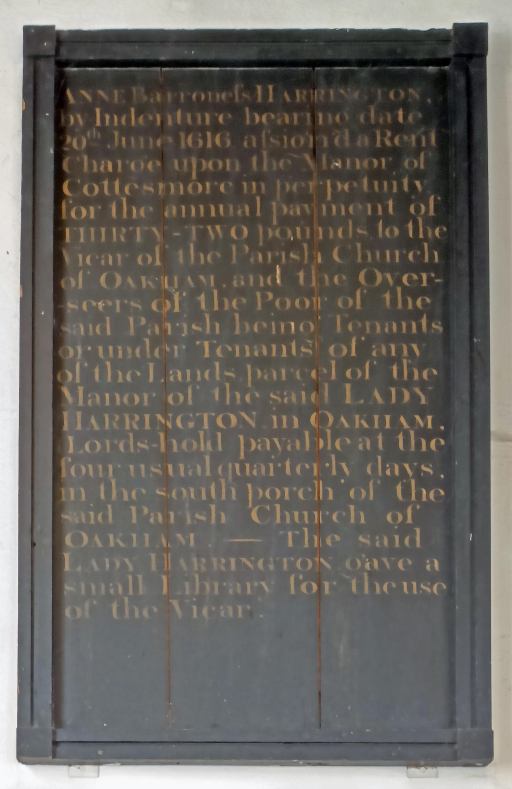
ANNE Barroness HARRINGTON, by Indenture bearing date 20th June 1616 assign’d a Rent Charge upon he Manor of Cottesmore in perpetuity for the annual payment of THIRTY-TWO pounds to the Vicar of the Parish Church of OAKHAM, and the Overseers of the Poor of the said Parish being Tenants or under Tenants of any of the Lands parcel of the Manor of the said LADT HARRINGTON in Oakham Lords-hold payable at the four usual quarterly days, in the south porch of the said Parish Church of OAKHAM. – The said LADY HARRINGTON gave a small Library for the use of the Vicar.
The inscribed board in the vestry of All Saints church in Oakham (photograph by Richard Adams)
Anne, Lady Harrington
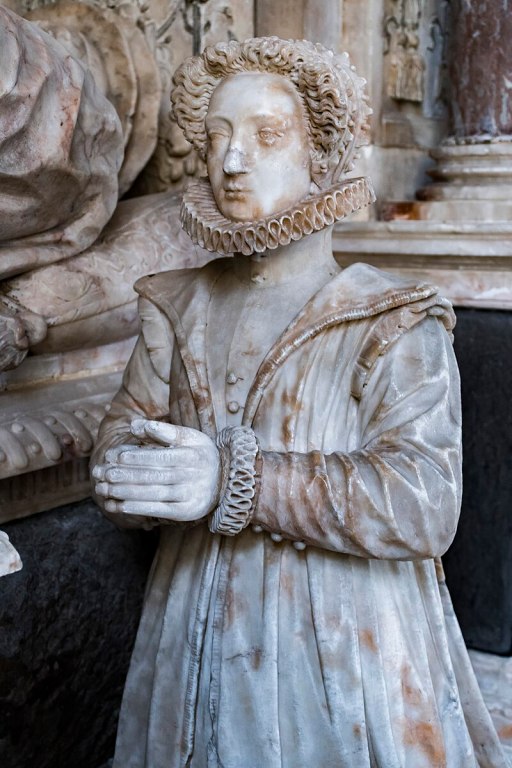
Anne Keilway was a daughter of Robert Keilway of Minster Lovell in Oxfordshire. She married John Harington, 1st Baron Harington of Exton, in 1573. After the Union of the Crowns in 1603, she was appointed as a Lady of the Bedchamber and was made Governess to Princess Elizabeth, the daughter of James 1, travelling with Elizabeth in 1613 to Heidelberg for her wedding to Frederick V of the Palatinate. Anne died in May 1620. The younger Anne is depicted on a memorial to her Father in Exton parish church (right).
The Harrington bequest
In 1616 Lady Anne Harringtom made a two part bequest, which is recorded on a an inscribed wooden board in the vestry of All Saints Parish church in Oakham shown above. This involved an annual bequest of £32 to support the poor of the township of Oakham Lordshold, and the bequest of a small library for the use of the vicar of All Saints church. This post describes the second part of the bequest – what was to become known as the Oakham Parish library. The support for the poor of Oakham is addressed in a related post.
The Oakham Parish Library
In 1616 Anne bequeathed a collection of books to All Saints Oakham, and these formed the core of the parish library. a number of volumes were added to the library over the years, mainly service books and bibles, This collection, numbering 115 volumes was transferred in October 1980 on indefinite loan into the custody of the Department of Special Collections of Nottingham University Library. The Oakham Parish Library is well described in the paper “Oakham Parish Library” by Anne Herbert. This paper is however not easily available (unless one has a University Library access or is prepared to pay £35 for a copy), so I quote below the most relevant passages.
……Until their removal to Nottingham the books were housed in two oak presses 176 cm. in height, 183 cm. in width and 39 cm. in depth, with three shelves apiece and a central vertical divide of a later date. The craftsman ship is rather crude and lacking in decoration with the exception of a single strip of carving along the top of each press……
…..Oakham parish library …… comprises almost exclusively works of theology with a sprinkling of history, mainly ecclesiastical, and canon law…… It is strongest in the Greek and Latin fathers-Athanasius, Chrysostom, Epiphanius, John of Damascus, Origen; Augustine, Gregory, Hilary, Jerome, Tertullian……. But the medieval schoolmen, the Protestant reformers and pre-Reformation theology and law are also represented….
…..The books were originally shelved with the spines innermost but there is no evidence to suggest they were ever chained. All but the late additions to the library have fore-edge numbers and some also have author and title information on the fore-edge…..
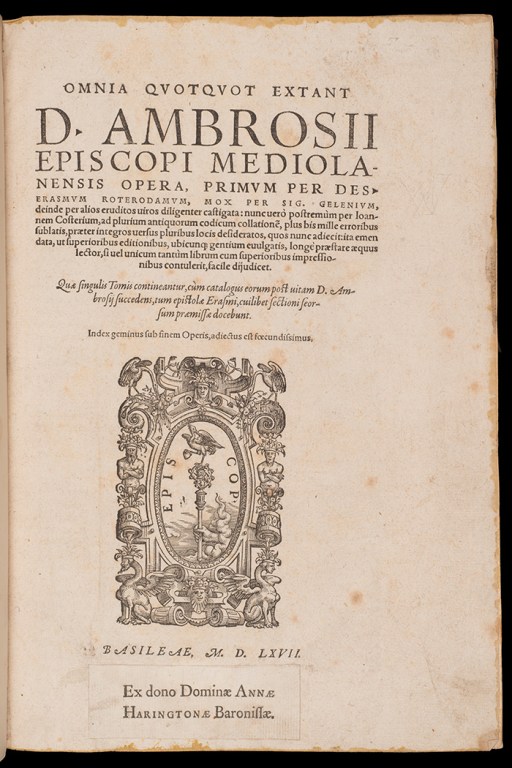
…..A printed book label, which survives in 46 of the volumes, pasted at the base of the title-page, commemorates Lady Harington’s bequest and bears the inscription ‘Ex dono Dominae ANNAE HARINGTONAE Baronissae….
…..The books are for the most part fairly uniformly bound in calf decorated only with fillets round the edges of the covers. The incunables and early sixteenth century volumes, however, have blind-stamped leather bindings over wooden boards…..
….Oakham parish library seems to have been rather neglected durng the subsequent centuries. There is very little documentation relating to its establishment or history-no extant loan records and little evidence that it was ever used by the incumbents of Oakham for whose benefit the books were originally given…..
In an appendix to her paper, Herbert lists 67 books that belong to or were contemporary with the Harrington bequest, the remaining items being later additions to the library. The library is also discussed by Aaron T Pratt “A Baroness and her books” which contains a photograph of the printed book label shown to the left, and also some examples from elsewhere that show how the books might have looked on their shelves.
The library at the University of Nottingham
81 items from the Oakham Parish Library are listed in the Nottingham University Catalogue. As Herbert states that 115 volumes were transferred in 1980, it is likely that some catalogue entries relate to multiple documents – most likely those referring to bibles or prayer books.
ANNE Barroness HARRINGTON, by Indenture bearing date 20th June 1616 assign’d a Rent Charge upon he Manor of Cottesmore in perpetuity for the annual payment of THIRTY-TWO pounds to the Vicar of the Parish Church of OAKHAM, and the Overseers of the Poor of the said Parish being Tenants or under Tenants of any of the Lands parcel of the Manor of the said LADT HARRINGTON in Oakham Lords-hold payable at the four usual quarterly days, in the south porch of the said Parish Church of OAKHAM. – The said LADY HARRINGTON gave a small Library for the use of the Vicar.
The inscribed board in the vestry of All Saints church in Oakham (photograph by Richard Adams)
Anne, Lady Harrington
Anne Keilway was a daughter of Robert Keilway of Minster Lovell in Oxfordshire. She married John Harington, 1st Baron Harington of Exton, in 1573. After the Union of the Crowns in 1603, she was appointed as a Lady of the Bedchamber and was made Governess to Princess Elizabeth, the daughter of James 1, travelling with Elizabeth in 1613 to Heidelberg for her wedding to Frederick V of the Palatinate. Anne died in May 1620. The younger Anne is depicted on a memorial to her Father in Exton parish church (right).
The Harrington bequest
In 1616 Lady Anne made a two part bequest, which is recorded on an inscribed wooden board in the vestry of All Saints Parish church in Oakham shown above. This involved an annual bequest of £32 to support the poor of the township of Oakham Lordshold, and the bequest of a small library for the use of the vicar of All Saints church. This post describes the first part of the bequest. The library bequest is addressed in a related post.
The Harrington Charity
As set out on the board in the vestry of All Saints church shown above, the original bequest was for £32 per annum to the vicar of All Saints and to the Overseers of the Poor, to be distributed to the poor in the township of Oakham Lords-hold. The distinction between Oakham Lords-hold and Oakham Deans-hold is an ancient one and in well described by T H McK Clough in “Oakham Lordshold in 1787”. The distribution was to be made on the quarter days from the south porch of the church. In 1915 the administration of the bequest was formalised by the Charity Commission. The Trustees of the Charity were to be the Vicar of All Saints, and four others appointed by the (then) Urban District Council. Procedures for meetings of the Trustees and for their appointment are also set out. The income is specified as £32 per year from the Earl of Gainsborough, which shall be spent as follows
As set out on the board in the vestry of All Saints church shown above, the original bequest was for £32 per annum to the vicar of All Saints and to the Overseers of the Poor, to be distributed to the poor in the township of Oakham Lords-hold. The distinction between Oakham Lords-hold and Oakham Deans-hold is an ancient one and in well described by T H McK Clough in “Oakham Lordshold in 1787”. The distribution was to be made on the quarter days from the south porch of the church. In 1915 the administration of the bequest was formalised by the Charity Commission. The Trustees of the Charity were to be the Vicar of All Saints, and four others appointed by the (then) Urban District Council. Procedures for meetings of the Trustees and for their appointment are also set out. The income is specified as £32 per year from the Earl of Gainsborough, which shall be spent as follows.
I. Grants or contributions for or towards the the provision of Nurses, and of medical and surgical assistance for the Sick and Infirm, including medical and surgical appliances, medicines, and comforts or necessaries : II The supply of (a) Clothes. Linen. Bedding, Fuel, or Food or other articles in kind (b) Temporary assistance in money by way of loan or otherwise. III Weekly allowances. being in no case, except with the approval of the Charity Commissioners, less in value than 1s 6d a week or more than 3s a week, during the pleasure of the Trustees, to or for the benefit or persons qualified, as aforesaid, and not in receipt of Poor-law relief other than medical relief, who have attained the age of 60 years, and become wholly or part unable to maintain themselves by their own exertions, in augmentation of any means of support possessed by the beneficiaries – which shall be proved to the satisfaction of the Trustees to be reasonably assured. and to be sufficient, when so augmented, to enable the beneficiaries to live in reasonable comfort.
The Minute Book 1925 to 2000
A minute book for the Harrington charity has recently come to light, during a clear out of old financial documents. this runs from 1925 to 2000, and contains some interesting information on the development, and the running down of the charity over that period. In this section we will look at the general trends over that period. In the following section we will look in more detail at the entries for 1925.
The annual entries in the minute book are largely routine, reporting the appointment of trustees, and giving a list of those to whom payments were made. Each year from 1925 to 2001 the total payments were close to the income of £32. There were a few other points of interest however. In 1933, it was decided to make payments directly to individuals rather than requiring them to congregate in the Church School – which had replaced the south Porch of the church as the distribution centre at some point. In 1935 grocery vouchers worth 2s 6d and redeemable at G. W. Peesgood, were also distributed alongside the cash dole. In 1954 enquiries were made as to whether it was possible to support those outside the Lordshold area, which seem to have been inconclusive. No meetings were held in 1998, 1999 and 2000 and the final meeting in 2001 discussed the possibility of amalgamation with the Morren charity. It also resolved to request the last three years payment from the Exton Estate (still of £32 / year). How these two issues were, or were not resolved is not recorded. Note however that the distribution in this form is not a good match with that specified in the 1915 document – and indeed there are no indications that regaulr weekly payments were made over the period.
The minute book also enables us to look in more detail at some aspects of the dole. The figure to the right shows the number of recipients of the dole over the years. It can be seen that this falls from just under 90 in 1925 to around 60 by 1930, and remains at that number until 1960, when a gradual decline sets in. Up until 1930, different amounts were given to different people – either 2s 6d, 5s, 7s 6d or 10s. From 1933 a standard amount was paid. this was 10s to each recipient to 1960, and then increasing gradually as the number of recipients fell from then on. In the mid 1990s £8 was paid to each four recipients.
The number of recipients of the Harrington dole from 1925 to 1997
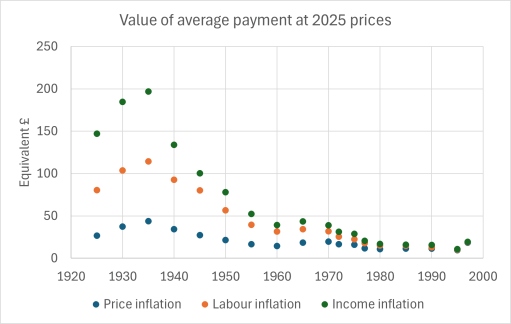
Value of the average dole between 1925 and 1997 in today’s prices, using three different inflation measures.
But how much were such payments worth in todays prices? There are various ways of calculating this as set out by the Measuring Worth website. The right hand figure shows the value of the average dole payment from 1925 onwards at today’s prices, as calculated using price inflation, labour cost inflation and income inflation. The last two are probably the most relevant to this study. These show that the average dole payment in the 1920s and 1930 was worth somewhere between £100 and £200 in today’s terms – not a massive amount, but perhaps something like the Winter Fuel allowance.
Using the same method, the value of £32 in 1603 when the charity was set up was £127,000 based on labour cost inflation and £228,000 based on income inflation. On the assumption that there were around 100 recipients of the dole, this gives the worth of an average payment of between £1000 and £2000 in today’s terms, which would be quite substantial.
The 1925 Dole
We now look at the information for the 1925 payments in more detail. This year is on the limit of the 100 year period usually applied to the release of individual names, and the entries in the minute book may be of interest to Family Historians.
The 1925 pages have been scanned and transcribed, and both the scan and the transcriptions are shown below in pdf viewers. The original writing is not easy to read, so I can’t be certain about the accuracy of the transcripts – but I have done my best! In general terms, the large majority of the recipients were women, usually identified as Widows.
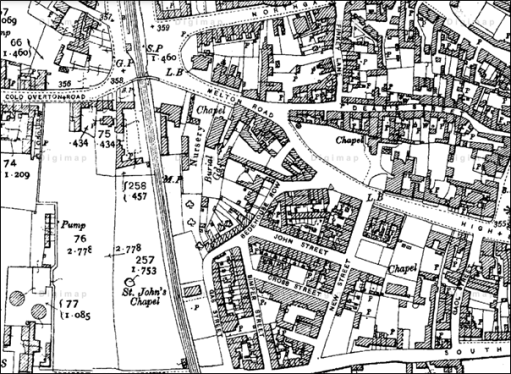
Brooke Rd Cold Overton Rd Cross St Crown St Gaol St Gas St John St Johns court Jubilee Buildings Mill St Mount Pleasant New St Northgate St Park Lane Pullins Yard Simper St South St Westgate
1 7 3 5 4 7 10 7 3 3 2 2 5 1 1 10 5 10
A breakdown of the streets where those who recieved the 1925 lived is given to the left. Most of these are shown on the map from 1910above. Some of these streets no longer exist, specifically those streets in the area between New St., Melton Rd. and the railway line – Cross St., Gas St., and Simper St., with John St. being much curtailed. Others cannot be precisely located – Pullins Yard and Johns Court, although they are likley to be in the same area. Bedehouse Row on the map is referred to as Westgate in the minute book. In total 58 of the dole recipients (around two thirds of the total) lived in the area bounded by South St, Gaol St., High St., Melton Rd. and the railway.



















 Engineering, history and ecclesiology
.jpg)


