The 1858 Restoration of All Saints church in Oakham – Part 1

Introduction

In this series of three related posts, I present transcripts of the press reports concerning the re-opening of All Saints church in Oakham in November 1858. This is done primarily to make the source documents for that event available and easily readable, and there is no discussion of their contents. That will come later. The material is all found in the British Newspaper Archive and the archive OCR text forms the basis of the transcripts, although. As with any OCR text, this has needed considerable editing, which, as I am sure the reader will find, has been imperfectly done. The material presented in the three parts is as follows.

  • Part 1 contains the notice of the re-opening the from the Leicester Journal of 5th November 1858 and a report on the event itself from the Stamford Mercury of 12th November 1858. The latter contains the text of the report by Gilbert Scott that describes the state of the church before the restoration and what, in his view, needed to be done.
  • Part 2 contains a report of the opening from the Leicester Journal of 12th November 1858. This covers some of the same ground as the Stamford Mercury report, and whilst not including Scott’s report, does give details of the opening event, including the sermon that was preached.
  • Part 3 (this part) is from the Lincolnshire Chronicle of August 24th 1860, and gives the text of a lecture that was given at Oakham Castle entitled “Gothic Architecture” by the Rev Canon James, one of the principal proponents of the Gothic in the region, where the changes that were made to the church are explained and justified.

Leicester Journal 5th November 1858

ALL SAINTS’ CHURCH, OAKHAM.

THE RESTORATION of this Church, in which great and general interest has been shown, is now so near completion that the of November may fixed for the RE-OPENING. It is purposed, therefore (D.V.), to have Divine Service, on WEDNESDAY, November 10th, Eleven o’clock am., Morning Prayer, with Sermon by


THE REV. E. MEYRICK GOULBURN, D.C.L,
Chaplain in ordinary to Her Majesty, and Minister Quebec Chapel, London;

Three o’clock, p.m., Evening Prayer, with Sermon by

 THE REY. CANON JAMES, M.A.
Rural Dean, Vicar of Theddingworth and Sibbertoft.

On THURSDAY, November 11th, Seven o’clock p.m., Evening Prayer, with a Sermon by

THE BEV. J. R. WOODFORD, M.A.
Vicar of Kempsford, Gloucestershire.

On SUNDAY, November 14th, Eleven o’clock, in, Morning Prayer and Holy Communion, with a Sermon by

THE HON. and REV. CANON STUART, M.A.
Rector of Cottesmore.

 6.30. p.m., Evening Prayer, with Sermon by

THE REV. THOMAS YARD, M.A.
Rural Dean and Rector of Ashwell.

A Collection will be made each service in aid the Restoration Fund. A deficit of about £300. remains this; to meet which the sum raised these Collections the only resource available.
The presence and aid of all who take interest this important work is respectfully invited.
In order to secure accommodation for those who reside out of the town, admission until 10.50 a.m. on Wednesday morning will be by cards only; at 10,50 the doors will be thrown open.
Those who propose to attend, are requested to apply for as many Cards as they desire, to one of the Churchwardens ; or to any resident member of the Restoration Committee; or to the Secretary, the Rev. C. A Stevens.

Heneage Finch, Vicar
Rich. Davies, Churchwardens. William Ratcllff, Churchwardens

The Agricultural Hall will, by the kind permission of its managers, be thrown open to Visitors during Wednesday, the 10th November. Arrangements have been made for the supply of Refreshments there on the arrival of the Morning trains, and during the day.

Stamford Mercury 12th November 1858

For a considerable period the very filthy and dilapidated condition of the magnificent church of All Saints, at Oakham, was a subject for regret, not only to those who worshipped within its damp and dingy-looking walls, but to all admirers of Christian architecture. At length the noble sum of £800. was given through the Architectural Society of the Archdeaconry, by unknown donors, which originated the fund that has procured the restoration of the edifice, and which was re-opened for divine worship on Wednesday last. When there seemed to be no longer doubt respecting the raising sufficient amount for beautifying the church the services of Mr. G. G. Scott, the eminent architect, were sought, and after inspecting the fabric returned to London and drew up the following report, which he forwarded to the Rev. Heneage Finch, the Vicar.

 I have made a careful survey of your parish church, with a view to forming an opinion as to the extent of the reparations and restorations which are requisite to putting it into a satisfactory condition, and as to the probable cost of the work. The church is, as you are aware a remarkably fine one. It is the work of several different periods, extending from the end of  the 12th to the commencement of the 16th century. I have not been able to trace out the course of alteration and addition which has brought to its present form but may mention that its earliest feature is the inner doorway of the porch which is of the end of the 12th century. The next date are the interior of the porch itself and the lower parts of the south wall, with blank recess or window in the east side of the south transept, which are of the first half of the 13th century. Then come the corresponding parts on the north side, with the single pillars in both transepts. The chancel arch, and some minor portions, which are the beginning of the 14th: and the tower, with perhaps the pillars and arches, of the same, and some other portions, which are of the latter part of the same century; while the chancel and the clerestory, and probably the north chancel aisle, are of the 15th, and the south chancel aisle of the 16th centuries. Various, however, as are the dates of these different portions the church, they unite to forming a symmetrical and harmonious whole, having generally the aspect of a church of the 15th century.
In describing the present condition of the church, I will commence with the roofs. The roof of the nave (which pretty good roof in design, though constructed as to press somewhat severely upon the clerestory walls) is a very sad state of decay : one half of it was repaired some years ago, and means were taken to reduce the pressure upon the walls, It will be necessary to do the same throughout; but at the same time the roof will require thorough reparation. I fear that it will be found that a very large proportion of the timbers are decayed. These must be replaced with new oak, the boarding and lead renewed, and the whole restored to a perfect condition. The roofs of the nave aisles are ancient, and better condition than that of the nave itself, but require considerable repairs, and the lead and boarding must be re-laid. The roofs of the transepts have been repaired some thirty years since, and much of the timbers concealed by plastering. I would recommend the substitution of oak panelling for this, and such general repairs as may be found necessary. The chancel has a roof of modern date concealed by a flat plaster ceiling which cuts across the chancel arch. The same roof extends over the north chancel aisle, thus deforming the east end, by placing two divisions under one gable. The north aisle has most beautiful oak panelled ceiling, which happily conceals its roof from within. The south aisle of the chancel has modern roof, of the very meanest description, so that in the interior of the chancel and its aisles we have first a plain flat plaster ceiling to the chancel itself; then to the north aisle a beautiful oak ceiling, showing the manner in which the ancient builders treated their work; and on the south aisle the roof of modern hedge-carpenter, such as would disgrace a cart-shed.
The mode of treatment I would recommend would as follows. First, as the chancel roof has been originally of high pitch, would renew it in that form, and in a manner suited to the beauty of the church. Secondly, I would thoroughly restore the ceiling the north aisle, bringing the external roof to its original level Thirdly, I would put over the south aisle a ceiling corresponding in some degree with that on the north aisle. The roof of the porch and vestry would also require reparation. The walls of the church seem generally pretty substantial, but have suffered much from mutilation, and require careful reparation throughout. The cusps of the windows have nearly everywhere been cut out. The east window has been renewed on a most extraordinary design. Many of the mullions are shattered, and must be renewed, Generally, all mutilated and decayed parts must be renewed, the internal stonework cleaned, the plastering of the walls repaired or renewed as the case may be, the clerestory walls, which have been thrust out must be strengthened, the parapets reset where necessary, the pinnacles restored, and the whole rendered  perfect and substantial The tower has either through settlement, or through the effects of lightening been somewhat split  down its south-eastern angle, and has some few other defects. – These must be substantially repaired, and I would recommend the insertion of a tier of strong iron ties to prevent their re-appearance. The floor of the tower immediately over the church must be renewed, and the other floor and the bell timbers substantially repaired. Of the internal fittings I have but little to say.  They exceed in meanness even what is usual in country churches.  And there must be but one opinion about them – they must entirely cleared away, and the whole refitted in proper manner with good oak seats. There are numerous remnants of old screen work of very character, and some remains ancient seats. These will be useful guides in designing the new fittings The floors must almost entirely new. The doors must be new, excepting that to the south porch, which is ancient and ornamental, but requires restoration. The glazing should be renewed throughout, and stained glass introduced from time-to-time opportunity may offer. While these reparations are in hand, it would be very desirable that the church should be efficiently warmed.
I estimate the probable cost of the works as follows. Those connected with the church and tower with £2300; those to the chancel fabric £575 and fittings £225, (£800); those to the south aisle of the chancel, fittings £320, fittings £80 (£400); those to the north aisle of the chancel fabric £275, fittings £7L (£350): making in all about £3850. The above calculation is made on the supposition of everything being done the best manner, the roofs and the whole executed in a manner worthy of so fine a church,  and need I hardly say that the church so restored would be a most noble and beautiful structure.

The above report was dated April 21,1857, and on the 30th of the same month the Vicar convened a meeting of the inhabitants and others interested the restoration and re-seating the church. Geo. Finch Esq. presided. Mr. Scott’s report having been read, the following resolution was passed “That this meeting having heard the report of Mr. Scott on the state of the parish church, and acknowledging  the liberal offer of donations to the amount of 800L towards carrying it into effect, is of the opinion that thus opportunity should be taken advantage of and make an immediate and strenuous effort to restore the church to condition befitting its high purposes. A committee wan immediately formed. Mr. Scott was employed as architect and subscriptions to the restoration fund solicited., the Rev. C. A. Stevens accepting the arduous office of honorary secretary.

The call has been liberally responded to as the following subscriptions will show.

Geo. Finch Esq. £1000 
Anonymous, £400
The Dean and Chapter of Westminster, £300
The Rev. Heneage Finch, the Vicar, £200
The late Wm Ades , Esq., £150
The Church Building Society, £150
The Marquis of Exeter, Lord Aveland, the honourable Colonel Lowther, Miss Jones, Miss B. Jones Mrs. Doria, Mrs. Bicknell, the Rev. Brown (Lyndon), the Church Building Society of the Archdeaconry of Northampton, and the Governors of Oakham Grammar-school and Hospital, £100 each
The Hon. G. H. Heathcote, the Rev. J. Jones (Burley), the Hon G. J.NoeL S. Parke, Esq. (Spalding), the Hon. and Rev. A. G. Stewart (Cottesmore), the Rev Thos. Yard (Ashwell), Mr. Adam, and Mrs. Hicks (Jermyn-terrace), £50 each
Messrs. Crowson and Sons, £40
Mrs-Fydell Morcott, £35L
Messrs. Eaton, Cayley, and Co., (Stamford) £30Major-General FludyeZr (Ayston), Col. Freer (Leamington), Miss Thompson (Ketton), Colonel and Mrs. Talbot Clifton, Mr. Hough, Mr. F. King, Mr. Mackinder, Mr. Clarke Morris, Messrs. Morris and Co., Mr. Samson, and the Rev. W. S. Wood, £25 each
The Rev. c. S. Elbcott (Whitwll), Chiselden Henson, Esq. (Cheltenham), Wm. Hopkinson, Esq. (Stamford), Mr. and Miss Hunt and  friends (Clapton), F.J.Mould, Esq. (Brompton) the Hon. and Rev. Noel (Exton), the Misses Wingfield (South Luffenham), Mr. Dain, Mr. Churchwarden Davies, Mr. Hawley, Miss Mason, and Mr. Wellington, £20 each
H. W. Baker, Esq. (Cottesmore), and Ayscough Smith, Esq. (Leesthorpe Hall), £10 10s each
Miss Belgrave (Preston), the Rev. F. G. Burnabv (Barkestone), General Johnson (Wytham on the Hill), John Keal, Esq. (London), Thos. Lawrence, Esq. (Preston), the Rev D. Royce (Netherswell), Colonel and Mrs. R. W. Wood, Mr. Brown (Melton-road), the Rev. T. Byers, Miss Jane Layng, Mr. Morton (Egleton), Miss Mould, Mrs Rawlings, Mr. R. Simpson, the Rev. C. A. Stevens, Mr. Tirrell (Egleton), and Mr. S. C. Turner, £10 each
The Rev. Thos. Field (Cambridge), the Rev. G. H. Parker (London), Mr. Brown (Ashwell-road), Mr. Burn, Mr. Churchwarden Ratcliff and Mr. Thos. Shuttlewood, £5 5s each
The Rev. H. Applebee (Whissendine), the Rev. Canon Argles (Barnack), the Rev. C. Atlay (Barrowden), the Rev. Jas. Atlay (Cambridge). the Rev. the Master Catherine Hall, Edw. Conder Esq (London), the Hon. and Rev. K Cust (Belton), the Yen. Archdeacon Davys (Peterborough), Mrs. Decker (Lyndon), the Rev T. Dove Dove (Frome Solwood), the Rev. C. J. Ellicott (Cambridge), Mrs. Hayton (Kimbolton), the Rev. Canon James (Peterborough), the Rev. H. Jones (Greetham), the Rev. J. Pullein (Kirkthorpe), Wm. Sheild, Esq. (Uppingham), Mr. E. Wright (Melton), N. W. Wyer, Esq. (Bedford), anonymous, Mr. W. Burnett, Mr. Bell, .Mr. Bruce, Miss Butt Mr. D. Cooke, Mr. E. Cunnington (Barleythorpe), Mr. Furley, Mr. W. KeaL jun., Miss Emma Keal, Mr. S. and Mr. J. Tirrell (Egleton), and Mrs. Whyers, £5 each.
Of the £800 which formed the ground-work of the undertaking, £440  now appears in the subscription list as an anonymous donation, and £100 to each the names of the four daughters of the late J. E. Jones, Esq., of Oakham. The Earl of Gainsborough gave £125 to the fund: the north chantry belongs to his Lordship, and in consideration of the above donation the expense of its adornment will be paid out of the general fund.

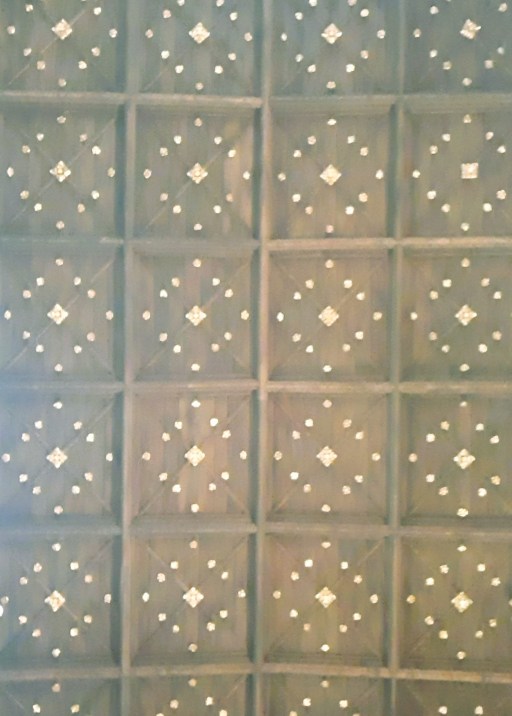
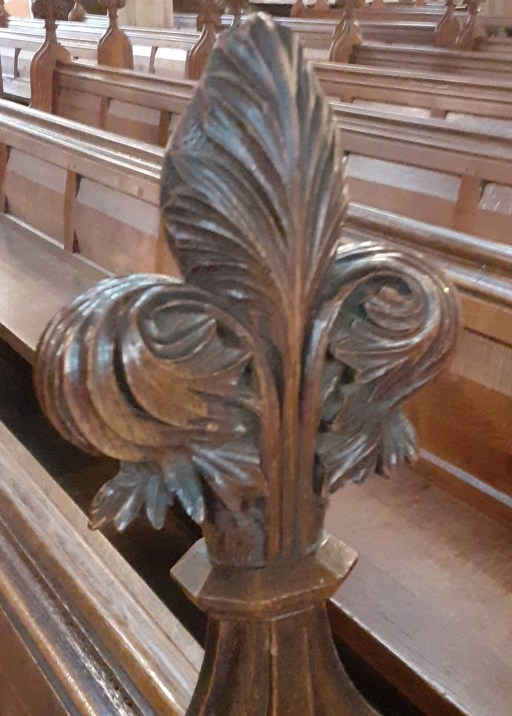
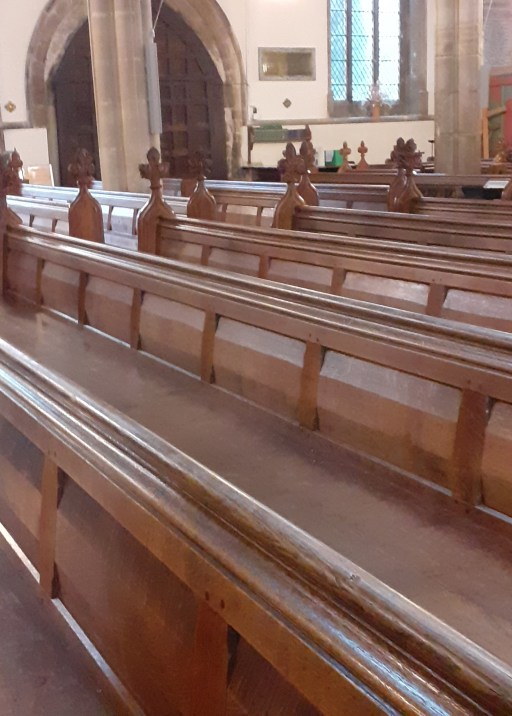
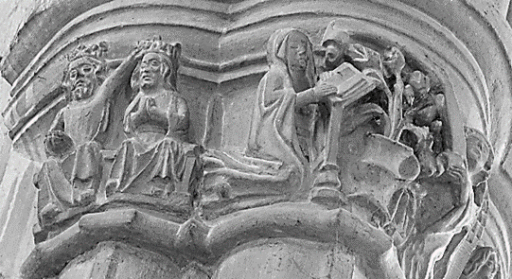
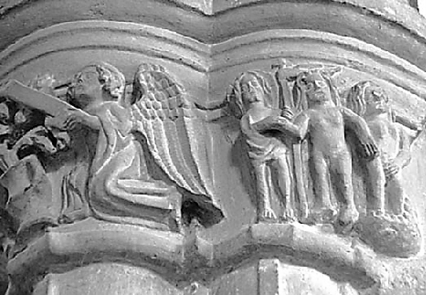
For the execution the works several firms were solicited send in tenders, and that of Messrs. Ruddle and Thompson, of Peterborough was accepted, the amount of contract being £4400. In a few days afterwords the unsightly furniture was removed from the church, and the restoration proceeded with. In carrying out the undertaking Mr. Scott has strictly preserved every mediaeval detail; even the triangular lines over the tower arch which show gable form of the roof of the earlier church have not been allowed to be erased. He considers that such details show to some extent the history of the church. A portion of the capital the north pillar of the chancel arch was cut away to admit of the erection of the roodscreen, perhaps in the 15th century: the capital illustrated a subject from scripture, but there is not sufficient of the sculpture left enable Mr. Scott effect a faithful restoration he has left the capital in its mutilated form, believing that course be preferable to inserting that which would not be a simile of that chiselled the 14th century. Amongst the improvements effected are— the chancel is floored with Mutton’s encaustic tiles of a rich design, given by the Rev. Lord A. Compton; the aisles are paved with red and black tiles, in pattern ; the interesting Norman font has been removed and re-fixed; the parapet of the nave clerestory has been taken down and re-fixed; the chancel gable and that of the north aisle the chancel have been taken down and re-built; the debased east window has been replaced by a new one of five lights, having deeply sunk and moulded tracery and arches, with columns of polished Derbyshire marble and moulded caps and bases; the pillars, bases, caps, arches, and seats the south porch arcade have been restored; all the windows, cuspings, defective mullions, tracery, jambs, arches, etc. have been carefully restored; the windows have been reglazed with diamond quarries of cathedral glass; all the carvings have been scraped; the whole of the internal stone-dressings of the doorways and windows, pillars, and arches, including tower arches, corbels, stringcourses, quoins, and other dressings have had all the mortar, whitewash etc. taken off; the two galleries over the tower arch have been taken away, and the arch re-opened; and all the piscinas, lockers, tabernacles, etc. restored. The new seats are plain, low, and open: they are three feet high, the poppy-heads being richly carved, the design being similar to several seat ends found in the church before the restoration, and probably the first introduced here after the Reformation. On the seat ends are carvings from natural foliage, including the vine, oak, holly, ivy, maple, hop, thorn, convolvulus, filbert, fig, etc. The fronts of the seats are filled with tracery, having carved spandrils, Ac. The stalls in the chancel have moulded standards, with richly carved finials and arm rests of varied design, and moulded fronts and book rests. The octagonal pulpit is made of the finest wainscot, having traceried panels, the design being in perfect unison with the fittings. The screen (height 3 feet 4 inches) dividing the nave and chancel is formed of a series of trefoiled headed arches deeply moulded and sunk, the cornice being moulded and tilled with bosses. The two screens at the easternmost end, under archways dividing aisles from chancel, have rich tracery heads, supported by circular shafts and moulded caps and bases. The cornice is moulded and embattled, and enriched with carved bosses, the lower part being solid moulded framing. The altar rail and table are of wainscot, and in keeping with the other fittings. The roofs have been thoroughly restored in English oak. The chancel roof is entirely new, the ceiling of which is panelled, and takes the form of the pointed arch, having moulded ribs and carved bosses at the intersections, the part of the roof over the altar being filled with extremely rich wrought tracery. The whole of the roofs are oak boarded and leaded. The gas fittings have been supplied by Mr. Skidmore, of Coventry: the standards are of blue and gold, four of them being erected in the chancel. The warming apparatus has been erected by firm at Birmingham.
Pew End
Low pews
Pew End

Mr. Dent. of the Strand, the maker of the great Parliamentary and other clocks, has been employed to make a clock for the tower of this church, the cost of which, with its erection, will be about £190. It will chime three of the quarters, but not the hour. The time will be ascertained from dials erected under the belfry windows, on the west and south sides of the tower. The design of the- hon dials is quite new: they are perforated throughout and might, with a little extra outlay, be adapted for illumination. The belfry contains six bells: two them have been recast by Mr. Mears of London. About the middle the 17th century peals of were re-introduced into churches to a very great extent. The most celebrated founder this part of the kingdom was Tobie Norris, of Stamford, and plate of bell metal in St George’s church, in that town, thus records the interment of his remains there “Here lieth the body of Tobie Norris, bell-founder.” On one of the bells in the tower of Oakham church is this inscription “Tobie Norris cast me, 1677. God Save the King, T. Meekings.” And on a larger bell, “Tobie Norris, 1677. G. Burton, A. Burton.” Another bell has this inscription ” Henry Perm made me, 1723. Francis Cleeve, W. M. Maidwell, churchwardens.” Many towers this district contain bells cast by Tobie and Thomas Norns, at Stamford, but the site of their foundry is not now known.

The subscribers to the restoration fund have the satisfaction of knowing that the committee secured the services of gentlemen eminent their calling to carry out the important work now on the eve of being completed. Mr. G. G. Scott, the architect, is one of the leading men the profession, his services being sought in most parts of the kingdom on the most important and extensive ecclesiastical edifices. The contractors, Messrs. Ruddle and Thompson, of Peterborough’, have carried out with satisfaction great undertakings at various cathedral and parish churches: they are now executing the extensive restoration at Higham Ferrers church, and only few days ago the contract entered into by them for the roofing and internal fittings at St. George’s church, Doncaster, for the sum of £10,259*., was completed. Messrs. Minton and Co., who supplied the flooring tiles, Mr. Mears, bell founder, who re cast two of the bells, Mr. Skidmore, of Coventry, who supplied the gas standards, and Mr. Dent, the manufacturer of the new clock, are firms known throughout the kingdom.

Wednesday last will be a “red letter day” in the history of the county town of Rutland. As early as six o clock the church bells reminded the inhabitants of Oakham that the anxiously looked for day had arrived when they were again to possess the privilege of worshipping their Maker in their own parish church. The Agricultural Hall was thrown open for the reception of distant visitors on their arrival, where a supply refreshments and good fires had been provided by direction of the committee. By 10 o’clock the workmen had ceased their labours; the committee of management were seen to be busily engaged; and the police were attendance to prevent the pressure of the crowd at the entrances. At half past ten the visitors began to assemble and were conducted to the seats by the committee. The clergy, in their gowns entered in procession. At ten minutes before eleven the doors were thrown open, when those who had not procured tickets were admitted, and the church was quickly filled.

At eleven the service commenced by the Rev. H. Wingfield reading the service for the day: the Psalms having been chanted, the Rev. R. King read the first and the Rev W P Wood the second lesson; the Litany was read the Rev. R. Sorsbia, the communion service by the Rev H Finch the Epistle for the day by the Rev. J.R Woodford, the Gospel by the Rev. C. Stuart, and the Creed by the Rev T Yard The sermon was preached by the Rev. E. M. Goulburn D.C.L., of London. The text was taken from Exodus iii 5. The sermon was eloquent and appropriate; and the choir (from Leicester) efficient and powerful. The church was well warmed and the arrangements excellent. The inconvenience experienced by the strong sun light through the cathedral glass during the morning service will, it is hoped, at no distant day lead to the introduction of stained glass, which is much wanted to subdue the light.
Amongst the congregation were Lord Wensleydale, the Hon. Calthrop, the Hon. Colonel and Miss Lowther, H. Lowther, Esq., MP. Geo. Finch, Esq., Lady Louisa Finch, the Misses Finch, John and Lady Trollope, Colonel R. and Mrs. Wood, the Hon Hy. and Mrs Noel. Miss Noel and friends, J. M. Wingfield Esq. the Misses Wingfield, H. Wingfield, Esq., the Hon. Evans Freke, Captain Doria, General Fludyer. Miss Fludyer, Mrs. Jackson, W. A. Pochin Esq and friends, Mrs. and Miss Baker, J. F. Mould, Esq. the Misses Arnold (Tinwell), W. Sheild, Esq., E. Cayley, Esq, R. de Capel Brooke Esq., Mr and Mrs. Barnard, Mr. and Mrs. Latham, Mrs. Whitchurch and friends, Mr. and Mrs. Harrison; the Rev. Hon. Leland Noel and family, Hon. A. Stewart and family, H. Fludyer, F. E. Gretton, W .J. Williams, C. Nevinson, Lovick Cooper, N. Twopeny, E. Cayley, H. Jones, S. Rolleston, W. Belgrave, H. Yard, C E. Prichard S. Walters P.J. E. Miles, T. Hoskins, M. Garrett, W. Metcalfe, J Noyes, W Ostler, F P Johnson, E. Brown, T. James J. R Woodford, W. S. Wood, T. Byers, R. King, R. Sorsbie J. W. Sherrington, G. E Gillett, G. A. Poole, W. Jay, H. J. Bigg c. A. Stevens, Prescott, T. Peake, T. Cooke, J. Beresford.

ln the afternoon the sermon was preached by the Rev. Canon James, Vicar of Theddingworth and Sibbertoft, from 11th chapter of Luke and 25th verse. The collections in the morning amounted to £174i 0s 6d and in the afternoon to to £31 7s. 1½d, total £205 7s 7½d.

The early hour at which the first train leaves Peterborough’ in the morning prevented many from attending the re-opening of the above church.

The first Mercian Lands

First published on this site as a web age in June 2020, but republished as a blog post in august 2024 for consistency with other material.

Preamble

The Tribal Hidage, that most enigmatic of early texts, begins its perambulation of the polities in Southern England with a reference to “the first (or original) Mercian lands” (Davies and Vierck, 2010). It is the purpose of this short essay to unpack this phrase, and to see if it is possible to arrive at a coherent description of what was the original Mercia in the early / mid seventh century when, it will be seen, I take the Tribal Hidage to have been composed. We begin by briefly considering some aspects of the Tribal Hidage itself and then move on to a discussion of what can be deduced about early “kingdom” boundaries in the period of late antiquity – although the nature of the different polities discussed may well be very different from one another – through a consideration of detailed reconstructions from studies of regional history, and through consideration of ecclesiastical diocesan boundaries.  We then discuss what might have been the nature of this early Mercian kingdom, through a consideration of the likely transport networks in its confines, and considers the historical events surrounding its establishment. 

Throughout, we will work with what seems to be the developing consensus that it is difficult to separate Anglian, Saxon and British kingdoms on a strict ethnic basis, and most of the polities discussed will be of an ethnic mix, although it is clear that in the period of late antiquity following the withdrawal of the Roman armies, there was an increasing Germanic cultural influence throughout England, perhaps involving a relatively small migration from the Anglian and Saxon homelands. Such an approach seems to be consistent with recent archeological studies, which shows no major discontinuities in agricultural practices or evidence of major warfare in the early settlement period (Oosthuizen, 2017), and with recent genetic studies that show a homogeneous genetic background across most of England, although a genetic boundary between England Wales is apparent, and second level genetic differences can be observed in the South West, and in South Yorkshire (Lesley et al, 2015). 

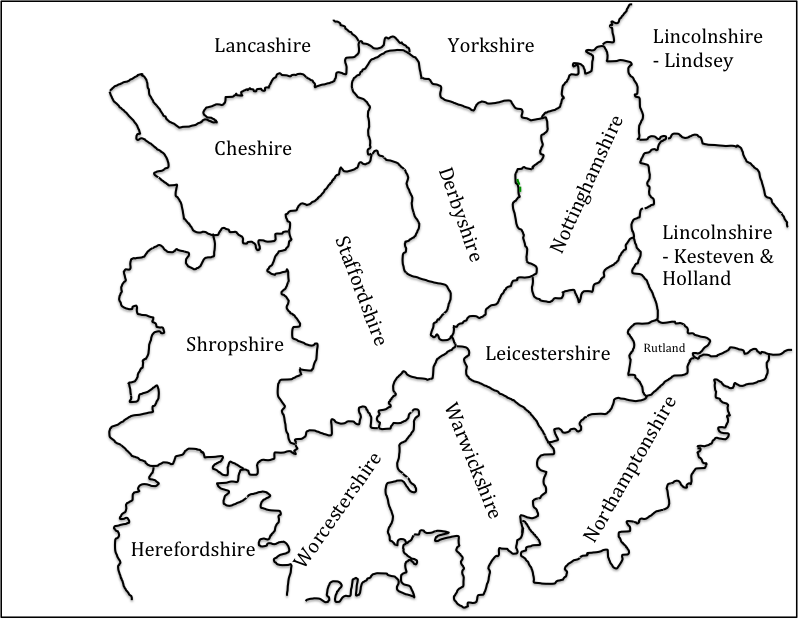
In what follows, an essentially geographical analysis will be presented in an attempt to locate the original Mercia, based on the drawing of boundaries of different types – kingdom boundaries, diocesan boundaries and county boundaries. Most of these are not contemporary with the period under consideration, and there is an implicit assumption that these boundaries reflect underlying and ancient boundaries from late antiquity. Whilst others have followed this route it is a somewhat dangerous course and open (quite rightly) to significant criticism. Also of course the concept of a boundary between peoples may or may not have been of relevance in the period under consideration and this needs to be borne in mind in what follows. These points having been made, we will in what follows use two scales of maps that both show, as the basis for relating to current geography, the pre-1974 county boundaries (see figure 1 for the larger scale of map that will be used). These counties were first defined in the 10thcentury, and remained relatively stable up to the 1974 re-organisation, although there have been continual minor modifications to boundaries over the centuries. In the area shown in figure 1, this has particularly affected the boundaries of Worcestershire, which became fragmented as a result of transfers of property from secular to ecclesiastical ownership and vice versa, with detached areas in the surrounding counties. These areas are not shown in figure 1 for clarity.  There is one region however where the pre-1974 boundaries are not shown – the county boundary between the south west of Staffordshire and Shropshire – where there was an early (12thcentury) loss of land from Staffordshire to Shropshire due to the actions of Earl Roger to consolidate all his holdings into Shropshire (Thorn et al, 1986). As this region is particularly pertinent to the discussion that will follow, the Domesday boundaries for this region will be shown in all the maps that follow. 

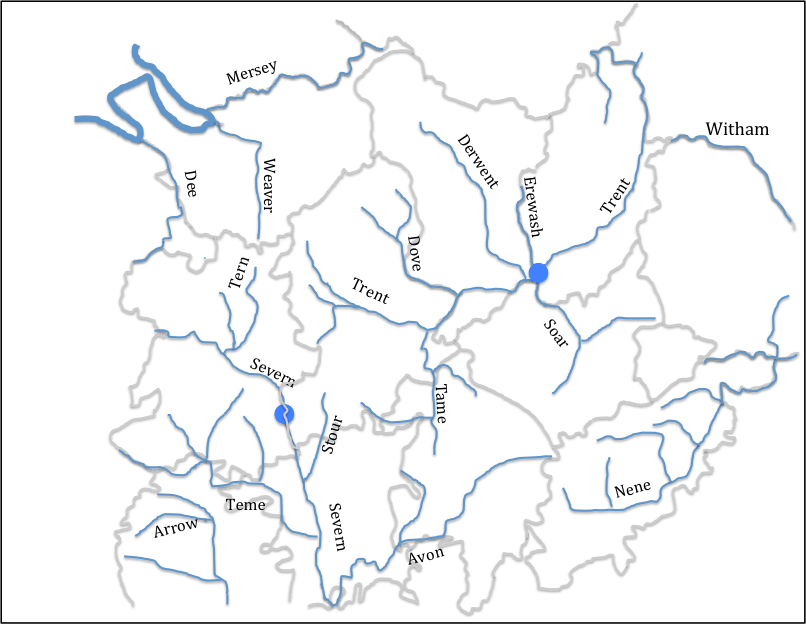
Figure 2 uses this map to illustrate the river systems in the English Midlands – and in particular the Trent, Severn, Wash and Cheshire basins. It is clear that the county boundaries in general follow river basin boundaries. In the area of interest here, this is particularly the case for the Staffordshire / Cheshire, Shropshire / Cheshire and Staffordshire/ Shropshire boundaries. The southern Severn / Trent basin boundary is also coincident with county boundaries, except in the case of Warwickshire which sits across the watershed between them.  

Figure 1. The base map, showing pre-1974 county boundaries and names 

Figure 2 Rivers and county boundaries 

(Only major rivers and tributaries are shown. The blue filled circles indicate riverine locations of importance to the argument that follows below.)

The Tribal Hidage

The Tribal Hidage exists today in a number of different manuscripts, which are set out and compared by Dumville (1989).  It essentially consists of two lists of kingdoms / polities of various sizes, with hidages attached to each entity. The date of the original document is disputed, with dates from the 620s to the 780s suggested (Corbett, 1900; Hart, 971; Higham 1995). I find the approach taken by Higham (1995), who proposes date in the 620s, the most persuasive, although this does not appear to be the universal view of historians. He suggests that it is in origin a tribute list of Edwin of Deira, dating from 624/5. The primary list is effectively a list of tributes payable to him from what Higham terms the Midlands “Overkingship”, whilst the secondary list was added perhaps a year later to indicate the tribute from the Southern “Overkingship”. The level of hidage seems to be standardized to 7000 for county sized entities, and to multiples of 300 for smaller entities particularly in the region know as Middle Anglia around the Wash and the East Midlands. For the Southern Overkingship entries in the secondary list, there is clearly a punitive element, particularly with the 100,000 hides allocated to Wessex.  

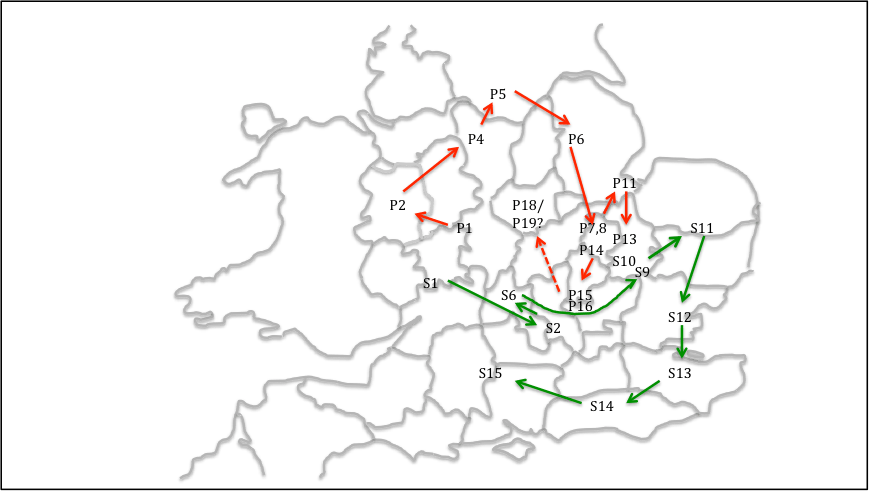
For the current purposes it is the order of the entries that is of most interest. The kingdoms on which most authors can agree are shown in figure 3 for both the primary (P) and secondary  (S) lists.  Original Mercia (P1 on the figure) is placed at the historic centre of the kingdom in south Staffordshire around Lichfield and Tamworth. A number of points arise from this figure.

  • There is a well-described clockwise progression in the primary list (and a subsidiary clockwise progression in the Fenland entities – based on the recent wok of Osthuizen (2017) and similarly in the secondary list. The latter list is indeed almost a closed loop. This is so marked, it seems to have been a specific intention on the part of the original compiler of the list. 
  • The list includes Elmet, which was incorporated into the Deiran kingdom by Edwin (i.e. before 633) and Lindsey and Hatfield, which were never associated as a dual entity after the reign of Edwin. This argues for an early date for the Hidage (Higham, 1995).
  • The list does not include the Magonsaete in the south Shropshire / Herefordshire region, which was certainly in existence by 680 when it was ruled by Merewalh (note the British name), who is described by some as a son of Penda of Mercia. Again this argues for an early date (Pretty, 1989).
  • The area of Leicestershire and Northamptonshire, which the diocesan boundaries suggest is in Middle Anglia (see below) are not allocated any of the agreed kingdoms on the Tribal Hidage map. This suggests to me that the Noxgaga (P18) and Ohtgaga (P19) at the end of the primary list, both county sized entities, should be located in this area, rather than in the Middlesex / Surrey area suggested by some authors (Hart, 1977). This identification would make the primary list an almost closed loop. 
  • This identification identifies the area around which the primary list loops to be in the Nottinghamshire area. This will be seen to be of relevance in what follows. 

Figure 3. Tribal Hidage. “Firm” locations of regions in the primary and secondary lists 

(P1- Myrcna lands; P2 – Wocensætna; P4- Pecsætna: P5 – Elmedsætna: P6 – Lindesfarona mid Hæþfeldlande: P7 – Suþgyrwa: P8 – Norþgyrwa: P11 – Spalda; P13 – Herefinna : P14 – Sweordora P15 – Gifla : P16- Hicca: P18- Noxgaga: P19 – Ohtgaga; S1 – Hwinca; S2 – Cilternsætna; S6 – Færpinga; S9 – Eastwilla; S10 – Westwilla; S11 – Eastengle; S12 – Eastsexena; S13 – Cantwarena; S14 – Suþsexena; S15 – Westsexena)

Kingdom and Diocesan boundaries

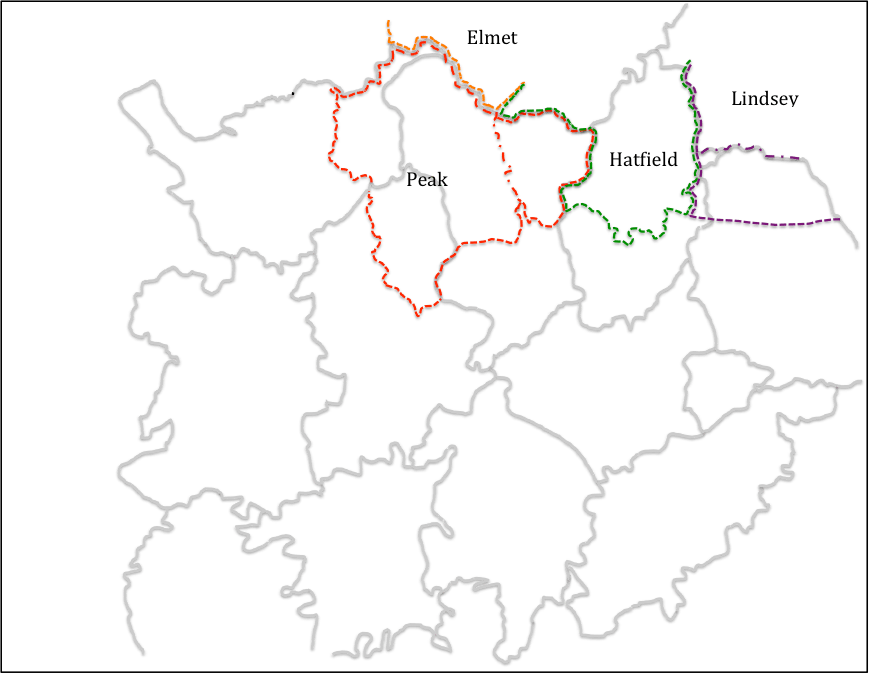
The work of local historians in various parts of England, who have carried out detailed work on boundaries of sub-Roman, early Anglo-Saxon polities that enables the boundaries of these polities to be drawn in more detail than the Tribal Hidage allows, even though these are to some extent speculative. Here we consider the work of Higham for the Pecsaetna in the Peak (Higham, 1993), Breeze for Elmet in South Yorkshire (Breeze, 2002), Parker for Hatfield in South Yorkshire / North Nottinghamshire (Parker, 1992) and Bassett for the kingdom of Lindsay (Bassett, 1989), All of these authors would, I am sure, have significant caveats for their work, but taken together they form a useful set of data. The boundaries they identify are again shown on figure 4. Higham suggests that the area of the Pecsaete consist of the Cheshire Domesday hundred of Hamestan, the Derbyshire hundred of the same name, plus the Staffordshire hundred of Totmonslow. The area of Hadfield identified by Parker includes not only the area of south Yorkshire that is usually so identified, but also north Nottinghamshire. The boundaries of the Pecsaete and Hatfield are, on this basis separated by a thin strip of Derbyshire (essentially Scarsdale Hundred), and it seems likely that the territory of one or the other of them extended to fill the gap between them. We choose here to extend the region of the Pecsaete into this area, as it will be seen below that a significant diocesan boundary separates Derbyshire from Nottinghamshire.  Elsewhere the region of Elmet identified by Breeze can be seen to border on the Pecsaete, and the area of Lindsey is, following Bassett, taken to include not only the pre-1974 Parts of Lindsey to the north of the River Witham, but also a similar sized area to the south.

Figure 4 Kingdom boundaries in the north Midlands

(red dotted line shows the region of the Pecsaetna assumed in what follows – the red chain dotted line ins the boundary identified by Higham; the green dotted line shows the region of Hatfield; the brown dotted line shows the region of Elmet; the purple dotted line shows the region of Lindsey – with the chain dotted line showing the southern boundary of the Parts of Lindsey)

Now let us move to the consideration of the boundaries of church dioceses, particularly in the English Midlands. Some historians have expressed doubt about how the known medieval boundaries can be extrapolated back to the seventh century, the period under consideration here. This is particularly true of those areas which fell within the Danelaw where a number of dioceses ceased to operate. Nonetheless, they are used here for two reasons – firstly the 10th century Midland county boundaries follow these diocesan boundaries in many places and this suggests that the latter predated the former, and secondly, in many parts of the Midlands, there seems to be no record of any historical events that could have led to boundary changes. This is indeed the approach followed by Hart (1977) in his consideration of the Tribal Hidage, although he did not follow this approach to its logical conclusion. 

The Mercian diocese came into existence in 655, and in its early days it covered a large region across the English Midlands. The situation changed with the reorganization of Theodore of Tarsus (Archbishop of Canterbury 669-690), who created dioceses based on “kingdoms” – a Lichfield diocese reduced in size for Mercia, Hereford Diocese for the Magonsaete (676), Lincoln diocese for the kingdom of Lindsey (678), Worcester diocese for the Hwicce (680) and Leicester diocese for the Middle Angles (681) (Podmore, 2008). These dioceses, as they existed in the late Anglo-Saxon era, are shown in figure 5, together with the relevant county boundaries (Ordnance Survey, ??).

From this figure it can be seen that the Mercian diocese covers much of west Warwickshire, Staffordshire, part of Shropshire, Derbyshire and the “land between the Mersey and the Ribble”.  Clearly as such it encompasses the areas listed in the Tribal Hidage as Wocensætna and Pecsaetna, as well as whatever polities existed north of the Mersey, which must thus have been incorporated into Mercia sometime between the compilation of the Tribal Hidage (in 625 if Higham’s argument is accepted) and the re-organisation of dioceses in the 670s.

Equally significant are those areas that are not part of the Mercian diocese. Firstly Nottinghamshire has been, from at least 956 when the church was re-established following the Danish conquests, part of the York diocese (Stenton, 1968). At this time the area based on the minster church of Southwell, which was granted to Oskytel, Archbishop of York by King Eadwig.  It seems likely to methat this was simply are-establishment of the pre-conquest status quo. There is a local tradition that the area was first evangelised in the early seventh century by Paulinus operating from York.  Thus, in ecclesiastical terms, Nottinghamshire looks to the north and the Humber, rather than to the Midlands and the diocese of Lichfield. Secondly, the counties of Leicester and Northamptonshire are in the Leicester (i.e. Middle Anglian) diocese. Hart, in his definition of the geography of Mercia, arbitrary labels this area as “outer Mercia” (Hart, 1977), an entity which has no historical context at all. The fact that it is regarded as being in Middle Anglia is consistent with the argument set out above that the Noxgaga and Ohtgaga should be located in this area. 

Figure 5 Diocesan and county boundaries.  

Locating the original Mercia 

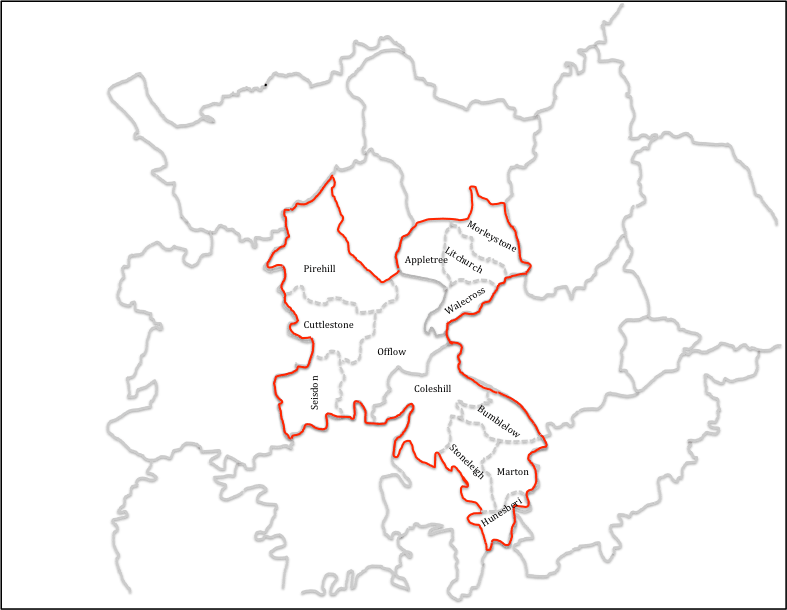
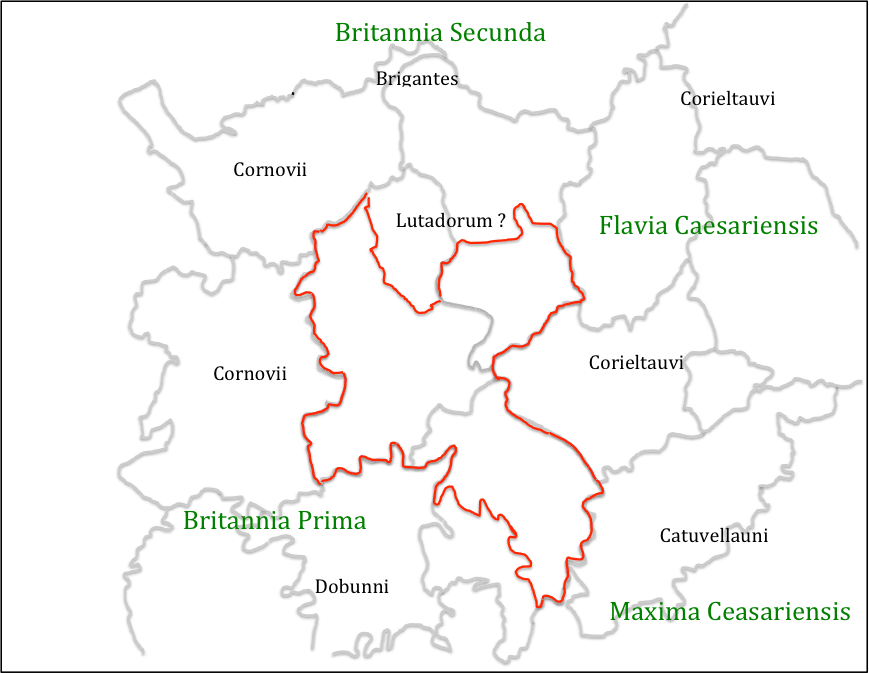
An attempt can now be made at locating the original lands of Mercia, about which the Tribal Hidage seems to revolve – see figure 6. The diocesan boundaries and boundaries of other kingdoms would suggest that this region included west Warwickshire, south Staffordshire and south and east Derbyshire. The main unknowns are the location of the northern and western boundaries. With regard to the northern boundary, this has been chosen to exclude the long neck of land between the regions of the Pecsaete and Hatfield, as identified by Higham and Parker, as this seems the more logical geographical boundary. The boundary shown in figure 6 thus forms the southern boundary of the Domesday Scarsdale Hundred.   With regard to the western boundary, the logical place for this would be on the watershed between the Trent and Severn basins. This is followed by the western border of Staffordshire, except for Seisdon hundred in the south, where part of the catchment of the Stour, a tributary of the Severn, is included within Staffordshire and the Domesday county boundary was the River Severn itself. The boundary of the original Mercia is drawn to follow the Staffordshire boundary even in this region for reasons that will become apparent below. The original Mercia thus consists of the Staffordshire Domesday hundreds of Seisdon, Cuttlestone, Pirehill and Offlow (the latter containing Lichfield), the Derbyshire hundreds of Walecross, Appletree, Litchurch and Morleystone and the Warickshire hundreds of Coleshill, Bumblelow, Stoneleigh, Marton and Hunesberi. Many authors have pointed out that this region lacks natural boundaries or defensive positions of any sort, and this will be considered below. But at this point the reason for the name of the kingdom – the borderlands – becomes obvious if this area is considered in terms of the Roman Civitas, the broad areas of which are also shown on figure 7 (it is not being possible to draw these with any precision) together with an indication of the Provincial areas following the reorganization of Diocletian (Jones and Mattingley. 1993). There is coming to be agreement that throughout the fifth and sixth centuries there was some continuity in Civitas level government, at least in the west of England, either through Governors or through kings (Dark, 2000). On the presumption that something similar to these Civitas continued to exist in some form into the late 6thcentury, it can be seen that the original Mercia sat across the borders of a number of them – the Dobunni in Worcestershire and Gloucestershire, who seem to have morphed into the Hwicce; the Cornovii in Shropshire / Chester, who became the Wocensætna, the Corieltauvi in Warwickshire / Leicestershire / Lincolnshire; the Catuvellauni in Northamptonshire / Bedforshire / Buckinghamshire, and, if it actually existed, Lutadorum in the Peak District, who can perhaps be identified with the territory of the  Pecsaete. It would seem that Mercia took land from all of these and straddled the borders of each, and in doing so straddled the borders of at least three of the four late Roman provinces. 

Figure 6. The original Mercia mapped.

Figure 7. The original Mercia and Civitas and Provincial regions

(Civitas names in black, Provincial names in green)

The point has often been made that the original Mercia, whatever its precise location, lacked natural boundaries. However this is probably a misconception. Figure 8 shows the original Mercia as identified above, together with the established Roman road network, which was usable well into Medieval times, and also some conjectural, but likely roman roads. This changes the picture of Mercia significantly. It can be seen that the centre of the kingdom at Lichfield / Wall sits on a major junction of roads, from where small bands suitably mounted and armed could reach all parts of the kingdom very quickly and could establish control over a wide area.  Also at the borders there were at least the locations of Roman towns which could have acted as regional centres – Water Eaton to the west, Greensforge to the south west, Metchley to the south, High Cross to the south east and Derby to the north. Perhaps most importantly this network would also allow control of trade across the whole region – and thus control of major trading routes across England – Watling Street between High Cross and Water Eaton; Ryknield Streets between Derby and Metchley, as well as the northern saltways from Droitwich. To this road network, can be added strategic riverine locations at Sawley – the junction of the Trent, Erewash and Soar, and on the Severn at Quatford, which could thus control major river traffic flows. The latter is the major reason for suggesting that Seisdon hundred in Staffordshire was part of the orginal Mercia, as it gave control over the saltway at Greensforge and the roads to the borders and mid Wales, as well as access to the Severn at Quatford. This interpretation thus sees the original Mercia as very much a commercial enterprise as well as one in kingdom building.

Figure 8 – Communications networks

(blue indicates probably and possible Roman Roads; red indicates locations within the Original Mercia; green indicates major locations outside this area. Blue circles indicates the riverine crossings at Quatford (in the west) and Sawley (in the east)

Finally the question arises as to whether or not there is a historical context into which the above scenario could fit. Here there is little alternative but to use the evidence of the various chronicles and early histories, and which are open to serious challenges as to their veracity and utility. With that proviso, they are used and viewed as broadly reliable in what follows.

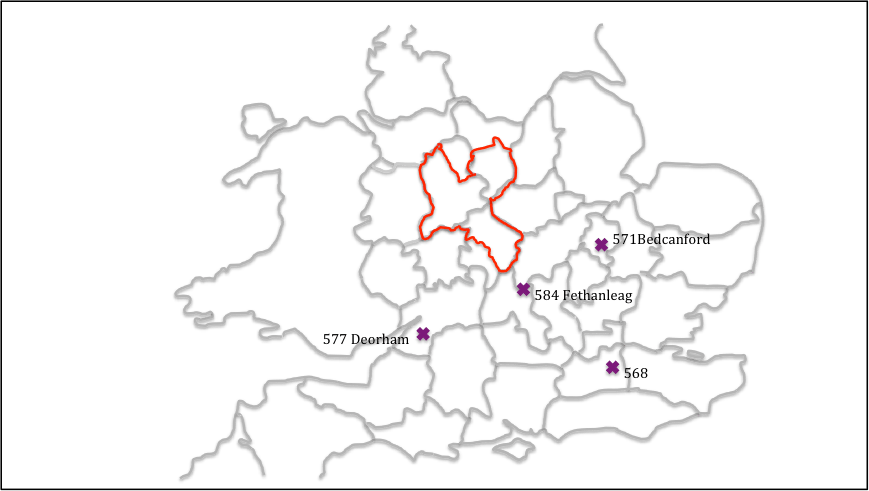
The third quartile of the sixth century was a time of expansion by the kingdom of Wessex, as illustrated in figure 9.  In 568 a Wessex force led by Ceawlin and Cutha, defeated Aethelberht of Kent, and pushed him back towards his homeland. In 571, in a northern advance, Cuthwulf defeated British force at Bedcanford (usually taken as Bedford) taking control of a number of towns in that region.  This was followed in 577 by the battle of Deorham, where three British kings were again defeated by Cuthwine and Ceawlin and three major towns taken – Bath, Glouccester and the capital of the Province of Britannia Prima, Circencester.  Then for 584, for  Anglo-Saxon chronicle reads

Ceawlin and Cutha fought with Britains at the place called Fethanleag and Cutha was killed, and Ceawlin took many townships and countless spoil and returned in anger to his own. 

Here Cutha is a king in Wessex, and Fethanleag has been identified as Stoke Lyne near Bicester in north Oxfordshire – a few miles south of the southern border of Mercia shown in figure 6.  Davies (1977) relates this to an entry for the next year in the Henry of Huntingdon’s Historia Anglorum which states 

585 Beginning of the kingdom of Mercia, with Crida

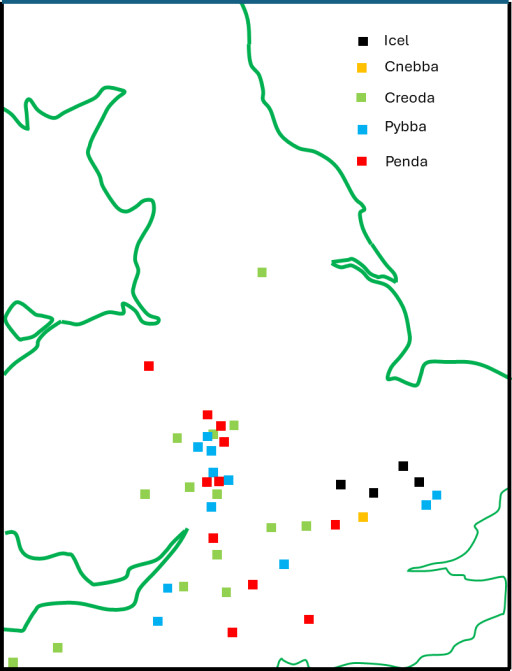
If one can make that equation, this suggest that Cutha met his match in an essentially British force that stopped the northern expansion of Wessex, and that this force was led by Crida who then went on to establish the kingdom of Mercia as outlined above, and a dynasty in the form of Crida, Pybba and Penda. Note the partially British name of the latter, which strongly suggests a kingdom of mixed ethnicity.  The dynasty was known as the Iclingas after the (perhaps mythical) ancestor Icel, and the Anglo Saxon Chronicle gives the names of his descendants before Crida as Cynewald and Cnebba. As noted by Myers there are a number of place names that reflect the name Icel across Suffolk, Cambridgeshire and Hertfordshire, and there is a concentration of names based on Pybba (Pedmore) and Penda (Pendford, Pinvin) in the Worcestershire / south Staffordshire area, suggesting the popularity of these names around there.

The nature of the original Mercia is however still elusive. It may be that Crida’s family of the 580s, simply took the region centred on Wall and held it by force of arms against the neighbouring polities. Dark would suggest that these polities were the remains of the sub-Roman Civitas system, which to the east were clearly (from the evidence of the small polities of the Tribal Hidage in the East Midlands) in the process of dissolution due to internal pressures, and perhaps also the pressure of migrating Saxons from the area around the Wash and the Humber; whilst in the west bureaucratic Civitas governments of the Dobunni and Cornovvii may well have been in their final sharp decline. This suggest the possibility (and it can be rated no higher than that) that the family and their followers were effectively foederatiemployed by these bureaucratic governments to resist the growing pressure of Wessex from the south and the chaos enveloping their eastern borders. If so, then their eventual subjugation by an expanding Mercia might suggest that this was ultimately not a good move. 

In the early seventh century, there does seem to have been a break in the succession, and Bede tells us of another Mercian king – Cearl – who took the refugee and later Deiran King, Edwin, under his protection in around 605. Higham argues that he was the Midlands Overking at the time, able to resists the demands of Aethelfrith in Northumbria for the return of Edwin (Higham, 1995). The fact that Edwin was able to reach Cearl easily, and after Cearl’s death find refuge with Raedwald in East Anglia, strongly suggests that Ceorl’s activity was in the north midlands – perhaps in the south of Nottinghamshire which has been identified as an anomaly in diocesan terms. In this scenario, Cearl would have been of northern Anglian stock, but Bede would have referred to him as king of Mercia, because the region in which his power was centred was Mercian in Bede’s day. Taking this further one can perhaps see the primary list of the Tribal Hidage as a tribute list of Cearl, in which the punative 30,000 hides of the original Mercia reflected a recent takeover from the Icinglas dynasty that was not to prove permanent.  It can also be speculated that Ceorl’s territory was that of the North Mercians mentioned by Bede, with the original Mercia being South Mercia. In taking over Ceorl’s territory, Penda would thus become the first king to “separate the Mercians from the Northumbrians” as also noted by Bede. But here we are in the realms of speculation, and his must be only one of many possibilities of the situation on the ground in the early seventh century.

Figure 9 Anglo Saxon Chronicle battles of the mid / late sixth century

References

Bassett S (1989) “Lincoln and the Anglo-Saxon see of Lindsey”, Anglo-Saxon England, 18, 1-32

Breeze A (2002) “The Kingdom and Name of Elmet”, Northern History, 39, 2, 157-171

Brownbill J (1925) “The Tribal Hidage”, The English Historical Review, 40, 160, 497-503, Oxford University Press

Corbett W (1900) “The Tribal Hidage”, Transactions of the Royal Historical Society, New Series, 14, 187-230

Dark K (2000) “Britain and the End of the Roman Empire”, Tempus

Davies W (1977) “Annals and the origin of Mercia” in “Mercian Studies” edited by Ann Dornier, Leicester University Press

Davies W, Vierck H (2010) “The Contexts of Tribal Hidage; social aggregates and settlement patterns”, Frühmittelalterliche Studien

Dumville D (1989) “The Tribal Hidage: an introduction to its texts and their history”, in: Bassett, S (ed.), The origins of Anglo-Saxon kingdoms, Studies in the Early History of Britain, Leicester: Leicester University Press, 225–230, 286–287.

Hart C (1971) “The Tribal Hidage”,  Transactions of the Royal Historical Society, Fifth Series, 21 (1971), 133-157

Hart C (1977) “The kingdom of Mercia” in Mercian Studies, edited by Ann Dornier, Leicester University Press, 43-62  

Higham N (1993) “The origins of Cheshire”, Manchester University Press

Higham N (1995) “An English Empire – Bede and the early Anglo Saxon kings”, Manchester University Press.

Jones B, Mattingly D (1993) “An Atlas of Roman Britain”, Blackwell

Ordnace Survey (???)  “Monastic Britain”, South sheet, 2nd edition

Oosthuizen S (2017) “The Anglo-Saxon Fenland”, Windgather Press

Leslie S and 18 other authors (2015) “The fine-scale genetic structure of the British population”, Nature 519, 309-314

Parker M (1992) “The Province of Hatfield”, Northern History, 28, 1, 42-69, 

Podmore C (2008) “Dioceses and Episcopal Sees in England – A Background Report for the Dioceses Commission”, DC/R3

Pretty K (1989) “Defining the Magonsate” in: Bassett, Steven (ed.), The origins of Anglo-Saxon kingdoms, Studies in the Early History of Britain, Leicester University Press, 171-183

Stenton F (1968) “Anglo Saxon England”, The Oxford History of England, 2nd edition, Oxford University Press.

Thorn F, Thorn C (editors), Parker C (translator) (1986) “Domesday Book – Shrops

Oakham roofs

Introduction

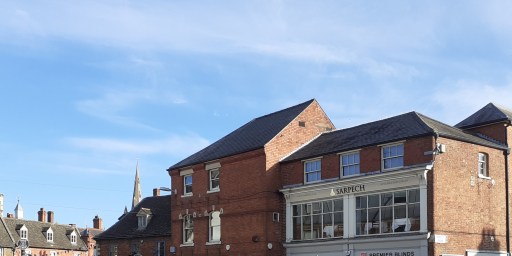
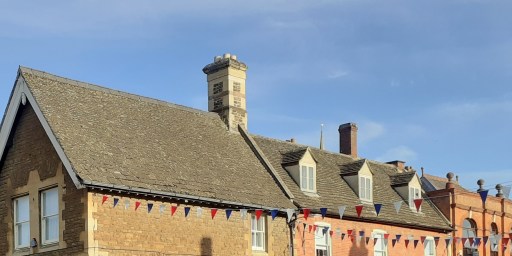
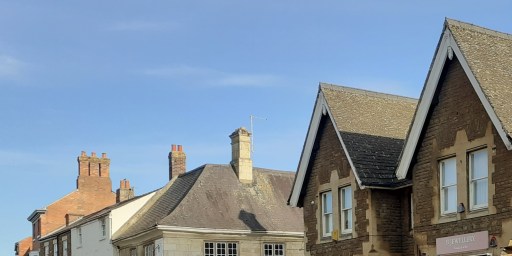
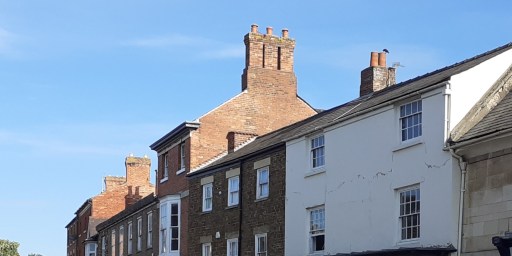
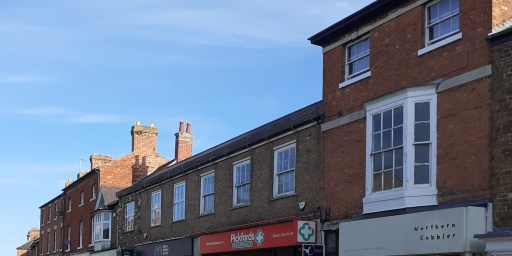
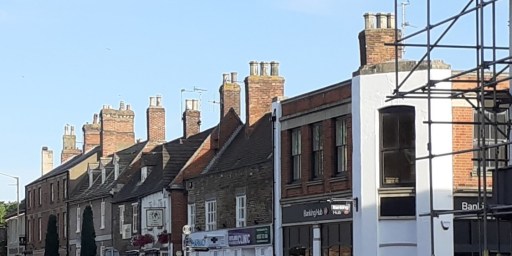
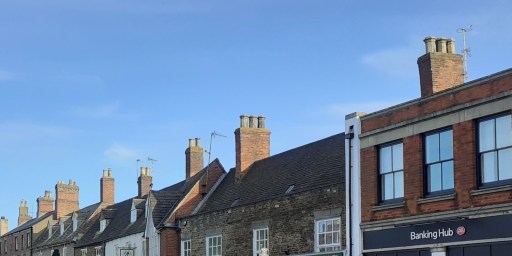
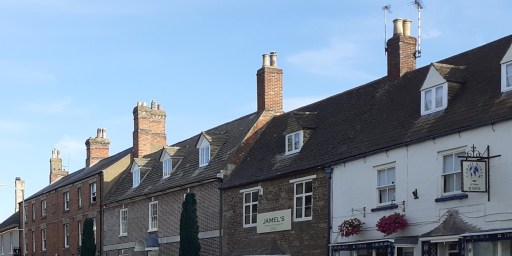
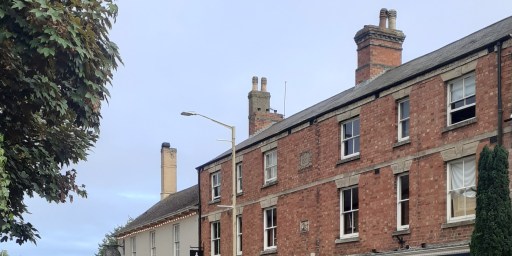
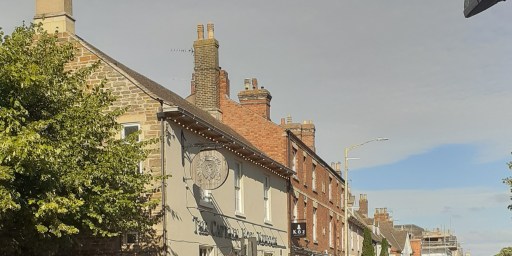
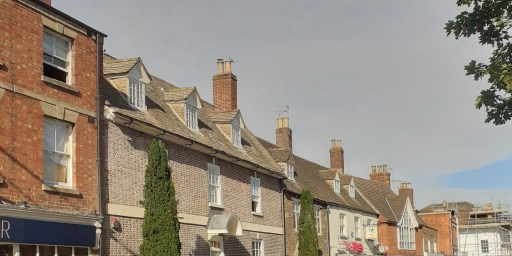
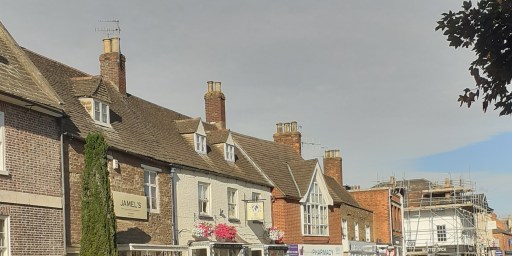
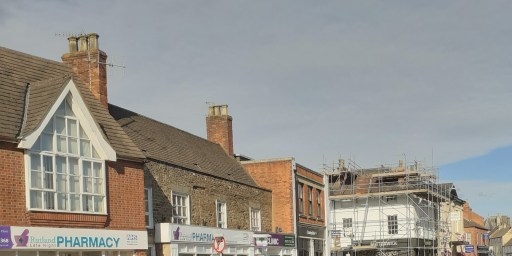
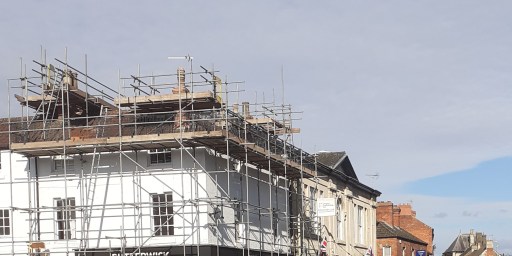
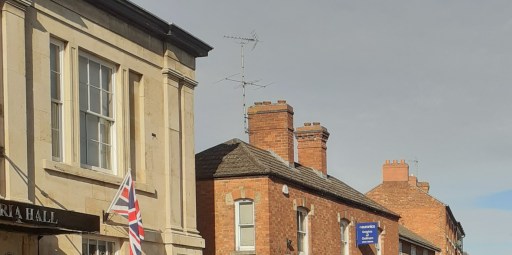
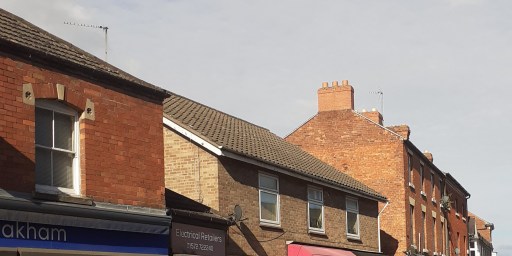
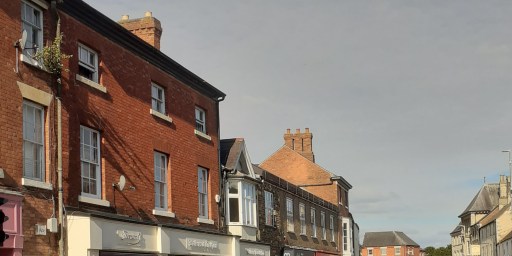
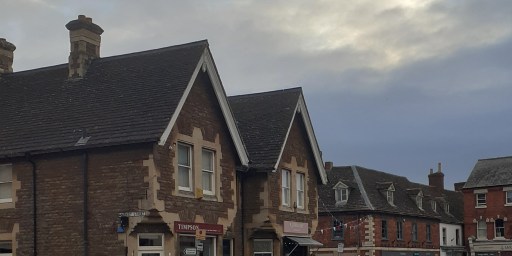
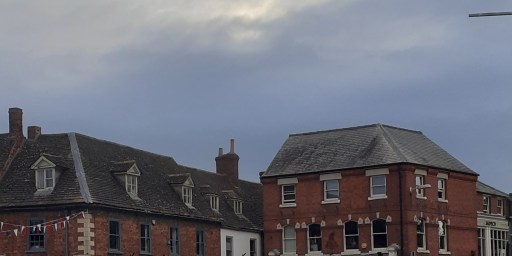
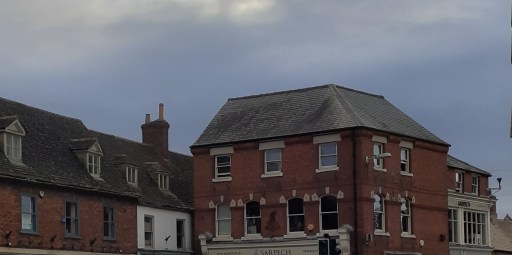
This post concerns roofs 1 – specifically those on the High Street of Oakham in Rutland. I find the upper floors of urban streets quite fascinating in their form and variety. When walking through towns however, one rarely looks upwards – indeed most of the time you would risk colliding with other pedestrians or walking into the road if you did. It is the shop fronts and their contents on the lower floors that command attention of course. But above them, the buildings themselves are sometimes stylish, sometimes idiosyncratic, sometimes merely odd – and usually worth a look. In what follows I show two galleries of photographs, both looking at the upper floors of buildings on the north side of Oakham High Street, taken from the pavement on the south side. The first gallery is a series of photographs from east to west (the junction with Burley Street and the Market area to the Wetherspoons pub), and the second from west to east. I am not really in a position to comment on the buildings in architectural terms, so the photos are simply presented for the reader’s interest and enjoyment.

1 I am fairly sure that when I was at school I was told that this was spelt “rooves”, but Google informs me that this is an archaic word, no longer used in practice. I fear I am thus labelled as archaic, which is probably true.

From east to west

From west to east

All the photos were taken by me, but I am happy for them to be used by others, with a proper acknowledgement.

A walk around Oakham

The walk

This is a picture blog, that simply gives pictures of a walk around Oakham. This is not a walk that takes in the traditional historical highlights, although some of those are included, but is rather one in which I show the things that have caught my eye, mainly on my wonderings about the town with the dog. So it is a little idiosyncratic, but I hope will be of interest to some. Except where otherwise indicated, the pictures were all taken by me, and I am happy for them to be used by others, properly credited of course.

The map

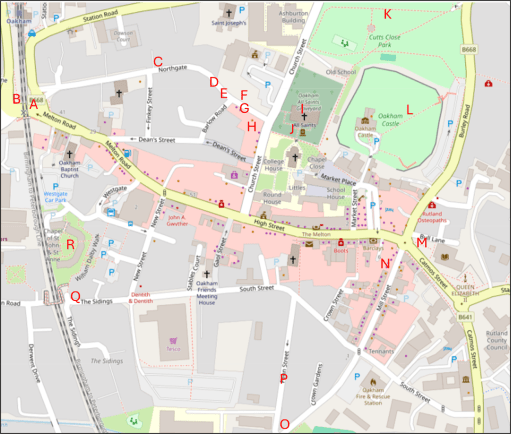
The map below shows the approximate locations from which the photographs (A to R) were taken, superimposed on an up to date map from Open Street Map.

The pictures

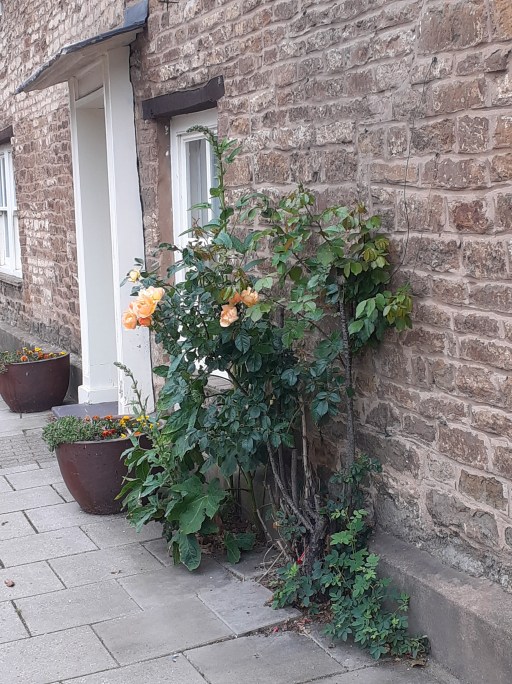
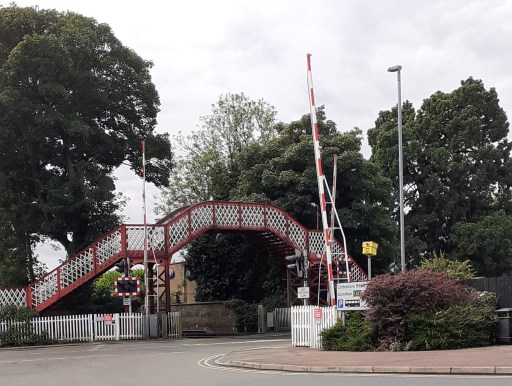
The first picture is of the listed Midland Railway bridge and level crossing (Picture A) a source of endless frustration to drivers, and, as the location of the meeting of five roads, a horribly hazardous place for pedestrians. There must be a better way of doing traffic management here. Picture B is the Midland Railway Signal Box, which was the inspiration for the Hornby Railway model. Turning along Northgate, there are three pictures of rose bushes (Pictures C to E), some cultivated, some not. but in early summer their cumulative effect is striking. Picture F is of a house a little further along Northgate, with a wonderful display of creepers and climbing foliage.

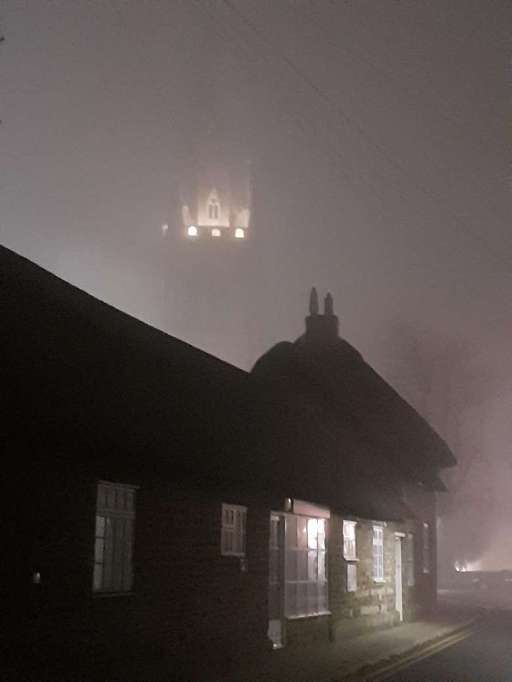
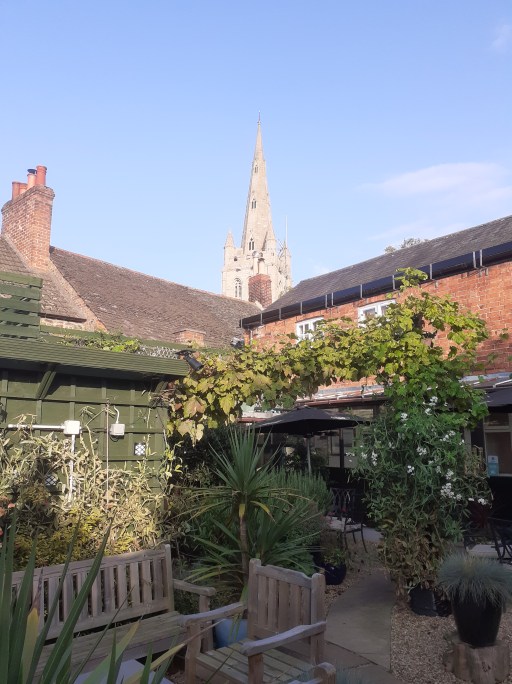
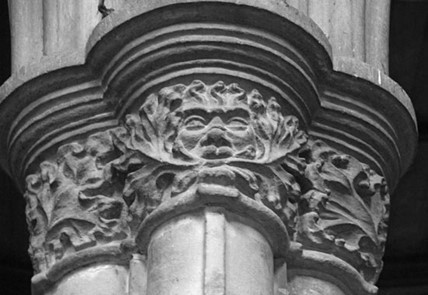
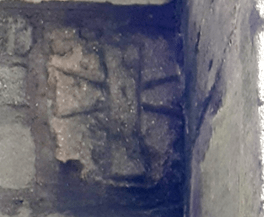
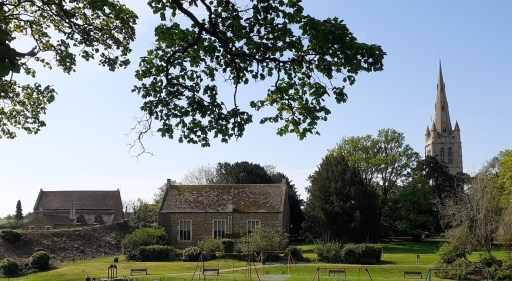
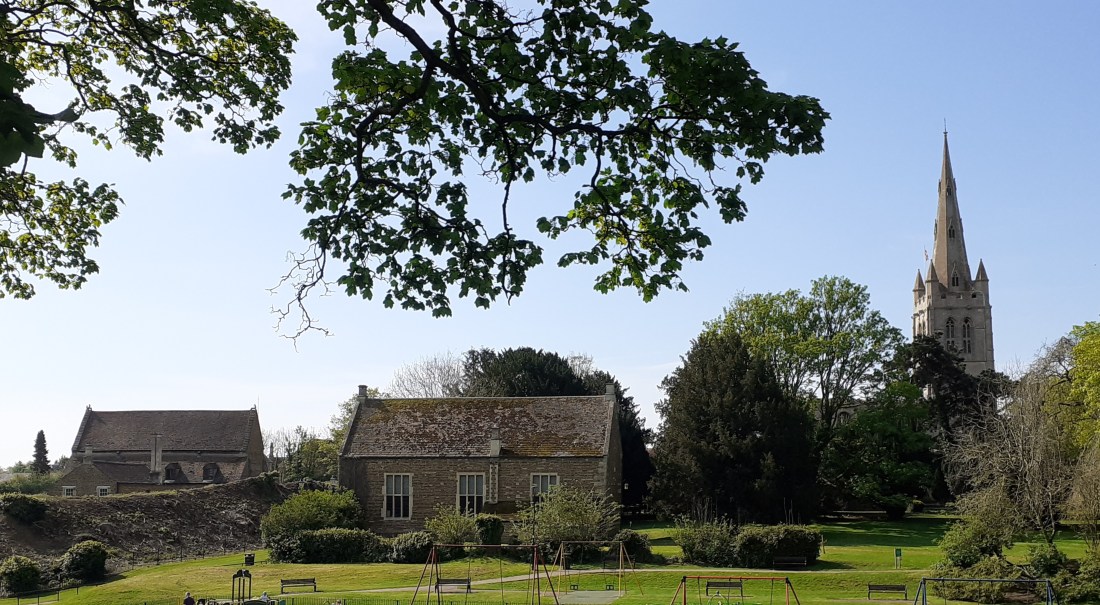
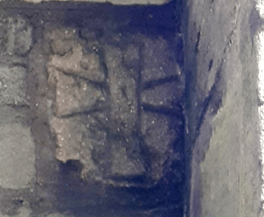
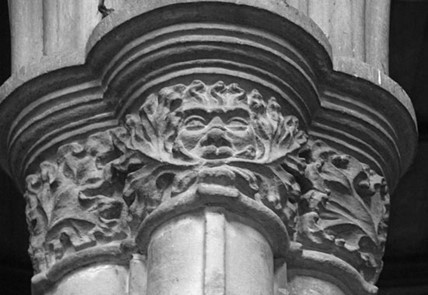
The next six photos all figure All Saints Church in one way or another. Picture G is a photo taken from Northgate on a misty evening where all that can be seen of the tower is a small floodlight area. The thatched cottages on Northgate can be seen in the foreground. Picture H shows the spire of the church from the garden of the Wheatsheaf pub opposite on a pleasant summer afternoon. Picture I (from here) shows the Green Man stone capital within the church – one of a series of wonderful capital carvings I have blogged about elsewhere. Picture J shows a possible Anglo-Saxon Saxon cross built into the south porch of the church. The identification is very speculative, but the cross is very similar to other, demonstratively, Anglo-Saxon examples. Pictures K and L shows t wo views of the Castle Great Hall, Old School and Church, from Cutts Close and the Castle grounds. I have argued elsewhere that these might be an indication of an early church group in the area. Click on the pictures to see the full extent of the photographs.

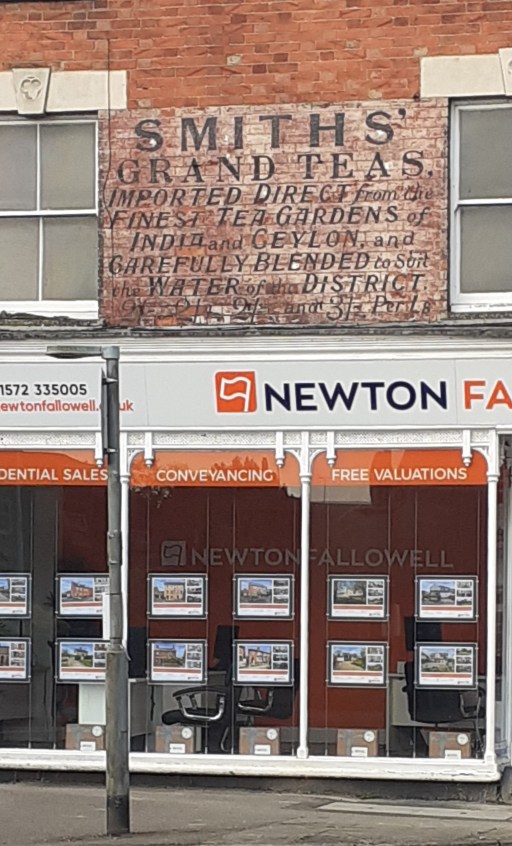
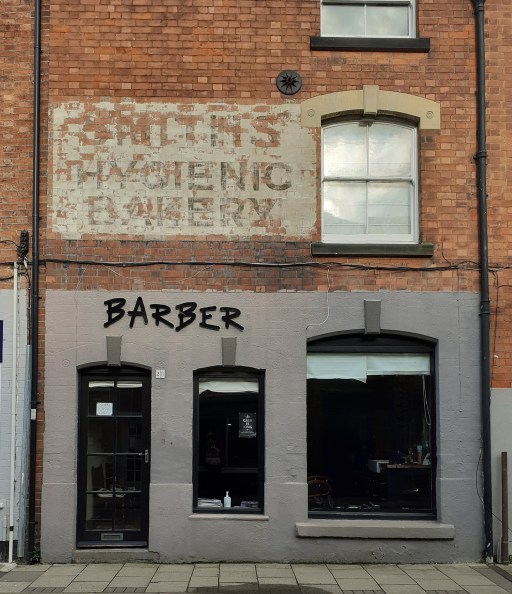
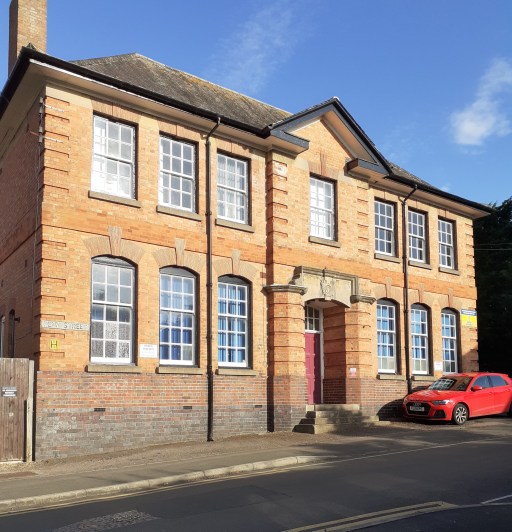
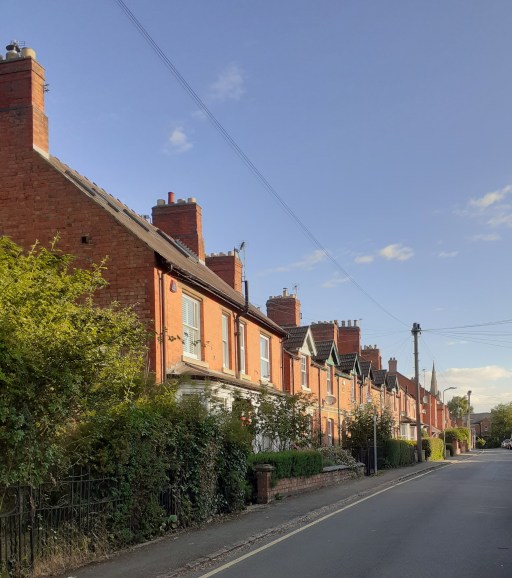
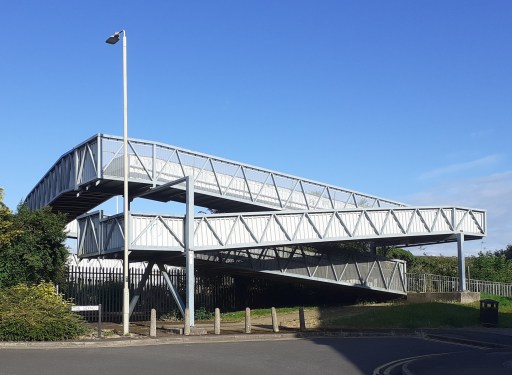
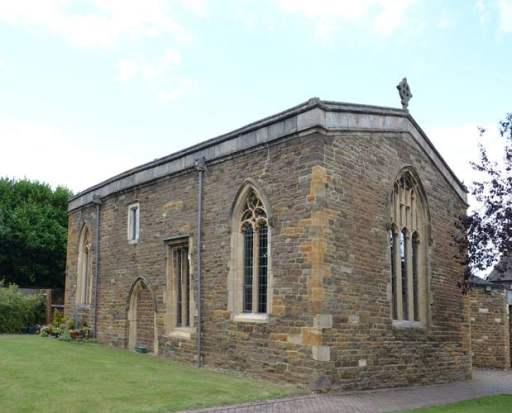
Pictures M and N show two nice examples of ghost signs from Catmose Street and Mill Street – faded, painted signs indicating a former usages. Picture O shows the Old Drill Hall on Penn Street which is impressive despite looking as if it could do with a bit of TLC. Picture P, also on Penn Street shows row of houses with a pleasing skyline. South Street Railway Bridge (Picture Q) is hardly beautiful, but very functional ,offering a way over the railway for pedestrians old and young, cyclists, mobility scooters, prams, shopping trolleys etc. For obvious reasons it is know in my household as the “slow bridge”. Finally Picture R (from here) shows the chapel of St John and St Anne – a medieval foundation serving the sheltered housing around it. It is the only place I know where the minister presiding at communion can watch, through the west window, the tops of passenger and freight trains passing within a few yards of the outer wall.#

Further posts on aspects of Oakham can be found using the button below.

A possible Anglo-Saxon church group at Oakham in Rutland

Amended on 8th May 2024 to include further details of Our Lady’s Well.

In her book describing the architecture and liturgy of the Anglo-Saxon church in England (1), Gittos describes, in some detail, the existence of what she calls “church groups”. By this she means the practice of constructing a number of churches close to each other in some sort of relationship, which can be demonstrated archaeologically at a number of sites around England, primarily from the early Anglo-Saxon period. These usually take the form of two or more churches aligned on one axis (usually approximately east / west), sometimes with other churches on a parallel axis a few hundred metres away. The alignments can also include crosses or other monuments. Typical examples can be found at St. Augustine’s Abbey in Canterbury, with the linear group of St Peter and St Paul, St Mary and St Pancras and the non-linear groups at Hexham and Ripon. These are of course from a monastic context. Gittos hypothesizes that these churches were used for different aspects of the liturgy, with processions between them. A similar linear arrangement can be shown to have existed at the secular Yeavering site.

Figure 1. All Saints Oakham (from the south)

Readers of my blogs will know that I recently moved to Oakham in Rutland and have become a member of the parish church of All Saints (Figure 1). In looking at the layout of the church and its environs, it seems to me that there are some topographical hints (and I would put it no stronger than that), that this was the site of an Anglo-Saxon church group. The oldest part of the current church, the south porch, visible at the left of the photograph of figure 1, dates from around 1190, but the church almost certainly stands on the site of an Anglo-Saxon predecessor (2).  In the wall of the south porch, there is what was thought to be a consecration cross, but it is visually very similar to the one shown in Gittos (p 239) from Earls Barton in Northamptonshire, that is demonstrably Anglo-Saxon (Figure 2). If the Oakham cross is Anglo-Saxon, it was presumably taken from the Anglo-Saxon church in the rebuilding of the late 12th century.

Figure 2. The crosses at Earls Barton (left) and All Saints Oakham (right)

All Saints now consists of a nave, transepts and chancel, with side chapels to either side of the chancel – dedicated to the Holy Trinity to the north, and to the Virgin Mary to the south. The original Norman church just consisted of the nave with the current transepts, the latter acting as side chapels (the communion niches, which would have been next to the altars, can still be seen). The earlier Anglo-Saxon church was probably of similar shape and dimensions.

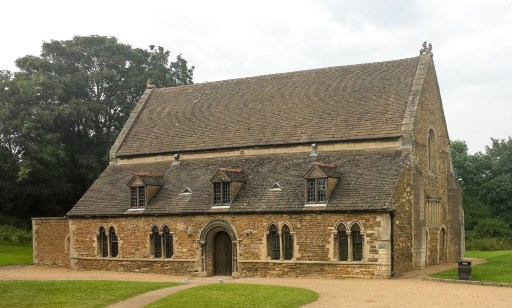
The first hint that the church might once have been part of a group arises from the fact that it lies within a substantial enclosure that now contains the Hall, inner bailey and outer bailey of Oakham Castle, as well as the church and church yard. This can be seen in Figure 3.  The interesting fact is that the Great Hall of the Castle, regarded as possibly the best surviving example of Norman Domestic Architecture (Figure 4) lies fairly precisely on the same axis as the church, and eighteenth century maps show a postern gate in the wall on the alignment, offering access between the Great Hall and the church.. There seems to be no reason for these features, other than whatever was on the site before the hall was built was in some way associated with the church. Interestingly, early sources indicate that there was a chapel within the Great Hall (3) to which specific individuals held right of appointment, which suggests that it was more than simply a domestic chapel. One can thus conjecture that there was a church / chapel on this site before the castle was built in 1190.

Figure 3. The church and castle enclosure (from 1900 Ordnance Survey Map)

Figure 4. The Great Hall of the Castle from the south

The second indication that there was a church group comes from extending this alignment to the west. This takes it through the medieval site of Northgate, shown in Speed (4) as a large open area with a small drawing of a cross on a plinth (Figure 6). Whilst the cross is somewhat south of the strict alignment (although due west of All Saints), its presence is again suggestive. Note that alignment of the church and the castle shown on the map is not accurate and does not represent the situation on the ground. The area around Northgate was bisected by the building of the Midland Railway in the 1840s and, if the Speed map is accurate, the location of the cross was at the position of the current signal box. This is itself a grade II listed building and the prototype for model railway signal box construction kits (Figure 6). Whether or not this is enough to make up for the loss of the cross must be left for the reader to decide.

Figure 5. The Speed map of Oakham (the cross can be see on the left of the picture)

Figure 6. Oakham signal box at the site of the Northgate Cross

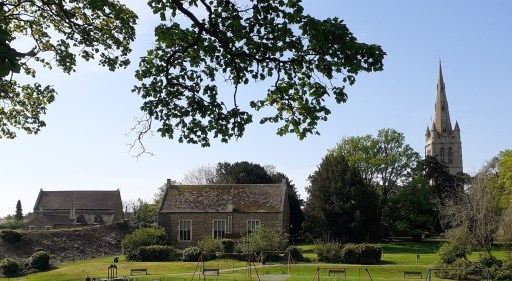
The third hint is the building to the north of the church, but on a roughly parallel axis that can also be seen in Figure 3. This is the original Oakham Grammar School, dating from just after the Reformation. It is built on the site of two former Guild chapels – one dedicated to St Mary, and one to St Michael the Archangel (3). The former included a toft, possibly the Guild Hall, and the latter at least was quite substantial, having dimensions of 60 feet by 30 feet. (3). Their topographical relationship to All Saints echoes that at Hexham and Ripon, referred to above. Perhaps here we have survivors of other ancient chapels that were part of the overall church group. Figure 7 shows a modern (i.e. May 2024) photograph of the castle (on the left), the old school (in the centre) and the church of All Saints (on the right) from the north side of Cutts Close Park (once the outer bailey of the castle). Visually they form quite a striking arrangement.

It also seems that there were another two pre-Reformation guilds at All Saints – one dedicated to All Saints itself, and presumably centred on the high altar, and one to the Holy Trinity, presumably centred on the chapel of that name within the church itself. How the Guild chapel of St Mary relates to the chapel with the same dedication in the church itself is not clear.

Figure 7. The castle, old school and church

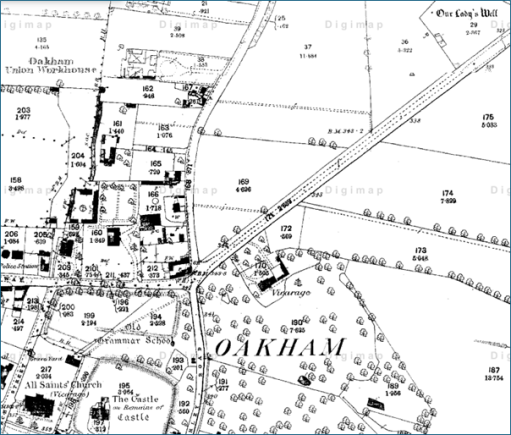
Reference (3) also indicates that there were pre-Reformation processions to a well dedicated to St Mary a “quarter of a mile to the north of the church”, and to an image of St. Michael, possibly within the chapel of that name – another of the characteristics of church groups identified by Gittos. The well still exists. It is shown on the 1880 and subsequent Ordnance Survey maps as “Our Lady’s Well”, actually almost half a mile north east of the church (Figure 8) with a straight path across Cutts Close and the Burley Road forming a direct and prominent link between the church and the well. It is not currently accessible being in an overgrown area managed for wildlife. Our Lady’s Well and All Saints church are on quite an accurate midwinter sunset / midsummer sunrise alignment. Whether or not this was intentional I will leave for others to judge. If it was then it suggests some sort of ritual activity at the site that predates the Anglo-Saxon era.

Figure 8. Our Lady’s Well and All Saints Church (from an 1880s OS map – the church is in the bottom left and the well in the top right).

At this point it is also worth noting that there is another surviving chapel in Oakham – that of the medieval Alms Houses of St. John and St Anne. This is however, not on the same alignment as the cross, church and castle and is some distance to the south west, and not likely to be part of any group. Neither is it in any sort of solar alignment with All Saints, being too far north to lie on the All Saints / Lady Well alignment. But the dedication is rather odd and perhaps hints at an earlier history.

So we can conjecture that we have here the surviving topography of a church group, with one church on the site of the current church in a linear alignment with one on the site of the Castle Great Hall and a cross at Northgate, and two on the Old School site where the guild chapels once stood. A church or chapel on the site of the current chancel of the church of All Saints is also a possibility. In making this suggestion we are of course making major assumptions that all the current buildings stand on the site of Anglo-Saxon originals, for which the evidence, such as it is, is very weak. There is also no evidence that there was ever monastic activity at Oakham, which seems to have been the context of many early church groups. So the suggestion that we have here the remains of a church group, attractive as it is, must only be regarded as very speculative.

References

  1. Gittos H (2015) Liturgy, Architecture, and Sacred Places in Anglo-Saxon England, Oxford University Press, 978-0198737056
  2. Aston N (2003) All Saints’ Oakham. A guide and history. Friends of All Saints, Multum in Parvo Press.
  3. Victoria county History (1935) A History of the County of Rutland: Volume 2, Oakham. From British History Online, https://www.british-history.ac.uk/vch/rutland/vol2/pp5-27#h3-s7
  4. Speed J (1611) Theatre of the Empire of Great Britaine. Modern version by Nigel Nicolson (1998) The counties of Medieval Britain. A Tudor atlas by John Speed. Pavilion Books Ltd.

Commemorating the 1000th Anniversary of the birth of Queen Edith

An address / sermon delivered by me at All Saints Oakham on March 10th 2024, at a Choral Evensong during the Queen Edith Festival. A video recording of the service can be found on the Oakham Team Ministry Facebook page.

By way of introduction, you will see that in Worship for the Week I am referred to as a professor, which seems to give this address some level of academic respectability. And while that appellation is true enough, my actual title is Professor of Environmental Fluid Mechanics, and I have spent my career teaching civil engineering students. In terms of expertise on Queen Edith, I fear, ladies and gentlemen, you have an imposter in your midst. But let’s see where we get to.

Edith of Wessex was born sometime around 1024 or 1025, so saying we are celebrating the 1000th anniversary of her birth is a bit of a guess, but not a bad one.  Her father was one of the most powerful men in the country at that time – the Saxon Earl Godwin. Her mother was Danish, Gytha, a relative of Cnut, the then king of England, Norway and Denmark. England was that time was an ethnically and linguistically very diverse society with the undoubted tensions that resulted. Edith’s brothers and sisters mostly had Danish names, and she too most probably was given a Danish name that was to be changed when she married. I think it likely her mother tongue was Danish. She was brought up and educated at Wilton Abbey near Salisbury, and came to speak Danish, English, Latin and Irish fluently. She also was very capable in weaving and embroidery and, we are told, in a work she commissioned, accomplished in grammar, rhetoric, arithmetic and astronomy.

After the death of Canute and his son Harthacnut, the Anglo-Saxon dynasty that their ancestors had forced into exile was re-established in 1043 with Edward, ultimately to be known as Edward the Confessor, taking the throne. Edith was married to Edward in 1045 and, unusually for the time consecrated as well crowned as queen. For the first few years of her marriage, she would have lived in the shadow of Edward’s mother, the dowager queen, Emma of Normandy, the wife of Edward’s father Aethelred, and then the wife of Canute, a redoubtable and quite ruthless lady. I would imagine there were mother-in-law issues. The marriage was childless, which no doubt caused both personal and political tensions. In 1051, Godwin came close to armed rebellion, and he and his family were forced into exile, with the loss of his titles and his lands. Edith also fell out of favour and was consigned to a nunnery, perhaps as a prelude to a planned divorce because of her childlessness. Just over a year later, the situation was reversed, and Edward, faced with the threat of an armed conflict that he could not win, was obliged to reinstate Godwin to his former titles and lordships, and over the next 13 years, the Godwins became very powerful, holding most of the large earldoms in England. Edith too was released from the convent and reinstated as Queen.  She was to become a close confidante and advisor to her husband, a de facto if not de jure member of the Witan, his body of counselors. We are told she took care to ensure that his royal dignity was appropriately displayed in his dress and his presentation. She acquired large estates and became a very wealthy woman – including most of Rutland, which were the dower lands of the later Mercian and Anglo-Saxon queens.  That wealth was also used in generous benefactions to the church, particularly in Winchester and Abingdon.

The question of succession was ever apparent. Edward brought back to his court other members of the Anglo-Saxon dynasty who had been in exile following the Danish takeover, and Edith took on parental responsibilities for the young boy Edgar, named the Aetheling as being eligible for the throne, and his sister Margaret, who Edith arranged to be educated at Wilton. The latter was to marry Malcolm Canmore, King of Scotland in around 1070, for whom, allegedly, Birnam Wood to Dunsinane didst come, and it was through their descendant’s marriage into the Norman royal line that the ruling family of England again came to be connected to Cerdic, the sixth century founder of the Wessex dynasty. In retrospect, Edith’s care for the child Margaret was thus to be of major long-term significance.

Over the latter part of his reign, Edward became increasingly occupied by the building of the Abbey Church at Westminster, which was consecrated in December 1065, just before his death and burial there in January 1066. The succession question then became critical. The claims of Edgar the Aetheling were swept aside, and the throne was taken by Harold Godwinson, Edith’s elder brother. This was disputed by both the King of Norway and, of course William of Normandy. By October that year, Edith had lost not just a husband, but her brother Tostig at the battle of Stamford Bridge, where he fought against Harold on the side of the Norwegian king, and three other brothers at the battle of Hastings. Edith submitted to William at Winchester and was allowed to keep her estates, the only surviving member of the Anglo-Saxon royal family to remain in England. In the years before her death in 1075, she continued to be a benefactor of various churches, and if some historians are correct, was instrumental in the design and production of the Bayeux Tapestry, or more properly the Bayeux embroidery. She also commissioned a book on the life of her husband and continued to manage his reputation after his death – and her actions were in large part responsible for his cannonisation several hundred years later. In the Anglo-Saxon Chronicle of 1075, we read

Edith the Lady died seven nights before Christmas in Winchester, she was King Edward’s wife and King William had her brought to Westminster with great honour and laid her near King Edward, her lord.

But what can we say about Edith as a person? Well, it depends upon what you read – the sources that we have can best be described as propaganda for various parties. They were either produced under the direction of Edith herself, or by those who saw her as a traitor. They describe her variously as moderate and wise, or hard and interfering. She is also alleged to have been involved in a number of church and court intrigues and was accused of rapaciously appropriating religious relics from churches around the kingdom and giving them to those she favoured. and of facilitating the murder of a Northumbrian noble, on behalf of her brother Tostig, the then Earl of Northumbria. It is simply not possible to say whether these descriptions or the allegations were true, and most probably have the same level of historical reliability as the Marriott Edgar poem that sees, at the conclusion of the Battle of Hastings

King Harold so stately and grand, Sitting there with an eyeful of arrow, On his horse, with his hawk in his hand.

But, with regards to Edith, taking all things together, it is probably fair to say that she was no saint. The words of Dylan Thomas through the Rev Eli Jenkins of Llareggub seem applicable.

We are not wholly bad, or good, who live our lives under Milk Wood.

In our consideration of the life and times of Queen Edith, we see the emergence of much that contributes to our modern world, and many historical parallels and continuities. Our language is a direct descendent of the one of those that Edith spoke; our constitutional monarch is still a descendent of Cerdic; in the gathering of counsellors around the king on the Witan, we see a foreshadowing of our system of government; and the system of shire, shire reeves and shire courts that underpinned late Anglo-Saxon England, we see the foundations of our local government and legal systems. Indeed, the very existence of Rutland is due to it being Edith’s dower lands, and she has left her name in one of its villages. And shire reeves are of course still around. Despite these solid foundations, English society in Edith’s time was in a state of turbulence – divided by ethnicity, politics and language; threatened by external powers; at the mercy of the ambitions of powerful men, again foreshadowing something of current tensions in our own society and around the world. The life of Edith herself also evokes many modern issues some of which have a particular resonance for Mothering Sunday – the shame of childlessness, the struggles of an arranged marriage, the pain of loss of family and friends on the one hand and devotion to husband and adopted children on the other. And above all the simple struggle for a woman to survive in a male dominated society. And this is perhaps the most significant thing about Edith – she was a survivor – a woman who tried to hold things together as family and society were falling apart; something we see in the faces of women in refugee camps and war zones around the world.

But there is I would suggest a deeper continuity between Edith’s times and ours, one that is perhaps not obvious in our secular age where religion is largely seen as a private pastime, and spiritual experiences and realities dismissed. But in Queen Edith’s time that was not the case, and the spiritual was enmeshed in everyday life to a degree we would find hard to understand. Prof Richard North of University College London writes of the perceptions of the Anglo-Saxons in the pre-conversion era, with words that are equally applicable to Edith’s time, that spiritual realities

…were varied and widespread, and to the heathen mind in the early seventh, if not our own blind folly in the twentieth century, the world was charged with their power.

It is perhaps the rhythms of our worship that are a clock through which we can come to a deeper understanding of Edith’s times – as we go from Advent to Pentecost, from Lady Day to Michaelmas, we experience the unfolding of the scriptural and seasonal narratives with which those of Edith’s day would have been familiar, rhythms that would have constrained and ordered her life. She would have experienced the daily rhythm of the nunnery – the Magnificat sung in Latin at Vespers and the Nunc Dimittis at Compline. And further, whilst there can be no certainty, it seems to me highly likely that at some stage in her 20 years of marriage, Edith would have visited her dower land in Rutland, and we can imagine her in one of her manorial churches in Ridlington, Hambleton or Oakham, and can picture her participating in the mass or Eucharist that has been regularly celebrated down the centuries in these churches, with very few breaks – perhaps only in the interdict of King John’s Day, the turmoil of the Civil War, and most recently during the Covid lockdown.  They were presided over by priest’s wearing very similar vestments to those used today – indeed when it was suggested we dress up as Anglo-Saxons at yesterday’s events, I thought about simply turning up wearing the Eucharist vestments! And the liturgy that she would have taken part in there would have been very similar indeed to the Eucharistic ceremonies of today – in Latin rather than English, but nonetheless essentially the same. God is praised, his saving work for the reconciliation of all things to himself is narrated, bread is broken, and wine is shared. I would suggest that it is in our worship that we can understand the rhythms of Edith’s time, and in which we find the deepest continuities between past and present.

And the Eucharist of course points to a yet deeper continuity, a longer thread, a thousand years before Edith – to Jesus and his disciples eating the Passover meal in Jerusalem just before his death and, three days later his resurrection.  And that Passover celebration itself points to an even more remote time perhaps twelve hundred years before that, in a time and culture that for us would be utterly strange, as the people of Israel fled from Egypt to worship their God Yahweh, I am what I am, in the cloud and the fire on Sinai.

As Edith, with all her flaws and ambiguities, watched the mass in her Rutland churches, as we,  being all too aware of our inadequacies, similarly  eat the bread and drink the wine of the Eucharist here in Oakham, as we move in the rhythm of the year towards Lady Day, Good Friday and Easter, we become part of that long thread of history that takes us back to Sinai and Jerusalem, and to the England of a 1000 years ago, in which we join with all God’s children, alive and dead, the saintly and the not so saintly, and become part of the outworking of God’s plan for the salvation of the world.

It thus seems appropriate to end with words of praise to God – the words of the earliest known English hymn – that of the Northumbrian cowherd Cadmaeon from the late 7th century.

Nū scylun hergan     hefaenrīcaes Uard,
metudæs maecti     end his mōdgidanc,

Now we must praise – the protector of the heavenly kingdom
the might of the measurer – and his mind’s purpose,
the work of the glory father – as he for each of his wonders,
the eternal Lord – established a beginning.
He shaped first – for the sons of the earth
heaven as a roof – the holy maker;
then the middle-earth – mankind’s guardian,
the eternal Lord – made afterwards,
solid ground for men – the almighty Lord.

The good, the bad and the grotesque – the decorated capitals of All Saints church in Oakham

Introduction and sources

One of the most interesting features of the parish church of All Saints in Oakham is the set of elaborately decorated capitals at the top of the pillars supporting the arches in the nave. The subject matter includes biblical stories, images of grotesque beasts, angels, devils and a green man. This blog posts will consider these capitals in some detail, trying to understand what is represented on each one, and speculating as to whether or not there are relationships between some or all of the individual designs.

There have been a number of descriptions of the capitals in the past – the Victoria County History for Rutland (1), Pevsner’s Buildings of England (2) and Aston’s Guide and history of the Church (3). These will be referred to as VCH, Pevsner and Guide in what follows. In addition, Lionel Wall has a web page on his “Great English Churches website (4), with many photographs of the capitals. These are significantly better than the photographs I have managed to take, and he has kindly given me permission to use them in this post. Thus nearly all the photographs in what follows are from this source, although they have all been rendered in greyscale for comparative purposes.  However, I will use a few of my own photographs, which will be clearly distinguished in what follows, even if only by their poor  quality.

I have adopted an identification system for the Capital carvings, and this is shown in figure 1 below, the underlying plan being taken from (1).  T indicates the carvings on the Tower capitals, C those on the chancel, CA those on the chancel arch and P1, P2 and P3 those on the pillars. N indicates those on the north side of the church, and S those on the south side.

Figure 1. Key to the Capitals – plan taken from (1)

On P1N, P2N, P1S, P2S and P3S the carvings encircle the capitals, whilst on P3N the carving is only on the Nave side. TN, TS, CN, CS, CAN and CAS are, due to the local geometry, carved on one side only. CAN and CAS have been partially damaged by the installation, and possibly the later removal, of the Victorian rood screen.

I will begin by looking at the Capitals in turn, and then move on to speculating as to the nature of a possible overall arrangement with links between the individual designs.

Descriptions of the Capitals

Tower North (TN)           

VCH – expulsion from Eden; Pevsner – expulsion from Eden; Guide – the expulsion of Adam and Eve from Eden

Figure 2. The Tower North Capital

The three earlier descriptions are clearly correct, but more can be said. The carving on the left of figure 2 shows Adam and Eve either side of either the Tree of Life or the Tree of the Knowledge of Good and Evil – there is debate amongst scholars as to whether or not these names refer to the same tree. The serpent can be seen between them (Genesis 3.1-6). Eve’s arm is extended to Adam, perhaps offering him the apple from the tree. The figure on the right shows the pair being expelled from the garden, with the angel with flaming sword depicted blocking the way back (Genesis 3.23-24).

Pillar 1 North (P1N)       

VCH – grotesque heads and hands; Pevsner – grotesque figures; Guide – grotesque heads and legs

Figure 3 Pillar 1 North Capital (photographs by author)

The four figures are indeed grotesque, with faces showing a range of expressions from aggression to horror. If they represent anything at all other than the stonemason’s fancy, they could represent the state of fallen humanity, or be representations of demons. This capital was very difficult to photograph because of the lighting conditions, and the pictures are not all that I would wish for.

Pillar 2 North (P2N)       

VCH – grotesque heads and limbs with a dragon biting itself; Pevsner – dragon; Guide – grotesque heads and a dragon.

Figure 4. Pillar 2 North Capital

There are more grotesque heads on one side of the capital, a male and a female in my view, with a coiled dragon on the other. The dragon only occurs in scripture at several places in the book of Revelation, where it is unambiguously a representation of Satan. So perhaps we have here a picture of the oppression of humanity by the devil. The two faces have animal like bodies however, so perhaps these too are meant to represent demons or evil spirits.

Pillar 3 North (P3N)       

VCH – foliage; Pevsner – leaves; Guide – the Green Man.

Figure 5. Pillar 3 North Capital

Oddly both VCH and Pevsner miss the main feature of this Capital – a rather fine Green Man with foliage sprouting from its mouth. This design is on one side of the capital only. The notion that the Green Man represents a survival from pagan worship has been thoroughly debunked in recent years (5), and historians have demonstrated an origin in India that came, via the Arab world to be used with a decorative function in European churches. In terms of Christian iconography, some think that Green Men with foliage springing from their mouths, such as the one here, reflected the Golden Legend of Jacobus de Voragine, from the 13th century, which describes how Seth, the third son of Adam, planted seeds from the Tree of Life in his dead father’s mouth as he lies in his grave. The tree that grew from them became the tree of the true cross of the crucifixion. The figure could thus represent the death mask of Adam, with a foreshadowing of the cross and resurrection.

Chancel North (CN)        

VCH – a beast-like figure playing upon a musical instrument, the figure ending in foliage; Pevsner – not described; Guide – a beast with a human head plays an instrument.

Figure 6. The Chancel North Capital

The decoration on the pillar next to the chancel show a winged beast with a human head playing an instrument that looks like a lyre, using a bow. The only meaning I can give to this is that it is a Siren of the legends of antiquity, that lured sailors to their death by the beauty of their song – the medieval period was much influenced by such classical legends. As such it may represent the alluring temptations of sin.

Chancel arch north (CAN)

VCH – not described; Pevsner – not described; Guide – not described.

Figure 7. The Chancel Arch North Capital (right hand photograph by author)

This carving was damaged by the installation of the Victorian rood screen, long since removed. Thank you, Gilbert Scott. The front figure shows two figures making faces, and there was presumably a third to the right. Around the back however, on the other side of the rood screen damage, there is a much more serious, although rather worn, person in prayer. What this all represents is beyond me – I am inclined to think it is simply the sense of humour of the mason.

Tower South (TS)            

VCH – rich foliage and a pelican in piety; Pevsner – birds; Guide – the pelican in her piety – symbol of the sacrament.

Figure 8. The Tower South Capital

The identification of the Pelican with Holy Communion is well set out in the following quote from the Catholic Education Resource Centre (6).

The symbolism of the mother pelican feeding her little baby pelicans is rooted in an ancient legend which preceded Christianity. The legend was that in time of famine, the mother pelican wounded herself, striking her breast with the beak to feed her young with her blood to prevent starvation. Another version of the legend was that the mother fed her dying young with her blood to revive them from death, but in turn lost her own life. Given this tradition, one can easily see why the early Christians adapted it to symbolize our Lord, Jesus Christ. The pelican symbolizes Jesus our Redeemer who gave His life for our redemption and the atonement He made through His passion and death. We were dead to sin and have found new life through the Blood of Christ. Moreover, Jesus continues to feed us with His body and blood in the holy Eucharist.

On the Capital we have the pelican and her chicks on a nest in a tree – perhaps again representing the Tree of Life.

Pillar 1 South (P1S)        

VCH – fox stealing goose followed by goslings and man with a besom, and on the other side an ape with his clog; Pevsner – a fox, an ape with a chain ending in a clog; Guide – the legend of Reynard the Fox.

Figure 9. Pillar 1 South Capital

This is perhaps the most complex of the carvings and certainly the most difficult to interpret. VCH and Pevsner’s descriptions are brief and partial, whilst that of the Guide makes quite a firm statement as to its content. The Guide goes on to give the following further explanation.

The carving of Reynard the Fox is similar to that at Tilton on the Hill, 8 miles west in Leicestershire. At Oakham Reynard is seen on the north side of the capital, with a goose in his jaws, followed by goslings. A man points his distaff at the fox.  A fettered monkey is also depicted, and two snake-like creatures intertwine, each biting the others tail. The fox may represent the Abbot of Westminster making off with the great tithe, leaving only the small tithe for the local priest (the fettered monkey). Alternatively, it could be and illustration of Chaucer’s Nun’s Priest tale.

I find some of this very debatable indeed. Firstly, my reading of the medieval stories of Reynard the Fox suggests he is primarily a trickster, and I can find no reference to him stealing a goose. The Nuns Priest’s tale is perhaps a better fit. A summary from the Harvard Geoffery Chaucer web site (7) reads as follows.

In a chicken yard owned by a poor widow, the rooster Chaunticleer lives in royal splendor with his seven wives, of whom his favorite is the fair Pertelote. He dreams that he is attacked by a strange beast (a fox, which he does not recognize because he has never seen one). Pertelote advises he forget the dream; dreams, she says, come from indigestion. Chaunticleer insists on the power of dreams to predict the future. But he takes her advice. Later that day a fox appears and by trickery seizes Chaunticleer and carries him off, pursued by all of the old widow’s household. Chaunticleer tells the fox to taunt his pursuers; the fox opens his mouth to do so, and Chaunticleer is free to fly into a tree. Chaunticleer, the fox, and the narrator all draw morals from the adventure.

The specific moral of interest is a warning against vanity – as demonstrated by both Chaunticleer and the fox.

As the fox seems to have dropped the “goose” from his mouth, and he is pursued by seven “goslings”, this would seem to fit with at least part of the Capital depiction, although how well a stonemason might be expected to know what was essentially a courtly tale is debatable.  It could however be based on a folk tale that was used by Chaucer for his composition.

But, there are other characters in the carving that certainly don’t figure in the Nuns Priest’s tale: the recumbent man holding a distaff (but why should be holding a distaff, usually the symbol of a women, is another issue); the creature with the chain around its neck which is almost certainly an ape or a monkey – the “weight” that seems to hang from it is a clog – a wooden block that was used to attach to a chain (although the animal appears unfettered); and the serpentine figure between the fox and the ape.   

I presume the notion that this is representative of the disagreements between the clergy of Westminster Abbey and the local clergy has a source somewhere, but I have never come across it, and why the former should be represented by a fox and the latter by an ape / monkey is a bit of a mystery.

So what are we to make of this? Perhaps the answer lies in Christian symbolism. Foxes are occasionally mentioned in scripture, almost always negatively. Jesus refers to King Herod as “that fox” (Luke 13.32). In the Song of Solomon we read

Catch for us the foxes, the little foxes that ruin the vineyards (Song of Solomon 2.15)

Perhaps we have here the likely meaning – the fox is a symbol of and of the sins of church members that are the ruination of faith – in particular, if the Nuns Priest’s tale is referred to, the sin of vanity. In Christian iconography, monkeys or apes represent base instincts such as lust, greed and malice, particularly when unchained (8). The snakes might also be representations of the devil. So taken together we might have an allegorical representation of the sins that defile individuals and the church. But the level of speculation here is becoming excessive.

Pillar 2 South (P2S)        

VCH – four angels; Pevsner – four angels; Guide – four angels facing the points of the compass.

Figure 10. Pillar 2 South Capital

The four angels are indeed facing in the four cardinal directions. They are all quite similar in form. Symbolically they may simply be an indication of the protection of God’s people, or they might refer more explicitly to the four angels of Revelation 7.1.

After this I saw four angels standing at the four corners of the earth, holding back the four winds of the earth, that no wind might blow on earth or sea or against any tree.

The winds here indicate the coming judgement of God on the world, held back until the right time by the heavenly powers.

Pillar 3 South (P3S)

VCH – symbols of the four Evangelists; Pevsner – signs of the Evangelists; Guide – the four Evangelists

Figure 11. Pillar 3 South Capital (bottom two photographs by the author)

These figures do indeed represent the four gospel writers – Saint Luke (Ox – top left picture), Saint John (Eagle – top right picture) and St Mark (Lion – bottom left picture) and Saint Matthew (Angel – bottom right picture). These in turn reflect the natures of the four living creatures of Ezekiel’s vision from the Old Testament, the seraphim bearing the throne chariot of God each with the same four faces. Ezekiel 1.10 describes them as follows.

Their faces looked like this: Each of the four had the face of a human being, and on the right side each had the face of a lion, and on the left the face of an ox; each also had the face of an eagle.

This chapter, and its associated symbolism, was very influential in early Christian and Jewish apocalyptic literature (9). These symbols then probably represent the Word of God, and the presence of God.

Chancel South (CS)         

VCH – the Expulsion from Eden, the Annunciation, the Coronation of the Virgin; Pevsner – Adam and Eve, the Annunciation and the Coronation of the Virgin; Guide – Coronation of the Virgin – the Annunciation.

Figure 12. Chancel South Capital

This is perhaps the most intricately carved of all the capitals in All Saints. There are three scenes. The first shows a king crowning a queen, taken as being the Crowning of the Virgin Mary in heaven by either God the Father or her son Jesus, also crowned – a thoroughly non-biblical story. The very anthropomorphic nature of the scene suggests to me that this is based on a model of the coronation of a medieval queen. The second scene is a representation of the Annunciation – the appearance of the angel Gabriel to Mary to announce the coming birth of Christ. Between Mary and Gabriel, we can see the Lily – the symbol of Mary. Finally on the right we seem to have another Adam and Eve scene, accompanied by an angel with a scythe – perhaps representing the final harvest of souls, where the first couple are given a vision of the redemption of the world by the son of Mary.

Chancel arch south (CAS)

VCH – not described; Pevsner – not described; Guide – damaged by the Victorian rood screen

Figure 13. Chancel Arch South Capital (photograph by author)

As with the north chancel arch carving, this was damaged to install the Victorian rood screen. Its contents are not clear, but seem to be largely foliage. However it is perhaps possible that some of the foliage is actually small heads, and digits, but there is too much damage to be certain. Again, hearty thanks are due to Mr Scott for his contribution.

A bigger picture

So, having discussed all the Capital designs individually, is it possible that they fit into an overall scheme in some way? In what follows I will try to make the case that there is an overarching theme that connects all the designs, although in doing so, I am conscious I might simply be reading too much into the available evidence – and that the collection simply represents the imagination and arbitrary decisions of the masons.

Figure 14 below is an annotated version of Figure 1 that will help to understand the musings that follow with relationships between the different capitals indicated by arrows. Firstly, there are clear similarities of them between TN and CS – the story of Adam and Eve, both at the creation and at the end of time. These are on a diagonal across the church. Moving clockwise PIN and P3S are clearly similar although opposites of each other.  – grotesque animals and faces in the former, with a devilish aspect, with similar, but sanctified beasts in the latter representing the evangelists. P2N and P2S are also opposites – the devil in the former and the angels in the latter. Carrying on clockwise, we come to P3N (the Green Man) and P1S (the fox and his entourage). It is hard to see much in common or in opposition here, other than their ambiguity of meaning. Perhaps in the former we see good coming from evil, whilst the latter shows that evil is always aiming for a comeback. Then we come to CN and TS – both featuring birds or winged beast – the first luring humanity to sin, and the second showing the cure for sin – the eucharist. That leaves us with the chancel arch decorations – I can see no linkage here, and, if there is an overall plan to the other carvings, I do not think these are part of it.

Figure 14. Relationships between Capitals

Overall then, these carvings seem to show a set of images in opposition to each other across the nave of the church – symbols of evil and darkness on the north and symbols of redemption and light on the south – which is quite consistent with many aspects of church and churchyard architecture.

One final puzzle however – nowhere I the carvings is there an unambiguous representation of Christ, unless that be in the scene of the Coronation of the Virgin. This seems to me odd, but perhaps the reader better versed in medieval symbolism might be able to enlighten me. 

References

  1. A History of the County of Rutland: Volume 2. Originally published by Victoria County History, London, 1935. British History Online https://www.british-history.ac.uk/vch/rutland/vol2/pp5-27  Accessed February 2024
  2. Pevsner N (1960) “The buildings of England. Leicestershire and Rutland”, Penguin Books
  3. Aston N (2003) “All Saints, Oakham, Rutland. A guide and history” Friends of All Saints. Multum in Parvo Press, Oakham
  4. Great English Churches, the website of Lionel Wall.  Oakham. Accessed February 2024
  5. Wikipedia https://en.wikipedia.org/wiki/Green_Man Accessed February 2024
  6. Catholic Education Resource Centre. https://www.catholiceducation.org/en/culture/catholic-contributions/the-symbolism-of-the-pelican.html  Accessed February 2024
  7. Harvard Geoffery Chaucer web site. https://chaucer.fas.harvard.edu/pages/nuns-priests-tale  Accessed February 2024.
  8. Daniel Esparza (2019) The curious place of apes in Christian art https://aleteia.org/2019/10/15/the-curious-place-of-apes-in-christian-art/ Accessed February 2024
  9. Rowland C (2002) “The Open Heaven: A Study of Apocalyptic in Judaism and Early Christianity” Wipf and Stock

Rutland – an enigmatic history

The enigmas of early Rutland history

Since moving to Rutland last summer, I have come to realise that there are a number of enigmas in the early history of the county. Firstly, there is the fact that the county was the last one to be formed, and at Domesday, the northern Wapentakes of Alstoe and Martinsley were a detached part of Nottinghamshire, and the large double-hundred of Witchley in the south was part of Northamptonshire. In his consideration of this issue, Phythian-Adams (1), suggests that there was an underlying unity to the area that was to become Rutland, as it was formed from the dower lands of the late Mercian and Anglo-Saxon queens, and as it was also a Royal Forest, and that the split between Nottinghamshire and Northamptonshire occurred at some point during the period of the five Viking boroughs. This seems to have been generally accepted and seems to me quite plausible. Phythian-Adams also speculates that this area might have a longer history as a discrete unit. I have taken these thoughts a little further in a recent blog, and, noted that Rutland is essentially the upper catchment of the River Welland, whilst neighbouring South Kesteven is the catchment of the River Glen that joins the Welland east of Stamford. This of itself falls into the pattern of some early Anglo-Saxon polities in being based on river catchments, but the fact that both rivers run into the heavily managed fenland, in this case in the region of the Spalde of the Tribal Hidage (2) suggests that both Rutland and Kesteven would have required some authority, at least in terms of water management. I went further and suggested that these two polities could have been the East and West Wixna mentioned in the Tribal Hidage, as the order in which that document lists the polities in the fenland area, places them between the Gyrwe around Peterborough on the Nene and the Spalde to the north i.e. consistent with the geographical locations of Rutland and South Kesteven.

The second enigma is that within the county there are a number of place names that refer to the Anglo-Saxon tribe of the Hwicce. These have been investigated by Green (3) and include Witchley Warren, Witchley hundred, Whissendine and Witchely Leys. The Hwicce of course are known in the historical record as a West Midland polity, based around Worcestershire and Gloucestershire, so the existence of these names in Rutland is somewhat odd, and suggests that at some point in their history, at least a part of the Hwicce were resident in Rutland – probably before they became established in the Worcestershire area, so perhaps in the early sixth century. Phythian Adams (1) also points out that, on the western boundary of the county, there are a number of place names that refer to beacons, military guard posts etc., which suggest that the Rutland Hwicce had need to be wary of their neigbours to the west.  I have addressed this issue in a second recent blog post, suggesting that the possible area name of East Wixna is another indication of the presence of the Hwicce, and also pointing out that in 1066 Queen Edith, the wife of Edward the Confessor, as well as holding much of Rutland in Lordship, was also the Lord of a large cluster of manors in Herefordshire, in the area usually ascribed to the Magonsaete tribe, sometimes referred to as the Western Hecani, or Hwicce. How far back these holdings go would require a detailed study, but on the face of it, it does suggest enduring links between Rutland and what was to become the main territory of the Hwicce.

There is however a third enigma – the often-observed fact that the place names within Rutland are overwhelmingly English, despite being surround by Danish areas, which suggest that although the Danes might have had political control of the area, they did not settle there. Phythian-Adams (1) speculates that this was due to an agreement in 893 between a representative of King Alfred of Wessex and the Danes of York, who seemed to be exercising political control in the area, because Rutland was the dower of the late Mercian queens – and thus of his own sister Aethelswyth, the wife of the last King of Mercia, Burged who was deposed by the Danes, and possibly his daughter Aethelflaed, the Lady of the Mercians who was married to Ealdorman Aethelred. Whist this plausible, I do not find it wholly convincing as a reason for Wessex to strike such a bargain with the Danes, presumably at some unspecified cost. In what follows I speculate on a further reason why the rules of Mercia, and later Wessex, might wish to retain Rutland as a specific English-speaking area. I will base this on the work of Green (4), who proposed a wave of migrations eastwards and northwards from Lincolnshire in the early sixth century, and of Jones (5) who mapped the place names associated with the early members of the Mercian royal house.

East of England migrations

Through a detailed consideration of place and tribal names Green (4), in her extensive discussion of Anglo-Saxon Lindsey, shows, conclusively to my mind, that Lindisfarne off the coast of Northumbria, was colonized by settlers from Lindsey in Lincolnshire. She puts this migration in the early part of the sixth century, on the basis that the Anglo-Saxon Chronicle shows Anglo-Saxon expansion from Lindisfarne after 550, with activity around Bamburgh and Yeavering on the mainland. Further she notes that the other main centre of Northumbrian activity was at Jarrow, the early forms of the name are Gyrwe – the same as the people from the Tribal Hidage in the region of Peterborough. Thirdly she notes that Rippingale in Lindsay is cognate with the name Hrepingas, the tribe in the area around the Mercian ecclesiastical centre of Repton. She then further refers to the point that has been made above, that there are many place names in Rutland that relate to the Hwicce. All these relationships and possible migrations are shown on Figure 1. Taken together they show a considerable Anglo-Saxon expansion from the Lincolnshire / Fenland / Ruland area. It seems to me likely that these all occurred in the first part of the sixth century, on the basis of the formation of Northumbria, and that by a century later, Mercia and the kingdom of the Hwicce were well established. This timing suggests that this movement of peoples was associated with the climate catastrophes of the 530s (possibly due to a major volcanic explosion) and the spread of the Justinian plague across Europe in the 540s (6).

Figure 1. 6th Century Anglo-Saxon migrations from the East Midlands (after Green (4))

The early Mercian dynasty

The early kings of Mercia identified themselves as the Iclingas – the descendants of Icel. The early genealogies give their order as Icel, Cnebba, Cynewald, Creoda, Pybba and Penda, although there is much doubt about the veracity of the earlier names.  However, Penda can confidently be placed in the early to mid seventh century. Counting back the generations, on the assumption that the list is vaguely reliable, puts the early names around the end of the fifth and beginning of the sixth century. Now Myers has pointed out that there are a series of place names in the Cambridgeshire / Suffolk area that can be associated with those of the early kings – Ickleford, Ickleton and Icklingham – and perhaps indicate a migration route. These are also shown on the map of Figure 1. However, it has long been known that there are clusters of place names in the Worcestershire / Gloucestershire area that are associated with the names of the later kings from Creoda onwards. These have been mapped by Jones (5), and a composite map for the kings up to Penda, redrawn from the data in Jones’ paper with some added information, is shown in Figure 2. The chronological procession from Suffolk and Cambridgeshire in the east to the West Midlands in the west is clear, and the clustering in the Worcestershire / Gloucestershire area is very striking. Despite the fact that these are Mercian kings, and early Mercia can be placed fairly confidently to the north in Staffordshire and Derbyshire, it seems that the kings from Creoda to Penda were closely associated with the region of the Hwicce.

Figure 2. Place names associated with the early Mercian kings (after Jones (5))

Synthesis

To  sum up what has been written above, in the first half of the sixth century, there was a major movement of Anglo-Saxons (culturally if not ethnically) from the East Midlands to the West. The early ruling dynasty of Mercia was part of this, and place name evidence suggest that they were associated with the tribal area of the Hwicce in Worcestershire and Gloucestershire. Whilst the Hwicce seem to have migrated from the Rutland area, the dynasty of Icel seems to have migrated from somewhat further south in East Anglia. This does however bear on the third enigma outlined above. The fact that Creoda, Pybba and Penda had very close associations with the Hwicce area, could mean that later members of the dynasty regarded the territory of the Hwicce as their homeland of origin, and, by extension, Rutland came to be of ancestral importance for them. So my basic suggestion, which as ever is only really speculation, is that the later Mercian monarchs and their Wessex supporters and successors did all they could to keep Rutland from Danish settlement, not only because it was the dower land of their queens, but also because they regarded it as their place of origin, to which they had a significant historical, and perhaps emotional, attachment. Whatever price they paid to the Danes not to settle in the area was felt to be worth it to protect their (supposed) ancestral homeland.

References

  1. Phythian-Adams C (1980) “The Emergence of Rutland and the Making of the Realm“, Rutland Record 1, 5-12
  2. Hart C (1971) “The Tribal Hidage”,  Transactions of the Royal Historical Society, Fifth Series, 21 (1971), 133-157
  3. Green C (2016) “The Hwicce of Rutland? Some intriguing names from the East Midlands”, https://www.caitlingreen.org/2016/03/the-hwicce-of-rutland.html
  4. Green C (2020) “Britons and Anglo-Saxons: Lincolnshire AD 400-650)”, History of Lincolnshire Committee (Second edition)
  5. Jones G (1998), ‘Penda’s footprint? Place-names containing personal names associated with those of early Mercian kings’, Nomina, 21 (1998), 29–62.

Rutland and the Hwicce

Introduction

The articles by Phythian-Adams (1977,1980) from several decades ago, and the more recent one by Green (2016) have highlighted the rather odd fact that within Rutland in the East Midlands, there are a number of place names that refer to the Hwicce, an Anglo-Saxon tribe whose territory was in the West Midlands, particularly in Worcestershire and Gloucestershire. In this short blog I firstly rehearse some of the findings of these authors and then extend the discussion somewhat, presenting some further, although tenuous, evidence of links between Rutland and the Hwicce based on consideration of the early Anglo-Saxon document known as the Tribal Hidage, and on estate holdings at the time of Domesday.

Place names

We begin by setting out the place name evidence as outlined by Phythian-Adams and Green. They showed that there are a number of place names in Rutland that strongly suggest an association with the Hwicce .These ae as follows.

  • Witchley Warren/Wicheley Heath  – a farm in Edith Weston, but originally covering a significantly larger common area;
  • Withley East and Witchley West hundreds – the extensive area in the south of Rutland, that was included in the Northamptonshire Domesday;
  • The village of Whissendine in the north west of Rutland;
  • Witchley Leas on Whissendine parish.

In addition, around 20 miles to the south in Northamptonshire there is the parish of Whitson. A full discussion of these names, including their earlier forms is given in Green (2016) and their association with the name of the tribe of Hwicce is clear.

Topography and the Tribal Hidage

In an earlier blog I have shown that the current area of Rutland, plus the area around Stamford, matches fairly closely the catchment of the Upper Welland, whilst the catchment of the Glen, which joins the Welland below Stamford corresponds to at least the southern part of the Lincolnshire district of Kesteven. After the junction of the Glen and the Welland, the Welland flows towards Spalding – the territory of the early Anglo Saxon tribal grouping of the Spalde on the margins of Fenland . This was an extensively managed area, with well-defined common rights (Oosthuizen, 2017). In particular the control of water levels was vital to the pastoral economy, and thus the amount entering the area from the Welland was of crucial importance. This level of importance, and the fact that the two catchments of the river became well defined administrative areas, argues for their early definition as coherent units. Taking this further, I suggested that these land units corresponding to Kesteven and Rutland could be identified with the East and West Wixna of the Tribal Hidage (Hart, 1971), the first of 300 hides and the second of 600 hides, where the hide is an economic rather than a geographical measure. The reason for this assertion was that, in the listing of the Tribal Hidage these polities came between the Spalde and the South and North Gyrwa, which are known to be in the Peterborough area*. Although I am neither a linguistic nor a place name expert, it seems to me that the name of Wixna is also possibly associated with the name of Hwicce, and suggests that at the time of the production of the Tribal Hidage, which I take to be in the early seventh century following the argument of Higham(1995) at least part of the Hwiccan peoples populated the areas of Rutland and Kesteven.

*I also made the alternative suggestion that Rutland Kesteven could be identified with the East and West Willa, with names that are cognate with Welland, but on reflection I think their location in the list of the Tribal Hidage makes this less plausible.

Domesday and Queen Edith

It is well know that in 1066, Queen Edith, the wife of Edward the Confessor, held much of what was to become Rutland in Lordship, particularly in the southern Wycherley hundred, which was then part of Northamptonshire. However these were far from her only land holdings. The full extent of them is revealed through the analysis of the Open Domesday web site (Open Domesday, 2023), and shown on the map of Figure 1 below.

Figure 1. The Domesday holdings of Queen Edith (from Open Domesday)

The holdings where Edith was either Lord or Overlord, are shown by small red circles. There is a general dispersed group of holdings scattered across the north London / Oxford / Milton Keynes area, with further scattered holdings across the south Midlands. There are, however, a number of clusters. The Rutland cluster is indicated by the red circle labelled as A. The largest cluster is in the Herefordshire / Worcestershire area and is labelled B, with smaller clusters around Grantham (C) and Horncastle (D), with a further scatter across north Lincolnshire. Cluster B is of particular interest, as this lies in the western part of the territory of the Hwicce, which extends through Worcestershire and Gloucestershire. More specifically it lies within the territory of the Magonsaete, an early polity about which little is known (Pretty 1989), but which is sometimes referred to is referred to as the western Hecani – probably another name for Hwicce. Thus, we possibly have here another instance of Edith, as the Queen of England, and the successor of the Mercian Queens, as having much land in the predominantly Hwicce area, providing another link between the Hwiccan lands of Rutland and the larger Hwiccan kingdom in the west.

But what of the other clusters – can any Hwiccan connection be demonstrated between these and the Hwicce? Here the evidence is tenuous at best. The holdings around Grantham are in the Wapentake of Winnibriggs. This something of an odd name, and Coates (2009) would see it as a compound of a personal name and a bridge. I would make the very tentative suggestion however that this might be associated with the Hwicce, but this is very speculative. With regard to the Horncastle cluster, I can find no relationship at all with the Hwicce in terms of place names. For both however, it may be that historians of the locality may be able to identify any connection if it actually exists.

One further, tenuous connection exists between the Northampton shire village of Whitson mentioned above (which does have a Hwiccan association) with the isolated Queen Edith holding of Finedon. These are in the same area of the county, about 10 km apart. I will leave it to the judgement of the reader as to whether or not any weight should be placed on this.

References

Coates R (2009) “Reflections on some major Lincolnshire place names. Part Two: Ness wapentake to Yarborough”, Journal of the English Place Name Society, 41, 57-102

Green C (2016) “The Hwicce of Rutland? Some intriguing names from the East Midlands”, https://www.caitlingreen.org/2016/03/the-hwicce-of-rutland.html

Hart C (1971) “The Tribal Hidage”,  Transactions of the Royal Historical Society, Fifth Series, 21 (1971), 133-157

Higham N (1995) “An English Empire – Bede and the early Anglo Saxon kings”, Manchester University Press.

Oosthuizen S (2017) “The Anglo-Saxon Fenland”, Windgather Press

Open Domesday (2023) https://opendomesday.org/name/queen-edith/

Phythian-Adams C (1977) “Rutland Reconsidered’ in Ann Dornier, ed., “Mercian Studies”, Leicester, 63-84

Phythian-Adams C (1980) “The Emergence of Rutland and the Making of the Realm“, Rutland Record 1, 5-12

Pretty K (1989) “Defining the Magonsaete”, in The origins of Anglo Saxon Kingdoms ed S Bassett

The origin of Rutland

Preamble

The study of local history is often a very personal affair. I recently moved from Lichfield to Oakham in Rutland, and have thus naturally become interested in the local history of the area, about which I previously knew very little. In particular the early, pre-Domesday, history of the area intrigues me. The nature of the now the county of Rutland in that period is far from clear. At Domesday in 1086 (1), it was divided between “Roteland” – the two northern wapentakes of Alstoe and Martinsley, which were recorded as a detached part of Nottinghamshire, and the southern hundred of Witchly, which was part of Northamptonshire (Figure 1 – from (2)). In a detailed study Phythian-Adams (3,4) argued that there was a deeper underlying unity and that Martinsley and most of Witchley formed the dower lands of late Anglo-Saxon queens, and possibly Mercian queens before that; and that a royal hunting forest stretched over these two regions. He hypothesized that the division of the region took place during the Viking period in the ninth and tenth centuries and this division was incorporated into the newly formed counties in the area in the late 10th and early 11th centuries. In addition, the whole region is also remarkably free from Danish place names, despite being firmly within the sphere of influence of the Five Boroughs of Lincoln, Nottingham, Derby, Leicester and Stamford, again suggesting a shared history of some sort.

Figure 1. Rutland at Domesday (from (2))

(1 indicates Alstoe Wapentake; 2 is Martinsley Wapentake, and the remaining area is Witchly Hundred.)

Be that as it may, Phythian-Adams was unable to make much headway into the origin of the land unit that was to become Rutland prior to the Danish invasions. He suggested that it might be a small polity similar to those listed in the area of Middle Anglia in the Tribal Hidage (5), that most enigmatic of documents that I have discussed elsewhere, but was unable to say any more. He also demonstrated that there were a number of settlement names on the western county boundary that could be interpreted as watchtower / beacon or something similar, suggesting a contested boundary with whatever polity lay to the west.   In addition, he noted that where the Roman Road known as Ermine Street crossed the county boundary, there were significant Roman settlements at Great Casterton and Thistleton. Roman towns on boundaries seems to have been a characteristic of the Roman east midlands, possibly to control the boundaries of different tribal areas, which again suggests that the Rutland area had an identifiable identity at that period as a sub-region of the Corieltauvi tribal area.

In this blog post we revisit this issue of the early origin of Rutland through rather a different approach – by looking at the topography and river catchments of the area, and the interaction with the eastern fenland tribal areas that have been extensively studied by Oostthuizen (6). We will conclude that in these terms, the areas that were to become Rutland and the Lincolnshire “Part” of Kesteven formed two coherent neighbouring territories with rivers that drained into the highly managed fenland boundary and the polities of the Tribal Hidage that existed there and were important in maintaining the fenland habitat. In addition, a VERY speculative reanalysis of the Tribal Hidage gives two possibilities identifications of these territories.

Topography

Figure 2. The Welland catchment

Figure 2 shows a map of the catchment of the River Welland, produced by the Welland Valley Partnership (7). On it we have superimposed

  • the boundaries of the modern County of Rutland and the Lincolnshire area of Kesteven (dotted red lines)and the location of the town of Stamford (red circle);
  • the tentative boundary of the Tribal Hidage region of the Spalde (around Spalding) – Oostthuizen suggests that this represented by the hundred of Elloe in the Lincolnshire part of Holland.
  • The locations of the western “defensive” settlements mentioned above (green circles).

It can immediately be seen that the Martinsley and Witchly areas of Rutland, together with the area around Stamford, is effectively the area of the major part of the Upper Welland catchment and its tributaries, the Eye, the Chater and the Gwash, with the exception of a relatively narrow strip to the south of the Welland. The position of Stamford just outside Rutland in a narrow strip of Lincolnshire has frequently been noted as being anomalous, and consideration of a number of late Anglo-Saxon estate holdings suggest it was once part of the Rutland with significant estate links to the area. In topographic terms, the boundary between Rutland and Kesteven would make much more sense if it were to the east of Stamford. The defensive settlements can be seen to be at the upper end of the catchment, close to the watershed.

 The area of Kesteven contains the catchment of the Glen that feeds into the Welland below Stamford. The Welland then feeds in to the fenland region of the Splade. This is of some significance. Oostthuizen shows that this area was heavily utilised for agriculture, with communal rights to use specific areas of the Fen for grazing. There are indications of the control of rivers and drainage channels in this and other fen boundary areas. This is of importance, as it implies that the Spalde would have every incentive to ensure some degree of control of the contents of the Welland and its tributaries, particularly in times of drought and flood, to ensure the productivity of their region. Thus, the two areas of Kesteven and Rutland would have been of some importance to the fenland economy of the Spalde, which points to the need for some sort of level of organization, either as separate polities, or as upland extensions of the territory of the Spalde, even if only with the status of a modern drainage authority. This in turn suggests that the origin of these two areas could arise from their topography as important catchments for the fenland economy. There is an anomaly here however – the wapentake of Alstoe is outside this catchment, with its streams flowing to the Soar and the Trent. Taken with the fact that this area was not part of the lands of the Anglo-Saxon queens, or of the Royal Forest, tends to suggest that it was not part of the original land unit.

But can we say any more about the nature and names of these two areas of Rutland and Kesteven? To that question we now turn.

The Tribal Hidage

I have discussed the nature of the document known as the Tribal Hidage elsewhere – see here and here. Almost everything about this document is disputed in one way or another and great care needs to be taken in its interpretation and any conclusions that are drawn from it must be viewed with some circumspection. In its various versions, it consists of what was probably a Mercian or Northumbrian tribute list of various polities of a wide range of sizes (Table 1 reprinted from here), some of which can be identified and located, whilst the locations of others are disputed. It is arranged in two lists – a primary list and a secondary list, both, as far as can be judged proceeding a roughly clockwise direction (Figure 3 reprinted from here). Its date is as uncertain as any other aspect of the document, but for me the early date of around 620 proposed by Higham (8) seems the most logical.

Table 1 The Tribal Hidage

Figure 3. The order of the primary and secondary lists in the Tribal Hidage

Now in the primary list we have, at P7 and P8, the south and north Gyrwa. These can be located with some confidence in the Peterborough area, around the River Nene. The Spalde are at P11. Between The Gyrwa and the Spalde at P9 and P10 on the list, we have the East and West Wixna. These have not been located, with some writers placing them around Wisbech or the Norfolk edge of the fen to the east. However, their position in the list would suggest a location between the Gyrwa and the Spalde. As these two polities bordered each other, this is a bit tricky, but to identify them with Rutland and Kesteven is broadly consistent with the order of the list.

But there is another possibility. As mentioned above, the Tribal Hidage consists of two lists. In the Primary list, after the Hicca at P16, which can be located around Hitchen, there is the Whitgara. In the map of figure 3 I did not suggest a location for this. However, in the view of some scholars, such as Hart (5) this is an obvious reference to the Isle of Wight. In placing the unknown entities of P18 and P19 (Noxgaga and Ohtaga) in the Leicestershire / Northamptonshire area, I conveniently ignored this suggestion (on the basis that if some evidence doesn’t fit, it is best ignored – which I observe is a common practice of historians!). But if in fact the identification with the Isle of Wight is accepted, this means that the Primary list has two parts – the rotation round the north of Mercia, and then possibly three large entities in the south – Wight, Noxgaga and Ohtaga added on at the end. This would match with the suggestion of Hart who placed the latter two in the Surrey / London area. Pushing this line of reasoning a little further for the Secondary list, if this was again in two parts, we would have a rotation around the south and east of Mercia, and then a list of major subject kingdoms beginning with East Anglia running around the east and south of England. This in turn opens up the possibility of not having to consider placing S7 to S10 in the South Midlands in order to proceed from S6 (Faerpingas) in Oxfordshire to East Anglia (S11) in a reasonably logical way, but they could be allowed to be in the East Midlands where there is something of a hole on the map. Of particular interest are S9 and S10 – the East Willa and the West Willa. Hart places these in southern Cambridgeshire and argues that the name Willa is cognate with the name of the Well stream, a major waterway in the area. An identical argument could apply for polities next to the River Welland ie Rutland and Kesteven. However , the chain of assumptions is a long one, and this identification should be regarded as very speculative.

Concluding remarks

A consideration of the topography of the Welland Catchment, suggest that this may have been what defined the boundaries of what were to become Rutland and Kesteven. In the early Anglo-Saxon era, both these polities would have been important to the economy and agriculture of the Fenland boundary, and especially the region of the Spalde. In addition, it seems possible that we could identify Rutland and Kesteven with the Tribal Hidage polities of either the East and West Wixna, or the East and West Willa. Of these, the first two fit most naturally into the order of the Tribal Hidage, whilst the last two are most linguistically likely. But neither may be correct!

References

  1. Thorn F (1980) “Rutland Domesday*”, Domesday Book 29, series editor John Morris
  2. Prince Yuri Galitzine (1986) “Domesday Book in Rutland – the Dramatis Personae”, Rutland Record Society, ISBN 0907464 05 X
  3. Phythian-Adams C (1977) “Rutland Reconsidered’ in Ann Dornier, ed., “Mercian Studies”, Leicester, 63-84
  4. Phythian-Adams C (1980) “The Emergence of Rutland and the Making of the Realm“, Rutland Record 1, 5-12
  5. Hart C (1971) “The Tribal Hidage”,  Transactions of the Royal Historical Society, Fifth Series, 21 (1971), 133-157
  6. Oosthuizen S (2017) “The Anglo-Saxon Fenland”, Windgather Press
  7. Welland Valley Partnership (2013) “Enhancing the River Welland“,
  8. Higham N (1995) “An English Empire – Bede and the early Anglo Saxon kings”, Manchester University Press.