The Midland Tornado of 1545

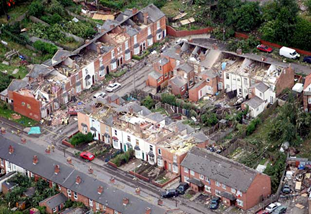
Damage caused by the Birmingham Tornado

Preamble

In the recently published book “Come wind, come weather” (Lichfield Press, 2021), Trevor James draws attention to the Midland Tornado of 1545 which caused very considerable damage along a very long storm track in Derbyshire. A description of the damage from that time is given in the Derbyshire edition of the Magna Britannia in 1817 and is reproduced below. In this short post, the nature of the storm will first be discussed and then we will make some estimates of the windspeeds that occurred, using modern damage scales. I will then address the question as to whether the event was actually a tornado, or some other type of wind storm.

The event

From the Magna Britannia.

” At Darbie the 25th daye of June 1545.

“Welbeloved sonne I recomend me unto you, gevyng you Godds blessyng & myne. Son this is to sertifie you of soche straunge newes, as that.hath of late chauns,ed in thes p’ties; that is to wytt, apon Satterday last past, being the 20th daye of this moneth, on Say’te Albons day, we had in thes p’tyes great tempest. … wether, about xi of the clok before none: & in the same tempest, The dev[ill] as we do suppose beganne in Nedewood, wch is ix myles from Da[rbie]; & there he caste downe a great substance of wood; & pulled up by the rotts: & from thens he came to Enwalle [Etwall] wher at one Mre Powret [Porte] dothe dwell, & he pulled downe ij great elmes, that there was a dossyn or xvj loode apon a piese of them; & went to the churche & pullyd up the leade, & flonge it apon a great elme that stondyth a payer of butt lenghthes from the churche, &. … it hangyd apon the bowys lyke stremars; & afte. …….. tourned. …… & the grounsells upwards & some layd bye apon. ….. heape &. ……. that was apon viij bayes long he set it a…….. gge & the. …… ro[ots] sett upwards; & he hathein the same towne lefte not past iiij or v housses hole. And from thence he came a myle a this syde, & there grewe opon Ix or iiijxx wyllowes, & apon xij or xvi he hathe brokyn in the mydds, & they were as great as a mans body: & so he lefte them lyke a yard and a half hye: And from thence he went to Langley, wch is lyke iiij myles from Darby, & there he hath pullyd downe a great p’te of the churche, & rowled up the leade & lefte it lyeing, & so went to Syr Wyllam Bassetts place in the same [towne] & all so rente it, & so pullyd a great parte of it downe wth his. …..& the wood that growethe abowte his place, & in his parke he pulled downe his pale & dryve out his deare, & pulled downe his woods, & so[me] broken in the mydds that was xvj or xx loode of wood of some one tre. And after that he went into the towne to Awstens housse of Potts & hath slayne his sonne & his ayer, & perused all the hole towne, that he hath left not past ij hole howsses in the same towne. And from thence he went to Wy’dley lane, & there a nourse satt wt ij chylderen uppon her lappe before the fyre, & there he flonge downe the sayde howse, & the woman fell forwards ap[on the] yongechyl[dren] afore the fyre, & a piese of ty’ber fell apon her. …… & so killed [her] but the chylderen were savyd, & no more hurte, [and none] of the house left standyng but the chymney, & there as the house stode, he flange a great tre, that there is viij or x lood of wood apon it. And from thence he went to Belyer [Belper] & there he hath pullyd & rent apon xl housses; & from thence he wente to Belyer [Belper] wood & he hathe pullyd downe a wonderous thyng of wood & kylled many bease; & from thens to Brege [Heage] & there hath he pulled downe the chappyl & the moste parte of the towne; & from thens to WynfeldmaJ that is the Erie of Shrowseberys [Wingfield Park], & in the parke he pulled him downe a lytell…… & from thens to Manfyld [Mansfield] in Shrewood & there I am sure he hath done [no] good, & as it is sayd he hathe donne moche hurte in Chesshire &….. shire. And as the noyse goeth of the people ther felle in some places hayle stons as great as a mans fyste, & some of them had prynts apon them lyke faces. This is trewe & no fables, there is moche more hurte done besyds, that were to moche to wryte, by the reporte of them that have sene it; and thus fare you well.”

James is persuaded that the account is genuine, not least by the mention of the damage to the chapel at Heage. The church at Heage was indeed officially a chapel (dependent upon another church) at the time and there are records elsewhere that indicate it was rebuilt after the storm. James quotes a further source (Warkworth’s Chronicle) which again suggests strong winds in Cheshire and Lancashire on that day.

The personification of the event as the “devil” is of interest and may reflect both the belief that such events were demonically rather than divinely inspired but might also refer to the name of such events – indeed even today small whirlwinds are referred to as dust-devils or something similar.

The description allows the track of the storm to be determined quite accurately, and this is shown on the map of figure below. In all the track where precise damage details are given seems to have been about 40 km long at least.

The track of the event. Purple lines indicate the boundary of Derbyshire and the purple circle is Derby itself. Red circles indicate the places where damage occurred, and green arrows indicate the storm track

Wind speeds

On the assumption that we are dealing with an tornado here, rather than another type of windstorm (see below), is it possible to obtain estimates of what the windspeeds actually were? Tornado windspeeds are usually estimated by inspecting the damage that they cause, and then using a damage classification method to determine the broad range of wind speeds that would cause that damage. Two methods are commonly used – the Enhanced Fujita (EF) scale developed in the US, and the T scale developed by the Tornado Research Association TORRO. Extracts from the damage descriptors are given below.

Enhanced Fujita EF Scale

EF2         49–60m/s      Roofs torn off from well-constructed houses; foundations of frame homes shifted; mobile homes completely destroyed; large trees snapped or uprooted; light-object missiles generated; cars lifted off ground.

EF3         60-74m/s      Entire stories of well-constructed houses destroyed; severe damage to large buildings such as shopping malls; trains overturned; trees debarked; heavy cars lifted off the ground and thrown; structures with weak foundations are badly damaged.

EF4 74-89m/s Well-constructed and whole frame houses completely leveled; some frame homes may be swept away; cars and other large objects thrown and small missiles generated.

TORRO T scale

T4           52 – 61m/s           Motor cars levitated. Mobile homes airborne / destroyed; sheds airborne for considerable distances; entire roofs removed from some houses; roof timbers of stronger brick or stone houses completely exposed; gable ends torn away. Numerous trees uprooted or snapped.

T5          62- 72m/s            Heavy motor vehicles levitated; more serious building damage than for T4, yet house walls usually remaining; the oldest, weakest buildings may collapse completely.

T6           73 – 83m/s          Strongly built houses lose entire roofs and perhaps also a wall; windows broken on skyscrapers, more of the less-strong buildings collapse.

To give some context, the Birmingham Tornado of 2005 (pictured above), one of the strongest in recent years, was classified as a T5 event.

It is immediately clear that these descriptions are very subjective and the classification of damage into a particular class is not straightforward. It is perhaps less clear that each of these scales is to some extent culturally dependent. The EF scale reflects North American building and vehicle types, and the T scale reflects building and vehicle types from the UK in the 1970s when the scale was first produced. Neither reflects building practice in the 1540s and neither were there any cars to be lifted up in that period!  Nonetheless, the description of 1545 can be used within these classifications at least in an approximate way. I would thus classify the 1545 event as borderline EF2 / EF3 or borderline T4/T5. These classifications give a wind speed range around 135 mph or 60 m/s. However,  Neaden, in a study of tornado risk for the HSE, based on the above description, assigns a category of T6 to the event, giving a wind speed of at least 73m/s. This again illustrates the subjectivity of the classification.

The T scale also gives a classification based on path length

T4 2.2 to 4.6km

T5 4.7 to 9.9km

T6 10 to 21km

T7 22 to 46km

On the basis of path length Neaden again gives a T6 classification, although the length as shown in figure 1 suggests a T7 classification. My view would be that the event should properly be categorised as EF2/EF3 or T4/T5 with an unusually long path length but the subjectivity of this assessment must again be emphasised.

Was it a tornado?

The question that then needs to be addressed is whether or not the 1545 event was a tornado or some other storm type – presumably one of the usual extra-tropical cyclones that pass across the UK quite frequently. Even in such storms there are known to be smaller tracks of major damage. In the 1987 storm for example there was a swathe of extreme damage to trees in a arc a few miles wide across the south of England. This was attributed to a high-level jet of wind sweeping down to ground level – a phenomenon know as a “sting jet” because of the scorpion tail-like cloud formation with which such events are often associated. 

The points that suggest the event was a tornado are firstly the existence of a coherent storm track, albeit significantly longer than would normally be the case, and secondly the fact that the event occurred in June, when extra-tropical cyclones are uncommon but tornadoes are. On the other hand, the point that suggest the damage was due to an extra-tropical cyclone is the reference in more than one source to concurrent strong winds in Cheshire and Lancashire. Indeed, wind speeds of 60 m/s have been measured in extra-tropical cyclones in the past – for the 1987 Burns Night storm for example the peak wind speed was somewhere around this value.

Referring again to the work of Neaden, his data indicates that between 1800 and 1985 there were around 10 tornadoes with a classification of T5 or higher in Derbyshire. This indicates that one would occur on average every 20 years or so. One would expect that most of these would have path lengths of a few kilometres and thus the effects would be localised – and in a rural county like Derbyshire not much damage might be recorded.

Now, one might expect that an extra-tropical cyclone with wind speeds of the order of 60m/s would only occur in lowland Britain once every 200 to 300 years – indeed the 1987 storm was assessed as having this return period. Thus they are very rare events indeed.

A comparison of the likelihoods of a T5 tornado and an extra-tropical storm with the same windspeeds thus suggests to me that it is most likely that the 1545 event was indeed a tornado with an EF2 / EF3 or T4/T5 classification, albeit with an unusually long storm track, but also that it was quite possibly embedded in a larger extra-tropical cyclone of some strength. However, as with any other historical phenomenon of this type, absolute certainty as to its cause is of course not possible.

The Seisdon anomaly

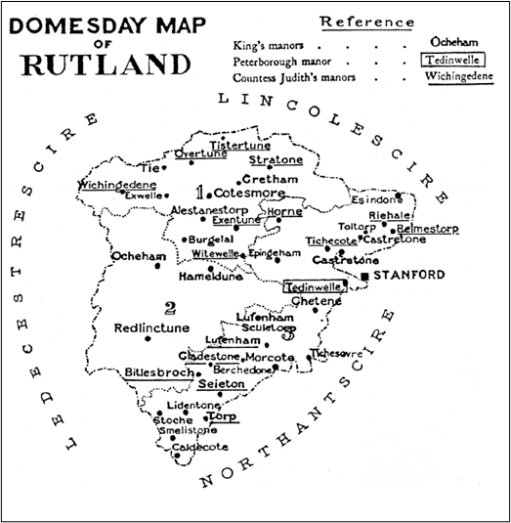
In coming to a the definition of the Original Mercia outlined in “The first Mercian Lands”, I included Seisdon Hundred in south Staffordshire within its bounds (figure 1). The reason for doing so was primarily because this area became part of the Mercian Diocese of Lichfield. However there is some rather disparate evidence that at least part of Seisdon hundred was Hwiccan territory at some stage before the formation of the diocese. 

  • Topographically, the area is in the catchment of the Smestow and Stour and thus of the Severn itself, as is the case for the other Hwiccan territories. Other parts of Staffordshire are in the Trent catchment.
  • There are Domesday linkages between the manors of Tardebigge and Clent in Worcestershire and Kingswinford in Staffordshire – and indeed Clent was for many centuries post-Domesday an island of Staffordshire within Worcestershire.  
  • The manors of Kingswinford and Amblecote (in Staffordshire) and Oldswinford (in Worcestershire) were almost certainly once part of the same land unit. 
  • The ecclesiastical parish of Oldswinford was split between the manors of Oldswinford in Worcestershire and Amblecote in Staffordshire.
  • The large Worcestershire enclave of Dudley has been surrounded by Staffordshire since the Domesday survey.
  • The name of the Hundred itself is taken from the village name of Seisdon, which can plausibly be translated as the Hill of the Saxons. This ties in with the now rather dated assumption that the Hwicce represent the northward advance of Saxons up the Severn valley.

Thus a case can be made that the area of Seisdon Hundred was originally Hwiccan territory that was absorbed into the Original Mercia. The reason for this is clear from the map of figure 1 – strategically it is a very important area. The Roman road system centred on Greensforge controls access along the Saltway from Droitwich to the north, access to Shropshire, the borders and Wales, and gives a direct link to Quatford on the Severn, allowing control of river traffic. Three potential roads are shown on the map that are not shown on the larger scale map of figure 8 in the main text – those from Greensforge north east to Wall, from Water Eaton to Metchley and from Metchley to Greensforge. The routes of the first two can be traced in places on the ground (Horovitz, 2005; Bassett, 2001), but the lines shown on the map are purely conjectural. It is however likely that the two routes crossed at Wednesbury. The route between Metchley and Greensforge (Baker, 2013) begins with the Metchley to Water Eaton route but branches from it through the village known as the Portway near Oldbury and then passing though, or to the south of Dudely, to Kingswinford and Greensforge.  Taken together this road network clearly adds to the connectivity of the region and emphasises its strategic importance. 

Figure 1 – Seisdon Hundred

(Red shows boundary of the hundred  – a solid line where it coincides with the county boundary, and a dotted line otherwise; grey shows other county and hundred boundaries; brown shows the pre-1974 county boundary, reflecting the early post-Domesday losses to Shropshire; roads are shown (schematically) in green and rivers in blue).

D Horovitz (2005) “Place names of Staffordshire”, published by D Horovitz, Brewood

S Bassett (2001) “Birmingham Before the Bull Ring”, Midland History, 26, 1, 1-33,

C J Baker (2013)  “Pensnett – its name and origins” Staffordshire History Journal

More on the Tribal Hidage

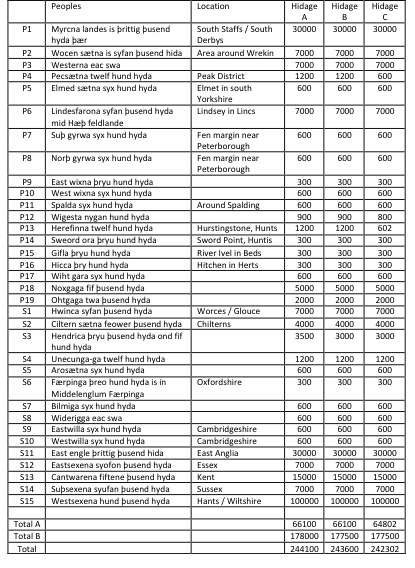
Table 1 The three recensions of the Tribal Hidage

On the page “The first Mercian Lands”, 1 have drawn on information in the document known as the Tribal Hidage, as part of the investigation into the location of the original Mercian lands. In this short note, I consider this document in a little more detail. Table 1 above gives a summary of the three separate recensions of the Tribal Hidage. The description of the polities from Recension A is given, together with the location where there is general scholarly agreement. As noted in the main text, there are two combined lists – Primary (P) and Secondary (S). The Hidages from the three recensions are then also given. It can be seen that these vary somewhat. The sum of the hidages in all three recensions is given for both lists A and B. In Recension A, a false total is given for the total hidage of 242,700. 

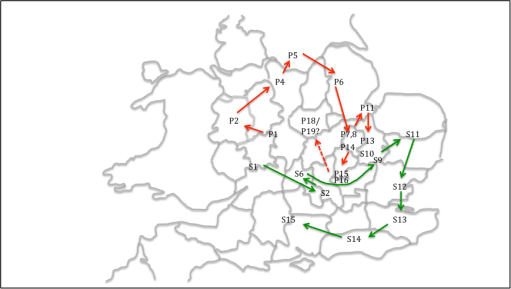
Figure 1. Tribal Hidage. “Firm” locations of regions in the primary and secondary lists  (figure 3 in main text)

(P1- Myrcna lands; P2 – Wocensætna; P4- Pecsætna: P5 – Elmedsætna: P6 – Lindesfarona mid Hæþfeldlande: P7 – Suþgyrwa: P8 – Norþgyrwa: P11 – Spalda; P13 – Herefinna : P14 – Sweordora P15 – Gifla : P16- Hicca: P18- Noxgaga: P19 – Ohtgaga; S1 – Hwinca; S2 – Cilternsætna; S6 – Færpinga; S9 – Eastwilla; S10 – Westwilla; S11 – Eastengle; S12 – Eastsexena; S13 – Cantwarena; S14 – Suþsexena; S15 – Westsexena)

It was noted on “The first Mercian Lands” that the clockwise ordering of the primary and secondary lists seems to be a very deliberate tactic on behalf of the original compiler of the list – see figure 1 above. At the risk of pushing this schema too far, it is worth asking the question if the location of the polities whose locations are not known can be inferred by imposing this clockwise presentation scheme. Thus let us consider those polities in table 1 where no location is given.

  • Westerna (P3). Scholars usually identify this as one of the Magonsaete in south Shropshire / Herefordshire, somewhere in Wales, or the region around Chesire. Higham would see it as representing the tribute payment of the Welsh Overkingship from somewhere in Gwynedd. It does not seem to the author that the Magonsate is a possibility as this kingdom seems to have been established late in the 7thcentury i.e. after the Tribal Hidage was compiled. The clockwise rotation would best place this polity in Wales or the Cheshire region. My preference would be to see it as the Western half of the Civitas of the Cornovii that was ultimately to become the kingdom of Powys, which fits best with both the name and the clockwise rotation.
  • East and West Wixna (P9 and P10). Within the Fenland there seems to be a subsiduary clockwise rotation, at least based on those polities identified by Oosthuizen.  If this is the case then the East and West Wixna would lie somewhere on the Fenland margin between the Gwyre and the Spalda. This is not however consistent Oosthuizen’s analysis.
  • Wigesta (P12). The clockwise rotation within the fens would place this to the south and west of the Spalda.
  • Wiht gara (P17). This is taken by most scholars to be the Isle of Wight. The present author finds this very difficult to believe, as it lies within the primary list, but is separated from all the other polities in that list by those in the secondary list.  In the author’s view this probably represents a typographical error, with the original name being confused for the (more familiar) name for the Isle of Wight. The clockwise rotation would see this region in the Bedfordshire area. 
  • Noxgaga (P18) and Ohtgaga (P19).It has already been argued on “The first Mercain Lnds”, that the clockwise rotation places these two sizeable entities in the Northanptonshire /Leicestershire area.
  • Hendrica (S3).The Ciltern sætna and Hendrica together have an assessment of 7000 or 7500, suggesting they are subdivisions of one unit. If so this would obviously place the Hendrica in the Chilterns area, which is consistent with the clockwise rotation of the secondary list.
  • Unecunga-ga (S4).This name is clearly corrupt and no convincing location seems to have been proposed.  Again, the clockwise rotation would suggest that it be placed somewhere in the Oxfordshire area.
  • Arosætna (S5). Conventionally, this polity is identified as being in the valley of the River Arrow in Worcestershire and Warwickshire. However there is no indication elsewhere that this area was ever anything other than part of the Hwicce, and I find it difficult to accept this identification. The clockwise rotation would again suggest that this be placed somewhere in the Oxfordshire region.
  • Bilmiga (S7) and Widerigga (S8). Various locations have been suggested for these entities, including the area of Lincolnshire to the west of the Wash, and regions in Eastern Northamptonshire. Both these suggestions however cut across the boundary between primary and secondary lists i.e. between the Midlands and Southern Overkingships. The clockwise rotation would see them best placed in the south Midlands area perhaps in Buckinghamshire or Hertfordshire. 

It has been noted above that the hidage values are generally expressed in terms of a duodecimal system for the smaller polities, and in units of 7000 for the middle sized polities. The larger kingdoms seem to have punitive assessments of 30,000 or 100,000. One must approach these numbers with a very great deal of caution and be very wary of giving them too great a significance. In an early study of the Tribal Hidage,Russell (1947)give an interpretation of the significance of the numbers in a tour de force of somewhat dubious arithmetic and remarkable assumptions of copyists errors to show hidden additions and totals throughout the list. What he actually demonstrates is the remarkable flexibility of the duodecimal system to provide all sorts of totals and subtotals from any subset of numbers. However there are perhaps two numbers that do have some significance – the figure of close to 36000 of the primary list of the Tribal Hidage (excluding the original Mercia), and the approximate 144,000 total of the primary and secondary lists excluding Wessex. Both these numbers have rich biblical symbolic meanings, which would have been well appreciated by later copyists, and in particular latter might be thought to emphasize the totality of the tribute being paid by the Midlands and Southern overkingships. These numbers are not of course exact, but there is perhaps some indication that those who later edited the lists attempted to make the additions more precise.  For example Recension C removes a 100 hides from the 900 for the Wigesta, which would reduce the overall total for the primary list (excluding the original Mercia) to 36,000 – although he also removes 600 from the Pecsaete and 598 (!) from the Herefina, which destroys this calculation. A similar change of 100 hides would also bring the overall total for the two lists to 144,000 (excluding Wessex), although this is again obscured by other minor changes (which are possibly copyists errors). It is not argued here that the numbers in the list should be seen as having any particular significance – but rather that later editors and compilers thought that this might be the case and tried to make them fit to what they believed were appropriate numbers. 

Climate and plague

At the page “The first Mercian Lands” I have argued that a plausible historical context for the establishment of Mercia was the northward expansion of Wessex during the third quartile of the sixth century. This followed, if the general thrust of the various annals and chronicles is taken as reliable for this period, a period of relatively calm between the various ethnic groups in southern England – the peace following the Battle of Mons Badonicus as recorded by Gildas (Higham, 1994). The question then arises as to what caused this renewed military activity on behalf of Wessex. It seems clear to the author that the primary reason for this was the climate upheavals of the 530s and 540s and the associated first pandemic of plague that swept across Europe, which resulted in depopulation and political destabilization. This effect is well documented, and probably resulted from multiple volcanic eruptions with or without some sort of impact event around that time (Degroot, 2016; Newfield, 2016). Yet this effect hardly seems to be considered at all by the academic historical community. The author can see no reason for this, other than a perhaps understandable reluctance to become involved in any way with the more speculative theories outlined in a number of popular works. Yet it seems that the objectivity of these events have a number of implications for academic historians.

  • Gildas’s magnum opus De Excidio Britanniaemust have been written before the first climatic catastrophe, which occurred in 535AD according to reliable tree ring evidence. Otherwise he would surely have included it within his polemic against the moral failure of the rulers of his day. 
  • The fact that this polemic was in some way validated by major external events (either through coincidence or divine action depending on your point of view), may well have been a major reason why Gildas and De Excidio Britanniaewas held in such high authority by his contempories and subsequent writers.
  • The plague hit a weakened Roman population in 542 AD, and would have spread throughout Europe over the next two or three years, judging by the speed of progress of the second pandemic (the Black Death) that has a well established chronology. The Historia Brittonum, regarded by most historians as unreliable for this period, gives the death date, by plague of Maglocunus, one of the rulers castigated by Gildas, as 547AD. This is perhaps three or four years too late, but does (perhaps uncomfortably for some) give an external validation to the Historia Brittonum.
  • The Annales Cambriaegives the death date of Gildas as 570AD, which, on the basis of the above, may be a few years too late. Now Gildas writes that he was born in the year of Mons Badonicus and was 44 years old at the time. Thus supposing he wrote De Excidio Britanniaein 534AD, this gives a date for his birth and the battle of 490AD, which is roughly where many historians would locate it, and would give him an age of, something less than 80 at his death, which does not seem impossible.

Thus, at the very least, a consideration of the effects of the global events of the 530s has the potential to cast some light on the chronology of the mid / late seventh century, and to give a little more confidence in the various annals and chronicles from that period.

N Higham (1994) “The English Conquest – Gildas and Britain in the firth century”, Manchester University Press

D Degroot (2016) “Volcanoes, Comet Crashes, and Changes in the Sun: How Sixth-Century Cooling Transformed the World”, 

T Newfield (2016) “The Global Cooling Event of the Sixth Century. Mystery No Longer?”

St. Michael’s, Lichfield in the 19th century. Part 1

Preamble

The most common modern use for parish registers for baptism, marriage and burial is in family history research – to trace the lives of individuals and families through the centuries. But they also form a rich historical resource that can be looked at in quite another way. Where detailed registers exist, they allow a picture to be built up of the wider societal context, by looking at the entries in the register as a whole rather than individually, and considering details of birth and death statistics over time; the professions and trades of those bringing children to baptism and their places of residence.

In this post we take such a wide look at the parish registers for St, Michael’s parish in Lichfield during the 19thcentury.  These have been conveniently produced by Midland Ancestors as .rtf files, and can thus, with some manipulation, be imported in EXCEL and interrogated in a number of different ways. We begin by briefly describing the registers and the nature of St. Michael’s parish in the 19thcentury, then move on to consider statistics of baptisms and burials. The registers also give details of where the individuals lived and their trades or professions, and thus give us a snapshot of Lichfield society in the period. The marriage registers allow the level of literacy to be determined, from an analysis of those who signed the registers, and those who simply made their mark.  The registers also allow a survey of names to be carried out, which shows how the popularity of different Christian names varied over the century. Finally the registers cast some light on the ministers who performed the services, and on the nature of church practice. 

The information presented here will mainly be in the form of simple graphs and tables. Not everyone will be comfortable with such a presentation, but the material to some extent demands it. I will however attempt to describe the information shown on these figures in a more qualitative way, and try to draw out what they can tell us about church and parish in the 19thcentury. 

St Michael’s parish and the registers

Figure 1. The red solid line indicates the boundary of St. Michael’s parish around 1820. The red dotted line indicates the extra-parochial portion of Freeford township. St Michael’s church is indicated by the red cross. The green, blue and purple lines and crosses indicate the boundaries of St Chad’s parish, St Mary’s parish and the Cathedral Close and their churches respectively. The extra parochial area of the Friary is not shown.

The formation of parishes came relatively late in the Lichfield area, where the ecclesiastical organization was, until the seventeenth century, largely based on the Cathedral Prebendial system, with the Prebends appointing vicars who took responsibility for the three city centre churches. It was eventually divided into three parishes – St. Mary’s covering the city centre, St. Chad’s to the north-west and St. Michaels to the south west, south east and south (figure 1). There were three extra-parochial areas – the Cathedral Close, the area around the old Friary and part of the township of Freeford. Of the three parishes, St. Michael’s is the largest. The church itself and its large graveyard on Greenhill is just to the east of the boundary with St. Mary’s parish. In the early part of the 19th century, the parish contained the land immediately to the east and south of the city centre, and large areas further to the south and east containing a number of smaller townships – Wall to the south, Burntwood in the south west, Streethay in the north east, and Freeford and Fulfen to the east. In addition there were a number of detached portions – at Fisherwick and Haselour to the east for example. Thus, whilst the registers mainly concentrate on those who live close to the church in the more densely populated area on the eastern edge of the city, they also contain entries for a more dispersed rural population. As the 19thcentury progressed, some of the outlying townships became parishes in their own right – Burntwood in 1820 and Wall in 1845 and after those dates their inhabitants largely disappear from the St. Michael’s registers. Similarly a large area to the west of the city around the hamlet of Leamonsley formed Christchurch parish in1848. 

There are however further complications. St. Mary’s parish that encompasses the city centre has no graveyard, and used that at Greenhill. Thus the St. Michael’s burial register also contains many entries from St. Mary’ parish.  There also seems to have been a leakage across parish boundaries in baptism and marriage, with parishioners of St. Mary’s and St. Chad’s using St. Michael’s– and no doubt vice versa. The other complicating factor was the existence of the Lichfield Union Workhouse in St. Michael’s parish from 1840 onwards, which housed paupers from a wide area around Lichfield. As these were mainly men, care needs to be taken in any analysis, as the Workhouse entries in the registers can skew the statistics significantly if they are not allowed properly for. 

Before considering the detailed statistics from the registers, it is instructive to look at the general social make up of the parish in the 19thcentury. The baptismal registers contain brief descriptions of the occupation of the one who brings the child for baptism, usually the father. A statistical analysis of this information is, to say the least, difficult, so I will confine myself to only broad comments here. In total there are 6885 baptisms recorded. The number of families represented will be significantly less than this of course. But for these baptisms 2100 give an occupation as “Labourer” and around 650 are economically inactive (most often “Single Women” in the Workhouse or “Spinsters”). Thus around 2750 are at the lowest levels of the society of 19thcentury Lichfield. At the other end of the scale, there are around 35 baptisms of children of those who might be described as “Professional” – bankers, solicitors, architects etc.; 29 from the Ecclesiastical Establishment; and 40 who describe themselves as “Gentlemen”. In between there is a wide range of trades and occupations present of differing levels of skill, from low skilled gardeners and bricklayers to the highly skilled clockmakers, cordwainers and coach builders. Basically it seems that St Michael’s in the 19th century was a church for the workers and middle class artisans and tradesmen of the city – and certainly it attracted few at the higher end of the social scale to bring their children for baptism.  This is in accord with the various monuments and inscriptions within the church, few of which date from the 19th century, with most from the 18th and 20th centuries, indicating that for this period the upper reaches of Lichfield society looked elsewhere.

Population Statistics

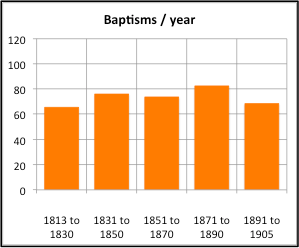
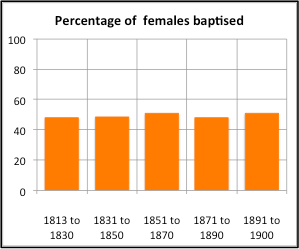
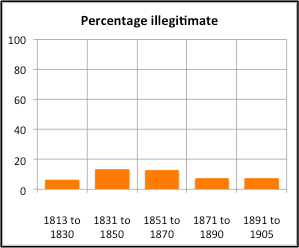
Figure 2 shows the basic statistics from the baptismal register for the period between 1813 and 1905. Here the data is shown in nominally 20 year bands, with the first (1813-1830) and the last (1891-1905) being somewhat shorter. This variability in period can be allowed for to some extent by considering the number of baptisms / year in each band.  It can be seen that there were around 70 baptisms a year across the period, with that figure remaining relatively stable. The expected rise in baptism numbers due to population growth thus seems to have been balanced by the number of baptisms taking place in the new chapels at Burntwood, Wall and Christchurch, and also no doubt by an increase in the number of baptisms in non-conformist churches. The percentage of females was baptized was close to 50% throughout the period as would be expected, which at least shows the inhabitants of the parish in the 19thcentury did not practice female infanticide. Finally it can be seen that that the number of illegitimate children baptised is around 5 to 10% of the whole. This graph may not be wholly accurate however, as illegitimacy was recorded in different ways over the century, or not recorded at all, so some cases may have been missed, but any errors will be small.

Figure 2. Baptism statistics for number of baptisms / year, percentage of baptised females and the percentage of illegitimate children

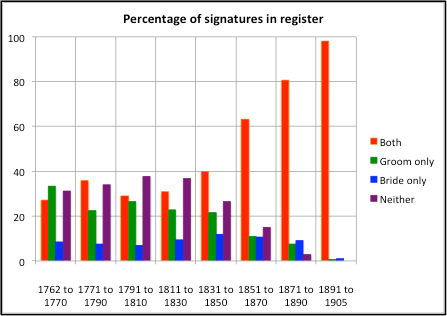
Figures 3 show the marriage statistics . This data is given over a longer period than for the baptismal reisters, as the .rtf transcription extends back further into the 18thcentury. The number of marriages per year peaks at something over 40 marriages per year between 1811 and 1830. The register also provides an indication of the level of literacy amongst those getting married. The right hand figure gives the proportion of weddings where bride and groom both signed the register, just one of them signed, or neither signed. Very broadly, up to the middle of the nineteenth century, there were around a third of marriages where neither couple could sign their name, a third of marriages where one of them could (most often the groom) and around a third where both signed. After that time, the proportion of weddings where both signed increased rapidly, no doubt due to the establishment of the National Schools in the area, and by the start of the 20th century both partners almost always signed.

Figure 3. Marriage statistics, showing number of marriages per year and the percentage of participants signing the register.

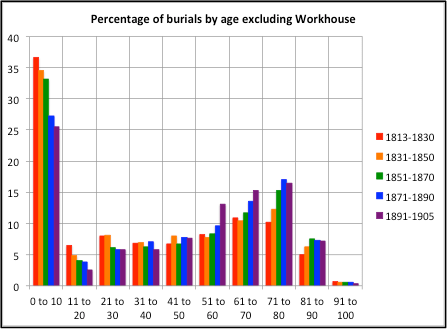
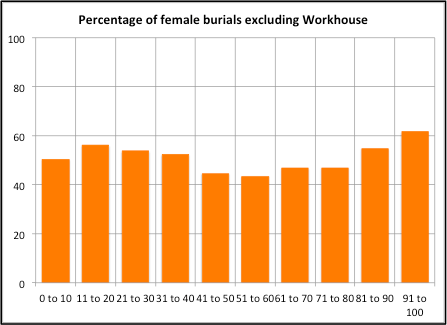
Figure 4 shows the analysis of the burial statistics, excluding the Workhouse entries. The number of burials / year increases through the century, reflecting the increase in population. In the breakdown of burials by age group, the large infant mortality rate is clear, although burials in the 0 to 10 age group decrease from 36% of all burials to 25% over the 19th century. This same trend of reducing mortality is shown in the 11 to 20 and 21 to 30 age groups. The number of burials then increases with age, with a peak in the 71 to 80 age range, with a sharp fall off for the oldest age ranges. The percentage of female burials against age range rises from around 50% for the lowest age range, then increases to around 55% for the 11 to 20 and 21 to 30 age ranges, reflecting deaths during childbirth. There is a trough at just over 40% in the 51 to 60 age range as male mortality peaks, with a rise to around 60% in the highest age ranges, which simply reflects the greater longevity of women if they survive infancy and childbirth.

Figure 4. Burial statistics, excluding Workhouse data, showing number burials / year, burials by age range and percentage of female burials

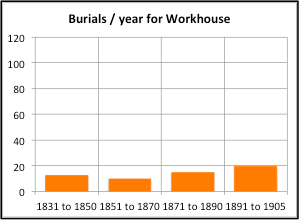
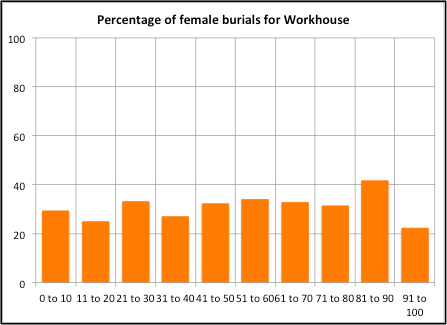
Figure 5 shows similar figures for Workhouse burials. It can be seen that the number of burials per year is between 10 and 20 – a significant proportion of the whole. The burials by age show the same form as for the general population, although the child mortality rate remains at around 35% throughout the century rather than falling. The percentage of female burials by age do not show the same trend as for the general population, although this might possibly be because the sample size is smaller and any trend masked by statistical variation. 

Figure 5. Burial statistics, for Workhouse data, showing number burials / year, burials by age range and percentage of female burials

Part 2 of this blog post can be found here.

A policeman’s life – Samuel Hicklin (1858-1924) Part 3

Part 1 – A (very) young constable 

Part 2 – Climbing the ladder  – from Sergeant to Superintendent

Chief Superintendent Hicklin

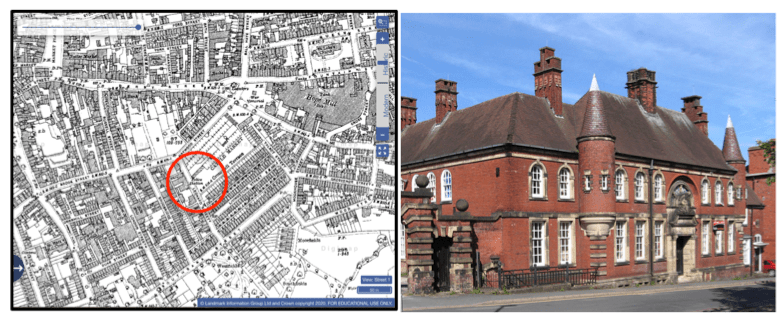
Burslem Police Station (from Edina Digimap 1920 and https://artuk.org/discover/artworks/burslem-police-station-18678)

Hicklin became Chief Superintendent in late 1906 in charge of the Potteries District (District C) with its four Divisions of Burslem, Longton, Stoke and Tunstall, and was based at Burslem Police station. He also seems to have more local responsibility for the Burslem Division with its 16 police stations, although this was no doubt delegated to some extent. As a Chief Superintendent Hicklin was even more a public figure than before and attended many civic and community functions. The Staffordshire Sentinel reported on his involvement in St John’s Ambulance exam awards, civic church services and church parades, charity football matches, formal dinners, funerals, council events and so on.

The range of crimes and offences dealt with by Hicklin and his men was similar to that at Burton, with licensing issues and traffic offences forming the majority of cases. The one that drew most public attention however was again a murder – that of Sarah Ann Price, aged 51, the wife of George Price, a colliery labourer. It would appear that the couple had been drinking heavily together, and had then quarreled. During the quarrel, Price had poured paraffin over his wife and set her on fire. She died from her burns, “burnt to a cinder”. Hicklin arrested Price and was involved in his prosecution for murder. Not surprisingly the incident created much interest in the press, both locally and nationally.

The other major challenge that presented itself was the policing of elections and, with more difficulty, strikes and industrial action. The major incident during Hicklin’s time at Burslem was a widespread strike amongst miners in early July 1909, aiming to increase the length of the lunch break and to increase pay for Saturday working. This not only involved walk outs, but also large crowds of striking miners moved around the area, aiming to force miners at non-striking pits to join them, and closing other industries. There was much violence and intimidation, and the police stood between the strikers on one hand and the non-strikers and mine owners on the other. The whole police force in the area was stretched very thinly, and Hicklin himself, whilst trying to persuade a crowd of 300 to 400 miners to disperse to enable non-striking miners to go home, was himself “assailed with a volley of stones”. The strikes were settled after a few days, with some small concessions from the employers on the length of the “snapping time” – or lunch break, but the trials for riot and affray occupied the Magistrate’s courts and Assizes for many months after. 

In 1910 Stoke on Trent City Police was formed with a merger of Hanley Borough Police and that part of the County Force area then within the Potteries Federation. This included significant parts of the then District C of the Staffordshire Constabulary, and a major re-organisation of the County force took place. A new District C was formed, spanning both parts of the Potteries and also more rural areas of the county, of which Hicklin took charge. The Divisions of this District were Leek, Newcastle, Stone and Uttoxeter.  The District covered a very wide geographical area in the north of the county. Hicklin and his family moved to the police station at Leek, where the District headquarters were located, in early 1910.

Leek police station (from Edina Digimap 1920 and https://commons.wikimedia.org/wiki/File:Leek_-_Police_Station_-_geograph.org.uk_-_1937202.jpg)

The 1911 census gives us a further snapshot of the family – Samuel aged 56 with a birth year of 1854/5, Eliza aged 55 with a birth year of 1855/56, young Samuel aged 20, now a tailor running his own business and shop; Flora, aged 18, helping with the domestic work; and Reginald, aged 11 still at school. Their accommodation, in the police station, had seven rooms 

Samuel Hicklin’s signature from the 1911 census

At Leek, Hicklin’s life seems to have continued in much the same way as at Burslem, no doubt the majority of the time being taken up by the administrative roles necessary in any large organization – appointments and promotions, finance and reporting and so on. It is likely that, as one of the four Chief Superintendents, he also played a role in the determination of strategy and plans for the whole constabulary under the direction of the Chief Constable. He continued to deal with much the same range of crimes and incidents as before, although it seems that the war years were rather quieter than previously, in part because licensing hours were restricted.  His first involvement with motor vehicle transgressions is recorded– a taxicab colliding with a horse and cart in 1918; and the death of a pedestrian after being knocked down by a car whilst disembarking from a tram. The war also caused a significant decrease in the number of public functions. One that did occur after the war in 1923, was the presentation of certificates to the 219 special constables who were in post in the Leek Division between 1914 and 1919, replacing those who had volunteered to enlist. 

During his time at Leek, two major honours came his way – the King George V Coronation Medal in 1912, and the MBE in 1919.

 The final mention of Hicklin in the press was on the 9thFebruary 1924 when he reported at the Annual Licensing Sessions of the Leek Division.

Chief Superintendent Hicklin reported that the number of licenses in the Division was 142, no license holders had been proceeded against under the licensing laws; 52 males and 10 females were proceeded against for drunkenness, all except 6 males and 4 females being convicted. 

As he began his career with drunken behavior, so he ended it.

Samuel Hicklin died on Thursday March 27th1924, having made his last court appearance on the Monday before, when he was in good health. This suggests that death was due to a heart attack or something similar. The obituaries were fulsome and generous. From the Staffordshire Sentinel of 31stMarch 1924.

…..During his 14 years at Leek, Chief Inspector Hicklin has made himself extremely popular with all classes but the courteous and tactful way in which he has carried out the important and various duties attached to his office. Of a quiet and unassuming disposition, and a man seeking little publicity, he was nevertheless a strict disciplinarian and his organization of the police in the large and important Leek Division was as complete and as efficient as anywhere in the county……. He was a zealous and efficient police official carrying out his work with conspicuous ability and whilst ever mindful of the responsibilities of his position, he was always fair and impartial in the preparation of prosecutions… 

He was also described as being in his 69thyear, implying birth years of 1855/1856. The tributes from magistrates and court officials were equally fulsome. In his obituary in the Staffordshire Constabulary Monthly Budget of April 1924 we read

The Chief Constable wishes to express his deep and sincere appreciation of the very valuable and loyal work of this officer during his long service of 48 years in the force.

In the same obituary his birth date is given, for the first time in the historical record, as 28th March 1857, which was probably one year earlier than his actual birth date.

Leek Parish Church (from https://en.wikipedia.org/wiki/St_Edward_the_Confessor%27s_Church,_Leek#/media/File:Leek,_church_of_St_Edward_the_Confessor.JPG)

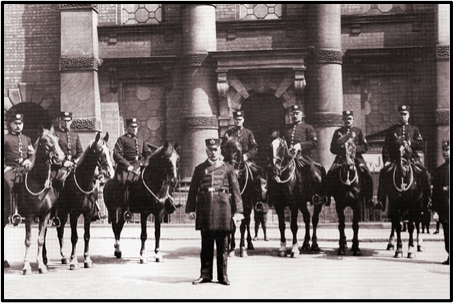
His funeral took place on the afternoon of Monday 31stMarch. There was a procession of 100 officers, including many ex-officers who had served with him across the county from the Police Station to Leek Parish Church, led by six mounted constables. Chief Constable Anson also attended. At the service there were representatives from the two Freemasons lodges of which he was a member, many magistrates and court officials, representatives off the Licensed Victuallers Association (which seems wholly appropriate) and many others. The coffin was carried into church by six constables. After the funeral service led by the vicar, his body was laid to rest in Leek Cemetry. The mourners were recorded as 

Mr Reginald Hicklin (son), Miss Flora Hicklin (daughter), Mr and Mrs A Tipper (sister and brother in law) , Mr and Mrs T E Harper, Mr J Goode (nephew) and ex-Inspector George Oulton of Leek, formerly of Burton”. 

Sam Hicklin, the eldest son was stated to be in Canada. Mrs Tipper was actaully his half-sister Harriet. It is notable that Eliza was not present. In the pre-second world war register of 1939, she is registered as still living in Leek, with her unmarried daughter Flora, and as being incapacitated. Perhaps that was already the case in 1924. The Staffordshire Advertiser who reported on this event, also contained the only picture I can trace of Sam Hicklin – it is shown below.

Samuel Hicklin 1858-1924

Samuel Hicklin’s life was in some ways quite exceptional – that a farm labourer’s child should rise to perhaps the highest police rank that was available to him (as Chief Constable and Deputy Chief Constable ranks were largely restricted to “gentlemen” or retired military officers) must be viewed as remarkable, and a tribute to his abilities, hard work and diligence. From press reports it is not really possible to form a view of his character and personality, but he does seem to have been genuinely well liked and respected by his peers. The number of colleagues and acquaintances his funeral alone is testimony to that. 

Throughout these posts I have mentioned the rather variable birth dates that he assigned to himself through the years. This might have been in part due his own uncertainty about his age, but I find this explanation not wholly convincing in view of his precision in other areas (not least his pedantic interactions with landlords who keep their pubs open somewhat later than they should) and I would wonder if throughout his career he was careful to ensure that nobody came to realize that he gave a wrong age at the very start of it. A very small blot on the copybook of a remarkable man!

Part 1 – A (very) young constable 

Part 2 – Climbing the ladder  – from Sergeant to Superintendent 

A policeman’s life – Samuel Hicklin (1858-1924) Part 2

Part 1 – A (very) young constable 

 Part 3 – Chief Superintendent Hicklin 

Climbing the ladder  – from Sergeant to Superintendent

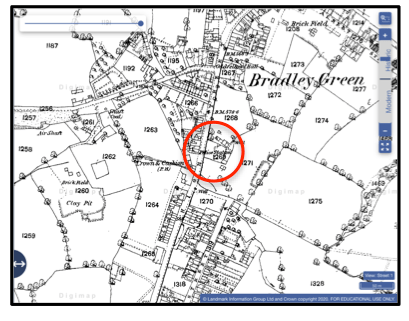
Bradley Green Police Station  (from Edina Digimap 1880)

Hicklin’s next move was to a completely different area – Bradley Green, near Biddulph in the Potteries District, where he took up a position as Sergeant 2nd class on December 1st1884. Perhaps oddly, as he scaled the promotion ladder, he becomes somewhat less visible, because of fewer court appearances and, one suspects, because the Congleton and Macclesfield Mercury, on which we rely for this period of Hicklin’s career, provided a less comprehensive news coverage than the County Express and County Advertiser between them for Tividale and Pensnett. But the necessity to deal with drunks and disorderly behavior continued, and we meet Hicklin in court a number of times proving cases of this type. In addition there are the usual incidences of petty theft and “furious” driving of horse and carts that needed to be addressed. He was also called to a number of suicides usually by hanging, then a criminal offence of course, and had to cut down the body. He was clearly becoming involved in more administrative duties, and we hear reports of him attending the Biddulph Local Board, and being given authority by that board to prosecute for “stone-throwing, swearing and dis-orderliness in the public street” on behalf of the Board.  

Of the more unusual incidents he had to deal with, perhaps the most distressing was that of Emily Poole of Hanley, who was very badly mistreated by her stepmother Priscilla Poole, a case which came to court in 1887. Emily was about 20, but looked much younger, and had been repeatedly beaten, left unfed with very little clothing, and was often required to work naked around the house. The neighbours, taking pity, gave her some clothes, but the step-mother pawned these. She slept in a damp, leaking garret room with very little bedding. Hicklin in giving evidence said he would rather sleep in the open air than in such a room as that. Over the past year Emily had tried to commit suicide, and Priscilla had continually abused the neighbours who remonstrated with her over step-daughter’s treatment.  The magistrate stated that this was the worst crime that he had ever had to deal with and sentenced Priscilla Poole to the maximum level he was allowed – six months in prison with hard labour. 

Perhaps the main incident that occurred during his time at Bradley Green, was in 1889 when he and one of his constables. PC Clay were charged with assaulting Samson Chadwick, a collier, in 1889. Chadwick had clearly been acting in a disruptive fashion in public, almost certainly due to drink, and PC Clay had tried to arrest him. He went with the PC quietly at first, but then began to resist. In a scuffle Clay threw him to the ground and tried to drag him, handcuffed, to the police station. Being unable to do so, he fetched Hicklin and another PC and between them they dragged Chadwick along the ground for three hundred yards to the station, in full view of the public.  At the station he was put into a cell, and was allegedly thrown roughly onto a bench, resulting in a black eye and other injuries. Witnesses testified that Clay kicked Chadwick on the ground while he was being dragged and that he did not have any injuries when he was put into the cell. According to Hicklin’s statement he was “laid very carefully upon the bench in the cell”.  Despite what appeared to be quite strong evidence that the police had been somewhat rougher than they ought to have been, and the less than convincing police statements, the magistrates conferred and decided in favour of the police.  And Samuel Hicklin was able to continue his career. 

The Hicklin’s third son Samuel was born in March 1891 and was baptized at Oldbury in early September. In the census of that year, Hicklin’s age had increased again to 36, giving a birth date of 1854/1855. In reality he was coming up to 33 at the time.  Eliza’s age was given as 35 and thus a birth year of 1855/56.

In November 1891, Hicklin moved directly from being a Sergeant 2nd class to being an Inspector 2nd class, thus jumping a grade. This involved a move to Burton upon Trent in the Rural District in 1891 and a subsequent move to Tipton, back in the Mining district for a brief period in 1896, at the same grade. Burton was of course near to his home, and the duties would have involved policing the area where he was born and brought up. In 1896 there were 17 Inspectors and 14 Superintendents in the Staffordshire Constabulary, which implies roughly one each per division. In this period of his career, Hicklin is at his least visible and the Burton Chronicle makes few mentions of him – too senior to be required to make many press-reported court appearances, but not quite senior enough to be the public face of the force. But where he does appear, the incidents he was dealing with were far removed from the drunkards of earlier years. At Burton in 1892, he rather wonderfully identified a shop-breaking suspect by comparing a boot print at the crime scene with the suspect’s boots – proper police procedure! In 1895, he was instrumental in the arrest of a fraudster on the run from the police in Oxford, having obtained jewelry by false pretenses; and in the same year, he arrested another travelling fraudster, who had pretended to be an old acquaintance of a number of leading cricketers of the day, now suffering from sickness, in order to obtain donations.  He moved to Tipton in early 1996 on what would seem to be a short term posting. The major incident that he was involved with there was the trial of Sarah Jane Williams (43) and Frederick Ward (49) were charged with the theft on significant money and property to the value of £400 from John Williams, Sarah’s husband, and then eloping via Liverpool to the United States.  Hicklin was entrusted with sailing to the United States in their pursuit and received them into custody on board the Belgenlandin Washington Docks, Philadelphia. It is to be hoped that he was actually allowed to disembark and see something of the USA after such a trip!

During their time in Burton, the Hicklin’s daughter Flora was born in Burton in August 1892.

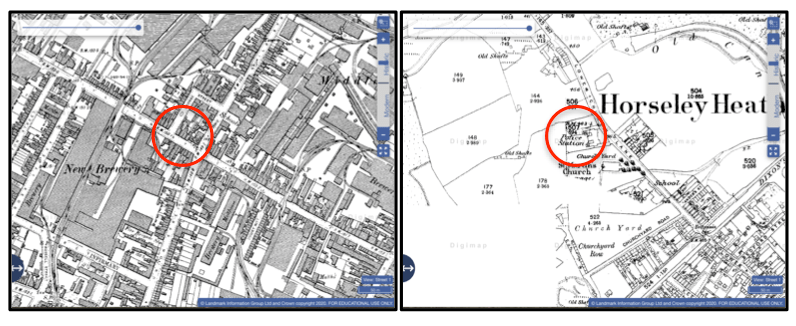
Burton upon Trent and Tipton Police stations  (from Edina Digimap 1900)

On December 1st1896, Hicklin was appointed as a Superintendent (again jumping the grade) of Inspector 1st class and moved back to Burton upon Trent where he was in charge of the Burton Division, with 18 stations including Uttoxeter, Tutbury, Horninglow, Alrewas, Yoxall and Burton itself. By this time the Districts had been renamed –the Mining District as District A, the Rural District as District B and the Potteries District as District C. After the years as Inspector when his activities weren’t very visible, becoming the Superintendent put him very much in the public eye. Whilst he was no longer involved in arresting drunks he was responsible for licensing public houses, and had to report on an annual basis to the various licensing authorities in the area on the number of licenses, number of offences of drunken behavior, recommendations for granting or withholding licenses etc. He seems to have exchanged catching drunks for counting them! He can also be seen making reports to local council committees on various aspects of policing; attending fund raising functions, including kicking off a charity football match between Burton and Lichfield Police; organizing inspections of police forces; and attending funerals and delivering tributes. In short he became a public representative of the police in the area. 

He and his family lived in accommodation at the Police Station on Station Street, together with 8 police constables (presumably in some sort of dormitory facility) and for the night of the 1901 census, three prisoners in the cells. The picture below is from the Burton upon Trent History website and is captioned there as showing the newly appointed Superintendent Moss in 1898. Moss was actually appointed in late 1906 / early 1907, after Hicklin left Burton. So either the picture is wrongly dated and shows Superintendent Moss in 1907, or the picture is of Samuel Hicklin himself. I would of course like the latter to be true, but even if it is not, it does give clear indication of the sort of uniform worn by the Staffordshire Constabulary at the time. 

Description: Macintosh HD:Users:chrisbaker:Dropbox:Web site:Blog material:Hicklin:Pictures:Burton police andstation 1898 - superintendent Moss? or Hicklin.jpg

Superintendent Moss or Hicklin? (from http://www.burton-on-trent.org.uk/category/amenities/police/police1)

Some things however remained the same – he continued to bring malefactors to court for not being in proper control of their horse and cart, or for causing obstructions on the highway. “Reckless cycling” through the borough was also becoming an issue. The range of minor crimes he and his men investigated was very wide – for example house breaking, cruelty to animals, shoplifting, perjury, embezzlement and fraud, illegal betting, trespass and family maintenance defaulters. He also had to deal with a distressing number of suicides and attempted suicides. In general both Hicklin and the bench of magistrates were very gentle with survivors, and tried to place them in situations where they might find help.   

Amongst the most amusing of these minor incidents was the case in 1899 of the shop fire at Burton-upon-Trent where the owner, a Mr. joseph North, a draper from Uxbridge Street, was unable explain to Hicklin how the fire had started at around midnight and why he and his wife were fully dressed at that time after retiring to bed early. Hicklin, unsurprisingly, found the facts that Mr Richardson’s attire included collar and tie and laced up boots more than a little suspicious, particularly in the light of the fact that the level of insurance was about eight times the value of the stock that was burnt.  There was a further case in 1905, when Hicklin was able to solve a series of robberies that had been committed by Elizabeth Smith and Mary Parkes, through the initiative of a local shoe shop owner, who attached an enticing pair of slippers to a cord, leading to a mousetrap that was activated (presumably loudly!) when the slippers were taken. When Hicklin searched the suspect’s homes, he found, to quote his evidence “a cartload of stuff, including boots, shoes and clothing”. 

The ongoing series of relatively minor offences however were punctuated by major incidents of violence and murder, which naturally made the headlines in the local (and sometimes national) press. Of these two incidents stand out –the first that ultimately involved only minor injury, and the third that involved quite a complex murder investigation. Both were reported very widely in newspapers across the UK. In both, Hicklin showed himself to be much more than a desk bound administrator. 

In the first of these, in 1900, some children were standing on the Recreation Ground  canal bridge in Burton, when one of the boatmen on a passing barge shot at them from below with a pellet gun. Five of the children were injured in the face and shoulders. The incident was reported to the police in Burton and we read that Hicklin chased them for seven miles along the canal (presumably mounted) and then arrested them at Alrewas. The claim was made that the children had been throwing stones.  The three boatmen – Benjamin Nixon, Emmanuel Lloyd and Harry Banks- were charged with causing grievous bodily harm to the children. From the evidence presented it was not clear which of the three had fired the shots. They were committed for trial at the Quarter Sessions. From our perspective, the interesting aspect is that Hicklin, even at the rank of Superintendent, rode after them, and arrested them, knowing that they were potentially armed – an act of considerable bravery. 

We find a similar pattern in perhaps the major incident of Hicklin’s time in Burton.  On a Sunday morning, in late January 1903, PC William Price, based at Stretton near Burton, was investigating the stealing of some ferrets. His enquiries led him to a “gypsy” encampment consisting of several caravans, where he arrested a certain Tom Sherrif.  Sherriff’s two brothers John and William then attacked him with sticks and stones. When trying to use his baton, Price was repeatedly hit and forced to the ground where they continued to beat him. They eventually made their escape, despite the efforts of Price who tried to pursue them before collapsing. He was taken to Burton Infirmary and wounds on his head dressed. Later however at home he became delirious and was readmitted to hospital, where a fractured skull was diagnosed and an operation performed. Price however died later that night. It would seem that when Hicklin heard of the events, he drove (a horse and trap) and having driven through his home territory of Marston-on-Dove and Hilton, caught up with the caravans at Hatton, and arrested the group. He was assisted by a number of constables it would seem, although reports are a little vague. Those he arrested however, were the mother and father of the three brothers – Hope and Hattie Sherriff , who were traveling Hawkers, and another Hawker Arkless Holland, together with other younger family members.  The evidence that these gave at the inquest the following day suggested they were not involved in the assault although they did little to prevent it. The three brothers in the meantime were nowhere to be found and a search was instigated. Again the actions of Hicklin are interesting – driving after what could have been a group of very violent youths in order to make an arrest, with little support. The runaways were eventually sighted at Scropton about eight miles from Burton, but overpowered and maltreated the officer, Sergeant Hutchinson ,who tried to arrest them. Reports were later received of them being sighted in Derby and Belper. They were eventually captured at Buxton on Wednesday night and Hicklin and a Sergeant went by train to collect them, suitably handcuffed, on Thursday morning. They met with a hostile reception from a large crowd at Burton station, and were brought to court very quickly, where they were remanded in custody. At the County Sessions a week later the three brothers pleaded guilty to murder, but stated that their father and Holland were not guilty. They were all committed for trail at Stafford Assizes in March 1903. In the train on the way to Stafford Jail the three brothers were overheard discussing the fight with the Price by the constable accompanying them.  The charges against Hope Sherriff and Arkless Holland were not proceeded with at the Assizes due to lack of evidence, but the three brothers, who had changed their plea to not guilty, were found guilty of manslaughter, based partly on the overheard conversation on the train.  This sentence was possibly arrived at, as it was not possible to say which, if any of them, was actually responsible for the blow that fractured Price’s  skull and resulted in his death. They were each sentenced to 15 years penal servitude. In 1911 they were all held in the prison on the Isle of Portland.  Whether they were actually gypsies (i.e. Romany) or not is debatable, and they might simply have been travelling tinkers. The term “gypsy” however was clearly used in a derogatory way in much of the press coverage.

Samuel and Eliza’s time second period in Burton was not without personal trauma. Their two older sons, both in their twenties, died in that period – John in 1899 and William in 1904.  Their youngest child Reginald was born in 1899. In the 1901 census, Samuel’s age is given as 46 and Eliza’s as 43 and thus implying birth years of 1854/5 and 1857/58. At that time, William, aged 18, is recorded as an Engineer’s apprentice. 

In August 1906, Hicklin was promoted to the rank of Chief Superintendent, and left Burton with fulsome tributes from the Mayor, the bench of Magistrates and court officials and counsel. The tone of the tributes as reported in the press was warm and he seems to have been held in genuine respect and affection. 

Part 1 – A (very) young constable 

 Part 3 – Chief Superintendent Hicklin 

A policeman’s life – Samuel Hicklin (1858-1924) Part 1

A (very) young constable

Part 2 – Climbing the ladder  – from Sergeant to Superintendent 

Part 3 – Chief Superintendent Hicklin 

Description: Macintosh HD:Users:chrisbaker:Desktop:20181007_124704-20181007_124719-e1539761058221.png

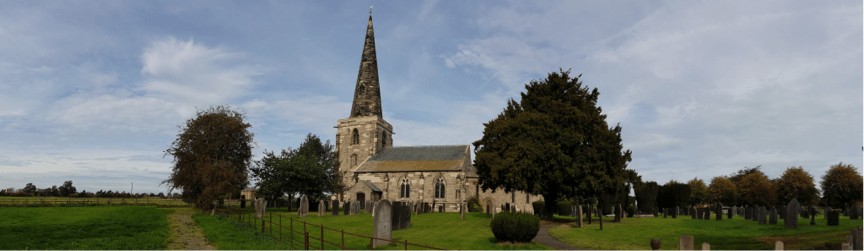
The church of Hilton, St Mary’s (from https://stmaryshilton.org

Arthur Samuel Hicklin was born in Hilton near Marston-upon-Dove in Derbyshire in late March or early April 1858, to John and Ann Hicklin. John was a farm labourer in the area, but there are no further details available of where or for whom he worked. Arthur Samuel was baptized at Hilton church on 25thApril 1858 and was the couple’s fourth child. Of his siblings, Eliza was born in 1852, John in 1854 and Samuel in around July 1856. The latter died the next year in May 1857. They were to have a further child, William, in 1860 before John himself died in that year, leaving Ann a widow. Ann married again in the mid-1860s to William Long, another farm labourer from Hilton, and had two further children, Ann and Harriett. In the 1861 census, Arthur Samuel was referred to using his first name. After that he always seems to have been known as Samuel, or, one suspects, Sam. I will in general use either “Sam” or “Hicklin” in what follows. In 1871 he was no longer with his family, but was a thirteen-year-old general servant on William Loverock’s farm in Horninglow near Burton upon Trent.  Loverock was a major landowner in the area, and employed a number of men and boys on his farm of nearly 300 acres, as well as a number of domestic servants. Sam seems to have lived in a house adjacent to the farm (possibly Hodgkin’s Farmhouse although the census return is difficult to read), with a number of other servants, both male and female.  He thus probably only received the most rudimentary of educations, which makes his rise through he Staffordshire Constabulary that we will see in what follows the more remarkable. 

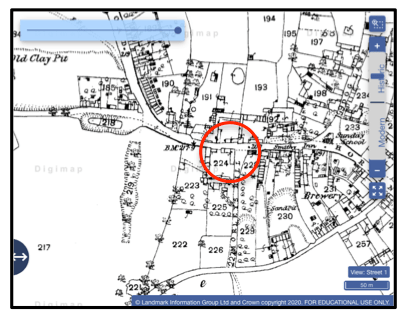
Possible location of Loverock’s Yard and Hodgkin’s Farmhouse in Horninglow (from Edina Digimap 1880) 

The Staffordshire Constabulary at that time was divided into three districts – the Mining district of the Black Country; the Potteries district around Stoke; and the Rural District for the rest of the county. This organization persisted, with some alterations of boundaries, throughout Hicklin’s career. At the head of the organization was the Chief Constable, based in Stafford. Each district was headed by a Chief Superintendent, one of whom served as Deputy Chief Constable. At times however the latter role was taken by a fourth Chief Superintendent. Each District was divided into Divisions headed by a Superintendent or Inspector, and each division into Sub-divisions, which included two or more police stations.

Sam joined the Staffordshire Constabulary in November 1875, when his age is given as 18 years and 7 months, implying a birth date of April 1857 – i.e. a year earlier than the actual date. There must therefore be a suspicion that he exaggerated his age in order to join the police. On entry to the force, he was described as being 5’ 8 5/8” tall, with brown eyes, dark brown hair and a fair complexion. His previous trade was given as labourer. He seems to have initially served in the Rural District, presumably in a training situation, possibly close to his home. In January 1876, he was the subject of a disciplinary charge for being drunk at the time he was meant to be on duty – and thus seems to have been aa fairly normal 17 year old. He was fined one shilling. He was then stationed at Tividale in the Black Country and thus continued his career in the Tividale station in the Blackheath Sub-division of the Brierley Hill Division in the Mining District.

His life at Tividale would have mirrored that of young constables anywhere. His first appearance in the press seems to have been in the County Advertiser of April 1st1876 which contains the following report of the proceedings of the Rowley Regis Magistrate’s court. 

Isaac Fisher was charged with being drunk on the 25thult., and pleaded guilty. Police Constable Hicklin proved the case, and the defendant was fined 5s with costs.”

Dozens of similar mentions appeared over the months and years that followed, mainly in the County Advertiser and County Express, as he rose from Constable 3rd class on appointment, to Constable 2ndclass on 1stAugust 1876 and Constable 1stclass on 1stAugust 1877. So he was clearly well regarded for his dealings with drunkards. To add a little variety, we also read of him apprehending carters driving too quickly or not exercising proper control over their horses; children stealing coal; bringing publicans to court for selling out of hours or for encouraging drunkenness; and (perhaps the highlight of his time in Tividale) bringing Joseph Evans and Benjamin Baker to trial for shooting ducks on the canal at Brades Village. Not all went totally smoothly however, and in May 1876 he faced another disciplinary charge for being absent from a “conference”. Again he was fined one shilling. But this clearly did not impede his progress.

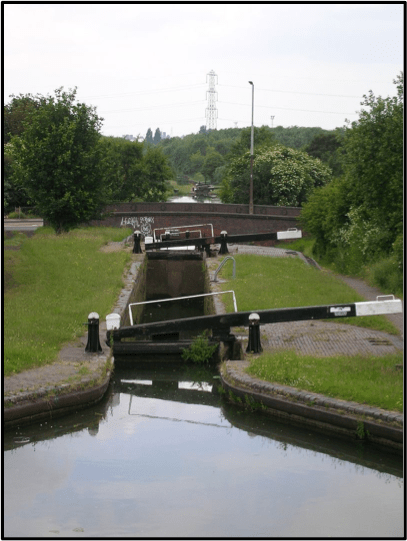
Brades Hall locks (from https://en.wikipedia.org/wiki/Gower_Branch_Canal#/media/File:Brades_staircase_locks,_Gower_Branch.jpg)

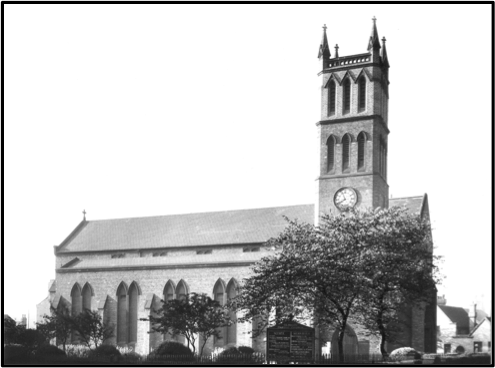
During his time at Tividale, his private life was probably more interesting than his professional life. In that period Sam met and married Eliza Taylor, the daughter of the boat builder John Taylor at Brades Hall locks on the Gower Branch of the BCN. They were married at Christchurch, Oldbury on 10thFebruary 1878.  Here, for what seems to be the last time, the name Arthur Samuel was used in the registers. Both he and Eliza were recorded as being 20 at the time, which at least for Samuel, was not the case. Eliza was baptized in August 1858, so should only have been 20 at the time if there had been a significant delay between her birth and baptism, but she could well have been born in late 1857 or early 1858.  Perhaps at this point Sam was finding it necessary to continue the minor deceit concerning his age.  The couple were to return to Oldbury for the baptisms of their children John in 1880, William in 1883 and Samuel in 1991. 

Christchurch Oldbury  (from http://www.historyofoldbury.co.uk/2story.htm)

In late 1879, Hicklin moved to a new posting in Pensnett – still in the Brierley Hill Division, but also in the Brierley Hill Sub-division. The head of the Division, Superintendent John Wollaston was based at Brierley Hill police station. The census record indicates that in 1881 Samuel and Eliza lived on Commonside (almost certainly in a police house) with their baby son John, and Police Constable Edward Wynn as a lodger. Their age inflation continued, with Samuel giving his age (in early April 1881) as 24, which implies a birth year of 1856/1857, and Eliza being 23, with a birth year of 1857/58. The move also coincided with a “merit” award on 1stJanuary 1880.

Brierley Hill Police Station and Magistrates Court (from http://www.brierleyhill.org/blog/2014/08/04/brierley-hill-on-the-day-war-broke-out-and-the-departing-of-the-first-tropps/and Edina Digimap 1880)

In many ways, Hicklin’s life in Pensnett was very similar to his life Tividale – the large majority of the cases he took to court were charges of being drunk and disorderly, with the next most common being coal stealing, other petty theft, “furious” wagon driving and so on. But there were a number of other notable events. On the 26thof October 1880, Hicklin and another policeman, concealed themselves at a pit in the Wallows area, and watched a large crowd of mainly women and children picking coal from that stored at the pit. When the constables emerged from their hiding place, all the coal pickers ran away, but most were apprehended later, having been identified. In total 26 were brought to caught with ages ranging from 11 to 61. All were fined between 2s 6d and 5s, or 7 to 14 days in prison. The report ends with the rather sad note that “the charge against May Angel (13) a deaf and dumb girl, was withdrawn”.  

He also continued to come into conflict with publicans for failing to keep hours. Almost as soon as he arrived at Pensnett, on Christmas Day 1879, he visited the Sampson and Lion and found them still serving at 3.00 in the afternoon – half an hour later than should have been the case.  The whole case hinged upon whether or not his watch was correct, or whether the landlord’s clock was correct. After much discussion the bench dismissed the case, on the grounds of the landlord’s respectability and the fact that there seemed to be no intention to remain open. Hicklin’s zealousness probably did little to endear him to his local pub landlords. In a similar way, he charged the landlord of the Rifle in March 1881 with selling beer after hours, Hicklin and a colleague having concealed themselves behind the pub to observe. This time the case was proven and the landlord fined. 

There were further instances. Early one Sunday morning in October 1881, he heard voices from a house close to the High Oak public house at 2.00 on a Sunday morning, and (after secreting himself in the door of the post office) saw a group of women coming from that house to collect ale from the High Oak to take back to the house. After they had entered and then left the pub, he confronted them and found ale in their possession. Despite a raft of excuses made to the bench, the landlord of the pub, William Evans, was found guilty of keeping his house open during prohibited hours. On another occasion in December 1881, Hicklin and the main witness to drunken behavior at the Fish Inn (Cornelius Chambers, one of the leaders of the teetotaler movement in Pensnett) were challenged in the court by the defense solicitor Mr. Waldren as to whether or not he was teetotaler, in such a way that implied they had an animosity towards the sale of alcohol in any form. Hicklin admitted he was a teetotaler, but denied that he had signed any pledge, and had no intent to do so. A similar challenge by Mr. Waldren was made in a case in 1883 concerning drunken behavior at the Crown Inn on Commonside, which was bluntly rebutted by Superintendent Woollaston on Hicklin’s behalf.He had clearly changed his ways somewhat since his initial charge for drunkenness in 1876.

The local animosity came out into the open in the middle of December 1981. Hicklin and a colleague, PC Lafford, assisted in throwing out four people from the Crown Inn on Commonside. He then went to the King’s Head Inn along the road to see the landlord there to ask him to serve on a Jury. As he entered, a man on a bench behind the door hit him a nu. mber of times with a stick, and a second man assaulted him with a poker with a blow across the shoulders. Lafford left to find assistance. When Hicklin recovered from being stunned he found his assailants and two of their friends had disappeared. Eventually Noah Bate, a miner from Commonside was arrested and brought to trial in March 1882. It would appear that Bate and the other three were those who had been thrown out of the Crown earlier. He was sentenced to jail with hard labour for two months. At that time, Hicklin was still suffering to some extent from the injuries he received. The story did not end there. On his way to the prison in Stafford, Bate was heard to say (by the accompanying Police Constable) that he would “do for that _____ Hicklin” when he came out. He was further charged with using threatening behaviour and bound over to keep the peace

Kings Head 1997 (from https://www.longpull.co.uk/downloads.html)

 Finally the last case that is worthy of note is an instance of forgery from 1882.  Hicklin was asked to check that the signatures on testimonials provided by an applicant to be a constable were valid, and he showed that two of them were forged. One suspects that this must have been a slightly uncomfortable experience for one who did not tell the whole truth on his application to the police force!

Part 2 – Climbing the ladder  – from Sergeant to Superintendent 

Part 3 – Chief Superintendent Hicklin