St Michael’s Lichfield blogs – a compilation

A compilation of some of my blog posts from the past few years about St Michael’s church in Lichfield.

Saddlebacks and serendipity. A brief post that identifies the occupant of the notable Saddleback grave in St. Michael’s churchyard (3rd January 2025)

The changing face of death. A blog post introducing a statistical analysis of the interment records and monuments of St Michael’s churchyard in Lichfield from 1813 to 2012, looking at the changes in funerary patterns over that period. (February 24th 2023)

100th Anniversary of the dedication of the choir vestry at St Michael’s church in Lichfield. A short blog post describing the occasion in 1923 (February 19th 2023)

The Churchyard at St. Michael’s, Lichfield – registers and records. An introduction to the web pages of the same name that collate a range of information from memorials and burial registers at St Michael’s from 1813 to 2012 (November 15th 2022)

James Jordan Serjeantson – Rector of St. Michael’s church in Lichfield, 1868 to 1886. This takes material from earlier blog posts and appeared as an article in the February 2022 edition of the Parish Magazine. (January 3rd 2022). Updated with information from the British Newspaper Archive in January 2023.

The seventeenth century graves of St Michael’s churchyard. A brief examination of some of the older grave monuments in the churchyard of St. Michael-on-Greenhill in Lichfield (June 10th 2021)

The St. Michael Chalice of 1684. A very brief blog post with a photograph of a 1684 communion chalice from St Michael’s Lichfield, sold in the 1850s to pay for something more modern. (December 30th 2020)

For some more similar posts  see https://profchrisbaker.com/historical-studies/lichfield-history/  

For links to my four part e book which contains most of the above material, and much else, go to https://profchrisbaker.com/historical-studies/st-michael-on-greenhill-lichfield-a-history-the-ebook/

Stephen Glynne’s church notes – Lichfield St. Michael

Preamble

Material in the following paragraphs is repeated from an earlier post as an introduction to Stephen Glynne and his church notes.

The Glynne Baronetcy dates back to 1661, with its main estate at Hawarden in Flintshire. The 8th Baronet, Sir Stephen Glynne (1780 to 1815) married Mary Griffin, daughter of Lord Braybrooke. After his early death, he was succeeded by his son Sir Stephen Richard Glynne, the 9th Baronet (1807-1874). I first came across him as the owner of the Oak Farm Iron Works in the Black Country, which was the subject of a spectacular financial crash. Glyne was saved from financial ruin by the efforts of his brother-in-law, the future Prime Minister William Gladstone, at very considerable expense to the latter.

More widely, Stephen Glynne is best known as a church antiquarian. Over the course of his adult lifetime he visited over 5000 churches in England and Wales, making notes, and in some cases sketches of their architecture, plans and furnishings.  These notes can be found in 106 volumes now housed in the Gladstone Library at Hawarden. Only a small minority of these have been transcribed and published. Here we give a transcript of his notes for St. Michael’s in Lichfield. The history of the church is set out in detail in my four part ebook. The restoration of the early 1840s, which is of relevance to what follows, is described in Part 3. At that time the Lichfield Society for the Encouragement of Ecclesiastical Architecture were instrumental in the rebuilding of the church (and the chancel in particular) in the prevailing gothic fashion.

Stephen Glynne’s description of St. Michael’s, Lichfield

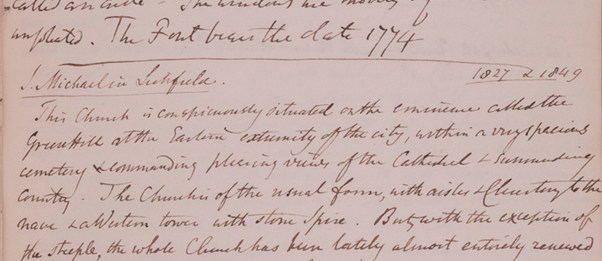
Stephen Glynne’s notes on St. Michael’s church in Lichfield are brief and mainly straightforward. They are oddly dated 1827 and 1849, but the description is clearly from a visit in 1849 after the extensive “restorations” of the early 1840s. There are a couple of entries on a blank facing page however that refer to the pre-restoration church and that might refer to an 1827 visit (given at the end of the transcript below).

The transcript

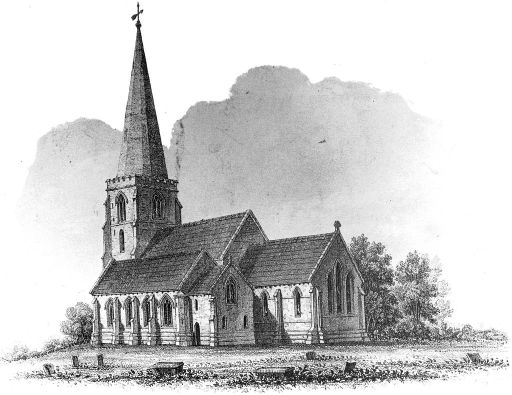
The church is conspicuously situated on the eminence called the Greenhill at the eastern extremity of the city within a very spacious cemetery commanding pleasing views of the Cathedral and surrounding county. The church is of the usual form with aisles and clerestory to the nave and a western tower with stone spire.  But with the exception of the steeple, the whole church has been lately almost entirely renewed and in great measure rebuilt in tolerably good style. The steeple which is of red sandstone, appears to be a three ?? (1) of plain kind. The tower is embattled with corner buttresses, a string course under the belfry only. The belfry windows of two lights on the north and south is a long ??? slot -a questionable lancet on the west, but no west door. The spire is octagonal but not ribbed, having three horizontal bands and two tiers of spire lights, which are on the same sides. The north aisle, as rebuilt, has a low pitched roof and a battlement with three Perpendicular windows. The south aisle is wider and loftier with a high pitched roof and Perpendicular windows, varying in tracery. At the east end has been added a gabled chamber for receiving the Organ (2). The nave is of four bays, the arcades with pointed arches and octagon columns. The chancel has been wholly rebuilt in the Perpendicular style – its east window a triplet and on each side three single lancets. The chancel is groined, the ribs springing from shafts (3). The clerestory of the nave has a  high pitched tiled roof and windows of two lights. The north porch is set in the western bay .

(4) The ancient chancel had a three ?? (1) east window, and the former chancel, as appears from a view in Shaw’s Staffordshire, had a quasi clerestory, an upper tier of windows. The whole of the former church was perpendicular.

Notes

1. This symbol can’t be read, but it is the same at both places where it occurs.
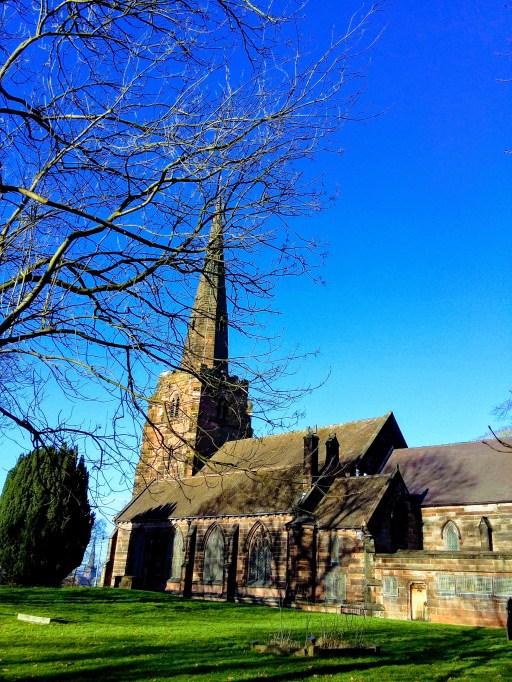
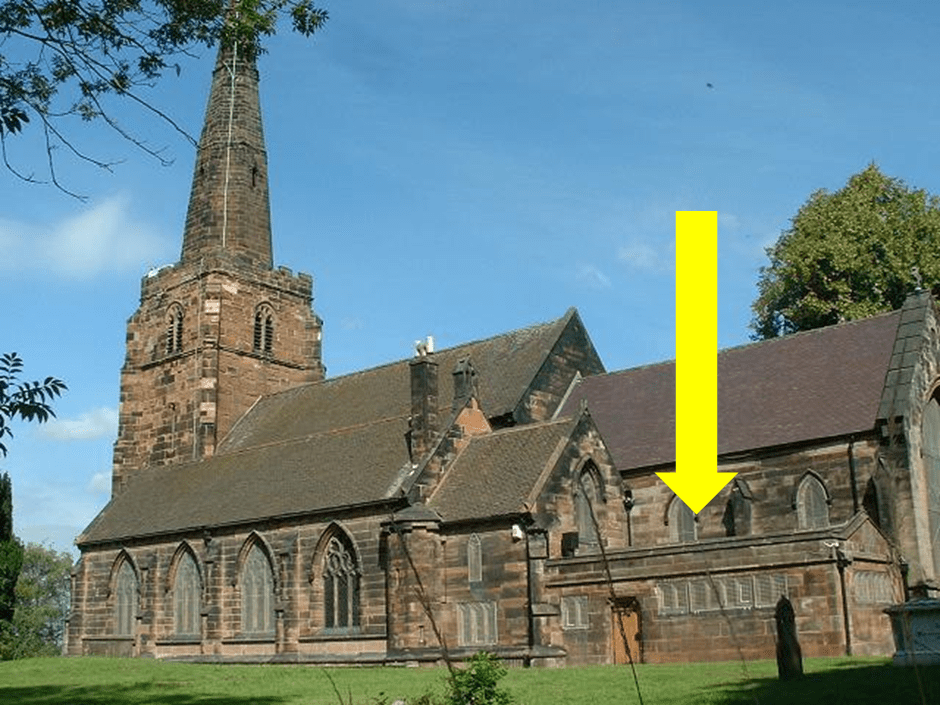
2. The description of the church matches what can be seen today, with one exception – the description of a gabled chamber for the organ. This clearly refers to a structure that was replaced by the current choir vestry in 1923 ad can be seen inthe foreground of the picture above.
3. The restored chancel was itself significantly altered in the late nineteenth century, with much of the work of the 1840 restorers removed or altered.
4. The text in this paragraph probably refers to an 1827 visit.

Saddlebacks and serendipity

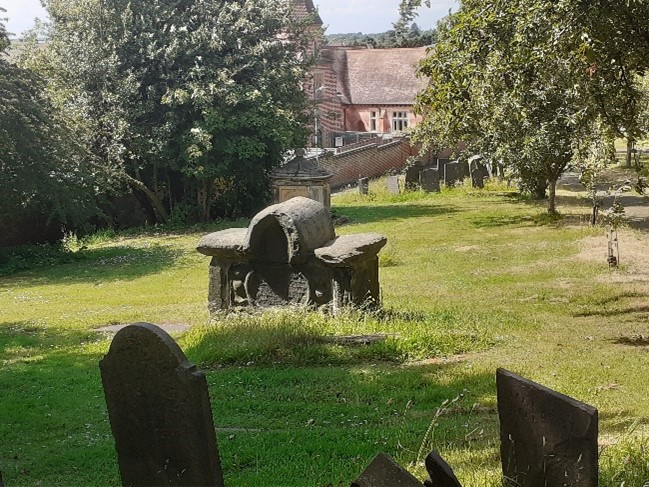
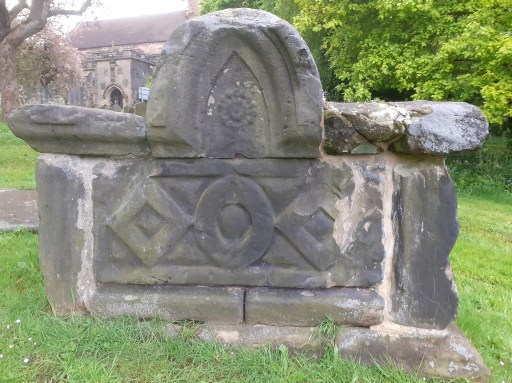
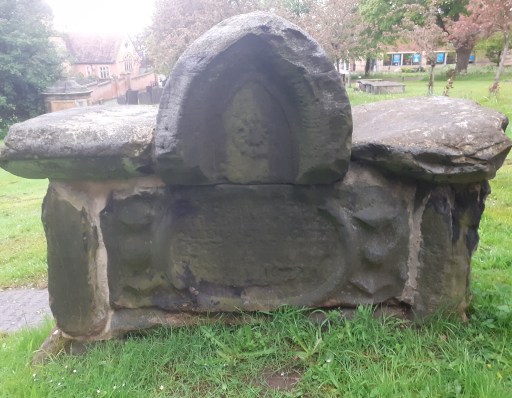
In 2021 I discussed  some of the early graves in St. Michael’s churchyard in Lichfield. Amongst these was the distinctive “saddleback grave” shown in Figure 1 below, one of the five listed monuments in the churchyard. At the time I wrote as follows.

The inscription is very worn and the dedication of the monument can’t be read. This grave features in a nineteenth century drawing that is in the William Salt library ……. That drawing gives the date of the grave as 1674, and with a little imagination this can be made out on the tomb itself. Apart from the date, it is the style of the grave that makes it so distinctive. It is a shame that the dedication is illegible.

Figure 1 The Saddleback grave in 2021

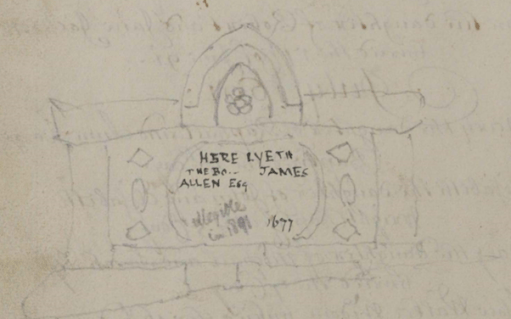
And this is where serendipity comes in. Over the last few days I have begun to think about filling in some of the gaps in my long term project to collate the memorial inscriptions of St. Michael’s churchyard with the burial registers – specifically to include material from the early registers up to 1812. A very helpful archivist at Staffordshire Archives told me that these have been scanned and can be found on Find my past. So I have been busy doing some mass downloads of the material during my seven day free trial (as you do). Whilst doing this I came across the sketch shown in Figure 2 in the register from 1680-1741, on a blank page opposite the entries from November to March 1691 (note this was before the calendar change!)

Figure 2. The sketch from the 1680 to 1741 Register

It clearly shows the Saddleback grave and gives the inscription as

Here lyeth the bo… of James Allen Esq…..1677

There is another note in lighter script that says

Illegible in 1891

So it seems we have an identification of the occupant of the Saddleback grave – although the date is given as three years later than indicated on the William Salt picture. Checking back on the records however in the 1574 to 1680 register, the only entry that corresponds to the name is from 1674

April 13th Mr James Allen, Magistrate, Beacon St

Beacon St is somewhat conjectural however – it is not easy to read. So it looks as if the William Salt date is the correct one.

The registers tell us little else. There is an entry for the marriage of James Allen (Gent) to Mrs. Hester, daughter of Richard Pyot (Dyot?) in November 1658 at St. Mary’s which seems possible. However this was in the Civil War / Commonwealth period when records become very patchy, so there may have been other about with the same name. If any reader knows more of James Allen, then please let me know. But a least we now have a name.

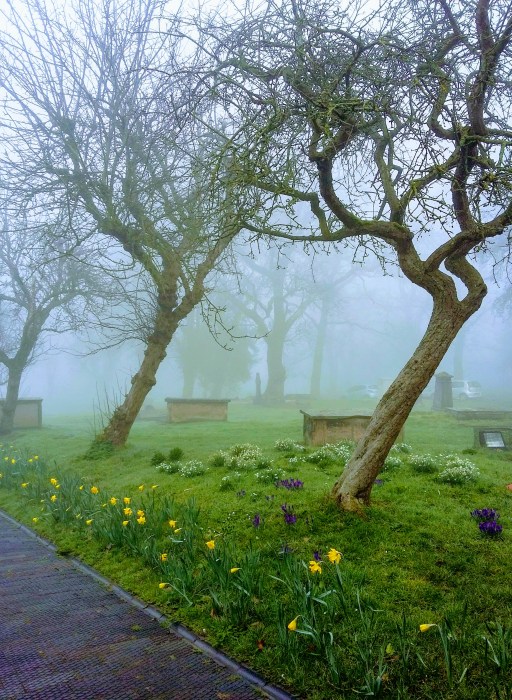
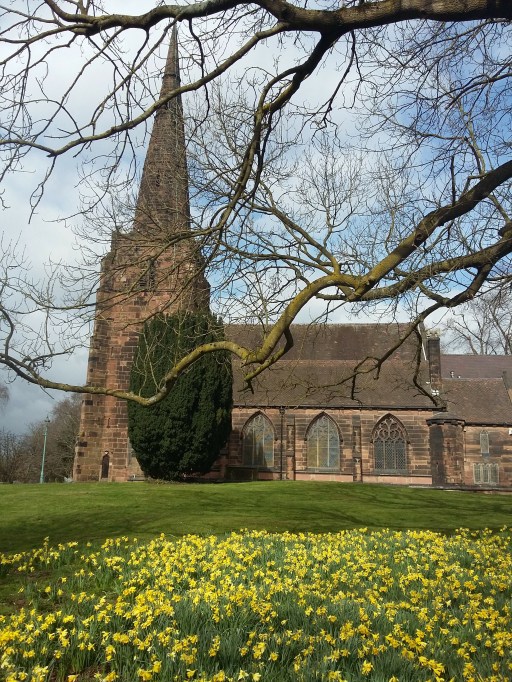
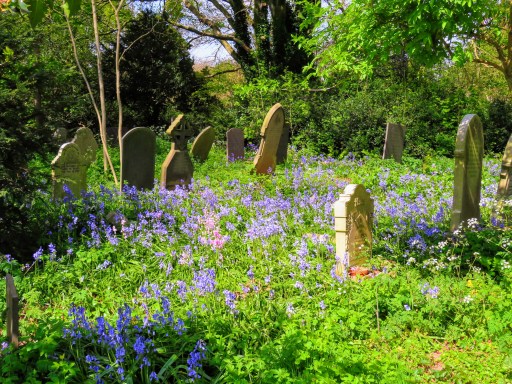
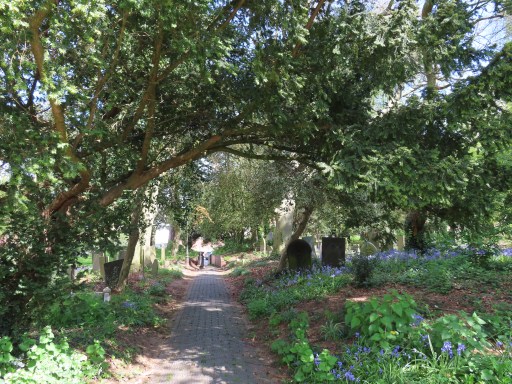
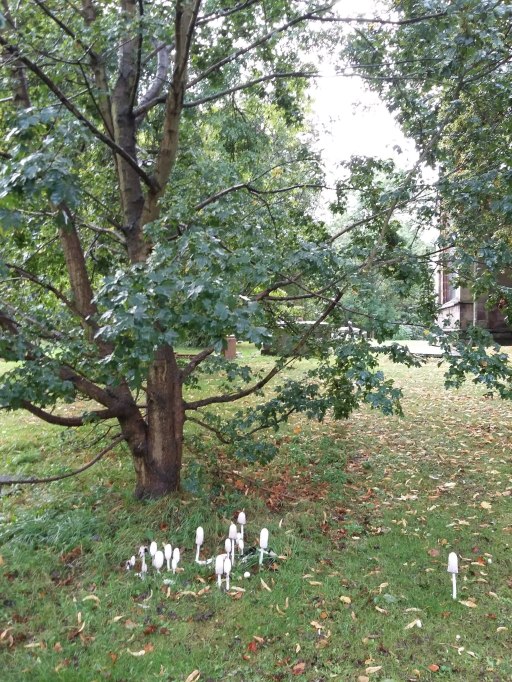
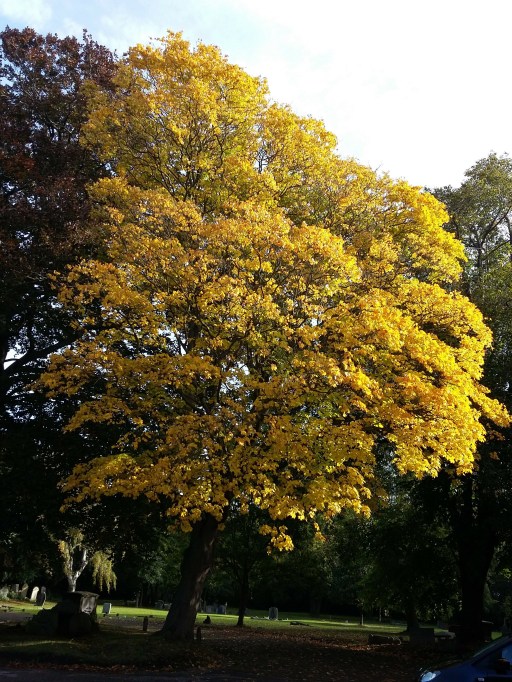
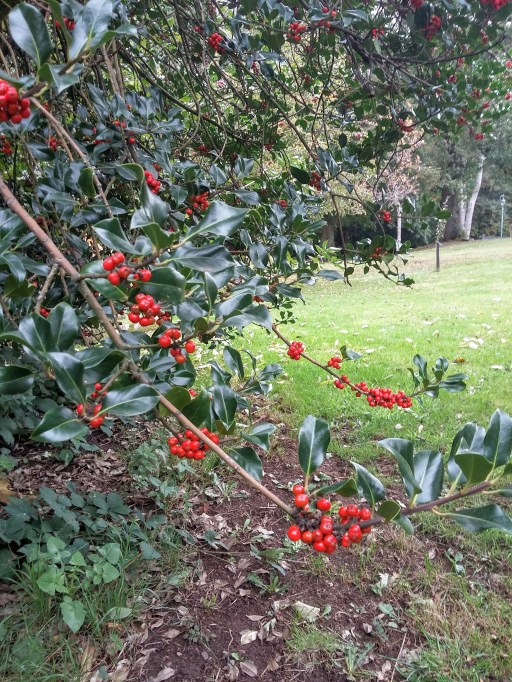
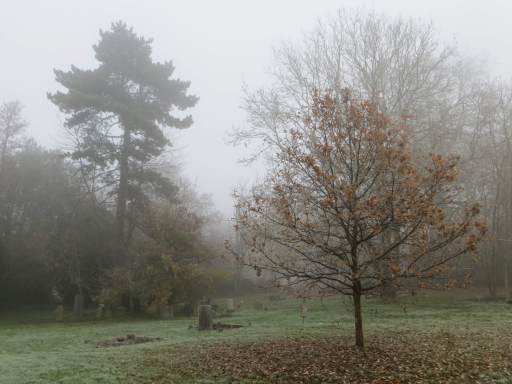
St. Michael’s Churchyard, Lichfield through the year

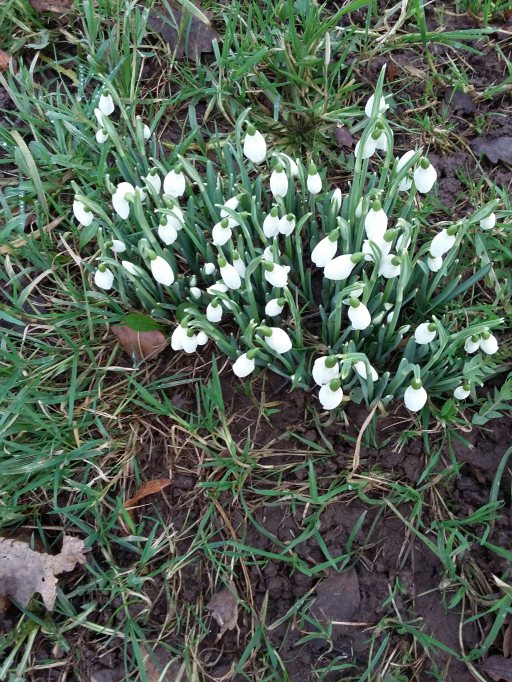
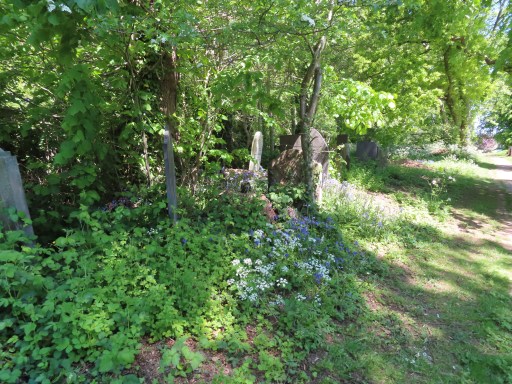
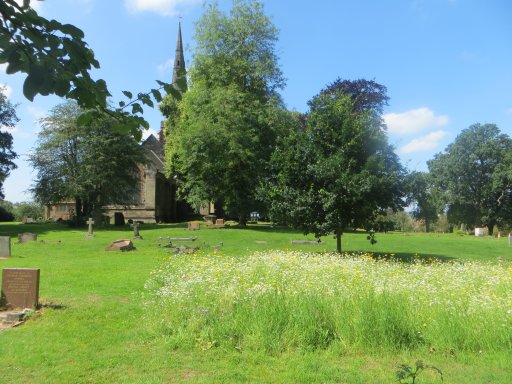
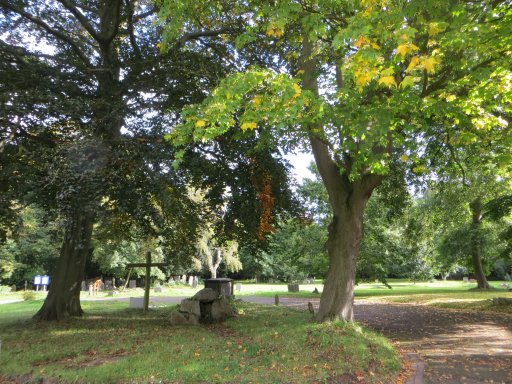
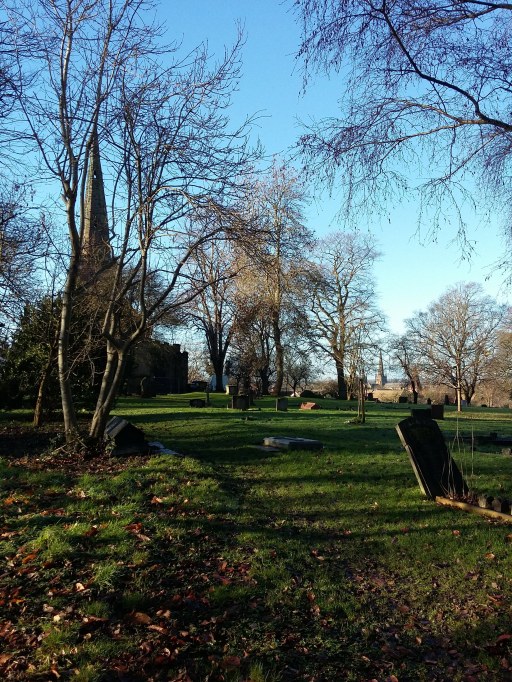
A picture blog featuring the photographs of Maureen Brand – evocative pictures of the churchyard of St Michael in Lichfield through the changing seasons.

Nore information on the church and churchyard can be found using the buttons below.

The final sermon

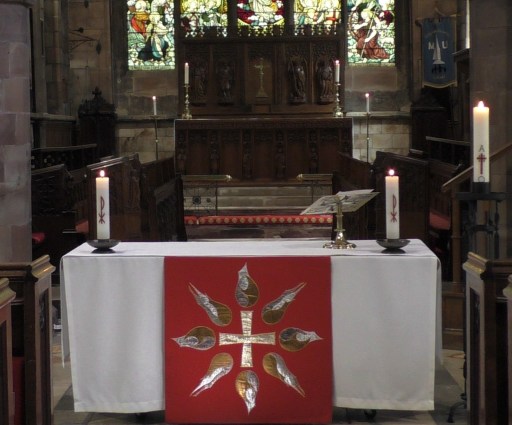
The altar at St. Michael-on-Greenhill Lichfield, with Pentecost frontal

It hasn’t been my habit to publish my sermon output on this site for two reasons – firstly, sermons always have a context – a time, a place, a certain set of hearers etc. and, my sermons at least, would lose much of their force outside this context. And secondly, I hardly ever write down my sermons, so preparing them for the web would be extra effort! But the sermon below is a significant one for me – the last sermon I preached at St. Michael-on-Greenhill in Lichfield on Pentecost 2023, and the last time I celebrated the Eucharist, having ministered there as a non-stipendiary minister for 25 years – and it seemed appropriate to record it. But it needs to be said that the text below is only a rough approximation to what was actually said, written down after the event.

As ever when working on sermons it is a learning experience, and from my perspective there are two insights that seem to me important (that do not particularly feature in the sermon). The first is the significance of the presence of Mary the mother of Jesus at the events described in Acts 2, and the striking parallel between the coming of the spirit upon her at the Annunciation and the Pentecost events. These were in both cases a creative act – the incarnation and the creation of the church, and Mary was the only one present who had experience the overshadowing of the Spirit before the Pentecost event. Of course this has been blindingly obvious to many in the past, not least to the entire catholic church (and see for example here for a recent non-catholic discussion) but its importance has only just dawned on me. The second point concerns the coming together of all the members of the early church between the Ascension and Pentecost. It seems to me that this could have implications for the beginning of the various gospel traditions. This period offered a chance to for all those present to tell and to hear all of the different disciples’ experiences of what Jesus said and did – stories that were eventually used by the different gospel writers in their own distinctive and idiosyncratic ways. The sources of the Petrine, Johanine and even the Q tradition, can perhaps be located in the stories the early church told each other in this period.

The sermon follows below the rather striking and inspirational depiction of Pentecost by Jean Restout below, which puts the figure of Mary in the centre of the event. The sermon will be found to be somewhat less striking and inspirational.

Jean Restout  (1692–1768) Pentecost

Acts 2.1-21 John 20.19-23

When the day of Pentecost came…..

Pentecost was, and indeed still is, one of the major festivals of the Jewish liturgical calendar, 50 days after Passover. It is both a harvest festival, and the annual remembrance of the giving of the law to Moses on Mount Sinai. Jerusalem would have been busy with pilgrims from Judea and Galilee and from the whole Jewish diaspora around the Mediterranean and the Middle East. The followers of Jesus, were indoors, perhaps still keeping a low profile, as at least for some of them, it might well be dangerous for them to be seen in public following the events of 50 days before. Luke, the writer of Acts, tells us they were all together in one place. As he has already told us in the previous chapter that there were around 120 followers of Jesus at that time, this implies somewhere rather large – perhaps with an internal courtyard, or that we shouldn’t put to much weight on the word “all”. At any rate it was a diverse group that gathered there – the eleven disciples and Matthias who had replaced Judas; the women who had supported Jesus financially during his ministry, including Mary Magdalene; perhaps those disciples who lived in the vicinity of Jerusalem – Mary, Marth and Lazarus, and Joseph of Arimathea and Nicodemus; and also members of Jesus’s family – certainly his mother Mary was there. And as they gathered together in prayer and worship, although they weren’t as terrified as they had been following Jesus’s death, they were perhaps puzzled, not knowing what to expect. In the finality of their last meeting with the risen Jesus, he had told them to wait in Jerusalem, and he would send the Holy Spirit to be with them. What were they expecting? They would know what the scriptures said about the Holy Spirit of course. God sent his Spirit powerfully on judges, kings and prophets to give them the ability to perform the tasks he had given them, often in difficult and dangerous circumstances. But they would also know of what the first few verses of Genesis says about the Holy Spirit.

“The earth was a formless void, and the Spirit of God hovered over the face of the waters”

The Spirit hovered over the formless primeval chaos. The metaphor here is picked up in the book of Deuteronomy where the same words are used to describe the mother eagle spreading her wings over her brood and lifting them gently in her talons, and indeed the verse can also be translated as the Spirit of God brooded over the face of the waters. The waters, the deep, would have been regarded as a place of terror, the deep places of the Leviathan. And the Spirit hovered, brooded over the primeval chaos and the terrors of the deep, to bring creation in to being, to give it birth and to nurture it. This same metaphor occurs throughout scripture. The psalmist frequently cries

“Hide me under the shadow of your wings.”

 The creative, nurturing, protective Spirit. The psalmist also speaks of the ever-present Spirit

“Where can I go from your spirit? Or where can I flee from your presence? If I ascend to heaven, you are there; if I make my bed in Sheol, you are there. “

But as well as these verses from Scripture describing the action if the Spirit, the disciples who gathered that day would have added their own personal knowledge. Some would have remembered the words of the Baptist.

‘I baptize you with water for repentance, but one who is more powerful than I is coming after me; I am not worthy to carry his sandals. He will baptize you with the Holy Spirit and fire.

Some will have remembered the Spirt, like a dove, descending on Jesus at his baptism. There were also the words of Jesus himself, describing the Spirt as a bringer of comfort and peace, equipping them for what was to follow, and being with them always. Then perhaps they would have listened to the one amongst them who had actually experienced the coming of the Spirit. Perhaps it was at this time that Mary would have told the group of the coming of the angel, her overshadowing by the Spirit, and her submission to God’s will,

“Be it unto me according to your word.”

And too, she might have told of the prophecy of Simeon that a sword would pierce her own soul, and the dreadful fulfillment of that prophecy.

But, based on all of these things, just what were they expecting? Almost certainly not what actually happened. Suddenly the house was filled with light and noise, a light that seemed to focus down on each one of them, bringing to each a realization of the presence of God. Much scholarly ink has been spilled on the significance of the wind and flame, but I doubt at that time the followers of Jesus stopped to think “This is rather like what the Baptist said would happen” or “The wind and the flame are symbols of Pentecost, of the giving of the law at Sinai”. No, for them, it was an objective, overwhelming experience. For Peter maybe the final assurance of his forgiveness for his betrayal; and his commission as leader of the group; for John, the disciple whom Jesus loved, the renewal of intimacy with his closest friend; for Mary Magdalene, told by Jesus not to cling to him, the all encircling presence of her Lord and teacher; for Joseph and Nicodemus, the burning intensity of the life in Jesus, whose cold body they had laid in the tomb; for Jesus’ family, the return of their beloved big brother; for Mary, the inexpressible joy at the presence of the spirit of her son, the erasure of the pain of the piercing sword. All their experiences with Jesus found their fulfillment at this point, and from there something new flowed. But for all of them, and experience of the overwhelming Spirit of Jesus, that forced them out of the house into the city, praising God and then, through a miracle of interpretation being understood by all, now matter where they came from.

Finally, through the chaos and the cacophony, Peter pulled himself together, perhaps stung by the accusations of drunkenness, and interpreted the events in the best way he could – going back to the prophecy of Joel that, on the day of the Lord, the spirit would be given to God’s people, the old would dream dreams, and the young would see visions.

It is often said that Pentecost is the church’s birthday – and in the years that followed, the Holy Spirit hovered, brooded over the nascent church, nurturing it through its growing pains – and they were indeed pains, that pierced as sharply as any sword, as the followers of Jesus came to the realization that the life of that body couldn’t be contained within the confines of Judaism, but was for the whole world, and they had to let go of much that was precious to them to allow this to happen.

So, what are our expectations this morning? Have we come here, just looking for a quiet break from the affairs of the week; or thinking that because its Pentecost, there will be some good hymns to sing; or perhaps to have a glass of wine at the end of the service to celebrate finally getting rid of the preacher after 25 years? If so, perhaps we need to raise our expectations somewhat.

Today, as was the case almost 2000 years ago, the Spirit still broods over the church, overshadowing us, offering us forgiveness and reconciliation, renewal of faith that has gone cold, stability in the chaos that surrounds us and hope for the future, the calming of our own terrors, offering new life and the outpouring of God’s love; waiting for us to turn and accept that invitation “Lord be to me according to your will”.

The Spirit today hovers over Greenhill, calling on those to us who belong to the church of the Archangel, calling for the old to dream dreams and the young to see visions. I suspect looking around there will be a preponderance of dreams. But what are our dreams for the future of the church in this place? How can we work with the brooding, nurturing Spirit to bring those dreams to reality?

And finally, as 2000 years ago, the Spirit sends us out – perhaps not to the market square (where in any case we would have trouble fining space in the middle of the Bower fun fair) but to go about our lives serving and meeting the needs of those around us, wherever that might be. And he promises to never leave us. With this in mind we return to the words of the psalmist.

Where can I go from your spirit? Or where can I flee from your presence? If I ascend to heaven, you are there; if I make my bed in Sheol, you are there.  If I take the wings of the morning and settle at the farthest limits of the sea, even there your hand shall lead me, and your right hand shall hold me fast. If I say, ‘Surely the darkness shall cover me, and the light around me become night’,

even the darkness is not dark to you; the night is as bright as the day, for darkness is as light to you.

Or in the old words, which are still the ones that come immediately to my mind.

 Whither shall I go from thy spirit? or whither shall I flee from thy presence?

A little more on a Nurse’s Grave

In a recent post I set out what we know of Elizabeth Logan, a nurse who swerved with Forence Nightingale in the Crimea and who is buried in St Michael’s churchyard. Towards the end of the post I wrote

” In addition, sadly, her grave can no longer be positively identified, and there are a number of broken or very worn monuments in the region where a1984 survey by the Birmingham & Midland Society for Genealogy & Heraldry (Midland Ancestors)  suggests it is to be found.”

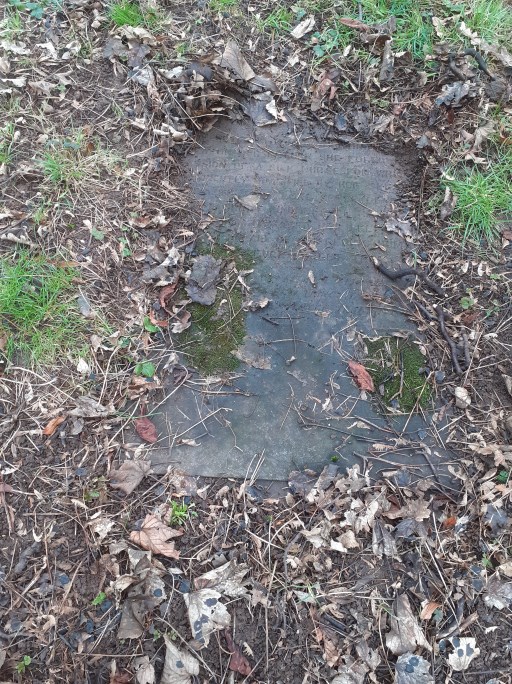
Thankfully her headstone has now been found, not by me, but by my wife who took all of 60 seconds to find what I had spent several hours looking for. My only excuse is that I was looking for a reasonably vertical headstone rather than one laid flat and half buried under grass – see the photo below. It can be seen to be in rather poor condition, and clearly some thought needs to be given as to how it can be better cared for and displayed.

100th Anniversary of the dedication of the choir vestry at St Michael’s church in Lichfield.

The location of the choir vestry

From the Staffordshire Advertiser January 13th 1923.

St. Michael’s Church. Lichfield. New Vestry erected at a cost of £1,200

On Sunday evening the large and commodious vestry which has recently been erected at the south east corner of St. Michael’s Church, Lichfield, to replace the small and inadequate room utilized by the clergy and choir in the past, was dedicated by the Archdeacon of Stafford (Rev. High Bright) in the presence of a large congregation.

At the morning service the Rector (Rev. Percival Howard) took advantage of the opportunity to refer to the important improvement which the vestry has made to the church, and in the course of an appropriate address outlined the course of the restoration of the church in the years 1842 and 1890 ……….

There follows a very lengthy description of all the alterations made between 1842 and 1892, before finally returning to the matter in hand.

…….. Since then no structural alterations had taken place until last year, when the Parochial Church Council decided to put in hand the building if a new vestry. This work has now been completed under the direction of Messrs. Bateman and Bateman, Architects, by Messrs. R. Bridgeman and Sons, and in place of the old and inadequate vestry, a large and commodious room has been created, which the Rector thought they would all agree was a handsome addition to the church, and in perfect keeping with the rest of the architecture. To prevent the smoke and fumes entering the church, considerable alteration has also been made to the flue. The whole of this work, which had cost £1,200, has been carried out without an appeal thanks to the generosity of their forefathers, who had left an endowment for the benefit of their church.

Following the dedication on the evening, the Archdeacon preached from the text “Seek ye My face! My heart said unto me, Thee, they face Lord, will I seek (27th psalm, 8th verse)

The congregation included the Mayor (Councilor J. H. Bridgeman), the Sheriff (Mr W. E. Pead), the Town Clerk (Mr W. Brockson) and a number of other leading citizens.

It is tempting to think that the alterations to the flue were to remove the smoke and fumes generated by the clergy and choir, but these were probably something to do with the boiler house beneath the vestry! And for all the praise heaped on the design, the roof has leaked continually over the last 100 years.

Of the people mentioned, the mayor, J.H Bridgeman was the son of Robert Bridgman, who was an earlier mayor and the founder of the Ecclesiastical Architects Robert Bridgman and Sons. The firm had many local commissions including the east front of the cathedral. Both Robert and John are buried in the churchyard. Mr Pead, the Sheriff wrote a lengthy war diary describing the war in Lichfield, that was published and is available on Google Books. The Rector at the time, was Percival Howard (Rector 1913-1946), who served as an army chaplain in the Great War, and reports of his leaving presentation suggest he was highly regarded in the parish. There is a memorial to him in the chancel.

But after a hundred-year life, changes are in the air. The new parish rooms are intended to be connected to the church through the choir vestry, so that part of the church will see major changes in the next few years. But a hundred years for £1200 still represents pretty good value for money.

A nurse’s grave

In the records of headstone inscriptions for St. Michael’s churchyard in Lichfield, we find the following entry.

Sacred to the memory of Elizabeth Logan who died February 28th 1878. Having acted with Miss Nightingale in the Crimea on her return she followed the profession of sick nurse for which she was eminently qualified by her skill and experience. A strong sense of duty and great kindness of heart. No one who witnessed her self—denying exertions in aid of suffering humanity could ever forget them. Well done good and faithful servant. Thou hast been faithful over a few things, I will make thee ruler over many things. Enter thou into the joy of thy Lord.

The burial register tells us that she was 66 when she died and the register and lived on Dam St. In the 1861 census she is recorded as a nurse, lodging with a greengrocer and his wife on Market Street. She there identifies herself as “Mrs” and her birthplace is given as Glasgow. This leads me to conjecture that she was widowed before she went to Crimea, and probably had no children, although there are lots of other possibilities of course.

In the records of Miss Nightingale’s nurses she is noted as coming from Edinburgh and having been recommended by “Dr Simpson and others and committee of Nursing home” and was “one of the very best nurses, returned on the Ottawa, July 1856”. Florence Nightingale writes of her to her friend Lady Cranworth, from the Barrack hospital at Scutari in early July 1856.

My probable last letter to you is merely to say that Elizabeth Logan, nurse, whom I have sent home by the Ottawa is, on the whole, the one I consider the most respectable and sober, efficient, kind and good of all my nurses, the one I most hope not to lose sight of, the one I have the deepest regard for. She wishes for a private situation. If she comes to you for a character, I think you may be perfectly safe in recommending her. She is an excellent nurse.

Praise indeed from such as she. We read of Elizabeth briefly again in August 1856 when she wrote to Miss Nightingale saying her wages had not been settled (one presumes by the army), and in February 1857 when she wrote thanking her “for the Sultan’s gift and for her help in securing her present agreeable situation”. Would that we knew what the gift and her situation was!

And that is about as much as we know of her. The fact that she was probably a widow with her husband’s name makes her very difficult to trace through the census and baptism and marriage registers. Indeed Elizabeth Logan is not an uncommon name in Glasgow and Edinburgh around that period. So we have no details at all of her early life, or what she did when she returned from Crimea, other than that she finished up in Lichfield. In addition, sadly, her grave can no longer be positively identified, and there are a number of broken or very worn monuments in the region where a1984 survey by the Birmingham & Midland Society for Genealogy & Heraldry (Midland Ancestors)  suggests it is to be found. But the presence of her grave in the churchyard does balance to some degree the many soldiers graves found there, including of those who fought in the Crimean War.

So to end with a plea – if any reader can provide any more information about her life, it would be hugely appreciated.

The Churchyard at St. Michael’s, Lichfield – registers and records

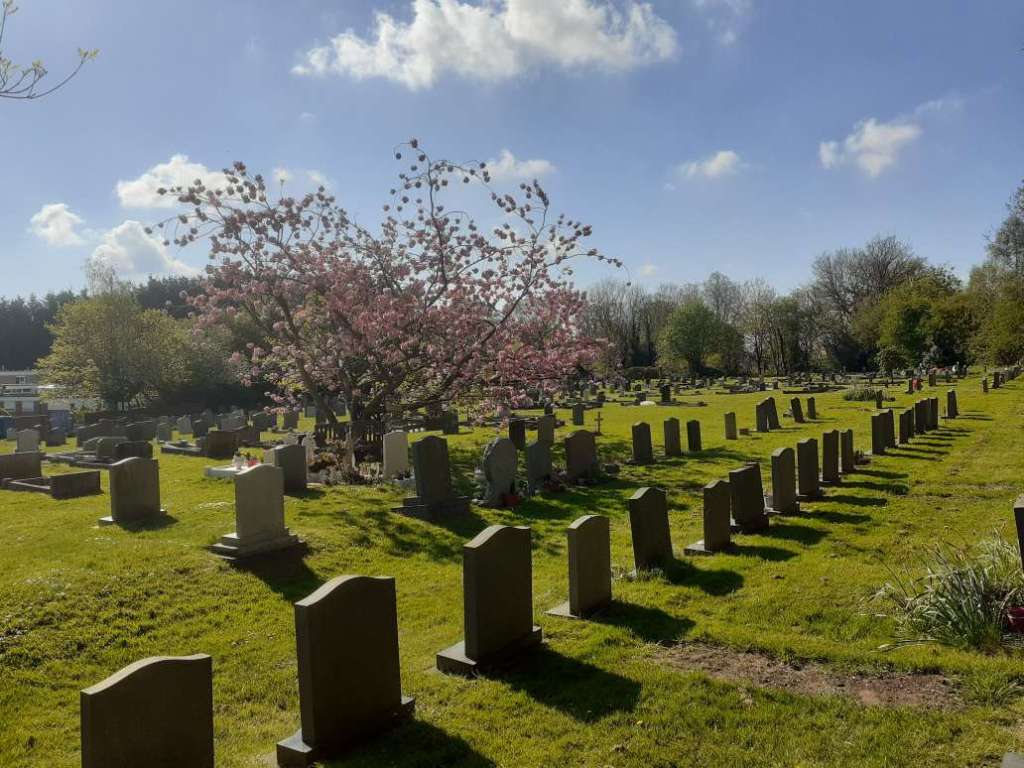
The churchyard of St Michael on Greenhill in Lichfield is very large and of some antiquity, with indications that it was a place of worship well before the Conquest. Today it comprises two sections – the old churchyard, which was formally closed to new burials in the late 1960s, and the new churchyard, which opened in 1944 and is still in use, although burial space is becoming very restricted. Both contain numerous graves and monuments, and the churchyard is of considerable interest to both local historians and those involved in family history research. Unsurprisingly, the church receives many requests for family history searches. 

In the past two surveys have been carried out of the graves and monuments – one of the grave positions by the local council in 1967 before the reordering of the old churchyard and the moving of the headstones, and one if the monumental inscriptions in 1984 by the Birmingham and Midland Society for Genealogy and Heraldry (BMSGH). There is also a full set of burial registers available from 1813 to the present, with those to 1905 having been transcribed in 2005 by the Burntwood Family History Society.

Over the last few months, I have been occupied in working on a project to bring together all the grave and register information into one spreadsheet that can be publicly accessed by those interested in researching their own family history. The results of this project can be found on a series of web pages that can be accessed from the button below. In developing these webpages, the 1967 and 1984 surveys have been collated and the latter has been very considerably extended to include memorial inscriptions up to 2012. A significant number of what appear to be typographical errors in both surveys have also been corrected (and no doubt others introduced). The registers from 1906 to 2012 have also been transcribed. The debt to those who produced the original surveys and inscription transcripts remains significant.

The material is presented as follows.

  • An introductory page.
  • A page that contains maps and plans that define the positions of graves and monuments from the 1960s to the present. The situation is complex, with a number of different classification systems used over the decades, and the headstones being moved to different locations.
  • A page that links to sub-pages which describe the current state of the various grave areas and clusters within the churchyard and contains photographs of the more notable monuments.
  • A page that links to and describes the downloadable spreadsheet that contains all the register and monument information in a searchable format. These include, for each entry in the registers, the surname and Christian names, death date, cremation date and interment date (where available), the inscription on the grave, and indications of original gave location and current headstone location within the churchyard.

In addition, photographs have been taken of all extant headstones. Although web site storage limits do not allow these to be uploaded, they can be obtained on request.

There is of course much more that could be done. The information in the spreadsheet can be used to carry out a detailed demographic analysis and analysis of funeral practices; there is much information there that can be integrated into the very long history of St Michael’s church and parish; and there is much, much more to be said about the lives of those who found their last resting place in the churchyard. Over the course of the next year or two, I hope to follow up on all of these. So watch this space – but don’t expect anything very quickly!

A view from St. Michael’s church in Lichfield in 1840

Recently, whilst searching for some lost material in the choir vestry at St. Michael’s, I came across a framed version of the picture shown above, which is one that I have not seen before.  It shows a view from the north side off the church looking out over the city in 1840. In some ways it is very familiar, with the cathedral in the background, and in the middle distance, towards the left of centre, we can see St Mary’s, but without its spire that wasn’t added until the rebuilding of the 1850s and 1860s. In front of St. Mary’s, we can see the back of houses that were on Greenhill, and housing in the area that we know as Deanscroft but was more usually referred to at that time as Dean’s Croft. Indeed parts of this were still owned by the Chapter of the Cathedral in the 1840s. The Greenhill / Church St / Dean’s Croft area was quite densely populated at that time. Now that area is largely taken by the old school buildings (built in stages in the second half of the nineteenth century). The position of the cathedral and the houses enables the position of the artist to be determined fairly accurately – see the map below.

The solid red circle shows the approximate position of the artist, the open red circle the position of the Emery tomb, and the red ellipse the position of the Harrison tombs.

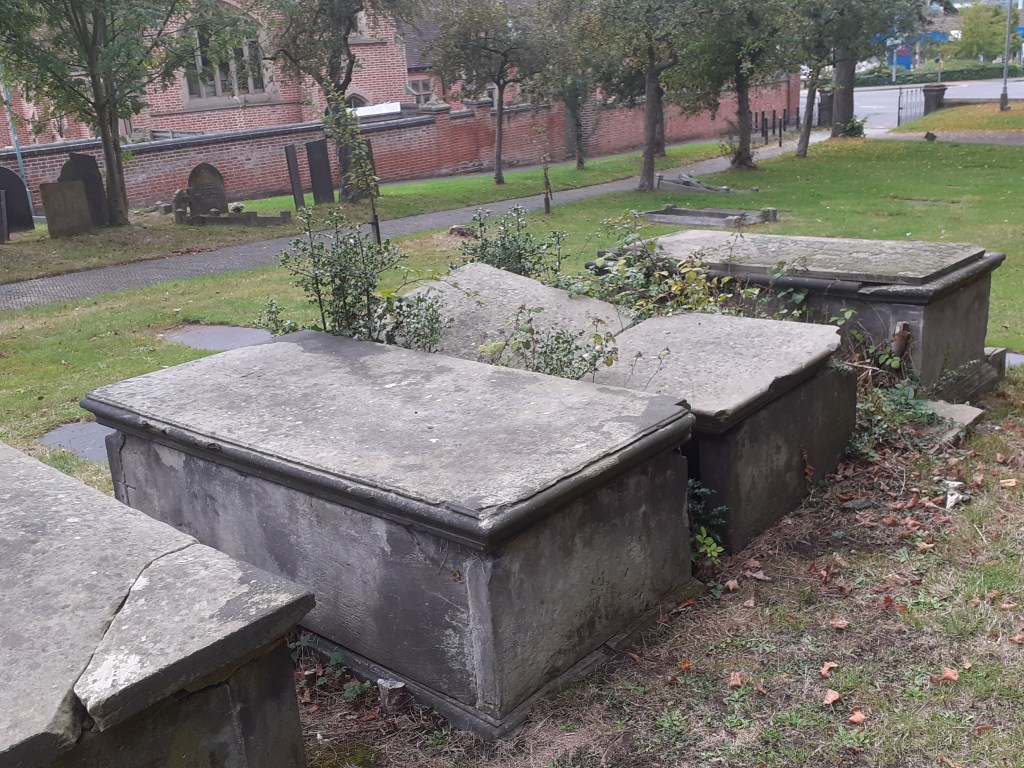
But it is in the foreground that we see the major changes when comparing this picture with what we see now, with many more graves and monuments visible than is now the case. But here all is not all that it seems. Firstly, it is puzzling that the avenue of trees that leads from the church door to the north gate is not shown. This was planted as an avenue of elms in the 1750s and should have been visible. Perhaps they obscured the view, and the artist, as was his or her prerogative, thought it best to omit them. Secondly it is difficult to reconcile the grave locations in the picture with those currently visible. A photograph that shows roughly the same view is shown below. Whilst many of the headstones were laid flat in the re-ordering of the churchyard in the 1960s, the chest tombs were generally left in position, and these have usually survived to the present day.

The current view, showing the Emery tomb to the left and the Harrison tombs to the right

What remains in today’s view is the large Emery chest tomb to the left, and the rather dilapidated row of chest tombs to the right. The details of the graves in the picture from 1840 are a little different in the photographs with different grave styles and only three graves in the row to the right, again suggesting the use of “artistic license” in the drawing. Some of the grave details are reminiscent of those on other chest tombs in the graveyard, so the artist might have been trying to capture a range of details not completely in the field of view. The ground level also appears to have changed, with a build up of the ground around the base of the tombs so that they appear lower than they did originally. This is due to many decades of grass growth and mowing, leading to a steady increase in height of the ground surface.

Returning to the graves themselves, the inscription on the Emery tomb was recorded in the 1980s as follows, although much of this is no longer readable.

Sacred to the memory of WILLIAM EMERY died December 9th 1767 aged .9 years. And of MARY his wife who died… Also of ELIZABETH and ANN daughters of WILLIAM and MARY EMERY. ELIZABETH died January 27th 1773 aged 16. ANN died…… WILLIAM who died March 12th l…„and ANN EMERY his wife died July 8th 1825 aged 66. Also JOHN son of RICHARD and ANN EMERY died January 18th 1853 aged 46. And of RICHARD EMERY who died February 23rd 1826 aged 72 also ANNE wife of above died December 17th 1863 aged 82.

Those to the right are largely of the Harrison family. Again in the 1980s the inscriptions were transcribed as follows.

Rev. JOHN HARRISON son of THOS. and FRANS. HARRISON died January 22nd 1793 aged 39. THOMAS HARRISON son of THOS. qnd FRANS. HARRISON died December 31st 1807 aged 48

Here lieth the body of ANN the wife of SAMUEL HARRISON who departed this life  Jany 1st 1785 aged 48. Also near this place lies the body of JESSE DEE (brother to the said ANN HARRISON) who died June 1st 1785 aged 39

To the memory of SAMUEL HARRISON who died April 2nd 1798 aged 62.

In memory of Sarah Harrison who departed this life July 28th 1835 aged 72 years

These tombs have seen better days as can be seen from the close up picture below.

The Harrison tombs

Of course, what is also missing from the modern photograph is the sheep – the nineteenth century version of the council grass mowing machine – and the rather elegantly dressed family who are walking down the path from church. The husband and wife are very clear, but their two young children less so. In the original picture there is a similarly dressed gentleman sitting on a chest tomb that is no longer identifiable, apparently studying his laptop, although this is probably not the correct interpretation!