Traces of the 1918 Spanish flu pandemic in St. Michael’s churchyard, Lichfield

Background

Over the last decade or so, I have collated a great deal of information concerning the interments in the large churchyard of St. Michael’s church in Lichfield, bringing together burial register entries and monumental inscription surveys into one searchable spreadsheet. This has proved to be useful for family history researchers in particular. The data has also allowed me to carry out a fairly detailed analysis of how patterns of death and burial have changed over the two hundred year period since burial registers were introduced in 1812, The results of this work can be found elsewhere on this website in the paper “The changing face of death“.

Now of necessity this analysis, dealing with 200 years of data, has used fairly broad data averaging periods to examine long term trends, and most of the analysis used data averaged over 10 year periods. Thus the effects of any events that occur over a shorter time period will not be visible in the results. Now recently I have been reading a number of papers and reports about aspects of death, burial and cremation and have come across repeated references to the Spanish Flu epidemic of 1918 / 1919. This has led me to wonder if there is any trace of the deaths caused by this epidemic in the St. Michael’s churchyard data. As esch wave of this epidemic occurred over a period of a few months, an analysis over much shorter time scales than I previously used was required. This blog post presents the results of this analysis, and is supplemented by newspaper material from the period that illustrates how the pandemic was viewed in the wider Lichfield area.

Burial numbers 1918/1919

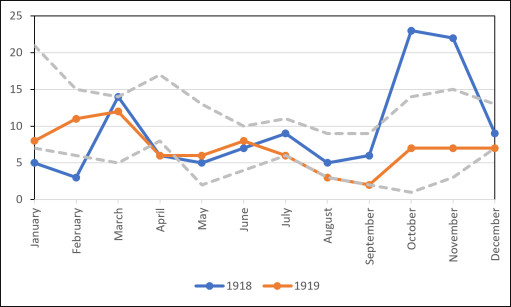
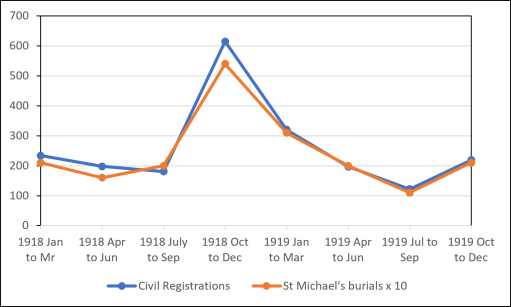
The analysis of burial numbers looked at two sets of data. The first was the information from the burial registers. This was analysed over annual, quarterly and monthly periods from 1910 to 1920. The second set of data was from the Civil Death Registration database for the Lichfield Registration area. This is much larger than the parishes of St. Michael and St. Mary that use the churchyard, and also much larger than the city of Lichfield itself. It extends to the surrounding towns and villages, including Brownhills, Burntwood and Rugeley. Data was analysed over annual and quarterly periods. The results of the analysis are shown in Figure 1 below. Figure 1a show the annual data for the two sets of records. The St. Michael’s data has been multiplied by a factor of 10 for clarity. In general the results imply that the number of burials recorded in the St. Michael’s records are around 10 to 15% of those for the entire registration district, which seems reasonable. The civil registrations show a significant peak in the data for 1918, but such a peak is not apparent in the St. Michael’s data. Figure 1b show quarterly burial numbers and registrations for 1918 and 1919. Here both datasets show a significant peak in the last quarter of 1918, which ties in with historical records that the epidemic was at its peak over this period. Figure 1c shows the monthly data for the St. Michael’s burials for 1918 and 1919 only. The dotted lines show the spread of the monthly data for the years 1910 to 1917.The 1918 data shows a low number of burials in January and February, below the 1910 to 1917 spread of data, and a major peak in October and November as the epidemic hit Lichfield. The low values in January and February of that year explain why the epidemic peak could not be seen in the annual averages, as they would tend to lower the averages despite the peak later in the year. The 1919 data lies within the spread of the 1910 to 1917 data. Tus to answer the question posed above, it is possible to see some traces of the epidemic in the St. Michael’s data, concentrated in the months of November and December 1918.
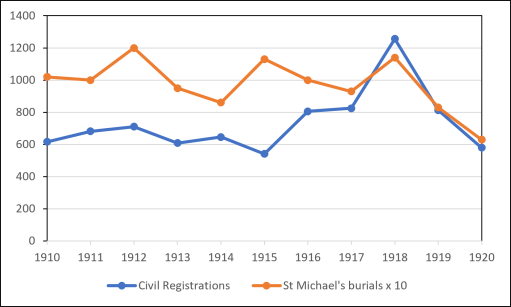
a) Annual averages 1910 to 1920
b) Quarterly averages 1918 and 1919
c) Monthly averages 1918 to 1919

Figure 1. Analysis of burials by year, quarter and month

Residence

In total in October and November 1918 there were 45 deaths recorded in the St. Michael’s burial register and it is possible to look at where these lived within the parish and their age at the time of death. Details of all 45 individuals are given in Table 1 below (a downloadable pdf). Of these 13 were residents of the Workhouse on Trent Valley Rd. The addresses do not reveal any particular cluster of cases, and deaths from across and beyond the parish were recorded.

Table 1. Details of the burials in October and November 1918

Age distributions

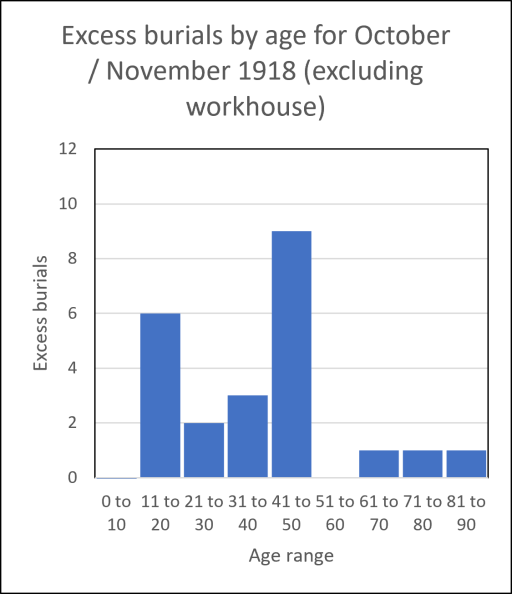
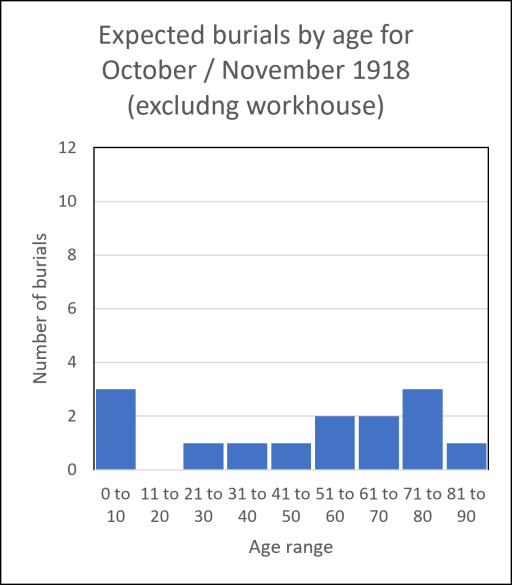
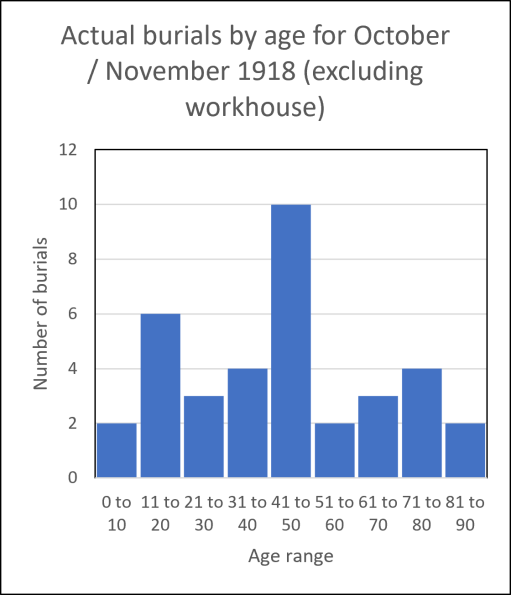
The data in table 1 also enables the age distribution of the deaths to be investigated. First however, the question arises as to what might be the expected age distribution of deaths. For the October / November period in the years 1910 to 1917 there were an average of 14 deaths. If one applies the average death age distribution for the decades 1910 to 1930 to the expected 14 deaths, the expected death age distribution for October / November 1918 is shown in figure 2a. It can be seen it shows a peak for ages between 0 and 10, followed by a rapid fall off, then a gradual rise withe age, peaking in the 71 to 80 age range. It thus shows high child mortality, but the majority of other deaths in the older age group. Note that these are average expected values and there were large variations around this distribution from year to year. Figure 2b shows the actual number of deaths by age in October / November 1918. The difference between Figures 2a and 2b is best appreciated from Figure 2c which shows this data from Figure 2b minus the expected death rates from Figure 2a i.e. what would now be called the excess deaths. It is clear that most of the excess deaths were in the 11 to 50 age range, which is very much in line with what has been reported by many other sources – that the Spanish flu virus was particularly dangerous for the young and healthy.
a) Expected deaths
b) Actual deaths
c) Excess deaths

Figure 2 Death rates by age group

From the press

Naturally the arrival of the epidemic in Lichfield caused much consternation and was reported at length in the press -particularly the Lichfield Mercury. In this section we present a few extracts from that publication between October and December 1918.

From 11/10/1918, we have this description of the effects of the virus and the symptoms.

An epidemic of influenza raging in Lichfield and all the schools. with the exception of the High School, have been closed. The epidemic is the most widespread that has occurred for very many years, and it has developed with great rapidity. There are quite a large number of instances where four or five members of a household are down with the disease and one case reported where eight persons in one house are under treatment Happily, the cases are for most part of mild type, though a proportion are of a more serious character. One noteworthy feature is that number of cases the influenza is accompanied by nose bleeding and vomiting, while in  others the sufferers are delirious. The outbreak has increased the strain on the local doctors, who. for a long time have been working at high pressure consequent on the absence on military service of members of the who formerly practiced in the district.

A week later (18/10/1918) there was no respite.

The influenza epidemic in Lichfield at present shows no signs of waning. Every day brings an addition the list of cases, and several deaths have occurred. The Grammar School and High School and all the elementary schools in the City are closed. Many people who so far have escaped are taking all the recognized precautions, and the local chemists have had large demands made upon them far quinine, essence of cinnamon, eucalyptus oil, and other preventatives.

On 25/10/1918 we read of the actions taken by the City Council with the (limited) provision of nursing support. Official advice on how to behave is also given.

The present influenza epidemic is the most virulent and widespread has been experienced in the district for very many years, certainly for the last quarter of a century. The Lichfield City Council, as the local health authority, has, through the Sanitary Committee, had the matter under consideration, and two special nurses have been called in to assist combating the disease. They are acting under the direction Mr. G. Homan. the City Medical Officer of Health, and the other local doctors, and although at the time of writing fresh cases continue to be notified, it hoped that before long the disease will have run its course.
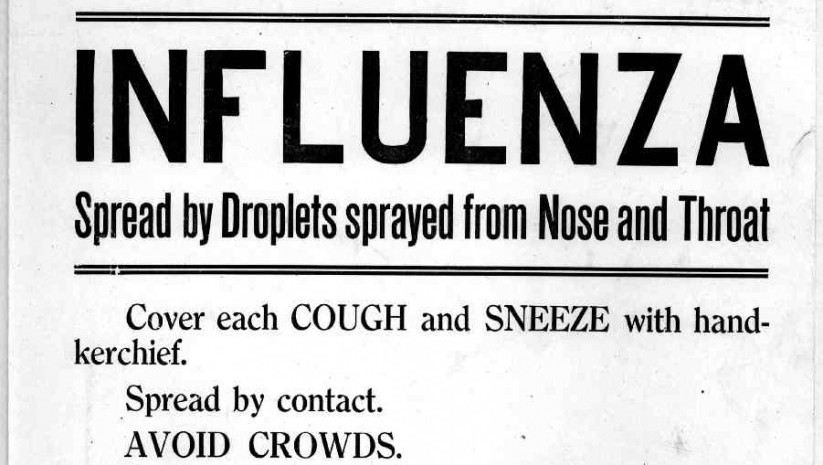
Of course the position in Lichfield is not by any means singular in regard to the extent of the epidemic; it has made its appearance in all parts of the country, and amongst all classes of the community. Those who have, so far escaped attack will wise to take all the available precautions. Sir Arthur Newsholme, Medical Officer of the Local Government Board, has issued a pamphlet asking for the cooperation of everyone in obtaining control over disease, and suggesting preventive measures. Infection is chiefly spread in the earlier stages, and every patient who has severe cold or fever should go bed and stay there for three or four days. If every person suffering from fever were to do this the spread of disease in factories and workshops, offices, shops, and schools would be greatly reduced. Among the precautions suggested are;— Avoid scattering infection in sneezing and coughing. Boil handkerchiefs. Spit in receptacles containing disinfectant. Indiscriminate spitting is especially dangerous during the prevalence of influenza. Keep windows open, especially in bedrooms. Thoroughly wash all utensils from influenza sick room. Overcrowding in dwellings, unventilated assembly rooms, and places of entertainment should avoided. Gargle the throat with solution of one in 5,000 permanganate of potassium in water containing a pinch of common salt. This should also be snuffed up through the nostrils and expelled through the mouth. Stay in bed until all fever is gone. Relapses follow chills or over exertion while convalescent. Alcoholism favours infection. Old persons and young children should not be allowed near an influenza patient. No vaccine is available for the treatment of influenza, and although in cases of primary pneumonia and bronchitis, treatment with a vaccine has sometimes been found useful, no such treatment can be recommended for the pulmonary complications of influenza.

By 1/11/18 the epidemic in the city was abating, although its seems to be still spreading in the outlying villages. The writer of the article below speculates on how such an epidemic might be better managed in the future,

LESSONS FROM THE LICHFIELD OUTBREAK -THE POLICY OF THE FUTURE
The influenza epidemic is still causing acute anxiety in Lichfield. Fresh cases continue to occur in the City, though they are not as numerous as they were fortnight or three weeks ago. Unfortunately the disease seems now to be spreading to the outlying districts and the schools are closed at Armitage, Gentleshaw, Fradley, Alrewas Shenstone. Wall, Chasetown, Kings Bromley, Whittington, Weeford, BrownhilIs and Norton Canes. It cannot, therefore, be said that there is any real abatement.
The impression has gaining ground that disease which has made its appearance with such virulence and over practically the whole world is not influenza. This impression arose the fact that the symptoms seemed in general to be a of quite different type from those experienced in previous epidemics. In the many people there was a suspicion that the outbreak was a form plague. The latter suspicion, is, according Sir Walter Director of the Medical Research Committee, and Lieutenant-Col. Harvey, the Royal Army Medical College, entirely without foundation. Research work has been proceeding for some time and no such organism as the plague bacilus has been found. Further it is pointed out by another expert that influenza manifests itself in various ways, and bacteriologists may find that what we call influenza is really a group of distinct diseases.
The widespread nature of the outbreak is responsible for the great public attention that the disease is attracting at the present time. The State is now directing its energies io ascertain what preventive measures may be taken, and a special conference of representatives of ail departments has been promised by Mr. Haves Fisher. But, Professor W. J. H. Simpson, of King’s College, London, points out. to wait until epidemic has acquired a full grip on the community before taking measures against it is not prevention. There should be some central health organization in the country which have readily its command all available information concerning all communicable diseases occurring in every part of the world and in every part of its own country. 

THE NURSING ARRANGEMENTS.
From the outbreak as it has manifested itself in Lichfield, a number of useful lessons may be drawn .It is of course, essential that the Medical Officer of Health should at once call into consultation with him the local doctors, and as part of the possible co-ordinate their service. Then, too, the local authority should take such steps they are able to secure adequate nursing. At Lichfield both these things have been done, though in regard to the nursing of cases the arrangements made have been totally inadequate. But for the latter fact it must be remembered that neither the Medical Officer of Health nor the City Council is in any degree to blame. Two nurses were specially engaged to in the nursing of cases and these, with the nurses from the Nursing Homo, have worked zealously and untiringly. But so heavy was the demand their services that they were not remain at one case for any length of time, and in cases of influenza and pneumonia not only careful but continual nursing is essential.
The simple truth that the supply of nurses not equal to the demand. The question arises, in the case of epidemic of the present magnitude, what can be done to remedy the paucity of trained nurses. An answer may be found if we turn our thoughts back to the beginning the war. The call went forth for nurses to assist in looking alter the wounded, and immediately there was noble and patriotic response on the part of a large number women, partly trained in nursing as members of the V.A.D. The call in the interests of the nation was answered then; and there is every reason to be believe that it would be similarly answered when an epidemic which threatened to have d effect on the mortality of the nation made its appearance. Some organizarion might established whose duty it would be to maintain a list of women who were prepared in an emergency offer their services. Such a scheme would, of course, call for some form of subsidy on the part of the local authority. It would be necessary to have available a number of women who could be called upon to sit up with patients during the night. The ordinary individual cannot afford to bear the whole of the expense a fully qualified nurse even if such were available. But if the City Council had a list of women, possessed of shrewd common sense and some knowledge of nursing, whom they could call upon in case of a serious epidemic and  to whose payment they would make a grant, it would be an incalculable service to the community.

Only a small number of obituaries of the deceased were published. The first (from 25/10/1918) describes the death of a soldier from influenza after having recovered from being wounded in action. Second Lieutenant Ward was not buried in the graveyard but was presumably buried around Le Havre. However the grief of his mother was firmly located in the city.

The death took place in. hospital on Saturday, from influenza and pneumonia, Second Lieutenant E. Ward. R.F.A., son of Mrs. Ward. 24, Trent Valley Road, Lichfield. Second Lieutenant Ward enlisted the R.F.A. in 1906. and at outbreak of the war was serving in India as a sergeant. His battery then served in Mesopotamia until last April, when they were moved to France. Last February deceased was granted commission as Second Lieutenant. and September 13th he was wounded. Recovering from his wounds was sent to Havre, and was passed as fit for duty. Subsequently he was admitted to hospital suffering from influenza and died as already stated. This is the second son Mrs Ward has lost and another son is still serving on Salonika.

And from 8/11/18

The funeral of the late Mrs. Agnes Pilsbury, wife of Councillor A. Pilsbury, 29, St. John Street, took place Saturday. The deceased, who was 43 years of age, died on the 28th ult. from pneumonia, following influenza, leaving a family of six little children, with whom, and the husband, sincerest sympathy is felt. The first part of the service was in St. Mary’s Church, the Rev. H. S. Cresswell officiating The interment place in St. Michael’s churchyard. The mourners were Councillor A. Pilsbury (husband), Misses Sylvia and Winifred Pilsbury (daughters). Mr. Jno. Topliss (brother), Miss Topliss (sister), Mr. and Mrs. Fred Topliss (brother and sister-in-law), Mr. and Mrs. W. Lester (Burton). Miss Leedbam, and Mrs Dix.

Finally on a lighter note, clearly some saw the pandemic as a commercial opportunity. From the 1/11/18 edition and weekly till the end of December we find this advert for an overcoat.

TO PREVENT INFLUENZA!
Order a good Overcoat, all wool. from £4 10s.
YOU KNOW THE TAILOR G. C. DEAN.
Lierapnon Serge, regd. (guaranteed all wool). 20 ozs.), Indigo, just arrived. Suit to Order, £6 6s.
Note Addresses:— 26, Queen Square, WOLVERHAMPTON. Corner Corporation St., BIRMINGHAM, (Opposite Stephenson Place). 94. BULL. RING. (Opposite Seed Shop). Tel. Mid 860.

On the 13/12/18 we see the difficulties caused by the war and the epidemic to the makers of Bovril.

Amongst the many difficulties that have hampered Food Manufacturers during the War none have been more troublesome. or have entailed more serious sequences, than the shortage of containers all kinds, and especially of glass bottles and jars. During the current  influenza epidemic, tor example, the special strengthening and stimulating powers of Bovril made large supplies of this well-known food, so urgently needed. the proprietors found themselves  totally unable to meet the public requirement through lack of bottles although they had ample supplies of raw materials in stock.
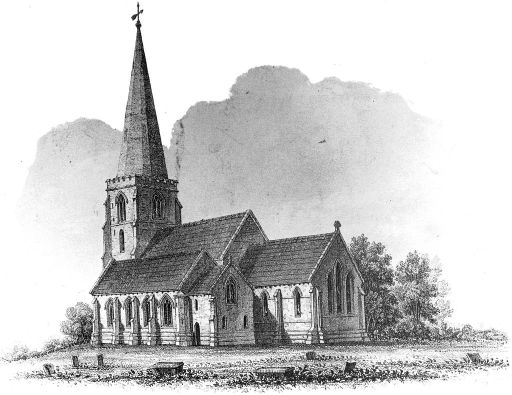
Stephen Glynne’s church notes – Lichfield St. Michael

Preamble

Material in the following paragraphs is repeated from an earlier post as an introduction to Stephen Glynne and his church notes.

The Glynne Baronetcy dates back to 1661, with its main estate at Hawarden in Flintshire. The 8th Baronet, Sir Stephen Glynne (1780 to 1815) married Mary Griffin, daughter of Lord Braybrooke. After his early death, he was succeeded by his son Sir Stephen Richard Glynne, the 9th Baronet (1807-1874). I first came across him as the owner of the Oak Farm Iron Works in the Black Country, which was the subject of a spectacular financial crash. Glyne was saved from financial ruin by the efforts of his brother-in-law, the future Prime Minister William Gladstone, at very considerable expense to the latter.

More widely, Stephen Glynne is best known as a church antiquarian. Over the course of his adult lifetime he visited over 5000 churches in England and Wales, making notes, and in some cases sketches of their architecture, plans and furnishings.  These notes can be found in 106 volumes now housed in the Gladstone Library at Hawarden. Only a small minority of these have been transcribed and published. Here we give a transcript of his notes for St. Michael’s in Lichfield. The history of the church is set out in detail in my four part ebook. The restoration of the early 1840s, which is of relevance to what follows, is described in Part 3. At that time the Lichfield Society for the Encouragement of Ecclesiastical Architecture were instrumental in the rebuilding of the church (and the chancel in particular) in the prevailing gothic fashion.

Stephen Glynne’s description of St. Michael’s, Lichfield

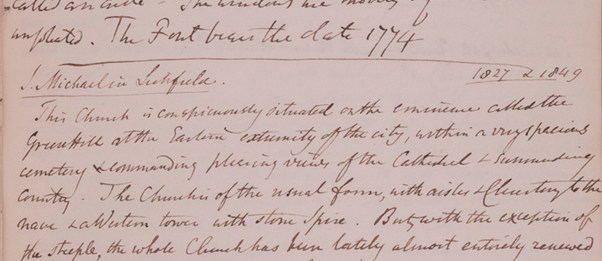
Stephen Glynne’s notes on St. Michael’s church in Lichfield are brief and mainly straightforward. They are oddly dated 1827 and 1849, but the description is clearly from a visit in 1849 after the extensive “restorations” of the early 1840s. There are a couple of entries on a blank facing page however that refer to the pre-restoration church and that might refer to an 1827 visit (given at the end of the transcript below).

The transcript

The church is conspicuously situated on the eminence called the Greenhill at the eastern extremity of the city within a very spacious cemetery commanding pleasing views of the Cathedral and surrounding county. The church is of the usual form with aisles and clerestory to the nave and a western tower with stone spire.  But with the exception of the steeple, the whole church has been lately almost entirely renewed and in great measure rebuilt in tolerably good style. The steeple which is of red sandstone, appears to be a three ?? (1) of plain kind. The tower is embattled with corner buttresses, a string course under the belfry only. The belfry windows of two lights on the north and south is a long ??? slot -a questionable lancet on the west, but no west door. The spire is octagonal but not ribbed, having three horizontal bands and two tiers of spire lights, which are on the same sides. The north aisle, as rebuilt, has a low pitched roof and a battlement with three Perpendicular windows. The south aisle is wider and loftier with a high pitched roof and Perpendicular windows, varying in tracery. At the east end has been added a gabled chamber for receiving the Organ (2). The nave is of four bays, the arcades with pointed arches and octagon columns. The chancel has been wholly rebuilt in the Perpendicular style – its east window a triplet and on each side three single lancets. The chancel is groined, the ribs springing from shafts (3). The clerestory of the nave has a  high pitched tiled roof and windows of two lights. The north porch is set in the western bay .

(4) The ancient chancel had a three ?? (1) east window, and the former chancel, as appears from a view in Shaw’s Staffordshire, had a quasi clerestory, an upper tier of windows. The whole of the former church was perpendicular.

Notes

1. This symbol can’t be read, but it is the same at both places where it occurs.
2. The description of the church matches what can be seen today, with one exception – the description of a gabled chamber for the organ. This clearly refers to a structure that was replaced by the current choir vestry in 1923 ad can be seen inthe foreground of the picture above.
3. The restored chancel was itself significantly altered in the late nineteenth century, with much of the work of the 1840 restorers removed or altered.
4. The text in this paragraph probably refers to an 1827 visit.

The Cross City Line – 1962 to 2024

Introduction

I have been a collector of old bus and railway timetables for many years, with no particular end in view, other than to put them in boxes for some unspecified future use. However, the assembled timetables seem to be too good a resource not to make use of in some way, and I used some of them to compile a recent post on the development of public transport in Oakham in Rutland. This went down surprisingly well with readers, which shows there are some very odd folk out there. But the reception has encouraged me to press ahead with a series of posts that will use my stash of timetables to look at the development of public transport services in particular places or on particular routes. This particular post will consider the development of the Cross City railway line that runs from Lichfield in the north, through Birmingham, to Redditch and Bromsgrove in the south. There is an excellent Wikipedia article that describes the history of the line, and there is little point in reproducing that, and in this post I will concentrate on the development of the timetable on the line from the early 1960s (when it didn’t exist as one route) through to the present. It will be seen that it is in some sense a story of ambition that has never been quite fulfilled because of operational issues.

In what follows we will track this timetable development through the use of timetable extracts – usually for the weekday morning post peak period, but sometimes for other parts of the day where the (lack of) availability of information makes that necessary. This shows the broad outline of the timetable, but cannot of course capture the full detail.

September 1962 to June 1963

North
South

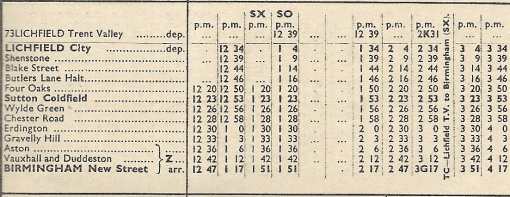
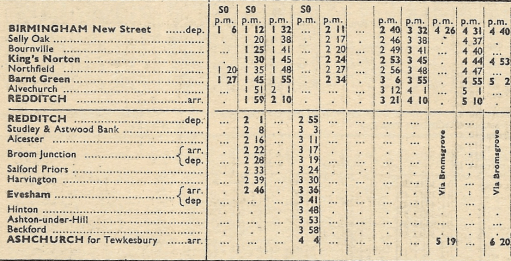
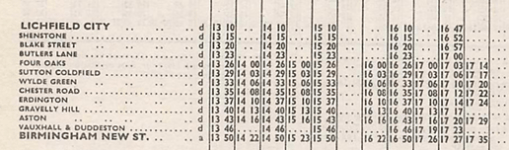
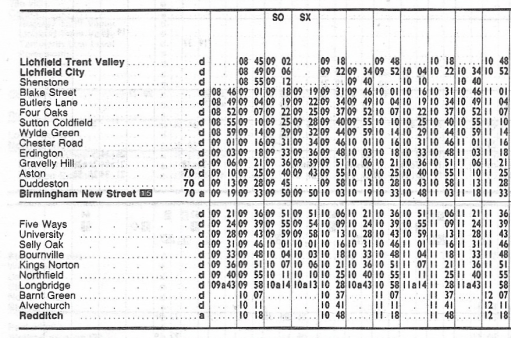
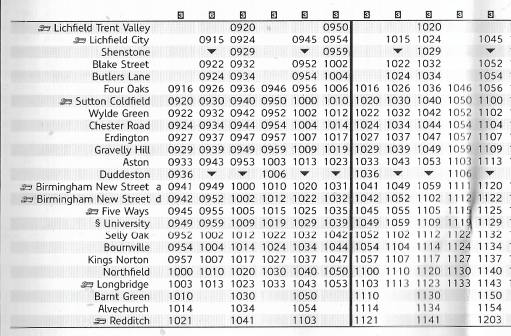
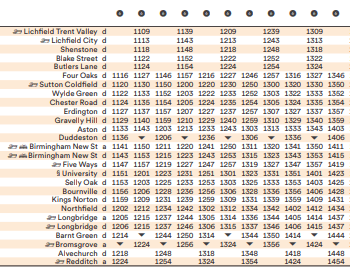
We first of all consider the situation in the early 1960s. Extracts from the timetables for the routes that were ultimately to form part of the Cross City line are shown above, for the early afternoon weekday period (taken from the London Midland Region timetable for September 1962). It can be seen that there is broadly a half hourly service from Lichfield city to Birmingham New Street. Connections are provided to Lichfield Trent Valley (where the current Cross city line crosses the West Coast Main Line) by a Burton on Trent – Lichfield – Walsall service, with occasional through services from Trent Valley to Birmingham. Some trains started and terminated at Four Oaks, but there was no regular pattern. South of New Street, the service to Redditch was somewhat sporadic, with some trains extending to Evesham and Ashchurch for Tewksbury. Note that trains did not at that stage call at Five Ways (which was closed) or University (which didn’t exist).

September 1964 to June 1965

North
South

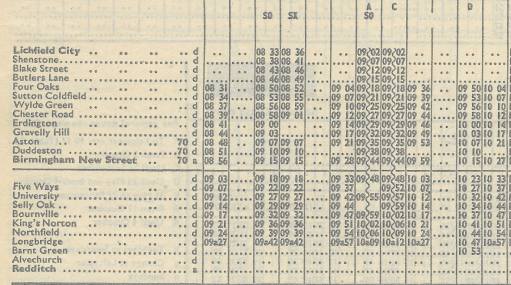
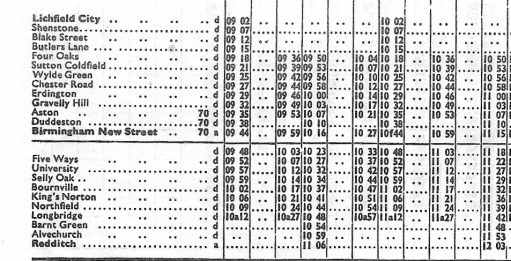
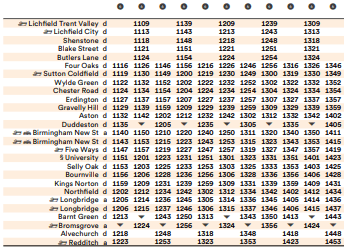
By 1964, the first wave of the Beeching cuts had taken place and the timetables above (again from the London Midland Region timetable) such trains as there were to Redditch from New Street terminated there. North of New Street, the service to Lichfield varied between a thirty minute and an hourly frequency, with hourly trains starting at Four Oaks. Again, there were connections to Lichfield Trent Valley from Lichfield City on the Walsall to Burton service.

May 1969 to May 1970

North
South

The May 1969 timetable (from the London Midland Region timetable downloaded from Timetable World) shows a more regular service on the north end of the route, with an hourly service from Lichfield City and a thirty minute service from Four Oaks to New Street. South of New Street the trains to Redditch were again somewhat sporadic, with one, two or three hour intervals between them.

May 1978

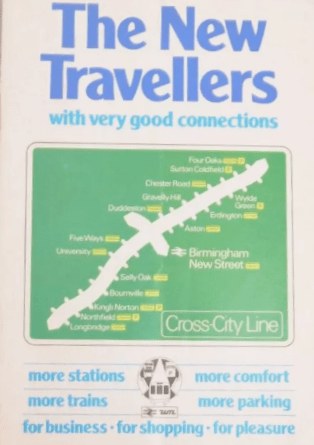
The Cross City line opened in something like its current form in 1978. The graphic above (a screenshot from a rather fuzzy ebay photo) shows that it was marketed as a service between Longbridge and Four Oaks, with a fifteen minute interval service between the stations. There were in fact hourly trains to Lichfield City that were not referred to in the timetable shown, and sporadic trains to Redditch in the south. The route was operated at this stage by Class 116 DMUs. Five Ways station had been re-opened and a new station built at University.

Class 116 DMU

May 1980 to May 1981

The May 1980 service (shown above from the national BR timetable) is similar to the 1978 service. Here the extract shows no services to Redditch although there were again some sporadic, mainly peak hour services down the Redditch branch.

May 1983 to May 1984

By May 1983 the situation to the south had become more satisfactory with hourly trains to Redditch, with Lichfield City also having hourly trains, and four an hour from Four Oaks to Longbridge.

May 1984 to May 1985

One year further on, in May 1984, the situation is again similar, but with one of the Four Oaks trains per hour extended to and from Blake street.

July to September 1991

By 1991 there were significant changes. Two trains per hour ran south from Lichfield Trent Valley (which had been reopened in 1988), four trains per hour from Lichfield City with some peak services running from Blake Street.. To the south there were four trains per hour to Longbridge, two of which were extended to Redditch.

September to November 1992

The BR national timetable showed that the situation in September 1992 was very similar to the previous year, but was only timetable to extend to the end of November 1992, when a different timetable came into operation (see below).

December 1992 to May 1993

The December to May 1993 timetable is very odd, with the services being split at New Street, with four trains per hour from Lichfield Trent Valley to Birmingham, and four to Longbridge, with two extended to Redditch. There is no rationale given for this but may well have been something to do with the electrification works that were going on at the time.

June to September 1997

My more intimate involvement with the Cross city line began in 1997/8 when I began working at the University of Birmingham, whilst living in Lichfield, and travelling on the line daily. I thus began collecting the Cross City pocket timetables at this point. It will be seen below that the art work / size / format changed continually over the years that were to follow. The route had been electrified in 1993 and was thereafter, until 2024 operated by Class 323 EMUs, up until 2020 in mainly three car formation, with some six car trains at peak times. The situation was similar to the early 1990s with four train per hour frequency between Lichfield City and Longbridge , with two trains per hour extended to both Redditch and Lichfield Trent Valley.

Class 323 EMU

June to September 2002

In the summer of 2002 we have a very similar looking timetable and frequency, albeit with some slight changes of times. But in general we can see the timetable pattern has remained stable over at least five years.

September 2002 to January 2003

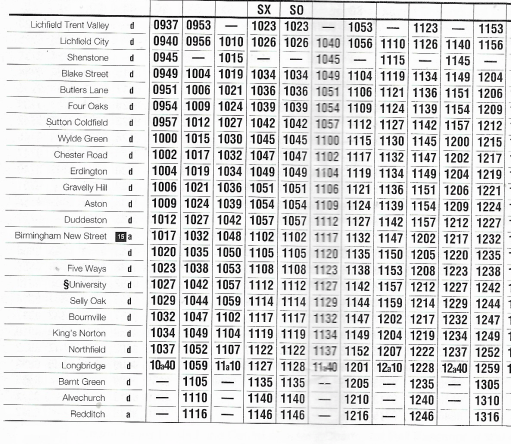
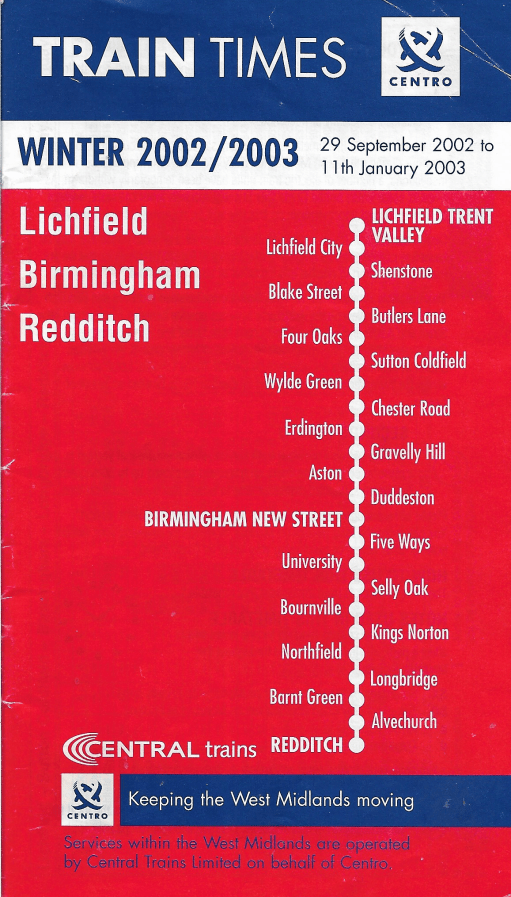
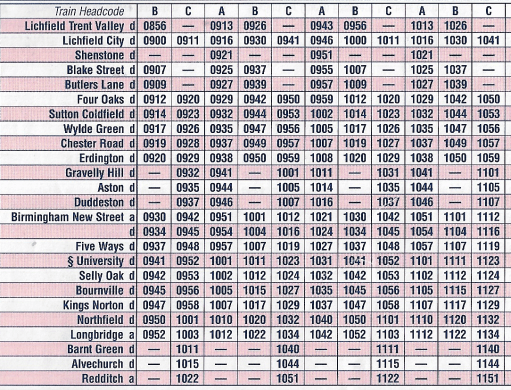
In September 2002, there was something of a revolution. The number of trains was increased to six per hour, with four beginning their journeys at Lichfield Trent Valley, and two at Lichfield City and four ending their journeys at Longbridge and two at Redditch. The stopping pattern was complex with not all trains stopping at all stations. To try to make life easier for passengers, trains were to carry a headcode (that can be seen on the above timetable) indicating their destination and the stopping pattern. To put it bluntly, the service was an absolute disaster. A very frequent service with variable stops needs to be highly reliable – and that has never been the case for the Cross City line, largely due to congestion at New Street. My memory is of confused and angry passengers, very late running and many cancelled trains. Although the ambition was laudable, the pattern was never going to work. My memory is that it was replace by an emergency timetable within only a few weeks of its implementation, but I can’t be certain about that. At any rate, a new timetable was issued from January 2003.

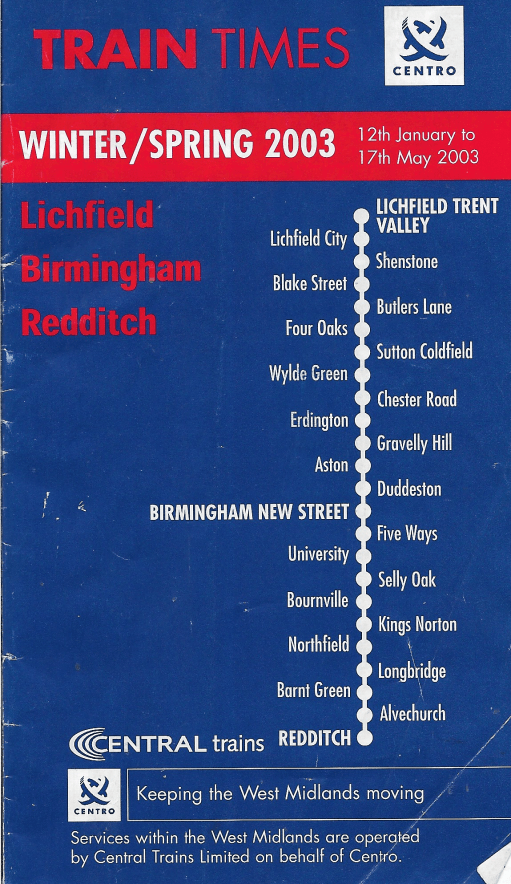
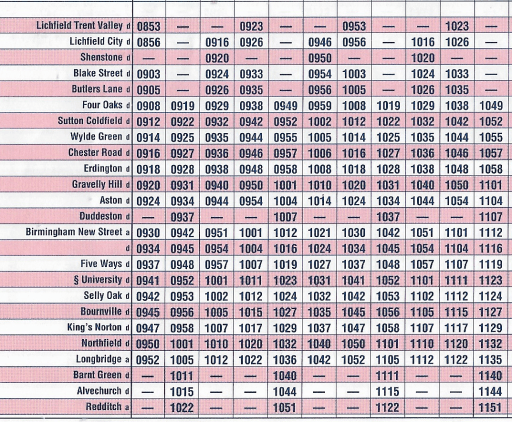
January to May 2003

The new timetable again had six trains an hour, two beginning at Trent Valley, two at Lichfield City and two at Four Oaks, with four an hour terminating at Longbridge and two at Redditch. With only minor exceptions (Shenstone and Duddeston), all trains stopped at all stations. From a personal perspective, this led to an unbalanced departure schedule at Lichfield City, with twenty and ten minute intervals, but this pattern was to persist, in essentially the same form until 2018.

May to December 2009

The 2009 timetable is very similar to that from 2003, with very minor changes of timing.

May 2015

Similarly the 2015 timetable was of the same form, but Redditch was now served by three trains per hour following the opening of a passing loop at Alvechurch that increased the capacity of the branch.

May to December 2019

The main change in 2019 was the extension of two of the three services that terminated at Longbridge to Bromsgrove, following electrification of the line through Barnt Green, with some other slight timing modifications. Then in 2020 COVID happened.

May to December 2022

During the COVID lockdown, the services on the cross city line were scaled back to four per hour, with two starting at Lichfield Trent Valley and two at Four Oaks, with two terminating at Bromsgrove and two at Redditch and this pattern was to persist. These four trains used four of the six paths from the earlier six train timetable resulting in unbalanced intervals between trains along the line. Stations north of Four Oaks suffered particularly, with the service being reduced to half hourly, the lowest level of service since the mid-1980s. To make up for this all services were six coaches however.

December 2024 to May 2025

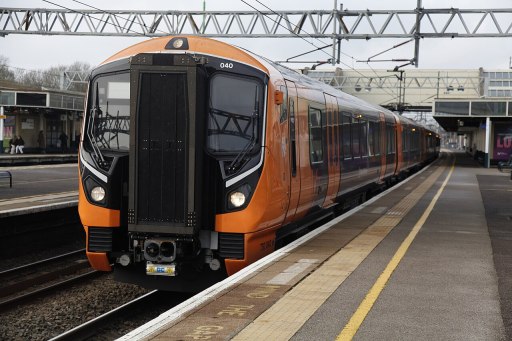
In the present 2024 winter timetable, this situation persists, for good or ill. The quality of the rolling stock has however increased with the use of Class 730 EMUs.

Class 730 EMU

Journey times and leaf fall timetables

Finally, before I close, I will brielfy discuss journey times and leaf fall timetables, which are quite closely connected. I take the journey time between Lichfield City and Birmingham New Street as a comparative value through the years. In the 1960s, when the service was operated by Class 116 DMUs, the journey time was around 45 minutes, but by the close of the decade it had reduced somewhat to between 40 and 42 minutes. . After electrification with the introduction of Class 323 EMUs , this time fell to between 35 and 37 minutes. Current times with the Class 730 are still around 37 minutes.

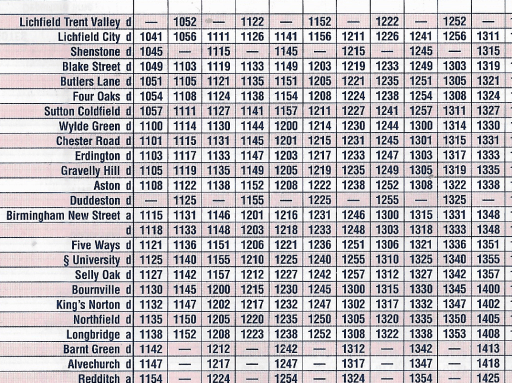
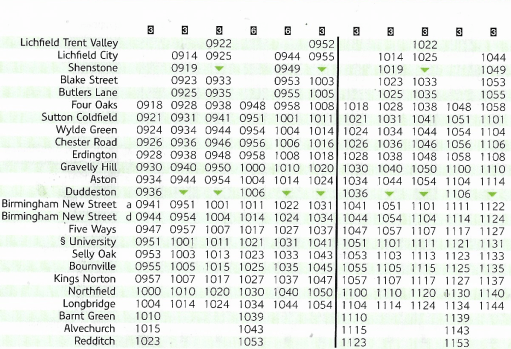
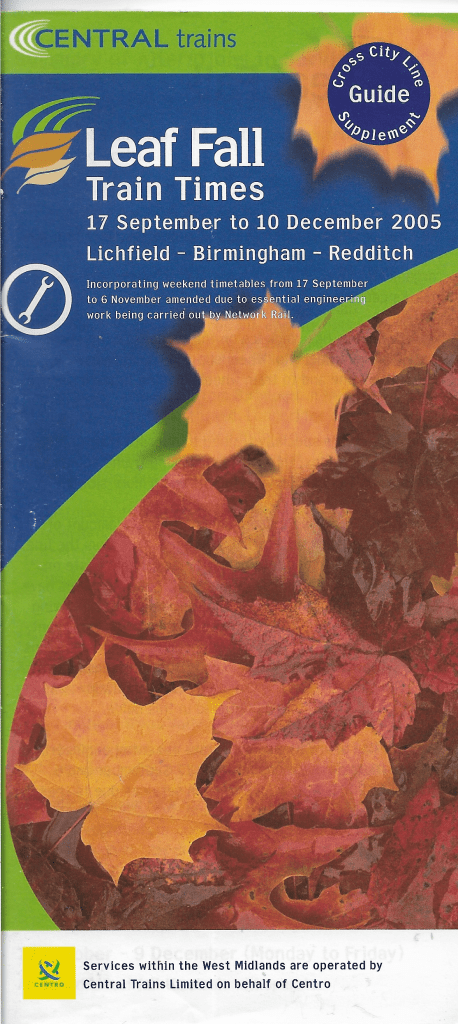
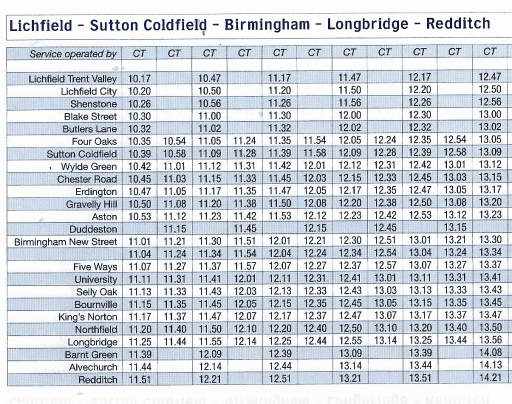
From the early 2000s a “leaf fall timetable” has operated on the Cross City line between October and December, when track conditions can become difficult. A typical example for 2005 is shown below. At the time the normal timetable consisted of six trains an hour, with two starting at Lichfield Trent Valley, two at Lichfield City and two at Four Oaks, with four terminating at Longbridge and two at Redditch. The revised timetable shows four trains an hour, with two starting at Lichfield Trent Valley and two at Four Oaks, with two terminating at Longbridge and two at Redditch. Journey times from Lichfield City to Birmingham New Street were 45 minutes. There was thus both a significant reduction in service frequency and a significant increase in journey time in the interests of maintaining reliability.

Closing remarks

As I said at the start of this blog, the history of services on the Cross City line show a commendable ambition on behalf of the operators, but with this ambition compromised by lack of operational reliability. The six train per hour service that operated from 2003 was notoriously unreliable, with this unreliability in the peak leading to significant overcrowding as two trains worth of passengers often tried to squeeze onto one, with most trains having only three coaches. Perhaps the current less frequent timetable, but with longer trains, is more satisfactory in that regard. The unbalanced timetable, with alternating ten and twenty minute gaps between trains is far from satisfactory however. If one is optimistic, one might say that this will allow six trains per hour to be reinstated in the future, but if this is not going to be the case, the timetable really does need recasting with a consistent fifteen minute interval.

Saddlebacks and serendipity

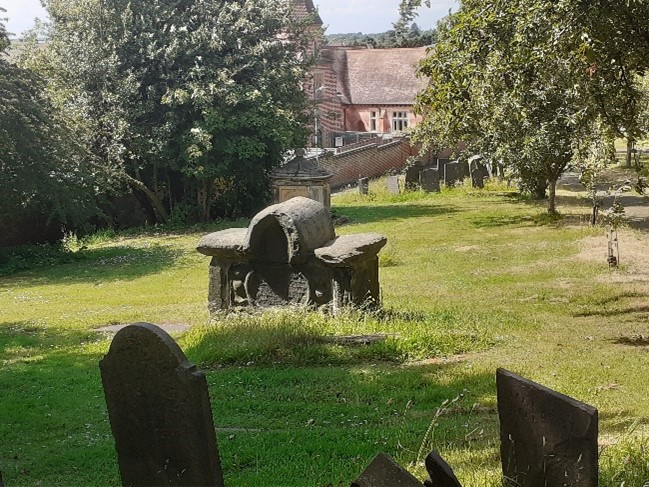
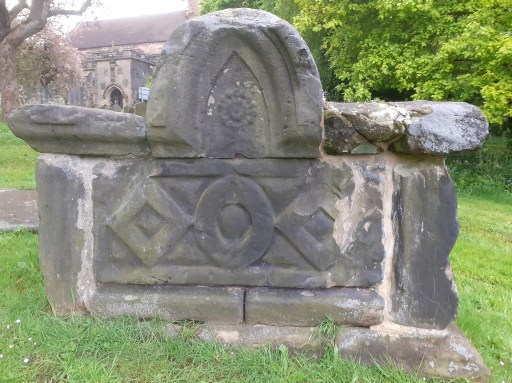
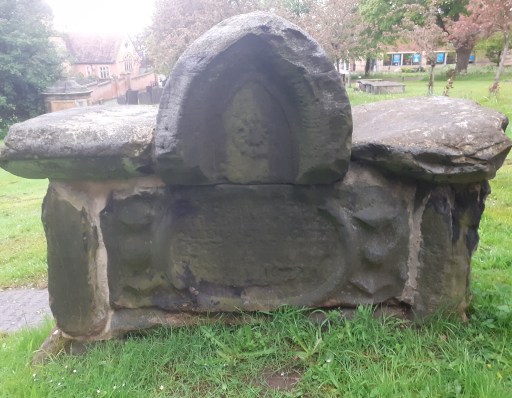
In 2021 I discussed  some of the early graves in St. Michael’s churchyard in Lichfield. Amongst these was the distinctive “saddleback grave” shown in Figure 1 below, one of the five listed monuments in the churchyard. At the time I wrote as follows.

The inscription is very worn and the dedication of the monument can’t be read. This grave features in a nineteenth century drawing that is in the William Salt library ……. That drawing gives the date of the grave as 1674, and with a little imagination this can be made out on the tomb itself. Apart from the date, it is the style of the grave that makes it so distinctive. It is a shame that the dedication is illegible.

Figure 1 The Saddleback grave in 2021

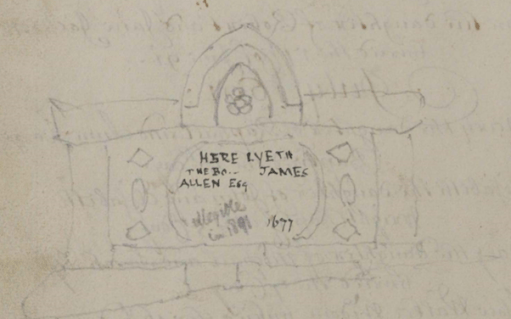
And this is where serendipity comes in. Over the last few days I have begun to think about filling in some of the gaps in my long term project to collate the memorial inscriptions of St. Michael’s churchyard with the burial registers – specifically to include material from the early registers up to 1812. A very helpful archivist at Staffordshire Archives told me that these have been scanned and can be found on Find my past. So I have been busy doing some mass downloads of the material during my seven day free trial (as you do). Whilst doing this I came across the sketch shown in Figure 2 in the register from 1680-1741, on a blank page opposite the entries from November to March 1691 (note this was before the calendar change!)

Figure 2. The sketch from the 1680 to 1741 Register

It clearly shows the Saddleback grave and gives the inscription as

Here lyeth the bo… of James Allen Esq…..1677

There is another note in lighter script that says

Illegible in 1891

So it seems we have an identification of the occupant of the Saddleback grave – although the date is given as three years later than indicated on the William Salt picture. Checking back on the records however in the 1574 to 1680 register, the only entry that corresponds to the name is from 1674

April 13th Mr James Allen, Magistrate, Beacon St

Beacon St is somewhat conjectural however – it is not easy to read. So it looks as if the William Salt date is the correct one.

The registers tell us little else. There is an entry for the marriage of James Allen (Gent) to Mrs. Hester, daughter of Richard Pyot (Dyot?) in November 1658 at St. Mary’s which seems possible. However this was in the Civil War / Commonwealth period when records become very patchy, so there may have been other about with the same name. If any reader knows more of James Allen, then please let me know. But a least we now have a name.