A blog from a previous version of this website – written in 2017
At the time this blog was written, Storm Friederike has just passed over Western Europe and has resulted in a number of deaths and considerable traffic chaos. The BBC reported that
Deutsche Bahn had already suspended rail traffic in North Rhine-Westphalia (NRW), neighbouring Rhineland-Palatinate state and Lower Saxony, when it announced a Germany-wide suspension of long-distance trains. Any regional trains still running have cut their speed because of the strong winds.
A spokesman said it was the “right decision” due to the risk of trees falling on overhead wires and on tracks.
and
The Dutch Railways (NS) and operator ProRail said overhead power lines had been damaged by the wind, as well as some railway tracks. An alert on the NS website said that “at most, only a few trains” would run throughout the evening.
Trains do occasionally blow over. The first recorded incident was on the Leven viaductin south Cumbria in 1904 when a wooden bodied train blew over on the embankment on the approach to a viaduct. A number of other incidents have occurred around the world in recent years, the latest being in Switzerland where a video has been posted online of a train in the process of being blown over – here and here. Clearly as accidents of this type can have potentially very severe consequences they need to be in some was taken into account by train builders and railway operators in design and practice.
The effect of cross winds on trains (and lorries to some extent) is a research topic that has stayed with me throughout my career. My first involvement with the issue was when I worked for BR Research in the early 1980s in looking at the effects of high winds on the Advanced Passenger Train. The issue arose again when the Channel Tunnel was opened as the very light lorry carrying vehicles were found to be at risk of blowing over in ports. Then, with the advent of high speed trains in the 1990s, considerable effort has been devoted to developing a methodology to ensure that cross wind effects are taken into account in both design and operation – in Europe, Japan, Korea, and most recently in China. There is broad agreement on the methodology that is to be used. It consists of three parts.
An assessment of the aerodynamic loads on the train – usually in the form of graphs of aerodynamic forces and moments against wind angle.
The use of this aerodynamic data in some sort of mathematical model of the effects of wind on the vehicle under consideration to determine a graph of wind speed that will cause and accident against vehicle speed – usually referred to as a Cross Wind Characteristic or Characteristic Wind Curve (CWC).
The use of this CWC together with weather, route and operating data to determine the risk that the train will blow over on the route under consideration.
The design of trains usually considers only the first two steps and the CWC that is obtained is compared with reference CWCs in the train certification process. Train operators clearly need to know the output of the third stage, so they can design suitable risk alleviation systems – eg. slowing trains down, providing protection such as wind breaks etc.
Each of the above steps can have varying levels of complexity.
The assessment of aerodynamic loads can involve physical model tests of different types – using standard low turbulence wind tunnel tests, wind tunnel tests with a simulation of atmospheric turbulence or moving model tests. Embankments and bridges may or may not be modeled. Alternatively the loads can be determined by CFD calculations, again of varying levels of complexity, from simple RANS calculations, through to complex (and resource hungry) DES and LES calculations.
The calculation CWCs needs a simulation of the wind – that can either be the specification of a simple gust velocity, the specification of a spatially and temporally varying ideal gust, or the full specification of a wind time history; and also a simulation of the vehicle system – either a simple one, two or three mass model or the specification of the suspension system with varying levels of complexity. More recently some authors have even used calculations that are coupled with the track dynamics and with the dynamics of a bridge that the train passes over.
Finally the determination of the risk requires detailed wind statistical information that is not always easily available, together with route topographical information – embankment heights, bridge geometries etc.
To my mind one of the most important things about this three part process, and one that is not always appreciated, is that each component has a very different level of precision. The aerodynamic forces and moments can probably be specified to within 5%. The calculation methodology for CWCs, given specific values of the forces and moments, is highly accurate (say to within 1%), whilst the calculation of risk has massive inbuilt uncertainties because of the uncertainties in the meteorological information. Thus usually the risk of a wind induced accident can only be specified to within an order of magnitude i.e. 10-8or 10-9. Thus highly accurate determinations of CWCs are really pointless when the uncertainties in the risk calculations are considered.
Having spent the last 40 years involved with this problem to some degree or other, I would thus like to make the following reflections.
The different aspects of the subject – fluid mechanics, vehicle dynamics, meteorology etc. – make for a fascinating intellectual mix, and have led to the development of a range of complex modeling and analytical techniques. For an academic these challenges are fascinating – but these intellectual challenges can sometimes result in the end points of the process (train certification and risk specification) to be forgotten. I am as guilty of this as anyone of course. As an academic I can argue that my work in this area has enabled progress in other research areas, as indeed it has, but the end goal shouldn’t be forgotten.
The current train certification methodology in the CEN code is essentially a comparative one with CWCs for particular trains being compared with CWCs for trains that are considered safe. As such, accurate values of accident wind velocities are not required, as long as they were derived in the same way as for the reference safe vehicle. The CEN code sensibly goes down this route, and specifies a simple type of wind tunnel test to obtain the force coefficients. However it requires a full multi-body dynamic simulation with an artificial gust simulation, with a complexity that seems inconsistent with the accuracy with which the aerodynamic forces and moments can be specified.
The above multi-body simulation technique can, and has in the recent past, result in game playing that has no relevance to train operation or safety – by marginally changing the suspension parameters in an arbitrary way in the dynamic calculations so that the CWC is above the reference value and thus allowing the train to be certified. There must be doubts about any methodology that allows such things to happen.
Taking the above considerations a little further, there is an increasing tendency in published papers in this area to include as many complications as possible – multiple degrees of freedom of train, track and (if appropriate) bridge; coupling of train movement with the aerodynamic coefficients; very high resolution (and resource usage) CFD calculations. In my view the proper way to use such techniques is to carry out studies to determine the effects of such complex methodologies on overall aerodynamic forces and CWCs (almost always second order) and then to develop a much similar methodology that allows for them in an approximate way that is consistent with the accuracy of the overall process. Just because it is possible, using modern numerical techniques, to make complex calculations, it is not always sensible, or a proper use of resources, to do so.
Finally there is the effect of operation that needs to be taken into account, which brings us back to where we began. In the recent storms, the German and Dutch railway authorities simply stopped train movement, because of worries about debris on the track or trees falling onto overhead wires – not because of worries about trains overturning, as the wind speeds were much too low for that. The same happens in the UK. When high winds are forecast Network Rail and the TOCs first impose a blanket regional 50mph speed limit, mainly so that trains have some hope of reducing speed when debris is blown onto the track. A major problem in this regard seems to be trampolines at the moment – see figure 2 below – and at higher predicted gust speeds of around 65mph, train operation is stopped completely. Also, very often, train movements are blocked by tree fall onto the overhead. Operational reality takes precedence over all the wind tunnel tests, CFD calculations and MDS modeling we can conceive of doing.
Trampoline blown onto track
Tree fall onto overhead
The study of the effects of high winds on trains is fascinating and alluring academically, and allows the use of a whole range of fun physical model experiments and challenging computational techniques. But a sense of perspective is required I think – to keep the various methodologies simple enough for reasonably routine use in train certification and route risk assessment; and not to forget the overriding importance of train operational considerations.
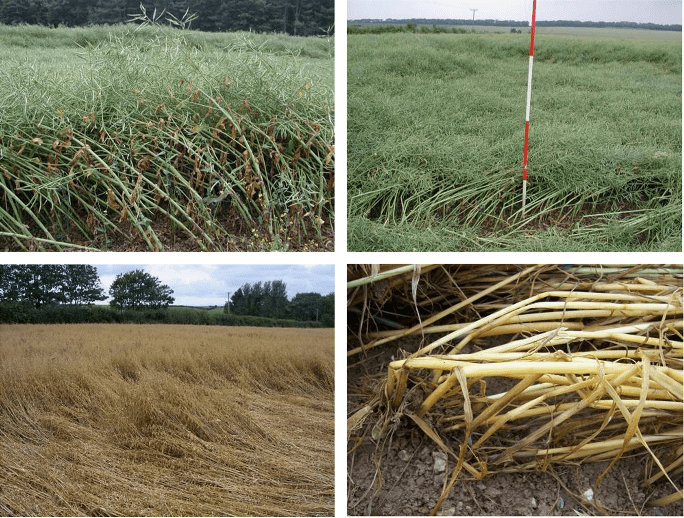
In this blog post I want to introduce the work that I, together with a number of colleagues, are carrying out on the phenomenon known as crop lodging. First I guess it is actually necessary to define what the word “lodging” means. In simple terms, lodging is the failure of crops due to stem breakage or uprooting during periods of high winds and/ or heavy rainfall. I need to make the point very firmly right at the start that it has got absolutely nothing at all to do with crop circles! It does however have significant economic consequences, with yield losses in winter wheat resulting in costs to growers of the order of £100m in the UK in a high lodging season. Some pictures of lodging are given in figure 1 below.
Figure 2. Lodging in coral crops
Our work on this issue goes back in one form or another over a period of 30 years. It all began in in 1987 when I was an academic at the University of Nottingham. After the Great Storm of that year wreaked havoc with the tree stock in the south of the country, I still remember a colleague (Andrew Dawson) putting his head around the door of my office and saying “I have an idea for a research grant….”. This led to a grant from the Science Research Council to investigate the aerodynamics of urban trees – and we thoroughly enjoyed ourselves making measurements of the mechanical and aerodynamic properties of trees on and around the University campus, evolving an experimental technique that we named tree-twanging – pulling trees with a winch and then releasing them to measure the frequency of the oscillations. One of the less successful parts of that work was the initial development of a mechanical model of trees in high winds, which tried to represent trees in engineering terms. At the time this didn’t progress very far, but a few years later, in the early 1990s, I was approached by a colleague from the University School of Agriculture at the Sutton Bonnington Campus (Prof. Keith Scott) to help with a project that was investigating the lodging of winter wheat, and in particular to help supervise the PhD research of two students – John Griffin and Pete Berry. Perhaps the most challenging part of this work, both for me and staff and students at Sutton Bonnington was the need to learn to speak the vocabulary of anther discipline. This collaboration led to me doing some serious work on analytical model development that produced a reasonably robust description of the mechanical behavior of plants, and in particular winter wheat, in high winds and heavy rainfall.
The next phase of this work began in 1998, when we (myself and colleagues at Sutton Bonnington and ADAS) obtained a grant from the Biology and Biotechology Research Council (BBSRC) to investigate lodging of winter wheat in some detail, to identify those plant characteristics that resulted in an increase in lodging risk. This date also coincided with my move from Nottingham to the University of Birmingham. This work involved an extensive series of field trials at ADAS to measure characteristics of plants relevant to the lodging process, and we at Birmingham were responsible for developing a model of the lodging process and for carrying out experiments to calibrate the model. By this time (Dr.) Pete Berry was working for ADAS, so the collaboration with him thus continued. The Research Fellow appointed at Birmingham for this work was Dr. Mark Sterling, who had recently graduated from there with a PhD in open channel flow. We built the lodging model on the basis of the earlier modeling work, but needed a variety of aerodynamic information to calibrate this. Normally in engineering terms, this would have been obtained through wind tunnel tests – it is however not easy to put a representative section of a wheat field into a wind tunnel. The solution was to take a wind tunnel into the field – see the picture below. This proved to be more than a little challenging, but during the course of the experiments we were able to obtain the very first video footage of lodging actually taking place – this usually occurs in high winds and heavy rain and more often than not in the middle of the night, so the use of a portable wind tunnel, difficult as it was, was actually the most straightforward way of doing this. I am told by Mark that fixing strain gauges to wheat stems in the field to measure the displacement was one of the most entertaining tasks that he has ever been faced with.
Overall the project was very successful and enabled us to learn a great deal about the mechanics of root and stem lodging, to provide solid scientific information that cut through much of the hearsay that was around in the industry at the time about lodging, and to provide robust agronomical advice for farmers for techniques to avoid lodging. The collaboration between the University and ADAS was vital in this regard.
Over the next few years, work continued at a lower level, with the production of a few collaborative review papers, and the application of the lodging model to barley. However by the start of the current decade it was becoming clear that the model as it stood, whilst perfectly acceptable for wheat crops where the plants were essentially isolated throughout the growing season, was not really applicable to a range of crops for which, late in their growing season, individual plants interlocked to produce a much denser canopy. Thus we (myself, Pete Berry and Mark Sterling, by now the Head of Civil Engineering at Birmingham and thus my boss) began work on the development of a generalized lodging model that could allow for plant interlocking. Whilst the modeling was quite complex, it resulted in the relatively simple pictorial representation shown below in figure 2, where regions of stem lodging and root lodging were defined in terms of the daily rainfall rate and the hourly wind speed. The various velocities and rainfalls shown on this figure are all (rather complex) functions of plant and soil parameters and can, once the model is calibrated, be fairly easily specified. In principle this graph can be used with a representation of wind and rainfall probabilities to determine the risk of lodging occurring for any set of plant and soil parameters, and mitigation methods taken if this risk is deemed to be too high. In the peer review process, one of the reviewers of the paper acknowledged the elegance of the model, but made the comment that it would never find a practical outcome. We were to prove him wrong!
Figure 2. Lodging regions in the rainfall / windspeed plane
Over the last few years the work on lodging has grown very significantly, and we now have three projects underway. The first was funded by Teagasc in Ireland, to investigate methods to reduce oat lodging. We used the model described above and the work included a series of experiments in Ireland to measure, the behavior of oats in high winds.. The second project was funded by BBSRC under the SARIC (Sustainable Agriculture Research and Innovation Club) scheme, with myself and Mark, working again with Pete at ADAS. This used the same set of techniques to investigate the lodging of Oil Seed Rape. The unique aspect of this project however was a collaboration with Dr. Alan Blackburn and his colleagues at the University of Lancaster who are experts in Earth Observation and Remote Sensing, and the local modeling of lodging is being embedded in a much wider scheme to integrate spatial, topographic and meteorological data sets to predict the risk of lodging for individual crops and fields, and to identify those soil, plant and weather characteristics that cause lodging. The final project was also funded by BBSRC, but this time through the Global Challenges Research Fund which directs research funds to the problems of developing countries. We used a similar approach to the SARIC project, but this time directed towards maize and rice, working again with ADAS and Lancaster University, and also with colleagues at the Chinese Agricultural University and with CIMYTT in Mexico, who work in a large range of countries in the developing world. The potential significance of this project is huge – lodging causes yield losses of up to 40% in rice and maize, reduces grain quality, increases time to harvest, increases grain drying costs and increases health damaging micro-organisms on grain. It is estimated that lodging in rice and maize reduces crop production in China and Mexico alone by $1500 million per year.
All this research has all developed from a chance conversation and some early blue-sky research on trees over 30 years ago – and now has the possibility of producing results that will have a major effect on crop productivity around the world. In these days when funding for such fundamental research is under increasing pressure, this is perhaps worth remembering. But for now, these are exciting times – watch this space for future updates.
This post is based on a talk given by the author at the PWI Midland Technical Seminar – High Speed Rail: The Technical Challenges, on October 19th2017.
Introduction
When the word “aerodynamics” is used within a railway context, most listeners would immediately think of trains with streamlined front ends whose function is to reduce aerodynamic resistance and thus fuel consumption. This indeed is an important issue for train manufacturers and operators, and, since train aerodynamic resistance varies with (train speed)2, has become of increasing importance in recent years as train speeds increase. However the most aerodynamic effects on the railway are not simply concerned with train design and operation, but are of significant importance to the railway infrastructure as well. These effects include the pressure waves that pass up and down tunnels and affect passengers aural comfort; the sonic booms that are emitted from the end of tunnels on high speed lines; the transient pressures that load trackside structures as trains pass; the high velocity slipstreams flows that can cause problems to passengers waiting on train platforms; the pickup of ballast beneath high speed trains; and a range of disruptive effects caused by high winds.
In the next section, we will briefly consider the tools that are available to the engineer to investigate aerodynamic effects, and then we will proceed to give brief introductions to the effects outlined above.
The available tools
There are essentially four different tools that can be used to investigate aerodynamic effects on train infrastructure – full scale testing; physical model scale testing; computational fluid dynamics (CFD); and the use of codes and standards. We will consider each of these in turn.
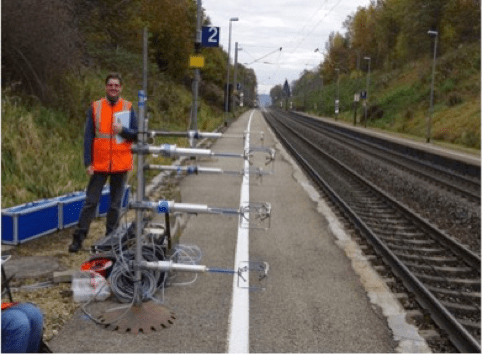
Clearly full scale measurements are the preferred type of testing, as these, properly conducted, will actually measure the reality of the situation. There are well established techniques for measuring wind velocities (using a range of anemometers of different types) and pressures (loads) on the infrastructure or the train (using pressure probes and pressure transducers) – see figure 1 for some slipstreams measurements made by BCRRE staff in Germany. However, there are serious practical issues. Setting up measurements requires close liaison with operators, development of safe working practices, possessions to install equipment etc., all of which can be costly and difficult to organize. Full scale tests are very vulnerable to weather conditions, and high winds, which unfortunately tend to come at the most inconvenient time, can make any test results very hard to interpret. To obtain representative data, usually around 20 passes of trains are required, with trains of the same configuration running at close to the same speed, which is of course not always achievable. And of course, very often, information is required for trains or structures that are not yet built, and so full scale testing is not possible. This technique remains the best to use, but these practical issues can often make it impossible to do so.
Figure 1 Slipstream measurements in Germany
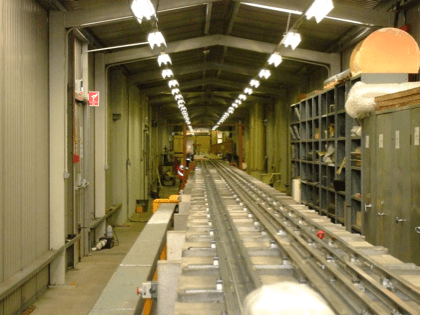
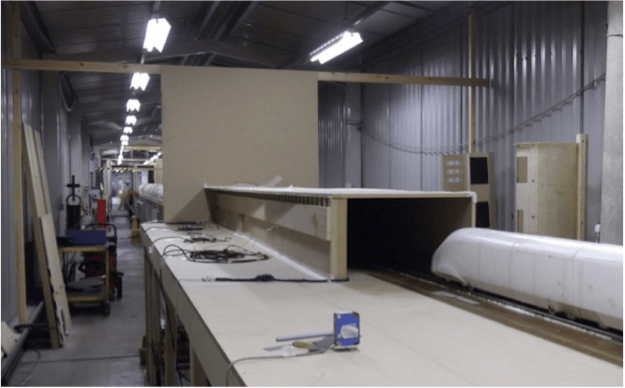
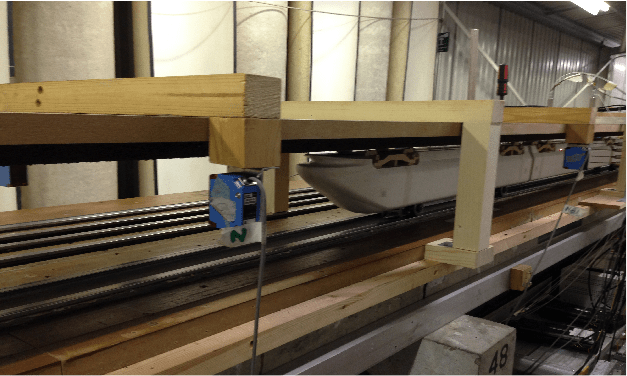
Physical model tests can take a variety of forms. The simplest (used to investigate cross wind effects) are standard low turbulence wind tunnel tests. However such tests do not properly reproduce the relative motion between the train and the ground. To model these effects properly it is necessary to use a moving model rig, such as the BCRRE TRAIN Rig based at Derby, which is a 150m long test track, capable of firing 1/25thscale model trains along two tracks at 75m/s (270 km/hr) – see figure 2 below. Such rigs can also be used to measure tunnel pressure transients (the TRAIN rig was originally built by BR Research in the 1980s to investigate transients in the proposed Channel Tunnel); loads on trackside structures; slipstream effects and (most recently) for the measurement of flow beneath trains in ballast pickup studies.
Figure 2 The BCRRE TRAIN Rig
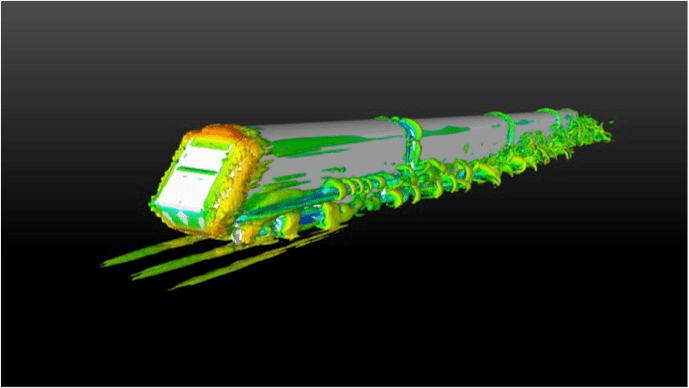
CFD techniques have seen major advances in recent years, and there have been a large number of applications to investigate railway aerodynamic effects. Most investigators use steady flow methods (usually referred to as RANS – Reynolds Average Navier Stokes – methods), which can be run on desktop workstations with run times of the order of hours or a few days. These methods can be learnt quite easily, and can give an indication of the flow field around trains and railway infrastructure. Whilst they are undoubtedly convenient, they do have significant limitations in that they cannot fully describe the highly transient an unsteady aerodynamic conditions that exist in the railway environment. Thus in recent years unsteady methods such as Detached Eddy Simulation (DES) and Large Eddy Simulation (LES) have come to be used more and more. Whilst these methods can produce a great deal of flow field and loading information (see figure 3 below for exapmle), they are extremely resource intensive. For example recent calculations at Birmingham to measure cross wind effects on trains have used computational grids with more than 50 million cells, which take weeks or months to run on the University supercomputer facility. Such methods are not yet practical for routine use in the train and infrastructure design, although they may well become so in the not too distant future.
Figure 3 DES Simulation of the flow field around a Class 43 HST
Finally we come to codes and standards. In recent years much work has been undertaken by CEN to produce a series of standards entitled “Railway Applications – Aerodynamics EN14067”. There are six parts to this code – Part 1 Symbols and Units; Part 2 Aerodynamics on the Open Track; Part 3 Aerodynamics in tunnels; Part 4 Requirements and test procedures for aerodynamics on open track; Part 5 Requirements and test procedures for aerodynamics in tunnels; Part 6 Requirements and test procedures for cross wind assessment. These standards have aimed to synthesise a great deal of work that has been carried out over recent years, and provide a very valuable resource. At the time of writing revisions are underway on parts 4 to 6, and a further standard on ballast pickup assessment is in the very early stage of development. Various aerodynamic requirements are also set out in the Infrastructure and Rolling Stock TSIs, often referring back to the CEN standards for the methodology.
Tunnel pressure waves and sonic booms
The phenomenon of pressure changes in tunnels is well known. Essentially when a train enters a tunnel a compression wave (pressure increase) passes along the tunnel at the speed of sound. This reflects from the open end of the tunnel as an expansion wave (pressure decrease) and travels back along the tunnel. To complicate matters when the end of the train enters the tunnel this generates and expansion wave which again passes along the tunnel but reflects as a compression wave. These pressure waves can thus bounce from one end of the tunnel to another, resulting in extremely complicated pressure patterns both in the tunnel and on the train itself. The complexity can be compounded by the presence of airshafts which can also cause wave reflections, or by more than one train in the tunnel at the time. On unsealed trains this variable pressure can be very uncomfortable for passengers, and there are some tunnels on the GB network where aerodynamic speed limits are in operation. Most modern trains are sealed of course, and depending on the degree of sealing the pressure transients may or may not be felt by passengers. The CEN codes specify criteria for allowable pressure changes over different periods of time – for example 3kPa in 4 seconds in a single track tunnel. These transients can be quite accurately predicted using very simple one dimensional calculation methods, based on the equations of gas dynamics, and more complex CFD methods are only necessary for very detailed calculations around, say, the inlet to the tunnel. The advantage of the simple methods is that they can be run a large number of times to investigate a wide range of cases i.e. when trains enter the tunnels from both ends, the time lag between the first and the second entering the tunnel can be varied to investigate the worst case scenario.
An associated issue is that of the sonic booms that are emitted form the ends of tunnels on high-speed lines. This was first noticed in Japan in the 1980s as Shinkansen speeds increased through relatively small tunnels. Once observed, its cause was quite quickly established. The compression wave that results from train entry into the tunnel is not an instantaneous pressure rise, but rather a more gradual rise over a short period of time. The pressure wave thus has a spatial gradient. For long tunnels, particularly with ballasted track, the friction of the tunnel wall and track bed tends to steepen the wave significantly. When this wave arrives at the far end of the tunnel, most of the energy is reflected as an expansion wave, but some of the energy propagates outward as a sonic boom, with an intensity that is proportional to the pressure gradient at the exit. The method for minimizing sonic booms is straightforward, although perhaps not intuitive, and involves giving the inlet pressure wave as shallow a gradient as possible, so that even if it does steepen in the tunnel, its gradient at the outlet is still not sufficiently large to cause a strong sonic boom. This is achieved by the use of variable area hoods at the entrance to the tunnel – see figure 4 below for a hood that was tested on the TRAIN Rig at Birmingham as part of the initial HS2 studies.
Figure 4 Tunnel entrance hood to eliminate sonic booms
Aerodynamic loading of trackside structures
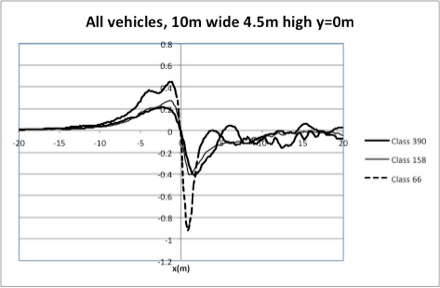
As the front of trains pass by trackside structures, they generate a transient pressure wave on the structure with the pressures first increasing and then decreasing. For example figure 5 shows the pressure on the underside of an overbridge as three different trains pass, plotted in dimensionless terms as a pressure coefficient. The peak to peak pressures are not in general that large (around 0.5 to 1kPa in dimensional terms) but, when they are repeated many thousands of times, can lead to fatigue failure of structures such as noise barriers, platform canopies etc. Guidance on allowing for these effects can be found in the CEN codes, based on full-scale tests carried out in Germany in the 1980s. These are of course not directly applicable to the GB situation because of the different loading gauge, so the RSSB have recently commissioned some tests on the TRAIN rig to measure the pressure transients on a variety of structures (hoardings, canopies, overbridges, tressle platforms) using 1/25thscale models, to provide information for a UK National Annex. The data shown in figure 5 is taken from those experiments and shows that the pressure transients caused by a Class 66 locomotive is very much greater than that caused by a Class 158 multiple Unit or the Class 390 Pendolino.
Figure 5 Pressure transients measured on a 10m wide bridge, 4.5 m above the track in TRAIN Rig experiments
Train slipstreams
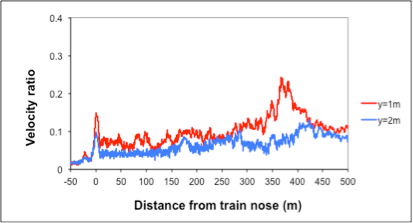
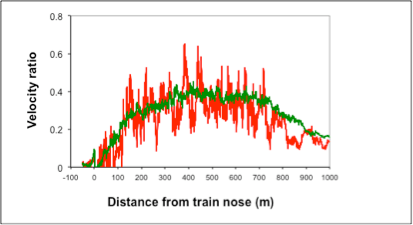
As trains move along the track, not only do they generate pressure transients as outlined above, but they also generate high velocities. This velocity field is known colloquially as a slipstream. Along the side of the train (and on the roof) there is a region of flow where the air around the train is moving at the train speed next to the surface of the train (due to friction effects), decaying to zero at some distance away from the train. This region is known as the train boundary layer, and its thickness grows along the train. For passenger trains the boundary layer can be around 1m to 1.5 thick at the end of the train. For freight trains the boundary layer can be much thicker and extend 3 or 4m from the side of the train. In the wake of the train, the flow is very different for passenger and freight trains. For passenger trains the flow within the boundary layer rolls up into longitudinal vortex structures that can extend for tens or hundreds of metres behind the train – and indeed for such trains the highest airflow velocities are usually found in the wake and experienced by passengers on platforms when the train is disappearing into the distance. For freight trains these vortices do not seem to exist, and the flow velocities decay rapidly behind the train. This difference in the flow field is illustrated in figure 6, which shows the average velocities measured at trackside for around 20 train passes, as an ICE2 and a container freight train pass by. It can be seen that the highest velocities for the ICE2 occur in the wake of the train, but for the freight train these occur along the side of the train and the high velocities exists for much longer than for passenger trains. In this figure the air velocities are normalized by train speed, and the normalized freight train air velocities are much higher than those for the passenger train. This implies that the air flow velocities caused by freight trains at their normal operating speed (80 to 100km/h) can be higher than those caused by passenger trains moving much faster. This issue has come to prominence lately because of two incidents in the UK. In the first, at Twyford station, a disabled girl in a pushchair was sucked into the side of a hopper train, and, mercifully, simply bounced of with only a minor injury. In the second an empty pushchair was moved by the slipstream of a passing container train at Nuneaton station and hit the train before bouncing back onto the platform. There is potentially an issue here that needs to be addressed by the industry.
Figure 6. Slipstream velocities measured for a high speed passenger train (ICE2) and a container freight train. (passenger train figure shows velocities at different distances from the side of the 270m long train; container train figure shows velocities for two different container consists for a 600m long train)
As noted above, train slipstream velocities can be measured at full scale, with all the practical difficulties that involves. A methodology is given in the CEN standards, together with limits for allowable velocities at both trackside and on platforms. Over recent years, it has been demonstrated that moving model tests an also be used for slipstream velocity measurements, although careful consideration of scaling effects is required. Standard RANS CFD techniques are not yet suitable for slipstream velocity assessments, because they do not capture the highly transient nature of the flow.
Ballast pickup
The problem of ballast flight beneath trains is one that has made itself felt very forcibly over recent years, with a variety of (usually unpublicised and unpublished) events occurring on high speed lines, where ballast has been lifted from the track, seemingly by aerodynamic effects, and caused considerable damage to train under bodies and tracks. The phenomenon seems to manifest itself in different ways in different countries. In parts of Europe incidents have occurred in normal weather conditions, where large quantities of quite large ballast have become airborne and caused extensive pitting of train under bodies. In particular this occurred during ICE3 tests in French and Belgium lines in 2003 and 2004, where major damage was caused to the trains, but other incidents have been reported in Italy and Spain. In other parts of France and the Far East, the problem seems to be due to ice particles falling from trains, that then displace ballast that then causes train and track damage. In the UK, the problem appears to be due to smaller ballast particles being lifted onto the track, where they are crushed by either the train that caused the ballast to lift or a following train, leading to pitting of the wheel and rail, and the need for more regular maintenance and shown below. Indeed discussion with operators in the UK suggest that the flight of ballast has been a problem for many years, with long term requirements for extra wheel maintenance through grinding, for the front and rear wheel sets, and regular observations of ballast high up in the underbody equipment during maintenance periods. But without a doubt the most severe issues occur on ballasted high-speed lines when operating around and above 300km/hr.
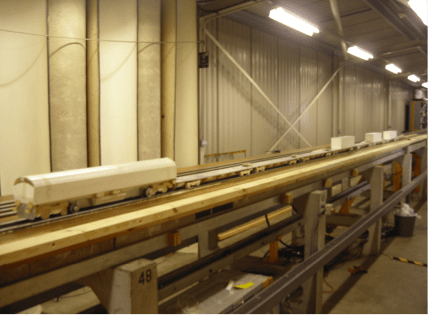
The causes of ballast pickup are quite complex. Ballast experiences a number of different types of force as trains pass over – mechanical forces due to track vibration and aerodynamic pressure and friction forces. These forces all vary in different ways with train geometry speed, ballast size and packing etc., and these variations probably explain the different ways in which the phenomenon is manifested. This phenomenon has initiated a significant amount of research work around the world, particularly within Europe, through the Aerodynamics in the Open Air (AOA) and AeroTRAIN projects. The thrust of these investigations has been towards developing a method for the certification of new trains, through a standardised testing procedure, based on measuring the flow velocity beneath trains above a standardised track form. More recent tests by the University of Birmingham and the University of Southampton on HS1 have measured mechanical effects and aerodynamic effects simultaneously during the passage of Eurostars in an attempt to understand more fully the physics behind ballast pick up. Southampton University developed the technique of using ballast with accelerometers, data loggers and batteries mounted within the ballast itself – with the data downloaded each evening via a USB port! Alongside these full scale tests, work was carried out to predict the flow beneath the train using physical models on the TRAIN Rig and advanced CFD techniques. The Eurostar model on the TRAIN Rig is shown in Figure 7. It can be seen that the train travelled along the rig upside down under a false floor, to make access easier for instruments. The physical model experiments were in excellent agreement with full-scale results and potentially offer a way for the certification of new train designs, although much further development work is required.
Figure 7 Upside down Eurostar model on the TRAIN Rig for underbody flow measurements
High wind effects
The study of the effects of high winds on trains has a long history dating back to the risk assessment that was carried out to determine the risk of the Advanced Passenger Train blowing over on the West Coast Main Line in the late 1970s. The Rolling Stock TSI specifies that all new high speed trains have to demonstrate that they have sufficient cross wind stability (i.e. they will not overturn) and likewise the Infrastructure TSI requires that a suitable risk assessment is carried out before trains can be certified to run on specific routes. The methods for carrying out these assessments are quite complex and are set out in the TSIs and CEN standards. The risk assessment requires the exposure of routes to high winds to be assessed, and the risks of high wind gusts to be specified.
However the effect of cross winds on railway operation is not of course confined to train design and route risk assessment. In the recent storms in Europe (early 2018), the German and Dutch railway authorities simply stopped train movement, because of worries about debris on the track or trees falling onto overhead wires – not because of worries about trains overturning, as the wind speeds were much too low for that. The same happens in the UK. When high winds are forecast Network Rail and the TOCs first impose a blanket regional 50mph speed limit, mainly so that trains have some hope of reducing speed when debris is blown onto the track. A major problem in this regard seems to be trampolines at the moment (!) and at higher predicted gust speeds of around 65mph, train operation is stopped completely. Also, very often, train movements are blocked by tree fall onto the overhead.
Closing comments
It can be seen from the descriptions of the various issues set out above that there are a wide range of aerodynamic issues that need to be taken into account in railway infrastructure design and operation, as well as in the design of new trains and other rolling stock. One final point is worthy of mention however. It seems to the author that this range of issues is ill served by a simple split between train effects and infrastructure effects, as is, inevitably, fostered by the Rolling Stock and Infrastructure TSI. Aerodynamic effects on the railway are usually a combination of the effects of train movement around and through infrastructure – trackside structures, the track itself, tunnels and so on, and cannot easily be compartmentalized. This is perhaps what makes the subject such a fascinating one for study!



 Engineering, history and ecclesiology