Coal mining in the Shut End and Corbyn’s Hall area

Shut End and Corbyn’s Hall

In an earlier post, I discussed the railway system around the Shut End and Corbyn’s Hall Ironworks and Colliery complexes in Pensnett  in the late 19thcentury. One reader of that post pointed me in the direction of the Coal Authority web site, which contains huge amount of information about disused coalmines across the country, including of course the Shut End and Corbyn’s Hall area.   It really is a fascinating site, and I would encourage readers to have a look at it. What I want to do in this post is to use some of the information presented there to give more details of the mining operations that I briefly discussed in Kingswinford Manor and Parish (KMAP) and in the blog post just mentioned. Figure 1 shows the area that I will concentrate on, which is centred on the High Oak in Pensnett where Commonside meets Pensnett High Street. The figure shows the major roads in the area; the canal feeder pools, which are such a major feature of the local geography; and the locations of the Ironworks at Shut End and Corbyn’s Hall.
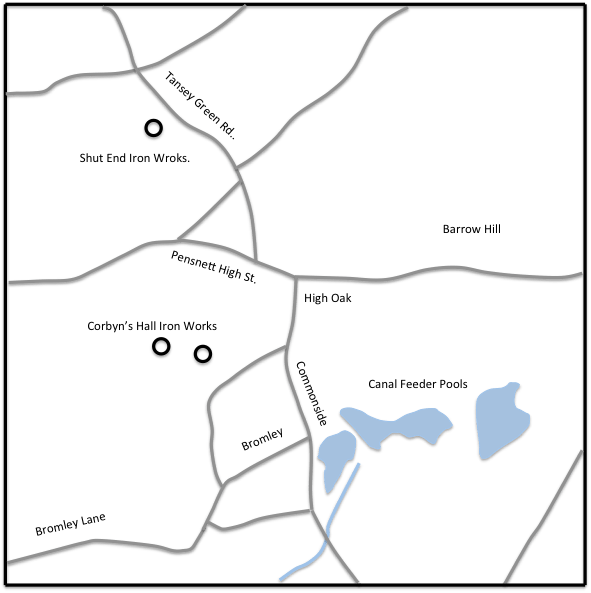
Figure 1 The study area

Topography and Geology

Figure 2 shows the topography of the study area, with the elevation profiles taken from Google Earth. It can be seen that it falls quite steeply from east to west from around 150 a.s.l. in the east to around 90m a.s.l. in the west. This will be seen to be of importance when considering the depths of coal seams and mines below.   

Figure 2 Topography of the study area from Google Earth

Details of the geology of the area can be obtained from the Edina Digimap web site. Figure 3 shows the underlying bedrock geology of the area. This has been very much simplified from the Digimap version to show only the major features. There are four main types of underlying geology – sandstone to the west and in outcrops across the area; an igneous outcrop in the Barrow Hill area; large areas of the Etruria formation of sandstone / mudstone, with some areas of Pennine Coal measures formation of sandstone / mudstone / siltstone. The latter two are the principal coal bearing strata. The major faults are also shown. The fault to the west is actually the edge of the South Staffordshire coalfield. There can be seen to be a number of faults in the area, which cause quite complex underground coal seam patterns. This will be discussed further below.

Whilst the figure shows the underlying geology, close to the surface the nature of the land changes completely, and the Digimap website describes it as “artificial ground” – a somewhat euphemistic description of the fact that the whole area is largely built on waste and colliery spoil.

Figure 3 Geology of the study area from Edina Digimap 

The Coal Authority web site

We turn now to the information provided on the Coal Authority web site. Coal has been mined over the entire region around our study area for many hundreds of years, firstly exploiting surface outcrops of coal, and then digging deeper and deeper mines to bring the buried coal to the surface.  Most of the main surface outcrops of coal in the region were in the area south and east of Brierley Hill, which unsurprisingly was the first part of the ancient parish of Kingswinford to undergo industrialization. In our particular study area there were however a few outcrops (figure 4) – at Brockmoor in the south and in the Coopers Bank / Old Park areas in the north. 

Figure 4 Surface outcrops of coal from Coal Authority web site

Figure 5 shows the seams of buried coal, where there is sufficient information for the contours to be mapped, and spot depths for seams at other points. The heights of the seams are all given in metres a.s.l. This figure needs to be considered in the light of the topographical information in figure 2 to enable the depth of the seams below ground level to be appreciated. The shallowest deposits are to the east of the area where the seams can be as little as 30m below the ground. In the west of the area, the seams are much further below ground level – up to 150m. The deepest mines in the region were ultimately to be those at Baggeridge to the north of the study region, where the deposits were 350m below sea level. 
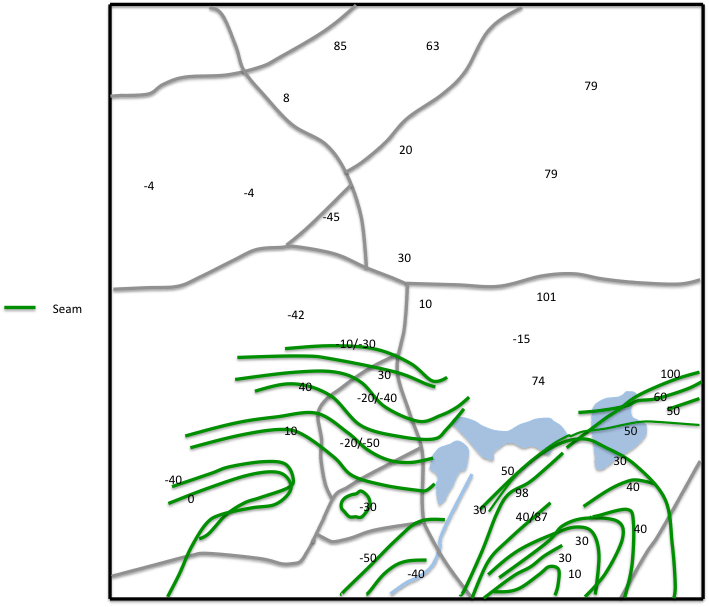
Figure 5 Coal seams and depths from Coal Authority web site

Looking at the distribution of coal from another direction, figure 6 shows a section through the study area from a drawing by William Matthews in  a paper he wrote in 1860. Matthews was the proprietor of Corbyn’s Hall Iron Works at the time and a little more issued about him in KMAP.  The approximate location of the section is given on figure 3. The line as specified by Matthews is a direct line from Dudley Castle to “Kingswinford” although where in Kingswinford is not spelt out and it is not possible to identify the precise location of the line.  That being said the location of the igneous outcrop at Barrow Hill can be seen and the faulted and fractured nature of the coalfield is apparent.  The need for deep pits to extract the bottom seams of coal is also clear. 

Figure 6. Section through the study area (redrawn form Matthews , 1860)

Figure 7 shows the “mine openings” as defined on the coal authority site. These mines were not of course all operating at the same time, so the map gives no temporal information. But the huge number of openings is instructive (and the density here is by no means as high as in the older Black Country mining areas of Bilston and Wednesbury). The site gives name information for many of these, which to some degree is indicative of ownership. The five main groupings are indicated on the map of Figure 7 as follows.

  • The Shut End group, originally owned and operated by James Foster in the 1830s as part of the Shut End Iron Works complex, and later by the Shut End Colliery Ltd. 
  • The Tiled House / Corbyn’s Hall group, developed by Ben Gibbons and his associates in the 1830s to 1850s, and which provided coal for the Corbyn’s Hall Iron Works.
  • The Himley Group of the Estate of the Earl of Dudley. It can be seen that this was to the east of Commonside, which was, in the main, the boundary of the Pensnett Chase Enclosure Award of 1784. A clause in the act reserved all the underground mineral rights to the Earl of Dudley and his successors, even where the land itself was allocated to others. The estate exploited these rights to the full over the next century and a half.  
  • A group in the Old Park area, which had been mined to varying degrees for several centuries by the Earls of Dudley. 
  • A group of mines around the Wallows / Woodside, which were probably also part of the Dudley estate.

Figure 7.  “Mine openings” from Coal Authority web site

If the “mine opening” category on the Coal Authority site does not give temporal information, the “mine working” category does.  For each mine that is included, it gives a year when it was working. The precise definition of this year is not clear to me i.e. was it the first year of operation; the last year; or something in between? But at least it gives an indication of when mines were in operation. I have presented this data in figures 8, 9 and 10 in twenty-year time slices – 1830-1850, 1850 to 1870 and 1870 to 1890. The former corresponds to some degree to that given on the 1840 Fowler map of Kingswinford, and the latter to the period I considered in my earlier post where I discussed the railways of the area. A comparison of the maps is instructive. Between 1830 and 1850 the highest concentration of mines is in the Shut End area, where the Iron Works was in operation, with limited mines around the Corbyn’s Hall area, presumably feeding the Iron Works there. Between 1850 and 1870 the mines close to the Shut End Iron Works had clearly all been worked out, and supplies were brought in from somewhat further afield by rail  – a process I discussed in the earlier post. In this period there was much more activity around Corbyn’s Hall and the High Oak area of Pensnett, and mines were operating in the Wallows and Old Park areas. It can thus be seen that the exploitation of the coal reserves by the Earl of Dudley’s estate was well underway in this period. In the 1870 to 1890 time slice, the situation has changed again with the most heavily exploited areas being in the Fens and Barrow Hill regions. Many of the mines in this area were in the residential areas of upper Pensnett. A cluster of them was around Pensnett church and vicarage, and no doubt contributed to the long term subsidence problems of structural damage to the church. Comparing this information with that given in KMAP for the distribution of the coal pits on the 1840 Fowler Map and the 1883 Ordnance Survey map, shows that these two sources show far fewer pits than the Coal Authority map. This might be of course simply because they show the situation at a particular time rather than in a twenty year time slice, but it does give some idea of both the short lived nature of many of the mines, and the uncertainties in handling data from different sources. 
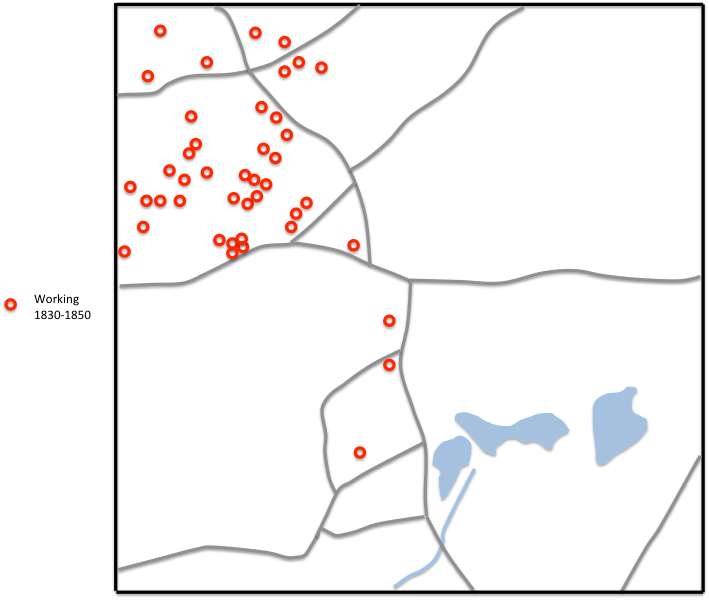
Figure 8. “Mines working” between 1830 and 1850 from the Coal Authority web site
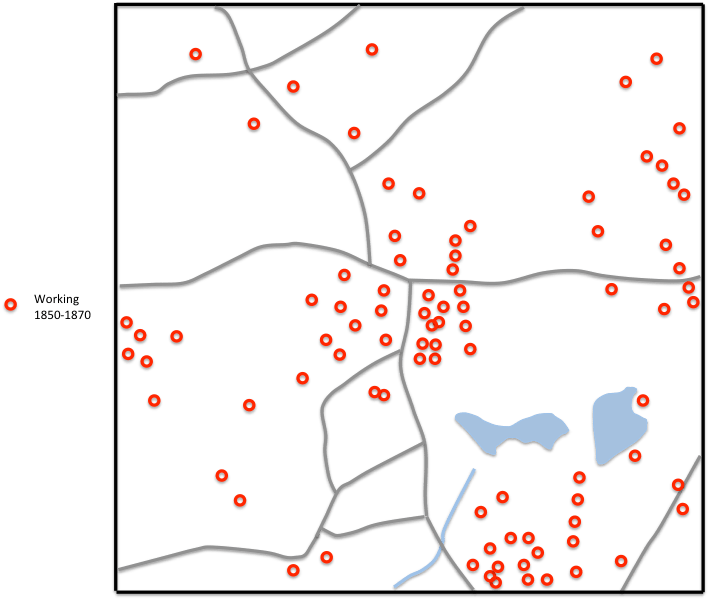
Figure 9. “Mines working” between 1850 and 1870 from the Coal Authority web site

Figure 10. “Mines working” between 1870 and 1890 from the Coal Authority web site

Final thoughts

Two final thoughts come to mind, in connection with items I have already posted. Firstly in Kingswinford Manor and Parish, when considering the spread of mining through the parish of Kingswinford I rather simplistically suggested that, during the nineteenth century, there was a gradual spread from the old mining areas in the Brierley Hill area in the south of the parish, northwards towards Pensnett and Shut End. The situation described above shows that it was rather more complex than that, with an early exploitation of the coal reserves around Shut End, and to a lesser extent Corbyn’s Hall, followed by a gradual “filling in” with mines of the areas between Brierley Hill and Brockmoor and Shut End over the next half century. 

Secondly in my earlier post on the Railways of the area, I put forward a model of how Ironworks / Colliery complexes developed in the area – firstly with ironworks and coalmines being in close proximity; then as the coal reserves became exhausted, with railway systems being developed to bring coal from mines somewhat further away but still in the locality, and finally with coal being brought from considerable distances. Figures 8 to 10 above tend to confirm this model in the Shut End area in particular, with the early development and later decline of mines close to the ironworks there, but there is also evidence of the same process around Corbyn’s Hall. 

Without a doubt the Coal Authority web site has a huge amount of data of interest to industrial historians, and I am very grateful that I was told about it. In this post I feel I have only scratched the surface of this material – so I may well return to it in future.
St Michael’s church, Lichfield – Landscape, Topography and Archaeology

Introduction

The historical importance of St. Michael’s church in Lichfield has been made clear in other articles and posts on this site – see here and here. Now. in the near future new church rooms will be built behind the church, and no doubt archaeological work will be required to investigate the site of the new build. I thus thought it would be appropriate to gather together historical and archaeological material concerning St Michael’s, to inform both those involved in the coming work and the congregation of St. Michael’s in general (of which, it will become apparent, I am a member). Thus in what follows I will present the results of a number of investigations by various authors – the first that considers St. Michael’s in the context of the early church in Lichfield; the second which considers the local topography around the church and churchyard; and the third which considers the results of previous archaeological digs.  I won’t present any information on the development of the ecclesiastical parish, building or churchyard, except in passing. These are well enough covered in the guidebooks that are available in the church,  the Victoria County History (1990) and in the work of Trevor James (1998). 

A Romano-British diocese?

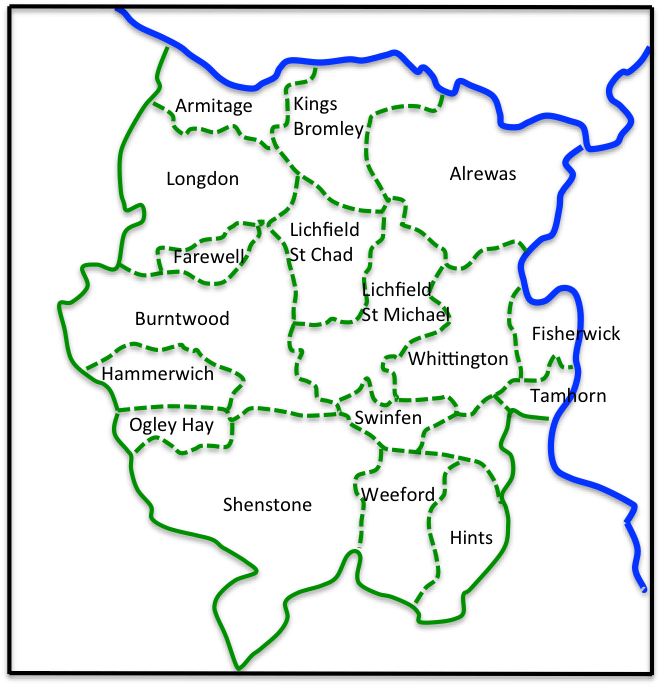
Bassett (1992) considers a number of ancient churches in the Midlands, and discusses how they might have evolved over the period of late antiquity after the departure of the Roman armies. Amongst those he discusses is St Michael’s. Based on material from a very wide range of sources, he comes to the conclusion that a good case could be made for St Michael’s being the centre of a British ecclesiastical diocese that predates the Augustinian mission in 596AD. His reconstruction of the possible extent of this diocese is shown in Figure 1 below. It can be seen to be very extensive indeed, occupying land in the area between the Tame and the Trent. Indeed an argument can be made that it also extended east of the Tame, as the townships of Haselour and Statfold have historical links with St. Michael’s. James (1998) has arrived at a similar conclusion as regards the size of the ancient parish of St. Michaels, although he doesn’t speculate on its episcopal nature. Basset’s arguments are complex and in places compelling, but I must admit to not being entirely convinced by them. Many of the points he makes would be just as applicable to a large secular land unit as to an ecclesiastical unit. There is also a basic assumption that St. Michael’s has been a parochial church for much of its existence, whereas the historical record, for example as outlined in Victoria County History (1990), suggest that the parochial system was only formalised within the last few centuries with much of the earlier pastoral work being focussed on the cathedral prebends. But the thought that St. Michael’s was an episcopal see is an attractive one to a member of the current congregation. In particular I like the implicit suggestion in Basset that the Cathedral, St. Mary’s and St Chad’s parishes were all created out of the much larger St. Michael’s parish – and thus later arrivals on the Lichfield ecclesiastical scene. 
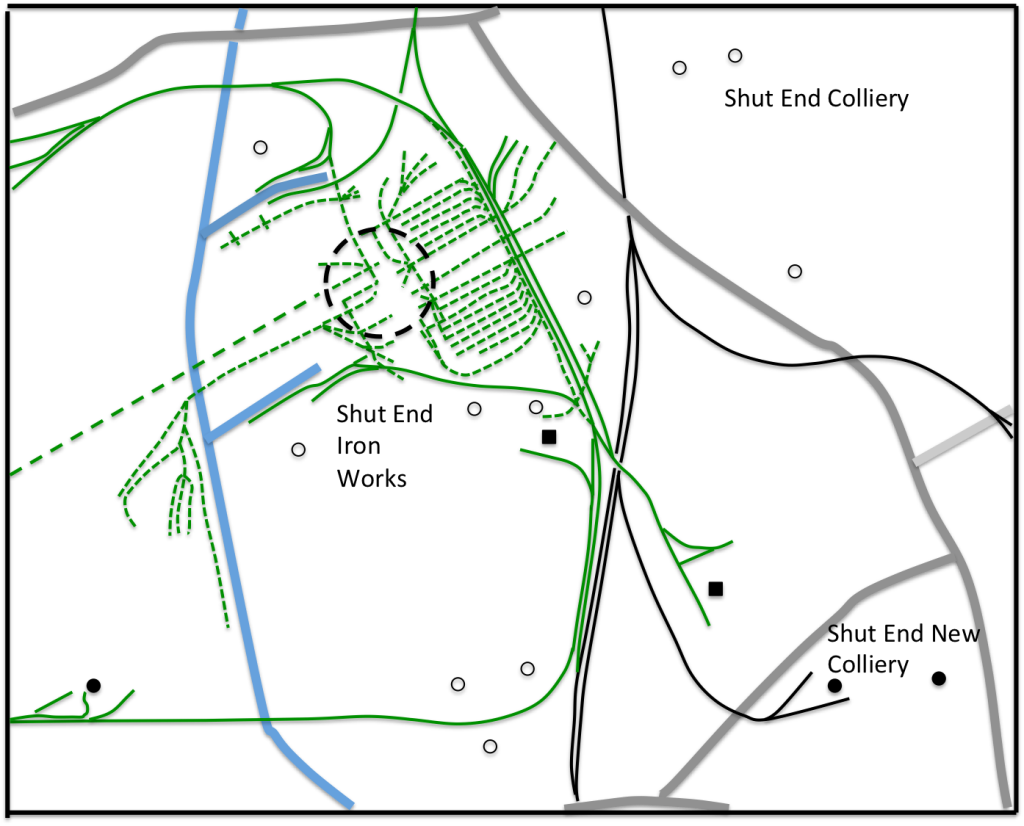
Figure 1. The Romano-British diocese of St. Michael’s as reconstructed by Basset   

(This is a simplified version of the map in Basset (1992) and shows 19thcentury townships and parishes. The parish of Lichfield St Chad includes the Cathedral and Lichfield St. Mary. The parish of Lichfield St Michael includes the townships of Streethay, Fulfen and Freeford.)

Lichfield topography

In an earlier paper Basset (1981) discusses the development of the city of Lichfield and its environs. In an extremely detailed topographical study of the area he studied the relationship between field boundaries and roads and trackways shown on tithe maps. He was able to show that some trackways conformed to the field boundaries, and were thus presumably in place before the field system was laid out, whereas some roads cut across the field boundaries and thus can be conjectured to post-date the establishment of the field system. The point of most significance to emerge from this map is that Ryknield Street cut across a number of pre-existing field boundaries, which thus implies that the field system was set out in very early Roman times, or more probably because of its extent, in the Bronze and Iron Age periods. Figure 2 shows the major trackways and roads that were identified as conforming with field boundaries, and which can thus be taken as of pre-Roman origin. The modern day names of these roads are given in the key to help with identification. It can be seen that Lichfield was far from being an underdeveloped area at the start of the Roman era, with a number of trackways converging on the area. 

Whilst the map of figure 2 is interesting in a general sense to all who know the area, of particular relevance in the current context are those in the vicinity of St. Michael’s church. Note that the church is shown in purple to reflect its potential episcopal nature! Road B on the map follows the current lines of Darnford Lane, Boley Cottage Lane and Frenchman’s Walk. Within Boley Park its course has been built over, but the general line has been preserved between the end of Boley Cottage Lane and Frenchman’s Walk by Broadlands Rise, a connecting jennel, and Oakhurst.  Road C follows the lines of Cappers Lane and Burton Old Road. Around St. Michael’s its course is no longer directly visible – this will be seen to be of relevance in what follows. Note that Sturgeon’s Hill / Rotten Row does not appear on the map – this clearly cuts across field boundaries and postdates the laying out of the field network. 

Figure 2. Ancient roads and trackways in Lichfield (from Basset, 1981)

A – Walsall Road, Christchurch Lane, Gaia Lane; B – Darnford Lane, Boley Cottage Lane, Frenchman’s Walk; C – Cappers Lane, Burton Old Road; D – Valley Lane, Wissage Road, Curborough Road / Nethrstowe; E – Grange Lane; F – Cross in Hand Lane, Beacon Street; G – Fosseway Lane, Fosseway, Shortbutts Lane, Tamworth Road 

Figure 3. Roads in the vicinity of St. Michael’s

(Road identifiers the same as in figure 2. H – Sturgeon’s Hill / Rotten Row, S – Stowe Gate, T – Tamworth Gate. The edge of the burgh is given by the brown line)

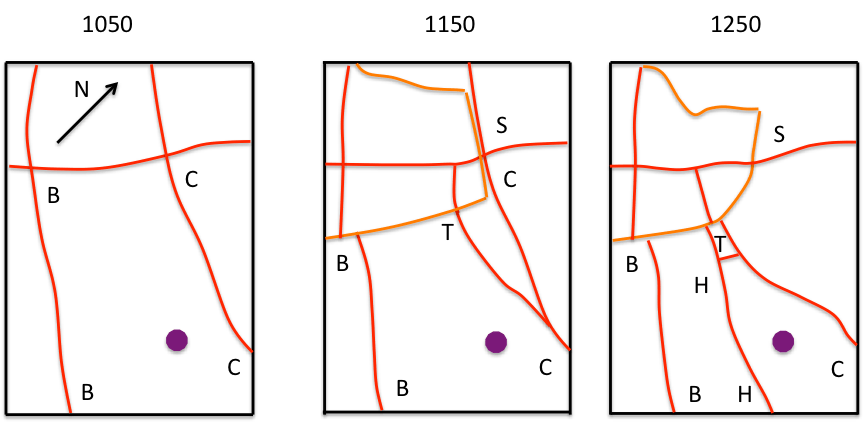
Basset also looked in detail at the development of the city. In short, the city was a planned development, laid out by Bishop Roger de Clinton around 1125 to 1150 Figure 3a shows the roads around St Michael’s around 1050AD, with the same identification letters as in figure 2. Figure 2b shows the road layout inferred by Basset in 1150AD after the Burgh was laid out. It can be seen that a new road has developed from Road C (Burton Old Road) and heads to the Tamworth Gate (denoted by T). The old road continues to the Stowe Gate (S). By 1250AD the situation has changed somewhat. The old road to the Stowe Gate no longer exists (although it can even now still be traced by the lines of back gardens along part of its course. Road H (Sturgeons Hill / Rotten Row) has appeared and converges on the Tamworth gate and the diverted road C. At the gate there was an open area that was used as a market, and which ultimately became the cattle market. The diverted section of road C was eventually to become part of Trent Valley Road / Church St. at the bottom of St. Michael’s graveyard. The important point to appreciate is that over the course of this development, the area around St. Michael’s graveyard became increasingly constrained, both by Road H and by the diversion of Road C and the market area. It is quite possible that the size of the graveyard was actually reduced by these constraints. 

Archaeology

There have been two archaeological excavations at St Michael’s in recent decades. The first was by Gould and Gould (1976) who cut a trench in he bank between the old and the new churchyard to see if there was any evidence of a churchyard enclosure, as is often found around ancient churches. There wasn’t. You win some and you lose some.

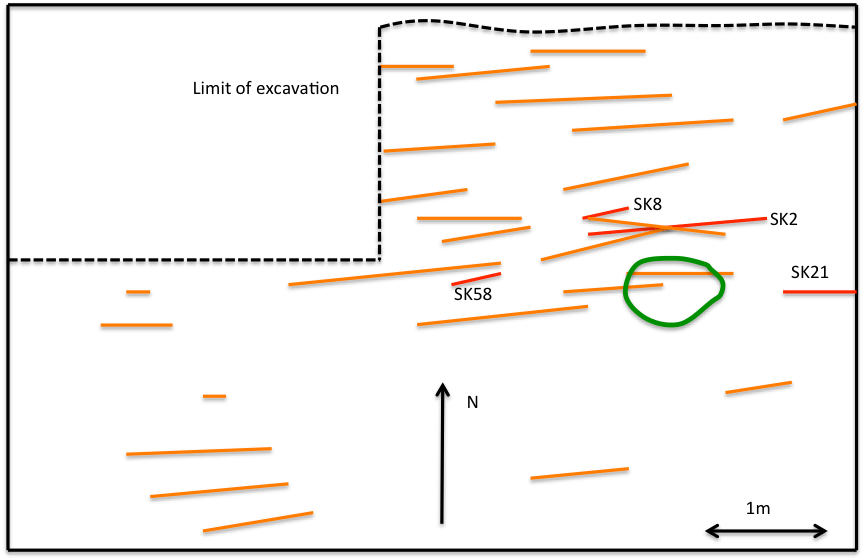
The second excavation was carried out in 1978 on the site of the new choir vestry (Wilson, 1981).  A sketch of the excavation is given in figure 4. This was rather more profitable in terms of the archaeology as follows. 

  • A single post pit, filled with sandstone fragments in the bottom layer.
  • 49 complete or partial skeletons, mostly buried in the Christian manner with head to the west (so they would face their maker at the resurrection). There were two exceptions. Skeleton 21 was buried with its feet to the west, in a manner that would be suggestive of a priestly burial (so he would face his flock at the resurrection). The expected chalice and paten were not found, possibly because this skeleton was at the edge of the excavated area and it head was outside the area. Murphy’s law and all that. Alternatively Wilson suggests he simply could have been buried the wrong way round. Skeleton 58 was a crouched burial. Such burials are known from Palaeolithic times. In a Christian context they are most often dated from the Anglo-Saxon period. No independent carbon dating was possible. In addition skeletons 2 and 8 were of a woman and a small child – who possibly died during childbirth.
  • Five flint flakes from the Mesolithic period but in a secondary context; large quantities of building material from earlier churches, including 300 fragments of glazed medieval roof tiles; a range of different types of decorated floor tile; a sherd of Roman pottery; a halfpenny from the reign of George III and a silver penny from the reign of Richard II. 

There thus seems to be some evidence of very early use of the Greenhill site, but precise dating was not possible.

Figure 4. The 1978 excavation

(There of excavation covers the area of the current choir vestry. Brown lines indicate burials with skull to the west. Red lines indicate specific skeletons discussed in the text. Green indicates the posthole.) 

A personal postscript

There is a further quasi-archaeological point of personal interest. In 1822 one John Baker and his wife Anne (nee Woodfield) were buried in the churchyard at the location shown in figure 5. They were my great-great-great grandparents. I can find out little about them other than that they were very prolific in producing children (11 can be traced). They were one of the few of my ancestors to be able to afford a gravestone. St. Michael’s monumental inscriptions records the inscription as 

2022 John Baker 17/9/1822 also Ann Baker

So it was probably not a terribly large gravestone. It has of course been moved as the churchyard has been tidied over the recent decades and I don’t know its location. If anyone comes across it at any stage please let me know! Further fascinating details of my family tree, the members of which were almost exclusively miners, ironworkers or agricultural labourers, can be found here.

Figure 5. Location of John and Ann Baker’s grave

References

Basset S (1981) “Medieval Lichfield: A topographical Review”, Transactions of the South Staffordshire Archaeological and Historical Society, XXII, 93-121

Basset S (1992) “Church and diocese in the West Midlands; the transition from British to Anglo-Saxon control”, Pastoral Care Before the Parish p. 13-40

Gould D, Gould J (1976) “St Michael’s churchyard, Lichfield, Staffs”, Transactions of the South Staffordshire Archaeological and Historical Society

James T (1998) “The development of the parish of St-Michael-on-Greenhill over 1500 years”, St Michael’s papers number 1, PCC of St Michael’s, Lichfield

Victoria County History (1990) ‘Lichfield: Churches’, in A History of the County of Stafford: Volume 14, Lichfield, ed. M W Greenslade (London, 1990), 134-155. British History Online http://www.british-history.ac.uk/vch/staffs/vol14/pp134-155

Wilson P (1981) “Investigations in St Michael’s and St Mary’s churches, Lichfield”, Transactions of the South Staffordshire Archaeological and Historical Society, XXII, 

Corbyn’s Hall from above

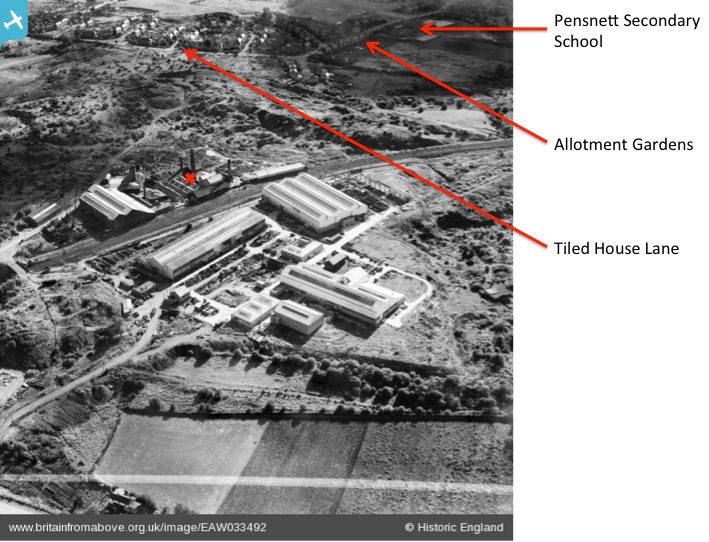
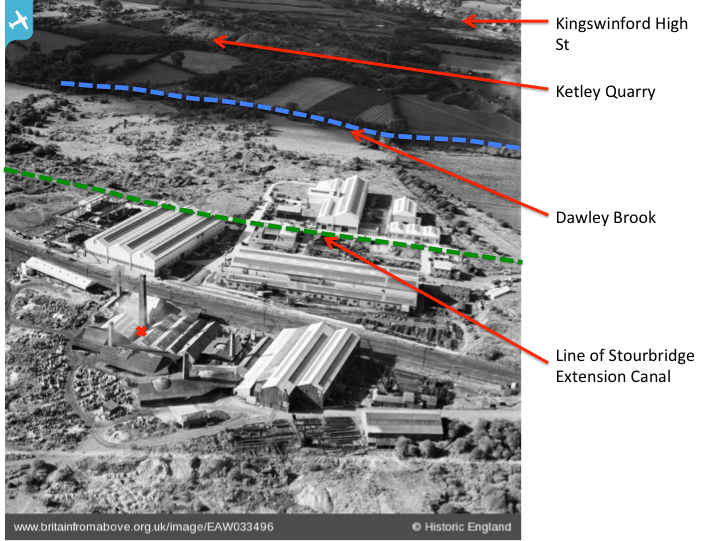
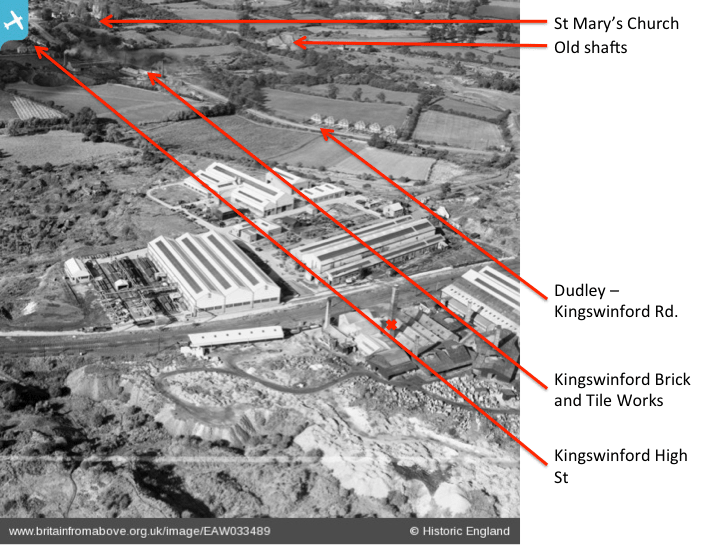
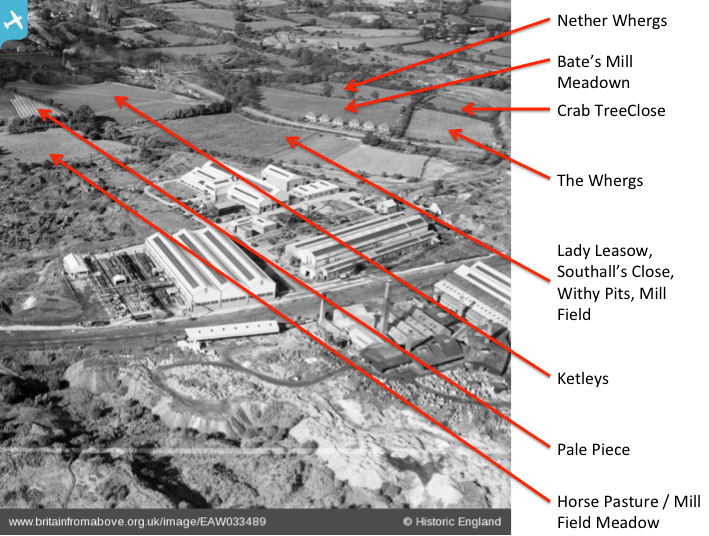
The “Britain from Above” archive contains a huge number of aerial photographs covering the entire country. These are usually arranged in sets of photographs concentrating on a particular notable landmark, and they give a huge amount of detail of the area around the site. Low-resolution photos can be downloaded and used on websites, and a simple free registration allows the reader to zoom in to small parts of the photographs for amazingly detailed views. When a search is made for Kingswinford, two sets of photographs appear – one is a set of six photographs of “Woodfield House and its Environs, Kingswinford, 1939” and the other a set of nine photographs of “Gibbons (Dudley) Ltd Silica Works at Corbyn’s Hall, Kingswinford, 1950”.  It is with the second that this blog post is concerned. I will post some of the low-resolution photos taken as the plane flew around the site and label them with information contained on the large scale Ordnance Survey map for the 1950s from Edina Digimap. Taken together they provide us with a glimpse of the Corbyn’s Hall area in the 1950s and also, if one looks carefully, at the neighbouring villages of Kingswinford, Pensnett and Bromley. 

Gibbons (Dudley) Ltd

The firm was founded in 1834 by Benjamin Gibbons, who is discussed at length in Kingswinford Manor and Parish, using high-grade fireclay to make bricks. They manufactured refractory products – firebricks, cements, concretes and plastic refractories. The main works was at Dibdale, Lower Gornal with additional works at Cooper’s Bank and Corbyn’s Hall, Pensnett.  The Pensnett works  was just one of the industrial concerns that grew and prospered on the Corbyn’s Hall estate that came into the ownership of the Gibbons Family in 1780. These included coal mines, iron and steel works and brick works. The map from the 1950s indicates a brick works at the centre of the site, with a number of chimneys, which was presumably the Sillica works, but also a large steel works and numerous disused coal and ironstone pits. In all the photographs that are used, the tallest chimney at the works will be marked by a red cross as a point of reference for the reader. 

Looking northeast

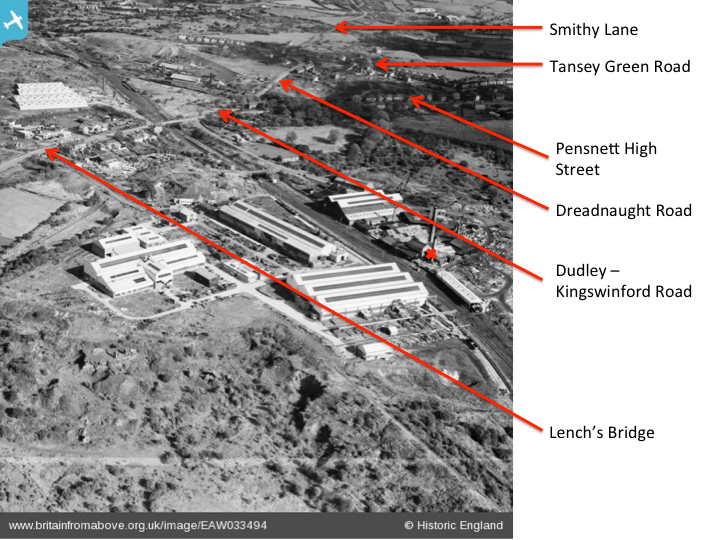
We begin with the view looking northeast over the site, given. Here the relevant photograph is given twice. The first highlights the roads in the area – the Kingswinford-Dudley Road, Dreadnaught Road, Tansey Green Road, Smithy Lane and Pensnett High Street. Lench’s Bridge is also shown. This was built to span the Stourbridge Extension Canal. Little can be seen of this canal by 1950, it having been abandoned several decades earlier, although I will indicate its course in later photographs. The second photograph shows the various industrial concerns in the area, mainly distributed along the Wombourne Branch Railway (at this time still part of the through route for goods trains from Stourbridge to Wolverhampton). Just south of the main road is the site of Pensnett Halt, one of the stops on the short-lived passenger service on the line in the 1920s.  On the Corbyn’s Hall site itself the brick works and steel works can be seen, the former being marked by a red cross as mentioned above, together with a number of old colliery workings. On the northern side of the Dudley – Kingswinford Road there are the Dreadnaught tile works and Stourbridge Refactories, both rail connected. The sawmill just to the south of the road has a long history and it can be traced back in census records to the 1880s at least. One of the most obvious features of the photograph, that will be observed on all those that follow, is the large area of waste ground around the site – caused by a century or more of coal and ironstone mining and other industrial use. This area, with all its hidden dangers, was the playground of my youth.

Looking east

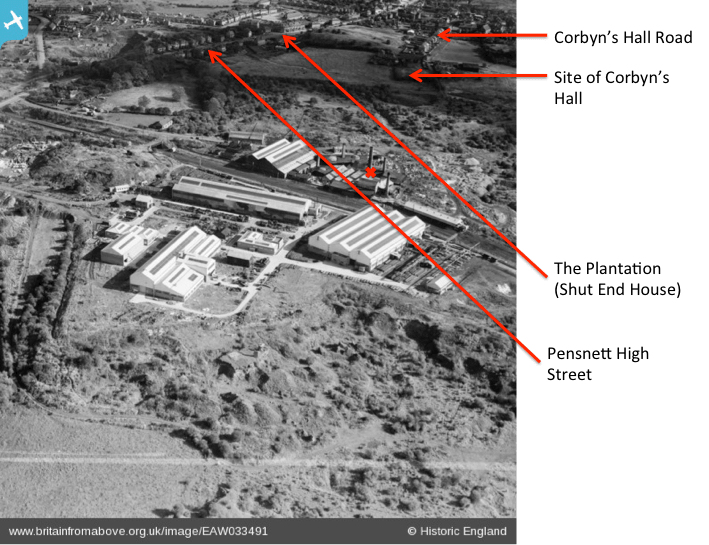
The next photograph shows the view looking east over the site. In the background we can see Pensnett High St, the large house known as the Plantation, which was formerly known as Shut End House, the residence of Ben Gibbons himself. The photo also shows the site of the original Corbyn’s Hall which suffered badly from subsidence due to the mining activities and was demolished in the early years of the twentieth century. 

Looking southeast

The next photograph swings round further and looks southeast. At the top of the photograph Tiled House Lane and its numerous cul-de-sacs is clearly seen, together with a region of allotments and Pensnett Secondary Modern School. The large area ofwaste land between Tiled House Lane and the works is very obvious.

Looking south

The next photograph looks due south towards Bromley, with Bryce Road, Bromley Iron Works and the disused New Bromley Colliery in the distance. I include on this photograph, and the following two, the line of the abandoned Stourbridge Extension Canal. It can be seen that the steel works is effectively built over the line of the former.  The canal had a number of short branches. One of these served the Corbyn’s Hall old iron works which was on the left of the picture, and would have left the main line somewhere under the modern works, and gone under the railway line. The other was the Standhills branch, which left the main line somewhere around the top of the photograph and followed a large loop to the west. 

Looking west

This photograph looks due west towards Kingswinford in the background. I have indicated on it the line of the Stourbridge Extension Canal, and also the line of Dawley Brook. The latter marks the bottom of the steep slope down from Commonside in Pensnett towards Kingswinford. The original Corbyn’s Hall estate extended well to the west of the brook.  On the Fowler map of 1822, this brook had a number of pools along its length – which were possibly the remains of mill pools or ornamental features. 

Looking northwest

The last photograph, looking northwest, is repeated three times. On the first the Dudley –Kingswinford Road is again labeled, together with the Kingswinford Brick and Tile Works, St Mary’s Church and the old shafts and spoil tips of Shut End Colliery.  The second again shows the lines of the Stourbridge Extension Canal (on both sides of Lench’s Bridge) and the Dawley Brook, and also shows the line of the original Kingswinford Railway (of Agenoria fame). The third shows the names of some of the surviving fields. These can be linked back to the 1822 Fowler Map of the area, and also earlier 18thCentury maps of the Corbyn’s Hall Estate. Their essentially rural names speak of a very different age. Some of these names indicate the presence of mills along the Dawley Brook. I find it remarkable that they were able to survive in an identifiable form as late as the 1950s. 

More detail

As mentioned above, much more detail can be seen by zooming in on the photos on the Britain from Above site. It is tempting to reproduce screen shots of these views here, but I don’t think this would meet the license conditions. But I would urge interested readers to have a look. The specific views that intrigue me are on the “Looking east” photo, where one can see the large open cast area just west of Tansey Green (close to the old Shut End Methodist Chapel), the Birds Meadow school, and the back of the Independent Methodist Chapel on Commonside (the successor to the Shut End Chapel, and the one I attended as a child); and on the “Looking southeast” photo the close up of houses in Tiled House Lane – including the one where I spent the first 18 years of my life.  Do take a look!

Cornyn’s Hall today

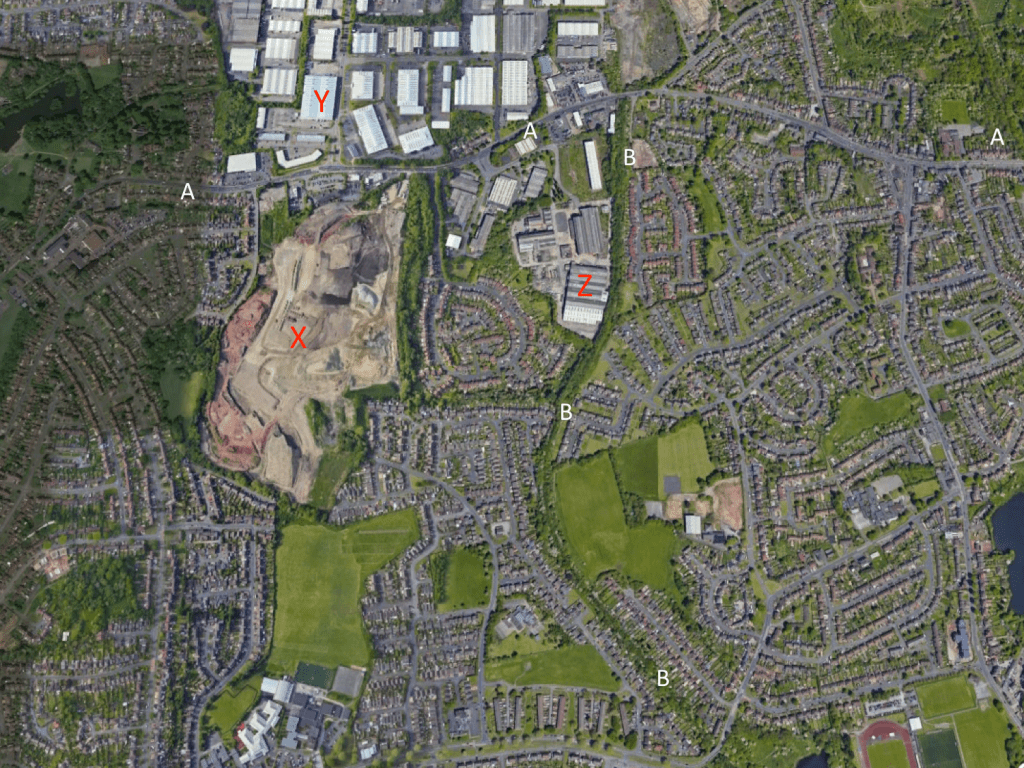
Finally, following a request from Tony Garratt (see comments), the figure below shows the area in 2020 (from Google Earth). I have marked the Kingswinford to Dudley Road (A-A-A) and the Wombourne Branch railway line (B-B-B) for comparison with the other photos. The picture is dominated by Ketley Quarry (X), the Pensnett Trading Estate (Y) and the industrial premises on the part of the site shown in the photos above, to the west of the railway line (Z).

Some thoughts on Family Tree studies

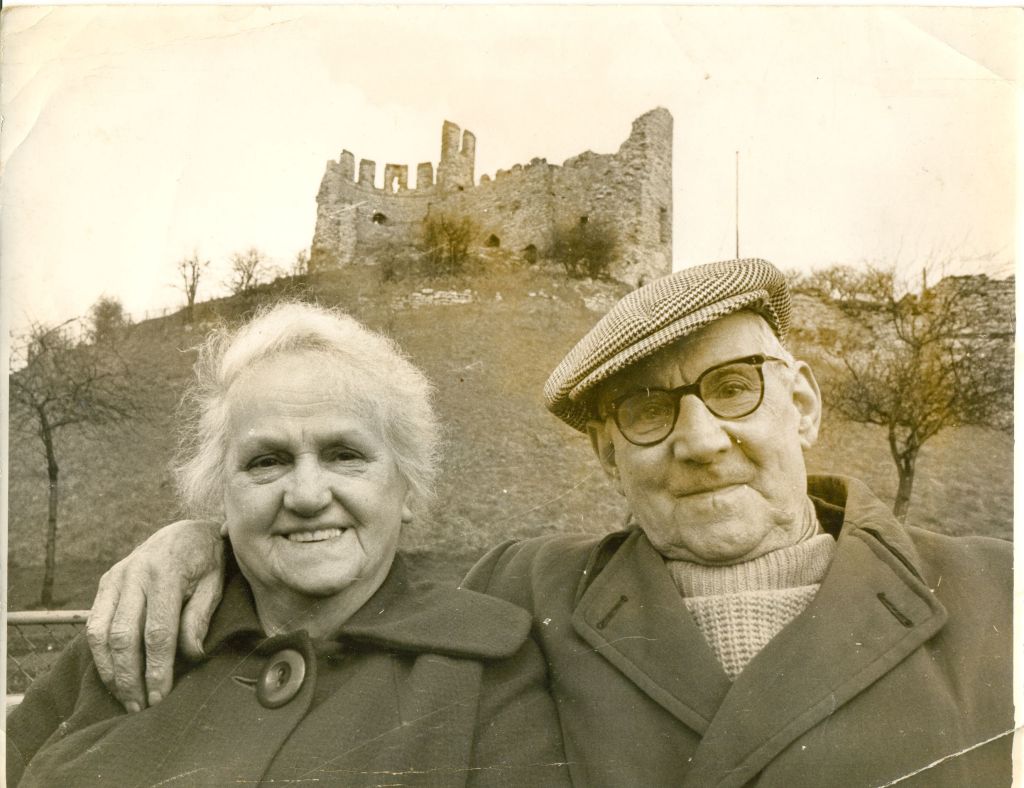
Alice and Sidney Baker – my paternal grandparents

A salutary lesson

Over perhaps the last ten years, I have spent some of my spare time researching my family tree, in a fairly ad hoc and disorganised way, but I had nonetheless built up a considerable set of information, and one or two branches on my tree reached back to the 1650s. In recent weeks, having a little more time because of retirement and enforced isolation, I have been looking again at all the information in a hopefully more systematic way. I have posted the results of my endeavors at the Baker Family Tree on my website.  During this reappraisal, I have tried to make sure that all I include is properly sourced in census, birth, baptism, marriage or death records. I did however find that, in my enthusiasm to push my tree back as far as possible, I had previously used some unsourced family tree material found on, for example, Ancestry Public Member Trees. When I came to check where this material came from, I could not actually find any proper sources in a number of cases, and I have had, regretfully, to remove such material from my tree, and in doing so have lopped of a few quite long branches. Looking at the various public trees, I am clearly not the only one who has done this, with some of the unsourced material I initially used being repeated in a number (and sometimes a large number) of family trees.  The temptation to do so is obvious as it represents a quick way of identifying ancestors, but it retrospect it was not the wisest thing to do.

The Baker Family Tree

That being said, the whole affair has made me think a little more deeply about the accuracy and quality of information that is available to build up family trees. As a result, I have carried out some simple analysis using my own tree to try to investigate these issues a little further. Before going any further however, I need to make clear the characteristics of this tree, as to some degree these determine what follows. Very broadly my ancestors, as far back as I can trace them, were either miners, ironworkers or industrial or agricultural labourers of some description – in other words at the bottom of the social scale. The tree is centred on a region at the western edge of the Black Country, and by and large my ancestors come from within 30 to 40 miles of there, as far back as I can trace them.  Some of the branches of the tree can be traced back to the seventeenth and eighteenth centuries in places where there are comprehensive surviving baptismal and marriage registers – in particular in the Anglican churches in Lichfield, and the non-conformist churches in Shifnal in Shropshire.  On my website, I present my tree as four separate sub-trees, beginning with my grandparents – the paternal grandfather tree, the paternal grandmother tree, the maternal grandfather tree and the maternal grandmother tree. I label my grandparents generation as generation 1, their parents as generation 2 and so on. The tree concentrates on my direct ancestors, although I do give details of the children of direct ancestors where I have found this information. More could be done in this regard. The other very specific oddity of the tree is that both my father’s surname and my mother maiden name was Baker, so there are two, independent, Baker sub-trees. 

Generation length

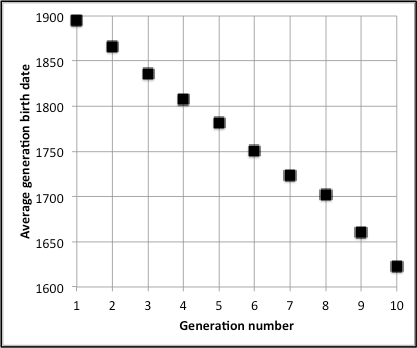
Firstly I looked at the average birth / baptism dates for each generation, using the information for each member of the tree that was available. Birth dates are plotted against generation number in figure 1 below. Basically it shows that, on average, the generations are spaced at around 25 to 30 year intervals – which seems reasonable, given that most of my ancestors married at around the age of 20 and those who bred successfully continued to doing so into their forties. 

Figure 1 Generation birth dates

Completeness

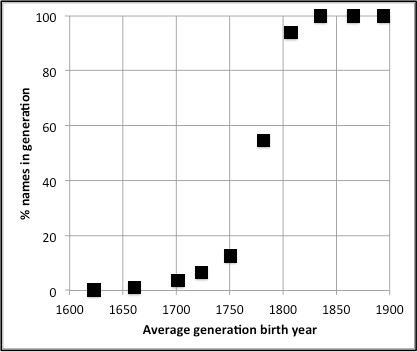
Secondly I looked at the completeness of the tree. In each generation there are a theoretical maximum number of individuals – 4 in generation 1, 8 in generation 2, and up to 4096 in generation 10. Figure 2 shows the percentage of this maximum number that I have identified in each generation. For convenience I plot this percentage against the generation birth date. It can be seen that this percentage remains high for birth dates back to around 1800, then drops rapidly, and remains at a low level as far back as the trees can be traced in the seventeenth century. The major fall off in the completeness of the tree around 1800 is due to the fact that individual born before that rarely appear in the censuses from 1841 onwards, and that the coverage of parish and non-conformist registers is somewhat patchy before this date.  Information finally runs out around 1630 to 1650, before which the parish records were all but non-existent.  For trees such as mine these two dates represent significant information horizons. For those with ancestors somewhat higher up the social scale there may well be other sources of information available that allow trees to be pushed back further in time.  Taken to its extreme, the House of Windsor can trace its pedigree back to the early royal houses of Wessex, Mercia, Dal Riada and the Picts etc. Indeed, if one believes some genealogies this pedigree can be traced back further to Woden, although the source information for that is probably not readily available. 

Figure 2 Generation Completeness

Quality

I then looked at the quality of the information for each individual in the tree. I used a scoring system with one point allocated for each of the following pieces of information.

  • Birth / baptism year
  • Birth / baptism location
  • Marriage year
  • Marriage location
  • Death year
  • Father’s first name
  • Mother’s first name
  • Mother’s maiden name
  • Spouse’s first name
  • Spouse’s surname

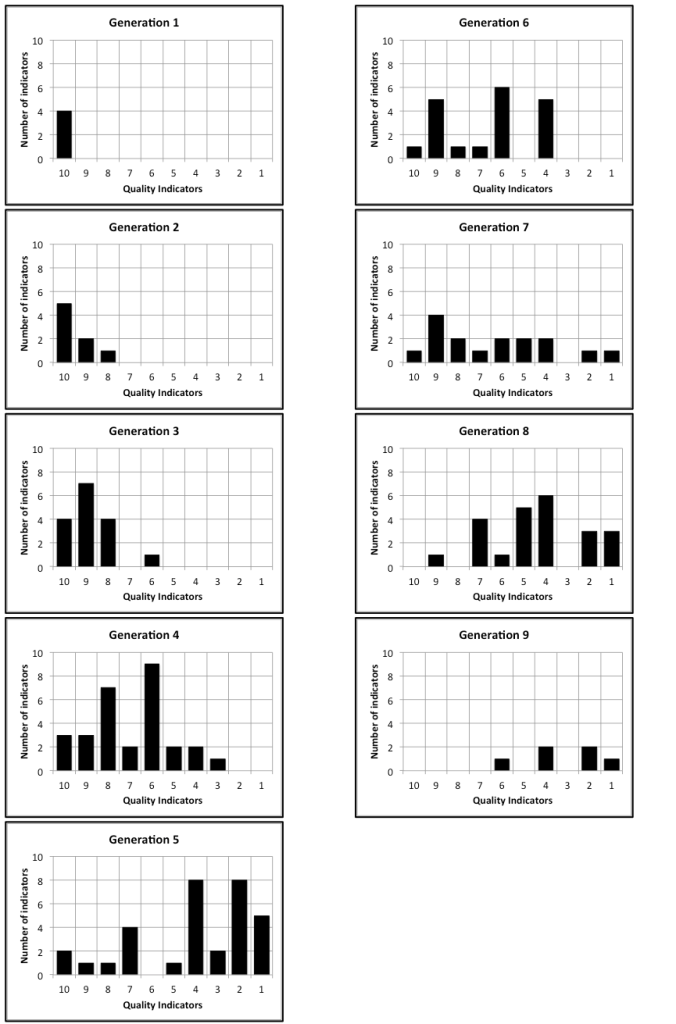
Whilst the list is to some degree arbitrary, in my experience the more of these details that are known about an individual the more confident one can be about their place in the tree.  There are thus a maximum of ten points for each person.  Applying this to my tree, one can draw histograms of quality scores for each generation, and these are shown in figure 3 below.  Generation 1 has four entries, all of which have maximum scores. The number of entries increases through generations 2 to 4, but in general the quality of information remains high, although it is beginning to spread out by generation 4 with some low scores. Generation 5 is however distinctly different, with a large number of individuals with low quality scores. This corresponds to the fall of in the number of identifiable individuals in figure 2 for this generation with an average birth date of 1780, and the low scores represent individuals whose line can be traced back no further. Generations 6 to 9 then show a wide spread of scores, with high scores for those branches that are well documented, and low scores for those branches that are coming to an end. The high scores become fewer and fewer as the generation date approaches the early limit around 1630 to 1650.

This raises the question as to whether it would be sensible to impose a confidence limit on individuals in tracing back family trees. My own feeling is that if the quality score for an individual is 3 or below, then it would be wise to stop the tree this point, rather than making speculative identifications from the record for earlier generations. 

Figure 3 Generation Quality

Ambiguity

As I noted above most of my ancestors were very unadventurous in terms of where they lived and all came from a quite restricted area. This same tendency can be seen in the names they chose for themselves.  There are 21 different first male names in my tree, with the top four being John, William, Joseph and Thomas (in that order), accounting for 65% of the total. There are slightly more female names – 27 in total with the top four in order being Mary, Ann, Hannah and Sarah, which account for 47% of the total. This is very consistent with the analysis of the names in the Book of Reference to the 1822 Fowler Map of Kingswinford in Kingswinford Manor and Parish. Here the top four male names were the same as in my tree, and in the same order and accounted for 55% of the total. The top four female names in my tree are all in the top five of those in the Fowler Book of Reference, although not in the same order, and together they make up 57% of the total. This concentration of names is matched throughout the area over the period from 1600 to 1900. Also “Baker” is a common name with two Baker families being represented in my tree with perhaps half a dozen other Baker families in the records in the immediate vicinity, and many of the other names in the tree are equally common. Putting these two facts together, it is easy to see that in a number of cases, there is significant ambiguity in identifying individuals in the record. The name “John Baker” was particularly difficult in this regard – there were a lot of them about.  It is this ambiguity that brings many branches of the tree to an end. I have taken the view that if there is there is more than one candidate for a particular place in the tree, and there is no strong supporting evidence for choosing one above the other (such as, for example, birth / baptism location) then it is best to make no identification until further evidence can be found. 

Final thoughts

Finally, can my reflections above, based on my own, really very specific , family tree, be generalized in any way? I think a number of fairly general points can be made. 

  • The two information horizons I identified will be generally true for all those trees without a high status component, and all such trees are likely to thin when the generation birth dates are before 1800, and to run out completely around 1650.
  • The concept of quality of information might be useful to those researching trees, in identifying an appropriate place to stop each branch.
  • Very great care should be taken with ambiguous situations – there is little point in pursuing a branch back in time if there is a significant probability that one link on it may be incorrect.

The Shut End Primitive Methodist Chapel. Part 3 – Ministers and families

Part 2 of this post can be found here.

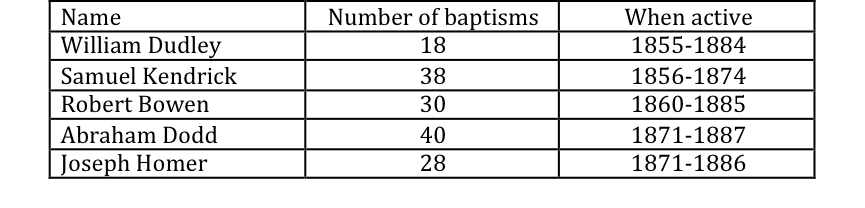
The Baptismal Register gives details of those ministers who baptized the children. These can be expected to be in two categories – members of the church who held a position of authority of some form and conducted services – perhaps stewards or trustees; and preachers from the local Primitive Methodist Circuit. In total 151 baptising ministers are listed  (although the variable forms of the names may mean this is an overestimate), with most officiating at just a few baptisms.  The five most common baptizing ministers are shown in table 6 below.

Table 6 Baptising ministers

The census returns in principle allow a little more information to be gleaned for these ministers. For one of them – Robert Bowen – there is however no obvious candidate in the census record.  Of the others, William Dudley was born in 1817 in Oldswinford and in 1861 he is listed as a tailor and draper in Kingswinford. Samuel Kendrick was born in 1811 in Ketley in Shropshire, lived in the Smithy Lane area and is listed as a miner.  Abraham Dodd was born in 1844 in Oak Farm and worked as a miner. He was the son of another Abraham, a miner from Wombridge in Shropshire. There are a number of Joseph Homer’s in the census record, born around 1835 to 1845, so it is not possible to be precise concerning his birth or residence, although all of the possible Joseph’s were either miners or labourers. 

The longevity of the ministry of all in table 6 would suggest that they were all members of the congregation itself – indeed in the case of Sam Kendrick and Abraham Dodd, their families can be traced in the baptismal entries themselves. It is likely that many of the others who performed just a few baptisms were circuit ministers. Only two such can be identified with confidence by their appellation – Rev R Brewen in 1861 and the Rv J Hawkins from 1881 to 1884. Dood (1883) draws attention to another possibility – Henry Higginson – and says that he was nicknamed the Roving Ranter. Unfortunately the census records reveal no more about him, which is the greatest of pities, as the name suggests there are stories to be told.

Two further points arise – firstly the ministers in the local congregation all shared the same background as those to whom they ministered, as manual workers or small shopkeepers. Secondly the link with the Shropshire coal field is obvious. In KMAP I described the society in Pensnett in the 19thcentury as a migrant society, with a considerable population influx, particularly from the Shropshire area. 

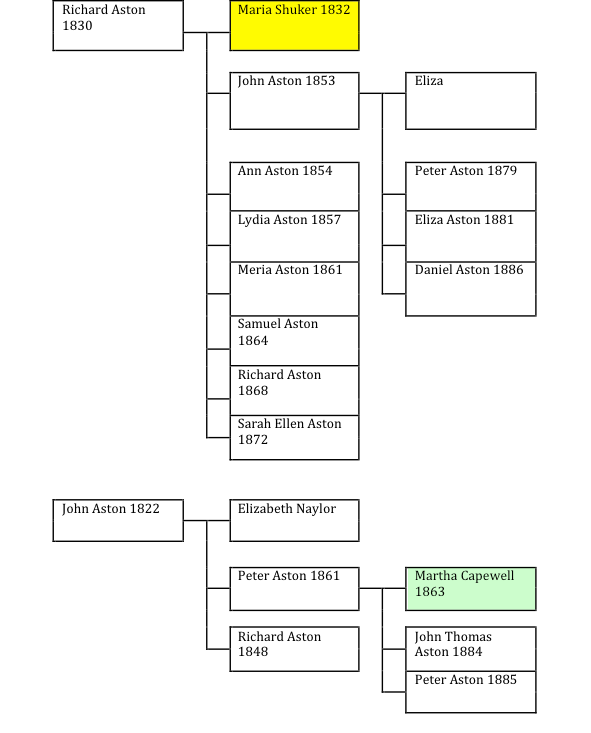
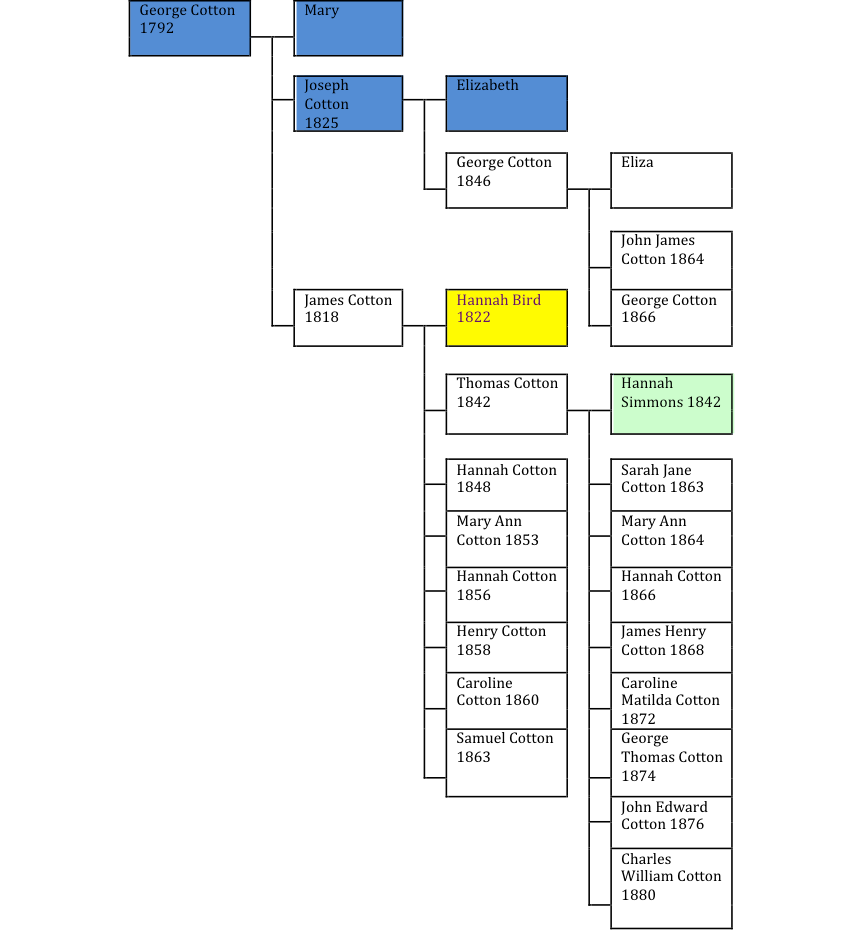
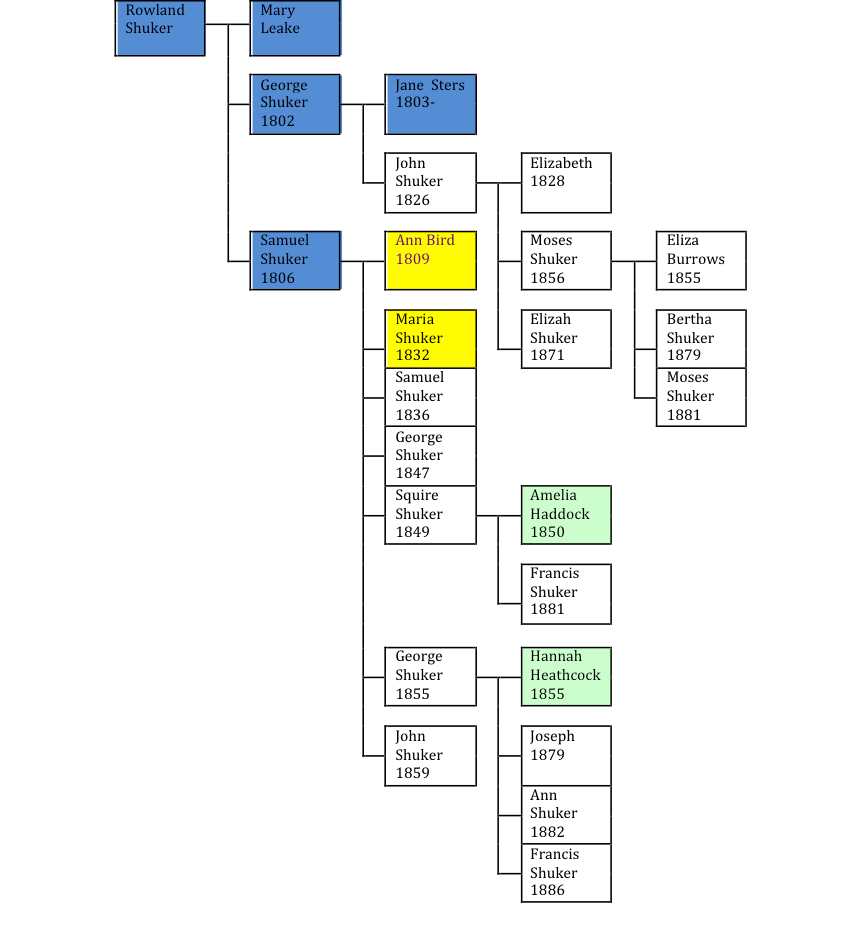
To fully describe all the families and individuals mentioned in the register is of course not possible, and its primary use in this regard will be by those researching family histories. The approach I take here is to consider in some detail just three families, who between them were involved in 46 baptisms over the course of the 42 years of the register. These are the Astons, the Cottons, and the Shukers. The family connections for these three families are shown in figures 3, 4 and 5 below. In these figures the following conventions have been adopted.

  • Those individuals with no shading on their entry appear directly in the register either as parents of as the child being baptized.
  • Those shaded in green indicate membership of families that appear elsewhere in the register.
  • Those shaded in blue indicate individuals who have been identified through census / BMD searches, usually from generations earlier than those in the register, that connect some of the register entries together. 
  • Those shaded in yellow indicate linkages between the three families.

Note that these trees only show the names of individuals in the register or those who link the various individuals together.  Many of the families in these figures can be shown through census records to have other children who do not appear in the register for one reason or another.

Figure 3. The Aston Tree

First consider the Aston tree shown in figure 3. Three generations of the family appear in the register. Those in the first generation – John (1822) and Richard (1830) were probably brothers, but their parents are elusive in the record. The earlier generation comes from the Dudley area, and the later generations lived in the Tansey Green and Commonside areas. Without exception all those in the register were manual workers throughout their lives. Richard (1830) married Maria Shuker (1832), the first of the inter-family connections that we can identify.

Figure 4 The Cotton Tree

The Cotton tree in figure 4 covers four generations. George (1792) (not in the register) came from the Wombridge area of Shropshire (near Oakengates and Wellington), and the two distinct families of the Cottons were his descendants, migrating to the Kingswinford area in the early 19thcentury. James (1818) and Hannah Bird (1822) also come from the same area. Hannah is the second of the family interconnections – see below. After the family moved to the Pensnett area, they all lived around Shut End / Coopers Bank / Tansey Green. Without exception, all the males mentioned in the register were miners. 

Figure 5 The Shuker Tree

The third tree in figure 5 is that of the Shukers. Here 5 generations are shown, with the latter three appearing in the register. The early generations were again from the Wombridge area. Samuel Shuker (1806) married Ann Bird (1809), the elder sister of Hannah in figure 4. The Bird family was again from Wombridge.  One of their children, Maria (1832) married into the Aston family (figure 3). The later generations lived in the Shut End / Tansey Green / Commonside area and were mainly labourers, but one or two were skilled manual workers.

These three trees can only of course represent a snapshot of a small section of the register, yet they do show the interconnectedness between the families and other families who attended the Chapel, and their common roots. Other families could of course be considered – such as the Dodds from Shut End and Tansey Green (12 baptisms), or the Greenaways from Coopers Bank (19 Baptisms), both of which had those in leadership positions in the church – Abraham Dodd (mentioned above) baptizing in the 1870s and 1880s, and Christopher Greenaway baptising in the 1880s. The significant point remains the same however – the lack of social and occupational mobility for such families. 

The Shut End Primitive Methodist Chapel. Part 2 – The Baptismal Register

Part 1 of this post can be found here.

The typed transcript of the Baptismal Register of Dodd (1983) is a copy of a handwritten transcript, that has itself been significantly amended. This was in turn a copy of the original register.  The Baptismal entries from 1845 to 1887 are given, with the following information.

  • Date of baptism
  • Christian name(s) of baptized child.
  • Christian name(s) of father and mother, and surname
  • Address – usually given by a broad area location
  • Occupation of father
  • Name of officiating minister
  • (Date of birth of child)

In total there were 777 entries over the period of 42 years, with 514 different couples represented. The Register can thus be seen to contain a great deal of potentially interesting information.  However, it must be admitted that that the typed transcript of the register is a bit of a mess – which either reflects the original register, or may be partly due to its transmission history.  Entries are not always in the correct date order, with some being significantly displaced. Names on the original were clearly difficult to read, and some of the guesses thus made are meaningless. The spelling is in general variable, which probably reflects the abilities of the officiating minister in transcribing names given orally.  

To analyse the register in detail, I transcribed all the entries to an EXCEL spreadsheet, which was not one of the more exciting experiences of my life. To enable the data to be ordered to reveal its various aspects more clearly, some cleaning up was needed. This involved adopting common spellings for addresses, occupations and names. The latter had to be done with care, so as not to use essential information, but most name changes were trivial – for example to standardize on “Henry” rather than “Henery” or “Henary”. In other places a greater degree of interpretation was required.  Whilst these changes may have resulted in minor errors that affect the statistics presented below, these should not be significant.

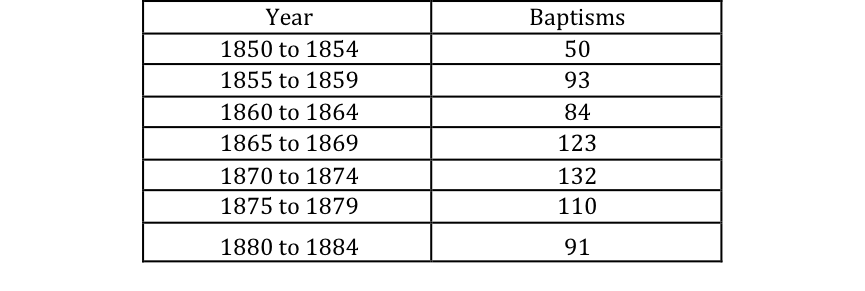
Table 1 shows the number of baptisms in five-year periods. It can be seen that these increase from 50 between 1850 and 1854 to a maximum of 132 between 1870 and 1874 i.e. from 10 to 26 / year on average. After that there is a slight fall off. KMAP shows that the population of the Shut End area followed a similar trend, peaking in the 1860s and then decreasing, and whilst the number of baptisms possibly reflects this, it also reflects the age distribution of the chapel congregation. Baptisms usually took place between 2 and 4 weeks after birth, but there were exceptions. For example, sometimes double family baptisms are recorded in the register. Whilst a few of these were baptisms of twins, for most of those where children’s birth dates are given,  they are for a baby and an older sibling who had clearly missed out on baptism after birth for one reason or another.

Table 1 Baptism by year

Table 2 shows the number of baptisms by area of residence. To compile this table, the register entries have been consolidated somewhat – for example in the few cases where streets are given, these are included in the relevant area. In the table, the Pensnett area refers to the area of the new developments, mainly centred on the Hollies area, but extending as far west as New / Swan St. It is not clear to me how Shut End and Tansey Green were distinguished by residents, and there may well be some confusion between them. These uncertainties aside the vast majority of baptisms were of those in the 1845 ecclesiastical parish of Pensnett (Pensnett, Commonside, Shut End, Tansey Green and Bromley – 83.1% in total) and most of the rest from closely surrounding areas (Kingswinford, Coopers Bank, Oak Farm, Brockmoor, Brierly Hill and Wordsley – 13.8%). The remaining entries were wide spread, from as close as Dudley to as far away as Wigan, and probably indicate married children returning home for the baptism of their child at their home chapel.

Table 2 Baptism entries by area of residence

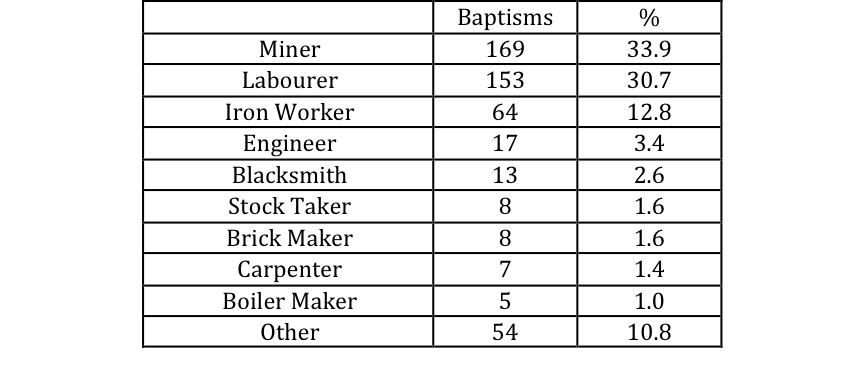
Table 3 shows the Register entries grouped by father’s occupation. Here again some cleaning of the data was required. The major change was to re-label a range of entries as “Iron Workers”. These took on a large variety of forms including moulder, furnace man, roller and puddler. Some of these, particularly the latter, were regarded as highly skilled jobs.  The “other” category includes trades such as groom, keeper, horseman, boat builder, shoemaker, grocer, butcher, with a very small number classified as managers or clerks.  It can be seen that the majority of the entries are for fathers who were miners or labourers, whilst almost all of the others would be working in or servicing the various industries listed. The labourers could be working in any of the other industries included in the list.

Now to some degree these figures will reflect the fact that the fathers of those baptized were relatively young and unskilled, and thus more likely to be labeled as labourers than their elders, but nonetheless they do show that the congregation at the chapel were overwhelmingly manual workers of various skill levels.

Table 3 Baptismal entries by father’s occupation

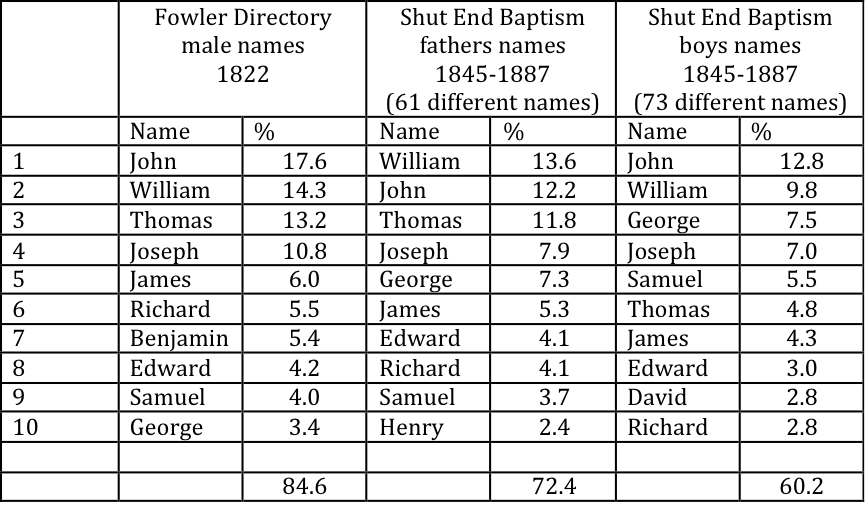
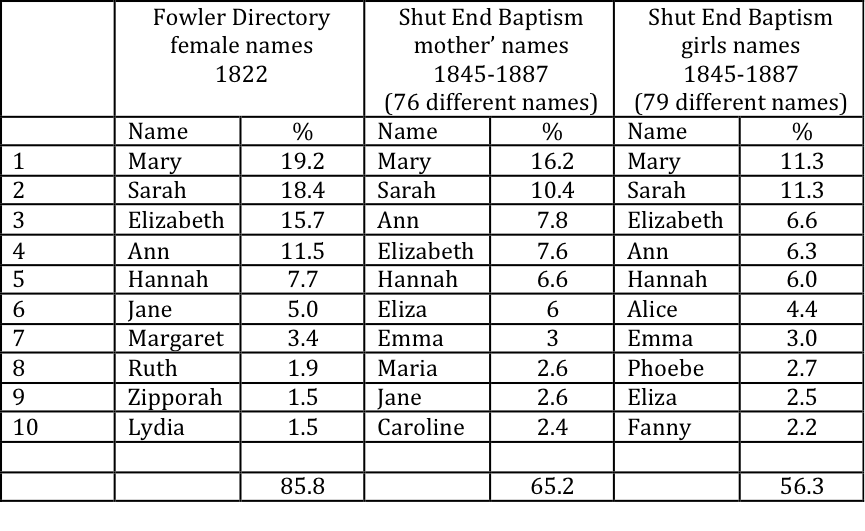
The baptismal registers of course give a very great deal of information concerning names – both Christian names and surnames. However this aspect of the register data is most difficult to analyse because of the huge variability in spelling, and a lot of cleaning of the data was required to put the most common names into a common format so that the data could be ordered and searched. The results of the analysis are shown in table 4 for male names and table 5 for female names. Each table shows the most common ten names and their percentage of the total from the following sources. 

  • The Fowler 1882 map directory for the whole of Kingswinford parish (as included in KMAP).
  • The names of the mothers and fathers in the Baptismal register.
  • The names of the children in the baptismal register.

This thus represents three different time slices – the first reflecting names given between around 1780 and 1820, the second for the period between approximately 1820 and 1860, and the third for the period between 1845 and 1885. The second and third thus overlap somewhat.

Consider first the male names in table 4. The most striking thing is the similarity between the three lists, with most names occurring in all three. Benjamin, Richard and Samuel become less popular over the years, whilst George moves up the popularity list. Overall the top ten names contribute 85% to the total in 1822, but only 60% between 1845 and 1885, reflecting the fact that whilst that outside the most popular names, there was an increasing variability. For both the father’s and the son’s names, there was a consistent use of Old Testament forms, some more obscure than others. There were also a few oddities: from 1871, Lord Dando, son Mark and Caroline Dando of Pensnett, Blacksmith; from 1849, Squire Shuker, son of Samuel and Ann Shuker of Shut End, Engine Worker; and from 1860, Theophilus Hadduck son of Benjamin and Meriah Hadduck of Commonside, Forgeman.

Table 4 Male names 

The female names in table 5 show something of the same level of stability for the top 5 names, but thereafter the names in the list are very variable. In 1822 the top 10 names contributed 86% to the total, but for the baptized girl’s names, this figure fell to just 56%, indicating again a greater variability as the years go by. This trend seems to be more pronounced amongst the female names, perhaps indicating a greater influence of prevailing fashion, although it is probably best if I, as a male, say no more here.  Of all the names the most variable in spelling was Maria and its variants – Mariah, Meria, Meriah and Marieh. Whilst they all obviously refer to the same name, the large number of occurrences of these variants suggests a variability in the way that they were pronounced – and thus recorded in the register. Again there were some oddities: in 1865, Tryphena Wassell, daughter of John and Sarah Wassell of Bromley, Brickmaker; in 1868, Ursula Adelaide Danks, daughter of William and Caroline Danks of Pensnett, Roller; in 1874, Adelaide Amos, daughter of John and Pamela Amos of Tansey Green, Miner.  The name Adelaide seems to have been taken from Queen Adelaide, the wife of William IV.  

Table 5 Female names

In Part 3 of this series of posts I will consider in more detail the ministers of the church and the church families that can be found in the register.  

The Shut End Primitive Methodist Chapel Part 1. Introduction and the chapel building

This is the first in a series of three posts concerning the Shut End Primitive Methodist Chapel in Pensnett, and in particular the period from 1845 to 1887. In this first post I will consider the physical nature of the Chapel itself and the activities that went on there. In the second and third posts I will discuss the very informative Baptismal Register for that period. It will be seen that this gives a wealth of information on the members of the chapel, their families and occupations. Nearly all of them were at the bottom of the social scale as labourers and miners, and the register allows their lives a little more visibility than would normally be the case.  

Introduction

The Shut End Primitive Methodist Chapel is described in Kingswinford Manor and Parish (KMAP) as follows.

The other (Primitive Methodist) was the Shut End Methodist chapel, the history of which begins in 1832. The Chapel was situated on Tansey Green Road, and consisted of a Chapel Building and a Schoolroom. Directly behind it was the Shut End Pit, and there were later to be subsidence problems due to this. The first services were held in December 1832, and by 1836 meetings of some sort were also being held in Commonside and at Shropshire Row in The Oak……..The 1851 Religious Census records morning / afternoon and evening congregations of 110, 134 and 120 respectively, with 120 sittings provided, and in 1887 there were over 250 children in the Sunday School and 20 teachers. The Church also operated its own Friendly Society – the Shut End Primitive Methodist Economic (Sunday School rooms) with 54 members in 1878, and assets of £200. …….In 1861, the minutes of the Trustees of the Primitive Methodist Church on Tansey Green reveal an offer for the purchase of the building from the proponents of the Dudley and Bridgnorth Railway, part of the Welsh and Midland Counties Junction Railway – a line that was never given parliamentary approval and about which little detail is available……Over the years the building continued to deteriorate and there were repeated moves to persuade the local Primitive Methodist circuit to purchase land for a new chapel. Matters came to a head in the early 1890s when the congregation purchased land for a new chapel on Commonside themselves and were expelled from the circuit. It seems that payment of the quarterly circuit fees were also an issue at the time (Wesley History Society, 1961). In 1893 the original building, which by that time was badly in need of repair, was finally sold and the new Independent Methodist chapel built (on Commonside). The baptismal registers are available for this chapel, unlike the other non-conformist chapels in the area (Dodd, 1983). 

The Chapel Building

Figure 1 Location of the Chapel (Tansey Green Road to the right, Dreadnaught Road to the left, and High Street at the bottom)

The Shut End Primitive Methodist Chapel and its associated Schoolroom was situated in the triangle of Tansey Green Road, Dreadnaught Road and Pensnett High Street as shown on the Google Earth view of figure 1.  Basically the site was a long rectangle at the rear of the back gardens of the current numbers 25 to 29 Tansey Green Road, with the western side of the rectangle being the boundary between these houses and numbers 17 to 19 Tarry Hollow Road. The latter name is presumably the name that was given to the open cast workings of Shut End mine, although it is not one with which I am familiar. The northernmost part of the site is beneath the property at 6a Renown Close.  The whole triangle of land between the roads was indicated as owned by Ben Gibbons on the 1822 Fowler Map of Kingswinford, and consisted of crofts and houses.  By the time of the 1840 Fowler map, the Chapel building itself existed, to the north end of the plot. The land in the triangle was then owned by the Trustees of the Earl of Dudley, and was described as old colliery lands or crofts.  The Chapel itself is described as being owned by the “Trustees of William Porter and others”, whilst the southern half of the plot was owned by Joseph Downing, but occupied by Ephraim Guest, William Greenway and William Morris. These surnames occur frequently in the Baptismal Register. 

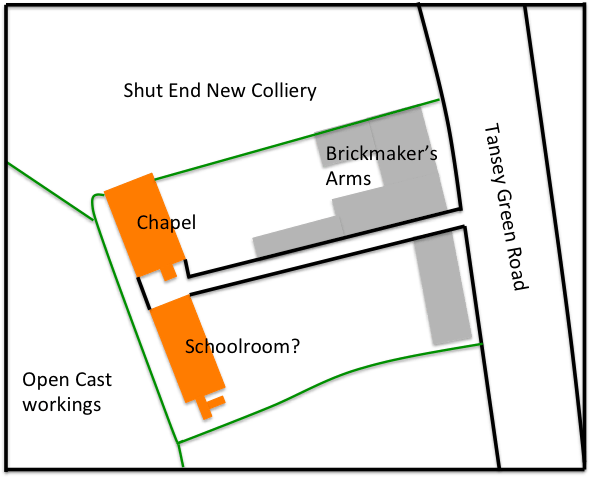
The 1859 redrawing of the Pensnett portion of the 1840 map shows no change to the chapel but there were by then mines to the north of the plot and open cast workings to the west.  By the 1883 OS map (figure 2) the Schoolroom was present, and the open cast mine to the west was very clear. Both the Chapel and the Schoolroom were rectangular in form, roughly 14m by 8m in plan.  After the congregation moved to the new building on Commonside (the Independent Methodist Chapel, it would seem that the buildings were in use as a sewing factory. The 1910 map indicates that they had become a “Picture House” and the Chapel and Schoolroom had been joined together into one long structure. 

 
Figure 2. The chapel and schoolroom (from the 1883 Ordnance Survey map)

No details of the interior of the building survive, but these can perhaps be conjectured by what was built to replace them on Commonside. This had a balcony at the front of the chapel for the choir and organ, with the raised preaching desk and the table for the Lord’s Supper placed centrally at the front of the Chapel beneath the balcony. Pews occupied the rest of the chapel building. Although the original chapel was unlikely to have had a balcony, it would almost certainly have had a preaching desk / pulpit of some sort of simple communion table at the north end (probably beneath where 6a Renown Close now is.

As noted in the Introduction above in the 1850s there were three services on a Sunday – morning, afternoon and evening. In the latter years of its life various directories in the 1880s indicate that there were only two services on a Sunday – at 10.45am and 6.00pm, but there was also a mid week service on Wednesday at 7.30pm, which probably existed throughout the life of the chapel. Similar midweek services were common practice for all the churches in the area at that time. The dates in the baptism register indicate that baptisms could occur on Sundays and also on other days. 

In the second post of this series, I will begin my consideration of the Baptismal Register from 1845 to 1887, and in particular look to see what this document says about the overall nature of the congregation – where thy lived, the jobs they did, and the names they chose for themselves.

The railways of Shut End and Corbyn’s Hall

In the latter chapters of Kingswinford Manor and Parish (KMAP), a fair amount of attention was given to the developments in the central section of the parish, and in particular the Shut End and Corbyn’s Hall estates, which both developed from estates owned by the local gentry into major industrial concerns. A significant system of railways developed in the area, and this is discussed in Chapters 5 and 6 of KMAP and in the recent post “The Earl of Dudley’s Railway”. In this post I want to look in detail at these railway systems as revealed by the 25 inch to the mile 1882 Ordnance Survey map. It will be seen that very extensive networks existed on both estates, which it was not possible to show on the small-scale maps of KMAP. Unfortunately, because of the licensing conditions, it is not possible to show the map itself, so I will use figures that I have drawn that show the major features that will be discussed. 

Figure 1. The study area (Major roads are shown in grey and the Stourbridge Extension Canal in blue)

Figure 1 shows the area to be discussed, with the major roads and the Stourbridge Extension Canal shown. The locations of the larger scale maps of Shut End and Corbyn’s Hall that will be used below are also shown. 

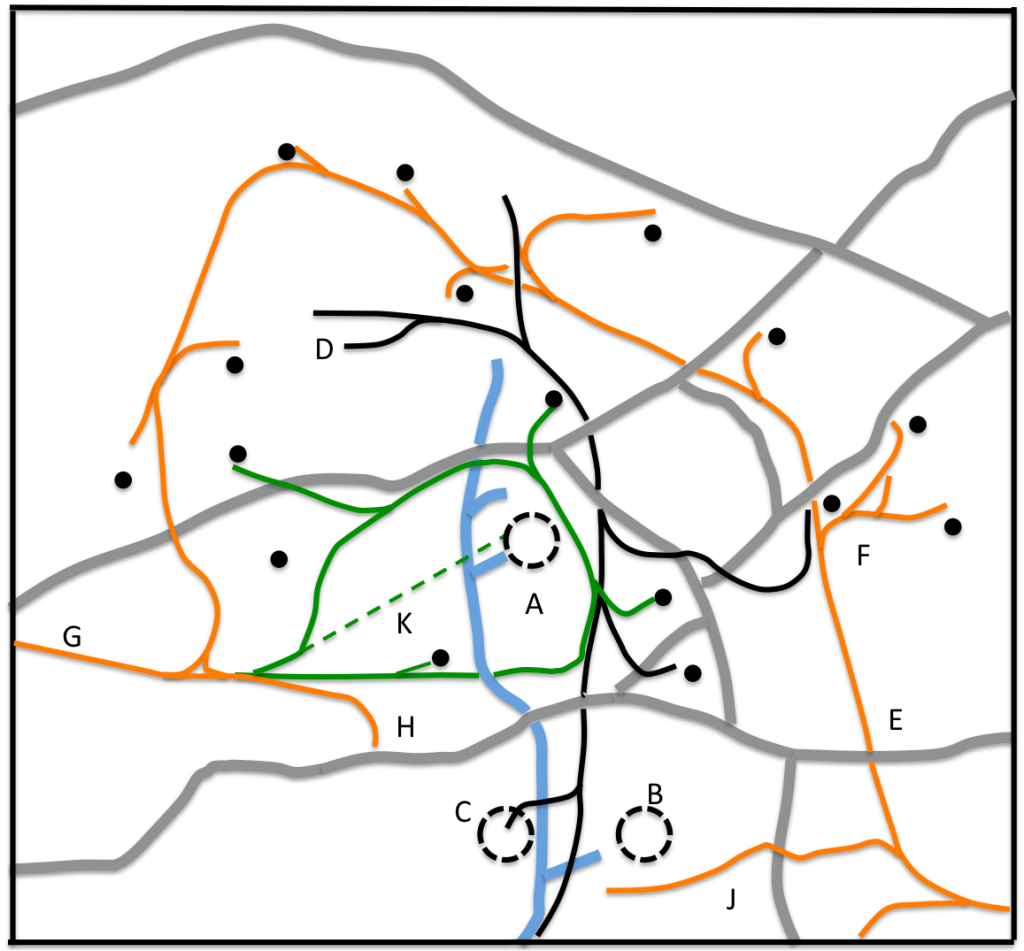
Figure 2. The railway network (GWR lines in black, Pensnett Railway in brown, Shut End Railway in green. Black dotted circles show iron works. Small black circles show coal mines in operation.) 

Figure 2, to the same scale as figure 1, shows the overall railway network in 1882. The iron works at Sut End (A) and Corbyn’s Hall (B and C) are shown as dotted circles. There are three distinct railway operations. The first is the GWR line (in black) that broadly follows the line of the canal to the terminus of both near Oak Farm (D), which began life as an OWWR branch before that company was taken over by the GWR in 1863. The second is the Pensnett Railway of the Earl of Dudley (in brown), with the main line from the Wallows and Round Oak going down the Barrow Hill incline (E to F), before looping around to the north of Oak Farm to a junction with the original Kingswinford Railway (G to H). Of particular note is the long Tiled House branch (J) to Corbyn’s Hall, which will be discussed below.  The third is what we will call the Shut End Railway, around the Shut End works (in green). Not all details of this railway can be shown at this scale. The dotted line indicates the course of the original incline to the works (K), which at this stage was not used.  There was also a fourth system (the Corbyn’s Hall Railway), which can again not be shown at this scale. Figure 2 also shows locations of working coal pits, which can be seen in the main to be rail connected.

Now in this particular part of the Black Country, the development of Iron Works can be considered to have three phases.

  • Phase 1. Where the works developed in an area where both coal and ironstone was readily available, and the first priority was to develop links to transport their products to local markets. 
  • Phase 2, where the immediate sources of supply were used up and a transport system to bring in coal and ironstone from the surrounding area was developed.
  • Phase 3 where all the raw materials within easy reach of the works have been exploited and either material needs to be brought from a distance,  the works needs to close or its nature needs to change. 

In terms of these phases, Corbyn’s Hall in 1882 seems to have been in phase 3, and Shut End in phase 2. Corbyn’s Hall Iron Works was developed by the Gibbons brothers in the 1820s, and its phase 1 transport links was provided by a tramway to the Fens branch of the Stourbridge Canal to the south. This was replaced, to some extent, by the Kingswinford Railway in 1829 and by Stourbridge Extension Canal in 1840, which indeed purchased the tramway.  The Kingswinford Branch of the OWWR in 1858 also gave another outlet for the products of the works.  The phase 2 supply lines were also provided by a complex set of tramways on and around the estate, which can be seen on the 1832 one inch to the mile OS map and the 1840 Fowler Map.  By 1882 all the local mines were exhausted and, as we shall see, raw materials were brought to the Corbyn’s Hall works from elsewhere. 

Shut End Iron Works developed somewhat later that Corbyn’s Hall, in the mid-1830s, and its phase 1 transport links were immediately supplied by the Kingswinford Railway and later by Stourbridge Extension Canal and the Kingswinford Branch of the OWWR.  By 1882 the map of figure 2 shows a phase 2 pattern, with its external railway network extended into surrounding areas, to mines some distance from the works. By 1903 the Iron Works had closed although some mines were still exploited, and other industrial concerns were latter to develop at the site (Phase 3).  

As an aside, it is interested to note that the Round Oak Iron works of Lord Dudley can also be considered within this pattern, with the Pensnett Railway shown on figure 2 acting as the phase 2 transport links to bring in raw materials from the surrounding area from the many mines to which it was connected, although in this case this railway was also used to transport coal for export to elsewhere in the UK. 

Figure 3. The Corbyn’s Hall Iron Works (GWR and Pensnett Railways are indicated by black and brown lines respectively, and the Corbyn’s Hall railway by purple lines. Old mine shafts are shown as open circles, and the major residential properties as filled triangles) 

Now let us turn to the Iron works themselves. Figure3 shows the area around Corbyn’s Hall at an expanded scale.  The various railways are again shown, and this time the Corbyn’s Hall Railway, an internal network within the works is also shown. It can be seen that there are two iron works. The original one was to the east of the Canal, near to Corbyn’s Hall itself, and is marked on the 1882 map as disused, but was clearly still in situ.  The new works was to the west of the canal, so we probably here have a picture of the transitional situation. The map also shows the major residential properties of Corbyn’s Hall itself, by this time becoming increasingly derelict; the Tiled House and Shut End House. Many disused collieries can also be seen, from where the original raw material was obtained in the 1820s and 1830s. The Corbyn’s Hall railway itself is a complex set of interlinked lines serving the immediate needs of the old works, and providing connections to the Corbyn’s Hall branch of the Stourbridge Extension canal and the GWR Kingswinford Branch. The Tiled House branch of the Pensnett Railway (in brown) can be seen in the bottom right of the figure, ending in a set of sidings. The gradient of this branch is severe, at about 1 in 25, and there is no indication of an engine house anywhere that could provide motive power for hauling full trucks up the branch. It thus seems sensible to regard this branch as being to supply the needs of the Iron Works for coal and ironstone, rather than taking away finished products, with loaded trucks descending the branch by gravity (but with brakes!) and empty trucks being hauled up the branch by horses. It can also be seen that the Corbyn’s Hall railway provides a somewhat convoluted connection between the Pensnett Railway and the GWR in this region, although it is doubtful it was ever used such.
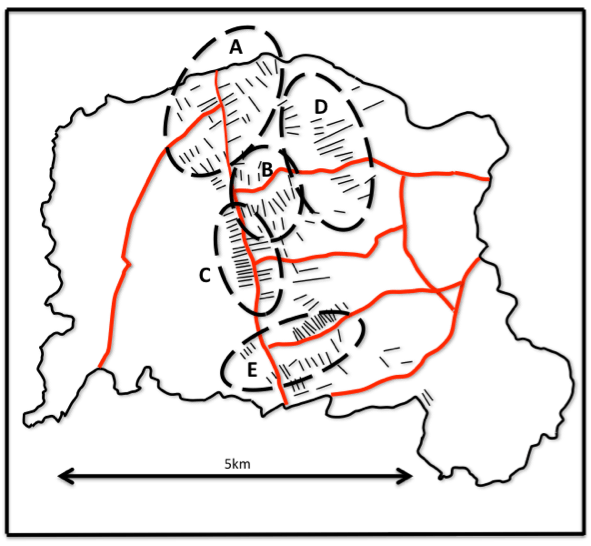
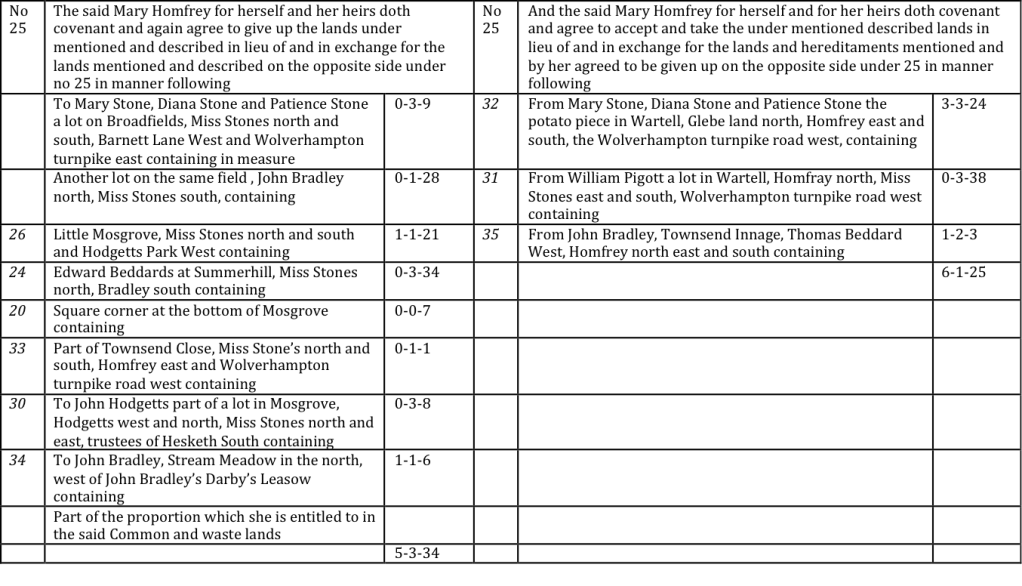
Figure 4. Corbyn’s Hall land use (Green indicates arable land, allotments etc. Brown indicates residential areas, including gardens, hatched area indicates spoil and waste, and grey areas active industrial areas and links)

Figure 4 shows a map of the same area as figure 3, but this time showing the land use in broad categories. Note there is some subjectivity in how these are defined from the OS map.  The large area of “waste” that surrounds the works is very apparent, and was to be a lasting scar on the area for many decades afterward. Nonetheless there was still arable land in close proximity. 

Figure 5. The Shut End Iron Works (GWR and Shut End Railways are indicated by black and green lines respectively. Working mines are shown as filled circles and old mine shafts are shown as open circles. Brickworks are shown as filled squares)

Figure 5 shows the area around the Shut End works. The most striking feature of this map is the extensive internal works network of the Shut End Railway. It would seem that this can be divided into two – the solid green lines show the tracks that connect to mines in the locality and to the Pensnett Railway and the GWR. The dotted lines show those tracks that seem to serve an internal works purpose only. Further study on the layout of the works themselves would be of interest, but I lack the detailed knowledge of the operation of iron works in that period that would be required for this. 

Figure 6. Shut End land use (Green indicates arable land, allotments etc. Brown indicates residential areas, including gardens, hatched area indicates spoil and waste, and grey areas active industrial areas and links)

Finally figure 6 shows the land use in the Shut End area. Again the area of waste and spoil is significant (and indeed over the next 20 years was to come to encompass nearly all of the area shown on the map. The proximity of both arable and residential areas to the waste and industrial areas is also clear.

Land exchanges in the Ashwood Enclosure Act of 1784

The Ashwood Hay Enclosure Act of 1776 discussed in Chapter 3 in “Kingswinford Manor and Parish” (KMP) mainly relates to the formal enclosure of around 600ha of land in the west of the parish of Kingswinford (see figure 1 which is figure 2.9 in KMP). However, it also contains extensive details of land exchanges between proprietors in the area marked as Common Fields Enclosure, which were not considered in any depth in KMP. These formalize long term leases that were entered into about a century before the enclosure to consolidate land holdings in the area, moving away from the concept of individuals holding strips in each of the three open fields.  Figure 2 (figure 2.6 in KMP) shows the conjectured position of these fields that seem to have been variously named over the centuries – Wall Heath / Mosgrove field represented by the area A, Kingswinford / Old / Wartell field by area B and Wordsley / Broad field by area C. 

Figure 1 Kingswinford Enclosures
Figure 2 Kingswinford Fields

In this blog, I give transcriptions of just two of these land exchanges as illustrations – frankly because a complete transcription would be a daunting task that I simply don’t have time for at the moment. Now it is, in the main, possible to locate the various packets of land that were exchanged from the corresponding names on the Fowler 1822 map of the parish, but that is not always the case, and the location of some of the exchanged plots below  is very conjectural.

Figure 3. Transcript of the Homfrey exchanges
(The numbers in columns 1 and 4 refer to the exchange number. The top figure in normal type is that described below. The lower figures in italic type were handwritten and refer to the other exchange in which they were referred. The figures in colums 3 and 6 are the plot areas in acres – roods – perches)

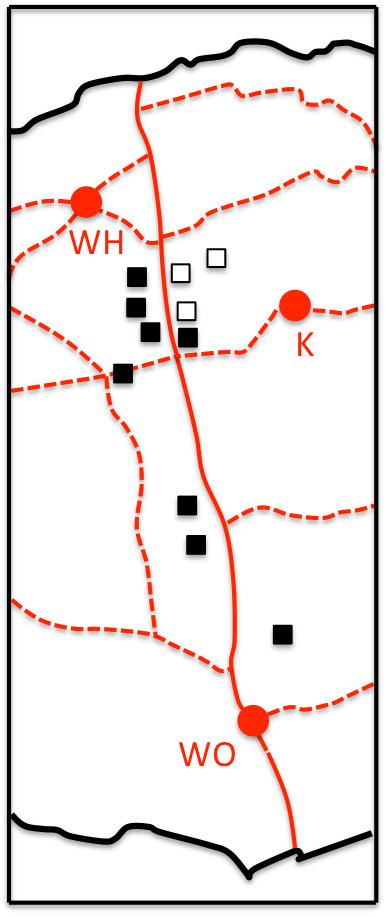
The first exchange is shown in figure 3 for lands relinquished and received by Mary Homfrey, a relatively minor landowner in the parish. The lands that she relinquished were somewhat scattered in Wallheath / Mosgrove field and Wordsley / Broad field, mainly to the west of the Stourbridge to Wolverhampton turnpike road, but with at least one on the east in Wordsley field (near Stream Meadow) (figure 4). The lands that she received were in Kingswinford / Wartell field, and there it is clear that they all bordered land she already owned. She received about half an acre more than she relinquished, and it is stated that this will be allowed for in the division of the common lands in the Ashwood Hay enclosure.

Figure 4 Location of the Homfrey exchanges
(solid red line is turnpike road; dotted red lines are other roads; red circles are Wall Heath (WH), Kingswinford (K) and Wordsley (WO); filled black squares are lands that were relinquished; open squares are lands that were received)

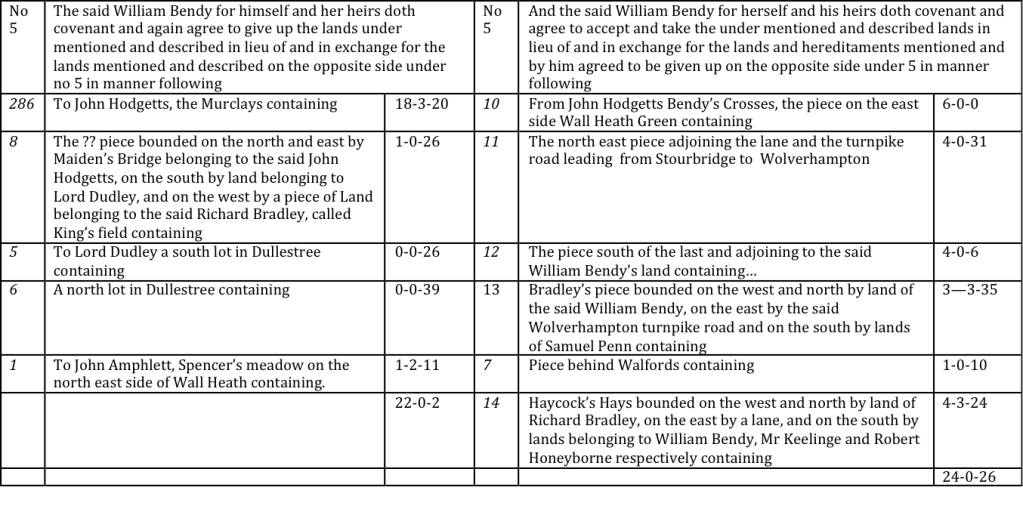
The second transcription is of lands relinquished and received by William Bendy (figure 5). From the tree of figure 3.6 in KMP it can be seen that this refers to William Bendy (1700-1782) the son of the second marriage of his father, William Bendy (1653-1725). He was the minor beneficiary of his father’s will, most of whose estates going to the Hodgetts and Dolman families, through the marriage of the daughter’s of his first marriage. He relinquished 22 acres of land in 5 lots. Four of these, amounting to around 4 acres, can be confidently placed in the area of Wall Heath field to the east and north of Wall Heath itself (figure 6).  The major area, referred to as the Murclays, which was relinquished to John Hodgetts (1721-1789), cannot be precisely located with confidence, and was almost certainly subdivided by 1822.  It is possible that it corresponds to an area of Wartell field close to Kingswinford village, that was owned by his son, John Hodgetts Hodgetts Foley (1797-1861) in 1822, which has an area of around 20 acres.  It would have been close to the latters Shut End Estate, which itself had been inherited from William Bendy (1653-1725) through his great-grandfather’s marriage to William’s daughter Mary.  In return the later William received six parcels of land amounting to 24 acres, with no indication that the areas would be equalized in the Enclosure allocation. These areas cannot all be located, but were clearly contiguous in the main with land he already owned, so again there seems to have been a consolidation of land. Those that can be located were to the east of Wall Heath bounded by the turnpike road. We know that William Bendy lived in the New House, somewhere on the Wolverhampton to Stourbridge Road in that area, so these lands were presumably around that house. A possible location is the triangle of land between Wall Heath and the turnpike road shown on figure 6, where the 1822 map shows a significant dwelling. On the 1882 OS map, this is named as Dawley House. 

Figure 5 Location of the Bendy exchanges 
(The numbers in columns 1 and 4 refer to the exchange number. The top figure in normal type is that described below. The lower figures in italic type were handwritten and refer to the other exchange in which they were referred. The figures in colums 3 and 6 are the plot areas in acres – roods – perches)
Figure 6 William Bendy’s exchanges
(solid red line is turnpike road; dotted red lines are other roads; red circles are Wall Heath (WH), Kingswinford (K) and Wordsley (WO); filled black squares are lands that were relinquished; open squares are lands that were received)

If the somewhat speculative locations inferred above are accurate, then there were some interesting consequences. When the Kingswinford Railway was built in 1827, most of the land it passed over was owned by its main promoters – the Earl of Dudley and James Foster (who by then had purchased the Shut End Estate from Hodgetts-Foley for his new Iron Works). The exception was the land north of Kingswinford still owned by Hodgetts-Foley  – identified here as the Murclays. The subsequent lease that was required was, to a significant extent, to determine the operation and life of the Kingswinford Railway and had various knock on effects to the whole of the Earl of Dudley’s Pensnett Railway network.

Secondly, in 1822 Thomas Dudley (1749-1825) was in residence in Shut End Hall, still at that stage owned by Hodgetts-Foley from the Bendy inheritance. The Dudley family tree is given in figure 3.10. His son Robert Dudley (1783-1856) was in residence in the house on the turnpike road identified here as the New House, by now owned by the Earl of Dudley, but again part of the Bendy inheritance. There is a pleasing symmetry here that the residences of William Bendy (1673-1725) and his son William Bendy (1700-1782) should come to be once more occupied by a father and son. 

It can thus be seen from the above that the land exchanges containing the Ashwood Hay Enclosure Act contain a potential wealth of information concerning the life in Kingswinford at the time. They deserve fuller consideration. Perhaps one day I will look at them in more detail. Then again…..

The Earl of Dudley’s Railway

In early 2019, I gave a talk to the Aldridge 41 club ( a group of retired Rotarians) entitled the Earl of Dudley’s Railway – i.e. the Kingswinford and Pensnett Railways. Most of the material I used was easily available in books or on the web, but I did draw some sketch maps to show how the railway developed and declined over its 150 year life. These maps provided a quite striking way of looking at the railway, and it seemed worthwhile to add a little detail to them and reproduce them here – see below. Before considering them further a health warning or two is required. First these maps were produced for a presentation and thus their cartographic accuracy is not great; secondly the information they contain has been culled from a variety of sources, particularly maps of different sorts. Even the best of these (OS) can sometimes show features that ceased to exists some time before the map was produced, and these anachronisms may well have been reproduced below. That being said, let us consider these maps one by one.

  • The 1780 map shows the towns of Dudley, Stourbridge and Kingswinford as three red circles, that will appear on all the following maps. The only form of large scale transport at that time was the Staffordshire and Worcestershire Canal in the western boundary of the map.
  • By 1800 the local canal system had begun to develop and the Stourbridge and Dudley canals formed a link between the Staffordshire and Worcestershire canal and the Birmingham Canal Navigations in the north east, via the Dudley tunnel. These served a range of extractive and heavy industries in the region close to the canals.
  • Little had changed in transport terms by 1820, but coalminers were being developed in the area around Corbyn’s Hall to the north of the Stourbridge canal. These mines and the associated industries were to drive much of the future development.
  • The 1830 map shows the newly opened Kingswinford Railway from Ashwood Basin on the Staffs and Worcs (shown as a solid green line) to the iron works and collieries in the centre of the map. A number of tramways (shown as dotted green lines) to transport coal and iron products to the canal were also in existence. The tramways are only shown in outline – the system was considerably more extensive and detailed than could be included here.
  • 1840 saw the opening of the Stourbridge Extension canal from the Fens branch of the Stourbridge canal to the Oak Farm area. The Pensnett Canal, a short branch from the Dudley tunnel entrance to the Round Oak area, had also been constructed.
  • By 1850 the Round Oak Iron Works was in production and the first lines of the Pensnett Railway had been constructed to supply the works with coal.
  • By 1860 the Pensnett Railway had developed considerably, with a network centred on Round Oak extending both north and south. Main line railways had reached the area with the opening of the OWWR line between Stourbridge, Dudley and Wolverhampton. This connected at Dudley with the southern end of the South Staffordshire Railway, and also had short branch to the Stourbridge canal at Bromley.
  • Mainline railway developments continued and by 1870, the Stourbridge Railway had been built (later to be taken over by the GWR) and the Bromley brain of the OWWR had been extended to Kingswinford and beyond. The Pensnett Railway continued to grow and a connection had been made between the Pensnett and Kingswinford lines.
  • The situation was similar in 1880, with the only development in the area being the GWR Dudley to Old Hill branch. At this time there was a very extensive internal railway system at the Bradley Iron works that is not shown on the map.
  • By 1900 the Pensnett Railway had changed somewhat, with branches to now dissed collieries being shut and new branches being opened. The longest of these, to Dibble in Gornal, was actually owned by Ben Gibbons and was not a formal part of the Pensnett Railway.
  • New lines continued to be built and by 1920 we can see the GWR Wombourne brach from Kingswinford to Wolverhampton (which briefly included a passenger service) and the final Pensnett Railway extension to Baggeridge Colliery in the north of the picture. By this time the eastern end of the original Kingswinford Railway had been truncated.
  • The decline of industry in the area saw the decline of the transport network and by 1950 the Stourbridge Extension canal and the Pensnett Canal had been abandoned, and most of the Pensnett Railway branch lines had met similar fate.
  • The situation was even more stark by 1980, with the Pensnett Railway reduced to an internal works railway at Round Oak, and the main line Wombourne branch beings truncated at Kingswinford and the Old Hill branch having been closed.
  • The current situation is shown in the 2010 map. The Kingswinford branch and the main line north of Round Oak has been closed, and the only railway in the area is the Stourbridge to Birmingham line in the south.
  • There are however possibilities of reopening, as shown in the 2030 map. There is sporadic discussion of reopening the line between Stourbridge, Dudley and Walsall primarily s a heavy freight diversionary route. There are more concrete proposals for using the trackbed of the line from Wednesbury to Dudley for a branch of the Midland Metro tram system, with street running from there, through Dudley town and on to Merry Hill and Brierley Hill. At the time of writing preliminary works on this line are underway.

One other point is worthy of mention. For the sake of clarity I have not included the street tramways of the area on these maps. These had quite short lifetimes, with a steam operated line between Dudley and Stourbridge opening in the 1880s, which eventually became a linked system of electric tramway connecting Dudley, Stourbridge, Kinver, Kingswinford and Old Hill and Cradley Heath. These were all to close in the 1920s.