Kingswinford Junction 1949. A post describing the train movements through and around Kingswinford Junction in the Black Country and the associated marshalling yard in 1949, just post-nationalisation. (April 15th 2021)
The OWWR Kingswinford branch 1854. A post based on a set of drawings that showed proposed changes to an OWWR branch line before it had been built, possibly to accommodate the travel needs of Baron Ward, and incidentally gives early information about the layout of Oak Farm Iron Works (April 14th 2021)
The Earl of Dudley’s Railway – Accidents and Incidents Using material taken from a search of newspapers between 1830 and 1920, this post looks at the sort of accidents that occurred on the Pensnett Railway to both railway workers and those who lived close by, and at the nature of crime on and around the railway. (May 19th 2020)
And finally, something more modern from a little further afield.
The Cross City Line – 1962 to 2024, which looks at the development of the service on the Cross city Line in the West Midlands between the early 1960s and the present day (February 1st 2025)
Readers of two earlier blogs will know that I have been a collector (or perhaps better described as a hoarder) of train and bus timetables for many decades. In the two posts, I used this collection to look at public transport developments in Oakham and the development of the cross city rail line in Birmingham, both over the last 50 or 60 years. In this post, I do something similar, and look at how the rail journeys through the Gwynedd town of Porthmadog have changed from the 1960s to the present day. Specifically I look at how services on the Cambrian Coast railway have changed over that period. I visited the area many times from the 1980s onwards, and particular from the mid 1990s through to the mid 2000s for family holidays. These holidays were often focussed on travelling on the Ffestiniog Railway and were thoroughly enjoyed by all. I do not however consider the services on the FR in this blog, except in passing.
In what follows, I basically consider the southbound services through Porthmadog in terms of frequency, connectivity, journey times and reliability, with my considerations based on timetables I have in my collection or are easily accessible over the web. The services heading east to Pwllheli exhibit much the same trends. But first we need to set out the basic facts about the Cambrian Coat line itself.
Cambrian Coast line
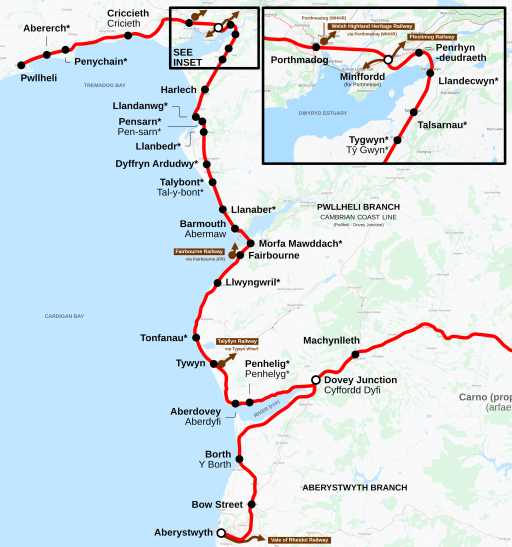
The Cambrian Coast line is shown on the map if Figure 1 (from Wikipedia). It extends from Pwllheli in the north to Dovey Junction in the south, where it meets with the Aberystwyth to Shrewsbury line. In between it passes through a number of small towns (Criccieth, Porthmadog, Harlech, Barmouth and Tywyn) and a larger number of villages. It is a single track route with a number of passing places – at Porthmadog, Harlech, Barmouth and Tywyn.
In the pre-Beeching area, there were two other connections with the national rail network – at Afon Wen between Pwllheli and Criccieth where the line was met by the Caernarfon and Bangor line; and at Morfa Mawddach, south of Barmouth, where there was a junction with the line to Dolgellau, Llangollen and Wrexham. At Porthmadog the line was crossed by the narrow gauge Ffestiniog and Welsh Highland Railways.
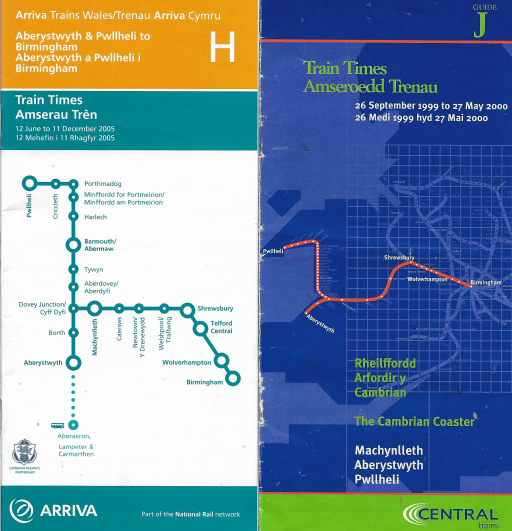
From the 1960s onwards the main service on the line has been between Pwllheli and Machynlleth, the latter being the first main station on the Aberystwyth to Shrewsbury line after Dovey Junction. Some of these services continued to Shrewsbury and beyond, often having attached to a service from Aberystwyth. These services have been provided by a number of operators – British Rail up to privatisation in 1996, then Regional Railways Central, which morphed into Central Trains from 1996 to 2001, then within the Wales and Border franchise operated by Arriva Trains Wales up to 2018. The franchise was then awarded to Keolis Amey Wales by Transport. Following the financial collapse of the franchise in 2021, services have been provided directly by Transport for Wales, through Transport for Wales Rail.
The traffic on the line is mostly passenger – some local traffic for work / school / leisure purposes, but mainly tourists and holidaymaker traffic that, inevitably, is much higher in the summer than in the winter. The major destinations are Barmouth, Porthmadog and Pwllheli, and up to the 1980s, there was a sizeable flow to Butlins near Pwllheli.
Post-Beeching the traction on the line was mainly coaches hauled by diesel locomotives – class 25s and then class 31s. But by the 1980s, the dominant forms of traction were DMUs of various types. Services are now provided by two coach Class 158s.
More details of the line can be found at its Wikipedia page, although this is somewhat unbalanced in subject matter and not terribly consistent in format and style.
Frequency Analysis
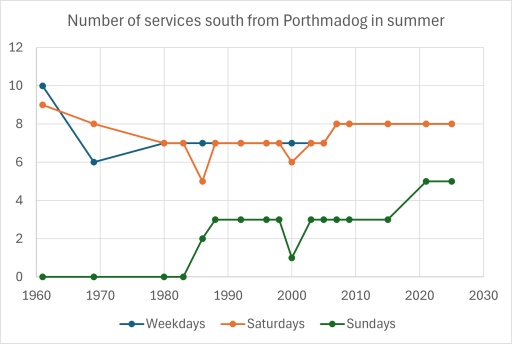
Figure 2 shows the number of trains on the line from 1960 to the present day, for weekdays, Saturdays and Sundays. These are southbound trains through Porthmadog during the summer period (there often being a slight reduction in the winter). In the early 1960s (pre-Beeching) there were nine or ten services on the line. including through trains to Wrexham (and beyond) from the junction at Morfa Mawddach. Many of the services terminated at Barmouth. There were also trains from Pwllehil to Bangor via Afon Wen that did not pass through Porthmadog. After the Beeching cuts however, the service number settled down somewhat to seven or eight per day on weekdays and Saturdays. Sunday services were introduced in the 1980s and the number of these have steadily increased to around five per day.
Figure 2. Southbound services
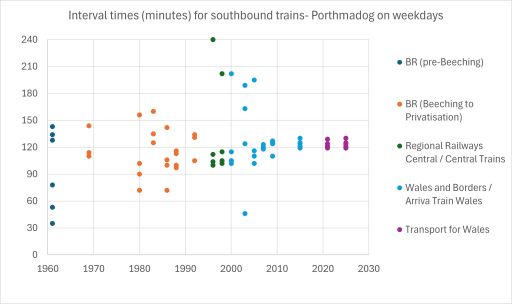
Figure 3 shows the interval between services on weekdays only – the graphs for Saturdays and Sundays tell the same story. Broadly, up to 2007, the services were irregular, with intervals between services from one hour to three hours are more. Around that time, a regular interval timetable was imposed, with trains at broadly two hourly intervals. This will be reflected in much of the discussion that follows.
Figure 3. Intervals between southbound services
Connectivity Analysis
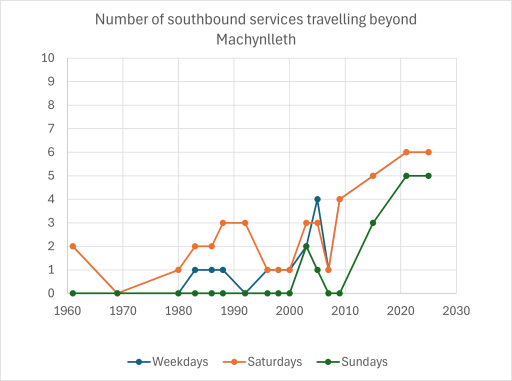
Figure 4 shows the number of through trains that ran south from Porthmadog and went beyond Machynlleth, again for weekdays, Saturdays and Sundays. From the 1960s to the 1980s these were very occasional, with most through trains running on Saturday for the holiday market. These included the Cambrian Coast Express to Euston. From the 1990s onwards the number of through services increased, mainly through the Cambrian Coast DMU coupling to the service from Aberystwyth and running to Birmingham New Street. In the late 1990s and early 2000s the turnaround time at New Street was very tight, which led to unreliability and late running, the effect of which was magnified by the single track nature of the line westwards from Shrewsbury, with delays caused by the need to wait for passing trains. This was to some extent alleviated from 2008 when most services ran through to Birmingham International. Most services on the line are now through services, although, oddly, the current timetable doesn’t acknowledge this and suggests a change at Machynlleth is necessary. There seems no obvious reason for such reticence, unless the operators are simply keeping their options open to terminate the Cambrian Coast services at Machynlleth.
Figure 4. Southbound services beyond Machynlleth
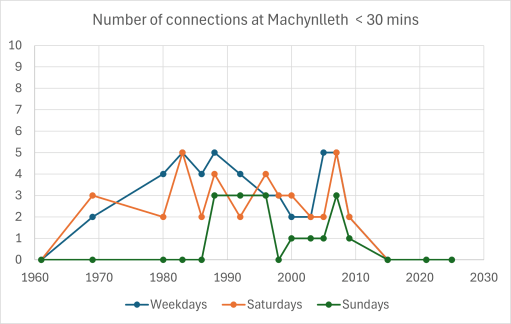
Figure 5 shows the number of connecting services from the Cambrian Coast line onto the Aberystwyth – Shrewsbury – Birmingham services, with a connection time of less than 30 mins. These peak in the 1980s and 1990s and then fall off as through trains become the norm.
Figure 5. Connections at Machynlleth
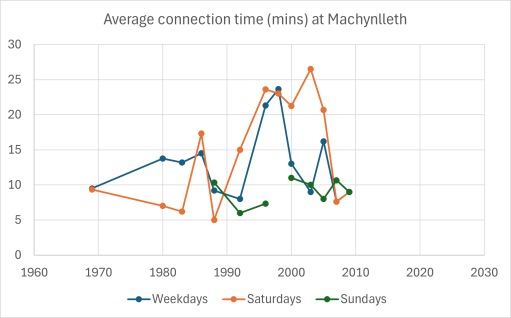
Figure 6 show the average connection times at either Machynlleth or Dovey Junction. In the 1990s and early 2000s the average connection time was over 20 minutes, with some connections (if they can be called that) having times of 40 minutes or more. Machynlleth is a very pleasant station on a dry summers day, and it is a pleasure to wait there. However, it is in mid-Wales and such days are few and far between. In general waiting there for 30 or 40 minutes for a connecting train was usually rather unpleasant. Some services required a change at Dovey Junction, a station with road access, minimal facilities and in the middle of a bog. Again on a dry summer’s day it has a certain bleak charm. But one suspects scheduling connections there was simply an act of sadism by the franchise timetabling teams.
Figure 6. Connections times at Machynlleth
Journey Time Analysis
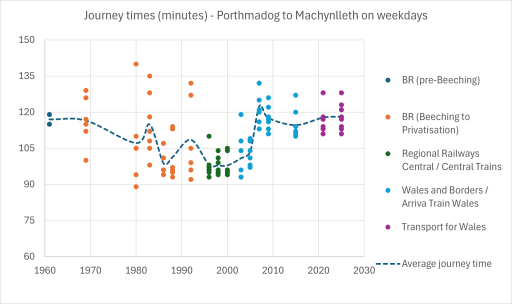
Figure 7 shows the journey times between Porthmadog and Machynlleth on weekdays – again the Saturday and Sunday times are similar. From the 1960s to the mid 1990s these decrease from around two hours on average to around one hour forty minutes on average, with a wide spread. In 2007, coinciding with the introduction of a regular interval service, there is a sharp increase in average journey times to around one hour and 55 minutes – roughly the same as in the 1960s.
Figure 7. Journey times
Reliability Analysis
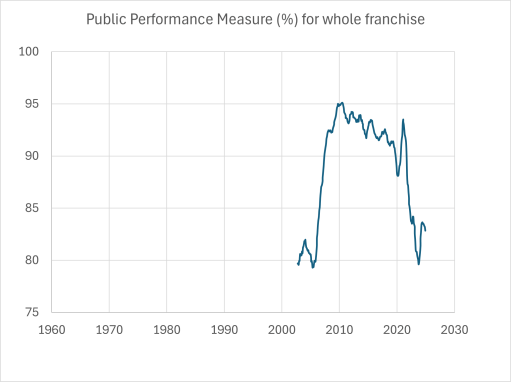
The rail industry measure reliability through the use of a Public Performance Measure (PPM). Essentially it produced a figure between 0 and 100% that is a measure of lateness / cancellation etc. All franchises are given targets for the measure that they have to meet. A value of 90 to 95% is regarded as adequate or good whilst one of 80% is regarded as poor. The historical figures for the whole of the Wales and Borders franchise are given in Figure 8. (The figures for individual routes are not easily available – at least I can’t find them on the web.) The graph shows a significant increase in PPM between 2006 and 2007, which coincides with the frequency and journey time savings on the Cambrian Coast. Now the Wikipedia page indicates that the Cambrian line was by far the worst performing line in the franchise, so it is not unreasonable to conclude that the changes made there in 2007 had a significant effect on the overall franchise PPM.
Figure 8. Public Performance Measure
Discussion
The major point to arise from the analysis presented above, is that in 2007 there was a positive decision to adopt a regular interval timetable, which enabled an increase in through journeys beyond Machynlleth through coupling with the Aberystwyth trains and resulted in a significant increase in reliability. However, this also resulted in a significant increase in journey times. The question arises as to whether a regular timetable and better connections and reliability was worth the extended journey times. I am inclined to think it was, but others may well disagree.
But could journey times be improved? I think perhaps they could be. simply having a longer layover at Pwllheli, with trains arriving there earlier and leaving later, should keep similar times for all the trains in the passing places. However I say this without having done any sort of timing analysis, which would require detailed route information and train performance characteristics. But perhaps a few minutes could be taken off the journey without loss of reliability.
Similarly, could journey frequency be improved to an hourly service? Leaving aside the issues of whether passenger numbers warrant this, or of stock availability, the answer is probably yes, if the two currently unused passing places at Barmouth and Porthmadog are brought into use. However this would effectively mean that the line was running at capacity – which would almost certainly lead to loss of reliability. A better way to improve service frequency would be, in my view, a closer integration with the Traws Cymru T2 bus service from Aberystwyth to Bangor via Machynlleth and Porthmadog. Indeed that service already offers a 1 hour 28 minute journey time between Machynlleth and Porthmadog – considerably better than the rail journey time, although it does take a much shorter route through Dolgellau.
I have been a collector of old bus and railway timetables for many years, with no particular end in view, other than to put them in boxes for some unspecified future use. However, the assembled timetables seem to be too good a resource not to make use of in some way, and I used some of them to compile a recent post on the development of public transport in Oakham in Rutland. This went down surprisingly well with readers, which shows there are some very odd folk out there. But the reception has encouraged me to press ahead with a series of posts that will use my stash of timetables to look at the development of public transport services in particular places or on particular routes. This particular post will consider the development of the Cross City railway line that runs from Lichfield in the north, through Birmingham, to Redditch and Bromsgrove in the south. There is an excellent Wikipedia article that describes the history of the line, and there is little point in reproducing that, and in this post I will concentrate on the development of the timetable on the line from the early 1960s (when it didn’t exist as one route) through to the present. It will be seen that it is in some sense a story of ambition that has never been quite fulfilled because of operational issues.
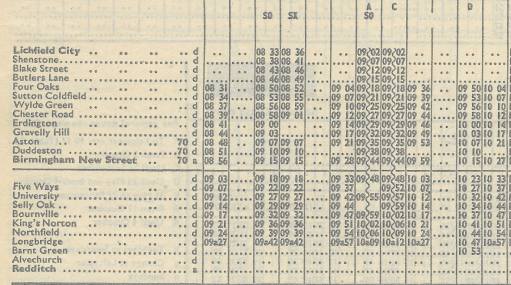
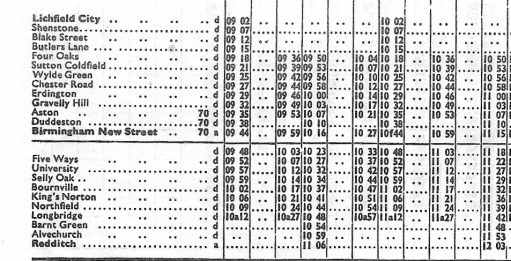
In what follows we will track this timetable development through the use of timetable extracts – usually for the weekday morning post peak period, but sometimes for other parts of the day where the (lack of) availability of information makes that necessary. This shows the broad outline of the timetable, but cannot of course capture the full detail.
September 1962 to June 1963
North
South
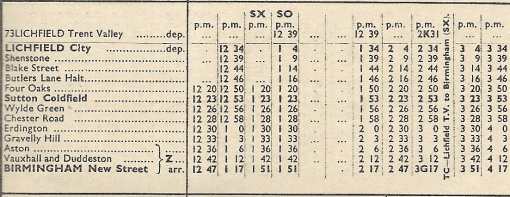
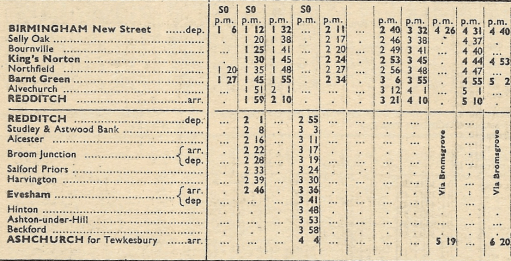
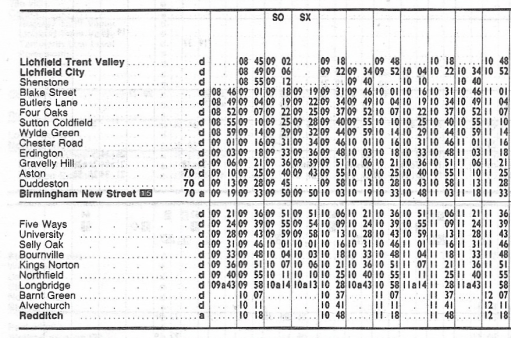
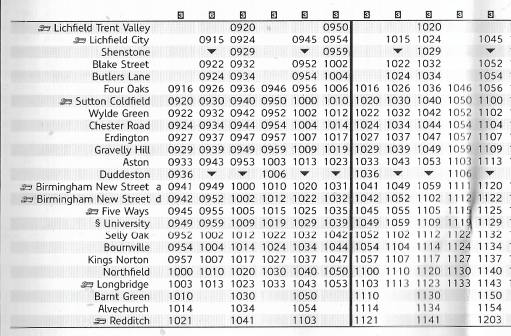
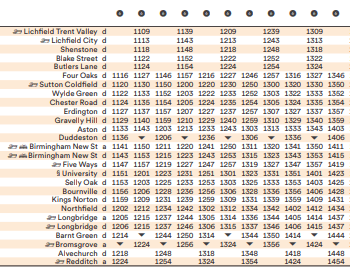
We first of all consider the situation in the early 1960s. Extracts from the timetables for the routes that were ultimately to form part of the Cross City line are shown above, for the early afternoon weekday period (taken from the London Midland Region timetable for September 1962). It can be seen that there is broadly a half hourly service from Lichfield city to Birmingham New Street. Connections are provided to Lichfield Trent Valley (where the current Cross city line crosses the West Coast Main Line) by a Burton on Trent – Lichfield – Walsall service, with occasional through services from Trent Valley to Birmingham. Some trains started and terminated at Four Oaks, but there was no regular pattern. South of New Street, the service to Redditch was somewhat sporadic, with some trains extending to Evesham and Ashchurch for Tewksbury. Note that trains did not at that stage call at Five Ways (which was closed) or University (which didn’t exist).
September 1964 to June 1965
North
South
By 1964, the first wave of the Beeching cuts had taken place and the timetables above (again from the London Midland Region timetable) such trains as there were to Redditch from New Street terminated there. North of New Street, the service to Lichfield varied between a thirty minute and an hourly frequency, with hourly trains starting at Four Oaks. Again, there were connections to Lichfield Trent Valley from Lichfield City on the Walsall to Burton service.
May 1969 to May 1970
North
South
The May 1969 timetable (from the London Midland Region timetable downloaded from Timetable World) shows a more regular service on the north end of the route, with an hourly service from Lichfield City and a thirty minute service from Four Oaks to New Street. South of New Street the trains to Redditch were again somewhat sporadic, with one, two or three hour intervals between them.
May 1978
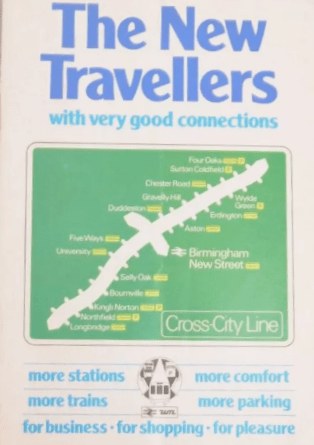
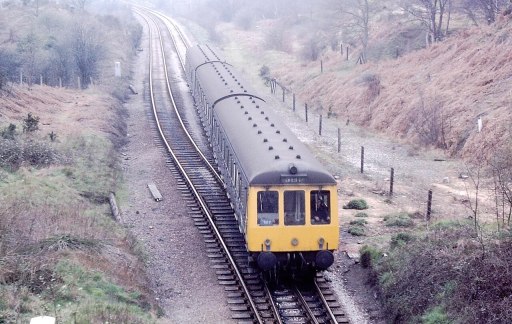
The Cross City line opened in something like its current form in 1978. The graphic above (a screenshot from a rather fuzzy ebay photo) shows that it was marketed as a service between Longbridge and Four Oaks, with a fifteen minute interval service between the stations. There were in fact hourly trains to Lichfield City that were not referred to in the timetable shown, and sporadic trains to Redditch in the south. The route was operated at this stage by Class 116 DMUs. Five Ways station had been re-opened and a new station built at University.
Class 116 DMU
May 1980 to May 1981
The May 1980 service (shown above from the national BR timetable) is similar to the 1978 service. Here the extract shows no services to Redditch although there were again some sporadic, mainly peak hour services down the Redditch branch.
May 1983 to May 1984
By May 1983 the situation to the south had become more satisfactory with hourly trains to Redditch, with Lichfield City also having hourly trains, and four an hour from Four Oaks to Longbridge.
May 1984 to May 1985
One year further on, in May 1984, the situation is again similar, but with one of the Four Oaks trains per hour extended to and from Blake street.
July to September 1991
By 1991 there were significant changes. Two trains per hour ran south from Lichfield Trent Valley (which had been reopened in 1988), four trains per hour from Lichfield City with some peak services running from Blake Street.. To the south there were four trains per hour to Longbridge, two of which were extended to Redditch.
September to November 1992
The BR national timetable showed that the situation in September 1992 was very similar to the previous year, but was only timetable to extend to the end of November 1992, when a different timetable came into operation (see below).
December 1992 to May 1993
The December to May 1993 timetable is very odd, with the services being split at New Street, with four trains per hour from Lichfield Trent Valley to Birmingham, and four to Longbridge, with two extended to Redditch. There is no rationale given for this but may well have been something to do with the electrification works that were going on at the time.
June to September 1997
My more intimate involvement with the Cross city line began in 1997/8 when I began working at the University of Birmingham, whilst living in Lichfield, and travelling on the line daily. I thus began collecting the Cross City pocket timetables at this point. It will be seen below that the art work / size / format changed continually over the years that were to follow. The route had been electrified in 1993 and was thereafter, until 2024 operated by Class 323 EMUs, up until 2020 in mainly three car formation, with some six car trains at peak times. The situation was similar to the early 1990s with four train per hour frequency between Lichfield City and Longbridge , with two trains per hour extended to both Redditch and Lichfield Trent Valley.
Class 323 EMU
June to September 2002
In the summer of 2002 we have a very similar looking timetable and frequency, albeit with some slight changes of times. But in general we can see the timetable pattern has remained stable over at least five years.
September 2002 to January 2003
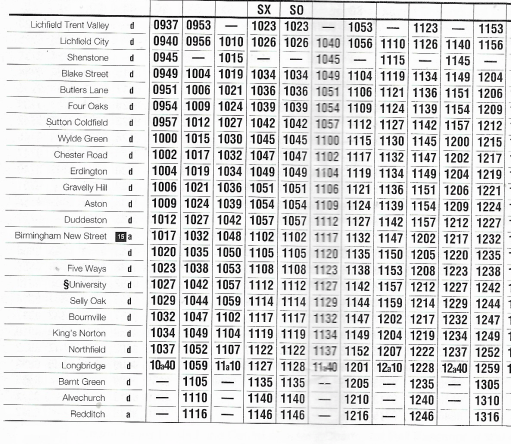
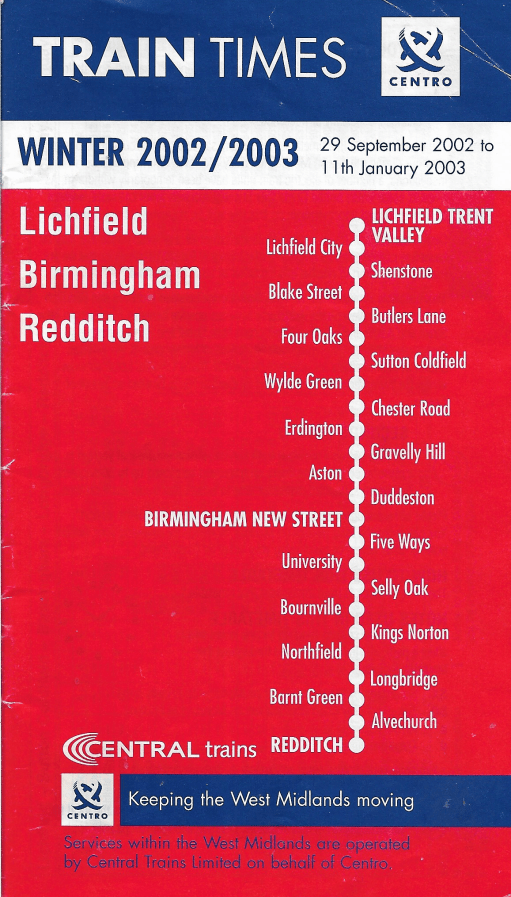
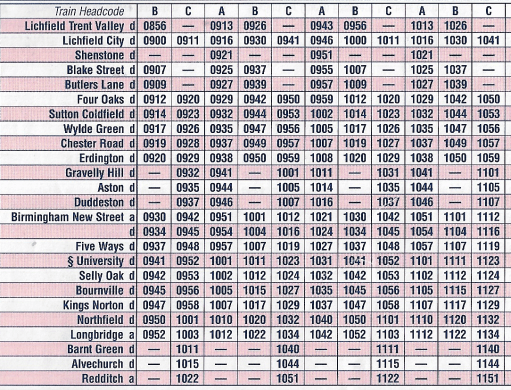
In September 2002, there was something of a revolution. The number of trains was increased to six per hour, with four beginning their journeys at Lichfield Trent Valley, and two at Lichfield City and four ending their journeys at Longbridge and two at Redditch. The stopping pattern was complex with not all trains stopping at all stations. To try to make life easier for passengers, trains were to carry a headcode (that can be seen on the above timetable) indicating their destination and the stopping pattern. To put it bluntly, the service was an absolute disaster. A very frequent service with variable stops needs to be highly reliable – and that has never been the case for the Cross City line, largely due to congestion at New Street. My memory is of confused and angry passengers, very late running and many cancelled trains. Although the ambition was laudable, the pattern was never going to work. My memory is that it was replace by an emergency timetable within only a few weeks of its implementation, but I can’t be certain about that. At any rate, a new timetable was issued from January 2003.
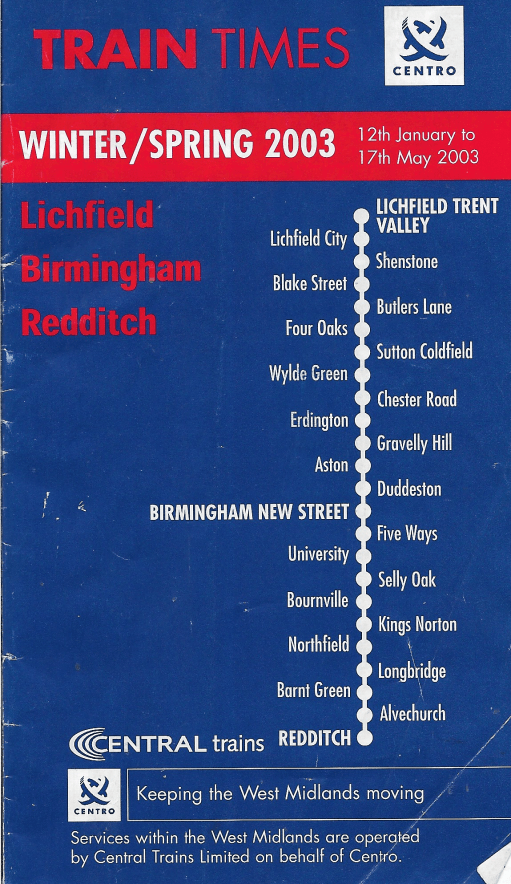
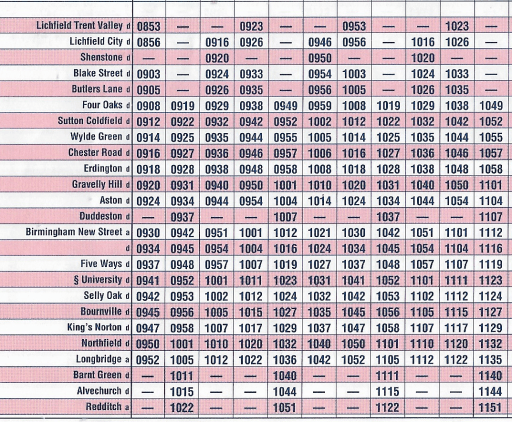
January to May 2003
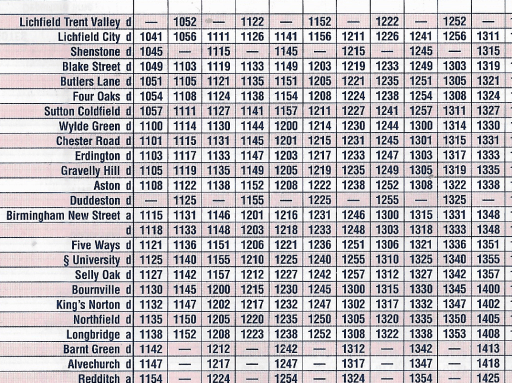
The new timetable again had six trains an hour, two beginning at Trent Valley, two at Lichfield City and two at Four Oaks, with four an hour terminating at Longbridge and two at Redditch. With only minor exceptions (Shenstone and Duddeston), all trains stopped at all stations. From a personal perspective, this led to an unbalanced departure schedule at Lichfield City, with twenty and ten minute intervals, but this pattern was to persist, in essentially the same form until 2018.
May to December 2009
The 2009 timetable is very similar to that from 2003, with very minor changes of timing.
May 2015
Similarly the 2015 timetable was of the same form, but Redditch was now served by three trains per hour following the opening of a passing loop at Alvechurch that increased the capacity of the branch.
May to December 2019
The main change in 2019 was the extension of two of the three services that terminated at Longbridge to Bromsgrove, following electrification of the line through Barnt Green, with some other slight timing modifications. Then in 2020 COVID happened.
May to December 2022
During the COVID lockdown, the services on the cross city line were scaled back to four per hour, with two starting at Lichfield Trent Valley and two at Four Oaks, with two terminating at Bromsgrove and two at Redditch and this pattern was to persist. These four trains used four of the six paths from the earlier six train timetable resulting in unbalanced intervals between trains along the line. Stations north of Four Oaks suffered particularly, with the service being reduced to half hourly, the lowest level of service since the mid-1980s. To make up for this all services were six coaches however.
December 2024 to May 2025
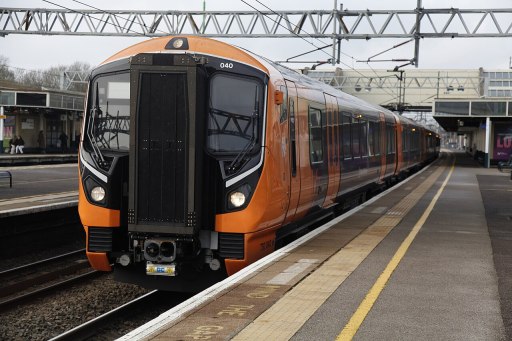
In the present 2024 winter timetable, this situation persists, for good or ill. The quality of the rolling stock has however increased with the use of Class 730 EMUs.
Class 730 EMU
Journey times and leaf fall timetables
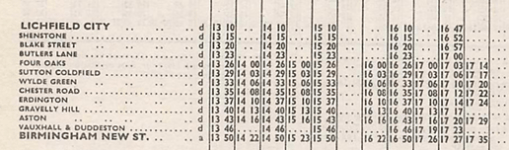
Finally, before I close, I will brielfy discuss journey times and leaf fall timetables, which are quite closely connected. I take the journey time between Lichfield City and Birmingham New Street as a comparative value through the years. In the 1960s, when the service was operated by Class 116 DMUs, the journey time was around 45 minutes, but by the close of the decade it had reduced somewhat to between 40 and 42 minutes. . After electrification with the introduction of Class 323 EMUs , this time fell to between 35 and 37 minutes. Current times with the Class 730 are still around 37 minutes.
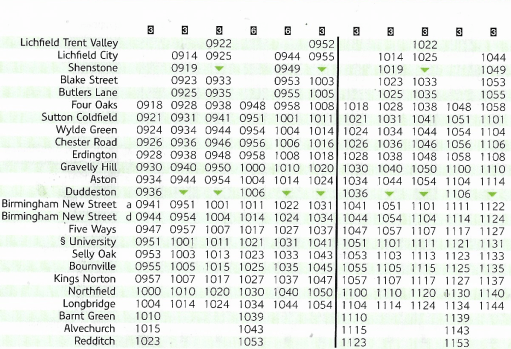
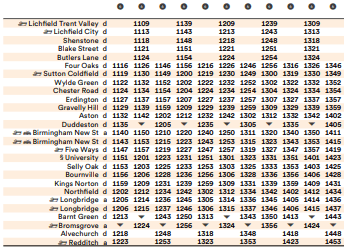
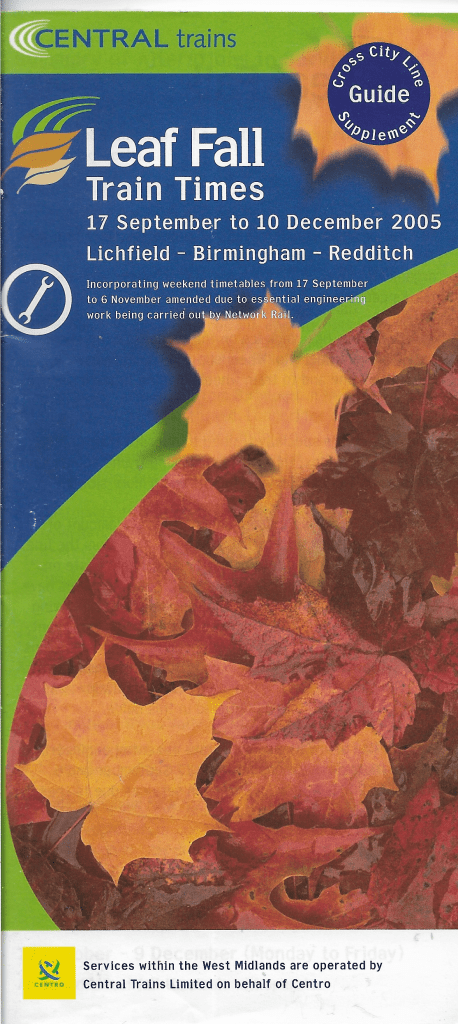
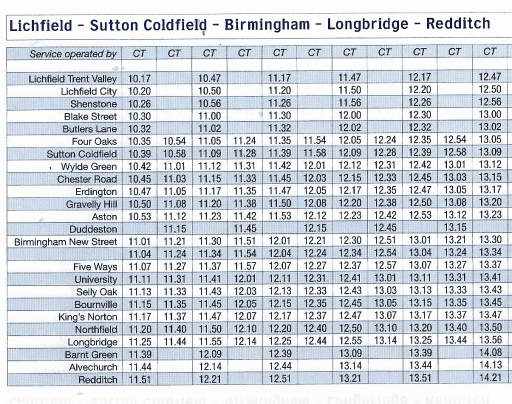
From the early 2000s a “leaf fall timetable” has operated on the Cross City line between October and December, when track conditions can become difficult. A typical example for 2005 is shown below. At the time the normal timetable consisted of six trains an hour, with two starting at Lichfield Trent Valley, two at Lichfield City and two at Four Oaks, with four terminating at Longbridge and two at Redditch. The revised timetable shows four trains an hour, with two starting at Lichfield Trent Valley and two at Four Oaks, with two terminating at Longbridge and two at Redditch. Journey times from Lichfield City to Birmingham New Street were 45 minutes. There was thus both a significant reduction in service frequency and a significant increase in journey time in the interests of maintaining reliability.
Closing remarks
As I said at the start of this blog, the history of services on the Cross City line show a commendable ambition on behalf of the operators, but with this ambition compromised by lack of operational reliability. The six train per hour service that operated from 2003 was notoriously unreliable, with this unreliability in the peak leading to significant overcrowding as two trains worth of passengers often tried to squeeze onto one, with most trains having only three coaches. Perhaps the current less frequent timetable, but with longer trains, is more satisfactory in that regard. The unbalanced timetable, with alternating ten and twenty minute gaps between trains is far from satisfactory however. If one is optimistic, one might say that this will allow six trains per hour to be reinstated in the future, but if this is not going to be the case, the timetable really does need recasting with a consistent fifteen minute interval.

















 Engineering, history and ecclesiology
