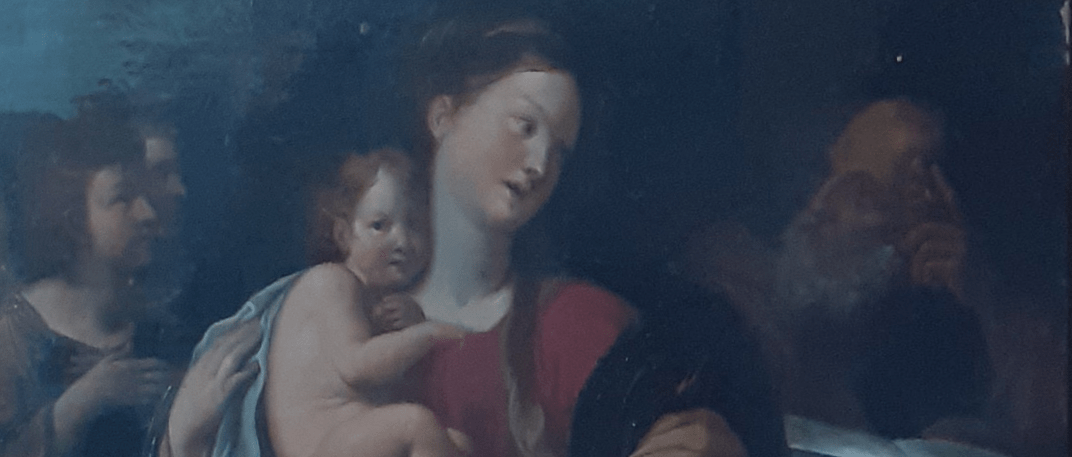
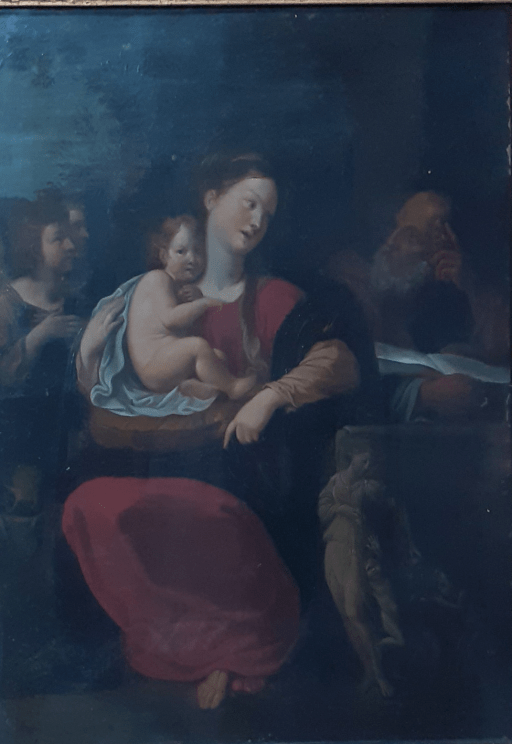
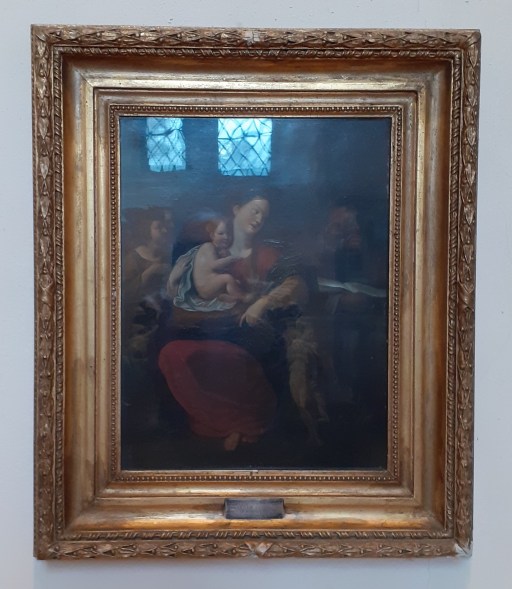
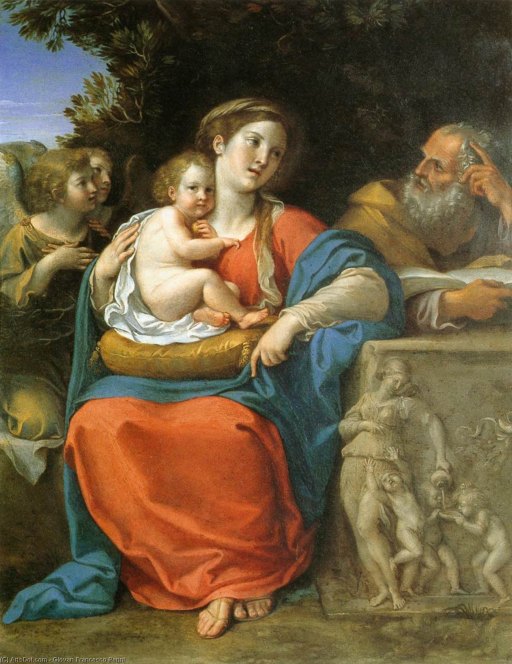
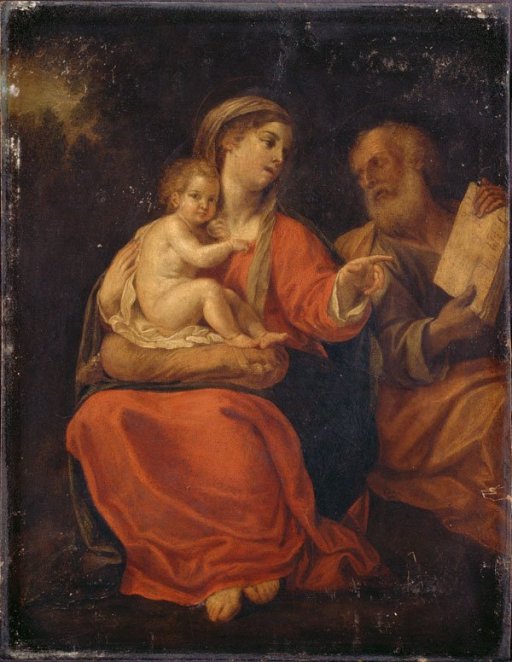
The painting of the Holy Family shown below has hung in the Vicar’s Vestry at All Saints church in Oakham for many years, and has, until recently, never been properly identified. Recent expert advice suggests it is a late 18th / early 19th century copy of a composition by Francesco Albani of between 1608 and 1610. It is believed that it was produced by a workshop in Italy, or perhaps the Netherlands, to satisfy the demands of those on the “Grand Tour” for devotional works. Whilst thus not of any great value, it thus does have an interesting back story.
After a composition by Francesco Albani, paint on metal, late 17th / early 18th century
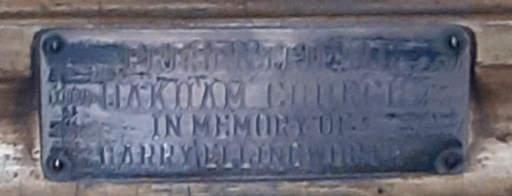
It’s detailed provenance is not known, but a difficult to read caption on the painting frame (below) has the inscription
“Presented to Oakham Church in memory of Harry Ellingworth”.
The Ellingworth family were prosperous shopkeepers in Oakham in the late 19th and early 20th century, and a number of them were named Harry. The most significant of these seems to have been a Harry Ellingworth who was a Town Crier in Oakham in 1881.
Painting in frame (with window reflections)
Dedication label
Interestingly a number of similar copies of the painting can be traced – either painted in Albani’s workshop or elsewhere (see below). The details vary, but the basic composition is the same. The market for such paintings was clearly buoyant.
Print of the original by Francesco Albani housed in the Museum of Fine Arts in Boston. 1608-1610
Dulwich Art Gallery Holy Family by Studio of Francesco Albani 1610-60
The painting shows a somewhat weary and pensive looking Madonna in a red dress with a dark blue shawl, The Christ child sits on a golden cushion on her lap, partly surrounded by a blue sheet. Joseph looks on from the right, with an open book in front of him, that seems to be placed on a stone chest or altar or perhaps a tomb. It may be that the directions in which the Madonna and her husband are pointing is of some iconographic significance – Joseph, in his contemplation of scripture pointing upwards to God, and Mary, with the Christ child on her lap, pointing down to earth, the direction, if that is an appropriate word, of the incarnation. Two angelic figures look on from the left. There is a figure carved on the stone chest, that, from the original, appears to be some sort of Bachannalia, with wine being poured out for small dancing child like figures. Again there may be some iconographic significance here with a representation of Christ’s blood being poured out at the Eucharist. The mixture of biblical and classical themese seems to have been common at the period of the original composition.
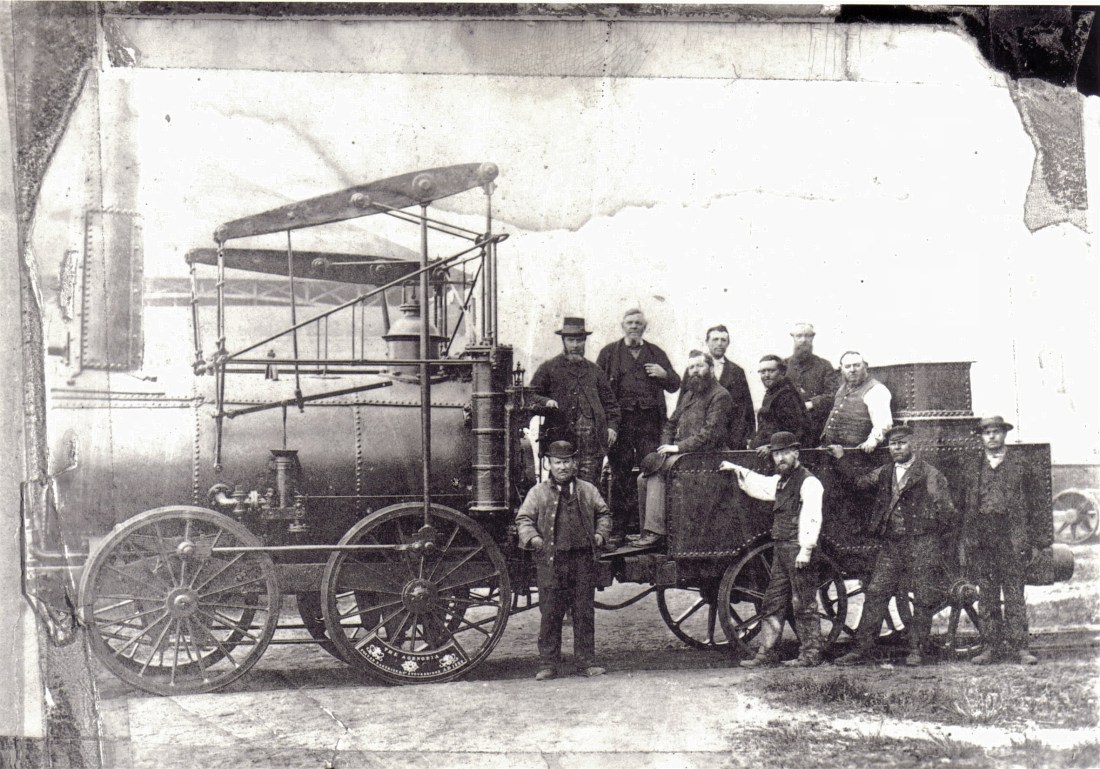
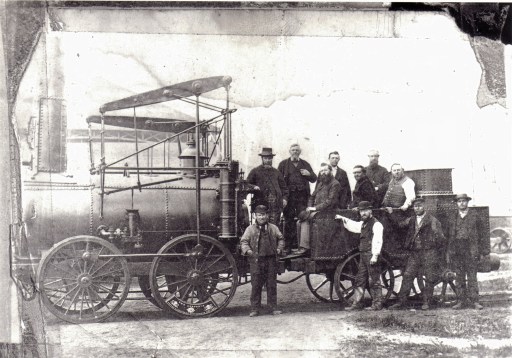
One of my recent tasks as a member of the committee of the Black Country Society has been to help organise an exhibition of photographs and other material at Dudley Archives entitled “From Agenoria to Beeching – the first and last days of steam in Dudley”, which ran from October 2025 to January 2026. This brought together material on the first Railway in the area (the Shutt End or Kingswinford Railway) and its locomotive, the Agenoria, with photos from the 1950s and 1960s that illustrate the last days of steam in the area. As the exhibition drew to a close, I prepared a web version which included the majority of the material in the exhibition and gave it some sort of long term presence. When this online exhibition went live, it resulted in some very interesting email exchanges and conversations with a number of those who looked at it. One of these was with Mr. David Marlow from Northumbria who provided two items that are now actually included in the online exhibition. The first is a photograph of a plaque on the wall on the old (and then derelict) John Bradley and Company factory in Stourbridge (now renovated as the Lion Health Centre), which commemorated the locomotives Agenoria and its sister locomotive, the Stourbridge Lion, that were built there. The second was a copy of a posed picture of the Agenoria with a number of workmen / managers. The original was donated to the National Railway Museum in the 1990s. From Mr. Marlow’s perspective, this photograph was particularly interesting as the “driver” of the locomotive was his great great grandfather Edward Stockton. Both these items raise some interesting chronological questions about the timelines of the Agenoria and the Stourbridge Lion, and these issues are probed in what follows.
Construction and operation
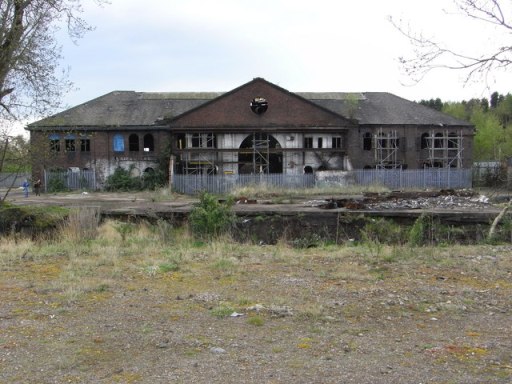
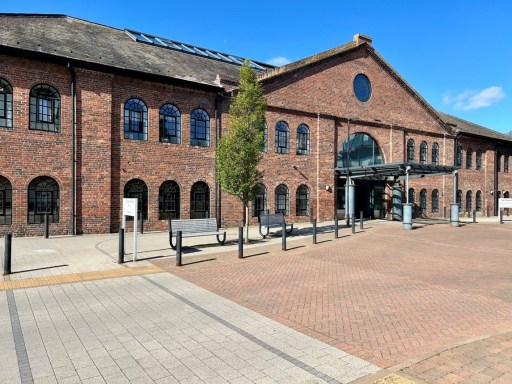
Figure 1. The derelict John Bradley factory in the early 2000s and the renovated building, now the Lion Health Centre
The Agenoria and the Stourbridge Lion were built at the John Bradley factory in Stourbridge in the 1820s (figure 1). The first was to run on the Shutt End Railway in Kingswinford for over 30 years, and is now preserved in the National Railway Museum in York. The second became the first locomotive to run under steam in the USA, although it was not much used because the tracks provided were not sufficiently robust. The careers of both locomotives are well outlined in “Two Stourbridge Locomotives” by Bill Pardoe and Michael Hale, Black Country Society Studies in Industrial Archaeology No. 3, published by the Black Country Society.
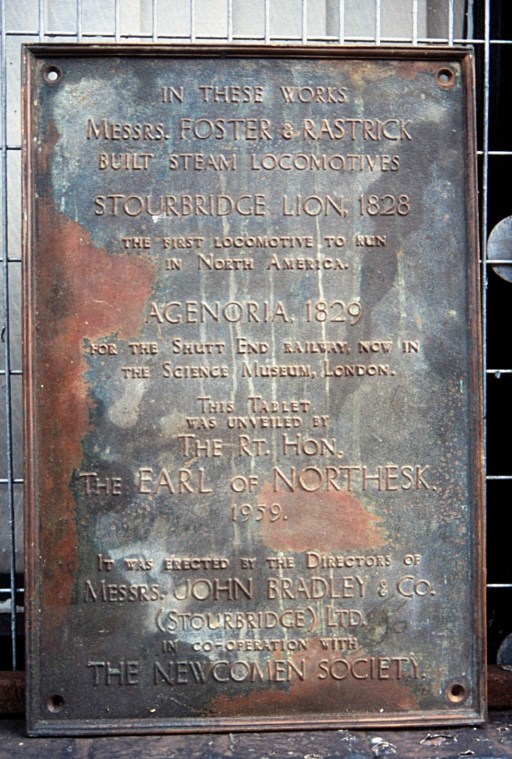
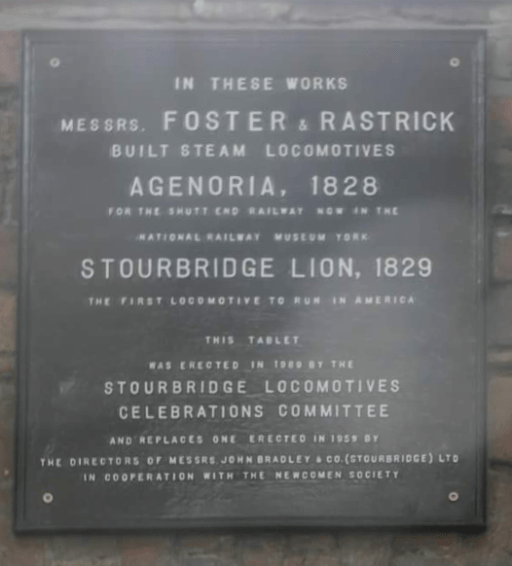
On a Black Country Society Industrial Archaeology Group visit to the derelict John Bradley foundry in 2005, Keith Hodgkins took a photo of a plaque that had been placed there by the Newcomen Society in 1959, commemorating the Stourbridge Lion and the Agenoria (Figure 2a). In our recent correspondence Mr. Marlow sent a photo of another plaque from the same building, apparently placed there to replace the Newcomen Society plaque by the Stourbridge Locomotives Celebrations Committee in 1988 (Figure 2b). The current whereabouts of these plaques is not known. But my interest was aroused by the dates on the plaques – Stourbridge Lion 1828 and Agenoria 1829 on the first, and Agenoria 1828 and Stourbridge Lion 1829 on the latter. There is clearly some chronological confusion here – which of the two engines should have the chronological priority?
a
b
Figure 2. Plaques celebrating the Agenoria and the Stourbridge Lion
From the historical record, we can trace the timeline of the construction and operation of the locomotives to some extent. The Shutt End Railway was first proposed in the early 1820s to connect the mines and the developing Iron Works in the area to the Staffordshire and Worcestershire Canal to the west, to enable coal and iron products to be shipped to market. Eventually in January1827 an agreement to build the line was signed between the Dudley Estate and James Foster of the Shutt End Iron Works, which was itself owned by John Bradley and Company, coal and iron masters of Stourbridge. Construction took place soon after the signing of the agreement and the line was opened with great celebrations on June 2nd 1829. The Agenoria locomotive was built by Foster Rastrick and Co at Stourbridge (at the works of Figure 1). The Foster was the same James Foster who owned the Shutt End works, and John Rastrick was a noted locomotive engineer and builder.
In 1828 Horatio Allen, went on a railroad research tour of England on behalf of the Delaware and Hudson Railway in the USA. By July 1828 he had ordered four locomotives – three from Foster, Rastrick and Company and one from Robert Stephenson and Company. Stourbridge Lion was one of these three locomotives built by Rastrick, but Stephenson’s shop completed their locomotive, the Pride of Newcastle, before any of Rastrick’s locomotives, and it arrived in America nearly two months before the Stourbridge Lion, which was transported from Liverpool aboard the ship John Jay, arriving at New York in mid-May 1829. The two other Foster, Rastrick & Co locomotives that had been ordered by Allen, Delaware and Hudson, arrived in New York in August and September 1829. The Lion however was the first to be used, running on the Delaware and Hudson Railway on August 8th 1829. Although the locomotive performed well, the track laid for it was unable to adequately take its weight and it never found operational use.
So which of the Agenoria and Stourbridge Lion should have priority. Certainly the Agenoria ran along tracks at Shut End in June 1829 a few months before the Lion did the same in the USA. But the Lion is the first recorded in the historical record on its shipment to the US in May that year. But, in my mind it is likely that the Agenoria was under construction and seen by Allen before he placed his order in July 1828. Certainly the Agenoria must have been complete by early 1829, as it is almost certain that there would have been extensive trials on the Shutt End line before the public opening in June that year. So I would suggest that Agenoria was probably completed first, sometime in late 1828, and the Lion a few months after that. Thus of the two plaques, the second, from 1988, is probably correct, although it would be fairer to say that both were probably constructed if not completed in 1828, and first ran in operation in 1829. But Agenoria should have the historical priority in both construction and operation.
Retirement and Restoration
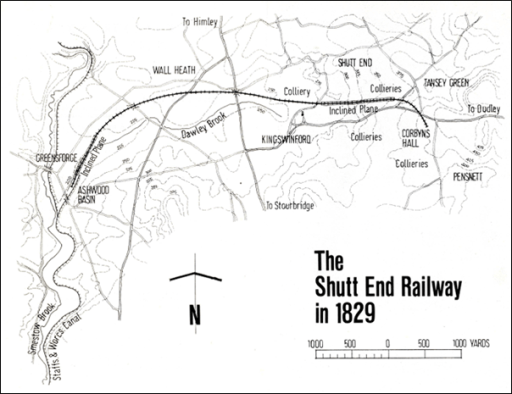
The Agenoria ran along the Kingswinford Railway from the top of the incline at Ashwood Basin in the west to the bottom of two inclines close to Kingswinford church in the east. See the map from “Two Stourbridge Locomotives” shown in Figure 3.
Figure 3.The Shutt End Railway – from “Two Stourbridge Locomotives” by Bill Pardoe and Michael Hale, Black Country Society Studies in Industrial Archaeology No. 3
One incline (shown in Figure 3) took the railway itself to the mines around Corbyn’s Hall in Pensnett, and one (not shown on the Figure) provided access to and from the works of John Bradley and Co. Both inclines can be assumed to have been cable hauled. The Engine Shed and presumably other maintenance facilities was close to the foot of the two inclines. The Kingswinford Railway was only connected to the wider Earl of Dudley’s Railway network (the Pensnett Railway) in 1865, through a junction several hundred yards to the west of the bottom of the inclines. Correspondence in 1864 between the mineral agent of the Dudley Estate (Frederick Smith) and William Orme Foster who had taken over control of John Bradley and Co Iron Works from his uncle James Foster, implies that Agenoria was owned by John Bradley and Co, rather than by the Dudley Estate, as was the Locomotive Shed and the maintenance facilities. The correspondence was about the state of the Kingswinford Railway infrastructure and led to improvements being made and a new locomotive being purchased by Foster in 1865 – a Manning Wardle 0-4-0 saddle tank. It is generally assumed that it was around that time that the Agenoria was taken out of service.
The next mention of Agenoria in the historical record is in 1880, when Edward Marten (Chief Engineer at the Midland Steam boiler Inspection and Insurance Co in the 1860s, and later the engineer in connection with the South Staffordshire Mines Drainage and Improvement Act of 1873) sought to gain support for restoring and preserving the locomotive whose components by that time seem to have been scattered around Shut End Iron Works. This led to a restored Agenoria being exhibited at Wolverhampton Fine Arts & Industrial Exhibition in 1884, before being formally donated to the Science Museum in 1885 by William Orme Foster. The implication here is that, after the Agenoria had been taken out of service, it was taken into the Iron Works, either by being hauled up the incline or (possibly more likely) taken around a less steep but more circuitous connection into the works that was in place by 1880 and possibly a couple of decades earlier.
Figure 4. The Agenoria and workers (from Mr. D. Marlow)
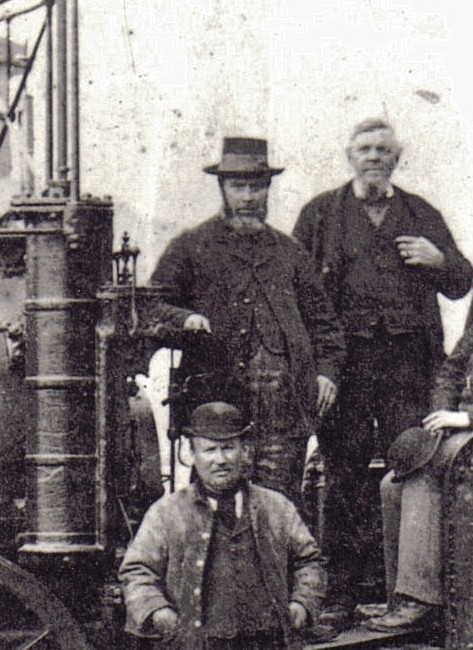
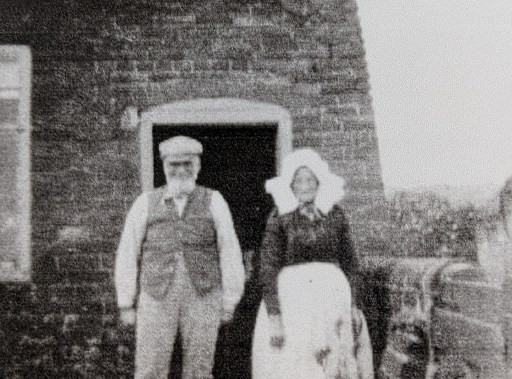
Now consider the photograph that was sent to me by Mr Marlow, shown in Figure 4 above. Mr. Marlow believes the figure closest to the boiler on the photograph, in the driver’s position, is his great great grandfather, Edward Stockton, and family tradition has it that he was one of the drivers of the locomotive. Figure 5a shows an expanded version of Figure 4 where the driver is shown in better definition, whilst figure 5b shows an (admittedly poor) photograph that is certainly of Edward Stockton and his wife Ellen from the 18890s or later, also supplied by Mr. Marlow. These both, in my view, seem to show the same person, and I am reasonably confident that the driver of the footplate is indeed Edward Stockton.
a
b
Figure 5 Edward Stockton – (a) from Figure 4 and (b) showing Edward and his wife Ellen
Edward Stockton was born at Moreton Cobbett in Shropshire in 1824, Some time before the 1851 census he had moved to the Pensnett area as he married an Eliza Farringdon at Dudley Parish Church in November 1847. She died within a very short time and Edward then married her sister Ellen two years later, this time at Kingswinford Parish Church. In the 1851 census he is identified as a Furnace Man, in 1861 as a Labourer, in 1871 as a Labourer in Iron Works and in 1881 as a Farm Labourer, always living in the vicinity of the Shutt End Iron Works. Nowhere is he identified as an Engine Driver as might be expected. Of course this might simply be due to the idiosyncrasies of how he completed the census returns, but it seems to me more likely that Stockton became an Engine Driver sometime after the 1871 census. This suggests that the Agenoria, after being withdrawn from the Kingswinford Railway, had a brief afterlife as a locomotive in the Shutt End works, where an extensive railway system was developing in the 1870. Supposing the photo to have been taken between 1871 and 1875, this would put Edward in his late 40’s / early 50’s at the time, which seems consistent with the photograph. The occasion of the photo might be to mark the start of Agenoria’s Iron Work’s career (which would imply that it was not moved into the works till the 1870s, or perhaps we have here a picture of the reconstructed engine in 1880 or early 1881 before the census of that year. However at this time Edward was a farm labourer and presumably working elsewhere. The first occasion seems to me to be more likely.
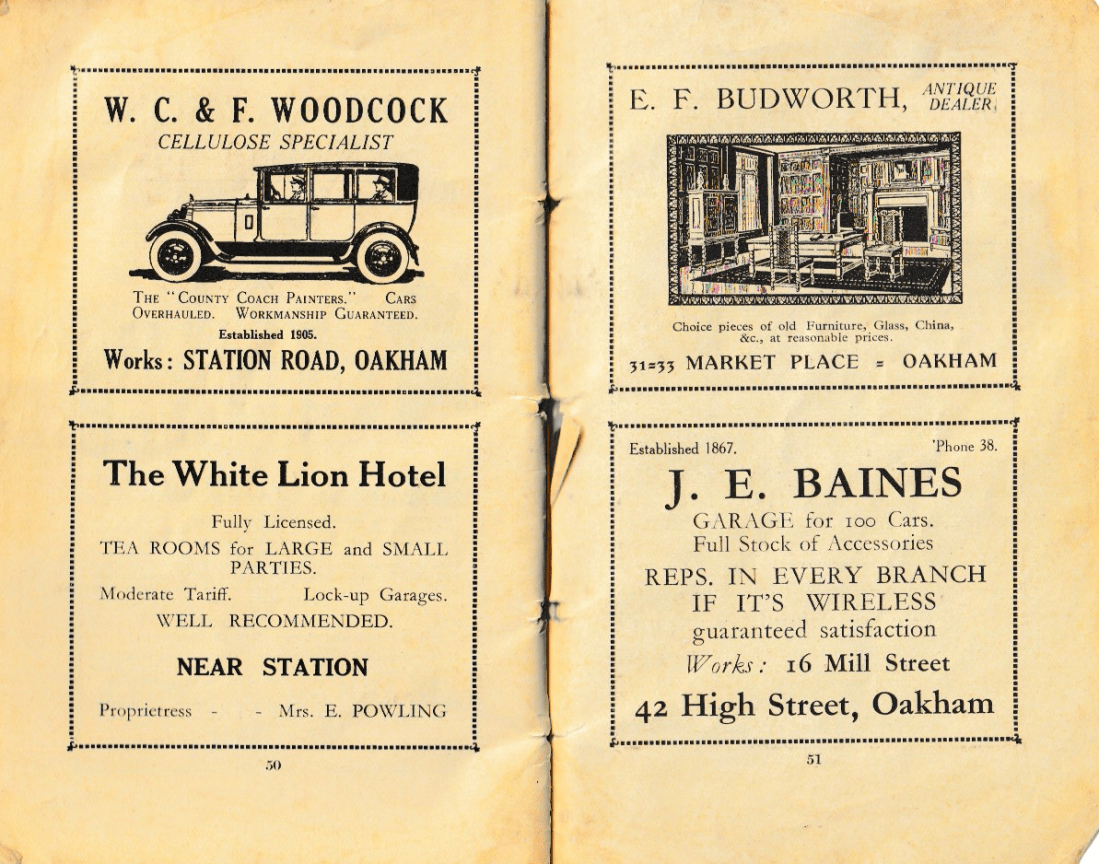
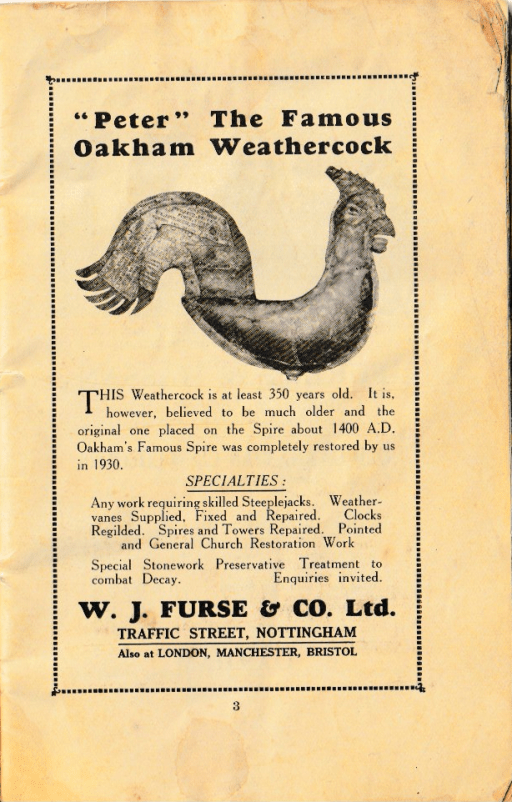
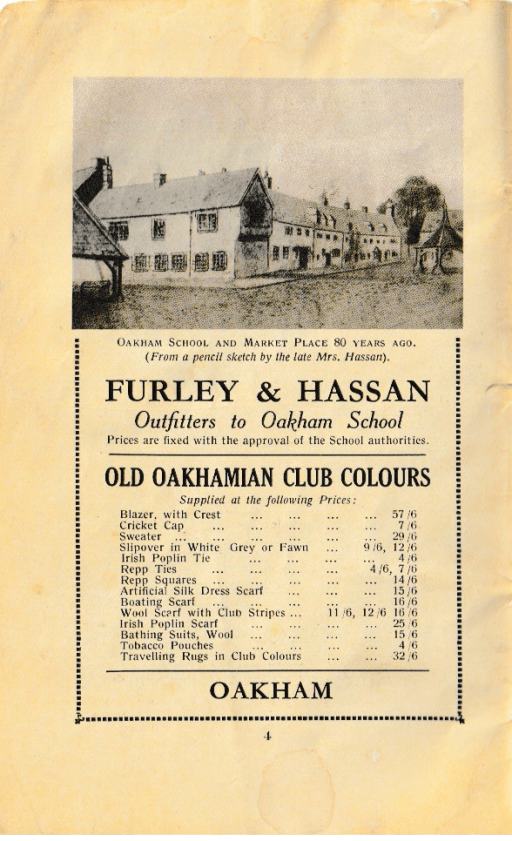
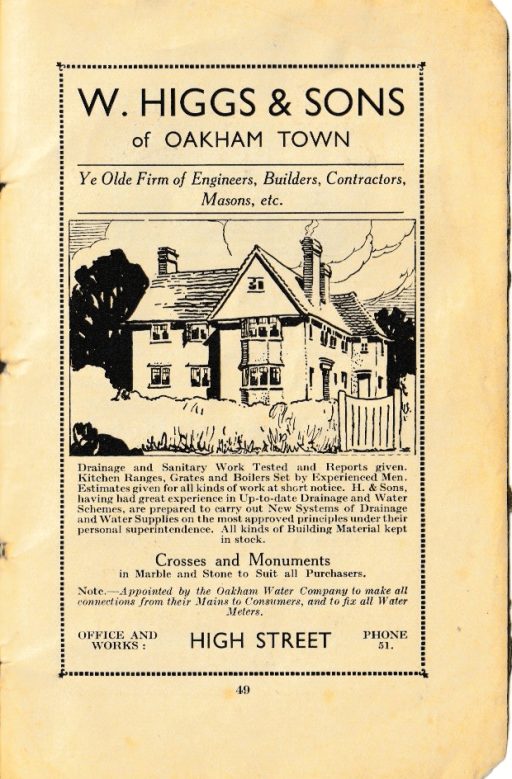
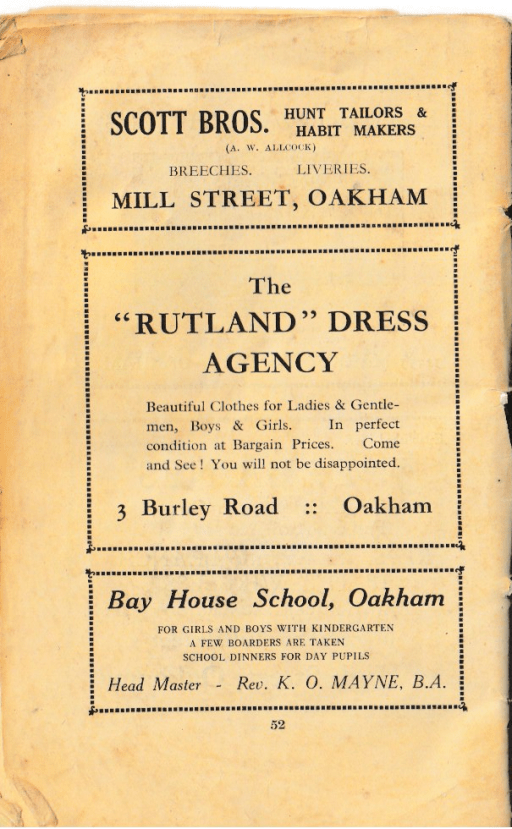
Recently I have come across a number of old Church Guides and Histories for All Saints Church in Oakham- from 1932, 1972 and 1980. PDFS of these can be found on the History and Heritage page of the church website. There comes a time of course when old guides and histories become historical documents in their own right, revealing how the church was thought of and communicated at the time of writing, and in their description of their contemporary activities, give an indication of the nature of the church’s worship and other activities. This is particularly true of the 1932 guide – The Story of Oakham Church, School and Castle by the then vicar, A. Edward Fraser. In what follows I post just a few pages from this this guide – the adverts it contained for local businesses that paid for its publication. These are given below, and I suspect that Oakham readers will find them of considerable interest.
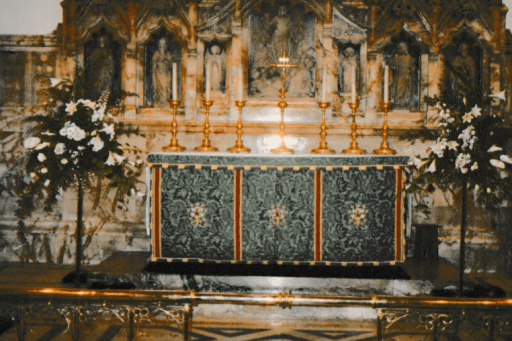
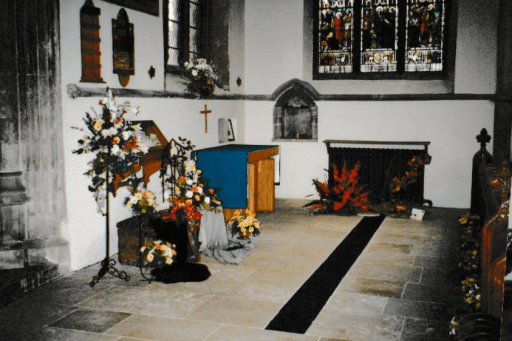
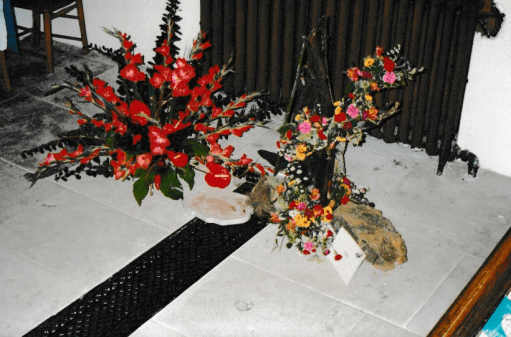
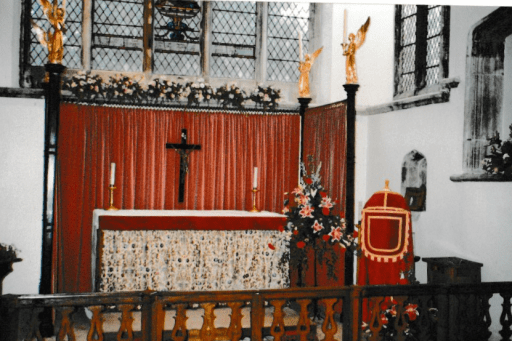
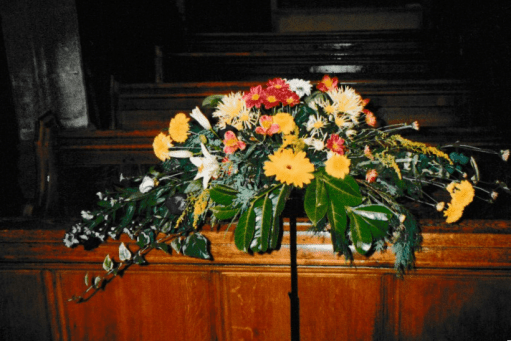
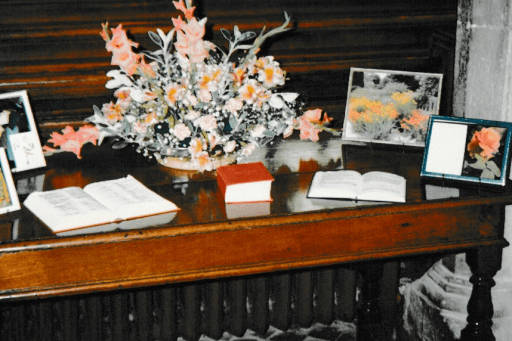
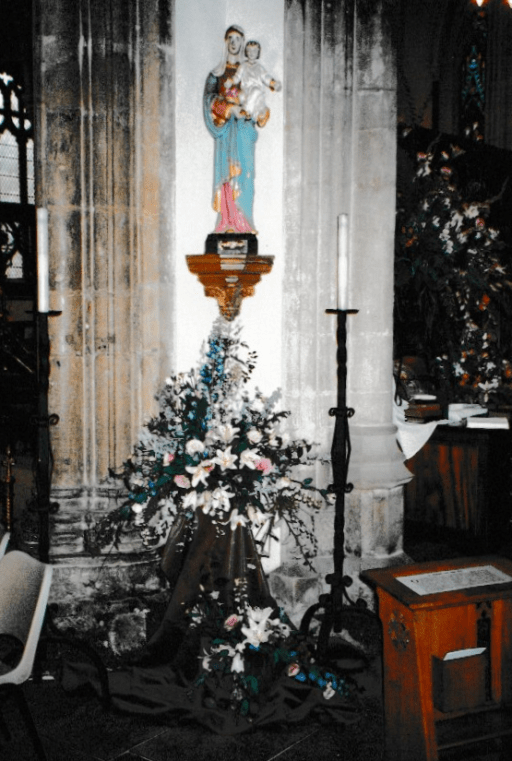
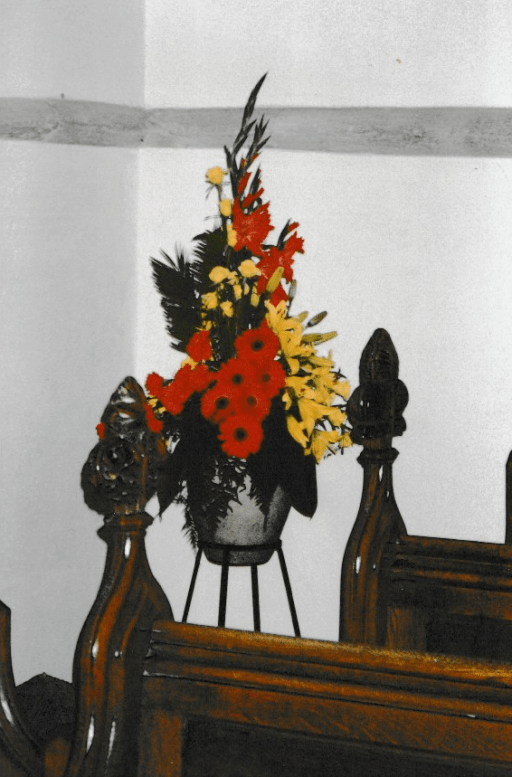
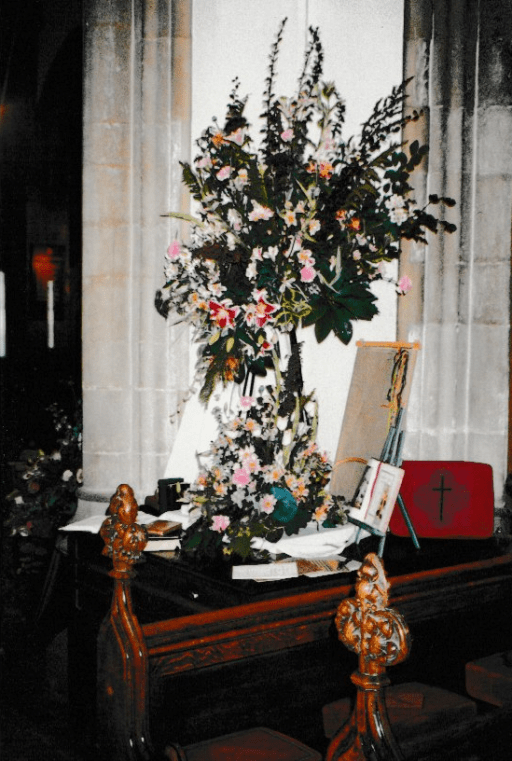
In 1996, All Saints church in Oakham, organised a flower festival. Some photographs from this event were deposited in the church safe for safe keeping, and I have recently come across these whilst searching the safe for other items. It seems to me that these photos are well worth sharing – both for the flower displays but also for the glimpse they give of the church from 30 years ago. Pleas click on the photos below for larger versions of the pictures. The colours aren’t marvellous – they can only be as good as the prints – but they will be of interest to some.
Holy Trinity ChapelHoly Trinity ChapelNorth TranseptHigh altarSouth TranseptSouth TranseptSouth TranseptLady ChapelLady ChapelArea near north doorCentral CrossingCEntral CrossingNorth TranseptNear pulpitEntrance to Lady ChapelWest End
The Lady Chapel at All Saints Church in Oakham is to the south of the chancel and is entered from the south transept. It is a high roofed open space dating from around 1480, that has had a number of functions in the recent past – as a location for the organ, as a choir vestry, and as a small side chapel. Indeed there is still an altar with its associated communion rails at the east end of the chapel. It is currently mainly used as an area for after church coffee, small meetings etc.
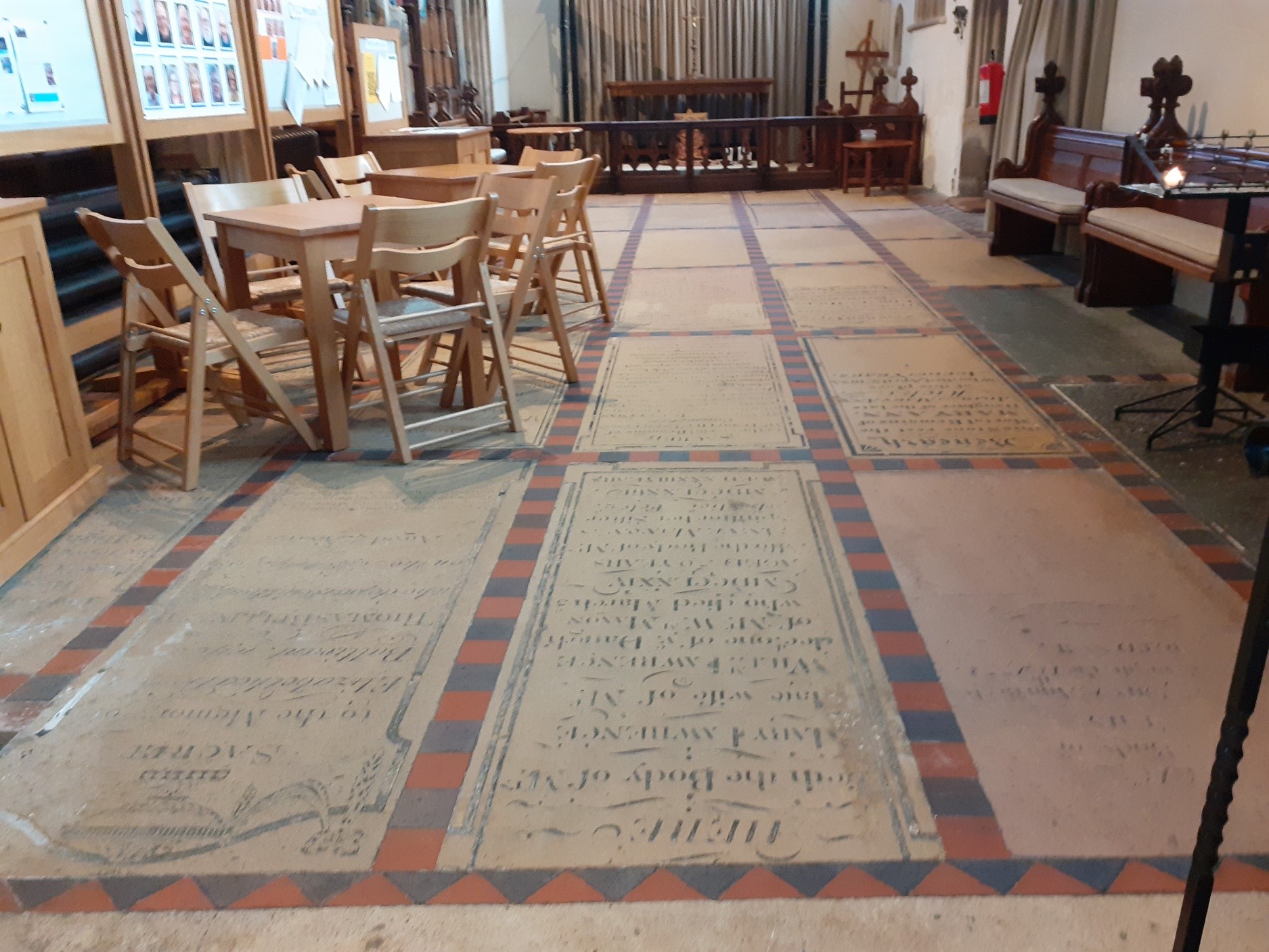
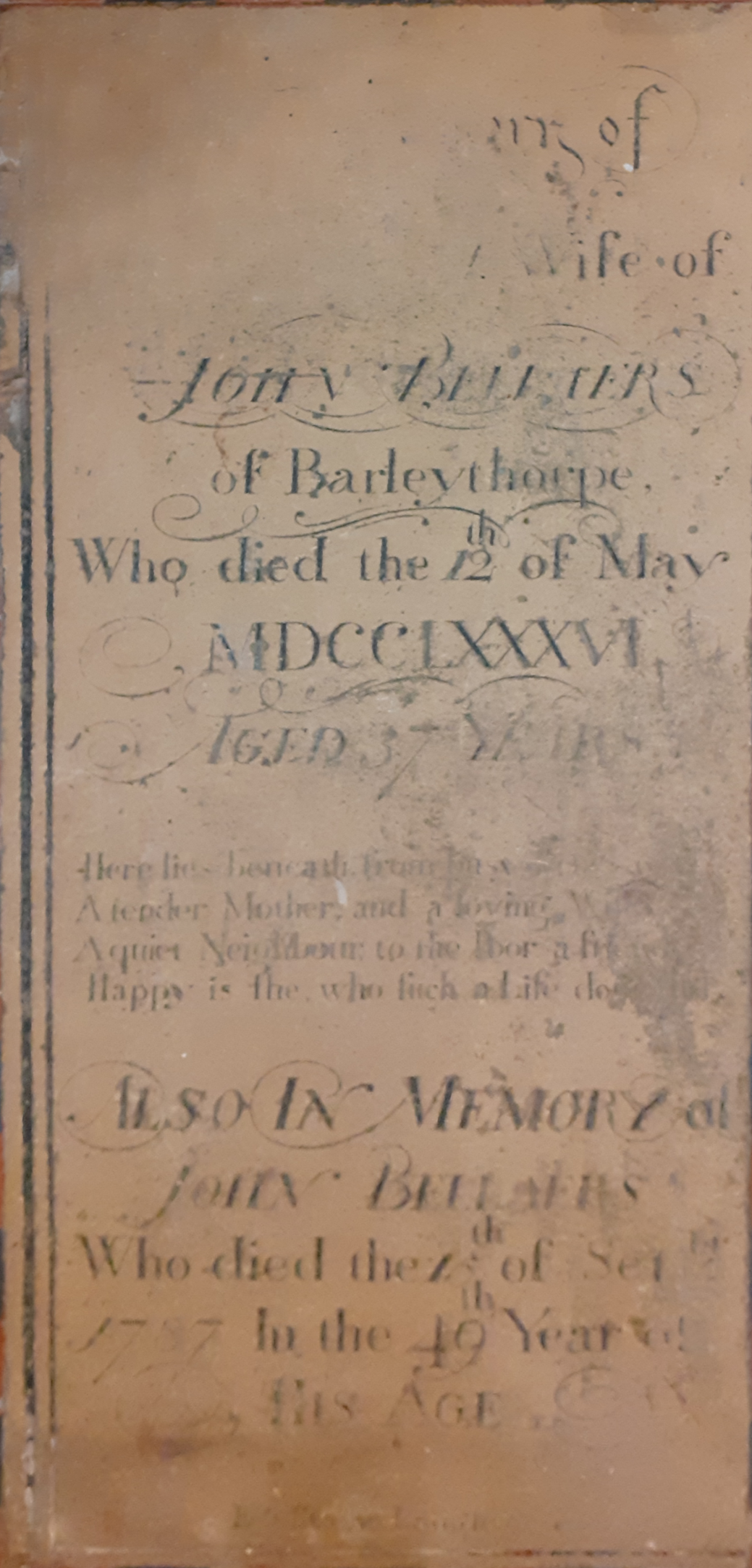
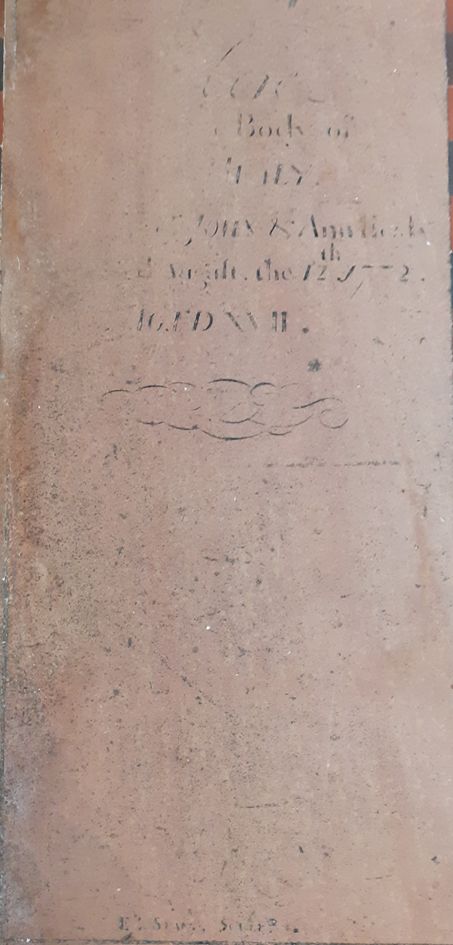
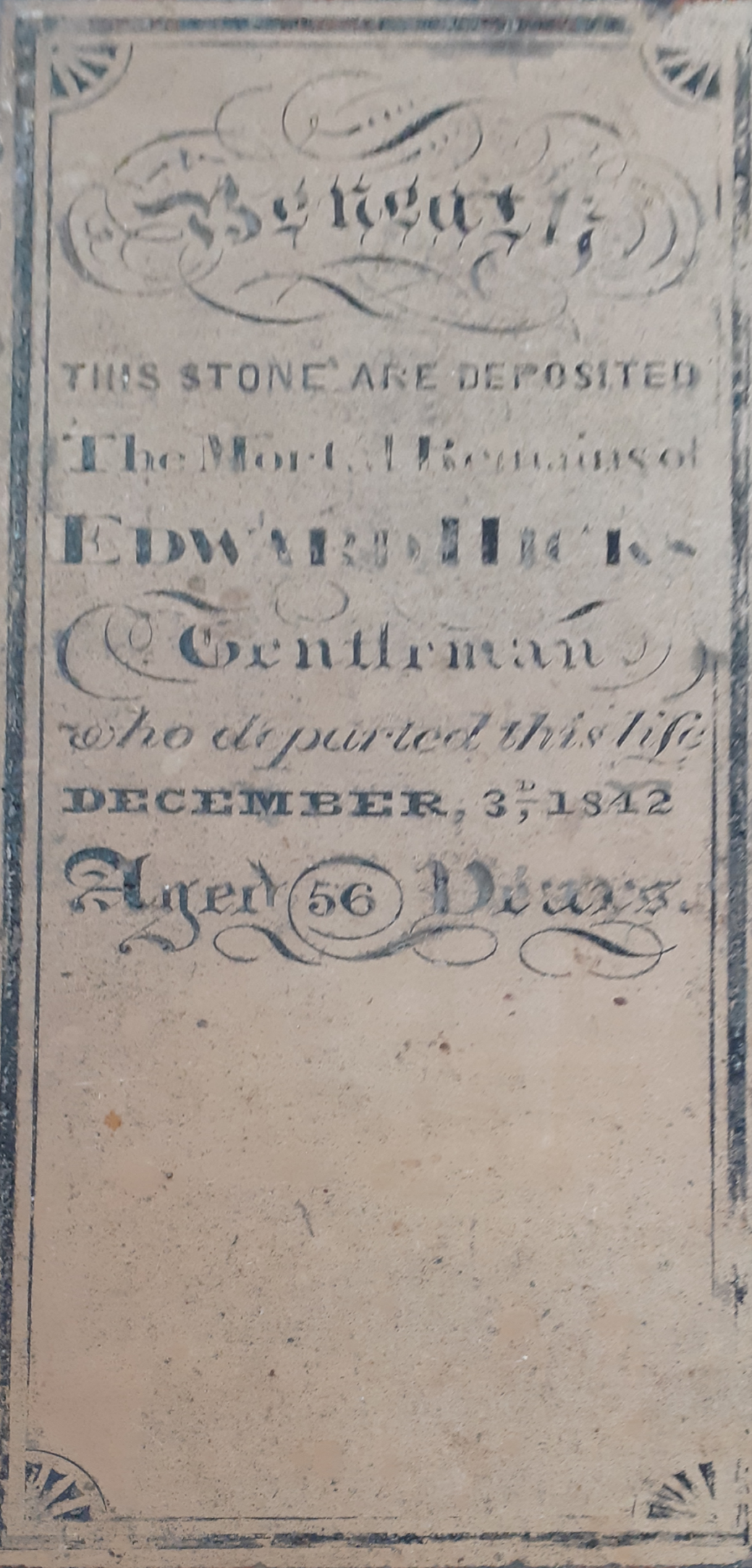
The floor of the chapel consists of memorial slabs from the late 17th to the early 19th centuries, a number of which contain inscriptions indicating that there are burials beneath them. Thus it would seem that in the 18th century this area was an internal burial space of some sort. Why this area was used in this way and what determined who was buried in this area is not clear. Now over the years some of the memorials have been worn down very badly, particularly those between the priest’s entrance and the vicar’s vestry on the south side of the chapel and the entrance to the chancel on the north side. With its current use as a fellowship area, it is likely that the other memorial slabs will experience a rapid deterioration over the coming years. Thus the purpose of this post is twofold – firstly to record the current layout and inscriptions that are still visible, and secondly to try to come to some understanding as to why the area was used as a mortuary space.
The layout of the Lady Chapel
Figure 1 shows a view of the Lady Chapel from its entrance from the south transept, looking east. The altar and communion rail can be seen in the background. It can be seen that the floor consists of a regular grid of memorial slabs, separated by a pattern of tiles. In total there are seven rows of slabs between the entrance and the communion rail (which will be denoted by the letters A to G, with A being at the transept entrance. There are five columns of slabs, which will be denoted by the letters A to E, with A being on the south side to the right of the view of Figure 1. Thus, for example, slab AC is the one in the near centre of figure 1 – row A and column C. Most of the slabs are a soft brown stone, with the exception of AA and BA (to the right of the view in Figure 1) which are of a darker colour, although they are both badly worn.. The grid of memorials is regular in columns B, C and D, but the rows are displaced somewhat in columns A and E due to the presence of structural columns at the transept end.
Figure 1. The layout of the Lady Chapel
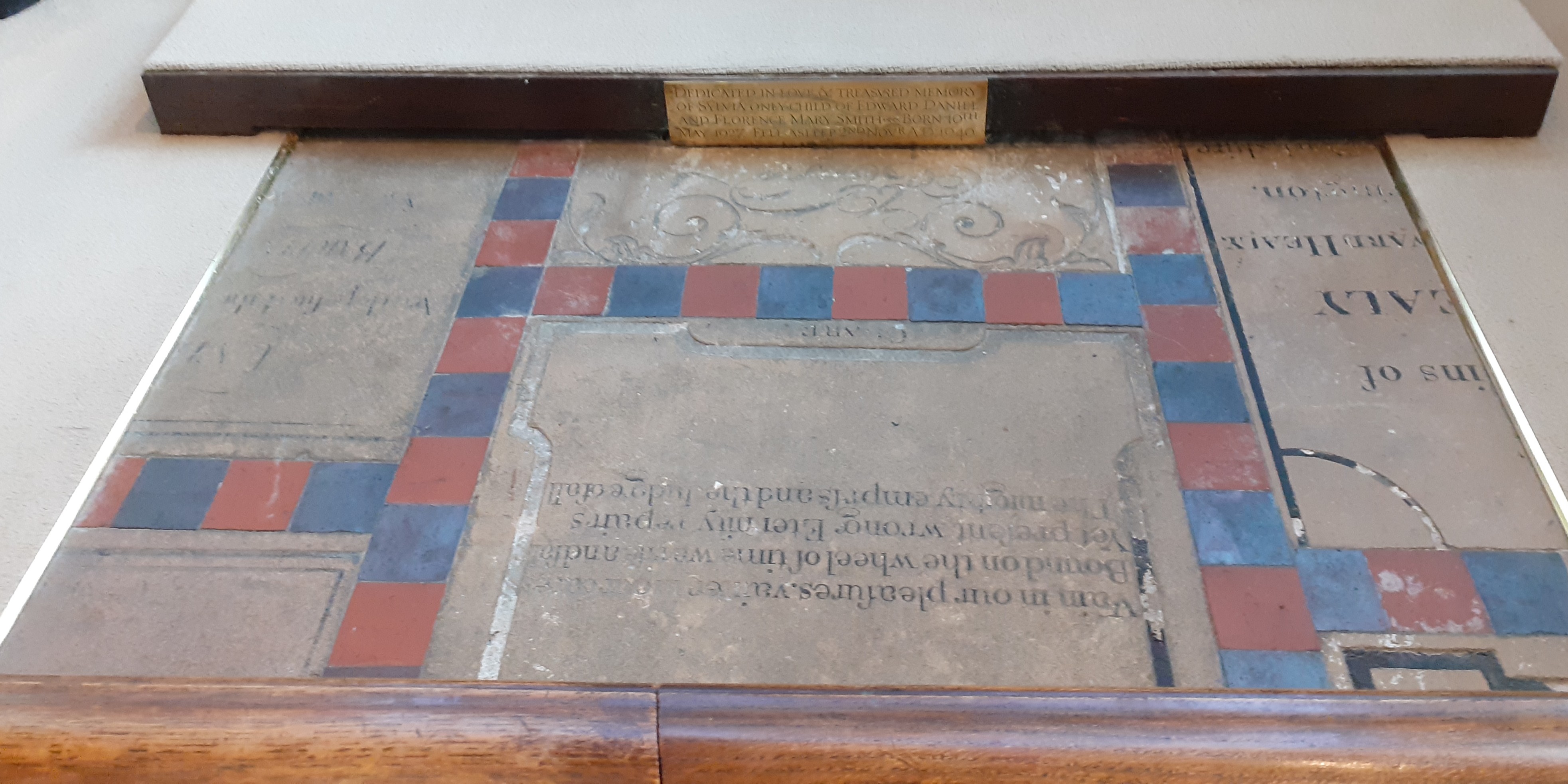
Figure 2 shows a view of columns B to D in rows F and G from just in front of the altar rail at the east end of the chancel. It can be seen that the rail cuts across a number of slabs, and there is a carpeted area that obscures part of columns B and D and all of columns A and E. Indeed very little can be seen of the slabs in row G, which extend beneath the altar. In this region the regularity of the grid in columns B to D is lost and the slabs become staggered – presumably to fit into the space available at the east end of the chapel beneath the current altar.
Figure 2 Detailed view of the slabs in front of the Lady Chapel altar
The memorials
The layout of the meorials is shown in Figure 3 below. The photos of the slabs are in roughly the correct position relative to each other, although the correspondence with the actual layout in the Chapel is not exact. They are identified using the notation given above. The discontinuity in the photographs of slabs FB, FC and FD indicates the position of the altar rail.
AABACADAEA
ABBBCBDBEBFB
ACBCCCDCECFC
ADBDCDDDEDFD
AE BECEDEEEFE
Figure 3. The layout of the memorial slabs
The inscriptions
In the inscriptions that follow, I have (deliberately) not reproduced the details of the typogrpahy on the memorials (capitalisation, punctuation etc.) but have tried to put them in a form where they are more easily read with modern typography. The texts in italics are not on the memorials.
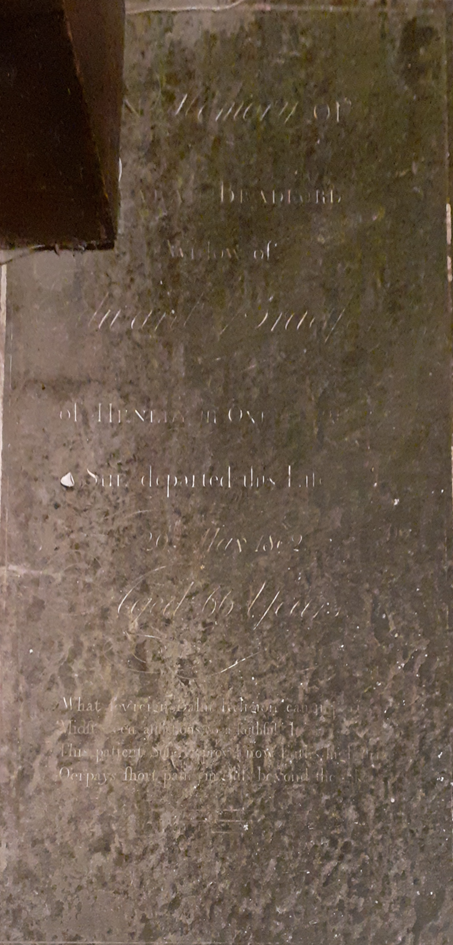
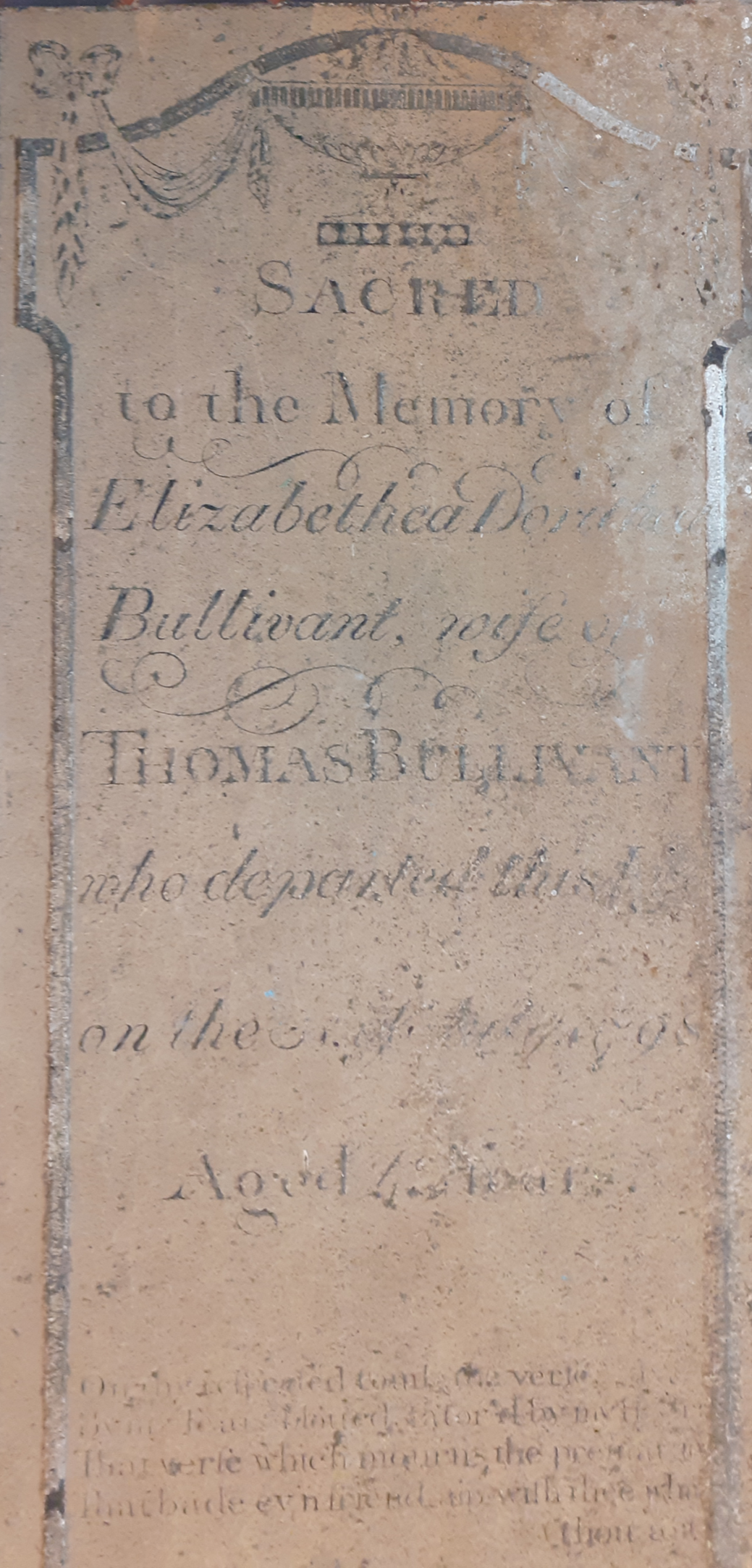
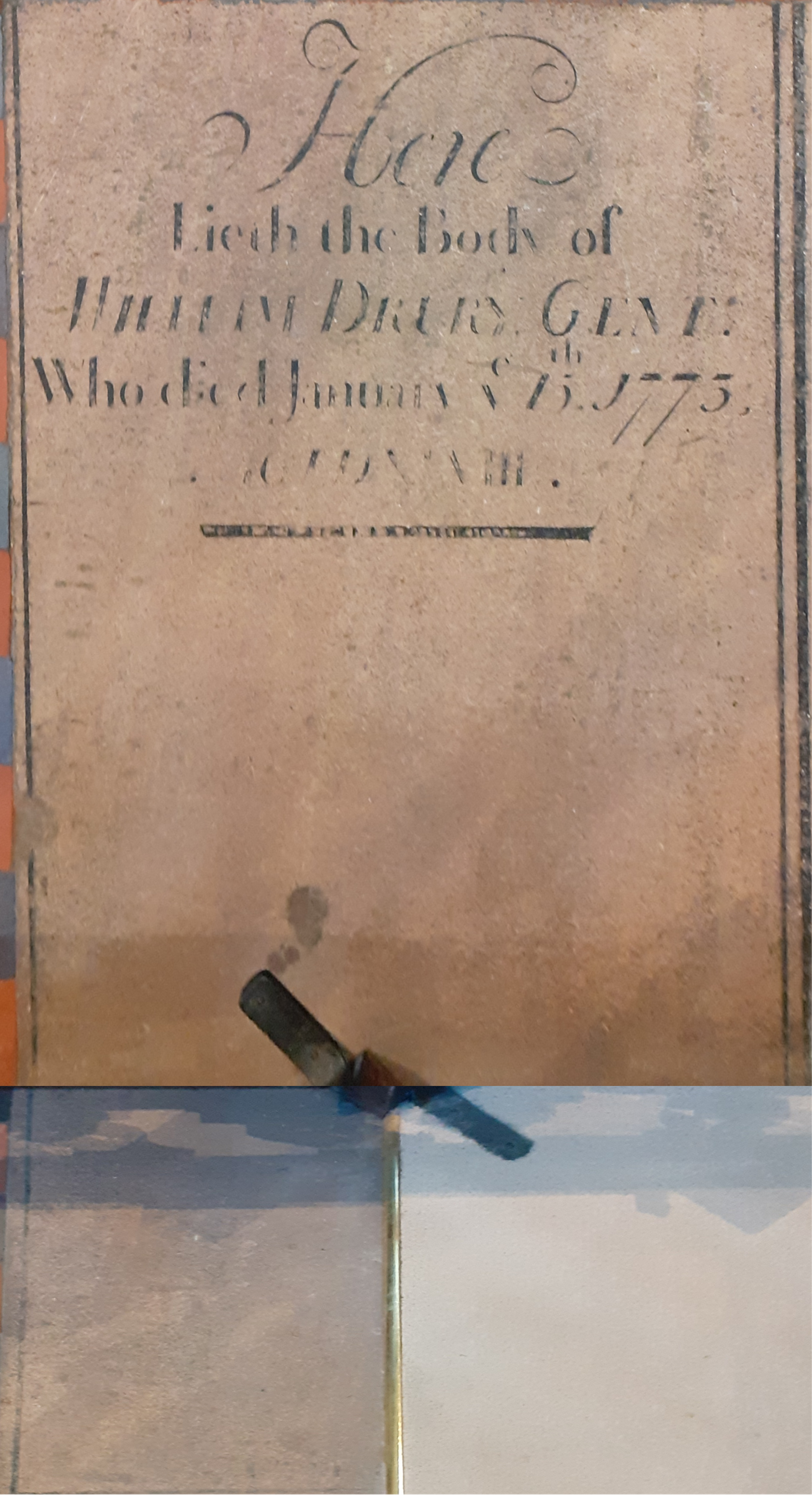
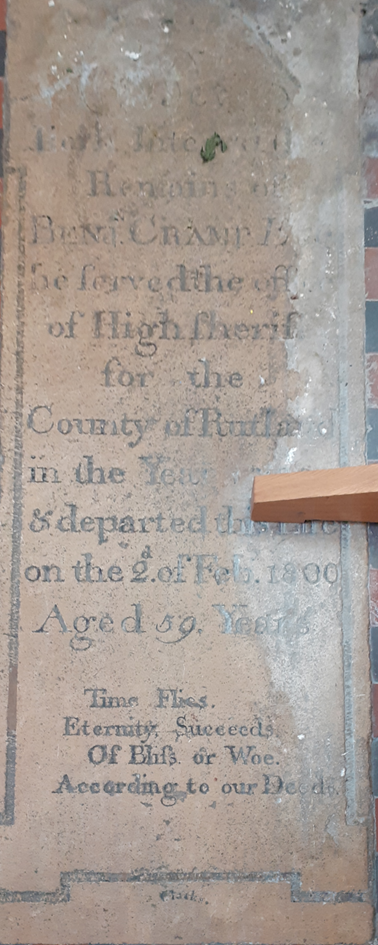
AA. …Bradford….Widow of … of Henley in Ox… departed this life .. 20th May 1802 aged 66 years ….. Undecipherable verse AB. … body of …. 12th 1772…. AC. Here lieth the body of Mary Lawrence, late wife of Mr William Lawrence, dec., one of ye daughters of Mr William Maxon, who died March 5th MDCCLXXIV (1774) aged 39 years. Also the body of Anne Maxon…her sister who died February 2nd MDCCLXXIII (1773) aged XXXIII (33) years. AD. Sacred to the memory of Elizabeatha Doris Bullivant, wife of Thomas Bullivant who departed this life on the ….. 1798 aged 42 Years………. AE. … remains … Benjamin Cramp Esq. He served the office of High Sheriff for the County of Rutland in the year … departed this life on the 2nd February 1800 aged 59 years. Time flies; Eternity succeeds; of bliss or woe; according to our deeds.
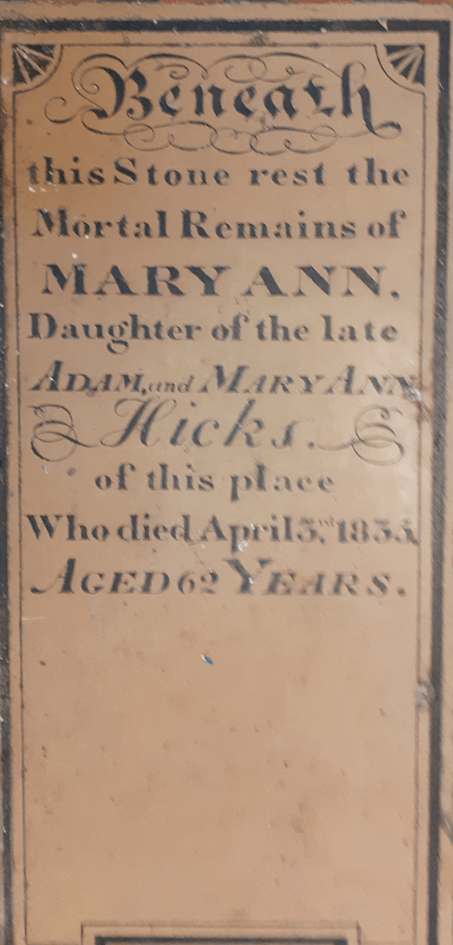
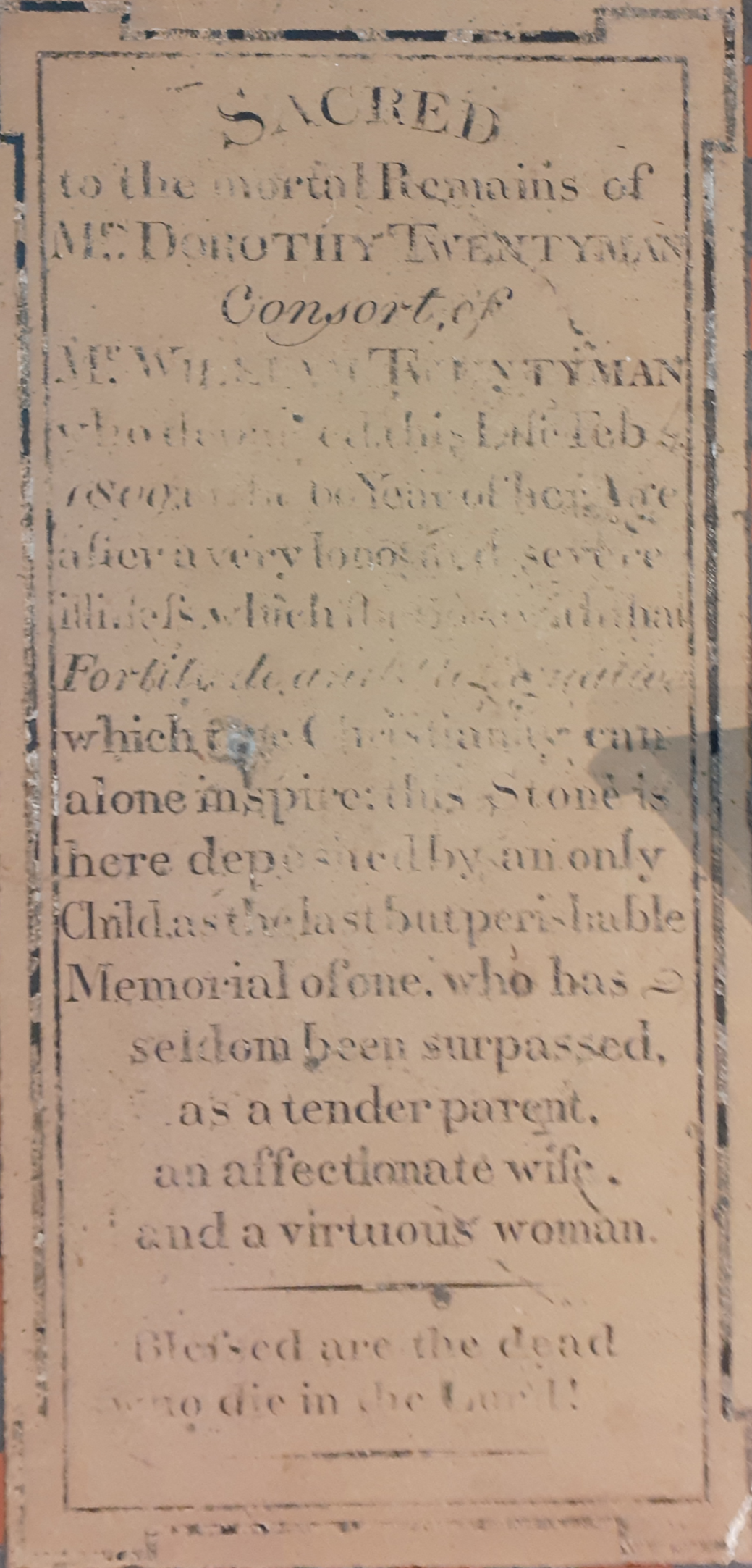
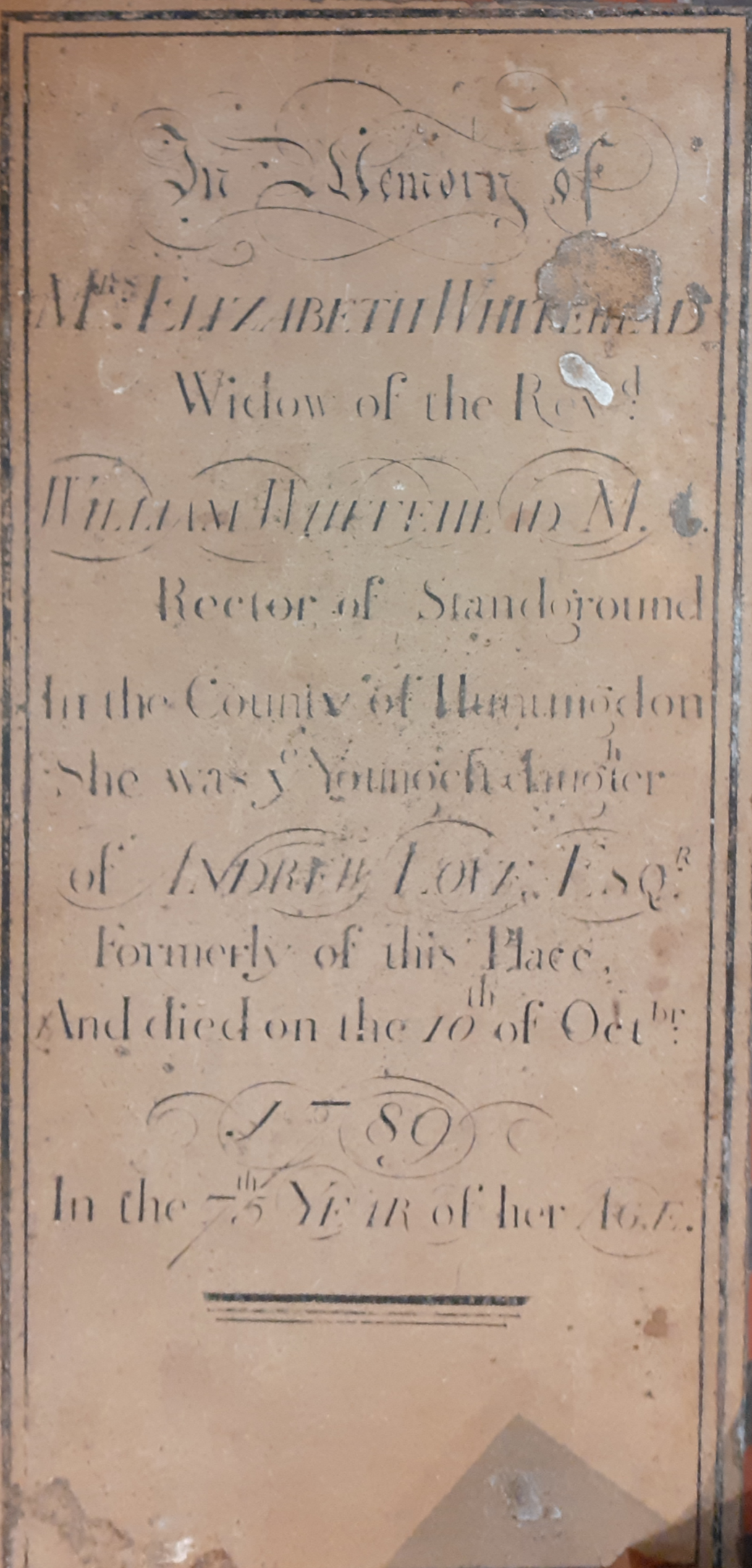
BA. Not readable BB. Beneath this stone rests he mortal remains of Mary Ann, daughter of the late Adam and Mary Ann Hicks of this place who died April 3rd 1835 aged 62 years, BC. Sacred to the mortal remains of Mrs Dorothy Twentyman, consort of Mr William Twentyman who departed this life February … 1809 in the ,,, year of her age after a very long and severe illness which…..Christianity can alone inspire. This stone is here deposited by an only child as the last but perishable memorial of one who has seldom been surpassed, as a tender parent, an affectionate wife and a virtuous woman. Blessed are the dead that die in the Lord! BD. In memory of Mrs Elizabeth Whitehead, widow of the Revd William Whitehead MA, Rector of Stanground in the county of Huntingdon. She was ye youngest daughter of Andrew Love Esq. formerly of this place, and died on the 10th of October 1789, in the 75th year of her age. BE. …. Hind Gent who died February the 17th MDCCLXXI (1771) aged LXXIX (79) years. Likewise ….are buried the remains of Elizabeth …who was buried March …MDCCII (1702) Also five … sons if the above died…infants
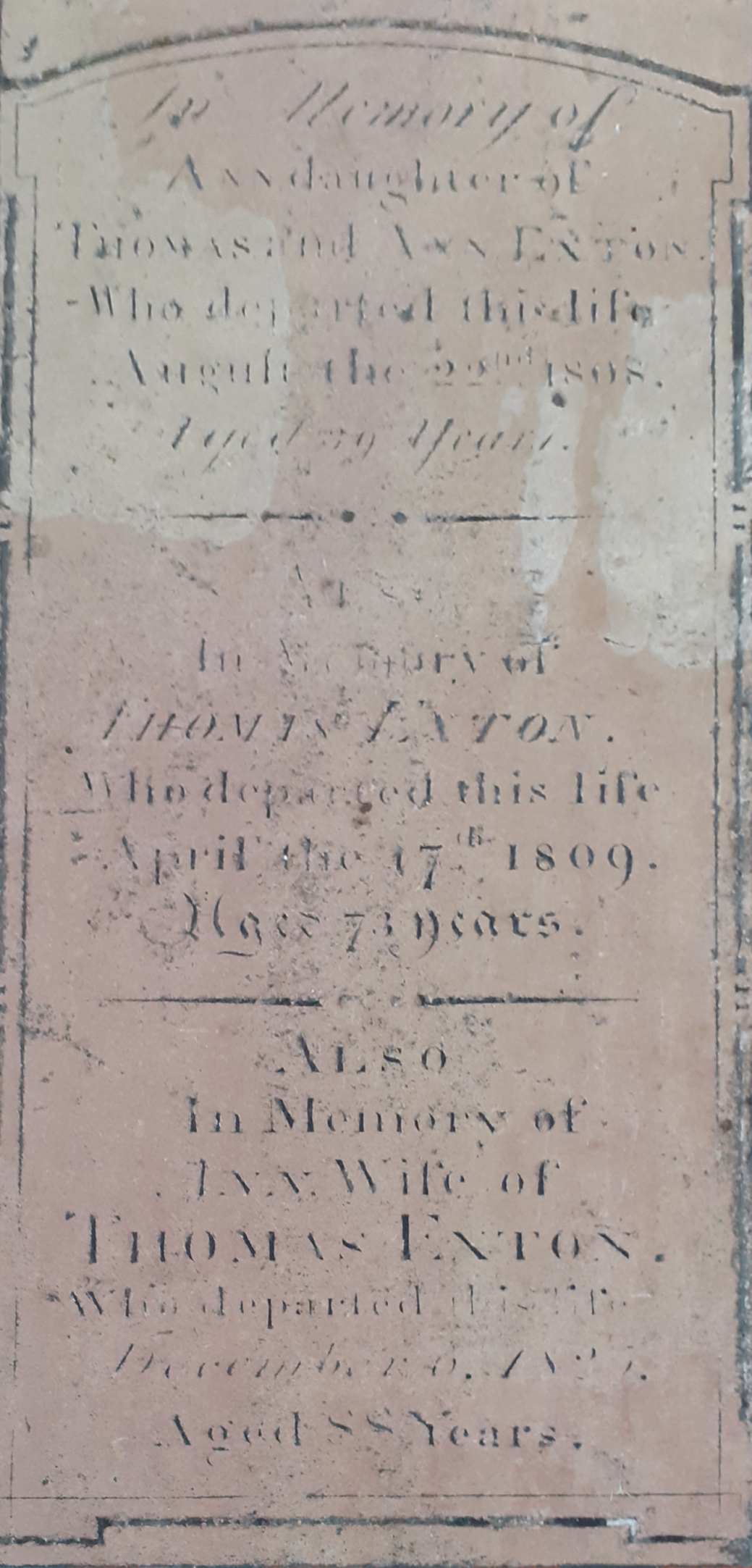
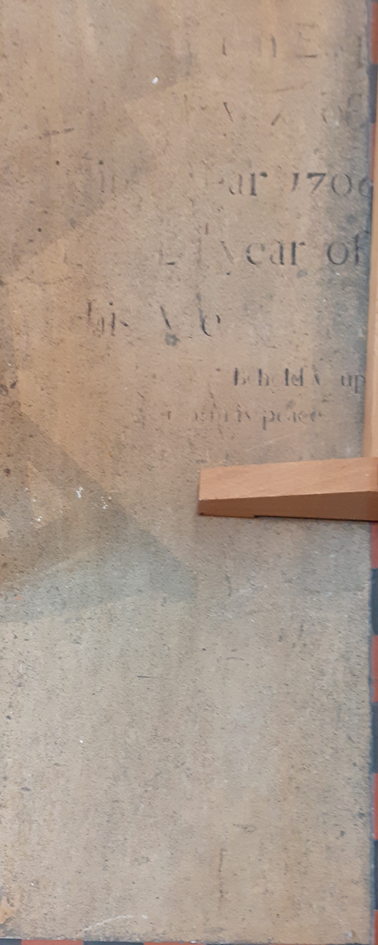
CA. No inscription visible CB. Beneath this stone are deposited the mortal remains of Edward Hicks, Gentleman who departed this life December 3rd, 1812 aged 56 years. CC. In memory of Ann, daughter of Thomas and Ann Exton, who departed this life August the 22nd 1808 aged .9 years. Also in memory of Thomas Exton who departed this life April the 17th 1809 aged 73 years. Also in memory of Ann, wife of Thomas Exton, who departed this life November …18… aged 88 years. CD. Here lieth the body of Frances Davie, the wife of Thomas Davie Senior who died January 12th 1721 aged 67 years. Full happy man that dies in faith, His good works follow him…; …….are his saints …. to be; To live with Christ his face to see. Also the remains of Frances Ashby, who died September 6th 1792 aged 66 years, The sweet remembrance of the just … shall flow … they sleep….. CE. ….year 1706 .. year of his age ….peace
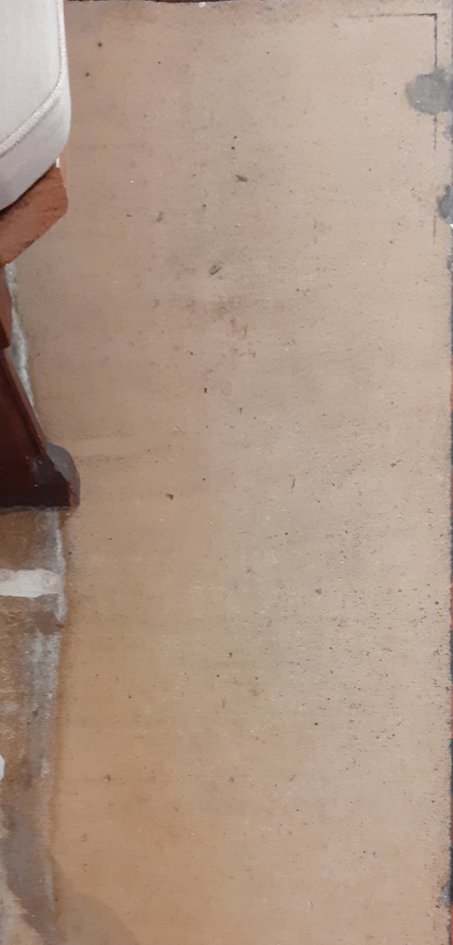
DA. No inscription visible DB. No inscription visible DC. No inscription visible DD. No inscription visible DE. No inscription visible
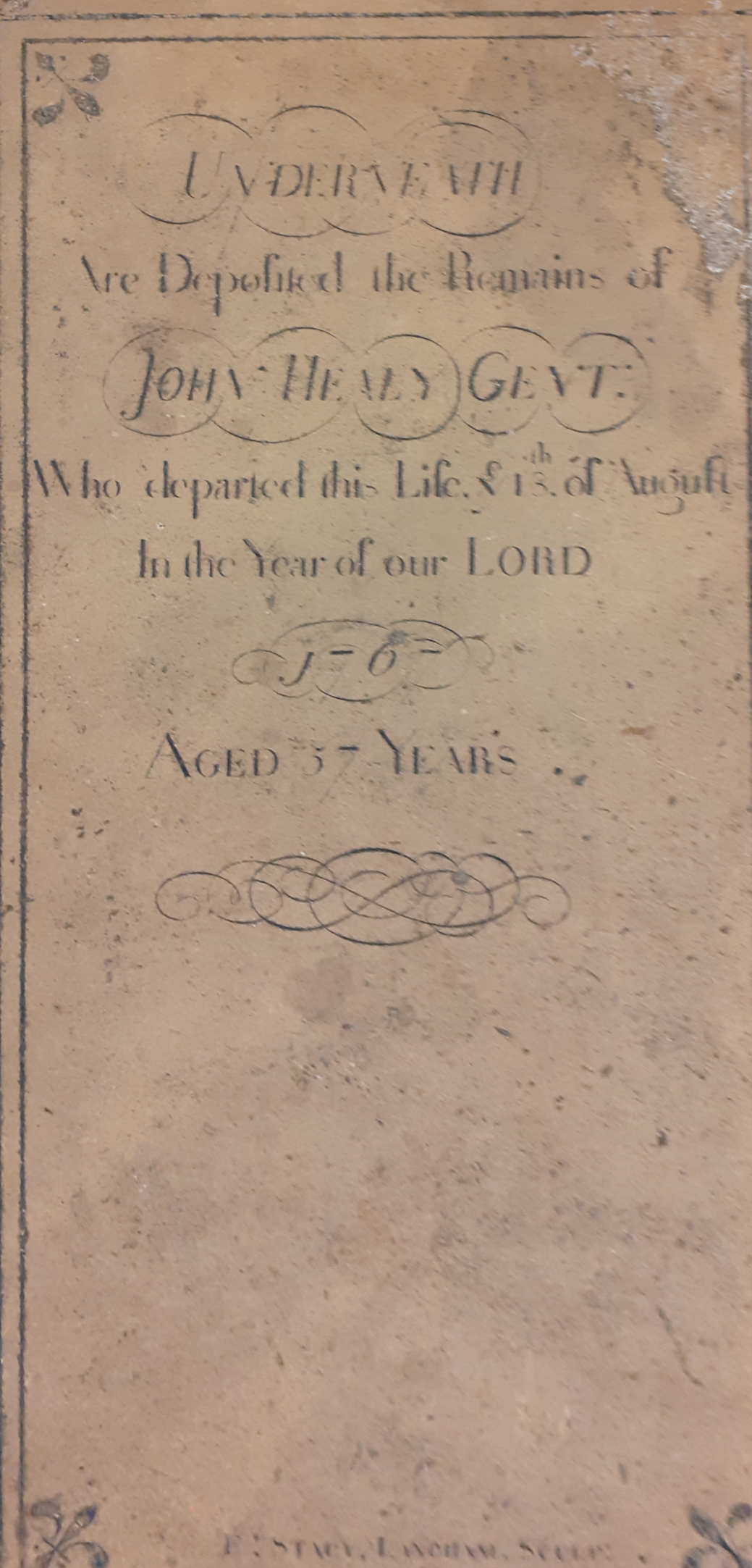
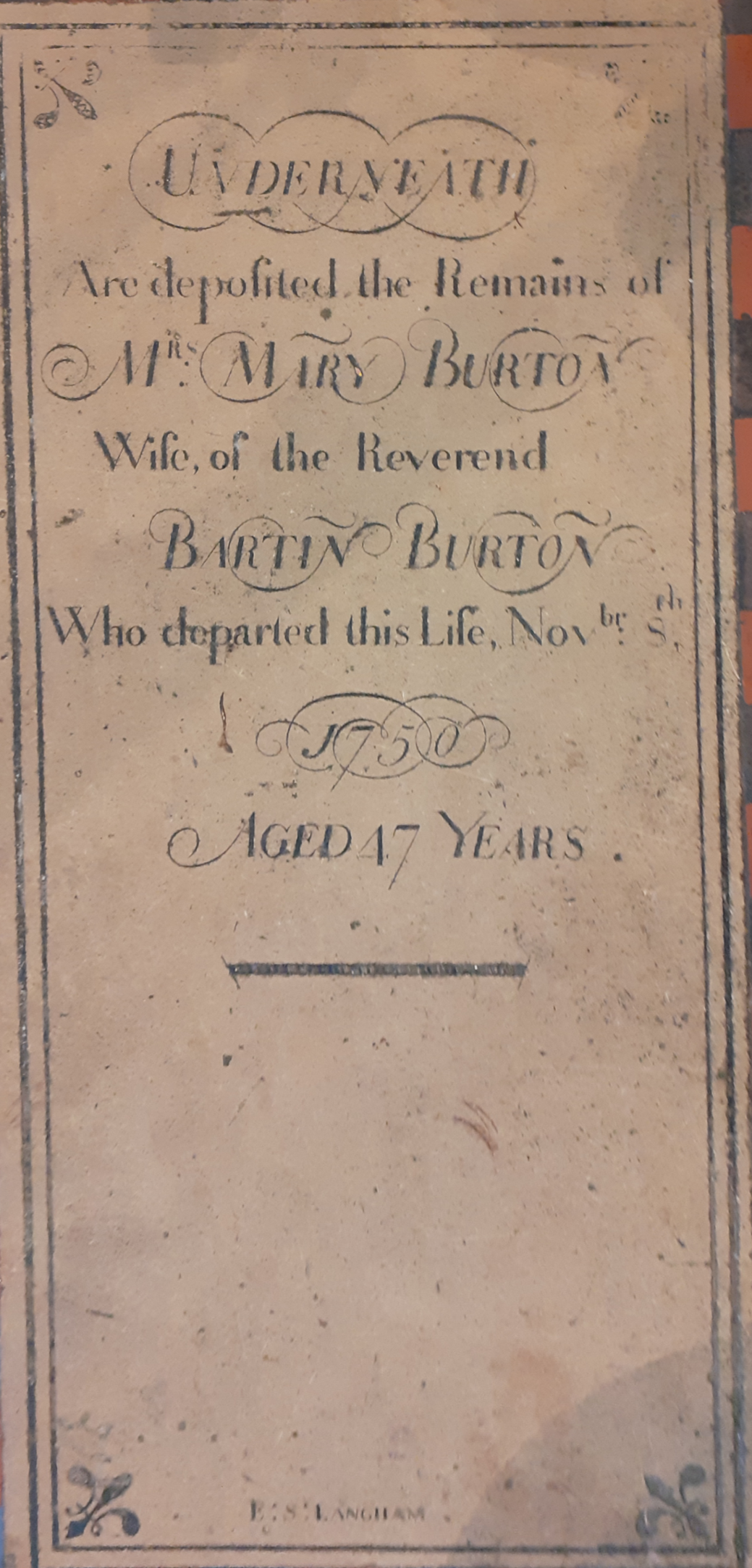
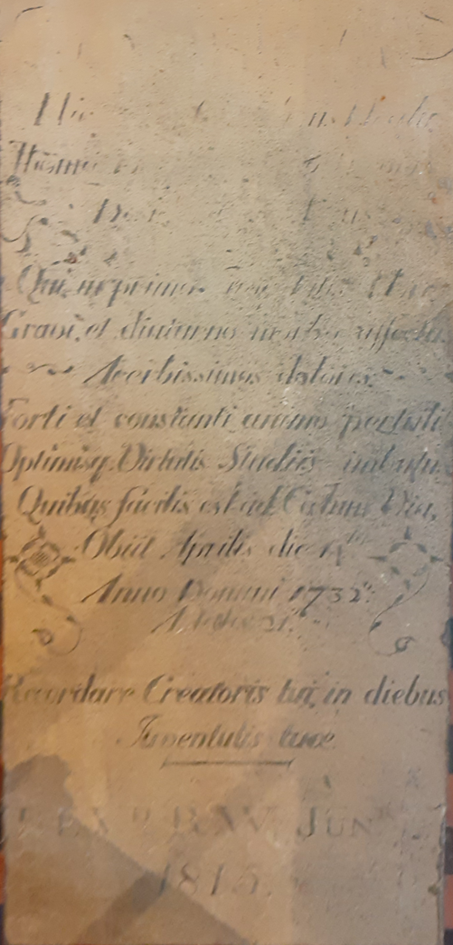
EA. …memory of ….. wife of … John Bellaers of Barleythorpe, who died the 12th May MDCCLXXXVI (1786) age 37 years, Her lies beneath…; A tender mother, a loving wife; A quiet neighbour, to the poor a friend; Happy is he who finds a …. Also in memory of John Bellaers who died the … of September 1787 in the 49th year of his age. EB. Here lies the body of John Bellaers who died August 18th MDCCCIX (1789) aged .2 years. Affliction … long time I bore; Physician skill was vain; Till Christ the chief sent me relief; And cured me of my pain. EC. Underneath are deposited the remains of John Healy, Gent.. who departed this life on 13th August in the year of our Lord 1767 aged 57 years. ED. Underneath are deposited the remains of Mr Mary Burton, wife of the Reverend Bartin Burton, who departed this life November 8th 1750 aged 47 years. EE. ……forti et constanti …….opptimiissii vertutis studies…..quibus finerlis est… obit aprilis …4th Anno Domini 1732…19…21. Recordare creatoris tin in oliebus. Juventulis tiroe……Jun 1815 (latin text very uncertain)
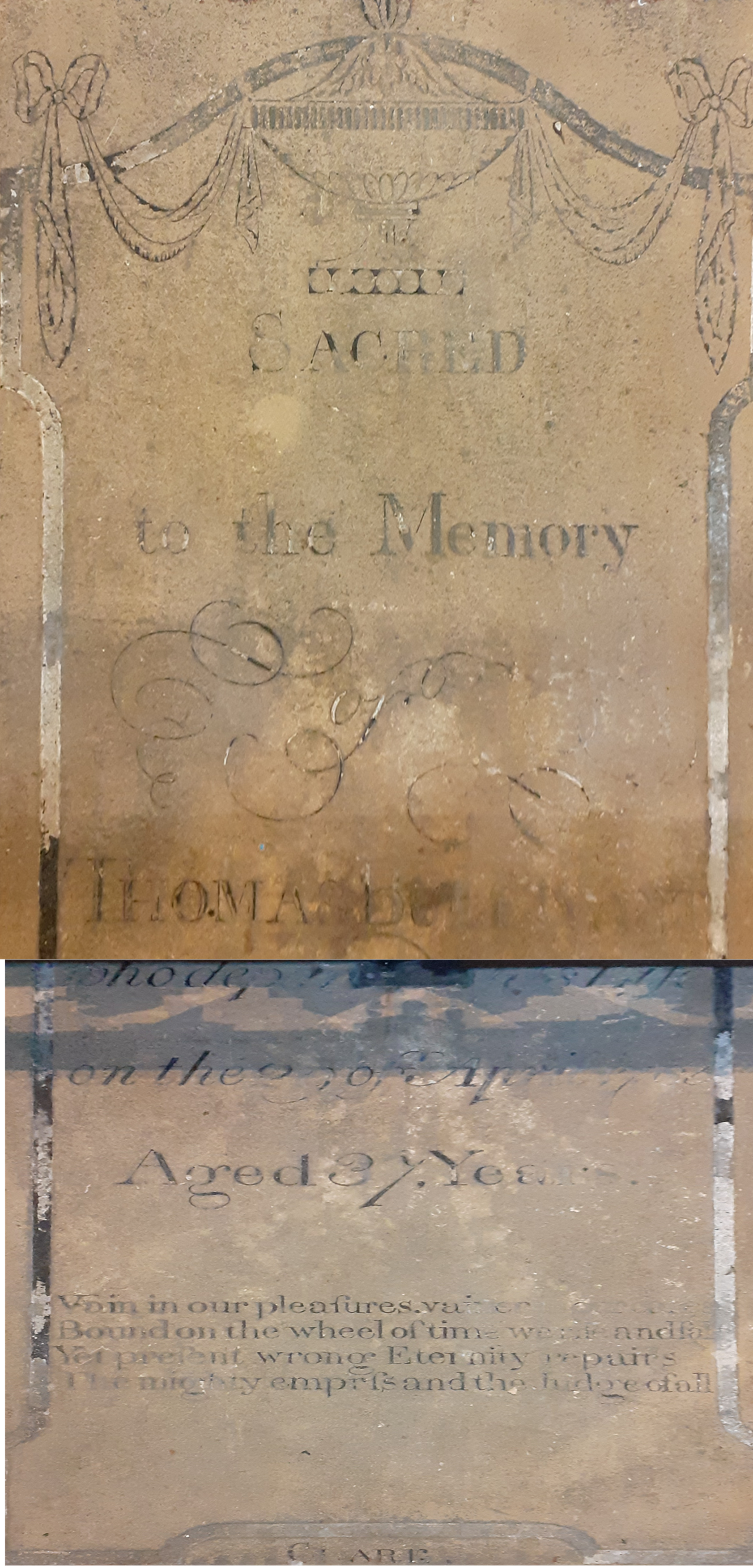
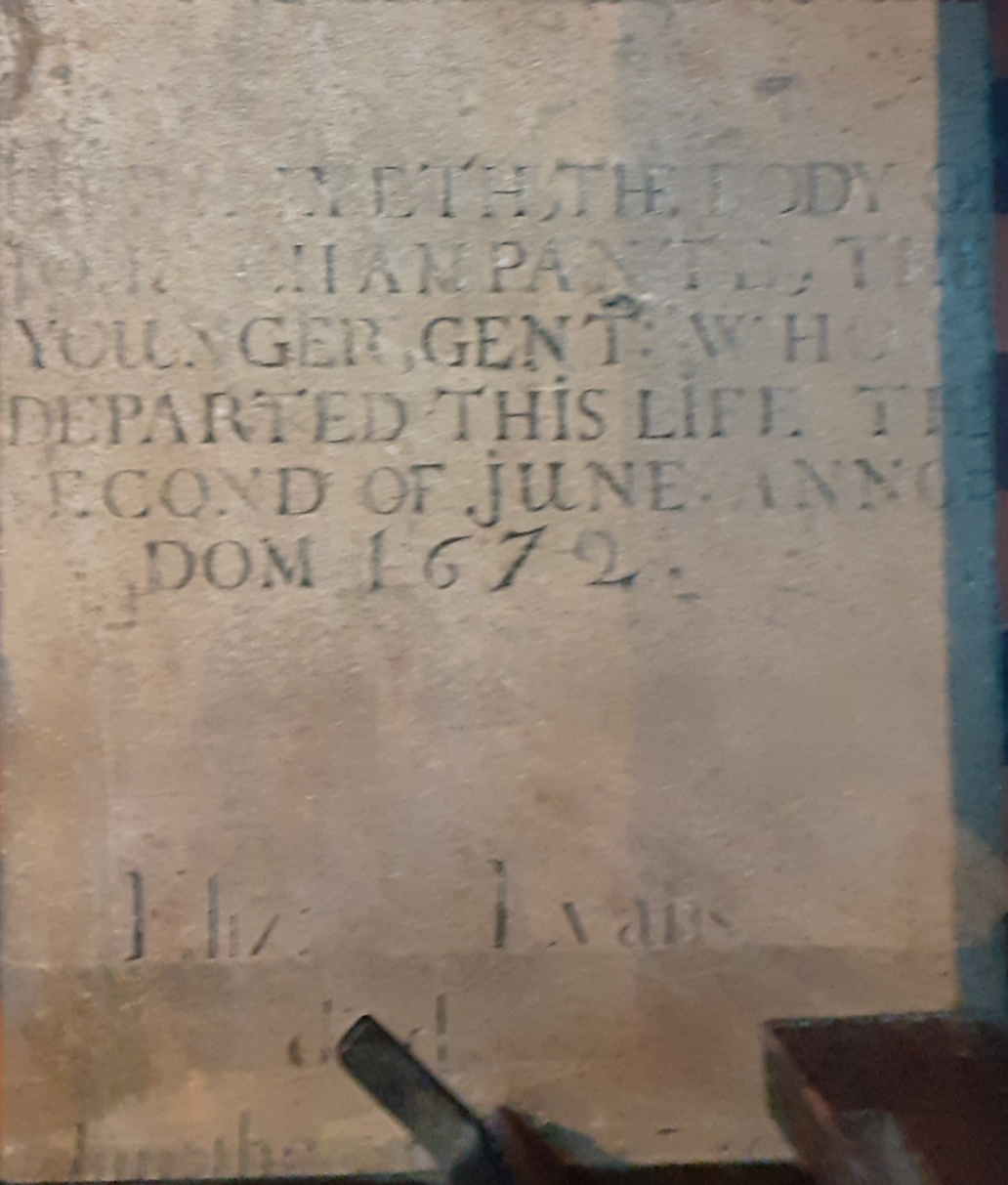
FA. Covered by altar rail and carpet FB. Part covered by altar rail and carpet. In memory of Martha Ades wife of …..this day .. year 1846 … years. FC. Part covered by altar rail. Sacred to the memory of Thomas …on the …. April … Aged 37 years. Vain in our pleasures…..; Bound on the wheel of time … and ….; Yet present wrong eternity repairs; The mighty empires and the …. of all FD. Part covered by altar rail and carpet. Here lieth the body of … Drury, Gent., who died January 15th 1775 ….. FE. Part covered by altar rail and carpet …lieth the body of William Pante the younger, Gent. who departed this life the second of June Ann. Dom 1672
GA. Covered by carpet. GB. Partially covered by carpet and altar. …. remains of Healy …. Edward Ealy…. GC. Mostly covered by altar. No inscription visible. GD. Parially covered by carpet and altar. Inscription not legible GE. Covered by carpet
When and Who
Two questions arise in association with the floor memorials. Firstly, when was the Lady Chapel used for burials and secondly what sort of people were buried there? To answer the first consider Table 1 below which shows the dates from the memorial slabs where they could be found. The pattern is not wholly consistent, but it is clear that the earlier graves are on the north side next to the chancel and the later ones on the south side next to the outside wall. The earliest grave of all – FE- dates from 1672, and the latest – FA – from 1846. The larger majority date from the 18th century. The pattern suggests that the early graves might have been a continuation of graves in the chancel. In the late 17th and 18th centuries, the chancel was configured very differently and was rebuilt in the restoration of 1858, so if there were similar graves there, the memorial slabs have been lost.
AA 1802
AB 1772
AC 1773
AD 1798
AE 1800
BA
BB 1835
BC 1809
BD 1789
BE 1702
CA
CB 1812
CC 1808
CD 1721
CE 1706
DA
DB
DC
DD
DE
EA 1786
EB 1789
EC 1767
ED 1750
EE 1732
FA
FB 1846
FC
FD 1775
FE 1672
GA
GB
GC
GD
GE
Table 1. Memorial dates
In terms of who is commemorated on the memorials, on the eighteen inscriptions where one might expect to find some designation, there are four identified as Gent., two as Esq. and two as clergy (not necessarily referring to the one who is buried). A web search revealed that there are the memorials of four High Sherrifs – William Lawrence 1765, Thomas Bullivant 1771, John Bellaers 1783 and Benjamin Cramp 1789. In addition William Twentyman was the Supervisor of Excise in Oakham Lordshold in 1787. Thus it is clear that those interred in the Lady Chapel were, as one might expect, members of the Rutland Gentry.
Finally it is worth noting that the family of Rev Bartin Burton, whose wife is interred in ED, also has a wall memorial in the south transept (figure 4). It may be that Burton himself and his son are also interred in one of the plots in the Lady Chapel with an illegible memorial inscription.
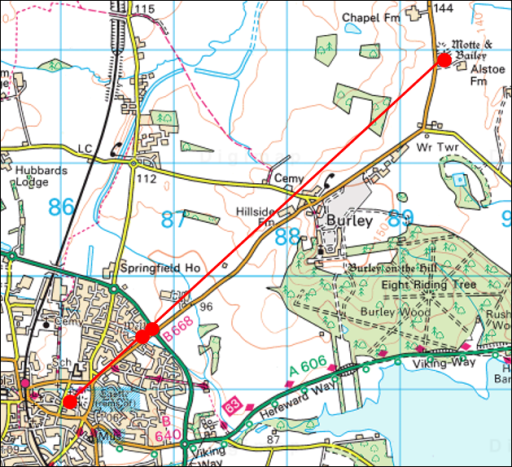
In a post “A possible Anglo-Saxon church group at Oakham in Rutland” from May 2024, I noted that All Saints Church in Oakham, and Our Lady’s Well to the north east were on what could be a mid-summer sunrise / mid-winter sunset solar alignment. I went no further than simply noting this, and didn’t speculate further about what it might imply. One always needs to be cautious about such alignments – they can be simple coincidences, and, if they are being looked for, can be found in the most unlikely places. For example from Borrowcop Hill in Lichfield, possibly an ancient burial mound, there was until recently a perfect alignment with the medieval spires of Lichfield Cathedral and the cooling towers of Rugeley power station, the latter sadly now demolished, which can hardly be of ancient origin. That being said, a reader of the May 2024 post sent me some further information that suggests that a cluster of Stone Age / Bronze Age / Iron Age remains have been found to the north east of Our Lady’s well that could also be on the same alignment. Looking at this further, I realised that several kilometres to the north east of that, and again on much the same alignment, we have Alstoe Mount, another historic monument. These are all shown on the Ordnance Survey map extract of Figure 1 below. The nature of this possible alignment, along the axis of the mid-summer sunrise and mid-winter sunset is discussed further in this post.
Figure 1. The possible alignment. The sites are shown as red circles – from the south west to the north east these are All Saints church in Oakham, Our Lady’s Well, the historic monuments and Alstoe Mount.
The sites
All Saints church, Oakham
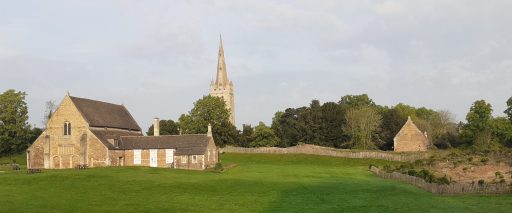
All Saints Church is Oakham (Figure 2) is a twelfth century church with thirteenth to fifteenth century additions. Internally it is pure Victorian, having been restored by Gilbert Scott. However it almost certainly stands on the site of an Anglo-Saxon church, and a church in Oakham is mentioned in the Domesday book. A compendium of historical information is given on the church website.
Figure 2. All Saints Oakham and Oakham Castle (photograph by the author)
Our Lady’s Well
Our Lady’s Well is a historically well-attested pilgrim site to the north east of All Saints church – see Figure 3. To quote from Leicestershire and Rutland’s Holy Wells by Bob Trubshaw from 2004;
Our Lady’s Well was once famed for curing sore eyes – providing that a pin was thrown in first. In 1291 indulgences could be obtained by visiting Oakham Church during its patronal festival and, for a price, joining a pilgrimage to Our Lady’s Well. In 1881 it was visited by the future Queen Alexandra. The well is to the north-east of the town, in a somewhat overgrown area between the Cottesmore road and a modern housing estate (NGR SK:866095).
It’s current condition is no better, and it is now impossible to access the well, in an overgrown plot of wasteland, which seems a shame.
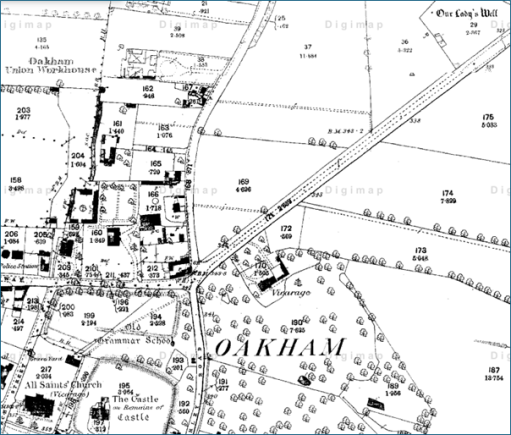
Figure 3. Location of Our Lady’s Well from the 1880 Ordnance survey Map (All Saints church is at the bottom left, and the well at the top right.)
The Stone Age / Bronze Age / Iron Age monuments
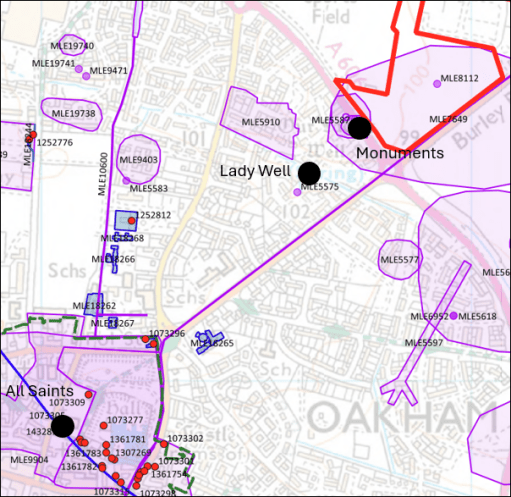
The material I was sent concerning the Stone Age / Bronze Age / Iron Age monuments came from “Land off Burley Road Oakham, Vision and Delivery Document” produced by Pigeon Investment Management with regard to a proposed hosing development. Figure 4 is taken from that document and shows the location of Our Lady’s Well and the relevant monuments.
The monuments are listed as follows, where the numbers are those on the Historic England National Heritage list.
MLE5587 – Possible Mesolithic site west of Burley Road MLE5592 – Late Iron Age/Roman site west of Burley Road MLE5593 – Bronze Age burial, west of Burley Road MLE5594 – Neolithic pit circle site west of Burley Road
Alstoe Mount
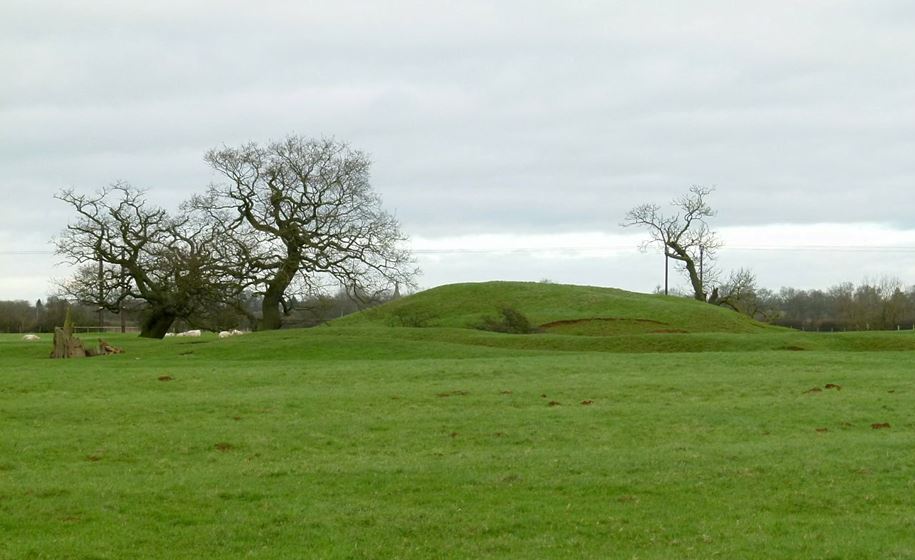
The substantial mound of Alstoe Mount (Figure 5) is described on the Ordnance Survey map as a Motte and Bailey. That is almost certainly not true. It was probably the Moot location for Alstoe Hundred. Details of the mound and the surrounding deserted village are given in the Historic England list entry.
Figure 5. Alstoe Mount (photograph from Historic England by Alan Murray-Rust, 2016)
The possible solar alignment
A current mid-summer sunrise / midwinter sunset direction from Oakham is 47.5 degrees east of north (from SunCalc). However obtaining a precise value to compare with the possible alignment shown in Figure 1 is difficult for two reasons. Firstly the actual direction of sunrise and sunset has varied over the millennia – and as things stand, we have no date for which a calculation can be made. This change is however small – of the order of 0.2 to 0.5 degrees. Also the apparent direction from any point depends upon the precise topography of the horizon over which the sunrise / sunset is observed – and as we know nothing about the observation point or the direction of observation, this is again not possible to specify. This again results in an uncertainty of around 0.5 degrees. So all we can probably say is that we are looking for an alignment of 47.5 +/-1.0 degrees east of north.
The actual directions between All Saints Oakham and the other sites is as follows.
Oakham to Our Lady’s Well – 46.3 degrees Oakham to Stone Age / Bronze Age / Iron Age monuments – 47.1 degrees Oakham to Alstoe Mount – 47.8 degrees
Again there is uncertainty here – particularly in the specification of the precise site at Our Lady’s Well of any structure that might have been visible from All Saints, and similarly the precise position of any relevant structure in the monument field. The location point for All Saints (taken as the centre of the building) could be around 10m to the east or west. This can have an effect of the bearings of Our Lady’s Well and the monuments by around 0.25 degrees. Considering these uncertainties the above bearings and a sunrise / sunset direction of 47.5 degrees seem broadly consistent, and thus there does seem to be some evidence for all four sites lying along a solar alignment of some significance.
But there is another issue – that of elevation. A cross section along the proposed alignment is shown in Figure 6. From this it is clear that Alstoe Mount would not be visible from Our Lady’s Well or from the Monument field, and would only just be visible from All Saints if any observation platforms that existed there and at Alstoe were raised off the ground by a metre or so. Beacons however would have been visible.
Figure 6. Section through the proposed alignment (from Google Earth Pro.).
Discussion
So what does the above analysis lead to. Firstly I think there is plausible (but far from conclusive) evidence for a mid-summer sunrise / mid-winter sunset alignment, at least between the Monument field / Our Lady’s Well and All Saints, and possibly between Alstoe Mount and All Saints. but the available evidence gives us no chronological information as to when the alignment might have been of significance. Our Lady’s Well is first mentioned in the late Middle Ages and All Saints and Alstoe Mount can only be said to become of important in the pre-conquest period. There is no evidence at all, except in the monument field, for the other sites being important in the Stone Age / Bronze Age / Iron Age. So in my view it is probably better to stop at this point – acknowledging that there may be a solar alignment, but not taking speculation any further. The boring, cautious approach I guess, but I don’t think there is much more to be said.
A compilation of some of my blog posts from the past few years about St Michael’s church in Lichfield.
Saddlebacks and serendipity. A brief post that identifies the occupant of the notable Saddleback grave in St. Michael’s churchyard (3rd January 2025)
The changing face of death. A blog post introducing a statistical analysis of the interment records and monuments of St Michael’s churchyard in Lichfield from 1813 to 2012, looking at the changes in funerary patterns over that period. (February 24th 2023)
The St. Michael Chalice of 1684. A very brief blog post with a photograph of a 1684 communion chalice from St Michael’s Lichfield, sold in the 1850s to pay for something more modern. (December 30th 2020)
Some summer reading – a compilation of a few of my blog posts about the history of Lichfield.
Lichfield – a pre-conversion pagan cultic centre? A post that considers the early history of the city of Lichfield, and argues that it might have been a place of cultic significance before the Christian era. Some of this is very speculative, but may be of interest
“That way madness lies” – the search for solar alignments in Lichfield The city of Lichfield lies on a rough midwinter solar alignment with the Bronze Age site at Catholme. This post investigates this further to see if this alignment is intentional or merely accidental. (April 12th 2020)
Lichfield’s First Station Master. A post that looks at the career of Lichfield’s first Station Master and church warden of St. Michael’s, William Durrad. (January 15th 2021)
All Saints church in Oakham is not particularly well endowed with memorials to individuals and events, and there are no spectacular carvings. However some of those that do exist enable interesting stories to be told. In this post I present a number of these, with links to more information, and highlight those memorials that require further investigation. The post is very much a work in progress, and I will edit it as more information becomes available.
Note – to read some of the inscriptions below readers may well need to magnify them. Even then, some will take a little patience to read, particularly the brasses where it is difficult to take photographs without reflections obscuring the text.
Vestry
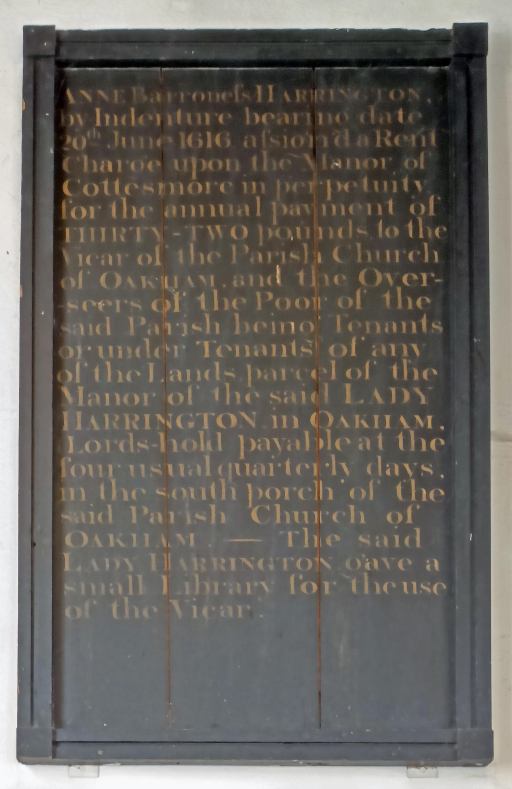
I have discussed the wooden memorial of the Lady Harrington bequest – money for the relief of the poor and a donation of a Parish Library – in two blog posts here and here. The memorial is in the vestry on the south side of the church and is not usually publicly accessible.
Chancel
A transcript of this plaque in the Chancel is given in the post From Oakham to Mandalay and a little more information is given on the career of Henry Jerwood.
Lady Chapel
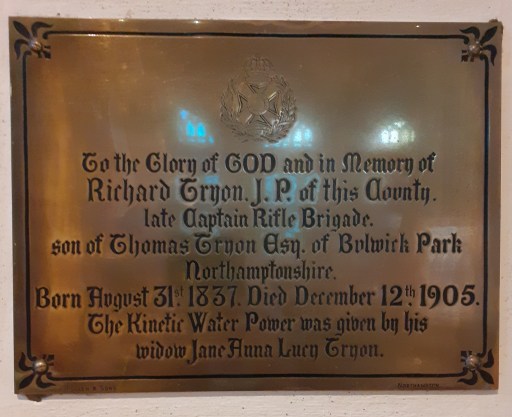
A transcript of this plaque in the Lady Chapel is given in the post Kinetic Water Power, and information is given there about Richard Tryon and (at some length) the Kinematic Water Power apparatus.
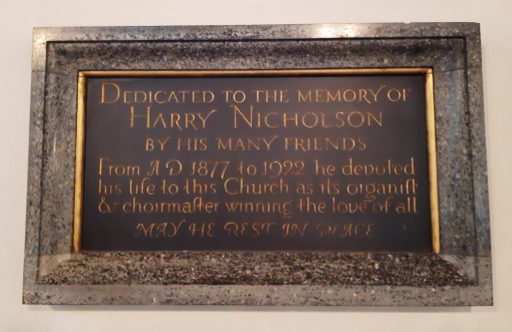
The life and times of long term organist of All Saints church and the founder of the Oakham Choral Society are well described in a blog from the Rutland County Museum.
Pulpit
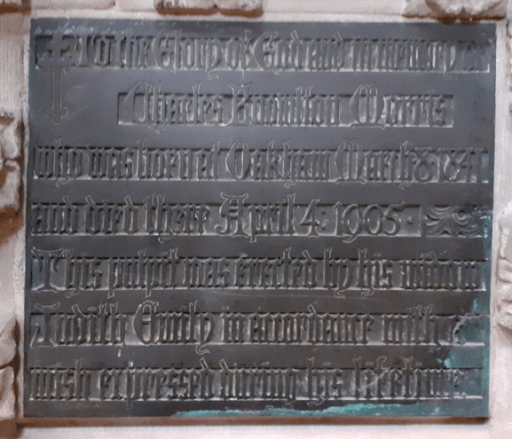
The pulpit has a dedicatory plaque, very low down near the foot of the steps. It reads as follows To the Glory of god and in remembrance of Charles Knowlton Morris, who was born in Oakham March 18 1841 and died there April 4 1905. This pulpit was erected by his widow Judith Emily in accordance with his wish expressed during his lifetime. Charles Morris was a brewer and a coal merchant. A window in the church has a similar dedication from his wife and is described in the following way Depicting Endurance, Humility, Innocence, Love, Principle, Sympathy, Fortitude, Charity and Justice, as mostly portrayed by scenes from Jesus’ life. The badge of the Vale of Catmose lodge of the Independent Order of Oddfellows is at the bottom.
South Transept
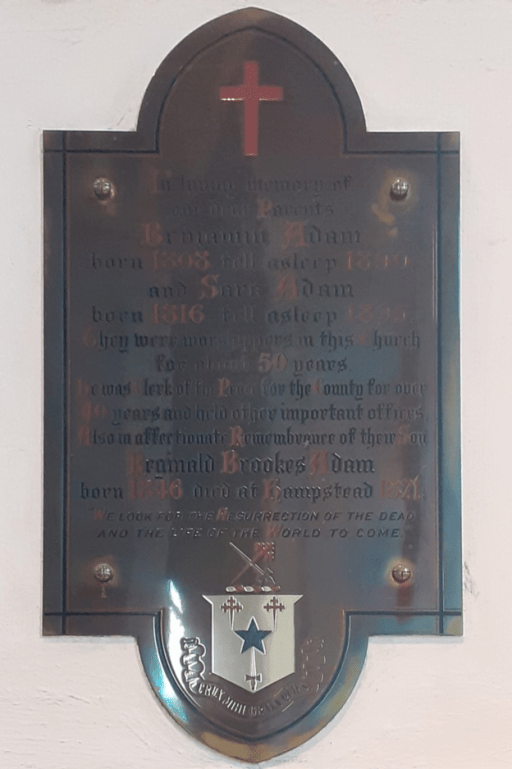
This difficult to read memorial is to Benjamin Adam (1808-1890?), his wife Sara (1816-1895?) and their son Reginald Brookes Adam (1846-1871?). We are told that Benjamin and Sara were worshippers at All Saints for over 50 years, and that Benjamin was Clerk of the Peace for the County (a legal officer) for over 40, and that he also held other important positions.
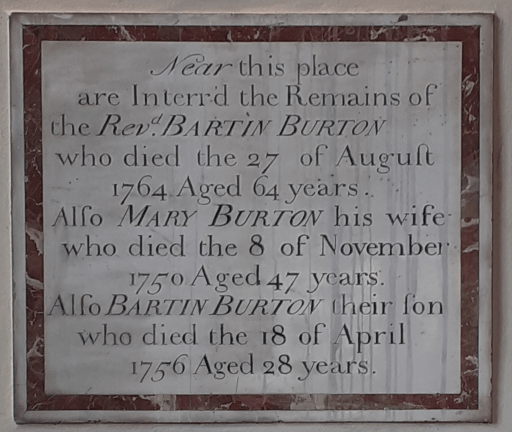
The Church of England Clergy database reveals that Bartin Burton was born in Oakham and served as Curate in the parish of Rockingham, Rector at Oxendon (both in Peterborough diocese) from 1728 to 1729 and Vicar of Ravenstone in Buckinghamshire (Lincoln diocese) from 1747 to 1764.
North Transept
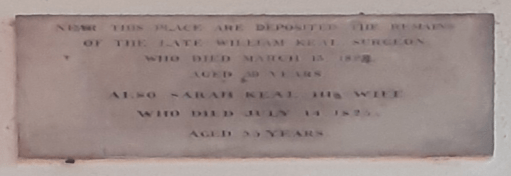
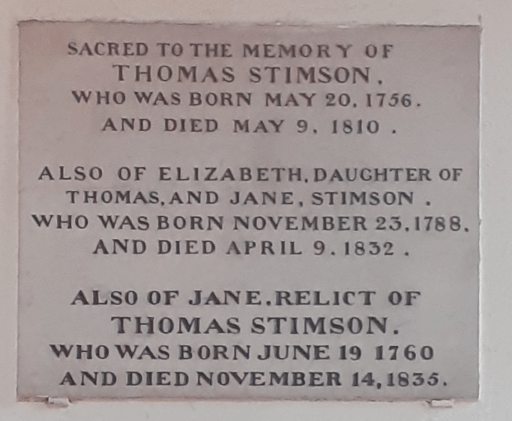
These four memorials in the north transept are placed one above the other in the order shown to the left. The top one commemorates William Keal, a surgeon (d1824?) and his wife Sara (d1825). The one below it commemorates the lives of Thomas Stimson (1756-1810), his wife (relict) Jane (1760-1835) and their daughter Elizabeth (1788-1832).
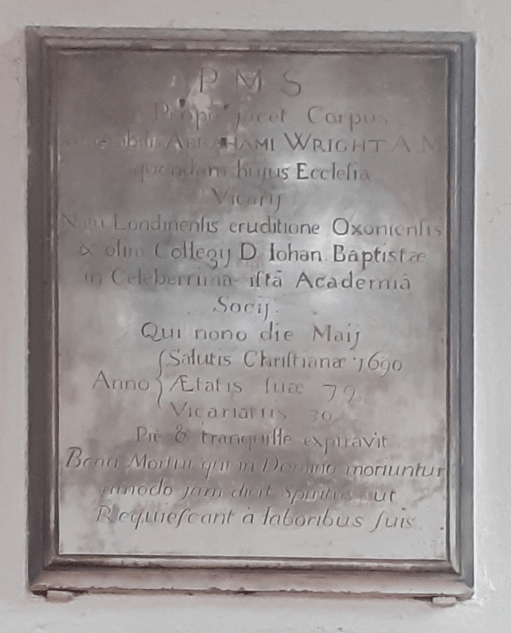
The third is in Latin and commemorates John Abraham Wright (d1690) aged 79, vicar for 30 years, during and after the Commonwealth period. In the first instance he served only one year (1644-5) before he was and replaced by the parliamentary favourite Benjamin King. He took up his post again after the Restoration in 1660.
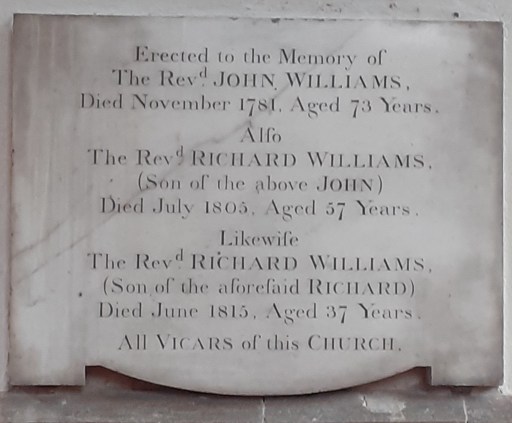
The lower memorial is to three generations of Vicars of the parish – John Williams (d1781), Richard Williams (d1805) and Richard Williams (d1815). More details of their appointments at Oakham and elsewhere can be found in the Church of England Clergy Database.
South Aisle
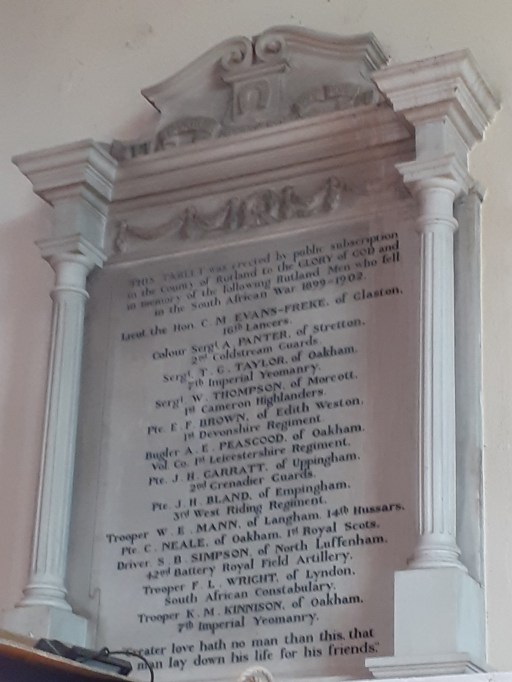
This Boer War monument is now above the choir vestry in the South aisle and not easily accessible – or indeed to photograph. The expertise of a military historian is probably required to unpack and present the stories of those listed here.
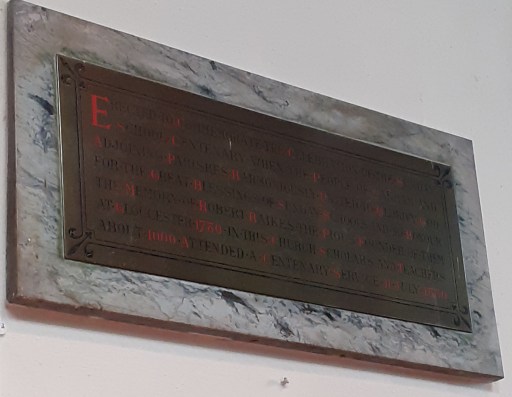
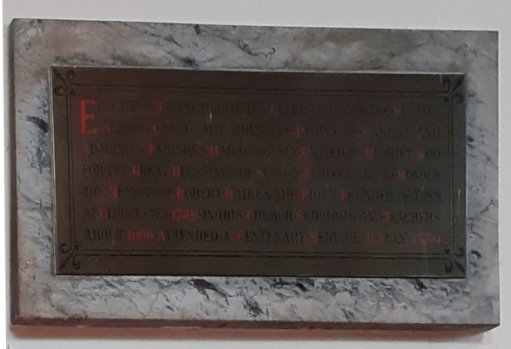
The monument above was both difficult to photograph (to avoid reflections) and difficult to read. It is shown in two forms – as originally taken, and with an attempt made to remove the effect of perspective. It commemorates the 100th anniversary celebration of the Sunday School movement, which around 1000 people attended, and commemorates its founder, Robert Raikes of Gloucester.
North aisle
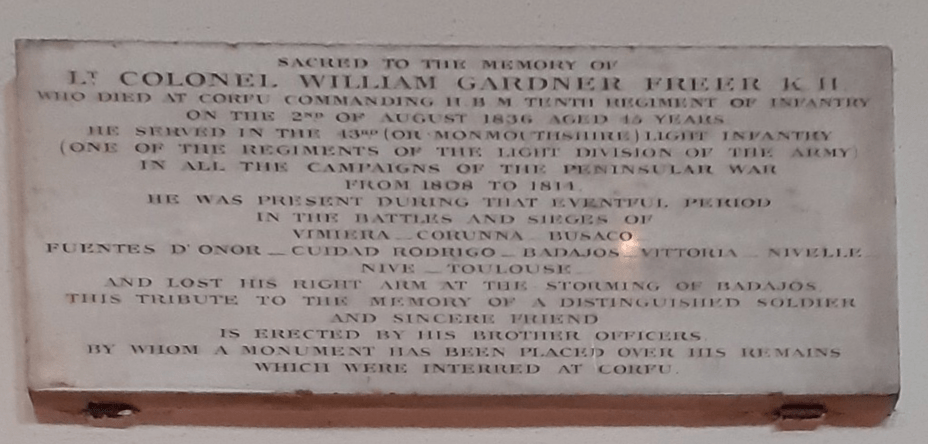
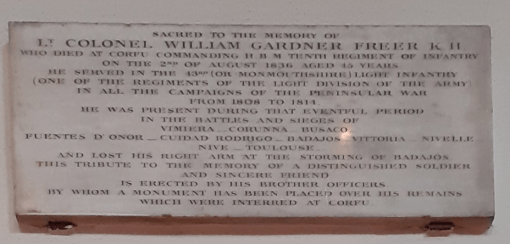
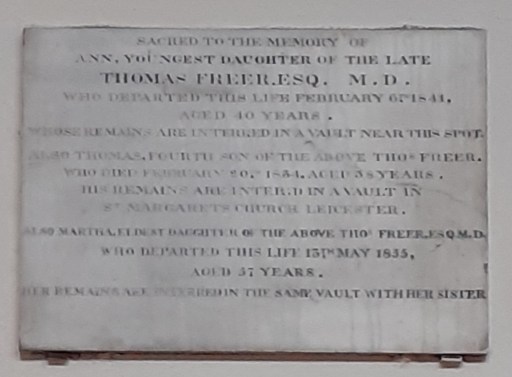
These three monuments are placed above each other in the north aisle in the order shown. The top one is too small to read easily from ground level. They all refer to the Freer family from the early 19th century. The bottom memorial is to Thomas Freer, a doctor, who died in 1835, his wife Martha who died in 1827, and his third son, Edward Gardner who fell in action in the Pyrennees in 1813 aged 20. The second memorial commemorates Thomas and Matha’s youngest daughter Ann (d 1844), their fourth son Thomas (d 1834) and buried in Leicester, and their eldest daughter Martha (d 1835). Finally the upper memorial describes in very small text, Lt. Colonel William Garner Freer who died in Corfu in 1836, whilst commanding the 10th Infantry Regiment. His long military career is outlined, including the loss of his right arm at the storming of Badajos. He is buried in Corfu.
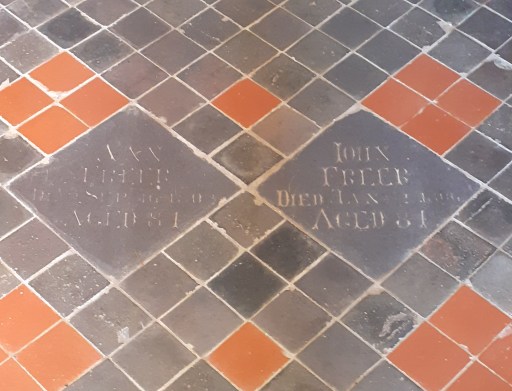
The Freer’s are also commemorated in two tiles in the nave aisle – much faded as they are on the main thoroughfare through church. They are dedicated to Ann and John who, as far as I can make out, died in the early 1800s.
West End
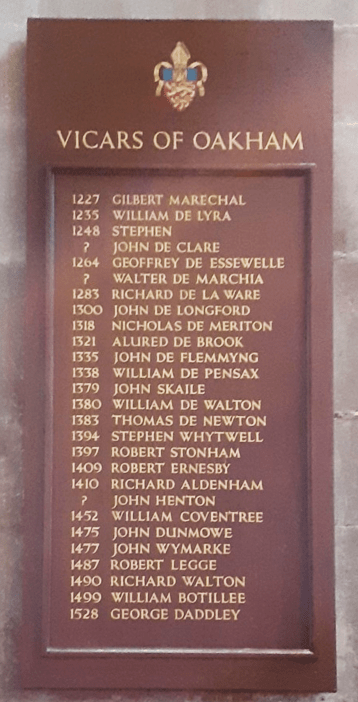
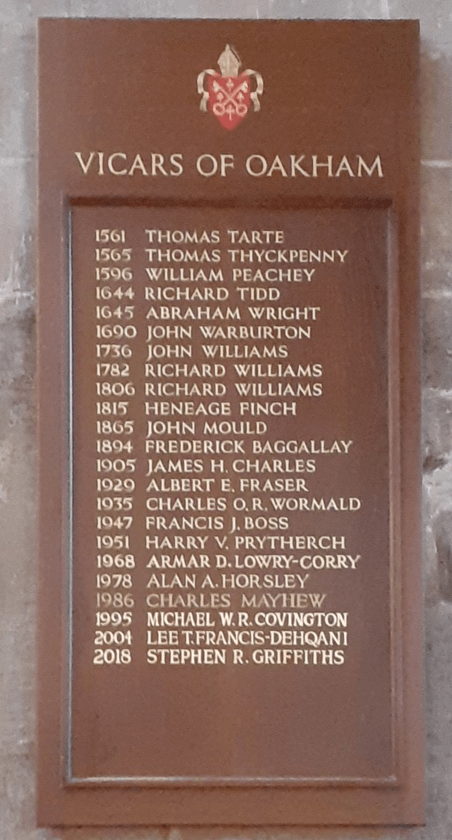
More details of the Vicars of Oakham can be found in the church guide. The Church of England Clergy Database also includes records for both vicars and curates of the parish, and of the surrounding chapels from the mid-sixteenth to the early nineteenth centuries.
All Saints Church in Oakham is a long term supporter of the Church Mission Society (CMS). It has recently been allocated two new mission partners, both working in Myanmar (formerly Burma). CMS have requested that the church does not publicise these links, as the partners work in a dangerous and sensitive situation. Nonetheless we pray for them and support them as best we can.
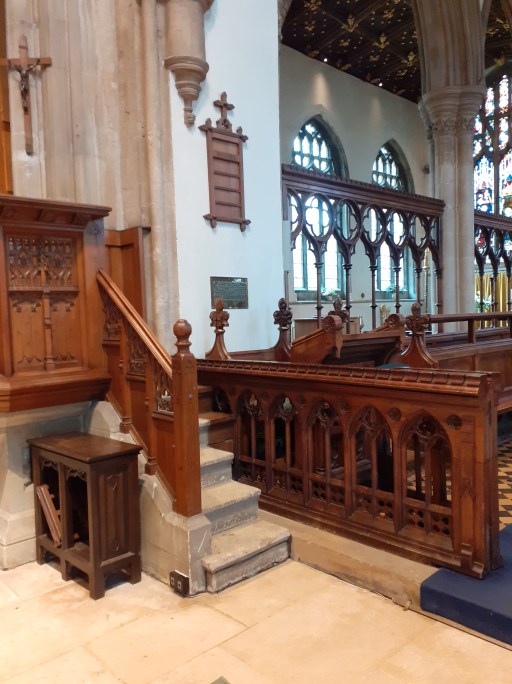
Very recently, after a service of Morning Prayer in which the mission partners were remembered, I happened to look at a plaque on the wall of the chancel just behind the pulpit, over one of the clergy stalls. The plaque’s location, and the plaque itself are shown in the photographs below.
The typography of the plaque makes it quite difficult to read, which is presumably the reason I have never done so in the past, despite the fact that I have sat in front of it on numerous occassions. But on reading it, I noted that the church in 1906 already had a link with Burma. The plaque reads as follows.
To the glory of God and in memory of Henry Arthur Jerwood, scholar and prefect of Oakham School; a faithful and beloved curate of this parish and a zealous missionary. The lamps in the chancel and sanctuary are erected by his schoolfellows, friends and parishioners. He died serving in obedience to his Master’s call at Mandalay on March 26th 1906.
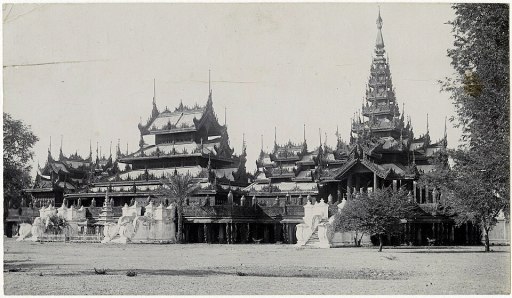
Mandalay is the second largest city in Myanmar, 600km north of the capital Yangon (formerly Rangoon) and is the centre of a largely Buddhist area. Our current mission partners are thus not the first links that the church has had in that area.
Henry Arthur Jerwood
Can we say any more about Henry Jerwood? His basic biographical details can easily be traced on Ancestry. He was born in 1878, the eldest child of Rev. Thomas Frederick Jerwood (1846-1926), Rector of Little Bowden and Dorothea Elizabeth Longsdon (1853-1942) who were married in Yorkshire in 1877. The couple had a number of other children, amongst them Helen Dorothea Jerwood (1880-1965), who will be mentioned below, Rev. Frederick Harold Jerwood (1885-1971) who was to become Chaplain at Oakham School, amd Major Hugh John Jerwood MC (1890-1918) who was killed in action. The latter had a son, born in 1918 after his death – John Michael Jerwood (1918-1991), a businessman and philanthropist, who was to become a significant benefactor of Oakham School, and a number of the school facilities bear his name.
St. Nicholas, Little Bowden, Northants
Oakham School
Henry Arthur attended Oakham School, as his father had done before him, and his brothers were later to follow him there. He matriculated at Sidney Sussex College, Cambridge in 1897, taking his BA in 1902 and his MA in 1905. He took some time out just before he graduated to fight in the South African (i.e. Boer) War from 1900 to 1902 with the Suffolk Regiment.
Clergyman and Missionary
After graduation, Henry Jerwood attended the Clergy Training School in Cambridge (the early name of Wescott House) and was ordained deacon in 1902 and took up the curacy at All Saints church in Oakham, a town with which he would have been very familar from his schooldays. The chronology of his training and ordination as deacon and priest is not wholly clear from the sources. In 1905 he applied to become a missionary to Burma. We can trace his short career there through the pages of the Quarterly Paper of the Rangoon Diocesan Association (RQP), a nationwide organisation that supported the work of missionaries in Burma, and was affiliated to the Society for the Promulgation of the Gospel (SPG). These are all available as pdfs in the SOAS missionary archive. As an aside, those who, like myself, dabble in historical matters, are hugely indebted to the patience and the perseverance of the archivisits who made such material available. In RQP 34, June 1905 we read the following under the heading Reinforcements, which says something of the military mindset of the organisation.
…….The Rev. Henry Arthur Jerwood, B.A., of Sidney Sussex ‘College, Cambridge, and the Clergy Training School, was ordained in 1902, to the Curacy at All Saints, Oakham, in the Diocese of Peterborough……
The Rev. A. Jerwood, at present an assistant Curate at Oakham, will join Mr. Fyffe at Mandalay~ a man stout and , vigorous in body and stout of heart, who went to South Africa when the war broke out, and did his part there man fully, and will carry to his work in Burma the same vigour he gave to South Africa and Oakham.
In the next edition (RQP 35, September 1905) we read that, as a consequence of Jerwood’s departure, Rev H J C Knight, the Commissary of the Rangoon Diocesan Association (who recruited for the Association and was living in Jesus Lane in Cambridge), preached at All Saints on Sunday July 30th. The collection of £3 4s was given to the R.D.A.
Then in RQP 36 from December 1905 Jerwood’s arrival in Burma is noted, under the heading News from the Front, again another military metaphor.
The newcomers have arrived, and are settling down to work, the Rev. H. A. Jerwood and Mr. Hart with Mr. Fyffe at Mandalay, the Rev. R. J. Stone at Bishop’s Court as Chaplain, the Rev. R. G. Fairhurst at S. Luke’s, Toungoo, and the Rev. W. H. C. Pope at Rangoon .
We also have the following description of the work in Mandalay,
The Buddhist Field – The Winchester Brotherhood has been founded at Mandalay, on the general lines of the Indian Community Missions, for systematic study of Buddhism and work in the field. The Head, Rev. R. S. Fyffe, has at present only one Brother (Rev. H. A. Jerwood). These two men are the only English Clergy for Missionary work in the chief town of Upper Burma, a city of 180,000 souls. They need at once two men of (if possible) a studious type, of patience, hope, and brotherliness. There is work to do while learning Burmese. The Brothers have passage and outfit paid, maintenance, lodging together, and £40 a year.
The mention of Jerwood in RQP 37 for March 1906 is very brief and simply says that he had taken over the role of Principal at the School run by the Winchester Brotherhood from Mr. Hart, who arrived in Burma at the same time as he did. Jerwood died on March 28th 1906. We read his obituary in RGA 38 June 2006, written by the Commissary Rev H. J. C. Knight.
Though most of our readers will have read the Bishop’s notice of Mr. Jerwood in the Mission Field for June, our R. Q. P. ought to have some notice of him. He was born on February 25th, 1878, the eldest son of the Rev. Thomas Frederick Jerwood, Rector of Little Bowden. He must have owed much to his home. On hearing from Bishop Montgomery that he had fallen asleep, his father was able to write “we hope to send another son.” and assuredly in homes that can speak thus:
“The father’s passion arms the son, And the great work goes on, goes on.”
All his school days were spent at Oakham School; thence he entered Sidney Sussex College, Cambridge. While yet an undergraduate he served in the S. A. war. On his return he graduated, entered the Clergy Training School, and was ordained to Oakham in 1902. Last autumn he went to Burma, calling at Delhi {where his sister was working under S. P. G. in the Cambridge Mission), and other Brotherhoods, and joined Mr. Fyffe at Mandalay in December. On the 28th March last he passed from us. The cause of his death was a rare type of paralysis – nothing climatic. The Bishop and the Rev. R. J. Stone, who was with him at the C. T. S., were in Mandalay at the time. His body rests near the graves of the Colbecks.
We had looked for great things from his ministry in Burma. His qualities of simple manliness, unaffected and robust piety, a very-single-hearted devotion, unselfishness, courage and affection, drew men to him. These, and his unfailing cheerfulness, promised much for our Winchester Brotherhood. He went out “for life,” and so his home gave him. His letters from Mandalay were always touched with humour, and were full of hope and determination. It is easy to pray “Thy will be done,” while we have no disappointments or reversing of our purposes; but it is hard really to bow to the surrender of such a man. When Bishop Maples was drowned on Lake Nyassa. on the very day of his arrival as Bishop of Likoma, Augustine Ambati wrote, “God liked to take him, to make white (i.e., consecrate) so the waters of the lake.” Even so may Mr. Jerwood’s death in Mandalay be one more consecration of the city. To his friends – there and here – it will be one more tie binding us to the missionary spirit, and the forward march of the Church. It is good to know that Mr. Garrad, whom God has moved to carry on his torch, will be, we believe, in every way a brother to Mr. Fyffe. Those who loved H. A. J. will pray “The Lord bless his going out and coming in. ”
H. J. C. K.
The sister in Dehli that is referred to is Helen Dorothea. At the time she worked for the Cambridge Mission of SPG, but was later to work for the East India Company in Dehli. She remained in India all her life, dying in 1965.
Some final thoughts
Interesting as it is to find that All Saints had a link with Myanmar one hundred and twenty years before our current one, and to read Arthur Jerwood’s interesting and ultimately tragic story the aspect that has struck me most in the preparation of this post, is how very different our current Christian culture is to that of 1906. As noted above, military metaphors are often used in the RQP, and indeed the whole publication shows an extremely ordered and extensive organisation that itself has a military flavour. The form of Christianity that one finds in its pages is a very muscular and forceful one and whilst one can admire the earnestness and zeal of those determined to bring the gospel to those who had never heard it, the tone of the publication reflects the colonial era of its time, and the implicit superiority of European (and particularly British) civilisation and culture to that of the “natives”. Howerver, whilst I find this aspect more than a little repellent, I do wonder if we have lost something over the last century, in terms of our zeal and enthusiasm for the mission of the church, both at home and overseas. The words of Revelation 3.15-16 come uncomfortably to mind.

































 Engineering, history and ecclesiology
