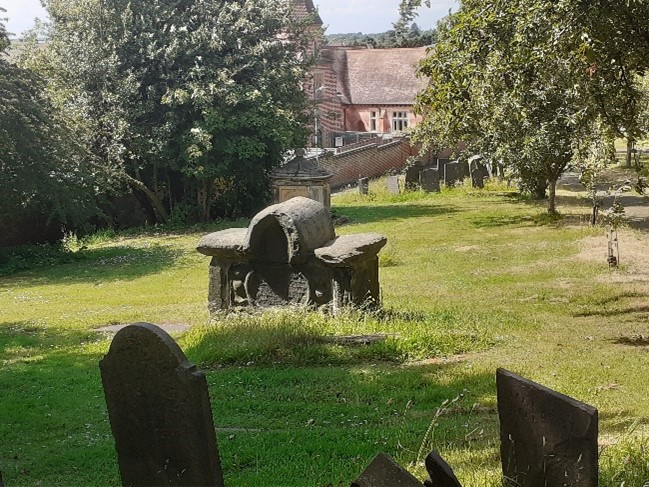
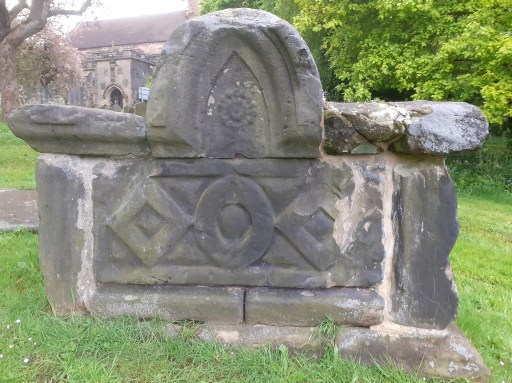
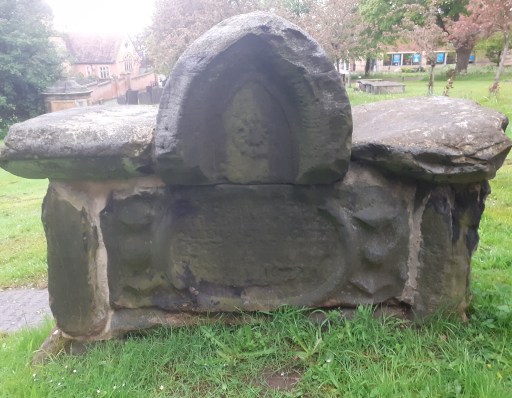
In 2021 I discussed some of the early graves in St. Michael’s churchyard in Lichfield. Amongst these was the distinctive “saddleback grave” shown in Figure 1 below, one of the five listed monuments in the churchyard. At the time I wrote as follows.
The inscription is very worn and the dedication of the monument can’t be read. This grave features in a nineteenth century drawing that is in the William Salt library ……. That drawing gives the date of the grave as 1674, and with a little imagination this can be made out on the tomb itself. Apart from the date, it is the style of the grave that makes it so distinctive. It is a shame that the dedication is illegible.
Figure 1 The Saddleback grave in 2021
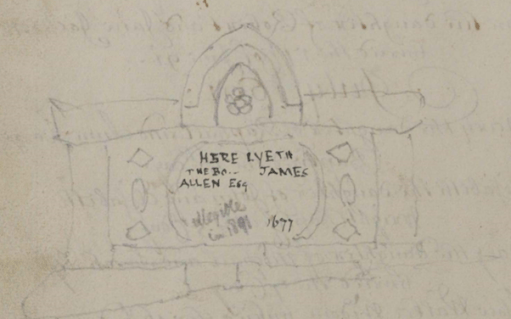
And this is where serendipity comes in. Over the last few days I have begun to think about filling in some of the gaps in my long term project to collate the memorial inscriptions of St. Michael’s churchyard with the burial registers – specifically to include material from the early registers up to 1812. A very helpful archivist at Staffordshire Archives told me that these have been scanned and can be found on Find my past. So I have been busy doing some mass downloads of the material during my seven day free trial (as you do). Whilst doing this I came across the sketch shown in Figure 2 in the register from 1680-1741, on a blank page opposite the entries from November to March 1691 (note this was before the calendar change!)
Figure 2. The sketch from the 1680 to 1741 Register
It clearly shows the Saddleback grave and gives the inscription as
Here lyeth the bo… of James Allen Esq…..1677
There is another note in lighter script that says
Illegible in 1891
So it seems we have an identification of the occupant of the Saddleback grave – although the date is given as three years later than indicated on the William Salt picture. Checking back on the records however in the 1574 to 1680 register, the only entry that corresponds to the name is from 1674
April 13th Mr James Allen, Magistrate, Beacon St
Beacon St is somewhat conjectural however – it is not easy to read. So it looks as if the William Salt date is the correct one.
The registers tell us little else. There is an entry for the marriage of James Allen (Gent) to Mrs. Hester, daughter of Richard Pyot (Dyot?) in November 1658 at St. Mary’s which seems possible. However this was in the Civil War / Commonwealth period when records become very patchy, so there may have been other about with the same name. If any reader knows more of James Allen, then please let me know. But a least we now have a name.
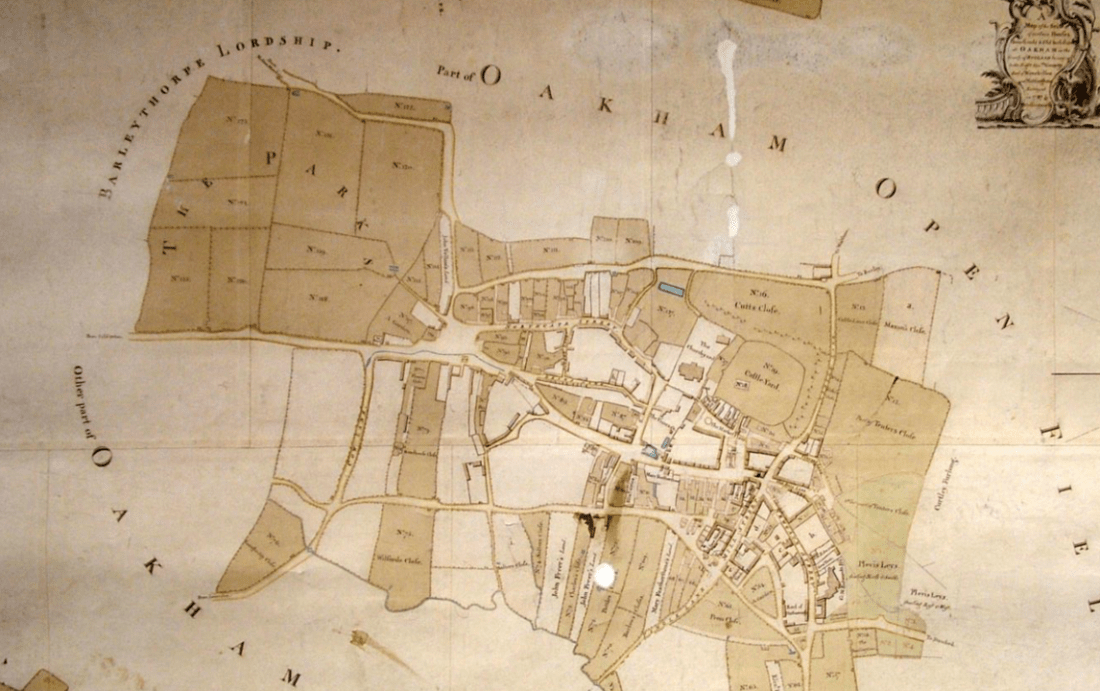
In the monograph “Oakham Lordshold in 1787”, Clough (2016) considers the map of the town of Oakham in Rutland produced for Lord Winchilsea in that year. This is the earliest map to show significant detail of the urban topography of the town, and from it Clough was able to infer some aspects of its late Anglo-Saxon / early Norman topography, in particular the existence of two enclosures encompassing the castle and the church, and the castle and a large portion of the town. In this post. I take his considerations somewhat further and, by considering the likely Anglo-Saxon road network around Oakham, infer some further features of the Anglo-Saxon urban topography.
Oakham connections
Cox (1994) in his extensive survey of Rutland place names, identifies a number of settlements in the Oakham area that were likely to have been in existence in the sixth and seventh centuries i.e. early on the Anglo Saxon era. These are as follows.
Place names ending in -ham, meaning village or estate. These include Oakham itself; Langham and Wymondham to the north west; Greetham and Grantham to the north east, Empingham to the east and Uppingham to the south.
Place names ending in -dun meaning a large hill, of which the only one in the vicinity of Oakham is Hambleton.
Place names associated with the Anglian tribe of the Hwicce of which Whissendine to the north of Oakham is the only one locally.
The villages of Brooke, which has an early attestation, and Braunston, which incorporates an early form of Anglo-Saxon name and has possible Roman antecedents.
The -well names meaning spring, and in particular Ashwell, although this might be slightly later than the others.
The major settlements in the wider region either with proven continuity since the Roman period or are of an early form- Leicester, Nottingham, Lincoln and Stamford.
In what follows we presume that in the Anglo-Saxon and Norman periods, Oakham had road / pathway connections to these early settlements that are, broadly, the predecessors of those we see today at least out of the settlements themselves. Country roads are very conservative topographical features and change little over the centuries. Within, and on the entry to settlements, they would however have been more prone to change, because of building and commercial developments. In these terms we will consider seven such roads that converge on Oakham and in particular we attempt to trace the “natural” course of these roads into and through the town, again assuming that these are the courses that would have been followed in the Anglo-Saxon period, rather than the courses that have developed over the centuries.
But first a broader point is worth making. Oakham was in the ninth and tenth centuries was in many ways at the centre of the Danelaw, with roads passing through it that connected Leicester in the west to Stamford and Lincoln in the east, and Northampton in the south with Derby and Nottingham in the north. As such, it is likely to have been of some strategic importance, particularly during the period when King Edward and Lady Aethelflead finally defeated the Danish armies in the area between 910 and 920.
The Anglo-Saxon roads
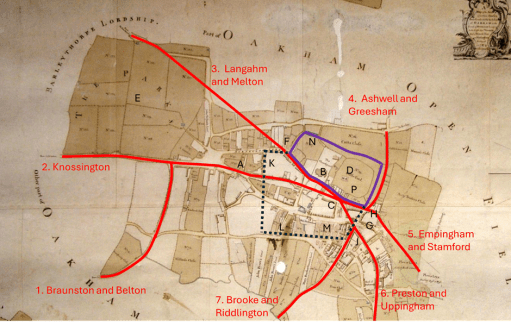
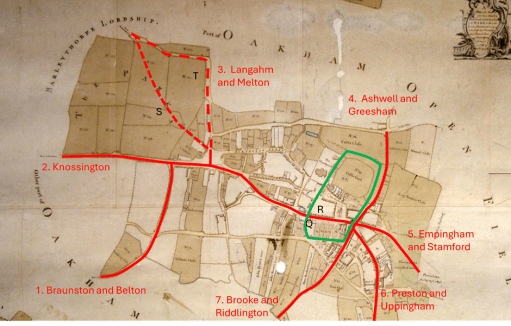
The roads that we are considering are shown in Figure 1 on a copy of the 1787 map as given in Clough (2016). These are as follows.
Figure 1. The proposed early road layout
Road 1 from Belton and Braunston (and beyond that Leicester) that runs up what is now Braunston Road and West Road (formerly known as Cow Lane) and joins Road 2 to the west of Oakham.
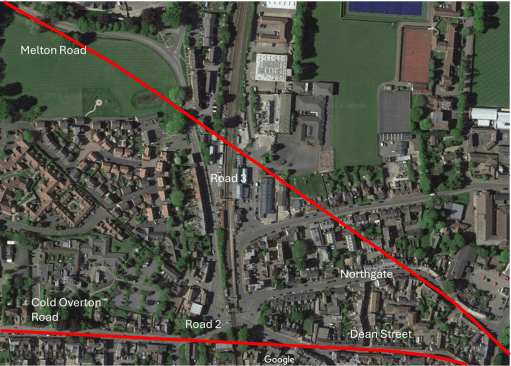
Road 2, the current Cold Overton Rd from Knossington, runs in a west to east direction, across what would become many centuries later the railway crossing and into Oakham. If the line of the road is continued, it runs along Dean Street (A) towards the church (B), and not along High Street. This straight alignment is very clear from the satellite view of figure 2. I will argue below that High Street was a relatively late development and was laid out in the Norman period. I have then shown the road running to a point in the current market place (C) in front of the castle (D) although this last stretch is conjectural.
Road 3 is the road from Melton Mowbray (and Derby and Nottingham beyond) through Wymondham and Langham. The modern approach to Oakham is via a sharp 90 degree turn along the railway down towards the level crossing. It will be seen below that this route was actually in place in the 16th century at the latest, so it is not a modern development. However, here we take the natural line of the road to continue from the north of the area marked as the Parks (E) towards the sharp kink in the modern Northgate (F) and then following Northgate and Church Alley to a junction with Road 2 in the Market Place. Again, this natural course is very obvious on the satellite view of Figure 2. This seems a much more natural route into the centre of the town.
Road 4 is from Ashwell and Greesham (and beyond that Grantham) that is taken to follow the existing course of Burley Rd. east of the castle to a junction with Road 5.
The course of Road 5 from Stamford and Empingham has changed significantly over the centuries, as it was moved to loop around Catmose Hall. Clough conjectures that it used to entire town through either or both of Bull Lane (G) or Tanners Lane (H) to the north of Bull St. We choose the latter course here as it allows this road to meet those from the west in the Market Place.
Road 6 from Uppingham and Preston follows its modern course to the end of Mill St. (J) and then cuts across to meet the other roads in the Market Place,
Road 7 from Brooke and Riddlington follows the current course of Mill St. to a junction with Road 6 (J).
Figure 2. Satellite views of the western and northern approaches
The Saxon / early Norman enclosures.
Figure 1 also shows two enclosures. The black dotted lines is a (very) conjectural boundary of the Anglo-Saxon settlement, based on the discovery of boundary ditches at K, L and M summarised by Clough. The purple solid line is the enclosure surrounding the castle and the church identified by Clough, largely on the basis of the flooded ditch at N (that has also been identified in archaeological investigations). Taken together these two enclosures would seem to represent the extent of the Anglo—Saxon and early Norman settlement. The strategic and defensive position of the castle (and in particular the Motte in the south east corner P) adjacent to the meeting point of the roads through the town is very clear. The most striking point about the proposed reconstruction is the absence of the High Street – its anomalous orientation with regard to the other roads suggests it postdated the original road layout. South Street was however likely to be in existence early as it marks the southern boundary of the enclosure. Note its original course ran straight from the west to the east, and did not diverge to the south east at its eastern end.
Changes in the Norman period
Figure 3. The post-conquest road layout
Figure 3 shows the road system and enclosures in the later Norman period. Clough identified the enclosure outlined in green that contains the castle and the portion of the town to the south. He speculates that the pattern of enclosures was changed when the manor was relinquished by (probably) William II and divided between Lordshold and Deanshold (the Dean referring to being that of Westminster Abbey), with the results that the church and the castle holdings were separated. This enclosure was again identified on the basis of a flooded ditch at Q. Clearly the function of this enclosure is very different and seems to be about controlling the movement of people and goods through the town (presumably for taxation purposes). It is like that this is the period when the current High Street came into existence. The Speed map of 1611 (Figure 4) shows “Bargate” at R, (built into the current Flores House) where presumably people and goods were assessed . The road system has also been changed to ensure all traffic flows along High Street. In the west, Road 3 was rerouted, probably in the first instance to follow the current line of Park Lane (S) down to Road 2. At some point the area named as the Parks was enclosed (both routes are shown on the 1611 map), and the route would again have been changed to run around this area, resulting in the modern road configuration (T). The current traffic chaos around the level crossing on the Cold Overton Road thus has its genesis many centuries ago! The combined roads 2 and 3 were then rerouted along the new High Street, rather than down Dean Street. To the east, it is likely that the Stamford Road was rerouted to come into town via what is now Bull Lane.
Figure 4. The Speed map of 1611
Loose ends
In this final section we note a number of what might be called loose ends in the above argument – the lack of destinations for one of the identified roads; the lack of direct roads from a significant place in the locality and the nature of the town “gates”.
A road to nowhere
Road 2 approaches Oakham on a straight route from the west, and within the town becomes Dean Street. But where was it coming from? There are no settlements out in that direction that can be confidently given an early date. Two thoughts come to mind – either that it was part of a somewhat roundabout route to Leicester, or that it was the route to what can be surmised to be early fortifications of the Rutland border to the west (where a number of names indicate beacons). There are no doubt other possibilities.
The route to Hambleton
There are clear indications in Domesday that the major settlement in the area at the time was Hambleton, and it was suggested above that this settlement was of an early date. As far as can be ascertained from the fairly recent maps that are available, the route there was a 90 degree junction of the Stamford Road (see the 1900 Ordnance Survey map of Figure 5). However the map shows a pedestrian way to the west of the junction that cuts of a corner and is a much more natural way to Hambleton. It seems possible that the Stamford Road bifurcated at that point with branches to Empingham and Stamford to the north and Hambleton and Ketton to the south, but that this junction was supressed during the enclosures. So Road 5 might better be referred to as the road to Hambleton, Empingham and Stamford
Figure 5. The road to Hambleton (from 1900 Ordnance Survey map
The gates
“Gates” is an ambiguous word. It can either refer to a physical gate to the town, or be a derivation from the Norse -gata simply meaning road. Bearing this in mind, Clough identifies two gates – an East gate at the entry of the Stamford Road into the enclosure around the present Bull Lane, and a West gate – the Bar-gate mentioned above. The road system was clearly arranged to direct all traffic through these, and resulted in quite a small central enclosure.
Now, whilst no south gate has ever been identified, from the earliest maps, there is a Gibbet Gate shown on the Speed Map on Stamford Road (Figure 4). This is someway outside the enclosed areas, and is this case the word gate probably simply defines a road rather than anything else. albeit one leading to a somewhat grisly destination.
The name Northgate, however, appears on a number of maps. On the Speed map this is positioned somewhere near the railway crossing, and on later maps, the current Northgate is known by either that name or by Northgate Street. Again, this could either refer to an actual gate to the town, or simply a way to denote a road. But if there was an actual North Gate, where was it? In my view, the most likely position is at the current sharp junction of the modern Northgate – F in figure 1, on the original Melton Road and at the possible confluence of the Saxon town and Castle / Church enclosures. A modern photograph is shown in Figure 6 below – taken from the east showing the possible location of the north gate (the thatched cottages) and the line of the road from there to the castle.
Figure 6. The possible location of the north gate
References
Clough T. H. McK. (2016) ” Oakham Lordshold in 1787 – A map and survey of Lord Winchilsea’s Oakham estate” Rutland Local History & Record Society, Occasional Publication No 12
Cox B (1994) “The place-names of Rutland” English Place Name Society
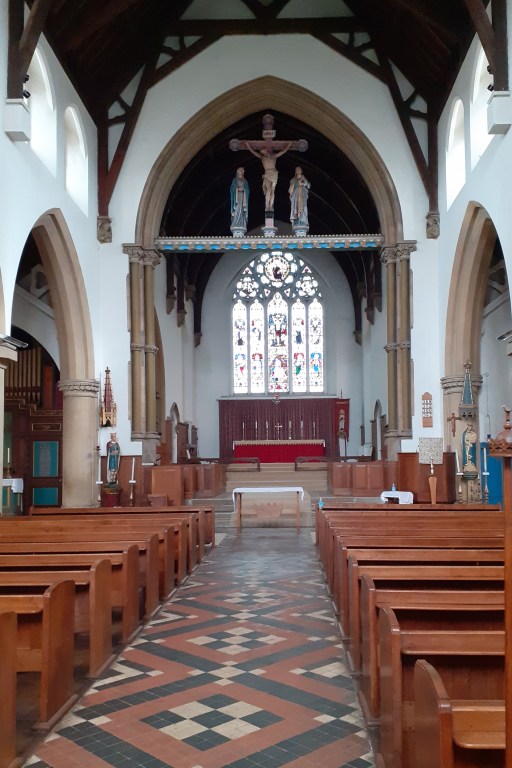
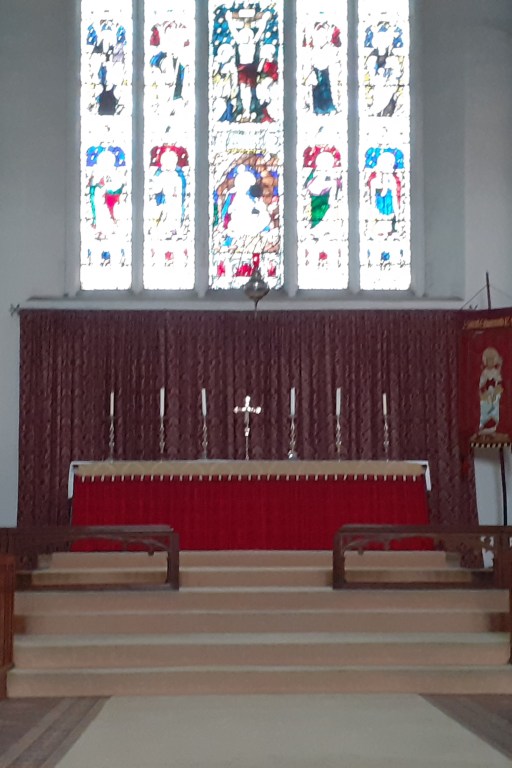
Appropriately, on the eve of St Edmunds Day in November 2024, we paid a visit to St Edmund’s church in Hunstanton in Norfolk (“we” being myself, my wife and our dog).This mid-Victorian church is VERY Anglo-Catholic as can be gathered from the photographs of Figure 1 which show the crucifix in the chancel arch, the baptistry at the west end (with the chapel of Our Lady at Walshingham on the right), and the raised altar in the chancel. I doubt I could ever have managed to get up and down those altar steps safely in a cassock or alb, and certainly now, if I were ever to preside there (which is unlikely in the extreme), I would certainly need a stair rail, and possibly, given the current state of my right knee, a stair lift*. That being said, it is an impressive church interior.
Nave and chancel (east end)Baptistry (west end)Altar
Figure 1. The interior of St. Edmund’s
Now whilst there are some fairly conventional depictions of biblical events and saints in the windows in the church, those that I found of most interest are the series of windows that depict the life and death (and afterlife) of King Edmund. In reality, very little is known about him other than the entry in the Anglo Saxon Chronicle of 870.
In this year the raiding army rode across Mercia into East Anglia and took up winter quarters at Thetford. That winter King Edmund fought against them, and the Danes had the victory and killed the king and conquered all the land.
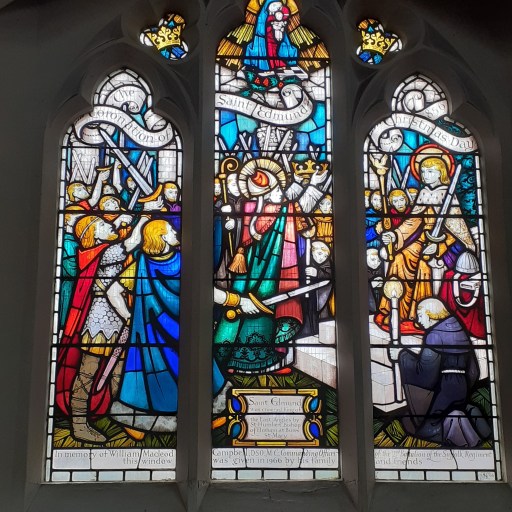
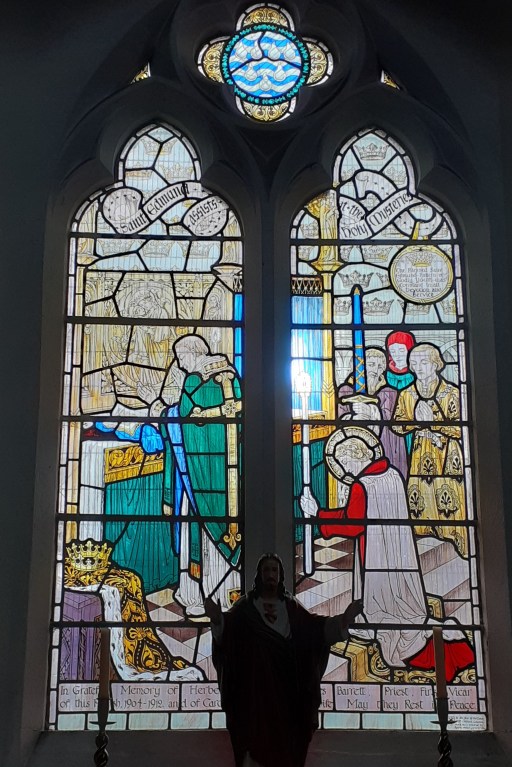
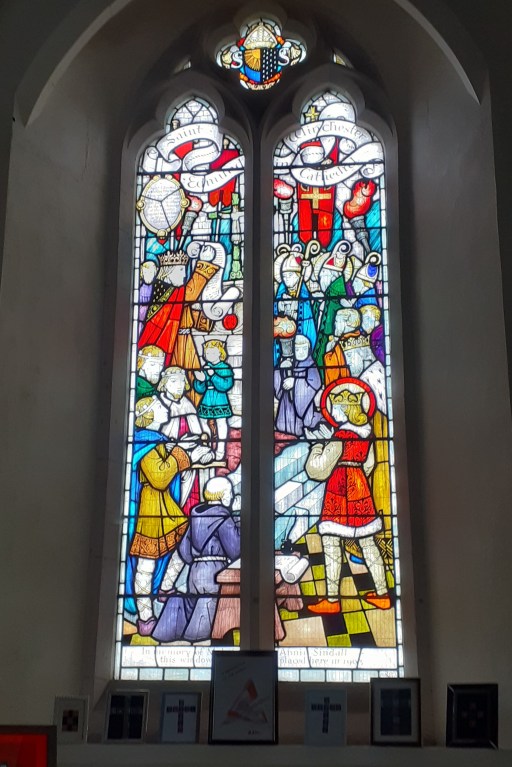
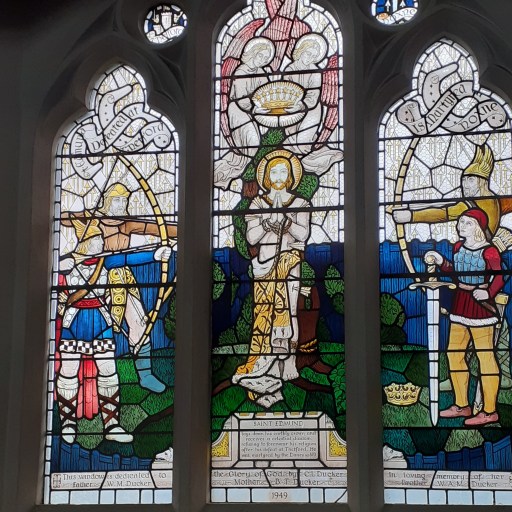
However, a much more fulsome legend of his life soon appeared. and the events of this legend are related in the windows that are shown below in Figure 2. The perspective of some of these is a little odd, largely because I was trying to avoid the above-mentioned dog and his lead whilst taking the photographs. The windows show Edmund’s landing from Saxony at Hunstanton; his coronation; Edmund reading from the psalms, showing hospitality and assisting at mass (illustrating his devotion and humility); Edmund in Winchester (not sure why); his martyrdom at the hands of the Viking Great Army (but not his later beheading); his welcome into heaven and being brought before God by the East Anglian saints Humbert, Felix, and Lady Julian of Norwich; and his shrine at Bury St Edmunds. There is a lot of detail in the windows that reward close scrutiny,
Sailing from SaxonyCoronationReading from psalmsShowing hospitalityAssisting at massAt WinchesterMrrtyrdomKneeling before GodThe shrine
Figure 2. The St. Edmund windows
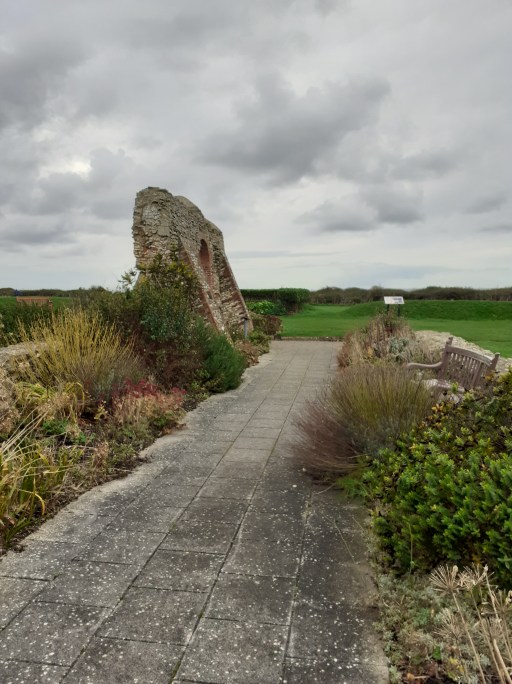
To the north of the village there is another site of relevance to St. Edmunds – the ruins of the old medieval chapel dedicated to the saint, allegedly built to mark the point of his arrival into England – see Figure 3 below. The last photograph shows a wolf carving – commemorating the legend, probably arising from the supposed fact that Edmund was a member of the Wulfinglas dynasty, that the followers of St Edmund, after his death and beheading, found his head protected from further harm by a wolf.
South wall and doorView through south door looking northLooking along nave to east endPosition of altarLooking along nave to west endThe wolf carving
Figure 3. Ruins of St. Edmund’s chapel
* Any such ecclesiastical stair lift should of course have changeable cushions in the correct liturgical colours.
In August 1860 the Rev. Thomas James., M.A.- honorary canon of Peterborough, vicar of Theddingworth, and one the secretaries of Architectural Court of the Archdeaconry of Northampton delivered a lecture to Oakham Literary Institute at the Old Castle Hall of Oakham, on ” Gothic Architecture,” particularly with regard to the history and arrangements of the Church and Castle Hall in Oakham (1). The transcript of his talk can be found here. The speaker was described as “an accomplished ecclesiologist and erudite and painstaking antiquary” and was clearly a major proponent of gothic church architecture in the area.
In his talk he mentions two speculations that I wish to consider briefly in this post. Firstly he stated that there was “a cupboard in the eastern wall, behind the altar, which might have been used as a receptacle for relics, or for receiving the stoup of holy water which stood at the chancel door.” Secondly, with regard to the clergy vestry he said, obviously referring to some past time “…the vestry was two storied, in all probability it was formerly used as the dwelling of an anchorite, that being a prevailing custom at one time. There was a similar instance of a two storied room attached to the church at Barnack, near Stamford“. We consider each of these two statements below.
The altar cupboard
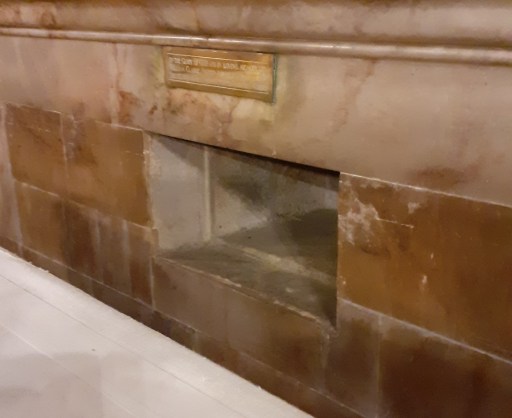
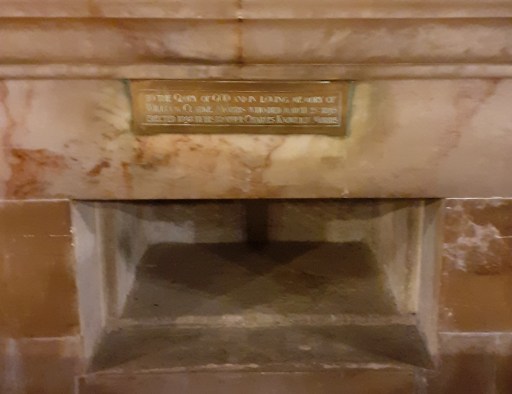
The east end of the church was extensively modified by Gilbert Scott in 1858, but probably only from the bottom of the east window upwards, and it would seem, from the description by James, that the altar cupboard, whatever it was, was still in place in 1860. The area was further extensively modified in 1898 when the current Reredos was installed , and the walling and flooring renewed. However there is still a slot behind the altar which almost certainly was created to mark the position of the cupboard (figure 1). So what was it – a reliquary, a place for storage of holy water, or perhaps an aumbry, where the consecrated bread and wind would be kept? There are as far as I know, no historical mention of any relics in All Saints, but a church of its size and significance may well have been graced with them. There is of course evidence of relics at the priory cell at Brooke to the south of Oakham and the Reliquary can be seen in Rutland County Museum. If it were an aumbry for consecrated bread and wine or a storage place for holy water, then it would need to be opened fairly regularly, and its location behind the altar, which would have been standing against the east wall would have made it relatively inaccessible. So it is possible that it was a reliquary, which would not have been opened regularly, but this must remain as speculation.
Figure 1. The slot in the wall at the east end marking the position of the “cupboard”
The Vestry
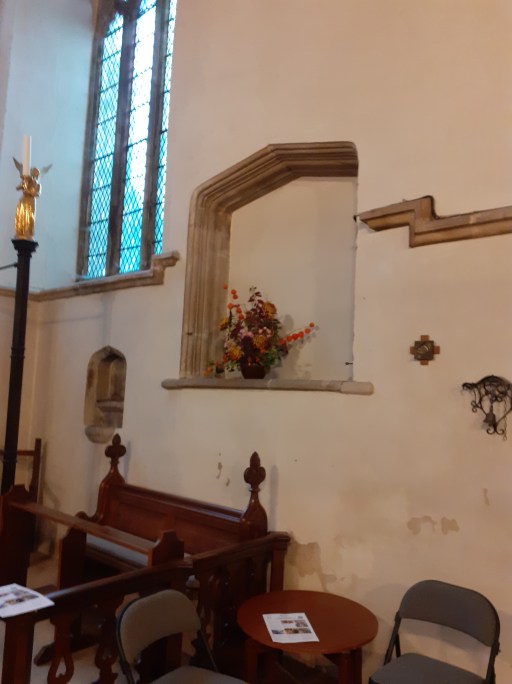
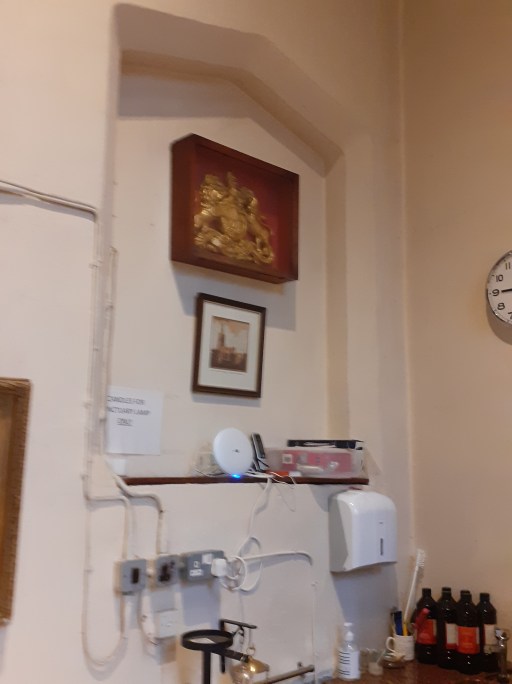
The vestry is thought to have been built around 1480 at the same time as the adjoining Lady Chapel, although this is not certain. It is certainly tall, and could have accommodated a second floor, although there is no current structural evidence for that. One potential feature could be consistent with the idea that and Anchorite hermit (or an Anchoress) resided there, is that there is a blocked up “window” structure in the wall between the vestry and the Lady chapel, which could possibly have been used by the resident hermit to observe the celebration of the mass at the altar below (figure 2). As it stands, the lower edge of this recess is rather too low for it too have been at the level of the floor above, so this might have involved a step down, or perhaps was first built to match the height of an earlier structure on the site of the current vestry. So this perhaps goes some way to bolstering the claim made by Wood, but again there is no certainty.
a
b
Figure 2. The blocked up window structure. a – from the Lady chapel; b – from the vestry. The bottom edge is at the same level in each case.
So to conclude. Whist the presence of relics and hermits in All Saints is a possibility, this is far from certain. As with many Victorian ecclesiologists and antiquarians, the Revd. James may well have let his speculations outrun the evidence.
Additional Note (29/11/24)
After reading the above blog, the Vicar of Oakham, Revd. Stephen Griffiths, sent me the photograph shown in Figure 3 below. This shows two blocked up windows on the east side of the Vestry. From the inside, the lower window corresponds with a recessed cupboard in the wall, which has the appearance of a door, and from the photograph, there seems to be a break in the stone work beneath the window that might indeed suggest it was originally a door. The upper window is similar in form to the stair windows in the tower. Taken together they perhaps suggest a separate entrance with access to an upper level in the vestry. How this relates to the issues addressed in the above blog is not, however, at all clear. All a bit of a mystery.
Figure 3. The east side of the vestry (photograph by Revd. Stephen Griffiths)
In this post we will consider how bus and train transport in Oakham has changed from the 1960s to the present day, for both good and bad. To do so, we will use a variety of historical resources, primarily old bus and rail timetables. We will look at four time slices – at the state of the railways in the early 1960s i.e. before the Beeching cuts; at the bus services and train service provided in the late 1960s, after Beeching but before bus deregulation; in the late 1990s after rail privatization and bus deregulation; and the current situation. The time slices chosen have in effect been determined by what information is available. However, between them they give a clear picture of how bus and train services in Oakham have developed (or perhaps degraded) over the last 50 to 60 years.
Sources and limitations
For the early 1960 rail services we use the following sources:
London Midland Region timetable for 1963 and 1965 (personal collection);
These are quite comprehensive and give a full coverage of the rail services at that time, which is of course before the Beeching Report and associated closures. The sources for the late 1960s are both taken from Timetable World:
London Midland Region timetable for 1969;
Bus timetables for the late 1960s.
Whilst the rail timetables can again be expected to be comprehensive, the bus timetables are probably less so. Finding services through Oakham requires a search of the index for bus companies operating in the area. It is possible that I have missed some potential sources of information, although I believe I have captured most of the main services. What I have almost certainly missed are any very local services operated by small operators in the Oakham district, which simply do not appear on the Timetable World web site. The bus timetables are from the years 19868 and 1969 with one exception from 1973 (for a Saturday only service). For the late 1990s we obtain information from the following sources:
Railtrack Great Britain timetable for 1999 (from Timetable World);
Great Britain Bus Timetable 1999 (personal collection).
The Great British Bus Timetable is a compilation of services from across Great Britain. It admits that it excludes local operators and services of a purely local nature, so again the bus information might not be fully comprehensive here. For the current situation we used information for bus and train times that is available on the web as follows:
In the analysis that follows, we will identify bus and train operators by a two letter code.
BL – Blands of Cottesmore – a local bus company based in a village to the east of Oakham.
BA – Bartons or Barton Tobin Hood – a large regional bus company based around Nottingham, but with a garage in Stamford.
BR – British Rail – the National pre-privatisation rail operator.
CB – CentreBus – an East Midlands regional operator.
CC – Cross Country Trains – the current franchise operator of trains through Oakham, with a wide nationwide network.
CT – Central Trains – a previous operator of trains through Oakham, based in Birmingham with a wide regional network across the Midlands.
EM – East Midlands Railway – the mainline train operator serving the East Midlands cities, that runs occasional services through Oakham (and is, bizarrely, the firm responsible for running the station).
KI – Kinchbus – a small Loughborough based bus company
LR – Lincolnshire Road Car – a large regional company in the 1960s, primarily based, as might be expected, in Lincolnshire.
MR – Midland Red Leicester – the regional operator of the very large Midland Red network that operated buses across the wider Midlands area.
RC – Rutland County Council – which currently operates a small number of services for which no franchise partner could be found.
UC – United Counties Omnibus Company – a large regional company primarily based in the Northampton area.
Analysis
In what follows we consider the public transport services through time in four categories:
Local interurban services to Stamford, Melton Mowbray and Uppingham;
Regional services to Peterborough, Leicester, Nottingham, Grantham and Corby;
Long distance services to Birmingham, Cambridge and London;
Miscellaneous services for which information is incomplete – very local services, long distance coaches etc.
For the first three categories we present the data in tabular form in a consistent format, and then discuss how these have evolved over time. Discussion of the latter category is inevitably rather more diffuse due to the lack of much historical information.
Local interurban services
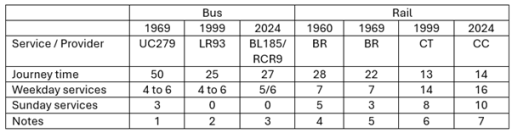
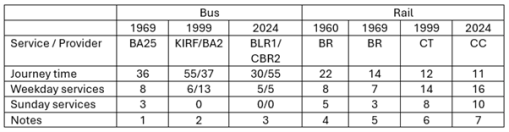
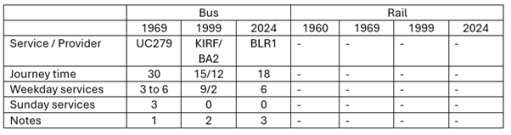
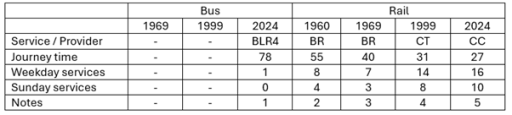
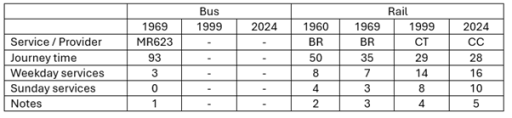
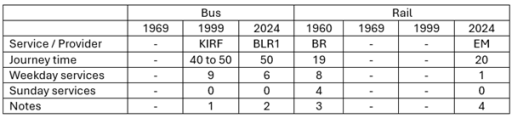
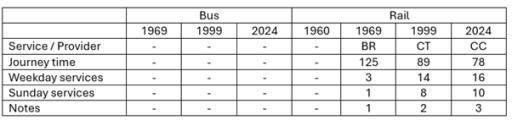
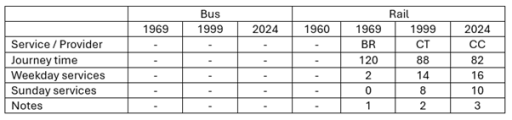
Tables 1 to 3 show, in standard form, the bus and train services between Oakham and Stamford, Melton Mowbray and Uppingham. Journey times and number of journeys / day are shown. Clearly there are both train and bus options to Stamford and Melton Mowbray, but only bus options to Uppingham. The bus journeys in 1969 and 1999 were provided by major bus operators for which Oakham was at the edge of their operating area – United Counties in Northampton, Lincolnshire road Car, Bartons in Nottingham, Kinchbus in Loughborough. Currently they are provided by more local operators – primarily Blands, but with Rutland County Council running the current Oakham to Stamford service. The bus journey times and service frequencies have remained similar over the period (although note that the former can vary significantly depending on what villages are served on the way between urban centres. The loss of Sunday services is obvious from the data in the tables. What is not so obvious is the fact that evening services on all the bus routes have been significantly cut over the study period.
By contracts the train services have seen major improvement. The Leicester to Peterborough shuttles stopped at all the village stations before Beeching and the journey times between Oakham and Melton Mowbray and Stamford were of the order of 20 minutes. By 1969 these stations had closed and the journey times significantly reduced. This reduction has continued up to the present with faster stock being introduced on the line and, most significantly, the number of journeys has increased by a factor of two with the introduction of hourly through Birmingham to Cambridge / Stansted Airport services. These improvements have however resulted in a significant loss of connectivity to the villages where stations were closed in the 1960s.
Table 1. Oakham to Stamford
Uppingham to Stamford via Ridlington, Wing, Oakham (Railway Station Crossing), Exton, Whitwell, Empingham and Great Casterton. UC also operated service 280 with one return journey on Fridays only from Oakham to Stamford vis Edith Weston.
Oakham to Stamford via Whitwell, Empingham and Great Casterton.
Oakham to Stamford via Whitwell, Empingham and Great Casterton. BL185 has one service from Monday to Friday and four on Saturday. RCR9 has five services Monday to Friday.
Leicester to Peterborough East via Syston, Frisby, Melton Mowbray, Saxby, Ashwell, Oakham, Manton for Uppingham, Luffenham, Ketton and Collyweston, Stamford, Helpston and (for some journeys) Peterborough North.
Leicester to Peterborough via Melton Mowbray, Oakham and Stamford
Birmingham to Cambridge / Stansted Airport via Leicester, Melton Mowbray, Stamford and Peterborough.
Birmingham to Cambridge / Stansted Airport via Leicester, Melton Mowbray, Stamford and Peterborough. Also, two early morning / late evening EM services from Nottingham to Norwich calling at Loughborough, Melton Mowbray, Stamford and Peterborough (not included in table).
Table 2. Oakham to Melton Mowbray
Melton Mowbray to Oakham (Station Approach) via Whissendine, Ashwell and Langham. Also, four journeys / day Oakham to Langham only.
KIRF (Rutland Flyer) Corby to Melton Mowbray via Uppingham, Oakham and Cottesmore; BA2 Uppingham to Nottingham via Oakham, Langham, Whissendine and Melton Mowbray.
BLR1 Corby to Melton Mowbray via Uppingham, Oakham, Langham and Whissendine; CBR2 is Oakham to Melton Mowbray via Exton, Cottesmore and Whymondham. Also, one BLR4 service per day Melton Mowbray to Peterborough via Oakham and Uppingham (not shown in table).
Leicester to Peterborough East via Syston, Frisby, Melton Mowbray, Saxby, Ashwell, Oakham, Manton for Uppingham, Luffenham, Ketton and Collyweston, Stamford, Helpston and (for some journeys) Peterborough North.
Leicester to Peterborough via Melton Mowbray, Oakham and Stamford.
Birmingham to Cambridge / Stansted Airport via Leicester, Melton Mowbray, Stamford and Peterborough.
Birmingham to Cambridge / Stansted Airport via Leicester, Melton Mowbray, Stamford and Peterborough. Also, two early morning / late evening EMT services from Nottingham to Norwich calling at Loughborough, Melton Mowbray, Stamford and Peterborough (not included in table).
Table 3. Oakham to Uppingham
Uppingham to Stamford via Ridlington, Wing, Oakham (Railway Station Crossing), Exton, Whitwell, Empingham and Great Casterton.
KIRF (Rutland Flyer) Corby to Melton Mowbray via Uppingham, Oakham and Cottesmore; BA2 Uppingham to Nottingham via Oakham, Langham, Whissendine and Melton Mowbray.
Corby to Melton Mowbray via Uppingham, Oakham, Langham and Whissendine
Regional interurban services
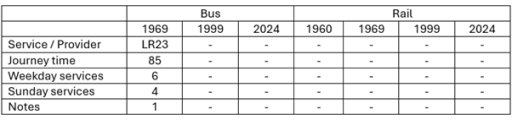
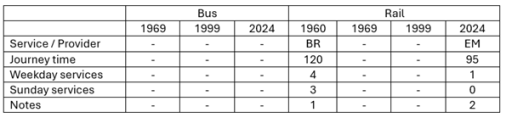
In this section we consider the evolution of services from Oakham to the major surrounding conurbations of Peterborough, Leicester, Nottingham, Grantham and Corby (Tables 4 to 8). With regard to Peterborough and Leicester, the same remarks can be made as in the last section in terms of the rail services, with steadily decreasing journey times and a major improvement in service frequency. For both towns there have only ever been occasional and sporadic bus links, addressing specific leisure, employment or educational needs, with long journey times. Direct services to Grantham were an early casualty of service rationalization and were not provided after the early 1970s.
In the early 1960s train services were provided from Nottingham to Melton Mowbray, Oakham, Corby, Kettering and beyond. Services on this line were a major casualty of the Beeching closures and there are now only very limited rail services to both Nottingham and Corby. Whilst there was quite a good bus service from Oakham to Nottingham in 1999, operated by Barton, this did not last and there are now no direct bus services to that city. There are, however, regular services to Corby that run through Oakham to Melton Mowbray. In 1999 these were provided by Kinchbus and marketed as the Rutland Flyer. Now the service is operated by Blands. Journey times are of the order of 40 to 50 minutes.
Table 4. Oakham to Peterborough
Melton Mowbray to Peterborough via Langham, Oakham, Uppingham and South Luffernaham.
Leicester to Peterborough East via Syston, Frisby, Melton Mowbray, Saxby, Ashwell, Oakham, Manton for Uppingham, Luffenham, Ketton and Collyweston, Stamford, Helpston and (for some journeys) Peterborough North
Leicester to Peterborough via Melton Mowbray, Oakham and Stamford
Birmingham to Cambridge / Stansted Airport via Leicester, Melton Mowbray, Stamford and Peterborough.
Birmingham to Cambridge / Stansted Airport via Leicester, Melton Mowbray, Stamford and Peterborough. Also, two early morning / late evening trains from Nottingham to Norwich calling at Loughborough, Melton Mowbray, Stamford and Peterborough (not included in table).
Table 5. Oakham to Leicester
Saturdays only. Oakham (Station Road) to Leicester via Braunston, Knossington, Cold Overton and Melton Mowbray.
Leicester to Peterborough East via Syston, Frisby, Melton Mowbray, Saxby, Ashwell, Oakham, Manton for Uppingham, Luffenham, Ketton and Collyweston, Stamford, Helpston and (for some journeys) Peterborough North.
Leicester to Peterborough via Melton Mowbray, Oakham and Stamford
Birmingham to Cambridge / Stansted Airport via Leicester, Melton Mowbray, Stamford and Peterborough.
Birmingham to Cambridge / Stansted Airport via Leicester, Melton Mowbray, Stamford and Peterborough. Also two early morning / late evening trains from Nottingham to Norwich calling at Loughborough, Melton Mowbray, Stamford and Peterborough (not included in table).
Table 6. Oakham to Grantham
Oakham (Railway Station) to Grantham, calling at Cottesmore, Greetham, Market Overton and Thistleton. Also 3 journeys from Oakham to Cottesmore only.
Table 7. Oakham to Nottingham
Nottingham to Uppingham via Melton Mowbray, Whissendine, Langham and Oakham.
Nottingham to Kettering, via Old Dalby, Melton Mowbray, Oakham, Manton for Uppingham, Gretton, Corby and Kettering, Two or three of these were from Nottingham (and beyond) to London St Pancras.
Nottingham to Norwich calling at (Leicester), Loughborough, Melton Mowbray, Oakham, Stamford and Peterborough (early morning and late evening only)
Table 8. Oakham to Corby
Corby to Melton Mowbray via Uppingham, Oakham and Cottesmore.
Corby to Melton Mowbray via Uppingham and Oakham
Nottingham to Kettering, via Old Dalby, Melton Mowbray, Oakham, Manton for Uppingham, Gretton, Corby and Kettering. Two or three of these were from Nottingham (and beyond) to London St Pancras.
Melton Mowbray to London St Pancras calling at Oakham and Kettering.
Long distance services
The three long-distance services we consider are Oakham to Birmingham, Cambridge and London (Tables 9 to 11). All of these are rail based. The first two reflect the changes described above to the Leicester to Peterborough services with a significantly increased number of services and steadily reducing journey times. The London situation is very different. When services ran from Nottingham to London via Oakham in the early 1960s, there were four trains to and from London each day. After Beeching these were withdrawn completely and it is only in recent years that one journey, from Melton Mowbray to London has been reinstated. Thus whilst there has been considerable improvement in east / west connectivity, north / south connectivity has been reduced to a nominal level.
Table 9. Oakham to Birmingham
Birmingham to Cambridge / Norwich via Leicester, Melton Mowbray, Stamford and Peterborough.
Birmingham to Cambridge / Stansted Airport via Leicester, Melton Mowbray, Stamford and Peterborough.
Birmingham to Cambridge / Stansted Airport via Leicester, Melton Mowbray, Stamford and Peterborough
Table 10. Oakham to Cambridge
Birmingham to Cambridge via Leicester, Melton Mowbray, Stamford and Peterborough.
Birmingham to Cambridge / Stansted Airport via Leicester, Melton Mowbray, Stamford and Peterborough. Birmingham to Cambridge / Stansted Airport via Leicester, Melton Mowbray, Stamford and Peterborough
Table 11. Oakham to London
Nottingham to Kettering, via Old Dalby, Melton Mowbray, Oakham, Manton for Uppingham, Gretton, Corby and Kettering. Two or three of these were from Nottingham (and beyond) to London St Pancras.
Melton Mowbray to London St Pancras via Oakham and Kettering
Other services
When looking at the information available from the sources listed above, it is clear that there are two broad categories of bus service that are not fully represented – very local services in and around Oakham and the nearby villages; and long-distance coach services. With regard to the former, it is known that local companies such as Blands provided specific services to places of work and education and indeed that still continues in the latest timetable. These are usually one or two journeys a day with no wider public transport relevance. Als Rutland County Council operate a minibus Rutland Hopper service around the town to out-of-town stores and local villages.
It is also clear that some long distance coaches operated through Oakham, but these are not easy to find, usually occurring in specific operators timetables. For example, in 1968 Barton operated a long-distance coach service between Corby and Glasgow (presumably for steel worker s to visit families), with daytime trips on Sunday, Monday and Wednesday, and overnight trips on Friday and Saturday, that picked up and dropped off at the Crown Hotel. Similarly in 1969 Trent Motor Traction, based in Derbyshire and Nottinghamshire ran weekend services from Derby and Nottingham to Southend on Sea, Cambridge and Clacton that ran through Oakham, picking up and setting down at the Market Place. There were no doubt other similar occasional services.
Conclusions
So what can one conclude from the data presented above? Firstly with regard to rail services, it is clear that there have been major improvements in connectivity to the east and the west, with reducing journey times and increased frequencies. That being said, current reliability and punctuality is poor and requires improvement. Services to the north and south have however seen major degradation and are now only represented by one journey a day to London. With regard to bus services, in some sense these have seen little change, with journey times and frequencies on most routes remaining broadly constant, at least on weekdays. That being said, there have been some losses – to Grantham and Nottingham in particular, Sunday services are non-existent and evening services have been severely cut back, Perhaps more importantly the service times and frequencies that were acceptable in the 1960s now simply represent a very basic service that is not attractive to most car-owning travelers.
This post contains a transcript and a re-recording of the presentation I gave at the Black Country History Day at the Black Country Museum on November 9th 2024. The title for the day was “Buildings, Heritage and the Built Environment in the Black Country” and was organised by the Black Country Society. It focused on how local buildings and sites are being protected, preserved and presented and how the built environment has been described and visualised by artists, writers and photographers. The programme for the day was as follows.
Tube Town Tales – what the world owes to Wednesbury, Keith Robinson
Rev John Louis Petit’s 19th-century Black Country art: the impact of the Industrial Revolution on the built environment, Philip Modiano
The challenges of rescuing industrial heritage buildings, Mark Davies
Rubery Owen: Exploring the archives of one of Britain’s largest historic privately owned companies – documents, photographs and film
Forging Ahead: Bringing the Halesowen & Hasbury Co-op to Life, Clare Weston
The Black County environment of the mid-20th century through the poetry of Jim William Jones, Chris Baker.
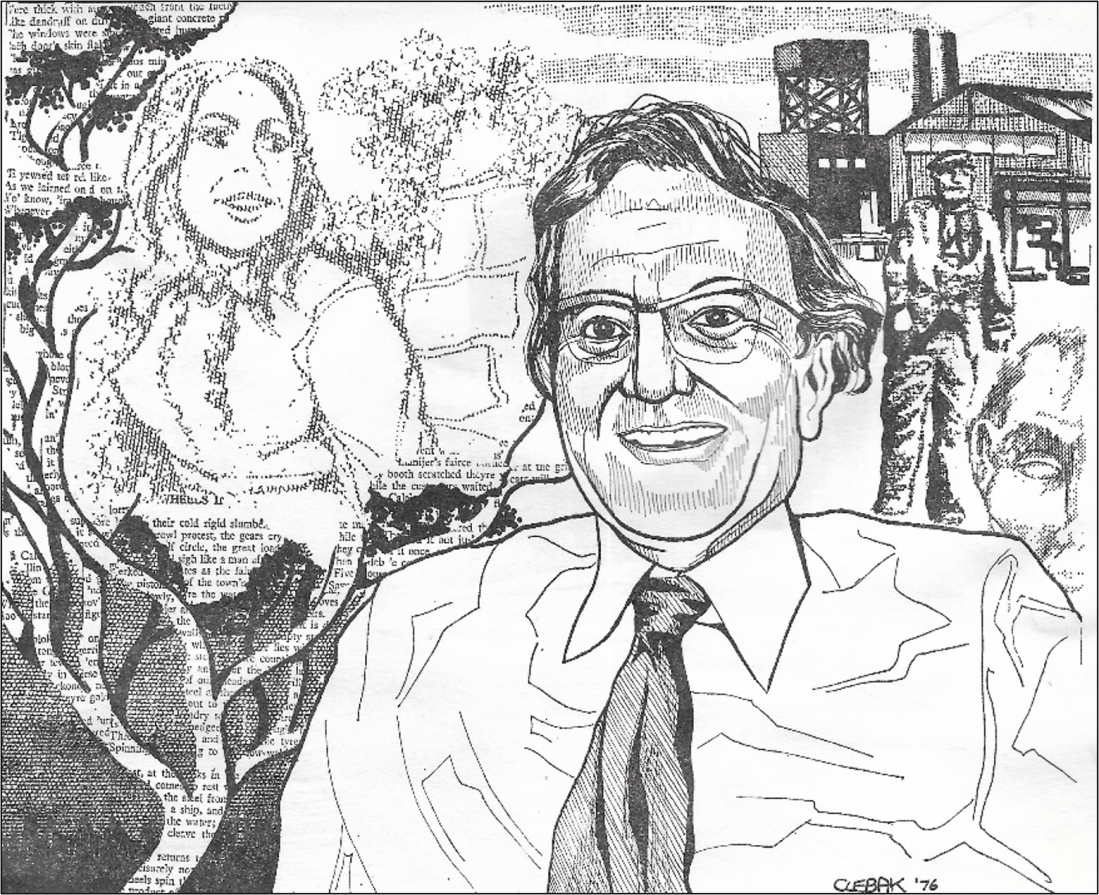
More details of Jim Jones’ life can be found in both the presentation and the transcript below as well in an earlier blog post. The presentation contains both the audio of the poems being read, as well as background slides with illustrative material. The transcript itself contains only one picture, which is of particular relevance to one of the poems.
For those interested in reding more of Jim Jones’ poetry, pdfs of two publications from the 1970s, and a compilation of his Blackcountryman poems can be purchased from the Black Country Society online shop.
Three recent blog posts here, here and here, contain transcripts of newspaper reports that describe the restoration of All Saints Church in Oakham in 1858, under the direction of Gilbert Scott. It is clear from these reports that at the time the church was in a very bad state of repair and most of the restoration was concerned with repairing defects, particularly to the roofs, renovating historical features and replacing much of the internal furnishings. However there was one major area of the church where significant work was carried out that went far beyond simple repairs – to the chancel and to the east end in general. In his condition assessment Scott (1) wrote
The chancel has a roof of modern date concealed by a flat plaster ceiling which cuts across the chancel arch. The same roof extends over the north chancel aisle, thus deforming the east end, by placing two divisions under one gable. The north aisle has most beautiful oak panelled ceiling, which happily conceals its roof from within. The south aisle of the chancel has modern roof, of the very meanest description, so that in the interior of the chancel and its aisles we have first a plain flat plaster ceiling to the chancel itself; then to the north aisle a beautiful oak ceiling, showing the manner in which the ancient builders treated their work; and on the south aisle the roof of modern hedge-carpenter, such as would disgrace a cart-shed.
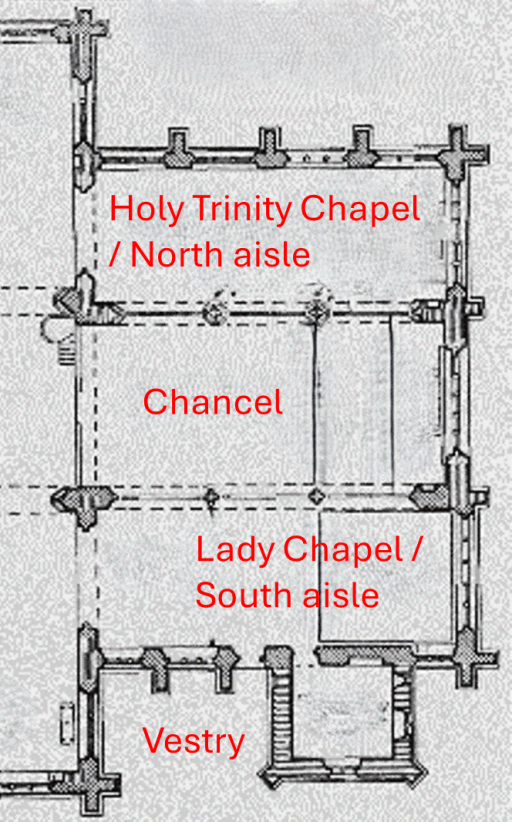
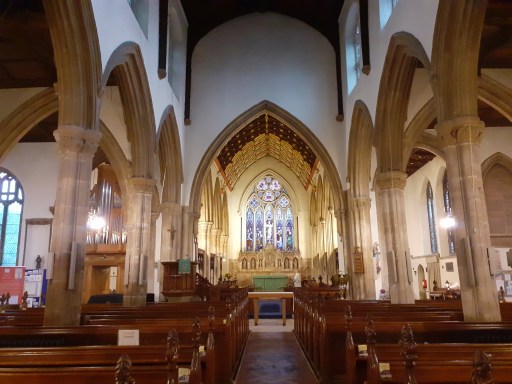
It is not altogether clear what is being described here, particularly in the first sentence, and this is the aspect of the work that will be considered in this post. First of all, let us consider the current (2024) state of that area of the church. A plan is given in figure 1 and shows the chancel, with the 13th century Holy Trinity chapel to the north and the Lady Chapel (built around 1480) to the south (the chapels are the north and south aisles referred to in the above quotation) (2). Figure 2a,b,c,d shows views of chancel and the chapels from the west end of the church. The chancel arch, referred to by Scott can be seen in figure 2d. It can be seen that the chancel itself is higher than the chapels to either side and certainly higher than the chancel arch, so the ceiling that Scott took exception to has been removed.
Figure 1. Plan of the east end of the church
a
b
c
d
Figure 2. a – North aisle / Holy Trinity chapel; b -Chancel; c – South aisle / Lady chapel; d – view from nave showing chancel arch.
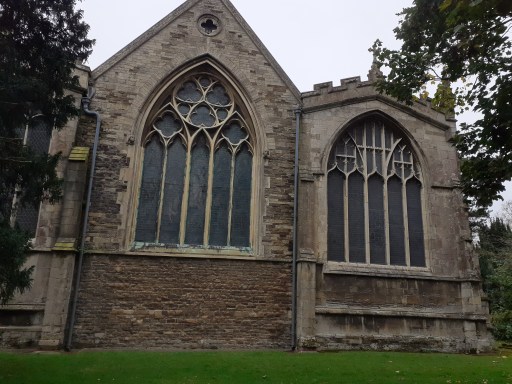
Photographs of the east end of the church from the outside are shown in figure 3. There is no natural viewing point to take an overall photograph and the view is obstructed by trees in the churchyard, but, despite the odd perspective, both chapels and the chancel can be seen. The change in stonework around and above the chancel window shows the rebuilding of the 1850s.
a. Lady chapel and chancel
Chancel and Holy Trinity chapel
Figure 3. The east end of the church
Happily we can gain an understanding of what this end of the church looked like before the restoration from an 1851 model kept in the church (3). This is in a glass display case, currently in the north transept, and was not altogether easy to photograph, largely because this entailed standing on a pew, turning through ninety degrees and trying to photograph something in a glass case next to a window, with multiple reflections. Nonetheless, a rather poor quality photograph is shown in figure 4. The caption on the display case reads
In loving memory of Mary Grinter who passed to her rest on 10th February 1950. Age 87 years. This model was made by her father John Pitt Coulam (1833-1898)
Figure 4. The 1851 model
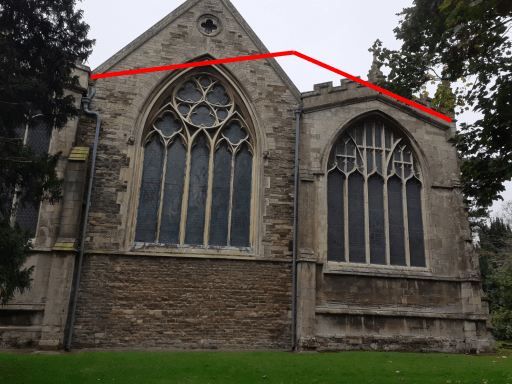
Figure 5. Photograph of the east end of the church showing the roof line of the 1851 model.
The east end in this photograph can be seen to be very different from the photographs of figure 3. Figure 5 shows the 1851 roof line from figure 4 superimposed on the photograph of figure 3b. And from this one can understand what Scott meant. The chancel seems to have been reduced from its original height (which the height of the chance arch suggest was similar to today), and a pitched roof added over both the north aisle / Holy Trinity, chapel and the chancel itself. Thus, the two chapels indeed share a gable, and the roof / ceiling of the chancel would cut across the chancel arch in a very un-elegant fashion. The window at the east end would also seem to have been deliberately lowered to fit into the new arrangement. Figure 6 shows, in an edited version of figure 2b, how Scott would have seen the interior of the church, with the top of the chancel arch blocked, a lower flat ceiling in place, and a smaller east window
Figure 6. The chancel as would have been seen by Scott, with chancel arch blocked, lowered flat ceilingand smaller east window
Scott’s work changed all this, restoring the chancel to its original height and adding sound roofs and spectacular internal ceilings. A new east window was inserted, which, the 2003 church guide (3) tells us, was criticised at the time for being of “decorated” rather than “perpendicular” form. Funny what folk get upset about.
So why on earth did this happen – why was the original rather elegant design of the chancel and chapel changed in this way, presumably sometime in the 15th to 17th centuries. I can think of two possible reasons. The first is wholly utilitarian – the chancel, and in particular the roof, may have been in a very poor state of repair, and required extensive renovation and repair. The arrangement criticised by Scott could have been a cheap way of making that end of the church reasonably sound, if rather ugly. The second reason has a more theological basis. After the Reformation, the Elizabethan settlement enforced conformity of practice – in particular taking down the altars at the eats ends of chancels and replacing them, for the purpose of celebrating holy communion, with a table placed lengthways in the chancel, around which communicants would have gathered, with the celebrant on the north (long) side of the table. The combined chancel and north chapel would thus have provided a typical Elizabethan “communion room”. A surviving example of such an arrangement can be seen locally at Brooke. (figure 7) where the spacious chancel is separated from a north chapel by a simple screen. This arrangement was only temporary and after the restoration of the monarchy in 1660, with the Laudians in the ascendency, the altars at the east ends of chancels were reinstated with little opposition. Some clergy however continued to celebrate from the north end even with the altar in the new positions, and indeed, this is still the case in a few places.
Whatever the reason, I have to admit (albeit grudgingly) that Scott was correct in this case in his desire to restore the chancel to its gothic glory from what seems to have been a somewhat botched Elizabethan / Stuart arrangement.
One further point arises. In the north aisle / Holy Trinity chapel there is a large chest tomb, with no dedication, placed lengthways next to the chancel (figure 8). It is said in (2) to be early 16th century – perhaps around the time of the Reformation. The images of sheep bells or wool weights on the side have led to the suggestion that it might be the tomb of a wool merchant. In the chancel arrangement before Scott’s restoration this would have been very prominent – indeed in the centre of the gable, possibly between two altar positions. One can speculate that the tomb was either placed in this position deliberately or indeed whoever was responsible might also have rebuilt the chancel / chapel to give the tomb such a prominence.
‘Parishes: Oakham’, in A History of the County of Rutland: Volume 2, ed. William Page (London, 1935), British History Online [accessed 21 October 2024].
Aston N (2003) All Saints Oakham, Rutland. A guide and history.
“Communion of the Saints” in a Baptistry in Padua (José Luiz)
On October 31st 2024, I gave a lecture at All Saints church entitled “A time to mourn, and a time to dance – the All Saints season through the ages“, which explored how the season between Halloween had developed over the centuries and millennia. This was part of a wider celebration of the festival of All Saints that included a musical concert; church tours; a tower climb, a pop up cafe and a number of services of worship.
In the church notices for the Sunday beforehand I wrote the following introduction to the talk.
The start of November marks the beginning of winter in seasonal terms, and is the time of a number of festivals and celebrations – Halloween, All Saints Day, All Souls Day, Bonfire Night and Remembrance Day. In this talk I will explore how all these evolved through the ages from pre-Christian times, through the medieval period to the Reformation and from then to the 21st century. A few other festivals which haven’t made it to modern times will also be mentioned. There will be a large cast of popes and bishops, kings and queens, saints and sinners with a few fairies and witches thrown in. I will of course be using PowerPoint, the academics comfort blanket, with some audio tracks, so if nothing else the almost inevitable failure of technology may be entertaining. But I found putting the talk together really quite interesting, and I l learnt a few things that were new to me on the way, so hopefully others will find it interesting too – and possibly even enjoyable!
This web page contains links to a transcript of the talk, and a re-recording of the talk made after the event. The latter contains the PowerPoint slides I used; the former is just the text. The presentation does not include the audio clips I used in the talk – YouTube would not have allowed me to upload these for copyright reasons.
For those interested in reading further about the development of seasonal celebrations in England I would recommend the following book by Prof Ronald Hutton – from which I took much of the information for the talk.
Last time I gave a talk of this nature, at the Queen Edith Festival last March, I began by admitting I was something of an imposter and that my real expertise lay elsewhere – mainly in rather obscure branches of engineering, but in historical terms, in 19th century Black Country history – neither of which are terribly relevant to what I am about to say tonight. So once again, ladies and gentlemen, I fear you have an imposter in your midst.
Be that as it may, as you will be quite aware, we are at the beginning a quite intensive run of festivals of different sorts – in ecclesiastical terms, the feasts of All Saints and All Souls, nominally on the 1st and 2nd of November, tomorrow and Saturday, but which we will be celebrating on Sunday and Monday. Then we have the more secular celebrations of Halloween tonight, Bonfire night on Tuesday November 5th, but which will mainly be celebrated in different places over the coming weekend and Remembrance Day on Monday November 11th, but again with the main ceremonies held next Sunday. In this talk – I hesitate to call it a lecture since that suggests expertise – I want to trace how all these festivals came about, and how they interact with each other, at least as far as Britain and (to an extent) Ireland are concerned. In doing the research for this talk, I have been led down some fascinating alleyways of knowledge and have really rather enjoyed myself. Hopefully what I have to say may be of interest, and perhaps also to a limited extent, enjoyable.
As a working title for the season I am thinking about, I will refer to it as the All Saints season that extends from the end of October through to the middle of November. The title of the talk is of course taken from the book of Ecclesiastes that, for those of a certain age, they will know this passage from the version by the soft rock band the Byrds in the 1960s.
To everything there is a season, and a time to every purpose under the heaven: A time to be born, and a time to die; a time to plant, and a time to pluck up that which is planted……. A time to weep, and a time to laugh; a time to mourn, and a time to dance…….
I chose the title, because the season is indeed one of contrasts, of joy and sadness, of light and darkness.
Before going any further though, it is worth pointing out that this isn’t the first time there has been a special series of events here in the All Saints season. On November 10th 1858, the church was re-opened after its restoration (it should have been on All Saints Day, but the work dragged on somewhat). The events in that case consisted of a series of sermons spread over three or four days. The church was filled on at least some of these occasions – I doubt sermons would be that attractive today! There were also similarities in financial terms. – there was a deficit of £300 on the total project cost of £4000 and the collections were devoted to that. Not unlike the current lighting appeal!
But onto the talk. In thinking about the material, it is clear that in the development of this season there are a number of what one might call strands, as in a rope, that twist around each other. So, it seems to me that a way of presenting the material is to think of each strand separately and then think about how they interact with each other. Up to the time of the Reformation in the 1500s, it seems to me that there are two major strands, and I will call them the seasonal strand and the sacral strand. Each of these strands are composed of different threads, although that is perhaps pushing the metaphor a bit far. After discussing the nature of these strands, I will then go on to argue that the Reformation caused major disruption. But after the Reformation, by the late 1500s, these strands have reformed, although composed of perhaps rather different threads, and a third one added, that I will refer to as the secular strand. This gives a pleasing three-way alliteration such as is beloved of preachers, of which of course I am one. And, whilst I will basically try to keep this as a historical talk, it will inevitably have a Christian perspective, with very much of an Anglican bias.
So, we begin by thinking about the pre-Reformation era, and firstly with the seasonal strand. For all agricultural and pastoral societies, the development of a calendar of some sort is a necessity to know when crops should be planted and harvested, when animal migrations will occur and so on. Now, there are two basic types of calendars that are found to this day – the solar and the lunar. Both have had an effect on how this season of All Saints has developed. Of most importance to this particular season is the solar calendar – it comes at a fixed time of year as Autumn closes and the rigours of winter begin. The influence of the lunar calendar is less obvious but comes from the fact that the central religious events that are commemorated in the Christian tradition – the death and resurrection of Jesus – are defined by the Jewish lunar calendar, and these feasts move year on year through the solar calendar. We will see that this has influenced, at times, the dates of All Saints Day in particular. Getting the relationship between the lunar calendar and the solar calendar correct was of huge importance to early Christians – obviously so that the date of Easter would be correct. This led to a form of calendric mysticism – seeing in the overlapping lunar and solar cycles something about the nature of time and the nature of God.
Now in the British Isles there have been two basic solar calendars. The first is built around the quarter days, the spring equinox; the summer solstice; the autumn equinox, and the winter solstice. From an early period, perhaps from the early Anglo-Saxon era. these quarter days have been sacralised and aligned, roughly, with Christian feasts as Lady Day (the feast of the Annunciation); the birth of John the Baptist and the feast days of St Peter and St Paul in the middle of summer, the feast of St Michael and All Angels or Michaelmas, and, of course, Christmas Day. They correspond with the approximate middle of our four seasons of spring, summer, autumn and winter. In the Gaelic and Brittonic speaking areas of the British Isles – Ireland, Scotland and Wales the seasons were marked by festivals that (approximately) aligned with the mid-quarter days – Imbolc the start of February, Bealtaine at the start of May, Lughnasadh at the start of August and Samhain at the start of November. These correspond to the beginnings and endings of the four seasons. Again, they became, to a degree, sacralised after the conversion to Christianity in late antiquity- Imbolc became Candlemas; Lughnasadh became Lammas (loaf mass) Samhain becomes
All Hallows or All Saints. It is the latter of course that is of interest to us at the moment. Sacralisation never really worked for Bealtaine, and all it managed was to become the feast of St Philip and St James, two apostles about whom little or nothing is known. Historically, the records, such as they are, suggest that before the Reformation, Samhain was a time when there was widespread celebrations and feasts in Ireland, Wales and Scotland, as families and tribes gathered together – a community time. The Venerable Bede, in the seventh century refers to the month of November as Blod-monath in pagan Anglo-Saxon times – Blood month, where animals are slaughtered before the winter, and their meat salted, and this may well have also been an aspect of Samhain for the 1000 years that followed the conversion. The number of folk tales of witches, fairies, goblins and so on that have Samhain as a setting, suggest that it was regarded as an “uncanny” time, when the spirits were abroad. There is however no evidence at of religious rites, sacrifices to gods and so on. This is hardly surprising in my view – all of the British Isles was thoroughly Christianised by the six and seventh centuries, and although we read tales of the early evangelists contending with demons these tend to run out near the beginning of the Anglo-Saxon period in the century after the conversion. One of the last such group of tales seems to belong to the life of St Guthlac of Crowland not far from here, in the fens around Peterborough in the early 700s, where he battled against demons and demi-gods. Recently on an early morning train trip seeing the mists drifting over the fens around Whittlesea, it still seemed like an ideal place for demons to inhabit! But after Guthlac’s time, there is no record of worship of anything other than the Christian God and the formal warnings by Bishops against pagan practices cease about the same time too. There is however evidence, albeit from a rather late period, that the festival was also marked by the lighting of fires – perhaps as a protection against the surrounding spirit world, or perhaps for the purposes of divination as is known to be the case at Bealtaine for example.
In England and much of Europe, however, the situation was somewhat different and the community and feasting aspects of the season were centred on Martinmas on November 11th, which was seen as the end of the harvest and the start of winter. St Martin was a 4th century Roman soldier who couldn’t reconcile his Christianity with a military life and became a hermit and then a bishop at Tours in France. He was much loved by his congregation and was very active in the destruction of pagan temples and sacred groves.
Moving on now to the second strand – the Sacral. From the depths of time, it is possible to discern in the archaeological and written records, a deep human concern with ancestors, with careful preparation of bodies for burial, storage of ancestor’s bones and so on through cultures as diverse as the ancient Egyptians and the neolithic, bronze and iron age inhabitants of these islands. At the start of the Christian era in the Mediterranean, it was commonplace for families to meet at the tombs of ancestors to eat, and in some sense share with the dead, a celebratory meal. There is some evidence that at the feast of Samhain in particular in Ireland and to a lesser extent in Scotland and Wales, the spirits of the ancestors were perceived to be abroad and needed to be appeased by offerings of food and drink.
One striking exception to these practices concerned with the ancestors seems to be in the Jewish tradition, where there was no clear concept of the afterlife, and certainly noindication that the ancestors were in any way concerned with the living. Indeed, any attempts to contact ancestors or to appease them was strictly forbidden under the Torah. At the start of the common era there were two schools of thought within Judaism. The first envisaged a rather nebulous and shadowy afterlife for the dead in Sheol. Again, from the book of Ecclesiastes
For the living know that they will die, but the dead know nothing; they have no further reward, and even their name is forgotten
Ecclesiastes was a cheery soul. The other school held to a developing concept of a heavenly resurrection from the dead. These were the Sadducees and Pharisees of the biblical accounts.
The events of the Jewish month of Nisan in the year 33 were to change all that – the passion and resurrection of Jesus. Whatever one makes of these events, one thing about them is certain – that the relationship between the dead and the living was radically changed for the followers of Christ. The hope of an eternal existence and some sort of physical resurrection was, and is, the core of the Christian story, with the belief that life continues beyond the grave. This radical change in belief was to have several implications both for Jewish and non-Jewish Christians that were worked out over the centuries. The first was the concept that for the heroes of the faith – the martyrs, those who lived particularly holy lives – their death meant a direct entry to the presence of God. From this there arose, quite early in the Christian era, the concept of the saints in heaven being in close relationship with those on earth. From the letter to the Hebrews, written in the second half of the first century
Therefore, since we are surrounded by such a great cloud of witnesses, let us throw off everything that hinders and the sin that so easily entangles.
The boundary between the church triumphant in heaven and the church militant on earth was perceived as very thin and porous. And the saints took the place of ancestors in the lives and rituals of many. In the early centuries meals were eaten around the tomb of these “saints”, as they had been around the tombs of ancestors, which in turn lead to the development of churches around these tombs, where the Christian meal of the Eucharist was celebrated, often within cemeteries. The Basilica of St Peter in Rome is the most magnificent outworking of this. In essence the saints became part of the Christian family in a specific location. And it is clear from the records that many Christians felt a very close and real relationship with their local saint, or with the saint they were named after. This is not something that, with our twentieth century materialistic mind set, we can easily understand, but it was of huge importance to those in the Middle Ages. From this the medieval cult of the saints developed, with churches of increasing magnificence being built around the tombs of saints, or parts of saints – their relics – with pilgrimages to particularly holy sites. And saints were appropriated by different groups in society as their patrons. For example, consider the saints commemorated on May Day, Bealtaine, the two little know apostles – Philip became the patron saint of bakers and cooks and James the patron saint of hatters. Generally, the major celebration of any particular saint or martyr was on the anniversary of their death and if this was not known, then some arbitrary day related to Easter or Pentecost was often chosen. But there were of course many minor saints, martyrs and holy men and women who were not celebrated universally and whose death date was generally not known, and it was this that led to the idea of celebrating this crowd of witnesses on a particular day.
From the fourth century onwards, this celebration of All Hallows seems to have been held on days at fixed times around Easter and Pentecost and this remains the case for some of the eastern churches – on the lunar calendar of course. However, in Northern Europe churches began to celebrate this feast on November 1st (on the solar calendar) and this practice was extended to the whole catholic church by Pope Gregory IV in the ninth century. It is not clear why this date was chosen, but clearly one particular reason might have been that this coincided with the date of Samhain, and similar feasts elsewhere in Europe where the ancestral spirits were felt to be active. But this is really speculation. The feast clearly proved popular however and the church dedication to All Saints or All Hallows is the third most popular in England.
There were of course many other Christians than the saints and martyrs that were so honoured and exalted. And the line of thought developed over the centuries that these did not go straight into the presence of God, but rather to “purgatory” a place of purging and preparation the nature of which could be quite benign, a sort of final washing away of the sins of this world, or could be more severe – with the obligatory taste of hellfire and the length of stay (one might say sentence) was dependent upon the nature of one’s life on earth. This period could be shortened by the prayers of the faithful still living, or, much more effectively, by the prayers of the saints who are already in the presence of God. And this led to the practice of invoking the saints to pray for dead loved ones evolved. This was a very radical change in concept from the pre-Christian era in all parts of Europe, and it took a strong hold within the British churches. By the time of the Reformation, the concepts of praying for those who have died, both directly and through ones favoured saint or saints had become the norm. The institution of a day for a general payer for the departed, on November 2, is due to Odilo, abbot of Cluny who died 1048, chosen to follow All Saints’ Day. Having celebrated the feast of all the members of the church who are believed to be in heaven, the church on earth turns, on the next day, to commemorate those souls believed to be still in purgatory. Again, the choice of this date was consistent with the date of Samhain and other similar festivals.
The idea of purgatory and the need for prayers for the dead had many consequences. One of these was the trend toward establishing chantries – to pay priest to say masses and to pray for the souls of specific departed and for their release from purgatory. And in many medieval churches there would have been altars dedicated to such purposes. Here at All Saints, it is likely that the guild altars dedicated to the Holy Trinity, All Saints and St Mary (the modern Trinity chapel, chancel and Lady chapel) would also have been used for this purpose, together with the other guild chapels located where the old grammar school now stands, dedicated to St Michael and St Mary again. The existence of communion shelves or piscinas in the north and south transepts suggests there was an altar on their east walls, that again were likely to be used as chantries.
It is possible too that here at All Saints there were relics – 19th century reports describe a cupboard in the east wall for that purpose – and it is still marked by a shelf in the late 19th century stone work. Whist that may have been the case, I am far from convinced. But of course there is a more proven place of relics locally, at Brooke, and the Brooke Reliquary can be seen in the County Museum.
Another consequence of the concept of purgatory that is perhaps less attractive was the selling of indulgences – by suitably donating to the church, a reduction of the time your loved ones spent in purgatory could be reduced. Apparently. Apparently. Johan Tetzel is said to have coined the phrase
As soon as the coin in the coffer rings, the soul from purgatory doth spring.
So just prior to the Reformation in the 1500s, ordinary Christians would have experienced the liturgical expressions of All Saints Day – the ceremonial of the high mass and processions to shrines, and the call to prayer for the dead on All Souls Day. The primary liturgical celebration of the latter was the ringing of bells – for the encouragement of the dead, to show that they have not been forgotten. In parts of the British Isles these celebrations would have been accompanied by family and community celebrations, perhaps with the lighting of fires, and generally there was an enhanced awareness of the reality of the spirit world all around them.
The two strands of the seasonal and the sacral had become thoroughly entwined. But the Reformation was to change all that. This is not the place to give the history of the Reformation, or to chart its different courses across the countries of Europe. It is usually said to have begun in 1517 when Martin Luther famously nailed his 95 theses to the door of the church in Wittenberg, with one of his major targets being the sale of indulgences. Uniquely in England it led to the considerable enrichment of the monarchy, in this case Henry VIII, through the dissolution and sale of the monasteries, overseen by Thomas Cromwell, and to a reformed protestant national church, with a quite conservative liturgical provision, as well as a wide range of fissiparous non-conformist churches.
Now let’s move on to see how the season developed after the Reformation. As I said both the seasonal and the sacral strands were to re-form, perhaps with rather different threads, and we will see a third was added – the secular. Again, we consider each in turn.
Firstly, the Martinmas feasting tradition in England died out and was not revived, and the community and family celebrations moved to the feasts of All Saints and All Souls at start of the month, effectively merging with the Samhain celebrations in the rest of the islands. Indeed, Martinmas was known as the old Halloween, particularly after the loss of 11 days in the calendar change of 1752. In the regions where Catholicism remained strong, particularly in Ireland the Highlands, the seasonal strand at Samhain continued much as before. As the sources become more widespread, we can see that, in all parts of these islands, there were collections for provisions for the feasts associated with this strand, often with “collecting” songs – for example the soul cake tradition
A soul! A soul! A soul-cake! Please good Missis, a soul-cake! An apple, a pear, a plum or a cherry, Or any good thing to make us all merry. One for Peter, two for Paul Three for Him who made us all.
Similar collecting songs were widespread across the country, including the more protestant areas. The collections were often accompanied by lanterns made from candles within hollowed out mangle wurzels or turnips. It remained an “uncanny” time and there are records of bonfires for either protection or divination continuing across England, Wales, Scotland and Ireland – the evidence usually coming from reports of clergy attempting to suppress them.
Even where they were successful in this, the tradition changed, either to small hand-held fires – such as those in Lancashire consisting of a bunch of straw at the end of a fork, or small bonfires known as tindles around Derby, which seems to have an association with praying for the dead in purgatory. In addition, a tradition of disguising begins to appear in the record (seemingly at first to protect those disguised from witches and fairies), and this, inevitably, evolved into pranks and games. This began in Ireland, but quickly spread with the emigration of the Irish to England and Scotland, particularly in the 18th and 19th centuries. It also passed to the United States and from there back to England through immigrants and visitors and we all know where that was to lead to.
But again, it needs to be stressed that there is no evidence at all that pagan deities were worshipped at the time. That such worship continued underground throughout the Christian era is largely an invention of the Victorian folklorists and in particular Sir James Frazer of Trinity College Cambridge and Margaret Murray of University College and President of the Folklore Society. This concept has been thoroughly debunked in recent years by historians who, quite reasonably, went back to the source material and found nothing there. But nonetheless this concept has entered the popular imagination, and many would still believe that pagan worship continued underground beneath a thin veneer of Christianity, despite the complete lack of any evidence for this.
That being said, is perhaps worth digressing to consider the concept of fairies, spirits and witches a little at this point. Was there any reality behind the fears and worries apparent in many of the stories of the seasonal thread that derived from Samhain? As someone who believes in a creator God, I don’t find it difficult to believe that other, what one might call, spiritual, entities exist, in our world. But if they did, or indeed, do exist, recent scholarship has shown that they are very much dressed in the clothes of beings that ultimately find their origin in classical Greek and Roman myths and folk tales, mediated through the medieval church. They have been moulded, if not created, by men and women. As such, if they are human creations even in a secondary sense, they will, like humans, be a complex mix of the good and the bad. With regard to the witches so feared at Samhain, these probably derived from the ancient “wise woman” or “cunning folk” traditions, or from simple fear of older ladies who refused to be bound by social conventions. There are maybe a few such in Oakham still.
Moving on now to the Sacral strand. This strand was inevitably most affected by the Reformation. As in other countries, the unscriptural doctrines of purgatory, the selling of indulgences and praying to the saints for the departed were obvious targets for the reformers. Article 22 of the 39 articles reads
The Romish Doctrine concerning Purgatory, Pardons, Worshipping, and Adoration, as well of Images as of Reliques, and also invocation of Saints, is a fond thing vainly invented, and grounded upon no warranty of Scripture, but rather repugnant to the Word of God.
In the prayer book of 1549 and all those that followed, All Saints Day was retained as a festival, but as a simple commemoration of the lives of past saints, rather than an affirmation of the unity of church triumphant and militant. Saints were at best seen as examples and role models. For example, the hymn “How bright these glorious spirits shine!”, by the 17th century hymn writer Isaac Watts, contains these verses.
Lo! these are they from sufferings great who came to realms of light, and in the blood of Christ have washed those robes that shine so bright.
Now with triumphal palms they stand before the throne on high, and serve the God they love amidst the glories of the sky.
Here the Saints are pictured, and their heavenly state described, but there is no indication that there is any possibility of human interaction as in the old pre-Reformation days. All Souls Day was not mentioned in the Prayer Book at all, and the concept of praying to the saints and for the departed was, as far as it was possible, abolished – although the personal prayers of individuals couldn’t of course be so proscribed – for example the small fires mentioned above were regarded by some as surrogates for prayer for their loved ones. Also of course the graves of the dead were still visible, and still received the attention of their families. And there could be no prohibition on whatever private prayers might have been offered there.
Ringing bells for the dead was intermittently banned and restored during the reigns of Edward VI, Mary and Elizabeth after the reformation, but continued sporadically for many years in a number of places, despite clergy opposition. Nonetheless until the Tractarian Revival of the nineteenth century revived the practice, praying for the departed was absent from the church’s liturgy. Even now, for many parts of the Church of England and the non-conformist churches, such prayer is definitely not encouraged, in public at least, and there is often a hesitancy about the practice. The invocation of the prayers of the saints for the departed has really departed from mainstream Anglican and non-conformist traditions.
I mentioned earlier that after the Reformation a third strand appeared – which I called the secular. The secular strand first arose in the reign of Queen Elizabeth I, where it became the practice to ring church bells, usually in the evening, to celebrate her accession date conveniently timed for the season on November 17th. This began after the catholic rebellion of 1569 as a mark of loyalty. Whilst theoretically not connected at all with the earlier practice of ringing for the dead, many would no doubt have made the connection. This practice continued after her death, particularly in London, as a form of protest – the bells were rung for her on November 17th and very ostensibly not rung for the birthdays of Charles I and his (catholic) wife Henrietta Maria on November 19th and 16th respectively. Who would have thought that bell ringers would be radical protesters? The same situation arose after the Restoration with the bells ringing on November 17th in contrast with the non-celebration of Charles II’s catholic wife Catherine of Broganza on November 15th. Maybe the older bells in Oakham’s ring of eight, which, at least before their recast in 1910, date from this period, were used for this seditious purpose. It would be nice to think so.
The next thread in the secular strand is of course the events of November 5th, 1605 – Gunpowder, Treason and Plot and so on. It was clearly very thoughtfully timed for the All Saints season, and the celebratory bonfires (and papal effigies) that resulted were almost immediately popular and have remained so to this day. Again, they are not in a direct way a continuation of the bonfires of protection and divination in the pre-Reformation seasonal strand, but they certainly match the mood of celebration and provision of light that were characteristic of the old ways. Fireworks were used almost from the start, at least for the larger events, the techniques of making them having come from China a couple of hundred years before. This is perhaps the most international aspect of the season. Sporadic attempts were made to ban them – most notably by the catholic James II in the early 1680s, but these were mostly futile. Again, most suitably for the season, William of Orange, scourge of the Catholics, landed in England on November 5th, 1688. James II fled to France, and the Glorious Revolution began.
This essentially secular festival did, however, become entwined with the sacral strand, with a liturgy being produced by the Church of England and used through to the mid nineteenth century. This had specific responses, readings and prayers that were to be used on November 5th, which included this gem
ALMIGHTY God…we yield thee our unfeigned thanks and praise for the wonderful and mighty deliverance of our late gracious Sovereign King James, the Queen, the Prince, and all the Royal Branches, with the Nobility, Clergy, and Commons of England, then assembled in Parliament, by Popish treachery appointed as sheep to the slaughter, in a most barbarous, and savage manner, beyond the examples of former ages. From this unnatural conspiracy……thy providence, delivered us: therefore, unto thy Name be ascribed all honour and glory … through Jesus Christ our Lord. Amen.
We don’t have collects like that anymore. And that one wouldn’t have done a great deal for ecumenical relations. The liturgy for the day was withdrawn in 1849.
And of course, in this secular strand, we have Remembrance Day on November 11th, commemorating in the first instance the end of the Great War in 1918. When this annual remembrance was first suggested, there was a move to create a Bank Holiday as a day of celebration. This was resisted by the then government on the grounds that there should be a solemn act of remembrance rather than the celebrations that would result from a Bank Holiday. Indeed, in the first instance, the only act of remembrance that was specified was the silence on November 11th on whatever day of the week it was, although specific liturgies were to develop. This decision seems to me to have been wise, and to a large extent responsible for the fact that Remembrance Sunday has retained its importance and is usually the final act of the All Saints season.
But over the last fifty or so years another aspect has been added to the season, that fits in with both the seasonal and the sacral strands – the rise of what has been called Modern Paganism for which the feast of Samhain is a significant time. Modern Paganism exists in many different forms, but one of its underlying concepts seems to be a desire to recover the “uncanniness” of the season, for which I have every sympathy. But with this quite often comes a pantheistic approach to creation – that God and creation are one and the same, which is certainly not consistent with the Christian idea of a transcendent God that is both within and separate from the created world. Some forms of paganism also see this as an occasion for worship of their Gods, primarily the duality of the Mother Goddess and the Horned God, which it has to be said doesn’t seem to have much historical justification, as it is clear that this hasn’t been an aspect of the festival for most of the last 1500 years. Indeed, the origin of some of the pagan deities worshipped today lies in literary movements of the nineteenth century – the literary recreation of Natura, nature personified, and the minor Greek god Pan. Nonetheless, this brings a completely new aspect to the season, one that has considerable spiritual power for its adherents.
And all of this of course brings us to the present, where we see our three strands to the season thoroughly entwined, with each of the current elements of the season reflecting to a greater or lesser degree all three of them.
Whilst the precise dates of the various festivals have slipped somewhat, often to the nearest available weekend date, we now go through them in their calendar order.
Modern Halloween, on October 31st is, in the main, a secular celebration, although it clearly has a seasonal aspect. Sometimes it seems, with its demand for sweets and other goodies, almost to be a license for robbery with menaces! It is common, particularly amongst church goers, to bemoan the commercialization and trivialisation of the day, although a church that in the past sold indulgences to fill its coffers is perhaps in no position to moan. I do object however to the use of pumpkins, American interlopers, as lanterns rather than turnips or mangle-wurzles. I think I might start a campaign for the reintroduction of turnip lanterns.
The importance of Halloween to Modern Paganism has taken on a sacral aspect for its adherents. Whilst one should be respectful of those involved, and perhaps welcome the emphasis on the uncanniness of the season, the church needs nonetheless to be very wary of worship focused on anything other than Jesus, the way, the truth and the life – be it the worship of material possessions or spiritual beings.
Also on October 31st, the church now, with a deep implicit irony, celebrates the life of Martin Luther, from whom the Reformation sprang. He would probably be horrified to be remembered on the eve of the commemoration he sought to abolish – the anniversary of the day he posted his 95 theses on the door of the church in Wittenberg. In many European countries the day is celebrated as Reformation Day or held on the Sunday before as Reformation Sunday – an echo of which can be found in the Anglican Bible Sunday with which it coincides.
With regard to All Saints itself on November 1st, a body of powerful, new liturgical material has become available in recent years and I sense that once again the concept of the proximity of the heavenly and the earthly, the church triumphant and the church militant, is being more consistently reflected in the liturgy, and it is now more than a mere commemoration of the saints of old. There is, I believe, a deep human need for ceremony and ritual – a need I believe the more formal Anglican worship on occasions such as All Saints Day can go some way to meeting.
Recently too there have been wider liturgical innovations. All Saints Day has become the first day of a liturgical season that extends to Advent in which the lectionary explores the former traditional Advent themes of death, judgement, heaven and hell – perhaps after the realization that to try to make Advent about anything other than the preparation for Christmas is a losing battle!
There is one more thing I would like to say about All Saints itself. Specifically, I think there is a potential for it to become part of a much fuller seasonal liturgy. The church since the Reformation has to a great extent ceded the seasonal calendar to others – to commercial interests, to new age mystics, and to modern paganism. I would suggest that there is an opportunity to recapture that ground and provide a coherent and dramatic seasonal liturgy built around the eight solar calendar points, that both celebrates the changing seasons, and the world God has given us, but also tells the Christian story. Or in more theological terms, to redeem the calendar and consecrate the seasons. We do it already to some degree of course, specifically with Christmas, Easter and Harvest, but I think an overall coherent liturgical structure would give a framework and a focus for the growing “outdoor church” movement and for concerns over climate change and environmental degradation, moving beyond the current “creation” season which has been tacked on the liturgy in September time. The festival of All Saints would be crucial in any such liturgical framework – in some ways the culmination of the seasons, the drawing together of the events of the previous year, the turning of the seasons and the apex of the Christian story. Something to consider perhaps.
All Souls Day too on November 2nd was reinstated into the Prayer Book in 1928 and found its proper place in the liturgy of the church. It continues to provide for many, both within and without the church, focus for their prayers and their thoughts for their loved ones, with the candles that are so often used being in a direct line of descent from the small fires that were ignited after the Reformation. This has come at a time when there have been major shifts in the nature of funerary practices. Firstly, the most common form for a funeral is now cremation, and with the scattering of ashes at the deceased’s favourite locations, often there is no “place” for mourners to return to. Lighting a candle in church for the departed can fill a gap here, be it on all Souls Day or at other times. And secondly funerals and funerary monuments have moved away from proclaiming the hope of the Christian of resurrection, towards the celebration of the departed’s place within the family and a somewhat incoherent belief that those departed and their family will meet again.
This was very clear from a study I recently carried out on the memorial inscriptions in the large nine-acre churchyard of the church where we worshipped in Lichfield, where there was a significant shift in the nature of the inscriptions. Up to around 1940 these were very much centred on the Christian hope of resurrection, but since then they have come to reflect the deceased role as mother, father, grandparent and in some cases uncle, auntie, great-grandparent, or of their role within society, with a vague hope that all will meet again. The deceased is spoken of in such glowing terms that sometimes one wonders sometimes looking at the grave inscriptions what has happened to the curmudgeonly and miserable old grandfathers and grandmothers – they do not ever seem to have existed. But perhaps this lost hope of eternity is something that the All Souls service can help to rebuild as well as continuing to meet the emotional needs of the bereaved and to help them to remember those they have lost
On November 5th Bonfire night continues to meet the universal need for a good knees-up as winter closes in and with its fun and fireworks surely reflects the old bonfires of the pre-Reformation period – doe example effigies of prime ministers and other politicians are regularly burnt in the major celebration at Lewes. No doubt the current prime minister will feature at some stage.
Recently a new liturgical feast has been added to the season – one week after All Saints Day – the Saints and Martyrs of England on November 8th. Some of these martyrs come from the relatively recent past – a reminder perhaps that, to quote T S Elliot “There will always be martyrs and saints”.
Remembrance Day, marked on November 11th or on Remembrance Sunday continues, and its observance is widespread. In the poppy we have a powerful symbol that has been loaded with all kinds of significance. For those in any sort of public position the wearing of poppies for perhaps up to two weeks before seems almost obligatory. If they don’t, it seems to me they face the modern-day equivalent of blasphemy charges by sections of the press. Whilst it is essentially a secular festival, it is celebrated in many places, included here, with sacral or quasi-sacral rites, as indeed will happen here on Remembrance Sunday.
A further recent change has been the growth of Festivals of Remembrance, concerts with an Act of Remembrance, such as those at the Royal Albert Hall on Saturday, which have a significant entertainment aspect. So, we again see perhaps the festival moving away from the church and the coming together of the secular and seasonal strands, in a way that is completely consistent with the history of the season.
But perhaps on Remembrance Day it is also no bad thing to remember that it is also the feast day of St Martin of Tours who walked away from his career as a soldier to follow the way of Jesus, the Prince of Peace.
But our country is changing, with an influx of new immigrant communities from around the world. And I suspect these will all have an effect on the season. The catholic European and Latin American communities may bring new life to the traditional sacral celebrations, whilst the Black churches of the African communities may bring an increased awareness of the uncanny. But what will be particularly interesting is how these communities and also the large South Asian communities will begin to relate to the remembrance aspects of the season – remembering the departed on All Souls and those killed in conflicts on Remembrance Day. I don’t know enough of these communities to be able to even speculate on these questions, but these aspects of the season are of general and universal relevance and could be a major aid in the urgent need we have in this country to develop greater community coherence.
So, a season then of light and dark, a time to mourn and a time to laugh. A season of different strands and threads from a range of sources, but now all thoroughly mixed up together. I end with some very well-known words by William Walsham How, that speak of what to me is the most important aspect of the season, the long held Christian conviction that what we see is not all that there is, that the barrier between the church triumphant and the church militant is very thin, that we are indeed surrounded by a great cloud of witnesses.
But lo there breaks a still more glorious day: the saints triumphant rise in bright array; the King of glory passes on His way. Alleluia, Alleluia!
From earth’s wide bounds, from ocean’s farthest coast, through gates of pearl streams in the countless host, singing to Father, Son, and Holy Ghost. Alleluia, Alleluia!
This post simply shows some photographs that I have found amusing for one reason or another in the past, in the hope that others may also find them enjoyable. They have been collected over the last couple of decades, and I am afraid I don’t know the source of some of them, but if any reader can supply the missing information, I would gladly acknowledge the photographer, or remove the pictures if required.
Unknown source. From around 2015
Unknown source (from 2023/4)
From Prof Roger Goodall, Loughborough University
Unknown Source, 2020?
Unknown Source, 2023?
Unknown Source, 2023?
Jim Baker, Cromer 2024
Oakham, 2024
BBS Gloucestershire December 2024Unkown soutce 2023?
From Twitter 2014 “Thomas the Tank Engine: The crystal meth years.”