
Tornadoes and debris

Get the facts about tornadoes - Chronicle Media

The debris trajectory animations of Figures 6 to 11 were provided by Professor Mark Sterling, whose ability to use advanced EXCEL functions seems to be significantly greater than mine. His contribution is much appreciated.

Previous work

In 2017 Mark Sterling and I published the paper “Modelling wind field and debris flight in tornadoes”, which described the integration of a tornado wind field model and the debris flight equations to look at the pattern of compact debris movement in tornadoes of different types. Typical results for falling and flying debris are shown in figure 1 below and give an indication of the complexity of the debris trajectories that were predicted.

Figure 1. Debris Trajectories from 2017 model

Now whilst the tornado wind model that was used in the analysis was a considerable improvement over those that existed at the time, in that it gave a consistent three dimensional velocity formulation, it did however have one major drawback. This was the fact that the vertical velocity component was unbound and increased with height, albeit quite slowly. In a more recent paper in 2020 “The lodging of crops by tornadoes”, we developed an improved model, in which the vertical velocity peaked at a certain height and then decreased at greater heights. In this blog post I will briefly explore  the use of this wind model to predict compact debris flight paths using the same methodology as in the first paper, and in doing so will illustrate the importance of the tornado model on debris trajectory prediction.

The tornado wind model

Figure 2. Velocities from 2020 model

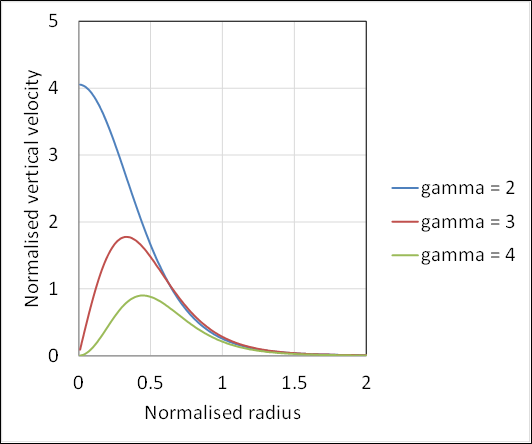
The expressions for the radial, circumferential and vertical velocities in the 2020 model are given in figure 2. Here the velocities are normalized by the maximum circumferential velocity and the radial and vertical distances by the radius at which the maximum velocity occurs. Note that this is different from the 2017 paper where the maximum radial velocity was used for normalization. The parameter K is related to what will be termed the swirl ratio S (the ratio of the maximum circumferential to maximum radial velocity) by a function of the parameter gamma, which is a shape parameter that affects the shape of the radial and vertical profiles. (Unfortunately this web template doesn’t support Greek letters, so I have to spell them out). Figure 3 shows typical velocity profiles for different values of this parameter.  It can be seen that for gamma = 2, the peak of the vertical velocity is at the vortex centre, as in a typical single cell vortex, whilst for higher values it moves away from the centre becoming more like a two cell vortex (but note there is no downflow at the vortex centre in this case.
Debris flight equations

The equations for compact debris flight are given in figure 4. These are the same as in the 2017 paper, although expressed a little differently. The debris velocities (lowercase) in the three directions are again normalized by the maximum tangential tornado velocity. Two dimensionless parameter are identified – the Tachikawa number Ta that relates the flow force on the debris particle to its weight, and a tornado Froude number Fr. Different dimensionless parameters were used in the 2017 paper, because of the different reference velocity that was used
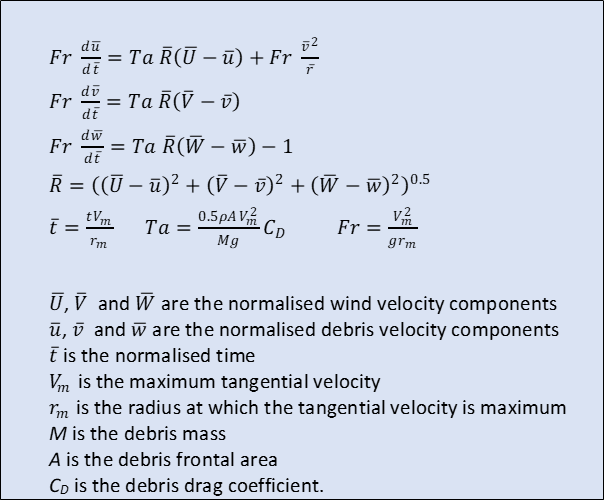
Figure 4. Debris flight equations

Solutions

Figure 5. Base case parameters

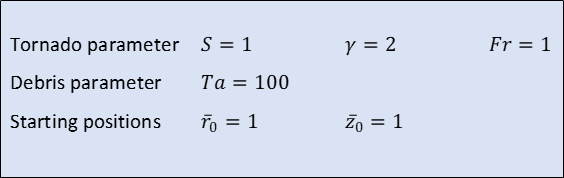
Putting together the velocity equations in figure 2 and the particle flight equations in figure 4, it can be seen that there are four parameter that define debris trajectories – the tornado parameters S, gamma and Fr, and the debris Tachikawa number Ta. In addition any one flight trajectory will be defined, at least in its early stages by the dimensionless values of the radius and height at its release point. If these six parameters are specified then the equations of debris flight can be solved in a straightforward manner.  In what follows we define a base case situation as in figure 5, and then vary each of the parameters around this base case value. We present the results in the animations of figures 6 to 11.Each animation shows four plots – the trajectories projected onto a vertical plane through the tornado centre; the trajectories projected onto a horizontal plane; the trajectories in a rotating plane in the radial and vertical directions, and a plot of the variation of particle kinetic energy with time. The latter acts as a damage indicator of debris flight, but also clearly shows whether or not the solution converges or diverges with time. Note that the dimensionless time shown in the kinetic energy plots is proportional to the time of revolution of the vortex – a time of 2 pi corresponds to one vortex revolution. 

aaaaaaaaaaaaaaaaaaaaaaaaaaaaaaaaaaaaaaaaaaaaaaaaaaaaaaaaaaaaaaaaaaaaaaaaaaaaaaaaaaaaaaaaaaaaaaaaaaaaaaaaaaaaaaaaaaaaaaaaaaaaaaaaaaaaaaaaaaaaaaaaaaaaaaaaaaaaaaaaaaaaaaaaaaaaaaaaaaaaaaaaaaaaaaaaaaaaaaaaaaaaaaaaaaaaaaaaaaaaaaaaaaaaaaaaaaaaaaaaaaaaaaaaaaaaaaaaaaaaaaaaaaaaaaaaaaaaaaaaaaaaaaaaaaaaaaaaaaaaaaaaaaaaaaaaaaaaaaaaaaaaaaaaaaaaaaaaaaaaaaaaaaaaaaaaaaaaaaaaaaaaaaaaaaaaaaaaaaa

Figure 6. Effect of variations in Tachikawa number

First consider the effect of changing Tachikawa number, Ta – see Figure 6. This represents changes in the nature of the debris. A low value of Ta represents heavy debris and vice versa. It can be seen that at low values of Ta, the debris tracks can reach significant heights and the debris undergoes a diverging motion when viewed in the radius / height plane, with a diverging kinetic energy oscillation. At some point in the trajectory the debris hits the ground and the energy falls to zero. The base case situation at Ta = 100 is still mildly diverging but the trajectory does not intersect the ground plane for the length of the calculation. As Ta increases further, the debris takes up a stable path in the radius / height plane travels around a small circular trajectory, with the kinetic energy converging to a stable value. This suggest that light debris can reach an equilibrium where it is held aloft by the tornado. The position around which the circular motion takes place is around a normalized radius of 1.3 and a normalized height of 0.9. The value of height is much less than calculated in the 2017 paper, reflecting the fact that the vertical velocity does not decrease indefinitely with height for the new model as it did in the old.

aaaaaaaaaaaaaaaaaaaaaaaaaaaaaaaaaaaaaaaaaaaaaaaaaaaaaaaaaaaaaaaaaaaaaaaaaaaaaaaaaaaaaaaaaaaaaaaaaaaaaaaaaaaaaaaaaaaaaaaaaaaaaaaaaaaaaaaaaaaaaaaaaaaaaaaaaaaaaaaaaaaaaaaaaaaaaaaaaaaaaaaaaaaaaaaaaaaaaaaaaaaaaaaaaaaaaaaaaaaaaaaaaaaaaaaaaaaaaaaaaaaaaaaaaaaaaaaaaaaaaaaaaaaaaaaaaaaaaaaaaaaaaaaaaaaaaaaaaaaaaaaaaaaaaaaaaaaaaaaaaaaaaaaaaaaaaaaaaaaaaaaaaaaaaaaaaaaaaaaaaaaaaaaaaaaaaaaaaaa

Figure 7. Effect of variations in Froude number

The effect of variations in Froude number is shown in Figure 7. The primary effect that increase in Fr has is to increase the centrifugal force on the debris. At low values, the trajectories are stable and similar to that of the base case. As the values increase above 1.0 the oscillations become larger due to the increased centrifugal forces and eventually become unstable, with the trajectories meeting the ground at high values.

aaaaaaaaaaaaaaaaaaaaaaaaaaaaaaaaaaaaaaaaaaaaaaaaaaaaaaaaaaaaaaaaaaaaaaaaaaaaaaaaaaaaaaaaaaaaaaaaaaaaaaaaaaaaaaaaaaaaaaaaaaaaaaaaaaaaaaaaaaaaaaaaaaaaaaaaaaaaaaaaaaaaaaaaaaaaaaaaaaaaaaaaaaaaaaaaaaaaaaaaaaaaaaaaaaaaaaaaaaaaaaaaaaaaaaaaaaaaaaaaaaaaaaaaaaaaaaaaaaaaaaaaaaaaaaaaaaaaaaaaaaaaaaaaaaaaaaaaaaaaaaaaaaaaaaaaaaaaaaaaaaaaaaaaaaaaaaaaaaaaaaaaaaaaaaaaaaaaaaaaaaaaaaaaaa

Figure 8. Effect of variation in Swirl Ratio

The effects of variations in the Swirl ratio shown in Figure 8 are complex, with diverging trajectories (and ground impact) at both low and high values, and a region of stable trajectories between values of around 1.0 to 1.9. At low values the trajectories are destabilized by the high values of radial velocity, and at high values are destabilized by high values of the circumferential velocity.

aaaaaaaaaaaaaaaaaaaaaaaaaaaaaaaaaaaaaaaaaaaaaaaaaaaaaaaaaaaaaaaaaaaaaaaaaaaaaaaaaaaaaaaaaaaaaaaaaaaaaaaaaaaaaaaaaaaaaaaaaaaaaaaaaaaaaaaaaaaaaaaaaaaaaaaaaaaaaaaaaaaaaaaaaaaaaaaaaaaaaaaaaaaaaaaaaaaaaaaaaaaaaaaaaaaaaaaaaaaaaaaaaaaaaaaaaaaaaaaaaaaaaaaaaaaaaaaaaaaaaaaaaaaaaaaaaaaaaaaaaaaaaaaaaaaaaaaaaaaaaaaaaaaaaaaaaaaaaaaaaaaaaaaaaaaaaaaaaaaaaaaaaaaaaaaaaaaaaaaaaaaaaaaaaa

Figure 9 Effect of variations in gamma

The change in values of gamma from the one cell form of gamma = 2 to the quasi-two cell form of gamma = 4 shown in Figure 9 results in little change to the debris trajectories from the base case, although the oscillations in the kinetic energy fall as gamma increases.

aaaaaaaaaaaaaaaaaaaaaaaaaaaaaaaaaaaaaaaaaaaaaaaaaaaaaaaaaaaaaaaaaaaaaaaaaaaaaaaaaaaaaaaaaaaaaaaaaaaaaaaaaaaaaaaaaaaaaaaaaaaaaaaaaaaaaaaaaaaaaaaaaaaaaaaaaaaaaaaaaaaaaaaaaaaaaaaaaaaaaaaaaaaaaaaaaaaaaaaaaaaaaaaaaaaaaaaaaaaaaaaaaaaaaaaaaaaaaaaaaaaaaaaaaaaaaaaaaaaaaaaaaaaaaaaaaaaaaaaaaaaaaaaaaaaaaaaaaaaaaaaaaaaaaaaaaaaaaaaaaaaaaaaaaaaaaaaaaaaaaaaaaaaaaaaaaaaaaaaaaaaaaaaaaa

Figure 10. Effect of variations in radial starting position

aaaaaaaaaaaaaaaaaaaaaaaaaaaaaaaaaaaaaaaaaaaaaaaaaaaaaaaaaaaaaaaaaaaaaaaaaaaaaaaaaaaaaaaaaaaaaaaaaaaaaaaaaaaaaaaaaaaaaaaaaaaaaaaaaaaaaaaaaaaaaaaaaaaaaaaaaaaaaaaaaaaaaaaaaaaaaaaaaaaaaaaaaaaaaaaaaaaaaaaaaaaaaaaaaaaaaaaaaaaaaaaaaaaaaaaaaaaaaaaaaaaaaaaaaaaaaaaaaaaaaaaaaaaaaaaaaaaaaaaaaaaaaaaaaaaaaaaaaaaaaaaaaaaaaaaaaaaaaaaaaaaaaaaaaaaaaaaaaaaaaaaaaaaaaaaaaaaaaaaaaaaaaaaaaa

Figure 11. Effect of variations in vertical starting position

The debris trajectories remain stable as the normalized radius varies between 1 and 1.9 but outside those limits the trajectories diverge and intersect with the ground (Figure 10). Similarly the trajectories are only stable for normalized values for height between 0.8 and 1.2 (Figure 11). Thus the starting point window for the trajectories to ultimately attain a stable form is quite small.

Concluding remarks

A number of points arise from the results presented above.

  • Even for the simple wind and debris flight formulation adopted, debris trajectories can be quite complex.
  • A comparison of the results obtained with the old and the new wind field model show very considerable differences, due to the different vertical velocity formulation. analysis reveals that the debris trajectories can be specified by a small number of debris and tornado parameters, with the Tachikawa number and the Swirl Ratio being the most significant.
  • There are regions within parameter space for which the debris trajectories become stable – i.e. the debris flies indefinitely.

Pollution, Covid and Trains

Voyager at Birmingham New Street

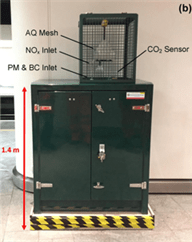
There has been a significant amount of research recently to investigate the air quality in railway stations. Perhaps the major study, with which I was very much involved, involved extensive measurements of the air quality at Birmingham New Street by colleagues at the University of Birmingham (Figure 1). Measurements were made of the oxides of nitrogen (NOX) and particulate matter (PM) and concentrations were measured that were considerably in excess of Environmental Health limits. Typical daily average results are shown in Figure 2. This work informed the efforts by Network Rail to improve the air quality at the station through an improved ventilation system. Further work was carried out by Kings College London and Edinburgh University, under an RSSB contract, to measure NOX and PM at Kings Cross in London and Edinburgh Waverley. Typical results are shown in figure 3 and although these results are not as extreme as the Birmingham measurements, do show some exceedances of environmental health limits. Between them, these three investigations have given a great deal of information on station air quality and informed methods for alleviating the worst of the effects.

Figure 1. Air quality measurements at Birmingham New Street
Figure 2. Daily pollutant levels at Birmingham New Street (red lines show EU limits)
Figure 3 Comparison of pollutant levels at New Street, Kings Cross and Edinburgh Waverley

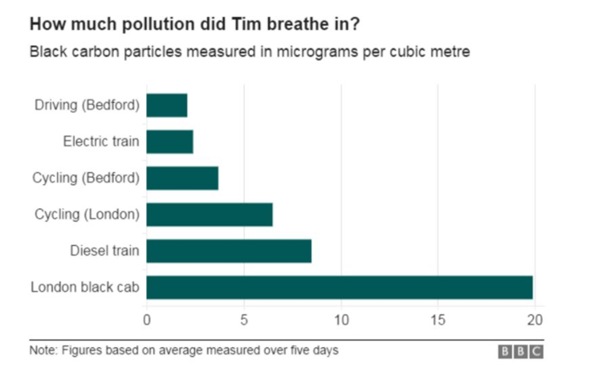
However, that is not the whole story. There are growing indications that air quality ON trains is also very poor. A study on diesel commuter stock in Canada has shown high levels of ultrafine particles and black carbon within the passenger cabins (Figure 4). In 2016 the BBC reported the measurements made by their reporter Tim Johns  as he commuted into London, which again showed high particulate levels on diesel commuter trains, although not as high as in Black Cabs (Figure 5). Similarly, the BBC in 2019 reported a study by the Committee on the Medical Effects of Air Pollutants which showed very high levels of particulates on the London underground (Figure 6) which resulted in a strong response from the rail unions. These high levels are presumably due to two sources – diesel particulate emissions from trains being ingested into air conditioning systems, and also from ambient particulates in the dirty tunnels of the underground. The levels of particulates measured have significant implications for human health, particularly for those with respiratory conditions.  

Figure 4. Air Quality measurements on Canadian trains
Figure 5. Particulate measurements by BBC Reporter
Figure 6. BBC report on Underground particulate levels

Similarly, some work has been recently reported from Greece that shows elevated levels of both gaseous pollutants and particulate pollutants on diesel trains, both in excess of EU limits (Figure 7). Again this is presumably due to ingestion of diesel emissions by ventilation systems. Hopefully in the near future we will see the results of more quantitative investigations for the UK of on train NOX and particulate concentrations, and of work to investigate the ingestion of external pollutants, both from diesel emissions and dirty environments, by ventilation systems. However current indications are, that, care should be taken in using ventilations systems that draw external air into the train without the use of extensive filtering of the input.

Figure 7. NOX measurements on Greek train (red line is EU limit)

And then along comes Covid-19. The importance of high levels of ventilation on reducing pathogen concentrations and thus the risk of infection is becoming clear – se for example the recent seminar organized by the University of Birmingham. Ideally, very high (airline) levels of air exchange with the outside are required in internal environments, including trains and buses. An interesting illustration of this is provided by the publicity material in figure 8 produced by SNCF in France. I have seen nothing similar for the UK. There is an obvious dichotomy here between the need to reduce external air intake to minimize NOX and PPM ingestion and to keep internal levels of NOX and particulates at an acceptable level, and the need to increase ventilation rates to decrease pathogen levels. Both could be achieved by aggressive filtration of the air drawn through the train. However, this is likely to require major modification to existing trains in Britain, that won’t be cheap. I suspect train ventilation is going to become a major issue in the near future.

Figure 8. SNCF publicity material

A historical curiosity – Fog Cottages

The original Lichfield Trent Valley station

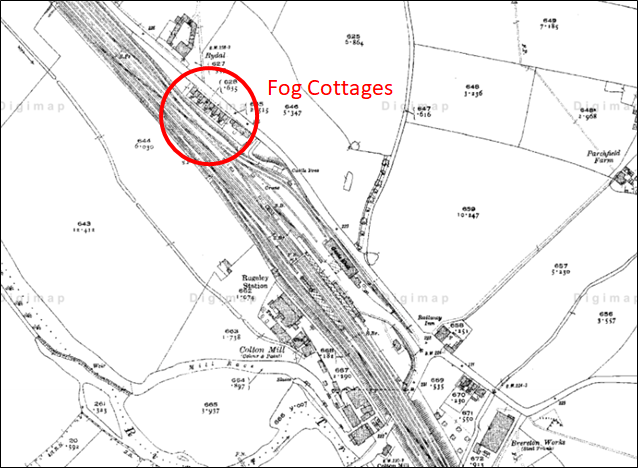
Next to the original Lichfield Trent Valley station (north if the current one – see my blog post at https://profchrisbaker.com/…/lichfield-trent-valley…/ ) the OS map of 1900 shows a row of cottages that the census return names as Fog Cottages as shown in figure 1 below.

Figure 1. Lichfield Trent Valley 1900 OS map

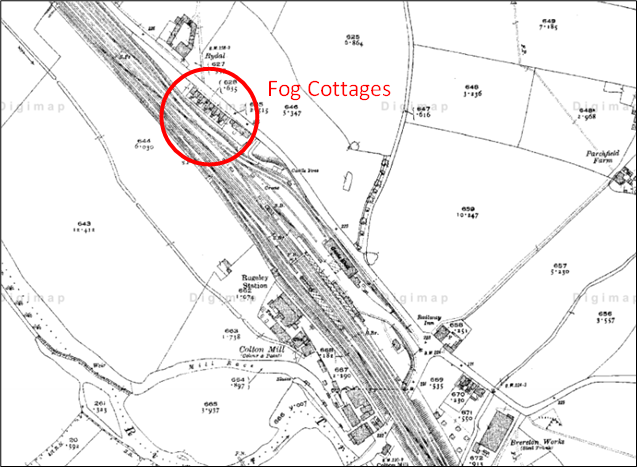
I noticed recently whilst out walking that there is another similarly named row of cottages just beyond Rugeley Trent Valley station. This is not shown on the 1900 map, but is there on the 1920 map, again shown on Figure 2.

Figure 2. Rugeley Trent Valley 1920 OS Map

The Staffordshire Past Track website has a picture of these cottages at https://www.search.staffspasttrack.org.uk/Details.aspx… with the following explanation for the name.

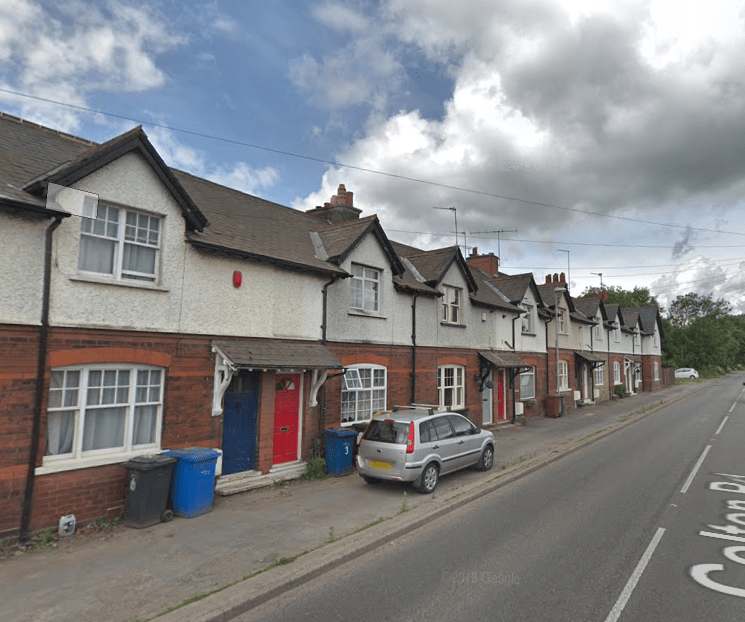
“A postcard view of Fog Cottages, on the Colton Road near Trent Valley Station, Rugeley. They acquired the name Fog Cottages because the end cottage had an alarm bell installed and this was used in foggy conditions to call out the railway men who lived in the cottages to go and place fog detonator alarms on the nearby rails to assist the train drivers.”.

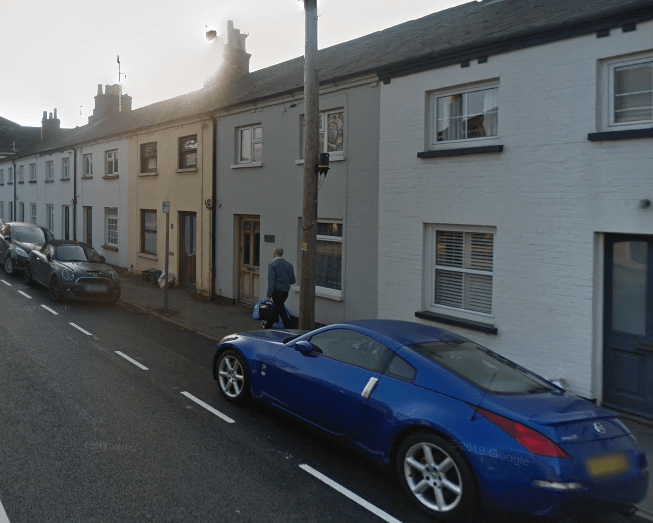
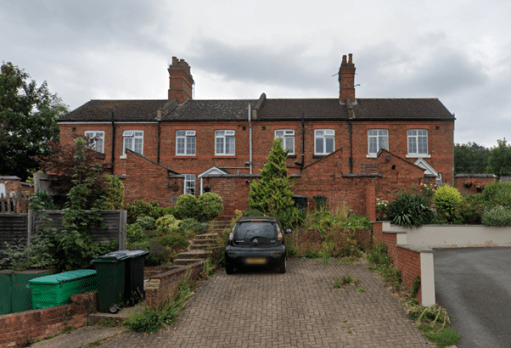
A modern view of the Rugeley Cottages (from Google Street View) is shown in Figure 3 below.

Figure 3. Fog Cottages, Rugeley

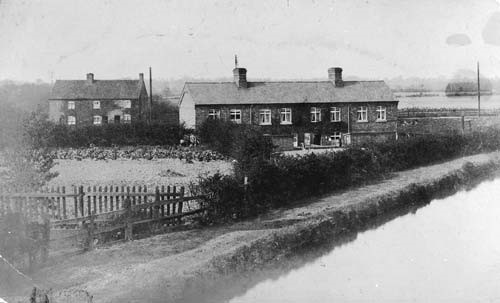
The question then arises as to whether the name of Fog Cottages has more widespread use. And the answer is that it does. Mathams and Keshall (2014) present an old photograph of a now demolished set of Fog cottages at Amington, next to the LNWR line north of Tamworth (Figure 4).

Figure 4. Fog Cottages Amington (Mathams and Keshall, 2014)

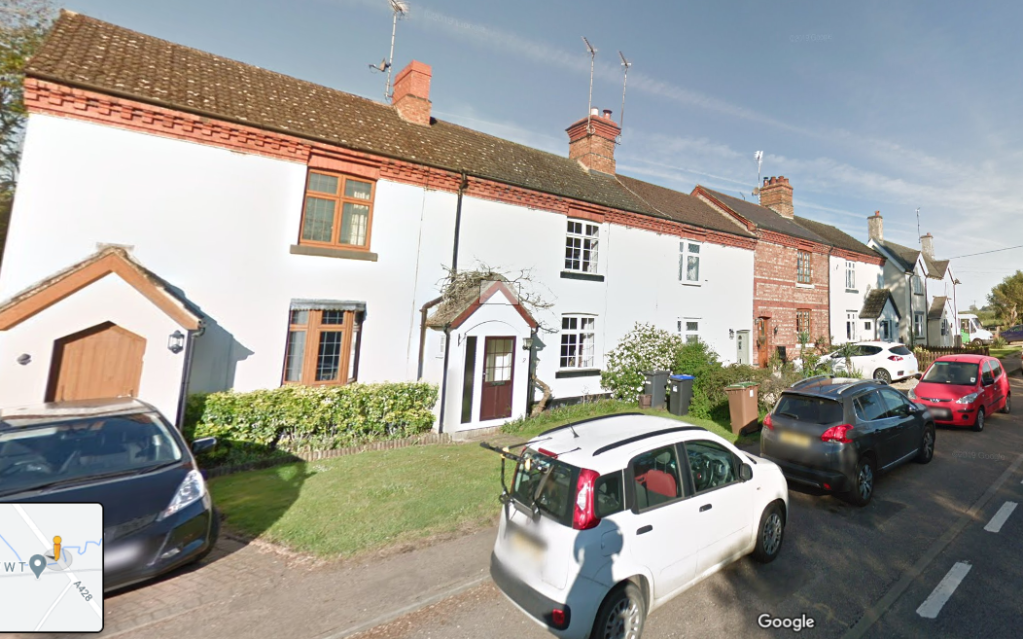
Rightmove (perhaps one of the more unusual historical sources!)  reveals that there are Fog Cottages at Watford, Collingtree and Althorp Parkin Northamptonshire and at Tring in Hertfordshire (see the Google Street View shots of these in figure 5). There are almost certainly more that I have not identified. All are next to the LNWR line, but only some are near stations or the sites of former stations. On the Amington Cottages Mathams and Keshall write

The LNWR standard cottages were built after 1883 when the design was introduced by Francis Webb, Chief Engineer of the LNWR and later examples – built after 1883/4 – are recognisable by the courses of stepped-out brickwork on the gable ends and under the eaves, and the four red-brick bands which run round the building in line with window sills and lintels, all of which can be seen in the picture below.  Nearly everything (except the slates) came from the LNWR works at Crewe;  bricks, woodwork and metal fittings.  

I can find no mentions of Fog Cottages other than in LNWR territory so it looks as if we have here a specifically LNWR naming policy. But if there are any occurrences away from the LNWR I would be pleased to be told.

A brief look at the incidence of Covid-19 in UK Universities

See the source image

Alarm has been expressed by many commentators at the prevalence of Covid-19 in UK Universities, and on the face of it, the figures do seem to be alarming. For example, the UniCovid UK website that attempts to track the spread of Covid in Universities indicates that, as at October 17th 2020, since the start of term there have been 1650 cases at the University of Manchester and 1522 at the University of Northumbria. This data comes from a variety of sources where it is reported in different ways and needs to be treated with caution, but nonetheless gives a broad indication of the current situation. However these raw figures do not give a real indication of the situation since they do not take into account the size of the institution or the length of time since the start of term, which differs from place to place. To look at this in a little more detail I have carried out the following simple analysis using the UniCovid UK data at October 17th 2020.  I have taken the number of reported cases since the start of term at each institution and divided them by the factor (total student population x days since the start of term / 14). This gives a rough approximation of the proportion of students who might currently be expected to have Covid-19, making the assumption that the illness lasts for 14 days. I am very aware of the other implicit assumptions involved in this calculation (the assumption of constant infection rate,  the neglect of the different demographic profiles of different universities, different rates of testing and so on), but at least it gives a crude normalization of the data. On this basis, the 30 Universities with the highest percentages of students currently with Covid-19 is shown in the table below.

Approximate % of students infected (October 17th 2020)

Now the UniCovid UK web site gives the prevalence of the virus amongst the student age population as between 0.24 and 0.52%. Most of the Universities in the above table lie above the upper bound value, but many not by a great amount (and here the assumptions in the analysis need to be kept in mind). Only twelve exceed a value of greater than 1% of the students having the virus. Whilst for some of these top twelve the situation is clearly very serious, with the proportion of those infected many times the expected levels, the numbers suggest that the issues are localized – and indeed mainly in areas where there are high rates of infection in the wider community.

The Kingswinford Tithe Agreement

The 1840 Fowler Map

In Kingswinford Manor and Parish (KMAP) I have written extensively about the two Fowler Maps of 1822 and 1840 – two large scale maps of the parish that were produced for the landowners  by W. Fowler and Co. and which, together with their Books of Reference that give names of owners and occupiers, give a detailed picture of the life of the parish at that time. When the Staffordshire Tithe Maps were published on line by Staffordshire Fast Track, and described in outline in another blog post, it came as a considerable surprise to me to find that the Kingswinford Tithe Map was actually a version of the 1840 Fowler map, with some added information on tithe rental values and ownership. In this post, I will belatedly (and to my shame as I should have known about this much earlier) consider this new material in the light of the discussion in KMAP, to see what new insights it brings.

Tithes before 1840

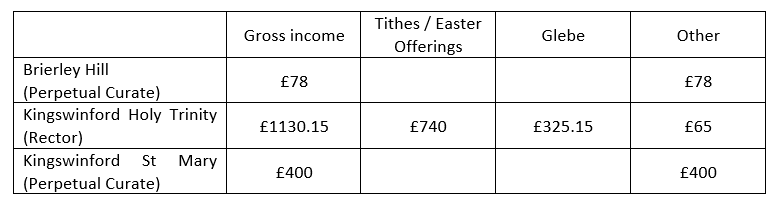
The Tithe Commutation Act of 1836 replaced the old tithe system in which a tenth of the produce of the land was given to the church either in kind, or through a cash allocation, with a rental system where a tithe rental charge was allocated for each portion of land. In preparation for the Act, in 1832 the Ecclesiastical Commissioners wrote to the incumbent of every parish in the country asking for details of their income from tithes and other sources. The returns for Kingswinford parish are shown in table 1.

Table 1 Church income 1832

The chapel of St Michael at Brierley Hill had been opened in the 1760s and was staffed by a Perpetual Curate. The new parish church was Holy Trinity at Wordsley, which was built in 1831, when the old parish church of St Mary in Kingswinford village was felt to be too small for the growing population, and was also suffering damage to its fabric due to mining subsidence. The Rector was based at the former whilst the latter was staffed by a Perpetual Curate. It can be seen that the income has three components – tithes and easter offerings, rental from Glebe land (land set aside for the use of the clergy) and other sources. The Perpetual Curates relied on the latter, with the tithe and glebe income going to the Rector. The overall figure for the Rector of £1130 would have made the parish one of the most lucrative in the county (see E Evans 1970, “A History of the tithe system in England 1690-1859 with special reference to Staffordshire”, PhD thesis, Warwick University), and was much sought after by clergy in the eighteenth and nineteenth who often did not take up residence and left all their duties to paid curates, but took most of the income for themselves.

Before the passing of the Act, the collection of tithes would have been an arduous affair, and would usually have been carried out by a paid tithe collector, who would travel around the parish at harvest time to take their due from the landowner, and would also assess and collect a tenth of the other produce of the land – in terms of cattle, sheep, wool etc.. In Kingswinford there were more than a hundred tithe payers, and over two thousand distinct plots of land and tithe collection was obviously a complex affair. In addition, there were a range of extra customary dues that had to be collected, known as moduses. For example, for Kingswinford parish these included a modus of two pence / per acre on all meadow and pasture land; one penny and a halfpenny for a cow and a calf; one penny for a garden; and four pence for a colt. Not all land was treated in the same way – for example the lands enclosed by the Ashwood Hey Enclosure in 1776 were only liable for the tithes of “wool and lamb”. When the difficulties of collecting all that was due are considered, it can be seen that the move to a tithe rental was a major simplification and seems to have been broadly welcomed in the parish.

The Rector and landowners of the parish were keen to move to a new system, and soon after the Act became law they moved quickly to reach a voluntary agreement on tithe rental by June 1838. In many other parishes in the county and elsewhere agreement on tithe rentals could not be reached voluntarily and tithe commissioners imposed a valuation. The results of the agreement are contained within the Tithe Allocation agreement and the associated map. 

The Tithe Allocation agreement

The total area of the parish of Kingswinford was 7319 acres. Of this, 6032 acres (82.5%) was allocated a tithe rental.  The only recipient of tithe rentals was the Rector of the parish, George Saxby Penfold, which was one reason why reaching agreement was straightforward. The total rental allocation was £813. Of those lands that were assessed for no payment, 174 acres was Glebe (i.e. allocated to the Rector, who was not expected to pay the tithe rental to himself, and usually rented to others for farming) and 178 acres was the Corbyn’s Hall estate which was tithe free (see below). The rest of the untithed land was composed of many very small plots of land which presumably had their allocation rolled into nearby tithed land, so as to simplify the allocation and collection procedure. (Note that these figures are taken from summing those that have been transcribed from the Fowler Reference and the Tithe Agreement, and do not quite match the equivalent figures in the tithe agreement, due to  differences in the allocation of plots to different categories. The differences are however small and of no real consequence.)

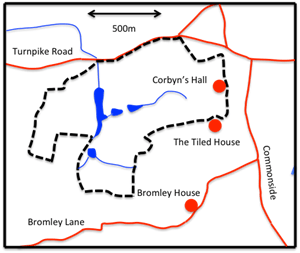
The fact that Corbyn’s Hall was specified as tithe free is of interest. It is not clear why this is the case but was presumably the result of how the estate was originally established. In KMAP I speculated that the Corbyn’s Hall, Tiled House and Bromley Hall estates were originally one land unit. The fact that the latter two were allocated tithe rentals in the normal way suggests that this might not have been the case. At the time of the tithe allocation map, the extent of the Corbyn’s Hall estate was very similar to that shown on a  1703 map of the estate shown in outline in figure 1 below (again from KMAP), and included the region around Corbyn’s Hall and Shut End, some land in the Tansey green region and a block of land around Standhills.

Figure 1 1703 map of Corbyn’s Hall estate

The way in which tithe rentals were allocated to individual portions of land is not wholly clear from the tithe agreement. The land in the parish seems to have been allocated to a small number of land use categories – arable, meadow and pasture; woodland; and a further miscellaneous category combining mines, road and houses etc. The calculation given in the tithe agreement gives 3486 acres of arable land; 1532 acres of meadow or pasture; 154 acres of woodland; and 1655 acres in the miscellaneous category. A rental / charge per acre was applied to each category other than the miscellaneous for which no charge was allocated. For the arable land this was based on a weighted average of the cost of wheat, barley and oats over the previous few years.  

If the tithe rentals for plots of land greater than one acre in size are plotted against the allocated rental (figure 2) it is clear that there were two basic rental allocations – one at around 5s per acre (the green line) and one at around 1s per acre (the red line). In general arable land and high status houses and ground cluster around the green line, and pasture and woodland around the red line. There is considerable scatter about these lines however, which no doubt reflects the specific circumstances of each plot of land and lengthy debates between the landowner and the Rector.  In the area that was enclosed by the Ashwood Hay act, the arable land is also clustered around the lower red line, no doubt reflecting the lower tithes that were prescribed by the act (see above). Most of the land in the miscellaneous category was not allocated a tithe rental.

Figure 2 Tithe Allocation

Table 2. Tithe payers and landowners

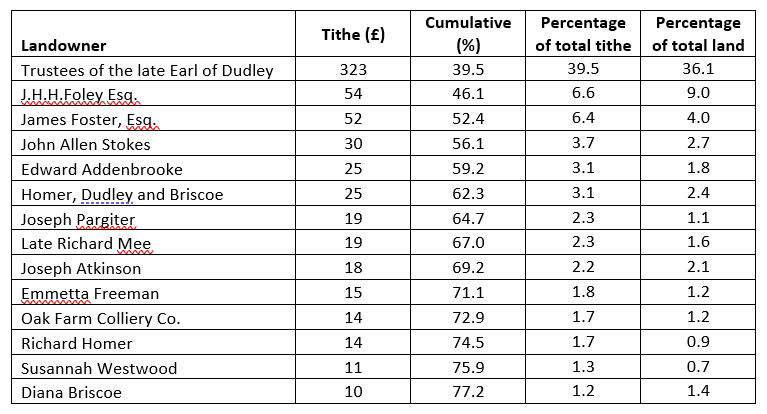
In total there were one hundred and twenty six tithe payers, although this involved some duplication due to some individuals being involved in partnerships that were assessed for tithes. Of these one hundred payed less than £5 and sixty six payed less than £1. The fourteen who payed more than £10 are shown in table 2. The cumulative tithe column in the table shows that three quarters of the tithe rental was paid by just thirteen individuals or organisations. The percentage of the tithe that each payed is also given, as is the percentage of the land that they owned (from KMAP, chapter 4). As is to be expected, the figures in these columns correlate quite well, with the percentage of tithe rental being in general greater than the percentage of land, due to the significant proportion of untithed land.

The other major landowners given in KMAP are the Glebe lands, the lands of John and Benjamin Gibbons,, and the Stourbridge Canal Company.  As noted above, the Glebe lands were tithe free and provided the Rector with an income as they were rented out for farming. The Gibbons main holdings were on the tithe-free Corbyn’s Hall estate. It would also seem that when the Stourbridge Canal Company was formed it purchased land without the tithe obligations, and the land it gained in the Fens area from the enclosure of Pensnett Chase was also tithe free.

Reducing train aerodynamic resistance through the use of slab track

Ballastless double track of the type "Rheda 2000" including concrecte slabs and ties/sleepers, rails, and drainage slits.

There are major efforts underway to “decarbonize” the GB rail network. One way of pursuing this goal is to reduce traction energy costs which would contribute to decarbonization either directly through the reduction in fossil fuel use, or indirectly through the reduction in the use of electricity produced from non-renewable sources. In this post,  I will attempt to show that the  train aerodynamic drag reduction due to the use of slab rather than ballasted track may result in significant fuel and energy savings for an entire train fleet that would contribute to the decarbonization agenda and that could radically change the overall business case for the installation of slab track, which is currently only used in specific circumstances. It will be seen that the argument is very speculative in places, but perhaps strong enough to warrant further investigation. We begin in the next section with an introduction to train resistance.

Train Resistance

The specification of train resistance is required for the assessment of energy consumption, train timing etc. Now train resistance is, very broadly, composed of mechanical (rolling) resistance and aerodynamic resistance, and is conventionally described by the Davis equation given in equation (1).

Equation 1

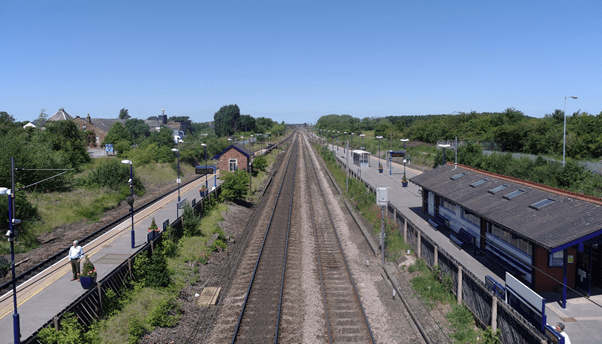
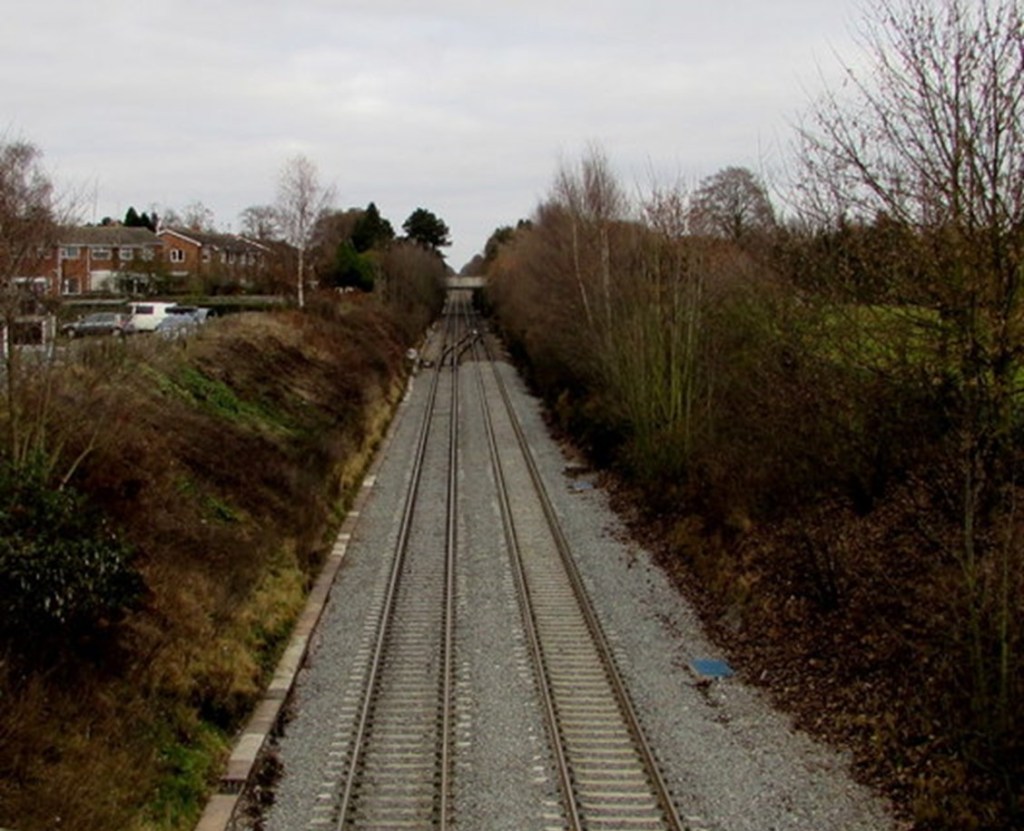
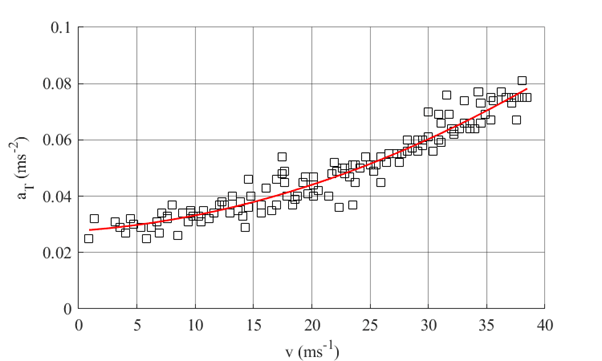
Here v is the train speed and a, b and c are constants. The first two terms are taken to be the mechanical resistance, and the last term is taken to be the aerodynamic resistance. The aerodynamic resistance is thus proportional to the square of train speed and becomes progressively more important as train speed increases.  The parameters a, b and c are usually obtained from coast down tests on (ideally) straight, level section of track, in which trains coast from top speed to zero and acceleration, speed and distance are measured. A quadratic curve is then  fitted to data. Typical examples of tests sites in the UK are given in figure 1 and a typical set of results in figure 2. Note that this figure and most of those that follow are taken from the recent book “Train Aerodynamics – Fundamentals and Applications” by myself and a number of colleagues. Note also that it is also possible to estimate the aerodynamic component of resistance from wind tunnel tests and CFD calculations, but there are significant technical issues (mainly due to the inability of both techniques to model full length trains) and thus in what follows we  consider only data from full scale measurements.

Figure 2 Typical results for Class 45 and 6 passenger coaches between Thirsk and Northallerton

Drag coefficient

The coefficient c is related to the aerodynamic  drag coefficient CD by the simple expression of equation (2).

Equation (2)

Here A is the frontal area of the train and r  is the density of air. The drag coefficient for a wide range of trains is shown in figure 3 (from ???).

Figure 3. Drag coefficient correlation

Very broadly, for any individual train class, the drag  coefficient in linearly proportional to train length, and can be represented by the simple form of equation (3).

Equation (3)

Here L’ is an effective train length (the length of the train minus the length of the nose and tail sections) and p is the wetted perimeter of the train envelope. The values of the parameters K1and K2 are given in table 1 for the train types shown in figure 3.

Table 1 Parameter values

Breakdown of Aerodynamic drag

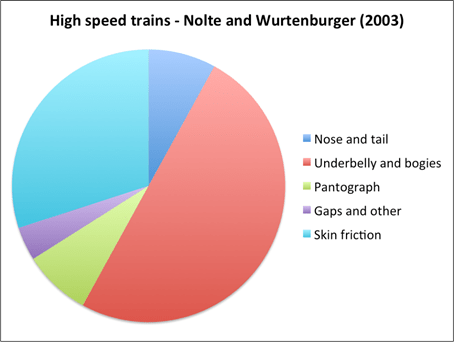
Figure 4 shows how the components of aerodynamic drag for high speed trains from the work of two different authors. Whilst there is some variability between the results it can be seen that the drag of the underbelly and bogies contributes 20 to 50% of the overall drag and skin friction drag on the train side and roof contributes 30% to 40%. An important point to appreciate is that the underbody drag includes drag due to the track roughness – energy needs to be used to overcome the aerodynamic resistance of the track itself. This point does not seem to have been well appreciated in the past.

Referring back to equation (3), K2 is a friction coefficient for train, combining theeffect of skin friction on side and roof and bogie and underbody drag. As can be seem from figure 3, values of 0.004 are typical for high speed trains (but note the quality of fit is not terribly good).

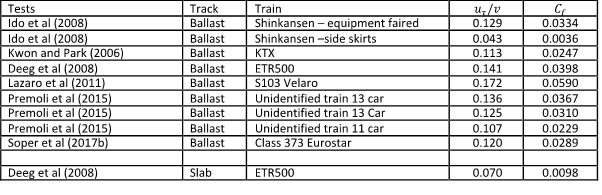
Friction coefficients can be obtained directly from measurements of the velocity profile on the side and beneath the train and then fitting of logarithmic profile to the data. This process is somewhat difficult and subjective, but has nonetheless been attempted by a number of authors in the past. Table 2 shows the values for skin friction on the side of the train that have been obtained, and table 3 shows values for the underbody of trains.

Table 2 Skin friction coefficients
Table 3 Underbody friction coefficients

Typical values of the former are 0.0015 and  typical values for the latter for ballasted track are 0.03. The higher values for underbody coefficient are of course to be expected because of the roughness of the train underbelly. For slab track the one set of data available gives a significantly lower value of the underbody friction coefficient of 0.01.

Synthesis

If we assume that, for high speed trains, skin friction values of 0.0015 and underbody drag of 0.03 and assume that the former acts over 90% of the wetted perimeter and the latter over 10% these weights give a value of K2 of 0.00435 which is consistent with drag compilation value from table 1 of 0.004 and result in a drag coefficient of 1.4 for a 200m high speed train. If underbody drag reduced to 0.01 by use of slab track, the same calculation leads to drag coefficient of 0.81 – a staggering 40% decrease. A rule of thumb that is often applied is that a drag coefficient reduction of x% results in an energy saving of 0.4x% suggests 40 x 0.4 % which suggest a potential reduction in fuel use of 16%.

Now many assumptions have been made in the above analysis, perhaps the most significant being the value of friction coefficient for slab track, which is based on one set of experimental results only. Thus the argument that significant fuel cost reductions might be a possibility through the use of slab track more widely, is at best suggestive but I would suggest merits further investigation. The question arises as to whether such energy savings have the potential to change the business case for slab track, which is in general only currently used for very specific situations such as tunnels, poor ground conditions etc.  I would thus suggest a preliminary investigation that addresses the question of what reduction in drag coefficient would actually be required to change business case for slab track? As both infrastructure and trains would be involved, a system approach would be required here. If further investigation of the business case shows that it is worth pursuing these ideas, the next stage would be to conduct coastdown tests with the same train over ballasted and slab track. A long straight level section of slab track would thus be required. Does such a section of track exist in the UK?
Leisure travel by rail after the pandemic

Figure 1 Public transport use in the UK

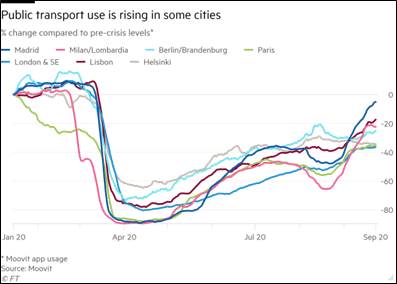
It is becoming clear that the effect of the Covid-19 pandemic on public transport in the UK is very significant, and is resulting in a major reduction in rail and bus use that looks as if it will persist at least in the short and medium term and also possibly into the long term future. Figure 1, compiled from DfT statistics, shows the seven-day average use of rail and bus over the course of the pandemic, up to 29/9/2020. It can be seen that rail and tube use seems to be plateauing at around 40% of the pre-pandemic values, and bus use at around 60%. The same trend can be seen in other cities around Europe – see figure 2 from the Financial Times, which shows general public transport use. London does however seem to have a greater reduction than other capital cities.

Figure 2 Public transport use in major European cities

The trends shown on figures 1 and 2 do however mask considerable geographical and service type variations. There is evidence that the use of public transport in larger cities has fallen more sharply than in smaller conurbations, and also that travel patterns are changing. Network Rail Chairman Peter Hendy made the following comment at a recent online conference

“It is clear that people’s methodology of working has changed. Many jobs can’t be done from home, but there are lots of people who can work from home and have learned something they didn’t know before and are learning to live in a different way. Leisure travel has returned quicker than work travel. One of the scenarios that we might want to have in our heads is that we might be going back to a situation like the 1950s, when maximum traffic on the railway was on peak summer Saturdays and not in  what we now regard as normal peak hours.”

My personal experience would tend to confirm this – I, and others in my family, have recently travelled on quite heavily loaded services with passengers heading for leisure destinations in the north of England. This trend is also clear in the data from the excellent Centre for Cities website for Birmingham and Bournemouth, shown in figures 3 and 4 below. These show a variety of metrics that indicate how these places are recovering. It is clear that activity in Birmingham, a major commuter hub, remains well below pre-pandemic values, whilst activity in Bournemouth, at least in part a leisure resort, has in general increased.

Figure 3 Centre for Cities data for Birmingham

Figure 4 Centre for Cities data for Bournemouth

In this post I want to consider briefly how the rail network might take into account this leisure market. In pre-nationalisation days and the early days of BR, this market was catered for by excursion traffic from the major centres of population to a range of coastal resorts. In retrospect this involved a very inefficient use of rolling stock, with the carriages that were used for these excursions often having no other use other than at summer weekends. It also required extensive siding space at the resorts themselves, as the trains often waited there for a significant time before returning. After the demise of such traffic, the strategy (if one can use that word) seems to have been to provide an essentially local service on the routes to resorts, with connections to the main line, and to simply accept overcrowding oh high days and holidays. By its very nature such a strategy was self-limiting in terms of passenger numbers – the experience of trying to crowd onto a two-coach multiple unit with a family and luggage is not one that is willingly repeated if there is another way to travel.

So is there a way in which such traffic can be catered for in a more passenger friendly way? I would suggest there is, but it requires significant changes to the structure of the industry to make it effective. Firstly, it seems to me that there are a number of basic passenger requirements.

  • Passengers wish to go from their point of departure to their destination without changing trains – particularly those travelling with family and luggage.
  • There should be significant space for luggage, so that aisles and vestibules are not blocked.
  • There should be no overcrowding.

On a basic level these points suggest that excursion traffic and local traffic should be kept separate, with the former running directly from departure to destination. With regard to the first bullet point, considering the Birmingham / Bournmouth route as an example, trains should pick up at a small number of points in the West Midlands conurbation (say Wolverhampton, Sandwell and Dudley, Birmingham New Street and Coventry) and run non-stop to Poole and Bournemouth. The normal intermediate stops of Banbury, Oxford and Reading (amongst others), delightful as these places are, are simply of no interest to leisure travellers. The second point suggest that luggage facilities should be provided, perhaps in a separate coach with luggage tagged, loaded and unloaded by station staff. And the third point suggest that such trains should have compulsory reservations and those without reservations not allowed to board.

How could such an operation be achieved, making efficient use of rolling stock? I would suggest that there is already sufficient rolling stock available, particularly with the increasing use of relatively high speed, hybrid multiple units that are not restricted by the extent of electrification. However, a national approach needs to be taken, such that some rolling stock of this type is used for local, regional and  commuter services for much of the year, is transferred to excursion traffic during the summer when the local and regional demand is lowest. This requires a national approach to stock utilisation that cuts across TOC / Operating Unit boundaries, and also a similar integrated approach to timetabling and service provision. One could thus envisage for such services route 9 or 10 coach  hybrid multiple units, that would normally work on local and regional services, operating as excursion stock in the summer, both on weekdays and at weekends. Luggage facilities could be provided in one coach that has fold down seating, which is a perfectly viable concept. Passengers would deposit and collect their luggage at stations, which would require a suitable luggage tracking system and appropriate staffing. Reservations would need to be made before hand and systems put in place at stations for allowing only those with such reservations to access the platform as the train arrives.

The above is a suggestion for only one type of leisure traffic – the medium to long distance excursion market. There are many other types of leisure traffic that need to be catered for and a variety of methods need to be developed. The important point is that such traffic cuts across the neat geographic and organisational boundaries of the current system and require a national approach to stock utilisation, timetabling, station organisation etc. The current organisation of the network, with the multiple internal boundaries and barriers between regions and operating units, would simply not allow such services to be developed. Perhaps a nationwide “Leisure Travel” operating unit needs to be considered? Something for the still slumbering “Guiding mind” to think about?

Journeys by rail and coach

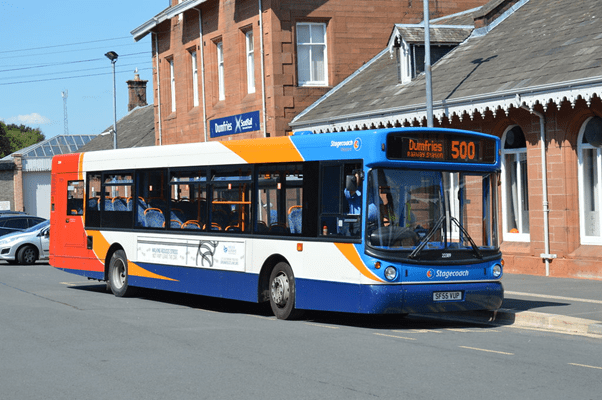
Stagecoach 500 at Dumfries Station

I recently travelled from my home in Lichfield to Gatehouse of Fleet in Galloway. The journey involved three trains (Lichfield to Crewe, Crewe to Carlisle, and Carlisle to Dumfries) and one bus journey (Stagecoach 500 from Dumfries to Gatehouse). The journey in both directions was, apart from some minor late running, pretty much without incident, and all the connections were made comfortably. The trains were comfortable and, as required for the moment, suitably socially distanced. The bus legs were similarly comfortable, with rather plush coaches and helpful drivers. That being said, the journey reinforced thoughts I often have when making journeys of this sort, that the weak links are the interchange between train and bus, and also the physical infrastructure of the bus pick up and set down points. I will consider each of these in turn with regard to my recent journey, but the same or similar points could be made for other journeys of this type.

The problem of train / bus interchange begins well before the journey itself, when journeys are being planned and fares considered. Finding the bus timetable is easy enough, even with current Covid related restrictions, but nonetheless required searching different web sites for the information, and making some sort of assessment of suitable connection times. No information at all was available on the fares, and I had to enquire of the bus driver on the outward leg as to whether returns were available or not. They were, at a very reasonable price, but it would have been good to know beforehand. On the journey itself, having alighted at the quite delightful Dumfries station, we found the rather flimsy bus shelters outside the station, effectively in the middle of a pedestrian thoroughfare. The weather, for both the outward and return journeys, was fine so this mattered little. No information at all was provided on how the bus was running, when it was due etc. But it came on time and all was well.

All the above could so easily be improved – by integrating train and bus timetables and fares; by extending a canopy from the station to serve as a bus waiting area and incorporating the bus area more completely into the station complex, so that toilets, the café etc. are more easily accessible to bus passengers; and developing the passenger information system so that details of both trains and buses were included.

At Gatehouse the facilities are rudimentary – simple bus shelters on the pavement with little by way of information, either on timetables or real time. The latter was not helped by recent Covid related service changes however. Once again this could so easily have been remedied – there is space available for a dedicated bus pick up / drop off point, ideally with more substantial passenger facilities that could act as a transport focus for the town; and the technology is available for real time bus running information to be made available.

Obviously the situation with regard to train / bus interchange and to local bus waiting facilities will be unique to any situation, but it does seem to me that there are two basic areas of improvement as follows.

  • Information – the integration of time, price and ticket information and purchase for at least a selection of important bus / coach routes with the train boking systems; and real time passenger information at interchanges and bus stops.
  • Infrastructure – at interchange points, the full physical integration of bus waiting facilities into the train station facilities; and the provision of more substantial local bus facilities that are ideally not part of a pedestrian throughfare.

But the question that then arises is who should be responsible for such facilities – it is clear that at the moment these fall into gaps between the train infrastructure and service operators; the bus operators; local authorities and community groups. Much has been said recently of the need for a “guiding mind” to oversee the rail network. I would suggest that this guiding mind, should it ever achieve consciousness, should have a wider role in the overall transport network, and particular in the field of modal interchange. The post-Covid recovery of the public transport network would benefit greatly from this.

Lichfield Trent Valley 1847-1871

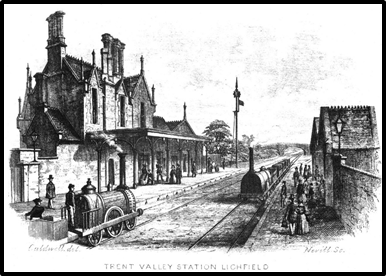
Figure 1 The original LNWR station looking north (down platform on left; up platform on right)

As it stands today, Lichfield Trent Valley railway station is situated at the point where the West Coast Main Line (WCML) is crossed by the extension of the Cross City Line towards Burton-upon-Trent. It has three platforms – two low level platforms on the WCML and one high level platform on the Cross City Line. It lies to the east of Trent Valley Road, the old turnpike road from Lichfield to Burton. In this post, I will describe the earliest stations in this area that existed between the late 1840s and the early 1870s and will also describe the career of the first station master. It will be seen that the grandeur of the early station building and the status of the Station Master in Lichfield society indicates the importance and significance of the early railway system.

The original Lichfield Trent Valley station

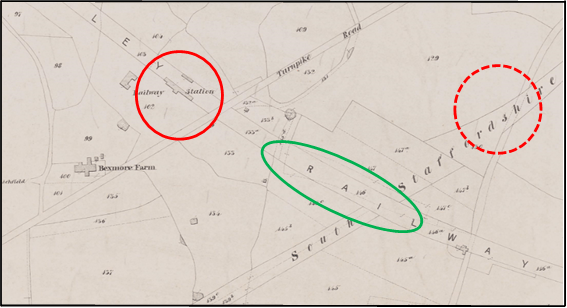
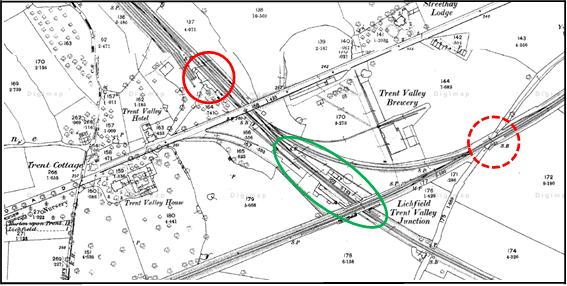
The positions of the first stations in the area are shown on the Lichfield St. Michael parish (Streethay township) Tithe Map of 1848, an extract from which is given in figure 2. The current station location is indicated by a green oval. The original 1847 Lichfield station of the London and North Western Railway (red circle) is on the west of the Turnpike Road, with platforms on either side of the track, and the main station building on the down line. The station is illustrated in the drawing of figure 1 and can be seen to be quite a substantial affair, designed by the architect John William Livock in the gothic style. It was clearly designed to make a statement as to the importance and grandeur of the company. As was normally the case at the time, the platforms were much lower than is the case today. The Turnpike Road crossed the railway on a flat crossing rather than the current bridge, and it is likely that passengers also used this crossing.  The map also shows the line of the South Staffordshire Railway that crosses the London North Western line, although that was not completed when the map was produced and not opened until 1849. Its station (Lichfield Trent Valley Junction – indicated by the dotted red circle) was just to the south of the point where the  line crosses the Old Burton Road and was connected to the LNWR station by a chord as shown in the 1882 Ordnance Survey Map of figure 3. It is not known if there was also a pedestrian connection between the stations, but one can surmise that there was as otherwise the walk between the two would have required a considerable trek along local roads and tracks. (For those who know this area, this would have entailed a walk down Burton Old road in Streethay, to the current junction with Cappers Lane, which did not exist at the time, then along Burton Old Road east to the path across the Cross City line by the tip, then up Trent Valley Road to the other station.)

Figure 2 Extract from 1848 Tithe Map (red solid circle LNWR station location 1847-1871; red dotted circle – SSR station location 1849-1871; green oval – location of  current station)

Figure 3 1882 Ordnance Survey map showing the station sites (key as in figure 2)

Building survival after closure

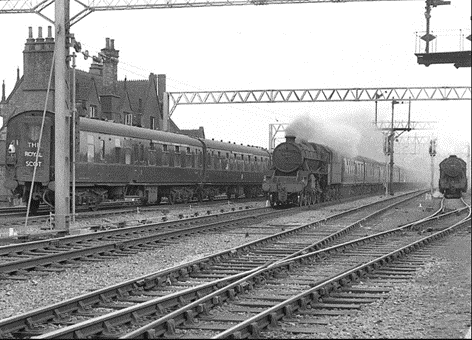
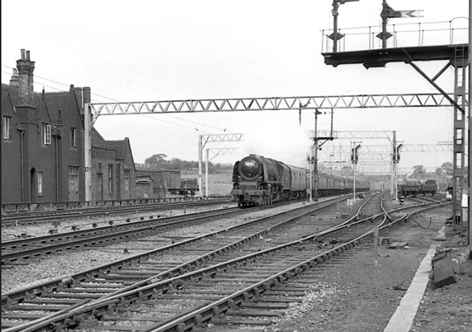
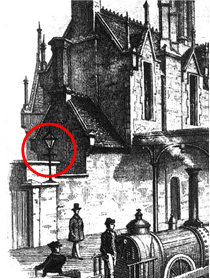
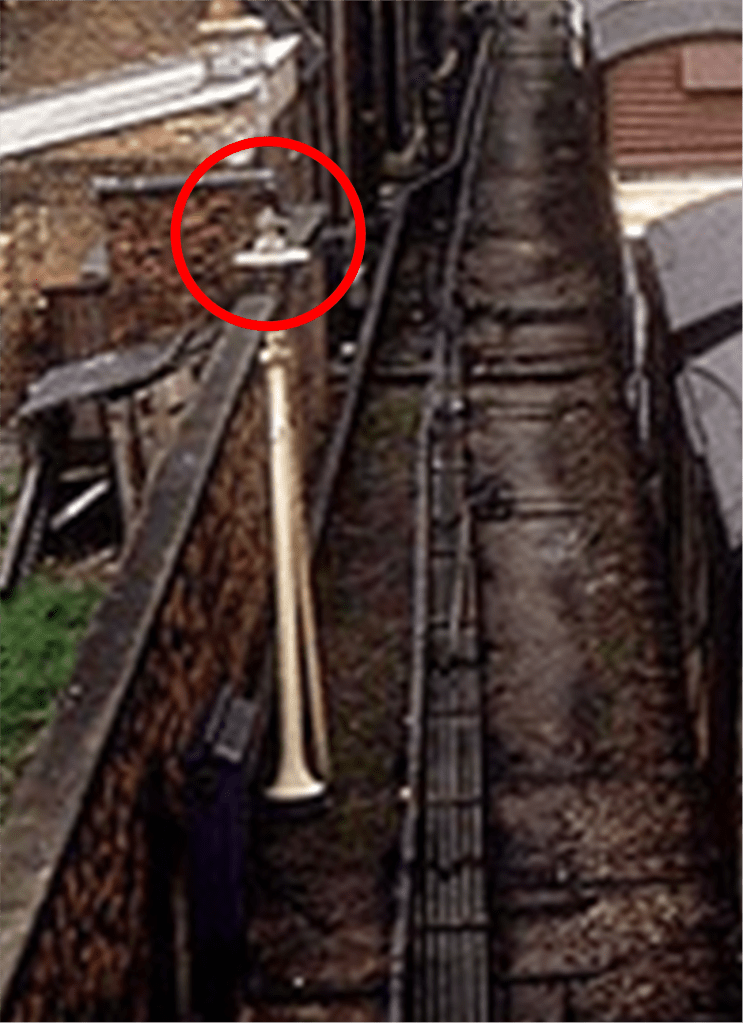
To make connections easier, a new station (Lichfield Trent Valley) was built by the London North Western Railway in 1871 at its current location. This is shown on the 1882 Ordnance Survey Map in figure 3 and there can be seen to be station buildings on both the low level LNWR line and the upper level South Staffordshire line. Interestingly the old LNWR station building can still be seen on the down side of the line next to a set of sidings, although that on the up line has been obliterated by other sidings. This building survived into modern times, as can be seen on the 1970 Ordnance Survey map of figure 4. The realization that this building was around till then made me take a more careful look at some 1960s train photographs, and I was gratified to find a number of shots of the building, which are shown in figure 5. Those of figures 5a and 5b are taken from the Trent Valley Road bridge over the railway line, and those of figures 5c and 5d from track level on the west of the bridge. Clearly here the focus of the photographers was on the locomotives rather than the building, but they do show that the original station building survived in its more or less original form until modern times.  Perhaps one can even see a surviving gas light column – see the enlargements of figure 6 – although here I may be confusing a signalling column with a lamp stand.

Figure 4 1970 Ordnance Survey map showing the station sites (key as in figure 2)

Figure 5 1960s photographs showing the original LNWR station in the background

Figure 6 Gas lamp survival?

The later stations

The station buildings of 1871 survived until the 1970s when they, like so many elsewhere, were replaced by much less substantial structures – effectively portakabins and bus shelters. In 2014 a rather more substantial main building was constructed on the WCML down platform, and more recently lifts have been built to improve access to the high level platform and the up WCML platform. The various incarnations of the station are shown in figure 7. Figure 8 shows the site of the original South Staffordshire station – nothing now survives. The same is true of the LNWR station, although the site is no longer accessible and cannot be easily photographed (I have tried!). Nonetheless, the fact that the original LNWR  building survived for over a century was perhaps a historical accident,  but enables the grandeur and the ambition of the builders to be appreciated.

Figure 7 Later station buildings

Figure 8 The site of the original South Staffordshire Railway station

The first station master

The first Station Master of the 1847 station was William Durrad, born in Northamptonshire in 1819, the son of a weaver. He was married to Elizabeth, two years his junior. Their first son, another William, was born in 1849, and he was followed by Arthur in 1850, Walter in 1852, Emma in 1854 and Bertram in 1867. They continued to live in the old railway station building until the 1871, with a succession of live-in servants. All the children survived to adulthood, and two of them (Arthur and Bertram) were educated at Loughborough Grammar School and studied at Jesus College, Cambridge, both becoming clergymen. William junior and Walter worked in banks and the former became a bank manager in Rugeley. William senior retired from his role of Station Master in 1871 at the closure of the first station. and we next read of him in the local press as a Bailiff (law officer) in the County Court. He was clearly an important man in the locality and the press of the time frequently mention his name as an attendee at various civic functions.  William junior died in 1882 and Elizabeth in 1883. William senior himself died in 1889, living £3138 in his will, a very substantial sum. He is recorded as living at Misterton cottage on Trent Valley Road. These three are buried together in one grave in the graveyard of St Michael’s church. They are also commemorated in floor plaques in the church at the front of the chancel beneath the pulpit – see figure 9.  These are positioned (deliberately?) on the opposite side of the chancel to two similar plaques commemorating the lives of two of the 19th century Bishops of Lichfield (Selwyn and Lonsdale). This is perhaps a final indication of the perceived importance of the Station Master in Lichfield society at the time.  Now, as well as spending too much time writing blog posts, I am also a minister at St Michael’s church and it came as a surprise to me that I should have been walking over these memorials in the course of celebrating the eucharist for the last twenty years, yet having  not the faintest idea who they related to.

After the Durrads left the old station, the building seems to have been divided into separate residences, but in 1881 only one was occupied by a railway porter and his wife. There was however a considerable community of railway staff (labourers and platelayers) in the nearby railway cottages that can be seen in figures 3 and 4. Unfortunately the 1891 census records for the area seem to be missing (or at any rate I can’t find them), but by 1901 the old railway station was occupied by 16 people from four families of railway workers (porters, platelayers, clerks), including the station master David Brown, his wife Sarah and their five children. There were a further 28 people from five (mainly railway families) living in the associate cottages, by this time referred to as the Fog Cottages.

Figure 9. The Durrad memorials in St Michael’s Church

Modelling of extreme wind gusts

Nomenclature

This post addresses the issue of the use of what has become known as the “Chinese Hat” gust model. The use of this title has become increasingly problematic over recent years for obvious reasons, and I will no longer use it, but will instead refer to the “CEN extreme gust model” in what follows.

The CEN extreme gust model

In a number of situations in wind engineering, some sort of deterministic (as opposed to stochastic) gust model is required in order to determine structural response. One such case is in the determination of the risk of overturning of road or rail vehicles in high winds. A methodology of this type is set out in CEN (2018), where an extreme gust model is described.  This model was originally developed in wind loading studies for wind turbines as a time dependent gust to be applied to calculate wind turbine loading at one fixed location (Bierbooms and Cheng, 2002). As such, it is perfectly adequate and a good representation of an average extreme gust in high wind conditions.  In the methodology of CEN however, it is re-interpreted as a stationary spatially varying gust. This must be regarded as a very significant assumption for which, in my view, there is little justification. Nonetheless the formulation has proved useful practically and we begin by considering it in a little more detail.

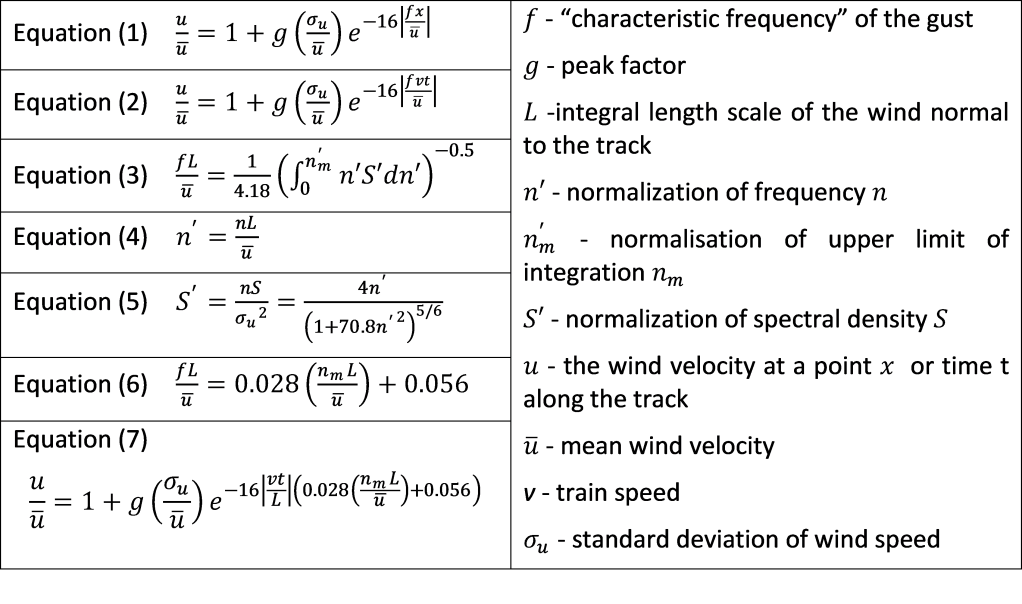
For a wind normal to the track, the extreme gust formulation is given by equation (1) on Box 1. Note that the “characteristic frequency” of the gust is calculated from standard wind engineering methods for temporally, rather than spatially, varying gusts. Equation (1) is a generalised form of that given in CEN (2018) to remove some of the constants that tie the expression to a particular location and topography through specific values of peak factor and the turbulence intensity (the ratio of the standard deviation to the mean velocity). The time dependence is recovered through the passage of the train passing through this gust at a speed v = xt to give equation (2). It can be seen that the gust thus has a maximum value of (1+ peak factor x turbulence intensity) when t = 0 and decreases to unity for small and large times. It is symmetrical about t = 0. The velocity relative to the train is then found by the vector addition of this gust velocity with the vehicle velocity to give a time varying value.

To enable the gust profile to be specified, the characteristic frequency f is required. This is specified in equations (3) to (5). These equations are again in a more generalized form than given in CEN (2018), where a value of the upper limit of integration is fixed at 1 Hz, together with an implicit value of the turbulence length scale of around 75m. The genesis of the 4.18 factor is however not clear to me.  Equation (3) shows that the calculation of the characteristic frequency is thus based on the calculation of the zero-crossing rate of temporal fluctuations through the use of the velocity spectrum. Again, note that these parameters describe a time varying rather than a spatially varying velocity, and their use is not formally consistent with a spatially varying gust. From equations (3) to (5), it can be seen that the normalized characteristic frequency is a function of the normalized upper limit of integration. A numerical solution of these equations was carried out and the following empirical line fitted to the results for a value of the latter greater than 1.5 (which is the realistic range) – equation (6). From equations (2) and (6) we thus obtain equation (7). Although the overall methodology cannot be regarded as wholly sound, equation (7) does (in principal) significantly simplify its use and also allows the implicit wind parameters in the method to be explicitly defined.

Box 1 Equations 1 to 7

Is there a better methodology?

It can be seen from the above that the CEN  methodology thus does not fully describe a typical gust as seen by a moving train, which would vary both spatially and temporally, and can at best be regarded as an approximation, although its practical utility must be acknowledged. Ideally, if such an approach is to be used, a gust that varies both in space and time is really required.  Such a gust was used in the SNCF route assessment method of Cleon and Jourdain (2001), where the shape of the gust is appropriately described as a rugby ball. This method was however for very specific wind characteristics and does not seem to have found widespread use. Thus in this post, we investigate the possibility of developing a spatially and temporally varying gust, that can be expressed in a simple form (ideally similar to equation (2)) for practical use.

Towards a new model

In this section we will draw on experimental results for extreme gust characteristics in both temporal and spatial terms to construct a simple, if empirical model, that fulfills the function of the CEN (2018) model without the theoretical drawbacks.

We consider first the full-scale experimental data analysed by Sterling et al (2006) which used conditional sampling to determine the average 99.5th percentile gust profile for four anemometers on a vertical mast with heights between 1m and 10m. These results thus give the time variation in gust speed as the gust passes the anemometers. They showed that the gust profiles could be well approximated by the formula shown in equation (8) (Box 2). The parameter G in this equation is the equivalent of the peak factor multiplied by the turbulence intensity in equation (2) and for these measurements was 0.786.  n was -0.096, and the value of m depended upon whether t was greater or less than zero. For t < 0, i.e. on the rising limb, m was 0.1, whilst for t > 0, on the falling limb, m was 0.2. The gust shape was thus asymmetric with a maximum at t = 0.  This curve was a good fit to all the gust profiles throughout the height range. In what follows we will use a rather different curve fit expression to the same data, more consistent with that used in CEN (2018) – equation (9). It was found that the best fit value of b  was equal to 0.5 for all t, whilst the best fit values of a were 0.49 for the rising gust and 0.37 for the falling gust. This expression thus describes the temporal variation of wind speed as a gust passes through the measuring point

To describe the lateral spatial variation of the gust profile, we use the data of Baker (2001) who presents conditionally sampled peak events for pressure coefficients along a 2m high horizontal wall. This data allows the lateral extent of the gusts to be determined, from the variation of the time varying pressure coefficient divided by the mean value of the coefficient and then assuming that the gust velocity variation can be found from equation (10). The spatial variations of velocity were then fitted by a curve of the form of equation (11). g was found to be 6.16 and d was found to be 0.7.

On the basis of the above expressions one can thus write the expression of equation (12), which describes the variation of the gust velocity in both space and time. The movement of the train through the gust can again be allowed for by letting x = vt (equation (13)).

Box 2 Equations 8 to 13

Model comparison

Box 3 sets out the formulations of the CEN extreme gust model and the model derived here. In some ways they are similar in form, with an exponential formula that is primarily a function of normalized time. Whilst the CEN model is symmetric around t = 0, the new model has a degree of asymmetry because of the different values of the curve fit parameters for t < 0 and t > 0. However an examination of the new model suggest that the asymmetric term may be small, and thus Box 3 also shows an approximate version of the new model where this term is neglected.

Box 3 Model Summary

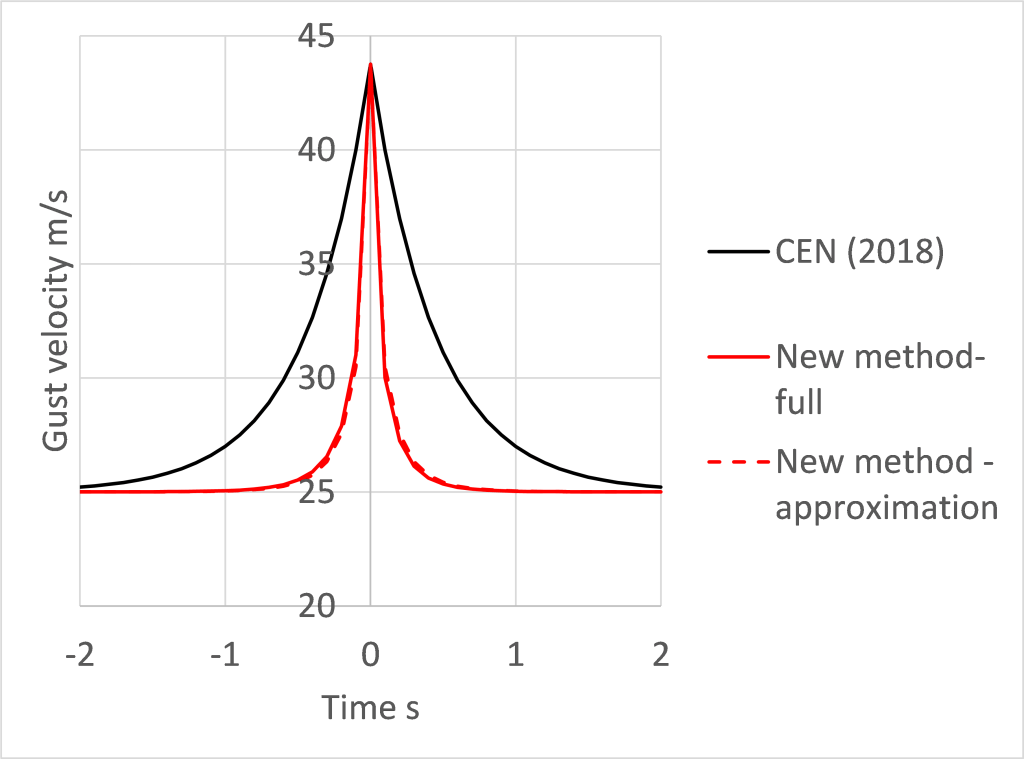
Figure 1 shows a comparison of these three models for the following parameter values – peak factor = 3.0; turbulence intensity = 0.25; train speed = 75m/s; mean wind speed = 25m/s; turbulence length scale = 75m, upper frequency of integration = 1.0Hz. It can be all three models are similar in form, showing a sharp peak at t = 0. The full and approximate forms of the new model are almost indistinguishable, showing that the approximation suggested above is valid. The main difference is that the CEN model has a much greater spread in time than the new model. This difference persists whatever input parameters are chosen.

Figure 1 Model Comparison

At this point it is necessary to consider again the genesis of the models – the CEN model resulted from an application of a time varying gust model as a spatially varying gust model, whilst the new model was developed based on measured temporal and spatial gust values. As such, I would expect the latter to be more accurate. The broad spread of the CEN gust may result from an application of the time varying along wind statistics to a cross wind spatial gust. Since it is known that that longitudinal integral scale is several times larger than the lateral integral scale, this would result in a wider spread of the gust than would be realistic. This is to some extent confirmed by the period of the two gusts – around 2s for the CEN gust and around 0.8s for the new model. For a train speed of 75m/s, this corresponds to gust widths of 150m and 60m – roughly approximating to the expected the longitudinal and lateral turbulence integral scales.

Concluding remarks

In this post I have looked again at the CEN extreme gust method and raised concerns about its fundamental assumptions. I have also developed an equivalent, but perhaps more rigorous, methodology based on experimental data for wind conditions at ground level. This strongly suggests that the CEN gusts are spatially larger than they should be, which suggests its long term use should be reviewed. However, when used to compare the crosswind behaviour of individual trains, rather than in an absolute sense, it is probably quite adequate.  

References

Baker C J, 2001, Unsteady wind loading on a wall, Wind and Structures 4, 5, 413-440. http://dx.doi.org/10.12989/was.2001.4.5.413

Bierbooms, W., Cheng, P.-W., 2002. Stochastic gust model for design calculations of wind turbines. Journal of Wind Engineering and Industrial Aerodynamics 90 (11), 1237e1251. https://doi.org/10.1016/S0167-6105(02)00255-6.

CEN, 2018. Railway Applications d Aerodynamics d Part 6: Requirements and Test Procedures for Cross Wind Assessment. EN 14067-6:2018.

Cleon, L., Jourdain, A., 2001. Protection of line LN5 against cross winds. In: World Congress on Rail Research, Köln, Germany.

Sterling M, Baker C, Quinn A, Hoxey R, Richards P, 2006, An investigation of the wind statistics and extreme gust events at a rural site, Wind and Structures 9, 3, 193-216, http://dx.doi.org/10.12989/was.2006.9.3.193