St. Michael’s, Lichfield in the 19th century. Part 1

Preamble

The most common modern use for parish registers for baptism, marriage and burial is in family history research – to trace the lives of individuals and families through the centuries. But they also form a rich historical resource that can be looked at in quite another way. Where detailed registers exist, they allow a picture to be built up of the wider societal context, by looking at the entries in the register as a whole rather than individually, and considering details of birth and death statistics over time; the professions and trades of those bringing children to baptism and their places of residence.

In this post we take such a wide look at the parish registers for St, Michael’s parish in Lichfield during the 19thcentury.  These have been conveniently produced by Midland Ancestors as .rtf files, and can thus, with some manipulation, be imported in EXCEL and interrogated in a number of different ways. We begin by briefly describing the registers and the nature of St. Michael’s parish in the 19thcentury, then move on to consider statistics of baptisms and burials. The registers also give details of where the individuals lived and their trades or professions, and thus give us a snapshot of Lichfield society in the period. The marriage registers allow the level of literacy to be determined, from an analysis of those who signed the registers, and those who simply made their mark.  The registers also allow a survey of names to be carried out, which shows how the popularity of different Christian names varied over the century. Finally the registers cast some light on the ministers who performed the services, and on the nature of church practice. 

The information presented here will mainly be in the form of simple graphs and tables. Not everyone will be comfortable with such a presentation, but the material to some extent demands it. I will however attempt to describe the information shown on these figures in a more qualitative way, and try to draw out what they can tell us about church and parish in the 19thcentury. 

St Michael’s parish and the registers

Figure 1. The red solid line indicates the boundary of St. Michael’s parish around 1820. The red dotted line indicates the extra-parochial portion of Freeford township. St Michael’s church is indicated by the red cross. The green, blue and purple lines and crosses indicate the boundaries of St Chad’s parish, St Mary’s parish and the Cathedral Close and their churches respectively. The extra parochial area of the Friary is not shown.

The formation of parishes came relatively late in the Lichfield area, where the ecclesiastical organization was, until the seventeenth century, largely based on the Cathedral Prebendial system, with the Prebends appointing vicars who took responsibility for the three city centre churches. It was eventually divided into three parishes – St. Mary’s covering the city centre, St. Chad’s to the north-west and St. Michaels to the south west, south east and south (figure 1). There were three extra-parochial areas – the Cathedral Close, the area around the old Friary and part of the township of Freeford. Of the three parishes, St. Michael’s is the largest. The church itself and its large graveyard on Greenhill is just to the east of the boundary with St. Mary’s parish. In the early part of the 19th century, the parish contained the land immediately to the east and south of the city centre, and large areas further to the south and east containing a number of smaller townships – Wall to the south, Burntwood in the south west, Streethay in the north east, and Freeford and Fulfen to the east. In addition there were a number of detached portions – at Fisherwick and Haselour to the east for example. Thus, whilst the registers mainly concentrate on those who live close to the church in the more densely populated area on the eastern edge of the city, they also contain entries for a more dispersed rural population. As the 19thcentury progressed, some of the outlying townships became parishes in their own right – Burntwood in 1820 and Wall in 1845 and after those dates their inhabitants largely disappear from the St. Michael’s registers. Similarly a large area to the west of the city around the hamlet of Leamonsley formed Christchurch parish in1848. 

There are however further complications. St. Mary’s parish that encompasses the city centre has no graveyard, and used that at Greenhill. Thus the St. Michael’s burial register also contains many entries from St. Mary’ parish.  There also seems to have been a leakage across parish boundaries in baptism and marriage, with parishioners of St. Mary’s and St. Chad’s using St. Michael’s– and no doubt vice versa. The other complicating factor was the existence of the Lichfield Union Workhouse in St. Michael’s parish from 1840 onwards, which housed paupers from a wide area around Lichfield. As these were mainly men, care needs to be taken in any analysis, as the Workhouse entries in the registers can skew the statistics significantly if they are not allowed properly for. 

Before considering the detailed statistics from the registers, it is instructive to look at the general social make up of the parish in the 19thcentury. The baptismal registers contain brief descriptions of the occupation of the one who brings the child for baptism, usually the father. A statistical analysis of this information is, to say the least, difficult, so I will confine myself to only broad comments here. In total there are 6885 baptisms recorded. The number of families represented will be significantly less than this of course. But for these baptisms 2100 give an occupation as “Labourer” and around 650 are economically inactive (most often “Single Women” in the Workhouse or “Spinsters”). Thus around 2750 are at the lowest levels of the society of 19thcentury Lichfield. At the other end of the scale, there are around 35 baptisms of children of those who might be described as “Professional” – bankers, solicitors, architects etc.; 29 from the Ecclesiastical Establishment; and 40 who describe themselves as “Gentlemen”. In between there is a wide range of trades and occupations present of differing levels of skill, from low skilled gardeners and bricklayers to the highly skilled clockmakers, cordwainers and coach builders. Basically it seems that St Michael’s in the 19th century was a church for the workers and middle class artisans and tradesmen of the city – and certainly it attracted few at the higher end of the social scale to bring their children for baptism.  This is in accord with the various monuments and inscriptions within the church, few of which date from the 19th century, with most from the 18th and 20th centuries, indicating that for this period the upper reaches of Lichfield society looked elsewhere.

Population Statistics

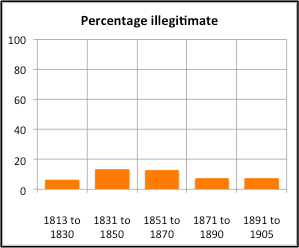
Figure 2 shows the basic statistics from the baptismal register for the period between 1813 and 1905. Here the data is shown in nominally 20 year bands, with the first (1813-1830) and the last (1891-1905) being somewhat shorter. This variability in period can be allowed for to some extent by considering the number of baptisms / year in each band.  It can be seen that there were around 70 baptisms a year across the period, with that figure remaining relatively stable. The expected rise in baptism numbers due to population growth thus seems to have been balanced by the number of baptisms taking place in the new chapels at Burntwood, Wall and Christchurch, and also no doubt by an increase in the number of baptisms in non-conformist churches. The percentage of females was baptized was close to 50% throughout the period as would be expected, which at least shows the inhabitants of the parish in the 19thcentury did not practice female infanticide. Finally it can be seen that that the number of illegitimate children baptised is around 5 to 10% of the whole. This graph may not be wholly accurate however, as illegitimacy was recorded in different ways over the century, or not recorded at all, so some cases may have been missed, but any errors will be small.
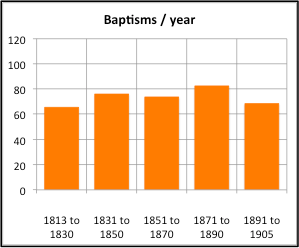
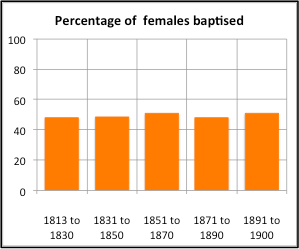
Figure 2. Baptism statistics for number of baptisms / year, percentage of baptised females and the percentage of illegitimate children

Figures 3 show the marriage statistics . This data is given over a longer period than for the baptismal reisters, as the .rtf transcription extends back further into the 18thcentury. The number of marriages per year peaks at something over 40 marriages per year between 1811 and 1830. The register also provides an indication of the level of literacy amongst those getting married. The right hand figure gives the proportion of weddings where bride and groom both signed the register, just one of them signed, or neither signed. Very broadly, up to the middle of the nineteenth century, there were around a third of marriages where neither couple could sign their name, a third of marriages where one of them could (most often the groom) and around a third where both signed. After that time, the proportion of weddings where both signed increased rapidly, no doubt due to the establishment of the National Schools in the area, and by the start of the 20th century both partners almost always signed.

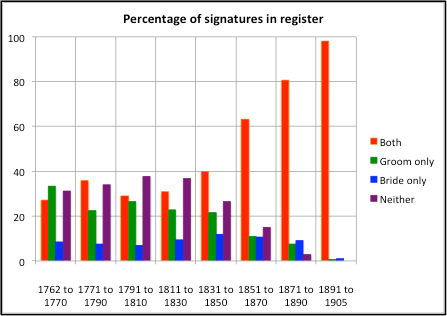
Figure 3. Marriage statistics, showing number of marriages per year and the percentage of participants signing the register.

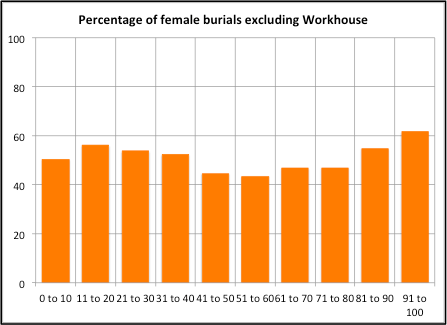
Figure 4 shows the analysis of the burial statistics, excluding the Workhouse entries. The number of burials / year increases through the century, reflecting the increase in population. In the breakdown of burials by age group, the large infant mortality rate is clear, although burials in the 0 to 10 age group decrease from 36% of all burials to 25% over the 19th century. This same trend of reducing mortality is shown in the 11 to 20 and 21 to 30 age groups. The number of burials then increases with age, with a peak in the 71 to 80 age range, with a sharp fall off for the oldest age ranges. The percentage of female burials against age range rises from around 50% for the lowest age range, then increases to around 55% for the 11 to 20 and 21 to 30 age ranges, reflecting deaths during childbirth. There is a trough at just over 40% in the 51 to 60 age range as male mortality peaks, with a rise to around 60% in the highest age ranges, which simply reflects the greater longevity of women if they survive infancy and childbirth.

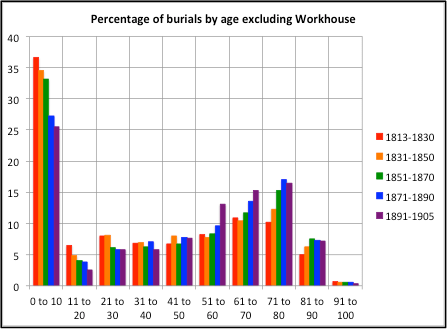
Figure 4. Burial statistics, excluding Workhouse data, showing number burials / year, burials by age range and percentage of female burials

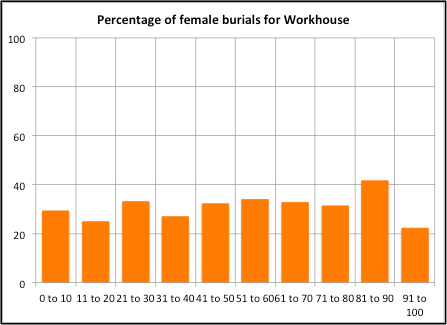
Figure 5 shows similar figures for Workhouse burials. It can be seen that the number of burials per year is between 10 and 20 – a significant proportion of the whole. The burials by age show the same form as for the general population, although the child mortality rate remains at around 35% throughout the century rather than falling. The percentage of female burials by age do not show the same trend as for the general population, although this might possibly be because the sample size is smaller and any trend masked by statistical variation. 
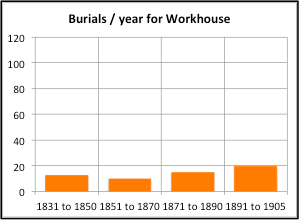
Figure 5. Burial statistics, for Workhouse data, showing number burials / year, burials by age range and percentage of female burials

Part 2 of this blog post can be found here.

Measuring the behaviour of pedestrians in high winds

This post outlines some of the results from the project “The safety of pedestrians, cyclists and motor vehicles in highly turbulent urban wind flows” funded by the UK Engineering and Physical Sciences Research Council. The work that is described below involved a number of colleagues, whose contribution to the project was significantly greater than mine, particularly Dr Zhenru Shu, Dr Mike Jesson, Dr Andrew Quinn, and Prof Mark Sterling. Their contribution is gratefully acknowledged.

1. Introduction

The assessment of wind conditions around new buildings has become standard practice over recent years, either by wind tunnel testing or through the use of CFD calculations. The assessments usually concentrate on two aspects – the effect of wind conditions on human comfort and thus the usability of the area around the building; and the effect of high wind conditions on human safety and stability. It is with the latter that this paper is concerned. In general the criterion for assessing a site for pedestrian safety is based on a gust wind speed of a specified magnitude with a specified probability of occurring, that is deemed to be at the safety limit. Current UK practice is illustrated in Figure 1 below. There is a great deal of variability in the specification of this windspeed and the specification is usually based on largely subjective data from questionnaires etc. Following a fatality caused by high winds around a new building in the city of Leeds, a major research project was funded by the UK Engineering and Science Research Council to enable the University of Birmingham to investigate the safety of vehicles and pedestrians around high-rise buildings. This included full-scale wind measurements and the assessment of the ability of different wind tunnel and CFD techniques to replicate these measurements. In addition tests were carried out to make quantitative measurements of human response in gusty winds, using instrumentation mounted on volunteers. As will be appreciated by any reader who has tried to make full scale wind measurements of any type, the setting up of the experimental apparatus usually guarantees that strong winds will not occur, and the same phenomenon was observed for these tests. The two winter seasons that were available for these measurements had relatively few storms, and only two trials could be carried out. As a result, although some very interesting results were obtained and will be presented in what follows, they must be regarded as provisional and tentative. More work is required to obtain a fuller dataset of human response measurements of the type that are presented here.
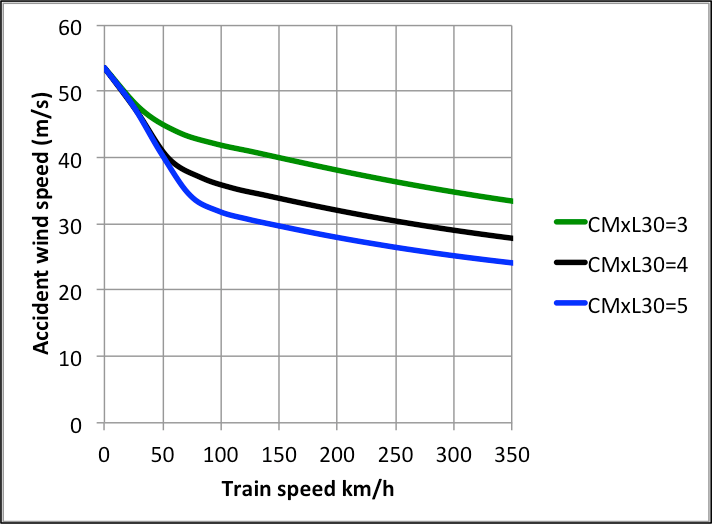
Figure 1 Current UK practice for specifying wind comfort and safety (Values given are for mean wind speed and percentage of time exceeded)

2. The trials

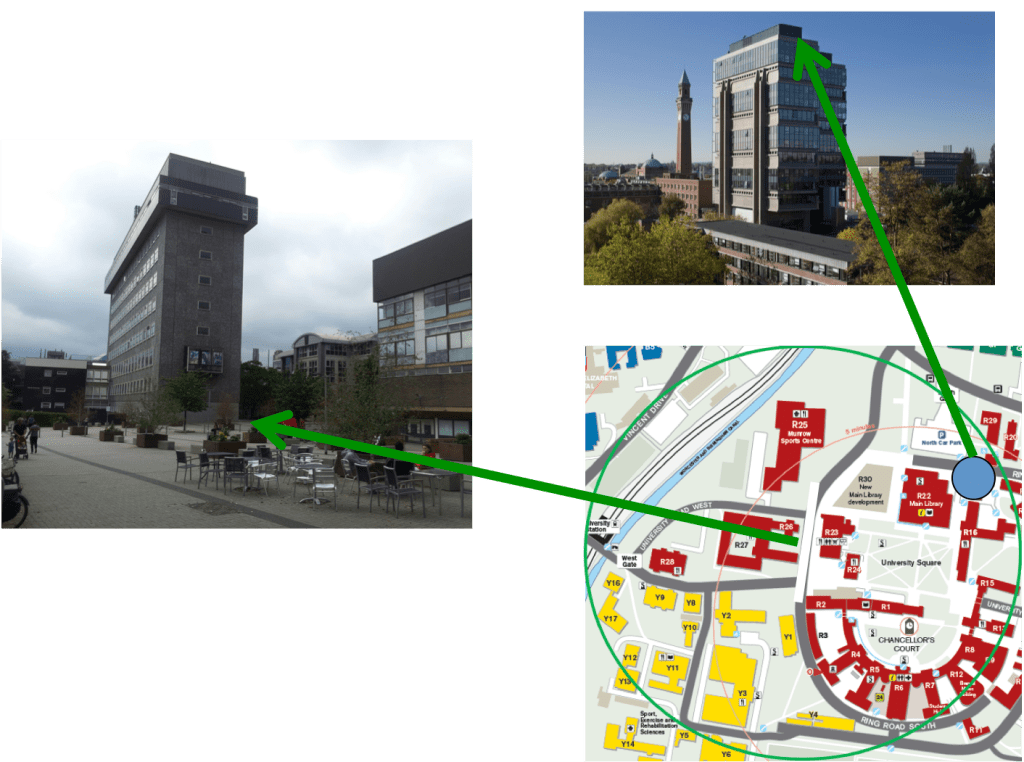
Figure 2. The test site showing the walking route along the Biosciences building and the reference anemometer site on the Moorhead Tower

The trials on the response of pedestrians to high winds were carried out on the campus of the University of Birmingham (figure 2). A walking route of length 63m was set up in the centre of the campus. Eight sonic anemometers were placed 2m above the ground at 9m intervals along the route.  A reference anemometer was installed at the top of the nearby high rise Muirhead Tower. A reference anemometer was mounted at the top of the Moorhead Tower. All the anemometers sampled at 10 samples / sec, and data was recorded on an AntiLog data logger. Human response was measured using GaitUp Physilog (combined accelerometer and gyroscope) sensors. Sensors were attached to both feet of the subjects, and provided details of walking speed and stride parameters every second through GaitUp’s proprietary software. A third sensor was placed on the back of a safety jacket worn by the subjects and thus gave details of upper body acceleration.  

Two trials were carried out – October 2017 during Storm Ophelia, and in February 2019 (figure 3. In total there were 15 subjects, with weights ranging from 54 to 110kg, and ages between 28 and 75. Each subject was asked to walk along the test route 10 times in each direction during which the gait and acceleration information was measured. 

Figure 3 Wind conditions during the trials

3. Analysis

The overall wind conditions at the reference site on the Muirhead Tower are shown in figure 3 for the two test periods. It can be seen that in each case the wind is from the South-West (shown in longer term analysis to strongly be the prevailing wind direction), with gust speeds up to 18m/s

Before the data could be analysed, some data preparation was required. Firstly the gait data and accelerometer time series had to be synchronized with the anemometer time series of velocities and the raw accelerometer data was transformed into horizontal and vertical co-ordinates. The time series of velocity and direction relative to the subjects were then derived form the stationary anemometer data as the subject walked along the route. A histogram of gust speed distribution, as experienced by the volunteers, for the two trials is shown in figure 4.

Figure 4 Histogram of gust velocities

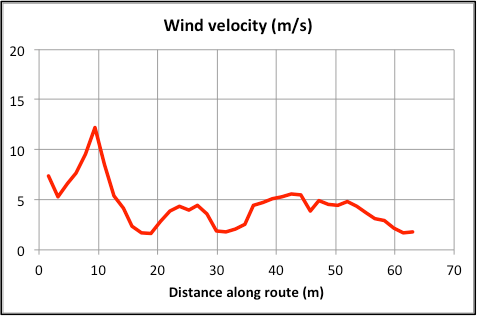
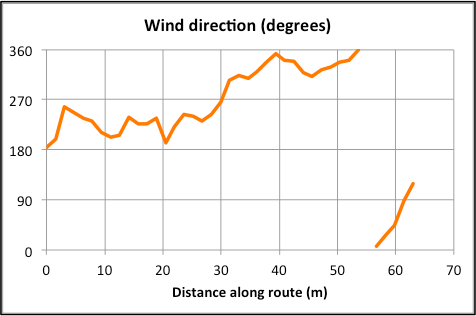
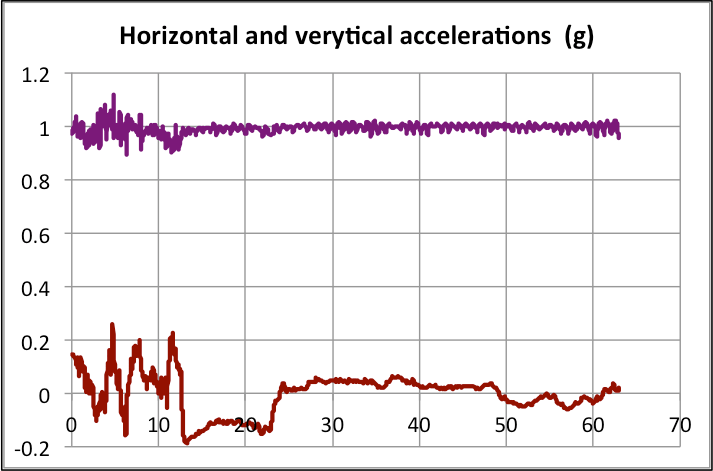
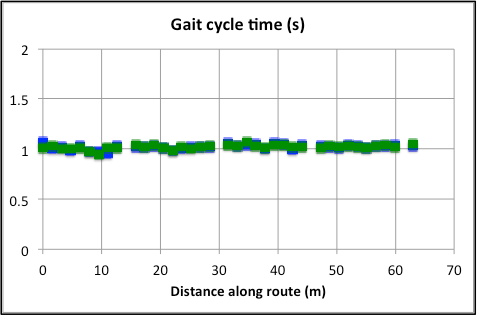
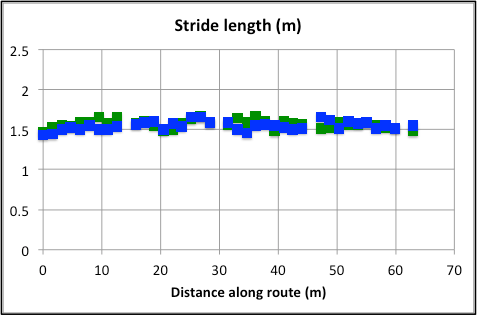
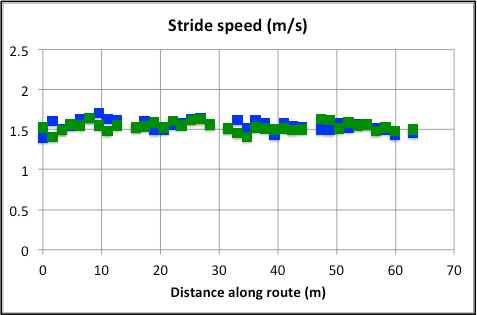
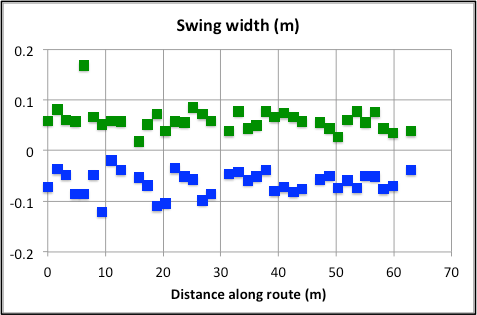
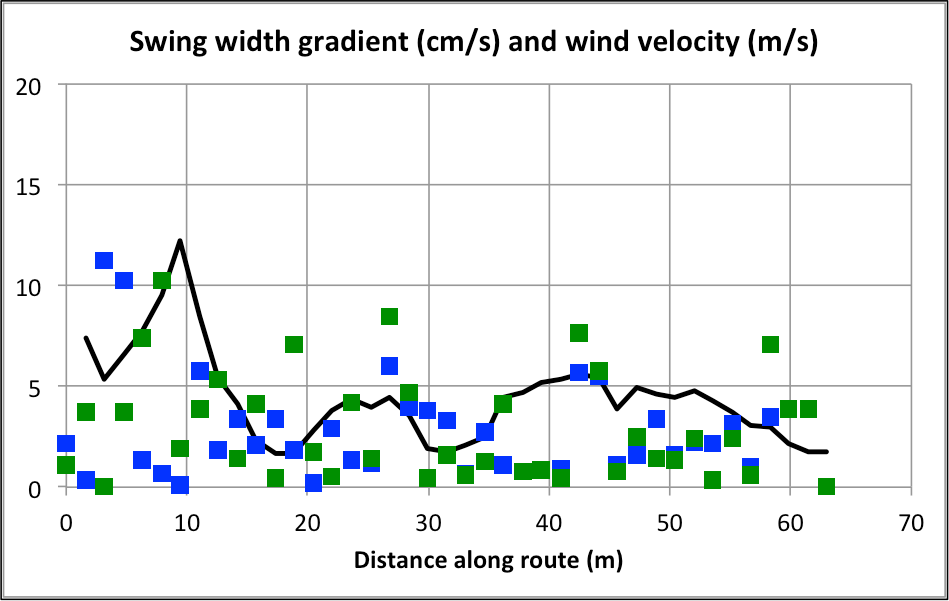
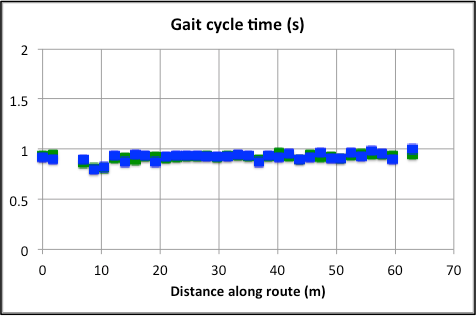
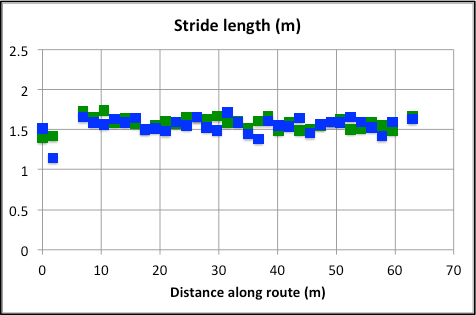
Initial inspection of the data showed that there was very significant variability between each recorded walk along the track. This was in part due to the normal variation in wind conditions with higher gust speeds on some walks than on other, but it also seemed that the reaction of subjects varied both with time and between subjects. A typical set of results is shown in figure 5.  The direction of travel of the subject is from 0 to 63m. The wind speed relative to the subject can be seen to have a maximum of around 12 m/s in this case (associated with the corner flow from an adjacent building). The horizontal and vertical accelerometer data show slight oscillations around the gust position gust with the former having an average value of zero, and the latter an average value of 1.0. Most of the gait measurements (cycle time, stride length, stride speed) revealed little change in behaviour as the subjects walked along the route, all remaining approximately constant along the walk in most conditions.  The one parameter that did show variation was the swing width – the lateral variation of the foot during a stride cycle. In particular rapid changes in swing width were sometimes (but not always) observed as the subjects encountered gusts – see the graph for swing width gradient.

Figure 5 Wind, acceleration and gait parameters for typical gust (green symbols indictate left foot, blue symbols indicate right foot)

At the highest gust speeds that were recorded, there were three events where the subject became unstable to a variable extent. Figure 6 shows the experimental data for one such case. Here it can be seen that at the gust position there are significant vertical and horizontal acceleration responses, and all the gait parameters show a response at the event. The swing width response is again the most noticeable.

Figure 6 Wind, acceleration and gait parameters for strong gust

A somewhat more quantitative approach to the data is possible by looking at the various responses statistically. In what follows we consider the results from both trials, for all subjects, as one dataset. Figure 7 shows the percentage of such gusts in which the subjects showed a swing width response (with either the left or right swing width changing by more than 0.06m in one second) and acceleration response (where an acceleration response greater than 0.05g could be detected) or an instability response (with an acceleration response greater than 0.4g). In considering these results the low number of gust events in the upper velocity bands need to be considered, as does the subjectivity of the response limits used. These points being made, it can be seen that for even low speed gusts of magnitude less than 10m/s, around 50% of the gusts result in a swing width response (which are mostly unconscious responses not registered by the subject). The frequency of such responses rise rapidly for gust speeds above 10 m/s, and all gusts over 14 m /s show such a response. Acceleration responses become significant at gust speeds of about 10m/s, and are observed for all gusts above 16m/s. Instability responses begin to occur at gust speeds over 14m/s, although it should be noted here that only a very small number of such events (3) were observed.

Figure 7 Frequency of different types of response

4. Concluding remarks

The results for human response in gusts presented here suggest that three levels of response can be identified – swing width response , upper body acceleration response and instability response, with the frequency of each such response increasing with wind speed. However it must be emphasised once more that the number of bot high speed gust events and the number of subjects was too small for a valid statistical analysis to be carried out, and more data is required before firmer conclusions can be drawn.

Train crosswind performance – is there a “best” shape?

ICE 3 Velaro

This post arises out of a discussion with a number of colleagues on the issue of train overturning, in particular Mr Terry Johnson and Dr Dave Soper. Their (perhaps inadvertent) contribution to the development of the ideas set out below is gratefully acknowledged, although the responsibility for any inadequacies and errors must remain mine.

1. Introduction

In recent decades a great deal of research has been carried out to investigate the safety of trains in high cross winds, primarily to determine the wind speeds at which overturning will occur, and the risk of a wind induced accident (Baker et al, 2019). This usually takes the form of the determination of the aerodynamic forces and moment coefficient for a particular train, the use of these coefficients to determine the cross wind characteristic (CWC) – effectively a plot of accident wind speed against vehicle speed – and then some sort of risk analysis on the route over which the train will run. The first two steps are usually the concern of train manufacturers and are undertaken when the design of the train, at least in terms of overall shape and size, is fairly well advanced. The third step is usually the concern of the infrastructure operator. One question that is not often asked however is whether there is a “best” design for a train to minimise the risk of a wind induced accident, and thus to maximise safety. This has been addressed to some extent by a number of recent investigations that used a combination of CFD methods to calculate the forces and moments on a train, and optimisation methods to consider the effect of changes to train geometry. It is not however clear as to what should be the objective function of such optimisation – for example a number of different force or moment coefficients for a range of different yaw angles could be chosen. This post addresses this issue though an analysis of accident risk and investigates the aerodynamic parameters required to minimise this risk 

2. Aerodynamic force and moment coefficients

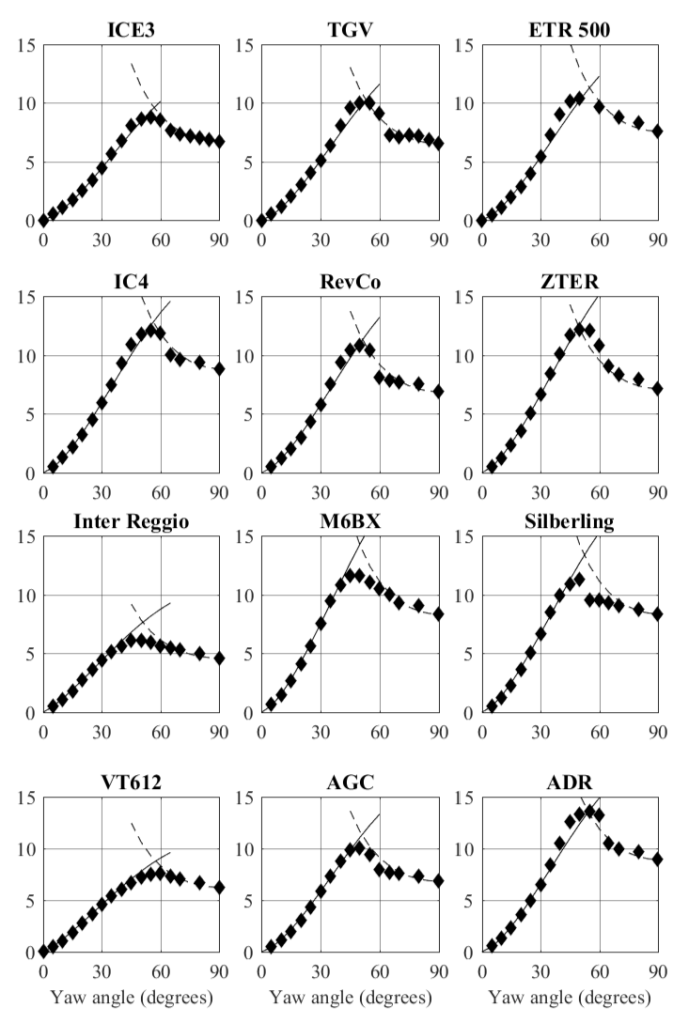
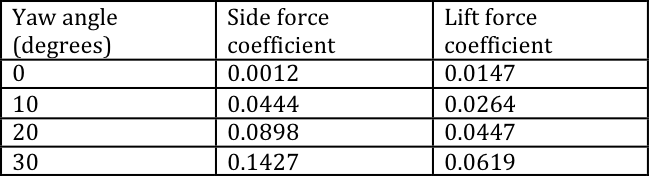
In a recent book (Baker et al, 2019) the author suggests a way of parameterising train aerodynamic force and moment data that seems to have a wide validity. This is set out in Box 1 below, in which the formulation for lee rail rolling moment coefficient is given, and is illustrated for a specific case. It applies equally well to side and lift force coefficient data. It can be seen that the form of the rolling moment / yaw angle curve is specified by four parameters – the coefficients at yaw angles of 30 and 90 degrees and exponent shape factors that describe the shape of curve, n1 and n2. Figure 1 shows a comparison of this methodology with side force coefficient data from the CEN codes (CEN, 2018) and the AeroTRAIN project (Paradot et al, 2015) as given in Baker et al (2019). All this data was obtained in a consistent way, with an STBR ground simulation in low turbulence wind tunnels. The agreement can be seen to be in general good and gives some confidence in the use of the parameterisation in what follows. The biggest discrepancy is in the transition region between the high and low yaw angle regimes, but it will be seen that this is not particularly critical to the argument that follows.

Box 1. Force and moment coefficient parameterisation
Figure 1 Parametrisation curve fit (from Baker et al, 2019)

3. Crosswind characteristics

The method used to specify the crosswind characteristic is also taken from Baker et al (2019) and is set out in Box 2. Using this methodology, the CWC are functions of n1 and n2, the ratio of the moment coefficients at yaw angles of 90 and 30 degrees, and what is defined as a characteristic wind speed, which is itself a function of train and track parameters. Box 2 gives the formulation for flat straight track, with a wind angle normal to the track – a fuller form can be found in Baker et al (2019). A comparison of this method with the results from CEN (2018) and Paradot et al (2015) is given in figure 2, again from Baker et al (2019). Agreement can be seen to be good, and this gives further confidence in the use of the methodology in what follows. 

Box 2 Calculation of cross wind characteristics
Figure 2 Cross wind characteristic curve fit (from Baker eta al, 2019)

Box 2 also indicates how the accident risk can be calculated for a specific reference site using the Weibull distribution to specify wind speed probabilities. We assume a section of railway of a specified length, with specified values of the Weibull parameters and a typical service pattern, and we then express the CWCs as a plot of train speed against the probability that a wind induced accident will occur in the section, rather than accident wind speed. This enables us to better address the question as to what is a “good” vehicle in cross wind terms, as it will highlight the relative importance in risk terms of different vehicle speed ranges. 

4. Analysis

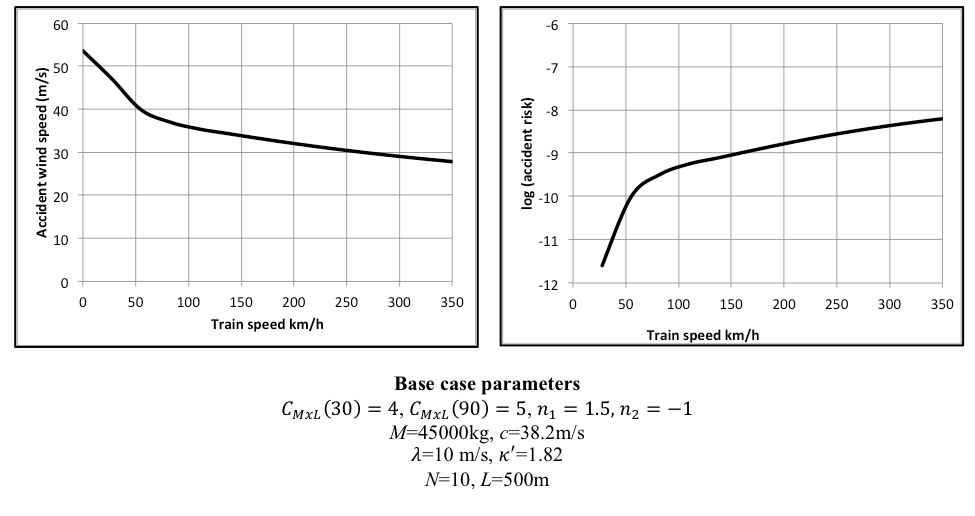
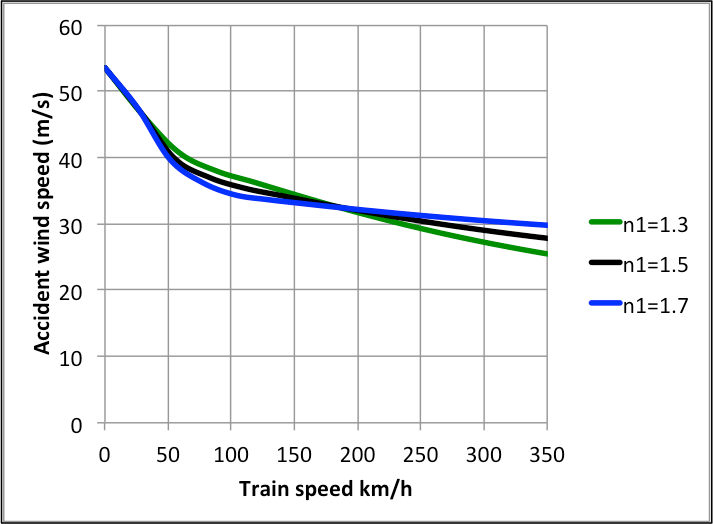
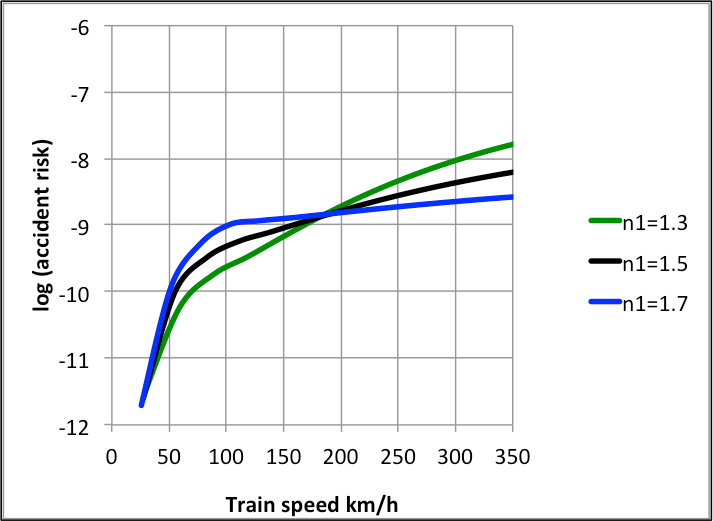
Figure 3 shows the calculated CWC, expressed as both an accident wind speed plot and as a risk plot, for what we will take as our base case. The parameters for this case are shown in the figure. The plot of accident wind speed against vehicle speed shows a reduction in the former as the latter increases, as would be expected. There is a break in gradient, at the point of transition between the low yaw angle (at high speed) and high yaw angle (at low speed) formulations of Box 2. Figure 2 shows that this is quite typical of the calculated CWCs from Paradot et al (2015). The plot of site risk against vehicle speed shows an increase in risk with the vehicle speed. At the vehicle speed of 350 km/hr the logarithmic risk is around -8 (but remember that this absolute value is completely arbitrary). The risk falls by an order of magnitude as the speed decreases through the low yaw angle range to around 100 km/h, with an increased rate of fall for low speeds, where the high yaw angle formulation becomes relevant.

Figure 3 CWC for base case

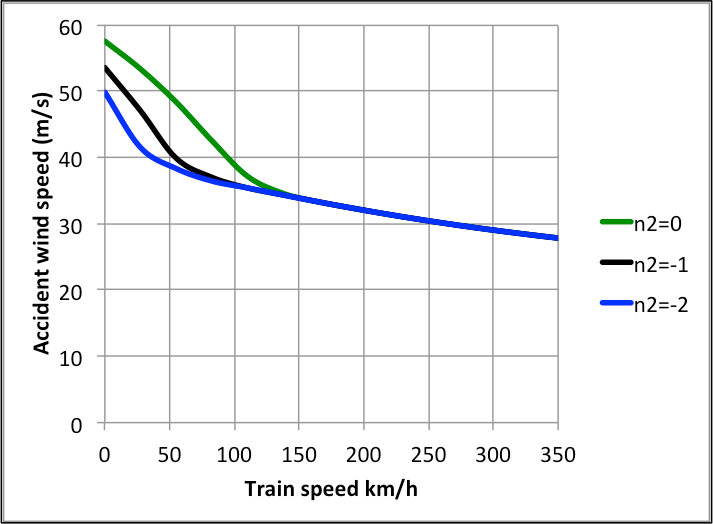
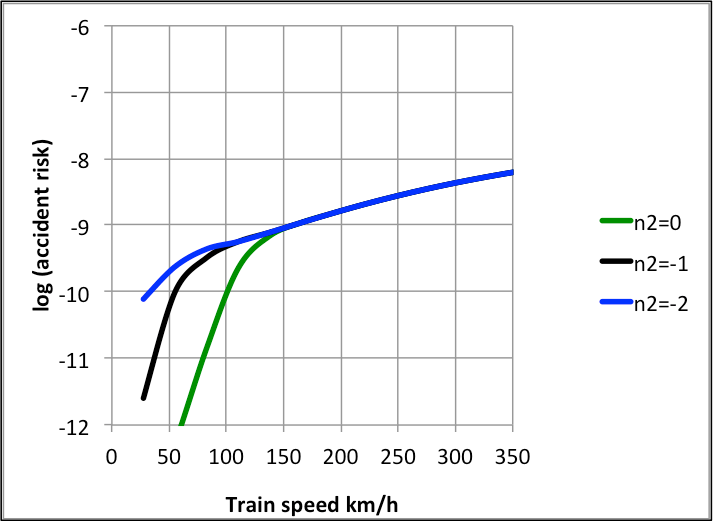
Figures 4 to 7 show the effect on the CWCs of changing the parameters for the moment characteristics. As the low yaw angle exponent n1 is varied between 1.3 and 1.7, there are variations of about half a magnitude in risk for the higher train velocities, although this varies through the speed range. This parameter is typically around 0.9 to 1.1 for lorries, 1.2 to 1.4 for blunt nosed trains, 1.4 to 1.6 for streamlined trains, and 1.7 to 2.0 for trailing vehicles. As the high yaw angle exponent n2 is varied, the variations in accident velocity and risk are confined to the low speed range as would be expected, although here the variations in risk can be several orders of magnitude. As the lee rail rolling moment coefficient at 30 degrees is varied between 3 and 5, there can be seen to be very significant variations in both accident wind speeds and risk throughout the speed range. For variations in the lee rail rolling moment coefficient at 90 degrees only the low speed accident wind speeds and risk levels are affected as would be expected. From these graphs it can be concluded that the risk of an overturning accident will be reduced for high vehicle speeds if n1 increases and the lee rail rolling moment coefficient at 30 degrees decreases; and for low vehicle speeds if n2 increases (becomes less negative) and the lee rail rolling moment at 90 degrees decreases. Of the parameters the 30 degree coefficient produces most change in accident wind speeds and risk levels across the speed range, and is perhaps where most design effort should be concentrated.

Now let us consider specific trains. Table 1 shows, for the CEN (2018) and AeroTRAIN (Paradot et al, 2015) trains, the maximum train speed, the values of the four parameters that define the rolling moment characteristic, the characteristic velocity, and the risk at the maximum operating speed. Those shaded red indicate values that would increase risk significantly above the average, and those shown in green indicate values that would decrease risk significantly the average. It can be seen that of these trains the ICE3, IR and Silbering has the “best” values of rolling moment coefficient. For the ICE3 this is presumably due to the nose shape, resulting in low levels of lift and side force, and thus rolling moment. For the IR and Silberling however, these low values are due to the lack of underbody blockage, at least as modelled in the wind tunnel tests. The ICE3 values of n1 and n2 are around the average, whilst those for the IR and Silberling are low, and would thus tend to increase risk. The worst train in terms of rolling moment coefficients is the double deck M6BX. The IC4, RevCo and ZTER also have high values of the coefficient at 90 degrees.

Table 1 Performance of a range of trains

The risk at the maximum speed for the all trains, with one exception, is between -7.3 and -8.4 i.e. it varies by one order of magnitude. The ICE3, TGV, ZTER and IR have the lowest risk and the M6BX the highest for the standard site. This risk variation is perhaps less than would be expected, and is partly caused by the reduction in risk with the reduction in maximum operating speed. The outlier from the range of -7.3 to -8.4 is the ADR, which has a low value of -9.1, which is due to its high mass and high resulting characteristic velocity. 

Concluding remarks

From the above, it can be seen that for high speed trains, the aerodynamic parameter that most affects the overturning risk is the lee rail rolling moment coefficient in the low yaw angle range, characterised by the value at 30 degrees. In these terms the ICE3 shape is “best”. However this does not necessarily apply for lower speeds, when the higher yaw angle range becomes of importance. These points being made there are some important caveats.

  • The overturning wind speed and thus accident risk depends upon a range of parameters as well as the aerodynamic characteristics. Train mass is particularly important.
  • Similarly the infrastructure characteristics are important, and accident wind speed and risk will be affected by can’t and topography.
  • Perhaps most importantly, the level of risk is determined by the nature of the train operation itself – if speed limits are imposed in high winds, it is quite possible that the most important aerodynamic characteristics will move from those in the low yaw angle range to those in the high yaw angle range.

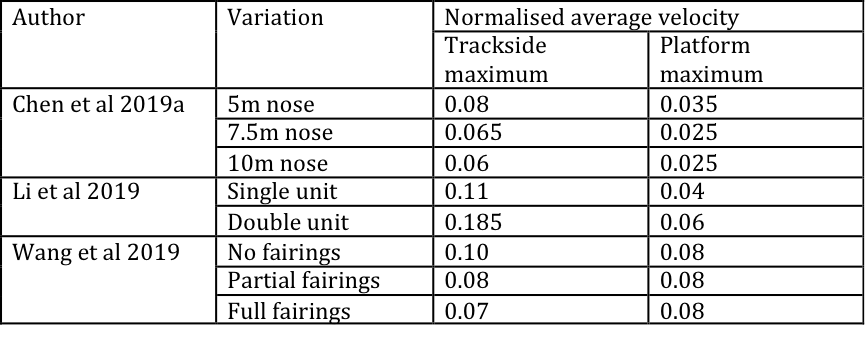
One further point is of interest. In Baker at al (2019) the head pressure pulse magnitudes and wake slipstream gust velocities are tabulated for orange of trains. Of those trains included, the Velaro (i.e. the ICE3) has both the lowest pressure pulse magnitude and the lowest slipstream gust velocities, suggesting that the nose / tail shape of this train has considerable aerodynamic advantages.

References

Baker, C., Johnson, T., Flynn, D., Hemida, H., Quinn, A., Soper, D., Sterling, M. (2019) Train Aerodynamics – Fundamental and Applications, Elsevier.

CEN, 2018. Railway applications — Aerodynamics — Part 6: Requirements and test procedures for cross wind assessment. EN 14067-6:2018. 

Paradot, N., Gregoire, R., Stiepel, M., Blanco, A., Sima, M. et al., 2015. Crosswind sensitivity assessment of a representative Europe-wide range of conventional vehicles. Proceedings of the Institution of Mechanical Engineers. Part F Journal of Rail and Rapid Transit 229 (6), 594-624.

A policeman’s life – Samuel Hicklin (1858-1924) Part 3

Part 1 – A (very) young constable 

Part 2 – Climbing the ladder  – from Sergeant to Superintendent

Chief Superintendent Hicklin

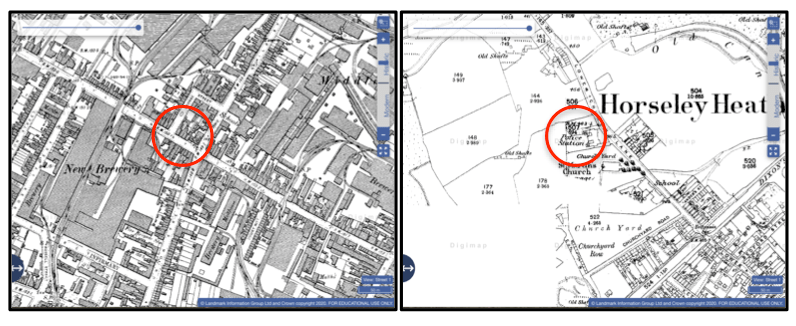
Burslem Police Station (from Edina Digimap 1920 and https://artuk.org/discover/artworks/burslem-police-station-18678)

Hicklin became Chief Superintendent in late 1906 in charge of the Potteries District (District C) with its four Divisions of Burslem, Longton, Stoke and Tunstall, and was based at Burslem Police station. He also seems to have more local responsibility for the Burslem Division with its 16 police stations, although this was no doubt delegated to some extent. As a Chief Superintendent Hicklin was even more a public figure than before and attended many civic and community functions. The Staffordshire Sentinel reported on his involvement in St John’s Ambulance exam awards, civic church services and church parades, charity football matches, formal dinners, funerals, council events and so on.

The range of crimes and offences dealt with by Hicklin and his men was similar to that at Burton, with licensing issues and traffic offences forming the majority of cases. The one that drew most public attention however was again a murder – that of Sarah Ann Price, aged 51, the wife of George Price, a colliery labourer. It would appear that the couple had been drinking heavily together, and had then quarreled. During the quarrel, Price had poured paraffin over his wife and set her on fire. She died from her burns, “burnt to a cinder”. Hicklin arrested Price and was involved in his prosecution for murder. Not surprisingly the incident created much interest in the press, both locally and nationally.

The other major challenge that presented itself was the policing of elections and, with more difficulty, strikes and industrial action. The major incident during Hicklin’s time at Burslem was a widespread strike amongst miners in early July 1909, aiming to increase the length of the lunch break and to increase pay for Saturday working. This not only involved walk outs, but also large crowds of striking miners moved around the area, aiming to force miners at non-striking pits to join them, and closing other industries. There was much violence and intimidation, and the police stood between the strikers on one hand and the non-strikers and mine owners on the other. The whole police force in the area was stretched very thinly, and Hicklin himself, whilst trying to persuade a crowd of 300 to 400 miners to disperse to enable non-striking miners to go home, was himself “assailed with a volley of stones”. The strikes were settled after a few days, with some small concessions from the employers on the length of the “snapping time” – or lunch break, but the trials for riot and affray occupied the Magistrate’s courts and Assizes for many months after. 

In 1910 Stoke on Trent City Police was formed with a merger of Hanley Borough Police and that part of the County Force area then within the Potteries Federation. This included significant parts of the then District C of the Staffordshire Constabulary, and a major re-organisation of the County force took place. A new District C was formed, spanning both parts of the Potteries and also more rural areas of the county, of which Hicklin took charge. The Divisions of this District were Leek, Newcastle, Stone and Uttoxeter.  The District covered a very wide geographical area in the north of the county. Hicklin and his family moved to the police station at Leek, where the District headquarters were located, in early 1910.

Leek police station (from Edina Digimap 1920 and https://commons.wikimedia.org/wiki/File:Leek_-_Police_Station_-_geograph.org.uk_-_1937202.jpg)

The 1911 census gives us a further snapshot of the family – Samuel aged 56 with a birth year of 1854/5, Eliza aged 55 with a birth year of 1855/56, young Samuel aged 20, now a tailor running his own business and shop; Flora, aged 18, helping with the domestic work; and Reginald, aged 11 still at school. Their accommodation, in the police station, had seven rooms 

Samuel Hicklin’s signature from the 1911 census

At Leek, Hicklin’s life seems to have continued in much the same way as at Burslem, no doubt the majority of the time being taken up by the administrative roles necessary in any large organization – appointments and promotions, finance and reporting and so on. It is likely that, as one of the four Chief Superintendents, he also played a role in the determination of strategy and plans for the whole constabulary under the direction of the Chief Constable. He continued to deal with much the same range of crimes and incidents as before, although it seems that the war years were rather quieter than previously, in part because licensing hours were restricted.  His first involvement with motor vehicle transgressions is recorded– a taxicab colliding with a horse and cart in 1918; and the death of a pedestrian after being knocked down by a car whilst disembarking from a tram. The war also caused a significant decrease in the number of public functions. One that did occur after the war in 1923, was the presentation of certificates to the 219 special constables who were in post in the Leek Division between 1914 and 1919, replacing those who had volunteered to enlist. 

During his time at Leek, two major honours came his way – the King George V Coronation Medal in 1912, and the MBE in 1919.

 The final mention of Hicklin in the press was on the 9thFebruary 1924 when he reported at the Annual Licensing Sessions of the Leek Division.

Chief Superintendent Hicklin reported that the number of licenses in the Division was 142, no license holders had been proceeded against under the licensing laws; 52 males and 10 females were proceeded against for drunkenness, all except 6 males and 4 females being convicted. 

As he began his career with drunken behavior, so he ended it.

Samuel Hicklin died on Thursday March 27th1924, having made his last court appearance on the Monday before, when he was in good health. This suggests that death was due to a heart attack or something similar. The obituaries were fulsome and generous. From the Staffordshire Sentinel of 31stMarch 1924.

…..During his 14 years at Leek, Chief Inspector Hicklin has made himself extremely popular with all classes but the courteous and tactful way in which he has carried out the important and various duties attached to his office. Of a quiet and unassuming disposition, and a man seeking little publicity, he was nevertheless a strict disciplinarian and his organization of the police in the large and important Leek Division was as complete and as efficient as anywhere in the county……. He was a zealous and efficient police official carrying out his work with conspicuous ability and whilst ever mindful of the responsibilities of his position, he was always fair and impartial in the preparation of prosecutions… 

He was also described as being in his 69thyear, implying birth years of 1855/1856. The tributes from magistrates and court officials were equally fulsome. In his obituary in the Staffordshire Constabulary Monthly Budget of April 1924 we read

The Chief Constable wishes to express his deep and sincere appreciation of the very valuable and loyal work of this officer during his long service of 48 years in the force.

In the same obituary his birth date is given, for the first time in the historical record, as 28th March 1857, which was probably one year earlier than his actual birth date.

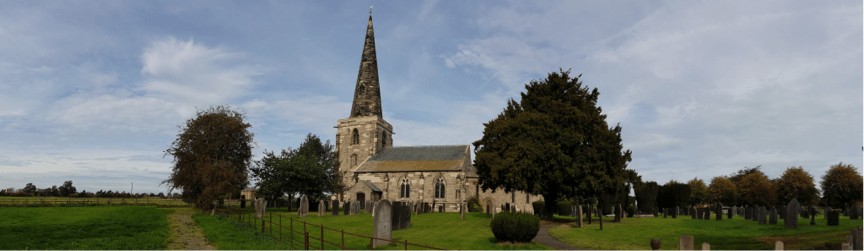
Leek Parish Church (from https://en.wikipedia.org/wiki/St_Edward_the_Confessor%27s_Church,_Leek#/media/File:Leek,_church_of_St_Edward_the_Confessor.JPG)

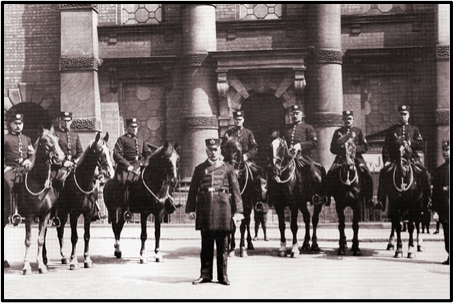
His funeral took place on the afternoon of Monday 31stMarch. There was a procession of 100 officers, including many ex-officers who had served with him across the county from the Police Station to Leek Parish Church, led by six mounted constables. Chief Constable Anson also attended. At the service there were representatives from the two Freemasons lodges of which he was a member, many magistrates and court officials, representatives off the Licensed Victuallers Association (which seems wholly appropriate) and many others. The coffin was carried into church by six constables. After the funeral service led by the vicar, his body was laid to rest in Leek Cemetry. The mourners were recorded as 

Mr Reginald Hicklin (son), Miss Flora Hicklin (daughter), Mr and Mrs A Tipper (sister and brother in law) , Mr and Mrs T E Harper, Mr J Goode (nephew) and ex-Inspector George Oulton of Leek, formerly of Burton”. 

Sam Hicklin, the eldest son was stated to be in Canada. Mrs Tipper was actaully his half-sister Harriet. It is notable that Eliza was not present. In the pre-second world war register of 1939, she is registered as still living in Leek, with her unmarried daughter Flora, and as being incapacitated. Perhaps that was already the case in 1924. The Staffordshire Advertiser who reported on this event, also contained the only picture I can trace of Sam Hicklin – it is shown below.

Samuel Hicklin 1858-1924

Samuel Hicklin’s life was in some ways quite exceptional – that a farm labourer’s child should rise to perhaps the highest police rank that was available to him (as Chief Constable and Deputy Chief Constable ranks were largely restricted to “gentlemen” or retired military officers) must be viewed as remarkable, and a tribute to his abilities, hard work and diligence. From press reports it is not really possible to form a view of his character and personality, but he does seem to have been genuinely well liked and respected by his peers. The number of colleagues and acquaintances his funeral alone is testimony to that. 

Throughout these posts I have mentioned the rather variable birth dates that he assigned to himself through the years. This might have been in part due his own uncertainty about his age, but I find this explanation not wholly convincing in view of his precision in other areas (not least his pedantic interactions with landlords who keep their pubs open somewhat later than they should) and I would wonder if throughout his career he was careful to ensure that nobody came to realize that he gave a wrong age at the very start of it. A very small blot on the copybook of a remarkable man!

Part 1 – A (very) young constable 

Part 2 – Climbing the ladder  – from Sergeant to Superintendent 

A policeman’s life – Samuel Hicklin (1858-1924) Part 2

Part 1 – A (very) young constable 

 Part 3 – Chief Superintendent Hicklin 

Climbing the ladder  – from Sergeant to Superintendent

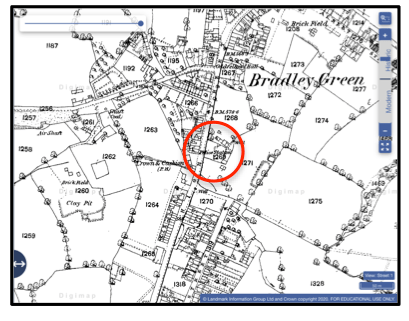
Bradley Green Police Station  (from Edina Digimap 1880)

Hicklin’s next move was to a completely different area – Bradley Green, near Biddulph in the Potteries District, where he took up a position as Sergeant 2nd class on December 1st1884. Perhaps oddly, as he scaled the promotion ladder, he becomes somewhat less visible, because of fewer court appearances and, one suspects, because the Congleton and Macclesfield Mercury, on which we rely for this period of Hicklin’s career, provided a less comprehensive news coverage than the County Express and County Advertiser between them for Tividale and Pensnett. But the necessity to deal with drunks and disorderly behavior continued, and we meet Hicklin in court a number of times proving cases of this type. In addition there are the usual incidences of petty theft and “furious” driving of horse and carts that needed to be addressed. He was also called to a number of suicides usually by hanging, then a criminal offence of course, and had to cut down the body. He was clearly becoming involved in more administrative duties, and we hear reports of him attending the Biddulph Local Board, and being given authority by that board to prosecute for “stone-throwing, swearing and dis-orderliness in the public street” on behalf of the Board.  

Of the more unusual incidents he had to deal with, perhaps the most distressing was that of Emily Poole of Hanley, who was very badly mistreated by her stepmother Priscilla Poole, a case which came to court in 1887. Emily was about 20, but looked much younger, and had been repeatedly beaten, left unfed with very little clothing, and was often required to work naked around the house. The neighbours, taking pity, gave her some clothes, but the step-mother pawned these. She slept in a damp, leaking garret room with very little bedding. Hicklin in giving evidence said he would rather sleep in the open air than in such a room as that. Over the past year Emily had tried to commit suicide, and Priscilla had continually abused the neighbours who remonstrated with her over step-daughter’s treatment.  The magistrate stated that this was the worst crime that he had ever had to deal with and sentenced Priscilla Poole to the maximum level he was allowed – six months in prison with hard labour. 

Perhaps the main incident that occurred during his time at Bradley Green, was in 1889 when he and one of his constables. PC Clay were charged with assaulting Samson Chadwick, a collier, in 1889. Chadwick had clearly been acting in a disruptive fashion in public, almost certainly due to drink, and PC Clay had tried to arrest him. He went with the PC quietly at first, but then began to resist. In a scuffle Clay threw him to the ground and tried to drag him, handcuffed, to the police station. Being unable to do so, he fetched Hicklin and another PC and between them they dragged Chadwick along the ground for three hundred yards to the station, in full view of the public.  At the station he was put into a cell, and was allegedly thrown roughly onto a bench, resulting in a black eye and other injuries. Witnesses testified that Clay kicked Chadwick on the ground while he was being dragged and that he did not have any injuries when he was put into the cell. According to Hicklin’s statement he was “laid very carefully upon the bench in the cell”.  Despite what appeared to be quite strong evidence that the police had been somewhat rougher than they ought to have been, and the less than convincing police statements, the magistrates conferred and decided in favour of the police.  And Samuel Hicklin was able to continue his career. 

The Hicklin’s third son Samuel was born in March 1891 and was baptized at Oldbury in early September. In the census of that year, Hicklin’s age had increased again to 36, giving a birth date of 1854/1855. In reality he was coming up to 33 at the time.  Eliza’s age was given as 35 and thus a birth year of 1855/56.

In November 1891, Hicklin moved directly from being a Sergeant 2nd class to being an Inspector 2nd class, thus jumping a grade. This involved a move to Burton upon Trent in the Rural District in 1891 and a subsequent move to Tipton, back in the Mining district for a brief period in 1896, at the same grade. Burton was of course near to his home, and the duties would have involved policing the area where he was born and brought up. In 1896 there were 17 Inspectors and 14 Superintendents in the Staffordshire Constabulary, which implies roughly one each per division. In this period of his career, Hicklin is at his least visible and the Burton Chronicle makes few mentions of him – too senior to be required to make many press-reported court appearances, but not quite senior enough to be the public face of the force. But where he does appear, the incidents he was dealing with were far removed from the drunkards of earlier years. At Burton in 1892, he rather wonderfully identified a shop-breaking suspect by comparing a boot print at the crime scene with the suspect’s boots – proper police procedure! In 1895, he was instrumental in the arrest of a fraudster on the run from the police in Oxford, having obtained jewelry by false pretenses; and in the same year, he arrested another travelling fraudster, who had pretended to be an old acquaintance of a number of leading cricketers of the day, now suffering from sickness, in order to obtain donations.  He moved to Tipton in early 1996 on what would seem to be a short term posting. The major incident that he was involved with there was the trial of Sarah Jane Williams (43) and Frederick Ward (49) were charged with the theft on significant money and property to the value of £400 from John Williams, Sarah’s husband, and then eloping via Liverpool to the United States.  Hicklin was entrusted with sailing to the United States in their pursuit and received them into custody on board the Belgenlandin Washington Docks, Philadelphia. It is to be hoped that he was actually allowed to disembark and see something of the USA after such a trip!

During their time in Burton, the Hicklin’s daughter Flora was born in Burton in August 1892.

Burton upon Trent and Tipton Police stations  (from Edina Digimap 1900)

On December 1st1896, Hicklin was appointed as a Superintendent (again jumping the grade) of Inspector 1st class and moved back to Burton upon Trent where he was in charge of the Burton Division, with 18 stations including Uttoxeter, Tutbury, Horninglow, Alrewas, Yoxall and Burton itself. By this time the Districts had been renamed –the Mining District as District A, the Rural District as District B and the Potteries District as District C. After the years as Inspector when his activities weren’t very visible, becoming the Superintendent put him very much in the public eye. Whilst he was no longer involved in arresting drunks he was responsible for licensing public houses, and had to report on an annual basis to the various licensing authorities in the area on the number of licenses, number of offences of drunken behavior, recommendations for granting or withholding licenses etc. He seems to have exchanged catching drunks for counting them! He can also be seen making reports to local council committees on various aspects of policing; attending fund raising functions, including kicking off a charity football match between Burton and Lichfield Police; organizing inspections of police forces; and attending funerals and delivering tributes. In short he became a public representative of the police in the area. 

He and his family lived in accommodation at the Police Station on Station Street, together with 8 police constables (presumably in some sort of dormitory facility) and for the night of the 1901 census, three prisoners in the cells. The picture below is from the Burton upon Trent History website and is captioned there as showing the newly appointed Superintendent Moss in 1898. Moss was actually appointed in late 1906 / early 1907, after Hicklin left Burton. So either the picture is wrongly dated and shows Superintendent Moss in 1907, or the picture is of Samuel Hicklin himself. I would of course like the latter to be true, but even if it is not, it does give clear indication of the sort of uniform worn by the Staffordshire Constabulary at the time. 

Description: Macintosh HD:Users:chrisbaker:Dropbox:Web site:Blog material:Hicklin:Pictures:Burton police andstation 1898 - superintendent Moss? or Hicklin.jpg

Superintendent Moss or Hicklin? (from http://www.burton-on-trent.org.uk/category/amenities/police/police1)

Some things however remained the same – he continued to bring malefactors to court for not being in proper control of their horse and cart, or for causing obstructions on the highway. “Reckless cycling” through the borough was also becoming an issue. The range of minor crimes he and his men investigated was very wide – for example house breaking, cruelty to animals, shoplifting, perjury, embezzlement and fraud, illegal betting, trespass and family maintenance defaulters. He also had to deal with a distressing number of suicides and attempted suicides. In general both Hicklin and the bench of magistrates were very gentle with survivors, and tried to place them in situations where they might find help.   

Amongst the most amusing of these minor incidents was the case in 1899 of the shop fire at Burton-upon-Trent where the owner, a Mr. joseph North, a draper from Uxbridge Street, was unable explain to Hicklin how the fire had started at around midnight and why he and his wife were fully dressed at that time after retiring to bed early. Hicklin, unsurprisingly, found the facts that Mr Richardson’s attire included collar and tie and laced up boots more than a little suspicious, particularly in the light of the fact that the level of insurance was about eight times the value of the stock that was burnt.  There was a further case in 1905, when Hicklin was able to solve a series of robberies that had been committed by Elizabeth Smith and Mary Parkes, through the initiative of a local shoe shop owner, who attached an enticing pair of slippers to a cord, leading to a mousetrap that was activated (presumably loudly!) when the slippers were taken. When Hicklin searched the suspect’s homes, he found, to quote his evidence “a cartload of stuff, including boots, shoes and clothing”. 

The ongoing series of relatively minor offences however were punctuated by major incidents of violence and murder, which naturally made the headlines in the local (and sometimes national) press. Of these two incidents stand out –the first that ultimately involved only minor injury, and the third that involved quite a complex murder investigation. Both were reported very widely in newspapers across the UK. In both, Hicklin showed himself to be much more than a desk bound administrator. 

In the first of these, in 1900, some children were standing on the Recreation Ground  canal bridge in Burton, when one of the boatmen on a passing barge shot at them from below with a pellet gun. Five of the children were injured in the face and shoulders. The incident was reported to the police in Burton and we read that Hicklin chased them for seven miles along the canal (presumably mounted) and then arrested them at Alrewas. The claim was made that the children had been throwing stones.  The three boatmen – Benjamin Nixon, Emmanuel Lloyd and Harry Banks- were charged with causing grievous bodily harm to the children. From the evidence presented it was not clear which of the three had fired the shots. They were committed for trial at the Quarter Sessions. From our perspective, the interesting aspect is that Hicklin, even at the rank of Superintendent, rode after them, and arrested them, knowing that they were potentially armed – an act of considerable bravery. 

We find a similar pattern in perhaps the major incident of Hicklin’s time in Burton.  On a Sunday morning, in late January 1903, PC William Price, based at Stretton near Burton, was investigating the stealing of some ferrets. His enquiries led him to a “gypsy” encampment consisting of several caravans, where he arrested a certain Tom Sherrif.  Sherriff’s two brothers John and William then attacked him with sticks and stones. When trying to use his baton, Price was repeatedly hit and forced to the ground where they continued to beat him. They eventually made their escape, despite the efforts of Price who tried to pursue them before collapsing. He was taken to Burton Infirmary and wounds on his head dressed. Later however at home he became delirious and was readmitted to hospital, where a fractured skull was diagnosed and an operation performed. Price however died later that night. It would seem that when Hicklin heard of the events, he drove (a horse and trap) and having driven through his home territory of Marston-on-Dove and Hilton, caught up with the caravans at Hatton, and arrested the group. He was assisted by a number of constables it would seem, although reports are a little vague. Those he arrested however, were the mother and father of the three brothers – Hope and Hattie Sherriff , who were traveling Hawkers, and another Hawker Arkless Holland, together with other younger family members.  The evidence that these gave at the inquest the following day suggested they were not involved in the assault although they did little to prevent it. The three brothers in the meantime were nowhere to be found and a search was instigated. Again the actions of Hicklin are interesting – driving after what could have been a group of very violent youths in order to make an arrest, with little support. The runaways were eventually sighted at Scropton about eight miles from Burton, but overpowered and maltreated the officer, Sergeant Hutchinson ,who tried to arrest them. Reports were later received of them being sighted in Derby and Belper. They were eventually captured at Buxton on Wednesday night and Hicklin and a Sergeant went by train to collect them, suitably handcuffed, on Thursday morning. They met with a hostile reception from a large crowd at Burton station, and were brought to court very quickly, where they were remanded in custody. At the County Sessions a week later the three brothers pleaded guilty to murder, but stated that their father and Holland were not guilty. They were all committed for trail at Stafford Assizes in March 1903. In the train on the way to Stafford Jail the three brothers were overheard discussing the fight with the Price by the constable accompanying them.  The charges against Hope Sherriff and Arkless Holland were not proceeded with at the Assizes due to lack of evidence, but the three brothers, who had changed their plea to not guilty, were found guilty of manslaughter, based partly on the overheard conversation on the train.  This sentence was possibly arrived at, as it was not possible to say which, if any of them, was actually responsible for the blow that fractured Price’s  skull and resulted in his death. They were each sentenced to 15 years penal servitude. In 1911 they were all held in the prison on the Isle of Portland.  Whether they were actually gypsies (i.e. Romany) or not is debatable, and they might simply have been travelling tinkers. The term “gypsy” however was clearly used in a derogatory way in much of the press coverage.

Samuel and Eliza’s time second period in Burton was not without personal trauma. Their two older sons, both in their twenties, died in that period – John in 1899 and William in 1904.  Their youngest child Reginald was born in 1899. In the 1901 census, Samuel’s age is given as 46 and Eliza’s as 43 and thus implying birth years of 1854/5 and 1857/58. At that time, William, aged 18, is recorded as an Engineer’s apprentice. 

In August 1906, Hicklin was promoted to the rank of Chief Superintendent, and left Burton with fulsome tributes from the Mayor, the bench of Magistrates and court officials and counsel. The tone of the tributes as reported in the press was warm and he seems to have been held in genuine respect and affection. 

Part 1 – A (very) young constable 

 Part 3 – Chief Superintendent Hicklin 

A policeman’s life – Samuel Hicklin (1858-1924) Part 1

A (very) young constable

Part 2 – Climbing the ladder  – from Sergeant to Superintendent 

Part 3 – Chief Superintendent Hicklin 

Description: Macintosh HD:Users:chrisbaker:Desktop:20181007_124704-20181007_124719-e1539761058221.png

The church of Hilton, St Mary’s (from https://stmaryshilton.org

Arthur Samuel Hicklin was born in Hilton near Marston-upon-Dove in Derbyshire in late March or early April 1858, to John and Ann Hicklin. John was a farm labourer in the area, but there are no further details available of where or for whom he worked. Arthur Samuel was baptized at Hilton church on 25thApril 1858 and was the couple’s fourth child. Of his siblings, Eliza was born in 1852, John in 1854 and Samuel in around July 1856. The latter died the next year in May 1857. They were to have a further child, William, in 1860 before John himself died in that year, leaving Ann a widow. Ann married again in the mid-1860s to William Long, another farm labourer from Hilton, and had two further children, Ann and Harriett. In the 1861 census, Arthur Samuel was referred to using his first name. After that he always seems to have been known as Samuel, or, one suspects, Sam. I will in general use either “Sam” or “Hicklin” in what follows. In 1871 he was no longer with his family, but was a thirteen-year-old general servant on William Loverock’s farm in Horninglow near Burton upon Trent.  Loverock was a major landowner in the area, and employed a number of men and boys on his farm of nearly 300 acres, as well as a number of domestic servants. Sam seems to have lived in a house adjacent to the farm (possibly Hodgkin’s Farmhouse although the census return is difficult to read), with a number of other servants, both male and female.  He thus probably only received the most rudimentary of educations, which makes his rise through he Staffordshire Constabulary that we will see in what follows the more remarkable. 

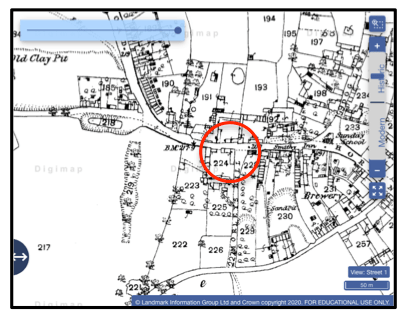
Possible location of Loverock’s Yard and Hodgkin’s Farmhouse in Horninglow (from Edina Digimap 1880) 

The Staffordshire Constabulary at that time was divided into three districts – the Mining district of the Black Country; the Potteries district around Stoke; and the Rural District for the rest of the county. This organization persisted, with some alterations of boundaries, throughout Hicklin’s career. At the head of the organization was the Chief Constable, based in Stafford. Each district was headed by a Chief Superintendent, one of whom served as Deputy Chief Constable. At times however the latter role was taken by a fourth Chief Superintendent. Each District was divided into Divisions headed by a Superintendent or Inspector, and each division into Sub-divisions, which included two or more police stations.

Sam joined the Staffordshire Constabulary in November 1875, when his age is given as 18 years and 7 months, implying a birth date of April 1857 – i.e. a year earlier than the actual date. There must therefore be a suspicion that he exaggerated his age in order to join the police. On entry to the force, he was described as being 5’ 8 5/8” tall, with brown eyes, dark brown hair and a fair complexion. His previous trade was given as labourer. He seems to have initially served in the Rural District, presumably in a training situation, possibly close to his home. In January 1876, he was the subject of a disciplinary charge for being drunk at the time he was meant to be on duty – and thus seems to have been aa fairly normal 17 year old. He was fined one shilling. He was then stationed at Tividale in the Black Country and thus continued his career in the Tividale station in the Blackheath Sub-division of the Brierley Hill Division in the Mining District.

His life at Tividale would have mirrored that of young constables anywhere. His first appearance in the press seems to have been in the County Advertiser of April 1st1876 which contains the following report of the proceedings of the Rowley Regis Magistrate’s court. 

Isaac Fisher was charged with being drunk on the 25thult., and pleaded guilty. Police Constable Hicklin proved the case, and the defendant was fined 5s with costs.”

Dozens of similar mentions appeared over the months and years that followed, mainly in the County Advertiser and County Express, as he rose from Constable 3rd class on appointment, to Constable 2ndclass on 1stAugust 1876 and Constable 1stclass on 1stAugust 1877. So he was clearly well regarded for his dealings with drunkards. To add a little variety, we also read of him apprehending carters driving too quickly or not exercising proper control over their horses; children stealing coal; bringing publicans to court for selling out of hours or for encouraging drunkenness; and (perhaps the highlight of his time in Tividale) bringing Joseph Evans and Benjamin Baker to trial for shooting ducks on the canal at Brades Village. Not all went totally smoothly however, and in May 1876 he faced another disciplinary charge for being absent from a “conference”. Again he was fined one shilling. But this clearly did not impede his progress.

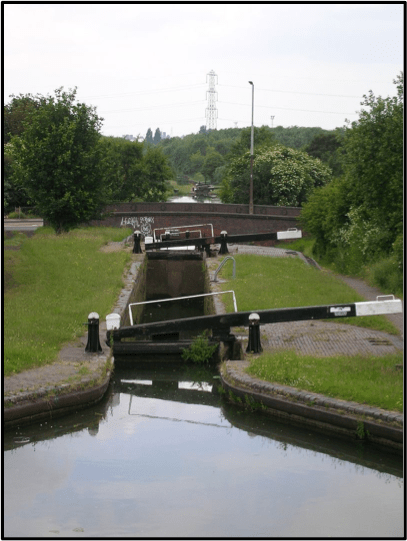
Brades Hall locks (from https://en.wikipedia.org/wiki/Gower_Branch_Canal#/media/File:Brades_staircase_locks,_Gower_Branch.jpg)

During his time at Tividale, his private life was probably more interesting than his professional life. In that period Sam met and married Eliza Taylor, the daughter of the boat builder John Taylor at Brades Hall locks on the Gower Branch of the BCN. They were married at Christchurch, Oldbury on 10thFebruary 1878.  Here, for what seems to be the last time, the name Arthur Samuel was used in the registers. Both he and Eliza were recorded as being 20 at the time, which at least for Samuel, was not the case. Eliza was baptized in August 1858, so should only have been 20 at the time if there had been a significant delay between her birth and baptism, but she could well have been born in late 1857 or early 1858.  Perhaps at this point Sam was finding it necessary to continue the minor deceit concerning his age.  The couple were to return to Oldbury for the baptisms of their children John in 1880, William in 1883 and Samuel in 1991. 

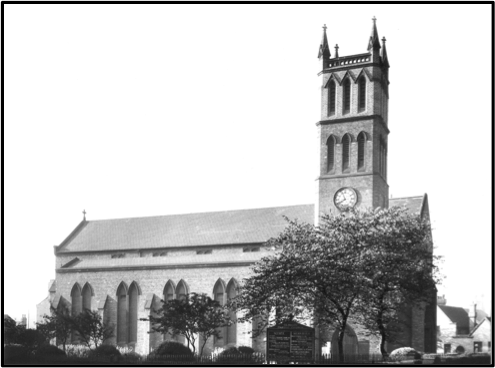
Christchurch Oldbury  (from http://www.historyofoldbury.co.uk/2story.htm)

In late 1879, Hicklin moved to a new posting in Pensnett – still in the Brierley Hill Division, but also in the Brierley Hill Sub-division. The head of the Division, Superintendent John Wollaston was based at Brierley Hill police station. The census record indicates that in 1881 Samuel and Eliza lived on Commonside (almost certainly in a police house) with their baby son John, and Police Constable Edward Wynn as a lodger. Their age inflation continued, with Samuel giving his age (in early April 1881) as 24, which implies a birth year of 1856/1857, and Eliza being 23, with a birth year of 1857/58. The move also coincided with a “merit” award on 1stJanuary 1880.

Brierley Hill Police Station and Magistrates Court (from http://www.brierleyhill.org/blog/2014/08/04/brierley-hill-on-the-day-war-broke-out-and-the-departing-of-the-first-tropps/and Edina Digimap 1880)

In many ways, Hicklin’s life in Pensnett was very similar to his life Tividale – the large majority of the cases he took to court were charges of being drunk and disorderly, with the next most common being coal stealing, other petty theft, “furious” wagon driving and so on. But there were a number of other notable events. On the 26thof October 1880, Hicklin and another policeman, concealed themselves at a pit in the Wallows area, and watched a large crowd of mainly women and children picking coal from that stored at the pit. When the constables emerged from their hiding place, all the coal pickers ran away, but most were apprehended later, having been identified. In total 26 were brought to caught with ages ranging from 11 to 61. All were fined between 2s 6d and 5s, or 7 to 14 days in prison. The report ends with the rather sad note that “the charge against May Angel (13) a deaf and dumb girl, was withdrawn”.  

He also continued to come into conflict with publicans for failing to keep hours. Almost as soon as he arrived at Pensnett, on Christmas Day 1879, he visited the Sampson and Lion and found them still serving at 3.00 in the afternoon – half an hour later than should have been the case.  The whole case hinged upon whether or not his watch was correct, or whether the landlord’s clock was correct. After much discussion the bench dismissed the case, on the grounds of the landlord’s respectability and the fact that there seemed to be no intention to remain open. Hicklin’s zealousness probably did little to endear him to his local pub landlords. In a similar way, he charged the landlord of the Rifle in March 1881 with selling beer after hours, Hicklin and a colleague having concealed themselves behind the pub to observe. This time the case was proven and the landlord fined. 

There were further instances. Early one Sunday morning in October 1881, he heard voices from a house close to the High Oak public house at 2.00 on a Sunday morning, and (after secreting himself in the door of the post office) saw a group of women coming from that house to collect ale from the High Oak to take back to the house. After they had entered and then left the pub, he confronted them and found ale in their possession. Despite a raft of excuses made to the bench, the landlord of the pub, William Evans, was found guilty of keeping his house open during prohibited hours. On another occasion in December 1881, Hicklin and the main witness to drunken behavior at the Fish Inn (Cornelius Chambers, one of the leaders of the teetotaler movement in Pensnett) were challenged in the court by the defense solicitor Mr. Waldren as to whether or not he was teetotaler, in such a way that implied they had an animosity towards the sale of alcohol in any form. Hicklin admitted he was a teetotaler, but denied that he had signed any pledge, and had no intent to do so. A similar challenge by Mr. Waldren was made in a case in 1883 concerning drunken behavior at the Crown Inn on Commonside, which was bluntly rebutted by Superintendent Woollaston on Hicklin’s behalf.He had clearly changed his ways somewhat since his initial charge for drunkenness in 1876.

The local animosity came out into the open in the middle of December 1981. Hicklin and a colleague, PC Lafford, assisted in throwing out four people from the Crown Inn on Commonside. He then went to the King’s Head Inn along the road to see the landlord there to ask him to serve on a Jury. As he entered, a man on a bench behind the door hit him a nu. mber of times with a stick, and a second man assaulted him with a poker with a blow across the shoulders. Lafford left to find assistance. When Hicklin recovered from being stunned he found his assailants and two of their friends had disappeared. Eventually Noah Bate, a miner from Commonside was arrested and brought to trial in March 1882. It would appear that Bate and the other three were those who had been thrown out of the Crown earlier. He was sentenced to jail with hard labour for two months. At that time, Hicklin was still suffering to some extent from the injuries he received. The story did not end there. On his way to the prison in Stafford, Bate was heard to say (by the accompanying Police Constable) that he would “do for that _____ Hicklin” when he came out. He was further charged with using threatening behaviour and bound over to keep the peace

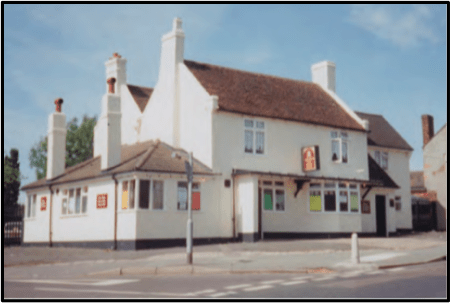
Kings Head 1997 (from https://www.longpull.co.uk/downloads.html)

 Finally the last case that is worthy of note is an instance of forgery from 1882.  Hicklin was asked to check that the signatures on testimonials provided by an applicant to be a constable were valid, and he showed that two of them were forged. One suspects that this must have been a slightly uncomfortable experience for one who did not tell the whole truth on his application to the police force!

Part 2 – Climbing the ladder  – from Sergeant to Superintendent 

Part 3 – Chief Superintendent Hicklin 

The Earl of Dudley’s Railway – Accidents and incidents

Preamble

“Countess”, delivered to the Pensnett Railway in 1859

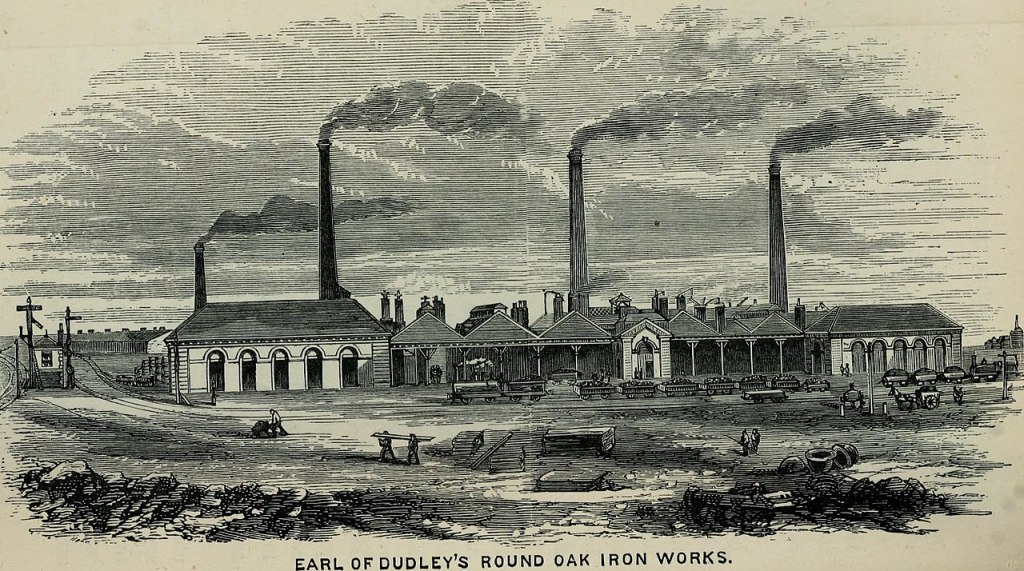
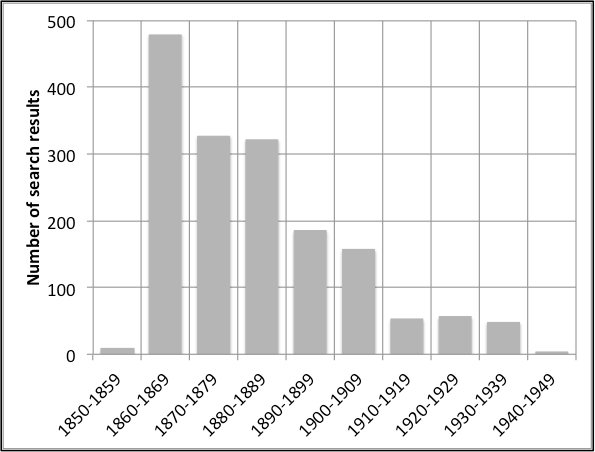
Elsewhere on this web site and in “Kingswinford Manor and Parish” I have written about the Pensnett or Earl of Dudley’s Railway, which developed in the mid-nineteenth century from the original Kingswinford Railway to carry coal and metal products around the Brierley Hill, Pensnett and Kingswinford area. It was centred on the Round Oak Iron Works, but extended to Ashwood in the west, Baggeridge in the north, Saltwells in the east and Cradley in the south. Along with others who have written on the subject, I have primarily concentrated on the development of the system and the industry it served. However, the railway was an integral part of the local society, and impinged on the inhabitants in ways both good and bad. In this post I want to present some information on how the wider public perceived the railway, from a keyword search of the British Newspaper Archive for the phrases “Pensnett Railway”, “Earl of Dudley’s Railway” and “Kingswinford Railway” from the opening of the Kingswinford Railway in 1827 up to 1920. The extent and quality of this information is thus wholly dependent upon what the local newspapers thought it worthwhile to report on. As is the way with press reports, the material primarily concerns accidents that often resulted in inquests presided over by a coroner, or criminal activity that found its way to the local police and magistrate’s courts. We will thus consider firstly accidents on the railway, both to its workers and to others and then move on to consider criminal cases associated with the railway, principally small scale stealing of coal, but also some more serious incidents. 

Accidents and inquests

Round Oak Iron works showing Pensnett Railway in foreground

Accidents to railway workers were by no means unusual, and occurred throughout the period being considered. One major cause of accidents involved workers being run over by the trains, either through failing to see a train approaching, or through slipping from the train itself. For example, in the County Advertiser of 15/9/1877 we read that Thomas Jones, a labourer at the Wallows, was on the railway just after a possession (a flag) had ended, and was not aware of a train of 13 trucks approaching him. 

“The buffer of one of the trucks struck him and rolled him over. The wheels of six trucks went over him and he died in about five minutes”.

And from the County Express of 21/6/1910 we read of Richard Teague, aged 60, who worked on the incline between Level St. and Saltwells.

“…. several trucks loaded with ironstone had just reached the summit, when he attempted to disconnect the rope from the first wagon. He slipped down, and in a moment his body was cut in a frightful manner by the wheels, death being instantaneous.”.

Shunting was also a hazardous occupation, and there were a number of incidents of workers being crushed between wagons. From the Staffordshire Sentinel of 15/9/1877, concerning John Small at Sandfield Bridge.

“…the trucks did not stop at the proper time and he was crushed against a wall….. in a space of eight inches and was frightfully mangled…”

From the County Express of 28/5/1910, concerning Benjamin Parker (24), a shunter at Round Oak, 

“…both his legs were caught between the wagon and locomotive, with the result that they were frightfully smashed, and a thigh and a leg bone broken…”

There were also accidents to those other than railway workers. The most common seem to have been to children (almost always boys) who tried to jump on or off a moving train for a free ride. In the County Advertiser of 30/4/1904 we read that nine-year old Samuel Oakley of Lower Church St, Pensnett attempted to mount a train on the Barrow Hill incline, but slipped and fell beneath the train

“Two of the trucks passed over him and when the train had been stopped it was found that both legs had been severed from the body and his right arm and hand were terribly crushed”

He died soon afterwards at the Guest Hospital.  In the Dudley Chronicle of 17/6/1916, we read again of children from Church St. in Pensnett – Robert Clowes (14), George Adlington (14) and Thomas Downey (12). They jumped onto a train of empties on its way to Baggeridge. After riding some distance, Downey jumped off, and turned to see Clowes and Adlington disappear through the bottom frame of the truck. Clowes was killed and Adlington seriously injured, one of his arms being badly mangled. 

Much of the railway was used as walking routes by those in the locality, and inevitably this could lead to accidents. In 1882 George Shakespeare (13) had walked along the railway with a friend, Isaac Hardwick, who was taking supper to his father at the Round Oak works. As many readers will be aware one of the idiosyncrasies of the Pensnett Railway was that it crossed the GWR main line at Round Oak on an extended flat crossing across six or more tracks.  When the two lads were using this crossing, George missed the approach of an express train from Wolverhampton, and he was “swept down by the express” ((County Express 21/1/1882). We read further

….when the train had passed the lad was found to be quite dead, the top of his head being crushed to pieces and his brains scattered about the place”. 

If an accident resulted in a fatality, an inquest was held within days at a local public house under the jurisdiction of the coroner, with a jury drawn from the locality. For example for George Shakespeare, the inquest was held in the Commercial Inn in Bromley. The verdict for accidents of the type described above was nearly always “accidental death” with little blame being attached to employer or operator.  In the early days these seem to have been relatively informal affairs, but in the early twentieth century, there was a greater level of formality, with factory inspectors often involved, and the Earl of Dudley being represented by legal council. 

Not all accidents resulted in injury to either workers or local residents. In 1916, Charles Mace, an engine driver, was shunting trucks in a siding near Tansey Green, when a number of trucks ran into the engine and through him off. The driverless engine and its coke trucks then ran for about a mile towards the Stallings Lane crossing where it derailed  (Dudley Chronicle, 28/1/1916). The report also notes that 

“It is a curious fact that the same engine, in charge of the same driver, was overturned at the same spot sometime ago.”

Curious indeed. Finally, it is worth mentioning the accident that received the most press coverage of them all, the same text being reported in newspapers the length and breadth of the country. Naturally it involved animals rather than humans. We quote the Worcestershire Chronicle of 6/11/1867 in full.

“On Friday evening at the Earl of Dudley’s railway at the Old Park  Coliery near Dudley, a singular accident occurred. Mr Phineas Parsons, a farmer of Pensnett, has the  right to run his sheep on the pasturage near the Old Park Colliery; and on the night in question one of Mr. Parson’s men proceeded to drive a flock of 65 sheep from one portion of the land to another, and in doings o the whole flock got onto the tramway. A couple of trucks, loaded with coal had been started in charge of one of the men down the incline, and these trucks overtook the sheep in a narrow cutting, and the consequence was that 23 were killed on the spot, and six others were so mutilated as to render it necessary to slaughter them at once. “

Phineas Parsons worked Hollies Farm (1872 Post Office Directory), so it is natural he would have pasturage rights in the Old Farm area nearby. It is not however clear which incline is referred to here – the Barrow Hill incline seems too far away from Old Park to be the incline in question, so perhaps there was a smaller incline within the Old Park colliery complex itself. 

From Facebook post by Dave Fisher, photograph by Roger Shenton. If further acknowledgements are required, please let me know. The likely site is at the bottom of the Barrow Hill incline.

Crime and punishment

The stealing of coal was endemic in the area in the nineteenth and early twentieth century, both from pits themselves and the railway, and scores of incidents are reported in the press.  This perhaps reflects the relative poverty of the area , as well as the easy availability of coal. Those involved were of all ages, although children and young adults were in the majority, with the magistrates court imposing fines of between 5s and £1 or 7 to 14 days imprisonment. In 1916 the local Superintendent of Police complained in court that “the local people went and fetched the coal away as though they had a right to it” (Dudley Chronicle 15/1/1916). Marxist historians would no doubt agree that they did, as the land from which the coal came had been common land on Pensnett Chase until a century before, when the rights of commoners had been extinguished by the Pensnett Chase Enclosure Award, and ownership of all underground resources had been “stolen” from the locals and given explicitly to the Earl of Dudley. Whether or not one accepts this analysis, it is hard not to feel sympathy for some of those arrested for coal stealing. For example Letitia Garbett (63) of Lower High St, Pensnett  was fined £1 for stealing coal from the railway, or fourteen days imprisonment. She complained she had no money and would have to go to prison in her old age (County Express 25/11/1911). Similarly, in 1916 Oswald Smith (11), Mary Parkes (12), Albert Beddard (10) and Alice Timmins (10) all of Chapel St Pensnett were caught with small amounts of coal in their possession by the local constable, and their parents were each fined 10s, or 6 days imprisonment if they could not pay (Dudley Chronicle 22/4/1916). 

Many of those brought to court were serial offenders. For example, Edward Jones (16) from Pensnett was said at his trial in 1881 to have been convicted six times in the previous four years, and was lucky not to be sent to the Quarter Sessions. He was imprisoned for six weeks with hard labour (County Express 31/12/1881). A year later Caroline Pulley (32), who was sent to prison for two months, was said to have nine previous convictions (Birmingham Daily Post 13/6/1882). 

One particular area of activity seems to have been the Queen St / Church St / Chapel St area of Pensnett, with many defendants coming from that area.  At the same hearing where  the elderly Letitia Garbett was sentenced, Eliza Wilde of Queens Lane, Pensnett was fined 10s; Barbara Watkins of Church St was fined £1; Gertrude Barker of Church St and Mary Hunt of Lower Church St were fined 5s each. This might be simply due to press reporting giving a false impression of the prevalence of crime in the area, but it may also be due to the assiduousness of the local night watchman, Josiah Hickman. He lived at Woodside and is recorded a number of times in the press as “proving cases” against a wide variety of offenders.  As an example of his modus operandi, we have a report in the County Express of 9/4/1910 of him lying on the ground somewhere around the end of Church St., waiting for Joseph Westwood to leave his home 50 or 60 yards away. The latter picked up a large chunk of coal from a truck on the railway (weighing about half a hundredweight), before Hickman detained him by putting his stick around his neck. Westwood managed to struggle free. It would seem that Ellen Horton was also in the area and tried to warn Westwood when Hickman appeared, shouting “Hey Up, Joe”. Westwood was fined 10s and Horton 5s for aiding and abetting. 

There are also indications of more organized activity. In hearings in 1916, several dozen women were charged with coal stealing from the Wallows area, where, it was said in court, the average loss on that part of the line was 25 to 30 tons per week (Dudley Chronicle 29/1/1916). It seems that there was an elaborate system of pickets to warn of approaching constables or watchmen. If any were caught and fined, then the fines were covered by a whip-round of all those involved. It was revealed that in total there were 215 convictions for coal stealing at Brierley Hill magistrates for the year ending January 24th1916, 57 involving children (and their 57 guardians who paid the fines), 90 involving women and 11 involving men.  For all involved at the cases being heard that day the sentences were quite severe – a 25s fine, or 21 days in jail. It was clear the magistrates were significantly swayed by the fact that most of the women were in receipt of army allowances, as their husbands were in the forces, and were thought well able to afford to buy coal.

From time to time the minor criminality associated with the railway took on a more dangerous form. Of particular concern was deliberate vandalism by youths. In 1906 Hezekiah Price and Joseph Rider (both of Lower Church St. again) were charged with moving points and putting a brick between the rail and the points in order to derail a train. Although they claimed they were only playing, the magistrate took the matter very seriously and sentenced them to six strokes of the birch each (County Advertiser 22/9/1906). In a similar manner in 1913, George Treadwell (11) and Percy Treadwell (10) of Vine St, Hart’s Hill were charged with tampering with points at Round Oak, through the insertion of a brick. This time it actually resulted in a derailment of truck, with the brakeman on the buffers of the truck being thrown off, and the tearing up of 30 yards of permanent way.  

At the other end of the railway in 1914, Albert Greenaway (10) and Joe Andrews (10) of High St., Wall Heath, were charged with releasing a truck at the top end of the Ashwood incline by tampering with its brakes (Dudley Chronicle 9/5/1914). Fortunately nobody was injured, although the seriousness of the offence was stressed. On hearing that the boys had already been whipped by their fathers for the offence (which, said the magistrate, “was the proper thing to do”), the boys were discharged and ordered to pay costs of 7s 6d each only.

Some of the components of the railway of course were worth stealing in their own right. In 1906, Josiah Hickman caught two brothers from Low Town (near Holly Hall), James and Joseph Bagley, removing “keys” from the line – wooden pegs used to attach the rail to the chair. 18 were removed in total to a value of 3s. The brothers were fined 21s each, or a month in jail. The railway also carried valuable items of course other than coal. In 1917 there was a spate of thefts from trucks on the railway, but no culprits could be found. It seems that a trap was set, and two constables kept watch under cover on some trucks laden with “sharps” near Sandfield Bridge (Dudley Chronicle 3/11/1917). They waited from 3.00 in the afternoon, till 1.00 the next morning. Whilst they were watching, at about 12.50am, they saw Harry Darrell (20) a bricklayer of Smithy Lane, and Joseph Mason (45), a stallman from somewhere in Pensnett, make two visits to the truck to remove two bags of sharps. After the second bag was removed, Darrell was seized, but Mason ran away. On following him home, they found the other bag of sharps there, along with stolen bags of flour.  Similar bags of flower were found at Darrell’s home. The constables were commended by the magistrate for their actions.  Both Darrell and Mason pleaded guilty and asked for their previous exemplary character to be taken into account. Unfortunately, and frustratingly, the quality of the copy of the report in the BNA becomes very poor at this point, so I am unable to say what the magistrate made of the plea!

The oldest world record

Cricket in the 19th century

Perhaps the oldest sport world record still current is that for “Throwing the Cricket Ball”, with the record being listed in Wisden’s Cricketers Almanack as 140 yards 2ft by Robert Percival on Durham Sands Racecourse around 1882. The length of the throw, and the inability of any others to throw that distance over the last 140 years, has resulted in considerable scepticism concerning its veracity and reliability. As a result of a recent newspaper article about Percival’s throw (Guardian 23/4/2019), the author began to consider whether it would be possible to actually calculate the flight of a cricket ball given certain assumptions about throwing speed and angle of throw and the like, and perhaps to come to some more quantitative conclusion about whether or not Percival’s throw was possible. This paper presents the results of these calculations, together with a historical survey of “Throwing the cricket ball” competitions, and an examination of the events (and in particular the weather) on the day the record was set. 

We begin by setting out some of the background for the event at Durham Sands “around” 1882 (it will become apparent why quotation marks are used in what follows), give a brief discussion of the event itself, and then move on to discuss the results of flight trajectory calculations (in very broad terms) before coming to some sort of conclusion about whether Percival’s throw was possible. 

Throwing the cricket ball as an activity has a long history. In 1792, Mark Richmond, gamekeeper to the Duke of Richmond, threw 119 yards at Goodwood Park to defeat the Earl of Winchelsea “who had never before been beaten” (Hampshire chronicle 3/6/1820).  In the 1820s, contests were vehicles for wagers amongst gentlemen (Morning Chronicle 25/12/1822). As an athletics event it was popular at sports days in the mid- to late Victorian era, along with other events that sound strange to a modern ear, such a place kicking and drop kicking for distance and target throwing with a cricket ball at stumps between 20 and 50 yards away (for example, see the Luton Times and Advertiser 29/5/1855). However, throwing the cricket ball did not ultimately make it into the list of accepted sports for athletic events and its popularity waned. This is illustrated by the histogram of figure 1, which shows the number of mentions the phrase “Throwing the cricket ball” receives in a search of the British Newspaper Archive by decade from 1800 to 1950. This is hardly a valid statistical approach, since it depends upon the vagaries of press reporting, but is nonetheless illustrative. After around 1900, the event goes into sharp decline and by the middle of the century is confined to school sports days. It seems odd that such a simple throwing sport did not ultimately find favour at an international level, as it seems one of the most physically natural of all events and one can speculate on the reasons. Perhaps it was because throwing the ball is not really a stadium sport, as the throws are too long to conveniently fit within athletics tracks;  or because it was not included as an Olympic sport.

Figure 1 Search results for “Throwing the cricket ball” in the British Newspaper Archive

The BNA is also useful in enabling us to get some idea of how competitions were conducted and how far a cricket ball could be thrown. The competitions usually involved between two and four throws per competitor, presumably from behind some sort of throwing line. Sometimes the throw was from the top of a barrel to ensure that there was no overrunning. On occasion, penalties in terms of a set number of yards were applied, presumably for overrunning the line, and some competitions were run as handicaps (Sporting Life 12/16/1878). There is even one record of a competition where the ball had to be thrown in the left hand, won with a throw of 38 yards, presumably with no natural left hand / arm users taking part (Sporting Life 25/10/1862). Figure 2 shows the winning lengths for throwing the cricket ball events between 1860 and 1900 from “The Sporting Life” published in London, but with a national reach, and for papers published in Edinburgh during the same period. This represents only a small proportion of all the newspaper reporting, but is at least geographically representative. In general, only those results from senior pupils in school sports; from University sports; from military competitions; and from Athletics Clubs have been used. Length of throw is given in yards, in deference to historical usage, although all other units in this article will be the S.I. units in which the author (an engineer) would normally work. 

Figure 2 Length of throw from The Sporting Life and Edinburgh newspapers 

The results, although again statistically rather suspect, are nonetheless illustrative.  The London and the Edinburgh datasets are consistent with each other, with competition winning lengths through the period were around 80 to 110 yards. The school sports results tend to be at the bottom end of the range, and the student, military and athletic club results being at the higher end. There are a relatively few results above 110 yards, and the recorded limit seems to be around 120 yards. However there were a few reports of longer throws. A letter in the Dundee Evening Telegraph of 9/1/1889,reports that a Mr. Fawcett of Brighton College threw 126 yards 6 inches (or possibly 127 yards 4 inches – two figures are given). Much later, the Nottingham Journal of 18/3/1925 gave the information that, in 1873, W. H. Game of Oxford University threw 127 yards 1 foot 3 inches; in 1876. W. F Forbes threw 132 yards at the Eton College Sports; and in Dundee in 1882, A. McKellar threw 130 yards, 1 foot 6 inches. There is also the (almost inevitable) report of the omni-competent W G Grace’s prowess in this field, with a throw of 122 yards (Edinburgh Evening News 10/8/1895). Wisden itself lists two throws of similar distance to that of Percival – in 1872, Ross MacKenzie is said to have thrown 140 yards and 9 inches in Toronto, and on December 19 of that same year “King Billy the Aborigine” threw 140 yards at Clermont in Queensland. 

Now let us consider the world record event itself. The Sportsman magazine in 1889, states that it took place in 1884 at Durham Sands Racecourse (Sportsman Magazine, 3/1889). However, Rayvern Allen as reported on Cricinfo, states that this is a mistake and that it took place on Easter Monday April 18thin 1882. Something has clearly gone wrong in the transmission of information however, as Easter Monday in 1882 was on 10thApril. It was however on the required date in 1881, and the event is duly mentioned in the report in the Durham County Advertiser of 22/4/1881. Durham Sands Racecourse, was, and is, a large stretch of level ground next to the River Wear in Durham. It is shown on a map from the 1860s in figure 3. It is basically oriented east to west along the river.

Figure 3 Durham Sands Racecourse in the 1860s (from Edina Digimap)

1881 was the first year of the Sands Sports and was bitterly cold (in the author’s experience, typical of an Easter Monday on whatever date it occurs in whichever century one might be in) with a moderate easterly wind. This will be seen to be of some significance in what follows. There was a significant crowd, but visibility of the events was poor, and there was only one small stand that was poorly occupied. In addition to the Sports “there were a good number of shows, roundabouts, shooting galleries etc, …while two quadrille bands provided unlimited pleasure to numbers of young people and dancing was freely indulged in”. There was a short and rather cramped 300 yard track that was used for a horse races  – flat races for horses above 14 hands, for ponies below 14 hands, and a hurdle race for horses, all with an entrance fee and cash prizes for the winners and placed horses. For human competitors the events were a 220 yard flat race, quoits, high leap, 220 yard hurdle race, long leap, donkey race, pole leaping, put stone, one mile walking competition, 100 yards boys races, a mountebank race (!), an open flat race, and, of course, throwing the cricket ball. All had prize money for winners between 7s 6d and £1. The prize for throwing the cricket ball was the lower value. The results of the competition are simply stated as follows.

1stPercival, 2ndGnatt, 5 competitors

No throwing distances are given. It would seem that Percival was something of an expert in this event, and won many prizes, and thus supplemented his earnings as a miner quite well. At the time of the throw he was 25 years old. The census records give contradicting birth locations – Alston (1861/1871), West Auckland (1881/1891) or Northead (1901/1911).  In 1881 he lived with his family in East Thickley in County Durham. In the years following he was often to be seen at open weight wrestling competitions and was thus clearly a strong and well-built individual. The Cricinfo report of Rayvern Allen’s work suggest that in October 1884 he won £10 in a wrestling competition at Durham Sands – hence the confusion about the date of the Throwing Event. The author has not been able to trace any reference to this, but Percival did win a best of seven falls wrestling match worth £10 against G Stockdale of Spennymoor, at Wood View Gardens, Tudhoe Grange in October 1884, so again there is possibly some confusion in the transmission of information (Durham County Advertiser 24/10/1884).  He was married to Mary, and they had 6 children. In the mid 1880s and early 1990s he was firstly the professional at New Brighton CC and then  groundsman to Liverpool Police Athletic Society. But by the early 1900s he was again a miner and died in South Shields in 1980 of broncho-pneumonia. There was no obituary. 

In terms of the claim for a world record length, the Sportsman magazine in March 1889 stated that it took place on Easter Monday, 1884 (3 years too late) and “the throw was measured by the committee“. In 1897 Sporting Records was more skeptical writing “It has been claimed by R Percival that he threw 141 yards at Durham Racecourse in 1884, but this is regarded as so doubtful that few authorities even mention it.” Note that Percival himself seems to have been making the claim, and it was clearly contentious even at that stage. The record was not listed in Wisden until the 1908 edition. Also note there were other claims to the world record around at that time – on 8/11/1889 the Sporting Life reported that in Australia a certain “Crane” threw 128 yards 10½inches, beating the world record by 2 yards and 7 inches, in a competition with a touring American baseball team. Who set the “old” record, and who designated it as such, is not clear. 

So it can be seen that while Percival’s claimed throw is very much above the run of the mill competition winning throws of around 80 to 110 yards of the period, there are a number of other recorded throws of rather greater distances, and Percival’s throw seems to be at the upper end of what was possible. However, its claim to be a world record has always been treated with skepticism. Can any more be said about the likelihood of him being able to make such a throw? We thus move on now to briefly consider the trajectory calculations. They are described in a little more detail in the Appendix for those who are interested.  In simple terms the calculations use Newton’s laws to determine the trajectory of the cricket ball, allowing for air resistance and the somewhat peculiar aerodynamic properties of the cricket ball. The maximum distances are always achieved at an initial throwing angle of around 40 degrees (so the trajectory is rather like that of a javelin rather than the normal cricket throw). This results in trajectory heights of the order of 30 to 40 m. Figure 4 shows the maximum distances achieved against initial throwing speed for a new cricket ball and an old cricket ball, for no wind. Paradoxically the aerodynamic resistance of the latter is less than that of the former (just as dimpled golf balls have lower drag than smooth golf balls), and this is reflected in the distances travelled. To give some context to the throwing speeds, 40m/s (≈90mph) is the bowling speed of a current international fast bowler – but as the throwing angle and ball orientation needs to be precisely controlled, this is probably less than the maximum speed obtainable in a less controlled throw. Major League baseball players have been known to throw at up to 50m/s (≈110mph). From this figure one can conclude that, at least in still air conditions, an old ball and a high initial speed are necessary to approach the 140 yard mark. One might expect that it would be normal to use a used ball in such competitions rather than waste a new ball.

Figure 4 Calculated length of throw against throwing speed for old and new cricket balls

However, as noted above, on the day of Percival’s throw it was somewhat windy. The wind speed increases with height above the ground, and this effect has been modeled in the calculations using the same methods as would be uses in calculating the wind load on buildings in modern structural engineering codes of practice. Figure 5 shows the calculated contours of throwing distance for an old ball, plotted against initial throwing speed and wind speed at 10m above the ground, assuming a following wind. The annual average wind speed in England is of the order of 4 m/s at 10 m above the ground. It can be seen that wind speeds above the average can have a significant effect on the throwing distances at any one throwing speed. In particular a 6m/s following wind will allow a throw of 140 yards to be achieved with the same initial throwing speed as a 120 yard throw with no wind. These calculations show that the trajectory of cricket balls are much more sensitive to wind conditions than, say, javelin trajectories, largely because cricket balls are aerodynamically bluff rather than streamlined

Figure 5 Contours of length of throw plotted against initial throwing speed and wind speed at 10m height.

Now the wind conditions on the day of the throw can actually be quantified with some precision. The Durham University Observatory(figure 6), which has the second oldest sequence of continuous meteorological measurements in the world after the Radcliffe Observatory in Oxford, is just over 1 km away (see figure 3). Prof Tim Burt of the University Geography Department, who now has charge of the Observatory, has kindly provided the author with meteorological data for April 18th1881. Basically the wind speed that day, at the 10.00 observation, was 6 m/s from the north east. This is probably a mean value and one might expect gust wind speeds to exceed this. Presuming this was a direct following wind (and there is no indication of the throwing direction on the day, but somewhere in the east / north east quadrant is quite possible looking at the layout of the Sands) then this level of wind speed couldhave significantly assisted the throw, although, there can be no certainty on this.

So what then are we to conclude? Robert Percival was clearly one of the top throwers of the age judging by the number of competitions he won, and his wrestling activities suggest considerable innate strength. It seems to the author that, there is a prima facie case that he would have been capable of propelling the ball at the necessary speed for a 120m plus throw of an old cricket ball in still air. The conditions at the Sands on the day of the record were such that the winds may have given him considerable assistance. A throw of 140 yards seems a realistic possibility. That such a throw is possible is further confirmed in Wisden which lists a number unverified, throws of around the 140 yard mark in recent decades (in particular Ian Pont, in Cape Town in 1981 was said to have thrown 138 yards) and an unverified world record throw has appeared on Youtube.

Figure 6 The Durham Observatory

Before we conclude, some other points come to mind. 

  • Firstly the press reports tell us that on the day of the throw the conditions were quite chaotic at the Sands, with a considerable crush of people, and there was difficulty of finding space for the events themselves.  This would hardly have made for accurate measurement of the throw and perhaps gives pause for thought as to the accuracy of the measurements.  
  • Secondly, can a throw be described as a world record if it is heavily influenced by wind conditions, as the calculations suggest was the case on Easter Monday in 1881?  This point of course is a general one that reflects on the actual integrity of all results for throwing the cricket ball as the required ball trajectories are quite high and can be expected to be affected by the wind even on relatively calm days. 
  • Finally was there perhaps an anti-north, anti-working class bias in the reporting – most of the athletics reports between 1860 and 1900 concentrated on the activities of the public schools, the military and the southern clubs, and the exploits of a miner in an open Durham meeting would not be likely to gain great acceptance. Perhaps this is partly why there was a reluctance to accept the record? 

Appendix. More details on the flight calculations

The author has reported calculations of cricket ball trajectory in normal play in “A unified framework for the prediction of cricket ball trajectories in spin and swing bowling”, and the method that was developed in that paper will be used here .  The aerodynamics of cricket balls is quite complex and varies depending upon whether the ball is new or used. Basically there are three aerodynamic forces acting on the ball – the drag, the lift force due to the spin of the ball, and a side force due to differential separation on either side of the ball because of the presence of a seam. The force due to spin is only of relevance at low-ball speeds and will not be considered here. Similarly the side force relies on the seam of the ball having a fixed orientation to the flow, and a spin to stabilize it. Neither of these will be possible in a long throw, and thus this force will also not be considered. With regard to the drag force, the Reynolds’ number of the ball during flight means that the ball will pass through the “drag crisis” associated with the transition from laminar to turbulent separation. In the trajectory calculations it was assumed, based on earlier work, that for a new ball this occurs between Reynolds numbers of 1.8 x10⁵and 2.2 x 10⁵, whilst for old balls, it occurs between 105and 1.4 x 10⁵. In both cases, the low Reynolds number drag coefficient was taken as 0.5 and the high Reynolds number coefficient as 0.3. For the trajectories calculated, the ball passed through the critical Reynolds number range both on the upward part of the trajectory, and on the downward leg. 
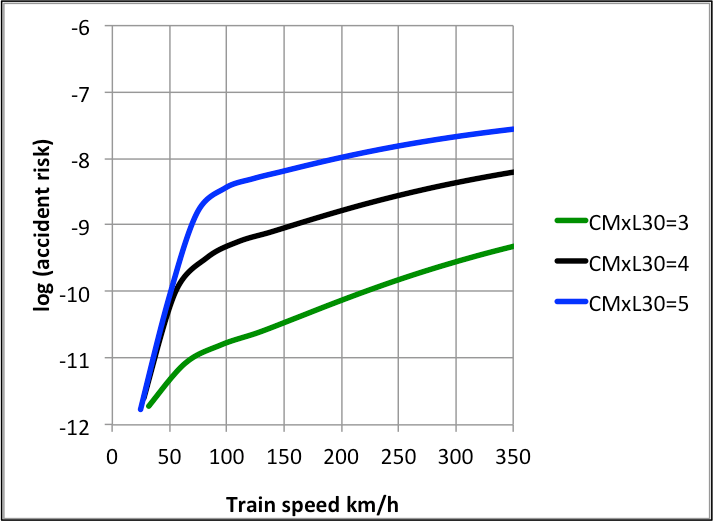
The flow around trains – analysis of CFD results

Introduction

In a post of January 2020, I attempted to collate the numerous train aerodynamics research papers that had appeared since myself and my fellow authors began to write the book “Train Aerodynamics – Fundamentals and Applications” (hereafter referred to as TAFA) in mid-2018. I considered these papers under the application headings that were defined in TAFA – train drag, loads on structures etc.  In this post I want to look at a subset of these papers, but consider them in rather a different way.  Specifically I will consider a number of papers that used various CFD approaches to investigate a range of issues. One of the major benefits of CFD methods is that they can, in principle, give details of the entire flow fields around the trains that are studied and I will thus try to assess what information can be obtained from these papers to assist our basic understanding of the flow around trains. In what follows I will make no comments at all on the methodology used in the papers, assuming that these have been validated by the publication procedures, but will rather consider only the results in order to assess the flow field. I will use the framework outlined in TAFA, for various flow regions – nose region, boundary layer region, underbody region, wake region and cross wind effects. The papers that I will use are given in table 1. Note that most (but not all) of these papers come from Chinese institutions and are thus (naturally) mainly concerned with the variants of the Chinese High Speed Train (CRH2).

Chen et al (2019a)   Chen et al (2019b)   Dong et al (2019)     Gao et al (2019)        Guo et al (2019)       Li et al (2018)           Li et al (2019)            Liu et al (2018)         Niu et al (2018a)      Niu et al (2018b)     Paz et al (2018)        Wang et al (2018)    Wang et al (2019)

Table 1 Papers used in study and web links

Nose region

Two studies in particular give useful information concerning the pressure pulse around train noses – those of Wang et al (2019) and Dong et al (2019) both for a CRH2C train. The former investigates the effect of bogie complexity on a three-coach train, whilst the latter investigates the effect of bogie fairings on a two-coach train. Neither bogie complexity or fairings however affect the flow around the nose to any extent.  Usefully both authors give data for the two TSI positions of 0.2m (termed trackside) and 1.4m (termed platform) above top of rail (ATOR) at various distances from the centre of the track (COT). In TAFA Table 5.1 typical values of peak-to-peak pressure coefficient for high-speed trains at 1.4m ATOR are within the range 0.15 to 0.20. At this position Wang et al give values of 0.18 and Dong et al a value of 0.14, which are broadly consistent with TAFA.  Both papers also give useful information on how the peak-to-peak values vary with distance from the centre of the track – see the graphs of figure 1. There is a difference between the two sets of data which is not easily explicable, as the calculation conditions and set up are similar.  Dong et al also give pressures on the track centre line, with a value of peak-to-peak pressure coefficient of 0.78 at the height of the top of the rail, 0.66 at 0.05m below the top of the rail and 0.52 at 0.23m below the top of the rail. The last value is similar to the value of 0.48 reported in TAFA Figure 5.19 for track bed pressures under the Class 373 Eurostar. 

Figure 1 Nose pressure transients

Both papers also give data that enables the peak of the dimensionless nose velocity transient to be determined. Similar data can be obtained from the work of Chen et al (2019a) who investigated the effects of different nose lengths on an idealized high-speed train model. The results are shown in figure 2 for the heights of 0.2m and 1.4m above the top of rail. The data from Chen et al is for a 7.5m nose length. Although this parameter is not tabulated in TAFA, figure 5.2 gives a value of 0.08 at 0.2m above the top of rail, which is consistent the data from the more recent papers. There is again no obvious reason for the difference between the results of Dong et al and Wang et al. The data for Chen et al for a 7.5m nose is close to that of Wang et al at 0.10. For the 5m and 10m nose lengths the values are 0.12 and 0.09.

Figure 2. Nose velocity transients

Boundary layer region

In addition to the three papers mentioned in the last section (Chen et al, 2019a; Dong et al, 2019; and Wang et al, 2019), the papers by Li et al (2019) and Wang et al (2018) also give information on the nature of the flow in the boundary layer region along the train side and roof. Li et al (2019) considered the effect of the coupling between two units, comparing the results found for a single 6 coach unit, and those for two coupled three-coach units, both with CRH2 geometry.  Wang et al (2018) used a two-coach model of a more generic high-speed train shape to study the effects of bogies on the flow.  All five papers gave slipstream velocity time histories that were in principle directly comparable, and could also be compared with the full-scale data for high-speed trains in TAFA chapter 5.  The results are plotted in figure 3, with the normalised velocity values being given at the centre of each coach.  The accuracy for the data from the published papers is not high, as I have taken the information from small-scale figures, but it should nonetheless suffice.  Specifically the following sets of data are shown on the graph.

  • Chen et al (2019a) – 7.5m nose length
  • Dong et al (2019) – Complex bogie
  • Li et al (2019) – Single unit
  • Wang et al (2018) – Full model
  • Wang et al (2019) – No bogie fairings

In general it seems that the slipstream velocities around the CFD models increase much quicker along the train than for the full-scale data, and thus there is much more rapid boundary layer growth in the CFD calculations. There is much scatter however, and some of this growth may be due to the specific model configuration used. For example the Wang et al (2019) data was for the case with no bogie fairings, which might be expected to lead to a rapidly growing boundary layer. That being said, one would actually expect a more rapidly growing boundary layer at model scale than at full scale for trains such as those considered here. For smooth high speed trains, where the analogy with a flat plate boundary layer is appropriate, the ratio of boundary layer thickness to distance from the nose of the train can be expected, very broadly, to be proportional to (Reynolds number based)-0.2. For a model scale of 1/8 and roughly full scale train speeds, which is the case for most of the calculations considered here, this suggests that at any point on the train, the scaled up boundary layer thickness for the computations should be about 1.5 times the actual full scale size, all other things being equal. For trains with blunter noses, or for freight trains, the size of the boundary layer will be more influenced by local separations and model scale and full-scale values should be more consistent. 
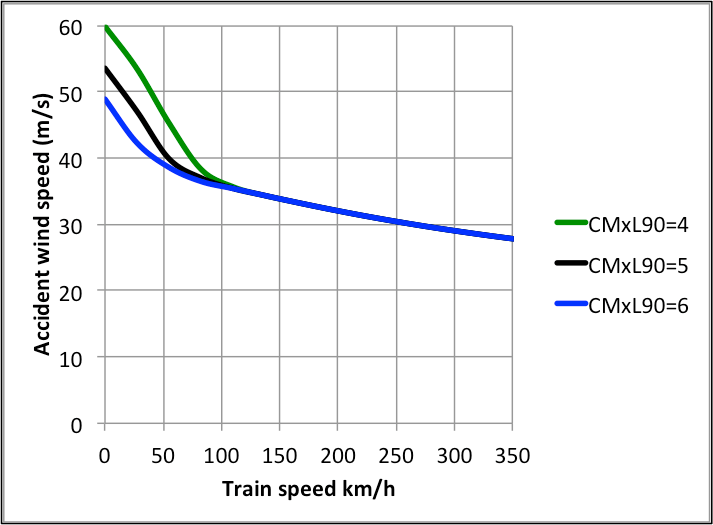
Figure 3. Normalised velocity at 3m from COT and 0.2m above TOR

The growth of the boundary layer has been measured by Chen et al (2019a) in terms of the classic boundary layer parameters of displacement and momentum thickness and form parameter.  His results for the displacement thickness on the side of the train are shown in figure 4 below for both the trackside and the platform cases, and also on the roof of the train. For the train side case, the boundary layer thicknesses from full-scale measurements of the ICE1 are also shown (from TAFA figure 5.12). These can be seen to be somewhat above those of Chen et al (2019a) which is perhaps not surprising as the blunt nosed ICE1 will cause a significant boundary layer thickening near the front of the train.  For both the side and the roof results of Chen the form parameter is around 1.25 to 1.3, somewhat nearer to the classical boundary layer value than the ICE1 values of 1.15.

Figure 4 Boundary layer displacement thickness along side of train and roof

Figure 5 again shows the data for Chen et al (2019a) for the train roof, but this time showing the momentum thickness in order to enable a comparison to be made with a comparison with the results of Li et al (2019). The results can be seen to be similar if not identical. 

Figure 5 Boundary layer momentum thickness along the roof of the train

In terms of overall boundary layer thickness, Gao et al (2019) and Niu et al (2018b) show contour plots around the train section. The figures shown are too small to take meaningful numbers from, but do indicate the thickening of the boundary layer close to the bogie region, and a slight thinning over the roof of the train. Wang et al (2019) provide rather more information of boundary layer thickness, and the development of the boundary layer down the side of their models is shown in figure 6, in terms of bogie position. These values are consistent with the displacement and momentum thicknesses shown above, being about an order of magnitude greater than the displacement and momentum thicknesses. 

Figure 6 Boundary layer thickness along the side of the train

Wang et al (2019) also give data for the velocity profiles at the side of the train (figure 7). These show the boundary layer extending to 3 to 4.4m from COT, which whilst broadly consistent with the various full-scale data sets in TAFA (figure 5.11), are perhaps somewhat thicker than the full scale results given there.
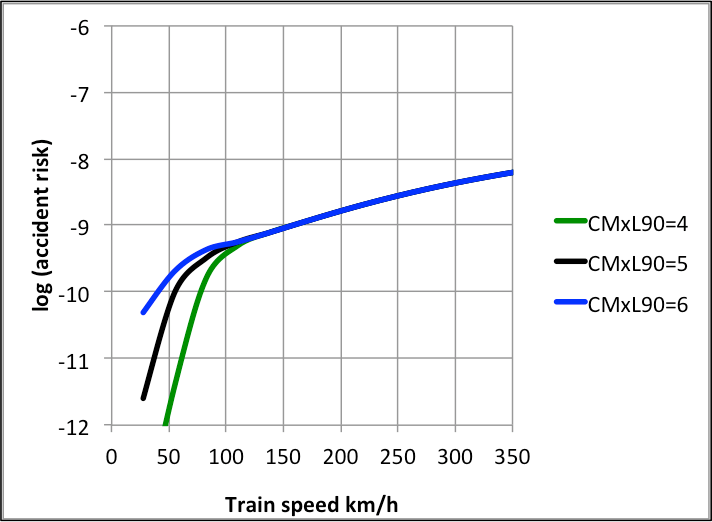
Figure 7 Boundary layer velocity profiles

Finally the individual datasets in some of the papers give useful information of the effect of different train geometries. These are summarised in table 2, which shows the normalised slipstream velocities at 3m from the centre of the track and 0.2m above TOR for the last coach of the train for Chen et al (2019a) (different nose lengths); Li et al (2019) for single and double units; and Wang et al (2019) for bogie fairings. The most noticeable effect is that of the gap between the units in double unit formations. 

Table 2. Effect of train modifications on normalised velocity (3m from COT, 0.2m above TOR at the centre of the last coach).

Underbody region

Perhaps the most significant paper to consider the flow beneath trains was that of Paz et al (2019) who looked at a novel method of specifying ground conditions that was much more realistic than current methodologies. This involved the scanning of the ballast and sleeper profiles of real track, with all the inherent irregularities and using this as the bottom boundary condition in CFD simulations. They showed that this methodology produced velocity profiles under long trains that conformed well with full-scale experiments, and that results in much more turbulent and chaotic flows than conventional ground simulations. This has obvious implications for the movement of ballast beneath trains. It seems to me that this paper sets the standard for proper ground simulations beneath trains in the future

A number of other papers looked at specific issues to do with the flow underneath the train, but it is difficult to draw any general conclusions from them, partly because they were addressing very localized effects and partly because they in general used short trains where the flows beneath the trains were not fully developed – for example Dong et al (2019) used a 2 car model when investigating different ground simulations; Gao et al (2019) used a three car model to look at bogie effects on the wake flow; Liu et al (2018) used a 1.5 car model to investigate snow accumulation on bogies; and Wang et al (2019) used a 3 car train to investigate the effect of bogie fairings. Whilst all these results are interesting in their own right, their application is very specific to the cases considered.  

Wake

A number of authors considered the wake flow of high-speed trains in some detail, looking at the effect of various geometric changes on the nature of the wake. In all cases the broad structure of the wake was similar to that found by many investigations in the past – a pair of counter-rotating longitudinal vortices. The investigations came to a number of conclusions as to the effect of geometric variations on the strength of this vortex pair as follows. 

  • Chen et al (2019a) found that the flow pattern for the shortest of the three train noses they used (5m) created a different wake topology to that with the 7.5m and 10m noses, and higher slipstream velocities. 
  • Gao et al (2019) showed that the precise position of the rear bogies had a noticeable, if not major effect upon wake topology. 
  • Li et al (2019) looked at the different wakes for single and multiple unit trains, They found that the wakes were similar in the two cases, but that for the double unit was more unsteady, reflecting the greater unsteadiness in the separating boundary layer at the end of the train due to the inter-unit gap. Overall they suggested however that the vortex pattern was dominated by the separation from underbody structures.
  • Wang et al (2018) showed that the presence of bogies on train models enhanced the unsteadiness of the flow. However the same dominant wake frequencies appeared with and without bogies, suggesting that whilst the vortex pattern results from the separated shear layer from the train, and has a certain fundamental unsteadiness, this unsteadiness is enhanced by the turbulence from the underbody flow
  • Wang et al (201), showed, unsurprisingly, that large fairings decrease scale and intensity of wake flow.

Overall these results suggest that the counter-rotating flow behind a high speed train is basically formed from the separating shear layers from the train side and roof boundary layers, but can be significantly modified by high levels of turbulence in the underbody flow. Here a word of caution is appropriate. As noted above, the underbody flow is the most difficult to simulate and really requires long trains and a sophisticated ground simulation, neither of which is usually the case in most CFD calculations. Thus the calculated effects of underbody flow or geometric changes on the wake structure must only be regarded as illustrative. There is a danger of reading too much into the various CFD results with regard to the wake structure. In addition it has been pointed out in TAFA that wake flows are quite sensitive to even small cross winds. Such winds will have length scales of the same approximate size as the vortex scale and it can be expected that in reality the general vortex flow pattern will be significantly distorted by such effects. Care should thus be taken so as not to overanalyze CFD models of wake flows. 

These points having been made, it is possible to extract from the various papers values of the average maximum wake flow velocity, and the TSI gust velocity. These values are shown in tables 3 and 4 below for the trackside TSI position 3m from COR and 0.2 ATOR for both single and double units, together with data from TAFA. Very broadly the ensemble mean maximum peak for the CRH2 tests is consistent with the published data, as are the TSI gust measurements, for both single and double units. The ensemble mean maximum for the generic high speed trains than  are however lower than the published values.

If one accepts that the wake structure is largely determined by the nature of the separating boundary layer at the end of the train, the fact that the CRH2 results are similar to the full scale results is perhaps a little surprising, in that the train boundary layers seem to grow more rapidly at model scale than at full scale (see above). It may be that this effect is compensated for by two effects; firstly that the model scale trains are shorter than the full scale trains, and thus the boundary layer at the end of the model scale trains will have a scaled thickness similar to that at full scale; and secondly it may be that the wake flow is not overly sensitive to the precise boundary layer characteristics at the end of the train. Nonetheless it does suggest some caution is required in the interpretation of slipstream measurements from reduced scale physical or computational tests for high speed, relatively smooth trains. 

Table 3 Wake velocities for single units

Table 4 Wake velocities for double units

Crosswind

Of the papers reviewed, four of them looked at specific crosswind effects

  • Chen et al (2019b) investigated the effect of nose length on cross wind pressures on the train. These were found to be small except around the nose and the tail.  
  • Guo et al (2019) compared the crosswind behavior of single and double units in terms of cross wind forces and wake characteristics. 
  • Li et al (2018) looked at the effect of crosswinds on pantograph forces, and also presented some useful calculations of train roof boundary layers in crosswinds. 
  • Niu et al (2018a) considered the effects of wind breaks on cross wind forces and wake characteristics.

All the calculations presented in the above papers give details of the inclined vortex wake behind the trains in low yaw angle crosswind conditions, and analyse these wakes in some depth. Now, none of the simulations attempted to reproduce atmospheric turbulence, so they are all unrealistic in this regard. The length scales of atmospheric turbulence near the ground are of the same order of size as the trains and the inclined vortices in the train wake. Thus in reality train wakes will be very disrupted by atmospheric turbulence and the detailed patterns observed in the CFD results will not occur. This suggests that to carry out a detailed analysis of the train wake is to over interpret the results. 
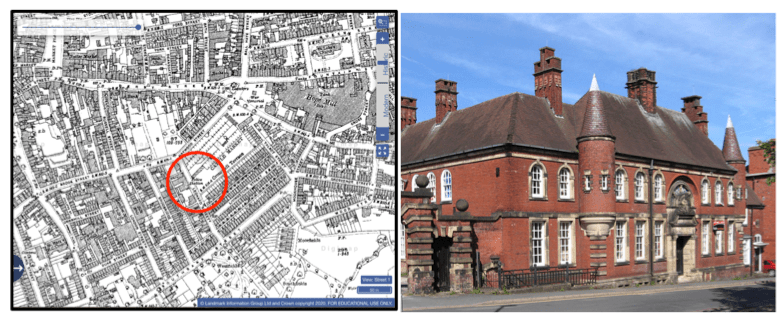
Thus in what follows, we do not look at the detailed results in these papers, but rather the results for global force coefficients that can be used to expand the existing database of information on crosswind forces on trains. Force coefficient data is given in Guo et al (2019), Li et al (2018) and Niu et al (2018a). Side force and lift force coefficients are set out in tables 5 to 7, with the reference area taken as 10m2in the conventional way. Two major points arise from these tables.

  • There is little difference between single and multiple unit crosswind forces, except for the cars near the junction between the two sets.
  • The windbreak calculations suggest there can actually be significant negative side forces on trains behind wind breaks under some circumstances.

Table 5. Force coefficient data from Guo et al (10 degrees yaw)

Table 6 Pantograph force coefficients from Li et al (2018)

Table 7 Train force coefficients from Niu et al (2018a) (15 degrees yaw, Zero porosity windbreak)

Coal mining in the Shut End and Corbyn’s Hall area

Shut End and Corbyn’s Hall

In an earlier post, I discussed the railway system around the Shut End and Corbyn’s Hall Ironworks and Colliery complexes in Pensnett  in the late 19thcentury. One reader of that post pointed me in the direction of the Coal Authority web site, which contains huge amount of information about disused coalmines across the country, including of course the Shut End and Corbyn’s Hall area.   It really is a fascinating site, and I would encourage readers to have a look at it. What I want to do in this post is to use some of the information presented there to give more details of the mining operations that I briefly discussed in Kingswinford Manor and Parish (KMAP) and in the blog post just mentioned. Figure 1 shows the area that I will concentrate on, which is centred on the High Oak in Pensnett where Commonside meets Pensnett High Street. The figure shows the major roads in the area; the canal feeder pools, which are such a major feature of the local geography; and the locations of the Ironworks at Shut End and Corbyn’s Hall.

Figure 1 The study area

Topography and Geology

Figure 2 shows the topography of the study area, with the elevation profiles taken from Google Earth. It can be seen that it falls quite steeply from east to west from around 150 a.s.l. in the east to around 90m a.s.l. in the west. This will be seen to be of importance when considering the depths of coal seams and mines below.   

Figure 2 Topography of the study area from Google Earth

Details of the geology of the area can be obtained from the Edina Digimap web site. Figure 3 shows the underlying bedrock geology of the area. This has been very much simplified from the Digimap version to show only the major features. There are four main types of underlying geology – sandstone to the west and in outcrops across the area; an igneous outcrop in the Barrow Hill area; large areas of the Etruria formation of sandstone / mudstone, with some areas of Pennine Coal measures formation of sandstone / mudstone / siltstone. The latter two are the principal coal bearing strata. The major faults are also shown. The fault to the west is actually the edge of the South Staffordshire coalfield. There can be seen to be a number of faults in the area, which cause quite complex underground coal seam patterns. This will be discussed further below.

Whilst the figure shows the underlying geology, close to the surface the nature of the land changes completely, and the Digimap website describes it as “artificial ground” – a somewhat euphemistic description of the fact that the whole area is largely built on waste and colliery spoil.

Figure 3 Geology of the study area from Edina Digimap 

The Coal Authority web site

We turn now to the information provided on the Coal Authority web site. Coal has been mined over the entire region around our study area for many hundreds of years, firstly exploiting surface outcrops of coal, and then digging deeper and deeper mines to bring the buried coal to the surface.  Most of the main surface outcrops of coal in the region were in the area south and east of Brierley Hill, which unsurprisingly was the first part of the ancient parish of Kingswinford to undergo industrialization. In our particular study area there were however a few outcrops (figure 4) – at Brockmoor in the south and in the Coopers Bank / Old Park areas in the north. 

Figure 4 Surface outcrops of coal from Coal Authority web site

Figure 5 shows the seams of buried coal, where there is sufficient information for the contours to be mapped, and spot depths for seams at other points. The heights of the seams are all given in metres a.s.l. This figure needs to be considered in the light of the topographical information in figure 2 to enable the depth of the seams below ground level to be appreciated. The shallowest deposits are to the east of the area where the seams can be as little as 30m below the ground. In the west of the area, the seams are much further below ground level – up to 150m. The deepest mines in the region were ultimately to be those at Baggeridge to the north of the study region, where the deposits were 350m below sea level. 

Figure 5 Coal seams and depths from Coal Authority web site

Looking at the distribution of coal from another direction, figure 6 shows a section through the study area from a drawing by William Matthews in  a paper he wrote in 1860. Matthews was the proprietor of Corbyn’s Hall Iron Works at the time and a little more issued about him in KMAP.  The approximate location of the section is given on figure 3. The line as specified by Matthews is a direct line from Dudley Castle to “Kingswinford” although where in Kingswinford is not spelt out and it is not possible to identify the precise location of the line.  That being said the location of the igneous outcrop at Barrow Hill can be seen and the faulted and fractured nature of the coalfield is apparent.  The need for deep pits to extract the bottom seams of coal is also clear. 

Figure 6. Section through the study area (redrawn form Matthews , 1860)

Figure 7 shows the “mine openings” as defined on the coal authority site. These mines were not of course all operating at the same time, so the map gives no temporal information. But the huge number of openings is instructive (and the density here is by no means as high as in the older Black Country mining areas of Bilston and Wednesbury). The site gives name information for many of these, which to some degree is indicative of ownership. The five main groupings are indicated on the map of Figure 7 as follows.

  • The Shut End group, originally owned and operated by James Foster in the 1830s as part of the Shut End Iron Works complex, and later by the Shut End Colliery Ltd. 
  • The Tiled House / Corbyn’s Hall group, developed by Ben Gibbons and his associates in the 1830s to 1850s, and which provided coal for the Corbyn’s Hall Iron Works.
  • The Himley Group of the Estate of the Earl of Dudley. It can be seen that this was to the east of Commonside, which was, in the main, the boundary of the Pensnett Chase Enclosure Award of 1784. A clause in the act reserved all the underground mineral rights to the Earl of Dudley and his successors, even where the land itself was allocated to others. The estate exploited these rights to the full over the next century and a half.  
  • A group in the Old Park area, which had been mined to varying degrees for several centuries by the Earls of Dudley. 
  • A group of mines around the Wallows / Woodside, which were probably also part of the Dudley estate.

Figure 7.  “Mine openings” from Coal Authority web site

If the “mine opening” category on the Coal Authority site does not give temporal information, the “mine working” category does.  For each mine that is included, it gives a year when it was working. The precise definition of this year is not clear to me i.e. was it the first year of operation; the last year; or something in between? But at least it gives an indication of when mines were in operation. I have presented this data in figures 8, 9 and 10 in twenty-year time slices – 1830-1850, 1850 to 1870 and 1870 to 1890. The former corresponds to some degree to that given on the 1840 Fowler map of Kingswinford, and the latter to the period I considered in my earlier post where I discussed the railways of the area. A comparison of the maps is instructive. Between 1830 and 1850 the highest concentration of mines is in the Shut End area, where the Iron Works was in operation, with limited mines around the Corbyn’s Hall area, presumably feeding the Iron Works there. Between 1850 and 1870 the mines close to the Shut End Iron Works had clearly all been worked out, and supplies were brought in from somewhat further afield by rail  – a process I discussed in the earlier post. In this period there was much more activity around Corbyn’s Hall and the High Oak area of Pensnett, and mines were operating in the Wallows and Old Park areas. It can thus be seen that the exploitation of the coal reserves by the Earl of Dudley’s estate was well underway in this period. In the 1870 to 1890 time slice, the situation has changed again with the most heavily exploited areas being in the Fens and Barrow Hill regions. Many of the mines in this area were in the residential areas of upper Pensnett. A cluster of them was around Pensnett church and vicarage, and no doubt contributed to the long term subsidence problems of structural damage to the church. Comparing this information with that given in KMAP for the distribution of the coal pits on the 1840 Fowler Map and the 1883 Ordnance Survey map, shows that these two sources show far fewer pits than the Coal Authority map. This might be of course simply because they show the situation at a particular time rather than in a twenty year time slice, but it does give some idea of both the short lived nature of many of the mines, and the uncertainties in handling data from different sources. 

Figure 8. “Mines working” between 1830 and 1850 from the Coal Authority web site

Figure 9. “Mines working” between 1850 and 1870 from the Coal Authority web site

Figure 10. “Mines working” between 1870 and 1890 from the Coal Authority web site

Final thoughts

Two final thoughts come to mind, in connection with items I have already posted. Firstly in Kingswinford Manor and Parish, when considering the spread of mining through the parish of Kingswinford I rather simplistically suggested that, during the nineteenth century, there was a gradual spread from the old mining areas in the Brierley Hill area in the south of the parish, northwards towards Pensnett and Shut End. The situation described above shows that it was rather more complex than that, with an early exploitation of the coal reserves around Shut End, and to a lesser extent Corbyn’s Hall, followed by a gradual “filling in” with mines of the areas between Brierley Hill and Brockmoor and Shut End over the next half century. 

Secondly in my earlier post on the Railways of the area, I put forward a model of how Ironworks / Colliery complexes developed in the area – firstly with ironworks and coalmines being in close proximity; then as the coal reserves became exhausted, with railway systems being developed to bring coal from mines somewhat further away but still in the locality, and finally with coal being brought from considerable distances. Figures 8 to 10 above tend to confirm this model in the Shut End area in particular, with the early development and later decline of mines close to the ironworks there, but there is also evidence of the same process around Corbyn’s Hall. 

Without a doubt the Coal Authority web site has a huge amount of data of interest to industrial historians, and I am very grateful that I was told about it. In this post I feel I have only scratched the surface of this material – so I may well return to it in future.