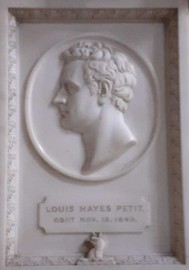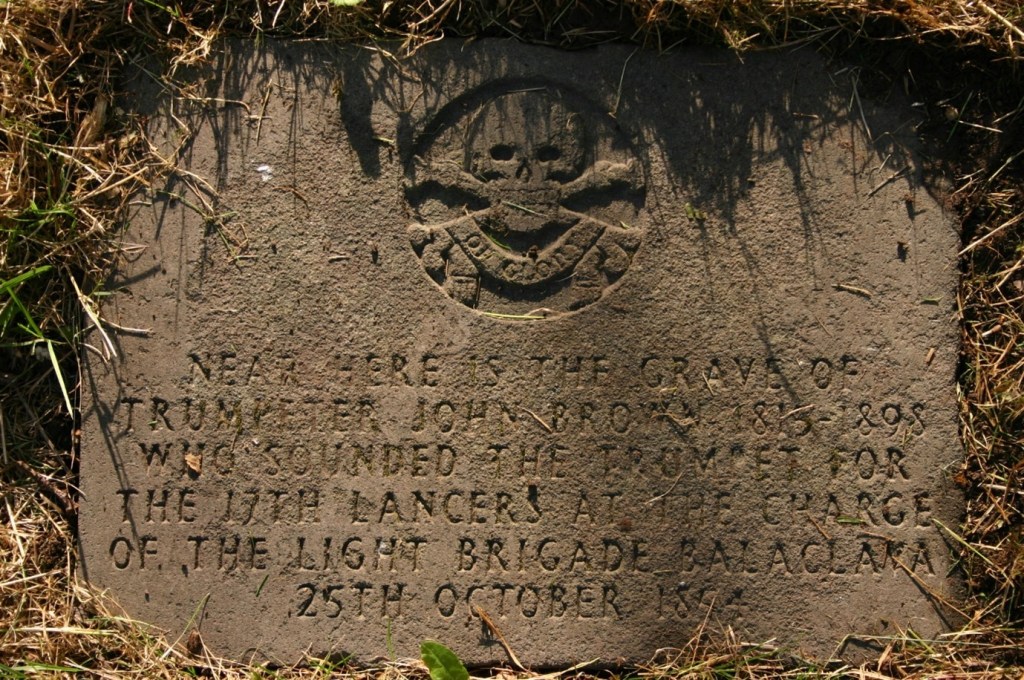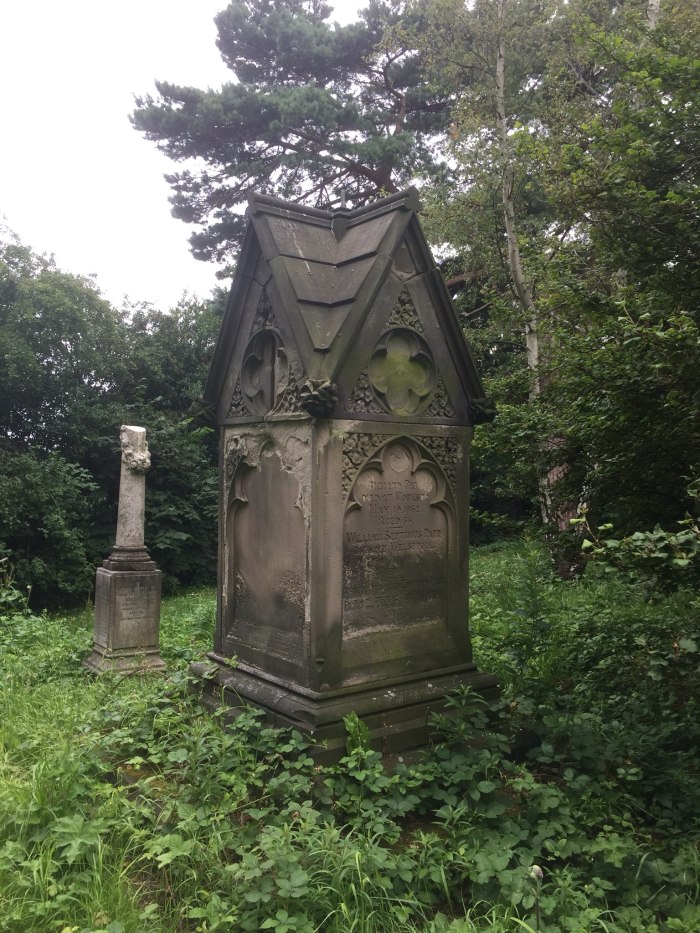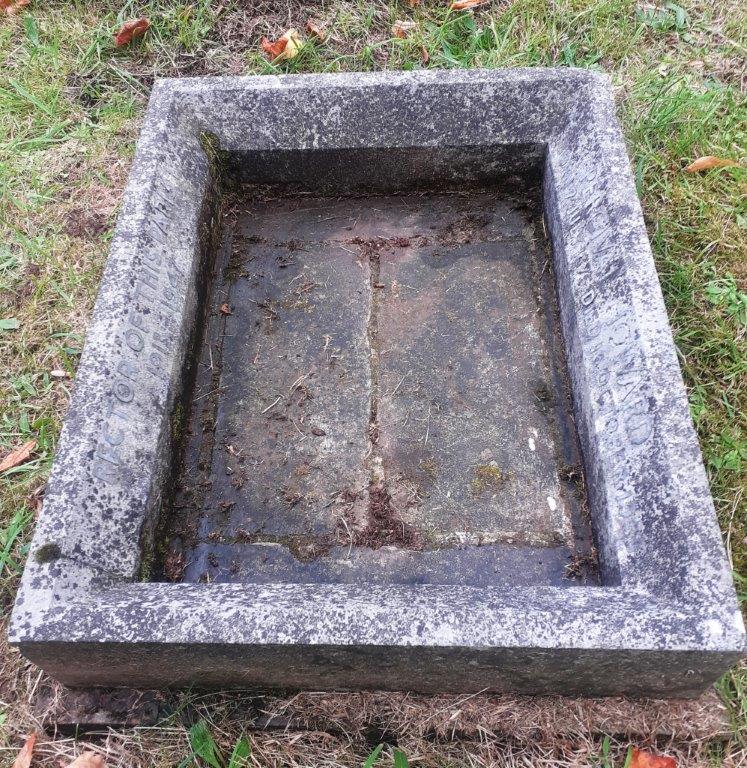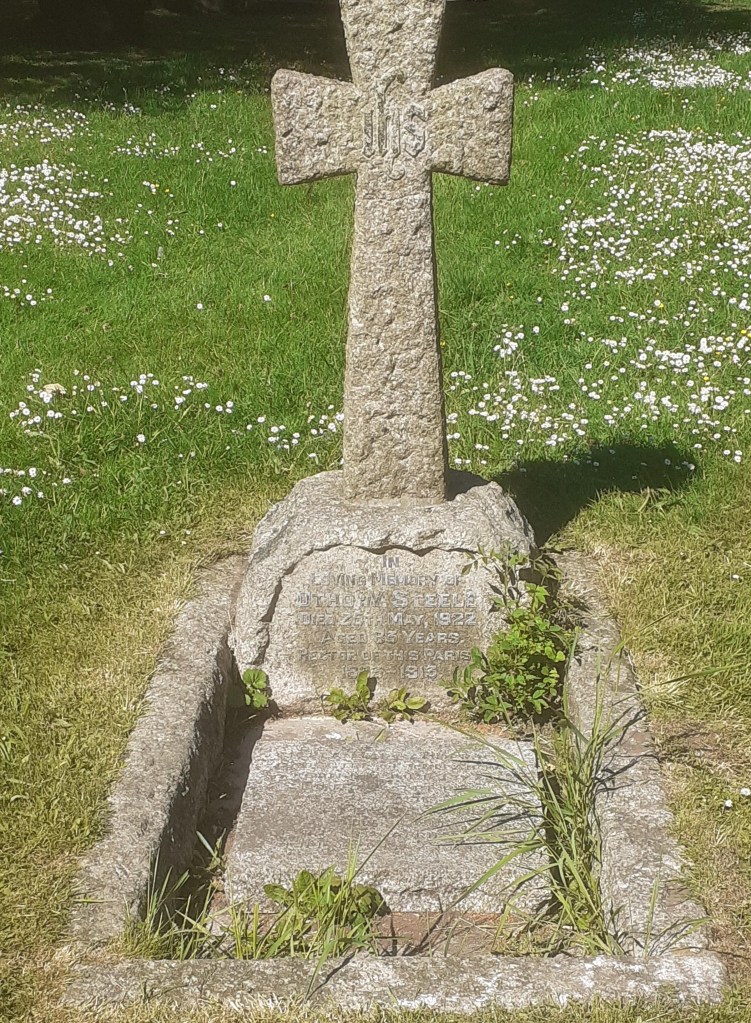
James Jordan Serjeantson – Rector of St. Michael’s church in Lichfield, 1868 to 1886

From the early 18th century until 1867, the clergy at St. Michael’s were “perpetual curates” – appointed by the incumbent of St. Mary’s. These were paid a cash stipend, but had no income from tithes and glebe lands, and were often of lower social standing than Rectors. At the start of December 1867, the then perpetual curate, Thomas Gnossall Parr, who has been in post as a Perpetual Curate since 1831, was made the first Rector of the parish. He was not to enjoy that title for any length of time and fell ill and died shortly afterwards on December 23rd1867.

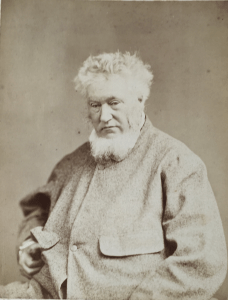
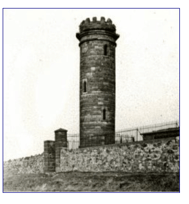
He was succeeded in June 1868 by the first to actually be appointed to the post of Rector – James Jordan Serjeantson (pictured). Serjeantson was born in Liverpool in 1835, the son of a Liverpool merchant and an Irish mother and attended Liverpool Grammar and Rugby Schools. In 1854 he matriculated at Trinity College in Cambridge and was awarded his BA in 1858 and his MA in 1861. He was a rowing blue and part of the University crew that lost the boat race in 1857 by 11 lengths. There have only been six larger losing margins in the 190-year history of the race, so I doubt it was an experience he relished. He was ordained deacon in 1859 and priest a year later, both at Lichfield Cathedral. He served a curacy at Stoke from 1859 to 1868 before coming to St. Michael’s. He left Stoke in June 1868 to high praise from his incumbent and the Archdeacon, with gifts (including a hall clock) from parishioners and Sunday School children.  He married Elizabeth Buckley, a clergyman’s daughter in August that year and they were to have seven children. 

It is clear from the records we have that he was an assiduous, hard-working parson, much admired and respected by his parishioners. In June 1877, he notes in the service register that “this is the 1000th sermon I have preached in this church”. In June 1983, he was to write again “this is the 2000th sermon I have preached in this church”.  This is an average of around 130 per year! Some indication of his activities can be judged from the activities of Holy Week in 1882 shown below. In total there were 16 sermons or addresses that week, all preached by Serjeantson. His sermons were very practical and he made no claim to eloquence, but were much appreciated by his congregation. It would seem he was quite blunt in his manner, not afraid to call a spade a spade, but was nonetheless admired for his straightforwardness.

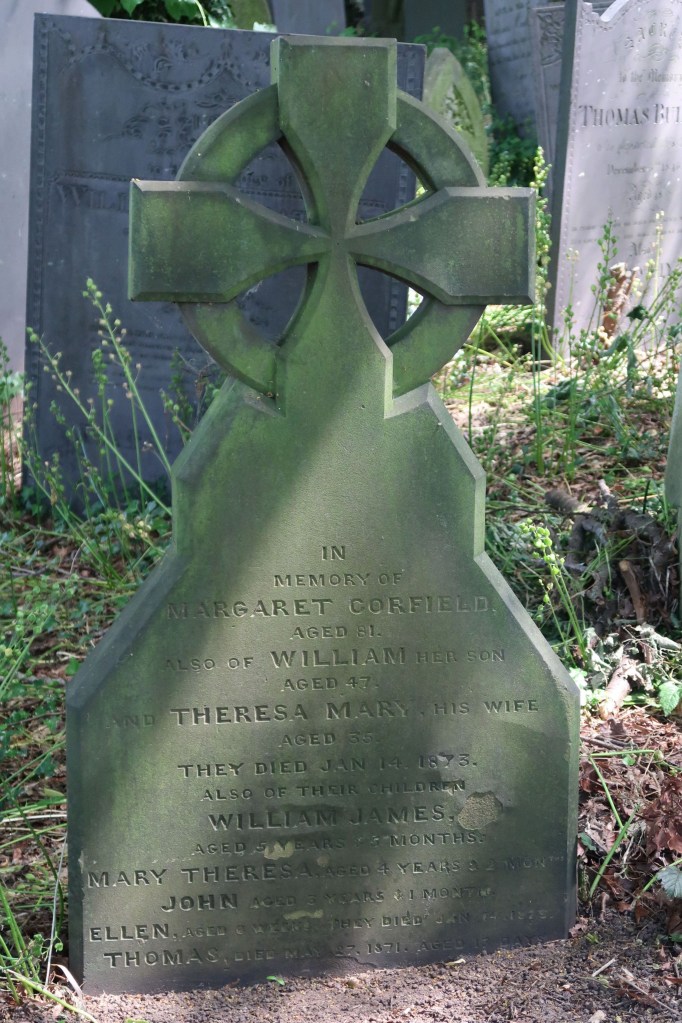
He presided at the pastoral offices – 1123 baptisms, 1189 marriages and 215 funerals in total over the years of his incumbency and also presented 20 to 30 young people each year for confirmation. One of the more memorable funerals was that of William Corfield and his wife Theresa, his elderly mother and four young children who all died from suffocation in a house fire on Breadmarket Street, next to Dr Johnson’s birthplace in January 1873. The press reported that James Serjeantson’s voice trembled with emotion as he read the words of the funeral service around the grave before the coffins were lowered one by one.

Theologically, he seems to have been very much against the ceremonial associated with the Anglo-Catholic Oxford movement and is recorded as a signatory of a letter of 1875 to the bishops that argued against legalizing the use of eucharistic vestments and the eastward position for celebrating the eucharist. Some aspects of current worship at St. Michael’s would have certainly made him uncomfortable! The service register indicates he was a strong supporter of the Melanasian Mission, formed by Bishop Selwyn, the former Bishop of New Zealand, and indeed one of his curates, Rev John Still (1869-1871), left Lichfield to become a missionary in the South Pacific, at a time just following the martyrdom of Bishop John Patteson in the Solomon Islands.

Serjeantson had gifts other than his preaching and pastoral abilities. Within twelve months of arriving in the parish he was awarded the prize for the best variegated geraniums at the annual flower show (which almost certainly didn’t go down well with some of the more established exhibitors!) and he was also the founder and a valued member of the bell ringing team. His name can still be found on a number of memorial boards in the belfry, that commemorate the ringing of specific peals – for example he was part of the team that rang a complete peal of Grandsire Minor in 1876. He was a very knowledgeable naturalist, who initiated a scheme for replacing dead trees in the churchyard; an amateur astronomer (possessing his own telescope), and as a historian he was well acquainted with the church records. In short he was something of a polymath. He also served as a Workhouse Guardian and took an in various educational initiatives within the city.

In 1881 he and his wife, their two sons, Cecil (10) and Ronald (7), and three daughters, Mildred (5), Edith (3) and Monica (1) lived at the Rectory on Mount Pleasant, with a housekeeper, cook and two servants. Two other children died as babies – Edward in 1870 and Joyce in 1884.

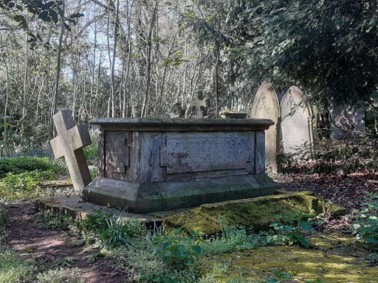
He died on New Year’s day 1886 and was buried four days later, with the funeral being taken by the Vicar of Stoke on Trent and the Vicar of St Mary’s, with the Bishop of Lichfield presiding at the graveside. His passing was very extensively covered in the local press, with full obituaries and even the full text of memorial sermons! His final illness seems to have been short – he was still presiding at funerals two weeks before he died. Elizabeth was to outlive him by 33 years. Their graves, and the graves of their infant children, are, at the time of writing, currently inaccessible in the very overgrown area at the east of the old churchyard. I have not succeeded in identifying them, although I have received many bramble scratches in the trying. 

But James Serjeantson does have other memorials. A fountain on Greenhill that was erected in his memory in 1886 contains the inscription

Erected by parishioners and friends in grateful and loving memory of the Rev J J Serjeantson MA, Rector of St. Michael’s, Lichfield.

In addition, a plaque in the chancel at St. Michael’s reads

To the glory of God and in loving memory of James Jordan Serjeantson M.A. for 17 years rector of this parish who by the sympathy and energy with which he fulfilled his ministry on Christ endeared himself to his parishioners and by the brightness of his manner and his cheerful readiness with which he brought out the stores of his varied learning won for himself the esteem and love of all classes.   He fell asleep January 1st 1886 aged 50 years.

Both memorials speak eloquently of the high esteem in which he was held in the church and the city and the love that his parishioners felt for him. He perhaps deserves more recognition as the first to be appointed Rector of the parish.

Chris Baker

St. Michael’s church, Lichfield – from the parish magazines 1889-1892

I have recently come across a bound copy of the church magazines from 1889 to 1892. In this article I will share some items of interest that I found there – some that will describe situations that will be very familiar to the current congregation and some that are rather strange in modern terms.

The vicar for those years was the Rev. Cyril Hubbard, an old Etonian who the census tells us lived at the Rectory in Mount Pleasant with his wife, two children and four servants (!), and had been Rector since 1886. He seems to have been the driving force behind the magazine and wrote an article each month – a mix of devotional and news material. He was particularly concerned to increase the number of communicants, but also to repair and restore the tower and the chancel which were in a poor state of repair – more of this below. As ever, there were financial issues, and not infrequent requests for subscriptions to projects and for increased weekly offerings.  In the November 1892 magazine he both announced that he was leaving the parish and also named his successor who had been appointed by the Bishop of Lichfield – Rev Otho Steele from Hanley. He was to leave early in 1893, and Rev Steel took up the post very soon afterwards. It doesn’t happen like that these days!

Rev. Cyril Hubbard

The magazine was a simple four- page affair – essentially a folded A4 sheet. There is an indication that these magazines were the first that were wholly church produced – a more generic ”Banner of Faith” magazine having been used beforehand. The front page was standard and gave details of the services and other activities. On a Sunday there were four or five services – a weekly Holy Communion at 8.00am (some things never change); Mattins at 10.45; a monthly Holy Communion at 12.00; an afternoon service at 3.00, that on various Sundays of the month included a Children’s service, baptisms, or churchings; and Evensong at 6.30.

There were also services on Wednesday evenings at 7.30 in church, and on Tuesday evenings at 7.30 in St. John’s St., and in Streethay. It is not clear where the latter were held – presumably in hired rooms?  Sunday Schools were held in the School at 9.30 and 2.30, and also in St John’s St. and occasionally Streethay at 2.30. There were a number of regular Monday meetings – a Clothing Club at the School from 12.00 to 1.00, three Mothers meetings at the Rectory, City Mill, and Birmingham Road Barracks at 2.00, and a Band of Hope Meeting (a young person’s temperance society) at 6.00 in the School. On Saints’ days there was a service of Mattins at 9.00. The Rev Hubbard and his congregation were not idle!

In addition to all the above there were occasional lectures, bible studies, concerts and so on. Of particular interest were the Smoking Concerts for men, where the entrance fee was 2d, for which they received 1d worth of tobacco and the rest being spent on the hired room and heating. Newspapers and board games were provided, and those who came entertained each other with song and rhymes (in a fog of tobacco smoke one assumes). The annual Vestry meeting took pace just after Easter, for the election of Churchwardens and presentation of their accounts; and the election of sidesmen for the parish and for the surrounding hamlets – Streethay, Fulfen, Tamhorn, Freeford, Statfold and Fisherwick. Sidesmen had a more representative role in that period than their current role as being welcomers into church. The churchwardens accounts for 1890 show a total income of £204 with £70 from St. Michael’s Trust, £52 from the offertory and £45 from burial and other fees; and an expenditure of £165 with £37 being spent on the organist and choir, £51 on the Sexton’s wages; £25 on the heating and cleaning; and £18 on “making a new carriage road to the church door”. There were special collections for charities such as “Waifs and Strays”, CMS, the clothing club et.c of £32 in total.

At the start of the period covered by the magazines, both the tower and the chancel were in a poor state of repair and it had become inadvisable to ring the bells except when strictly necessary. The tower had suffered from severe settlement problems, and by late 1889 there was a wide crack in the south wall that ran the entire height of the tower and part of the spire, and the western buttresses were also in a poor state. There were also problems with the north wall, and parapets. An appeal was launched to meet the £250 required for the work, which was successfully completed by September 1891.

The chancel had been extensively modified in the 1840s, when the roof was lowered, the walls plastered, a vaulted roof added, and all the windows (including the large east window) replaced by narrow lancet windows- in an effort to restore it to some (fictional) early English style. By 1889 it was in a very poor state of repair and work clearly needed doing. Rev. Hubbard largely financed this from his own resources.  The plaster was removed, a new oak ceiling added, and the east window restored to its past (and current) form. At that point there was not enough money to install stained glass, which was eventually incorporated a decade later. To the right of the altar a credence niche was created in the wall for the communion vessels. It was decorated with tiles found in a vault to the north of the altar that was entered by stairs beneath it – these tiles can still be seen.  The choir were moved into the chancel, a move which gave the Rev. Hubbard some anxiety as to whether they were too remote from the congregation to properly lead the singing, and he pleaded for the congregation to join in the singing psalms and hymns. The clergy reading desk was also moved into the chancel, which gave similar concerns, although it seems that the (unamplified of course) voice of Rev. Hubbard could still be heard.

The new Girl’s school was opened with a great fanfare in July 1889 – effectively the completion of the school in the form that many older residents of the parish will have known it. The new building was the part of the school next to Church Street and connected with the 1858 building with the tower to the south of it. At the opening, children’s games were played and after a short service of dedication the building was handed over by the Hon Alfred Percy Allsop, who had served on the school management committee for a number of years and had paid for the new building. The enthusiasm was somewhat damped within a few days by the sudden departure of the much-respected schoolmaster, Mr Lasseter, following the death of his wife and his own ill health. A former pupil teacher was drafted in to keep the school running while a new master was appointed. The school accounts for 1889 show an income of £479 with a government grant of £217, school pence (from families) of £130 and voluntary contributions of £53; and an expenditure of £493, with £404 spent on teachers’ salaries. There were 107 boys on the register, 92 girls and 60 infants (who were presumably also boys and girls).

At that time most of the burials in the churchyard were in the now overgrown area next to what we call the new churchyard, and these are recorded month by month in the magazine, in much the same way as now. A couple of articles also give details of the avenue that runs up to the church from the north gate. Mr Henry C Malden, in describing his research in the parish registers, informs us that the avenue was set with elm trees on February 26th 1750 – on a “windy Tuesday”. In 1890, many of these were in poor condition and had, according to Mr Walden, felt the effects of many windy Tuesdays and seen their best days, and it was decided to replace every other one by quick growing lime trees. Of crab apples there is not a mention. Mr Malden ends his article with the words.

“Sooner or later, my readers, like them, will have seen their best days, and have their names added to the long list of those whose last home is in the old churchyard on the hill.”

And that seems a good place for me to stop as well!

Pollutants, pathogens and public transport – ventilation, dispersion and dose

Preamble

The ventilation of buses and trains has come to be of some significance to the travelling public in recent years for a number of reasons. On the one hand, such vehicles can travel through highly polluted environments, such as urban highways or railway tunnels, with high levels of the oxides of nitrogen, carbon monoxide, hydrocarbons and particulate matter that can be drawn into the passenger compartments with potentially both short- and long-term health effects on passengers. On the other, the covid-19 pandemic has raised very significant concerns about the aerosol spread of pathogens within the enclosed spaces of trains and buses. There is a basic dichotomy here – to minimise the intake of external pollutants into vehicles, the intake of external air needs to be kept low, whilst to keep pathogen risk low, then high levels of air exchange between the outside environment and the internal space are desirable. This post addresses this issue by developing a common analytical framework for pollutant and pathogen dispersion in public transport vehicles, and then utilises this framework to investigate specific scenarios, with a range of different ventilation strategies.

The full methodology is given in the pdf that can be accessed via the button opposite. This contains all the technical details and a full bibliography. Here we give an outline of the methodology and the results that have been obtained.

Analysis

The basic method of analysis is to use the principle conservation of mass of pollutant or pathogen into and out of the cabin space. In words this can be written as follows.

Rate of change of mass of species inside the vehicle = inlet mass flow rate of species + mass generation rate of species within the vehicle – outlet mass flow rate of species– mass flow rate of species removed through cleaning, deposition on surfaces or decay.

This results in the equation shown in Box 1 below, which relates the concentration in the cabin to the external concentrations, the characteristics of the ventilation system and the characteristics of the pollutant or pathogen. The basic assumption that is made is of full mixing of the pollutant or pathogen in the cabin. The pdf gives full details of the derivation of this equation, and of analytical solutions for certain simple cases. It is sufficient to note here however that this is a very simple first order differential equation that can be easily solved for any time variation of external concentrations of pollutant generation by simple time stepping methods. For gaseous pollutants, the rate of deposition and the decay rate are both zero which leads to a degree of simplification.

Box 1. The concentration equation

The pdf also goes on to consider the pollutant or pathogen dose that passengers would be subjected to – essentially the integration of concentration of time history – and then uses this in a simple model of pathogen infection. This results in the infection equation shown in Box 2. Essentially it can be seen that the infection risk is proportional to the average concentration in the cabin and to journey length.

Box 2. Infection equation

The main issue with this infection model is that it assumes complete mixing of the pathogen throughout the cabin space and does not take account of the elevated concentrations around an infected individual. A possible way to deal with this is set out in the pdf. Further work is required in this area.

Ventilation types

The concentration and infection equations in Boxes 1 and 2 do not differentiate between the nature of the ventilation system on public transport vehicles. Essentially there are five types of ventilation.

  • Mechanical ventilation by HVAC systems
  • Ventilation through open windows
  • Ventilation through open doors
  • Ventilation by a through flow from leakage at the front and back of the vehicle (for buses only)
  • Ventilation due to internal and external pressure difference across the envelope.

Simple formulae for the air exchange rates per hour have been derived and are shown in Box 3 below. By substituting typical parameter values the air exchange rates are of the order of 5 to 10 air changes per hour for the first four ventilation types, but only 0.1 for the last. Thus ventilation due to envelope leakage will not be considered further here, although it is of importance when considering pressure transients experienced by passengers in trains.

Box 3. Ventilation types

Scenario modelling

In what follows, we present the results of a simple scenario analysis that investigates the application of the above analysis for different types of vehicle with a range different ventilation systems, running through different transport environments. We consider the following vehicle and ventilation types.

  • An air-conditioned diesel train, with controllable HVAC systems.
  • A window and door ventilated diesel train.
  • A bus ventilated by windows, doors, and externally pressure generated leakage.

Two journey environments are considered.

  • For the trains, a one-hour commuter journey as shown in figure 1, beginning in an inner-city enclosed station, running through an urban area with two stations and two tunnels, and then through a rural area with three stations (figure 1).
  • For buses, a one-hour commuter journey, with regular stops, through city centre, suburban and rural environments (figure 2).

Results are presented for the following scenarios.

  • Scenario 1. Air-conditioned train on the rail route, with HVACs operating at full capacity throughout.
  • Scenario 2. As scenario 1, but with the HVACs turned to low flow rates in tunnels and enclosed stations, where there are high levels of pollutants.
  • Scenario 3. Window ventilated train on rail route with windows open throughout and doors opened at stations.
  • Scenario 4. As scenario 3, but with windows closed.
  • Scenario 5. Window, door and leakage ventilated bus on bus route with windows open throughout and doors opened at bus stops.
  • Scenario 6. As scenario 5, but with windows closed.

Details of the different environments and scenarios are given in tables 1 and 2.  Realistic, if somewhat arbitrary levels of environmental and exhaust pollutants are specified for the different environments – high concentrations in cities and enclosed railway and bus stations and lower concentrations in rural areas. The air exchange rates from different mechanisms are also specified, with the values calculated from the equations in Box 3. Note that, in any development of this methodology, more detailed models of the exhaust emissions could be used that relate concentrations at the HVAC systems and window openings to concentrations at the stack, which would allow more complex speed profiles to be investigated, with acceleration and deceleration phases.

Figure 1. The rail route

Figure 2. The bus route

Table 1. The rail scenarios

Table 2. The bus scenarios

The results of the analysis are shown in figures 3 and 4 below for the train and bus scenarios respectively. Both figures show time histories of concentrations for NO2, PM2.5, CO2 and Covid-19, together with the external concentrations of the pollutants.

For Scenario 1, with constant air conditioning, all species tend to an equilibrium value that is the external value in the case of NO2 and PM2.5, slightly higher than the external value for CO2 due to the internal generation and a value fixed by the emission rate for Covid 19.

For Scenario 2, with low levels of ventilation in the enclosed station and in the tunnels, NO2 and PM2.5 values are lower than scenario 1 at the start of the journey where the lower ventilation rates are used, but CO2 and Covd-19 concentrations are considerably elevated. When the ventilation rates are increased in the second half of the journey all concentrations approach those of Scenario 1.

The concentration values for scenario 3, with open windows, match those of Scenario 1 quite closely as the specified ventilation rates are similar. However, for Scenario 4, with windows shut and only door ventilation at stations, such as might be the case in inclement weather, the situation is very different, with steadily falling levels of NO2 and PM2.5, but significantly higher values of CO2 and Covid-19. The latter clearly show the effect of door openings at stations.

Figure 3. The train scenario results

Now consider the bus scenarios in figure 4. For both Scenario 5 with open windows and doors, and Scenario 6 with closed windows and open doors, the NO2 and PM2.5 values tend towards the ambient concentrations and thus fall throughout the journey as the air becomes cleaner in rural areas. The internally generated CO2 and Covid-19 concentrations for CO2 and Covid-19 are however very much higher for Scenario 6 than for Scenario 5.

Figure 5. The bus scenarios

The average values of concentration for all the scenarios is given in Table 3. The dose and, for Covid-19, the infection probability, are proportional to these concentrations. For NO2 and PM10 the average concentrations reflect the average external concentrations, and, with the exception of Scenario 4, where there is low air exchange with the external environment for part of the journey. The average concentrations for CO2 and Covid-19 for the less ventilated Scenarios 4 and 6 are significantly higher than the other. For Covid-19, the effect of closing windows on window ventilated trains and buses raises the concentrations, and thus the infection probabilities, by 60% and 76% respectively.

Table 3. Average concentrations

Closing comments

The major strength of the methodology described above is its ability, in a simple and straightforward way, to model pollutant and pathogen concentrations for complete journeys, and to investigate the efficacy of various operational and design changes on these concentrations. It could thus be used, for example, to develop HVAC operational strategies for a range of different journey types. That being said, there is much more that needs to be done – for example linking the methodology with calculations of exhaust dispersion around vehicles, with models of particulate resuspension or with models of wind speed and direction variability. It has also been pointed out above that the main limitation of the infection model is the assumption of complete mixing. The full paper sets out a possible way forward that might overcome this. Nonetheless the model has the potential to be of some utility to public transport operators in their consideration of pollutant and pathogen concentrations and dispersion within their vehicles.

Covid-19 – how risky are church services?

As I write, in late July 2021, Covid-19 infection rates are increasing rapidly, at the same time as restrictions are being eased, and people from all walks of life are becoming increasingly nervous about being infected. This nervousness is, quite understandably, shared by church congregations, and some are questioning whether it is actually safe to come to church in the current circumstances. Is it therefore actually possibly to be a bit more precise about what the actual risk of attending church might be? The answer is a qualified, yes, it is possible, very approximately, to calculate the risk of infection at church services, and, in this article, I will describe the risks of attending church for different scenarios, based on the current situation at St. Michael’s church in Lichfield, where I serve as a minister.

The method I will use is that developed by Prof Jose-Luis Jimenez at the University of Colorado – Boulder in the USA. This is a simple spreadsheet-based model of Covid transmission and infection using the latest scientific knowledge and which can be used in a variety of situations – residential homes, shops, public transport and places of worship for example. It is more fully described here. It is based on aerosol transmission of the virus, which is now regarded as the main way in which the virus is transmitted, particularly if simple hygiene methods are followed, such as regular cleaning of services and washing of hands, to reduce the risk of picking up the virus by touch. Prof Jimenez would be the first to admit that the method is very approximate and comes with lots of uncertainties, not least because the understanding of the way in which infected people emit the virus is at the moment poorly understood. Nonetheless it does give a rough indication of risk.

The situation I have looked at is effectively the current practice in St. Michael’s in Lichfield – a large, fairly poorly ventilated area, with a congregation of about 60 and a choir of 6. Social distancing is assumed, together with everyone wearing masks and only the choir singing, for a one-hour service, with the current community infection rate of about one in a hundred people being infected with Covid at any one time. 80% of the congregation are assumed to be double vaccinated. Plugging this lot into the spreadsheet gives a risk of any one member of the congregation being infected with the virus at a particular service of 1 in 26,700. To give some perspective, the risk of being involved in a road vehicle accident in Britain in the week following the service is 1 in 22,000. Thus, attending a service at St. Michael’s with the current practice is very safe indeed, even allowing for the very approximate nature of the calculations – we are all likely to be in much more hazardous situations at other times in the week.

As restrictions ease, churches across the country are considering easing their own restrictions, and Jimenez’s spreadsheet gives a way of how this might change the risk. Again, for St Michael’s, having 100 people in the congregation in church as opposed to 60 (and reducing social distancing) increases the risk to 1 in 17,500. Doing away with masks as well increases the risk further to 1 in 6,100. This is a big jump, as masks both restrict the spread of the virus from those who are infected, and also give some protection to those who aren’t. Taking the next step and letting the congregation sing hymns increases the risk to 1 in 2500. This is because singing, or speaking loudly, increases the breathing rate and allows more virus to be both exhaled and inhaled. As an interim step, should we keep social distancing and mask wearing but allow congregational singing with masks on, the risk of infection comes out as 1 in 10,200.

How these results should be interpreted is of course a matter for the individual. I personally would find a risk of 1 in 5000 acceptable but would begin to get a bit twitchy if the risk were as high as 1 in 1000.  Importantly though it should be remembered that the risks are more or less proportional to the number of infected in the general population. So as the community infection rate drops, as one hopes it will, the risk decreases. For example, if the community infection rate was 1 in 500, the risk of being infected at a church service with no social distancing, no masks and with singing, falls to 1 in 12,500, which I, for one, would regard as very acceptable and quite safe.

The calculation of Covid-19 infection rates in churches

Preamble

In a recent post, I looked at the risk of Covid infection on GB trains, based on the spreadsheet calculation methodology of Professor Jimenez and his team at the University of Colorado – Boulder. This method is based solely on aerosol transmission, which is now regarded as being of much more significance than transmission by surface contamination, and the risk of the latter can be easily reduced by normal hygiene precautions. In this post, I apply the same methodology specifically to the case of churches and include a downloadable EXCEL spreadsheet that might be of use to others. There is a level of self-interest of course, as I am a minister at an Anglican church which will shortly be faced with decisions concerning the nature of worship as the Covid restrictions are removed.  Essentially the spreadsheet gives a numerical value for the risk of Covid infection with specified amelioration methods in place (social distancing, masks, no singing etc.) and allows a rational assessment of safety to be made.

At the outset, it needs to be made clear that there are very many assumptions in the methodology of Jimenez, with some of the parameters not well specified, and the base values of risk that the model gives must be regarded as indicative only and it is best used in a comparative sense. In what follows, I first describe the input and output parameters of the spreadsheet, and then look at how it might be used to compare risk levels for different situations.

Screenshot of spreadsheet

Download the spreadsheet from here

The spreadsheet

The spreadsheet is quite simple and straightforward, and requires no specific expertise to use. A screenshot is given above. The brown cells are input parameters, and the blue cells the output parameters The former are as follows.

  • Length, width and height of worship area. The model effectively assumes that the worship area is a three-dimensional box. This is clearly not usually the case, and some degree of judgement will be required in assigning the length, width and height. All dimensions are in metres.
  • Duration of worship is specified in hours.
  • The ventilation with outside air is specified in air changes per hour. For most old churches that have been well maintained, this will be small and a value of 1.0 can be assumed. For particularly drafty churches, this could be rather higher (at say 3.0). For air-conditioned worship areas a value of 10.0 is appropriate.
  • For the decay rate of the virus and the deposition to surfaces standard parameters are assumed. Normally the value for additional control measures will be zero unless there is filtering of recirculated air.
  • The number in the choir and congregation are self-explanatory. Ministers should be included in the latter. Because of lack of reliable data on breathing rates and virus emission rates in children, no breakdown by age is required. This is probably a conservative assumption.
  • The fractions of time that the choir sings and the fraction of time that the congregation sings are both values between 0 and 1.0. The choir fraction is when they are singing alone – it is assumed they will join with the congregation when the latter sing.
  • The fraction of population that is immune is taken to be the proportion of the population that have received a full course of vaccinations, multiplied by 0.9 to allow for virus escape. At the time of writing in the UK, this parameter has a value of around 0.5.
  • The parameter that allows for virus transmission enhancement due to variants has a base value of 1.0, a value of 1.5 for the alpha variant, and a value of 2.0 for the delta variant.
  • A choice of values for masks efficiency for both breathing in and out are given.
  • The fraction of the congregation with masks is a number between 0 and 1.0.
  • The probability of being infective is taken from regional ONS data. For example, if the ONS figure of those infected is 1 in 500, then the probability will be 1/500 = 0.002.
  • The hospitalization and death rates of those infected can also be taken from ONS data and have small values just above 0.0. At the time of writing the hospitalization rate is around 0.02 (2%) and the death rate is almost negligible and is taken as 0.001 (0.1%).

The next set of parameters in the spreadsheet are those that emerge from the calculation process and are not of direct interest to users. These lead on to the output parameters, which are as follows.

  • The probabilities of covid infection, hospitalisation and death of a person attending the service of worship.
  • These probabilities expressed as risk – for example a risk of 1 in 1000 of infection.
  • The number of covid cases, hospitalisations and deaths arising from attending the service.

Comparing risk

The absolute values of probability and risk must only be regarded as approximate. Indeed, Jimenez emphasises that there is a great deal of uncertainty around many of the assumed parameter and urges caution in the interpretation of the results. At best, the results will be accurate to within an order of magnitude. The main utility of the model would seem to be to assess changes in risk – for example, any particular congregation may be comfortable with a certain set of Covid amelioration methods (no singing, masks etc.) and the method can be used to see how this risk might change as these measures are relaxed.

As an example of this, let us consider a church (which is not dissimilar to the one where I am a minister), where the congregation is currently capped at 60, there is 100% marks wearing, and only the choir of 6 sings. For the current infection rate of 1 in 150, this gives a risk of infection of 1 in 18100 for a one-hour service. This level of risk would seem to be acceptable to the congregation. Indeed, for one person attending similar services each week for one year, the risk of covid infection is close to the UK risk of injury in a vehicle accident in a year.

Firstly, suppose that a capacity of 100 is allowed (i.e. social distancing regulations are abolished). This increases the risk of infection to 1 in 11800. Now suppose that in addition masks are no longer required. This leads to a risk of infection of 1 in 4100. Allowing congregational singing raises the risk further to 1 in 1600. As all these figures are dependent upon regional infection rate, they also allow for the congregation to decide at what infection level restrictions can be removed. Should the infection level fall to 1 in 1000, then the overall risk with no amelioration measures decreases from 1 in 1600 to 1 in 11300. Whilst these figures are themselves only approximate, they nonetheless give any congregation the information to make a rational choice of how to proceed as restrictions are eased.

Closing comment

In order to make the spreadsheet as easy to use as possible, I have deliberately kept it simple and have not included too many options. However, if anyone has any suggestions for improvements / useful additions, then please contact me on bakercj54@gmail.com.

Covid-19 death rates – an international comparison

Preamble

One of the things that has become clear during the pandemic is the widespread public misunderstanding of statistics. Nowhere is this clearer than in the attempts to compare the UK performance in the pandemic with that of other countries. Many on social media attempted comparisons with countries of very different social structure (such as those in East Asia), or with very different levels of connectivity (such as New Zealand and Australia) – effectively trying to compare apples with oranges. Comparisons were also made using daily statistics for case numbers and deaths on specific days, completely ignoring day to day statistical variability, the place of the country in the pandemic cycle and indeed the variability in population size. Very often comparisons of this kind were made on Twitter etc. for overtly political reasons and to attack or support the government and were very selective both in their content and timing – government critics were at their most vociferous when infection rates were increasing and strangely quiet when they were decreasing, and the opposite was true for government supporters. All these comments served to do was to illustrate the ignorance and prejudice of the commentator.

In this post, I want to address the same question – how did the UK cope with the pandemic in comparison to similar countries – but to do so in a slightly more rigorous way. It will become clear I am no epidemiologist, but hopefully the argument will be based on a rather more firmly based methodology than in the past.to do so, I will use one statistical measure only – that of deaths due to Covid-19, which seems to me the statistic that is most likely to be recorded accurately. I will not use case numbers as the variations in testing regime between countries means that any such comparisons are unreliable from the beginning. Further, I will only make comparisons with a subset of countries in Western Europe, essentially extending as far east as Poland and Hungary, but not including countries in the Scandinavian or Balkan peninsulas, 18 such countries in all. These are all broadly similar in terms of culture and society. An argument can be made that the comparison should be restricted further to just that small number of countries with populations similar to the UK – France, Germany, Italy, Spain and Poland – and indeed we will use this subset to some degree in what follows. 

Nature of the analysis

The weekly death rates from March 2020 to June 2021 for the UK are shown in figure 1 below from the WHO web site. The curves for all the other countries considered are broadly similar, but the precise shapes and timings of the curves depend crucially upon the lockdown measures that were imposed by different countries, upon the spread of the new variants through the countries (in particular the so-called Kent or alpha variant) and the effectiveness and rapidity of the vaccination programmes.

Figure 1 United Kingdom weekly death rates throughout waves 1 and 2

In the analysis we use WHO data for deaths and data from Wikipedia for country populations. The cumulative death figures at 30th June 2020 and 30th June 2021 are used and are shown in Table 1. The first wave of the pandemic was over by the first date, and the second wave well on the way to being over by the second, at least in terms of deaths. The death rates up to June 30th 2020 and between July 1st 2020 and June 30th 2021 have been calculated from the data and are expressed in what has become the conventional statistic of deaths per 100,000 population.

Table 1 Death rates per 100,000 for first and second waves

(At the time of writing – June 30th 2021- the delta variant continues to increase case rates in the UK, in effect a third wave, but deaths remain at a very low level. It is likely that this wave will spread across Europe in the next few months, but hopefully because of the vaccination efforts, serious illnesses and deaths in those countries too will remain at a low level.)

The first wave

The distinction between the first and second waves of the pandemic is important. For the first wave up to 30th June 2020, it can be seen from Table 1 that some countries were affected significantly whilst others hardly at all. The death rate per 100,000 in the UK of 60.6 was amongst the highest in the countries studied. The reasons for this variation are complex, and can be expected to include the degree of initial seeding of the countries from areas where Covid-19 was already endemic, the age profile of the population etc. The February half term skiing trips by many on the UK seem to have been a significant source of the spread, together with international travel from affected areas. There also seems to have been a pronounced west / east gradient, with the easternmost countries in the sample suffering very few deaths in this phase. Germany seems to have straddled this boundary. To unravel these effects would take a much more sophisticated analysis than I can carry out, and it must be left to those better able to do it, . This is not to say that what happened in this wave is unimportant, and the UK death rates were very high. Indeed, it is likely that the UK government will ultimately have to answer serious questions on their level of preparedness, PPE supplies, and in particular the decisions that were made to send untested elderly hospital patients back into care homes. The government estimate for the excess deaths in care homes up to mid-June 2020 was 19,394. If this figure is excluded from the totals the UK death rate in the first wave falls to 31.5 – close to the average of the death rates in the other countries.  That being said, the level of the analysis I am able to undertake does not enable me to draw any further conclusions concerning the relative performance of the different nations in the first wave of the pandemic.

The second wave

In the UK the rise in September and October 2020 was brought under control through a fairly severe lockdown from November 5th 2020 to 2nd December 2020 although by the end of the lockdown it had not fallen to pre-lockdown values. There was much criticism if the government at the lateness of the imposition of the lockdown. The rate began to rise again in early December, due to the emergence of the Kent or alpha variant, peaking in mid-January before being brought down by another lockdown which started on January 6th and was relaxed in stages from March 8th. Again, there was a widespread feeling that the government were late these restrictions and should not have allowed social mixing over Christmas. Vaccinations begin in late December 2020, and this also played a significant role in the lockdown. In the other countries under consideration, the peak in early 2021 due to the Kent variant usually began a month or two later, and the vaccination programmes were also a month or two behind those in the UK, so in general the curves were shifted along the time axis by a month or so. But by the end of June 2021 death rates were very low in all countries.

The international comparison shown in Table 1 indicates that in the second wave, the deaths per hundred thousand of all 18 countries varied widely between 33 in Denmark and 299 in Hungary. The population weighted average was 133. The average of the seven most populous countries was 129. The value for the UK was 132 – very close to the average for both the complete data set of all countries and for the restricted number of countries. Many of the death rates are similar with half the countries having rates between 75 and 150. The data offers little encouragement for those who would either praise or denigrate the performance of the UK – it was boringly average. No doubt it’s mistakes in not locking down quickly enough have been compensated by the rapid vaccination roll out, but the same sort of trade offs can be found in all countries. Perhaps the most important questions to ask are how Denmark, Ireland and Holland achieved the lowest death rates of less than half the average. There are almost certainly important lessons to be learnt from these countries.

The calculation of Covid-19 infection rates on GB trains

Preamble

In a recent post I looked at the ventilation rate of trains without air conditioning and compared them with the ventilation rate of airconditioned trains. The context was the discussion of the safety of trains in terms of Covid-19 infection. For air conditioned trains, the industry accepted number of air changes per hour is around 8 to 10. For non-air conditioned trains with windows fully open and doors opening regularly at stations, I calculated very approximate values of air changes per hour of around twice this value, but for non-air conditioned trains with windows shut and thus only ventilated by door openings, I calculated approximate values of a of 2.0. On the basis of these calculations, I speculated that the non-air conditioned trains with windows shut probably represented the critical case for Covid-19 transmission. In that post however I was unable to be precise about the level of risk of actually becoming infected and how this related to ventilation rate.

The work of Jimenez

I have recently come across the spreadsheet tool produced by Prof. Jose Jimenez and his group at the University of Colorado-Boulder that attempts to model airborne infection rates of Covid-19 for a whole range of different physical geometries, using the best available information on pathogen transport modelling, virus production rates, critical doses etc. They base their  analysis on the assumption that aerosol dispersion is the major mode of virus transport, which now seems to be widely accepted (and as anyone who has been following my blogs and tweets will know that I have been going on about for many months). I have thus modified the downloadable spreadsheet to make it applicable to the case of a standard GB railway passenger car compartment.  A screen shot of the input / output to the spreadsheet is shown in figure 1 below.

Figure 1 Screen shot of spreadsheet input / output parameters

The inputs are the geometry of the passenger compartment; the duration and number of occurrences of the journey, the air conditioning ventilation rate; the number of passengers carried; the proportion of the population who may be considered to be immune; the fraction of passengers wearing masks; and the overall population probability of an individual being infected. In addition, there are a number of specified input parameters that describe the transmission of the virus, which the authors admit are best guess values based on the available evidence, but about which there is much uncertainty. The outputs are either the probabilities of infection, hospitalization and death for an individual on a specific journey or for multiple journeys; or the number of passengers who will be infected, hospitalized or die for a specific journey or for multiple journeys.

The spreadsheet is a potentially powerful tool in two ways – firstly to investigate the effect of different input parameters on Covid-19 infection risk, and secondly to develop a rational risk abatement process. We will consider these in turn below.

Parametric investigation

In this section we define a base case scenario for a set of input variables and then change the input variables one by one to investigate their significance. The base case is that shown in the screen shot of figure 1 – for a journey of 30 minutes repeated 10 times (i.e. commuting for a week);  80 unmasked passengers in the carriage; a ventilation rate of 8 air changes per hour; a population immunity of 50%; and a population infection rate of 0.2% (one in 500). The latter two figures broadly match the UK situation at the time of writing. For this case we have a probability of one passenger being infected on one journey of 0.096% or 1 in 1042. The arbitrariness of this figure should again be emphasized – it depends upon assumed values of a number of uncertain parameters. We base the following parametric investigation on this value. Nonetheless it seems a reasonable value in the light of current experience. The results of the investigation are given in Table 1 below.

Table 1 Parametric Investigation

The table shows the risk of infection for each parametric change around the base case and this risk relative to the base case. There is of course significant arbitrariness in the specification of parameter ranges.  Red shading indicates those changes for which the infection risk is more than twice the value for the base case and green shading for those changes for which the infection risk is less than half the value for the base case. The following points are apparent.

  • The risk of infection varies linearly with changes in journey time, population infection rate and population immunity. This seems quite sensible, but is effectively built into the algorithm that is used. 
  • Changes in ventilation rate cause significant changes in infection risk. In particular the low value of 2ach, which is typical on non-airconditioned vehicles with closed windows, increases the infection risk by a value of 3.5.
  • The effect of decreasing passenger number (and thus increasing social distancing) is very significant and seems to be the most effective way of reducing infection risk, with a 50% loading resulting in an infection risk of 28% of the base case, and a 20% loading a risk of 6% of the base case.
  • The effect of 100% mask wearing reduces the infection risk to 35% of the base case.
  • 100% mask wearing and a 50% loading (not shown in the table) results in a reduction of infection risk to 10% of the base case.

From the above, regardless of the absolute value of risk for the base case, the efficacy of reducing passenger numbers and mask wearing to reduce risk is very clear.

An operational strategy to reduce risk.

The modelling methodology can also be used to develop a risk mitigation strategy. Let us suppose, again arbitrarily, that the maximum allowable risk of being infected per passenger on the base case journey is 0.1% (i.e. 1 in a thousand). Figure 2 shows the calculated infection risk for a wide range of national infection rate of between 0.01% (1 in 10,000) to 2% (1 in 50). Values are shown for no mask and full capacity; 100% mask wearing and full capacity; and 100% mask wearing and 50 % capacity. It can be seen that the no mask / full capacity curve crosses the 0.1% line at a national infection rate of 0.2% and the 100% mask / full capacity line crosses this boundary at 0.6%.

Figure 2 Effect of national infection rate on infection risk, with and without mask wearing and reduction in loading

Consideration of the results of figure 2 suggest a possible operational strategy of taking no mitigation risks below an infection rate of 0.2%, imposing a mask mandate between 0.2% and 0.6% and adding a significant capacity reduction above that. This is illustrated in figure 3 below.

Figure 3. Mitigation of risk to acceptable level through mask wearing and reduced capacity.

As has been noted above the absolute risk values are uncertain, but such a methodology could be derived for a variety of journey and train types, based to some extent on what is perceived to be safe by the travelling public. Regional infection rates could be used for shorter journeys. Essentially it gives a reasonably easily applied set of restrictions that could be rationally imposed and eased as infection rate varies, maximizing passenger capacity as far as is possible. If explained properly to the public, it could go some way to improving passenger confidence in travel.

The seventeenth century graves of St Michael’s churchyard

The churchyard

The surviving grave monuments in St. Michael’s churchyard in Lichfield are mainly from the eighteenth, nineteenth and twentieth centuries, with only a very few from the seventeenth century still in existence. In the main this is simply the result of natural decay – the lifetime of stone inscriptions in the graveyard seems to be of the order of 250 years. And over the course of the churchyard’s 1500 year existence, graves must have been dug over existing graves on many occasions. But there are a few graves that probably date from the seventeenth century and we will we will discuss these in this post.

Figure 1 Grave locations

The locations of the graves are shown on the map in figure 1 which shows the old churchyard, closed to new burials, and the new churchyard to the east that is still in use (although filling up rapidly). It can be seen that the graves we are considering are all, unsurprisingly, in the old churchyard and located quite close to the church. A study of the dates of all the graves in the old churchyard, suggest that most burials up to 1800 were in the area to the immediate north, west and south of the church, and the large areas to the east began to be used from around 1800. The churchwarden’s accounts indicate that the churchyard was let out for grazing and for taking a hay crop through to the seventeenth and eighteenth centuries, so this was presumably the main function of the eastern area before it was used for burials.

The Saddleback and Finney graves

Figure 2 The Saddleback grave

Returning to the graves, let us first let us consider those at the front (north) of the church. The first of this pair (A) is the unusual saddleback grave shown in figure 2 above. The inscription is very worn and the dedication of the monument can’t be read. This grave features in a nineteenth century drawing that is in the William Salt library and can be accessed from clicking the button above. That drawing gives the date of the grave as 1674, and with a little imagination this can be made out on the tomb itself. Apart from the date, it is the style of the grave that makes it so distinctive. It is a shame that the dedication is illegible.

Figure 3. The Finney grave

The dedication of the other grave to the north of the church (B) can however be distinguished (figure 3). This reads

Here lieth the body of Edward Finney the elder of this City Gente, who departed this life 1st May 1640 and the bodies of Michael, Thomas, John and Joyce, four of his children.

Pleasingly the historical records tell us a little more about Edward Finney. He was one of the bailiffs of the City of Lichfield in the 1620s and 1630s and was active in civic life. After his death he established a “bread dole” at St. Mary’s endowed with 1s. a month which still existed, as the Edward Finney Charity in 1715.

The Clarke grave

The third of the graves that we consider here has a particularly interesting history. This is the monument to William Clarke and his son, another William, two longed lived parish clerks. The Morning Chronicle of October 8th 1822 reports as follows.

In St. Michael’s churchyard at Lichfield an ancient tomb stone was lately discovered which had been buried in the earth a great number of years.  Upon it are deeply cut the following inscriptions.

Here lyes the body of WILLIAM CLARKE who was clarke of this church 51 years and buried March 5th 1525 aged 96. Here lies the body of William Clarke clarke of this church 71 years who died September 26th 1562 aged 86″.

The dates and longevity of those interred are remarkable. The Morning Chronicle notes that the elder William would have lived through the reigns of six monarchs, and the younger through the reigns of seven. The latter would have experienced the tumult of the Reformation and counter-Reformation that seems to have had a considerable effect on the fabric of St. Michaels. The inscriptions were still readable in the 1960s and 1980s when surveys of the churchyard monuments were carried out. It was also recorded in these surveys that the stone was “restored” in 1870. At the time of the earlier survey the monument was to the south of the church (C on the map) but was moved, probably more than once, in the churchyard re-ordering of the 1970s. Unfortunately it’s current location is unknown. There are one or two possibilities with very well worn inscriptions, and if I can make a positive identification I will edit this post and include a photo.

That is however not the end of the story. References to William Clarke can be found in the historical sources. In Harwood we read of a William Clarke who in 1662 gave Elias Ashmole information on monuments in the church that had been destroyed in the civil war and is described as having been  clerk to the parish for 65 years and his father had been clerk before him for 52 years. In the churchwarden’s accounts we read of a William Clarke (presumably the elder) being paid 8s for his year’s wages in 1580, and another William (presumably the younger) bring the custodian of church property in 1657. On the basis of these records, it thus seems to me likely that the death dates recorded in the Morning Chronicle, and “restored” in the 1870s were misreadings and were a century too early. If that were the case, the lives of the two William’s would have been even more interesting than supposed, with the elder being a small child in the initial iconoclasm of the Reformation, and living through the Counter Reformation, when the churchwarden’s accounts give a good description of the very catholic vestments and eucharistic tableware used in St. Michael’s. William the younger would have experienced the terrors of the Civil War, Commonwealth and Restoration.

The Miesson grave

Figure 4. The Miesson grave

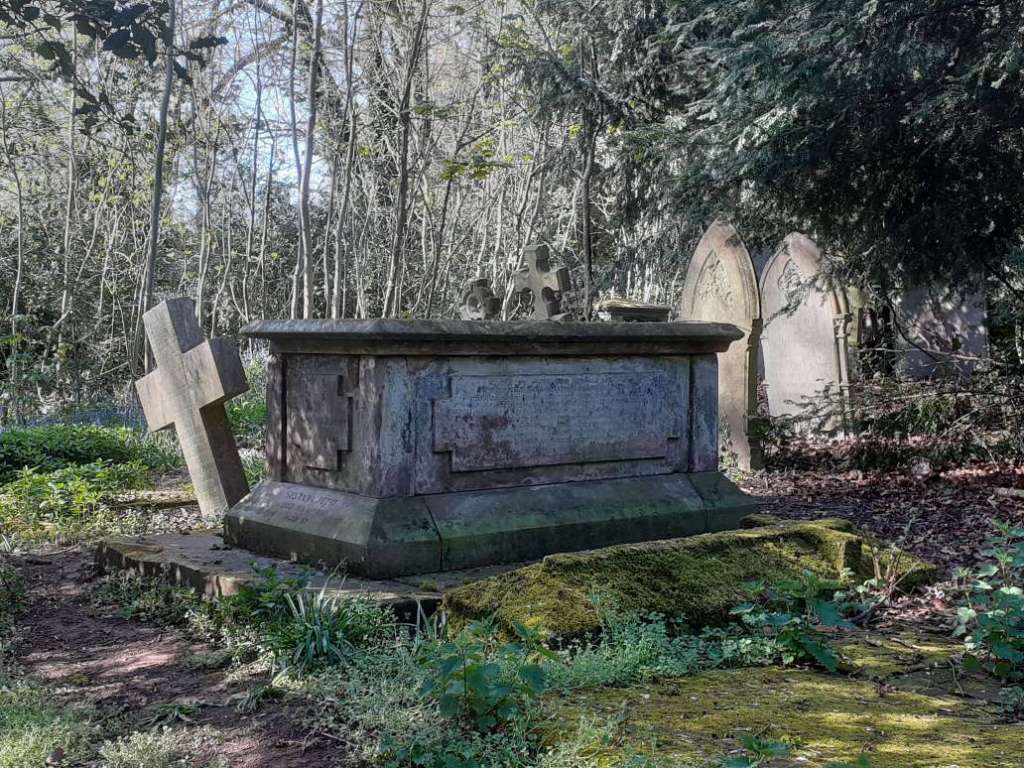
It must be admitted that the final grave we consider here (at D on figure 1) can’t be shown to belong to the seventeenth century, but it certainly has the look of something that old, and as we will see if of some interest (figure 4). Up till recently, this was the fairly simple chest tomb of Elizabeth Miesson and William Miesson . Recently the tomb has collapsed, and the inscribed end pieces placed on top of the remains, with the broken lid to one side. These are not particularly easy to read, but do confirm the names. A web search on Ancestry reveals there were several folk with these names in Lichfield around 1650 to 1750. The memorial to Elizabeth indicates contains the name of the city, rather inelegantly spread over two lines, as LICH and FIELD i.e. with a spelling mistake. The tomb could well have been a source of some embarrassment!

Lichfield St. Michael’s – pictures held by William Salt Library

The William Salt Library holds a significant number of mainly late eighteenth and early to mid nineteenth century drawings and paintings of St. Michael’s church in Lichfield that show the development of the church over that period when significant rebuilding took place. For copyright reasons these cannot be reproduced, so in this post I have listed them all in chronological order; given a link to the web page for each picture that opens in a separate tab; and reproduced the text describing each picture. The intention is to provide a convenient platform to understand the development of the church and churchyard throughout the period concerned.

1732 ‘The South West Prospect of the City of Lichfield.’ Stretching from the west to St. Michael’s, an easterly suburb. With a key describing the important features. Inscribed with a brief history of Lichfield. Artists: ‘S. & N. Buck, delin. et sculp., [drawn and engraved].

19th of April 1746 ‘St. Michael’s Church near the City of LICHFIELD.’  Anonymous.

1760 – 1799 (c.) ‘St. Michael’s Church Lichfield, with the Arms formerly in the Windows.’ North view of the church, [apparantly adapted from V.142b.] The church is surrounded by drawing of 17 coats of arms, which used to be in the windows. Anonymous, [? Stringer.]

1769  ‘St. Michael’s Church, Lichfield, 1769.’ North view showing the clerestory, the north aisle and porch, and the three-staged tower and spire at the west end. Anonymous.

1760 – 1799 (c.) ‘Showing the tower and spire from a field to the west of the church. Artist: ‘E. B. pinx.,[painted].’

1784 ‘St. Michael’s Church in Lichfield, North (corrected to South.)’ One dormer window is shown over the south aisle. The tower and the south door (without a porch,) are also shown.’J. W. delin.,’ [drawn; John Wright, 1784]

1784 ‘An ancient monument in the chancel of St. Michael’s Church, Lichfield.’ Showing a recumbent figure under a cusped arch. artist: ‘J. W.’ [John Wright, 1784.]

1798 ‘St. Michael’s Lichfield, 1798.’ South east view showing the south door with no porch. The clerestory and nave are not shown owing to the high south aisle. There is also a high chancel with a row of top windows. Anonymous,

1800 – 1899 (c.) ‘Showing an old tomb called ‘saddle-back’ and dated 1674, with a distant view of Cathedral from the south east. Anonymous.

1805 ‘An Ancient View of the City of Lichfield. From a painting in the possession of the Revd. Henry White.’ West view showing the gate tower, St. Mary’s church with a spire, and St. Michael’s church on a hill to the right. ‘C. Pye, sculp., [engraved]’.

1824 ‘Font in St. Michael’s Church, Lichfield.’ Showing an octagonal font with shields on panelled sides, and fleurs de lis and roses below. One shield is marked W.C., 1669, and another with a cross flory between Maltese crosses. Artist: ‘J. B.,’ [John Buckler.]

1832 ‘St. Michael’s Church, Green Hill, Lichfield, Sketched 1832.’ Showing the church in a country setting, with people standing on a road in the foreground.’Robt. Noyes.’

1833 ‘North West (corrected East) View of Saint Michael’s Church, Lichfield.’ Showing the east window, the chancel (with clerestory), the north aisle and porch, and the tower with a spire. artist: J. Buckler.

1838 ‘South West View of Saint Michael’s Church, Lichfield.’ Showing the tower and the spire,

1841 ‘South East View of Saint Michael’s Church, Lichfield.’ Showing the east window and the chancel (before rebuilding) with later [?vestry] addition to the south aisle. Artist: G. Buckler.

1841 ‘North West View of Saint Michael’s Church, Lichfield.’ Chiefly showing the tower and the spire, also the north aisle and the porch. Artist: J. C. Buckler.

1841 ‘Ground Plan of Saint Michael’s Church, Lichfield.’ Shown before the extension of the south aisle. A south doorway is shown, but a north porch. Artists: J. C. and G. Buckler.

1841 ‘Interior View of Saint Michael’s Church, Lichfield, from the Chancel.’ Showing the pulpit, a reading desk, and some carved pews in the chancel. artist: G. Buckler.

1841 :Interior View of Saint Michael’s Church, Lichfield from the north aisle.’ Showing a view across the nave, with box pews and a three deck pulpit. Artist: J. C. Buckler.

1841 ‘The North Porch of Saint Michael’s Church, Lichfield.’ North view showing a crenellated porch, with two shields of arms and a canopied niche above, but without cross or letters. Artist: J. C. Buckler.

9th of September 1842 ‘North east view of the north porch with shields of arms and a canopied niche, but without cross. Anonymous, [A.E. Everitt.]

1843 ‘South East View of Saint Michael’s Church, Lichfield.’ Showing a two-storey addition which has been made to the south aisle on the east end (with door) and a south door has been inserted in the chancel. Artist: J. Buckler.

1844 ‘South West View of Saint Michael’s Church, Lichfield.’ Showing the tower and the spire, and the south aisle. Artist: J. Buckler.

1844 ‘North West View of Saint Michael’s Church, Lichfield.’ Chiefly showing the tower and the spire, also the north aisle and the porch. Artist: J. Buckler.’

1844 ‘North East View of Saint Michael’s Church, Lichfield.’ Showing a north north east view of the east window, the chancel (with clerestory), the north aisle and porch, and the tower with a spire.’J. Buckler.’

1844 ‘Interior View of Saint Michael’s Church, Lichfield, from the Chancel.’Showing a view of the Nave through the chancel arch (perpendicular style). The three pairs of colums seen are of cluster type, (the sides are rounded and should be hollowed.) artist: J. Buckler.

1844 ‘Lichfield, St. Michael’s.’ South west view showing the tower and the spire, also the south aisle. Artist: H. J. Noyes.

1845 ‘Porch on the North side of Saint Michael’s Church, Lichfield.’ North west view showing a crenellated porch, with two shields of arms and a canopied niche above, also letters E and R, and a floriated cross above. Artist: J. Buckler.’

1846 ‘South East View of the New Chancel of Saint Michael’s Church, Lichfield.’ Showing the three lancet lights at the east end, and two on the south side. There is no door. Artist: J. Buckler.

1846 ‘Effigy on the North side of the Chancel of Saint Michael’s Church, Lichfield.’ Showing a male with a long gown and hood, with long sleeves. His hands are as at prayer, his head is on a cushion and his feet on an animal. Artist: ‘J. B.,’ [John Buckler.]

1846 ‘Interior View of the Chancel of Saint Michael’s Church, Lichfield. Showing the interior of the new chancel, which has a stone groined roof, and lancet lights. In the north wall is a plain arch with an old recumbent effigy. Artist: J. Buckler.

1847 ‘East View of Saint Michael’s Church, Lichfield.’ A three lancet window has taken the place of a five light perpendicular window, and the chancel clerestory has been removed. Artist: J. Buckler.

1858 St. Michael’s has a Perpendicular west tower and spire and the rest of the church is mostly Early English. It was extensively restored by Thomas Johnson of Lichfield in 1841-42. This is one of a series of watercolours of all the churches in Lichfield Diocese in Staffordshire, painted by Miss Theodosia Hinckes and Mrs Rebecca Moore for Lichfield Cathedral between 1857 and 1861. Reproduced by Kind Permission of the Chapter of Lichfield Cathedral who retain copyright.

1950 – 1970 (c.) Most of the Church dates from 1842-43 and is by Thomas Johnson.

More Black Country pictures of John Louis Petit

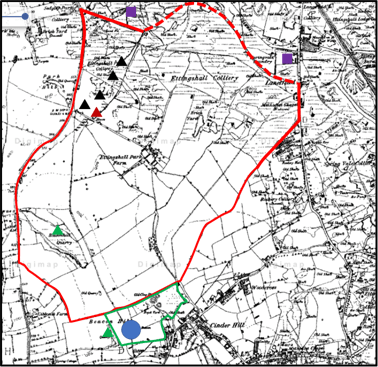
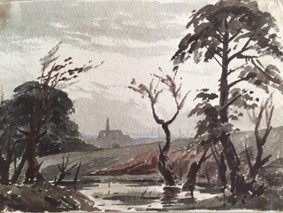
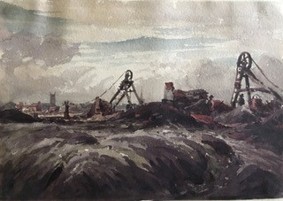
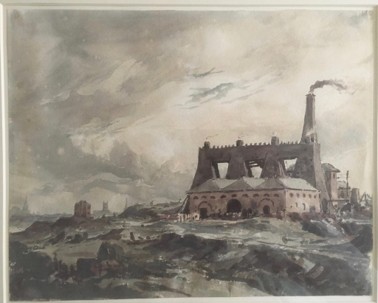
In an earlier post I discussed the two pictures of John Louis Petit shown above, and attempted to identify both the subject and the location from which they were painted. The title of the left hand picture, from the 1830s, suggests it shows mines in Wolverhampton, possibly on the basis of the two church towers in the background. I argued however, on the basis of the orientation of the towers and the location of the coal field that this was unlikely and that another location should be sought – perhaps to the west of Dudley, although this was very conjectural. The right hand picture from the 1850s is entitled Spring Vale Iron Works, and after examination I have no reason to doubt that attribution, and on the basis of the tithe map of the area, was able to identify a location from which it was painted, on the edge of John Louis Petit’s Ettingshall estate in Sedgley. Wherever they were painted however it does seem to me that their main significance lies in the fact that they are early representations of Black Country coal mines and ironworks and are of historical importance in that sense.

Since wring that post however, two other industrial scenes by Petit have been sent to me and they are shown below. Thanks to Philip Modiano of the Petit Society for permission to use these here. They are both believed to come from the 1830s. The first shows an ironworks in the distance, framed by a much more rural location. My best guess for this is that it is again a representation of the Spring Vale Iron Works, or perhaps the nearby Parkfield works seen from the western side of the Ettingshall estate at a location on the headwaters of the Penn brook (which leads into the Wom brook, and then into the River Smestow).

The second picture shows another ironworks, but this time with four furnaces rather than the three of Spring Vale. The position of the two churches in the background, the one with the spire and the one without, again matches St Peter’s and St John’s in Wolverhampton and their relative position suggest that the picture was painted from the south east in the Bilston area. The level of details it shows is remarkable. The furnaces themselves can be clearly seen, together with quite detailed depictions of ancillary buildings in the foreground. It would be interesting to know what was the function of these buildings. There are perhaps impressionistic indications of tram tracks and a canal basin in the right foreground, although this is very conjectural.
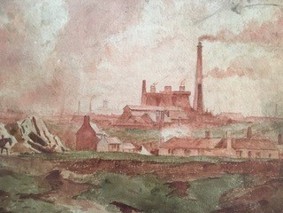
One of the many things that intrigue me about the work of Petit is its breadth that ranges from the type of scene in these pictures to his more usual output of sometimes quite idyllic churches. I wonder if he saw, in the size and functional architecture of blast furnaces, the same grandeur that he perceived in may of the churches that he drew, an, in his mind at least, the stark differences between churches and blast furnaces were not as significant as the similarities.