A memory of Dudley Sports Centre

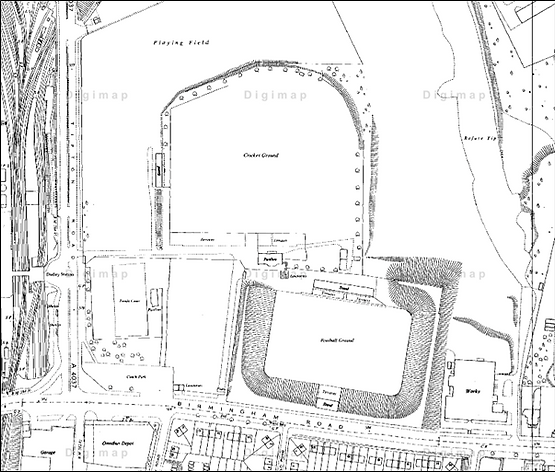
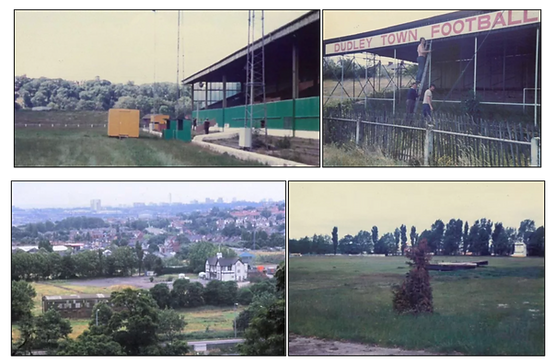
Dudley Sports Centre was a large football and cricket ground of the Tipton Road in Dudley. I guess these days it would be called a multi-sports complex! A 1950s map is shown below. The football ground was to the south with the main stand backing onto the cricket ground, with the cricket ground to the north, with the Pavilion and terraces in front of the back of the football stands. There were playing fields to the north and the west. It dated from the 1880 but was much expanded in the 1930s when the football ground was opened. It was used by Dudley Cricket Club and Dudley Town FC. Over 16000 spectators attended Dudley Town’s first match in 1932. Worcestershire CCC used it as an out ground from 1911 to 1977 for first class and list A fixtures.

The Sports Centre in the 1950s

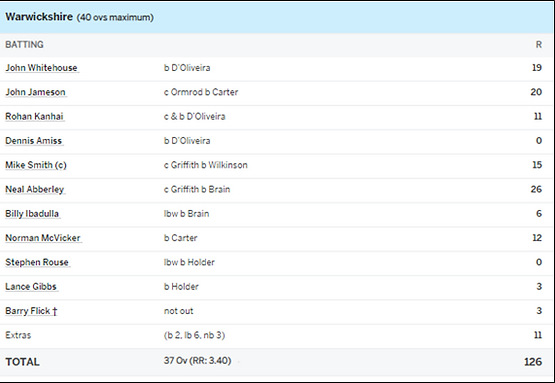
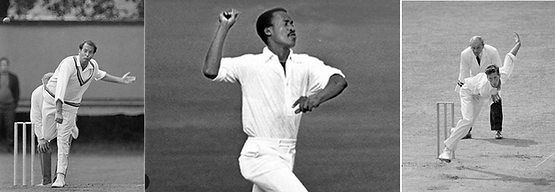
As a teenager, I watched games at the ground on many occasions – football matches between Dudley Town and my team, Brierley Hill Alliance, and a variety of other games including county cup finals; and cricket games when Worcestershire were in town. It is one of the latter that sticks most in my memory. This was the game between Worcestershire and Warwickshire on 5th September 1971, when I was 17. This was a 40 over John Player league game (in the days when it was felt acceptable for manufacturers of carcinogenic products to sponsor sports competitions). Worcestershire had had a good season and in this, their last game of the season, needed to win the match to have any chance of winning the league. As ever with cricket, the situation was complicated, and not only did they need the four points from the win, they needed to ensure that their run rate (runs / over) over the season was such that it surpassed that of Essex, the team below them. Even then they could not be sure of the title, as the third placed team, Lancashire had a game in hand, and played the following week. Lancashire had to lose that game, even if Worcestershire won on September 5th. I remember sitting on the terraces to the west of the Pavilion shown on the above figure. The TV cameras were in attendance, and my mother spent the entire afternoon watching a cricket match on BBC3 to see if she could see me in the crowd. Warwickshire batted first, and their scorecard is below. The only managed to make 126 – a very low score even in those pre-T20 days. Of the bowlers, Basil D’Oliveira, Vanburn Holder, the overseas signing for the year, and Brian Brain did most of the damage.

The Warwickshire Innings

Basil D’Oliveira, Vanburn Holder and Brian Brain

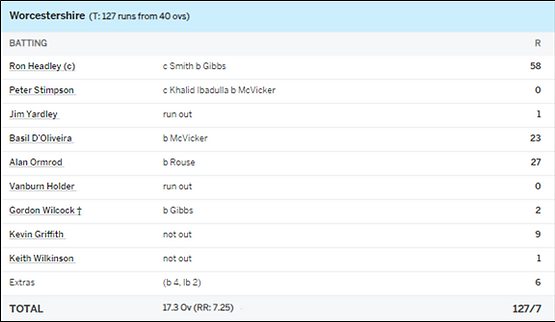
In the Innings break it was announced that, in order to achieve the required overall run rate for the season, Worcestershire needed to surpass that total in 17.5 overs – so the match became a T20 match 30 years before that concept was invented. I remember little of the innings other than its frantic nature. The scorecard is again given below. Nearly all of the runs were scored by three players – Ron Headley, the son on the West Indian batsman George, Basil D’Oliveira again and Alan Ormrod. Worcestershire made the required total with two balls to spare, resulting in raucous celebrations. Lancashire obligingly lost the match the following week, and Worcester were proclaimed as champions.

The Worcestershire Innings

Ron Headley, Basil D’Oliveira and Alan Ormrod

I went off to university a year after the match, and I don’t remember seeing any more cricket there. As is well known, the Sports Centre was shut in 1985 after a large hole appeared and part of the pitch disappeared into a limestone cavern beneath the site. Worcestershire never played there again, and Dudley CC, a long-term member of the Birmingham League, folded. Dudley Town have led a peripatetic existence ever since, playing at a number of grounds within and without the borough – the Round Oak stadium, the Dell stadium, Tividale and (currently) at Willenhall. The site is now the home of the Castle Gate complex.

The Sports Centre after closure

An election manifesto for Transport

Introduction

As the journalist Christian Wolmar has discussed in a recent article, the UK does not have any sort of agreed National Transport Policy that could be used as a rational way of developing transport infrastructure in a politically non-partisan way. Such a policy will certainly not emerge from the current government, and there is little to suppose that any future government will give priority to developing such a plan. Without it, transport policy is vulnerable to ill thought-out ad hoc initiatives and, as at present, in ad hoc cutbacks. In this post I will suggest a pragmatic way forward on this.

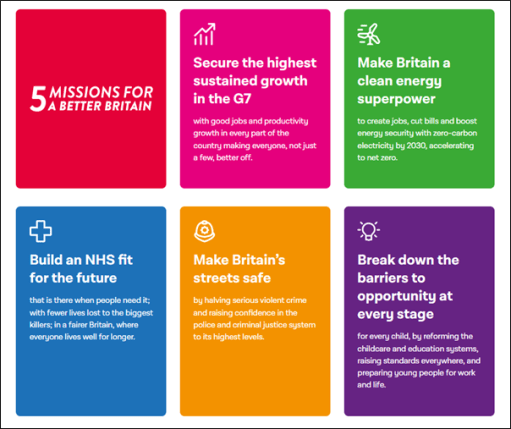
What I propose is based on the assumption that the next Government will be formed by the Labour Party, either as a majority party or with some sort of agreement with the Liberal Democrats. This is certainly what would be suggested by the opinion polls where at the time of writing Labour have a 22% lead over the conservatives. The Labour party has proposed five “missions” that will direct their approach to the 2024 elections and any subsequent government. None of these missions mentions transport at all, but there are transport issues embedded in each one of them. In what follows, I set out these missions, the transport issues that arise from them, potential policy objectives, and potential policy proposals. I then bring these proposals together to form a list of Transport policies that could be used, no doubt in a modified format, both for the next election and in any subsequent government.

Readers should not assume from this that I am a Labour Party supporter. I have never been a member of a political party, and never intend to be. Politically I am a centrist, but with somewhat radical environmental views, formed partly by my professional work as a Professor of Environmental Fluid Mechanics at the University of Birmingham (now retired). The proposals below are simply pragmatic – a possible way of influencing the next government to do something sensible in transport terms.

The Labour Part Missions

Mission 1

Secure the highest sustained growth in the G7, with good jobs and productivity growth in every part of the country making everyone, not just a few, better off.

Transport issues

  • Transport congestion on road and rail, for both people and products, leading to reduced productivity.
  • Poor workforce mobility, leading to inflexibility in employment locations.
  • DfT methodology for assessing CBR of transport infrastructure does not take proper account of induced flows on highways – i.e. new roads encourage traffic growth and can increase congestion.

Transport policy objectives

  • Revise DfT methodology for assessment of congestion reduction of new roads to include induced flow effects.
  • Infrastructure interventions to reduce road and rail congestion.
  • Encouragement of modal shift from road to rail, for both people and products.

Transport policy proposals

  • Revision of DfT methodology for assessing congestion reduction of new road schemes to include proper consideration of induced flow.
  • Small number of specific congestion-reducing road schemes (consistent with Mission 2).
  • Speed up development of rail enhancements and new build (HS2, EWR and NPR).

Mission 2

Make Britain a clean energy superpower to create jobs, cut bills and boost energy security with zero-carbon electricity by 2030, accelerating to net zero.

Transport issues

  • DfT methodology for assessment of contribution new transport schemes to carbon production and climate change has been shown to be flawed, particularly in relation to new roads.
  • UK Carbon based transport emissions levelling off or increasing.
  • Transport is now major carbon producing sector of economy.

Transport policy objectives

  • Reassessment of DfT methodology for assessing environmental impact and carbon production of new transport schemes.
  • Development and roll out low carbon technologies (electric and hydrogen vehicles, electric trains) including electric car recharging infrastructure.
  • Encouragement to use low carbon modes of transport and active travel modes.

Transport policy proposals

  • Revision of DfT methodology for assessing environmental impact of new road schemes to be revised.
  • Investment in electric and hydrogen vehicle research and production
  • Development of electric vehicle recharging infrastructure.
  • Electrification programme for railways
  • Fiscal incentives to encourage low carbon mode use.

Mission 3

Build an NHS fit for the future by reforming health and care services to speed up treatment, harnessing life sciences and technology to reduce preventable illness, and cutting health inequalities.

Transport issues

Transport policy objectives

  • Improve urban air quality through encouraging low emission vehicles.
  • Improve air quality through traffic reduction and modal shift to public transport.
  • Encourage active travel (cycling and walking).
  • Improve public transport (primarily bus) links to health care facilities,

Transport policy proposals

  • Fiscal incentives for ULEZs and LTNs.
  • Support for public transport
  • Fiscal incentives to local authorities to provide active travel infrastructure.

Mission 4

Make Britain’s streets safe by reforming the police and justice system, to prevent crime, tackle violence against women, and stop criminals getting away without punishment.

Transport issues

  • Safety issues due to high road speeds in urban areas.
  • Safety issues due to pavement parking.

Transport policy objectives

  • Make urban streets safe for pedestrians and cyclists.

Transport policy proposals

  • Fiscal incentives for LTNs.
  • Lower and enforce urban speed limits.
  • Enforce pavement parking laws.

Mission 5

Break down the barriers to opportunity at every stage, for every child, by reforming the childcare and education systems, raising standards everywhere, and preparing young people for work and life.

Transport issues

  • Poor access to childcare and education for those without cars (20% of households)

Transport policy objectives

  • Improve access to childcare and education for those without cars.

Transport policy proposals

  • Support for public transport
  • Fiscal incentives to local authorities to provide active travel infrastructure.

The policies

From the consideration of the individual missions, the following specific transport policies can be developed.

Policy 1

Revision of DfT methodologies for assessing new transport schemes to take proper account on induced flow and environmental effects. (Missions 1 and 2)

Policy 2

Invest in new transport infrastructure with a small number of congestion-relieving road schemes, electric car charging facilities, and major investment to rail infrastructure, including staged development of HS2, NPR and EWR) and a rolling programme of electrification. (Missions 1 and 2)

Policy 3

Support for public transport (trains and buses) for increasing employment opportunities and providing access to healthcare and education. (Missions 1, 3 and 5)

Policy 4

Reduction of urban speed limits and enforcement of pavement parking laws. (Mission 4)

Policy 5

Fiscal incentives and support to local authorities to encourage low carbon vehicles and modal transfer to low carbon modes; for the development of ULEZs and LTNs, and provision of active travel infrastructure. (Missions 2, 3 and 5)

Commentary

Policy 1 is not going to set any electoral debate alight, but it is quite crucial. In the past the DfT has used flawed policies to assess road building schemes against other transport schemes, knowing that they were flawed. This needs to change. Indeed, I would regard the DfT as no longer fit for purpose in many ways (as an example, its current handling of the railway network, the ongoing industrial action and major cutbacks to active travel budgets can be cited) and there is an argument for a complete re-organisation here to establish a wide ranging Department for Infrastructure that brings together transport, the utilities and construction. This would allow proper consideration to be given to the transport effects of new housing build (often built without public transport provision) and conversely the effect of a move to electric vehicles on the development of the electricity grid.

Policy 2 is wide ranging and expensive, and any specific proposals would need to be carefully phased in terms of expenditure. The basic point however is that high quality transport infrastructure for people and products is a fundamental requirement for a productive economy, the more so as the switch to the “green economy” proceeds.

Policy 3 is important for many, and in particular those on low incomes. The provision of a high-quality public transport network (particularly buses) that is comprehensive in its coverage would make access to employment, healthcare and education very much easier for many people.

Policy 4 is essentially aimed at public safety. It would no doubt be categorised as a “war on motorists” by sections of the press, but this is a battle that needs to be fought for the public good.

Policy 5 is another proposal that might be electorally contentious as (weirdly to my mind) LTNs, ULEZs and active travel have become very politicised. Fiscal incentives could be a way forward here, as proposed in the more detailed description of Mission 2 recently released by the Labour Party. This might include the possibility of both support for the initiatives and a wider reduction in rates for those Local Authorities that develop such schemes. This would be basically a bribe, and would need to be carefully costed and targeted, but could help in the establishment of such schemes. In terms of encouragement to use low carbon modes, a study should be initiated to look at how road pricing, aviation fuel duty and rail fares could be used to encourage the necessary modal shift.

The 292 bus route from Kidderminster to Ludlow – an important transport link?

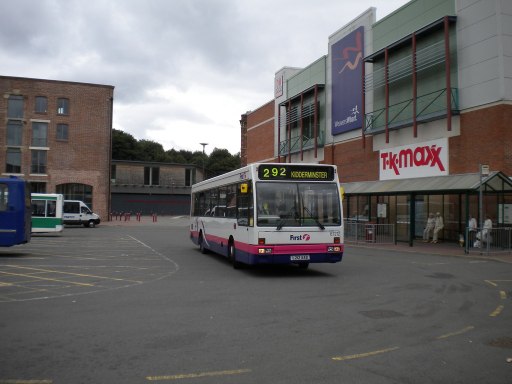
292 at Kidderminster Bus Station in 2010

I have recently been on a short break to Cleobury Mortimer in Shropshire, travelling there by train and bus from where I live in Lichfield. The train journeys, from Lichfield to Birmingham and Birmingham to Kidderminster went very smoothly and were quite a pleasant experience. There were a number of route permutations, but we chose to walk between Birmingham New Street and Birmingham Moor Street, both on the way there and back. The bus leg from Kidderminster, on the Diamon bus 292 was rather less easy. The bus didn’t stop at Kidderminster railway station, with the nearest advertised stops (on Google and various websites) being 400m away in Oxford St. Arriving there however, we found this was not the case, with no mention of the 292 on the timetables at the stop, so we walked on to the bus station, another 400 yards away. There we eventually did get the bus, which was running over half an hour late. The journey itself was fine, and as we were in no hurry, the delay was of no particular concern to us.

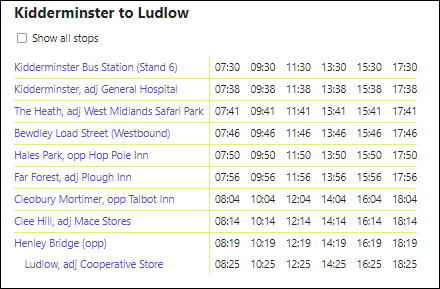
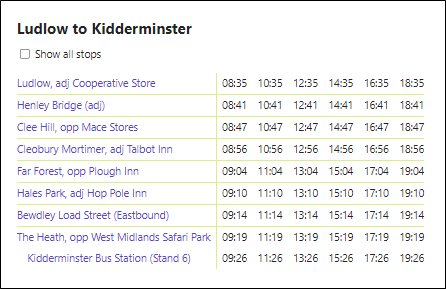
Over the days that followed, I kept track of the buses on the 292 route between Kidderminster, Bewdley, Cleobury Mortimer and Ludlow, and it soon became clear that the lateness was endemic. The journey was timetabled for 50 to 55 minutes, with a two-hour frequency, with one bus shuttling backwards and forwards – see the timetable below – from https://bustimes.org/services/292-kidderminster-ludlow . This timing was simply too tight to ensure punctual running throughout the day. Whilst some of the delays came from congestion in the towns at either end of the route as might be expected, the most critical delays were due to parked cars on the A4117 between Bewdley and Ludlow requiring single file traffic through the towns and villages along the road. Such delays could of course be quite easily eliminated, given the political will.

Current 292 Timetable

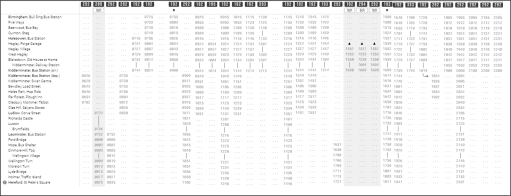
Now service 292, currently operated by Diamond buses, is actually the truncated remains of a much longer Midland Red service with the same number, that ran from Birmingham to Kidderminster, Ludlow and Hereford. A time table for this service is shown below from 1991 for the Birmingham – Hereford direction – from http://midlandred.net/service/timetable/display.php?routeID=1007. The service was withdrawn, apart from the Kidderminster to Ludlow leg, in the early years of the current century. It can be seen at that time there was an hourly service between these two towns, rather than the current two hourly service. This represents a considerable degradation in service provision.

292 Timetable 1991

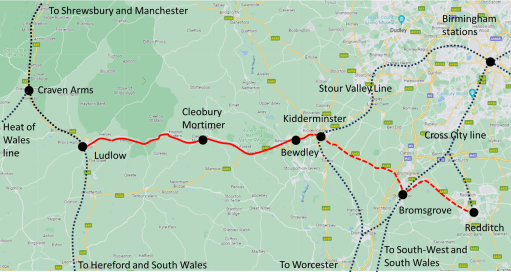
But the transport context has changed in many ways over the last few decades. The role of the long-distance bus has been largely taken over by trains, with a much greater frequency than 30 years ago. On the original 292 route there are now 4 trains an hour to Kidderminster from Stratford upon Avon through Birmingham, either terminating there or continuing to Worcester, and two from Worcester to Birmingham; at Ludlow there are two trains per hour in each direction between Manchester, Shrewsbury, Hereford and various destinations in south Wales. So in this sense, the truncation of the service was sensible and appropriate.  It now serves a purely local market for those who live on its route.  But I would argue, in any sane country that takes seriously the need to reduce carbon emissions and the need for modal change (i.e. not the one in which I reside), the Kidderminster to Ludlow route would be of some strategic importance. With improvements in frequency and connections with rail at Kidderminster and Ludlow, it would offer a route from the West Midlands conurbation, via  the Stour Valley line, into south Shropshire and the Marches, with major tourist potential. Further, if the route were combined with the hourly 52 from Kidderminster to Bromsgrove (and ultimately Redditch), it would offer connections from the south west at Bromsgrove into the same area, and also from the Cross City line that serves the north of Birmingham and the city centre. The 52 actually runs past both Bromsgrove and Kidderminster stations. Continuation of the service north of Ludlow to Craven Arms (in parallel with the railway) would offer connections to the Heart of Wales line, whose tourist potential has not been fully developed, and perhaps further to Welshpool for connections to the Cambrian line. All these possible connections are shown in the figure below.

But life is of course not that simple. For such a service to be a success other changes would be necessary. Firstly, efforts would be required to split the local markets in Ludlow and Kidderminster from the longer-distance markets to make overall journey times on through services as short as possible. There is no reason why this should not be possible but would require extra resources in terms of service provision to meet the requirements of the very local market. This mix of markets has been a major reason for the demise of long distance inter-urban buses in the past – perhaps most recently in the truncation of the Oxford to Cambridge X5 at Bedford, because the local market between Bedford and Cambridge resulted in significantly increased journey times.  Secondly, attention would need to be paid to the interchange points at either end of the route. For example, the bus stops of the Bromssgrove to Kidderminster route at Kidderminster Railway Station are on narrow pavements on a road bridge over the railway line – a very uninviting and inconvenient place for mode transfer. Attention would also o fcourse need to be paid to timetabling to ensure suitable connection times.

The other issue is of course more structural in that there is no overall transport policy in the UK that would facilitate such developments – see the recent blog by Christian Wolmar on this. And this lack of an overall policy means that resources cannot be channeled to such schemes, despite the fact that their benefits would be significant in terms of carbon emission reductions and stimulating local economies. It has always been thus as far as I can remember. I still want to believe that a competent government will one day realise that this is the road to take. But perhaps I am here opening myself up to a charge of naivety.

The final sermon

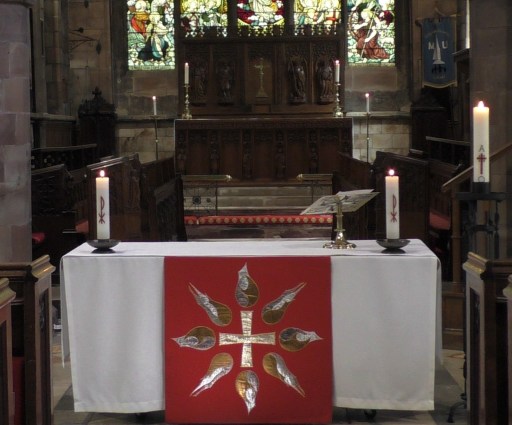
The altar at St. Michael-on-Greenhill Lichfield, with Pentecost frontal

It hasn’t been my habit to publish my sermon output on this site for two reasons – firstly, sermons always have a context – a time, a place, a certain set of hearers etc. and, my sermons at least, would lose much of their force outside this context. And secondly, I hardly ever write down my sermons, so preparing them for the web would be extra effort! But the sermon below is a significant one for me – the last sermon I preached at St. Michael-on-Greenhill in Lichfield on Pentecost 2023, and the last time I celebrated the Eucharist, having ministered there as a non-stipendiary minister for 25 years – and it seemed appropriate to record it. But it needs to be said that the text below is only a rough approximation to what was actually said, written down after the event.

As ever when working on sermons it is a learning experience, and from my perspective there are two insights that seem to me important (that do not particularly feature in the sermon). The first is the significance of the presence of Mary the mother of Jesus at the events described in Acts 2, and the striking parallel between the coming of the spirit upon her at the Annunciation and the Pentecost events. These were in both cases a creative act – the incarnation and the creation of the church, and Mary was the only one present who had experience the overshadowing of the Spirit before the Pentecost event. Of course this has been blindingly obvious to many in the past, not least to the entire catholic church (and see for example here for a recent non-catholic discussion) but its importance has only just dawned on me. The second point concerns the coming together of all the members of the early church between the Ascension and Pentecost. It seems to me that this could have implications for the beginning of the various gospel traditions. This period offered a chance to for all those present to tell and to hear all of the different disciples’ experiences of what Jesus said and did – stories that were eventually used by the different gospel writers in their own distinctive and idiosyncratic ways. The sources of the Petrine, Johanine and even the Q tradition, can perhaps be located in the stories the early church told each other in this period.

The sermon follows below the rather striking and inspirational depiction of Pentecost by Jean Restout below, which puts the figure of Mary in the centre of the event. The sermon will be found to be somewhat less striking and inspirational.

Jean Restout  (1692–1768) Pentecost

Acts 2.1-21 John 20.19-23

When the day of Pentecost came…..

Pentecost was, and indeed still is, one of the major festivals of the Jewish liturgical calendar, 50 days after Passover. It is both a harvest festival, and the annual remembrance of the giving of the law to Moses on Mount Sinai. Jerusalem would have been busy with pilgrims from Judea and Galilee and from the whole Jewish diaspora around the Mediterranean and the Middle East. The followers of Jesus, were indoors, perhaps still keeping a low profile, as at least for some of them, it might well be dangerous for them to be seen in public following the events of 50 days before. Luke, the writer of Acts, tells us they were all together in one place. As he has already told us in the previous chapter that there were around 120 followers of Jesus at that time, this implies somewhere rather large – perhaps with an internal courtyard, or that we shouldn’t put to much weight on the word “all”. At any rate it was a diverse group that gathered there – the eleven disciples and Matthias who had replaced Judas; the women who had supported Jesus financially during his ministry, including Mary Magdalene; perhaps those disciples who lived in the vicinity of Jerusalem – Mary, Marth and Lazarus, and Joseph of Arimathea and Nicodemus; and also members of Jesus’s family – certainly his mother Mary was there. And as they gathered together in prayer and worship, although they weren’t as terrified as they had been following Jesus’s death, they were perhaps puzzled, not knowing what to expect. In the finality of their last meeting with the risen Jesus, he had told them to wait in Jerusalem, and he would send the Holy Spirit to be with them. What were they expecting? They would know what the scriptures said about the Holy Spirit of course. God sent his Spirit powerfully on judges, kings and prophets to give them the ability to perform the tasks he had given them, often in difficult and dangerous circumstances. But they would also know of what the first few verses of Genesis says about the Holy Spirit.

“The earth was a formless void, and the Spirit of God hovered over the face of the waters”

The Spirit hovered over the formless primeval chaos. The metaphor here is picked up in the book of Deuteronomy where the same words are used to describe the mother eagle spreading her wings over her brood and lifting them gently in her talons, and indeed the verse can also be translated as the Spirit of God brooded over the face of the waters. The waters, the deep, would have been regarded as a place of terror, the deep places of the Leviathan. And the Spirit hovered, brooded over the primeval chaos and the terrors of the deep, to bring creation in to being, to give it birth and to nurture it. This same metaphor occurs throughout scripture. The psalmist frequently cries

“Hide me under the shadow of your wings.”

 The creative, nurturing, protective Spirit. The psalmist also speaks of the ever-present Spirit

“Where can I go from your spirit? Or where can I flee from your presence? If I ascend to heaven, you are there; if I make my bed in Sheol, you are there. “

But as well as these verses from Scripture describing the action if the Spirit, the disciples who gathered that day would have added their own personal knowledge. Some would have remembered the words of the Baptist.

‘I baptize you with water for repentance, but one who is more powerful than I is coming after me; I am not worthy to carry his sandals. He will baptize you with the Holy Spirit and fire.

Some will have remembered the Spirt, like a dove, descending on Jesus at his baptism. There were also the words of Jesus himself, describing the Spirt as a bringer of comfort and peace, equipping them for what was to follow, and being with them always. Then perhaps they would have listened to the one amongst them who had actually experienced the coming of the Spirit. Perhaps it was at this time that Mary would have told the group of the coming of the angel, her overshadowing by the Spirit, and her submission to God’s will,

“Be it unto me according to your word.”

And too, she might have told of the prophecy of Simeon that a sword would pierce her own soul, and the dreadful fulfillment of that prophecy.

But, based on all of these things, just what were they expecting? Almost certainly not what actually happened. Suddenly the house was filled with light and noise, a light that seemed to focus down on each one of them, bringing to each a realization of the presence of God. Much scholarly ink has been spilled on the significance of the wind and flame, but I doubt at that time the followers of Jesus stopped to think “This is rather like what the Baptist said would happen” or “The wind and the flame are symbols of Pentecost, of the giving of the law at Sinai”. No, for them, it was an objective, overwhelming experience. For Peter maybe the final assurance of his forgiveness for his betrayal; and his commission as leader of the group; for John, the disciple whom Jesus loved, the renewal of intimacy with his closest friend; for Mary Magdalene, told by Jesus not to cling to him, the all encircling presence of her Lord and teacher; for Joseph and Nicodemus, the burning intensity of the life in Jesus, whose cold body they had laid in the tomb; for Jesus’ family, the return of their beloved big brother; for Mary, the inexpressible joy at the presence of the spirit of her son, the erasure of the pain of the piercing sword. All their experiences with Jesus found their fulfillment at this point, and from there something new flowed. But for all of them, and experience of the overwhelming Spirit of Jesus, that forced them out of the house into the city, praising God and then, through a miracle of interpretation being understood by all, now matter where they came from.

Finally, through the chaos and the cacophony, Peter pulled himself together, perhaps stung by the accusations of drunkenness, and interpreted the events in the best way he could – going back to the prophecy of Joel that, on the day of the Lord, the spirit would be given to God’s people, the old would dream dreams, and the young would see visions.

It is often said that Pentecost is the church’s birthday – and in the years that followed, the Holy Spirit hovered, brooded over the nascent church, nurturing it through its growing pains – and they were indeed pains, that pierced as sharply as any sword, as the followers of Jesus came to the realization that the life of that body couldn’t be contained within the confines of Judaism, but was for the whole world, and they had to let go of much that was precious to them to allow this to happen.

So, what are our expectations this morning? Have we come here, just looking for a quiet break from the affairs of the week; or thinking that because its Pentecost, there will be some good hymns to sing; or perhaps to have a glass of wine at the end of the service to celebrate finally getting rid of the preacher after 25 years? If so, perhaps we need to raise our expectations somewhat.

Today, as was the case almost 2000 years ago, the Spirit still broods over the church, overshadowing us, offering us forgiveness and reconciliation, renewal of faith that has gone cold, stability in the chaos that surrounds us and hope for the future, the calming of our own terrors, offering new life and the outpouring of God’s love; waiting for us to turn and accept that invitation “Lord be to me according to your will”.

The Spirit today hovers over Greenhill, calling on those to us who belong to the church of the Archangel, calling for the old to dream dreams and the young to see visions. I suspect looking around there will be a preponderance of dreams. But what are our dreams for the future of the church in this place? How can we work with the brooding, nurturing Spirit to bring those dreams to reality?

And finally, as 2000 years ago, the Spirit sends us out – perhaps not to the market square (where in any case we would have trouble fining space in the middle of the Bower fun fair) but to go about our lives serving and meeting the needs of those around us, wherever that might be. And he promises to never leave us. With this in mind we return to the words of the psalmist.

Where can I go from your spirit? Or where can I flee from your presence? If I ascend to heaven, you are there; if I make my bed in Sheol, you are there.  If I take the wings of the morning and settle at the farthest limits of the sea, even there your hand shall lead me, and your right hand shall hold me fast. If I say, ‘Surely the darkness shall cover me, and the light around me become night’,

even the darkness is not dark to you; the night is as bright as the day, for darkness is as light to you.

Or in the old words, which are still the ones that come immediately to my mind.

 Whither shall I go from thy spirit? or whither shall I flee from thy presence?

Migration to the western Black Country, 1800 to 1850

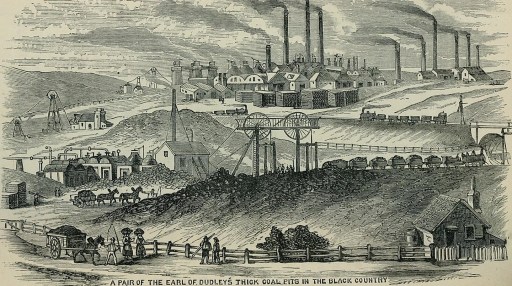
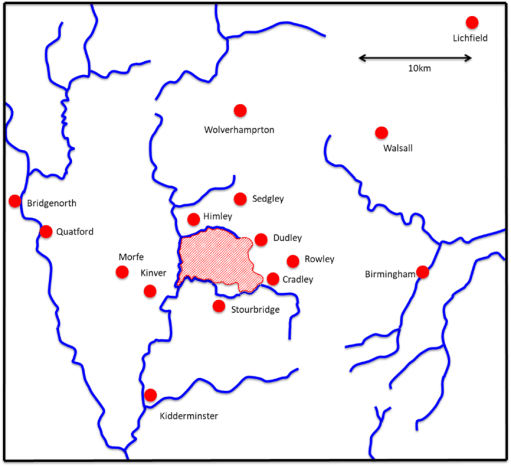
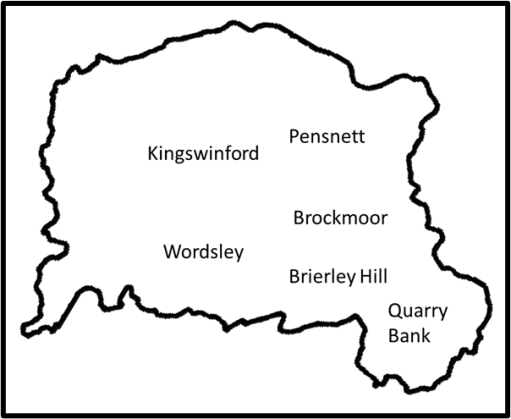
Industrialisation came rather late in the day in the parish of Kingswinford on the western edge of the Black Country (Figure 1). Although there was, in the eighteenth century, a long-established glass industry around the village of Wordsley in the south of the parish, and some shallow coal mining and iron manufacture around Brockmoor and Brierly Hill in the south east, it wasn’t until the first half of the nineteenth century that these grew in scale and spread northwards across the Staffordshire coal fields to utterly change the character of what was a largely rural area around Kingswinford and Pensnett (Figure 2). I have written on this process elsewhere – see here – in particular, in the context of the two Fowler maps of the parish that were produced in 1822 and 1840, which between them graphically illustrate this process of industrialisation.

Figure 1. Location of Kingswinford parish

Figure 2 Ecclesiastical Districts within the parish

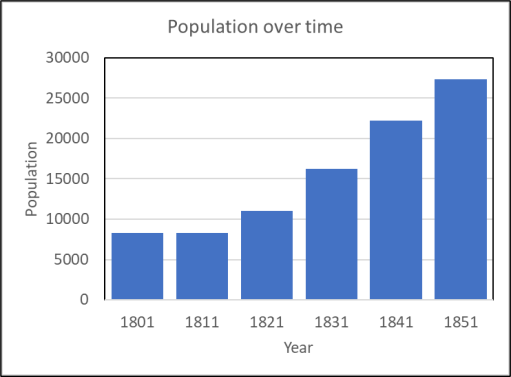
These developments inevitably led to a major increase in the population of the parish, through migration from surrounding areas and further afield. The census population figures are given in Figure 3, and the growth is population is very apparent. It is the purpose of this short post to investigate where this increase in population came from. I use the data from the 1851 census that has been transcribed into digital form by Ancestry, for all 27,413 entries for the parish, which I copied and pasted page by page from the census returns into an EXCEL spreadsheet in order to carry out the analysis – a lengthy, mind-numbing process and not to be recommended.  This included name, area of residence, age and place of birth. This enabled all the entries to be sorted as follows.

Figure3 Population of Kingswinford parish 1801 to 1851

  • By age, and then grouped into 10 and 20 year age bands.
  • By residence, in one of the five “Ecclesiastical districts” within the parish that were set up as a precursor to these areas becoming parished in their own right later in the 1850s. Each of these corresponded to a number on census enumeration districts. These were in the old established industrial areas of Wordsley, Brockmoor and Brierly Hill, where there was significant industry in the late eighteenth century; in the areas industrialised between 1820 and 1840 to the north of the parish of Kingswinford village itself (which still retained large rural hinterland) and in the Pensnett area; and in Quarry Bank in the south east, where industrialisation took place in the decade before the census (Figure 2). Residents of the Workhouse in Wordsley was not included in the analysis.
  • By birthplace, defined as being within one of five regions – Kingswinford parish itself; the Black Country and Birmingham (the former as defined largely by the modern four Black Country boroughs); Staffordshire (excluding the Black Country regions); Worcestershire (excluding the Black Country regions); Shropshire (excluding the detached portion of Halesowen which was taken as part of the Black Country); and elsewhere – mainly locations in England and Wales, with a very small number from Ireland and Europe). Around 1% of the total population were not allocated a birthplace in the Ancestry transcripts, due to non-legibility of the written entries.

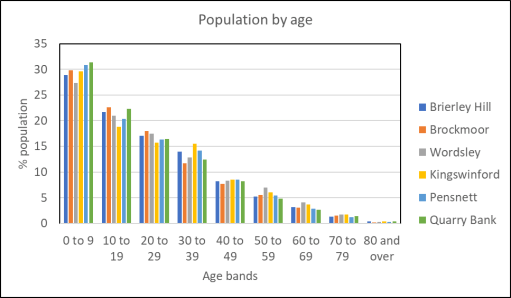
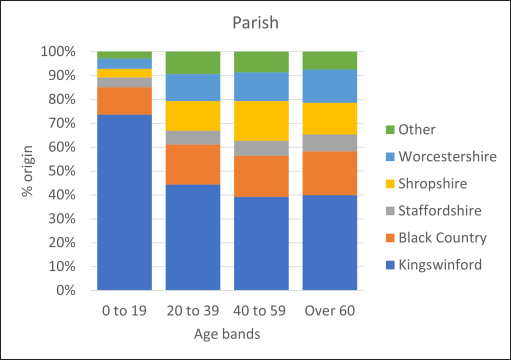
The most populous of the Ecclesiastical districts was that of Brierly Hill with 8800 inhabitants, followed by Pensnett with 4947. The others had populations of around 3000 to 4000 .  The breakdown by age decades for the entire parish population is shown in Figure 4, as percentages of the population of each Ecclesiastical district. All areas show similar trends, with around 50% of the population below the age of 20 (which was partly driven by the very large infant mortality). Figure 5 shows the birth locations for the parish as a whole, this time in 20 year (generational) age bands. The majority of the 0 to 19 year band were born within the parish or the surrounding Black Country (85%), but the situation is very different for the other generational bands, with only around 55% of the total being born in Kingswinford parish or the Black Country, with significant numbers being born in the three surrounding counties, particularly Shropshire, and around 10% of the total coming from further afield. This indicates that there had been significant migration, around 20 to 50 years before the census, which is consistent with the overall population growth shown in Figure 3.

Figure 4. Age breakdown of parish population

Figure 5. Breakdown of population by age and birthplace

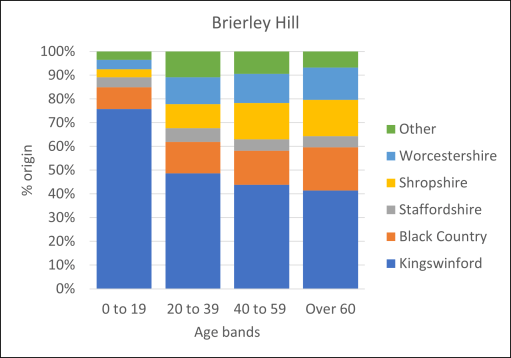
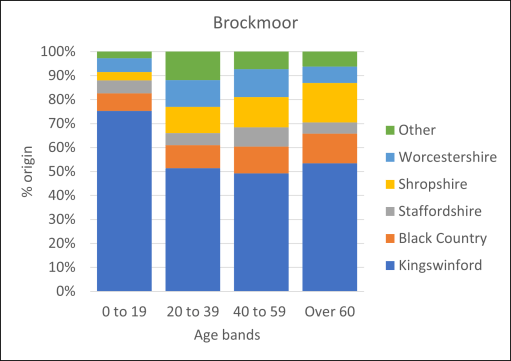
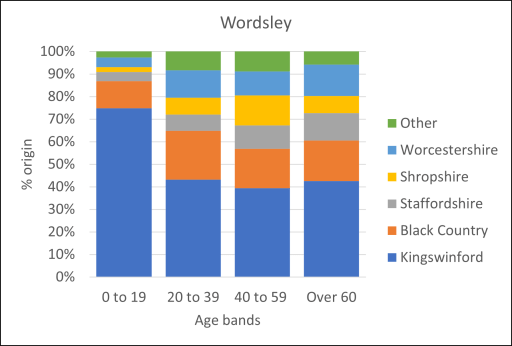
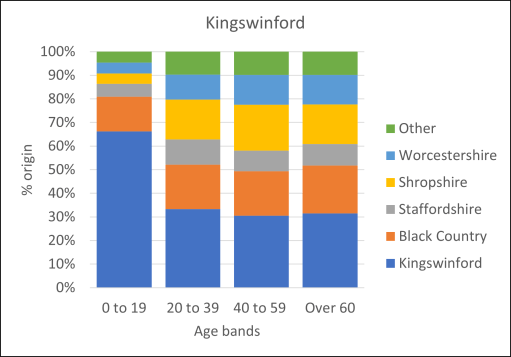
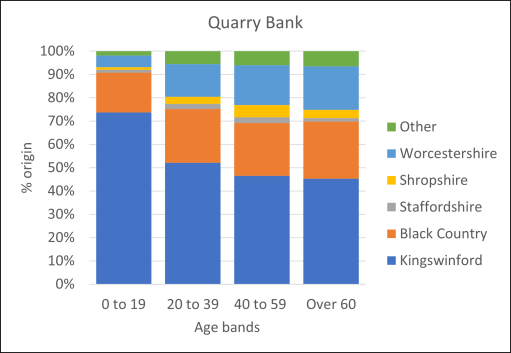
This pattern varied somewhat across the parish, and similar results for each Ecclesiastical district are shown in Figure 6 for the old established industrial regions of Brierley Hill, Wordsley and Brockmoor; for the regions industrialised in the previous 50 years in Kingswinford and Pensnett; and for the Quarry Bank area industrialised over the previous decade. The figures for Brierley Hill, Brockmoor and Wordsley show slightly higher proportions of “local” Kingswinford and Black Country births for the older generations than the parish overall i.e. lower levels of migration. The figures for Kingswinford and Pensnett are very different, with local births for the adult generations below 50%, and only around 30% for the parish births. The proportion of Shropshire births, particularly in the Pensnett data is very large, of the order of 25 to 30%, mainly, as far as can be ascertained form the records, from the Shifnal / Oakengates area. In the newly industrialised Quarry Bank area the pattern is different again with 60 to 70% of local births and the main contributor to the rest coming from Worcestershire (and in particular those areas of the county close to the Black Country).

Figure 6. Breakdown of population for each Ecclesiastical district

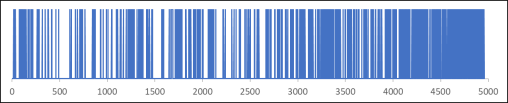
The levels of migration from Shropshire into the Pensnett / Kingswinford area are of particular interest. It is to my mind likely that such levels would result in significant social tensions, and there is also some evidence of “ghettoisation” (if such a word exists). For example, there was a road in Kingswinford that was named “Shropshire Row” and the Shut End Primitive Methodist church seems to have chiefly served the migrant Shropshire population. This can be illustrated by a spatial analysis of the Pensnett census entries. The occurrence of a Shropshire birth entry was plotted against census entry number for the Pensnett enumeration districts (Figure 7). There can be seen to be regions on the graph that show high density of Shropshire births (around entry 3400, and entries 4000 to 4900). Cross checking against addresses from the census shows that these regions correspond to the new housing estates in the Hollies area, along the Turnpike Road towards Dudley. In these areas the percentage of those with Shropshire births is over 30%. Whilst this analysis is somewhat subjective, it does tend to suggest that a degree of concentration of the Shropshire migrant population did take place.

Figure 7. Shropshire births in the Pensnett census entries (vertical line shows register ntry with Shropshire birthplace)

There is one particular migrant group that, though small in number, might well have been quite conspicuous due to language and accent – the Irish. In the 1851 census returns there are 131 entries which register a birth in Ireland. These were mainly concentrated in Brierly Hill (69), Wordsley (35) and Brockmoor (20), i.e. the older industrialised areas, with very few in the Kingswinford, Pensnett and Quarry Bank areas. Of these 36 were under 20, 62 between 20 and 39, 30 between 40 and 59 and only 3 over 60, suggesting perhaps a more recent migration than other groups, mainly over the previous 20 years.

Now the analysis of both the wider parish population and those born in Ireland has not taken into account the Workhouse population, since this was the Poor Law provision for the entire Stourbridge Union, which was larger than the parish. However, in 1851 there were 260 Workhouse entries, 0.95% of the total parish population. 17 of those registered a birthplace in Ireland, 11.5% of the total Irish population – in other words those born in Ireland were significantly over-represented in the Workhouse population.

Finally it is worth noting that much more could be done – particularly in investigating the nature of migrant employment. However there is an issue here in that the census employment details have not been transcribed into digital form, and would need to be transcribed by hand from the original forms (some 30 or 40% of the total number of register entries). This would be an even more time consuming and mind numbing occupation than the one undertaken to date to get the data on which this blog is based. Maybe I will get round to this when I want for something to do. Then again, maybe I won’t.

Yet more on cross winds effects on trains

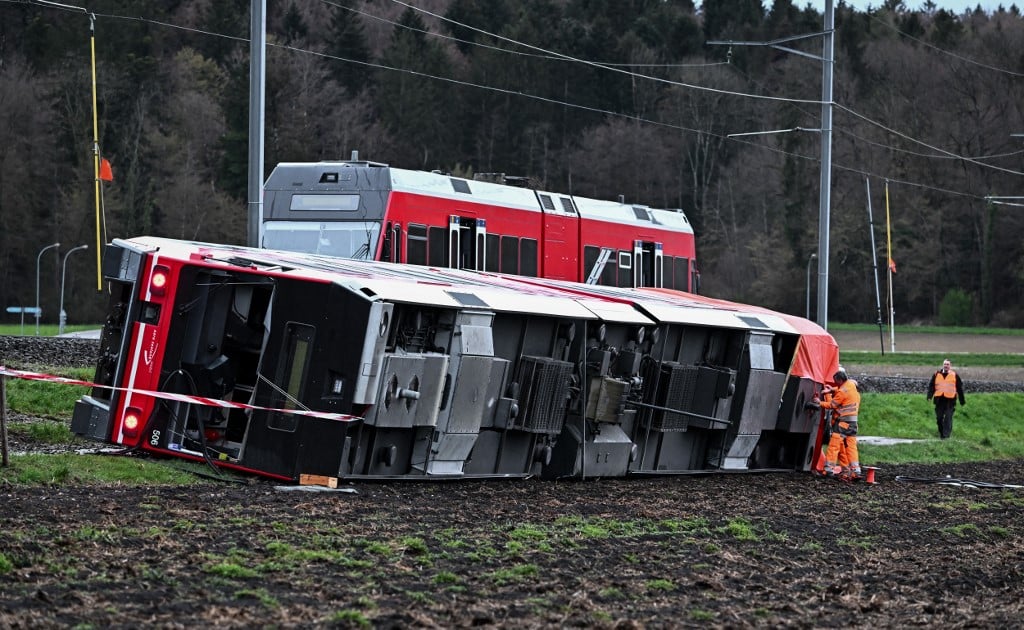
Train blown over by high winds in Switzerland in March 2023

This post and its attachments continues a sporadic (and what some might call obsessional) series on the effects of cross winds on trains. It gives links to a downloadable report and a downloadable spreadsheet.

The report (below), which follows on from two papers I wrote in 2010 and 2013, presents a detailed analysis of the effects of unsteady crosswinds on trains using a simple train dynamic system methodology. This begins with the specification of unsteady wind characteristics that are then used to calculate unsteady aerodynamic forces. These are then used as input to the dynamic model to calculate lateral, vertical and rotational displacements and unsteady track forces. Three specific effects are then considered – wheel unloading criteria, track force criteria and vehicle displacement criteria, and a rigorous statistical methodology used to specify values of these under specific unsteady crosswind conditions. A simple methodology for developing wheel unloading cross wind characteristics (CWCs) is then set out and calibrated using the dynamic model. This calibration indicates that the simple model is more than adequate to determine wheel unloadings in design, and that the more complex aspects of the suspension, track roughness of spatial non-correlation of the aerodynamic loads have little effect on the calculated CWCs. Finally possible extensions to the modelling methodology are outlined – in terms of investigating a range of effects on wheel unloading dynamics, the extension of the method to investigate track forces, roof displacements and pantograph / OHL displacements in cross winds.

The spreadsheet gives a simple and straightforward way of calculating the CWCs using the methodology described in the report. It is made available on the basis that the coding has not been verified in any rigorous fashion, and that the user takes full responsibility for the output. That warning being given, I hope some will find it of interest. There are two worksheets. For both the user-defined parameters are highlighted in yellow. The first calculates the CWC from a user-specified value of the characteristic velocity The second calculates the value of characteristic velocity from the vehicle geometric, mass and aerodynamic parameters as in section 11 of the above report. It uses the same values for these parameters as used in the report, but these can be changed as required.

Fall, incarnation and atonement

In this blog and those that preceded it (here and here), I indulge in some speculations concerning the nature and purpose of the created world and of God and humanity. These thoughts are based on the orthodox Christian narrative of fall, incarnation, atonement and resurrection, and I hope, take the scriptural revelation seriously. They nonetheless have a distinctly scientific and technical flavour that some might find rather cold and off putting. I would simply hope that what I write can complement the more traditional understanding of God and his love for his world and his people. Readers are of course completely free to choose whether or not the give my thoughts any credence at all!

In an earlier post I suggested that we could allow God to be both transcendent and imminent by postulating that he exists in the currently unobservable part of the universe what I have called Z that is both distinct from the physical creation A, and yet meshed with it. Humanity exists within A. But there are scriptural indications that the destiny of humanity is to be with God in Z, or perhaps more accurately for the barriers between Z and A to be broken down – the new heaven and the new earth – and that the route between the two is through physical death. But how does the Christian narrative of fall, incarnation and atonement fit into this. In this post I will speculate on these issues.

In the last post I suggested that the essential act of creation was for God to bring order to chaos. This is of course a direct reflection of the poetry of the early verses of Genesis.

the earth was a formless void (chaos) and darkness covered the face of the deep, while a wind from God (or the Spirit of God) swept over the face of the waters.

The scriptural use of the concept of chaos does not end with Genesis however, and we find this concept recurring throughout the Old Testament. This can be directly referenced such as in Isaiah. 

For thus says the Lord, who created the heavens (he is God!), who formed the earth and made it (he established it; he did not create it a chaos, he formed it to be inhabited!): I am the Lord, and there is no other’ I did not speak in secret, in a land of darkness. I did not say to the offspring of Jacob,  ‘Seek me in chaos.’. I the Lord speak the truth; I declare what is right.

More indirectly, some would see many of the adversarial psalms as also referring to the struggle between the order of God and the untamed chaos, or to put it another way between good and evil. This concept of chaos is later personified into two forms – the devil without and sin within.  I thus postulate that the chaos of the early creation, though tamed and repurposed to produce the complexity and diversity of the physical, biological and social creations that is the purpose of God, can still be force that disrupts and divides – a force indeed that has developed its own “personality”. This is perhaps what Paul is referring to in the letter to the Ephesian church when he writes.

For our struggle is not against enemies of blood and flesh, but against the rulers, against the authorities, against the cosmic powers of this present darkness, against the spiritual forces of evil in the heavenly places.

Now it is necessary to consider the nature of humanity. We have of course a physical existence. But it has long been recognised in theological terms that we also have a soul. I would reinterpret this in terms of what in technical terms is called “information”. I speculated in the last post that such information flows in Z might be the form of God, at least on a cosmic scale. For humanity, the physical body is encoded within our DNA which can itself be expressed in mathematical form. Our emotions and memories can similarly (in principle) be encoded in digital form. It is this information that defines who we are – and most importantly is does not have a physical form. I would suggest that this is the part of us that should in principle pass at death from A to Z and there be clothed in another style of body more appropriate to that mode of existence – the older theologies would refer to this as a soul. We are perhaps the first generation who can think in these terms – that all our nature, experiences and make up can in principle be digitally encoded and removed from the need for a physical shell.

As I argue above that chaos, the primal force or property of the universe, still exists, as the tendency towards disorder, both as a separate principle and within the creation. And although God has tamed this chaos, and used it to mould the physical, biological and cultural creations, there are inherent dangers in this moulding of chaotic forces. All processes that have a statistical base can be defined by parameters that describe their average value and their spread, but also their extreme values and their limits. I would speculate that the event or events that are classically described as the fall, are as a result of the underlying chaotic principle in the universe bringing about an extreme development in the nature of humanity that resulted in a divergence between the God given order of the physical, biological and social creations and the current trajectories of these creations – a bifurcation that leads to two potentially radically different types of creation.

The primary result of this seems to be that humanity cannot achieve its final destiny – the way to Z through physical death no longer exists on the current trajectory of the created order. This implies that humanity can no longer achieve whatever purpose makes it so important for God. And that is of course where the incarnation and atonement come in. It seems that the way in which this barrier could be restored, was by the intense localisation of God in human form as Jesus and accepting physical death brought about by the forces of chaos within the creation, and in doing so engaging in another creative act, in breaking down the barrier between A and Z – effectively allowing another bifurcation in creation that allows humanity to once again resume its proper path. The gateway to heaven has been opened for all believers.

Such a framework perhaps gives an indication as to why part of the process of God restoring humanity and opening the path to Z, involved the imposition of “law” as found in the Torah. The function of this can be seen as imposing limits on the statistical and chaotic human behaviour to ensure that no further bifurcations occur before the events of the incarnation and atonement. After those events, scriptural laws as defined in the New Testament take on a wholly different aspect – as being in place not so much to limit human behaviour as to develop those qualities within humanity that are required for God’s eternal purposes.

Transcendence and Imminence

In this and related blogs (here and here), I indulge in some speculations concerning the nature and purpose of the created world and of God and humanity. These thoughts are based on the orthodox Christian narrative of fall, incarnation, atonement and resurrection, and I hope, take the scriptural revelation seriously. They nonetheless have a distinctly scientific and technical flavour that some might find rather cold and off putting. I would simply hope that what I write can complement the more traditional understanding of God and his love for his world and his people. Readers are of course completely free to choose whether or not the give my thoughts any credence at all!

In Christian thought God is both transcendent – outside the creation – and imminent – working within the creation, specifically in the incarnation of Jesus, and in the presence of the Holy Spirit within the church. There is something of a logical contradiction here of course, that one might simply accept as a “mystery” that cannot be penetrated with our limited understanding. But in the Revelation narrative of the new heaven and the new earth that I discussed in an earlier post, that God’s dwelling place will be with men, there is a further implication – that heaven and earth, the spiritual and the physical creations will at some point come together.

So, what are we to make of this – is there some way that this can be resolved? In this post I suggest that there might be using the insights of modern science. The currently accepted standard model of cosmology brilliantly brings together many disparate theories of physics into a coherent whole in a way that can describe the observed nature of the physical world in a coherent and, some would say, quite beautiful way. But it has its limitations – the primary one being that it can only account for about 15% of the mass of the Universe and recourse has to be made  to concepts such as dark matter or dark energy (matter and energy being directly related) which have not been experimentally observed. This leaves something of a hole in the theory to say the least.  The phrase “god of the gaps” has often been used in a derogatory way to describe the shrinking space that the developments of modern physics allegedly leave for the existence of God. I would suggest an 85% shortfall in predicted mass means it would be rather better to talk about “god of the chasm”!

 I thus postulate that we can consider the physical creation as that described by modern cosmological theory and which can be experimentally observed) whereas God exists, within the overall universe in some of that part which cannot, at the moment, be experimentally observed. I will refer to these different aspects of the universe in what follows as A and Z, (I did intend to use alpha and omega, which has a pleasantly theological feel, but Word Press blogs don’t allow different fonts, so I had to compromise!).  A and Z are intertwined spatially, and largely do not interact. As it stands this is purely a metaphorical description, but perhaps there might be some reality behind it – time will tell. If we allow the entity that we call God to inhabit the full spatial extent of Z we can to some degree reconcile the concepts of transcendence an imminence, with God in Z being distinct from A, and thus outside the physical creation and transcending it; and as the A and Z intermingle, God can also be said to be imminent.

But this does imply that God is within the bounds of the Universe and thus either entered at the creation event (the big bang in popular parlance) or was already there. Within the early stages of the creation, we can consider God taming and ordering the primal chaos or randomness, including the formation of A and Z. Chaos was thus constrained, but the principal of chaos, expressed in the first instance in terms of statistical uncertainty, was still to play a role in the formation of the universe as the essential component of the complex and diverse nature of the physical, biological and social creations I discussed in an earlier post. Indeed, one might consider there is an ongoing interaction between the forces of order and chaos, a continual and ongoing creative act.

Understanding God in this way does however have another implication. If God is within the universe, even a distinct part of it, then he is likely to be constrained by the laws that hold it together – primarily that there is a limit in communication and travel imposed by the speed of light. Thus, if God were present in Z throughout the universe, there would need to be some concentration in specific spatial locations – with very long-distance communication over many millennia between these locations. One such would of course by the immediate area around the earth or solar system, or the field of Arbol as Lewis perceptively called it. Thus, God as we understand him is the localisation in near earth space of a universal entity. This localisation would have been made more intense in the incarnation of Jesus to which I will return in a future post.

It is pertinent to ask at this point what such a model says about the nature of God – what sort of entity is he (and here as elsewhere I use the masculine pronoun simply because it is a usage I am comfortable with). On the universal scale we can perhaps see God as encoded as information flows within the material that constitutes Z – rather than having a precise form. The concept that the essence of an individual can be captured in stored information (in physical terms as a DNA code) is one of the most powerful ideas of modern science, and applied here, does not of course preclude the notion of “personality” within the divine.  Within the localisations of God, the same might apply, but here there might be some specific form constructed from the material within Z.

Using this model, the biological creation, including humanity, would thus exist in A. However, there are numerous scriptural indications that this is not its ultimate state, where its existence in both A and Z is indicated, with some sort of coming together of these.  In the next post we turn our attention from God in Z towards the physical, biological and social creations in A, considering the theological concepts of fall, incarnation and atonement.

Plot and purpose

In this blog and those that follow (here and here), I indulge in some speculations concerning the nature and purpose of the created world and of God and humanity. These thoughts are based on the orthodox Christian narrative of fall, incarnation, atonement and resurrection, and I hope, take the scriptural revelation seriously. They nonetheless have a distinctly scientific and technical flavour that some might find rather cold and off putting. I would simply hope that what I write can complement the more traditional understanding of God and his love for his world and his people. Readers are of course completely free to choose whether or not the give my thoughts any credence at all!

In professional terms, I have spent may years studying a range of environmental issues – both looking at the effects of extreme phenomena on aspects of the built environments, but also looking at the effects of human activity on the natural environment – which all too often leads to environmental pollution and degradation, and at a larger scale, results in global warming with all its consequences. As the reader may know, I am also an ordained Anglican clergyman, and putting these two parts of my life together, it will be no surprise that over the years I have given much thought to what Christianity has to say about environmental issues. On the one hand, there are some fairly fundamental biblical principles that can guide us here. Firstly, that humanity has been given “dominion” over the natural world. This word has got something of a bad press, but at its heart it implies a delegated authority over the natural world given by God. In other words, humanity has been given a share in God’s responsibility for the natural world – which does not include trashing it. Secondly there is the principle of “neighbour love” that was articulated in the Torah and re-emphasised by Jesus in parable and commandment. Part of loving our neighbour is to care for the environment in which they live. Neighbour love is not shown by persisting with carbon producing activities, that lead to global warming, sea level rise that threatens the existence of many island states, and the extinction of large tracts of arable land which is home to many millions of people.

But there is another theme throughout scripture that speaks to this issue – what may broadly be described as a journey from creation to new creation. In Romans 8 Paul writes

For the creation waits with eager longing for the revealing of the children of God; for the creation was subjected to futility, not of its own will but by the will of the one who subjected it, in hope  that the creation itself will be set free from its bondage to decay and will obtain the freedom of the glory of the children of God

and from Colossians 1

He is the image of the invisible God, the firstborn of all creation; for in him all things in heaven and on earth were created, things visible and invisible, whether thrones or dominions or rulers or powers—all things have been created through him and for him. He himself is before all things, and in[i] him all things hold together. He is the head of the body, the church; he is the beginning, the firstborn from the dead, so that he might come to have first place in everything. For in him all the fullness of God was pleased to dwell, and through him God was pleased to reconcile to himself all things, whether on earth or in heaven, by making peace through the blood of his cross.

Both these passages build on Old Testament passages such as the latter chapters of Isaiah and seem to indicate that the benefits that flow from the incarnation and the atonement are not only directed at humanity, but are also for all the created order. Christ died and rose again to redeem and restore all creation. This concept meets in fulfilment in the final chapters of the book of Revelation, where we see a picture of a new heaven and a new earth, the new Jerusalem coming down from heaven to earth, God making his dwelling amongst men and women.

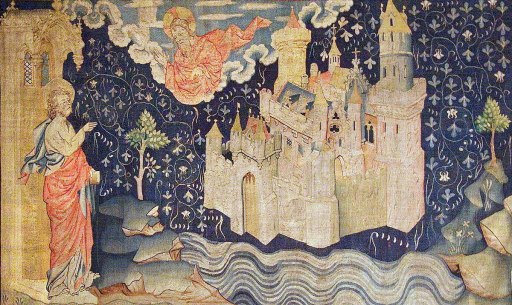
Then I saw a new heaven and a new earth; for the first heaven and the first earth had passed away, and the sea was no more. And I saw the holy city, the new Jerusalem, coming down out of heaven from God, prepared as a bride adorned for her husband. And I heard a loud voice from the throne saying, ‘See, the home[a] of God is among mortals. He will dwell with them; they will be his peoples, and God himself will be with them; he will wipe every tear from their eyes. Death will be no more; mourning and crying and pain will be no more, for the first things have passed away.’

So much seems clear from the scripture, but it leads me to ask the question “why?”. Why is the created universe, why are men and women, so important to God that

Jesus… was conceived by the Holy Spirit, born of the Virgin Mary, suffered under Pontius Pilate, was crucified, died, and was buried. He descended into Hell; the third day He rose again from the dead”.

Why was this necessary? What is the point of it? In the Westminster Shorter Catechism the answer is that “the chief end of man is to glorify God and enjoy Him forever”. I have to say I am far from convinced of that, pointing to a somewhat narcissistic God, and painting a very static picture of life in eternity.

The se questions are ultimately of course unanswerable with our earth-bound level of understanding – why God created the Universe must remain at the level of mystery. But I think that we can to some extent grasp what is the essential characteristic of the created order that is so important to God and his eternal purposes After much thought it seems to me that this is something to do with the diversity and complexity of the created world. In physical terms, modern science suggest that all physical matter ultimately consists of quantum fluctuations of energy that can only be specified in a statistical sense. At the other end of the scale, whilst the observable universe follows well defined deterministic laws, these are such that small fluctuations in physical parameters can results in immense complexity – the mathematical concept of chaos. At the level of the universe this complexity can be seen in the quite mind-boggling formation of galaxies and star systems.  On a more local level, whilst our weather patterns can be well described by simple physical mathematical equations, small fluctuations can again results in massive complexity at the global scale. This of course is what is known colloquially as the “butterfly effect”. In mathematical terms, work over recent decades has shown that very simple mathematical equations can produce solutions of immense complexity and beauty with patterns that repeat throughout a wide range of scale – for example the Mandelbrot set with its replicating patterns across the range of scales. There are also indications that the larger scale physical laws that bind our physical world actually emerge out of the very small scale quantum fluctuations. To summarise, our physical creation is immensely complex and diverse – and this seems an inbuilt feature.

The same can be said for the biological creation for which the physical creation forms a base. Here the complexity is driven by sexual reproduction and genetic variability to produce a staggeringly complex array of plant and animal-based life, including humanity, with all its widely different characteristics and types. This variability is also of course driven by the physical environment to some extent, and indeed feeds back to affect that environment.

Just as the biological creation finds its base in the physical, so the cultural and social creation finds its base in both the physical and biological creation. Again we can see if the social and community life of humanity is massively complex and diverse, and the same is true, although at a lesser level for the cultural life of the non-human creation.

So, my suggestion as to what is important to God in his creation, and the reason for the necessity of its redemption through the incarnation and atonement, is its very complexity and diversity, as expressed in physical, biological and cultural terms. Why this should be the case is unknowable, but given that it is there are some immediate implications.

  • The diversity of our natural world is critical to God’s purposes, and anything that reduces this diversity and complexity should be resisted. If a theological basis for protecting the natural world is required, then this provides it. Biodiversity issues are, in this view, central to God’s purposes.
  • Biological complexity is driven by genetic variability and sexual reproduction. In the first chapter of Genesis, we read “So God created humankind in his image, in the image of God he created them; male and female he created them”. This speaks directly into the current issues of sexuality that are dominating church discourse at the present time. Male / female distinctiveness is very important in God’s purposes, and very great care should be taken in embracing developments that try to eliminate this distinctiveness.
  • Cultural and social variation is also important, both without and within the church. The imposition of uniformity, which is a habit that has a particular hold on the larger denominational churches, may not be altogether the best thing.

There are many other issues that arise from such considerations of course, concerning the nature of God and the relationship between heaven and earth; what was the more precise purpose of the incarnation and atonement; and are there limits to diversity that need to be observed. I will attempt to tackle some of these issues in the posts that follow.

The beloved disciple – the missing years.

In his book “Jesus and the eyewitnesses”, the theologian and bible scholar Richard Bauckham argues, persuasively in my view, that the four New Testament gospels that have comedown to us actually represent mainly eyewitness accounts of the life and deeds of Jesus. This is chiefly indicated by a particular literary device – the inclusio – in which a particular disciple or eyewitness appears at the start and end of the events that he or she is claimed to have witnessed. As such this hypothesis is a welcome corrective to what seems to have been the prevailing critical belief that the gospels were the result of a reworking of various traditions about Jesus by early Christian communities. Bauckham is, in his gentle way, quietly scathing of this concept using phrases such as “the imaginary Johanine community“. It has always seemed to me that such theories have resulted from the sceptical presumptions of liberal scholars themselves, rather than from a proper study of the text, and it is nice to have someone of the status of Richard Bauckham to reinforce my own personal presumptions that in the first instance the biblical texts should be taken at face value and assumed to be reliable.

Whist Bauckham argues his case for all the gospels, a large part of the book is concerned with the Gospel of St John. He argues, again very persuasively from my perspective, that this represents the eyewitness testimony of the one identified in the text as “the disciple whom Jesus loved”, and who he further identifies as the John the Elder of the writings of Papias, rather than with John the son of Zebedee, one of the twelve disciples listed in the other gospels. This John seems to have been well connected with the religious authorities in Jerusalem and died at an advanced age in the latter years of the first century, probably in Ephesus, writing the gospel sometime before his death. He is also probably the writer of the three Johanine epistles, which have much in common linguistically with the gospel.

Now, if we assume that Bauckahm is correct, this leads to quite a significant issue. The beloved disciple was clearly present at some of the most important stages in Jesus life, from the early calling of the disciples, through to his death and resurrection, and was clearly very close to Jesus, but yet does not, in any explicit way appear in any of the other gospels, or in the account of the life of the early church in the Acts of the Apostles, Indeed he does not appear to have become a recognised figure in the early church until late in life, when he is recorded in Papias and Polycrates. This absence is actually a very good argument for identifying the beloved disciple with John the Son of Zebedee (who certainly was around during Jesus’ ministry and death, and during the early years of the church), and, although I am loathe to admit it, for a community reworking of the Johanine tradition that eventually resulted in the gospel. So, assuming Bauckham is correct in his deductions, why does John the beloved disciple not appear in the synoptic record?

Bauckham himself gives one possible solution to this problem, although that results from a consideration of the case of the raising of Lazarus, which is only found in John’s gospel and not in the synoptics. He argues that this is a case (along with others in all the gospels) of protective anonymity. In other words, the raising of Lazarus is deliberately omitted from the synoptic accounts because it would have placed him in a position of danger because of the animosity of the Jewish authorities at the time when these were written, if he had been included and identified. By the time the gospel of John came to be written (perhaps two decades after the synoptics) the danger would have passed, and in all probability the major characters on both sides had died. The same reasoning could be applied to the beloved disciple himself, particularly if he was well connected with the religious establishment. There is indeed some tradition that this is the case, and a phrase in Polycrates suggests he was actually, at some point, the high priest (which Bauckham suggests is an erroneous back reading and identification with John, a member of the high priestly family in Acts 4). But if the beloved disciple was indeed close to the Jewish establishment,, then to be identified publicly as one of the disciples and a member of the early church would have been very dangerous, and his lack of mention in the synoptics and in Acts might be a simple recognition of this fact.

But there is another possible, and perhaps more disturbing explanation. As has been noted above, from the nature of the gospel it is likely that the beloved disciple was well connected with the Jerusalem religious establishment, with detailed knowledge of the workings of the Sanhedrin – both personally and through Nicodemus, who is again only mentioned in St John’s gospel. It seems to me possible that after the resurrection he became one of those who tried to hold on to the Jewish traditions whilst also following the teachings of Jesus. As such he, and perhaps others would have become objects of suspicion, particularly as more and more gentiles became believers. Whilst not saying that he was one of those urging circumcision that attracted the considerable ire of St Paul, nonetheless it would not be surprising that he and others in his position were omitted from the synoptic accounts and the Acts of the Apostles. In such a scenario it was perhaps only after the split between the church and Judaism became absolute post AD 70, and the emotions that drove the conflicts recorded in the Pauline epistles had cooled, that John the elder, the beloved disciple, would once more be able to take his place as one of the surviving eyewitnesses of the life and death of Jesus. If this were indeed the case, it makes the graciousness and lack of rancour of his gospel the more remarkable.