Reflections on “The whole world a Black Country” by Matt Stallard

This is an article published in the Spring 2023 edition of the Blackcountryman, reflecting on an article by Matt Stallard in the previous edition

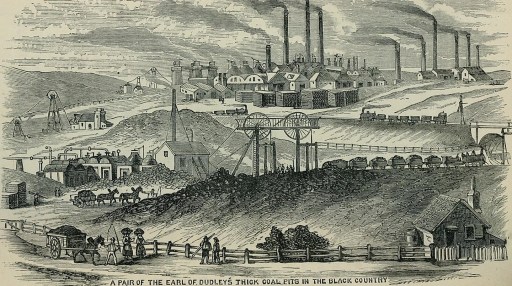
In the last issue of the Blackcountryman, Matt Stallard described the rather bizarre way in which the Victorians saw the Black Country as a horrific paradigm of environmental devastation that was uncomfortably close to home, whilst at the same time extolling those places elsewhere in the Empire which had taken the same path of industrial exploitation and were described as local Black Countries. Reflecting on our own Black Country he writes

In world-historic terms the Black Country has a rightful and still-underappreciated place as foundational when it comes to the engineering and scientific breakthroughs and forms of knowledge that were later transported in the minds and bodies of people … throughout the world; Dud Dudley, Thomas Newcomen, Abraham Darby, John Wilkinson and all the others, names and unnamed….

A proud legacy indeed, and one that resulted in major benefits for humanity, in terms of health and quality of life, but one that needs to be balanced against how this knowledge was used to cause significant environmental damage in this country and around the world. After a thorough survey of the developments of the various Black Countries around the world, driven by the process of colonialism tinged with classism, eugenics and racism, he concludes with the following more optimistic words.

For our region, placing our proud and truly world changing history at the centre of the most critical debates of our time has the potential to put us on the map in a positive, constructive way – where we dismantle those tangled, toxic legacies and write our own twenty-first century narrative, and map out new futures for our, and the many other Black Countries they imagined across the planet.
As I reflected on this article, another thought struck me. If the role of the Black Country was indeed foundational in the engineering and science developments that enabled the extraction of large quantities of coal which in turn fueled the Industrial revolution, with its legacies both positive and negative, then it has to be admitted that the current climate crisis, caused by climate warming fuel due to the greenhouse gases that result from the use of fossil fuel, also has at least some of its roots in the Black Country. This is not in any way to apportion blame or to lay the responsibility for the current crisis on those who live there now – the effects of fossil fuel burning on the climate have only become apparent in the last fifty years, and many of the current inhabitants of the area are descended from those who were as thoroughly exploited by the rich and powerful landowners and financiers as those held in slavery in the colonies. But nonetheless, it is important to acknowledge that our region was instrumental in the causes of the present crisis.
Now, it is clear that unless urgent action is taken, then the effects of climate change will be felt in a major way around the world, even within the Black Country. Whilst we will not be affected by the inevitable sea level rise, which is already underway and will continue for many decades whether or not action is taken to reduce carbon emissions, many low-lying areas around the world are facing inundation by rising water levels. Some parts of this country are most definitely at risk – I would very strongly advice about buying houses in the Fenland for example with or without flood insurance! But the Black Country will suffer in two ways – by consistent higher temperatures in summer, exacerbated by the urban nature of the Black Country leading to an “urban heat island” effect, where temperatures will be several degrees higher than the surrounding areas; and by the greater weather instabilities that can be expected, with higher winds and rainfall, which will be magnified by the significant elevation of the Black Country above sea level. No one will be immune.

Nut to return to Matt Stallard’s final observation, in the light of this legacy, what is the new narrative that we could write, the new future that we can map out? It has to be admitted that here I write in hope rather than expectation, but there is a potentially positive future in view, where the Black Country becomes a paradigm for adopting measures to mitigate the future effects of climate change internationally. The region still has a major engineering and construction skills base, that could be utilized in the production and installation of green energy products such as wind turbines and solar panels. In the nineteenth century, the Black Country was exploited for its underground wealth – could it now be exploited, for its much more environmentally friendly surface and aerial wealth. As I noted above, the Black Country sits on the Midlands plateau, 150m above sea level – an ideal location for onshore wind turbines. Although such turbines are currently something of a political hot potato, they do offer the prospect of significant amount of green energy. Similarly, there seems to me no reason why the huge stock of low-rise housing across the region should not be fitted with solar panels, and thus become a large-scale solar farm. Wind and solar energy are of course not continuous, and some sort of balancing energy source is required. The most efficient, and indeed most environmentally friendly, is the use of pumped storage – pumping from a low-level reservoir when energy is available and releasing the water to a lower level through turbines to produce energy at times of peak demand. Again, the topography of the Black Country is ideal for small scale pump storage schemes, with rapid drops to lower levels at the edge of the plateau – the long flights of locks on the Wolverhampton, Stourbridge and Dudley canals testify to this fact.

In addition to becoming a paradigm for green energy production, the Black Country need to do something about its direct production of greenhouse gasses – through insulation of the building stock to decrease energy use, and through a move away from carbon fuel-based transport to transport powered by renewable means (usually through electricity) of through active travel – cycling and walking. Indeed, across the UK the transport sector is a major issue in terms of carbon emissions, being the one sector where carbon production is still increasing. This presents a major challenge to the Black Country, which is very much the centre of a car dependent culture. The development of the Midland Metro and light rail schemes, and the roll out of electric buses and electrically assisted cycles and proper cycle infrastructure, are hugely important in this regard. A move away from car-based transport would also have a major effect on more local environmental and medical issues such as poor air quality due to transport emissions (which is estimated to kill between 28000 and 36000 people each year nationally) and obesity due to the lack of exercise.

So, I would suggest it is possible to map out a future for the Black Country that acknowledges that at least to some extent, the issues over climate can be traced back directly to engineering and scientific developments in the region but positions itself as a region where its skills can be used to develop new methods for solving the issue. A fanciful, optimistic vision? Maybe, but perhaps one that is worth holding on to.

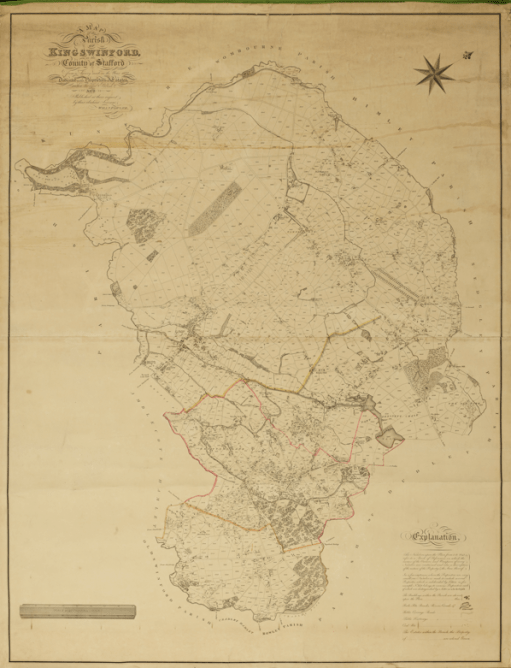
The Fowler maps of Kingswinford parish of 1822 and 1840

The paper summarised in this blog, and another on a different topic that was written around the same time, were originally intended to be sent to journals for publication – after five years of retirement I felt able once again to resume my career long warfare with journal editors and referees. However reading the journal author guides quickly made me change my mind, and I decided simply to mount the papers on this website. This has advantages in that doing so is good for my blood pressure and state of mind, and also allows for immediate dissemination of what has been written, but also disadvantages, in that the papers have not been tested by peer review and, as I am possibly the world’s worst proof reader, no doubt have significant numbers of typographical errors. Readers will come to their own views as to whether my approach has been the correct one.

Note – May 3rd 2024. A much revised version of the paper has been uploaded, with geo-referenced figures with OS grid co-ordinates and extended discussions. The blog below has also been mildly revised.

Outline

Figure 1. The 1822 Fowler Map

In 1822, the landowners of Kingswinford parish commissioned a map by the firm of William Fowler, a Birmingham firm of land surveyors, that delineated all the properties in the parish, and provided information in a book of reference. This produced a large map at a scale of 1:7920 that is almost a work of art in its own right (figure 1). Note that the map is oriented such that north is in the top right hand corner. The exercise was repeated, probably driven by the Tithe Act of 1835, in 1840. This post links to a technical and analytical paper that investigates what these maps can tell us about the development of the parish over the period between 1822 and 1840 and summarises the findings. Full details are of course given in the paper itself.

The basic approach taken was firstly to transcribe all the entries in the book of reference into searchable spreadsheets – a laborious task that was nonetheless ultimately profitable, and secondly to produce small scale maps with national grid co-ordinates that show the development of specific industries or community functions across the parish. Examples of these are given in what follows.

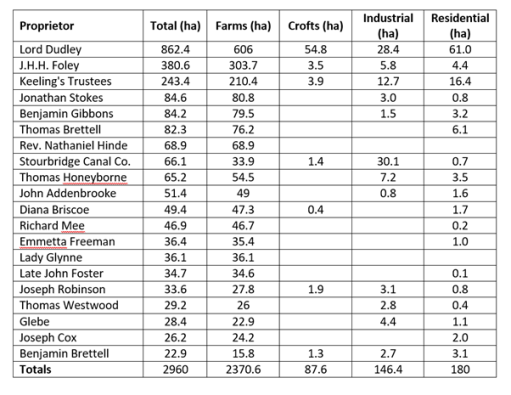
Firstly Table 1 shows the major proprietors in 1822, which shows the dominant position held by the Dudley Estate.

Table 1. Major proprietors in 1822

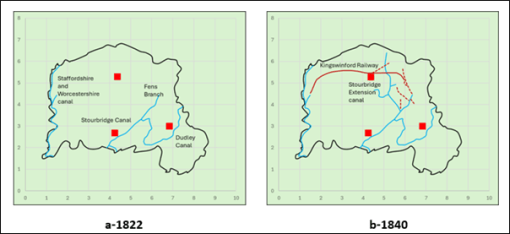
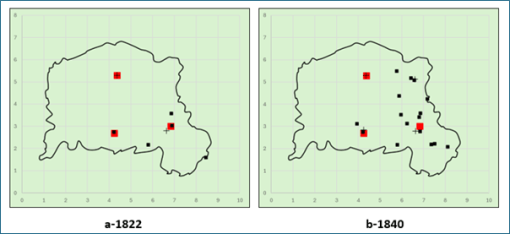
Figure 2 shows the development of transport links across the parish – and in particular the building of the Stourbridge Extension Canal and the Kingswinford Railway, with associated tramways. The maps here have north to the top in the conventional way.

Figure 2 Railways, canals and tramways in 1822 and 1840

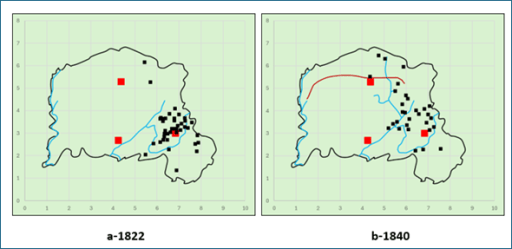
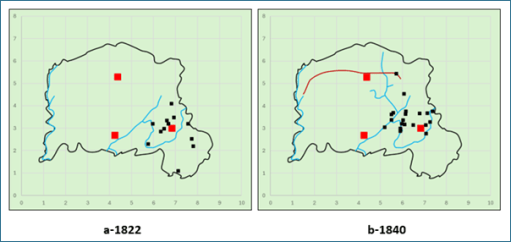
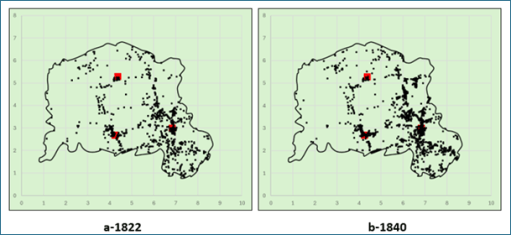
Figure 3 shows how coal mining spread across the parish between 1822 and 1840 – from the south to the north; and Figure 4 shows the consequent spread of disused mines.

Figure 3 Distribution of coal pits

Figure 4 Distribution of Old Colliery Land and Spoil

Figure 5 shows the increase in housing density across the parish and Figure 6 shows the increase in the number of places of worship across the parish, for both the established and non-conformist churches.

Figure 5. Housing

Figure 6 Churches and Chapels

Crosses are Anglican churches or chapels and black squares are non-conformist meeting houses.

The above examples are of course only illustrations of what is a rather complex analysis, which shows that there was a significant development of industry in the northern half of the parish, followed by domestic, commercial and community developments. This was facilitated by the development of canals and railways, and was driven by the major landowners and industrialists, but was enthusiastically followed by very many others.

The paper

The Pensnett Canal and the Pensnett Railway

Preamble

In canal histories, the Pensnett Canal is usually little more than a footnote – a short, one and a half mile private canal, often referred to by its owner’s name as Lord Ward’s canal, extending from the south end of Dudley tunnel with no locks or major engineering structures, to the Wallows to the south west, serving a number of iron works and mines on the way, from 1840 when it was built, through to the 1940s when commercial traffic ceased. What little there is to say about it is summarized in the definitive work of Hadfield (1), The Pensnett Railway by contrast, figures rather more prominently in railway histories, and indeed there are at least two books devoted to it (2), (3). Its origins can be traced back to the Kingswinford Railway of 1829, of Agenoria fame, with which it later merged, but it came into existence in its own right in 1843, again centred on the Wallows area, and eventually spread out across the southern Black Country, with more than 30 miles of railway, serving the mines and local industry in some form or other though to the 1960s.

In canal histories, one finds that the Pensnett Railway is rarely mentioned in any description of the Pensnett Canal, and similarly railway histories do not include the Pensnett Canal to any extent in the description of the Pensnett Railway. The history of both undertakings has thus been neatly compartmentalized. In this post, I will argue that this compartmentalization actually obscures something of importance – that both Canal and Railway have their origins in the same industrial and commercial needs and that the Pensnett Canal was conceived in part as a link in a much wider canal network that was never built to meet these needs. These needs were actually met in the construction of the Pensnett Railway, and indeed the initial construction was to a significant degree based on the abortive canal network proposals.  Thus, the histories of the two undertakings need to be considered together, and in what follows we will attempt to do this in broadly chronological order.

The Kingswinford Railway

Figure 1 Canals and railways in the Kingswinford area in the 1820s (dark blue lines indicate canals, dark brown lines indicate railways)

In the early / mid 1820s, the area to the south of Dudley, mostly in the large parish of Kingswinford, was undergoing significant industrial development (figure 1). Coal and iron extraction was already underway in the south of the area around Brierley Hill and Brockmoor and a number of iron works were in operation. The transport needs of these industries were met by the three canals that existed in the area at the time – the Staffordshire and Worcestershire Canal to the west, which offered an outlet for industrial products to the northern cities (via the Trent and Mersey Canal) and to the south and west (via the Severn). The Stourbridge canal to the south which allowed coal and iron products to access the Staffordshire and Worcestershire at Stourton, and via the Dudley Canal and the Dudley and Lapal tunnels gave access to the central Black Country area and the route to London.

However, as the decade progressed, coal and ironstone mining and iron manufacture pushed northward – to the mines and iron works of Corbyn’s Hall, owned by the Gibbons brothers (4), and beyond that to what would be the vast iron works of Bradley and Co in Shut End owned by James Foster (5). The Earl of Dudley’s Estate, which was the major landowner in the area was also beginning to develop significant mining activities in the Barrow Hill and Old Park areas. These concerns needed a reliable means of transportation for their products around the country. Discussions were held with the Stourbridge company to consider a branch into the area, but these came to nothing. The Dudley Estate, then took the matter into its own hands and conducted what was to become known as the Kingswinford Railway, which connected the Corbyn’s Hall and Shut End areas with the Staffordshire and Worcestershire canal at Ashwood Basin (figure 1). Most of the land was owned by either the Dudley Estate or by James Foster with just a small area owned the other major landowner in the area, John Hodgetts Hodgetts-Foley of Prestwood, with whom a lease agreement was concluded. It consisted of a 1 in 28 incline of 500 yards in length from Ashwood Basin which was followed by a largely level stretch of two miles, before another (Foster’s) incline that led to the Corbyn’s Hall area. A branch incline led into the Bradley and Co ironworks. The inclines were horse drawn, but the central section was operated by the steam engine Agenoria, about which much has been written (6). The line thus met the immediate needs and provided an outlet for the produce from the area, and also provided a steady toll income for the Dudley Estate.

Canal developments

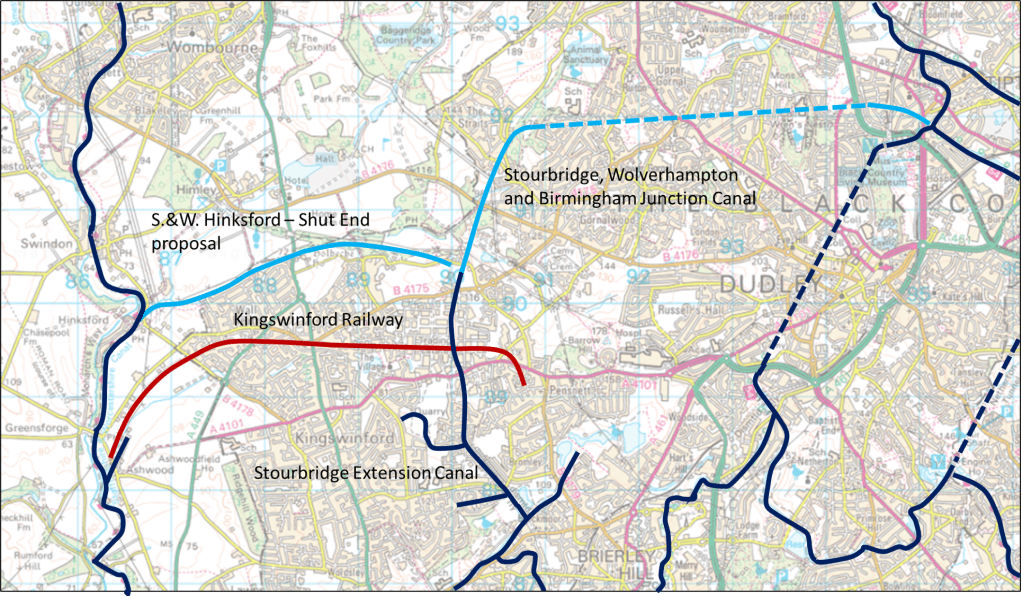
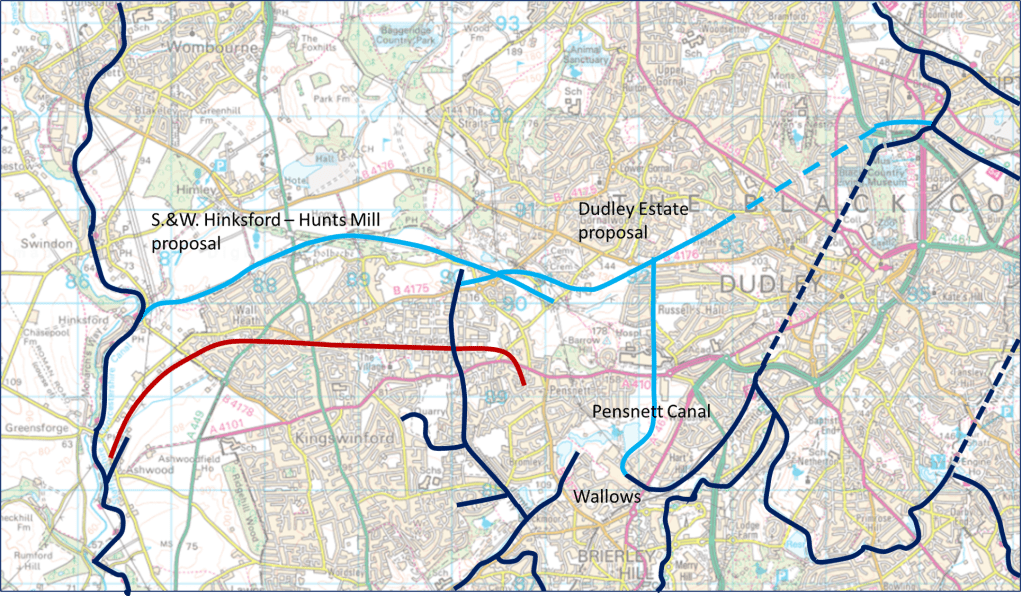
Figure 2 Canals and railways in the Kingswinford area in mid / late 1830s (dark blue lines indicate canals, that were constructed, light blue lines indicate canals that never passed beyond the proposal stage, dark brown lines indicate railways)

Whilst the Kingswinford Railway addressed some of the issues, others remained. Perhaps the most significant of these was to find an outlet for both coal and iron products to the north and east. In the short term this issue was solved in the mid-1830s by the construction of quite lengthy tramways to the Stourbridge Canal Feeder branch from the Corbyn’s Hall area and from the Dudley Estate mines in the Barrow Hill area and from there products could be carried back to the main line of the Stourbridge and Dudley canals and the Dudley tunnel (7). However, such transshipment was expensive and time consuming and some better form of carriage was required. Thus in 1836 a new company, formed by some of the Stourbridge Canal shareholders, put forward for parliamentary approval a proposal for a canal from the feeder branch at Brockmoor (at its summit level of 356 feet above sea level) to Corbyn’s Hall and Shut End, then onward to Straits Green and Sedgley with a flight of locks rising to the Wolverhampton level of 473 feet above sea level, and then through a one mile tunnel to the Birmingham Canal at Bloomfield (figure 2) (8). This canal – the Stourbridge, Wolverhampton and Birmingham Junction – would thus give access for the products of the Shut End and Cotbyn’s Hall area to both north and south without transshipment from tramways. It was opposed by both the Staffordshire and Worcestershire Company and the Dudley company as it potentially offered a bypass from the south that avoided the Wolverhampton locks on the Birmingham canal at the junction with the former, and also offered a more direct alternative to the Dudley Canal and tunnel. The former put forward their own proposal for a branch from Hinksford to Gornal Wood near Oak Farm, with 13 locks rising 104 feet, which was supported by the Dudley Estate (9*). The conjectured route (following the course of the Holbeche brook) is also shown in figure 2.  The projected rise would have taken it to a height of around 320 feet, somewhat below the level of the Stourbridge, Wolverhampton and Birmingham Junction Canal. However, before parliamentary arguments could begin, it became clear that the Stourbridge Company could not raise the necessary finance, and the plan was curtailed and became a two-mile level canal from the Stourbridge to Shut End, with branches to Standhills and Bromley (the latter unauthorized) where it terminated. It was renamed the Stourbridge Extension Canal, and opened in 1840. As such it still served a useful purpose in allowing goods to be moved more speedily onto the Stourbridge Canal and then onwards, but it did not help with the issue of longer distance transport to the central Black Country and beyond.

Plots and intrigues

Figure 3 Canals and railways in the Kingswinford area in 1839/40 (dark blue lines indicate canals, that were constructed, light blue lines indicate canals that never passed beyond the proposal stage, dark brown lines indicate railways)

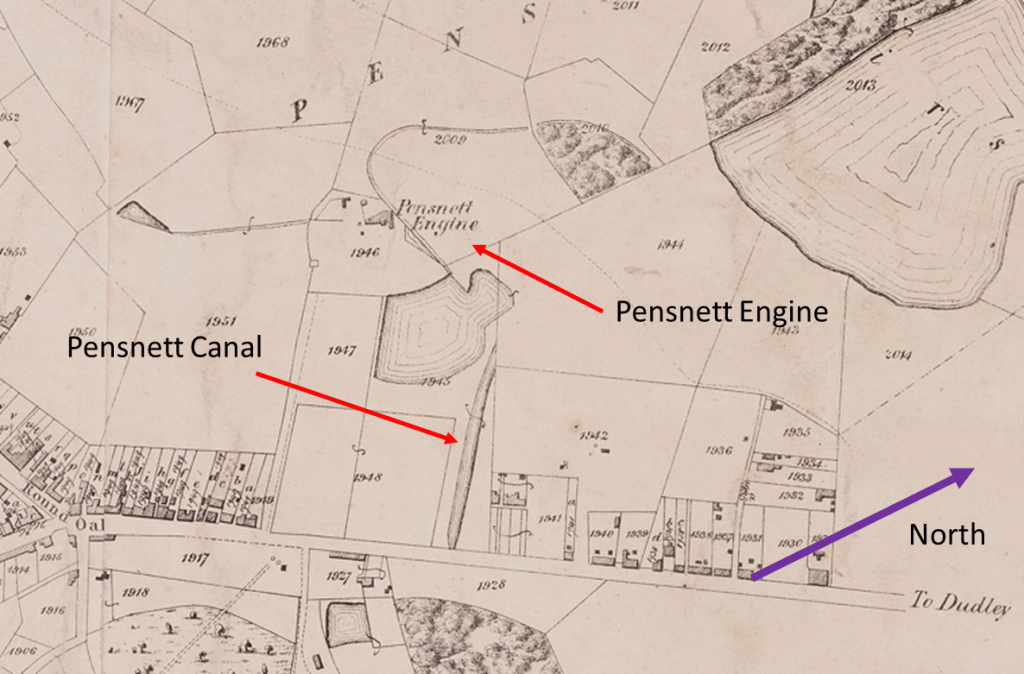
Whilst the Extension Cana was in its final stages of construction in 1839, two events occurred. The first was the building of the Pensnett Canal from the Wallows towards the southern portal of Dudley tunnel by the Dudley Estate. There were developing mining activities in the Wallows area, so of itself this was a justifiable step (figure 3).  As it was on land owned by the Estate, no parliamentary approval was required. It was completed and in use by 1840. The canal was built on the Wolverhampton level of 473 feet.  The start of its construction is captured on the Kingswinford Tithe Map of 1839 shown in figure 4 (10). The channel at what was to become the south west end of the canal can be seen, together with the “Pensnett Engine” that was used to dewater mines in the area – and which may have been intended to be the water supply to the canal.

Figure 4. Extract from the Kingswinford Tithe Map of 1839 showing the early stage of construction of the Pensnett Canal and the Pensnett Engine at the Wallows. Note the direction of north.

Also in 1839, the Staffordshire and Worcestershire canal company revived their proposal of 1836 for a branch from Hinksford but extending somewhat further and ending near Hunts Mill (11*). This would have required more locks than the earlier proposal, to bring it to that point, which is around 350 feet above sea level – very close to the Stourbridge Extension Canal level.   If it again followed the line of the Holbeche Brook, it would thus pass a little way to the north of the Extension Canal. The Stourbridge and Stourbridge Extension companies were alarmed by this, as they could see that potentially this branch could link with the Pensnett Canal in direct competition to their route. It would seem that meetings were held, and the proposals were withdrawn.

However, it was soon to be shown that the worries of the Stourbridge and Stourbridge Extension companies were quite justified. In 1840 a proposal was put forward by the Dudley Estate for a canal that joined with the Extension Canal at Shut End at the Stourbridge level of 353 feet, then rose through 19 locks to the Wolverhampton level on the Old Park area, where it was joined by an extended Pensnett Canal (12), (13). It then passed through a tunnel before joining the Birmingham Canal at Tipton near the northern portal of the Dudley Tunnel. This would have served the Dudley Estates mining developments in the Wallows and Old Park area and would also have served the Estate mines in the Barrow Hill area.  Moreover, a direct connection with the proposed Staffordshire and Worcestershire branch would have been straightforward near the junction with the Stourbridge Extension Canal as they were on the same level.  But, as Hadfield (1) remarks, the time was past, and the newer more efficient railways were already beginning to make inroads into the area, and the scheme was never progressed. Had it done so, the canal map of the south western black country would have been very difficult.

The Pensnett Railway

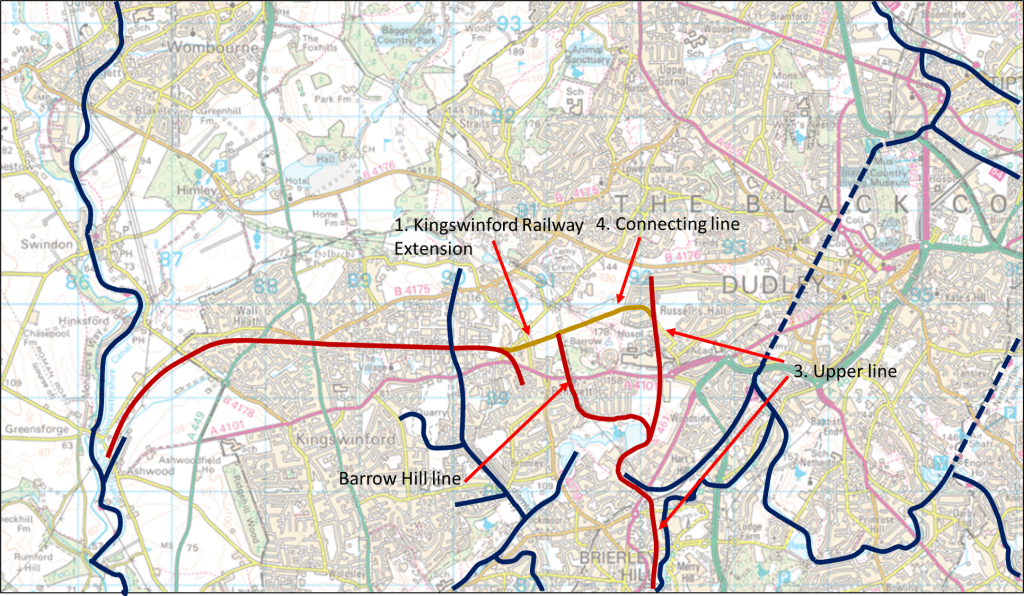
Figure 5. Pensnett Railway proposals of 1843 (dark blue lines indicate canals, dark brown lines indicate railways that were constructed, light brown line indicate railways that never passed beyond the proposal stage)

Although the Stourbridge Extension Canal and Pensnett Canal were completed and came into use, the need for rapid transport of the produce of the area to the Black Country, Birmingham and beyond remained. This was to become less pressing however, as local needs for coal and ironstone were increasing at the same time as the output from the traditional sources in the Brierley Hill area were decreasing.  In particular the Level New Furnaces provided a ready market for the products of the Dudley Estate mines in the Barrow Hill area.  This led to the Trustees of the Dudley Estate commissioning F. P. Mackelcan to develop schemes for railways in the area (2). He proposed the following lines (figure 5)

  1. An extension from the end of the Kingswinford Railway and running to the Dudley Estate mines at Barrow Hill and Old Park via a one in seventeen incline.
  2. A branch from this line that went up the one in twenty-five Barrow Hill incline, passed underneath the Dudley – Kingswinford turnpike road and skirted the Fens pool to join the third line below.
  3. The upper line from the mines of the Old Park area, underneath the Turnpike Road, around the Fens Poll to the Wallows, and then to the Level New Furnaces and the top of the nine locks.
  4. A line uniting the end of the upper line and the end of the extension.

It is striking how much these proposals were influenced by the earlier canal proposals. Firstly, the extension of the Kingswinford Railway would have served the same function as the canal branch from Hinksford proposed in 1836 and 1839, connecting the mines in the Barrow Hill area with the Staffordshire and Worcestershire canal. This proposal was not acted upon, as there were worries about the long-term stability of the existing Foster’s incline. Secondly the northern section of the upper line to Old Park (known as the “High lines”) follows closely the line of the extension to the Pensnett Canal proposed in 1840.  Thirdly the line connecting the extension to the upper line, which again was not built, would have followed the route of the 1840 canal proposals. Finally it should be noted that the designs were very much based on canal technologies – level stretches of track connected by inclined planes, and there were canal transshipment wharves at the Wallows and at the end of the Delph branch. Whilst the Pensnett Railway was to develop very much further in the area in a more conventional railway manner over the coming decades, its genesis in the various canal schemes of the late 1830s and early 1840s seems to be clear. The Pensnett Canal and the Pensnett Railway developed because of the same industrial needs and are best considered as different solutions to the same transport issues. Their history is inextricably tied together.

References

1. Hadfield C “The Canals of the West Midlands”, David and Charles, 3rd Edition, 1985

2. Gale W. K. V. “A history of the Pensnett Railway”, Goose and Son, 1975

3. Williams N. “The Earl of Dudley’s Railway”, The History Press, 2014

4. Grace’s Guide, https://www.gracesguide.co.uk/Benjamin_Gibbons_(1783-1873)m  Accessed September 2022

5 Grace’s Guide, https://www.gracesguide.co.uk/James_Foster, Accessed September 2022

6. Grace’s Guide,  https://www.gracesguide.co.uk/Foster,_Rastrick_and_Co:_Agenoria , Accessed September 2022

7. Baker C J, “Kingswinford Manor and Parish”, https://profchrisbaker.com/kingswinford-manor-and-parish-new/ , Accessed September 2022

8. Dudley Archives “Plan of Stourbridge, Wolverhampton & Birmingham Junction Canal”, DE/6/12/3/26, 1836

9*. Staffordshire Records Office “Plan, book or reference and section of an intended navigable cut or canal called the Staffordshire and Worcestershire Canal at or near Hinksford in the Parish of Kingswinford, County of Stafford”, Q/RUm/86, 1836

10. Staffordshire Records Office “Kingswinford Tithe Map”, Staffordshire Past Track, 1839

11*. Staffordshire Records Office “Plan, book of reference and section of intended cut or canal called the Staffordshire and Worcestershire Canal Navigation at or near Hinksford, in the Parish of Kingswinford, County of Stafford, to a certain close of arable land called the Plain Piece near Hunts Mill”, Q/RUm/121, 1839

12. Dudley Archives, “Sections of Intended Canals between Tipton Green and Shut End and between Dudley and Coseley”, DE/6/12/3/37, 1840

13. Dudley Archives, “Plan of Railways, Canals and Roads between the Black Country and Birmingham”, DE/6/12/3/44, 1841

* At the time of writing (September 2022) I have not consulted these items in full, as Staffordshire Records Office is closed for refurbishment. I will do so as soon as I am able and make any necessary changes to this post. However, what I have written is consistent with the catalogue contents, and what is presented in (1).

Kingswinford Junction 1949

Figure 1 Location sketch

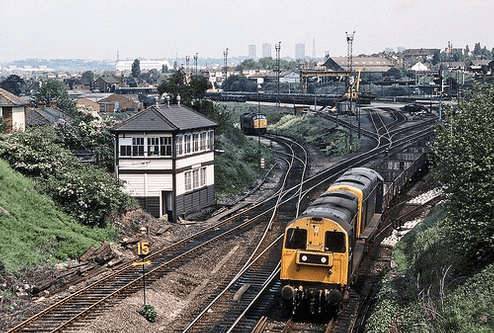
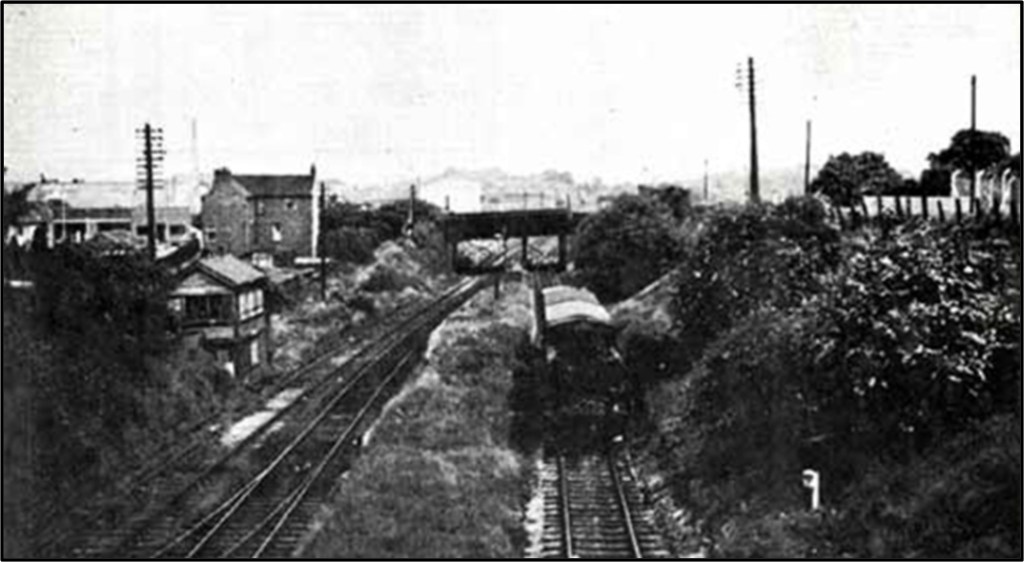
Kingswinford Junction was the point at which the GWR line to Wombourne and Wolverhampton left the GWR main line from Stourbridge Junction to Dudley and Wolverhampton – see the figure 1 for a sketch map showing the location and figure 2 for a detailed Ordnance Survey map from the 1930s. . It was situated between Brierley Hill and Brettell Lane stations (A and B on figure 2). There was also a very extensive set of sidings (C) at the junction that served as a major freight marshalling yard- see the figure above. Traffic through the yard was controlled from two signal boxes – Kingswinford North (D) and Kingswinford South (E). The latter can be seen in the photo in figure 3 from the 1980s (taken from here).

Figure 2 1930s OS map of Kingswinford Junction

Figure 3 Kingswinford Junction and South Box in the 1980s

This brief post describes the services that ran through the junction in 1949, just after nationalization of the railways. It is based on a working timetable for that year that can be found on the Michael Clemens Railways website. As such it gives a snapshot of a busy railway location at a crucial point in the history of the railways.

The main passenger service through Kingswinford Junction was the Wolverhampton – Dudley – Stourbridge Junction stopping service with around 14 trains in each direction, the number varying slightly by day of week and direction. The trains departed from Wolverhampton Low Level calling at Priestfield, Bilston, Daisy Bank and Bradley, Prince’s End, Tipton, Dudley, Blowers Green, Round Oak and Brierley Hill, and passed through Kingswinford Junction before calling at Brettell Lane and Stourbridge Junction. The journey time was around 45 minutes. The timetabling was irregular i.e. not at fixed times past each hour, which seems odd to modern eyes, but such timetabling was common practice at the time.  Some trains were extended to Kidderminster or Worcester in the south and Shrewsbury, Crewe or Chester in the north. In addition there was one through Wolverhampton to London Paddington train each day, leaving Wolverhampton at 6.50am, calling at the local stations mentioned above and passing through the junction at 7.29am. It then called at local stations to Worcester, then at Evesham, Moreton in the Marsh and Oxford before arriving at Paddington at 11.30am. The return journey left Paddington at 1.45pm, passing through the Junction at 6.18pm and arriving at Wolverhampton at 6.57pm. There was also a single daily service from Stourbridge to Birmingham via the local stations to Dudley and Great Bridge, in the morning and the return trip in the evening. Most Birmingham passengers would have changed at Stourbridge Junction or at Dudley and Dudley Port.

There was very extensive freight traffic through Kingswinford Junction and sidings. This traffic was of different types. Some trains simply passed through, mainly using the Kingswinford branch between the Junction and Oxley sidings in Wolverhampton. These included several daily workings from Worcester to Crewe and from Rowley Regis to Ellsmere Port and from Hollinswood in Shrosphire to Stourbridge Junction and Worcester.  There were also occasional through freight workings along the Dudley to Stourbridge Junction line through the Junction, generally with local freight services, which in the main served the steelworks at Round Oak.

The main function of the sidings however was as a marshalling yard, receiving trains from yards around the country and reforming the wagons into trains for onward journeys to other yards. It had daily services to and from Birkenhead, Crewe, Didcot, Morris Cowley, Scours Lane, Swindon and Tavistock Junction, and it can thus be seen that it was integrated into a national web of interlocking freight services. The marshalling activities would have been extensive and would have taken place throughout the day and night.  It can be seen from the map of the sidings that there were exits to the north and the south, and thus trains that continued their journey along the main line to Dudley or Stourbridge would have had a straightforward route out of the yard. There were 15mph speed restrictions at both exits. However, some trains that began their journey in the sidings used the Kingswinford branch – specifically those to Birkenhead and Crewe. The operation of these trains would have been complex as there was no exit / entry to the sidings from the north to the Kingswinford branch, so the train would have to have been shunted too or from the long siding by the main line towards Brettell Lane and then reverse in the other direction. The large height difference between the branch and the sidings, visible in figure 2 would have been a complicating factor.

The Working Timetable also contains details of “Bank Engine” duties. These were the timetables for specific locomotives that assisted trains where required (such as for the movements out of the yard described above); delivered freight brought to the yard by other trains in the immediate vicinity (eg. to Round Oak, or Cradley); or shunted trucks at various local sidings etc. An example is given in Figure 4 below for such a locomotive with duties primarily on the Kingswinford branch, including shunting and collecting trucks from Bromley (private sidings); Pensnett (the collieries in the Shut End area) and Baggeridge Junction (from the Pensnett Railway branch to the colliery). Train speeds on the branch were low – 10 to 15mph in general with only short stretches where 25mph was allowed.

Figure 4 Bank Engine Schedule

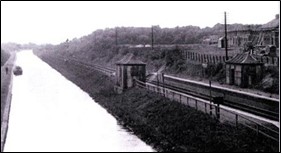
The branch briefly had a passenger service from 1925 to 1932, which served a number of halts along the line. Two of these – Bromley Halt next to the Stourbridge Extension Canal and Pensnett Halt are shown in figure 5 – the former from the 1930s and the latter from the 1950s. There were signal boxes at both Bromley and Pensnett that were still manned for part of the day in 1949.

Figure 5 Bromley Halt and Pensnett Halt

Finally, the question arises as to what type of freight traffic passed by and through the yard. Here the Working Timetable is not terribly helpful, as most trains are simply referred to by the generic term “freight”. But occasionally the entries are more explicit – such as a Worcester-Crewe train for “perishables”;  Ellesmere Port to Rowley Regis with fuel oil and the return Rowley to Ellesmere service was for empty oil tanks. There were also specific sidings in the yards for specific customers – David H Pegg, Harris and Pearson firebrick works in Brettell Lane and Marsh and Baxter’s. The latter was used for the transport of pigs to the bacon factory just to the east of the sidings – indeed there was a “pig” tunnel from the sidings, under the approach road and to the factory along which the animals were driven.

The OWWR Kingswinford branch 1854

The Oxford, Worcester and Wolverhampton Railway (OWWR) was authorised by Parliament in 1845 and was built in stages over the next few years as money became available. In the Black Country, the main line of the railway went from Stourbridge Junction to Dudley and thence to Wolverhampton. This was completed in 1853. The Kingswinford branch left the main line at Kingswinford Junction, in between the passenger stations at Brettell Lane and Brierley Hill. The route then passed through Brockmoor and Bromley to the north west, and then followed the eastern bank of the Stourbridge Extension Canal from Bromley to Corbyn’s Hall (figure 1). It then diverged from the line of the canal and followed a northwards line several hundred yards to the east, crossing the Dudley to Kingswinford Turnpike Road and the line of the Kingswinford Railway before curving westwards around the terminal basin of the canal at Oak Farm, and coming to an end at Oak Farm Iron Works. Just before the westward curve there was a branch to Askew Bridge on the Himley Road.  It seems to have been completed to Bromley by 1858 and to Oak Farm and Askew Bridge by 1860 and the route was broadly as authorised by parliament. The OWWR merged with other companies to become the West Midlands Railway in 1860 and in 1863, this in turn was absorbed by the GWR. In 1875 a short link was constructed near Askew Bridge to link to the Pensnett Railway, and in later years this was to be the source of much traffic onto the line from Baggeridge Colliery. Over 60 years later, in 1925, the branch was extended to Wombourne and Wolverhampton, mainly as a freight route, but for a while between 1925 and 1932 it boasted a passenger service calling at a number of halts and stations along the line.

Now whilst researching a quiet different topic, I came across a remarkable document on the Michael Clemens Railways web site – a pdf of an 1854 document that was presumably laid before parliament with proposed alterations of, amongst others, the route of the Kingswinford branch, at a time well before it was built. This route is also shown on figure 1. It diverges from the authorized route at Corbyn’s Hall, crosses the Extension canal and then follows a north westerly route several hundred yards to the west. This would have crossed the Dudley-Kingswinford Turnpike Road close to Kingswinford village, and then cross both the main line of the (then) Kingswinford Railway and Bradley’s incline that ran into the Shut End Iron Works. It would then have passed just to the west of Becknell Fields Farm and, before curving to the east and approaching the Oak Farm works from the west i.e. the opposite direction from what was eventually built, before coming to a terminus a few hundred yards to the east of Askew Bridge on the Himley Road.

Figure 1. The Kingswinford branch of the OWWR.

The red solid line shows the branch as authorised and built. The red dotted line shows the alterations proposed in the 1854 documents. The blue line shows the Stourbridge Extension Canal and its branches. The green lines show roads – those running left to right are (from top to bottom Dudley Rd/ Himley Rd (in top corners), Stallings Lane, Kingswinford to Dudley Turnpike and Bromley Lane. The road running from bottom to top is the Stourbridge to Wolverhampton Road.

The route would thus have reached much the same destinations as the one that was actually built and might be thought of as no more than an interesting option. However, two aspects of the document are of considerable interest. The first is that the proposed alteration branched close to Becknell Fields where the line turned to the east, with the branch continuing in a north westerly direction across fields before coming to a terminus at Himley Church and Rectory at the junction of the Wolverhampton and Dudley Roads. There were never any mineral resources in that area, so the branch would have served no purpose in this regard. However, Himley Hall, close to the church, was the home of William Ward, 11th Baron Ward and later Earl of Dudley. Indeed, Ward was one of the promoters of the OWWR and for a while in the early 1850s was its chairman. It seems to me that we can here see the justification for the proposed route alterations – to effectively provide a personal line to Lord Ward’s residence. The proposals however clearly failed to persuade parliament, whatever may have been the political influence of Baron Ward.

The second point of significance is some of the incidental detail shown on the map of the route. For example, in the Bromley area, Bromley Hall is shown as being on Bromley Lane to the west of Bromley Bridge (where the road crosses the canal). It seems that there were two properties that were sometimes called by this name, one to the west and one to the east of the bridge. This shows that in 1854 at least, the name was associated with the former, which is elsewhere referred to as Slater’s Hall. On the Fowler Map of 1840 (which was also the tithe map), the old Corbyn’s Hall furnaces are shown to the east of the Canal, and the area to the west is still arable with ornamental pools. The railway map shows, for the first time I believe, the location of Corbyn’s Hall new furnaces to the west of the canal, with the ornamental pools still surviving to some extent (but probably highly polluted by that stage).

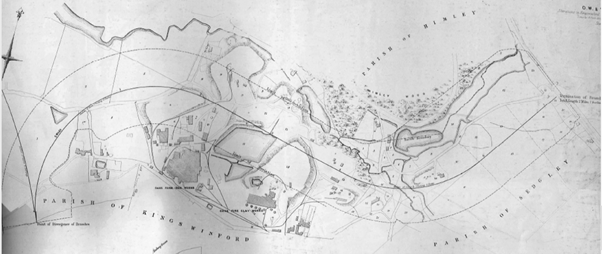
But perhaps the most significant is the detail of the layout of the Oak Farm Iron works, and its associated railways. This is shown in figure 2 below. In the 1840 Fowler Map, the Oak Farm area is essentially rural, and thus the works developed massively in the period between 1840 and 1854. The map shows what I believe is the earliest representation of the layout of the works and is of some historical significance. The existence of an internal works railway system is particularly interesting which may at the time have led to the terminal basin of the canal.

Figure 2. The Oak Farm Works in the 1854 document

The Pensnett Victoria Saxhorn Band

Preamble

In an earlier post on Football and Cricket in Victorian Pensnett, I discussed the activities of the Pensnett Victoria cricket team. I mentioned that there were a number of press reports for another Pensnett Victoria – the Pensnett Victoria Sax-horn Band, which seems to have been active in the late 1860s and early 1870s, or at least their activities were reported in that period. In this brief post, I will present the information that we can find about the band from press reports of the time. Whilst this information isn’t particularly extensive, some of it does give a vivid picture of the social life in Pensnett at that time. To illustrate this, after reviewing the band’s activities, I will present two verbatim reports of occasions when the band played, that show how at least some in the Black Country enjoyed themselves at the time.

Procession and carnivals

But first to the general activities of the band. We read about it being involved in the Temperance movement – leading Temperance societies to a large gathering of several thousand people at Aston Park in 1863, and playing at some public Temperance lectures in the New Connexion chapel schoolroom (St James’ Methodist) in 1865.  A regular venue seems to have been the grounds of Pensnett Vicarage where they played on the evenings when the grounds were open to the public and at the Annual Horticultural and Flower show in the late 1860s. The band played for other church events – the Sunday School “treat” in the Parsonage grounds in 1868, and the Sunday School Christmas Party in the Bell School Rooms in 1870.  They also played at celebrations after weddings, such as the one organised by the manager of Himley Fire Brick works when his son was married at the Stag’s Head in Wall Heath in 1868, and other fetes and carnivals – Dudley Fete in 1869; Wordsley Institute Flower Show and Glass Exhibition at Prestwood Hall in 1870; Cradley Heath in 1871 and Droitwich in 1872. On the last occasion the Pensnett Victoria cricket team was also in action, playing (and losing to) Droitwich C.C. Sometimes they were referred to as the Pensnett Brass Band, and sometimes as the Pensnett Brass and Reed Band. The Director of the Band is named occasionally as Mr. S. Smith. The only possible match I can find in the1871 census for Pensnett is for a Samuel Smith, born in 1820, who lived with his family at a house on the High Street. His profession is given as an (unreadable) Engineer. For the 1861 census he lived in Tipton and is described as an Iron Roller. So perhaps here we have a skilled industrial worker with a passion for music. It would be nice to know more about him.

Opening of the Pensnett Parsonage Grounds to the Public

As noted above, some of the press mentions of the band are of interest as much for what they show about the nature of Pensnett life as much as for what they tell us about the band itself, and I will present two here. The first of these is from the County Express of July 13th 1867.

It affords us much pleasure in stating that the energetic and deservedly popular incumbent of Pensnett, the Rev C J Atherton, has generously thrown open his beautiful grounds to the public, under certain restrictions. The parsonage grounds are open every alternate Tuesday evening, and the public of all denominations are admitted by ticket. The grounds were opened for a second time on Tuesday evening last, and, judging from the number of respectable people who attended, the parsonage grounds bid fair to become an “institution” in the locality. The Pensnett Victoria Sax-horn band has been “specially retained” to play on the nights the grounds are open, and several members of the excellent choir also kindly add to the entertainment of the visitors. The grounds occupy a most picturesque situation, and are laid out in a most beautiful manner, nature and art being most judiciously blended. The visitors have the option of listening to the dulcet strains of the band, indulging in innocent pastimes on the lawn, or, if they choose, they may ramble at will under the foliage of the park trees, or luxuriate in the many convenient rustic seats in the dell. We are sorry to learn that some thoughtless young people abused their privileges by dancing on the lawn, a mode of amusement which had been forbidden by the incumbent, while others behaved even worse, and wantonly destroyed many beautiful flowers by pulling them up at their roots. Such conduct of course ill repays the kindness of the incumbent and it is the duty of all who visit these delightful grounds to do all in their power to check such reprehensible practices. We perceive that the annual Cottage Flower Show and Horticultural Fete will be held in the Parsonage grounds on the 23rd inst. As the grounds are a great attraction in themselves, the show cannot fail to prove successful.

I have written on the career of Charles Atherton at length elsewhere – see the papers and presentation at the bottom of the Historical Studies page. At this point he would have been in his first few months as the Perpetual Curate of the parish. The report gives some details of the Parsonage grounds – which would have been very different from the rest of the area which by this time was becoming quite heavily industrialised. On the rather verbose prose used in the report, I make no further comment, other than to say that I for one am hardly surprised at the reprehensible actions of the Pensnett youth of the 1860s!

The choir trip to Rhyl

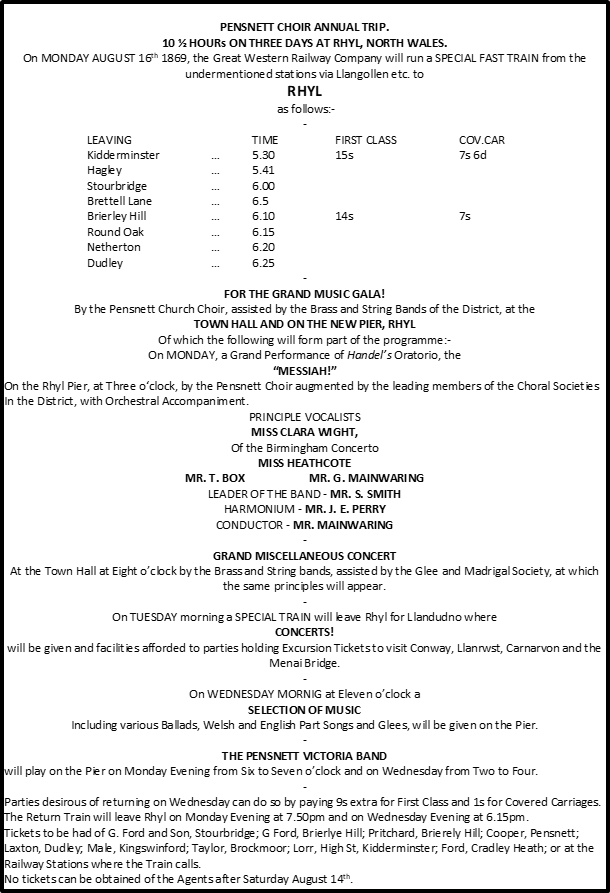
In the County Advertiser of 7th August 1869, the advert shown above was prominently placed. It gives details of an extensive choir / band trip to the seaside, with many concerts and performances packed into the three days. There were obviously sufficient numbers from the locality who wished to travel to make it worthwhile to hire a special charter train. Clearly the contacts, friends and family of the various performers were quite numerous. and widespread in the area. The route the train took is interesting to railway nerds (i.e. like me)- it would have travelled from Dudley to Wolverhampton, Shrewsbury and Gabowen, and then onto the long-vanished GWR line to Lllangollen and Corwen, before taking the (similarly vanished) LNWR line through Denbigh to Rhyl. There, the Pensnett Victoria band were well occupied indeed – it is to be hoped that the band members managed to have a little relaxation!

The Tiled House Estate

This post contains edited extracts from Kingswinford Manor and Parish, which gives full details of background sources etc.

The Tiled House Estate sat to the south of the Corbyn’s Hall estate, extending from Commonside in the east to the Standhills area in the west and Bromley Lane, the Bromley House estate and the hamlet of Bromley to the south. I speculate in KMAP that it may originally have been associated with the Corbyn’s Hall estate as part of the early enclosure of Pensnett Chase in the area. Against this is the evidence of the 1840 tithe map which gives a clear distinction between the Corbyn’s Hall estate, which was formally tithe free, and the rest of the land in the area on which tithes were levied. Whatever its origins, by the late 17th century, it was an established estate, based around the building that was known as the Tiled House – presumably because of its novel roofing material.

We first read of the Tiled House in 1688 when John Heydon made steel there using a novel process that involved the importation of Swedish Coal. Thus it seems to have been a place of industry from its earliest days. At some point in the 18th century it was occupied by Waldron Hill, father of John Hill who built the Wordsley Flint Glass House. During the latter part of the that century it was owned by the Mee family, and in 1760 Patience Mee, the widow of John Mee, leased it to Thomas Brettell. He was still in occupation in 1800. At this point the affairs of the estate become very complex, and one can do no better than quote the words of an exasperated cataloguer at Dudley Archives who writes the following in one of the most eloquent archivist entries that the author has had the pleasure to read.

A full description of the legal and equitable nightmare surrounding this estate between the 1790s and the 1840s is impossible. Many of the deeds are wanting. Suffice to say that a mother buys in the life interest of her bankrupt son and, in effect transfers it to his children, but leaves other actual and potential interests to be inherited by those grandchildren and her other children; the actual estates taken are the subject of litigation, particularly in respect of her eldest grandchild, Richard Mee like his father, who predeceases his father and leaves an infant daughter as his heir, whose husband eventually buys out most (all?) of the other interests and settles the outstanding charges on the estate. Other bankruptcies, insolvencies and imprisonments for debt just muddy the waters.

A court case of 1830 explains a little more. Patience Mee left the estate in the hands of trustees, with instructions to give her son Richard up to £50 a year from the proceeds (and no more!). The rest of the estate was to be used to provide for the education and upbringing of Richard’s three children, Richard, Sarah and John, during the life of Richard the elder. In 1830, Richard the elder was still alive, but John was the only one of the grandchildren still living, and although he was over 21, was arguing that because his father was still alive he was still entitled to support from the estate. He won his case.  Much detailed work is required to elucidate the complexities of the situation.

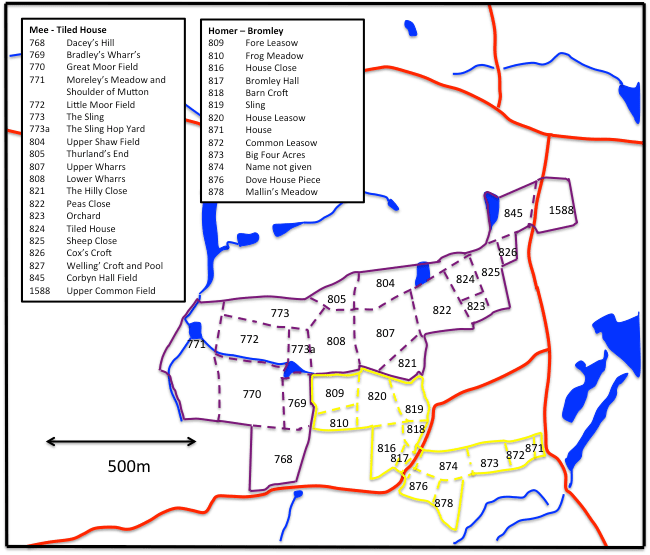
The Fowler maps of Kingswinford enable the boundaries of the estate to be drawn, and these are shown from the 1822 map in the figure below. There was little difference between the 1822 and 1840. Indeed, the plan produced for the unsuccessful sales of the estate in 1817 and 1825 show very similar boundaries. The particulars of the estate from the attempted sale of 1825 are included below, and illustrate the extent and nature of the property (and give an indication of how houses and lands were sold in the early 19th century.

The Tiled House Estate (purple) and Bromley Hall Estate (yellow) in 1822

In 1822 the entire estate was stilled owned by the impecunious Richard Mee, and Thomas Brettell was still in residence.  In 1833 and 1838, the elector’s lists indicate that it was occupied by John Dudley, who was a partner of the Iron Works on the Corbyn’s Hall estate. In 1840 the estate was in the hands of Trustees, Richard Mee having died some years previously. It is not clear who purchased the Tiled House Estate from the Trustees of Richard Mee, but certainly by the late 1830s William Matthews was in residence, and clearly came to own the estate at some point in the years that followed. Matthews died in 1871 and his estate passed to his son, Benjamin St John Matthews. However, William Matthews’ actual residence at the Tiled House was brief, and in the 1841 and 1851 census it is recorded as being occupied by Charles Woodcock, a Coalmaster. From sometime before 1861 till after 1891, the house was occupied by the family of William and Letticia Barlow. Barlow was a corn merchant and one of the founders of the New Connexion Chapel in Chapel St and remained an active member of that church and a Sunday School Superintendent for many years.

As with the neighbouring Corby’s Hall estate, the Tiled House estate gradually became more and more industrialised. Indeed, it would seem that both estates were operated as a unity, particularly during the ownership of William Matthews – see the earlier posts describing the Corbyn’s Hall estate, the mining activities in the area, and the development of the transport network.

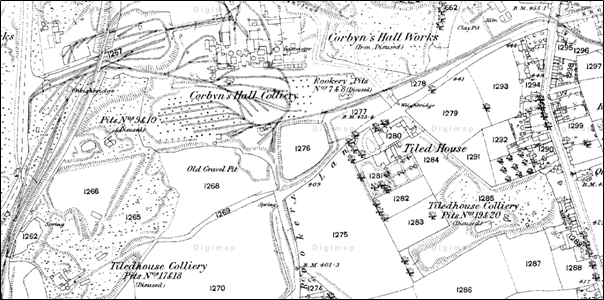
The Tiled House area on the 1882 Ordnance Survey Map

The later development of the area can be seen in the large-scale Ordnance Survey maps. In 1882, what was to become Tiled House Lane was in formation, with the lane from Commonside down to the Tiled House itself being joined by Rookery Lane, now the bottom end of Tiled Hose Lane coming from Bromley. A long railway siding ran parallel to the lane on the Corbyn’s Hall side. This line had quite a fearsome gradient of 1 in 25, and it seems to me likely it was used to deliver coal to the Corbyn’s Hall works, with the trucks being lowered from the top of the incline by gravity and the empties being pulled back up by horses. The present site of Mullet Park was Tiled House Colliery Pits Number 19 and 20 (disused) and between Rookery Lane and the GWR railway line, there were Pits 17 and 18 (disused). At the top of the lane at the junction with Commonside there was a Brick Works. This being said, a number of the fields shown in the figure above were still in use for arable purposes.

The Tiled House area on the 1930 Ordnance Survey map

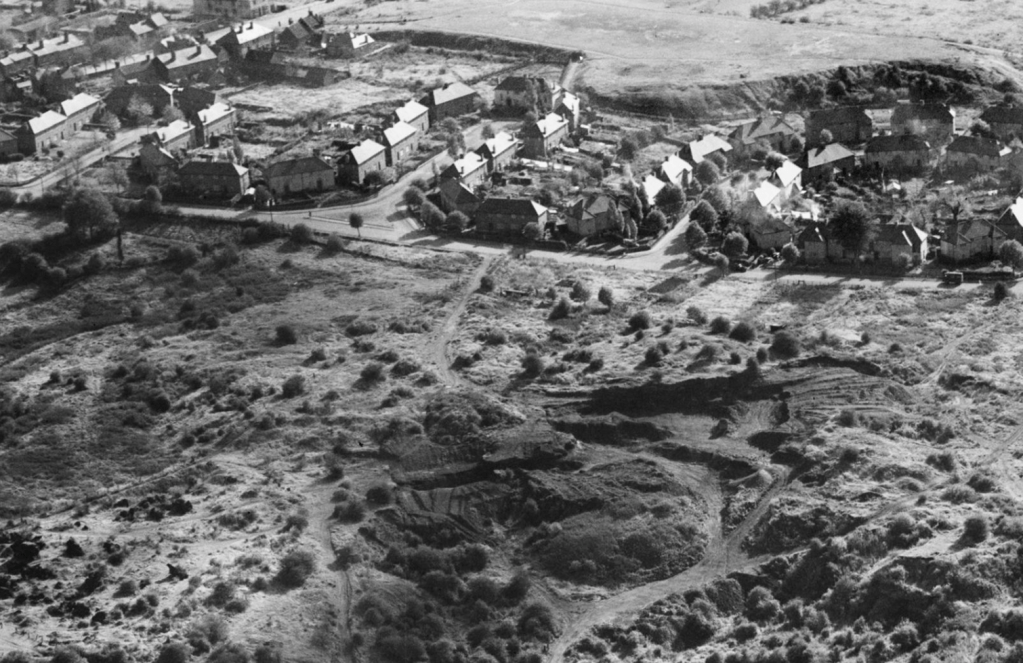
The situation had changed little by the time of the 1910 map, but by the time of the 1930 map shown above, the current Tiled House Estate had been built, together with the school near the Bromley end of the lane. Tiled House Colliery pits 19 and 20 had been replaced by Mullet Park, and large areas of dereliction can be seen to the north of Tiled House Lane in the Corbyn’s Hall area. This area is shown in the clip from a 1950s aerial photograph of Corbyn’s Hall shown below. This photograph is taken from over Corbyn’s Hall looking south over the upper end of Tiled House Lane, with Mullet Park in the background. The old industrial area north of Tiled House Lane is in the foreground. And here things become personal. I was brought up in Tiled House Lane in one of the houses shown in the picture, and Mullet Park and the broken ground to the north of the Lane were my childhood playgrounds. They bore little relationship to the agricultural estate of Richard Mee in the 1950s – and even less today!

Tiled House Lane in the 1950s

Transcript of Tiled House Estate Sale Particulars – 1825

TO be SOLD by AUCTION by BUNCH and JOHNSON at the Dudley’s Arms Inn, In Dudley, on Wednesday the 30th day of March, 1825, at 12o’clock at noon, in the following or such other lots as shall be agreed upon, and subject to such conditions as shall be produced at the time of sale:-

LOT 1. All that capital Messuage or Mansion House, with the malthouse, barns, stables, coach-house, granary, cowsheds and other outbuildings, fold-yard, plantations, garden and orchard thereto belonging, called the TILED HOUSE, situate in the said parish of Kingswinford and county of Stafford; together with the several closes or pieces of Land thereto adjoining, and occupied therewith, and containing the quantities following:-

 A.R.P.
House, Yards, Gardens, Orchard, Plantation and Rick-Yard5111
Upper Leasow, or Sheep Close4115
Lawn, Welling Croft and Pool813
Upper Shaw’s Field, including Road5331
Thurland’s End, including Road2339
Upper Wharrs831
The Hilly Close3039
Lower Wharrs6136
 45115

LOT 2. All those five closes of Land, adjoining together, and also adjoining the last lot, and fronting up to Bromley Lane, called by the names and containing the quantities following.

 A.R.P.
Dacey’s Hil808
Bradley’s Wharrs2223
Great Moor Field9338
Sling Hop-yard2139
Little Moor Field6225
Sling7012
 36324

LOT 3. A capital Meadow, adjoining the last lot, and communicating with the lane called the Greenlane, and called by the name of Moseley Meadow or Shoulder of Mutton Piece, and containing 12A. 1R. 25P.

LOT 4. A plot of Land, part of a close of land called Corbyn’s Hall Field, fronting the public highway leading from Shut End to Brockmore, containing in front 74 yards, and in the whole three roods and six perches.

LOT 5. Another plot of Land, also part of Corbyn’s Hall Field aforesaid, adjoining the last lot and fronting to the said public highway, containing in front 60 yards, and in the whole 3 roods and 18 perches.

LOT 6. Another plot of Land, also part of Corbyn’s Hall Field aforesaid, adjoining the last lot, and fronting the said public highway and also a private road leading to the Tiled House, containing in front next the said highway 38 yards, and next the said private road 80 yards, and in the whole 3 roods and 6 perches.

LOT 7. Another plot of Land, adjoin to the three last lots at the back part thereof, and also adjoining to the said private road, being other part of Corbyn’s Hall Field, containing in front, next the said private road 92 yards, and in the whole 2A. 2R. 8P. or thereabouts.

LOT 8. Another plot of LAND, part of a close called Tiled House Green, or Cox’s Croft, fronting the said private road, and containing in front 37 yards, and in the whole 2R. 23P.

LOT 9. Another plot of Land, other part of the said close called the Tiled House Green, or Cox’s Croft, also fronting the said private road, and containing also in front 37 yards, and in the whole 2R. 23P.

LOT 10. Another plot of Land, part of a close called the Upper Common Field, adjoining the last lot, and also fronting the said public highway, containing in front 67 yards, and in the whole 1A. 1R. 37P.

LOT 11. Another plot of Land, also taken out of the said Upper Common Field, adjoining the last lot, and also fronting the said public highway leading from Shut En to Brockmore, containing in front 67 yards, and in the whole 1A. 3R. 5P.

LOT 12. Another plot of Land, also taken out of the said Upper Common Field, adjoining the last lot, and fronting to the said public highway, containing in front 67 yards, and in the whole 1A. 2R. 21P.

LOT 13. Another plot of Land, adjoining the last lot, taken out of a close of land called Lower Common Field, and also fronting up to the said public highway, and also to an intended road 10 yards wide, and containing in front next to the said highway 69 yards, and next to the said intended road 94 yards, and in the whole 1A. 0R. 13P.

LOT 14. Another plot of Land, adjoining the last lot, also taken out of the said close called Lower Common Field, and fronting the said intended road, containing in front 94 yards, and in the whole 1A. 0R. 13P.

LOT 15. Another plot of Land, opposite to the last lot, also taken out of the said close called Lower Common Field, and fronting the said intended road, containing in front 72 yards and a half, and in the whole 1A. 1R. 33P.

LOT 16. Another plot of Land, adjoining the last lot, also taken out of the said close called Lower Common Field, containing in front 72 yards and a half, and in the whole 1A. 1R. 33P.

LOT 17. Two Dwelling Houses, with brewhouse, shops and gardens, fronting the said highway, and also the said private road leading to Tiled House,containing 1R. 20P. including the site of the buildings.

All the above lots are in the occupation of Thomas Brettell, Esq. of his under tenants.

The Mansion House is very roomy and commodious, and substantially built, and the out-offices and farming buildings are very extensive and convenient, and all the buildings are in good repair.

The whole of the Estate is freehold of inheritance, is in the parish of Kingswinford, and is distant about two miles from Dudley and four from Stourbridge.

Lots 4, 5, 6, 7, 8, 9 10,11, 12, 13, 14, 15, and 16 are staked out, and the whole may be viewed by application to Thomas Brettell, Esq. upon the premises.

Further particulars may be known by applying to Mr. Badham, Solicitor, Bromyard: to the Auctioneers, or at the office of Messrs, Bourne and Sons in Dudley, where maps of the Estate as marked out in lots may be seen.

The Corbyn’s Hall Estate

This post contains edited extracts from Kingswinford Manor and Parish, which gives full details of background sources etc.

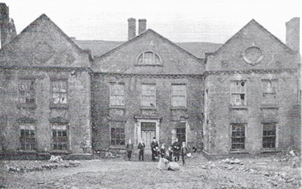
Corbyn’s Hall in the late 19th century

The Estate up to 1780

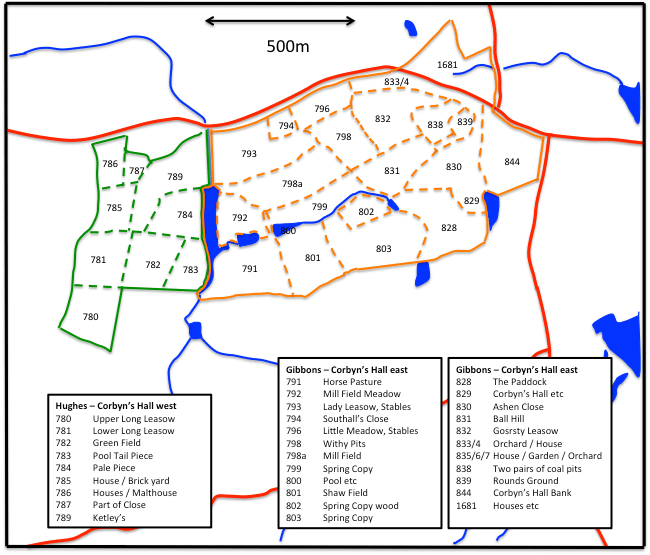
I have described the Corbyn family in an earlier post here. They occupied a large parcel of land in the centre of the manor of Kingswinford, that may have originally been allocated by John de Sutton II, 1st Baron Sutton of Dudley, to William Corbyn on his marriage to the former’s daughter Felicia de Sutton around 1350. On this land they constructed the large house that became known as Corbyn’s Hall. The extent of these lands doesn’t become clear however until the Corbyn family sold the estate to John Hodgetts in 1680. Two early maps exist – from 1703 and 1754 which show estate boundaries very similar to those of the Fowler Map of 1822, shown in the figure below. The map shows the Kingswinford to Dudley Road running from east to west, with the junctions with Tansey Green and Commonside to the east of the area, The estate occupied a large parcel of land that extended south of the Kingswinford – Dudley Road to what was to become Tiled House Lane, and from Commonside in the east to the Standhills area in the west. It sloped quite steeply from the east down to the valley of the Dawley Brook. The brook and its feeders seem to have been landscaped into a series of pools. The land then rose again towards Standhills. The maps also give the field names from 1822. Small changes occurred in these names from the earlier maps also, with corruptions / changes creeping in as the names were passed from generation to generation – for example Mansell’s Meadow in 1704 and 1754 (then in the Corbyn’s Hall Estate) has become two fields in the Tiled House Estate in 1822 – Moreley’s Meadow and Shoulder of Mutton, the latter name being descriptive of the shape of the field. The different colours of the field indicate the two different owners of the estate in 1822 – William Hughes to the west of Dawley Brook and the Gibbons brothers to the east.

The Corbyn’s Hall estate from the 1822 Fowler Map

The Gibbons era – 1780 to 1840

The Gibbons family were originally from the Sedgley area, and developed a significant banking and industrial concern in Bristol, Kingswinford and Wolverhampton by the late 18th century, headed by the three brothers – Thomas (1730-1813), William (1732-1807) and Benjamin (1735-1832). In 1779, the family purchased the Corbyns Hall estate, which included Shut End House.  In 1814 Benjamin made over the Level furnaces and other industrial plant to his nephews – John (1777-1851), Benjamin (1783-1873) and Thomas (1787-1829) in return for an annuity and ownership of the Corbyn’s Hall Estate. The three younger Gibbons brothers were declared bankrupt as bankers in 1816, in the slump following the Napoleonic Wars, pulling the iron business down with them. Fortunately, the elder Benjamin, as a preferential creditor, was able to take control of some of the iron and coal interests and save the family firm from total ruin. The younger Gibbons brothers continued to develop the Corbyn’s Hall Collieries and Blast Furnaces, which were built by them about 1824. The Gibbons brothers were major innovators in terms of iron production, and the hydraulic lift at Corbyn’s Hall furnaces could raise around 500 tonnes of raw material a day to the top of the furnaces. The Book of Reference for the 1822 Fowler map lists Benjamin as proprietor, but many of the fields were rented to others. There is a reference to two pairs of coal pits, machine office, engine, tool house etc., in a field to the south of Shut End House. Corbyn’s Hall was occupied by Michael Grazebrook, who also leased a number of the surrounding fields.  Benjamin senior (1735-1832) occupied a house on Commonside, whilst the younger Benjamin (1783-1873) occupied Shut End House.

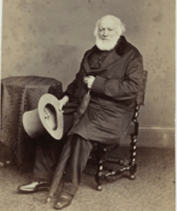
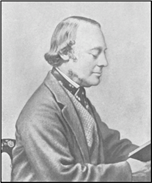
The elder Benjamin died in 1832. In the 1830s the Electoral Registers indicate that the younger Benjamin and brother John were living at Corbyn’s Hall. In 1833 Shut End House was occupied by Henry Bradley, the business partner of James Foster of Shut End.  In 1838 much of the estate was leased to William Mathews and John Dudley, ironmasters, for a period of 63 years to 1901. Benjamin however continued to live in Corbyn’s Hall and is recorded as being there in the Book of Reference for the 1840 Fowlers Map and the 1841 census. The 1840 Fowler map shows considerable changes to the estate, with the Stourbridge Extension Canal dividing it in two, with a branch from the canal serving the Corbyn’s Hall furnaces. That Book of Reference indicates that by then, whist the estate was still owned by the Gibbons, it was almost fully leased to Matthews, Dudley and Co. The Corbyn’s Hall furnaces are listed, as are three coal plus three (iron) stone pits etc., and the mines to the south of Shut End House are also referred to.  A William Gibbons, Benjamin and John’s cousin, is recorded as living at Shut End House. A portrait of Benjamin from the 1860s is shown below.

Benjamin Gibbons (1783-1873) in the 1860s (National Portrait Gallery)

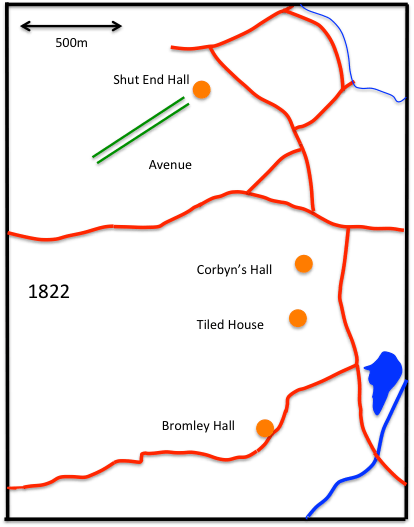
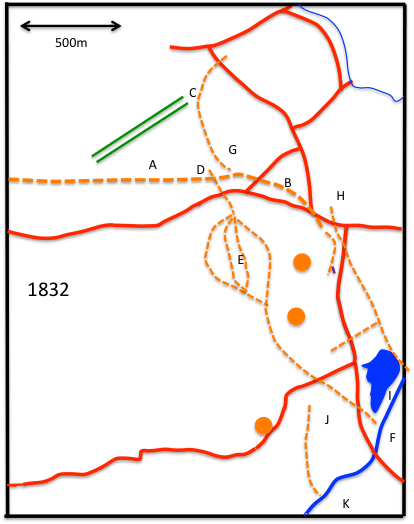
During the Gibbons time at Corbyn’s Hall, there were major developments in the transport infrastructure in the area.  The figure below shows three large scale scale maps of the region, that show the transport links on the 1822 Fowler map, the 1832 Ordnance survey map (the original of which was at 1 inch to the mile) and the 1840 Fowler map. In 1822 this area was ill-served by transport links, and industry was clustered around the Stourbridge Canal main line and its Fens Branch and thus to improve the accessibility of this area, Lord Dudley and James Foster of Foster Rastrick and Co. opened the Kingswinford Railway in 1829. This ran from a new basin at Ashwood on the Staffordshire and Worcestershire canal, up a 1:28 incline to a level section from the top of the incline to just north of Kingswinford village. From there it ran up another inclined plane with a gradient of 1:29, known as Foster’s incline (A) to a final level stretch in the Corbyn’s Hall area (B). The railway carried coal traffic from a number of mines along its route, and pig iron and iron products from the works of John Bradley and Co. (owned by James Foster) at Shut End (C). It also probably carried limestone from outside the area to the works. It is perhaps best known for its main means of motive power – the locomotive Agenoria, which was built by Foster Rastrick.  A fuller discussion of coal mining activity in the area is given in another post here.

There can also be seen to be an extensive series of tramways in the area, almost certainly worked by horse-power, man-power and, where possible, gravity. The major tramway ran from north of the Kingswinford Railway (D), which it seems to have predated as the latter crossed it via a bridge, through Corbyn’s Hall Iron Works (E), where there were a number of loops and branches, and then on through Bromley to a wharf on the Fens Branch of the Stourbridge Canal (F). This tramway was owned by the Gibbons and was used to take coal and iron from their mines and works on the Corbyn’s Hall estates. This involved some sizeable cuttings to keep its gradient constant and a tunnel beneath what is now Bromley High Street. The second tramway ran from the top of Foster’s incline (G) into the Shut End works (C) (see below), whilst a third ran from Lord Dudley’s mines in Shut End (H) to another wharf on the Fens branch (I). Finally, there was a shorter tramway from south of Bromley (J) to a third wharf on the Fens branch, some way to the west of the others (K).

By 1840 the Stourbridge Extension Canal had been built in close association with the Stourbridge Canal Company – indeed half of the members of the Extension Canal Committee were also on the corresponding committee of the Stourbridge Canal. The major shareholder were Sir Stephen Glynne, resident in north Wales and the owner of Oak Farm Iron and Brick works, James Foster, owner of the Shut End works and Francis Rufford, a clay merchant. The canal ran from a junction on the Fens branch to Oak Farm, just off the top of the map of Figure 3.2c where it served the Oak Farm works and the Shut End works.  There was a short branch into Corbyn’s Hall (L) that removed the need for the tramway system. Indeed, the main tramway, from Corbyn’s Hall to Bromley, was purchased by the Extension Canal Company under the terms of the Extension Canal Act. As far as can be ascertained from the 1840 map, this tramway was by then in a fragmentary state (M), although the long stretch through Bromley to the Fens branch still existed. The other tramways outlined above were also still in existence, with some extra branches and quite possibly some route changes. It can thus be seen that, even within the two decades between the Fowler maps a complex tramway system was developed and discarded in the Corbyn’s Hall estate. Without the use of the interim 1832 OS map, this would not have been picked out.  Another Extension canal branch left the main line and ran to the Standhills House area (N). In the 1840 Reference this is referred to as the new branch and there is no evidence for industry in this region in 1840. It seems likely that this branch was built as a precursor to the opening of mines in the area.

Development of Canals, Railways and Tramways in the Shut End and Bromley areas

William Matthews

As noted above, from 1838 much of the land and the industrial concerns at Corbyn’s Hall had been leased to William Mathews and John Dudley, ironmasters, for a period of 63 years to 1901. William Matthews was born in Hagley in 1796 and in his obituary from 1871 we read the following.

He acquired a minute knowledge of all the practical details and the successive improvements in the manufacture of pig, iron from the South Staffordshire ores, as well as a very extensive acquaintance with everything relating to the iron and coal trades of that district; and was constantly consulted upon all matters affecting these interests. He took an active part in the promotion of various railways in the district, especially the Oxford Worcester and Wolverhampton Railway, of which as well as of the South Wales Railway he was a director..

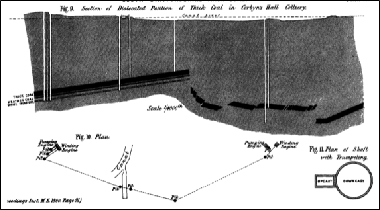
In 1860 he read a paper to the Institution of Mechanical Engineers on the South Staffordshire Coalfield, with particular reference to Corbyn’s Hall. It is clear from that paper, that he was much more than a simple entrepreneur, but rather he possessed deep knowledge of the nature of the coalfield and the working methods – and was able to write about them fluently and lucidly. A copy of one of the figures from that paper, showing the fractured nature of the seams below Corbyn’s Hall, is given below, and gives some indication of the difficulties that would have been involved in extracting the coal.

Section through Corbyn’s Hall showing coal seams from Matthews(1860)

In 1842, Matthews and Dudley seem to have bought at least part of the Estate themselves for a sum of £9995. The Matthews / Dudley partnership was dissolved by mutual agreement in 1846, and the estate passed fully into the hands of William Matthews. John Dudley (1807-1861) was a member of the Tipton Dudley family. He was a grandson of Thomas Dudley who was the last resident of Shut End Hall. It seems that he emigrated to New Zealand and the breakup of the partnership with Matthews night have been to facilitate this move.

From then on, for the next 50 years, the lease of the Corbyn’s Hall estate was held by a number of industrialists. These are given in outline in the  Table below – taken from Graces Guide for Corbyn’s Hall. The plan with the lease of 1847 is interesting in that it shows the land that has been spoiled by industrial activities – and indicates that any holder of the lease would be required to make it good. These intentions never seem to have been acted on.  The regularity with which the lease changed hands would suggest an inherent lack of profitability. 

The most notable event to occur during that period was the major boiler explosion in 1862. The Chelmsford Chronicle gives the following account.

A fearful boiler explosion occurred at about six o’clock on the 27th ult. at the Corbyn’s Hall Malleable Iron Works (Messrs. Blackwell and Sparrow), situated about two miles from Dudley, which resulted in the death of four men and serious injuries to about ten others. The exploded boiler was about 30 horsepower and was heated by the flues of the puddling furnaces. At six o’clock number of men were at work in the puddling furnaces, when a fearful explosion took place. The roof of the furnaces was immediately broken through by a mass of falling debris, and the whole place presented a scene of wreck. The bodies of four men were speedily found in the debris, all of them being employed at the works. Ten or twelve others were found to be seriously injured, some of them so seriously that no hopes are entertained of their recovery. The cause of the explosion at present remains a mystery.

The inquest revealed that the boiler had run out of water before the explosion. Those who died were Thomas and George Hudley, Daniel Mason and Ezekiel Newnman (puddlers), Joseph Harper (a fireman) and Morris Christopher, a labourer. The person in charge, Mark Simpson, was absent from the building when the accident occurred, which seems to have not been an unusual occurrence.  He was duly charged by the coroner with manslaughter and tried at Stafford Assizes, but the charges could not be proved, and the judge ordered the jury to acquit him.

1847Lease by William Mathews of Edgbaston esquire to William Malins of Mansion House Place, London and George and Charles Rawlinson of Newton Nottage, Glamorgan, iron and coalmasters, of the Corbyn’s Hall estate, 4 blast furnaces with foundaries, casting houses and related buildings (with specified reservations), and thick coal/ten yard coal, heathen coal and brooch coal, and ironstone, etc., etc. plus other adjacent lands and minerals (specified), for a term of 56 years
1849Corbyn’s Hall and Tiled House estates offered for lease (to 1901 and 1863)
1853Lease to Samuel Holden Blackwell of Dudley of a mill, forge and premises
1853Lease by the Trustees of the will of William Hughes of Kingswinford, gentleman, to William Mathews of Edgbaston and George Hickman Bond of Tiled House, parish of Kingswinford, coalmasters and co-partners, of coal and ironstone under the Ketley Estate for a term of 14 years
1862Lease of mill and forge to Henry Sparrow of Woodfield House, Wordsley for 6 years
1867Lease to Paul Robinson of Sedgley, Staffs., coalmaster, Gabriel Jones of Kingswinford, coalmaster, George Glaze of Brockmoor, parish of Kingswinford, ironfounder & Daniel Parsons of Pensnett, same parish, engineer, of mines under Tiled House Estate
1868Agreement with Samuel Hingley of Cradley, Staffs., ironmaster for an annual tenancy of the Corbyn’s Hall Estate, with plan and detailed schedule of buildings, fixtures and machinery
1869Agreement with Hingley for renting number 1 Blast Furnace
1870Lease to Hingley of ironworks at Corbyn’s Hall for 7 years
1872Lease to Benjamin Williams, Benjamin Williams the younger and George Williams, all of Kingswinford, iron manufacturers, of the ironworks at Corbyn’s Hall, for 7 years
1903Sale to Caleb William Roberts of Stourbridge, Worcs., colliery proprietor, of the Tiled House and Common Side Estates, parish of Kingswinford and mines under 97a of land there

Leases of Corbyn’s Hall and associated estates

The Corbyn’s Hall Iron Works.

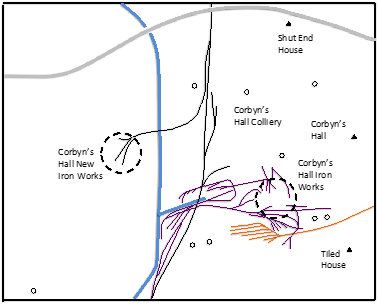
GWR and Pensnett Railways are indicated by black and brown lines respectively, and the Corbyn’s Hall railway by purple lines. Old mine shafts are shown as open circles, and the major residential properties as filled triangles.

By the time of the next major mapping of the area for the 1882 Ordnace Survey map, Corbyn’s Hall had an internal railway network for the transportation of coal and iron products to and from the canals and other railways that surrounded it. The situation in 1882 is shown in the figure below. It can be seen that there are two iron works. The original one was to the east of the Canal, near to Corbyn’s Hall itself, and is marked on the 1882 map as disused, but was clearly still in situ.  The new works was to the west of the canal, so we probably here have a picture of the transitional situation. The map also shows the major residential properties of Corbyn’s Hall itself, by this time becoming increasingly derelict; the Tiled House and Shut End House. Many disused collieries can also be seen, from where the original raw material was obtained in the 1820s and 1830s. The Corbyn’s Hall railway itself is a complex set of interlinked lines serving the immediate needs of the old works and providing connections to the Corbyn’s Hall branch of the Stourbridge Extension canal and the GWR Kingswinford Branch. The Tiled House branch of the Pensnett Railway (in brown) can be seen in the bottom right of the figure, ending in a set of sidings. The gradient of this branch is severe, at about 1 in 25, and there is no indication of an engine house anywhere that could provide motive power for hauling full trucks up the branch. It thus seems sensible to regard this branch as being to supply the needs of the Iron Works for coal and ironstone, rather than taking away finished products, with trucks descending the branch by gravity (but with brakes!) and empty trucks being hauled up the branch by horses. It can also be seen that the Corbyn’s Hall railway provides a somewhat convoluted connection between the Pensnett Railway and the GWR in this region.

After the estate was leased by Matthews and Dudley, both the 1840 Fowler Directory and 1841 census indicates that Benjamin Gibbons continued to live at Corbyn’s Hall and his cousin William and his family in Shut End House .  By 1851, the situation had reversed with Benjamin living at Shut End House with a solitary housekeeper, and William’s widow and family living in Corbyn’s Hall itself. By 1861, Shut End House only has a housekeeper present and Benjamin is living near Stourport. He was later to move to the Leasows in Birmingham and then to Halesowen where he died in 1873. 

After the Gibbons moved out, Corbyn’s Hall then found a variety of uses. In 1861 it was occupied by M. H de Summercourt (originally from Paris) and his family, the Manager of the Ironworks. By that time a considerable community, presumably of estate workers had come into existence around Corbyn’s Hall, and the new Corbyn’s Hall St and Corbyn’s Hall Lane are recorded in the census. In 1871 the occupation is not clear, as the hall was not specifically identified in the census returns. In 1881 there was again record of a community of sorts around the Hall with a set of houses called Corbyn’s Hall cottages, and the offices of the old Corbyn’s Hall Ironworks (to the east of the canal) were also used as a family residence. Corbyn’s Hall itself was occupied by the families of John Wilkinson, a timber merchant, and David Greenway, a coalminer. In 1891, it seems to have been subdivided still further. Corbyn’s Hall cottages still existed, but there was also a Corbyn’s Hall Villa and an Old Corbyn’s Hall.  John Wilkinson and his extended family and servants lived in Old Corbyn’s Hall, whilst at Corbyn’s Hall villa we find Thomas Brown and his family, an Inland Revenue Officer. There thus seems to have been an effort to make as much accommodation as possible, with the old house now providing for the local professional class. Around this time the house became increasingly derelict (see the picture at the top of the post) and was eventually demolished in the early twentieth century.

In the twentieth century, the Corbyn’s Hall area retained some industrial activity (as indeed it does to this day) but became largely residential in nature. A discussion of some aerial photographs of the area taken in the 1950s, is given in another post.

Kingswinford Landowners and Industrialists in the 19th Century – some surprising names

Preamble

As outlined in Kingswinford Manor and Parish, the Fowler Maps of 1822 and 1840 gave a great deal of information concerning the landowners and occupiers of the parish at those times. In the main most of the landowners were quite local, with the major ones being the Earl of Dudley’s Estate and John Hodgetts-Foley. However, a few surprising names of landowners and industrialists crop up – those who have some sort of national profile outside the immediate area of the Black Country. In this short post, I briefly consider three of these – Jonathan Stokes, Horace St Paul and Stephen Glynn and his fellow owner of Oak Farm Iron Works.

Jonathan Stokes

Jonathan Stokes (1755-1831) was an Edinburgh trained doctor, and, from 1782 to 1788 was a member of the Lunar Society, one of the intellectual driving forces of the period whose members included Matthew Boulton and Erasmus Darwin. He is remembered for his work, in collaboration with others, on the uses of digitalis. His parents were Rebecca and Jonathan Stokes, “Gentleman of Worcester”. Many of the sources say he was born in Chesterfield, although this has recently been shown to be untrue and his birth in Worcester has been established. He had a practice in Stourbridge for a number of years from 1782 to 1785. His membership of the Lunar Society ended following fierce arguments with his colleague William Withering over authorship of a book. He married Ann Rogers, a “minor poet” at Dronfield in 1784. The marriage was four months after the birth of Jonathan and Ann’s first child John Rogers Stokes (1784 – 1818), and Jonathan does not appear on the baptismal record. Their second son John Allen Stokes was born in Shrewsbury in 1786, being baptized in a Presbyterian Meeting House. They had other children. Of particular note are Anna Honora Seward Stokes (1791-1792) and Honora Anna Seward Stokes (b1794) both named after the poet Anna Seward, ‘the Swan of Lichfield” with whom they were close friends. 

In 1788, Rebecca Stokes, at that point a widow, was involved in the sale of a plot of land on which the Red House Glassworks in Wordsley was built. She clearly owned other properties in the area, and in 1822 Jonathan, as her heir, held a number of scattered plots across the parish, mainly concentrated in the area enclosed by the Ashwood Hay Enclosure Act of 1776 and the Wordsley and Brettell Lane areas. These amounted to around 200 acres in total of mainly arable land, with a few domestic properties. In 1840, these were in the hands of his son John Allen Stokes. How the Stokes came into the ownership of such extensive lands in Kingswinford is not clear. One possible route comes from a recorded marriage in 1781 between Nancy Freeman, one of the illegitimate children of John Keeling, the agent and steward of the Dudley estate who owned significant property in the area, and one William Stokes. Links with either Jonathan however cannot be demonstrated, so this must be conjectural. Keeling did however provide generously for his illegitimate offspring, and this might be another example of his provision.

Horace St Paul

Sir Horace St Paul (1775-1840) was a career soldier who became MP for Bridport from 1812-1832 and was created a Baronet in 1813. His father was

“a Northumbrian gentleman driven into exile after killing a man in a duel and was a soldier of fortune in the Seven Years’ War, who returned to England with an Austrian title and a royal pardon, subsequently distinguishing himself in diplomacy, before retiring to his ancestral home.”

The St Paul crest

The Austrian title was as a Count of the Holy Roman Empire, which his son inherited, the most impressive of all the titles of Kingswinford landowners. In 1822 he owned around 30 acres of arable land in the Kingsley Road / Mount Pleasant area of Kingswinford, to the east of Ridgehill Wood, and almost certainly came into his possession through his marriage in 1803 to Anna Maria, the natural daughter of John, 2nd Viscount Dudley whose forebears were granted the lands at the Ashwood Enclosure in 1776. Unfortunately however, the current residents of Kingsley Road and Mount Pleasant share the defining characteristics of their former owner’s title – they are neither Holy, nor Roman, nor in any sense, Imperial.

Stephen Glynne and the Oak Farm Iron works

The Glynne Baronetcy dates back to 1661, with its main estate at Hawarden in Flintshire. The 8th Baronet, Sir Stephen Glynne (1780 to 1815)  married Mary Griffin, daughter of Lord Braybrooke. After his early death, he was succeeded by his son Sir Stephen Richard Glynne, the 9th Baronet (1807-1874). He was a Conservative Party politician and is principally remembered as aa noted antiquary and student of British church architecture and writer of a treatise entitled “Notes on the Older Churches in the Four Welsh Dioceses”.

The Glynne family were also the owners of around 100 acres of land around Oak Farm in the north of Kingswinford parish. In 1822, these are in the possession of “Lady Glynne”, presumably the widowed Mary, as the younger Stephen was still a child. At this time these lands were wholly agricultural. In 1840, the same area was owned by the Oak Farm Colliery Company .The Tithe Allocation records the owners as Thomas Bagnall, James Boydell, Baronet Sir Stephen Glynn, John Hignett, William Hignett and Charles Townshend. By this time the lands were a mixture of arable, collieries, brickworks and the major industrial concern of the Oak Farm Iron Works. The latter was founded in 1835 by  Sir Stephen Glynne, Lord Lyttleton, W. E. Gladstone and James Boydell. Gladstone, the future Chancellor and Prime Minister, and Lyttelton had both married sisters of Stephen Glynne.

The Oak Farm works suffered major financial issues, and the company failed in 1848. These events that led to this are set out at some length in the Grace’s Guide entry for Oak Farm. There are conflicting views as to the causes of the financial difficulties – with James Boydell as Managing Partner described as either as being massively over optimistic and extravagent, or as being unsupported by the other owners during difficult time. One source writes

“…the brothers-in-law (Glynne, Lyttleton and Gladstone) appear to have suffered enormous financial losses, but the experience gained by W E Gladstone in dealing with the company’s debt was said to have stood him in good stead when he became Chancellor of the Exchequer…”

Thus the affairs of Kingswinford parish seem to have had a long lasting effect on the country as a whole! There is of course also a legacy of the Glynne family in Kingswinford itself with the name preserved in the Glynne Arms – the Crooked House.

Finally it is worth just saying a little more about James Boydell. He came from Denbigh in north Wales and was a prolific inventor and patent holder. He is best remembered for his “endless railway” system, From Grace’s Guide again.

“….. the ‘endless railway’ system, applicable to traction engines and trailers. A number of flat feet were attached to the outside of a traction engine’s wheels. They were hinged in such a way that as the wheel revolved each succeeding foot would lie flat in contact with the ground, thus spreading the weight of the engine, and allowing the wheels to roll on the plates. The idea was that this arrangement would be more efficient for road-haulage engines, enabling them to deal with poor road surfaces…..”

File:Im1896EnV82-p138.jpg
The Endless Railway System

He seems to have invented the tank!

Kingswinford families – the Corbyns, the Bendys and the Hodgetts. Part 3 – The Hodgetts of Shut End and Prestwood

Part 1 of this blog can be found here, and part 2 here.

If success can be measured in terms of social enhancement, the Hodgetts family is perhaps the most successful family in Kingswinford history. The early Hodgetts shown in the tree below all came from the Kingswinford / Shut End area and John Hodgetts (1550-1630) and John Hodgetts (1595-1634) are both described as yeomen farmers in their wills – see Kim Simmonds Family Genealogy, 2019, which also gives sources for these genealogies. Where their land was in relation to that of the Corbyns at Corbyn’s Hall and the Bendys at Shut End is not clear, but by the 18th and 19th centuries the Hodgetts held large tracts of land in Kingswinford and elsewhere, had married into one of the new aristocratic industrialist families, served as MPs for various places in the locality and lived in Prestwood House – the largest of the gentry houses in the Kingswinford area.

The Hodgetts Tree. Shaded boxes show links with other trees in KMAP

In the 15th and 16th centuries however the Hodgetts’ horizons were more limited. In the 1490s, Edward Sutton (1460-1531), 2nd Baron Dudley, leased land in the Russell’s Hall area to “Thomas Hodgetts of Swinford”, almost certainly the Thomas Hodgetts (1465-1532) at the top of the Hodgetts tree. Similarly, in 1526, Edward leased the “erbage, justment and pannage, etc. of the New Park at Pensnett Chase”, to Thomas’ son John Hodgetts (1495-). It is also possible Henry and William Hodgetts of Sedgley, who between 1610 and 1650 were custodians of the bones of St Chad after they had been removed from Lichfield Cathedral by Arthur Dudley, Edward’s nephew, in 1538, were also related to the Kingswinford Hodgetts.

The recurring generations of John Hodgetts tended to marry the daughters of local gentry – for example Margaret Paston (-1675), the daughter of the Rector Nicholas Paston; or to Hannah Bague (1652-1712), the daughter of George Bague and granddaughter of Gload de Bague, the glassmaker family from Lorraine, and major industrialists in the Wordsley / Brettell Lane area.  John Hodgetts (1650-1716) was Agent of the Dudley Estate in the early years of the 18th century. His daughter, Patience Hodgetts (1685-1772), married Richard Keeling(e) (1677-), who was also the Agent of the Dudley Estate.  Richard and Patience’s niece Ann Hodgetts (1709-1766), daughter of Thomas Hodgetts (1678-1740), Rector of Kingswinford and vicar of Press in north Shropshire, married their son John (1713-1783) who was, once again, the Dudley Estate Agent.

It was John Hodgetts (1650-1716) who purchased the Corbyn’s Hall estate on the death of the last male Corbyn in around 1688 and took up residence there until he sold it on early in the next century. His grandson, John Hodgetts (1698-1742) married Mary Bendy, the co-heiress of William Bendy and through her he inherited at least a significant proportion of the Bendys Shut End estate. This John became High Sherriff of Staffordshire in 1737 and was himself the Agent of the Dudley Estate.

Their son, John Hodgetts (1721-1789) took the major step in the families climb up the social ladder by marrying Elizabeth Foley (1707-1759). The Foleys were descended from Richard Foley, a Stourbridge nailer from the 16th century, who had become extremely wealthy as a result of a successful marketing of his products and were heavily involved in iron production around the Midlands. Richard’s grandson, Thomas (1617-1677) built Witley Court in the Malverns and was High Sherriff of Worcestershire in 1656. He was the first of the family with political ambitions and served as an MP for Worcestershire and Bewdley. Elizabeth was Thomas’s great-granddaughter through his son Philip (1648-1716), with this branch of the family being based at Prestwood at the western edge of Kingswinford parish. John Hodgetts (1721-1789) was, like his father, High Sherriff of Staffordshire in 1765, and seems to have taken up residence at Prestwood on his marriage. Shut End House at this time (approx. 1760 to 1780) seems to have been the residence of Commander John Becher, RN, but the actual ownership is not clear.

In 1790, the daughter of John and Elizabeth, Eliza Maria Foley Hodgetts (1759-), married a cousin from another branch of the Foley family, Edward Foley (1747-1803). This was Edward’s second marriage, with the first having been annulled (presumably by Act of Parliament) but no reason for this can be found. He was the proprietor of the Stoke Edith estate in Herefordshire, and the marriage settlement specified that Eliza and Edward’s oldest child, Edward Thomas Foley (1791-1847) should inherit Stoke Edith, and their second son, John Hodgetts Hodgetts Foley (1797-1861), should inherit the Prestwood estate. It was this John who, through his major land ownership in the Kingswinford area, was to play such a major role in its industrialization. He was the Whig MP for Droitwich from 1822 to 1834 and for East Worcestershire from 1847 to 1861. His rather odd name was the result of formalizing Hodgetts as part of the surname by royal license in 1821. He was married to Charlotte Margaret Gage, granddaughter of General Thomas Gage, who commanded the British armies in the early stages of the US War of Independence. By the time of the Fowler Maps of 1822 and 1840, he held the largest block of land in the manor after that of the Earl of Dudley – 381 ha in 1822 and 266 ha in 1840. His properties in 1822 were built around the old Hodgetts estates in Shut End, the former lands of the Bendy family in Shut End and Holbeach, and the Foley inheritance at Prestwood. He had also gained significant land from the Enclosure Acts in the Ashwood enclosure, largely extending his Prestwood holdings, and also some land in the Pensnett area following the enclosure of the Chase. Foley himself lived at Prestwood, while Shut End Hall was leased to Thomas Dudley (1749-1829), part of the Dudley family with extensive inter-generational marriage links with the Hodgetts, Keelings and others. The land around Prestwood was leased out as two farms – North Farm of 96 ha farmed by Robert Roper, and South Farm 0f 73.5 ha farmed by John Beddard.  By 1840 Foley’s total ownership in the parish had decreased somewhat, through the sale of the Shut End Estate to James Foster. Foster was a prominent local Ironmaster from Stourbridge, who owned the firm John Bradley and Co., and was also partner in Foster, Rastrick and Co. He radically changed the nature of the Shut End Estate, with the demolition of the Hall, and the building of the Shut End Blast Furnaces in the grounds, together with associated coal and iron stone mines. He was also instrumental in the building of the Kingswinford Railway and the Stourbridge Extension canal to serve these works. Around Prestwood both farms were by this time leased to John Beddard (157 ha in total).

Prestwood

The Hodgetts tree shows the extensive connections made by marriage with other local families over the course of the centuries. The Bendy, Foley and Bague families have already been mentioned but we also see marriages to the Keeling, Addenbrooke and Brettell families. The Keelings family were holders of major blocks of land in the Kingswinford area in the seventeenth and eighteenth centuries, and both Richard (1677-) and John (1713-1783) served as agents and stewards for the Dudley Estate. John was the last of the line and after his death his properties were held by trustees for 40 or more years, before being divided amongst the descendants of his mainly illegitimate children.

The Addenbrooke family members were also major landowners in the Kingswinford area. Jeremiah Addenbrooke (1701-1773) married Hannah Hodgetts in 1726, one of the two daughters of Thomas Hodgetts (1678-1740), the vicar of Kingswinford mentioned above. The most famous of the Addenbrooke family, John Addenbrooke, the student and fellow of St Catharine’s Hall in Cambridge who founded the Cambridge hospital was the son of Samuel Addenbrooke (1642-1710) shown in the tree, but, despite his fame, he is not a major character in Kingswinford history.

The other family that occurs in the Hodgetts tree is that of the Brettells, who were by marriage related to the Bague and Addenbrooke families. They are clearly an old established Kingswinford family, important enough to have an important thoroughfare name after them in Brettell Lane but are quite hard to pin down. Whilst there are many occurrences of the name Brettell in the marriage and (particularly) death registers, there are very few baptismal entries that would enable their descent to be determined. This is presumably because they were non-conformists of some form (and their association with the Bague family supports this assumption), and the baptismal lists of whatever chapels they might have attended have not survived.

Although KMAP does not take the history of the Hodgetts beyond about 1850, the family contend to reside at Prestwood. John Hodgetts Foley’s son was Henry John Wentworth Hodgetts -Foley (1828-1894), who was also an MP representing South Staffordshire from 1857–1868. He married Jane Frances Anne Vivian, the daughter of the first Lord Vivian. Their son Paul Henry Foley (19 March 1857 –21 January 1928) inherited the Stoke Edith estate, the other portion of the Foley / Hodgetts estate from his great aunt in 1900.  Paul Foley briefly played first class cricket for MCC and was influential in the formation of the Minor Counties Championship and was the leading figure in the transformation of Worcestershire CCC from an amateur side to one that won the Minor County Championship on several occasions and gained entry to the County Championship itself in 1899. He was also responsible for the purchase of the Worcestershire New Road ground and the construction of the pavilion there. With these most commendable of activities, Paul more than atoned for whatever may have been the sins of the ambitious Hodgetts in their rise up the social ladder.