An exhibition of John Louis Petit’s East Midlands paintings

Rutland County Museum, Oakham, August 23rd to October 4th, 2025

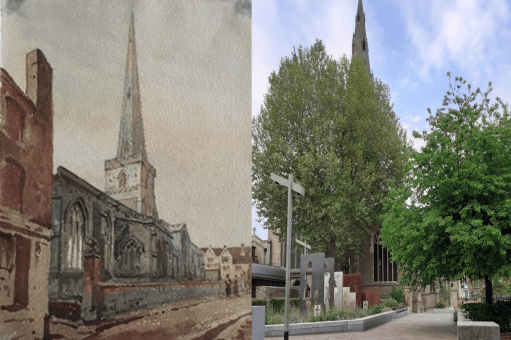
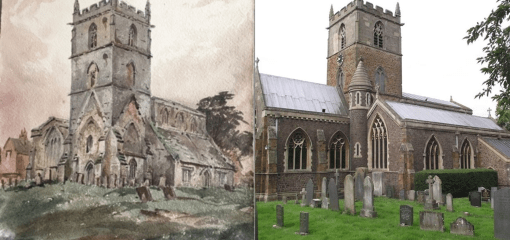
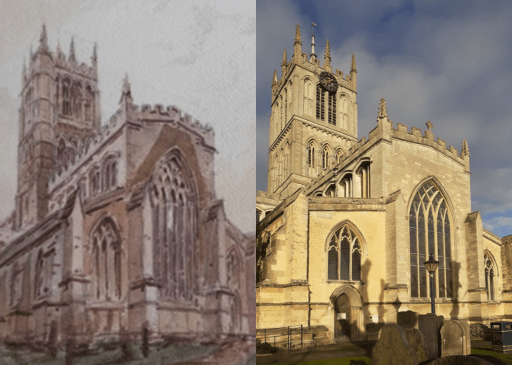
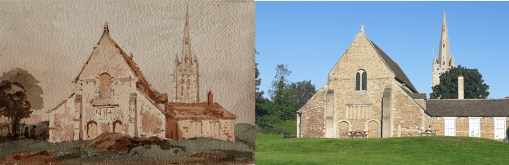
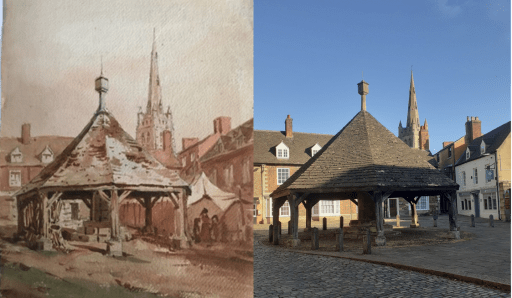
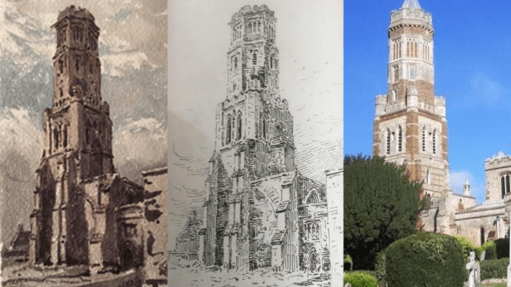
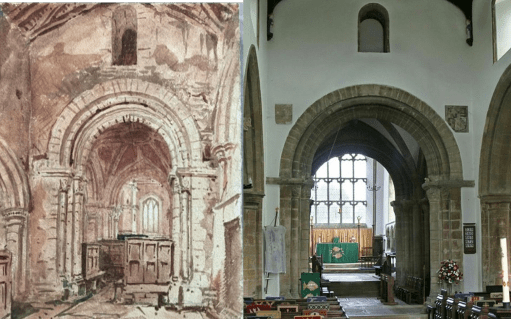
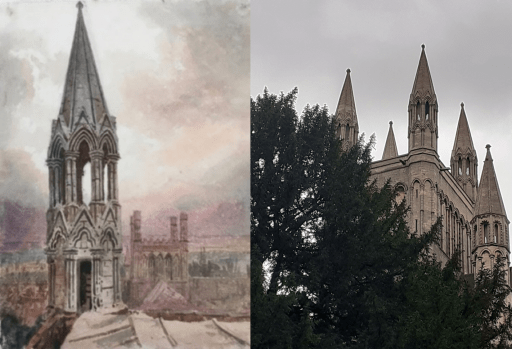
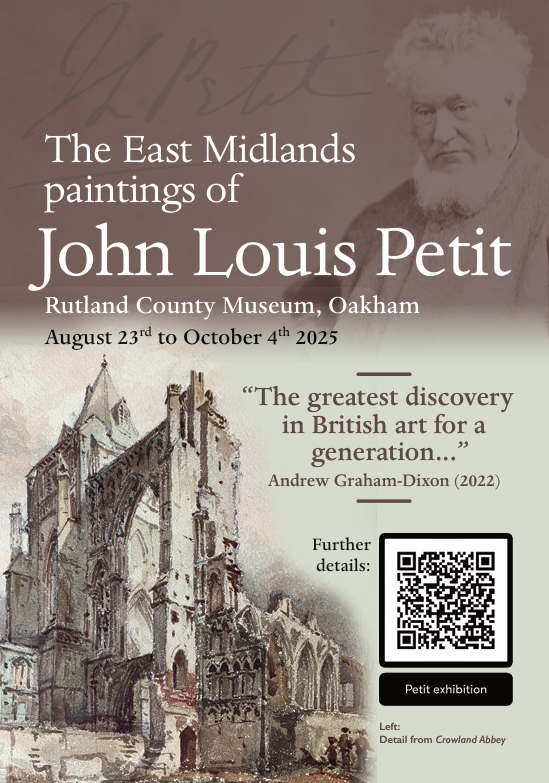
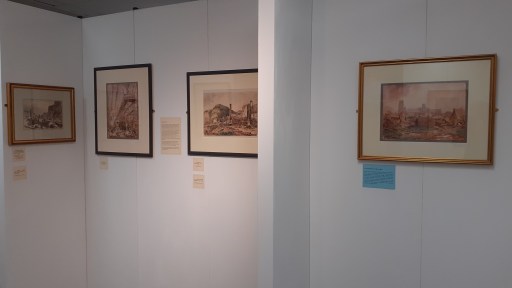
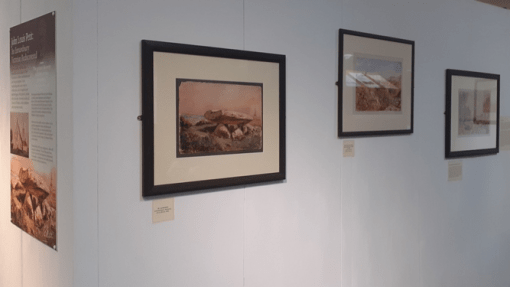
During his career Petit painted many thousands of pictures, but his work was never sold, and after his death in 1868, they were passed on to relatives. A century later they were discovered in an attic in Surrey, dumped in auctions and were widely scattered. Only now is their artistic merit and historical value being recognised. The art critic Andrew Graham-Dixon the greatest re-discovery in British Art for a generation, and the first book about his art, by the chairman of the Petit Society, describes him as Britain’s lost pre-impressionist. Petit’s art of the East Midlands is part of this re-discovery. Close to his home base in Lichfield, Petit visited and painted across the region many times. Often, he paints locations and subjects no other historical artist touched. Some 40 of these pictures were gathered together to be shown to the public for the first time ever at an exhibition held in Rutland County Museum between August and October 2025.

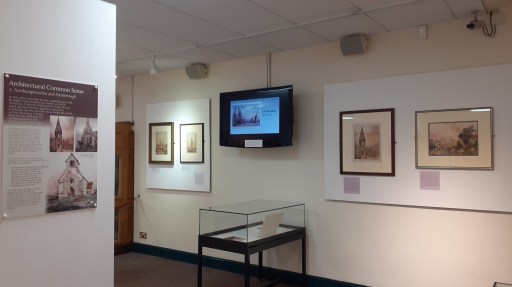
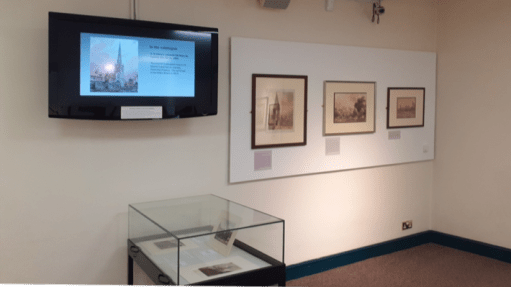
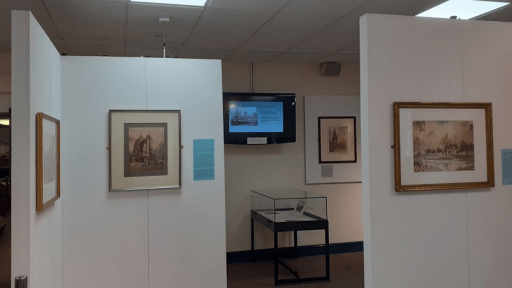
In this blog post we gather together a range of material related to the exhibition – the advertising material and display boards; photographs of the exhibition area itself; and the exhibition catalogues and slideshow that was shown on the screen in the exhibition area.

Exhibition flyer and display boards

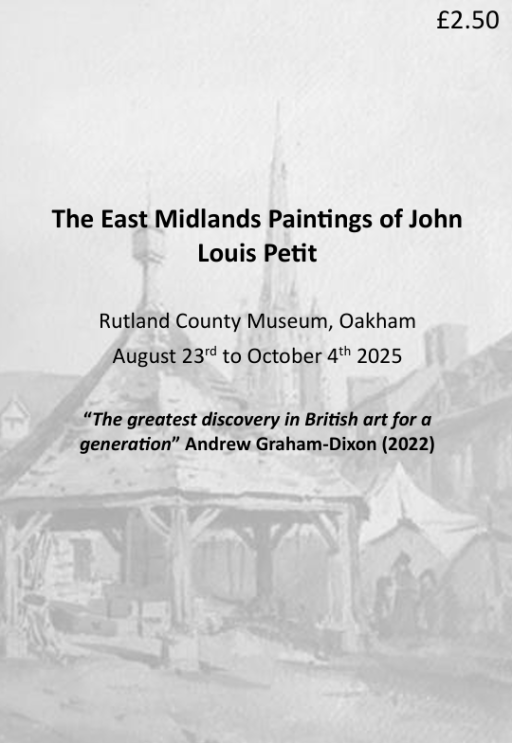
Exhibition flyer
Exhibition display boards

The flyer formed the basis of advertising the exhibition and was widely distributed by email and Social Media, with a small number of hard copies distributed locally around Oakham. There were five display boards – a general introduction (A1) and four others relating to the four geographical sections of the exhibition – Leicestershire and Rutland, Northampton and Peterborough, Lincolnshire and Cambridgeshire and Further Afield (A2).

The Exhibition

Catalogue and slide presentation

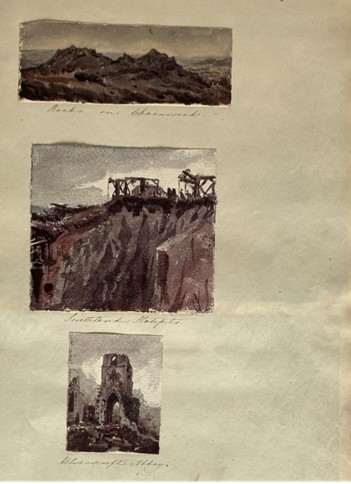
The simply produced catalogue contained brief details and a small photos of all the pictures that were planned to be exhibited. In the event a small number were not hung due to space limitations. These were shown as a slide presentation on a screen in the exhibition area, together with pages from an 1830 Album (see catalogue for description) and a selection of other East Midlands paintings.

Exhibition Catalogue
Slide show

Acknowledgements

The contributions of the following groups of people to the success of the exhibition need to be mentioned – the sponsors who provided much needed financial support; those friends of the organisers who helped with transport, mounting pictures and catering at the opening event; those who loaned paintings that were shown (identified in the catalogue); and most importantly the staff at Rutland County Museum for making the exhibition space available and constructing the exhibition. The help of all of them is very gratefully acknowledged.

Links
An ancient solar alignment in Oakham?

Preamble

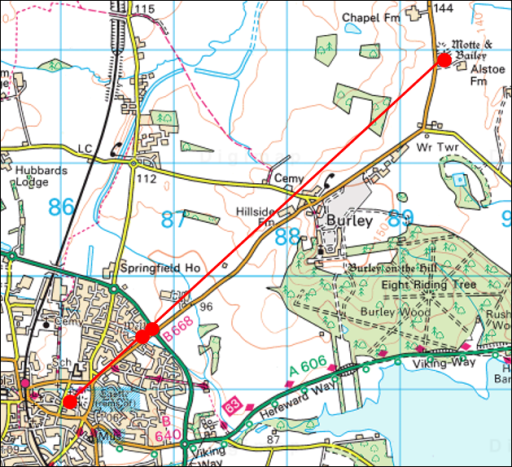
In a post “A possible Anglo-Saxon church group at Oakham in Rutland” from May 2024, I noted that All Saints Church in Oakham, and Our Lady’s Well to the north east were on what could be a mid-summer sunrise / mid-winter sunset solar alignment. I went no further than simply noting this, and didn’t speculate further about what it might imply. One always needs to be cautious about such alignments – they can be simple coincidences, and, if they are being looked for, can be found in the most unlikely places. For example from Borrowcop Hill in Lichfield, possibly an ancient burial mound, there was until recently a perfect alignment with the medieval spires of Lichfield Cathedral and the cooling towers of Rugeley power station, the latter sadly now demolished, which can hardly be of ancient origin. That being said, a reader of the May 2024 post sent me some further information that suggests that a cluster of Stone Age / Bronze Age / Iron Age remains have been found to the north east of Our Lady’s well that could also be on the same alignment. Looking at this further, I realised that several kilometres to the north east of that, and again on much the same alignment, we have Alstoe Mount, another historic monument. These are all shown on the Ordnance Survey map extract of Figure 1 below. The nature of this possible alignment, along the axis of the mid-summer sunrise and mid-winter sunset is discussed further in this post.

Figure 1. The possible alignment. The sites are shown as red circles – from the south west to the north east these are All Saints church in Oakham, Our Lady’s Well, the historic monuments and Alstoe Mount.

The sites

All Saints church, Oakham

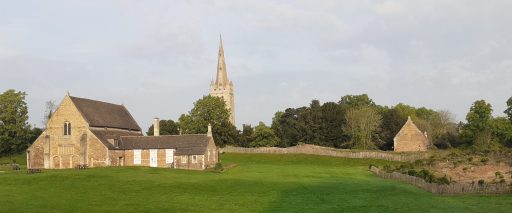
All Saints Church is Oakham (Figure 2) is a twelfth century church with thirteenth to fifteenth century additions. Internally it is pure Victorian, having been restored by Gilbert Scott. However it almost certainly stands on the site of an Anglo-Saxon church, and a church in Oakham is mentioned in the Domesday book. A compendium of historical information is given on the church website.

Figure 2. All Saints Oakham and Oakham Castle (photograph by the author)

Our Lady’s Well

Our Lady’s Well is a historically well-attested pilgrim site to the north east of All Saints church – see Figure 3. To quote from Leicestershire and Rutland’s Holy Wells by Bob Trubshaw from 2004;

Our Lady’s Well was once famed for curing sore eyes – providing that a pin was thrown in first. In 1291 indulgences could be obtained by visiting Oakham Church during its patronal festival and, for a price, joining a pilgrimage to Our Lady’s Well. In 1881 it was visited by the future Queen Alexandra. The well is to the north-east of the town, in a somewhat overgrown area between the Cottesmore road and a modern housing estate (NGR SK:866095).

It’s current condition is no better, and it is now impossible to access the well, in an overgrown plot of wasteland, which seems a shame.

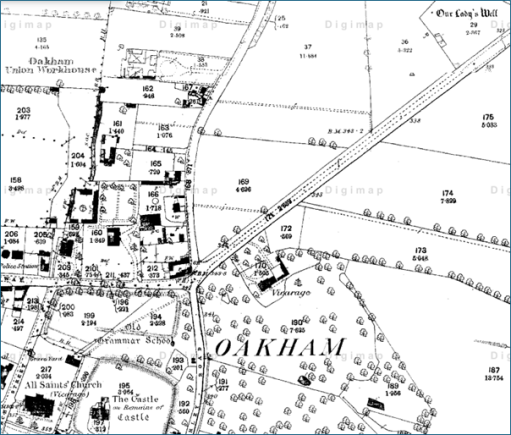
Figure 3. Location of Our Lady’s Well from the 1880 Ordnance survey Map (All Saints church is at the bottom left, and the well at the top right.)

The Stone Age / Bronze Age / Iron Age monuments

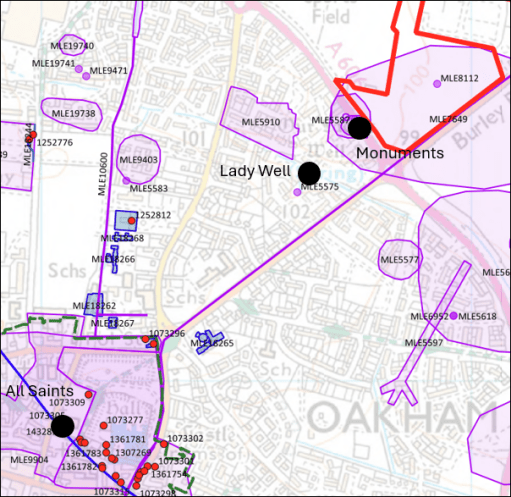
The material I was sent concerning the Stone Age / Bronze Age / Iron Age monuments came from “Land off Burley Road Oakham, Vision and Delivery Document” produced by Pigeon Investment Management with regard to a proposed hosing development. Figure 4 is taken from that document and shows the location of Our Lady’s Well and the relevant monuments.

Figure 4. The Stone Age / Bronze Age / Iron Age monuments (from Land off Burley Road Oakham, Vision and Delivery Document)

The monuments are listed as follows, where the numbers are those on the Historic England National Heritage list.

MLE5587 – Possible Mesolithic site west of Burley Road
MLE5592 – Late Iron Age/Roman site west of Burley Road
MLE5593 – Bronze Age burial, west of Burley Road
MLE5594 – Neolithic pit circle site west of Burley Road

Alstoe Mount

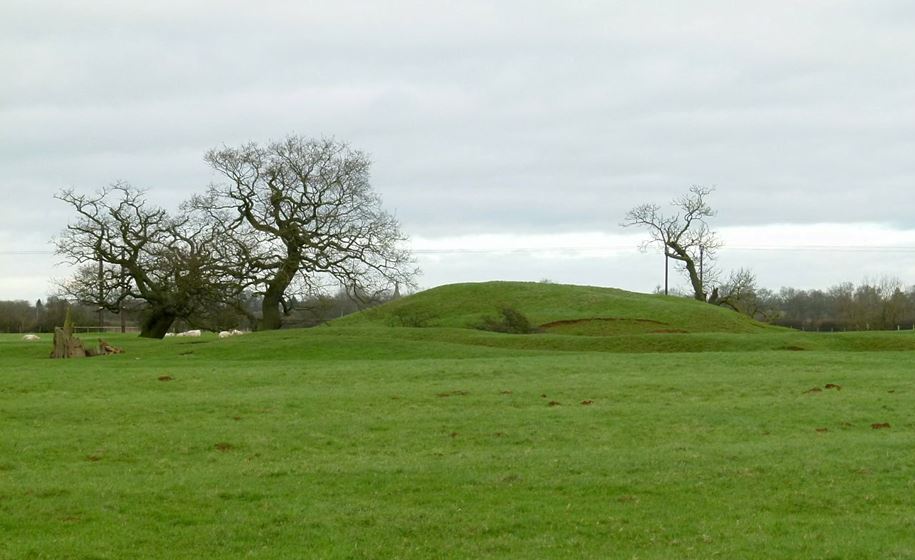
The substantial mound of Alstoe Mount (Figure 5) is described on the Ordnance Survey map as a Motte and Bailey. That is almost certainly not true. It was probably the Moot location for Alstoe Hundred. Details of the mound and the surrounding deserted village are given in the Historic England list entry.

Figure 5. Alstoe Mount (photograph from Historic England by Alan Murray-Rust, 2016)

The possible solar alignment

A current mid-summer sunrise / midwinter sunset direction from Oakham is 47.5 degrees east of north (from SunCalc). However obtaining a precise value to compare with the possible alignment shown in Figure 1 is difficult for two reasons. Firstly the actual direction of sunrise and sunset has varied over the millennia – and as things stand, we have no date for which a calculation can be made. This change is however small – of the order of 0.2 to 0.5 degrees. Also the apparent direction from any point depends upon the precise topography of the horizon over which the sunrise / sunset is observed – and as we know nothing about the observation point or the direction of observation, this is again not possible to specify. This again results in an uncertainty of around 0.5 degrees. So all we can probably say is that we are looking for an alignment of 47.5 +/-1.0 degrees east of north.

The actual directions between All Saints Oakham and the other sites is as follows.

Oakham to Our Lady’s Well – 46.3 degrees
Oakham to Stone Age / Bronze Age / Iron Age monuments – 47.1 degrees
Oakham to Alstoe Mount – 47.8 degrees

Again there is uncertainty here – particularly in the specification of the precise site at Our Lady’s Well of any structure that might have been visible from All Saints, and similarly the precise position of any relevant structure in the monument field. The location point for All Saints (taken as the centre of the building) could be around 10m to the east or west. This can have an effect of the bearings of Our Lady’s Well and the monuments by around 0.25 degrees. Considering these uncertainties the above bearings and a sunrise / sunset direction of 47.5 degrees seem broadly consistent, and thus there does seem to be some evidence for all four sites lying along a solar alignment of some significance.

But there is another issue – that of elevation. A cross section along the proposed alignment is shown in Figure 6. From this it is clear that Alstoe Mount would not be visible from Our Lady’s Well or from the Monument field, and would only just be visible from All Saints if any observation platforms that existed there and at Alstoe were raised off the ground by a metre or so. Beacons however would have been visible.

Figure 6. Section through the proposed alignment (from Google Earth Pro.).

Discussion

So what does the above analysis lead to. Firstly I think there is plausible (but far from conclusive) evidence for a mid-summer sunrise / mid-winter sunset alignment, at least between the Monument field / Our Lady’s Well and All Saints, and possibly between Alstoe Mount and All Saints. but the available evidence gives us no chronological information as to when the alignment might have been of significance. Our Lady’s Well is first mentioned in the late Middle Ages and All Saints and Alstoe Mount can only be said to become of important in the pre-conquest period. There is no evidence at all, except in the monument field, for the other sites being important in the Stone Age / Bronze Age / Iron Age. So in my view it is probably better to stop at this point – acknowledging that there may be a solar alignment, but not taking speculation any further. The boring, cautious approach I guess, but I don’t think there is much more to be said.

A cross country experience

Preamble

For family reasons, I often make the journey from Oakham to the Chesterton area of Cambridge, travelling by train from Oakham station to Cambridge North, changing at Ely, and then either walking or taking one or more buses to reach my destination. The last leg is actually quite time consuming, and adds considerably to the overall travel time. Now in July 2025, I learnt of the existence of a new bus service from Huntingdon to Fenstanton and then along the Cambridge Busway, through Chesterton to Cambridge, passing very close to my destination (the Whippet Coaches T1). This seemed to me to offer an interesting, and potentially quicker journey, travelling to Peterborough by Cross Country trains, then to Huntingdon on Thameslink, and then onto the bus to my final destination. What follows is a report on the journey there and back via this route, highlighting both its good and bad points.

The journey

I trevelled to Cambridge very early on a Saturday morning, catching the 5.47 East Midlands Trains service from Oakham to Peterborough, and then, after a 9 minute connection, the 6.24 Thameslink service to Huntingdon. The connection was straightforward, although there was some conflict between the online information and what actually happened on the ground with regard to the platforming of the Thameslink train at Peterborough. I arrived at Huntingdon on time at 6.38.

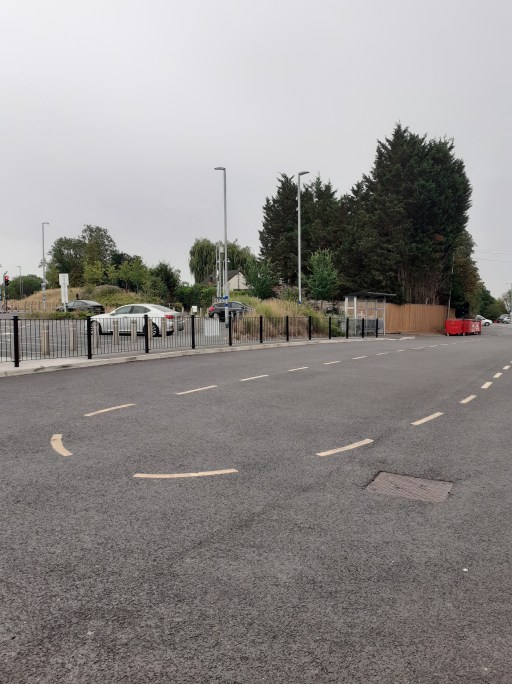
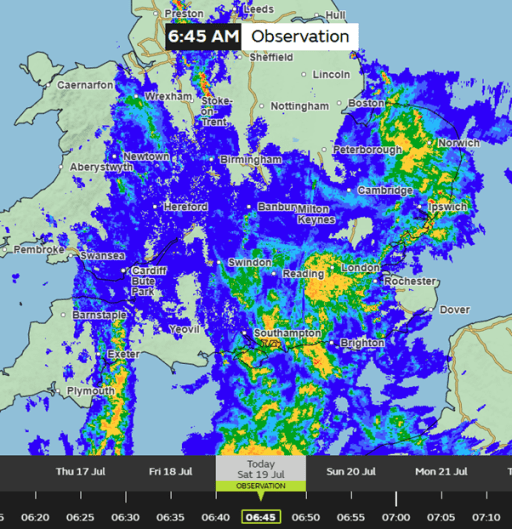
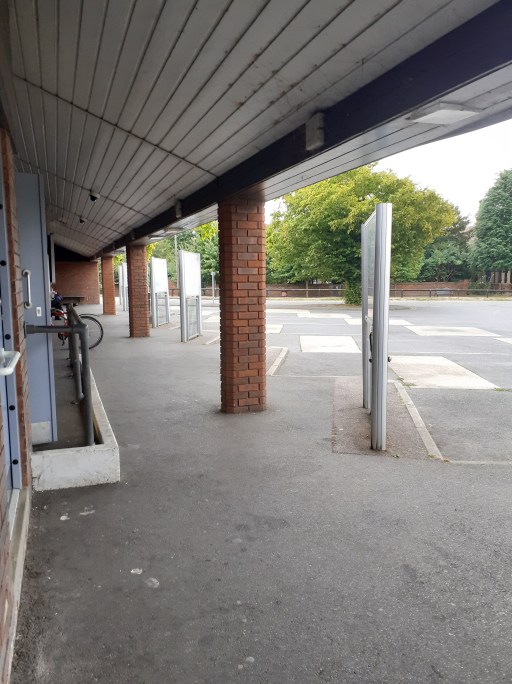
Now the weather that day was “interesting” to say the least, as can be judged from the weather radar screen shot below (Figure 1). The T1 was due to leave the station at 7.19, so I was anxious to find somewhere dry to wait. On leaving the Huntingdon station buildings, I found a convenient bus turning circle, with a respectable shelter (Figure 2). The only problem was that this was obviously not in use, and I was directed to a bus stop on the side of the ring road outside the station, which had no facilities other than a bus lay by and a stop sign (Figure 3). Why this change had occurred I have no idea – presumably something to do with operational convenience – but it had nothing to do with the comfort and convenience of passengers. Not good.

I was not anxious to wait to get soaked in such a situation, so I followed the signs to Huntingdon Bus Station, about a 5 to 10 minute walk away (including crossing the ring road) where the T1 was due to call after the railway station. This was a perfectly acceptable facility, with covered seating and adequate information – the only problem was that it wasn’t at the railway station (Figure 4).

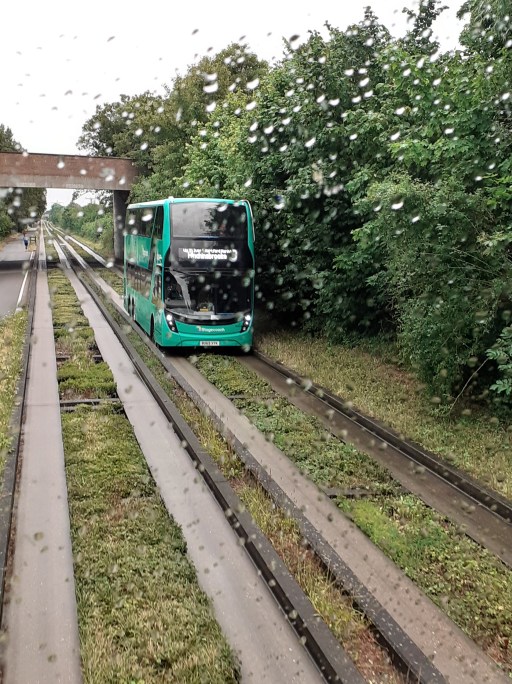
The bus arrived precisely on time. The driver was cheerful and efficient and everything ran smoothly. the bus ran non-stop to Fenstanton, then travelled quite slowly over some minor roads (with cars very dubiously parked) to the Busway at Swavesey. From there the trip was fast and smooth along the busway. The weather by this time was horrible as can be seen from figures 5 and 6. Loadings were light throughout, perhaps because it was a wet Saturday morning. It left the Busway at Milton Road in the north of Cambridge, and stopped at a number of stops along that road (unlike the standard Busway buses that run limited-stop into the city centre). I arrived at the stop I wanted a little after 8.00. The journey time was about 2 hours and 20 minutes, even with the 40 minute sojourn in Huntingdon. That was about the same time that the journey would have taken by train to Cambridge North. It was however rather cheaper, partly thanks to my Bus Pass!

The return journey was uneventful, except for the weather. Around about Fenstanton, the persistent rain became a deluge which persisted until after the bus arrived at Huntingdon. The drop off in the layby outside Huntingdon station and the walk into the station building was unpleasant to say the least. I got on the bus at around 12.30 and arrived back at Oakham at 14.20 – half an hour quicker than the outward journey thanks to good connections in Huntingdon and Peterborough.

Reflections

So what was my overall view of the journey. The T1 bus service itself was very pleasant and convenient and Whippet Coaches are to be congratulated. The journye times and stopping places suited me very well. The service has the potential to be more than just a local service and could have a more inter-urban role, if the connections into the rail network were better. The hourly service inevitably means some extended connection times at Huntingdon and / or Peterborough and a more frequent service would be nice, although whether this would be financially viable is perhaps doubtful.

The unpleasant part of the journey was the lack of proper bus connection facilities at Huntingdon station. It is difficult to see how this could have been made worse, and is a classic example of the neglect of the most basic principle of integrated transport. Whoever is responsible (Cambridgeshire County Council perhaps?) should hang their heads in shame.

St Michael’s Lichfield blogs – a compilation

A compilation of some of my blog posts from the past few years about St Michael’s church in Lichfield.

Saddlebacks and serendipity. A brief post that identifies the occupant of the notable Saddleback grave in St. Michael’s churchyard (3rd January 2025)

The changing face of death. A blog post introducing a statistical analysis of the interment records and monuments of St Michael’s churchyard in Lichfield from 1813 to 2012, looking at the changes in funerary patterns over that period. (February 24th 2023)

100th Anniversary of the dedication of the choir vestry at St Michael’s church in Lichfield. A short blog post describing the occasion in 1923 (February 19th 2023)

The Churchyard at St. Michael’s, Lichfield – registers and records. An introduction to the web pages of the same name that collate a range of information from memorials and burial registers at St Michael’s from 1813 to 2012 (November 15th 2022)

James Jordan Serjeantson – Rector of St. Michael’s church in Lichfield, 1868 to 1886. This takes material from earlier blog posts and appeared as an article in the February 2022 edition of the Parish Magazine. (January 3rd 2022). Updated with information from the British Newspaper Archive in January 2023.

The seventeenth century graves of St Michael’s churchyard. A brief examination of some of the older grave monuments in the churchyard of St. Michael-on-Greenhill in Lichfield (June 10th 2021)

The St. Michael Chalice of 1684. A very brief blog post with a photograph of a 1684 communion chalice from St Michael’s Lichfield, sold in the 1850s to pay for something more modern. (December 30th 2020)

For some more similar posts  see https://profchrisbaker.com/historical-studies/lichfield-history/  

For links to my four part e book which contains most of the above material, and much else, go to https://profchrisbaker.com/historical-studies/st-michael-on-greenhill-lichfield-a-history-the-ebook/
All Saints Oakham blogs and presentations – a compilation

Some summer reading and viewing – a compilation of some of my recent blog posts and a presentation on the history and heritage of All Saints church in Oakham.

Blog posts

The memorials of All Saints Oakham. Photographs and brief descriptions of the wall mounted memorials at All Saints church in Oakham (May 19th 2025)

From Oakham to Mandalay. The story of a young curate from Oakham and his brief service as a missionary in Burma before his early death (April 29th 2025)

Kinetic Water Power – some odd words on a memorial in All Saints Oakham led to some interesting findings about how church organs were powered at the start of the 20th century (25th April 2025)

The Harrington Bequest. Two posts that consider the bequest of Anne, Lady Harrington in 1616. Part 1- The charityPart 2 – Oakham Parish Library (31st March 2025)

The chancel and chapels of All Saints church Oakham – Gilbert Scott’s legacy. A post looking at some aspects of the restoration of All Saints Oakham in 1858 (November 5th 2024)

A time to mourn, and a time to dance – the All Saints season through the ages. The recording and transcript of a  talk given at All Saints Oakham on 31/10/24  (November 3rd 2024)

The 1858 Restoration of All Saints church in Oakham. Part 1Part 2, Part 3 Three linked posts giving the transcripts of press reports of the restoration and re-opening of All Saints church in 1858, including the condition report by Gilbert Scott (October 9th 2024)

The good, the bad and the grotesque – the decorated capitals of All Saints church in Oakham. An examination of some wonderful medieval stone carvings in Oakham Parish Church (3rd February 2024)

For more see https://profchrisbaker.com/ecclesiastical-studies/ecclesiastical-blog-posts/

Presentation

A time to mourn and a time to dance. A time to mourn and a time to dance – the All Saints season through the ages. The video of a talk given at All Saints Oakham on October 31st 2024

Oakham and Rutland blogs – a compilation

For some summer reading – a compilation of some of my recent blog posts on ancient and more modern Oakham and Rutland history.

The street topography of early Oakham. A post that considers how the street of Oakham and the surrounding areas might have been configured in the Anglo-Saxon and Norman periods (December 8th 2024)

Public Transport in Oakham from the 1960s to the present. A blog that looks how road and rail transport in and through Oakham has developed and degraded over the last 60 years. (November 15th 2024)

Oakham roofs. A photo blog simply showing the upper floors and roofs of the buildings on the north side of the High Street in Oakham. For no other reason than I like roofs. The history is implicit rather than explicit (July 23rd 2024)

Commemorating the 1000th Anniversary of the birth of Queen Edith. An address / sermon delivered by me at All Saints Oakham on March 10th 2024, at a Choral Evensong during the Queen Edith Festival (11th March 2024)

Rutland – an enigmatic history – a further speculative consideration of three oddities about the early history of Rutland (2nd February 2024)

Rutland and the Hwicce Some further thoughts on the County of Rutland and its association with the Hwiccan tribe of Worcestershire and Gloucestershire (30th December 2023)

The Origin of Rutland – some speculations on the early history of the area where I now live (2nd December 2023)

For more see https://profchrisbaker.com/historical-studies/rutland-history/

Railway blogs – a compilation

Summer reading for those interested in the early railways around Dudley.

Dudley and its Railways in 1868. A post describing the extensive rail services around Dudley in 1868 (August 25th 2024)

The Pensnett Canal and the Pensnett Railway – a post discussing how the beginnings of these two concerns were tied up together (September 21st 2022)

Kingswinford Junction 1949. A post describing the train movements through and around Kingswinford Junction in the Black Country and the associated marshalling yard in 1949, just post-nationalisation. (April 15th 2021)

The OWWR Kingswinford branch 1854. A post based on a set of drawings that showed proposed changes to an OWWR branch line before it had been built, possibly to accommodate the travel needs of Baron Ward, and incidentally gives early information about the layout of Oak Farm Iron Works (April 14th 2021)

The Earl of Dudley’s Railway – Accidents and Incidents Using material taken from a search of newspapers between 1830 and 1920, this post looks at the sort of accidents that occurred on the Pensnett Railway to both railway workers and those who lived close by, and at the nature of crime on and around the railway. (May 19th 2020)

The railways of Shut End and Corbyn’s Hall A detailed look at the industrial railways within and around the iron works at Corbyn’ Hall and Shut End. (March 2nd 2020)

And finally, something more modern from a little further afield.

The Cross City Line – 1962 to 2024, which looks at the development of the service on the Cross city Line in the West Midlands between the early 1960s and the present day (February 1st 2025)

Lichfield history blogs – a compilation

Some summer reading – a compilation of a few of my blog posts about the history of Lichfield.

Lichfield – a pre-conversion pagan cultic centre? A post that considers the early history of the city of Lichfield, and argues that it might have been a place of cultic significance before the Christian era. Some of this is very speculative, but may be of interest

A study of the ancient prebends of Lichfield Cathedral. A post that uses information from the Staffordshire tithe maps in an attempt to recreate the early geography of the Lichfield area. (August 12th 2020)

“That way madness lies” – the search for solar alignments in Lichfield The city of Lichfield lies on a rough midwinter solar alignment with the Bronze Age site at Catholme. This post investigates this further to see if this alignment is intentional or merely accidental. (April 12th 2020)

Lichfield’s First Station Master. A post that looks at the career of Lichfield’s first Station Master and church warden of St. Michael’s, William Durrad. (January 15th 2021)

Lichfield Trent Valley 1847-1871. A look at one the earliest railway stations in the Lichfield area. (September 28th 2020)

For other similar posts see https://profchrisbaker.com/historical-studies/lichfield-history/

Pensnett history blogs and presentations – a compilation

Some summer reading and viewing for those interested in the history of Pensnett (which includes the area that used to be known as Shut End).

Blog posts

The railways of Shut End and Corbyn’s Hall A detailed look at the industrial railways within and around the iron works at Corbyn’ Hall and Shut End. (March 2nd 2020)

The Shut End Primitive Methodist Chapel. These three posts are based on the Baptismal Register of the Shut End Primitive Methodist Chapel in Tansey Green, and look at the life of the chapel in the mid to late 19th century. Part 1 Introduction and Chapel Building Part 2 The Baptismal Register Part 3 Ministers and Families (March 21st 2020)

Coal mining in the Shut End and Corbyn’s Hall area This post looks the coal mines in the Shut End and Corbyn’s Hall area, using the extensive database on the Coal Authority website. (April 18th 2020)

Cricket and Football in Pensnett in the Nineteenth Century. a brief description of the sporting scene in Pensnett from around 1860 to 1900. (November 21st 2020). I have also posted an amplification of part of this post (the single wicket cricket match on the Black Country Society web site at Cricket, but not as we know it (September 29th 2022)

The Pensnett Saxhorn Band. A post describing the life and times of the Pensnett Saxhorn Band in the mid-nineteenth century, giving a snapshot of some aspects of Black Country cultural life at the time. (March 30th 2021)

The fields that survived. An investigation of a small unit of land consisting of three late 17th century Black Country fields that escaped the ravages of mining, colliery waste and urban development to remain more or less intact to the present day. (July 23rd 2023)

The early history of the Crooked House. A post looking at the history of the Crooked House, or Glynne Arms, up to the 1870s, mainly based on early maps of the area (September 23rd 2023)

For more blog posts about Pensnett and the wider Black Country see https://profchrisbaker.com/historical-studies/black-country-history/

Presentations

A tale of two maps – the 1822 and 1840 Fowler Maps of Kingswinford. A version of a talk given at a conference entitled “A landscape of the end of the world: the industrial revolution and the Black Country c. 1706-1914” at the Black Country Museum in July 2023

A policeman’s life – Samuel Hicklin (1858-1924). A policeman’s life – Samuel Hicklin (1858-1924). This presentation that describe the remarkable life of Sam Hicklin, the son of a farm labourer who was to progress to the highest ranks of the Staffordshire Constabulary (via Pensnett).
An Ecclesiastical Affair The video tells a true story from 1870, with many contemporary resonances, about the Victorian Black Country parish of Pensnett where the errant clergyman had a flirtation with a pupil teacher at the local school, that led to scandal in the village, a clergy discipline trial, a series of anonymous broadsheets circulating in the village making all sorts of accusations about church members (some comical, some rather nasty), and a nationally reported libel trial. Wayward clergy, scandal and libel – all the hallmarks of a good story!

The Morris memorials in All Saints Church in Oakham

Pulpit and window

Memorials in churches can be in some really odd places. I recently noticed a brass plaque almost at ground level on the base of the pulpit at All Saints in Oakham. Even sitting on the floor in close proximity I was unable to make out much of it, but by taking some photographs and enhancing the contrast, I was able to get the image on the right. This reads

To the Glory of god and in remembrance of Charles Knowlton Morris, who was born at Oakham March 18 1841 and died there April 4 1905. This pulpit was erected by his widow Judith Emily in accordance with his wish expressed during his lifetime.

Pulpit memorial tablet

The name rang a bell in my mind – there is a very similar dedication on the stained glass window in the south transept.

To the glory of God and in remembrance of Charles Knowlton Morris who was born at Oakham 8th March 1841 and died there 4th April 1905. This memorial is erected by his widow Judith Emily.

Window memorial dedication

Charles Knowlton Morris

So who was this Charles Knowlton Morris? He turned out to be quite easy to trace through the historical record. He was born in 1841, the son of Clarke and Francis Morris (nee Hare) of Catmose Street in Oakham, one of at least six children. Clarke Morris was a brewer in Northgate in Oakham. Two of his sons – William Clarke Morris and Charles Knowlton Morris took over the business after Clarke’s death in 1857. The brewery moved to Cross St / New St in 1866 and in censuses and trade directories, the business is usually described as Morris’ Rutland Brewery, and they were also listed as coal, salt and seed merchants at the railway station wharf. William Clark died in 1895 and it appears that the business passed directly to his brother. The Reredos and Marble flooring in the chancel at All Saints were donated by Charles in memory of his brother in 1898.

All Saints Reredos
Reredos dedication plate

Charles married late in life, in 1898 aged 57 to Judith Emily Tiptaft, the daughter of a Northamptonshire farmer, who was seventeen years his junior. There were no children. Charles died on 4/4/1905, leaving a very considerable business and effects worth £19448. The business was sold off by auction fairly soon after his death. It is described in the Grantham Journal of 25/11/1905  as consisting of the brewery in New Street, and nineteen public houses in Oakham and the surrounding area. Those in Oakham included the Railway Hotel on Station Road, the Roebuck Inn on Church Street, the Bell Inn on  Catmose Street, the Royal Duke Inn on West Road, Oakham, the Angel Inn on Northgate Street, and two off licenses, the Rutland Arms in New St and the Britannia Inn on Northgate Street.  The estate was bought for £28,250 by Warwicks & Richardsons Ltd, Newark. Brewing ceased in 1907, but Warwicks continued to use the name Morris Rutland Brewery on Guiness bottled in Newark until 1962.

Comapny banner
The Brewery in New St in 1980

The dedication service

On 6/9/1896 at a service at All Saints church in Oakham, a new pulpit and stained glass window were dedicated to the memory of Charles. These are described at length in the Grantham Journal of 8/9/1896 as follows.

The window composed of three long lights, surmounted by beautiful tracery, and is now the best of the many fine windows in this Church. The stained-glass design is governed by the architectural features, which are typical 14th century work, demanding small subjects and canopies. The subjects are nine in number, massed in rich deep colours, all contributing to the design of three bands running laterally through the tall lights in the window, and are set off by the intercepting canopies, which are soft, and display a silvery effect. Incidents in the life of our Lord with which all are familiar are represented, and portray, respectively, ” Endurance,” “Love,” ” Fortitude,” “Humility*,” “Principle,” “Charity,” ” Innocence,” Sympathy,” and “Justice.” These help to illustrate, in their appropriateness, the beautiful life of Charles Knowlton Morris, whose memory they will perpetuated.…..……. Flowers and birds are delicately introduced as emblems, and the Past Masters’ jewel .and badge of the Vale of Catmos Lodge (No. 1265) of Freemasons are shown a small shield at the foot of the centre light.

The apex of the window contains the dove, and rays emanate from it into the surrounding side lights, and disappear behind the finials of the canopy, which runs out from main design below. The window was designed and executed by Mr. Dudley Forsyth, 335, Finchley-road, Hampstead, London

The new pulpit, as detailed on the inscription panel at fulfils wish expressed by the late Mr. Morris during his lifetime. It is in the Gothic style, and has been carefully designed so as to harmonise with its surroundings. The steps and the stone base by which the pulpit is supported are green Chilmark stone. A large moulded corbel, springing from the base, carries the pulpit, which is, in shape, five sides octagon. The material used is Austrian oak, slightly tongued, in order that it may resemble the existing oak fittings in the Church. Each side of the octagon is divided into two panels, the lower part of each carved, the upper part pierced; and care has been taken vary the design of the carving, as avoid monotony and give interest work. The cornice which crowns the pulpit is variously carved to represent the of the Passion of our Lord. The balustrade to the steps is similarly treated panels, and the whole, including the brass memorial tablet, reading-desk, and black fittings, has been designed Messrs. Forsyth and Maale, architects, of London, and carried out for the pulpit by J. P. White, of Bedford, and for metal work by Messrs. J. Elsley, of London.

Later years

Judith Morris must have spent a considerable part of her inheritance on these monuments to her husband. She was later to marry Dr Henry Drew in London in 1922. She died in 1945 at the age of 87. Pictures are available of her here and here, although an Ancestry subscription will be required to access these.

After her death in 1945 we read in the Leicester Evening Mail of 16/3/1945

Under the will of the late Mr. Charles Knowlton Morris, a former Oakham brewer, the vicar and churchwardens of Oakham receive a legacy, following the death of his widow, Mrs, Judith Emily Drew. of Leadenham House, Braunston Road. Oakham, to provide pensions for members of the Church of England.  The sum is £3O annually. to provide three £l0 pensions for three poor persons of good character of the age of 85 and upwards residing in the town, and being members of the Church. It will be called the “Morris Gift.”

So it can be seen that much of what can now be seen at the “business” end of the church – around the altar where the Eucharist is celebrated, and the pulpit where sermons are preached was donated by the Morris family. Now the late 19th century was a time when the Teetotaller movement was very strong in reaction to the obvious ill effects of excess alcohol consumption, mainly on the poor. But clearly the Church of England in Oakham had no scruples about accepted considerable donations from a brewer. But, even in this more moderate age (at least in terms of alcohol consumption) the fact that Sunday services take place on structures funded by the receipts of nineteen public houses in Rutland might manage to raise a few eyebrows.