
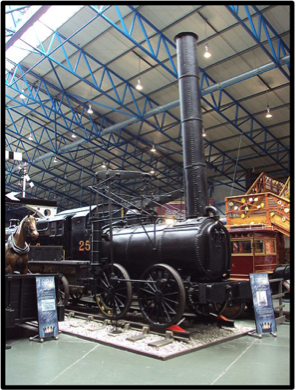
Agenoria and Stourbridge Lion – two chronological conundrums, which considers some chronological issues relating to the construction, operation and restoration of the Agenoria and Stourbridge Lion locomotives. (18th January 2026)
A series of posts based on the diaries / note books William Baker between 1907 and 1919. He was my great grandfather who lived in Pensnett and worked as a Stationary Engine Driver at Woodside Iron Works.
The diaries of William Baker 1907 to 1919 – Part 1. Introduction (9th December 2025)
The diaries of William Baker 1907 to 1919 – Part 2. The family entries. William’s family in and around Pensnett. (9th December 2025)
The diaries of William Baker 1907 to 1919 – Part 3. Local people and events. The people and events around Pensnett that William recorded before and during the Great War. (9th December 2025)
The diaries of William Baker 1907 to 1919 – Part 4. National people and events. The people and events in England and beyond that caught William’s notice. (9th December 2025)
The diaries of William Baker 1907 to 1919 – Part 5. Woodside Iron works. The operation of the Furnaces, his co-workers and early union organization. (9th December 2025)
Railway blogs – a compilation (JJune 6th 2025)
Pensnett history blogs and presentations – a compilation (June 6th 2025)
The Brettells of Kingswinford. A post that attempts to unravel some of the relationships of the Brettell family in Kingswinford in the early 19th century. (February 2nd 2025)
Jonathan Stokes and Wordsley. A post that sets out the origin of the lands in Wordsley held by Jonathan Stokes of the Lunar society and his son in the 19th century. (February 1st 2025)
The Black County environment of the mid-20th century through the poetry of Jim William Jones. A recording and transcript of the presentation I gave at the Black Country History Day organised by the Black Country Society on November 9th, 2024. (November 10th, 2024)
Dudley and its Railways in 1868. A post describing the extensive rail services around Dudley in 1868 (August 25th 2024)
A Black Country poet – Jim William Jones. An introduction to the life and work of the Black Country poet Jim William Jones (August 15th 2024)
Tansey Green Anglican Mission Room. A post that uses a brief extract from a 1949 history
of St Mark’s church in Pensnett, together with early Ordnance Survey maps to
locate the somewhat mysterious Tansey Green Mission Room. (August 15th
2024)
The timeline of the Crooked House Affair (from January 2024). A continuation of the blog post below that gives a timeline of the Crooked House affair from January 2024 onwards. (May 5th 2024)
The Black Country – from the Stone Age to Domesday. A post bringing together the somewhat disparate evidence for the area that came to be known as the Black Country in the period before Domesday in 1086. (March 17th 2024)
The Oak Farm (Crooked House) Mill and its watercourses. A post describing the changes in the water supply system to the Oak Fam Mill in the 19th century, and speculations on the early form of the building that was to become the Crooked House (November 2nd 2023)
The timeline of the Crooked House Affair (March 2023 to December 2023). A further blog post concerning the Crooked House – this time giving a timeline of events, together with links to press stories. This covers the period to December 2023. Later press reports can be found in another blog post here. (September 24th 2023)
The early history of the Crooked House. A post looking at the history of the Crooked House, or Glynne Arms, up to the 1870s, mainly based on early maps of the area (September 23rd 2023)
The fields that survived. An investigation of a small unit of land consisting of three late 17th century Black Country fields that escaped the ravages of mining, colliery waste and urban development to remain more or less intact to the present day. (July 23rd 2023)
“Dudley Sports Centre – a memory” – when Worcestershire won the John Player 40 over competition in 1971 (14th July 2023)
Migration to the western Black Country 1800 to 1860. An investigation of the census returns to find the origin of those who migrated to the Black Country for work in the first half of the nineteenth century (May 3rd 2023)
Reflections on “The whole world a Black Country” by Matt Stallard. An article published in the Spring 2023 edition of the Blackcountryman reflecting on the influence of Black Country history on current climate change concerns. (February 24th 2023)
The Fowler maps of Kingswinford parish of 1822 and 1840. A blog post introducing a technical and statistical analysis of the 1822 and 1840 Fowler maps of Kingswinford parish, showing the spread of industry, commerce and community across the parish, and discussing the owners and occupiers of the land. (February 24th 2023)
The Pensnett Canal and the Pensnett Railway – a post discussing how the beginnings of these two concerns were tied up together (September 21st 2022)
The Petits of Ettingshall and Lichfield. An article that appeared in the 2022 edition of the church magazine of St Michael’s church in Lichfield – it contains material from other blog posts on this site. (March 25th 2022)
More Black Country pictures of John Louis Petit. Some more musings on the industrial paintings of John Louis Petit (18th May 2021)
Kingswinford Junction 1949. A post describing the train movements through and around Kingswinford Junction in the Black Country and the associated marshalling yard in 1949, just post-nationalisation. (April 15th 2021)
The OWWR Kingswinford branch 1854. A post based on a set of drawings that showed proposed changes to an OWWR branch line before it had been built, possibly to accommodate the travel needs of Baron Ward, and incidentally gives early information about the layout of Oak Farm Iron Works (April 14th 2021)
The Pensnett Saxhorn Band. A post describing the life and times of the Pensnett Saxhorn Band in the mid-nineteenth century, giving a snapshot of some aspects of Black Country cultural life at the time. (March 30th 2021)
The Tiled House Estate. More extracts from Kingswinford Manor and Parish describing the development of the Tiled House Estate in Pensnett from a large arable farm to a centre of coal mining and then to a large estate of council houses. (March 29th 2021)
The Corbyn’s Hall Estate. Some extracts from Kingswinford Manor and Parish describing the development of the Corbyn’s Hall area in the eighteenth and nineteenth centuries. (March 25th 2021)
John Louis Petit was a notable landscape painter and architectural critic of the19th century. His artistic work is discussed elsewhere, but in these three blogs I examine the sources of his very considerable wealth that allowed him to pursue his artistic activities, the nature of his main land holding at Ettingshall Park in Sedgley, and the location of two of his paintings of Black Country mines and iron works. John Louis Petit – painter and landholder (20th March 2021) The Ettingshall Park Estate of John Louis Petit (22nd March 2021) The Black Country pictures of John Louis Petit (22nd March 2021)
Kingswinford Landowners and Industrialists in the 19th Century – some surprising names. A short blog post on some notable (and unexpected) 19th century landowners and industrialists in Kingswinford parish – a member of the Lunar Society, a Count of the Holy Roman Empire, and a future prime minister. (March 9th 2021)
Kingswinford families – the Corbyns, the Bendys and the Hodgetts. Part 1 – The Corbyns of Corbyn’s Hall (February 4th 2021)
Kingswinford families – the Corbyns, the Bendys and the Hodgetts. Part 2 – The Bendys of Shut End and Holbeache (February 18th 2021)
Kingswinford families – the Corbyns, the Bendys and the Hodgetts. Part 3 – The Hodgetts of Shut End and Prestwood (February 25th 2021)
Cricket and Football in Pensnett in the Nineteenth Century. This was originally intended as a simple extract from Kingswinford Manor and Parish (KMAP). However when I looked at the material, I realised it was one of the first parts of KMAP that was written in around 2015, and more newspaper material has appeared on the web since then. So this is an update to what was in KMAP, which has in turn led to a revision in KMAP itself. All very complicated. The post itself is much more straightforward – a brief description of the sporting scene in Pensnett from around 1860 to 1900. (November 21st 2020). I have also posted an amplification of part of this post (the single wicket cricket match on the Black Country Society web site at Cricket, but not as we know it (September 29th 2022)
Kingswinford Tithe Agreement. A study of the Kingswinford Tithe Agreement of 1839. (October 14th 2020)
Kingswinford parish – associations with slavery. A brief investigation of the tenuous links between the commercial activity of the parish and slave-owning organisations in the 18th and 19th centuries. (July 11th 2020)
The Seisdon anomaly – a brief post addressing the issue of why Seisdon hundred, on a tributary of the Severn rather than the Trent, was incorporated into early Mercia. (June 30th 2020)
In Chapter 9 of Kingswinford Manor and Parish (KMAP) I briefly describe the activities of PC Samuel Hicklin in the Pensnett area. His name cropped up regularly in the newspapers of the period, mainly in the context of bringing those accused of being drunk and disorderly to court, but also occasionally for more substantial misdemeanors. At that time, I did a quick check on the rest of his career through various web sites, and it was clear that after he left Pensnett, he rose through the police force to a high level in the Staffordshire Constabulary. I remarked in KMAP that his story remained to be told. These three linked blog posts are an attempt to do just that. I hope readers find it an interesting story. In some ways it tells a very mundane story of police life in the late nineteenth and early twentieth centuries, which is nonetheless punctuated by major incidents and cases that would be worthy of a crime novelist. A video presentation based on these posts is included below.
Part 1 – A (very) young constable. This post follows Hicklin from his childhood in Marston-on-Dove through his first postings as a Constable in the Staffordshire constabulary in Tividale and Pensnett in the 1870s and 1880s, which mainly involved dealing with drunks and other minor crime. During this period he was seriously assaulted at a pub in Bromley. (May 28th 2020)
Part 2 – Climbing the ladder – from Sergeant to Superintendent. Hicklin moved up the career ladder as a sergeant at Bidulph in 1885, Inspector at Burton on Trent and Tipton, and as Superintendent back at Burton by 1896. He dealt with a wide range of crimes – from the minor to the major, including severable notable murder cases. (May 28th 2020)
Part 3 – Chief Superintendent Hicklin. He reached the highest rank that was open to him by becoming a Chief Superintendent and head of one of the three districts in the Staffordshire Constabulary in 1907. He was based first at Burslem, where he had to deal with the policing of miner’s strikes, and then later at Leek. He died in 1924, still in service. (May 28th 2020)
The Earl of Dudley’s Railway – Accidents and Incidents Using material taken from a search of newspapers between 1830 and 1920, this post looks at the sort of accidents that occurred on the Pensnett Railway to both railway workers and those who lived close by, and at the nature of crime on and around the railway. (May 19th 2020)
Corbyn’s Hall from above A description of the Corbyn’s Hall area in the 1950s from an aerial photographic archive. (April 21st 2020)
Coal mining in the Shut End and Corbyn’s Hall area This post looks the coal mines in the Shut End and Corbyn’s Hall area, using the extensive database on the Coal Authority website. (April 18th 2020)
The Shut End Primitive Methodist Chapel. These three posts are based on the Baptismal Register of the Shut End Primitive Methodist Chapel in Tansey Green, and look at the life of the chapel in the mid to late 19th century. Part 1 Introduction and Chapel Building Part 2 The Baptismal Register Part 3 Ministers and Families (March 21st 2020)
The railways of Shut End and Corbyn’s Hall A detailed look at the industrial railways within and around the iron works at Corbyn’ Hall and Shut End. (March 2nd 2020)
Land exchanges in the Ashwood Enclosure Act of 1784 As well as new enclosure, the Ashwood Hay Enclosure Act of 1784 also formalised land exchanges from the previous century that consolidated plots in the old common fields of Kingswinford. This post briefly considers a few of these. (February 3rd 2020)
The Earl of Dudley’s Railway This post contains material from a talk given to a dining club that describes the growth and decline of the Earl of Dudley’s or Pensnett Railway. (January 24th 2020)
 Engineering, history and ecclesiology